Abstract
The problem of the peakon and antipeakon solutions of the Novikov equation including the term is studied. It is well known that, when , the Novikov equation admits peakon and antipeakon solutions. In this study, it is shown via the homotopy analysis method that, even in the case where , the Novikov equation also admits peakon and antipeakon solutions.
MSC:
35C08; 35C10; 35Q35; 35Q51; 76M99
1. Introduction
Both the celebrated KdV equation
and the modified KdV (mKdV) equation
where , , and constants, are among the simplest equations describing wave propagation. Equation (1) was originally introduced for describing propagation of unidirectional shallow water waves, whereas Equation (2) describes nonlinear acoustic waves. However, both of the aforementioned equations were also successfully used in several other physical problems; see, for example, [1] and the references therein.
Several generalizations of them have appeared in the literature. One of them is the well known Camassa–Holm (CH) equation [2]
where is constant, which is also an equation describing dispersive shallow water wave propagation. Associated with the CH equation are also the Degasperis–Procesi (DP) equation
and the Novikov equation (NE)
The DP equation for was derived in [3] in the context of a kind of asymptotic integrability of dispersive nonlinear equations, whereas the NE for was derived in [4] in an attempt to classify generalized CH type equations possessing infinite hierarchies of higher symmetry. Both Equations (4) and (5) can be thought of as generalizations of the CH equation. All Equations (1)–(5) share a common feature: they are nonlinear integrable equations with soliton solutions. However, among them, only the mKdV and the Novikov equations contain a cubic nonlinearity.
There is an extended literature for all Equations (1)–(5) where several mathematical issues for the behavior of their solutions are addressed. Apart from the pure mathematical interest on these equations, an important reason for studying them is the fact that they constitute simplified models for shallow water waves, which are governed by Euler equations, a set of equations quite difficult to be solved in general. Thus, even the study of the “simpler”, compared to Euler, Equations (1)–(5), can provide useful information on the problem of formation and propagation of shallow water waves.
Equations (3)–(5) share one more common feature: they all have peakon solutions, i.e., peaked-shaped soliton solutions, which are solitons with discontinuous first derivative. Peakon solutions are weak solutions of (3)–(5), but they are orbitally stable. There are many reasons why peakons are interesting and some of them are discussed in [5,6], including the fact that they “are reminiscent of Stokes waves” for which “there is no closed form available and the peakons capture the essential features of these extreme waves.” In addition, peakons are exact solutions that are always important when studying differential equations. Peakons of the CH equation were already presented in [2] and are studied for all Equations (3)–(5), mostly from a theoretical point of view.
This paper will be focused on the Novikov Equation (5), for which there exist several papers where various theoretical aspects for (5) are studied. Indicatively, a few recent works for the case will be briefly mentioned here. In [7], a matrix Lax pair as well as a bi-Hamiltonian structure for NE were found. In [8], modern group analysis was utilized in order to find the Lie point symmetries of NE and to prove that it is self-adjoint. The stability of peakons of NE was studied in [6,9]. The periodic and non-periodic Cauchy problems for NE were studied in [10,11,12,13,14,15] with respect to its well-posedness, dependence on initial data, continuity results for the data-to-solution map, existence, and uniqueness of global strong and weak solutions in Sobolev and Besov spaces, existence, and uniqueness of real analytic solutions, as well as persistence properties of the strong solution. In [16], sufficient conditions on the initial data were established in order to guarantee the formation of singularities in finite time of the solutions of NE. In [5], explicit multipeakon solutions of NE were calculated by inverse spectral methods using the matrix Lax pair found in [7]. In [17], explicit formulas were given for the characteristic curves of the CH, DP, and Novikov equations. In particular, Section 2 of [17] consists of a very good survey on the existing knowledge on these three equations. In [18], it was proved that a generalized Camassa–Holm equation, which includes the CH, the DP, and the Novikov equations, possesses peakon traveling wave solutions in Sobolev spaces. In [19], 2-peakon solutions on both the line and the circle for NE were constructed, with an asymmetric antipeakon–peakon initial profile. The peakon and antipeakon both move in the positive direction and collide at a finite time resulting in ill-posedness of the corresponding Cauchy problem. The introduction of [19] summarizes well the existing knowledge on the properties of NE.
Since NE is a nonlinear equation, it is not easy to explicitly find exact solutions of it, especially peakons, via analytic methods. Thus, numerical or approximate methods are usually implemented. Although there exists an excessively large amount of papers which numerically investigate smooth solitons of various well-known partial differential equations (PDEs), there are much less papers where peakons are numerically computed. Even more, in these papers, more sophisticated techniques than the ones used for numerically computing smooth solitons are implemented such as a finite volume method [20], a pseudospectral scheme [21], or a local discontinuous Galerkin method [22].
Another choice for finding and studying exact solutions of differential equations, including solitons and peakons, are via approximate techniques with the aid of which it is possible to analytically calculate an approximation of the corresponding solution. Nowadays, the rapid development and use of symbolic computation software has greatly aided the implementation of approximate methods. Among the most popular methods are perturbation methods (see, for example, [23] or [24]), the Adomian decomposition method (ADM) [25], the differential transform method (DTM) [26], and the homotopy analysis method (HAM), which is described in detail and applied to a variety of physical and mathematical problems in the books [27,28]. It is worth mentioning that the DTM, combined with the method of steps, has been successfully applied for solving PDEs [29] and boundary value problems for delayed differential equations [30].
Among the aforementioned approximate techniques, one of the most popular, and, at the same time robust method, is HAM, which, since its appearance, has been extensively used in a variety of physical problems, such as beam problems, oscillation problems, fluid mechanics problems, and, of course, wave propagation problems. Probably the first papers where HAM was applied to the study of nonlinear waves were [31,32], in which solutions to the problem of progressive waves in deep water and solutions for periodic waves for the mKDV equation, respectively, were derived. Ever since, HAM has been successfully applied to obtain soliton and/or peakon solutions of various important nonlinear PDEs including but not limited to the Fitzhugh–Nagumo equation [33], the CH equation [34,35], a 5th order KdV equation [36], and the DP equation [37,38].
Applying HAM to problems of nonlinear water waves, including the CH equation, in order to obtain peakon solutions, is one of the five challenging problems included in [39]. Motivated by this and the importance of NE and its peakons, the aim of the present paper is to apply HAM in order to obtain peakon and antipeakon solutions of NE. The mathematical formulation of the problem, as well as a sort description of HAM applied to NE, are given in Section 2. The implementation of HAM was achieved using Mathematica. In Section 3, a thorough discussion of the obtained results is given with respect to several values of , the velocity of the peakon, and initial guesses of the solutions to be obtained. Moreover, the corresponding averaged squared residual errors are calculated. The results for NE are similar to the results obtained for DP by Liao in [38], which also inspired this work. Finally, in Section 4, some brief conclusions are deduced.
2. Mathematical Formulation and Implementation of HAM
It is well known that traveling wave solutions of a PDE are obtained via the transformation
where is the velocity of the traveling wave. Solitons in particular of a PDE are solutions of the form (6) satisfying the boundary conditions
Thus, solitons of NE are obtained as solutions of the following boundary value problem (BVP)
which is obtained after substituting (6) into (5) and taking into consideration (7). Of course, denotes differentiation with respect to .
Although , it suffices to study (8) and (9) only for , since the simple change of variables
leaves (8) unchanged. Moreover, it is easy to see that, if g is a solution of (8) and (9), so is . Thus, if a peakon is a solution of NE, so is its corresponding antipeakon.
Since NE for possesses the peakon solution [18]
for , it is natural to change the dependent variable of (8) by setting
and study instead the BVP
It is obvious that, when , the wave speed c does not appear in (13).
In order to study (13) and (14), the HAM will be applied. According to HAM, the corresponding solution is given in the form of the so-called homotopy series
where is an initial approximation of the solution of (13) and (14). The functions are the solutions of the linear BVPs
where is a linear differential operator associated with (13), ℏ is a nonzero auxiliary quantity called convergence control parameter, is a nonzero auxiliary function and
with , . All of , , and are appropriately chosen in such a way so that , and consequently the series (15) are expressed only in terms of a proper set of base functions adequately describing the solution of the problem under consideration. Due to the form of (11) and the fact that exponential functions have already been successfully used for the derivation of peakons via HAM, an appropriate set of base functions for obtaining peakons of NE is the set
where . Obviously, for to be real, the inequality
should hold. It should also be mentioned that the corresponding to (13) linear equation
has exponential solutions only in the case where (21) holds.
Thus, the solution of (13) and (14) will be expressed in the form
where the coefficients are obtained from (23) after substituting . In view of the above, an appropriate choice for , and is the following:
where A a nonzero parameter.
In practice, M terms of the homotopy series are calculated, in order to obtain an adequate approximation of . The corresponding series
is called an approximate solution of order. The convergence control parameter ℏ will be chosen in such a way so that the series on the right-hand side of (15) is convergent. When this is true, it is known (see [27] or [28]) that the solution found by HAM is a solution of (13) and (14).
One way to choose ℏ is to use the so-called curves, which were proposed in [27] and have been greatly used. The curves are graphs of specific, usually important, quantities associated with the solution of the DE under consideration, calculated at specific values of the independent variable, against ℏ. If (15) is convergent, a horizontal line segment will be apparent in the curves. Furthermore, if a value of ℏ is chosen from this region, it is quite certain that (15) converges.
Another way to choose ℏ is to find the optimum ℏ for which the averaged squared residual error is defined by
where
is minimized, see [28] [Chapter 3]. In the present paper, the second approach will be used for reasons explained in Section 3.
3. Results and Discussion
In the current section, the solution of (13) and (14) will be determined using the homotopy analysis method, for various values of , c, and A. The implementation of HAM has been carried out via Mathematica, following the outline given in Section 2 for the nonlinear operator defined by (19) and the choices of , and given in (24).
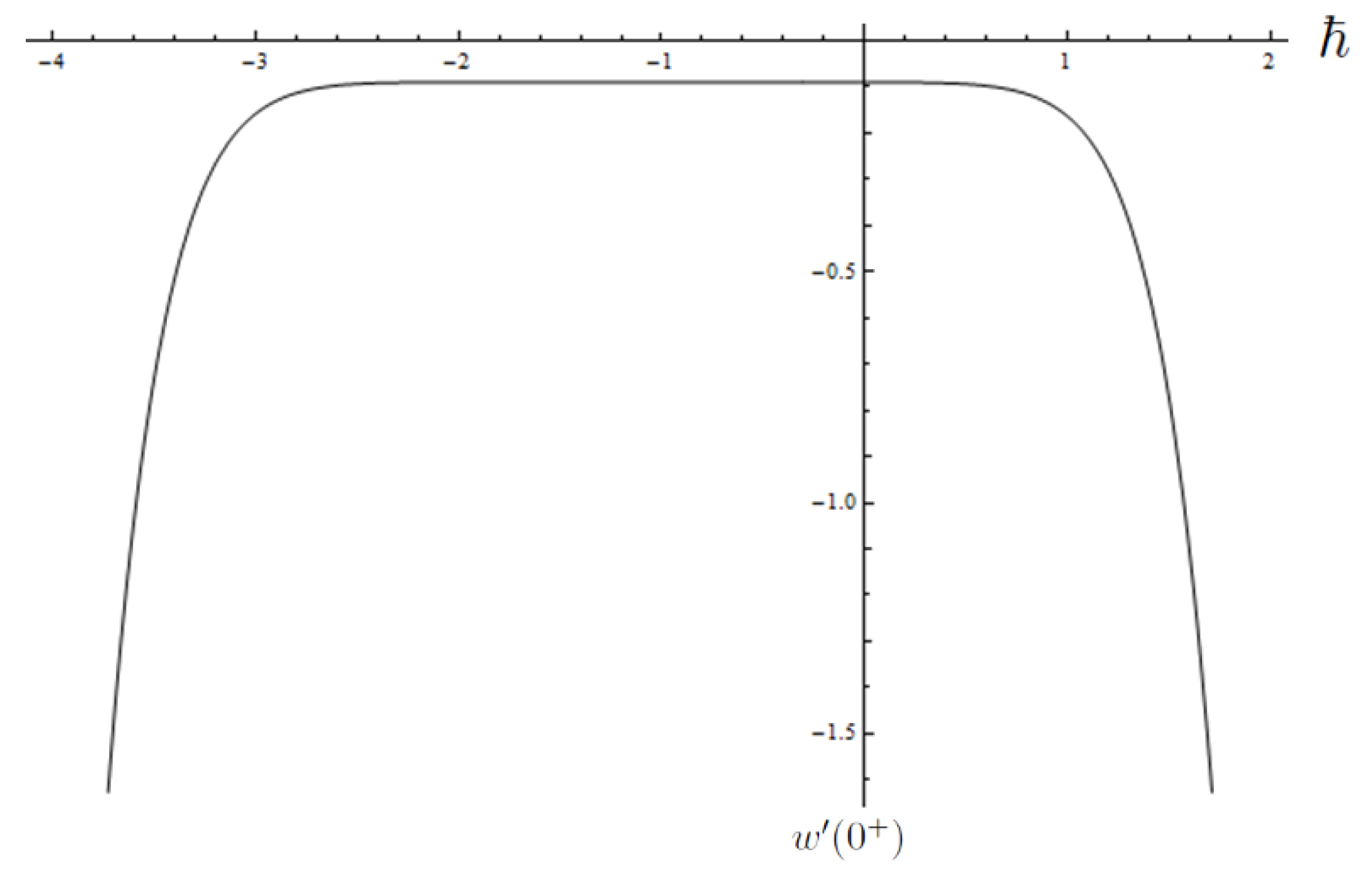
To begin with, the case where , , and is considered. In order to calculate the solution and at the same time find an appropriate value of ℏ, the 10th order approximation is calculated. Due to the geometry of the solution, a quantity of interest for is . Thus, the corresponding ℏ-curve is graphed in Figure 1. It is obvious from this graph that a valid region for ℏ is, roughly speaking, from up to . Thus, it is natural to choose . Table 1 shows as well as the corresponding averaged squared residual error defined by (26), for and for several values of the order M from 2 up to 16. For the calculation of the errors , it suffices to choose , since the solution of (13) and (14) decay exponentially to zero.
Figure 1.
curve for for 10 terms in the case , , and .
Table 1.
and corresponding errors for and .
It is obvious from Table 1 that the errors decay quickly to order and the value of converges to −0.0893676. However, as mentioned in [28], the whole procedure can be highly facilitated and accelerated by finding the optimum ℏ of a specific approximation, via minimizing the corresponding errors and then use this optimum ℏ in order to calculate higher approximations of the solution. Thus, in the rest of the paper, this approach will be used.
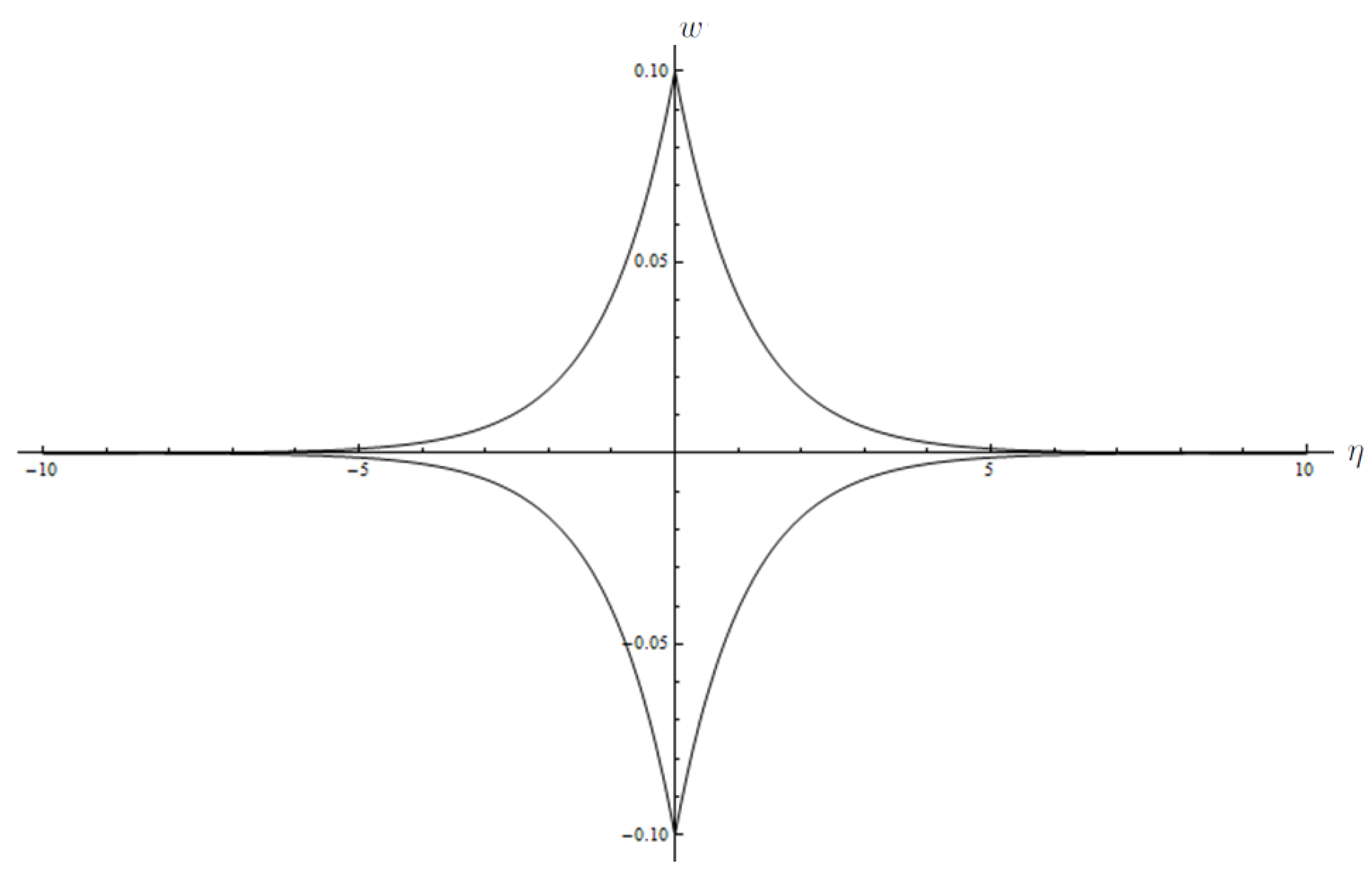
The optimum ℏ for the 6th order approximation is found to be −1.00791 and, by using the rounded value , the 10th order approximation of the solution is calculated. This peakon solution, together with its corresponding antipeakon solution, is presented in Figure 2. The second row of Table 2 presents the values of and in the case where , , , and . It is obvious that the value −0.0893676 of is attained at the second approximation and that the errors are much smaller than in the case where , reaching the order at the 10th approximation.
Figure 2.
Peakon and antipeakon solution for , , and .
Table 2.
and corresponding errors for and , and .
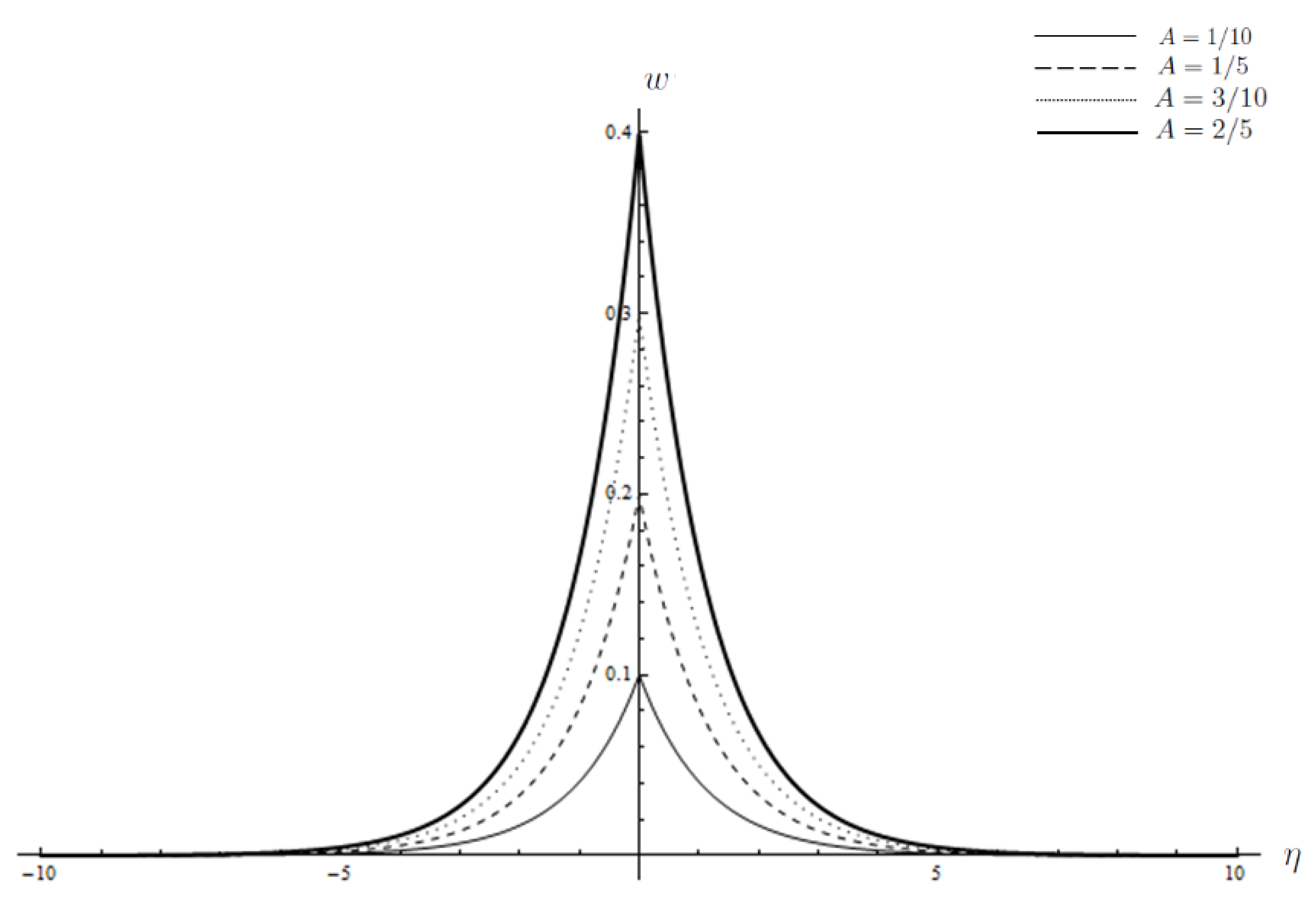
At the same table, Table 2, the values of and are also presented for greater values of A, namely for , , and . It is obvious that the HAM converges rapidly again and the corresponding errors are very small. However, the obtained results indicate that, as A increases, the errors for the same 10th approximation of the solution of (13) and (14) gradually increase, although they still remain very small. The corresponding peakon solutions for and the aforementioned values of A are shown in Figure 3.
Figure 3.
Peakon solutions for , and , and .
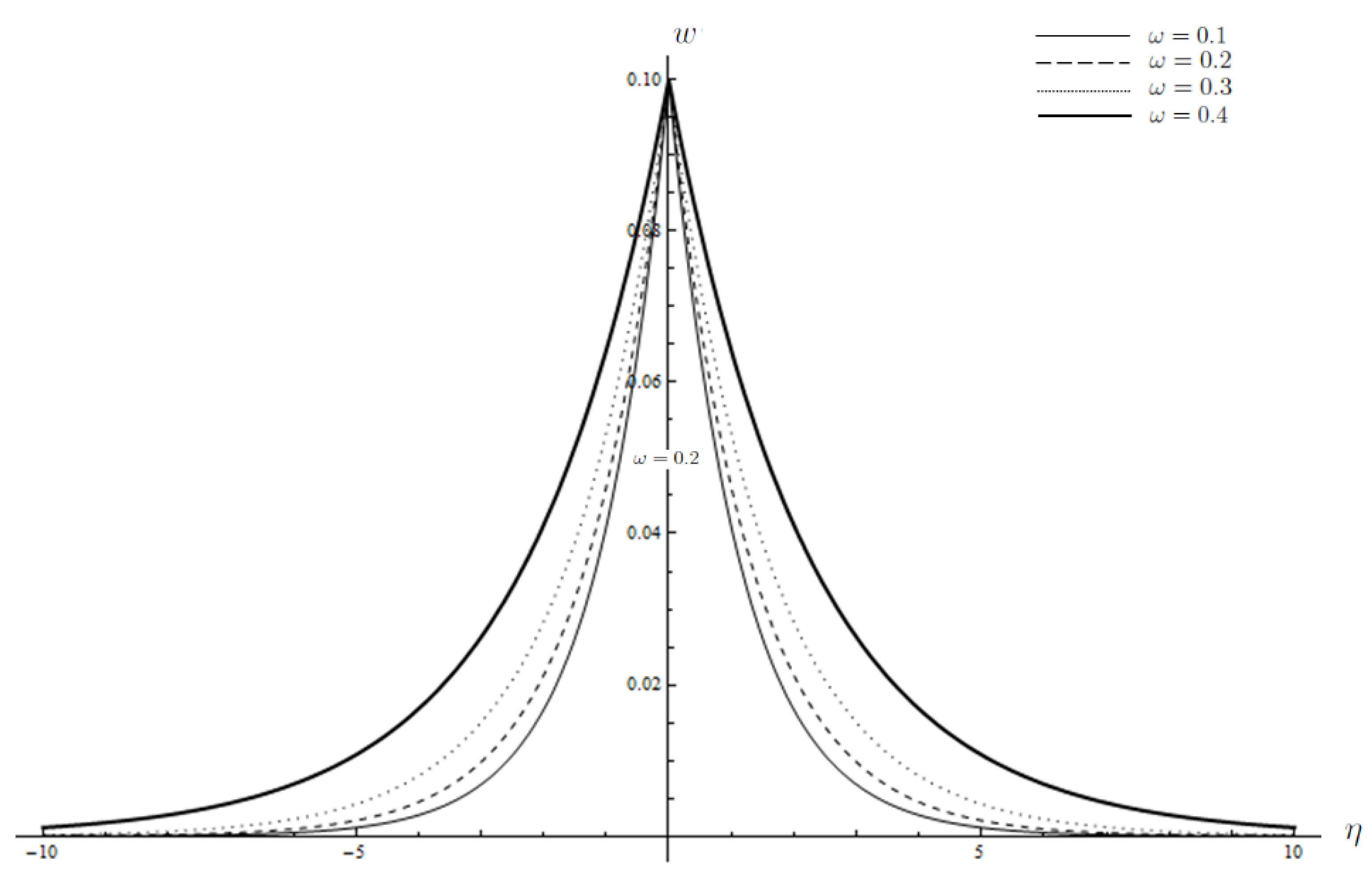
Similarly, in Table 3, the values of and are presented again for , in the case where and , but for four different values of , namely for , , , and . It is obvious again that HAM rapidly converges, but in contrast with the results of Table 2, the errors don’t seem to be affected by increasing . These peakon solutions are presented in Figure 4. The results indicate that the solution decays more slowly, as increases.
Table 3.
and corresponding errors for and and .
Figure 4.
Peakon solutions for , and , and .
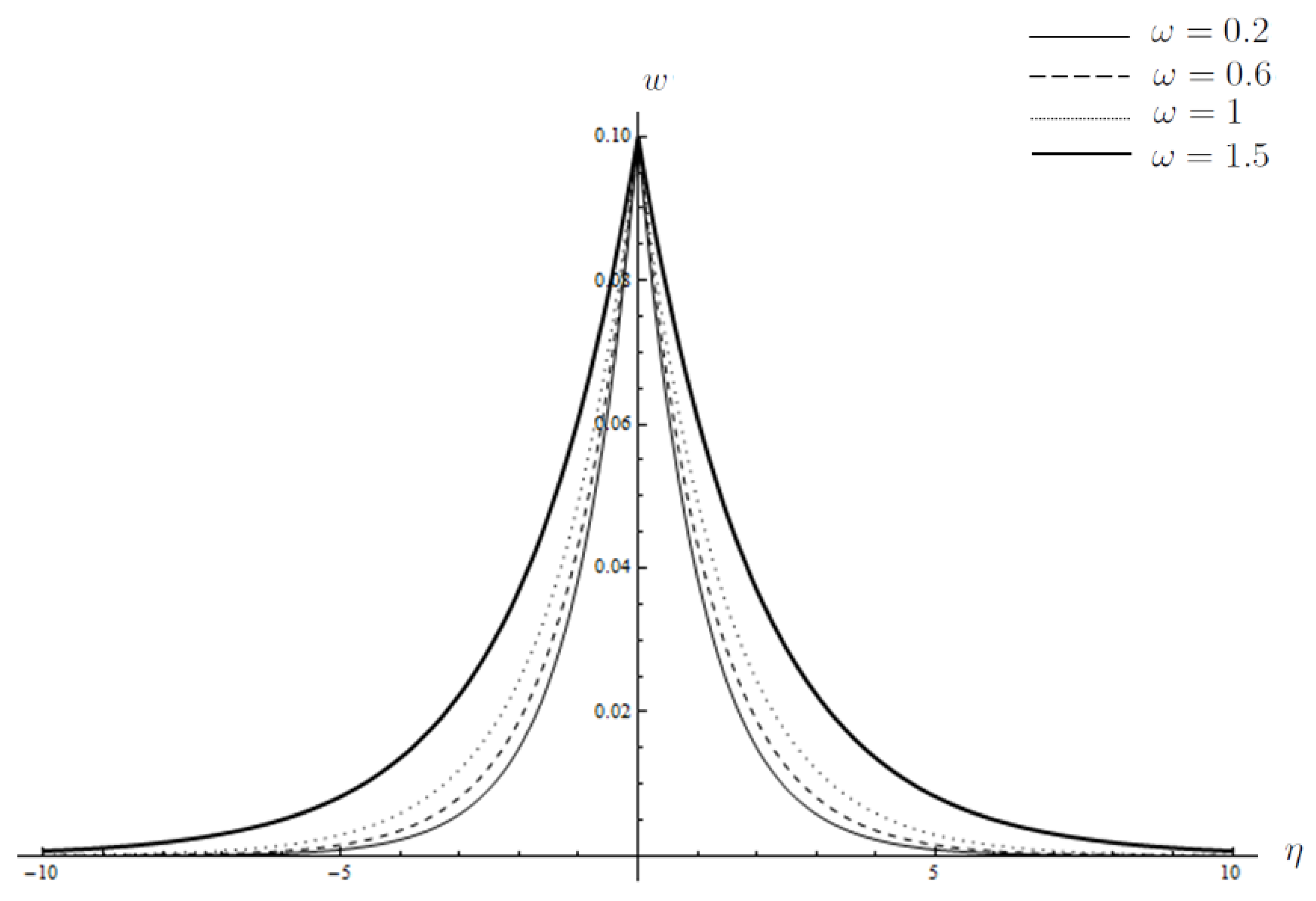
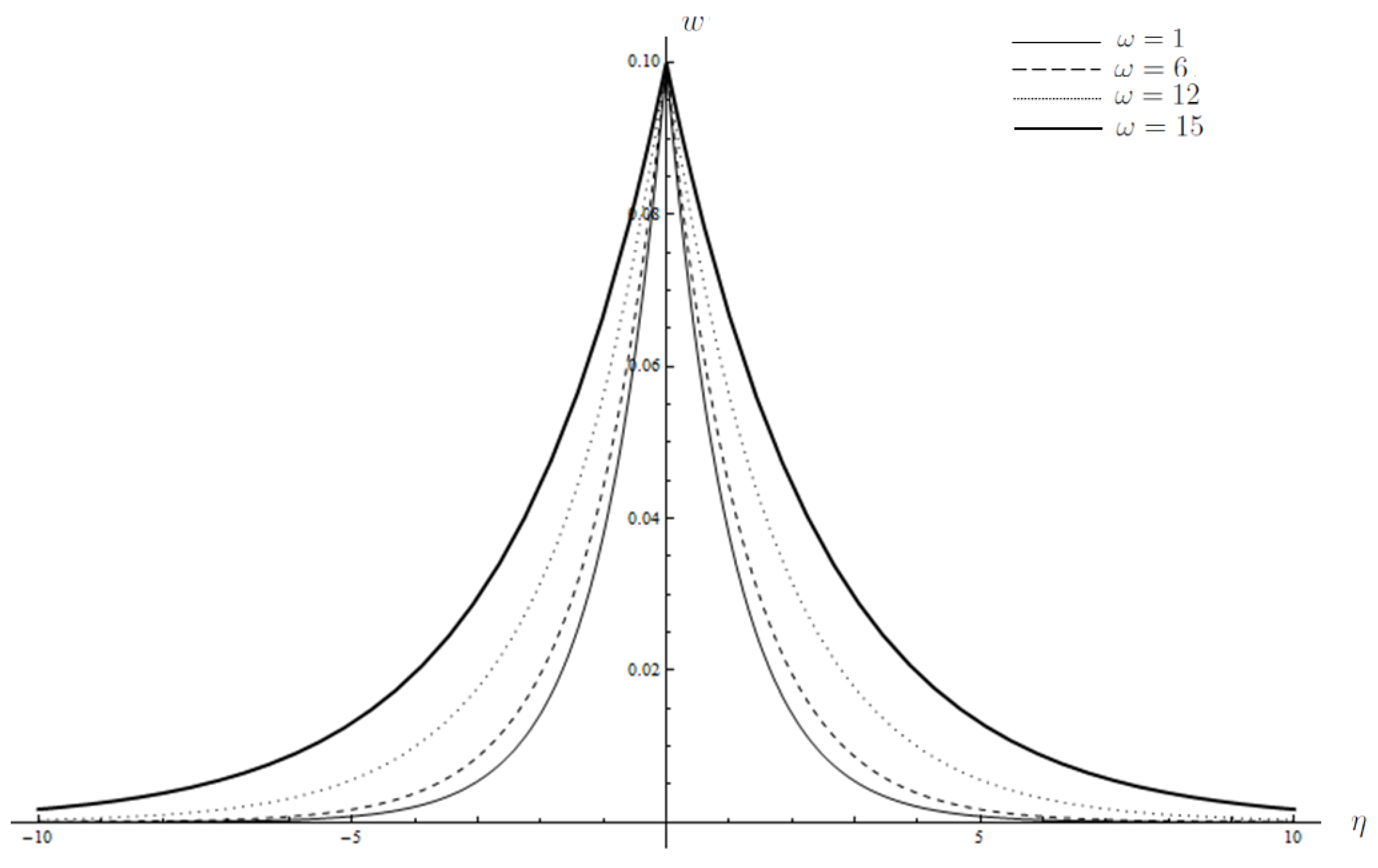
Several simulations have been carried out also for larger values of c and . The corresponding results indicate similar conclusions as before. The peakon solutions of problem (13) and (14) for and and for various values of are presented in Figure 5 and Figure 6, respectively.
Figure 5.
Peakon solutions for , and , and .
Figure 6.
Peakon solutions for , and , and 15.
4. Conclusions
It is well known that the Novikov Equation (5) has peakon solutions in the case . In this paper, it was shown via the homotopy analysis method that (5) also possesses peakon solutions even in the case where . In order to apply HAM, an initial approximation of the solution must be used, which in this case was the function , with . Several analytic approximations of the peakon and antipeakon solutions of (5) were obtained via HAM for various values of , A and the velocity c. The results show that the solutions decay more slowly, as increases. Moreover, the averaged squared residual errors were calculated for the aforementioned approximations. The results indicate that these errors are not affected when increases, but are increased when A increases. The obtained results in this paper for NE are similar to the results of [38] for the DP equation.
Author Contributions
Conceptualization by E.N.P.; investigation by A.G.E. and E.N.P.; methodology by A.G.E. and E.N.P.; software by A.G.E. and E.N.P.; supervision by E.N.P.; validation by A.G.E., E.N.P.; writing—original draft preparation by A.G.E. and E.N.P. All authors have read and agreed to the published version of the manuscript.
Funding
This research received no external funding.
Institutional Review Board Statement
Not applicable.
Informed Consent Statement
Not applicable.
Data Availability Statement
Not applicable.
Conflicts of Interest
The authors declare no conflict of interest.
Abbreviations
| mKdV | modified KdV |
| CH | Camassa–Holm |
| DP | Degasperis–Procesi |
| NE | Novikov Equation |
| PDE(s) | Partial Differential Equation(s) |
| ADM | Adomian Decompostion Method |
| DTM | Differential Transform Method |
| HAM | Homotopy Analysis Method |
| BVP(s) | Boundary Value Problem(s) |
| DE | Differential Equation |
References
- Debnath, L. Nonlinear Partial Differential Equations for Scientists and Engineers, 3rd ed.; Birkhäuser: Basel, Switzerland, 2012. [Google Scholar]
- Camassa, R.; Holm, D.D. An integrable shallow water equation with peaked solitons. Phys. Rev. Lett. 1993, 71, 1661–1664. [Google Scholar] [CrossRef] [PubMed]
- Degasperis, A.; Procesi, M. Asymptotic integrability. In Symmetry and Perturbation theory, Proceedings of the 2nd International Workshop (SPT 98), Universita di Roma “La Sapienza”, Rome, Italy, 16–22 December 1998; Degasperis, A., Gaeta, G., Eds.; World Scientific Publishing Co., Inc.: River Edge, NJ, USA, 1999; pp. 23–37. [Google Scholar]
- Novikov, V. Generalizations of the Camassa–Holm equation. J. Phys. A 2009, 42, 342002. [Google Scholar] [CrossRef]
- Hone, A.N.W.; Lundmark, H.; Szmigielski, J. Explicit multipeakon solutons of Novikov’s cubically nonlinear integrable Camassa–Holm type equation. Dyn. Partial Differ. Equ. 2009, 6, 253–289. [Google Scholar] [CrossRef]
- Liu, X.; Liu, Y.; Qu, C. Stability of peakons for the Novikov equation. J. Math. Pures Appl. 2014, 101, 172–187. [Google Scholar] [CrossRef]
- Hone, A.N.W.; Wang, J.P. Integrable peakon equations with cubic nonlinearity. J. Phys. A. 2008, 41, 372002. [Google Scholar] [CrossRef]
- Bozhkov, Y.; Freire, I.L.; Ibragimov, N.H. Group analysis of the Novikov equation. Comput. Appl. Math. 2014, 33, 193–202. [Google Scholar] [CrossRef]
- Palacios, J.M. Asymptotic stability of peakons for the Novikov equation. J. Differ. Equ. 2020, 269, 7750–7791. [Google Scholar] [CrossRef]
- Grayshan, K. Peakon solutions of the Novikov equation and properties of the data-to-solution map. J. Math. Anal. Appl. 2013, 397, 515–521. [Google Scholar] [CrossRef][Green Version]
- Ni, L.; Zhou, Y. Well-posedness and persistence properties for the Novikov equation. J. Differ. Equ. 2011, 250, 3002–3021. [Google Scholar] [CrossRef]
- Himonas, A.A.; Holliman, C. The Cauchy problem for the Novikov equation. Nonlinearity 2012, 25, 449–479. [Google Scholar] [CrossRef]
- Lai, S.; Ki, N.; Wu, Y. The existence of global strong and weak solutions for the Novikov equation. J. Math. Anal. Appl. 2013, 399, 682–691. [Google Scholar] [CrossRef]
- Tiğlay, F. The periodic Cauchy problem for Novikov’s equation. Int. Math. Res. Not. IMRN 2011, 2011, 4633–4648. [Google Scholar]
- Wu, X.; Yin, Z. Global weak solutions for the Novikov equation. J. Phys. A 2011, 44, 055202. [Google Scholar] [CrossRef]
- Jiang, Z.; Ni, L. Blow-up phenomenon for the integrable Novikov equation. J. Math. Anal. Appl. 2012, 385, 551–558. [Google Scholar] [CrossRef]
- Lundmark, H.; Shuaib, B. Ghostpeakons and characteristic curves for the Camassa–Holm, Degasperis–Procesi and Novikov Equations. SIGMA Symmetry Integr. Geom. Methods Appl. 2019, 15, 017. [Google Scholar] [CrossRef]
- Grayshan, K.; Himonas, A.A. Equations with peakon traveling wave solutions. Adv. Dyn. Syst. Appl. 2013, 8, 217–232. [Google Scholar]
- Himonas, A.A.; Holliman, C.; Kenig, C. Construction of 2-peakon solutions and ill-posedness for the Novikov equation. SIAM J. Math. Anal. 2018, 50, 2968–3006. [Google Scholar] [CrossRef]
- Artebrand, R.; Schroll, H.J. Numerical simulation of Camassa–Holm peakons by adaptive upwinding. Appl. Numer. Math. 2006, 56, 695–711. [Google Scholar] [CrossRef]
- Kalisch, H.; Lenells, J. Numerical study of traveling-wave solutions for the Camassa–Holm equation. Chaos Solitons Fractals 2005, 25, 287–298. [Google Scholar] [CrossRef]
- Xu, Y.; Shu, C.-W. A local discontinuous Galerkin method for the Camassa–Holm equation. SIAM J. Numer. Anal. 2006, 46, 1998–2021. [Google Scholar] [CrossRef]
- Bender, C.M.; Orszag, S.A. Advanced Mathematical Methods for Scientists and Engineers. Asymptotic Methods and Perturbation Theory; Springer: New York, NY, USA, 1999. [Google Scholar]
- Nayfeh, A.H. Perturbation Methods; John Wiley & Sons: Hoboken, NJ, USA, 2008. [Google Scholar]
- Adomian, G. Solving Frontier Problems of Physics. The Decomposition Method; Springer: Berlin/Heidelberg, Germany, 1994. [Google Scholar]
- Hatami, M.; Ganji, D.D.; Sheikholeslami, M. Differential Transformation Method for Mechanical Engineering Problems; Academic Press: Cambridge, MA, USA, 2016. [Google Scholar]
- Liao, S.J. Beyond Perturbation: Introduction to the Homotoy Analysis Method; Chapman & Hall/CRC, CRC Press LLC: Boca Raton, FL, USA, 2004. [Google Scholar]
- Liao, S.J. Homotopy Analysis Method in Nonlinear Differential Equations; Springer: Berlin/Heidelberg, Germany, 2011. [Google Scholar]
- Rebenda, J.; Šmarda, Z. Convergence analysis of an iterative scheme for solving initial value problem for multidimensional partial differential equations. Comp. Math. Appl. 2015, 70, 1772–1780. [Google Scholar] [CrossRef]
- Rebenda, J. Applications of differential transform to boundary value problems for delayed differential equations. AIP Conf. Proc. 2020, 2293, 340011. [Google Scholar]
- Liao, S.J.; Cheung, K.F. Homotopy analysis of nonlinear progressive waves in deep water. J. Engrg. Math. 2003, 45, 105–116. [Google Scholar] [CrossRef]
- Wang, C.; Wu, Y.-Y.; Wu, W. Solving the nonlinear periodic wave problems with the Homotopy Analysis Method. Wave Motion. 2004, 41, 329–337. [Google Scholar] [CrossRef]
- Abbasbandy, S. Soliton solutions for the Fitzhugh-Nagumo equation with the homotopy analysis method. Appl. Math. Model. 2008, 32, 2706–2714. [Google Scholar] [CrossRef]
- Abbasbandy, S.; Parkes, E.J. Solitary smooth hump solutions of the Camassa–Holm equation by means of the homotopy analysis method. Chaos Solitons Fractals 2008, 36, 581–591. [Google Scholar] [CrossRef][Green Version]
- Wu, W.; Liao, S.J. Solving solitary waves with discontinuity by means of the homotopy analysis method. Chaos Solitons Fractals 2005, 26, 177–185. [Google Scholar] [CrossRef]
- Abbasbandy, S.; Zakaria, F.S. Soliton solutions for the fifth-order KdV equation with the homotopy analysis method. Nonlinear Dynam. 2008, 51, 83–87. [Google Scholar] [CrossRef]
- Abbasbandy, S.; Parkes, E.J. Solitary-wave solutions of the Degasperis–Procesi equation by means of the homotopy analysis method. Int. J. Comput. Math. 2010, 87, 2303–2313. [Google Scholar] [CrossRef][Green Version]
- Liao, S.J. On peaked solitary waves of the Degasperis–Procesi equation. Sci. China Phys. Mech. Astr. 2013, 56, 418–422. [Google Scholar] [CrossRef]
- Liao, S.J. Chance and challenge: A brief review of homotopy analysis method. In Advances in the Homotopy Analysis Method; Liao, S., Ed.; World Sci. Publ.: Hackensack, NJ, USA, 2014; pp. 1–33. [Google Scholar]
Publisher’s Note: MDPI stays neutral with regard to jurisdictional claims in published maps and institutional affiliations. |
© 2021 by the authors. Licensee MDPI, Basel, Switzerland. This article is an open access article distributed under the terms and conditions of the Creative Commons Attribution (CC BY) license (https://creativecommons.org/licenses/by/4.0/).