


Abstract
In the present work, the propagation of (non)linear electrostatic waves is reported in a normal (electron–ion) magnetoplasma. The inertialess electrons follow a non-extensive q-distribution, while the positive inertial ions are assumed to be warm mobile. In the linear regime, the dispersion relation for both the fast and slow modes is derived, whose properties are analyzed parametrically, focusing on the effect of nonextensive parameter, component of parallel anisotropic ion pressure, component of perpendicular anisotropic ion pressure, and magnetic field strength. The reductive perturbation technique is employed for reducing the fluid equation of the present plasma model to a Zakharov–Kuznetsov (ZK) equation. The parametric role of physical parameters on the characteristics of the symmetry planar structures such solitary waves is investigated. Furthermore, the stability of the pulse soliton solution of the ZK equation against the oblique perturbations is investigated. Furthermore, the dependence of the instability growth rate on the related physical parameters is examined. The present investigation could be useful in space and astrophysical plasma systems.
1. Introduction
Ion-acoustic waves (IAWs) play an essential part in studying the linear and nonlinear aspects among several astrophysical plasmas. Such types of wave modes are basically low-frequency longitudinal plasma density oscillations, which Tonks and Langmuir anticipated in 1929 [1], as they defined the phase velocity for isothermal changes and frequencies well below the ion plasma frequency. Moreover, in 1933, it was observed that the IAWs posses the electrical oscillations within an electrical discharges through gases by Revans [2].
A large number of researchers have studied the dynamics of the IAWs experimentally and theoretically in the last few decades [3,4,5,6,7,8,9,10]. There are many approaches for investigation the different types of nonlinear structures in plasma physics such as a reductive perturbation technique (RPT), Sagdeev potential approach, etc. For instance, Washimi and Taniuti [11], for the first time, used the RPT for studying the characteristics of the weakly nonlinear ion-acoustic solitons (IASs) in an electron-ion () plasma. On the other side, for investigating the arbitrary amplitude IAWs in the plasma, a fully nonlinear theory was reported by Sagdeev [12]. The planar solitary waves are characterized by a high symmetry due to the balance between dispersion and nonlinearity. Ikezi et al. [13] experimentally proven the presence of ion-acoustic solitary waves (IASWs). The IASs with two different types of electrons (hot and cold) obeying non-extensive distribution have been studied by Saini and Shalini [14]. The presence of particles with nonextensive distribution shows that the characteristics of the IASs (compressive and rarefactive) in the given plasma system are drastically altered by changing the nonextensivity of electrons.
It is challenging to understand the nonextensive generalization of the Boltzmann–Gibbs–Shannon (BGS) entropy. This distribution is recognized for the first time by Renyi [15] and was later supported by Tsallis [16]. The well-known Maxwellian distribution in Boltzmann–Gibbs statistics is considered authentic universally for the macroscopic ergodic equilibrium systems. The Maxwellian distribution, however, may not be suitable for systems with long-range interactions and non-equilibrium static states, such as plasma and gravitational systems. The theory and experiment suggested that the BGS formalism is incapable of summarizing systems with long-range interactions and memory effects [16]. A number of irrefutable pieces of evidence indicate that the q-entropy may provide a valuable framework to analyze a range of astrophysical scenarios, including star polytropes, the solar neutrino challenge, and the unusual velocity distribution of galaxy clusters. The experimental results for electrostatic plane wave propagation in a collisionless thermal plasma led to a class of Tsallis’ velocity distributions being characterized by a nonextensive q-parameter less than unity [17]. The term of matter nonextensivity has been effectively implemented in plasma physics [17,18,19,20,21,22]. In nonextensive plasmas, a group of communal phenomena like ion-acoustic (IA) waves, DIA waves, DA waves, and electron acoustic waves have been examined, be it by assuming electrons to be nonextensive [23] or ion nonextensive [24,25], or both electron and ion nonextensive. Cairns et al. [26] carried out a study on the effect of ion temperature, external static magnetic field, and oblique propagation on the structure of these solitary waves. Moreover, Mamun and Cairns considered the same problem for cold ions [27]. Therefore, they were able to show the existence of compressive and rarefactive solitary waves as well as the investigation of their stabilities. The Zakharov and Kuznetsov (ZK) equation was first derived using RPT to govern the IAWs in a magnetized plasma in 1974 [28]. Furthermore, Ladke and Spatschek [29], Infeld [30], and Das and Verheest [31] investigated the existence and stability of solitary waves in a plasma with external magnetic field [32]. The main objective of this paper is to investigate the impact of the non-Maxwellian (say nonextensive distributed) electrons on the characteristics of IASWs in a magnetized anisotropic plasma. To do that, the RPT could be employed for deriving the evolution equation, i.e., ZK equation is derived. Furthermore, the stability of the ZK solitary wave solution will be investigated.
2. The Physical Problem and Mathematical Model
We consider a collisionless magnetized plasma consisting of cold ions and nonextensive electrons. The plasma model is supposed to be in an external magnetic field and the wave vector lie in the plane. The set of equations describing the IAWs in the present model may be explained by the mentioned sets of equations:
and the pressure tensor [33,34,35,36] is given as
here and represent, respectively, the unit tensor and unit vector along the external magnetic field. The parallel and perpendicular components of the ion pressures are given by
where and denote equilibrium values of the ion parallel and perpendicular pressure, respectively, and they are defined by
It was assumed that the electron will obey the Tsallis distribution [37,38]
Here, indicates the constant of normalization it is given by
Integrating in the entire velocities, we get the normalized form of electron number density as [39,40,41]
The energy of the nonextensive electrons can be obtained as
As the energy is always positive, this is possible only for [38].
Equation (8) can be expanded in the power of potential as
where and are, respectively, defined as
The Poisson’s equation for the given system is defined as
Consider the two-dimensional perturbations in the plane. As a result, the set of equations characterizing ion dynamics in the current model goes as follows:
The Poisson’s equation in normalized form is
In the mentioned sets of above equations, and represent the mass of ions, electron charge, electron density, electron equilibrium density, ion density, and ion equilibrium density, respectively. and are the ion fluid velocity along the corresponding axis, respectively. The parameter denotes the ion gyro-frequency, and the dimensionless parameter is defined as .
All quantities in Equations (13)–(17) are scaled as follows: the number density (n) is scaled by its equilibrium value , the ion fluid velocity (v) is scaled by ion-acoustic speed and the electrostatic wave potential is scaled the thermal potential . The space and time variables are, respectively, scaled by Debye length and inverse plasma frequency . The quantity indicates the normalized ion parallel pressure and is the normalized ion perpendicular pressure, respectively.
3. Linear Analysis
By linearizing Equations (13)–(17) and adopting a standard way where the first-order perturbed quantities are related to the following linear dispersion was obtained:
where k is the wave vector defined as . Equation (18) is quadratic in with their two possible roots:
where give the fast and slow modes of the electrostatic waves. It is shown that the value of depends upon on non-extensivity of electrons q through . Note that defines an acoustic mode and for a small value of we obtain
Remembering that relation (20) represents the speed of sound for quasi-parallel propagation within the Tsallis distribution, there exists a similar relation (32) in the nonlinear analysis section below. In the same way, when and then the fast mode of electrostatic waves reduces to .
3.1. Asymptotic Behavior
In order to summarize the for small wave number values , let us expand Equation (19) using Taylor expansion, one can obtain the expressions for and , respectively, in the following form:
and
3.2. Parametric Study of Dispersion Relation
It is seen from Equation (19) that the dispersion relation is a function of the parallel component of anisotropic ion pressure , component of perpendicular anisotropic ion pressure , non-extensivity of electrons , and the magnetic field strength . Therefore, it is important to study the impact of these parameters on the linear properties of the IAWs. The behavior of fast and slow modes versus parallel wave number is depicted in Figure 1a–d for different physical parameters. Figure 1a shows that the frequency of both slow and fast electrostatic modes decreases with the enhancement of the electron nonextensivity parameter q. Note that q is more effective in the faster mode than the slower mode. The effect of the parallel component of anisotropic ion pressure, , is depicted in Figure 1b, which depicts that the phase velocity of both fast and slow modes of the IAWs increases with increasing . The effect of perpendicular component of anisotropic ion pressure is shown in Figure 1c). It observed that increase the upper mode of frequency, while the reverse effect is seen in the lower branch. The influence of magnetic field on the phase speed is investigated in Figure 1d. One can see that for lower values of , growing the magnetic field leads to increase the phase speed related to fast modes, and attains a constant asymptotic value for higher values of . Moreover, it is observed that the frequency gap within the faster and slower ion-acoustic modes decreases with increasing the at large . Similarly, for small values of , it increases with magnetic field strength .
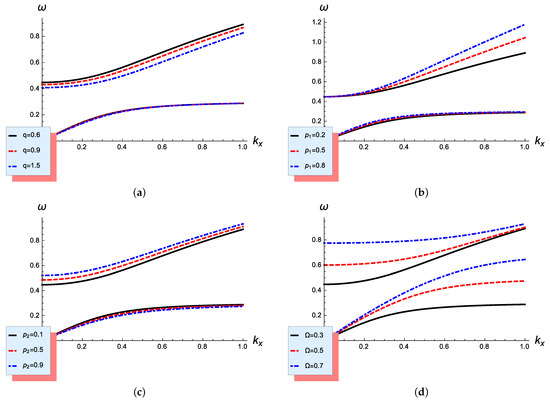
Figure 1.
Graph of against for (a) different q and fixed , , ; (b) different and fixed , , ; (c) different and fixed , , ; and (d) different and fixed , , and .
3.3. Limiting Cases
We may consider some special cases, in which our algebraic analysis reduces to some special cases in the appropriate limit:
- (I)
- The cold electron ion model is recovered by setting .
- (II)
- When the nonextensivity parameter is , then the Tsallis distribution adopted to Maxwell distribution.
3.3.1. Parallel Propagation
Consider the case of parallel propagation in which and , then Equation (18) can be reduced to the following form:
Relation (23) represents the dispersion relation of the electrostatic waves of magnetized plasma, with a parallel component of anisotropic ion pressure and Tsallis distributed electrons in case of parallel propagation. It is clear from relation (23) that does not depend on magnetic field.
3.3.2. Perpendicular Propagation
In this case, we consider and which Equation (18) could be reduced to
Here, relation (24) denotes the dispersion relation for electrostatic waves in a magnetoplasma, with Tsallis-distributed electrons and a component of perpendicular anisotropic ion pressure in the case of perpendicular propagation. It is clear from relation (24) that is a function of magnetic field strength and nonextensivity of electrons q through and perpendicular component of anisotropic ion pressure .
4. Nonlinear Analysis and Derivation of ZK Equation
To study the small amplitude IAWs in the present model, the reductive perturbation method is introduced. Accordingly, the following new coordinates related to the none-static frame are introduced:
where represents the phase velocity of the wave. The field dependent quantities are mentioned as
Substituting expansion (26) in Equations (13)–(17) and using Equation (25), we get the sets of expression in the order of expansion of , in the simplified form as following
and in the Poisson’s equation, the expansion order of reads
Comparing Equations (27) and (31), we obtain the expression for phase velocity as follows:
The phase velocity is plotted against the nonextensive parameter q for different values of parallel component of anisotropic ion pressure as shown in Figure 2. One can see from Figure 2 that the lower values of nonextensive parameter q correspond to higher phase velocity, and phase velocity decreases when q is increased. Furthermore, the phase velocity becomes constant when q approaches to 1. Moreover, we observe from Figure 2 that the phase velocity increases with increasing the parallel anisotropic ion pressure .

Figure 2.
Graph of versus q for different values of .
5. Analytical Soliton Solution of the ZK Equation
The soliton solution of the ZK Equation (39) is defined by
where is the transformed coordinate and u is the speed of the nonlinear structure, and represents the inverse of soliton width. For wave vector k, the direction cosines are defined as and , respectively. and express the amplitude and width of the IASWs, respectively. The nonlinear coefficient A is sometimes positive and sometimes negative, while the dispersion coefficients B and C are always positive. Both polarity compressive and rarefactive nonlinear solitary waves are observed in the present plasma system. The amplitude of the solitary wave is depends on nonlinearity coefficient A and width of the solitary wave w are the functions of dispersion coefficients C and B.
6. Parametric Study
In this section, the effects of the physical parameters on the nonlinearity coefficient A and the dispersion coefficients B and C, will be investigated. In Figure 3, the nonlinearity coefficient A and the dispersion coefficients B and C are plotted versus the nonextensive parameter q and for different values of anisotropic ion pressure . It is seen that the nonlinearity coefficient A increases while dispersion coefficients B and C decrease with increasing q. Furthermore, we note that increases the value of anisotropic ion pressure leads to the enhancement of the nonlinearity coefficient A and dispersion coefficients C while reducing the dispersion coefficients B. It is important to mention here that the nonlinearity coefficient A is positive as shown from Figure 3. Therefore, in the present plasma system, only compressive solitary structures are observed.

Figure 3.
The coefficients A, B, C versus q for different values of and .
It is clear from Equations (40) and (41) that the nonlinearity coefficient A and dispersion coefficient B are not based on , while the dispersion coefficient C is based on the magnetic field strength . However, it is essential to examine how affects C. Figure 4 depicts how affects C. Figure 4a is plotted for (), while for the (), Figure 4b is plotted. It should be observed that the C behaves identically in both circumstances, with the only difference being that the magnitude of C reduces in the presence of .

Figure 4.
Coefficient C versus q (a) for and (b) for with fixed values of and .
Figure 5 displays the effects of varies relevant parameters, namely, the nonextensivity parameter q, component of parallel anisotropic ion pressure , component of perpendicular anisotropic ion pressure and the magnetic field strength on the solitary wave profile. It is seen from Figure 5a that the amplitude and width of the IASWs increases with decreasing the nonextensive parameter q. In Figure 5b, the effect of on ion-acoustic nonlinear solitary wave potential is investigated. Note from Figure 5b that higher minimizes the amplitude of positive potential IASWs. In Figure 5c, we investigate the impact of the directional cosine on the solitary waves profile . This figure indicates that both the amplitude and width of compressive solitons decrease with increasing . The effect of on the solitary waves profile is investigated as shown in Figure 5d. It is observed that the width increases with increasing , while the amplitude remains unchanged. To demonstrate the effect of on the ion-acoustic nonlinear solitary waves, Figure 5e is presented. It is found that the width of the IASWs decreases with increasing , while the amplitude remains unchanged as shown in Figure 5e.
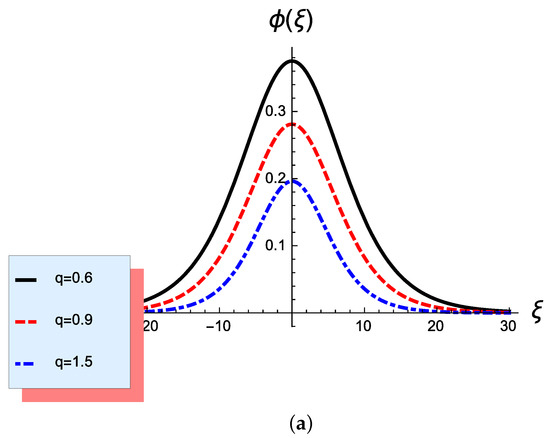
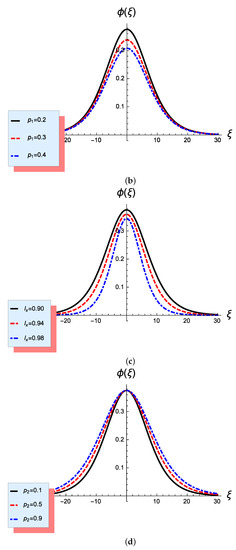
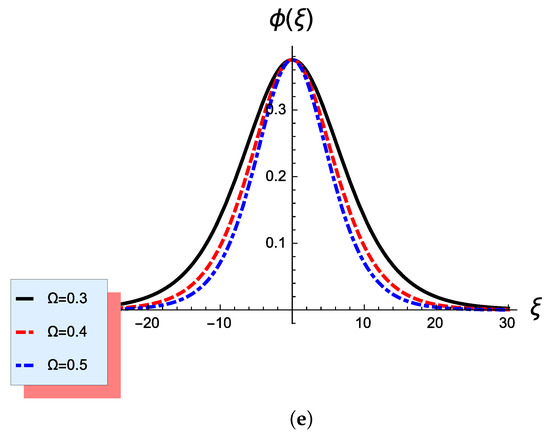
Figure 5.
(a) Graph of solitary wave solution versus for different values of q, and , , , , and . (b) Graph of solitary wave solution versus for different values of , and , , , , and . (c) Graph of solitary wave solution versus for different values of and , , , , and . (d) Graph of solitary wave solution versus for different values of , and , , , , and . (e) Graph of solitary wave solution versus for different values of and , , , , and .
7. Pulse Stability Analysis
In order to analyze the stability of the soliton pulse solution (42), we will follow the same technique mentioned by Allen and Rowlands (AR) [42]. First, a transformation can be introduced in order to transform the planar ZK Equation (39) to its “canonical” form (cf. Equation (1.1) in [42]). Applying the transformation (see Appendix A in [43]), the planar ZK Equation (39) reduces to
this equation is similar to Equation (1.1) in Ref. [42], (just instead of .
We concentrate on the major characteristics of Allen and Rowlands’ stability analysis [42] rather their derivations. The detail computation are mentioned in [42]. By following Allen and Rowlands [42], the solution of Equation (43) is assumed to be
where represents the exact solution of Equation (43), measures the instability growth rate, and k represents the wave vector transverse component. The quantity can be determined later by using the multi-scale perturbation technique, relying on an expansion in k (for more details see in [42]). For smaller the is related to Re(), and it can be retyped as
where and represent the first and second-order instability, respectively. After some lengthy computations,
the angle is in between the transverse component of the perturbation and the magnetic field. The first-order instability occurs when , that is, . Thus, the growth rate can be written as
The second-order instability still occurs when even if the configuration is stable for the first-order and, therefore, the growth rate reads as [42], and the expression of is given by
Allen and Rowlands’ [42] instability analysis may be expressed in the following form.
When , then the instability growth rate can take the form
For , the instability growth rate reads
For transforming Equations (49) and (50) into our physical model, one needs to use the following transformation equations , , , respectively, for , time t, and in order to transform Equation (43) into the planar ZK equation. Using the above transformation, we may use , , and in Equations (49) and (50), and finally we obtain the equations for growth rate instability as
and
The growth rate of the instability depends upon on varies plasma parameters, therefore it is important to study the effects of these parameters on the instability growth rate. The growth rate is plotted against for different plasma parameters as shown in Figure 6. It is clear that the growth rate goes to zero when . Figure 6a indicates that for smaller values of , the growth rate increases as the nonextensivity q decreases. Figure 6b demonstrates the effect of parallel component of anisotropic ion pressure on the growth rate . It is shown that increasing leads to the reduction of the growth rate. The decreasing in perpendicular anisotropic ion pressure suppress the growth rate as depicted in Figure 6c. Figure 6d shows the effect of magnetic field strength on growth rate which shows that growth rate is reduced with increasing . Similarly, the second-order instability growth rate is plotted versus based on Equation (52) for different plasma parameters as shown in Figure 7. The figure clearly indicates that the growth rate increases sharply for . From Figure 7a, one can see that the growth rate grows with increasing the nonextensive parameter q and finally saturates at larger angles. The effect of parallel anisotropic ion pressure is shown in Figure 7b, the growth rate shrinks when is increased. Figure 7c illustrates the impact of anisotropic ion pressure on . It is seen that the increase of leads to a decrease in the growth rate . Figure 7d depicts the influence of the magnetic field strength on growth rate , which we conclude that the growth rate is enhanced with increasing .

Figure 6.
The first-order instability growth rate versus is plotted for fixed values of , (a) for different values of q and , , ; (b) for different values of and , , ; (c) for different values of and , , ; and (d) for different values of and , , and .

Figure 7.
The second-order instability growth rate versus are plotted for fixed values of , (a) for different values of q and , , ; (b) for different values of and , , ; (c) for different values of and , , ; and (d) for different values of and , , and .
8. Conclusions
In the present article, the (non)linear ion-acoustic waves (IAWs) have been investigated in a magnetized plasma consists of warm ions and Tsalli distributed electrons. The effect of electron nonextensive parameter q, component of parallel anisotropic ion pressure , component of perpendicular anisotropic ion pressure and magnetic field strength on both the linear and nonlinear IAWs has been studied. The main obtained results could be summarized as follows.
- The frequency of both slow and fast electrostatic modes decreases with increasing the electron nonextensivity parameter q. On the contrary, the frequency of both modes enhances with increasing the parallel anisotropic ion pressure . Moreover, the frequency of fast(slow) mode increases(decreases) with the enhancement of the perpendicular anisotropic ion pressure .
- The phase velocity of both slow and fast of the IAWs grows with . Furthermore, the phase velocity decreases (increases) with the increasing the q (parallel anisotropic ion pressure .
- The fluid equations of the present plasma model have been reduced to the ZK equation using the reductive perturbation technique. It was found that this model supports both the compressive and rarefactive nonlinear solitary structures.
- It was shown that the A increases while the B and C decrease with increasing the q. Increasing the significantly enhances the A and the C while the B shrinks. Furthermore, the dispersion coefficient C decreases when increases.
- Both the amplitude and width of the ion-acoustic compressive soliton decay with increasing nonextensive parameter q and parallel anisotropic ion pressure . Increasing the perpendicular anisotropic ion pressure component leads the enhancement of the width of the ion-acoustic compressive solitary wave while amplitude remains unchanged.
- The approach of Allen and Rowlands was used for analyzing the solitary wave solution stability [42]. As a result, it was observed that raising the perpendicular anisotropic ion pressure enhances the growth rate , but increasing the nonextensive parameter q, parallel anisotropic ion pressure , and magnetic field decreases the growth rate . Furthermore, increasing the nonextensivity q and magnetic field increases the growth rate , but increasing the parallel anisotropic ion pressure and perpendicular anisotropic ion pressure suppresses the growth rate .
Finally, it is argued that the variables q, , , and have a considerable impact on the features of the ion-acoustic nonlinear structures. Our findings might be useful in a wide variety of space observation and astrophysical scenarios where nonextensive electrons and pressure anisotropy are present [34,44,45,46].
Author Contributions
Conceptualization, M.K. and A.-u.-R.; methodology, M.K. and E.A.E.; software, M.K. and A.-u.-R.; validation, M.K., A.-u.-R. and E.A.E.; formal analysis, M.K., A.-u.-R. and S.A.E.-T.; investigation, M.K., A.-u.-R. and S.A.E.-T.; resources, M.K.; data curation, M.K.; writing—original draft preparation, A.A., S.K.E., S.A.A., E.A.E. and S.A.E.-T.; writing—review and editing, A.A., S.K.E., S.A.A., E.A.E. and S.A.E.-T.; visualization, M.K., A.-u.-R. and S.A.E.-T.; supervision, M.K., A.-u.-R. and S.A.E.-T.; project administration, A.A., S.K.E. and S.A.A.; funding acquisition, A.A. and S.K.E. All authors have read and agreed to the published version of the manuscript.
Funding
Supporting Project number (TURSP-2020/326), Taif University, Taif, Saudi Arabia.
Institutional Review Board Statement
Not applicable.
Informed Consent Statement
Not applicable.
Data Availability Statement
All data generated or analyzed during this study are included in this published article.
Acknowledgments
This work was supported by Taif University Researches Supporting Project number (TURSP-2020/326), Taif University, Taif, Saudi Arabia.
Conflicts of Interest
The authors declare no conflict of interest.
References
- Tonks, L.; Langmuir, I. Oscillations in Ionized Gases. Phys. Rev. 1929, 33, 195. [Google Scholar] [CrossRef]
- Revans, R.W. The transmission of waves through an ionized gas. Phys. Rev. 1933, 44, 798. [Google Scholar] [CrossRef]
- Walter, G.; Wise, J.; Pribyl, P.; Baker, R.; Layton, W.; Skrzypek, J.; Niknejadi, P.; Ransom, R.; Lee, D.; Zarinshesnas, R.; et al. Ion acoustic wave experiments in a high school plasma physics laboratory. Am. J. Phys. 2007, 75, 103. [Google Scholar]
- Saeed, R.; Mushtaq, A. Ion acoustic waves in pair-ion plasma: Linear and nonlinear analyses. Phys. Plasmas 2009, 16, 032307. [Google Scholar] [CrossRef]
- Albalawi, W.; El-Tantawy, S.A.; Alkhateeb, S.A. The phase shift analysis of the colliding dissipative KdV solitons. J. Ocean Eng. Sci. 2021, in press. [Google Scholar] [CrossRef]
- El-Tantawy, S.A.; Salas, A.H.; Alharthi, M.R. On the dissipative extended Kawahara solitons and cnoidal waves in a collisional plasma: Novel analytical and numerical solutions. Phys. Fluids 2021, 33, 106101. [Google Scholar] [CrossRef]
- Aljahdaly, N.H.; El-Tantawy, S.A. Simulation study on nonlinear structures in nonlinear dispersive media. Chaos Interdiscip. Nonlinear Sci. 2020, 30, 053117. [Google Scholar] [CrossRef]
- Khalid, M.; El-Tantawy, S.A. Oblique ion acoustic excitations in a magnetoplasma having k-deformed Kaniadakis distributed electrons. Astrophys. Space Sci. 2020, 365, 75. [Google Scholar] [CrossRef]
- Kashkari, B.S.; El-Tantawy, S.A.; Salas, A.H.; El-Sherif, L.S. Homotopy perturbation method for studying dissipative nonplanar solitons in an electronegative complex plasma. Chaos Solitons Fractals 2020, 130, 109457. [Google Scholar] [CrossRef]
- Albalawi, W.; El-Tantawy, S.A.; Salas, A.H. On the rogue wave solution in the framework of a Korteweg–de Vries equation. Results Phys. 2021, 30, 104847. [Google Scholar] [CrossRef]
- Washimi, H.; Taniuti, T. Propagation of ion-acoustic solitary waves of small amplitude. Phys. Rev. Lett. 1966, 17, 996. [Google Scholar] [CrossRef]
- Sagdeev, R.Z. Cooperative phenomena and shock waves in collisionless plasmas. Rev. Plasma Phys. 1966, 4, 23. [Google Scholar]
- Ikezi, H.; Taylor, R.; Baker, D. Formation and interaction of ion-acoustic solitions. Phys. Rev. Lett. 1970, 25, 11. [Google Scholar] [CrossRef]
- Saini, N.S.; Shalini. Ion acoustic solitons in a nonextensive plasma with multi-temperature electrons. Astrophys. Space Sci. 2013, 346, 155. [Google Scholar] [CrossRef]
- Renyi, A. On a new axiomatic theory of probability. Acta Math. Hung. 1955, 6, 285. [Google Scholar] [CrossRef]
- Tsallis, C. Possible generalization of Boltzmann-Gibbs statistics. J. Stat. Phys. 1988, 52, 479. [Google Scholar] [CrossRef]
- Lima, J.A.S.; Silva, R.J.; Santos, J. Plasma oscillations and nonextensive statistics. Phys. Rev. E 2000, 61, 3260. [Google Scholar]
- Du, J. Nonextensivity in nonequilibrium plasma systems with Coulombian long-range interactions. Phys. Lett. A 2004, 329, 262. [Google Scholar] [CrossRef] [Green Version]
- Liyan, L.; Du, J. Ion acoustic waves in the plasma with the power-law q-distribution in nonextensive statistics. Phys. A 2008, 387, 4821. [Google Scholar] [CrossRef] [Green Version]
- Amour, R.; Tribeche, M. Variable charge dust acoustic solitary waves in a dusty plasma with a -nonextensive electron velocity distribution. Phys. Plasmas 2010, 17, 063702. [Google Scholar] [CrossRef]
- Livadiotis, G. Approach on Tsallis statistical interpretation of hydrogen-atom by adopting the generalized radial distribution function. J. Math. Chem. 2009, 45, 930. [Google Scholar] [CrossRef]
- Hanel, R.; Thurner, S. Stability criteria for q-expectation values. Phys. Lett. A 2009, 373, 1415. [Google Scholar] [CrossRef] [Green Version]
- Pakzad, H.R. Effect of q-nonextensive electrons on electron acoustic solitons. Phys. Scr. 2011, 83, 015505. [Google Scholar] [CrossRef]
- Tribeche, M.; Merriche, A. Nonextensive dust-acoustic solitary waves. Phys. Plasmas 2011, 18, 034502. [Google Scholar] [CrossRef]
- Ghosh, U.N.; Chatterjee, P.; Kundu, S.K. The effect of q-distributed ions during the head-on collision of dust acoustic solitary waves. Astrophys. Space Sci. 2012, 339, 255. [Google Scholar] [CrossRef]
- Cairns, R.A.; Mamun, A.A.; Bingham, R.; Shukla, P.K. Ion-acoustic solitons in a magnetized plasma with nonthermal electron. Phys. Scr. 1996, T63, 80. [Google Scholar] [CrossRef]
- Mamun, A.A.; Cairns, R.A. Stability of solitary waves in a magnetized non-thermal plasma. J. Plasma Phys. 1996, 56, 175. [Google Scholar] [CrossRef]
- Zakharov, V.E.; Kuznetsov, E.A. Three-dimensional solitons. Zh. Eksp. Teor. Fiz. 1974, 66, 594. [Google Scholar]
- Laedke, E.W.; Spatschek, K.H. Growth rates of bending KdV solitons. J. Plasma Phys. 1982, 28, 469. [Google Scholar] [CrossRef]
- Infeld, E. Self-focusing of nonlinear ion-acoustic waves and solitons in magnetized plasmas. J. Plasma Phys. 1985, 33, 171. [Google Scholar] [CrossRef]
- Das, K.P.; Verheest, F. Ion-acoustic solitons in magnetized multi-component plasmas including negative ions. J. Plasma Phys. 1989, 41, 139. [Google Scholar] [CrossRef]
- El-Taibany, W.F.; El-Bedwehy, N.A.; El-Shamy, E.F. Three-dimensional stability of dust-ion acoustic solitary waves in a magnetized multicomponent dusty plasma with negative ions. Phys. Plasmas 2011, 18, 033703. [Google Scholar] [CrossRef]
- Chew, G.F.; Goldberger, M.L.; Low, F.E. The Boltzmann equation and the one-fluid hydromagnetic equations in the absence of particle collisions. Proc. R. Soc. Lond. 1956, A236, 112. [Google Scholar]
- Denton, R.E.; Anderson, B.J.; Gary, S.P.; Fuselier, S.A. Bounded anisotropy fluid model for ion temperatures. J. Geophys. Res. 1994, 99, 11. [Google Scholar] [CrossRef]
- Khalid, M.; Rahman, A.-u. Ion acoustic cnoidal waves in a magnetized plasma in the presence of ion pressure anisotropy. Astrophys. Space Sci. 2019, 364, 28. [Google Scholar] [CrossRef]
- Khalid, M.; Hadi, F.; Rahman, A. Ion-scale cnoidal waves in a magnetized anisotropic superthermal plasma. J. Phys. Soc. Jpn. 2019, 88, 114501. [Google Scholar] [CrossRef]
- Silva, R., Jr.; Plastino, A.; Lima, J. A Maxwellian path to the q-nonextensive velocity distribution function. Phys. Lett. A 1998, 249, 401. [Google Scholar] [CrossRef] [Green Version]
- Verheest, F. Ambiguities in the Tsallis description of non-thermal plasma species. J. Plasma Phys. 2013, 79, 1031–1034. [Google Scholar] [CrossRef] [Green Version]
- El-Tantawy, S.A. Effect of ion viscosity on dust ion-acoustic shock waves in a nonextensive magnetoplasma. Astrophys. Space Sci. 2016, 361, 249. [Google Scholar] [CrossRef]
- El-Tantawy, S.A.; Wazwaz, A.-M.; Schlickeiser, R. Solitons collision and freak waves in a plasma with Cairns-Tsallis particle distributions. Plasma Phys. Control. 2015, 57, 125012. [Google Scholar] [CrossRef]
- El-Tantawy, S.A.; El-Bedwehy, N.A.; Moslem, W.M. Super rogue waves in ultracold neutral nonextensive plasmas. J. Plasma Phys. 2013, 79, 1049. [Google Scholar] [CrossRef]
- Allen, M.A.; Rowlands, G. Stability of obliquely propagating plane solitons of the Zakharov-Kuznetsov equation. J. Plasma Phys. 1995, 53, 63. [Google Scholar] [CrossRef]
- Adnan, M.; Williams, G.; Qamar, A.; Mahmood, S.; Kourakis, I. Pressure anisotropy effects on nonlinear electrostatic excitations in magnetized electron-positron-ion plasmas. Eur. Phys. J. D 2014, 68, 247. [Google Scholar] [CrossRef]
- Barkan, A.; D’Angelo, N.; Merlino, R.L. Experiments on ion-acoustic waves in dusty plasmas. Planet. Space Sci. 1996, 44, 239. [Google Scholar] [CrossRef]
- Baumjohann, W.; Treumann, R.A. Basic Space Plasma Physics; Imperial College Press: London, UK, 1997. [Google Scholar]
- Nakamura, Y.; Sharma, A. Observation of Ion-Acoustic Solitary Waves in a Dusty Plasma. Phys. Plasmas 2001, 8, 3921. [Google Scholar] [CrossRef]
Publisher’s Note: MDPI stays neutral with regard to jurisdictional claims in published maps and institutional affiliations. |
© 2021 by the authors. Licensee MDPI, Basel, Switzerland. This article is an open access article distributed under the terms and conditions of the Creative Commons Attribution (CC BY) license (https://creativecommons.org/licenses/by/4.0/).