


Abstract
Symanzik’s approach to the description of quantum field systems in an inhomogeneous space-time is used to construct a model for the interaction of neutrino fields with matter. In this way, the problem of the influence of strong inhomogeneities of the medium on the processes of oscillations is considered. As a simple example, a model of neutrino scattering on a material plane is investigated. Within this model, in the collisions of particles with planes, a special filtration mechanism can be formed. It has a significant impact on the dynamics of subsequent neutrino oscillations which are analogous to the Mikheev-Smirnov-Wolfenstein effect at propagation of these particles in an adiabatic medium. Taking into account the possibility of the filtration process in a highly inhomogeneous environment can be useful in planning and carrying out experimental studies of neutrino physics. It can also be considered by investigations of the role of neutrino in astrophysical processes by means of numerical simulations methods.
1. Introduction
Recently, much attention has been paid to research in the field of neutrino physics. Here, the effects of neutrino oscillations predicted theoretically more than 60 years ago [1,2,3,4,5] are finding new applications [6,7,8,9], and after the experimental confirmation of their existence, new interest has arisen to such processes [10,11,12,13]. It should be noted that the current stage of theoretical studies of neutrino oscillations is characterized by the desire to develop for them a quantum-field formalism that is more adequate for their physical essence instead of the phenomenological approach that has been used so far, based on the general principles of quantum mechanics [11,14,15].
The features of the interaction of neutrinos with the material environment are also being intensively investigated [16,17,18,19,20,21]. In order to describe such phenomena, we propose in this paper to apply the Symanzik approach for modeling interactions of quantized fields with space-time inhomogeneities [22]. It was applied to study the effects of interactions of quantum electrodynamics (QED) fields with two-dimensional materials [23,24]. Employing basic physical requirements of locality, renormalizability, and gauge invariance, which are assumed in this approach, we impose significant restrictions on the possible form of the model [25,26,27,28,29,30,31,32,33,34,35,36,37,38,39,40,41,42,43].
The interaction of photon fields with a two-dimensional (2D) object is carried out by the Chern-Simons potential, including only one dimensionless parameter and concentrated on a 2D-subspace of full Minkowski space-time [23,24,27,28,29,30,31,32]. To describe the interaction of homogeneous and isotropic material plane with spinor field, one needs, in the most general case, no more than eight dimensionless constants [33,34,35,36,37,38,39]. Within the framework of models constructed in this way, a number of unusual effects have been found. In particular, it is shown that the Casimir force between thin plates of an uncharged capacitor can not only be attractive, but also repulsive [23,24]. Using the Symanzik approach, we constructed models of interaction of Dirac particles with 2D materials, studied their bound states, scattering on a material plane [33,34,35,36,37,38,39,40,41], and calculated the Casimir force generated by vacuum fluctuations of quantum massless Dirac fields between two parallel thin plates [42].
Taking into account this experience, we apply the Symanzik approach for modeling the interaction of neutrino fields with strongly inhomogeneous material. As an example of this situation, we consider the interaction of neutrinos with a material plane and analyse the influence of collisions with it on the oscillation processes.
2. Neutrino Dynamics in the Free Field Approximation
Over the past 20 years, we have seen an intensive development in the physics of materials. One of the theoretical problems in this area is the construction of models of the interaction between 2D objects and fields of QED. In order to find possible methods for its solution, it was suggested to employ the Symansik approach [22] for construction of the QED models with space-time inhomogeneities interpreted as a description of material environments [23,24]. On this basis, modifications of QED were developed for modeling the interaction between QED fields and 2D materials. Some effects of this interaction were investigated and are presented in [23,24,25,26,27,28,29,30,31,32,33,34,35,36,37,38,39,40,41,42,43].
To describe the processes called neutrino oscillations, one uses a model of a system with three pairs of four-component spinor fields , , which a free-action functional reads as [6,11,14,15]
where are the Kronecker delta-symbols, M is a Hermitean - matrix with three eigenvalues and corresponding normalized three-component eigenvectors :
We assume that . In (1), we used the notation , , and is a Lorentz invariant scalar product of four-differential vector with a four-Dirac matrix vector
where is the unique matrix, and are the Pauli matrices
It is supposed that the spinor fields and the matrix are convenient for direct description of neutrino physics and its experimentally observed features.
One says that the system is considered in a lepton (also-called flavor) representation, if fields and the non-diagonal mass matrix M are used for its description. In the so-called mass representation, the system states are characterized by the fields and diagonal mass matrix (i.e., by the masses ). For writing indices, we will use the letter in the lepton representation and the letter in the mass one.
The considered system of spinor fields can be characterised by the local, independent from representation, bilinear function defined by a —matrix as follows
However, properties of the components of and appear to be essentially different.
In the stationarity point of the fields satisfy the Dirac equations
If one chooses as their plane wave solutions
then does not depend on the spase-time point x. For a similar quantity of flavor representation, one obtains
The dependence on the point x of this expression is determined by the factors . If space parts of the four moments coincide by : , then and do not depend on the space coordinates of . For given , the moment component is defined as , and is a periodic function of the time coordinate with period . Thus, the function describes an evolution of the system which is characterized by three periods, . It is an example of a typical process called neutrino oscillations within the flavor description of the system.
If , and , then
for small and
for small . The free field approximation of the action functional enables to describe the propagation of neutrino in vacuum.
For processes in which the influence of the material environment is significant, it was proposed to represent this in the model by an additional potential in the Hamiltonian. In this way, models with constant and adiabatically varying density of the matter were constructed and studied by Mikheev, Smirnov, and Wolfenstein [44,45,46,47,48,49,50,51]. It was shown that the effective masses of neutrino are changed by their interaction with material media. This can cause resonance effects in the processes of neutrino oscillations (MSW resonance), which significantly change their characteristics.
The problem of modeling the interaction of neutrinos with external media attracts the attention of many researchers. It remains actual at the present time. In developing the methods used in [44,45,46,47,48,49,50], many models describing the interactions of neutrino and matter with constant and adiabatically distributed density have been constructed [14,16,17,18,19,20,21].
However, little attention has been paid to the study of boundary effects and phenomena generated by the strong inhomogeneous medium, for modeling of which it is necessary to take into account the interaction of neutrinos with singular density distribution concentrated in a -dimensional subspace of the Minkowski space-time. In this paper, we will demonstrate the possibility of applying the methods of quantum field theory to such problems.
3. Interaction of Neutrinos with Matter
The main idea of Symanzik’s approach in constructing renormalizable models of quantum field theory in a non-uniform space-time is to use the possibility of modifying the action functional of a usual renormalizable quantum field model which is invariant in respect to the space-time translations and Lorentz transformations by appending an additional so-called defect action functional (DAF) obeying some general requirements [22].
The most important of these is that the modified model must remain renormalizable. It is a formal mathematical requirement that imposes strong restrictions on the possible form of the DAF. It should naturally also be assumed that the basic physical principles of interaction laws in the original model also remain non-broken in the modified one. In the gauge theory models, these could be the basic postulate about locality and local gauge invariance. In addition to that, some common physical requirements can be taken into account. For example, the DAF does not break the unitarity of the scattering matrix.
In the framework of Symansik’s approach, one constructed the model describing the interaction of the QED fields with two-dimensional material, which form is defined by the solution of equation . The full action functional of that reads as
where is the usual action functional of QED
with an electromagnetic field A and spinor fields , electron charge e, and mass m. The DAF is the sum of two terms: written as
We used here the notation for the totally antisymmetric Levi-Civita tensor (), a and the elements of the matrix Q are dimensionless parameters. The matrix Q satisfies the condition . The parameter a is a real number. The delta-function describes a subspace of -space-time filled with 2D material [23,24,33,34]. Any matrix can be represented as a linear combination of 16 linearly independent matrices with complex coefficients. As such basic elements, we will use the matrices of the following form
where I is the identity matrix. These can be considered as matrices that form a basis for a linear (reducible) representation of the Lorentz group. The Dirac matrices are transformed as components of a Lorentz contravariant vector, I is the scalar, and is the pseudoscalar. The matrices are represented as contravariant components of the pseudovector and antisymmetric tensor of the second rank, respectively.
Thus, the differential matrix operator and the QED action functional are invariant in respect to Lorentz transformations, and the describing the interaction of the QED fields with the extended object is breaking this symmetry. The remaining symmetry properties of the system are defined by the form of the surface and the choice of parameters of the matrix .
The action functional (3) was proposed in [23,24,25,26,27,28,29,30,31,32,33,34,35,36,37,38,39,40,41,42,43] as a realization of the opportunity to construct a model of the interaction of QED fields with two-dimensional materials within the framework of the Symanzik approach, unless the electron mass, does not contain other dimensional parameters. This model is local, gauge-invariant, and renormalizable. For a material with a given shape (function ) and with given material properties (parameters of matrix Q and a), it is possible to investigate theoretically within the framework of the model a large class of various problems. For example, it can be used for calculating the characteristics of scattering processes and bound states of particles. In this case, using conventional methods of QED and corresponding to their specific problem modifications, one can obtain quantitative results with a high degree of accuracy that are suitable for experimental verification and various predictions.
In our work, we propose to generalize this approach to the case of interaction of neutrino fields with matter whose distribution of density would be a local function concentrated in a subspace with dimension of the four-dimensional Minkowski space-time.
Since, by definition, the action functionals are dimensionless and the dimension of the product of two spinor fields is equal to three, for the DAF, it is necessary by to have parameters with negative dimensions. Adding such a DAF to the basic action of the model will violate the renormalizability of that. Therefore, the only valid value for is . Therefore, a possible generalization of the QED functional for a description of interaction of neutrino fields with a singularly distributed medium could be proposed for mass representation, as
Here, the elements of a hermitian ) matrix and matrix Q are constant dimensionless parameters. The matrix Q is supposed to be presented as with 16 complex numbers and linear independent matrices of the form (4). The solution of equation describes a region of Minkowski space filled with the matter that interact with neutrinos. Its properties are presented by the parameters . In this paper, we consider as the extended material object the plane . It corresponds to choosing .
We put on the matrix Q the restriction , which is necessary for the scattering matrix unitarity. It follows from , by that , , . Therefore, the coefficient by the matrix in the representation is imaginary, and all other coefficients are real.
The matrix Q is simplified if there is a symmetry in the interaction of plane and spinor fields. If it is assumed that the material plane is isotropic and homogeneous, that is, the DAF (5) is invariant with respect to rotation about the —axis and to translations along —directions, then Q has the form [34]
where , are real numbers.
The free action functional (1) has the form
Here, is the Hermitian matrix and is the Dirac operator matrix. The proposed contribution in DAF of spinor fields (5) is the quadratic form of the same structure with . From this point of view, (5) can be considered as a minimal model of interaction of neutrinos with material planes. We will use it in this paper.
This model contains 17 real parameters: 9 of them define the matrix , and there are 8 in Q. The unitary flavor transformation of fields enables one to diagonalize the matrix in (5). In this presentation, the eigenvalues of appear to be the coupling constants of three neutrino mixes with the plane .
In order to obtain an analogue of the Chern-Simons potential describing the coupling of electromagnetic fields with 2D material for the theory of weak interactions, it is sufficient to use the fact that the strength tensor of the non-abelian Yang-Mills field has the form , and changes as under the local gauge transformation with the matrix . It means that
where is the Heaviside step function of and are constant parameters, is a gauge invariant functional.
If the field disappears at large x, then , where
In the framework of the perturbation theory the functional is also equivalent to , and the last one can be used as DAF in modeling the interaction of the Yang-Mills field with 2D material concentrated on the surface . It can be considered as a possible generalization of the abelian Chern-Simons action functional for the non-abelian gauge vector field. If it disagrees with non-perturbative results obtained by using as an alternative versions of DAFs, this situation will impose a special investigation.
It is important to note that in the theory of gauge interactions of bosonic vector and fermionic spinor fields, their interaction with 2D materials is described within the framework of the proposed approach by the sum of functionals, each of which contains only bosonic or fermionic fields. Therefore, the influence of fields of one type on the effects of interaction of fields of another type with extended 2D objects is, in the main approximation, insignificant.
We assume that this is also true for the processes of interaction of neutrinos with a strongly inhomogeneous medium, and to study their features, we will use a model with DAF (5) which contains only neutrino fields.
The invariant in respect to all not affecting the axis transformations of the Lorentz group interaction of plane with a Dirac field was considered in [33]. For symmetry of such a kind, one needs to put in (6) and the matrix Q obtain the form
If one takes into account only the properties of the plane material which are invariant in respect to all rotations and busts, then one can put and obtain
This matrix depends on two real parameters . If the parity symmetry is supposed to not be broken by the DAF, then and
Thus, the full action functional describing the interaction of the material plane with the system of Dirac fields in the mass representation reads as
Here, the fields have three mass components , and , and each of them has four spinor components. For notations of spinor and flavor indices, we will use the Latin and Greek letters, respectively. The matrices , and Q do not depend on x coordinates. The one is diagonal on the spinor and mass indices: , but for Q it is so only in the special case (9). The matrix is supposed to be Hermitian of general form.
The action functional (10) describes three free Dirac particles with masses interacting on the plane . The matrix Q represents the properties that are material of this plane which are essential for its interaction with spinor fields. The diagonal part of the matrix defines, for each particle, its interaction constant with the plane. The non-diagonal elements of can be considered as induced by the plane coupling constants between different -components of the fields .
In the flavor representation, the action functional (10) is written as
For , it is presented in (1) and
The matrix elements of M, L and , are connected by relations
Thus, we constructed the model of interaction of neutrino fields with strong inhomogeneous matter based on the Symanzik approach in quantum field theory. The DAF (5) is supposed to be used as the addition term to the action functional of renormalized models describing neutrino physics. The constructed model is an analog of the model of interaction of the QED fields with 2D matter, of which the investigation in the Gaussian approximation enabled one to obtain non-trivial theoretical results about Casimir and Casimir-Polder effects [23,24,27,31,42], scattering processes [32,40,41], and the bound state of photons and Dirac particles [37,39,43]. Within the Gaussian approximation of the proposed model, we consider the scattering of neutrinos on the material plane and analyze the influence of collisions with it on their oscillations.
4. Statement of the Problem
Although the action functional (10) is Gaussian, the processes, which it describes, are nontrivial. We will study the scattering on the plane of particles, which are presented by the fields , by using the modified Dirac equations
characterizing the point of stationarity of the functional . The ordinary way to do it is to find the solution of (11) and (12) and applying that to construct the currents of incident, reflected, and transmitted particles. It enables one to calculate the characteristics of the scattering process. Such a problem was solved for the interaction of one Dirac field with the plane defined by the DAF with matrices Q of the form (6), (7). Our task is to obtain such results for the model with an action functional (10).
If , and denote solutions of (11) and (12) by and , respectively; then they must satisfy the free Dirac equations
and conditions on the plane :
with matrix S corresponding to the symmetry of considered interaction defined by the matrix Q, and a flavor matrix .
We suppose that in the scattering process, the incident and reflected particles are in the subspace , and the transmitted ones are in the region . The incident and transmitted particles move in the positive direction of the axes, and we denote by and the describing them spinors. Reflected particles moving in the opposite direction will be represented by the spinor . Thus, the fields in (14) have the form: , .
If the reflection of particles exists, then , the functions are not continuous by , and in (14). It seems to be in contradiction with (11), since (11) is correctly defined if is a continuous by function.
This problem is solved by an auxiliary regularization of the -function in the interaction action [33,39]. It enables one to construct a regularized version of the conditions (14), and it is possible after removing regularization in this expression, to obtain a finite limit for S in terms of the coupling constants of the plane with a Dirac field. For the matrix Q defining this interaction in the model with one spinor field, one received [39]. However, in the framework of other regularization schemes, it appears to be [33].
Thus, the matrix S which must be expressed in terms of Q and used in such an approach depends on choosing the regularization, but it is essential that both and obey the requirement
If (14) is fulfilled, and , then the equality (15) ensures that
that is, no additional current is created on the plane along the axis.
In constructing a solution to the problem proposed by us, we assume that its determining parameters are the elements of the matrices S and . In this case, it is supposed that there is a regularization procedure for the delta function in the action of the model, which makes it possible to establish a one-to-one relationship between elements of matrices and . In this respect, S and can be considered to be directly related to the observables and independent from the choice of the regularization procedure. Calculations based on the use of boundary condition (14) do not require any additional regularization scheme. Therefore, values of elements S and can be expressed in terms of experimental data. Values of the elements of the matrices may depend on the choice of regularization. It can be compared with renormalization in models of quantum field theory, where the observable values are expressed in terms or renormalized parameters which are considered as independent from bare parameters of Lagrangian and used regularization.
We suppose to calculate the characteristic of the scattering process by using the boundary condition (14) and to obtain results in terms of matrices . The problem here is that for our model, we are given matrix Q, but we do not know the matrix S independent of the choice of regularization. In this situation, it is natural to try to construct this matrix by analyzing the properties of the matrices and .
To reveal their structural features, which may also be the same for S, we introduce convenient notation that was used in [37,39]. If M is a matrix with elements , , then are the matrices
We will use the notations , for the matrices corresponding to the unit matrix and Pauli matrices , . The matrix Q (6) can be written as
where , and .
In virtue of , we receive
As , the condition is written for the -matrices as . This means that are imaginary and are real numbers, since , and with . It is fulfilled for real parameters , in (6). It follows from (16) that the parameters are imaginary and are real.
If M and N are -matrices, and is an analytical function at , then the following relations are fulfilled for the matrices
The matrix S from the boundary condition (14) can be obtained in the regularised model. It appears to be dependent on the regularisation scheme function of the matrix . Examples of such could be and .
For the description of neutrino scattering on the plane , we will use the matrix S of the form
where and , are real numbers. Employing this parameterization does not generate difficulties for constructing a complete solution to the problem posed by us. On the other hand, there is no reason to expect that the appearance of results obtained in this way cannot be received within the framework of the approach using regularization (see the Appendix A). To present formulas in compact form, it is convenient to also use the following notations
The condition is written for these parameters as .
It can also be useful to present , as
Here, and there are not conditions connecting with each other.
5. Scattering of Plane Waves
The solution of free Dirac equations (13) can be presented in the form
Here, we used the notation and to obey the condition . If , then the spinor in the integrand of (21) describes by the particle moving in the positive direction of -axes, and corresponds to movement in the opposite direction. The spinor fulfills the Dirac equation For the scattering process described by (13) and (14), the most general plane wave presentation of spinors can be chosen as
Here,
where ,
and are arbitrary complex parameters. Functions describe the incidend and transmitted particles moving in the positive direction of -axes, and corresponds to reflected particles moving from the plane in the negative direction of -axes. The boundary condition (14) is written for as
with matrix S presented in (17) and (18) and
Thus, (22) is a system of 12 linear equations which enables one to express the amplitudes , , of reflected and transmitted particles in terms of amplitudes of incident ones. Substituting the spinors in (22) and using the notations
for , we obtain six equations of the form
The solution for and can be written as
and the problem is to construct the matrices in an explicit form.
It can be solved in the more general formulation. Let be ()-matrices, - n-component vectors, , and
One needs to construct the solution of the system of equations (27)
with an explicit form of the -matrices , .
Here, the sets of the indexes are assumed to be chosen as . Comparing (28) and (29), we receive the following expressions for the matrices
Using and (26)–(29), one can calculate the matrices and obtain the right-hand sides in the representations (26) of in an evident form. However, for the unitary matrix of general form, they turn out to be rather cumbersome and inconvenient for analyzing their properties. Therefore, to study the most simple effects of the neutrino interaction with planes, we restrict ourselves in this paper to the case of a diagonal matrix, .
6. Explicit Results in a Simplified Model
In virtue of , a diagonal part of has the form with real parameters . For of such a kind, the matrices are diagonal, and (26) is written as
The currents of incident, reflected, and transmitted particles are of the form
Here, are components of the momentum vectors , , . In the used parametrization, .
In virtue of (23) and ,
Thus, the continuity of the current component at the plane implies that . Taking into account the direction of the current , we come to the conclusion that the equality
must be fulfilled. To verify (32), it is sufficient to use the above given expressions for the matrices and to take into account the relations for the parameters on which they depend. It follows from (32) that if one denotes the reflection and transmission coefficients for the considered scattering process of the -th particle as
then The matrices are Hermitian. The elements , of the matrix can be presented as
where . The elements of the matrix for , are the following
This is a consequence of the relation (32).
We see that in the mass representation, the obtained results for characteristics of the scattering process do not depend on parameters of diagonal matrix . However, they influence the oscillation events of transmitted and reflected neutrinos in the flavor description of the system, taking the contribution to the oscillating part of (2) in the form
It can essentially change the characteristics of neutrino oscillations after their collision with the material plane.
In the model with diagonal matrix and matrix S of the form (17), we constructed a plane wave solution of Equations (13) and (14), describing the motion of particles with an arbitrary angle of incidence to the plane . Now, we consider a special process of neutrino collision with a plane with an angle of incidence equal to zero.
7. Moving of Particles along the -Axes
If the particles move orthogonally to the plane’s direction, then , . This scattering process is described by reflection and transition matrices
where
The matrices , are also diagonal. Their elements
fulfill the relations . The reflection and transition coefficient could be written as
Here, the angle is defined by relation .
Let us denote
where are constant parameters determining this function, which will be used to analyze the scattering process under consideration. It follows directly from definition that . For , this function reaches its maximal value by :
The equation has, by and , two solutions, :
The neighbourhood of the point can be considered as characterizing the function region. We denote an estimation of its extension as . Then,
The parameters can be expressed in terms of as
Substituting them in , we receive the following presentation of this function
Let us put , where are real constants which can be parameterized by as follows:
Then, and
The function has the form , where
and . Since this relation between parameters , , and is symmetric in respect to replacement , there are two possibilities of inverting it, as
Since , , the relation 2) imposes the restriction on , and in case 1), the inequality must be fulfilled. Thus, the function can be presented in the form with , , . It is even: has the maximum value by , and the extension of the neighborhood of is . By given , the function has the minimal value of by . If , then .
The graphs of the functions by different are shown on Figure 1. With an increase of c, the vicinity of the maxima becomes increasingly more flat, and the positions of the maxima become increasingly less noticeable. Using the notation
one can present the functions of in the form and obtain the following expression for the transmission coefficient:
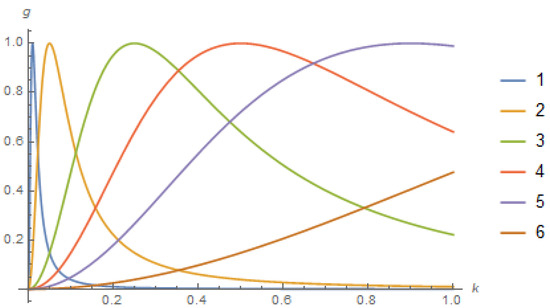
Figure 1.
The graphs of function by and different values of parameter c:
(1) ; (2) ; (3) ; (4) ; (5) ; (6) .
Let us consider, as an example, a scattering process for which and . In this case, and
The maximal value of is , , . The parameters (34) are very close to ones defining the function presented by Graphic 1 on the Figure 1. The difference between it and the graph of the function (33) is inessential. Note that (34) fulfill the restrictions and . However, and the inequality is not satisfied. Therefore, there is only one -parametrization of the function in this case.
Outside the neighborhood, ( ) of the point (, (33) is 10 times less than its maximum value. For , it decreases monotonically from to and has the maximal value at the point (34).
The graph of (33) differs significantly from the (graphs (2)–(6)) shown in Figure 2 for by . These ones can have two maxima (graphs (2) and (3)), one smoothed maximum (graph (6)), or change very little on the most part of the interval (graphs (4) and (5)).
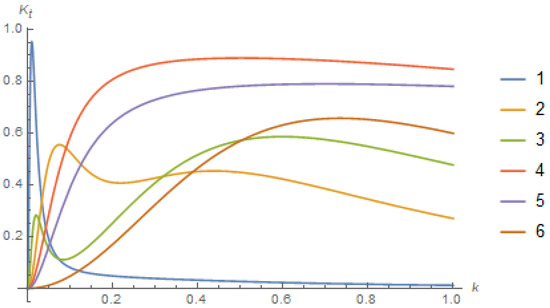
Figure 2.
Transmission coefficient by different values of : (1) (2) (3) (4) (5) (6)
In the general case, the process of neutrino scattering on the plane is described by one universal function parameterized by constants : with factors . In the terms of parameters used above, , , , . The maximal value of is . The argument k of this function is , where m is the mass of the particle and its energy. Hence, by the physical values of . If , then has the maximum on the interval . If , then grows from to with an increase of k by .
Since, in the considered scattering process m, and k fulfill the relations , , one can present , as , . Hence, if , then and , .
Corresponding to (33) function , the transmission coefficient as functions of has the maximum by m, and as the function of , it is maximal by .
Now, we analyze the features of system dynamics in the framework of the flavor representation. As the matrices used in (2) when discussing the oscillation process of neutrinos, we consider . The function is interpreted as the scalar (pseudo-scalar) density of the - particles with momentum , () is the four-current vector (axial four-current pseudo-vector) of the - particles moving along the -axis. We will use the plane wave presentation for spinors describing the particles with momentum moving orthogonal to the plane :
By means of notation , the results obtained for the are written in the form
and
Oscillations of incident waves are presented by as
and
For transmitted waves, one needs to replace . Thus, changing in (35) and (36)
one receives the corresponding results for transmitted neutrino oscillations. If and momentum is the same for all particles, then . For given , we denote , . If monotonically increases from zero to by , then , since . In virtue of
the greater the derivatives of the function are at points and for given that is, the faster grows on the interval , the more there will be an influence of the neutrino collisions with the plane on the process of their oscillations.
If there is a maximum of by , then each , can be maximal, and the following situations are possible:
- (1)
- is maximal, ;
- (2)
- is maximal,or ;
- (3)
- is maximal, .
The more the function resembles an approximation of the delta-function and the nearer the maximal is to the maximum of , the greater is the difference of maximal from non-maximal , and the more significant will be the changes in neutrino oscillations as a result of their collisions with the plane.
We considered the model with 8 real parameters in the matrix Q (6). It could be interesting to compare its properties with features of the system with matrices Q of the form (7)–(9). In the case (7), there are four real parameters defining Q and
Here, , are real parameters fulfilled the conditions , and , . Hence, for such materials,
Putting in (37)–(40), one obtains for the model given by matrix Q (8) with two real parameters
with real , fulfilling the conditions , , and , . In this model,
If one sets in (41) and (42) , then one receives, for the model with a matrix Q (9) containing one real parameter,
Here, , are real parameters, , and . In this case,
8. Conclusions
In our work, we considered the problem of neutrino interaction with matter. Using our experience in constructing models of QED in singular background fields, we have proposed a quantum-field approach, which may be useful for the theoretical description of neutrino propagation in a highly inhomogeneous medium. It assumes taking into account the basic symmetry principles of modern physics of fundamental interactions that underlie the Standard Model and can, in principle, be generalized to describe the interaction of all lepton fields with the external environment. Mainly, attention was paid to the problem of neutrino scattering on a material plane, considered as a simplest example of process in the space with a strongly inhomogeneous distribution of substance.
In a general form, for a model with an off-diagonal unitary matrix mixing Dirac fields in the mass representation, expressions for the reflected and transmitted waves were obtained. For them, in the model with a diagonal , an explicit solution was obtained, which was used to analyze the oscillations of neutrinos in the case of their motion, orthogonally to the plane . It was shown that the parameters that determine the material properties of the plane can be chosen so that its effect on the neutrino flux is similar to a filter that transmits particles in a narrow interval of low energies and almost completely reflects all other ones. As a result of the neutrino collision with the plane, the parallel component of the momentum does not change, and the orthogonal one does not change in absolute value. Only the amplitudes of fields can change significantly.
The example we have considered with parameters of the model (33) and (34) shows that the interaction of neutrinos with a plane can effect their filtration. A characteristic feature of the filtration process of particles upon collision with a plane is the possibility of essentially different transmission coefficients for neutrinos of different masses. In this case, due to filtration of their flux, the regimes of the neutrino oscillations before the plane and behind it can be strongly different. This phenomenon can be used to estimate the masses of neutrinos of various types in carrying out analyses of experimental data.
Although the filtering and MSW-resonance results are similar in many ways, their mechanics are not the same. The MSW effect is formed non-locally in space and time. This requires a certain volume of matter and a certain period of time, generally speaking, that are different for various substances. In order for the filtration of the neutrino flux to occur, their collision with the plane is sufficient, which (in the framework of the considered model) occurs instantaneously and locally at . From the point of view of the possibility of verifying the adequacy of the proposed model, it would be interesting to reveal in the dynamics of neutrino oscillations an effect, which cannot arise as a consequence of MSW resonance and is a manifestation of the filtration process.
One of the current theoretical problems in neutrino astro-physics is constructing numerical models of dynamics of supernova explosions. Many research teams have been working on this issue [52,53,54,55,56,57,58,59,60,61,62,63,64,65,66,67]. Perhaps, taking into account the filtering mechanism in such models will be useful to achieve a better understanding of the features of the process of collapse of the super-heavy star core.
In general terms, a possible scenario of its evolution can be presented as follows. If, in the core of the star, its shell filters neutrinos by energies, they can be divided into two classes. Particles with energies from the narrow range of the low-energy region leave the core unhindered. These neutrinos can be called free. For all the others, which we will call bound, the core shell is impermeable.
In the process of the star’s evolution, its core is subjected to the pressure of the increasing gravitational forces. In it, neutrinos are born, the free ones are emitted, and the bound neutrinos are accumulated in the core. This can go on until the main features of the interaction between the core shell and neutrinos changes, the class of free neutrinos expands, and the star will emit them with further contraction without a significant change in its structure. In our model, this can be described by changing the function . For instance, if the plots of possible , is shown in Figure 2, then within the change , a large fraction of the bound high-energy neutrinos become free, they will leave the star, essentially changing the intensity and spectrum of its neutrino emission.
If the main interaction features of neutrinos with the core shell are not changed and at least some of the bound neutrinos do not become free, then the enormous energy accumulated by them in the core destroys its shell sooner or later. After that, the core and the star are exploded.
There is great interest among experimentalists to determine neutrino masses directly [68,69,70,71,72]. One can assume that the employment of 2D materials and special surface treatment techniques in the construction of neutrino detectors would enable one to efficiently use the filtering mechanism in experiments of such a kind.
The maximal number of parameters in the model, the properties of which we have studied in detail, was eight for the matrix Q and three for the diagonal matrix . Not all of them are included in our results, and the question arises whether it is possible to reduce the number of parameters in the model without limiting its area of applicability. We considered versions of the model with four, two, and one parameters in the Q matrix, simplified for symmetry reasons, and found a difference in the properties of their predicted transmission coefficients. This raises the question of whether one can confine oneself to using the simplest models to describe real neutrino oscillation data.
We suppose that the proposed method for modeling the processes of interaction of neutrinos with matter can be useful for theoretical studies and analysis of the obtained experimental data.
Author Contributions
All authors contributed equally to this paper. All authors have read and agreed to the published version of the manuscript.
Funding
This research received no external funding.
Institutional Review Board Statement
Not applicable.
Informed Consent Statement
Not applicable.
Data Availability Statement
Not applicable.
Conflicts of Interest
The authors declare no conflict of interest.
Appendix A. Regularization and Parameters of Model
If the matrix S in (14) is a function of , then where , and the corresponding -matrices can be presented as
with real parameters , , and .
Indeed, for the matrices we can use the parametrisation of the form . In virtue of , the condition (15) is written for as and . Since , one obtaines
The solution of (A2) for has the form
Thus, the representation (A1) for is proven, and the matrices are written as
Here, and , are real numbers which can be expressed in terms of parameters , , of the matrix Q (6) in accordance with chosen regularisation.
If the parameters define the matrix , then
and for the function one obtains . Therefore , if and .
The parameters of the matrices (16) are imaginary by and real by . For the functions and , the conditions and are fulfilled. Hence, the expressions
obtained for by means of the regularization procedures [33,39] are in agrement with (15) and (A4).
The solutions of equations with given in the form (A1) can be written as
where n is an arbitrary integer number.
The parameters fulfill the restriction . Hense, if is real then and is real. If is imaginary, then
Therefore, in this case, is imaginary and is real.
The solutions of equations in respect to are of the form
For the matrix written as (16), the coefficients are imaginary and are real. The matrices of the form (A5), (A6) fulfill this condition. The calculation of the characteristics of the neutrino scattering on the plane can be carried out using the regularization of the modified Dirac equations. In this case, the expression of the results in terms of the parameters of the Lagrangian turns out to depend on the choice of the regularization scheme. The same results are obtained if we use the solutions of the Dirac equations for free particles and the boundary condition of the form (14) with the appropriately, in accordance with the used regularization scheme chosen matrix S.
Since regularization is not required to solve the boundary problem (14) with arbitrary S defined as (A4), the results turn out to be expressed directly in terms of the parameters of the matrix S. They can be considered as the only solutions of the posed problem that have a physical meaning. This is similar to what happens in quantum field theory, when the results of calculations are expressed in terms of the independent of the regularization scheme renormalized parameters.
References
- Pontecorvo, B. Mesonium and antimesonium. Sov. Phys. JETP 1957, 6, 429–431. [Google Scholar]
- Pontecorvo, B. Inverse β processes and nonconservation of lepton charge. Sov. Phys. JETP 1958, 7, 172–173. [Google Scholar]
- Gribov, V.; Pontecorvo, B. Neutrino astronomy and lepton charge. Phys. Lett. B 1969, 28, 493–496. [Google Scholar] [CrossRef]
- Bilenky, S.M.; Pontecorvo, B. Again on neutrino oscillations. Lett. Nuovo C. 1976, 17, 569–574. [Google Scholar] [CrossRef]
- Bilenky, S.M.; Pontecorvo, B. Lepton mixing and neutrino oscillations. Phys. Rep. 1978, 41, 225–261. [Google Scholar] [CrossRef]
- Bilenky, S.M.; Petcov, S.T. Massive Neutrinos and Neutrino Oscillations. Rev. Mod. Phys. 1987, 59, 671–754. [Google Scholar] [CrossRef]
- Bilenky, S.M.; Giunti, C.; Grimus, W. Phenomenology of neutrino oscillations. Prog. Part Nucl. Phys. 1999, 43, 1–86. [Google Scholar] [CrossRef]
- Fisher, P.; Kayser, B.; McFarland, K.S. Neutrino mass and oscillation. Ann. Rev. Nucl. Part Sci. 1999, 49, 481–528. [Google Scholar] [CrossRef]
- Bilenky, S.M. Neutrino masses, mixing and oscillations. Proc. Roy. Soc. London A 2004, 460, 403–444. [Google Scholar] [CrossRef]
- Bilenky, S. Neutrino oscillations: From a historical perspective to the present status. Nucl. Phys. B 2016, 908, 2–13. [Google Scholar] [CrossRef]
- Lobanov, A.E. Oscillations of particles in the Standard Model. Theor. Math. Phys. 2017, 192, 1000–1015. [Google Scholar] [CrossRef]
- Bilenky, S. Introduction to the physics of massive and mixed neutrinos. Lect. Notes Phys. 2018, 947, 1–273. [Google Scholar]
- Kudenko, Y.G. Neutrino oscillations: Recent results and future prospects. Phys.-Uspekhi 2018, 61, 739–747. [Google Scholar] [CrossRef]
- Lobanov, A.E. Particle quantum states with indefinite mass and neutrino oscillations. Ann. Phys. 2019, 403, 82–105. [Google Scholar] [CrossRef]
- Naumov, D.V.; Naumov, V.A. Quantum-field theoretical approach to neutrino oscillations. Phys. Part Nuclei 2020, 51, 5–209. [Google Scholar] [CrossRef]
- Giunti, C.; Studenikin, A. Neutrino electromagnetic interactions: A window to new physics. Rev. Mod. Phys 2015, 87, 531–591. [Google Scholar] [CrossRef]
- Kartavtsev, A.; Raffelt, G.; Vogel, H. Neutrino propagation in media: Flavor, helicity, and pair correlations. Phys. Rev. D 2015, 91, 125020. [Google Scholar] [CrossRef]
- Chukhnova, A.V.; Lobanov, A.E. Neutrino evolution in dense matter and electromagnetic field. EPJ Web Conf. 2019, 222, 03001. [Google Scholar] [CrossRef]
- Smirnov, A.Y.; Xu, X.J. Wolfenstein potentials for neutrinos induced by ultra-light mediators. J. High Energy Phys. 2019, 1912, 046. [Google Scholar] [CrossRef]
- Chukhnova, A.V.; Lobanov, A.E. Neutrino flavor oscillations and spin rotation in matter and electromagnetic field. Phys. Rev. D 2020, 101, 013003. [Google Scholar] [CrossRef]
- Agarwalla, S.K.; Das, S.; Masud, M.; Swaina, P. Evolution of Neutrino Mass-Mixing Parameters in Matter with Non-Standard Interactions. arXiv 2021, arXiv:2103.13431. [Google Scholar]
- Symanzik, K. Schrödinger representation and casimir effect in renormalizable quantum field theory. Nucl. Phys. B 1981, 190, 1–44. [Google Scholar] [CrossRef]
- Markov, V.N.; Pis’mak, Y.M. Casimir effect for thin films from imperfect materials. arXiv 2005, arXiv:hep-th/0505218v3. [Google Scholar]
- Markov, V.N.; Pis’mak, Y.M. Casimir effect for thin films in QED. J. Phys. A Math. Gen. 2006, 39, 6525. [Google Scholar] [CrossRef]
- Fialkovsky, I.V.; Markov, V.N.; Pis’mak, Y.M. Renormalizable mean field calculation in QED with fermion background. J. Phys. A Math. Gen. 2006, 39, 6357. [Google Scholar] [CrossRef]
- Fialkovsky, I.V.; Markov, V.N.; Pis’mak, Y.M. Field of homogeneous plane in quantum electrodynamics. Int. J. Mod. Phys. A 2006, 21, 2601–2616. [Google Scholar] [CrossRef]
- Marachevsky, V.N.; Pis’mak, Y.M. Casimir-Polder effect for a plane with Chern-Simons interaction. Phys. Rev. D 2010, 81, 065005. [Google Scholar] [CrossRef]
- Pismak, D.Y.; Pismak, Y.M. Scattering of electromagnetic waves on a planar surface in a model with the Chern–Simons potential. Theor.Math. Phys. 2011, 169, 1423–1431. [Google Scholar] [CrossRef]
- Pismak, D.Y.; Pismak, Y.M. Modeling the interaction of an electromagnetic field with a two-dimensional surface in the framework of Symanzik’s approach. Theor. Math. Phys. 2013, 175, 442–454. [Google Scholar] [CrossRef]
- Pis’mak, D.Y.; Pis’mak, Y.M. Chern-Simon potential in models of interaction of electromagnetic field with thin films. Phys. Part Nuclei. 2013, 4, 450–461. [Google Scholar] [CrossRef]
- Pis’mak, D.Y.; Pis’mak, Y.M. Chern-Simons potential in models of Casimir effect. AIP Conf. Proc. 2014, 1606, 337. [Google Scholar]
- Pis’mak, D.Y.; Pis’mak, Y.M.; Wegner, F.J. Electromagnetic waves in a model with Chern-Simons potential. Phys. Rev. E 2015, 92, 013204. [Google Scholar] [CrossRef]
- Pismak, D.Y.; Pismak, Y.M. Modeling the interaction of a material plane with a spinor field in the framework of Symanzik’s approach. Theor. Math. Phys. 2015, 184, 1329–1341. [Google Scholar] [CrossRef]
- Pismak, Y.M.; Shukhobodskaia, D.Y. Bound states in a model of interaction of Dirac field with material plane. EPJ Web Conf. 2016, 125, 05022. [Google Scholar] [CrossRef]
- Pismak, Y.M.; Shukhobodskaia, D.Y. Model of Dirac field interacting with material plane within Symanzik’s approach. EPJ Web Conf. 2016, 126, 05012. [Google Scholar] [CrossRef]
- Pismak, Y.M.; Shukhobodskaia, D.Y. Symanzik approach in modeling of bound states of Dirac particle in singular background. EPJ Web Conf. 2017, 158, 07005. [Google Scholar] [CrossRef][Green Version]
- Pismak, Y.M.; Wegner, F.J. Dispersion relations and dynamic characteristics of bound states in the model of a Dirac field interacting with a material plane. EPJ Web Conf. 2018, 191, 06015. [Google Scholar] [CrossRef][Green Version]
- Pismak, Y.M. Modelling of bound states of Dirac particles in singular background in framework of Symanzik approach. Phys. Part Nucl. Lett. 2018, 15, 380–383. [Google Scholar] [CrossRef]
- Wegner, F.J.; Pismak, Y.M. Wave packets of bound states of a Dirac field on a material plane. Theor. Math. Phys. 2019, 200, 553–565. [Google Scholar] [CrossRef]
- Pismak, Y.M.; Shakhova, O.Y. Symanzik approach in modeling the interaction of quantum fields with extended objects: Scattering of Dirac particles on material plane. Phys. Part Nucl. Lett. 2019, 16, 441–444. [Google Scholar] [CrossRef]
- Pismak, Y.M. Zero-range potential in the model of the spinor field interacting with a material plane: Conditions for transparency of the plane to Dirac particles. EPJ Web Conf. 2019, 222, 03026. [Google Scholar] [CrossRef]
- Pismak, Y.M.; Shakhova, O.Y. Interaction of Massless Dirac Field with 2D-Material in a Model Constructed in the Framework of Symanzik Approach. Phys. Part Nucl. 2020, 51, 578–582. [Google Scholar] [CrossRef]
- Pismak, Y.M.; Shukhobodskaia, D.Y. Bound state in a model of electromagnetic field interacting with a material plane. Mod. Phys. Lett. A 2020, 35, 2050170. [Google Scholar] [CrossRef]
- Wolfenstein, L. Neutrino oscillations in matter. Phys. Rev. D 1978, 17, 2369–2374. [Google Scholar] [CrossRef]
- Wolfenstein, L. Neutrino oscillations and stellar collapse. Phys. Rev. D 1979, 20, 2634–2635. [Google Scholar] [CrossRef]
- Mikheev, S.P.; Smirnov, A.Y. Resonance amplification of oscillations in matter and spectroscopy of solar neutrinos. Sov. J. Nucl. Phys. 1985, 42, 913–917. [Google Scholar]
- Mikheev, S.P.; Smirnov, A.Y. Neutrino oscillations in a variable density medium and neutrino bursts due to the gravitational collapse of stars. Sov. Phys. JETP 1986, 64, 4–7. [Google Scholar]
- Mikheev, S.P.; Smirnov, A.Y. Resonant amplification of neutrino oscillations in matter and solar neutrino spectroscopy. Nuovo Cim. C 1986, 9, 17–26. [Google Scholar] [CrossRef]
- Mikheev, S.P.; Smirnov, A.Y. Neutrino Oscillations in an Inhomogeneous Medium: Adiabatic Regime. Sov. Phys. JETP 1987, 65, 230–236. [Google Scholar]
- Mikheyev, S.P.; Smirnov, A.Y. Resonant neutrino oscillations in matter. Prog. Part Nucl. Phys. 1989, 23, 41–136. [Google Scholar] [CrossRef]
- Ioannisian, A.N.; Kazarian, N.A.; Smirnov, A.Y.; Wyler, D. A precise analytical description of the Earth matter effect on oscillations of low energy neutrinos. Phys. Rev. D 2002, 65, 064023. [Google Scholar] [CrossRef]
- Burbidge, E.M.; Burbidge, G.R.; Fowler, W.A.; Hoyle, F. Synthesis of the Elements in Stars. Rev. Mod. Phys. 1957, 29, 547–650. [Google Scholar] [CrossRef]
- Colgate, S.A.; White, R.H. The hydrodynamic behavior of supernovae explosions. Astrophys. J. 1966, 143, 626–681. [Google Scholar] [CrossRef]
- Colgate, S.A. Hot bubbles drive explosions. Nature 1989, 341, 489–490. [Google Scholar] [CrossRef]
- Burrows, A.; Livne, E.; Dessart, L.; Ott, C.D.; Murphy, J. Features of the Acoustic Mechanism of Core-Collapse Supernova Explosions. Astrophys. J. 2007, 655, 416–433. [Google Scholar] [CrossRef]
- Strumia, A.; Vissani, F. Neutrino masses and mixings and…. arXiv 2010, arXiv:hep-ph/0606054v3. [Google Scholar]
- Melson, T.; Janka, H.-T.; Marek, A. Neutrino-driven supernova of a low-mass iron-core progenitor boosted by threedimensional turbulent convection. Astrophys. J. Lett. 2015, 801, L24. [Google Scholar] [CrossRef]
- Lentz, E.J.; Bruenn, S.W.; Hix, W.R.; Mezzacappa, A.; Bronson Messer, O.E.; Endeve, E.; Blondin, J.M.; Harris, J.A.; Marronetti, P.; Yakunin, K.N. Three-dimensional core-collapse supernova simulated using a 15 m⊙ progenitor. Astrophys. J. Lett. 2015, 807, L31. [Google Scholar] [CrossRef]
- Gibney, E. How to blow up a star. Nature 2018, 556, 287–289. [Google Scholar] [CrossRef]
- Stapleford, C.J.; Fröhlich, C.; Kneller, J.P. Coupling neutrino oscillations and simulations of core-collapse supernovae. Phys. Rev. D 2020, 102, 081301. [Google Scholar] [CrossRef]
- Johns, J.L.; Nagakura, H.; Fuller, G.M.; Burrows, A. Neutrino oscillations in supernovae: Angular moments and fast instabilities. Phys. Rev. D 2020, 101, 043009. [Google Scholar] [CrossRef]
- Azari, M.D.; Yamada, S.; Morinaga, T.; Nagakura, H.; Furusawa, S.; Harada, A.; Okawa, H.; Iwakami, W.; Sumiyoshi, K. Fast collective neutrino oscillations inside the neutrino sphere in core-collapse supernovae. Phys. Rev. D 2020, 101, 023018. [Google Scholar] [CrossRef]
- Nagakura, H.; Johns, L. Constructing angular distributions of neutrinos in core collapse supernova from zero-th and first moments calibrated by full Boltzmann neutrino transport. Phys. Rev. D 2021, 103, 123025. [Google Scholar] [CrossRef]
- Abbar, S.; Capozzi, F.; Glas, R.; Janka, H.-T.; Tamborra, I. On the characteristics of fast neutrino flavor instabilities in three-dimensional core-collapse supernova models. Phys. Rev. D 2021, 103, 063033. [Google Scholar] [CrossRef]
- Bizouard, M.-A.; Maturana-Russel, P.; Torres-Forné, A.; Obergaulinger, M.; Cerdá-Durán, P.; Christensen, N.; Font, J.A.; Meyer, R. Inference of proto-neutron star properties from gravitational-wave data in core-collapse supernovae. Phys. Rev. D 2021, 103, 063006. [Google Scholar] [CrossRef]
- Román-Garza, J.; Bavera, S.S.; Fragos, T.; Zapartas, E.; Misra, D.; Andrews, J.; Coughlin, S.; Dotter, A.; Kovlakas, K.; Serra, J.G.; et al. The role of core-collapse physics in the observability of black-hole neutron-star mergers as multi-messenger sources. Astrophys. J. Lett. 2021, 912, L23. [Google Scholar] [CrossRef]
- Portilla, M.L.; Di Palma, I.; Drago, M.; Cerda-Duran, P.; Ricci, F. Deep learning for multimessenger core-collapse supernova detection. Phys. Rev. D 2021, 103, 063011. [Google Scholar]
- Robertson, R.G.H.; Knapp, D.A. Direct measurements of neutrino mass. Annu. Rev. Nucl. Part Sci. 1988, 38, 185. [Google Scholar] [CrossRef]
- Holzschuh, E. Measurement of the neutrino mass from tritium beta decay. Rept. Prog. Phys. 1992, 55, 1035. [Google Scholar] [CrossRef]
- Otten, E.; Weinheimer, C. Neutrino mass limit from tritium beta decay. Rept. Prog. Phys. 2008, 71, 086201. [Google Scholar] [CrossRef]
- Drexlin, G.; Hannen, S.; Mertens, V.; Weinheimer, C. Current direct neutrino mass experiments. Adv. High Energy Phys. 2013, 2013, 293986. [Google Scholar] [CrossRef]
- Formaggio, J.A.; de Gouvêa, A.L.C.; Robertson, R.G.H. Direct measurements of neutrino mass. Phys. Rep. 2021, 914, 1–54. [Google Scholar] [CrossRef]
Publisher’s Note: MDPI stays neutral with regard to jurisdictional claims in published maps and institutional affiliations. |
© 2021 by the authors. Licensee MDPI, Basel, Switzerland. This article is an open access article distributed under the terms and conditions of the Creative Commons Attribution (CC BY) license (https://creativecommons.org/licenses/by/4.0/).