


Abstract
A vertex-degree-based (VDB, for short) topological index induced by the numbers was recently defined for a digraph D, as where denotes the out-degree of the vertex denotes the in-degree of the vertex and the sum runs over the set of arcs of D. This definition generalizes the concept of a VDB topological index of a graph. In a general setting, we find sharp lower and upper bounds of a symmetric VDB topological index over , the set of all digraphs with n non-isolated vertices. Applications to well-known topological indices are deduced. We also determine extremal values of symmetric VDB topological indices over and , the set of oriented trees with n vertices, and the set of all orientations of a fixed graph G, respectively.
MSC:
05C92; 05C09; 05C35
1. Introduction
A digraph D is a finite nonempty set V called vertices, together with a set A of ordered pairs of distinct vertices of D, called arcs. If is an arc of D, then we write and say that the two vertices are adjacent. Given a vertex u of G, the out-degree of u is denoted by and defined as the number of arcs of the form , where . The in-degree of u is denoted by and defined as the number of arcs of the form , where . A vertex u in D is called a sink vertex (resp. source vertex) if (resp. ). We denote by the number of vertices of D which are sink vertices or source vertices. If , then u is an isolated vertex. The set of digraphs with n non-isolated vertices is denoted by .
One special class of digraphs is the oriented graphs. A pair of arcs of a digraph D of the form and are called symmetric arcs. If D has no symmetric arcs, then D is an oriented graph. We note that D can be obtained from a graph G by substituting each edge by an arc or , but not both. In this case, we say that D is an orientation of G. For example, in Figure 1 we show the directed path and the directed cycle , orientations of the path and cycle , respectively. A sink-source orientation of a graph G is an orientation in which every vertex is a sink vertex or a source vertex. Clearly, when we reverse the orientations of all arcs in a sink-source orientation, we obtain a sink-source orientation again. For instance, the digraphs and in Figure 1 are sink-source orientations of the star . Note that is obtained by reversing all arcs of .
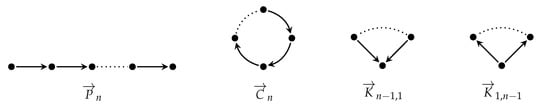
Figure 1.
Orientations of , , and .
Let and be digraphs with no common vertices. The direct sum of digraphs and , denoted by , is the digraph with vertex and arc sets and , respectively. In general, denote the direct sum of the digraphs . If for all i, then we simply write .
The following notation and concepts were introduced in [1]. Let . Let us denote by (resp. ) the number of vertices in D with out-degree (resp. in-degree) i, for all . For every , define the set
The cardinality of is denoted by . Clearly,
where a is the number of arcs D has.
A VDB topological index is a function induced by real numbers , where , defined as [1]
Equivalently,
When for all , we say that is a symmetric VDB topological index. In this case, the expression given in (2) can be simplified. In fact, let
for all , and
for all . Then
where
In particular, when is a graph, it was shown in [1] that Formula (6) reduces to
where is the number of edges in G which join vertices of degree i and j. So we recover the degree-based-topological indices of graphs, a concept which has been, and currently is, extensively investigated in the mathematical and chemical literature [2,3,4]. For recent results, we refer to [5,6,7,8,9,10,11,12].
This paper is organized as follows. In Section 2, in a general setting (Theorem 1), we find sharp lower and upper bounds of a symmetric VDB topological index over the set . As a byproduct, we obtain over sharp upper and lower bounds of well-known VDB topological indices, which include the First Zagreb index () [13], the Second Zagreb index () [13], the Randić index () [14], the Harmonic index () [15], the Geometric-Arithmetic () [16], the Sum-Connectivity () [17], the Atom-Bond-Connectivity () [18], and the Augmented Zagreb () [19].
In Section 3, based on Theorem 2, we give sharp upper and lower bounds of symmetric VDB topological indices over the set , the set of oriented trees with n vertices. In particular, we deduce sharp upper and lower bounds for the well-known indices mentioned above over . Finally, in Section 4, we consider the problem of finding the extremal values of a symmetric VDB topological index among all orientations in , the set of all orientations of a fixed graph G. In order to do this, we define strictly nondecreasing (resp. nonincreasing) symmetric VDB topological indices and show that for these indices, the value of any orientation at G is not greater (resp. smaller) than half the value at G. Moreover, equality occurs, and only if the orientation is a sink-source orientation of G. In particular, when G is a bipartite graph, we show that the sink-source orientations of G attain extremal values.
2. Bounds of VDB Topological Indices of Digraphs
From now on, when we say that is a symmetric VDB topological index, we mean that is induced by the numbers where , and it is defined as in the equivalent definitions (2), (3), or (6). In the first part of this section, we generalize several results of [20] to digraphs.
Let be a symmetric VDB topological index. Consider the function defined over the set K. For each , consider the subset of K
Recall that q is the number of vertices which are sink or source vertices of a digraph D.
Lemma 1.
Let φ be a symmetric VDB topological index and . Let . Then
Proof.
On the other hand,
Let be a symmetric VDB topological index with associated function . Define the sets
and
We will denote by and the complements of and in K, respectively. We now generalize ([20], Theorem 2.3) to digraphs.
Theorem 1.
Let φ be a symmetric VDB topological index and . Then
Moreover, equality on the left occurs, and only if for all . Equality on the right occurs, and only if for all .
Proof.
Assume that , where . By Lemma 1 and the fact that for all , we deduce
On the other hand, since for all , it is clear that
if, and only if for all . By inequality (10), this is equivalent to . The proof of the left inequality (and the equality condition) is similar. □
So by Theorem 1, in order to find extremal values of a VDB topological index over , we must find and , where . Fortunately, these were computed for the main VDB topological indices in [21] (see Table 1).

Table 1.
and for some VDB topological indices.
An important class of digraphs which occur frequently as extremal values of VDB topological indices are the arc-balanced digraphs, which we define as follows.
Definition 1.
A digraph D is arc-balanced if , for every arc of D, and .
A regular digraph is a digraph D such that , for all vertices u in D, where r is a positive integer. Clearly, every regular digraph is arc-balanced.
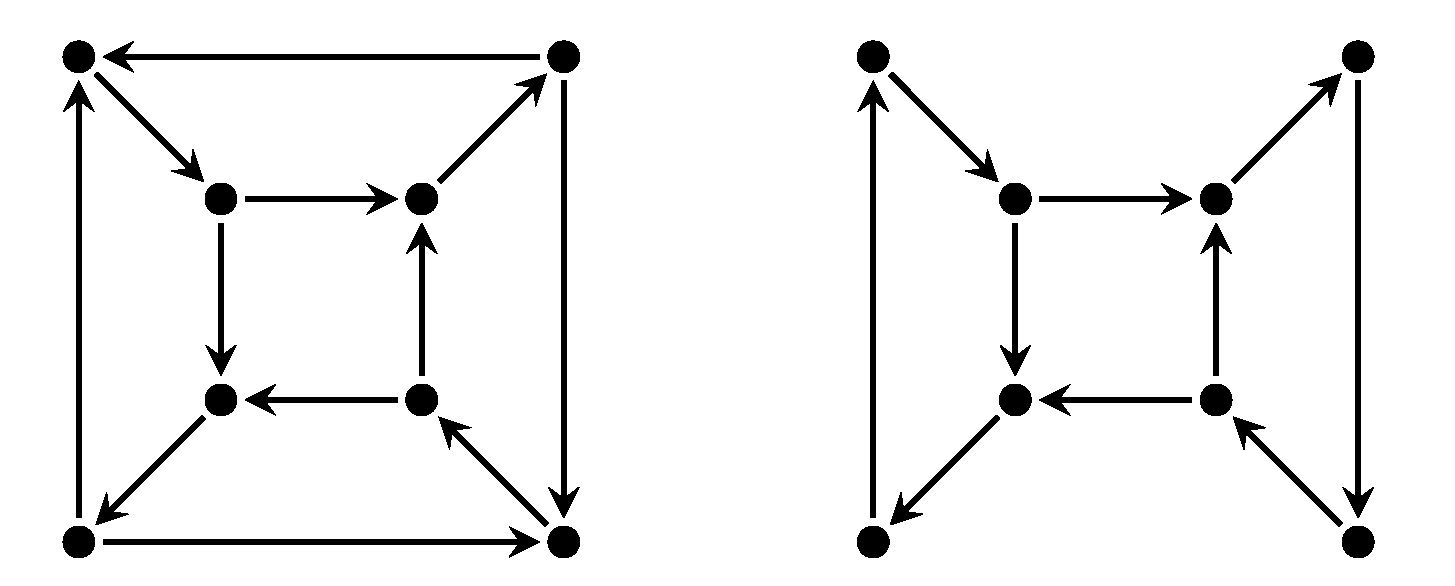
Example 1.
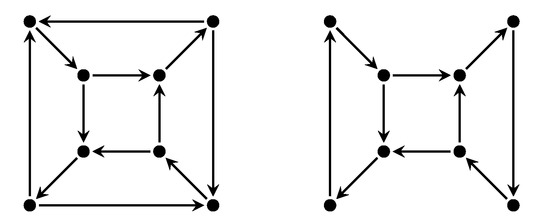
The digraphs in Figure 2 are arc-balanced but not regular digraphs.
Figure 2.
Arc-balanced digraphs.
Now we can give sharp upper and lower bounds for all VDB topological indices listed in Table 1. The following result is clear.
Lemma 2.
Let .
- 1.
- for all if, and only iffor some nonnegative integers and .
- 2.
- for all such that and ⇔ D is an arc-balanced digraph;
- 3.
- for all such that ⇔
- 4.
- for all and or
- 5.
- for all and is even and
- 6.
- for all and ⇔ n is odd and .
Lemma 3.
Assume that n is odd. Let . If , then .
Proof.
Every vertex of D is a sink vertex or a source vertex. Consequently,
where . In particular,
Since n is odd, then is also odd. Moreover, , since D has no isolated vertices. Hence,
□
Corollary 1.
Let . Then
- 1.
- (a)
- Equality on the left occurs ⇔ n is even and or n is odd, and ;
- (b)
- Equality on the right occurs
- 2.
- (a)
- Equality on the left occurs ⇔ n is even and or n is odd and ;
- (b)
- Equality on the right occurs
- 3.
- (a)
- Equality on the left occurs or
- (b)
- Equality on the right occurs is an arc-balanced digraph.
- 4.
- (a)
- Equality on the left occurs or
- (b)
- Equality on the right occurs is an arc-balanced digraph.
- 5.
- (a)
- Equality on the left occurs or
- (b)
- Equality on the right occurs
- 6.
- (a)
- Equality on the left occurs or
- (b)
- Equality on the right occurs
- 7.
- (a)
- Equality on the left occurs , for some nonnegative integers .
- (b)
- Equality on the right occurs
- 8.
- (a)
- Equality on the left occurs or
- (b)
- Equality on the right occurs
Proof.
Recall that is the associated function of the symmetric VDB topological index . The expressions for are shown in Table 2.
Table 2.
for some VDB topological Indices.
Since , we easily deduce the result from Theorem 1 and Lemma 2.
We only have to separately consider and when n is odd. By Theorem 1,
Since n is odd, , and so . Equivalently,
For the equality condition, it is clear that . Conversely, suppose that . Then by (11),
which implies . So there are only two possibilities: and . If , then by Lemma 3, . On the other hand, by Lemma 1 applied to
Thus,
which implies , a contradiction. Hence, . Consequently,
It follows from Theorem 1 that for all . Finally, by Lemma 2,
The case of when n is odd is similar.
In the case of the index, note that if, and only if . Then it is clear that
Conversely, if D is a digraph such that , then
which implies for all . Hence, by part 1 of Lemma 2, . □
Remark 1.
Using a linear programming modeling technique, the authors in [22] find some of the extremal values given in Corollary 1.
Now we give bounds of VDB topological indices in terms of the number of arcs. Let be a symmetric VDB topological index. Let us define
and
The complements in K are denoted by and , respectively.
Theorem 2.
Let φ be a symmetric VDB topological index. If D is a digraph with a arcs, then
Equality on the left occurs if, and only if for all . Equality on the right occurs if, and only if for all .
3. Bounds of VDB Topological Indices of Tree Orientations
The set of oriented trees with n vertices is denoted by . It is our interest in this section to determine the extremal values of a VDB topological index over . Clearly, for every . Hence, by Theorem 2 we deduce the following.
Corollary 2.
Let . Then
Equality on the left occurs if, and only if for all . Equality on the right occurs if, and only if for all .
Now we can obtain a first list of sharp upper and lower bounds for some VDB topological indices over .
Theorem 3.
Let . Then
- 1.
- 2.
- 3.
- 4.
- 5.
- .
Moreover, equality on the left of 1–5 occurs or . Equality on the right of 1–4 occurs .
Proof.
The inequalities on the left (and equality conditions) are immediate consequence of Corollary 1. The inequalities on the right of 1–4 are consequence of Corollary 2 having in mind Table 3.
Table 3.
and for , , , and .
We also use the fact that is such that for all if, and only if . Similarly, for all such that if, and only if . □
Theorem 4.
Let . Then
- 1.
- 2.
- 3.
Moreover, equality on the left of 1–3 occurs . Equality on the right of 1 occurs or
Proof.
The inequalities on the left of 1–3 (and equality conditions) are a consequence of Corollary 2, having in mind Table 4.
Table 4.
and for , , and .
And the fact that is such that for all if, and only if . On the other hand, the right inequality in 1 holds again by Corollary 2, bearing in mind Table 5.
Table 5.
and for .
And the fact that is such that for all if, and only if or □
The only extremal values we have not determined yet are the maximal values of and over . The problem in these indices is that , and there is no oriented tree such that for all . In the next section we will show that the maximum value of and over is attained in or (see Theorem 6). We propose the following problem.
Problem 1.
Find the maximum value of over .
4. Bounds of VDB Topological Indices over Orientations of a Fixed Graph
Let be a symmetric VDB topological index and G a graph. Let be the set of orientations of the graph G. Our main concern now is to determine the extremal values of a symmetric VDB topological index over . In order to do this, let us define a partial order over K as follows: if , then
Definition 2.
Let φ be a symmetric VDB topological index. We say that φ is nondecreasing (resp. nonincreasing) over K, if for every
Furthermore, if for every
we will say that φ is strictly nondecreasing (resp. strictly nonincreasing).
Example 2.
Consider the generalized Randić index induced by the numbers , where , . Clearly, is strictly nondecreasing when , and strictly nonincreasing when . In particular, the Randić index χ is strictly nonincreasing and the second Zagreb index is strictly nondecreasing. Additionally, the harmonic index and the sum-connectivity index are strictly nonincreasing, and the first Zagreb is strictly nondecreasing.
Theorem 5.
Let φ be a strictly nondecreasing (resp. nonincreasing) symmetric VDB topological index and G a graph. Let D be any orientation of G. Then
Equality holds if, and only if D is a sink-source orientation of G.
Proof.
We will assume that is strictly nondecreasing, and the other case is similar. Note that
for every vertex u of G. Hence, for any arc of D, . It follows by the nondecreasing property of and (3),
If D is a sink-source orientation of G, then or , for all vertices u of V. If is an arc of D then and . Hence, and , which implies by (13) that and . Hence,
Conversely, assume that . Then by (14), for every
Now since is strictly nondecreasing, for every . Finally, by (13), and . This clearly implies that D is a sink-source orientation of G. □
Corollary 3.
Let φ be a strictly nondecreasing (resp. nonincreasing) symmetric VDB topological index and G a bipartite graph. Then the maximal (resp. minimal) value of φ over is attained in a sink-source orientation of G.
Proof.
We assume that is strictly nondecreasing, and the other case is similar. Since G is a bipartite graph, G has a sink-source orientation which we call E [23]. Let D be any orientation of G. Then by Theorem 5,
□
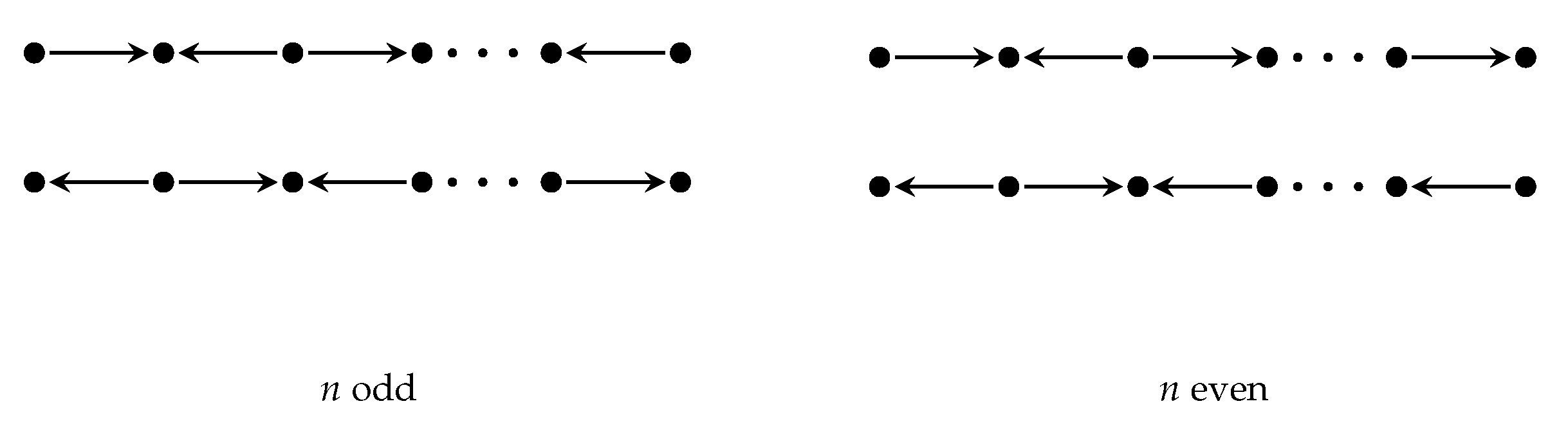
Example 3.
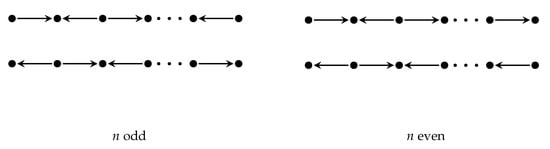
Consider the path tree . By Example 2 and Corollary 3, the sink-source orientation depicted in Figure 3 attains the maximal value for , and when , over . On the other hand, E attains the minimal value of and when , over
Figure 3.
Sink-source orientations of .
Example 4.
In [24] the authors studied the extreme values of χ on the set of all the orientations of hexagonal chains with k hexagons.
Theorem 6.
Let . Then
- 1.
- ;
- 2.
- .
Moreover, equalities 1–2 occur or
Proof.
Let G be a tree of order n. If G is different from , then [25]
Let and suppose that T is an orientation of a tree G. By Theorem 5 and the above equation,
Equality occurs if, and only if T is a sink-source orientation of , in other words, or . □
Author Contributions
The two authors have contributed equally to the article. Both authors have read and agreed to the published version of the manuscript.
Funding
This research received no external funding.
Institutional Review Board Statement
Not applicable.
Informed Consent Statement
Not applicable.
Data Availability Statement
Not applicable.
Conflicts of Interest
The authors declare no conflict of interest.
References
- Monsalve, J.; Rada, J. Vertex-degree-based topological indices of digraphs. Discrete Appl. Math. 2021, 295, 13–24. [Google Scholar] [CrossRef]
- Devillers, J.; Balaban, A.T. (Eds.) Topological Indices and Related Descriptors in QSAR and QSPR; Gordon & Breach: Amsterdam, The Netherlands, 1999. [Google Scholar]
- Gutman, I. Degree-based topological indices. Croat. Chem. Acta 2013, 86, 351–361. [Google Scholar] [CrossRef]
- Todeschini, R.; Consonni, V. Handbook of Molecular Descriptors; Wiley–VCH: Weinheim, Germany, 2000. [Google Scholar]
- Ali, A.; Furtula, B.; Gutman, I.; Vukičević, D. Augmented Zagreb index: Extremal results and bounds. MATCH Commun. Math. Comput. Chem. 2021, 85, 211–244. [Google Scholar]
- Cui, S.Y.; Wang, W.; Tian, G.X.; Wu, B. On the arithmetic-geometric index of graphs. MATCH Commun. Math. Comput. Chem. 2021, 85, 87–107. [Google Scholar]
- Das, K.C.; Rodríguez, J.M.; Sigarreta, J.M. On the maximal general ABC index of graphs with given maximum degree. Appl. Math. Comput. 2020, 386, 125531. [Google Scholar] [CrossRef]
- Gutman, I. Geometric approach to degree based topological indices: Sombor indices. MATCH Commun. Math. Comput. Chem. 2021, 86, 11–16. [Google Scholar]
- Horoldagva, B.; Xu, C. On Sombor index of graphs. MATCH Commun. Math. Comput. Chem. 2021, 86, 703–713. [Google Scholar]
- Molina, E.D.; Rodríguez, J.M.; Sánchez, J.L.; Sigarreta, J.M. Some Properties of the Arithmetic–Geometric Index. Symmetry 2021, 13, 857. [Google Scholar] [CrossRef]
- Rodríguez, J.M.; Sánchez, J.L.; Sigarreta, J.M.; Tourís, E. Bounds on the arithmetic-geometric index. Symmetry 2021, 13, 689. [Google Scholar] [CrossRef]
- Sigarreta, J.M. Mathematical Properties of Variable Topological Indices. Symmetry 2021, 13, 43. [Google Scholar] [CrossRef]
- Gutman, I.; Trinajstić, N. Graph theory and molecular orbitals. Total π-electron energy of alternant hydrocarbons. Chem. Phys. Lett. 1972, 17, 535–538. [Google Scholar] [CrossRef]
- Randić, M. On characterization of molecular branching. J. Am. Chem. Soc. 1975, 97, 6609–6615. [Google Scholar] [CrossRef]
- Zhou, B.; Trinajstić, N. On a novel connectivity index. J. Math. Chem. 2009, 6, 1252–1270. [Google Scholar] [CrossRef]
- Vukičević, D.; Furtula, B. Topological index based on the ratios of geometrical and arithmetical means of end-vertex degrees of edges. J. Math. Chem. 2009, 46, 1369–1376. [Google Scholar] [CrossRef]
- Zhong, L. The harmonic index for graphs. Appl. Math. Lett. 2012, 25, 561–566. [Google Scholar] [CrossRef] [Green Version]
- Estrada, E.; Torres, L.; Rodríguez, L.; Gutman, I. An atom-bond connectivity index: Modelling the enthalpy of formation of alkanes. Indian J. Chem. 1998, 37A, 849–855. [Google Scholar]
- Furtula, B.; Graovac, A.; Vukičević, D. Augmented Zagreb index. J. Math. Chem. 2010, 48, 370–380. [Google Scholar] [CrossRef]
- Rada, J.; Cruz, R. Vertex-degree-based topological indices over graphs. MATCH Commun. Math. Comput. Chem. 2014, 72, 603–616. [Google Scholar]
- Cruz, R.; Pérez, T.; Rada, J. Extremal values of vertex-degree-based topological indices over graphs. J. Appl. Math. Comput. 2015, 48, 395–406. [Google Scholar] [CrossRef]
- Deng, H.; Yang, J.; Tang, Z.; Yang, J.; You, M. On the vertex-degree based invariants of digraphs. arXiv 2021, arXiv:2104.14742. [Google Scholar]
- Monsalve, J.; Rada, J. Oriented bipartite graphs with minimal trace norm. Linear Multilinear Algebra 2019, 67, 1121–1131. [Google Scholar] [CrossRef]
- Bermudo, S.; Monsalve, J.; Rada, J. Orientations of hexagonal chains with extremal values of the Randić index. Int. J. Quantum Chem. 2021, 121, e26744. [Google Scholar] [CrossRef]
- Deng, H. A unified approach to the extremal Zagreb indices for trees, unicyclic graphs and bicyclic graphs. MATCH Commun. Math. Comput. Chem. 2007, 57, 597–616. [Google Scholar]
Publisher’s Note: MDPI stays neutral with regard to jurisdictional claims in published maps and institutional affiliations. |
© 2021 by the authors. Licensee MDPI, Basel, Switzerland. This article is an open access article distributed under the terms and conditions of the Creative Commons Attribution (CC BY) license (https://creativecommons.org/licenses/by/4.0/).