1. Introduction
A graph is a couple
, where
is a set of vertices and
is a set of edges, and
. The two ends of an edge are called two adjacent vertices. The set of pairwise non-adjacent vertices is called an independent set. A graph
is called simple if it has no loops and multiple edges. Several research papers of graph theory concerning the study of simple graphs have been produced [
1].
Definition 1. Letandbe positive integers. A complete bipartite graph onvertices, denoted byis a simple graph with distinct verticesandthat satisfies the following properties: For all, and for all
- 1.
There exists an edge from each vertexto each vertex.
- 2.
There is no edge from any vertexto any other vertex.
- 3.
There is no edge from any vertexto any other vertex.
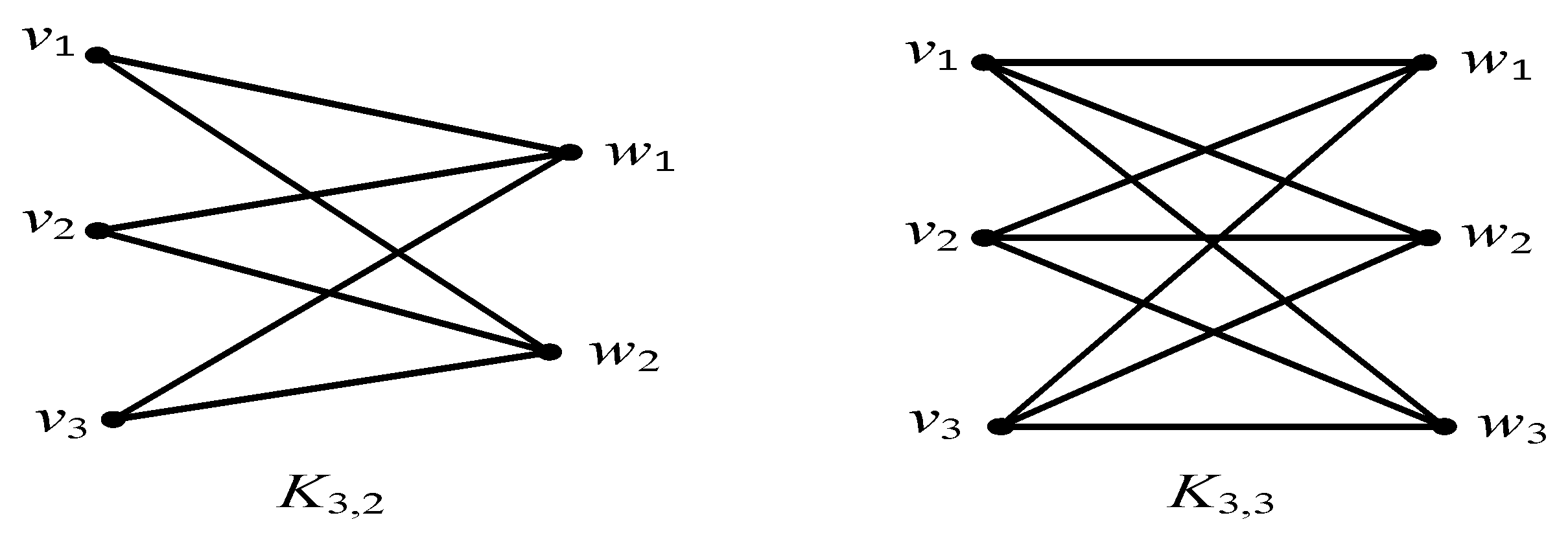
Definition 2. The complete bipartite graphsandare illustrated in Figure 1. Bipartite graphs assume conspicuous functions in graph theory [
2]. For instance, bipartite graphs are very helpful for studying problems of matching, such as job matching problem. Furthermore, bipartite graphs have very essential roles in theoretical consideration. For example, bipartite graphs can be used to describe the multipartite graphs [
3].
A Latin square with order
is an
matrix whose entries are taken from a set
with
, where all elements of
appear precisely one time in each row and each column. A pair of Latin squares with order
are called orthogonal to each other if when one is overlaid on the other the ordered pairs (
) of corresponding entries contain all possible
pairs,
. A family of
Latin squares of order
(any two of them being orthogonal) is said to be a set of mutually orthogonal Latin squares (MOLS). The applications of MOLS are common, famous, and can be studied in many textbooks (see Laywine et al., [
4] as an example). The reader can see [
5], for a brief review of MOLS constructions.
Assume that
is a subgraph of
with size
(number of its edges). A square matrix
of order
is called a
-square if each element in
appears precisely
times, and all graphs
where
are isomorphic to
The index set for the rows and columns of
is the group
. The two graph squares have the property that, when superimposed, every ordered pair occurs exactly once. Thus the squares are orthogonal. A set of graph squares
is pairwise orthogonal, or a collection of MOGS, if
and
are orthogonal for each
. For a survey of MOGS, see [
6,
7,
8,
9,
10,
11].
Hereafter, we will need the Kronecker product of the graph squares. As such, assume that
is a graph square of order
and that
is a graph square of order
. Let us indicate the entry at row
and column
of
by
In the same way, we indicate the
entry of
by
Hence the Kronecker type product of
and
is the
square
presented by
Such that each entry
of
is the
matrix
For clearing this Kronecker type product structure, for
assume
Then, the Kronecker product’s construction gives the ensuing 6 × 6 matrix, whose entries are ordered pairs
Orthogonal arrays are essential in statistics where they are basically utilized in experimental design, hence they are immensely important in medicine, manufacturing and agriculture. The applications of orthogonal arrays in the statistical design of experiments are common, well-known, and can be studied from many textbooks (for instance, see Hedayat et al., [
12]). Furthermore, they are used in cryptography and computer science. Officially, an orthogonal array can be characterized as follows.
Definition 3. [
12]
Anmatrixwhose entries are taken fromis called an orthogonal array withlevels, strengthand indexfor somein the rangeif allsubarrays ofcontaining each-tuple rely onpreciselytimes in a row. The integersandare considered the parameters of the orthogonal array which will be symbolized byThe orthogonal arrays with index unityare concerned here. Example 1. The following array is an orthogonal array relying on two levels (= 2, i.e., all the elements in the array take only two values, 0 or 1), with a strength of three, of index unity, with eight runs and with four factors (variables). In an orthogonal array with a strength of three (with two levels), by taking any three column we will find each of the eight possibilities 000, 010, 001, 011, 101, 100, 110 and 111 equally as often. A few creators like to speak of an orthogonal array as a array rather than an array. This saves the number of lines. The transposed array will be shown in our illustrations to save lines. Certain orthogonal arrays can be utilized to build MOLS, and conversely MOLS give a tool for building orthogonal arrays. Although Latin squares have numerous valuable properties, for some measurable applications these structures are excessively restrictive. The broader ideas of graph squares and MOGS offer greater adaptability. As such, MOGS likewise give an apparatus for building orthogonal arrays. This latter aspect is what concerns us in this paper.
The remaining part of the work is arranged as follows: Graph-orthogonal arrays by mutually orthogonal graph squares are given in
Section 2. Recursive constructions of the graph-orthogonal arrays are presented in
Section 3. For illustration, the applications of the graph-orthogonal arrays in the design of experiments are shown in
Section 4. Finally, the conclusion is given in
Section 5.
2. Graph-Orthogonal Arrays by Mutually Orthogonal Graph Squares
Many results of Latin squares can be stated in terms of transversal designs, defined as follows: A transversal design with groups of size and index denoted by , is a triple , where
is a set of elements;
is a family of -sets or groups which form a partition of ;
is a family of -sets or blocks of elements so that each -set in intersects each group in exactly one element, and any pair of elements from different groups occurs together in exactly blocks in
The partition of a set is a collection of disjointed subsets of whose union is . The disjoint means that for any two distinct subsets and we find that
Example 2. Table 1shows the groups and blocks of atransversal design. Theorem 1. ([
4])
. The existence of a transversal design is equivalent to the existence of a set of MOLS of order Example 3. The transversal design given in Example 2 can be used to give a better illustration of Theorem 1 by constructing a pair of MOLS, and, of order three. For more illustration, the symbols in cell (1, 1) of the Latin squares will be determined. Consider the elements of the design. They are together in blockwith the elementsAs such, the element in cell (1,1) ofis 1, while that ofis 1.Table 2 illustrates the construction and the Latin squaresand It is easy to check that an orthogonal array has a transversal design, and vice versa. The preceding is summarized by the following.
Theorem 2. ([
4]).
The following are equivalent:- 1.
MOLS of order;
- 2.
a transversal design;
- 3.
an orthogonal array.
Example 4. The following array (from Theorem 2 and the two MOLS of order three given in Example 3) gives an example of an orthogonal array The transpose of this array is as follows, where the first two rows represent the position after calculating its elements modulo 3.Note that after obtaining the orthogonal array from the MOLS, we can add additional two rows (the first and the second rows). These two rows represent the position of the cells in the MOLS. As such, it is easy to check that an orthogonal array is a transversal design, and vice versa.
Definition 4. If we havemutually orthogonal-squares, then by converting these squares to anarray by juxtaposing therows of the square and transposing, we get the graph-orthogonal array-by combining these arrays to form anarray.
In this section, we prove that if there are mutually orthogonal -squares of order , then there is a - Proposition 1, there are some new results for the orthogonal arrays as directly applied to Proposition 1.
Proposition 1. The existence ofmutually orthogonal-squares based onsymbols implies the existence of an-orthogonal array-
Proof. The technique of the construction can be shown as follows. Convert each of the mutually orthogonal -squares to an array by juxtaposing the rows of the -square and transposing. Then, these arrays are combined to construct an array. Since there are mutually orthogonal -squares based on symbols, the number of the levels equals , since the -squares are mutually orthogonal, then the superimposition of any two columns of the array gives , the array has strength two. □
Example 5. We have the three mutually orthogonal-squaresand; see [12]Thenwe obtain the array-this array can be represented by the, whereis the transpose ofAll the following results are based onProposition 1 andthe existence of MOGS for some classes of graphs that can be used as ingredients for obtaining new graph-orthogonal arrays. Consider the addition is calculated moduloof orderSee[11] for the ingredients fromtoThese ingredients are as follows. - (I)
Themutually orthogonal-squares areis a primeand.
- (II)
Themutually orthogonal-squares areand
- (III)
If, thenmutually-and.
- (IV)
I, thenmutually-let,then
- (V)
Themutually orthogonal-squares arewhereis a prime greater than; see [9].
Theorem 3. The existence ofmutually orthogonal-squares based onsymbols implies the existence of a-orthogonal array-
Proof. The technique of the construction can be shown as follows. Convert each of the mutually orthogonal -squares (Ingredient ) to an array by juxtaposing the rows of the -square and transposing. Then, these arrays are combined to construct an array. Since there are mutually orthogonal -squares based on symbols, the number of the levels equals , since the -squares are mutually orthogonal, the superimposition of any two columns of the array gives , the array has strength two. □
Theorem 4. The existence ofmutually orthogonal-squares based onsymbols implies the existence of an-orthogonal array-
Proof. The technique of the construction can be shown as follows. Convert each of the mutually orthogonal -squares (Ingredient ) to an array by juxtaposing the rows of the -square and transposing. Then, these arrays are combined to construct an array. Since there are mutually orthogonal -squares based on symbols, the number of the levels equals , since the -squares are mutually orthogonal, the superimposition of any two columns of the array gives , the array has strength two. □
Lemma 1. The existence ofmutually orthogonal-squares based onsymbols implies the existence of an-orthogonal array-
Proof. The technique of the construction can be shown as follows. Convert each of the mutually orthogonal -squares (Ingredient ) into an array by juxtaposing the rows of the -square and transposing. Then, these arrays are combined to construct an array. Since the mutually orthogonal -squares are based on symbols, the number of the levels equals , since the (-squares are mutually orthogonal, then the superimposition of any two columns of array gives , the array has strength two. □
Lemma 2. The existence offour mutually orthogonal-squares based onsymbols implies the existence of an-orthogonal array-
Proof. The technique of the construction can be shown as follows. Convert each of the mutually orthogonal -squares (Ingredient ) to a array by juxtaposing the seven rows of the -square and transposing. Then, these arrays are combined to construct an array. Since the mutually orthogonal -squares are based on symbols, the number of the levels equals , since the (-squares are mutually orthogonal, the superimposition of any two columns of the array gives the array has strength two. □
Theorem 5. The existence ofmutually orthogonal-squares based onsymbols implies the existence of a-orthogonal array-
Proof. The technique of the construction can be shown as follows. Convert each of the mutually orthogonal -squares (Ingredient ) into an array by juxtaposing the rows of the -square and transposing. Then, these arrays are combined to construct an array. Since the mutually orthogonal -squares are based on symbols, the number of the levels equals , since the -squares are mutually orthogonal, then the superimposition of any two columns of the array gives , the array has strength two. □
Lemma 3. The existence ofthree mutually orthogonal-squares based onsymbols implies the existence of an-orthogonal array-
Proof. We have
mutually orthogonal
-squares; see [
6]. The three mutually orthogonal
-squares of order
are defined as follows, where
and
Convert each of the
mutually orthogonal
-squares into an
array by juxtaposing the
rows of the
-square and transposing. Then, these arrays are combined to construct a
array,
Since the mutually orthogonal -squares are based on symbols, the number of levels equals , since the three -squares are mutually orthogonal, the superimposition of any two columns of the array gives 16 different ordered pairs i.e., the array has strength two. □
Lemma 4. The existence ofmutually orthogonal-squares based onsymbols implies the existence of a-orthogonal array-
Proof. We have
mutually orthogonal
-squares; see [
7]. The three mutually orthogonal
-squares of order
are defined as follows, where
and
Convert each of the three mutually orthogonal 4 × 4
-squares into a 16 × 1 array by juxtaposing the four rows of the
-square and transposing. Then, these arrays are combined to construct a 16 × 3 array,
,
Since the
mutually orthogonal
-squares are based on
symbols, the number of levels equals four
, since the three
-squares are mutually orthogonal, then the superimposition of any two columns of the
array gives 16 different ordered pairs, i.e., the
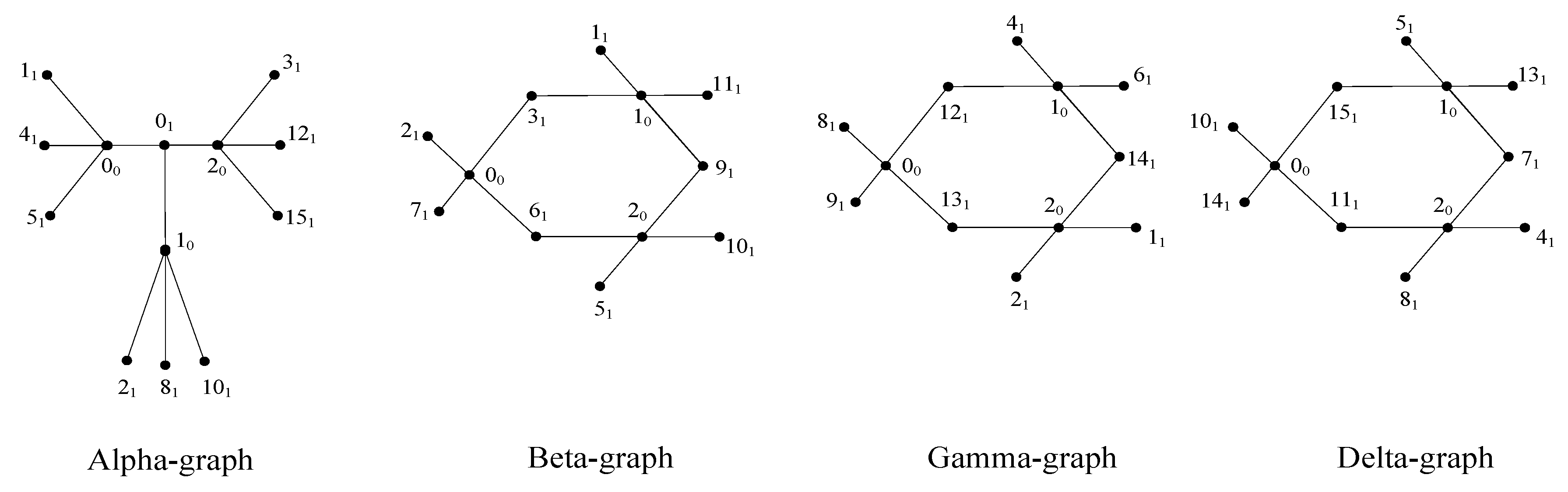
array has strength two. The
-
,
T, can be represented by the edge decomposition (as the graph squares), as shown in
Figure 2. □
In the following example, we convert the - to mutually orthogonal -squares by reversing the technique in the proof of Proposition 1.
Example 6. We have the array where
Now, we convert this array into three mutually orthogonal squares, and It is clear that the squares are three mutually orthogonal
-squares. See
Figure 3,
Figure 4 and
Figure 5.