


Abstract
The time–fractional reaction–diffusion (TFRD) model has broad physical perspectives and theoretical interpretation, and its numerical techniques are of significant conceptual and applied importance. A numerical technique is constructed for the solution of the TFRD model with the non-singular kernel. The Caputo–Fabrizio operator is applied for the discretization of time levels while the extended cubic B-spline (ECBS) function is applied for the space direction. The ECBS function preserves geometrical invariability, convex hull and symmetry property. Unconditional stability and convergence analysis are also proved. The projected numerical method is tested on two numerical examples. The theoretical and numerical results demonstrate that the order of convergence of 2 in time and space directions.
1. Introduction
Fractional calculus (FC) is described as an extension to arbitrarily non-integer order of ordinary differentiation. Due to its extensive implementations in the engineering and science fields, its research has attained considerable significance and prominence during the last few years. FC is being used for modeling physical phenomena by fractional-order differential equations (FODEs). Nowadays, several other relevant areas of FC are found in numerous fields of application such as chemistry, electricity, biology, mechanics, geology, economics, signal processing, and image theory [1,2,3,4]. Although, fractional-order derivatives have a significant model for detecting inherited characteristics of various conditions and treatments.
The reaction–diffusion equations (RDEs) emerge naturally as models for explaining several problems’ adaptation in the physical world, such as chemistry, biology, etc. The RDEs are used to explain the co-oxidation on Pt(1 1 0), the overview of the time–space variations of cytoplasmic dynamics in T cells under the impacts of -activated released channels, the problem in finance and hydrology. Several cellulars and sub-cellular biological mechanisms can be defined in the forms of species that diffuse and react chemically [5,6,7]. The structure of diffusion is defined by a time scaling of the mean square displacement proportional to of order . Many physical models are more accurately established in the form of FODEs. Fractional derivatives are more efficient in the model and provide an excellent tool to explain the history of the variable and the inherited properties of different dynamic systems. The TFRD model provides a valuable description of dynamics in complex processes defined by non-exponential relaxation and irregular diffusion [8,9]. In the TFRD model, the time derivative defines the extent-based physical phenomena, recognized as historical physical dependence, the spatial derivative explains the path dependence and global characteristics of physical processes [10].
Consider the TFRD model of the form [11]:
having initial and boundary conditions:
where is a constant, is a diffusivity constant and , , , are known functions. is a Caputo–Fabrizio fractional derivative (CFFD) and . The CFFD has introduced a new aspect to the research of FODEs. However, the Caputo, Riemann–Liouville, etc. operators exhibit a kernel for power-law and have shortcomings in modeling physical problems. The elegance of the CFFD operator is that it contains a non-singular kernel with exponential decay [12]. It is constructed with an exponential function and ordinary derivative convolution but as for the Caputo and Riemann–Liouville fractional derivatives, it preserves the same inherent inspiring characteristics of heterogeneous and configuration for various scales [13,14]. Application of CFFD has been discussed in several articles recently, for example, in a mass–spring Damper system [15], non-linear Fisher’s diffusion model [16], electric circuits [13], diffusive transport system [14], fractional Maxwell fluid [17].
In many cases, the fractional reaction–diffusion model (FRDM) has no analytical exact solution because of the non-locality of fractional derivatives. Therefore, the numerical solution of TFRD equation has fundamental scientific importance and functional and practical implementation significance. Rida et al. [18] solved the TFRD model via a generalized differential transform method. Turut and Güzel [19] applied Caputo derivative and multivariate Padé approximation to solve TFRD model numerically. Gong et al. [20] developed a numerical method depend on the domain decomposition algorithm for solving TFRD equation. Sungu and Demir [21] derived the hybrid generalized differential method and finite difference method (FDM) for solving the TFRD model numerically. Several numerical techniques for the TFRD model are seen in literature; such as explicit FDM [22], -Galerkin mixed finite element method [23], implicit FDM [24], the explicit–implicit and implicit–explicit method [10], Legendre tau spectral method [25]. Ersoy and Dag [26] solved the FRDM using the exponential cubic B-spline technique. Zheng et al. [27] presented the numerical algorithm of FRDM with a moving boundary using FDM and spectral approximation. Owelabi and Dutta [28] considered the Laplace and the Fourier transform to solve FRDM numerically. Zeynab and Habibollah [29] solved the fractional reaction–convection–diffusion model numerically using wavelets operational matrices and B-spline scaling functions. Kanth and Garg [11] proposed the exponential cubic B-spline for solving the TFRD equation with Dirichlet boundary conditions. Pandey et al. [30] obtained the numerical solution of TFRD equation in porous media using homotopy perturbation and Laplace transform.
The ECBS is a very well-known approximation method consisting of a free parameter within the interval and piecewise polynomial function of class . Akram et al. [31,32] solved the time-fractional diffusion problems using ECBS in Caputo and Riemann–Liouville sense. Various numerical techniques based on ECBS functions have been used to approximate fractional partial differential models, such as linear and non-linear time-fractional telegraph models [33,34], fractional Fisher’s model [35], time fractional Burger’s model [36], fractional Klein–Gordon model [37], time-fractional diffusion wave model [38], fractional advection-diffusion model [39].
The goal of this research is to explore a numerical technique for the TFRD model, which is an implicit method and is based on ECBS and CFFD methods. This non-singular kernel operator is used in B-spline methods for the first time. The TFRD model has not been developed to the highest of the author’s understanding so far with the ECBS approximation. The paper is set out as follows: the CFFD operator and ECBS function are defined in Section 2. Time discretization in terms of FDM is explained in Section 3. To solve the TFRD model, the CFFD and ECBS are implemented in Section 4. The unconditional stability and the convergence are proved in Section 5 and Section 6, respectively. Section 7 and Section 8 consist of numerical results and the conclusion.
2. Preliminaries
Definition 1.
The CFFD [12] is formulated as follows:
where is a normalizing function, so .
By Definition 1, it can be concluded that if is a constant function then CFFD of is zero similar to Caputo derivative. However, the kernel has no singularity. The CFFD with order can be defined as [40]:
Basis Functions
Consider being an equal length partitioning based on the existing interval with . Hence the presumed interval at the knots is divided into N equivalent sub-intervals as , where h is the step-size. The ECBS function [41] at the grid points over the presumed interval is formulated as follows:
where , in the is a parameter and is a variable. For , the cubic B-spline and the ECBS functions have the identical properties, such as symmetry in which the identical curve shape is produced if the control points are defined in the reverse order, convex hull, and invariability which are also called rotation, translation and scaling respectively. For , the ECBS converts to cubic B-spline. Figure 1 depicts the basis graphs at different knots and the colored parts are the piece-wise function. The same shape of the curve is generated when the control points are described in the opposite direction.
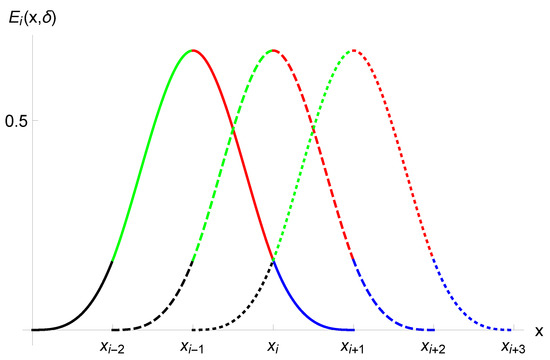
Figure 1.
Plot of the extended cubic B-spline (ECBS) function.
3. Finite Difference Approximation for CFFD
In this part, we consider CFFD for the discretization in time dimension. Suppose in which is the step length in time direction. The FDM is employed for the discretization of CFFD. Using the Equation (4), CFFD can be described as:
For , the above equation becomes
For , we obtain
The generalized form can be written as
where , The characteristics of coefficients can be easily proved:
- , as
- for
- .
Remark 1.
The graphical results of shows the asymptotic behaviour.
Theorem 1.
Suppose be a function satisfies and the fractional derivative . Then the CFFD at knot is
Proof.
From (10), we have
By expanding, we have
From the Taylor series of exponential function, we obtain
Therefore, we obtained the desired result
□
4. Illustration of the Method
In this portion, we employ the CFFD and the ECBS to establish the numerical approach for solving TFRD equation. Using relations (6) and (10) in Equation (1), we obtain
Rearranging Equation (13), we have
The aforementioned equation can be written as
The Equation (14) can be expressed in matrix form as
where
, , , , , , and . The above matrix system has of order . Two linear equations from the boundary conditions are necessary for a unique solution. To commence the iteration on the system, obtaining the initial vector is mandatory and we will use following initial conditions for the initial vector:
5. Stability Analysis
The principle of stability is connected to computing method errors which do not rise as the procedure continues. We will analyze the stability using the Von Neumann approach. Suppose in the form of Fourier mode represents the growth factor and is the computed solution. Consequently, we defined the error term at mth time stage as
Assume that the difference equation for the ECBS function in one Fourier mode as
where and are the size of the element, Fourier coefficient, mode number respectively. Using the Equation (21) and ECBS functions in (20), we obtain
All throughout divided by and reorganization of the terms, we achieve
Taking the term common on both sides then dividing by , we attain
where , .
Proposition 1.
Let be the solution of TFRD Equation (1), we have
Proof.
We verify this result with the assistance of mathematical induction. Substitute in Equation (22), we acquire
Since , we have
Assume that for For , we have
Thus , so that This implies that the proposed method for TFRD model is unconditionally stable. □
6. Convergence Analysis
First we recall some important findings to explain the convergence analysis.
Theorem 2
([42,43]). Notice that , and is subdivided at the equidistant knots with step length h. If is the ECBS approximation for solving TRFD model at knots , then there are free of h, such that
Lemma 1
Theorem 3.
The be the computational solution to the analytical of the TFRD model. Furthermore, if , we obtain
where constant is a free of h and h is sufficiently small.
Proof.
Assume that is the determined solution to the . Allow the present method for TFRD equation to achieve collocation condition as
The difference equation of ECBS method for the TFRD model at mth time level, can be stated as
and the boundary conditions are mentioned below:
where
From Theorem 2, it is clear that
Define and For in (27), we have
This implies
Take absolute values of , and from the initial condition , we obtain
The following relations can be obtained from the boundary conditions:
Therefore
Here is independent of h. Assume that for . Let then from (27), we attain
Taking absolute values of , , we obtain
Similarly from the boundary conditions, we get
Hence, for every m, we have
From the above inequality and Theorem 1, we get
By employing the triangular inequality, we have
7. Illustration of Numerical Results
In this portion, we will go through some numerical results for the ECBS technique. The theoretical statements were verified with errors. All computational results can be carried out in any programming language. The errors between the results obtained by the ECBS and the analytical results and are estimated as
The following definition can be employed numerically evaluate the convergence order:
where and are the errors at nodal points and .
Example 1.
Consider the TFRD of the form:
with
where and analytical solution is [11].
Table 1 shows the comparison of computational and analytical values corresponding to various , and at . Table 2 displays the maximum errors and the order of convergence for , and , respectively corresponding to numerous and h at . Table 3 displays the and errors at and corresponding . The piece-wise solutions of Example 1 for , , at are shown in Equation (31). The polynomial also shows that the solution based on the basis function of degree 4. Figure 2 and Figure 3 depict the graphs of computational outcomes at dissimilar time sizes and errors at different corresponding . Figure 4 illustrates the space–time plot for , and at . The graphical and computational results show that as we increase the number of partitioning in time–space directions, errors decrease.

Table 1.
The computational and exact values for at .
Table 2.
The maximum errors and order for , corresponding and h.
Table 3.
and for at various time.
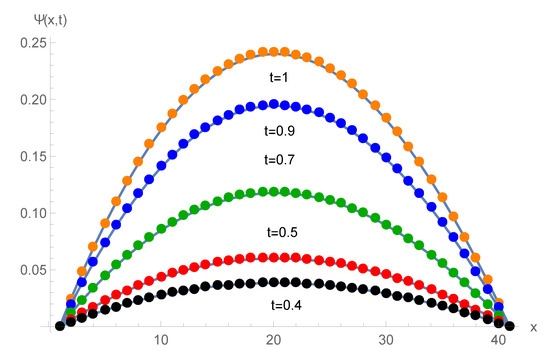
Figure 2.
Numerical solution corresponding to time at .
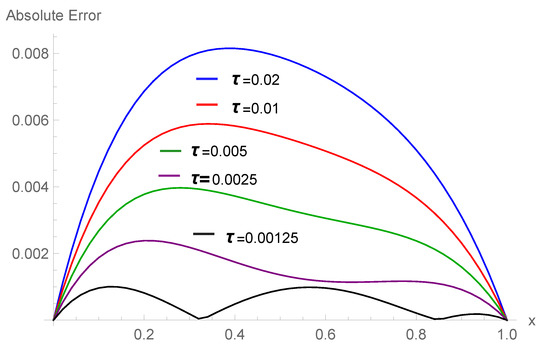
Figure 3.
Error plot corresponding to for , at .
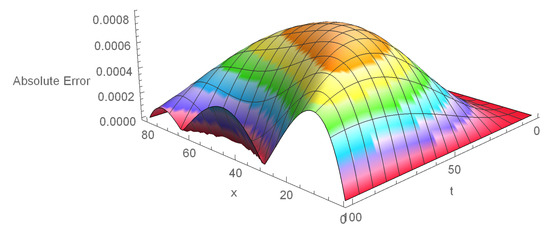
Figure 4.
Space–time plot of errors corresponding , .
The piece-wise solution can be attained as:
Example 2.
Consider the TFRD of the form:
with
where and analytic solution is [10,11].
Table 4 exhibits the maximum errors and order of convergence for , different and h. Table 5 demonstrates that the comparison of computational and exact values corresponding different , and . Table 6 displays the and errors at and corresponding . The computational values show that these results are compatible with the exact solutions. The piece-wise solutions of Example 2 for , , at are presented in Equation (32). This polynomial also presents that we have utilized the degree 4 basis function to obtain the computational outcomes. Figure 5 displays the numerical values at different time levels while Figure 6 and Figure 7 depict the comparison of errors for at and space–time graph of absolute errors for , and at .
Table 4.
The errors and order for corresponding and h.
Table 5.
The computational values and exact values of Example 2 corresponding at .
Table 6.
and for at various time.

Figure 5.
Numerical solution of Example 2 at , .
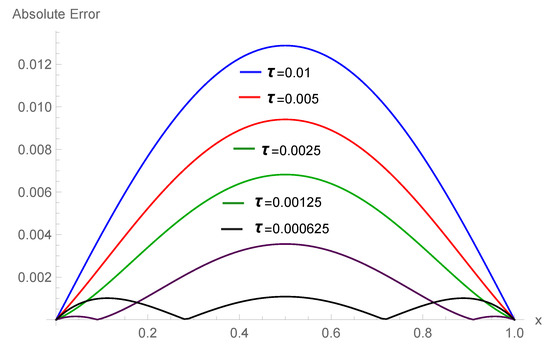
Figure 6.
Absolute errors corresponding , at .
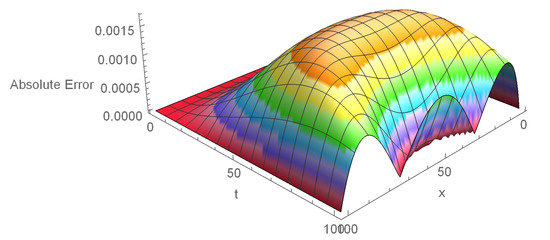
Figure 7.
Space–time error plot for , at .
The piece-wise solution can be attained as:
8. Conclusions
A ECBS collocation approach for the solution of the TFRD model was reported in this research paper. ECBS was employed for space discretization while CFFD was applied for time direction. The CFFD operator is used for the first time in B-spline methods. The operator is successfully utilized for the ECBS method. This approach has order 2 accuracy in time and space dimensions. Thus, the ECBS method with a non-singular kernel leads to accurate computational results. A variety of computational examples have validated the ECBS collocation approach.
Author Contributions
Conceptualization, T.A.; methodology, T.A. and M.A.; software, T.A. and A.A.; validation, T.A. and M.A.; formal analysis, T.A., M.A. and A.I.; writing—original draft preparation, T.A.; discussions, T.A., A.A. and D.B. writing—review and editing, M.A., D.B.; funding acquisition, D.B.; All authors have read and approved to the published version of the manuscript.
Funding
This research received no external funding.
Acknowledgments
The authors would like to thank the anonymous referees for their careful reading of this manuscript and also for their constructive suggestions which considerably improved the article.
Conflicts of Interest
The authors declare no conflict of interest.
Abbreviations
This manuscript employs the following abbreviation:
| RDEs | Reaction-diffusion equations |
| TFRD | Time fractional reaction-diffusion |
| ECBS | Extended cubic B-spline |
| FC | Fractional calculus |
| FODEs | Fractional order differential equations |
| CFFD | Caputo–Fabrizio fractional derivative |
| FRDM | Fractional reaction-diffusion model |
| FDM | Finite difference method |
References
- Murray, J.D. Mathematical Biology; Springer: New York, NY, USA, 2003. [Google Scholar]
- Kuramoto, Y. Chemical Oscillations Waves and Turbulence; Dover Publications, Inc.: Mineola, NY, USA, 2003. [Google Scholar]
- Wilhelmsson, H.; Lazzaro, E. Reaction–Diffusion Problems in the Physics of hot Plasmas; Institute of Physics Publishing: Bristol, UK; Philadelphia, PA, USA, 2001. [Google Scholar]
- Hundsdorfer, W.; Verwer, J.G. Numerical Solution of Time Dependent Advection-Diffusion-Reaction Equations; Springer: Berlin, Germany, 2003. [Google Scholar]
- Bar, M.; Gottschalk, N.; Eiswirth, M.; Ertl, G. Spiral waves in a surface reaction: Model calculations. J. Chem. Phys. 1994, 100, 1202–1214. [Google Scholar] [CrossRef]
- Mainardi, F.; Raberto, M.; Gorenflo, R.; Scalas, R. Fractional calculus and continuous-time finance. II: The waiting-time distribution. Physica A 2000, 287, 468–481. [Google Scholar] [CrossRef]
- Benson, D.A.; Wheatcraft, S.; Meerschaert, M.M. Application of a fractional advection-dispersion equation. Water Resour. Res. 2000, 36, 1403–1412. [Google Scholar] [CrossRef]
- Metzler, R.; Klafter, J. The random walks guide to anomalous diffusion: A fractional dynamics approach. Phys. Rep. 2000, 339, 1–77. [Google Scholar] [CrossRef]
- Hafez, R.M.; Youssri, Y.H. Jacobi collocation scheme for variable-order fractional reaction sub-diffusion equation. Comput. Appl. Math. 2018, 37, 5315–5333. [Google Scholar] [CrossRef]
- Zhang, J.; Yang, X. A class of efficient difference method for time fractional reaction-diffusion equation. Comput. Appl. Math. 2018, 37, 4376–4396. [Google Scholar] [CrossRef]
- Kanth, A.S.V.R.; Garg, N. A numerical approach for a class of time-fractional reaction-diffusion equation through exponential B-spline method. Comput. Appl. Math. 2019, 39, 09–37. [Google Scholar] [CrossRef]
- Caputo, M.; Fabrizio, M. A new Definition of Fractional Derivative without Singular Kernel. Prog. Fract. Differ. Appl. 2015, 1, 73–85. [Google Scholar]
- Atangana, A.; Alkahtani, B.S.T. Extension of the resistance inductance, capacitance electrical circuit of fractional derivative without singular kernel. Adv. Mech. Eng. 2015, 7, 1–6. [Google Scholar] [CrossRef]
- Gómez-Aguilar, J.F.; L’opez-L’opez, M.G.; Alvarado-Mart’ınez, V.M.; Reyes-Reyes, J.; Adam-Medina, M. Modeling diffusive transport with a fractional derivative without singular kernel. Physica A 2016, 447, 467–481. [Google Scholar] [CrossRef]
- Gomez, J.F.; Martinez, H.Y.; Ramon, C.C.; Orduna, I.C.; Jimenez, R.F.E.; Peregrino, V.H.O. Modeling of a mass-spring-damper system by fractional derivative with and without a singular kernel. Entropy 2015, 17, 6289–6303. [Google Scholar] [CrossRef]
- Atangana, A. On the new fractional derivative and application to nonlinear Fisher’s reaction-diffusion equation. Appl. Math. Comput. 2016, 273, 948–956. [Google Scholar] [CrossRef]
- Yang, X.J.; Zhang, Z.Z.; Srivastava, H.M. Some new applications for heat and fluid flows via fractional derivatives without singular kernel. Therm. Sci. 2016, 20, 833–839. [Google Scholar] [CrossRef]
- Rida, S.Z.; El-sayed, A.M.A.; Arafa, A.A.M. On the solutions of time-fractional reaction-diffusion equations. Commun. Nonlinear Sci. Numer. Simul. 2010, 15, 3847–3854. [Google Scholar] [CrossRef]
- Turut, V.; Guzel, N. Comparing numerical methods for solving time-fractional reaction-diffusion equations. Math. Anal. 2012, 2012, 28p. [Google Scholar] [CrossRef]
- Gong, C.; Bao, W.M.; Tang, G.; Jiang, Y.W.; Liu, J. A domain decomposition method for time fractional reaction-diffusion equation. Sci. World J. 2014, 2014, 5p. [Google Scholar] [CrossRef]
- Sungu, I.C.; Demir, H. A new approach and solution technique to solve time fractional non-linear reaction-diffusion equation. Math. Prob. Eng. 2015, 2015, 13p. [Google Scholar]
- Liu, J.; Gong, C.; Bao, W.; Tang, G.; Jiang, Y. Solving the Caputo fractional reaction-diffusion equation on GPU. Discret. Dyn. Nat. Soc. 2014, 2014, 820162. [Google Scholar] [CrossRef]
- Liu, Y.; Du, Y.; Li, H.; Wang, J. An H1-Galerkin mixed finite element method for time fractional reaction-diffusion equation. J. Appl. Math. Comput. 2015, 47, 103–117. [Google Scholar] [CrossRef]
- Wang, Q.L.; Liu, J.; Gong, C.Y.; Tang, X.T.; Fu, G.T.; Xing, Z.C. An efficient parallel algorithm for Caputo fractional reaction-diffusion equation with implicit finite difference method. Adv. Differ. Equ. 2016, 1, 207–218. [Google Scholar] [CrossRef]
- Rashidinia, J.; Mohmedi, E. Convergence analysis of tau scheme for the fractional reaction-diffusion equation. Eur. Phys. J. Plus 2018, 133, 402. [Google Scholar] [CrossRef]
- Ersoy, O.; Dag, I. Numerical solutions of the reaction diffusion system by using exponential cubic B-spline collocation algorithms. Open Phys. 2015, 13, 414–4275. [Google Scholar] [CrossRef]
- Zheng, M.L.; Liu, F.W.; Liu, Q.X.; Burrage, K.; Simpson, M.J. Numerical solution of the time fractional reaction-diffusion equation with a moving boundary. J. Comput. Phys. 2017, 338, 493–510. [Google Scholar] [CrossRef]
- Owelabi, K.M.; Dutta, H. Numerical Solution of space-time fractional reaction-diffusion equations via the Caputo and Riesz derivatives. Math. Appl. Eng. Model Soc. Issues 2019, 39, 161–188. [Google Scholar]
- Zeynab, K.; Habibollah, S. B-spline wavelet operational method for numerical solution of time-space fractional partial differential equations. Int. J. Wavelets Multiresolut. Inf. Process. 2017, 15, 3401–3424. [Google Scholar]
- Pandey, P.; Kumar, S.; Gömez-Aguilar, J.F. Numerical Solution of the Time Fractional reaction-advection- diffusion Equation in Porous Media. J. Appl Comput. Mech. 2019, 7. [Google Scholar] [CrossRef]
- Akram, T.; Abbas, M.; Ismail, A.I. An extended cubic B-spline collocation scheme for time fractional sub-diffusion equation. AIP Conf. Proc. 2019, 2184, 060017. [Google Scholar]
- Akram, T.; Abbas, M.; Ismail, A.I. Numerical solution of fractional cable equation via extended cubic B-spline. AIP Conf. Proc. 2019, 2138, 030004. [Google Scholar]
- Akram, T.; Abbas, M.; Ismail, A.I.; Ali, N.M.; Baleanu, D. Extended cubic B-splines in the numerical solution of time fractional telegraph equation. Adv. Differ. Equ. 2019, 2019, 365. [Google Scholar] [CrossRef]
- Akram, T.; Abbas, M.; Iqbal, A.; Baleanu, D.; Asad, J.H. Novel Numerical Approach Based on Modified Extended Cubic B-Spline Functions for Solving Non-Linear Time-Fractional Telegraph Equation. Symmetry 2020, 12, 1154. [Google Scholar] [CrossRef]
- Akram, T.; Abbas, M.; Ali, A. A numerical study on time fractional Fisher equation using an extended cubic B-spline approximation. J. Math. Comput. Sci. 2021, 22, 85–96. [Google Scholar] [CrossRef]
- Akram, T.; Abbas, M.; Riaz, M.B.; Ismail, A.I.; Ali, N.M. An efficient numerical technique for solving time fractional Burgers equation. Alex Eng. J. 2020, 59, 2201–2220. [Google Scholar] [CrossRef]
- Akram, T.; Abbas, M.; Riaz, M.B.; Ismail, A.I.; Ali, N.M. Development and analysis of new approximation of extended cubic B-spline to the non-linear time fractional Klein-Gordon equation. Fractals 2020, in press. [Google Scholar] [CrossRef]
- Khalid, N.; Abbas, M.; Iqbal, M.K.; Baleanu, D. A numerical algorithm based on modified extended B-spline functions for solving time fractional diffusion wave equation involving reaction and damping terms. Adv. Differ. Equ. 2019, 2019, 378. [Google Scholar] [CrossRef]
- Khalid, N.; Abbas, M.; Iqbal, M.K.; Singh, J.; Ismail, A.I. A computational approach for solving time fractional differential equation via spline functions. Alex Eng. J. 2020, in press. [Google Scholar] [CrossRef]
- Losada, J.; Nieto, J.J. Properties of a New Fractional Derivative without Singular Kernel. Prog. Fract. Differ. Appl. 2015, 1, 87–92. [Google Scholar]
- Han, L.X.; Liu, S.J. An extension of the cubic uniform B-spline curves. Comput. Aided Des. Comput. Graph. 2003, 15, 576–578. [Google Scholar]
- Hall, C.A. On error bounds for spline interpolation. J. Approx. Theory 1968, 1, 209–218. [Google Scholar] [CrossRef]
- Boor, C.D. On the convergence of odd degree spline interpolation. J. Approx. Theory 1968, 1, 452–463. [Google Scholar] [CrossRef]
- Sharifi, S.; Rashidinia, J. Numerical solution of hyperbolic telegraph equation by cubic B-spline collocation method. Appl. Math. Comput. 2016, 281, 28–38. [Google Scholar] [CrossRef]
© 2020 by the authors. Licensee MDPI, Basel, Switzerland. This article is an open access article distributed under the terms and conditions of the Creative Commons Attribution (CC BY) license (http://creativecommons.org/licenses/by/4.0/).