
Abstract
In this paper, we further extend the Filon-type method to the Bessel function expansion for calculating Fourier integral. By means of complex analysis, this expansion is effective for all the oscillation frequencies. Namely, the errors of the expansion not only decrease as the order of the derivative increases, but also decrease rapidly as the frequency increases. Some numerical experiments are also presented to verify the effectiveness of the method.
1. Introduction
Highly oscillatory problems widely appear in many fields of mathematics and engineering, such as asymptotic analysis and electromagnetics [1,2,3,4,5,6,7]. Especially, the Fourier integral is often encountered. While the parameter , the integrand is highly oscillatory, and this kind of integral is often called highly oscillatory integral. This kind of integration often appears in high frequency acoustic scattering, which is why we study this kind of problem. However, when using the traditional method for calculating the highly oscillatory integrals, such as Gaussian quadrature rule, usually very small discrete steps have to be taken before they can receive a satisfactory numerical results, which makes the computational cost quite high, thus the traditional numerical integration method usually cannot be used for highly oscillatory integral calculation [3,4,5,6,7]. In 1928, Filon first proposed the Filon method [8], which laid the foundation for the numerical method in the future. In recent years, many numerical analysts have developed various Filon-type methods [3,4,5]. An excellent reference on this topic is [3]. For a simple but classical example, the Filon-type method can be defined as
where is order Hermite interpolation polynomial of satisfying
However, the expression and error analysis of Filon-type method are not clear enough.
Therefore, we extend the Filon-type method to the Bessel function expansion in this paper. In addition, the upper bounds for reminders of the expansions are given by complex analysis.
The structure of the paper is as follows. Section 2 gives some basic theoretical results. The Bessel expansion of normal Fourier integral can be found in Section 3 and the Bessel expansion of Fourier integral with symmetric branch points are shown in Section 4. The numerical experiments are provided in Section 5 to show the effectiveness of the new method.
2. Some Basic Theoretical Results
We first give some theoretical results in this section. Firstly, we introduce Equations (1) and (2) (also see [9], Equation (8) and [10]).According to and integrating item by item,
By , we have
Thus, according to the series expression of Bessel function of the first kind [11] , and , if , we have
We only focus on the case of for no segmentation. If , we have
Similarly,
Now, we derive some results about Cauchy-type integral kernel, function approximation and its remainder estimation.
Assuming that U is a region, f is analytic in the region U and continuous in the closed region , i.e., , , , and P is the polynomial. We rewrite Cauchy integral formula as
where we define as Cauchy-type integral kernel. If for , then the geometric series
is absolutely and consistently convergent such that we can exchange the order of integration and summation,
where coefficients .
Theorem 1.
Suppose and , then the error of Equation (3) satisfies
where L is the length of Γ, the distance , and
Proof.
By the integral value theorem, the conclusion is obviously true according to the formula
□
3. The Bessel Expansion of Normal Fourier Integral
In this section, we focus on the normal Fourier integral of the form
3.1. Hermite Series of Analytic Functions
Let , then according to Equation (3),
where is a Jordan curve [12] with the points in its interior, then we derive the series of f,
and we define it as Hermite series, in which the coefficients are
and they can be computed by the residue theorem. Let
by Taylor expansion,
then we obtain the coefficients
Similarly, let
we have
According to Theorem 1, we estimate the truncation errors of Equation (5) as follows.
Corollary 1.
Suppose is analytic in the disk , then
where
3.2. The Bessel Expansion of Fourier Integral With Analytic Function
Theorem 2.
Suppose is analytic in the disk , then for ,
where the remainder satisfies
Proof.
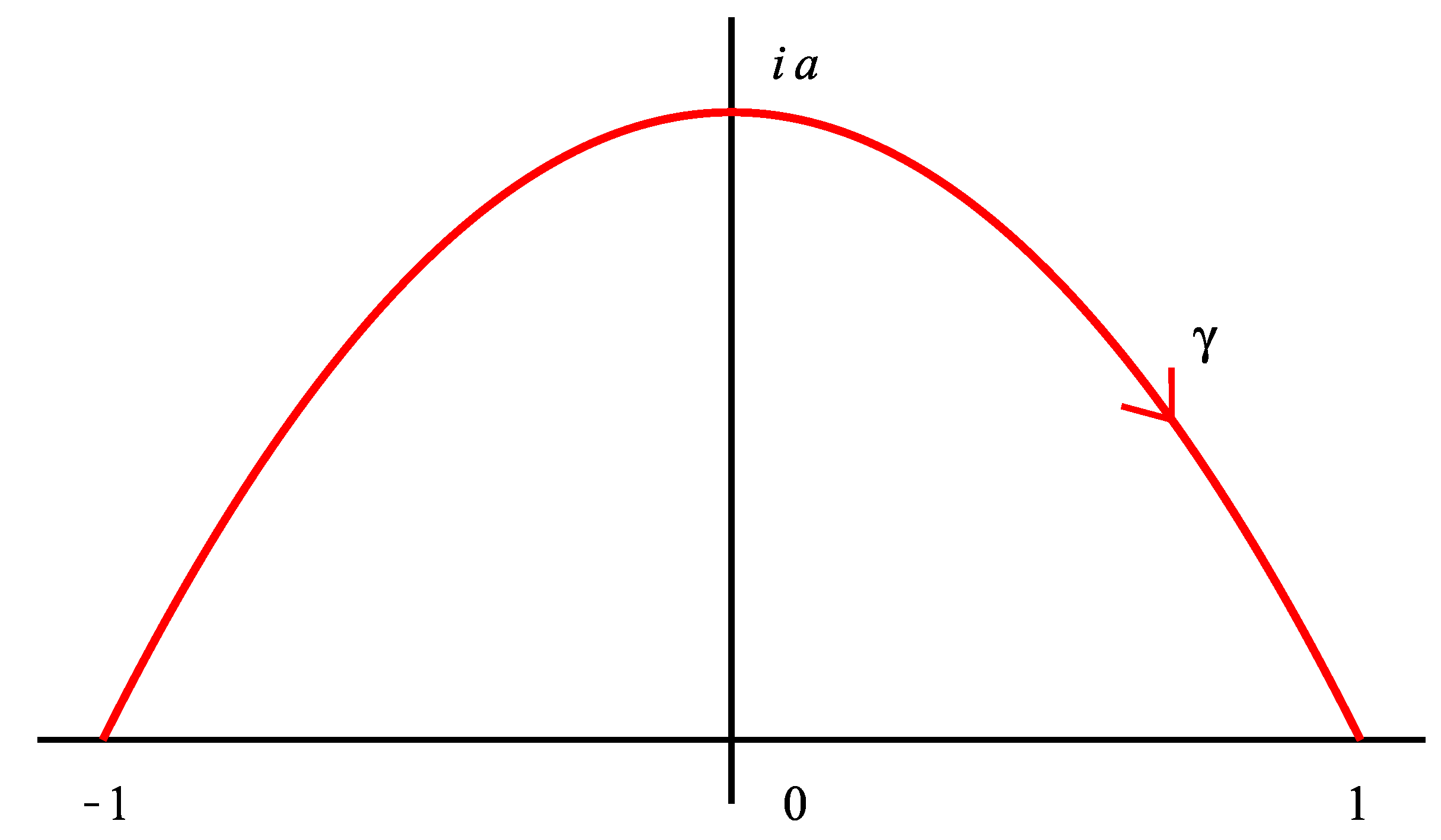
The path is shown in Figure 1, and can be represented as
Figure 1.
The homotopy deformation of integral path.
Let
according to Cauchy theorem, the error estimation
In the integral on the right side of Equation (9), since , on the path , it is true that
Letting , the right side of the inequality in Equation (8) behaves as
then we have the following.
Corollary 2.
Under the assuming condition in Theorem 2, it is true that
Remark 1.
In Theorem 2, if , we should rewrite the path as . For real number , it is obvious that
Remark 2.
We further enlarge the inequality in Equation (8): Firstly, if with and ω fixed, the right side of Equation (8) behaves as . Secondly, if with and n fixed,
In brief, the errors of Equation (7) not only decrease as the order n of the derivatives increases, but also decrease rapidly as the frequency ω increases.
4. The Bessel Expansion of Fourier Integral With Symmetric Branch Points
Let . In this section, we consider the case that there are symmetric branch points for f. Namely, with .
4.1. Hermite Series with Symmetric Branch Points
The function can be expressed by the multiple Cauchy integral formula
where is the skeleton of U, and, if , for , then the above integral kernel can be written as
Since
by variable substitutions and noting that , we have
Letting the coefficients
we can rewrite Equation (11) as Hermite series of f,
where the remainder is
The coefficients can be computed by the multi-dimension residue theorem. Letting
by multi-Taylor expansion,
then we obtain the coefficients
Similarly, letting
we have
Theorem 3.
For the Hermite series in Equation (12), if with and , then we have the error estimation of the remainder
where
Proof.
4.2. The Bessel Expansion of Fourier Integral with Symmetric Branch Points
Similar to Theorem 2, we have the Bessel expansion of Fourier integral with symmetric branch points, and the error estimation is as follows.
Theorem 4.
For , under the assumptions of Theorem 3, we have
where the remainder satisfying
and is independent of ω and a.
5. The Numerical Experiments
In this section, for the two cases of analytic functions and branch functions, we present two examples that verify the validity of Bessel expansion to calculate Fourier integrals. These numerical experiments were done in Maple 16.
Example 1.
Similarly, we have
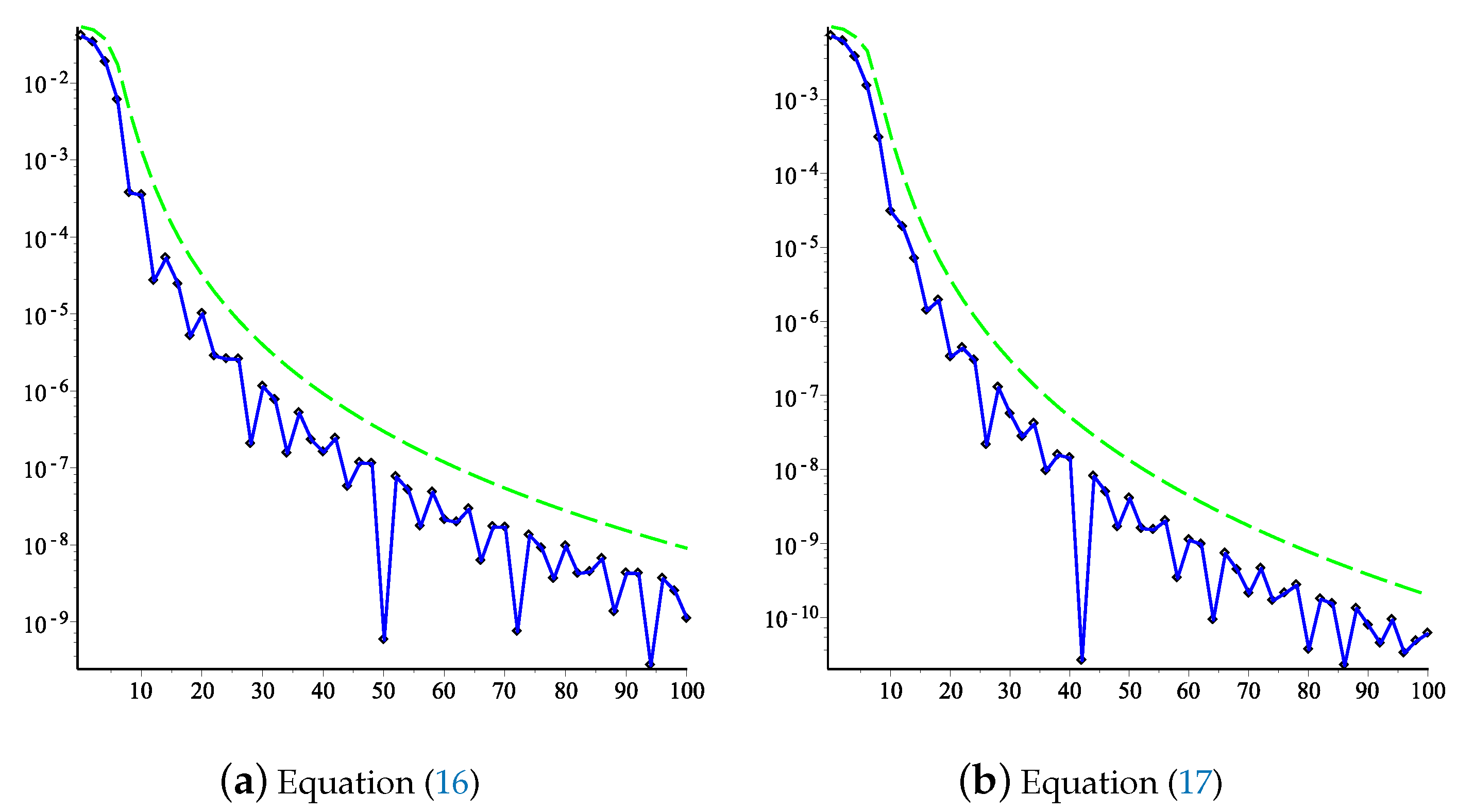
The two sides of the inequalities in Equations (16) and (17) are shown in Figure 2 for . The absolute errors of the expansion on the left side of the inequalities in Equations (16) and (17) are represented by diamond points. Besides, the error estimates on the right of Equations (16) and (17) are represented by dash lines.
Example 2.
We consider the case of or . According to Equations (14) and (15), we have
and
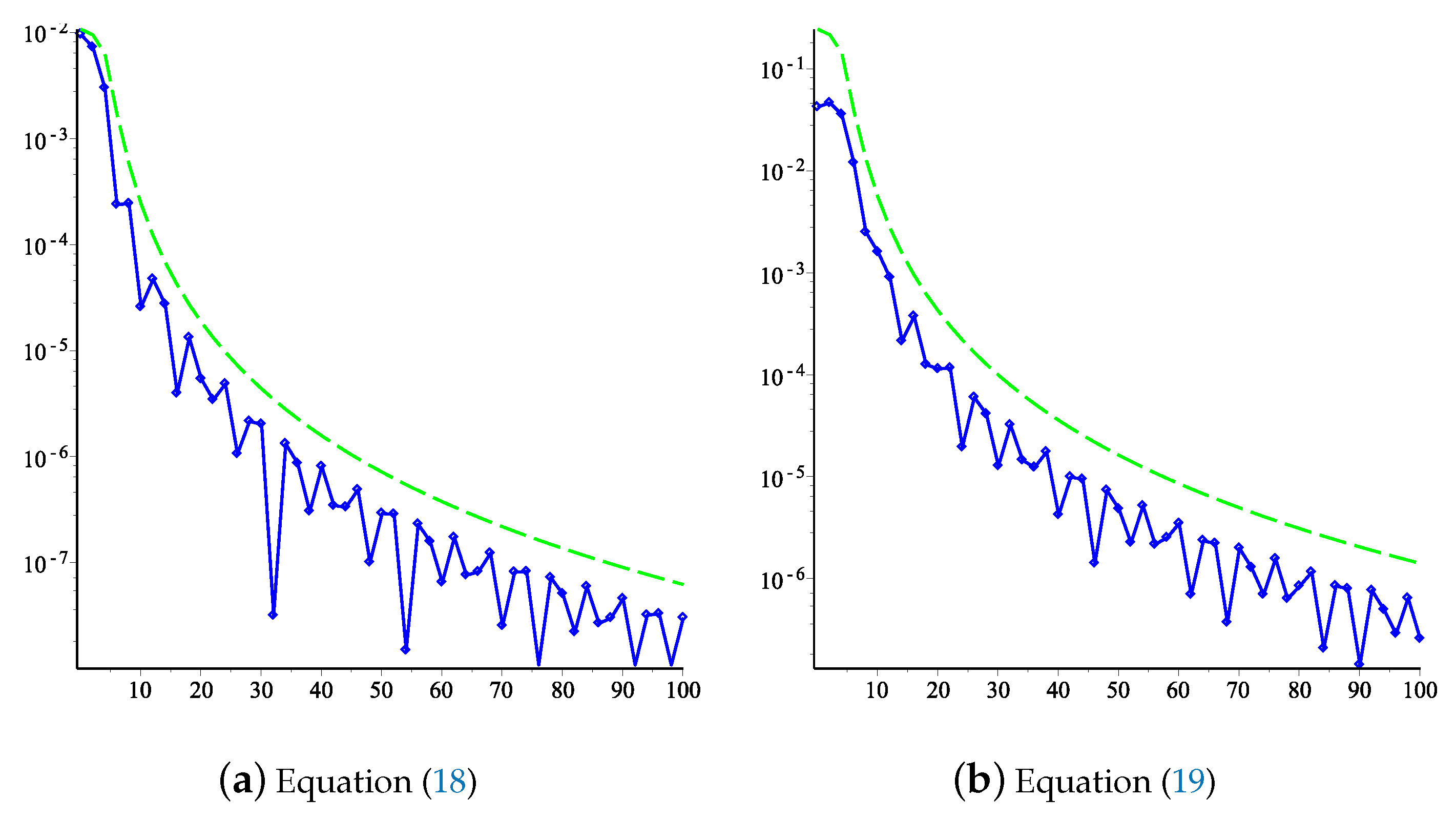
where and . The two sides of the inequalities in Equations (18) and (19) are shown in Figure 3 for . The absolute errors on the left side of Equations (18) and (19) are represented by diamond points. Besides, the error estimates on the right of Equations (18) and (19) are represented by dash lines.
6. The Conclusions and Acknowledgement
In this article, we make the expression of the Filon-type method more concise by the Bessel expansions for calculating Fourier integral. Moreover, we also derive the convergence rate of the Filon-type method by means of complex analysis. In fact, both error analysis and numerical tests have shown that the Filon-type method is efficient. On the road of frequency analysis and calculation, we will continue to study.
Author Contributions
For methodology, Y.Z. and Z.Z.; software, Y.Z.; validation, Z.Z.; formal analysis, Y.Z. and Z.Z.; writing—original draft preparation, Y.Z.; writing—review and editing, Z.Z.
Funding
This research was funded by project of enhancing school with innovation of Guangdong Ocean University grant number GDOU2016050228 and the APC was funded by project of enhancing school with innovation of Guangdong Ocean University(Q18306).
Acknowledgments
The authors sincerely thank the reviewers for their comments and helpful guidance.
Conflicts of Interest
The authors declare no conflict of interest.
References
- Born, M.; Wolf, E. Principles of Optics; Cambridge University Press: Cambridge, UK, 2001. [Google Scholar]
- Watson, G.N. A Treatise on the Theory of Bessel Function; Cambridge University Press: Cambridge, UK, 1966. [Google Scholar]
- Deaño, A.; Huybrechs, D.; Iserles, A. Computing Highly Oscillatory Integrals; SIAM: Philadelphia, PA, USA, 2018. [Google Scholar]
- Huybrechs, D.; Iserles, A.; Nørsett, S.P. From high oscillation to rapid approximation V: The equilateral triangle. IMA J. Numer. Anal. 2010, 30, 755–785. [Google Scholar] [CrossRef][Green Version]
- Xiang, S.H. Efficient Filon-type methods for f(x)eiωg(x)dx. Numer. Math. 2007, 105, 633–658. [Google Scholar] [CrossRef]
- Xiang, S.H.; Brunner, H. Efficient methods for Volterra integral equations with highly oscillatory Bessel kernels. BIT Numer. Math. 2013, 53, 241–263. [Google Scholar] [CrossRef]
- Kang, H. Efficient calculation and asymptotic expansions of many different oscillatory infinite integrals. Appl. Math. Comput. 2019, 346, 305–318. [Google Scholar] [CrossRef]
- Filon, L.N.G. On a quadrature formula for trigonometric integrals. Proc. R. Soc. Edinb. 1928, 49, 38–47. [Google Scholar] [CrossRef]
- Gradshteyn, I.S.; Ryzhik, I.M. Table of Integrals, Series, and Products, 7th ed.; Elsevier/Academic Press: Amsterdam, The Netherlands, 2007. [Google Scholar]
- Abramowitz, M.; Stegun, I.A. Handbook of Mathematical Functions: With Formulas, Graphs, and Mathematical Tables; Dover Publications Inc.: New York, NY, USA, 1965. [Google Scholar]
- Wang, Z.X.; Guo, D.R. Special Functions; World Scientific: Singapore, 1989. [Google Scholar]
- Ahlfors, L.V. Complex Analysis: An Introduction to the Theory of Analytic Functions of One Complex Variable; McGraw-Hill Book Company, Inc.: New York, NY, USA; Toronto, ON, Canada; London, UK, 1979. [Google Scholar]
© 2019 by the authors. Licensee MDPI, Basel, Switzerland. This article is an open access article distributed under the terms and conditions of the Creative Commons Attribution (CC BY) license (http://creativecommons.org/licenses/by/4.0/).