1. Introduction
In order to deal with imprecise information and inconsistent knowledge, Smarandache [
1,
2] first introduced the notion of neutrosophic set by fusing a tri-component set and the non-standard analysis. A neutrosophic set consists of three membership functions, where every function value is a real standard or non-standard subset of the nonstandard unit interval
. Since then, many authors have studied various aspects of neutrosophic sets from different points of view, for example, in order to apply the neutrosophic idea to logics, Rivieccio [
3] proposed neutrosophic logics which is a generalization of fuzzy logics and studied some basic properties. Guo and Cheng [
4] and Guo and Sengur [
5] obtained good applications in cluster analysis and image processing by using neutrosophic sets. Salama and Broumi [
6] and Broumi and Smarandache [
7] first introduced the concept of rough neutrosophic sets, handled incomplete and indeterminate information, and studied some operations and their properties.
In order to apply neutrosophic sets conveniently, Wang et al. [
8] proposed single valued neutrosophic sets by simplifying neutrosophic sets. Single valued neutrosophic sets can also be viewed as a generalization of intuitionistic fuzzy sets (Atanassov [
9]). Single valued neutrosophic sets have become a new majorly research issue. Ye [
10,
11,
12] proposed decision making based on correlation coefficients and weighted correlation coefficient of single valued neutrosophic sets, and gave an application of proposed methods. Majumdar and Samant [
13] studied similarity, distance and entropy of single valued neutrosophic sets from a theoretical aspect.
Şahin and Küçük [
14] gave a subsethood measure of single valued neutrosophic sets based on distance and showed its effectiveness through an example. We know that there’s a certain connection among fuzzy rough approximation operators and fuzzy relations (resp., fuzzy topologies, information systems [
15,
16,
17]). Hence, Yang et al. [
18] firstly proposed neutrosophic relations and studied some kinds of kernels and closures of neutrosophic relations. Subsequently they proposed single valued neutrosophic rough sets [
19] by fusing single valued neutrosophic sets and rough sets (Pawlak, [
20]), and they studied some properties of single value neutrosophic upper and lower approximation operators. As a generalization of single value neutrosophic rough sets, Bao and Yang [
21] introduced
-dimension single valued neutrosophic refined rough sets, and they also gave some properties of
-dimension single valued neutrosophic upper and lower approximation operators.
As another generalization of single value neutrosophic rough sets, Bo et al. [
22] proposed the concept of multi-granulation neutrosophic rough sets and obtained some basic properties of the pessimistic (optimistic) multigranulation neutrosophic rough approximation operators. However, the lattice structures of those rough approximation operators in references [
19,
21,
22], were not well studied. Following this idea, Zhao and Zhang [
23] gave the supremum and infimum of the
-dimension neutrosophic upper and lower approximation operators, but they did not study the relationship between the
-dimension neutrosophic upper approximation operators and the
-dimension neutrosophic lower approximation operators, especially in the one-dimensional case. Inspired by paper [
23], a natural problem is: Can the lattice structure of pessimistic (optimistic) multigranulation neutrosophic approximation operators be given?
In the present paper, we study the algebraic structure of optimistic (pessimistic) multigranulation single valued neutrosophic approximation operators.
The structure of the paper is organized as follows. The next section reviews some basic definitions of neutrosophic sets and one-dimensional multi-granulation rough sets. In
Section 3, the lattice structure of the pessimistic multigranulation neutrosophic rough approximation operators are studied. In
Section 4, for special neutrosophic relations, a one-to-one correspondence relationship between neutrosophic upper approximation operators and lower approximation operators is given. Finally,
Section 5 concludes this article and points out the deficiencies of the current research.
3. The Lattice Structure of the Pessimistic Multigranulation Neutrosophic Rough Approximation Operators
In this section, set is called a multigranulation neutrosophic relations set on if each is a neutrosophic relation on . In this case, the pair will be called an -dimensional multigranulation neutrosophic apptoximation space.
Definition 6 ([
22])
. Let be an -
dimensional multigranulation neutrosophic apptoximation space. We define two pairs of approximation operators as follows, for all and ,
where
Then the pairis called an optismistic multigranulation neutrosophic rough set, and the pairis called an pessimistic multigranulation neutrosophic rough setandare referred to as the optimistic and pessimistic multigranulation neutrosophic upper approximation operators, respectively. Similarly,andare referred to as the optimistic and pessimistic multigranulation neutrosophic lower approximation operators, respectively.
Remark 1. If, then the multigranulation neutrosophic rough set will degenerated to a one-dimensional multi-granulation rough set (see Definition 5). In the following, the family of all multigranulation neutrosophic relations set onwill be denoted by. Defined a relationonas follows:if and only if, thenis a poset, whereand.
, whereandbe a index set, we can define union and intersection ofas follows:where Thenandare two multigranulation neutrosophic relations on, and we easily show thatandare infimum and supremum of, respectively. Hence we can easily obtain the following theorem:
Theorem 1. is a complete lattice,andare its top element and bottom element, respectively, whereandare two neutrosophic relations inand defined as follows:,,,and,,. In particular,is a complete lattice.
Theorem 2. Letandbe two multigranulation neutrosophic relations set on,, we have
- (1)
,;
- (2)
,;
- (3)
,
;
- (4)
,
Proof. We only show that the case of the optimistic multigranulation neutrosophic approximation operators.
- (1)
, by Lemma 1 and Definition 6, we have the following:
Hence, .
- (2)
, by Lemma 1 and Definition 6, we have the following:
Hence, .
- (3)
, by Lemma 1 and Definition 6, we have the following:
Hence,
- (4)
, by Lemma 1 and Definition 6, we have the following:
Hence, □
From Theorem 2, we can easily obtain the following corollary:
Corollary 1. Letandbe two multigranulation neutrosophic relations set on. If, then,
Let and be the set of pessimistic multigranulation neutrosophic upper and lower approximation operators in , respectively.
Defined a relation on as follows: if and only if for each . Then is a poset.
Defined a relation on as follows: if and only if for each . Then is a poset.
Let and be the set of optimistic multigranulation neutrosophic upper and lower approximation operators in , respectively.
Defined a relation on as follows: if and only if for each . Then is a poset.
Defined a relation on as follows: if and only if for each . Then is a poset.
Theorem 3. (1)andbe a index set, we can define union and intersection ofas follows:whereThenandare supremum and infimum of, respectively. (2)andbe a index set, we can define union and intersection ofas follows:whereThenandare supremum and infimum of, respectively. Proof. We only show (1).
Let
, then
for each
By Corollary 1, we have
for any
. Thus
. If
is a multigranulation neutrosophic relations set such that
for each
, then
,
. Hence,
Thus So is the supremum of .
Let
, then
, we have
Thus
for each
. If
is a multigranulation neutrosophic relations set such that
for each
, then
By the construction of
, we can easily obtain
. Hence,
So is the infimum of . □
Remark 2. (1), ∀
a ∈
X,
we can calculate that the following formula holds.
Hence,,and. It shows thatand, i.e.,is the bottom element ofandis the bottom element of. By Theorem 3, we have the following result: Bothandare complete lattices.
(2) Similarly, we can prove that bothandare complete lattices if we can use the generalization formula of However, by Theorem 2, we known that So, naturally, there is the following problem:
How to give the supremum and infimum of the optimistic multigranulation neutrosophic rough approximation operators?
In the one-dimensional case, for convenience, we will use
and
to denote the set of neutrosophic upper and lower approximation operators in
X, respectively. According to Lemma 1, Remark 2 and Theorem 3, we have the following result: both
and
are complete lattices (it is also the one-dimensional case of Reference [
23]).
4. The Relationship between Complete Lattices and
In this section, we will study the relationship between complete lattices
and
. Set
Firstly, we will give an example to illustrate that is not an empty family.
Example 1. Letbe a single point set,andare two single valued neutrosophic relations in.
- (1)
If, then. In fact, if, thenfor each
Moreover,,, andConsidering the arbitrariness of, in particular, take, we have,and
Hence,.
Similarly, we also can show that the following result:
- (2)
If, then.
So, by (1), (2) and Corollary 1, we have, i.e.,is not an empty family.
Now, we will give the relationship between complete lattices and .
Proposition 1. If, then, whereis a index set, andfor each.
Proof. We first show that
. Let
be a neutrosophic relation in
such that
for each
, then
, this is equivalent to
since
. Thus
Moreover, by the construction of
, we have
On the other hand, we can show that
for each
. So
Hence
Now, we show that Let be a single valued neutrosophic relation in such that for each , then , this is equivalent to since . Thus Moreover, by the construction of . We have
On the other hand, we can show that
for each
. So
Hence,
From above proved, we know that □
Theorem 4. If, thenandare complete lattice isomorphism.
Proof. Define a mapping
as follows:
, Obviously,
is surjective. If
, notice that
, we know that
So
is one-one.
and
be a index set. By Theorem 3 and Proposition 1, we have
and
Hence, preserves arbitrary union and arbitrary intersection. □
From above proved, we know that and are complete lattice isomorphism.
Theorem 5. If, thenandare complete lattice isomorphism.
Proof. Define a mapping
as follows:
,
Obviously,
is surjective. If
, notice that
, we know that
So
is one-one.
and
be an index set. By Theorem 3 and Proposition 1, we have
and
Hence, preserves arbitrary union and arbitrary intersection. □
From the above proof, we know that and are complete lattice isomorphism.
Theorem 6. If, thenandare complete lattice isomorphism.
Proof. Through Theorems 4 and 5, we immediately know that the conclusion holds. We can also prove it by the following way:
Define a mapping
as follows:
,
Through Theorems 4 and 5, there must be one and only one
such that
for each
This shows
is surjective. If
, notice that
, we know that
So
is one-one.
and
be a index set. Through Theorem 3 and Proposition 1, we have
and
Hence, preserves arbitrary union and arbitrary intersection. So, and are complete lattice isomorphism. □
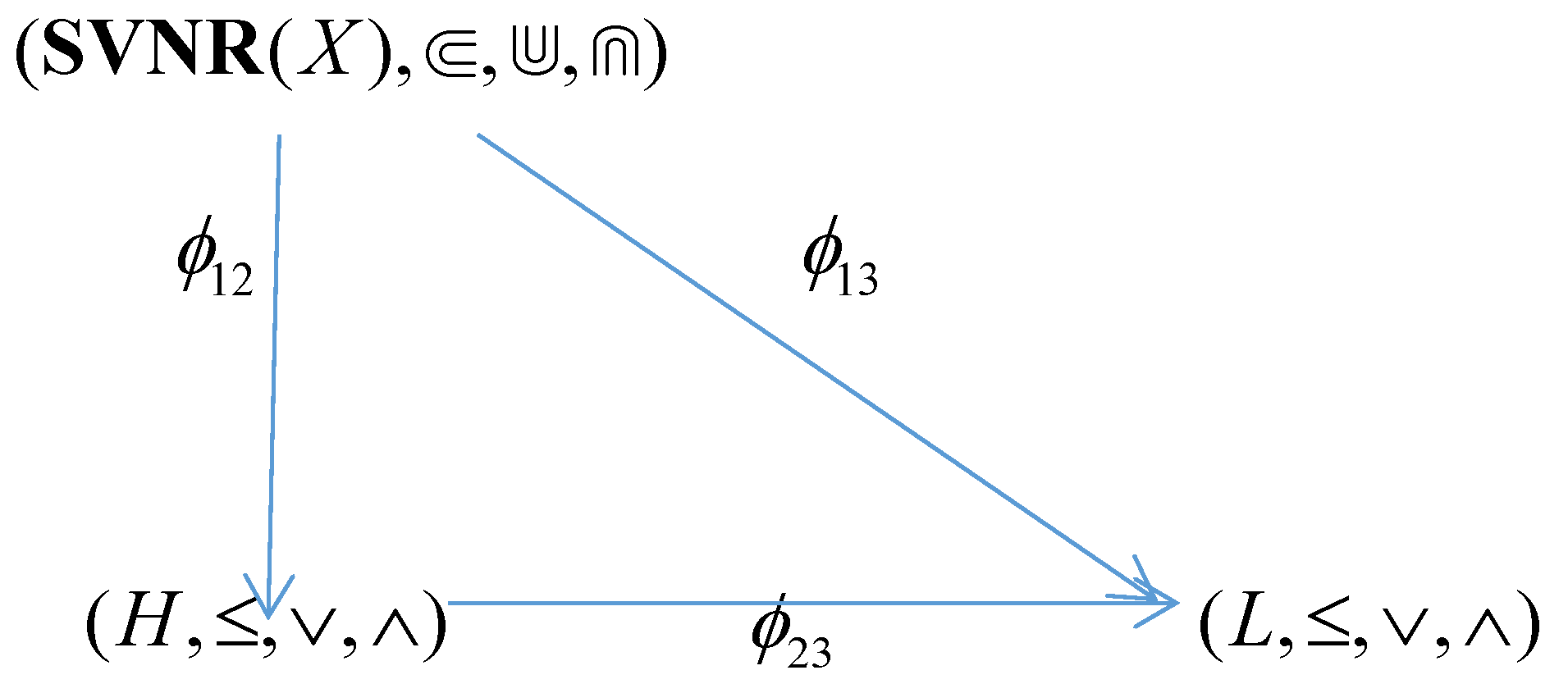
Remark 3. Through Theorems 4–6, we can ascertain that,
andare isomorphic mappings among complete lattices. Moreover, the following diagram can commute, i.e.,(see Figure 1).