1. Introduction
Symmetry is a principle which has served as a guide for the spectacular advances that have been made in modern science. In general, a symmetry associated with a “situation” is defined as an “immunity to change” for some aspect of the “situation” [
1]. As discussed in [
1], in order for a “situation” to have a symmetry: (a) the aspect of the “situation” remains unchanged (i.e., invariant) when a change (e.g., a transformation) is performed; and (b) it must be possible to perform the change, although the change does not actually have to be performed. For example—in physics—any mathematical expression describing a physical system, whether subatomic or macroscopic, must be invariant under space and time translations.
Group theory is the traditional mathematical language used to describe symmetry and its associated invariant properties (recall that an abstract group is a set of elements together with a law of composition “” such that for : (i) ; (ii) ; (iii) there is an identity element such that ; and (iv) for there is an inverse such that ). As a simple example, the set of 0°, 90°, 180° and 270° rotations in the plane of a square about its fixed center under “composition of rotations” forms a symmetry group for the square (0° is the identity element and the inverse of an rotation is a rotation). Each of these rotations is a symmetry which brings the square into coincidence with itself, i.e., they preserve the invariant shape of the square.
In recent years the concepts of generalized symmetry and Green’s symmetry have been introduced in the context of symmetries of graphs and digraphs [
2,
3,
4] and have been used to discuss properties that remain invariant during the evolution of networks [
5]. These symmetries of an object are based upon a semigroup description of the object and require the application of Green’s
and
equivalence relations to the object’s semigroup description. In the case of (abstract) networks, the application of Green’s symmetry principles identifies structural invariants common to all networks within a Green’s equivalence class. These are necessarily invariants for network evolutions occurring within a Green’s equivalence class—i.e., Green’s evolutions. Green’s symmetry principles also provide a method for computing the transformations—or symmetries—that produce network evolutions which preserve these invariants (as discussed in [
5], analysis of these transformations can provide insight into aspects of the internal structural dynamics of the network’s evolution).
The purpose of this paper is to extend the notions of Green’s
and
symmetries and evolutions in network structures [
5] to include Schützenberger symmetries and evolutions. In this context,
Schützenberger symmetries are network symmetries associated with fixed order networks contained within a Green’s
-equivalence class that preserve certain structural properties common to all networks in that equivalence class. As will be discussed and shown below, there are computable sets of right and sets of left Schützenberger symmetries associated with each Green’s
-equivalence class such that: (a) each right (left) symmetry transforms by right (left) multiplication any network within an
-class into another network within that class; (b) the
-class evolutions defined by these symmetries preserve the associated structural invariants; (c) these symmetries contain information about how the invariant preserving changes in network structure occur during the evolution [
5]; and (d) these sets of right and left Schützenberger symmetries are monoids (semigroups with an identity element) which have permutation group representations—i.e., the right and left
Schützenberger symmetry groups—which permute the networks within an
-class and preserve the associated invariants. These groups and symmetries have the properties that for any two
-equivalence classes in the same: (i) Green’s
-equivalence class, the associated right Schützenberger symmetry groups are isomorphic to one another; and (ii) Green’s
-equivalence class, the sets of right and left Schützenberger symmetries are the same.
In order to make this paper reasonably self-contained, the relevant definitions and terminology from semigroup theory are summarized in the next section (for additional depth and clarification the reader is invited to consult such standard references as [
6,
7]). The semigroup of networks
on a fixed set
of nodes is defined in
Section 3. Green’s equivalence classifications of
and the associated invariant properties are reviewed in
Section 4 (for the sake of brevity, the proofs of lemmas and theorems in
Section 3 and
Section 4 are omitted, but can be found in [
4,
5]). Schützenberger network symmetries and symmetry groups are introduced in
Section 5 and aspects of the theory are illustrated using simple examples in
Section 6 and
Section 7. Concluding remarks comprise the final section of this paper.
2. Semigroups
A semigroup is a set S and an associative binary operation “” called multiplication defined upon the set (contrast this with the above definition of a group and note that a group is a semigroup endowed with the additional special properties given by items (iii) and (iv)). The right (left) multiplication of by is the product . An element is an identity if for . An identity can be adjoined to S by setting and defining for . A semigroup which has an identity is a monoid. If for , then x is an idempotent. Semigroups and are isomorphic (denoted ) when there is a bijective map such that for all . They are anti-isomorphic if for all . Hereafter, the juxtaposition will also be used for the multiplication .
The well-known and Green’s equivalence relations on a semigroup partition into a highly organized “egg box” structure using relatively simple algebraic properties. In particular, the equivalence relation on is defined by the rule that if and only if for and the equivalence relation is similarly defined so that if and only if and . The relations and commute under the composition “” of binary relations and is the smallest equivalence relation containing and .
For and denote the class containing by , where or when or , respectively. Thus, if and only if . If and , then there exist elements in such that . Since , then it is necessarily the case that when there exist elements and in such that and , respectively.
3. The Semigroup
The semigroup
of Boolean matrices is the set of all
matrices over
with Boolean composition
defined by:
as the semigroup multiplication operation. Here
,
denotes Boolean multiplication (i.e.,
,
), and
denotes Boolean addition (i.e.,
,
). Note that because there exists an
such that
, then
is a monoid.
The rows (columns) of any are Boolean row (column) —vectors, i.e., row (column) —tuples over , and come from the set of all Boolean row (column) —vectors. These vectors can be added coordinate-wise using Boolean addition. If , then when the ith coordinate implies the ith coordinate , (⊑ is a partial order).
Let
be either the zero (unit) row or zero (unit) column vector (the context in which
is used defines whether it is a row or column vector). The matrix with
in every row—i.e., the zero matrix—is denoted by “□” and the matrix with
in every row is denoted by “ω”. For
, the row space
of
is the subset of
consisting of
and all possible Boolean sums of (one or more) nonzero rows of
α.
is a lattice
under the partial order ⊑. The row (column)
basis of
α is the set of all row (column) vectors in
that are not Boolean sums of other row (column) vectors in
α. Note that each vector in
must be a row (column) vector of
α. The vector
is never a basis vector and the empty set
is the basis for the □ matrix [
8,
9].
The semigroup
of binary relations on a set
of cardinality
(denoted
) is the power set of
with multiplication
being the “composition of binary relations” defined by:
It is easy to see that a bijective index map
induces an isomorphism
defined by
, where
if
and is
if
.
is therefore the Boolean matrix representation of
[
10].
A network of order is the pair , where is a nonempty set of nodes with , and the binary relation is the set of directed links connecting the nodes of the network. Thus, is both a digraph and a binary relation. If , then node is an in(out)-neighbor of node . The in-neighborhood of is the set of all in-neighbors of and the out-neighborhood of is the set of all out-neighbors of .
Let
be the set of networks on
and define “multiplication of networks”
by
, where
,
, and:
Lemma 1. is a semigroup that is isomorphic to.
Lemma 2. If, then.
Thus, is a monoid and is a Boolean matrix representation of .
4. Green’s Equivalence Classifications of and Associated Invariants
Let
be the isomorphism of Lemma 2 and
be an associated index bijection. If
is the
ith Boolean row vector and
is the
jth Boolean column vector in the matrix
corresponding to network
, then
encodes the out-neighbors of node
in
as the set:
and
encodes the in-neighbors of node
in
as the set:
when
and
, then
is a
basis out-neighborhood and
is a
basis in-neighborhood for network
. Thus, a basis neighborhood in
is a non-empty neighborhood in
which is not the set union of other neighborhoods in
.
Let be the set of basis out-neighborhoods and be the set of basis in-neighborhoods in network . Additionally, define as the set whose elements are and the sets generated by the closure under set union of the out-neighborhoods in and let be the poset ordered by the set inclusion relation “”. Thus, when , it may be formally stated that:
Lemma 3. is a lattice that is isomorphic to.
In what follows, will be referred to as the lattice for .
The following theorem provides complete and equivalence classifications of all networks of a fixed order:
Theorem 1. Let. Then:
- i.
if and only if
- ii.
if and only if
- iii.
if and only ifand;
- iv.
if and only ifandare lattice isomorphic.
Thus, the Green’s and equivalence classifications of the networks in partition the networks into and classes which have (generally distinct) nodes with identical out-neighborhoods, identical in-neighborhoods, and both identical out-neighborhoods and in-neighborhoods, respectively, whereas the equivalence classification partitions the networks in into classes having isomorphic lattices which are generated by their out-neighborhoods. These out-neighborhoods, in-neighborhoods, and lattices are the invariants for each equivalence class. Transformations applied to a network that keeps the network in the same equivalence class are Green’s symmetries since they necessarily preserve these invariants.
5. The Schützenberger Symmetries and Groups for an -Equivalence Class of Networks
Of interest here are the
-equivalence classes of networks in
, their invariants as specified by Theorem 1(iii), and the associated Schützenberger symmetries and groups. To this end, consider an arbitrary
-equivalence class
of networks in the monoid
and let
. This clearly defines
as a sub-monoid of
that acts upon
from the right according to
, where
ρ is the monoid action defined by
(in the Boolean matrix representation,
). Since
ρ preserves the
membership, then
is the special set of Green’s symmetries called the set of
right Schützenberger symmetries for the networks in
which preserve the associated network invariants. The
right Schützenberger problem for
is to find
(note from the last sentence in
Section 2 that the right Schützenberger problem is satisfiable because semigroup theory guarantees the existence of at least one symmetry
such that
).
Although the following facts are well known [
6,
11], they are stated here for the reader’s convenience without proof as the next theorem:
Theorem 2. (i) The action ρ is equivalent to a monoid homomorphismto the full transformation monoidonsuch thatis a simply transitive group of permutations ofunder right multiplication with; (ii) ifcontains an idempotent, thenis a group and; (iii) ifandare in the same-equivalence class, then; and (iv) ifandare in the same-equivalence class, then.
The group is the right Schützenberger symmetry group for the networks in . It acts upon from the right according to , where is the right group action , i.e., is a right -set.
Now let be the sub-monoid of that acts on from the left according to , where . The set is the set of left Schützenberger symmetries for the networks in which preserve the associated network invariants. The left Schützenberger problem for is to find (the left Schützenberger problem is also satisfiable since semigroup theory guarantees the existence of at least one such symmetry).
The following results are also well known [
6] and are stated here without proof for the reader’s convenience as the next theorem:
Theorem 3. (i) The actionis equivalent to a monoid anti-homomorphisminto the full transformation monoidonsuch thatis a simply transitive group of permutations ofunder left multiplication with; (ii) every element ofcommutes with every element of; and (iii)is anti-isomorphic to.
The group is the left Schützenberger symmetry group for the networks in . It acts upon from the left according to , where is the left group action , i.e., is a left -set.
6. Example: Solving the Right Schützenberger Problem for Simple Two Node Networks
In order to illustrate aspects of the results developed in the last section, refer to Table 1 and Figure 1 in [
4] and first consider the right Schützenberger problem for the singleton
-equivalence class containing the simple network designated by
η with node and directed link sets
and
, respectively, and neighborhood basis sets
. In general, solutions to the right Schützenberger problem for
are found by solving the equation
for
for every
when
and
are the associated Boolean matrices and multiplication is Boolean composition of matrices. This case is quite trivial since
and the associated Boolean equation is
, or:
By inspection it is easily seen that this equation is satisfied when
,
,
, and
so that:
It is obvious that, since , the monoid action ρ preserves the neighborhood basis sets and .
Since , it is a trivial observation that is the identity permutation of η with itself and in which case (Theorem 2(i)). Clearly, because the permutation is the identity, the right group action necessarily preserves the neighborhood basis sets and .
Now consider the network
with
and
and note that (Theorem 1): (i) L(
β) = L(
η) so that
; and (ii) D(
β) = D(
η) so that
and
are each lattice isomorphic to an undirected path of length 2. The procedure for solving the right Schützenberger problem for
is identical to that for
η and yields (Theorem 2(iv)):
Additionally, is the identity permutation of with itself in which case . Since is an idempotent, then is isomorphic to the trivial group and (Theorem 2(ii)). It is also obvious that (as is required by Theorem 2(iii) because D(β) = D(η)). The right monoid and group actions on also clearly preserve the basis neighborhoods of .
7. Example: Solving the Schützenberger Problems for an -Class of Map Networks
A map network is a special network in which every node is connected by a directed link to exactly one node, i.e., its topology is effectively that of a map on its node set. Consequently, the monoid of all map networks
on a fixed node set
is isomorphic to the full transformation semigroup
and its Green’s equivalence classification, i.e., “egg box” structure, is identical to that of
[
6].
Let
and denote a map network on
by
where
represents the link
,
represents the link
, and
represents the link
. For example, the network
has
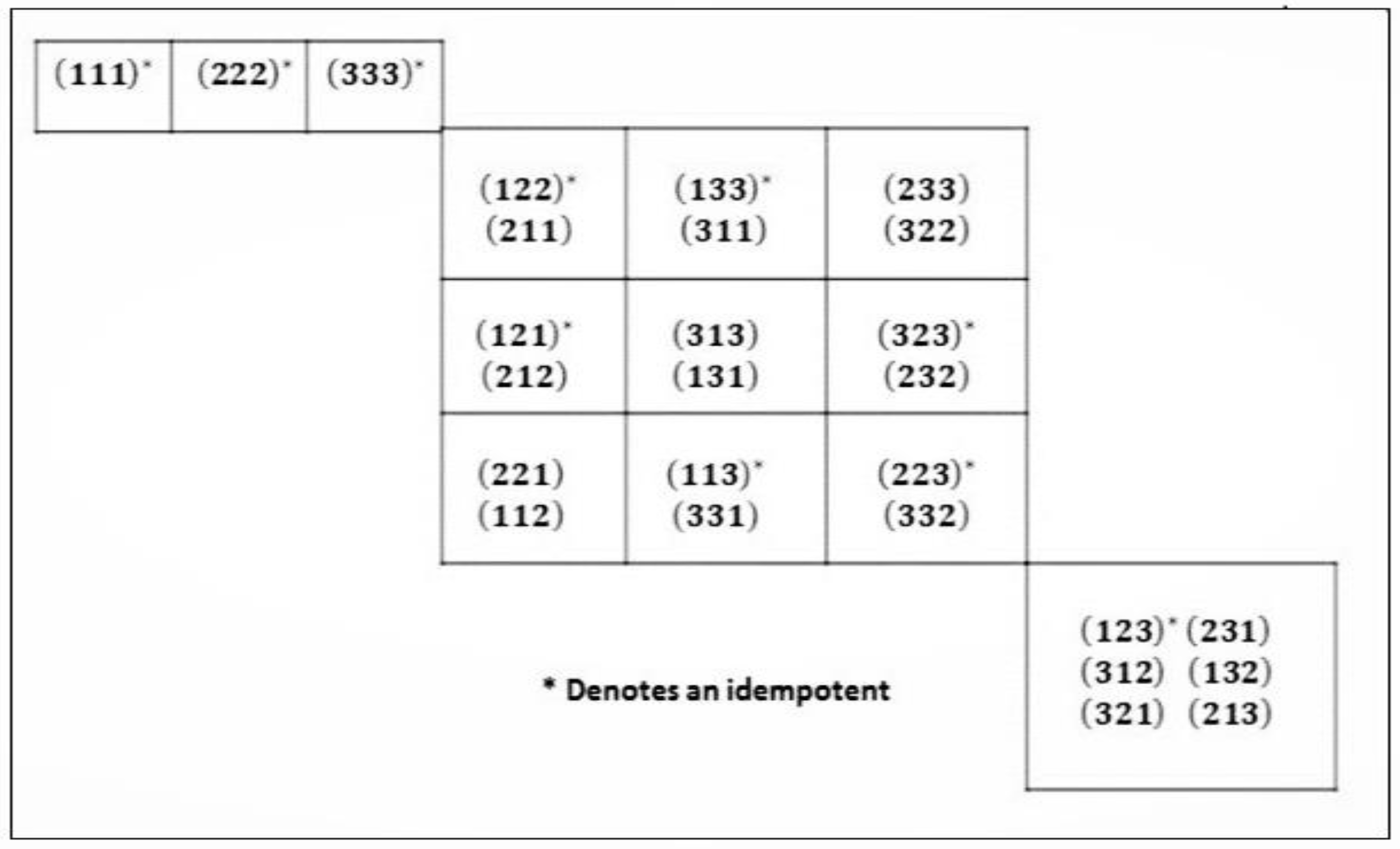
as it set of links. The “egg box” for
is shown in
Figure 1. There, each separate large “egg box” is a distinct
-class, each small “box” is an
-class, rows of
-classes within
-classes are
-classes, and columns of
-classes within
-classes are
-classes. Although more complicated, solving the right Schützenberger problem for any
-class in
follows the same procedure as that used in
Section 6. For example, choose
and observe that—as required by Theorem 1(iii)—each of these networks have the same out-neighborhood basis set
and in-neighborhood basis set
. Using the Boolean matrix representations of the networks and solving the equations:
yields:
where
is the monoid identity. The first three symmetries in
are solutions to equations (i) and (ii) and the last three are solutions to (iii) and (iv). Since
and
, where
is the only group of order
(up to isomorphism), then
and it must be the case that the surmorphism
maps according to
and
.
Solving the left Schützenberger problem for
requires solving the equations:
to find:
The first four symmetries in are solutions to and and the last two are solutions to and . Since then maps as and . That is an anti-homomorphism is a consequence of the fact that (i.e., if , then or in which case or ; and if , then and or and in which case or ). Similar reasoning shows that and are anti-isomorphic.
8. Concluding Remarks
In general, any system which has a semigroup description can be partitioned into equivalence classes using Green’s equivalence relations. As shown in previous research [
4,
5], Green’s
and
classifications of the semigroup of all networks of fixed order yield network invariants and symmetries that provide new insights into the fundamental nature of network structure and evolution. This paper has introduced an additional type of network symmetry—the Schützenberger symmetry—which is also a natural consequence of Green’s classifications of networks. In particular, Schützenberger symmetries and their group representations (Schützenberger symmetry groups) transform networks in an
-class amongst themselves in a manner that preserves the associated invariant neighborhood sets. Like Green’s
and
symmetries [
5], Schützenberger symmetries can be computed from first principles.
Useful applications of these symmetries and invariants include understanding the consequences of link reconfiguration in communication and sensor networks, e.g., [
13], identifying important relationships in social networks, e.g., [
14], and providing classification and analysis of biological network data, e.g., [
15]. In conclusion, it is noted that research associated with understanding the “internal dynamics” of
and
class evolutions and quantifying their complexities is reported in [
5]. Since an
-class evolution is both an
and an
class evolution, it would be interesting to investigate how these results apply to
-class evolutions.