


Abstract
The convexity in triangular norm (for short, ⊗−convexity) is a generalization of Zadeh’s quasiconvexity. The aggregation of two ⊗−convex sets is under the aggregation operator ⊗ is also ⊗−convex, but the aggregation operator ⊗ is not unique. To solve it in complexity, in the present paper, we give some sufficient conditions for aggregation operators preserve ⊗−convexity. In particular, when aggregation operators are triangular norms, we have that several results such as arbitrary triangular norm preserve convexity and convexity on bounded lattices, preserves convexity in the real unite interval .
1. Introduction
Fuzzy set theory introduced by Zadeh in 1965, as an mathematical tool to deal with uncertainty in information system and knowledge base, has been widely used in various fields of science and technology. By applying fuzzy set theory, Zadeh in [1] proposed the concept of quasiconvex fuzzy set, and has attracted wide attention of researchers and practitioners from many different areas such as fuzzy mathematics, optimization and engineering. Subsequently, Zadeh’s quasiconvex fuzzy set was generalized with a lattice L instead of the interval . A fuzzy set is quasiconvex if for any and all the inequality
holds.
A quasiconvex fuzzy set has an important property: intersection of quasiconvex fuzzy sets is a quasiconvex fuzzy set, i.e., let , for any fuzzy sets and ,
The above condition is called intersection preserving quasiconvexity. This property is also true for lattice valued fuzzy sets.
The theory of aggregation operators [2], has been successfully used in mathematics, complex networks and decision making etc (e.g., see [3,4,5,6]). The arithmetic mean, the ordered weighted averaging operator and the probabilistic aggregation are widely used examples. In reference [7] Janiš, Král and Renčová pointed that the intersection of fuzzy sets is not the only operator preserving quasiconvexity in general, and they gave someconditions in order that an aggregation operator preserves quasiconvexity.
Triangular norms are kinds of binary aggregation operations that become an essential tool in fuzzy logic, information science and computer sciences. By using triangular norms, properties of fuzzy convexity and various generalizations of fuzzy convexity were considered by many authors (for example, see [8,9,10,11]). Suppose is a triangular norm, Nourouzi [10] given the concept of convex set which generalized Zadeh’s quasiconvex fuzzy set. A convex set as defined in [10] can also be generalized as being lattice-valued in the following sense. Let L be a lattice and let be a triangular norm. A fuzzy set is called convex if for any and all the inequality
holds.
Following [7,10], in the present paper, we continue to study sufficient conditions for aggregation operators and triangular norms that preserve convexity on a bounded lattice. In Section 3, we give some sufficient conditions for aggregation operator preserving convexity, those results are generalizations of Propositions 2 and 3 (in [7]). Triangular norm is a kind of important aggregation operator, we give some sufficient conditions for triangular norm preserving convexity in Section 4. And Section 5 is conclusion.
2. Preliminaries
We first give the basic definitions and results from the existing literature. In following, we use L denote a bounded lattice .
Definition 1.
[2] An aggregation operation is a function which satisfies
- (i)
- whenever for .
- (ii)
- and .
A binary aggregation operation is said to be symmetric if for any , . A special aggregation function is a triangular norm defined as following.
Definition 2.
[12] A map is called a triangular norm if
- (T1)
- .
- (T2)
- if .
- (T3)
- .
- (T4)
- .
Example 1.
The two basic triangular norms and defined as the following are the strongest and the weakest triangular norms on L, respectively.
Example 2.
Suppose and let be an operation on H which satisfies (T1)–(T3) and
Then is a kind of triangular norms on follows from Proposition 3.60 in [13].
3. Sufficient Conditions for an Aggregation Operator Preserving Convexity
In this Section, we generalize Propositions 2 and 3 (in [7]), and give some sufficient conditions for an aggregation operator which preserves convexity.
Theorem 1.
Let be an aggregation operator on L, let be arbitrarily convex fuzzy sets. If for each , then is convex.
Proof.
Let be arbitrarily convex fuzzy sets, and . Then we see
Thus, is convex. □
The converse of Theorem 1, however, is in general not true. For example,
Example 3.

Consider a lattice , where , , and are incomparable elements and the aggregation operator defined in Table 1. Let be arbitrarily convex fuzzy sets. For any and all
we have
Table 1.
Aggregation operator A.
Hence, is convex. And ,
Theorem 2.
Let be an aggregation operator on L, let be arbitrary convex fuzzy sets. If is convex, then for each . Moreover if the triangular norm ⊗ is idempotent, then for each .
Proof.
Suppose that is convex. Let be arbitrary elements of L. For and , define
Clearly are convex. And
As has to be a convex fuzzy set, we have
From the monotonicity of A it follows that and . Hence
Therefore, since the operator ⊗ is idempotent it follows that
□
Since the triangular norm is idempotent, Proposition 2 (in [7]) follows from Theorems 1 and 2.
Theorem 3.
Let be an aggregation operator on L, and let be arbitrary convex fuzzy sets. If for each , then is convex.
Proof.
Let be arbitrary convex fuzzy sets. For any and all
Thus, is convex. □
The following shows that the converse of Theorem 3 is in general not true.
Example 4.
Consider a lattice , where , , and are incomparable elements and the binary symmetric aggregation operator A defined in Table 2. Let be arbitrary convex fuzzy sets. For any and all , can prove that is convex. And , , and .
Table 2.
Aggregation operator A.
Theorem 4.
Let be an symmetric aggregation operator on L, let be arbitrary convex fuzzy sets. If is convex, then for each . Moreover if the triangular norm ⊗ is idempotent, then for each .
Proof.
Suppose that is convex. Let be arbitrary elements of L, and put, for and , . We define
Clearly are convex and as A preserves convexity, then we have
Suppose that the triangular norm ⊗ is idempotent. Let and , define
Clearly are convex. Since, in addition, A preserves convexity this can be combined with the fact that the triangular norm ⊗ is idempotent, we deduce
From the monotony of A it follows that . Hence
Therefore
Hence
Thus
Let , from Theorem 2 we have
□
Then Proposition 3 (in [7]) follows from Theorems 3 and 4 due to is idempotent.
Since the triangular norm is the strongest triangular norm on , from the definition of convexity we can prove the following theorem.
Theorem 5.
If are both nondecreasing, . Let defined by , then preserves convexity for any triangular norm on . But the converse statement is in general not true.
Example 5.
Suppose , Then . i.e., is convex. And .
4. Sufficient Conditions for Triangular Norm Preserving Convexity
In this section we give some sufficient conditions which guarantee that a triangular norm preserves convexity. The following theorem is obvious.
Theorem 6.
Let be a triangular norm on L. If are arbitrary convex fuzzy sets, then is convex.
Theorem 7.
Let be a triangular norm on L. If are arbitrary convex fuzzy sets, then is convex.
Proof.
Let be arbitrary convex fuzzy sets. For any and all
Then we see
Hence
Thus, is convex. □
Let ⊗ be a triangular norm on L. Li in [14] given a family triangular norms as follows
Theorem 8.
Let be a triangular norm on L, and . If are arbitrary convex fuzzy sets, then is convex.
Proof.
Let be arbitrary convex fuzzy sets. For any and all
Then we have
Since or implies , we have
Thus, is convex. □
Example 6.
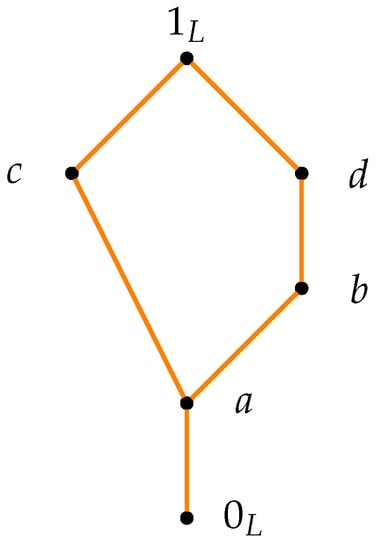
Consider the lattice given in Figure 1. Consider the function on L defined by
then is a triangular norm and is described in Table 3.
Figure 1.
The order ≤ on L.
Table 3.
Triangular norm .
Hence, for any -convex sets , is also a -convex set.
Theorem 9.
Let be arbitrary convex fuzzy sets. Then is a convex fuzzy set.
Proof.
Let be arbitrary convex fuzzy sets. For any and all
Then we deduce
Since we have
Thus, is a convex fuzzy set. □
Example 7.
Suppose and the triangular norm is
then, is a convex fuzzy set.
5. Conclusions
The authors of the paper [7] discuss properties which are preserved under aggregation for arbitrary lattices and arbitrary pairs of mappings Results in this paper are also discussed under aggregation for an arbitrary lattice and an arbitrary pair of mappings. However, this does not mean that even without these conditions the aggregation of SOME quasiconvex (convex) mappings to SOME lattices need not be quasiconvex (convex). Which are the properties of a lattice L and an aggregation A (weaker than those from the paper by Janis, Kral and Rencova in [7]), such that A preserves quasiconvexity (convex) for mappings into L? We hope to solve this problem in future work.
Author Contributions
Conceptualization, L.L.; methodology, L.L. and Q.L.
Acknowledgments
This work was supported by the National Natural Science Foundation of China (Grant Nos. 11701446, 61702389) and Shaanxi key disciplines of special funds projects.
Conflicts of Interest
The authors declare no conflict of interest.
References
- Zadeh, L.A. Fuzzy sets. Inf. Control 1965, 8, 338–353. [Google Scholar] [CrossRef]
- Lizasoain, I.; Moreno, C. OWA operators defined on complete lattices. Fuzzy Sets Syst. 2013, 224, 36–52. [Google Scholar] [CrossRef]
- Aggarwal, M. Discriminative aggregation operators for multi criteria decision making. Appl. Soft Comput. 2017, 52, 1058–1069. [Google Scholar] [CrossRef]
- Jiang, W.; Wei, B.; Zhan, J.; Xie, C.; Zhou, D. A Visibility Graph Power Averaging Aggregation Operator: A Methodology Based on Network Analysis. Comput. Ind. Eng. 2016, 101, 260–268. [Google Scholar] [CrossRef]
- Liu, P.; Chen, S.M. Group Decision Making Based on Heronian Aggregation Operators of Intuitionistic Fuzzy Numbers. IEEE Trans. Cybern. 2017, 99, 2514–2530. [Google Scholar] [CrossRef] [PubMed]
- Scellato, S.; Fortuna, L.; Frasca, M.; Gómez-Gardenes, J.; Latora, V. Traffic optimization in transport networks based on local routing. Eur. Phys. J. B 2010, 73, 303–308. [Google Scholar] [CrossRef]
- Janiš, V.; Král, P.; Renčová, M. Aggregation operators preserving quasiconvexity. Inf. Sci. 2013, 228, 37–44. [Google Scholar] [CrossRef]
- Hua, X.J.; Xin, X.L.; Zhu, X. Generalized (convex) fuzzy sublattices. Comput. Math. Appl. 2011, 62, 699–708. [Google Scholar] [CrossRef]
- Pan, X.D.; Meng, D. Triangular norm based graded convex fuzzy sets. Fuzzy Sets Syst. 2012, 209, 1–13. [Google Scholar] [CrossRef]
- Nourouzi, K.; Aghajani, A. Convexity in triangular norm of fuzzy sets. Chaos Solitons Fractals 2008, 36, 883–889. [Google Scholar] [CrossRef]
- Tahayori, H.; Tettamanzi, G.B.; Antoni, G.D.; Visconti, A. On the calculation of extended max and min operations between convex fuzzy sets of the real line. Fuzzy Sets Syst. 2009, 160, 3103–3114. [Google Scholar] [CrossRef]
- De Baets, B.; Mesiar, R. Triangular norms on product lattices. Fuzzy Sets Syst. 1999, 104, 61–75. [Google Scholar] [CrossRef]
- Klement, E.P.; Mesiar, R.; Pap, E. Triangular Norms; Kluwer Academic Publishers: Dordrecht, The Netherlands, 2000. [Google Scholar]
- Li, L.; Zhang, J.; Zhou, C. Sufficient conditions for a T-partial order obtained from triangular norms to be a lattice. Kybernetika 2018. submitted. [Google Scholar]
© 2018 by the authors. Licensee MDPI, Basel, Switzerland. This article is an open access article distributed under the terms and conditions of the Creative Commons Attribution (CC BY) license (http://creativecommons.org/licenses/by/4.0/).