1. Introduction
Zadeh presented the idea of fuzzy subset of a set [
1]. Fuzzy sets have been applied in disciplines including social sciences, automata theory, medical sciences, pattern recognition, engineering, robotics, statistics, artificial intelligence and decision making.
The authors introduced cubic fsm, cubic successor, cubic transformation semigroups and cubic subsystems in their work [
2]. Dörfler [
3] introduced new type of product which is called the “Cartesian composition” in his work. The concept of soft finite state machine is introduced in [
4], in which the authors applied soft set theory to fsms. Recently, Jun introduced “intuitionistic ffsms” and “intuitionistic ftss”, as well as produced some interesting results (see [
5,
6,
7,
8]).
Jun, Kim and Yang introduced P-union and the P-intersection of internal cubic sets [
9] and prove that the “P-union and the P-intersection of external cubic sets need not be external cubic sets, and the R-union and the R-intersection of internal (resp. external) cubic sets need not be internal (resp. external) cubic sets”. Jun, Lee and Kang studied Relations between cubic
p-ideals (respectively,
a-ideals and
q-ideals) [
10].
Hwang presented the concepts of fuzzy submachine, which are the generalized form of crisp submachine of a fuzzy finite state machine [
11]. Finite state machines are also studied in terms of some generalized fuzzy sets, for instance bipolar fuzzy sets [
12], N-fuzzy sets [
13] and interval neutrosophic sets [
14]. Kumbhojkar and Chaudhari [
15] gave different ways of the construction of products of ffsms. The authors in [
16] studied the concept of the “Cartesian composition of fuzzy finite state machines” and showed that fuzzyfinite state machines and their Cartesian composition share many structural properties. Algebraic techniques are very significant in the study of ffsms. Malik et al. [
17,
18,
19] applied algebraic techniques to fuzzy automata based on Wee’s concept.
Liu, Mo, Qiu and Wang introduced seven ways of construction of products for “Mealy-type fuzzy finite state machines” [
20]. The authors proved that the covering relationship is held in the product of factor machines.
In
Section 2, we discuss basic definitions and results. In
Section 3, we provide proofs of some results on cubic subsystem of finite state machines. In
Section 4, we define some operations on subsystems of cubic finite state machines and some related results are provided. Finally, in
Section 5, we discuss some results related with external cubic subsystems of cubic finite state machines.
2. Preliminaries
Definition 1. [1] “A map A map is called a fuzzy set of X.” An interval number is
, where
. Let
denote the family of all closed subintervals of
, i.e.,
We define the operations and in case of two elements in We consider two elements and in Then,
- (i)
if and only if and ,
- (ii)
if and only if and ,
- (iii)
if and only if and ,
- (iv)
,
- (v)
It is obvious that (
) is a complete lattice with
as its least element and
as its greatest element. Let
where
We define
Definition 2. [1] “An interval valued fuzzy set (briefly, IVF-set) on X is defined aswhere , for all . Then, the ordinary fuzzy sets and are called a lower fuzzy set and an upper fuzzy set of , respectively. Let Then,where ” Definition 3. [12] “Let X be a non-empty set. By a cubic set in X we mean a structurein which is an IVF set in X and is a fuzzy set in X.” Definition 4. [12] “Let X be a non-empty set. A cubic set in X is said to be an internal cubic set (briefly, ICS) iffor all ” Definition 5. [12] “Let X be a non-empty set. A cubic set in X is said to be an external cubic set (briefly, ECS) iffor all ” Definition 6. [12] “For any where we define - (a)
(R-union)
- (b)
(P-union)
- (c)
(R-intersection)
- (d)
(P-intersection)”
Definition 7. [2] “A cubic finite state machine (cubic FSM, shortly) is a triple , where and X are finite non-empty sets, called the set of states and the set of input symbols, respectively, and is a cubic set in ” “Let denote the set of all words of elements of X of finite length. Let denote the empty word in and denote the length of x for every ”
Definition 8. [2] “Let be a cubic FSM. Define a cubic set in byandfor all and ” Lemma 1. [2] “Let be a cubic FSM. Then,for all and ” 3. Subsystems of Cubic Finite State Machines
Definition 9. [2] “Let be a cubic FSM. Let be a cubic subset in Then, is called a cubic subsystem of if and only iffor all and ” If the cubic subsystem of is then we simply write for
Example 1. Let and Let be a cubic subset in defined by the table | | |
| | |
| | |
| | |
| | |
| | |
| | |
Thus, is a cubic FSM. Let be a cubic subset in defined by the table | | |
| | |
| | |
| | |
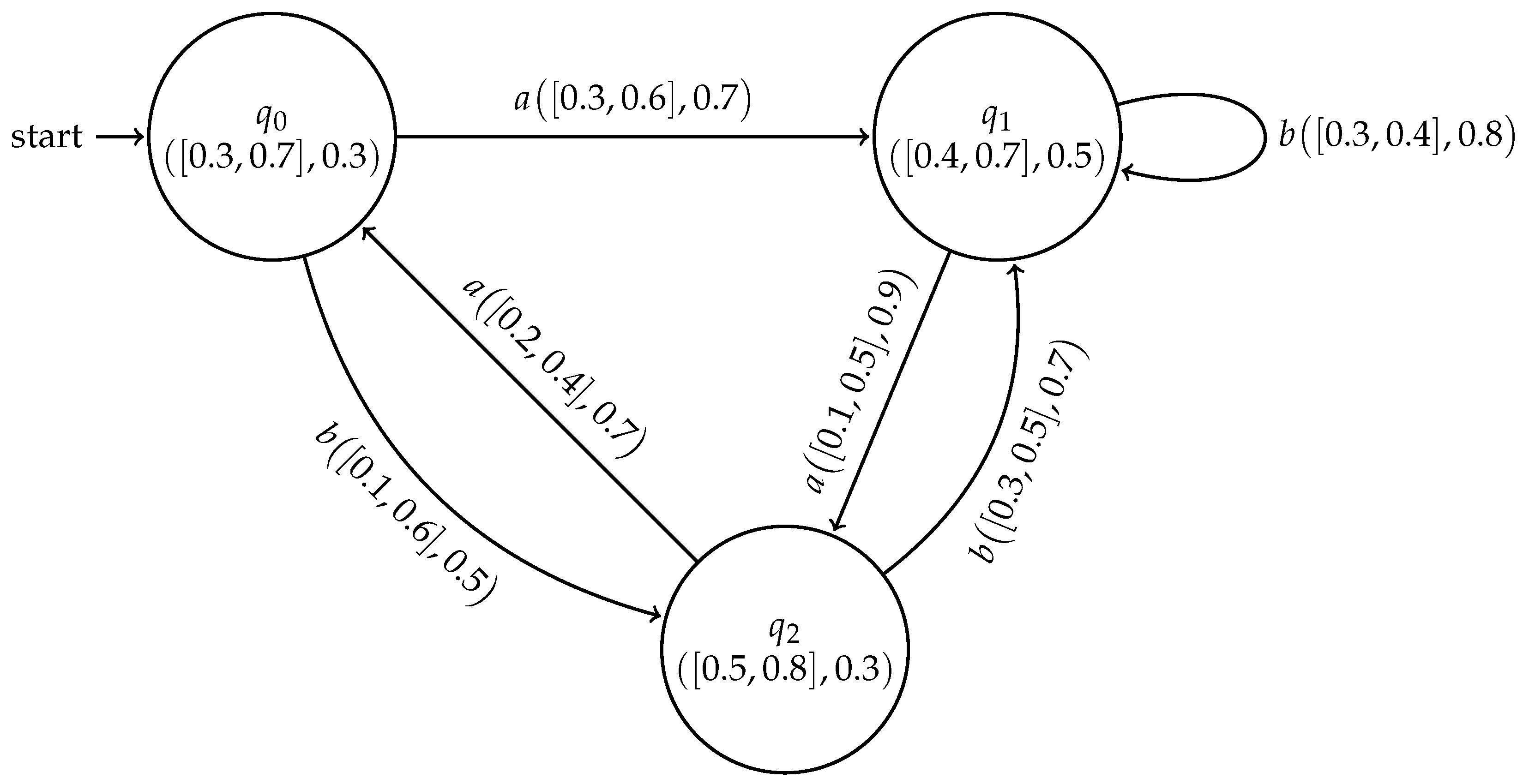
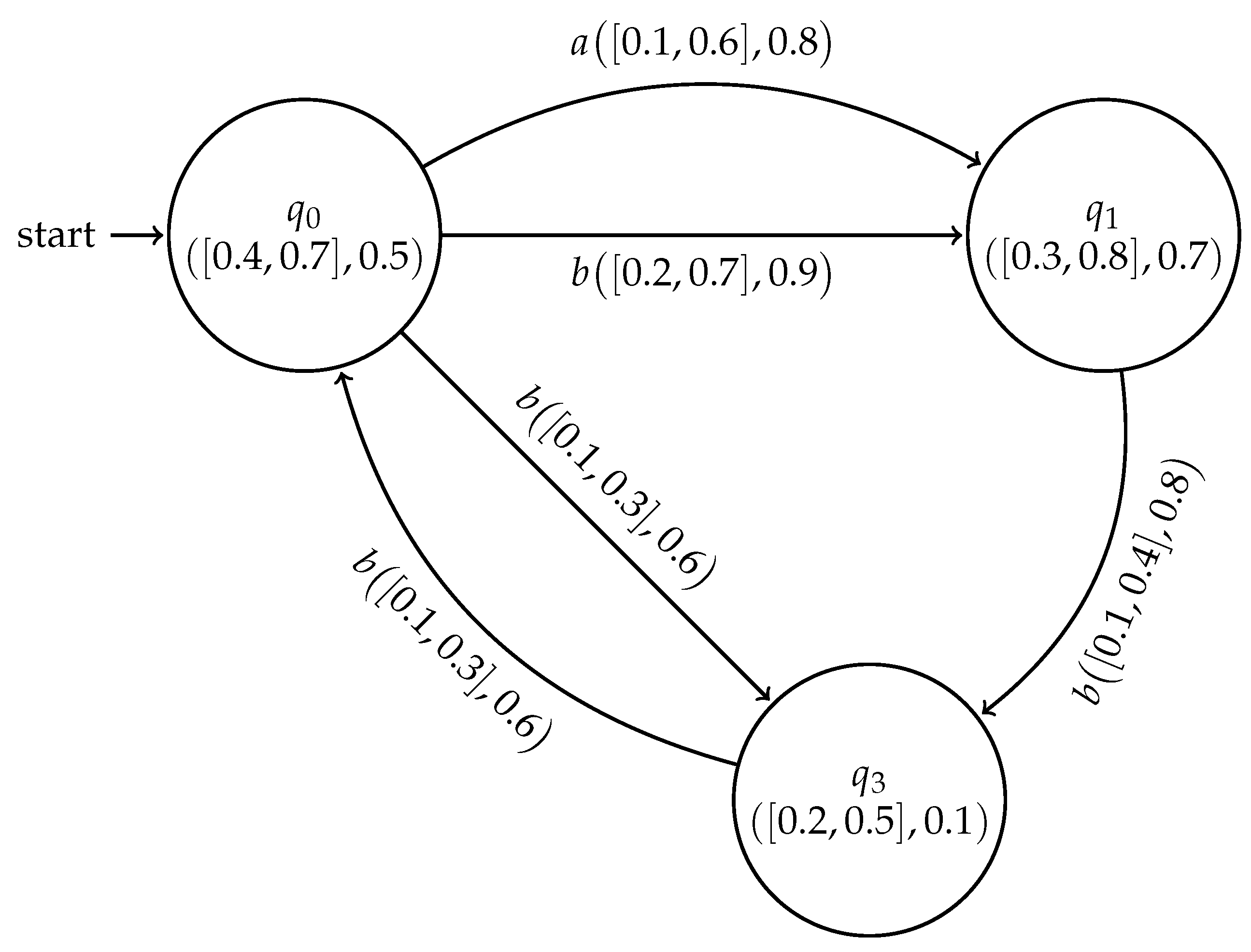
Then, the transition diagram is shown in Figure 1 as follows: Theorem 1. [2] “Let be a cubic FSM. Let be a cubic subset in Then, is a cubic subsystem of if and only iffor all and ” Definition 10. “Let be a cubic FSM. Let Then, the immediate successor p of q is defined as, if such that and p is called a successor of q if such that and ”
Let Then, the set of successors of q is denoted by If T is contained in then we define
Definition 11. “Let be a cubic FSM and let be a cubic subset of For all define the cubic subset of byand Proposition 1. Let be a cubic FSM. Then, for all cubic subsets of and for all , Proof. Consider a cubic subset
of
. Let
If
then
Let
Now,
and
Hence,
and
. Assume that the result is true ∀
such that
and for all
. Let
where
,
and
. Let
Then,
and
Hence, and ☐
Theorem 2. Let be a cubic FSM and let be a cubic subset of Then, is subsystem of if and only and for all
Proof. Let
be a subsystem of
. Let
and
Then,
and
Hence,
and
Conversely, suppose
and
for all
Let
and
Now,
and
Hence, is a subsystem of . ☐
Definition 12. Let be a cubic FSM. Let and . Define the cubic subset of byandfor all Definition 13. Let be a cubic FSM. Let and . Define the cubic subset of byandfor all Theorem 3. Let be a cubic FSM. Let and The following assertions hold.
- (i)
is a subsystem of
- (ii)
Proof. Let
and
Now,
and
Hence, and Thus, is a subsystem of by Theorem 2.
such that
and
Thus, ☐
Theorem 4. Let be a cubic FSM and let be a cubic subset of The following assertions are equivalent.
- (i)
is a subsystem of .
- (ii)
for all
- (iii)
for all
Proof. Let
. Let
and
Then,
and
Since is a subsystem. Hence,
This is Obvious.
Let
and
If
and
or
and
then
and
Suppose
and
and
and
Let
and
Then,
Thus, by the hypothesis,
. Thus,
and
Hence, is a subsystem of . ☐
4. Operations on Subsystems of Cubic FSMs
In this section, we define some operations on subsystems of cubic FSMs and some related results are provided.
Definition 14. Let and be two cubic subsystems of cubic FSMs and respectively, and let The Cartesian composition of and is denoted byand is defined as follows: - (i)
for all
- (ii)
for all and
- (iii)
for all and
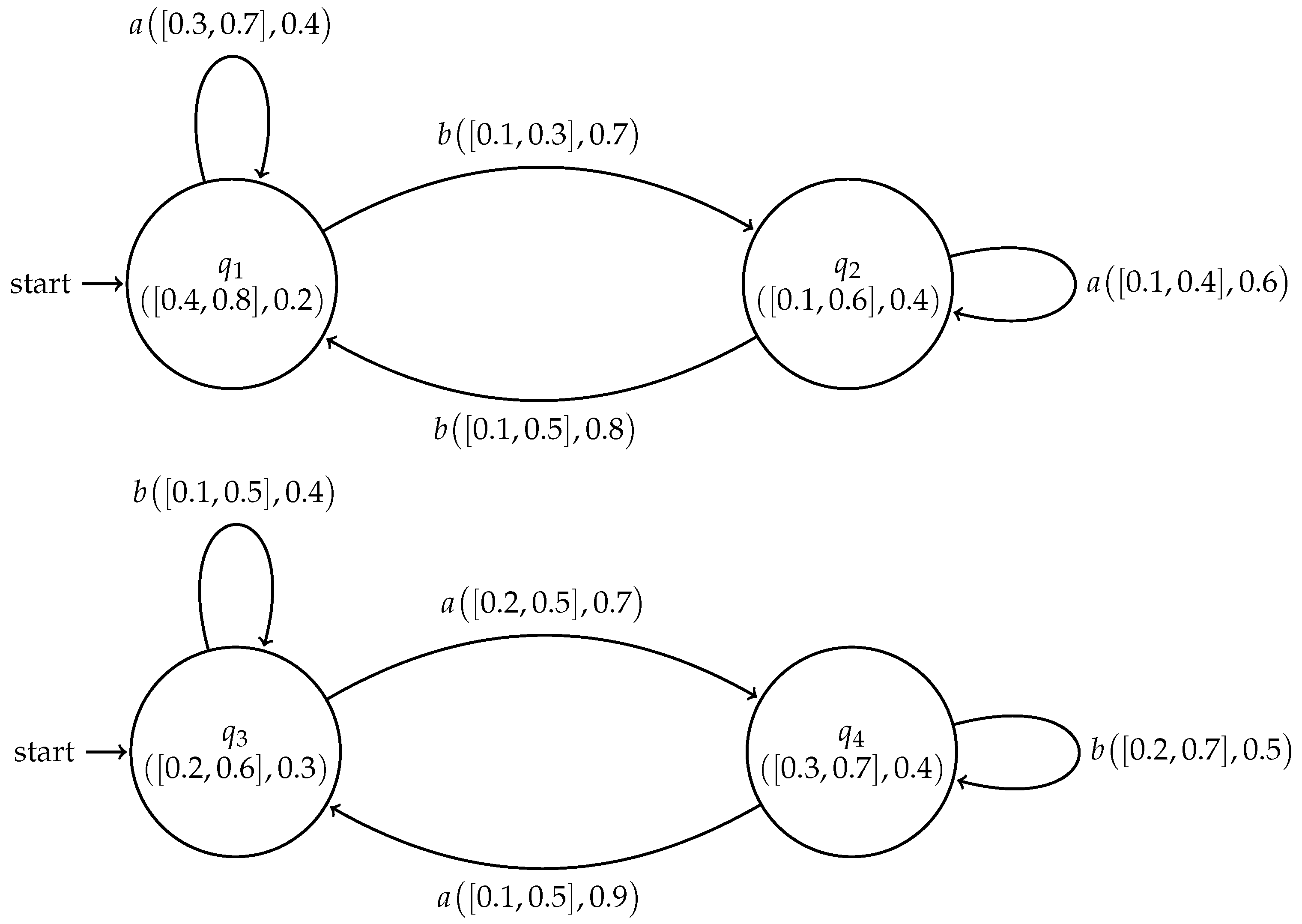
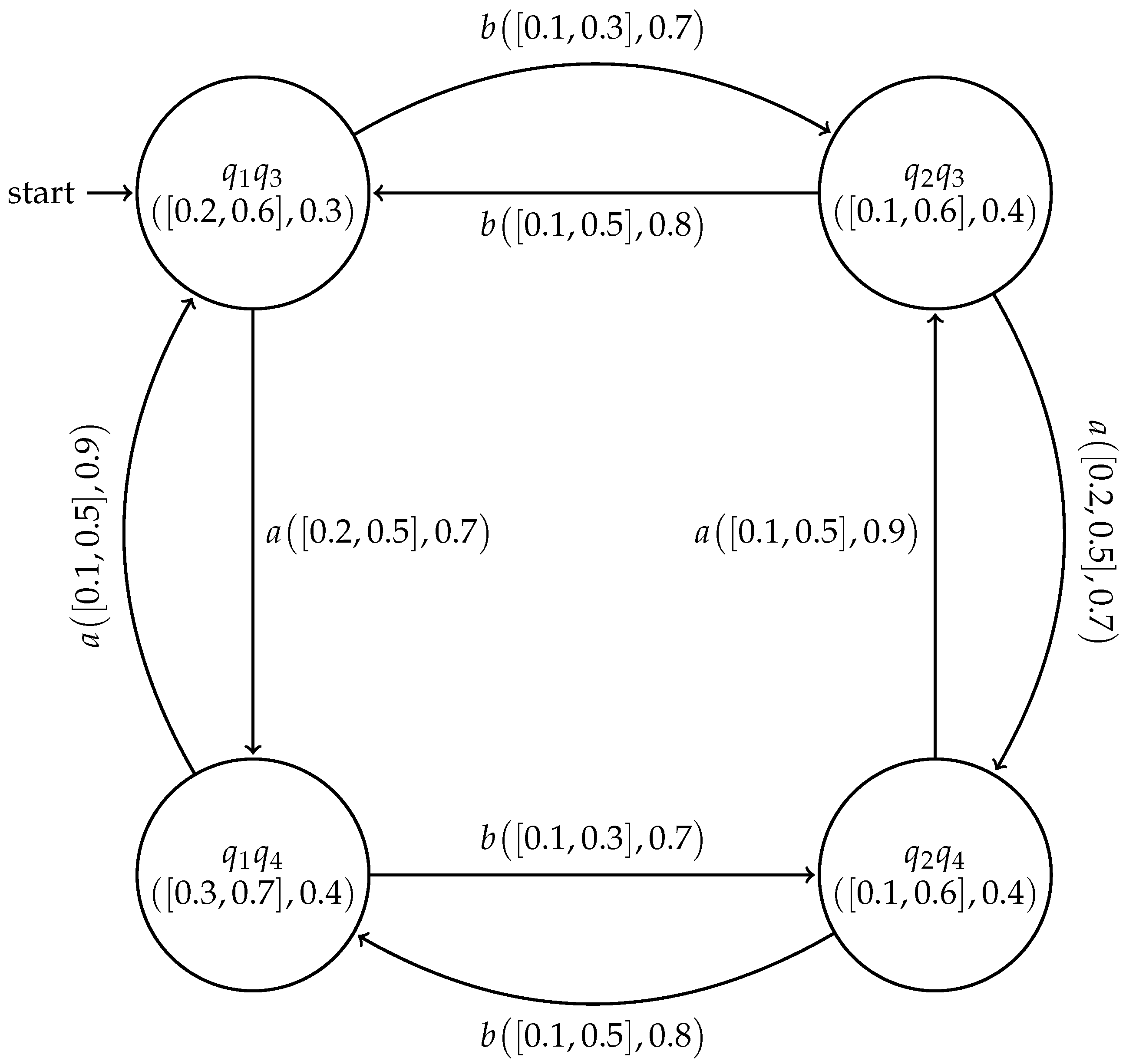
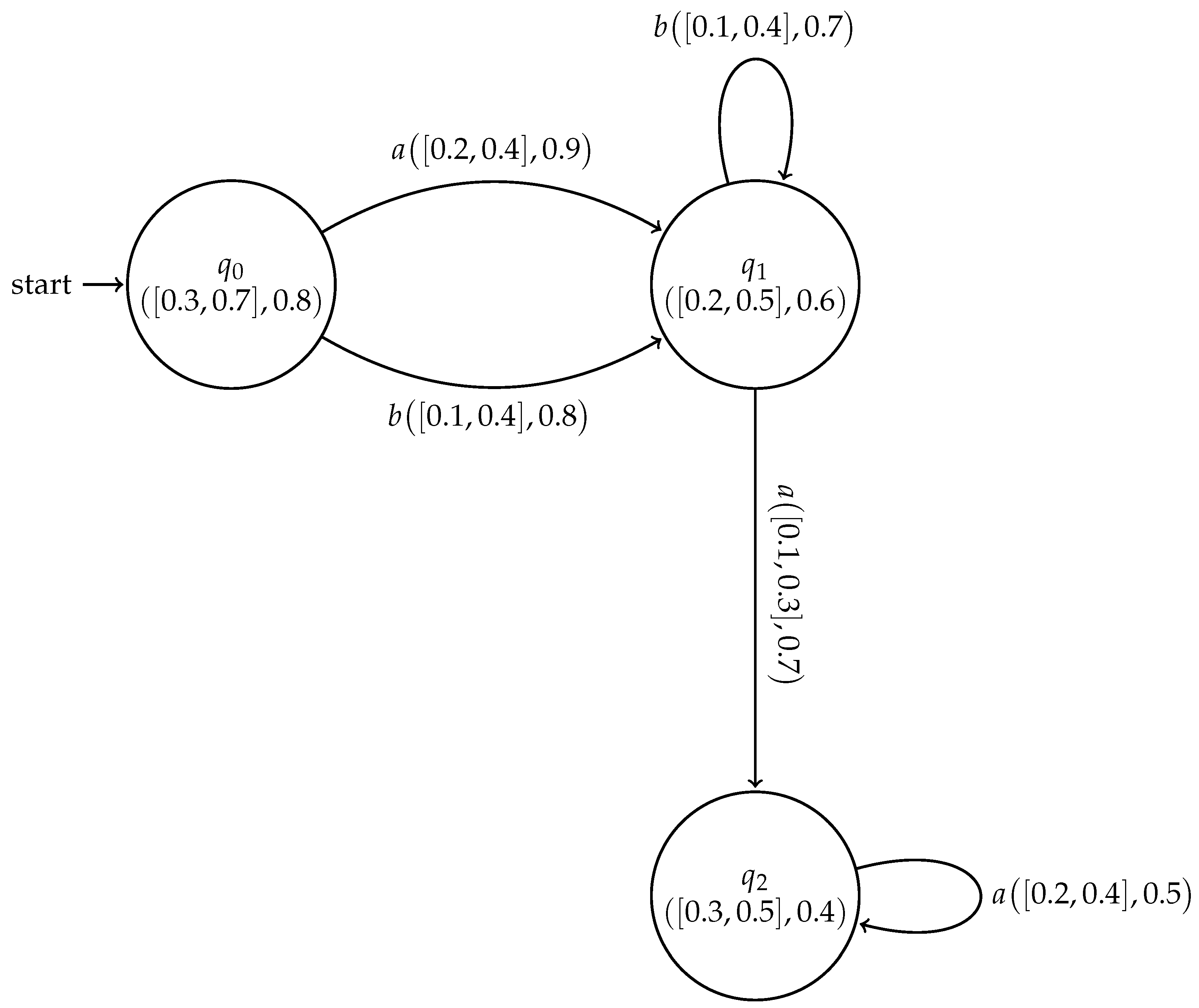
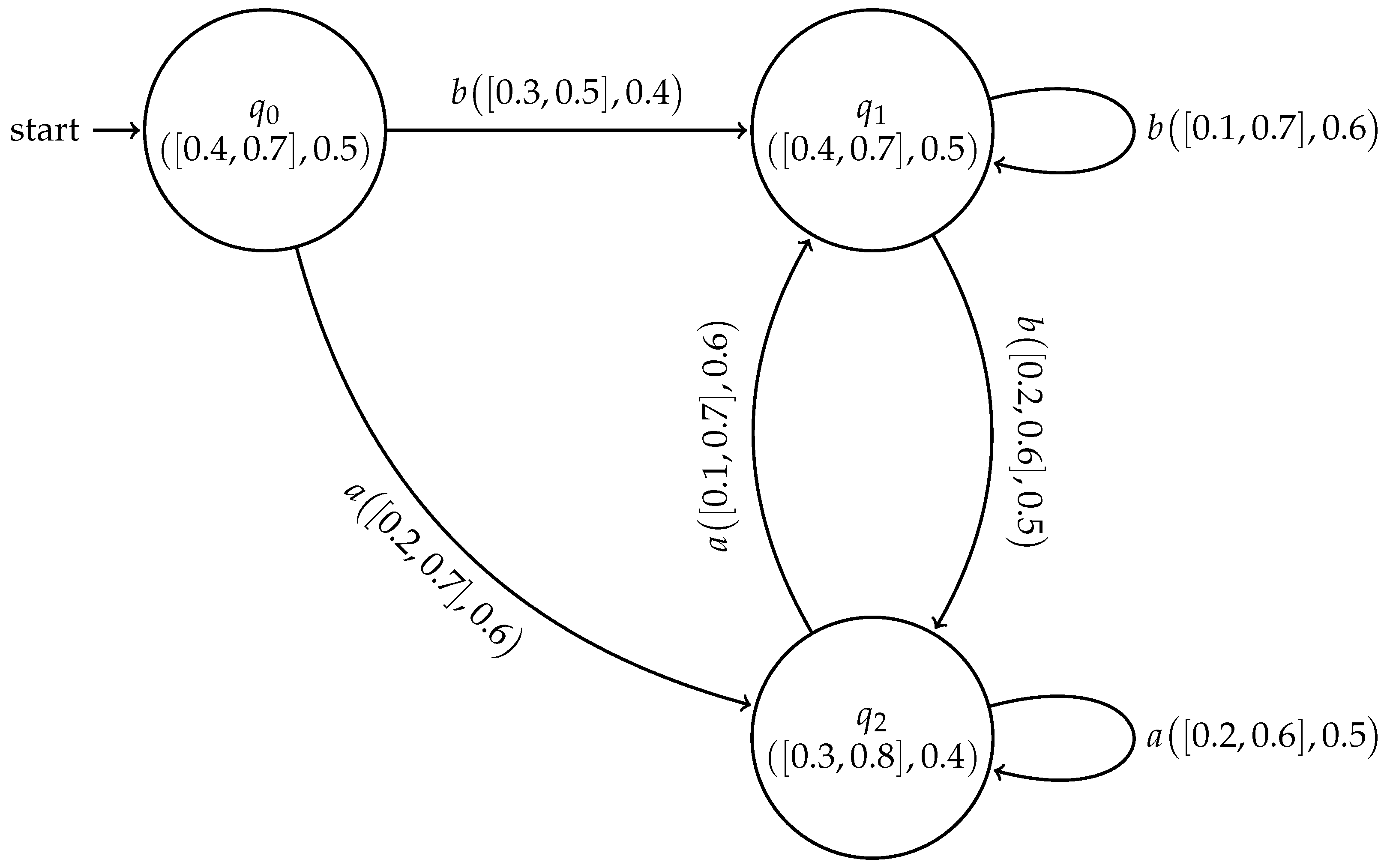
Example 2. Let and be two cubic subsystems of cubic FSMs and respectively, as shown in Figure 2: Then, their corresponding Cartesian composition is shown in Figure 3 Clearly, is a cubic subsystem of
Proposition 2. The Cartesian composition of two cubic subsystems is a cubic subsystem.
Proof. Condition (i) of Definition 14 is obvious, therefore, we verify only Conditions (ii) and (iii). Let
and
. Then,
and
Similarly, we can prove Condition (iii) for , and . ☐
Definition 15. Let and be two cubic subsystems of cubic FSMs and respectively, and let The direct product of and is denoted byand is defined as follows: - (i)
for all
- (ii)
for all and and
- (iii)
for all and and
- (iv)
for all and and
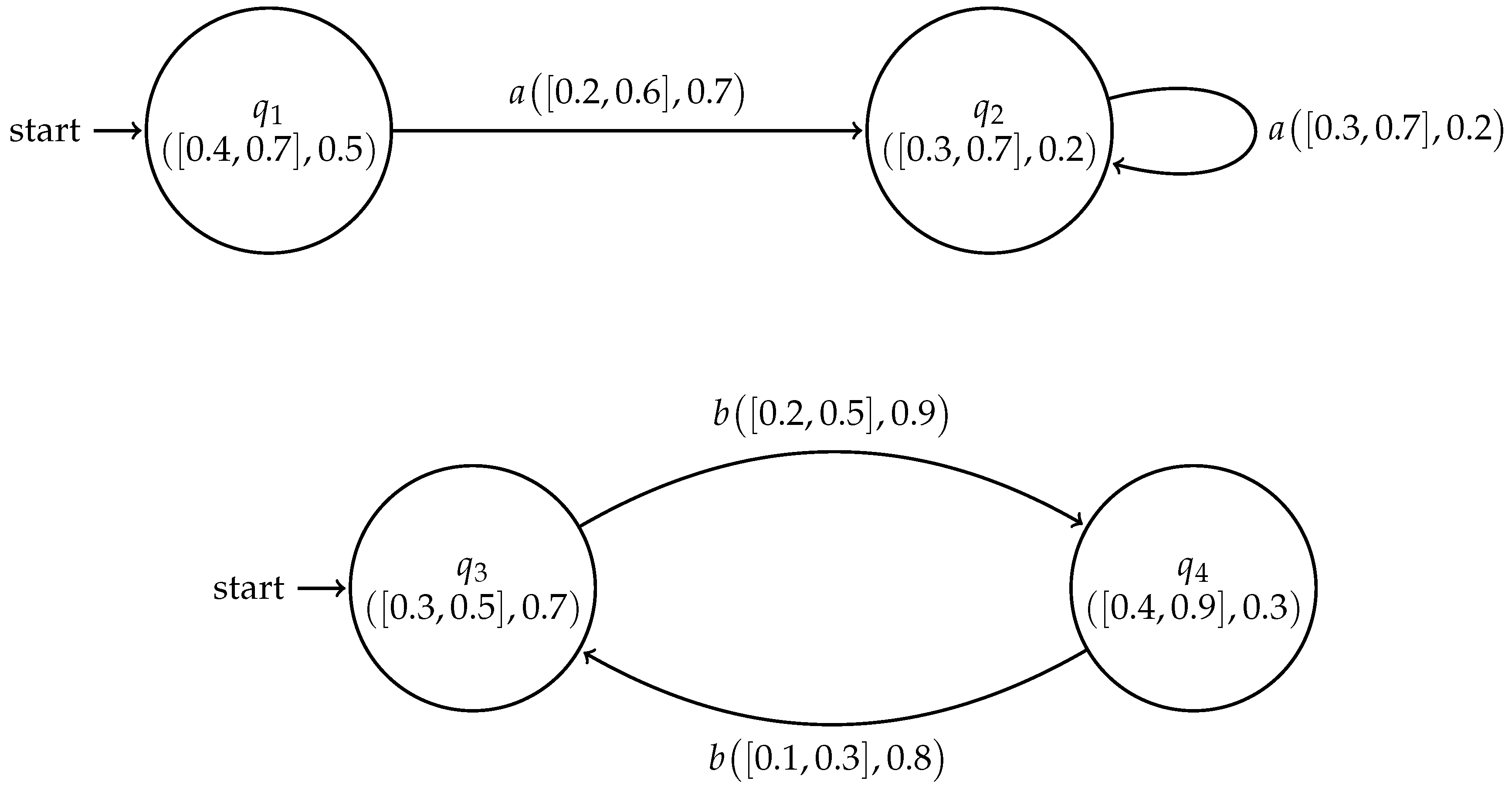
Example 3. Let and be two cubic subsystems of cubic FSMs and respectively, as shown in Figure 4 Then, their corresponding direct product is shown in Figure 5 Clearly, is a cubic subsystem of
Proposition 3. The direct product of two cubic subsystems is a cubic subsystem.
Proof. The proof is similar to the proof of Proposition 2. ☐
Definition 16. Let and be two cubic subsystems of cubic FSMs and respectively. The restricted direct product of and is denoted byand is defined as follows: - (i)
for all
- (ii)
for all and and
Proposition 4. The restricted direct product of two cubic subsystems is a cubic subsystem.
Proof. The proof is similar to the proof of the Proposition 2. ☐
Definition 17. Let and be two cubic subsystems of cubic FSMs and respectively. The R-union of and is denoted byand is defined as follows: - (i)
- (ii)
- (iii)
for all
- (iv)
for all
P-union, R-intersection and P-intersection can be defined in a similar way.
Example 4. Let and be two cubic subsystems of cubic FSMs and respectively, as shown in Figure 6 Then, their corresponding R-union is shown in Figure 7 Clearly, is a cubic subsystem of
Proposition 5. The R-union (respectively, P-union, R-intersection and P-intersection) of two cubic subsystems is a cubic subsystem.
Proof. Conditions (i) and (ii) of Definition 17 are obvious, therefore, we verify only Conditions (iii) and (iv). Let
and
. Then,
and
Thus, R-union of two cubic subsystems is a cubic subsystem. Similarly, we can prove that the P-union, R-intersection and P-intersection of two cubic subsystems are cubic subsystems. ☐
5. Internal and External Cubic Subsystems
In this section, we discuss some results related with internal and external cubic subsystems of cubic FSMs.
Definition 18. A subsystem of a cubic FSM is said to be an internal cubic subsystem (IC-subsystem) if
- (i)
- (ii)
for all and
Definition 19. A subsystem of a cubic FSM is said to be an external cubic subsystem (EC-subsystem) if
- (i)
- (ii)
for all and
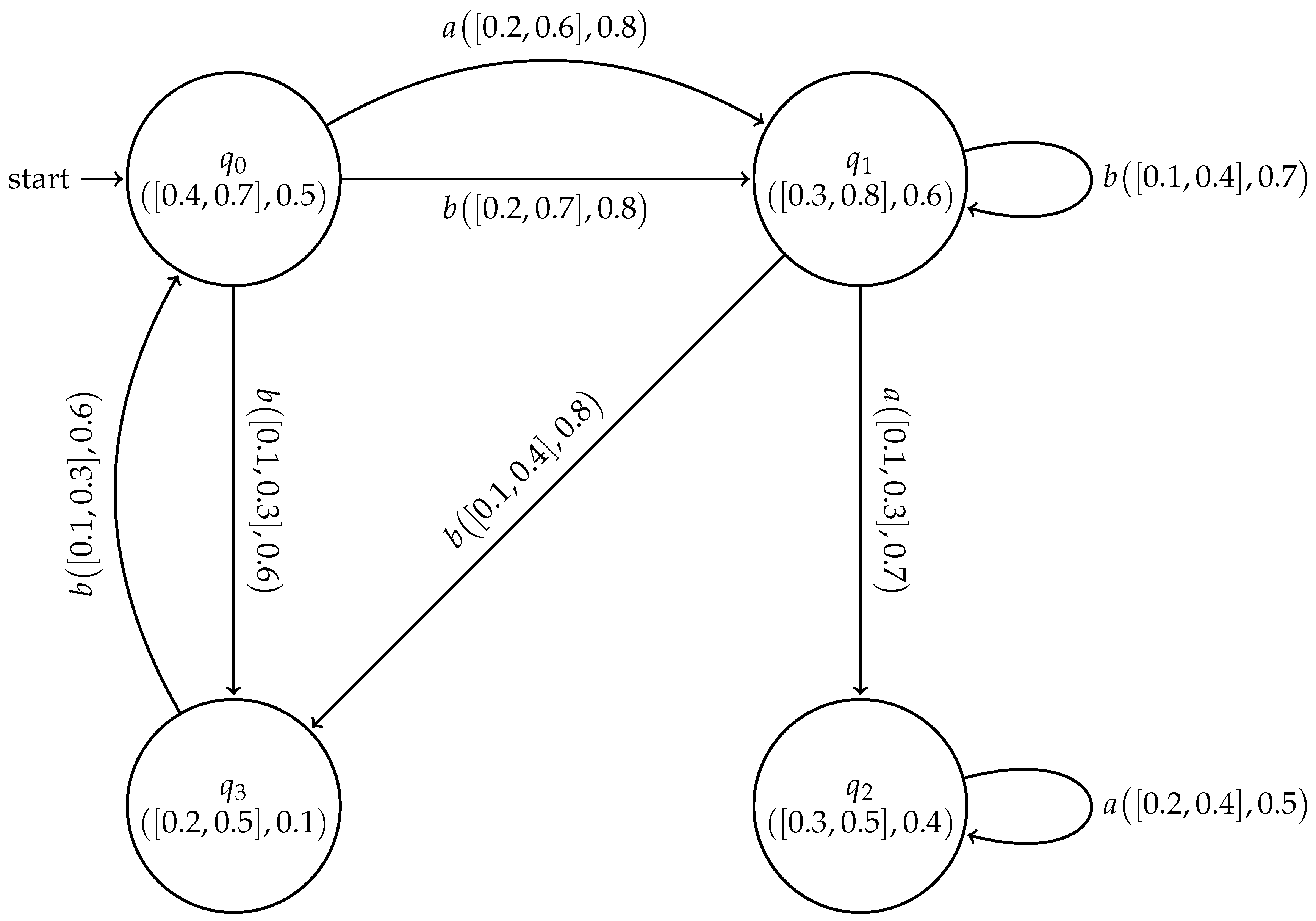
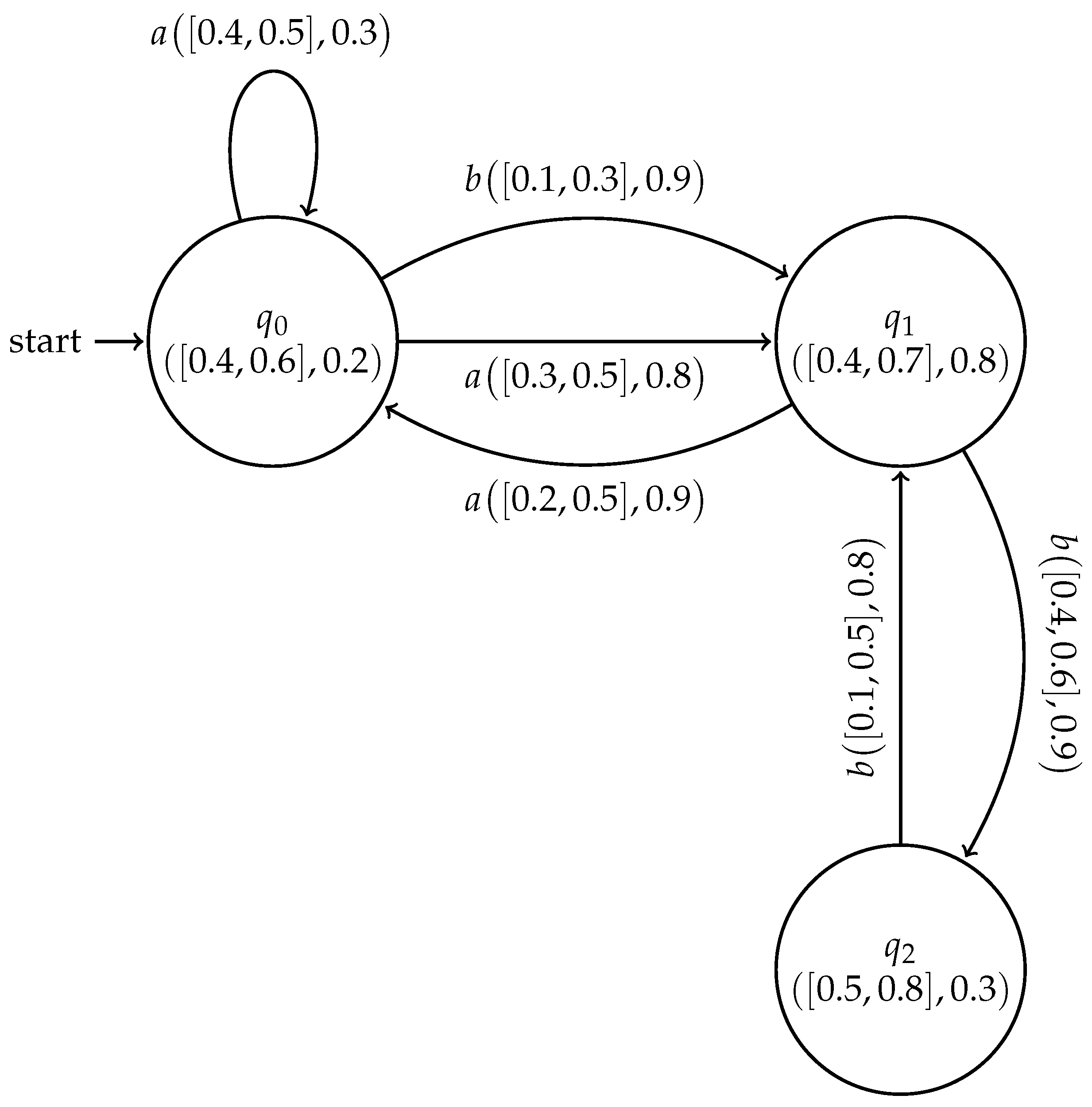
Example 5. The cubic FSMs and are internal and external cubic subsystems, respectively, as shown in Figure 8 and Figure 9 Theorem 5. Let be a cubic FSM. Then, is an internal cubic subsystem of iffor all and Proof. As it is given that and This implies that and are internal cubic subsets of and respectively. Thus, by Theorem 1, is cubic subsystem of . Thus, is an internal cubic subsystem of . This completes the proof. ☐
Theorem 6. Let be a cubic FSM. Then, is an external cubic subsystem of iffor all and Proof. The proof is similar to the proof of Theorem 5. ☐
Theorem 7. Let be a family of IC-subsystems of cubic FSMs . Then, is an IC-subsystem of .
Proof. Since
is an IC-subsystem, we have
and
for
This implies that
and
Hence, is an IC-subsystem of . ☐
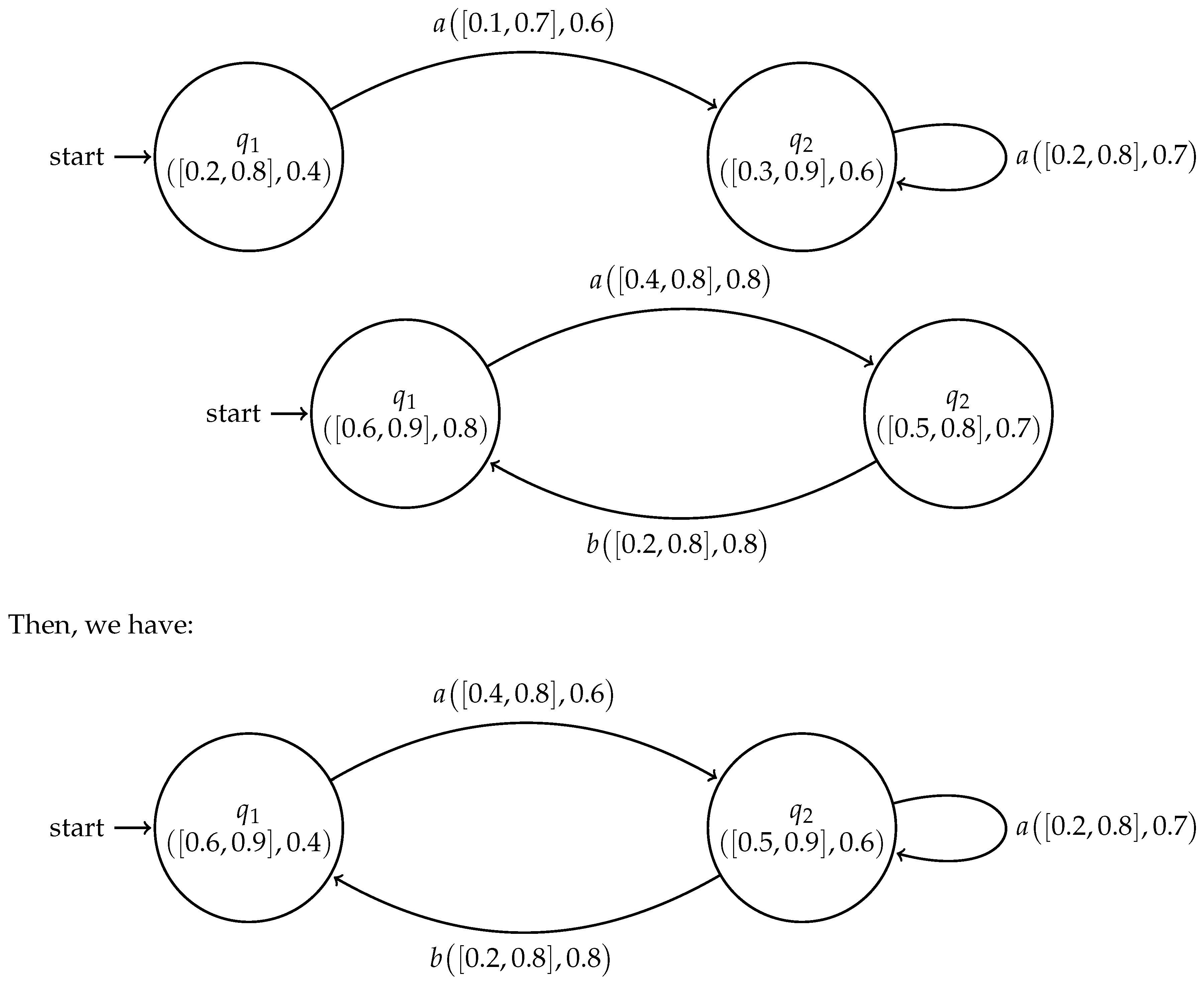
The following Example shows that the R-union of IC-subsystems need not be an IC-subsystem (EC-subsystem).
Example 6. We have the following two IC-Subsystems in Figure 10: We provide a condition for the R-union of two IC-subsystems to be an IC-subsystem.
Theorem 8. Let and be IC-subsystems of cubic FSMs and respectively, such thatandfor all and Then, the R-union of two IC-subsystems is an IC-subsystem. Proof. and
be IC-subsystems which satisfy the conditions
and
for all
and
Since
,
and
,
Thus, from the given condition we get
This shows that is an IC-subsystem. ☐
With the help of an example, it is easy to show that the P-union and R-union of EC-subsystems need not be an EC-subsystem (IC-subsystem). We provide a condition for the P-union and R-union of two EC-subsystems to be an EC-subsystem.
Theorem 9. Let and be EC-subsystems of cubic FSMs and respectively, such thatandfor all and Then, the P-union of two EC-subsystems is an EC-subsystem. Theorem 10. Let and be EC-subsystems of cubic FSMs and respectively, such thatandfor all and Then, the R-union of two EC-subsystems is an EC-subsystem. Theorem 11. Let be a subsystem of cubic FSM If is both an IC-subsystem and an EC-subsystem, thenfor all and Whereand Proof. Assume that
is both an IC-subsystem and an EC-subsystem. Then, by definition, we have
and
Thus,
or
and
or
Hence,
for all
and
☐
6. Conclusions
There are some generalizations in the concept of fuzzy sets, for example: vague sets, i.v fuzzy sets, bipolar fuzzy set, intuitionistic fuzzy sets, etc. Fuzzy sets deal with the positive characteristics of a problem while intuitionistic fuzzy sets deal with both the positive and negative characteristics of a problem. In addition, it is not possible in many problems to give a certain fix membership grade to a certain thing on the basis of its positive characteristics so we use cubic sets, which generalize the fuzzy sets and intutionistic fuzzy sets. Cubic sets are used for handling uncertainty if fuzzy sets, intuitionistic fuzzy sets and i.v fuzzy sets fails in dealing with uncertainty. The main advantage of the cubic set is that it contains more knowledge than the fuzzy set and the i.v fuzzy set. By using this idea, we can deal with different problems occur in several areas and can take the finest choice by means of cubic sets in different decision making problems.
A relationship between cubic sets and finite state machines was considered. We showed that the cartesian composition, direct product and union of two subsystems of cubic FSMs is a subsystem of a cubic FSM. Many Examples have been provided on each case. We considered conditions for subsystem of cubic FSM to be both an internal cubic subsystem of cubic FSM and an external cubic subsystem of cubic FSM.
Questions on the construction of “P-union, P-intersection, R-union, and R-intersection of cubic subsystems of cubic FSMs” is still open. In addition, applying the concept of cubic set theory to the switchboard state machines, which is a restricted and interesting class of FSMs, is still open.