


Abstract
We consider a bilateral birth-death process having sigmoidal-type rates. A thorough discussion on its transient behaviour is given, which includes studying symmetry properties of the transition probabilities, finding conditions leading to their bimodality, determining mean and variance of the process, and analyzing absorption problems in the presence of 1 or 2 boundaries. In particular, thanks to the symmetry properties we obtain the avoiding transition probabilities in the presence of a pair of absorbing boundaries, expressed as a series.
1. Introduction
Modeling physical phenomena by means of bimodal densities has recently been used in various contexts involving dichotomic systems [1,2,3]. Usually this task is performed by resorting to mixtures of unimodal densities, such as mixtures of Gaussian densities [4,5] or of inverse Gaussian densities [6]. However, in many cases the physical motivations of the considered models do not justify the use of preassigned mixtures, which rather emerge in the presence of an underlying random selection. This implies the need of constructing stochastic systems that are intrinsically bimodal. Accordingly, in this paper we aim to discuss some properties of a bilateral birth-death process characterized by nonlinear rates, namely of sigmoidal form, whose transition probabilities are bimodal. We recall that the large interest on birth-death processes in biomathematics is mainly due to their wide applicability, not only in the classical area of population dynamics but also in the realm of stochastic neuronal modeling (see, for instance, [7,8]).
Various previous investigations on birth-death processes have targeted the construction of new processes by similarity relations [9,10,11,12], or the individuation of spatial symmetries in 1 and 2 dimensions [13,14,15]. Some of these researches have been stimulated by the symmetry-based approach for one-dimensional diffusion processes described in [16]. The bilateral birth-death process that we are going to study has been considered within the examples of some of the cited contributions, since it is similar to the bilateral process with constant rates and it possesses certain suitable symmetry properties. Our purpose is now to disclose some new results that are based on the symmetry properties of this process.
After a brief description of the basic characteristics of the process, in Section 2 we discuss the bimodality fashion and the symmetry properties of its transition probabilities. Their asymptotic behaviour is also studied, and in particular it is shown that the process does not admit a steady state. Section 3 is devoted to finding the generating function of the transition probabilities. This function, in turn, is used to obtain mean and variance of the process, which are found to be linear and quadratic in time, respectively. In Section 4 we thus discuss some absorption problems and obtain the avoiding transition probabilities first in the presence of one boundary and then in the presence of two boundaries. It is also shown that the first passage is not sure in the one-boundary case.
2. A Bilateral Birth-Death Process
Let be a bilateral birth-death process, i.e., a birth-death process with state-space and no absorbing or reflecting states. Denoting, as usual, the birth and death rates respectively by
throughout the paper we assume that
with and .
2.1. Properties of birth and death rates
We note that the sum of birth and death rates (1) is independent on since
Moreover, there holds According to [17,18] process is simple, i.e., the birth and death rates uniquely determine the process, in the sense that the two-component birth-death processes, obtained by locating at a boundary reflecting in both directions, are simple. We remark that if and then process identifies with the nonlinear birth-death process treated in [19].
It is worth pointing out that when and the rates in 1 become constant in and then in both cases process identifies with the so-called randomized random walk (see [20] or Section 2.1 of [21]) with birth and death rates given respectively by and (when ) or and (when ). In addition, the rates in (1) are equal and constant in n when . Furthermore, apart from the trivial cases and they are monotonic in Precisely, is increasing and has limits
whereas is decreasing, with
We now stress that, apart from the trivial setting condition holds in each of the two following cases:
- (i)
- and ,
- (ii)
- and .
We also notice that if then is increasing in c and is decreasing in c, whereas such monotonicities are reversed if The related limits are:
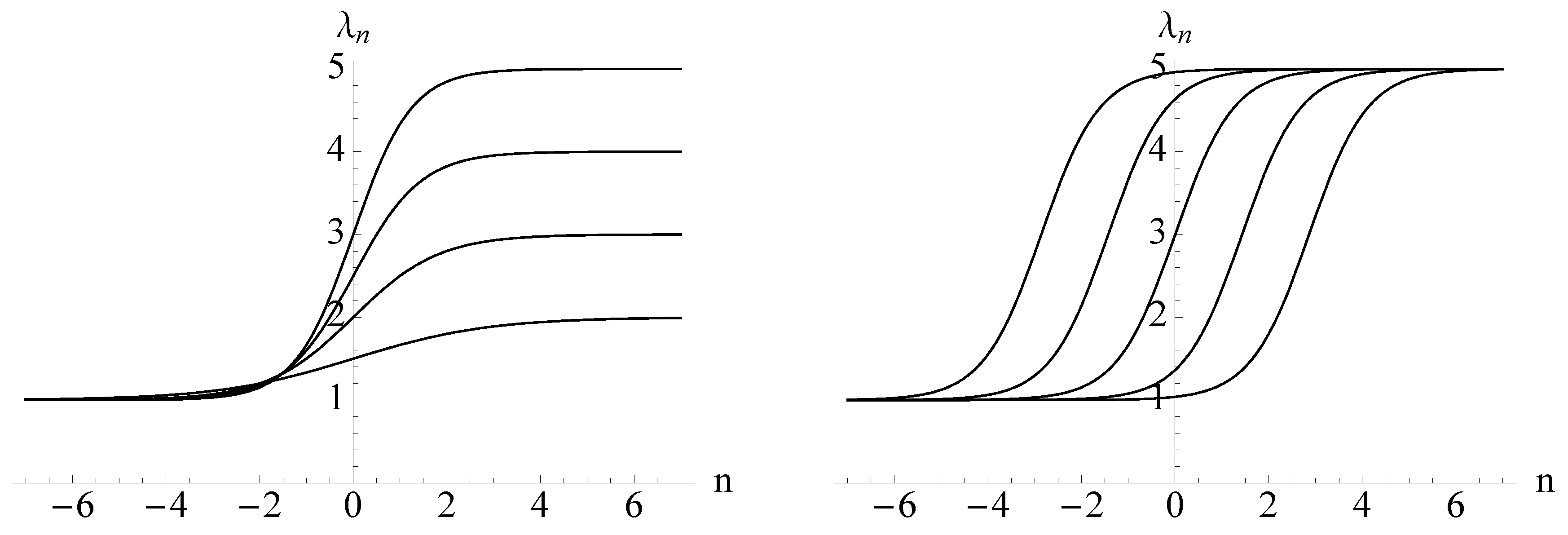
Some plots of are shown in Figure 1 (where, for better display, n is treated as a real number). We remark that the properties of the birth and death rates discussed above make particularly suitable to model situations where the sample-paths of the process tend to escape far from the initial state.
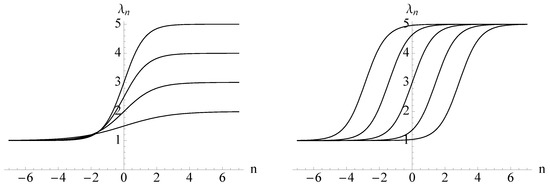
Figure 1.
Plots of for , and (from bottom to top) with and , on the left, whereas and , on the right.
2.2. Transition probabilities
Let us denote the transition probabilities of process by
These satisfy the following system of forward equations:
where the rates are given by (1). The initial condition of (2) is
being the Kronecker symbol. For all we have
where (see Equation 9.6.10 of [22])
denotes the modified Bessel function of the first kind. We point out that the right-hand-side of (4) has been obtained by making use of a transformation-based approach leading to similar processes [9,10]. Briefly, such an approach allows to express the transition probabilities of as
where
and where
are the transition probabilities of the randomized random walk, say , having birth rate and death rate (see, for instance, Theorem 1 of [23]). In other terms, the notion of similarity expresses that the ratio of the transition probabilities of processes and is time-independent (see also [11,12]).
Remark 1
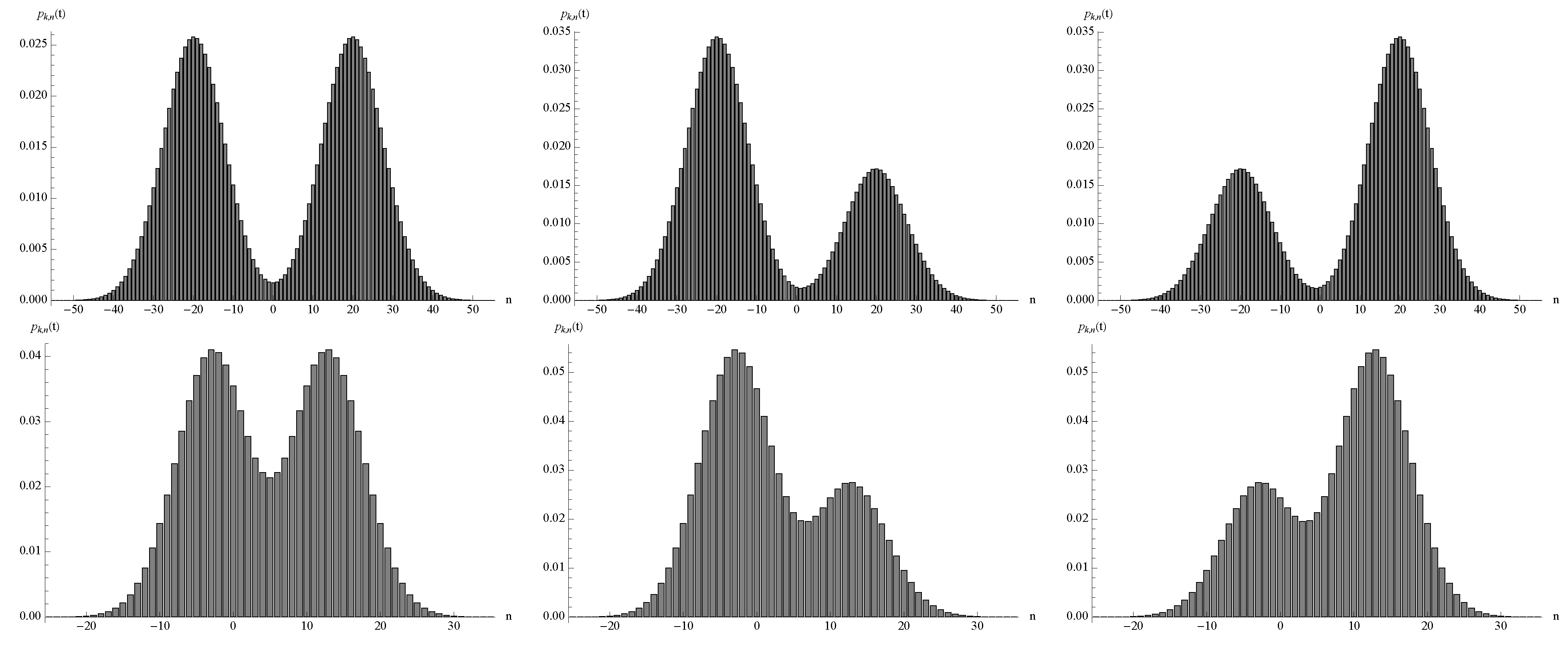
Some plots of the transition probabilities (4) are shown in Figure 2, where it is evident that exhibits a bimodality. In particular, when , then and in this case the values of at the modes are equal. This is also a consequence of the symmetry property discussed in Remark 4 below.
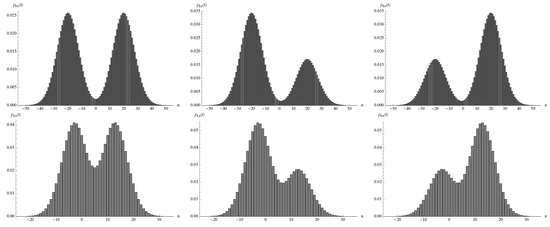
Figure 2.
Plots of for and ; on the first row , and (from left to right); on the second row , and (from left to right).
Remark 2
Let us now ascertain the existence of a stochastic ordering between the processes and . Indeed, by recalling the definition of likelihood ratio order (see, for instance, Section 1.C.1 of [24]) we have that, for any fixed ,
if and only if
By making use of (5) and (6) it is not hard to see that this condition is satisfied when , apart from the trivial case .
Remark 3
We point out that the transformation-based approach leading to similar processes in certain instances is useful for simulation purposes. Indeed, if Equation (5) holds and is finite, then one can simulate by adopting an acceptance-rejection technique (see Section 4.4 of [25], for instance).
2.3. Symmetry properties
Let us now point out that the transition probabilities (4) for all can also be expressed as
with
where we use the generalized hyperbolic cosine function defined in Equation (2.2) of [26]. This allows to write the ratio of probabilities of two arbitrary sample-paths as follows:
with defined in (10).
We recall that certain spatial symmetries for truncated birth-death processes have been studied in [13]. Extensions to a two-dimensional case and to continuous-time Markov chains are given respectively in [14] and [15]. In the same spirit of these contributions we now analyze some symmetry properties of . They will be obtained making use of Equation (11) and of identity for the Bessel function (see Equation 9.6.6 of [22]).
Remark 4
By setting and in (11) we have
Any sample-path of going from k to n has a symmetric path going from to (where births and deaths in a path correspond to deaths and births in the symmetric one, respectively). In other terms, this symmetry refers to translated and reflected paths. Relation (12) thus expresses that the ratio of the probabilities of two symmetric paths is time-independent. We recall that Equation (12) extends the property given in Example 5.1 of [15], where the case is treated. From (10) we have that when or when . Hence, by setting in Equation (12), we obtain that the symmetry property
is satisfied when
apart from the trivial case . Hence, if condition (13) is fulfilled then two symmetric sample-paths starting from the same state k have identical probabilities. This is in agreement with the fact that if (13) is satisfied, then due to (1) we have the following symmetry relation for the birth and death rates of :
In the left-hand plots of Figure 2 are shown two cases where (13) holds.
Remark 5
Remark 6
By choosing and in (11) we have:
which is the well-known time-reversibility relation (cf. [27], for instance).
Remark 7
In order to take account of the role of the parameters in the transition probabilities of , let us now denote by the right-hand-side of (9). It is not hard to see that the following symmetry property holds:
Moreover, if we have
We notice that the symmetries appearing in the two right-hand graphs of both rows of Figure 2 are a consequence of the two above properties and of the symmetry property discussed in Remark 4.
We conclude this section by pointing out that the above symmetry properties will play a relevant role in Section 4 for the resolution of some absorption problems for .
2.4. Asymptotic behaviour
Process does not admit a steady state. Indeed, the transition probabilities (4) tend to 0 when . Furthermore, by recalling the asymptotic approximation (cf. Equation 9.7.1 of [22])
from (9) we have that, for large t,
However, since the right-hand-side of (17) does not depend on n, the approximation given in (18) does not capture the bimodality of mentioned in Section 2.2. Hence, Equation (18) is useful just to establish how fast approaches 0 as . If we thus have
Otherwise, recalling that the decay parameter of a simple birth-death process is given by (see [28])
if we have that tends to 0 exponentially fast as , with decay parameter
3. Mean and Variance
In this section we shall obtain mean and variance of . To this purpose, let us now evaluate the generating function of , which is defined as
Proposition 1
For all , and we have
Proof.
We are now able to obtain the mean and the variance of .
Proposition 2
For all and we have
Making use of , the proof follows by straightforward calculations, and thus is omitted. Proposition 2 shows that, in general, the mean and the variance of are respectively linear and quadratic in t. This is in agreement with the results obtained in [19] when and .
Remark 8
4. First-passage time and absorption problems
This section is devoted to some problems related to the first-passage time of . We shall deal with the one-boundary and the two-boundaries cases.
4.1. One-boundary case
For all let us denote by
the first-passage time of through state s, starting from state k. The determination of the first-passage-time density
has been already addressed in [9,10]. Hereafter we limit ourselves to recall some useful results. By virtue of the similarity relation existing between and the randomized random walk, one can prove that
with probabilities given in (4) and (9). Alternatively, as a consequence of (5) the first-passage-time density can also be expressed as
where is defined in (6) and where
denotes the first-passage-time density of the randomized random walk . Hence, noting that
From (23) it follows that for the first-passage probability of is given by
It is worth pointing out that, apart from the trivial case , the first-passage from k to s is not sure since probability (24) is always less than 1.
Let us now introduce the s-avoiding transition probabilities of :
with and , or with and . By the symmetry-based result given in Theorem 2.5 of [13] we have two forms for the s-avoiding transition probabilities:
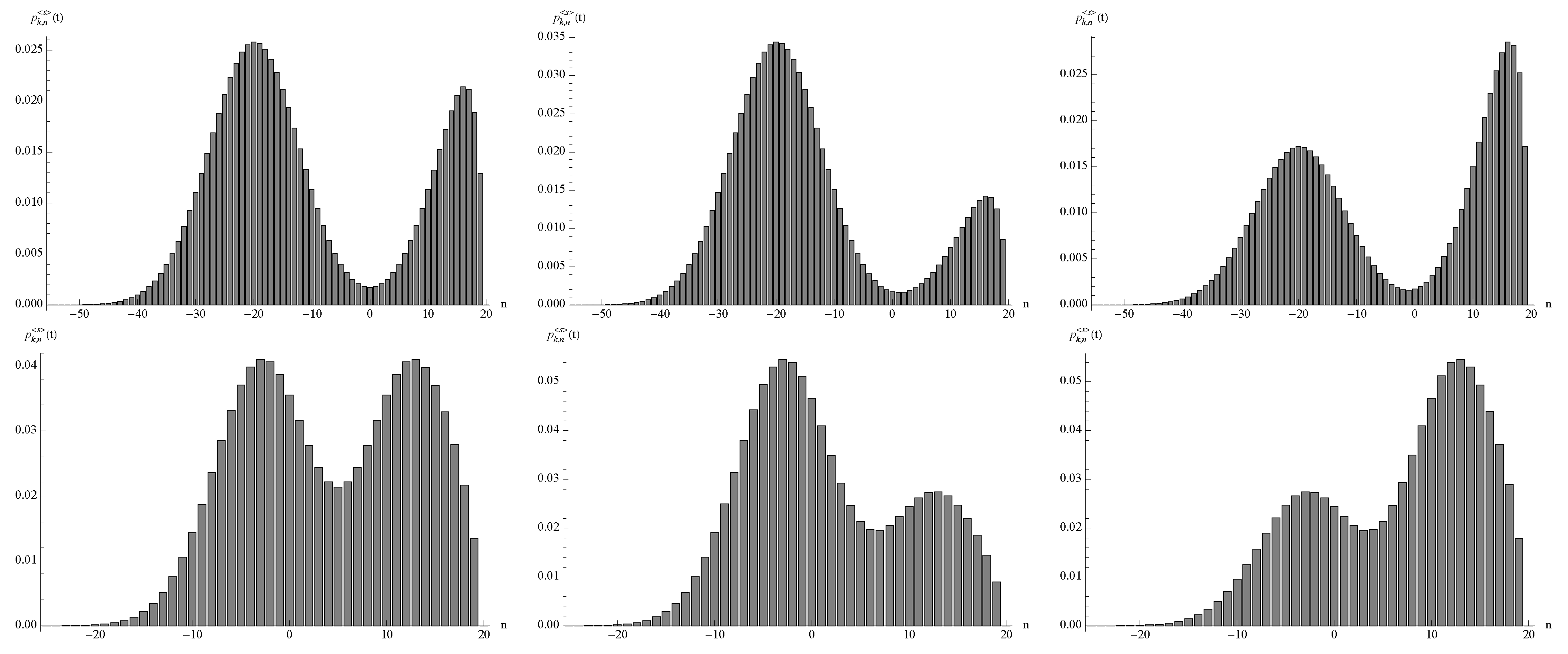
where the last identity is due to (12). Some plots of probabilities (25) are shown in Figure 3.
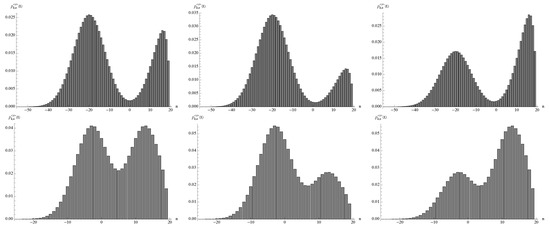
Figure 3.
Plots of for the same cases treated in Figure 2, with . The corresponding probability masses are: 0.7140, 0.8094, 0.6187 (first row), 0.9454, 0.9636, 0.9272 (second row).
4.2. Two-boundaries case
Now we treat the case when is in the presence of a pair of boundaries. For let
be the first-passage time of through the set of states , starting from state k. We are interested in the -avoiding transition probabilities of , defined as
with and . Let us now come to the main result of the paper, which will be obtained by making use of the symmetry properties exploited in Section 2.3., and by constructing a doubly infinite system of symmetry points
We remark that the first set contains point k, which belongs to the reduced state-space
whereas all remaining points are outside, as well as all points of the second set.
Proposition 3
Let and ; for all the -avoiding transition probabilities of admit the following two forms:
Proof.
First we recall that, due to (11),
where is defined in (10). The identity between (26) and (27) can be immediately obtained by means of (28), with two appropriate choices of N. Moreover, from (12) one has
Hence, making use of (29) the right-hand-side of (26) can be expressed as a linear combination of probabilities of the form , and thus it satisfies the system of equations (2). Moreover, recalling initial condition (3), for and we have
so that the right-hand-side of (26) is equal to when . We note that when the series appearing in (27) can be rewritten as:
by setting in the second series and recalling identity we obtain that the above difference vanishes. The same result holds when . In conclusion, both the expressions given in (26) and (27) satisfy the system of forward equations for the probabilities of with initial condition , and both vanish when and . Hence, they constitute the -avoiding transition probabilities of . ☐
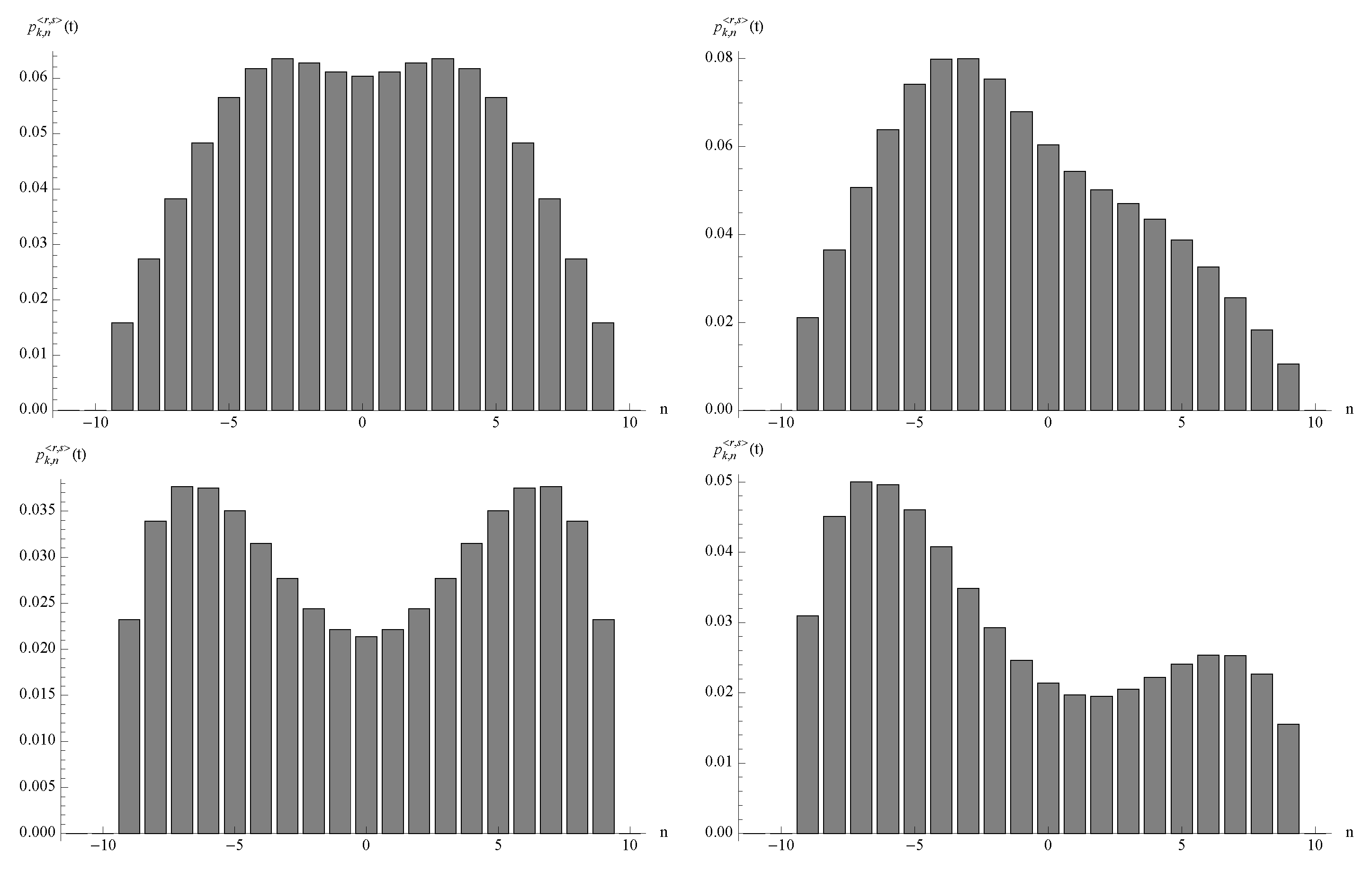
Figure 4 shows some plots of probabilities (27).
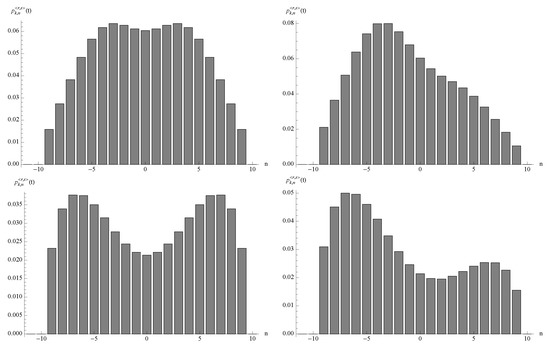
Figure 4.
Plots of for , , , and , with (first row) and (second row), and with (on the left) and (on the right).
We finally stress that the role of the symmetry properties of the transition probabilities has been essential to obtain the results on absorption problems given in this section.
5. Concluding Remarks
In this paper we have emphasized the bimodality and symmetry properties of the transition probabilities of , aiming to fulfill the needs of modelers and applied scientists who look for even more flexible stochastic models for their applications.
Among the applied fields where process plays a role we mention the theoretical neurobiology. We recall the recent paper [29], in which a stochastic process defined as an exponential transformation of has been used to describe the dynamics of neuronal membrane potential, in order to refine a model previously proposed in [30].
We also recall that, as noticed in [19], process can be viewed as the natural discrete counterpart of the diffusion process on , with drift and infinitesimal variance given respectively by
for , and . Such a diffusion process can be obtained by a suitable similarity procedure starting from Wiener process [31]. Among the explicit results on the process with infinitesimal moments (30) we mention the transition density in the presence of two time-linear absorbing boundaries, obtained in Section 4.1 of [32], that has stimulated the symmetry-based approach followed in Section 4.2.
Acknowledgments
This work has been partially supported by Regione Campania and G.N.C.S.-INdAM.
References
- Borromeo, M.; Marchesoni, F. The role of bistability in stochastic resonance. Eur. Phys. J. B 2009, 69, 23–27. [Google Scholar] [CrossRef]
- Dybiec, B.; Schimansky-Geier, L. Emergence of bimodality in noisy systems with single-well potential. Eur. Phys. J. B 2007, 57, 313–320. [Google Scholar] [CrossRef]
- Nicolis, S.C.; Nicolis, C. Extreme events in bimodal systems. Phys. Rev. E 2008, 78, 036222:1–036222:6. [Google Scholar] [CrossRef] [PubMed]
- Aprausheva, N.N.; Sorokin, S.V. On the uni- and bimodality of a two-component Gaussian mixture. Pattern Recogn. Image Anal. 2008, 18, 577–579. [Google Scholar] [CrossRef]
- Block, H.W.; Li, Y.; Savits, T.H. Mixtures of normal distributions: modality and failure rate. Stat. Prob. Lett. 2005, 74, 253–264. [Google Scholar] [CrossRef]
- Smith, C.E.; Lánský, P. A reliability application of a mixture of inverse Gaussian distributions. Appl. Stoch. Mod. Data Anal. 1994, 10, 61–69. [Google Scholar] [CrossRef]
- Giorno, V.; Lánský, P.; Nobile, A.G.; Ricciardi, L.M. Diffusion approximation and first-passage-time problem for a model neuron. III. A birth-and-death process approach. Biol. Cybernet. 1988, 58, 387–404. [Google Scholar] [CrossRef]
- Pokora, O.; Lánský, P. Statistical approach in search for optimal signal in simple olfactory neuronal models. Math. Biosci. 2008, 214, 100–108. [Google Scholar] [CrossRef]
- Di Crescenzo, A. On certain transformation properties of birth-and-death processes. In Cybernetics and Systems ’94; Vol. 1, Trappl, R., Ed.; World Scientific: Singapore, 1994; pp. 839–846. [Google Scholar]
- Di Crescenzo, A. On some transformations of bilateral birth-and-death processes with applications to first passage time evaluations. In Proceedings of the 17th Symposium on Information Theory and Its Applications (SITA ’94), Hiroshima, Japan, Dec, 1994; pp. 739–742. [Google Scholar]
- Lenin, R.B.; Parthasarathy, P.R.; Scheinhardt, W.R.W.; Van Doorn, E.A. Families of birth-death processes with similar time-dependent behaviour. J. Appl. Prob. 2000, 37, 835–849. [Google Scholar] [CrossRef]
- Pollett, P.K. Similar Markov chains. In Probability, Statistics and Seismology. A Festschrift for David Vere-Jones; Daley, D.J., Ed.; J. Appl. Prob. special volume 38A; 2001; pp. 53–65. [Google Scholar]
- Di Crescenzo, A. First-passage-time densities and avoiding probabilities for birth-and-death processes with symmetric sample paths. J. Appl. Prob. 1998, 35, 383–394. [Google Scholar] [CrossRef]
- Di Crescenzo, A.; Martinucci, B. A first-passage-time problem for symmetric and similar two-dimensional birth-death processes. Stoch. Models 2008, 24, 451–469. [Google Scholar] [CrossRef]
- Di Crescenzo, A.; Nastro, A. On first-passage-time densities for certain symmetric Markov chains. Sci. Math. Japon. 2004, 60, 381–390. [Google Scholar]
- Giorno, V.; Nobile, A.G.; Ricciardi, L.M. A symmetry-based constructive approach to probability densities for one-dimensional diffusion processes. J. Appl. Prob. 1989, 26, 707–721. [Google Scholar] [CrossRef]
- Callaert, H.; Keilson, J. On exponential ergodicity and spectral structure for birth–death processes II. Stoch. Proc. Appl. 1973, 1, 217–235. [Google Scholar] [CrossRef]
- Pruitt, W.E. Bilateral birth and death processes. Trans. Amer. Math. Soc. 1962, 107, 508–525. [Google Scholar] [CrossRef]
- Hongler, M.O.; Parthasarathy, P.R. On a super-diffusive, nonlinear birth and death process. Phys. Lett. A 2008, 372, 3360–3362. [Google Scholar] [CrossRef]
- Conolly, B.W. On randomized random walks. SIAM Review 1971, 13, 81–99. [Google Scholar] [CrossRef]
- Conolly, B. Lecture Notes on Queueing Systems; Ellis Horwood: Chichester, UK, 1975. [Google Scholar]
- Abramowitz, M.; Stegun, I.A. Handbook of Mathematical Functions with Formulas, Graphs, and Mathematical Tables; Dover: New York, NY, USA, 1992. [Google Scholar]
- Baccelli, F.; Massey, W.A. A sample path analysis of the M/M/1 queue. J. Appl. Prob. 1989, 26, 418–422. [Google Scholar] [CrossRef]
- Shaked, M.; Shanthikumar, J.G. Stochastic Orders; Springer: New York, NY, USA, 2007. [Google Scholar]
- Ross, S.M. Simulation, Third Edition; Academic Press: San Diego, CA, USA, 2002. [Google Scholar]
- Ren, Y.J.; Zhang, H.Q. New generalized hyperbolic functions and auto-Bäcklund transformation to find new exact solutions of the (2 + 1)-dimensional NNV equation. Phys. Lett. A 2006, 357, 438–448. [Google Scholar] [CrossRef]
- Karlin, S.; Mc Gregor, J.L. The classification of birth and death processes. Trans. Amer. Math. Soc. 1957, 86, 366–400. [Google Scholar] [CrossRef]
- Van Doorn, E.A. Conditions for exponential ergodicity and bounds for the decay parameter of a birth–death process. Adv. Appl. Prob. 1985, 17, 514–530. [Google Scholar] [CrossRef]
- Di Crescenzo, A.; Martinucci, B. A neuronal model with excitatory and inhibitory inputs governed by a birth-death process. In Computer Aided Systems Theory – EUROCAST 2009; Moreno Diaz, R., Pichler, F., Quesada Arencibia, A., Eds.; Springer-Verlag: Berlin Heidelberg, Germany, 2009; Vol. 5717, pp. 121–128. [Google Scholar]
- Di Crescenzo, A.; Martinucci, B. Analysis of a stochastic neuronal model with excitatory inputs and state-dependent effects. Math. Biosci. 2007, 209, 547–563. [Google Scholar] [CrossRef] [PubMed]
- Giorno, V.; Nobile, A.G.; Ricciardi, L.M. A new approach to the construction of the first-passage-time densities. In Cybernetics and Systems ’88; Trappl, R., Ed.; Kluwer, 1988; pp. 375–381. [Google Scholar]
- Di Crescenzo, A.; Giorno, V.; Nobile, A.G.; Ricciardi, L.M. On first-passage-time and transition densities for strongly symmetric diffusion processes. Nagoya Math. J. 1997, 145, 143–161. [Google Scholar] [CrossRef]
© 2009 by the authors; licensee Molecular Diversity Preservation International, Basel, Switzerland. This article is an open-access article distributed under the terms and conditions of the Creative Commons Attribution license http://creativecommons.org/licenses/by/3.0/.