


Abstract
This systematic review examines the intersection of systems thinking and learning theory in addressing rural–urban challenges in light of increasing global urbanization. We explore how different dimensions of systems thinking—ontological (how we understand systems) and epistemological (how we think about systems)—align with single-, double-, and triple-loop learning in rural–urban research from 2014 to 2024. Through a rigorous screening process of the peer-reviewed literature, we analyze how theoretical frameworks manifest in research approaches, methodological choices, and learning outcomes. Our findings reveal promising developments and persistent gaps in current approaches, and suggest pathways for more integrated theoretical and methodological frameworks. We also highlight the need for studies that develop knowledge and practices that support collective learning and joint trajectories towards sustainability from a cross-sectorial perspective in rural–urban geographies. This synthesis contributes to discussions on how to effectively address complex challenges at the rural–urban interface while advancing both theoretical understanding and practical application.
1. Introduction
The interface between rural and urban areas is fraught with complexity. As human settlements have trended towards urbanization over the last 70 years, with the global urban population rising from 30% in 1950 to 56% in 2020 [1], there is an increasing urgency to address this interface to achieve a sustainable Anthropocene—balancing societal, economic, and environmental needs. A key challenge to addressing this space within research lies within the exceptional diversity of the rural–urban interface around the globe. In every instance, it is a rapidly evolving amalgamation of cultural values, ecosystem attributes, and governance structures, manifesting in challenges such as competing land use demands, asymmetric power relations, and differing conceptualizations of development [2]. These interfaces face multiple pressures including resource competition, shifting demographic patterns, changing agricultural practices, and climate change impacts [3]. While common challenges exist at the rural–urban interface—such as food security, water management, and mobility infrastructure—there are few straightforward solutions applicable across all contexts due to the locally embedded nature of these systems [4]. The diversity of challenges is further complicated by varying institutional capacities, cultural norms, and historical development trajectories across regions [5]. Such a broad scope for research presents favorable conditions for the proliferation of a “hammer–nail” [6] research agenda, whereby researchers look for solutions based on the theoretical or methodological approaches they are most experienced with [7]. This methodological path dependency can limit both the degree to which the complexity of the rural–urban interface is addressed and the alignment of solutions with context-specific challenges. As argued by Willett [8], this highlights the need for adaptive, place-based approaches that can respond to local conditions while acknowledging broader systemic patterns and interdependencies.
Given the multifaceted challenges at the rural–urban interface, there is a growing recognition that new approaches to both understanding and addressing complexity are needed. Systems thinking emerges as particularly relevant, offering a conceptual orientation to inquiry that can help characterize and navigate such complexity [9]. The notion of systems thinking as a necessary skill to support sustainable management of natural resources in the Anthropocene is gaining momentum, spurred on by global initiatives such as the SDGs that call for integrated consideration of multiple sustainability challenges [10]. This approach is especially pertinent as traditional sectoral or siloed approaches have proven insufficient for addressing the interconnected nature of rural–urban challenges [11]. Systems thinking provides tools and frameworks for understanding feedback loops, emergence, and non-linear relationships [10], which can help to characterize rural–urban interactions. Understanding the application of the state of the art in systems thinking within urban, rural, and peri-urban research is, therefore, of critical importance. A clear example of this is found in research calling for the application of systems theory to overcome the historical dichotomy of discourse surrounding rural- and urban-focused studies, highlighting the essential role of peri-urban systems as dynamic transition zones rather than simple boundaries [12]. Moreover, systems approaches help reveal how apparent conflicts between rural and urban priorities might be reframed as opportunities for synergistic solutions, particularly when stakeholders develop shared understanding of system dynamics [13].
It has been observed that systems thinking contains both the ontological (knowledge about systems) and epistemological (systems thinking as a mental practice) dimensions [14,15,16]. Both these dimensions are necessary in order to work with transformative system change, but one also needs to ask what knowledge is being generated and who is doing the learning. In fact, recent research highlights the role of learning as a key element for driving sustainability transitions [17,18]. Barth et al. [17] highlight the growing importance of transdisciplinary learning within sustainable development processes and conceptualize using two main dimensions of learning: social interaction and degree of reflection. The latter is derived from management science theory [19] and has close ties to epistemological elements of systems thinking applied in practice [20,21].
The alignment between learning depths and systems thinking approaches is particularly relevant for rural–urban challenges, where transformation often requires not just understanding complex systems or improving how we study them, but fundamentally reconceptualizing the relationship between rural and urban spaces [12]. Thus, while systems thinking provides frameworks for understanding complexity [21], transdisciplinary and transformative learning offers insights into how this understanding can lead to action [19,22]. For example, while complex adaptive systems theory might help us understand rural–urban interdependencies, and assemblage thinking might question our methods of studying these relationships [23], systemic design approaches can facilitate the deep reflection needed to transform how stakeholders conceptualize and engage with rural–urban spaces altogether [10].
In this paper, we aim to build upon previous reviews focusing on the nature of the relationship between rural and urban areas. Recent reviews have made valuable contributions while maintaining distinct focuses. Delgado-Vinas and Gomez-Moreno [24] developed a comprehensive review of the current state of epistemological and methodological approaches and their evolution regarding rural and urban spaces. Similarly, Gutierrez-Velez et al. [25] focused on infrastructure and motivate for a reconceptualization of infrastructure planning that considers urban and rural as compliments rather than antagonists. Somanje et al. [26] provided important insights into infrastructure and governance challenges in Ghana’s rural–urban context, with broader implications for Sub-Saharan Africa. Tonne et al. [27] examined health outcomes in urban development. In their comprehensive analysis, Perpiña Castillo et al. [28] illustrated how demographic changes, access to services, and land use patterns shape urban–rural dynamics across the European Union, highlighting the need for integrated territorial approaches. A concurrent review by Cattaneo et al. [29] advanced our understanding of economic and social development along the urban–rural continuum, emphasizing how access to services and employment opportunities varies across this spectrum. Cattaneo et al. [29] and Perpiña Castillo et al. [28] underscored that binary urban–rural classifications are insufficient for capturing the nuanced interactions between these spaces. They demonstrated how population changes, service accessibility, and economic opportunities create complex interdependencies that require more sophisticated analytical frameworks.
Our review adds new insights to the area of rural–urban development by specifically examining how building stronger connections between systems thinking and conceptual approaches to learning may enhance our understanding of urban–rural dynamics. While previous work has established the structural and functional relationships between urban and rural areas, we aim to complement this knowledge by exploring how learning processes and systems perspectives can reveal new insights into these relationships.
Our review also adds new knowledge on the application and effectiveness of systems thinking approaches in this context. To provide structure to this analysis and guide future research, we address the following research questions:
- (RQ1) Which specific research themes receive focus within coupled urban–rural system contexts?
- (RQ2) Which established methods are employed for addressing complex systemic challenges in coupled urban–rural systems?
- (RQ3) How have learning perspectives/objectives supporting systems thinking been included in the discourse of coupled urban–rural systems in the past decade?
The main findings show that the reviewed papers fall into four main groups: papers focusing on rural areas and connections from urban to rural, papers focusing on urban areas and connections from rural to urban, papers focusing on bi-directional urban–rural interplay, and, finally, papers focusing on external factors influencing/affecting both urban and rural areas. In terms of learning perspectives, only a minority of papers consistently follow triple-loop or double-loop learning perspectives. The majority of papers mix different learning perspectives. A notable pattern is the setting of triple-loop learning objectives in the introduction, followed by the use of double-loop methods.
Analysis of the methodological approaches used showed that only a few papers consistently followed an epistemological approach, and about one-third followed an ontological approach. The remaining papers used a combination of both approaches, framing their introductions epistemologically but using ontologically oriented methods or results.
The rest of the paper is structured as follows: the next section presents the methodology used and our approach to synthesis and analysis. This is followed by a description of the main research results, their analysis, and discussion. Finally, we draw conclusions and propose suggestions for future research.
2. Method
2.1. Research Design and Methodology
The systematic literature review methodology [30,31,32] was used in order to ensure a methodologically rigorous overview of existing academic research and evidence. This approach is also in line with the overall aim of this study to synthesize knowledge in the area of rural and urban synergies with a focus on systems thinking and learning perspectives. In our systematic literature review, we adopted the four-step model from Tranfield et al. [32], which was previously used in systematic literature reviews executed in other research areas (e.g., [33]). The model is summarized in Figure 1.
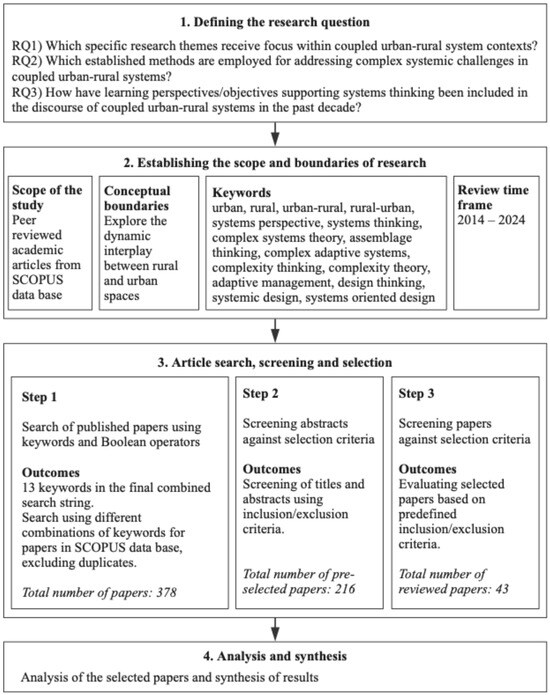
Figure 1.
Methodological approach and analysis for the review.
2.1.1. The Scope and Boundaries of Research
The review scope is articles published between 2014 and 2024. The decision to set the year 2014 as a starting point is based on the interest in exploring contemporary approaches to research of rural and urban systems, increasing rates of globalization, impact of climate change, boosting technological development, digital transformation, and other factors.
The SCOPUS database was used as the main source to search for relevant articles. As the analysis is specifically focused on systems thinking and systems approaches, the search began with iterative refinement of articles applying systems thinking or systems approaches and then expanding the assessment to other conceptual framings that share commonalities.
The review is focused on two domains: rural–urban synergies and systems thinking and systems approaches. Based on this, primary and secondary search terms were specified. Primary search terms were “Urban” and “Rural”. Secondary search terms were “Systems perspective”, “Systems thinking”, “Complex systems theory”, “Assemblage thinking”, “Complex adaptive systems”, “Complexity thinking”, “Complexity theory”, “Adaptive management”, “Design thinking”, “Systemic design”, and “Systems oriented design”.
Keyword selection was guided by the need to comprehensively capture different theoretical approaches to studying complex rural–urban systems. The main focus was on systems thinking and its related theoretical frameworks, recognizing a spectrum of ontological approaches that help characterize system properties and epistemological approaches that inform how we learn about and interact with these systems (see Figure 2). The selected keywords/approaches can be conceptualized in their application across this spectrum, depicting the evolution of systems thinking with the intention of capturing both ontological and epistemological aspects. These were chosen to ensure that the articles included a broad theoretical lens of systems thinking approaches used to understand and address rural–urban challenges. An overview of the definitions for these different approaches is provided in Table 1.
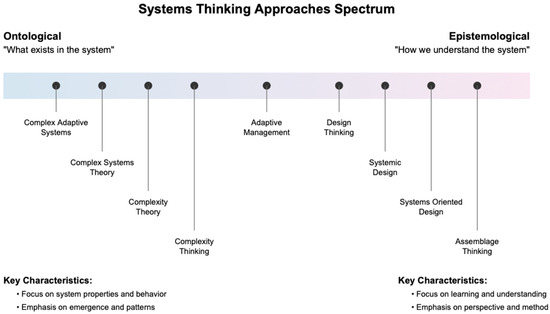
Figure 2.
Systems thinking approaches included in this review. The figure represents an example of their potential applications across the ontological–epistemological spectrum.

Table 1.
Summarized definitions of the secondary search terms taken from the literature.
2.1.2. Article Search, Screening, and Selection
The identified search terms were combined in different combinations in search queries using the Boolean operators “AND” and “OR”. Below is the example of our final query containing 13 keywords:
urban AND rural AND “systems perspective” OR “systems thinking” OR “complex systems theory” OR “assemblage thinking” OR “complex adaptive systems” OR “complexity thinking” OR “complexity theory” OR “adaptive management” OR “design thinking” OR “systemic design” OR “systems oriented design”.
After removing duplicates, the primary search resulted in 378 articles.
Four researchers with different backgrounds made a primary screening and selection by reviewing titles and abstracts of the selected papers against the selection criteria. The selection included research papers that were peer-reviewed, published in journals, focused on methodology or concept development, addressing the rural and urban problematics, using systemic perspective or systems thinking, and published between 2014 and 2024. Excluded from the selection were papers written in a language other than English, book chapters and Ph.D. dissertations, review articles, conference papers, papers not addressing rural and urban, and papers that used systemic thinking or systems thinking inappropriately (see Table 2). After the primary screening, 216 articles remained.
Table 2.
Inclusion criteria.
The articles were then classified and analyzed following a qualitative content analysis approach [52]. Three researchers read the remaining 216 articles in order to refine the selection by relevance to the research questions. Each paper was reviewed by at least two researchers. At this step, all papers were coded using two criteria (see Table 3):
Table 3.
Coding used for Step 3 screening.
- (i)
- Where the focus on urban and rural is (in methods, in results or discussion, or in the background and introduction). This was motivated by a desire to confine the analysis to those studies that actively work with these subjects rather than mention them as framing for the study.
- (ii)
- Where these papers apply systems thinking (in methods, in results or discussion, or in the background and introduction). Again, motivated to confine the review to articles which actively work with systems thinking, and exclude those that mention systems thinking as a high-level framing/motivation.
Papers that contained both criteria in methods and in results and/or discussion were selected for the review (this corresponds to table areas marked with 1 and 2). A total of 43 papers were selected for the final review.
2.1.3. Interpretation and Synthesis
Analysis and interpretation of the final papers for review began with a thematic organization based on their treatment of rural and urban perspectives. This deductive approach was based upon RQ 1 and 2. A summary of each paper was produced, describing the research topic, methods applied, and context in which the research was conducted.
Next, the concept of triple-loop learning, from organizational learning theory, was chosen to provide structure and rigor to the analysis as it relates to research question 3. Single-loop learning focuses on improving existing practices within accepted frameworks—aligning with ontological systems approaches that describe system properties [14,53]. Double-loop learning questions underlying assumptions and goals [17,54]—resonating with epistemological systems approaches that examine how we understand and study systems. Triple-loop learning ventures further by questioning the context itself and transforming the learner’s perspective [55]—closely aligning with reflexive approaches in systems thinking such as systemic design and adaptive management [44,48].
The definitions in Table 4 were distilled from the literature to assess the conceptual learning of the articles reviewed (single-, double-, or triple-loop). This was complimented by a parallel deductive coding process to characterize the dominant systems thinking perspective (ontological or epistemological). Two researchers performed the interpretation by iteratively updating and refining the coding to align the deductive inquiry with the research questions/hypotheses, using the literature definitions of the triple-loop learning framework as well as ontological/epistemological systems thinking (see Table 4). The introduction/background, methodology, and results/discussion were considered as distinct units of analysis in keeping with the article screening process.
Table 4.
The different forms of learning that are assessed in this review.
The overall process for addressing RQ3 is summarized in Figure 3. Learning goals and systemic framing were analyzed across introduction/background, methods, and results to give a more comprehensive picture of the interaction between these. The coding process was conducted by two researchers, following a grounded theory approach, who first coded 10 articles together and then benchmarked results to develop a shared interpretation strategy.
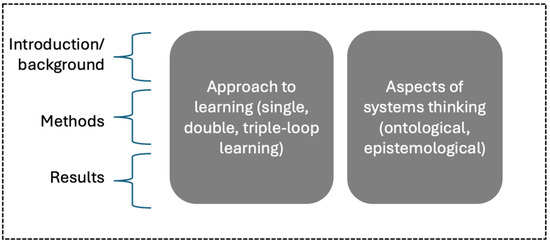
Figure 3.
Approach used in the second step of analysis and synthesis.
3. Results
Our selected 43 articles were published in 28 different journals, but nearly half of the articles were published in four journals, including Sustainability (28%), Land Use Policy (7%), Habitat International (5%), and Journal of Rural Studies (5%). All other articles were represented by individual journals.
The distribution of articles over the period between 2014 and 2014 shows that there has been at least one publication every year (see Figure 4), but it also indicates that no significant evolution of research production within this field has occurred during the review period.
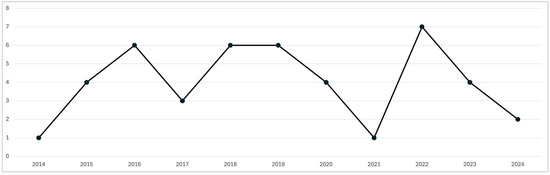
Figure 4.
Distribution of the selected articles by year.
The analyzed papers cover urban and rural synergies with a global geographical distribution. Most papers have their geographic focus in Asia (40%), followed by Europe (24%), then Africa (17%), Northern America (14%), and, finally, Latin America (5%) (see Figure 5).
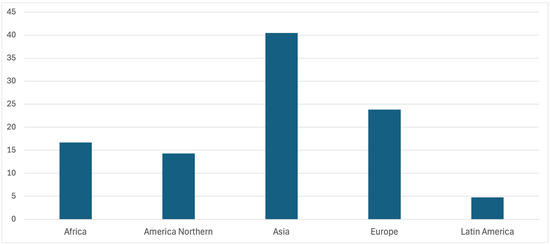
Figure 5.
Geographic distribution of the selected articles.
3.1. Research Methods
Regarding methodological choice, mixed-method approaches dominate (42%, n = 18), followed by qualitative studies (33%, n = 14), while purely quantitative approaches are less common (21%, n = 9), and purely conceptual or theoretical approaches are underrepresented (4%, n = 2) (see Figure 6).
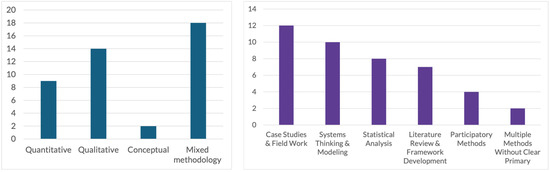
Figure 6.
Summary of methodology and methods used in the reviewed articles.
Systems thinking and modeling approaches appear in 23% of the papers (n = 10), often combined with empirical methods such as case studies (28%, n = 12) and statistical analysis (19%, n = 8) (see Figure 6). The use of participatory methods is less common (9%, n = 4).
The cross-analysis between methods and learning outcomes showed that systems thinking approaches were particularly effective in achieving higher-order learning, with all 15 papers mentioning systems thinking in the methods section, achieving either double- or triple-loop learning outcomes.
3.2. Research Themes
The reviewed papers all address/mention rural and urban perspectives and focus their work on different systemic challenges in these settings. The first research question in this review was intended to develop an understanding of which research themes and urban–rural perspectives were addressed in system-oriented research studies. This was achieved by categorizing the reviewed articles and briefly describing their main focus. The four categories used are described in Table 5, including the number of articles in each category.
Table 5.
Summary of research themes.
A short description of each article in the four categories is presented in the following text, along with tables that summarize the themes and contexts.
3.2.1. Focus on Rural Areas, and Connections from Urban to Rural
Different effects of urban development on rural areas are elaborated in three of the reviewed papers, as summarized in Table 6. Chiang et al. [56] focused their study on how industrial development in urban areas in Taiwan affects adjacent rural areas due to industrial wastewater polluting the waterways in rural areas. Interviews were held with rural residents on risk perceptions and adaptability. The aim was to explore responses to impacts of the industrial land development and to learn about the resilience of this rural society. Juschten et al. [57] investigated the results of a large-scale survey capturing intentions of urban residents to seek refreshment in nearby mountainous regions during heat waves. They discussed the positive effects this could have on (re-)vitalization of rural near-metropolitan areas which are often characterized by depopulation and degradation of infrastructure, as well as the risks/challenges connected to mobility behavior. Kusio et al. [58] assessed the role of partners from urban centers in the concepts of local development of rural areas. They studied three different agricultural regions where engaged local stakeholders had commenced innovative activities, and concluded, among other things, that the need for support from cities is first recognized in the following areas: content, obtaining financial resources for the implementation of projects developed by them, and choosing an appropriate organizational and legal form of implemented initiatives.
Table 6.
Urban to rural interactions discussed in the reviewed papers.
3.2.2. Focus on Urban Areas, and Connections from Rural to Urban
Turning to the perspective of how urban areas are affected by changing rural landscapes, the main themes in the reviewed papers were connected to studies on migration and urbanization, as described in Table 7.
Table 7.
Rural to urban interactions discussed in the reviewed papers.
The research theme focusing on migration appeared in several of the reviewed papers. Porst et al. [59] published a paper where they developed understanding of the interrelatedness between different empirical evidence in the analysis of migration and its impacts. They highlighted the interdependence of translocal connections and the embeddedness of migrants at the place of destination and concluded that both the type of embeddedness and the exposure to uncertainty are important determinants for potential risks and opportunities for migrants. Birtchnell et al. [60] took a more concrete approach to opportunities for migrants by studying how latent competences from migrating rural people to urban slums could be leveraged for urban greening. They also pointed out that this global south phenomenon can educate the global north on how to set up strategies for urban greening infrastructure beyond corporate objectives by using the people and latent knowledge. Continuing with the urban slums perspective, Niva et al. [61] developed a novel conceptualization of slums by reviewing the pushing and pulling factors of migration and their contribution to informal settlements through a socioecological system approach and the concept of adaptive capacity. They argued that the emergence of urban challenges should be linked to the root causes of flows into urban areas and that understanding these linkages through a socioecological system framework is important in order to avoid unsustainable urban development. Singh and Basu [62] explored the role of migration and commuting in addressing livelihood vulnerability from different system perspectives. They also argued that migration and commuting affect livelihood trajectories and choices beyond the migrants alone, and that understanding how these strategies affect household vulnerability over time is crucial for adaptation research. Continuing on the migration research path, Delazeri et al. [63] explored the impacts of climate change on rural–urban migration in the Brazilian Northeast region. They concluded that the climate–migration relationship depended on the agricultural income levels of rural origin areas and the educational attainment of the rural population. They also discussed the complexity of climate–migration linkages and proposed reconsideration of migration as not simply a negative consequence of climate change but also an advantageous adaptation strategy for different groups.
Moving from migration to urbanization, the study by Wang et al. [64] investigated land governance for eco-urbanization. They argued that adaptive measures in response to climatic uncertainties, the scale and level of sustainable consumption, and the ecological intercorrelation among multiple factors are important perspectives to include to balance between environmental conservation and economic development. Connected to urban growth, Farrell [65] introduced a multidisciplinary framework for conceptualizing rapid urban growth in developing countries. Their paper argued that there is a tendency to connect urban growth to migration, thus neglecting the growing contributions of urban natural population increase and reclassification of rural areas. The paper proposed a framework that can be used as a diagnostic for examining the urban transition and supporting policy development. Giacalone et al. [66] investigated long-term regional urbanization and suburbanization trends. A multi-indicator time series analysis was utilized to reflect different aspects of metropolitan growth and estimate the impact of economic expansion and social change on the local development path characteristic of the studied area.
3.2.3. Focus on Bi-Directional Urban–Rural Interplay
The next perspective found in the review was papers with a focus on bi-directional interactions between rural and urban areas (research themes summarized in Table 8). Here, an expanded perspective from urban migration towards bi-directional demographic dynamics could be found in several papers in the review. Tian et al. [67], for example, investigated the interconnection between agricultural and industrial development. They explored how development, migration, and land policies might synergistically foster healthy rural–urban development dynamics. Halbac-Cotoara-Zamfir et al. [68] explored how “fast” and “slow” transitions contributed to socioeconomic change in both urban and rural areas during a time period of 40 years. Following residential mobility, the empirical results of that study, among other things, indicated that residential mobility contributed to a more balanced age structure during suburbanization and an increased demographic divide in the subsequent urban waves. Zhu et al. [69] explored the synergy of the sustainable development of traditional village cultural landscapes. They proposed a synergistic activation path for the sustainable development of the cultural landscape in traditional villages under the perspective of “cultural balance” in three aspects: space, society, and industry. Sadat Nickayin et al. [70] aimed at quantifying structural and functional landscape transformations during post-war metropolitan development. Different stages of urbanization with population/settlement densification, suburbanization with medium-density settlement expansion, and counter-urbanization with settlement sprawl were included in the study. Finally, Rajendran et al. [71] argued that peri-urbanization needs to be reconceptualized as an alternative sociospatial framework that extends the predominantly Eurocentric discourse on counter-urbanization, making it more inclusive of the emerging urban–rural transformations in the global south.
Table 8.
Rural–urban bi-directional interactions discussed in the reviewed papers.
A more general approach to the topic of bi-directional rural and urban interplay was the development of different frameworks for integrated development. Leck et al. [72] presented a framework focused on multilevel governance and cross-border collaborations. They argued that weak inter-municipal collaboration, particularly between urban, peri-urban, and rural areas within metropolitan and functional city regions, has been a significant impediment to realizing transformative adaptation within such regions. Long [73] pursued an integration of theoretical approaches to comprehend land use transitions and associated regional development strategies. They developed a theoretical framework to explain land use transitions against the context of rapid urbanization and deployed the theoretical method towards rural development strategies. Hoffman et al. [4] developed the concept of rurbanity, an integrated theoretical framework for empirical research. The authors presented four analytical dimensions as entry points for empirical research: endowments and place, flows and connectivity, institutions and behavior, and lifestyles and livelihoods, and argued that the framework could be an effective starting point for assessing potential contributions of rurbanity to long-term global sustainability.
An often-highlighted interplay between rural and urban areas is the development of sustainable food systems. In the reviewed literature, there are several papers addressing this topic. Ozor et al. [74] developed a framework that detailed the undercurrents of rural–urban interdependence in food systems. They highlighted the vulnerability of livelihood and food systems in the face of climate change, especially in developing economies where a large percentage of the population depend on agriculture for their livelihoods. Armendáriz et al. [75] presented a qualitative framework model aimed at providing a systemic understanding of food supply and distribution systems with a focus on the integration of urban and rural structures considering the system biophysical boundaries and societal targets. The model analysis suggested that to increase sustainability and resilience of food systems, large emphasis must be maintained on multiple different perspectives connected both to social and ecological systems, and the interplay between urban and rural areas. Armenia et al. [76] used the framework from Armendáriz et al. [75] to show how system dynamics modeling and simulation could be used in this area of research. As an additional result, they showed how the developed model could be applied to analyze the dynamics of food supply and distribution systems in urban environments. A more specific challenge connected to food systems was presented by Sokame et al. [77]. The authors proposed an integrated assessment model that combined ecological, economic, and social dimensions to analyze the multifaceted impacts of the desert locust on the rate of urbanization changes, farming expansion, and food production, and how they lead to food unavailability (demand, supply, and price) and food and nutrition insecurity
One final topic connected to rural–urban interplay was the topic of ecosystem services. Hamann et al. [78] presented a study where a social–ecological systems perspective was used to investigate the linkages between ecosystem services and human well-being. They found that high levels of income and education generally coincided with areas characterized by low levels of direct ecosystem service use (or red-loop systems), while the majority of low-well-being areas coincided with medium and high levels of direct ecosystem service use (or transition and green-loop systems). Adem Esmail et al. [79] developed and tested an operative approach for designing and assessing the impact of watershed investments by using the concepts of ecosystem services and boundary work. The approach included a strategic and a technical component and was structured to facilitate negotiations among stakeholders. They argued that by addressing stakeholders’ concerns of credibility, saliency, and legitimacy, the approach could help facilitate negotiation of objectives, definition of scenarios, and assessment of alternative watershed investments, ultimately, to contribute to implementing an adaptive watershed management. Finally, Clay et al. [80] developed a place-based approach to assess ecosystem services in transitional forests (between rural and urban areas). They demonstrated how trajectories of forest composition were linked with shifting ecosystem services that both shaped and were shaped by management activities. They suggested that coordinated, adaptive management could improve provisioning of ecosystem services in ways that benefit multiple users.
3.2.4. Focus on External Factors Influencing/Affecting Both Urban and Rural Areas
The final focus found during the review was on factors that impact both urban and rural areas but that did not directly address the interplay between these areas. These themes are summarized in Table 9. The main topic in this category, and in all categories, is the topic of climate adaptation, risk, and resilience.
A subset of these dealt broadly with water and coast management. Moon et al. [81] presented simulations that projected changes in climate-change-induced risks over time and investigated policy alternatives to mitigate the risks from increases in sea level, heavy rains, and heat waves in urban and rural areas. Kirshen et al. [82] produced a qualitative study examining how integrated urban water management could be used to manage multiple urban water stresses under present and future climates and land use conditions for built, natural, and social systems in a semi-rural area. Malakar et al. [83] proposed a framework particularly tailored for marine fishing communities to identify the predominant adaptation strategies and their drivers in fishing communities in urban, semi-urban, and rural areas. Carrard et al. [84] focused on a statistical analysis of groundwater use. They concluded that almost 80% of residents in the geographical area studied were dependent on groundwater, and they conducted a review addressing concerns for future GW resource availability. Jhan et al. [85] developed and applied a socioeconomic vulnerability indicator framework (SVIF) to various coastal communities, highlighting the potential of to the development of local adaptation frameworks. Pandey et al. [86] developed a methodology for developing a water vulnerability index due to climate change at the household level by bringing both human and natural dimensions together.
Other climate-adaptation-focused papers highlight participatory approaches and inclusion of equity as an important dimension. Vizinho et al. [87] tested and assessed the usability of a tool, Adaptation Pathways, integrated in a participatory approach combined with scenario workshops to plan the adaptation of agriculture and forestry sectors and agroforestry farms. Lioubimtseva [88] examined how climate adaptation plans of small cities and counties considered equity in their climate vulnerability assessments and adaptation planning goals, and how consideration of equity in existing adaptation plans related to the inclusion of diverse categories of stakeholders. Khan et al. [89] used the Structured Interview Matrix facilitation technique to study local/regional public health agencies. Ethics and values were considered in the development of a framework focusing on the complexity of the system and the used tenets of complexity to support building resilience.
Other articles in this category had emphasis at the intersection of research and practice. Hincks et al. [90] developed a typology of climate risk for cities and regions. They then analyzed their classification focusing on the distribution of climate risk classes and highlighted a number of issues to inform climate change adaptation planning policy, practice, and research. Allen et al. [91] developed approaches to estimate the relative resilience of midsize cities, and included an example assessment. They argued that resilience assessments provided insights into how city planners and decision makers can use information about the resilience of midsize cities undergoing growth or shrinkage relative to their larger and smaller counterparts, and that these assessments could be valuable for transforming them into long-term, sustainable social–ecological systems.
Finally, Li et al. [92] developed a multisource data resilience assessment framework that addressed the rapid urbanization and intensification of interactions and coercive effects between various urban space subsystems.
Table 9.
Topics affecting BOTH rural and urban areas discussed in the reviewed papers.
Table 9.
Topics affecting BOTH rural and urban areas discussed in the reviewed papers.
| Reference | Research Theme | Context |
|---|---|---|
| Moon et al. [81] | Climate adaptation and risk | Simulations that projected changes in climate change-induced risks over time. |
| Kirshen et al. [82] | Climate adaptation and risk | Integrated urban water management to manage multiple urban water stresses under present and future climates. |
| Malakar et al. [83] | Climate adaptation and risk | Adaptation strategies and their drivers in fishing communities. |
| Carrard et al. [84] | Climate adaptation and risk | Statistical analysis of dependence on groundwater as drinking water. |
| Jhan et al. [85] | Climate adaptation and risk | Socioeconomic vulnerability indicator framework (SVIF) applied on coastal communities. |
| Vizinho et al. [87] | Climate adaptation and risk | Adaptation of the agriculture and forestry sector and agroforestry farms. |
| Lioubimtseva [88] | Climate adaptation and risk | Consideration of equity in climate vulnerability assessments and adaptation planning goals of small cities and counties. |
| Hincks et al. [90] | Climate adaptation and risk | Spatially explicit typology of climate risk for cities and regions. |
| Pandey et al. [86] | Resilience | Water vulnerability index for households. |
| Allen et al. [91] | Resilience | Approaches to estimate the relative resilience of midsize cities. |
| Khan et al. [89] | Resilience | Local/regional public health agencies and resilience. |
| Li et al. [92] | Resilience | Resilience assessment framework to address rapid urbanization. |
| Morzillo et al. [93] | Forests | Trajectories of change in rural forest-based communities. |
| Martin-Forés et al. [94] | Forests | Forest plots in rural and peri-urban areas with contrasting ecological and societal contexts. |
| Elbakidze et al. [95] | Spatial planning | Spatial planning as a collaborative learning process. |
| Hensel et al. [96] | Urban design | Performance-oriented approach to architectural and urban design |
| Yuan et al. [97] | E-waste | E-waste flow trends in regions with different levels of development |
A couple of reviewed papers were focused on forests and their roles in different contexts. Morzillo et al. used a conceptual approach for characterizing trajectories of change in rural forest-based communities. They synthesized insights on three commonly identified development trajectories and identified interactions among the resource base, connectivity to other places, and social adaptability as critical to these trajectories. Further, they described vulnerabilities, opportunities, contingencies, diversity, novel recombination, and mitigation as useful concepts for understanding community pathways within these trajectories. Martin-Forés et al. [94] investigated forest plots in four different landscapes in rural and peri-urban areas with contrasting ecological and societal contexts. They argued that to optimize nature’s contribution to people and to increase the societal awareness of and interest in spontaneous forest regrowth, close coordination with local stakeholders was pivotal.
Finally, there were three papers that had their own focus. For example, Elbakidze et al. [95] examined the extent to which the spatial planning in a region could be characterized as a collaborative learning process. They analyzed the main attributes of public-led spatial planning in nine municipalities representing a steep urban–rural gradient and identified the causal structure behind stakeholder participation in municipal planning processes, including main drivers and feedback loops. They concluded that there is a need for arenas allowing and promoting stakeholder activity, participation and inclusion that combines both bottom-up and top-down approaches, and where evidence-based collaborative learning can occur. Hensel and Sørensen [96] discussed a performance-oriented approach to architectural and urban design that sought to intensify the interaction between architectures and their specific settings and environments, and Yuan et al. [97] evaluated e-waste flow trends in regions with different levels of development and constructed a regional e-waste synergistic utilization model.
3.3. Systems Thinking Methods and Learning Perspectives
The second and third research questions in this review are concerned with the use of systems thinking approaches and learning objectives in rural–urban system studies. When analyzing the use of learning objectives across all sections of a paper, only nine (9) papers had a consistent orientation towards double-loop learning, and eight (8) papers towards triple-loop learning (see Figure 7). The vast majority of papers (i.e., 26 papers) used mixed learning perspectives, with a combination of double- and triple-loop being the dominant approach. A notable pattern is the appearance of triple-loop learning objectives in the introduction and application of double-loop methods.
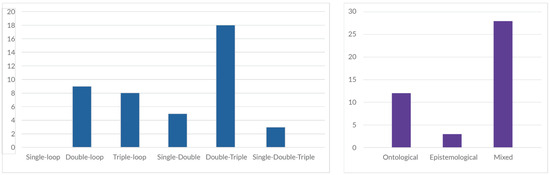
Figure 7.
Overview of findings from the third step of the analysis of the literature.
Of particular interest is the group of papers that combine all three learning perspectives [4,67,77]. Sokame et al. [77] had a single- or double-loop framing in the introduction but used a combination of double- and triple-loop learning in the remaining sections of the paper. Hoffmann et al. [4] and Tian et al. [67] set triple-, double-loop, or mixed learning goals in the introduction and methods, but in the results section, single-loop results were found. We use the example of Hoffmann et al. [4] to illustrate our approach.
In their introductory section, Hoffmann et al. [4] aimed to “describe the new configurations and relationships between the urban and the rural under globalizing conditions, including its spatial structures and social, political, and cultural articulations, we elaborate a concept termed ‘rurbanity’” (p. 1740). We categorize this as an ontological approach, as the study focuses on knowledge of the system and its structures, as opposed to an epistemological approach, which focuses on defining the complex system and trying to understand its purposes (see Table 4). We identify a mix of double- and triple-loop learning, where the authors explore new ways of addressing the challenge and seek to widen the perspectives currently used. The concept and methods section is mainly ontological, with a focus on double-loop learning, i.e., on the elements of the system: “Our focus, thus, is the environmentally, socially and culturally productive co-presence of urban and rural elements and practices” (p. 1743). However, there is a link to triple-loop learning through the widening of perspectives and the use of a triple-loop method—assemblage thinking (see Figure 2): “to usefully conceptualize rurbanity, we draw on two theoretical approaches that share a number of commonalities but also have important differences: social–ecological systems (a specification of complex adaptive systems) and assemblage thinking” (p. 1743). The results section presents the structuring of two selected case studies using the developed rurbanity framework, which is more akin to single-loop learning, a linear approach focused mainly on incremental improvement.
Analysis of the methodological approaches used showed that 12 papers were clearly oriented towards an ontological approach and 3 towards an epistemological approach, consistently across all sections of a paper. The remaining 28 papers featured a mix of epistemological and ontological systems thinking approaches distributed across different sections of the paper. There is a noticeable tendency for papers to have an epistemological framing in the introduction, but to adopt ontologically oriented methods or results.
A systematic analysis of the systems thinking approaches and learning perspectives used across all 43 papers reveals distinct patterns in how learning approaches and framing evolve across different sections of papers addressing rural–urban systems (see Figure 8). These findings are discussed in more detail in the subsections below.
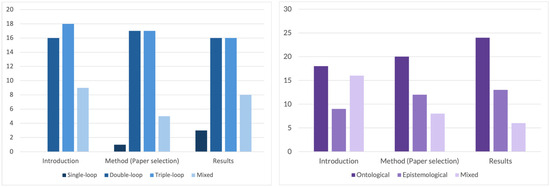
Figure 8.
Overview of the methodological approaches and learning perspectives used in the reviewed articles.
3.3.1. Analysis: Introduction/Background
The analysis shows that in the introduction/background, there is a relatively balanced distribution between triple-loop (18 papers) and double-loop learning (16 papers). There are nine (9) papers using a combination of learning perspectives (single–double—two (2) papers, and double–triple—seven (7) papers). Strictly epistemological approaches are observed in nine (9) papers. Strictly ontological approaches in the introductory part of the reviewed articles are the most common (18 papers), closely followed by mixed approaches (16 papers). Some examples of quotes to illustrate our categorization of papers are provided in Table 10.
Table 10.
Examples of approaches and learning perspectives used in the introduction sections.
3.3.2. Analysis: Methods
Analysis of systems thinking and learning perspectives featured in the methodology sections of analyzed papers followed the spectrum of systems thinking approaches presented in Figure 2.
The analysis shows a notable shift towards ontological framing (20 papers that are strictly ontological and 8 papers having a mixed ontological–epistemological approach) and with double- and triple-loop learning being dominant (17 papers, respectively) and 5 papers that have a mixed framing). Papers featuring solely an epistemological approach represent a minority (12 papers). Some examples of quotes to illustrate our categorization of papers are provided in Table 11.
Table 11.
Examples of approaches and learning perspectives used in the method sections.
3.3.3. Analysis: Results and Discussion
The analysis of the results and discussion sections shows a return to more balanced approaches, with equal numbers of papers using strictly double- or triple-loop learning approaches (16 papers each), a few papers using a combination of different approaches (2 papers with single-/double-loop approach and 6 papers with double-/triple-loop approach). There are three (3) papers using a single-loop learning perspective.
There is a clear dominance of papers using strictly ontological framing (24 papers). About one-third of the analyzed papers used a strictly epistemological framing (13 papers), and only 6 papers used a mixed ontological–epistemological framing. This pattern shows that researchers may not reflect on how to connect their findings to conceptual learning outcomes. Some examples of quotes illustrating our findings are provided in Table 12.
Table 12.
Examples of approaches and learning perspectives used in the results sections.
4. Discussion
There are two dominant themes observed in the reviewed literature: demographic dynamics and resilience. The papers addressing different aspects of demographics are both (a) building understanding on the complex relationships between rural and urban when it comes to migration and urbanization, and (b) exploring different epistemological perspectives. The dynamics of demographics are analyzed from ontological viewpoints in several papers, generating understanding of historical trajectories and structural linkages that affect migration to and from rural areas. It is clear from the reviewed papers that the current (epistemological) perception on migration and demographics needs to be developed, and several papers pose ontological advancements—though few actually create actions in order to test their learnings. The large number of papers focusing on resilience, climate adaptation, and risk are multifaceted; both ontological and epistemological approaches and learnings are generated, and from single-, double-, and triple loop learning perspectives. These papers, and most of the papers with other themes such as forests, ecosystem services, and food systems, connect to discussions (e.g., [98]) whose approaches, as the ones mentioned above, are endogenous/bottom-up approaches, whilst sustainability is largely seen as an exogenous/top-down approach. This may partially explain why research themes that focus on sustainable development as a complex systemic and transformative approach at the community level are largely missing in both research and practice on rural–urban development. A few reviewed papers touch on this perspective by presenting theoretical discussions and frameworks, but there is a definitive need to develop and test approaches with this perspective.
Regarding the methodological use in the reviewed papers, we adopt the viewpoint that ontological and epistemological approaches can be considered complimentary, wherein ontological approaches inform epistemological framings [14] which, in turn, can support evolution of ontological study designs and methods. It is, perhaps, therefore expected that a majority of papers reviewed included both of these aspects to some degree. However, there may be room for improvement to ensure that both aspects are consistently applied, i.e., a missing feedback reflecting on implications of ontological findings for epistemological understanding. Therefore, while shifting emphasis towards ontology within methods is, rather, expected, results and discussion should include both aspects to support further advancement of systems thinking for rural–urban research. For example, the novel ontological approaches [92] can help us develop new hypotheses and challenge prevailing systems thinking factors for developing sustainable rural–urban systems—and this requires epistemological reflection upon the ontological methods applied.
Another insight is a lack of papers that embrace systems-oriented design as a method for studying rural–urban systems. This method is intended to be a structured approach to merge the benefits of ontological and epistemological approaches, and argues that merely integrating these approaches is not enough as there is a difference in how these methods address problems. Ontological approaches aim for understanding structure, whilst more epistemological approaches focus on subjectification and creativity, where structure might be considered as a barrier. Therefore, it is important to think about how to develop and translate joint efforts [51].
The assessment of learning perspectives in this review can be considered in light of recent research regarding the essential role of transdisciplinary learning, and in particular collaborative and societal learning, in supporting sustainable change processes more broadly [17]. Researchers and academics, as a community engaged with the production of new knowledge, are both active learning participants as well as thought leaders contributing to contemporary knowledge discourse. It is, therefore, a reasonable expectation that researchers that aim to support transformative change in rural–urban systems engage with transformative learning processes themselves. Single-loop learning is quite likely insufficient to support these aims, and, in the worst case, may further entrench low-leverage or even counterproductive approaches to foster connectivity of rural and urban spaces. It is, therefore, unsurprising that none of the articles reviewed featured solely single-loop learning approaches. However, the low frequency of participatory approaches (four articles, Figure 6) indicates that collaborative or societal learning is often not included as part of the research design. One may then wonder “who” is undertaking the learning, and is knowledge being transferred sufficiently across research–practice/research–local context boundaries? The answer to this has important implications for fostering transformative change. This reinforces prevailing discourse on rural–urban, encouraging increased emphasis on local experimentation, translocal networking and broadening of values included in developing rural–urban connectivity [99].
5. Conclusions and Suggestions for Future Research
This systematic review provides insights into the application of systems thinking approaches in rural–urban research over the past decade. Our analysis suggests a tendency for studies to frame their work within sophisticated system paradigms during conceptualization, while often employing more conventional analytical approaches during implementation. This pattern may indicate challenges in fully operationalizing systems thinking throughout the research process. Our analysis also reveals a possible relationship between methodological choices and the conceptual learning outcomes reflected in studies. Papers employing mixed-method approaches appeared to engage with more complex learning perspectives in several instances. This suggests potential value in combining qualitative and quantitative methods, and especially participatory methods, when examining rural–urban dynamics. Future research could further investigate the effectiveness of different methodological combinations for enhancing the understanding of complex rural–urban relationships.
The geographical distribution of the reviewed studies reveals certain patterns, with Asian contexts (40%) and European studies (24%) appearing more frequently in our sample. This observation raises questions about how systems approaches might be contextualized across different socioecological and institutional settings, particularly in regions of Latin America and Africa, where representation in our sample was more limited.
Within our review inclusion/exclusion criteria, we anticipated, and we observed, that many researchers conceptualize rural–urban relationships as complex interdependencies rather than simple linear relationships. Studies addressing topics such as climate adaptation, food systems, and ecosystem services demonstrated particularly nuanced systems perspectives. This points to the need for developing frameworks that connect theoretical understanding with practical application, perhaps drawing from topic areas where systems thinking appears to have found particular resonance, for example, within integrated water resource management.
The research themes found in the review also highlight an area where research should be pursued, namely, rural–urban research and practice, where the theme is cross-sectorial and community-focused and where different perspectives are integrated in order to find trajectories towards sustainability. This connects to the epistemology of “worlding”, as described by Qian et al. [99], where three different focal points are suggested: (1) situated innovation and experimentation, where we argue that system innovation across sectors and with a community focus should be explored; (2) translocal and relational networks, where we argue that collaborative innovation clusters with actors that (3) add a multiplicity of logics, interests, and aspirations should jointly challenge norms and perspectives and develop pathways towards a joint vision of how the community can develop local and regional sustainable pathways as well as contribute to global sustainability.
Our analysis of learning perspectives found that papers often exhibited different approaches across their various sections. Many papers implied a triple-loop learning concept in their introductions while employing double-loop methods in their research execution. Future research might explore how consistent application and/or focus on learning outcomes throughout the research process could be better supported when engaging with rural–urban challenges.
Future research may also be well served by explicitly considering their application of systems thinking approaches, to increase impact and support knowledge generation for transformative change, including explicitly addressing metrics connected to who the intended audience is in terms of learning and what the learning goals are. It is, in many papers, difficult to decipher for whom the research is meant, and how it can contribute to the topic that is under scrutiny. Explicitly adding this in research might help align different studies and improve the build-up of connected knowledge.
Author Contributions
Conceptualization, P.S., T.A., S.A.C. and R.F.; methodology, P.S., T.A. and S.A.C.; formal analysis, T.A., S.A.C. and R.F.; investigation, P.S., T.A., S.A.C. and R.F.; resources, P.S., T.A., S.A.C. and R.F.; data curation, P.S., T.A., S.A.C. and R.F.; writing—original draft preparation, T.A., S.A.C. and R.F.; writing—review and editing, P.S., T.A., S.A.C. and R.F.; visualization, T.A. and S.A.C.; supervision, R.F.; project administration, S.A.C.; funding acquisition, P.S. and R.F. All authors have read and agreed to the published version of the manuscript.
Funding
This research was funded by the European Union’s Horizon-CL6-2023-Communities-01 European Commission under grant agreement no. 101136597 (Project RURBANIVE). The APC was funded by the European Union’s Horizon-CL6-2023-Communities-01.
Acknowledgments
This review was conducted within the ambitious scope of the Horizon Europe project RURBANIVE (Rural–Urban–Immersiveness), which seeks to better understand rural–urban innovation processes and enhance regional governance. The authors would like to thank Magnus Eriksson and Hayley Ho as well as RURBANIVE partners for their contributions to the project enabling this work.
Conflicts of Interest
The authors declare no conflicts of interest.
References
- United Nations. World Population Prospects 2022: Summary of Results; United Nations: New York, NY, USA, 2022; ISBN 978-92-1-001438-0. [Google Scholar]
- Yanou, M.P.; Ros-Tonen, M.A.F.; Reed, J.; Moombe, K.; Sunderland, T. Integrating Local and Scientific Knowledge: The Need for Decolonising Knowledge for Conservation and Natural Resource Management. Heliyon 2023, 9, e21785. [Google Scholar] [CrossRef]
- Wandl, A.; Magoni, M. Sustainable Planning of Peri-Urban Areas: Introduction to the Special Issue. Plan. Pract. Res. 2017, 32, 1–3. [Google Scholar] [CrossRef]
- Hoffmann, E.M.; Schareika, N.; Dittrich, C.; Schlecht, E.; Sauer, D.; Buerkert, A. Rurbanity: A Concept for the Interdisciplinary Study of Rural–Urban Transformation. Sustain. Sci. 2023, 18, 1739–1753. [Google Scholar] [CrossRef] [PubMed]
- Hidding, M.C.; Teunissen, A.T.J. Beyond Fragmentation: New Concepts for Urban–Rural Development. Landsc. Urban Plan. 2002, 58, 297–308. [Google Scholar] [CrossRef]
- Maslow, A.H. The Psychology of Science; Harper & Row: Manhattan, NY, USA, 1966. [Google Scholar]
- Calzada, I. Artificial Intelligence for Social Innovation: Beyond the Noise of Algorithms and Datafication. Sustainability 2024, 16, 8638. [Google Scholar] [CrossRef]
- Willett, J. Place-Based Rural Development: A Role for Complex Adaptive Region Assemblages? J. Rural. Stud. 2023, 97, 583–590. [Google Scholar] [CrossRef]
- Meadows, D.H. Thinking in Systems: A Primer; Chelsea Green Publishing: White River Junction, VT, USA, 2008; ISBN 978-1-60358-148-6. [Google Scholar]
- Voulvoulis, N.; Giakoumis, T.; Hunt, C.; Kioupi, V.; Petrou, N.; Souliotis, I.; Vaghela, C.; WIH. binti Wan Rosely. Systems Thinking as a Paradigm Shift for Sustainability Transformation. Glob. Environ. Change 2022, 75, 102544. [Google Scholar] [CrossRef]
- Zickgraf, C.; Jolivet, D.; Fry, C.; Boyd, E.; Fábos, A. Bridging and Breaking Silos: Transformational Governance of the Migration–Sustainability Nexus. Proc. Natl. Acad. Sci. USA 2024, 121, e2206184120. [Google Scholar] [CrossRef]
- Hutchings, P.; Willcock, S.; Lynch, K.; Bundhoo, D.; Brewer, T.; Cooper, S.; Keech, D.; Mekala, S.; Mishra, P.P.; Parker, A.; et al. Understanding Rural–Urban Transitions in the Global South through Peri-Urban Turbulence. Nat. Sustain. 2022, 5, 924–930. [Google Scholar] [CrossRef]
- Reed, M.S.; Rudman, H. Re-Thinking Research Impact: Voice, Context and Power at the Interface of Science, Policy and Practice. Sustain. Sci. 2023, 18, 967–981. [Google Scholar] [CrossRef]
- Cabrera, A. Systems Thinking. Ph.D. Thesis, Cornell University: Ithaca, NY, USA, 2006. [Google Scholar]
- Ison, R. Systems Thinking and Practice for Action Research. In The Sage Handbook of Action Research Participative Inquiry and Practice; Sage Publications: London, UK, 2008; pp. 139–158. [Google Scholar]
- Jackson, M.C. Critical Systems Thinking and Practice. Eur. J. Oper. Res. 2001, 128, 233–244. [Google Scholar] [CrossRef]
- Barth, M.; Jiménez-Aceituno, A.; Lam, D.P.; Bürgener, L.; Lang, D.J. Transdisciplinary Learning as a Key Leverage for Sustainability Transformations. Curr. Opin. Environ. Sustain. 2023, 64, 101361. [Google Scholar] [CrossRef]
- Stam, K.; van Ewijk, E.; Chan, P.W. How Does Learning Drive Sustainability Transitions? Perspectives, Problems and Prospects from a Systematic Literature Review. Environ. Innov. Soc. Transit. 2023, 48, 100734. [Google Scholar] [CrossRef]
- Tosey, P.; Visser, M.; Saunders, M.N. The Origins and Conceptualizations of ‘Triple-Loop’ Learning: A Critical Review. Manag. Learn. 2012, 43, 291–307. [Google Scholar] [CrossRef]
- Chowdhury, R. Holistic Flexibility for Deploying Systems Thinking as a Cognitive Skill. Syst. Pract. Action Res. 2023, 36, 803–825. [Google Scholar] [CrossRef]
- Reynolds, M. Systems Thinking Principles for Making Change. Systems 2024, 12, 437. [Google Scholar] [CrossRef]
- Pahl-Wostl, C. A Conceptual Framework for Analysing Adaptive Capacity and Multi-Level Learning Processes in Resource Governance Regimes. Glob. Environ. Change 2009, 19, 354–365. [Google Scholar] [CrossRef]
- Spies, M.; Alff, H. Assemblages and Complex Adaptive Systems: A Conceptual Crossroads for Integrative Research? Geogr. Compass 2020, 14, e12534. [Google Scholar] [CrossRef]
- Delgado-Viñas, C.; Gómez-Moreno, M.-L. The Interaction between Urban and Rural Areas: An Updated Paradigmatic, Methodological and Bibliographic Review. Land 2022, 11, 1298. [Google Scholar] [CrossRef]
- Gutierrez-Velez, V.H.; Gilbert, M.R.; Kinsey, D.; Behm, J.E. Beyond the ‘Urban’ and the ‘Rural’: Conceptualizing a New Generation of Infrastructure Systems to Enable Rural–Urban Sustainability. Curr. Opin. Environ. Sustain. 2022, 56, 101177. [Google Scholar] [CrossRef]
- Somanje, A.N.; Mohan, G.; Lopes, J.; Mensah, A.; Gordon, C.; Zhou, X.; Moinuddin, M.; Saito, O.; Takeuchi, K. Challenges and Potential Solutions for Sustainable Urban-Rural Linkages in a Ghanaian Context. Sustainability 2020, 12, 507. [Google Scholar] [CrossRef]
- Tonne, C.; Adair, L.; Adlakha, D.; Anguelovski, I.; Belesova, K.; Berger, M.; Brelsford, C.; Dadvand, P.; Dimitrova, A.; Giles-Corti, B.; et al. Defining Pathways to Healthy Sustainable Urban Development. Environ. Int. 2021, 146, 106236. [Google Scholar] [CrossRef] [PubMed]
- Perpiña Castillo, C.; Van Heerden, S.; Barranco, R.; Jacobs-Crisioni, C.; Kompil, M.; Kučas, A.; Aurambout, J.P.; Batista E Silva, F.; Lavalle, C. Urban–Rural Continuum: An Overview of Their Interactions and Territorial Disparities. Reg. Sci. Policy Pract. 2023, 15, 729–769. [Google Scholar] [CrossRef]
- Cattaneo, A.; Adukia, A.; Brown, D.L.; Christiaensen, L.; Evans, D.K.; Haakenstad, A.; McMenomy, T.; Partridge, M.; Vaz, S.; Weiss, D.J. Economic and Social Development along the Urban–Rural Continuum: New Opportunities to Inform Policy. World Dev. 2022, 157, 105941. [Google Scholar] [CrossRef]
- Kitchenham, B.; Pearl Brereton, O.; Budgen, D.; Turner, M.; Bailey, J.; Linkman, S. Systematic Literature Reviews in Software Engineering—A Systematic Literature Review. Inf. Softw. Technol. 2009, 51, 7–15. [Google Scholar] [CrossRef]
- Kitchenham, B.; Brereton, P. A Systematic Review of Systematic Review Process Research in Software Engineering. Inf. Softw. Technol. 2013, 55, 2049–2075. [Google Scholar] [CrossRef]
- Tranfield, D.; Denyer, D.; Smart, P. Towards a Methodology for Developing Evidence-Informed Management Knowledge by Means of Systematic Review. Br. J. Manag. 2003, 14, 207–222. [Google Scholar] [CrossRef]
- Marinković, M.; Al-Tabbaa, O.; Khan, Z.; Wu, J. Corporate Foresight: A Systematic Literature Review and Future Research Trajectories. J. Bus. Res. 2022, 144, 289–311. [Google Scholar] [CrossRef]
- Mitchell, S.D. Unsimple Truths: Science, Complexity, and Policy; University of Chicago Press: Chicago, IL, USA, 2009. [Google Scholar]
- Preiser, R.; Biggs, R.; De Vos, A.; Folke, C. Social-Ecological Systems as Complex Adaptive Systems: Organizing Principles for Advancing Research Methods and Approaches. Ecol. Soc. 2018, 23, 46. [Google Scholar] [CrossRef]
- Murray Li, T. Practices of Assemblage and Community Forest Management. Econ. Soc. 2007, 36, 263–293. [Google Scholar] [CrossRef]
- De Landa, M. Assemblage Theory; Speculative realism; Edinburgh University Press: Edinburgh, UK, 2016; ISBN 978-1-4744-1362-6. [Google Scholar]
- Holland, J.H. Complex Adaptive Systems. Daedalus 1992, 121, 17–30. [Google Scholar]
- Levin, S.; Xepapadeas, T.; Crépin, A.-S.; Norberg, J.; de Zeeuw, A.; Folke, C.; Hughes, T.; Arrow, K.; Barrett, S.; Daily, G.; et al. Social-Ecological Systems as Complex Adaptive Systems: Modeling and Policy Implications. Environ. Dev. Econ. 2013, 18, 111–132. [Google Scholar] [CrossRef]
- Morin, E.; Postel, R.; Morin, E. On Complexity; Advances in systems theory, complexity, and the human sciences; Hampton Press: Cresskill, NJ, USA, 2008; ISBN 978-1-57273-801-0. [Google Scholar]
- Rogers, K.H.; Luton, R.; Biggs, H.; Biggs, R.; Blignaut, S.; Choles, A.G.; Palmer, C.G.; Tangwe, P. Fostering Complexity Thinking in Action Research for Change in Social—Ecological Systems. Ecol. Soc. 2013, 18, 31. [Google Scholar] [CrossRef]
- Byrne, D.; Callaghan, G. Complexity Theory and the Social Sciences: The State of the Art, 2nd ed.; Routledge: London, NY, USA, 2023; ISBN 978-1-003-21357-4. [Google Scholar]
- Dong, M.W.Y. A Critical Analysis on Complex Urban Systems and Complex Systems Theory. J. Comput. Nat. Sci. 2023, 3, 24–34. [Google Scholar] [CrossRef]
- Holling, C.S. (Ed.) Adaptive Environmental Assessment and Management, Reprint of the 1978 ed.; Blackburn Press: Caldwell, NJ, USA, 1978; ISBN 978-1-932846-07-2. [Google Scholar]
- Allen, C.R.; Fontaine, J.J.; Pope, K.L.; Garmestani, A.S. Adaptive Management for a Turbulent Future. J. Environ. Manag. 2011, 92, 1339–1345. [Google Scholar] [CrossRef] [PubMed]
- Brown, T. Harvard Business Review, 2008; pp. 84–92.
- Cross, N. Design Thinking: Understanding How Designers Think and Work, 1st ed.; Zed Books: London, UK, 2011; ISBN 978-1-4742-9388-4. [Google Scholar]
- Jones, P.H. Systemic Design Principles for Complex Social Systems. In Social Systems and Design; Metcalf, G.S., Ed.; Springer: Tokyo, Japan, 2014; pp. 91–128. ISBN 978-4-431-54478-4. [Google Scholar]
- Ryan, A. A Framework for Systemic Design. FormAkademisk 2014, 7. [Google Scholar] [CrossRef]
- Sevaldson, B. Systems Oriented Design: The Emergence and Development of a Designerly Approach to Address Complexity. In Proceedings of the DRS//Cumulus: Design Learning for Tomorrow, Oslo, Norway, 14–17 May 2013. [Google Scholar] [CrossRef]
- Sevaldson, B. Designing Complexity: The Methodology and Practice of Systems Oriented Design; Common Ground Research Networks: Champaign, IL, USA, 2022; ISBN 1-86335-262-7. [Google Scholar]
- Sheydayi, A.; Dadashpoor, H. Conducting Qualitative Content Analysis in Urban Planning Research and Urban Studies. Habitat Int. 2023, 139, 102878. [Google Scholar] [CrossRef]
- Argyris, C.; Schön, D.A. Organizational Learning: A Theory of Action Perspective; Addison Wesley: Boston, MA, USA, 1978. [Google Scholar]
- Flood, R.L.; Romm, N.R.A. Plurality Revisited: Diversity Management and Triple Loop Learning. Syst. Pract. 1996, 9, 587–603. [Google Scholar] [CrossRef]
- Bateson, G. The Logical Categories of Learning and Communication. In Steps to an Ecology of Mind; Ballantine: New York, NY, USA, 1973; ISBN 978-0-345-23423-0. [Google Scholar]
- Chiang, Y.-C.; Tsai, F.-F.; Chang, H.-P.; Chen, C.-F.; Huang, Y.-C. Adaptive Society in a Changing Environment: Insight into the Social Resilience of a Rural Region of Taiwan. Land Use Policy 2014, 36, 510–521. [Google Scholar] [CrossRef]
- Juschten, M.; Brandenburg, C.; Hössinger, R.; Liebl, U.; Offenzeller, M.; Prutsch, A.; Unbehaun, W.; Weber, F.; Jiricka-Pürrer, A. Out of the City Heat-Way to Less or More Sustainable Futures? Sustainability 2019, 11, 214. [Google Scholar] [CrossRef]
- Kusio, T.; Rosiek, J.; Conto, F. Urban–Rural Partnership Perspectives in the Conceptualization of Innovative Activities in Rural Development: On Example of Three-Case Study Analysis. Sustainability 2022, 14, 7309. [Google Scholar] [CrossRef]
- Porst, L.; Sakdapolrak, P. Advancing Adaptation or Producing Precarity? The Role of Rural-Urban Migration and Translocal Embeddedness in Navigating Household Resilience in Thailand. Geoforum 2018, 97, 35–45. [Google Scholar] [CrossRef]
- Birtchnell, T.; Gill, N.; Sultana, R. Sleeper Cells for Urban Green Infrastructure: Harnessing Latent Competence in Greening Dhaka’s Slums. Urban For. Urban Green. 2019, 40, 93–104. [Google Scholar] [CrossRef]
- Niva, V.; Taka, M.; Varis, O. Rural-Urban Migration and the Growth of Informal Settlements: A Socio-Ecological System Conceptualization with Insights Through a “Water Lens”. Sustainability 2019, 11, 3487. [Google Scholar] [CrossRef]
- Singh, C.; Basu, R. Moving in and out of Vulnerability: Interrogating Migration as an Adaptation Strategy along a Rural–Urban Continuum in India. Geogr. J. 2020, 186, 87–102. [Google Scholar] [CrossRef]
- Delazeri, L.M.M.; Da Cunha, D.A.; Oliveira, L.R. Climate Change and Rural–Urban Migration in the Brazilian Northeast Region. GeoJournal 2022, 87, 2159–2179. [Google Scholar] [CrossRef]
- Wang, Z.; Deng, X.; Wong, C. Integrated Land Governance for Eco-Urbanization. Sustainability 2016, 8, 903. [Google Scholar] [CrossRef]
- Farrell, K. The Rapid Urban Growth Triad: A New Conceptual Framework for Examining the Urban Transition in Developing Countries. Sustainability 2017, 9, 1407. [Google Scholar] [CrossRef]
- Giacalone, M.; Turco, R.; Mosconi, E.M.; Alaimo, L.S.; Salvati, L. The Way Toward Growth: A Time-Series Factor Decomposition of Socioeconomic Impulses and Urbanization Trends in a Pre-Crisis European Region. Soc. Indic. Res. 2023, 175, 837–858. [Google Scholar] [CrossRef]
- Tian, Q.; Guo, L.; Zheng, L. Urbanization and Rural Livelihoods: A Case Study from Jiangxi Province, China. J. Rural. Stud. 2016, 47, 577–587. [Google Scholar] [CrossRef]
- Halbac-Cotoara-Zamfir, R.; Cividino, S.; Egidi, G.; Salvia, R.; Salvati, L. Rapidity of Change in Population Age Structures: A Local Approach Based on Multiway Factor Analysis. Sustainability 2020, 12, 2828. [Google Scholar] [CrossRef]
- Zhu, X.-G.; Li, T.; Feng, T.-T. On the Synergy in the Sustainable Development of Cultural Landscape in Traditional Villages under the Measure of Balanced Development Index: Case Study of the Zhejiang Province. Sustainability 2022, 14, 1367. [Google Scholar] [CrossRef]
- Sadat Nickayin, S.; Egidi, G.; Cudlin, P.; Salvati, L. Investigating Metropolitan Change through Mathematical Morphology and a Dynamic Factor Analysis of Structural and Functional Land-Use Indicators. Sci. Rep. 2023, 13, 695. [Google Scholar] [CrossRef]
- Rajendran, L.P.; Raúl, L.; Chen, M.; Guerrero Andrade, J.C.; Akhtar, R.; Mngumi, L.E.; Chander, S.; Srinivas, S.; Roy, M.R. The ‘Peri-Urban Turn’: A Systems Thinking Approach for a Paradigm Shift in Reconceptualising Urban-Rural Futures in the Global South. Habitat Int. 2024, 146, 103041. [Google Scholar] [CrossRef]
- Leck, H.; Simon, D. Local Authority Responses to Climate Change in South Africa: The Challenges of Transboundary Governance. Sustainability 2018, 10, 2542. [Google Scholar] [CrossRef]
- Long, H. Theorizing Land Use Transitions: A Human Geography Perspective. Habitat Int. 2022, 128, 102669. [Google Scholar] [CrossRef]
- Ozor, N.; Enete, A.; Amaechina, E. Drivers of Rural–Urban Interdependence and Their Contributions to Vulnerability in Food Systems in Nigeria—A Framework. Clim. Dev. 2016, 8, 83–94. [Google Scholar] [CrossRef]
- Armendáriz, A.; Armenia, S.; Atzori, A.S. Systemic Analysis of Food Supply and Distribution Systems in City-Region Systems–An Examination of FAO’s Policy Guidelines towards Sustainable Agri-Food Systems. Agriculture 2016, 6, 65. [Google Scholar] [CrossRef]
- Armenia, S.; Pompei, A.; Barreto, A.C.C.; Atzori, A.S.; Fonseca, J.M. The Rural-Urban Food Systems’ Links with the Agenda 2030: From Fao Guidelines on Food Supply and Distribution Systems to a Dairy Sector Application in the Area of Bogota. Systems 2019, 7, 45. [Google Scholar] [CrossRef]
- Sokame, B.M.; Agboka, K.M.; Kimathi, E.; Mudereri, B.T.; Abdel-Rahman, E.M.; Landmann, T.; Rwaheru, M.M.; Abdalla, O.; Mafabi, M.M.; Lubango, L.M.; et al. An Integrated Assessment Approach for Socio-Economic Implications of the Desert Locust in Eastern Africa. Earth’s Future 2024, 12, e2023EF003841. [Google Scholar] [CrossRef]
- Hamann, M.; Biggs, R.; Reyers, B. An Exploration of Human Well-Being Bundles as Identifiers of Ecosystem Service Use Patterns. PLoS ONE 2016, 11, e0163476. [Google Scholar] [CrossRef] [PubMed]
- Adem Esmail, B.; Geneletti, D. Design and Impact Assessment of Watershed Investments: An Approach Based on Ecosystem Services and Boundary Work. Environ. Impact Assess. Rev. 2017, 62, 1–13. [Google Scholar] [CrossRef]
- Clay, N.; Yurco, K.; Agrawal, A.; Persha, L. Ecosystem Services in a Transitional Forest Landscape: Shifting Trajectories in Southeast Michigan, USA. Soc. Nat. Resour. 2018, 31, 457–472. [Google Scholar] [CrossRef]
- Moon, T.H.; Kim, D.-H.; Park, C.S.; Lee, D.-S. Policy Analysis to Reduce Climate Change-Induced Risks in Urban and Rural Areas in Korea. Sustainability 2017, 9, 524. [Google Scholar] [CrossRef]
- Kirshen, P.; Aytur, S.; Hecht, J.; Walker, A.; Burdick, D.; Jones, S.; Fennessey, N.; Bourdeau, R.; Mather, L. Integrated Urban Water Management Applied to Adaptation to Climate Change. Urban Clim. 2018, 24, 247–263. [Google Scholar] [CrossRef]
- Malakar, K.; Mishra, T.; Patwardhan, A. A Framework to Investigate Drivers of Adaptation Decisions in Marine Fishing: Evidence from Urban, Semi-Urban and Rural Communities. Sci. Total Environ. 2018, 637–638, 758–770. [Google Scholar] [CrossRef]
- Carrard, N.; Foster, T.; Willetts, J. Groundwater as a Source of Drinking Water in Southeast Asia and the Pacific: A Multi-Country Review of Current Reliance and Resource Concerns. Water 2019, 11, 1605. [Google Scholar] [CrossRef]
- Jhan, H.-T.; Ballinger, R.; Jaleel, A.; Ting, K.-H. Development and Application of a Socioeconomic Vulnerability Indicator Framework (SVIF) for Local Climate Change Adaptation in Taiwan. Sustainability 2020, 12, 1585. [Google Scholar] [CrossRef]
- Pandey, R.; Kala, S.; Pandey, V.P. Assessing Climate Change Vulnerability of Water at Household Level. Mitig. Adapt. Strateg. Glob. Change 2015, 20, 1471–1485. [Google Scholar] [CrossRef]
- Vizinho, A.; Avelar, D.; Fonseca, A.L.; Carvalho, S.; Sucena-Paiva, L.; Pinho, P.; Nunes, A.; Branquinho, C.; Vasconcelos, A.C.; Santos, F.D.; et al. Framing the Application of Adaptation Pathways for Agroforestry in Mediterranean Drylands. Land Use Policy 2021, 104, 105348. [Google Scholar] [CrossRef]
- Lioubimtseva, E. The Role of Inclusion in Climate Vulnerability Assessment and Equitable Adaptation Goals in Small American Municipalities. Discov. Sustain. 2022, 3, 3. [Google Scholar] [CrossRef]
- Khan, Y.; O’Sullivan, T.; Brown, A.; Tracey, S.; Gibson, J.; Généreux, M.; Henry, B.; Schwartz, B. Public Health Emergency Preparedness: A Framework to Promote Resilience. BMC Public Health 2018, 18, 1344. [Google Scholar] [CrossRef] [PubMed]
- Hincks, S.; Carter, J.; Connelly, A. A New Typology of Climate Change Risk for European Cities and Regions: Principles and Applications. Glob. Environ. Change 2023, 83, 102767. [Google Scholar] [CrossRef]
- Allen, C.R.; Birge, H.E.; Bartelt-Hunt, S.; Bevans, R.A.; Burnett, J.L.; Cosens, B.A.; Cai, X.; Garmestani, A.S.; Linkov, I.; Scott, E.A.; et al. Avoiding Decline: Fostering Resilience and Sustainability in Midsize Cities. Sustainability 2016, 8, 844. [Google Scholar] [CrossRef]
- Li, G.; Cheng, G.; Wu, Z. Resilience Assessment of Urban Complex Giant Systems in Hubei Section of the Three Gorges Reservoir Area Based on Multi-Source Data. Sustainability 2022, 14, 8423. [Google Scholar] [CrossRef]
- Morzillo, A.T.; Colocousis, C.R.; Munroe, D.K.; Bell, K.P.; Martinuzzi, S.; Van Berkel, D.B.; Lechowicz, M.J.; Rayfield, B.; McGill, B. “Communities in the Middle”: Interactions between Drivers of Change and Place-Based Characteristics in Rural Forest-Based Communities. J. Rural. Stud. 2015, 42, 79–90. [Google Scholar] [CrossRef]
- Martín-Forés, I.; Magro, S.; Bravo-Oviedo, A.; Alfaro-Sánchez, R.; Espelta, J.M.; Frei, T.; Valdés-Correcher, E.; Rodríguez Fernández-Blanco, C.; Winkel, G.; Gerzabek, G.; et al. Spontaneous Forest Regrowth in South-West Europe: Consequences for Nature’s Contributions to People. People Nat. 2020, 2, 980–994. [Google Scholar] [CrossRef]
- Elbakidze, M.; Dawson, L.; Andersson, K.; Axelsson, R.; Angelstam, P.; Stjernquist, I.; Teitelbaum, S.; Schlyter, P.; Thellbro, C. Is spatial planning a collaborative learning process? A case study from a rural–urban gradient in Sweden. Land Use Policy 2015, 48, 270–285. [Google Scholar] [CrossRef]
- Hensel, M.U.; Sørensen, S.S. Performance-Oriented Architecture and Urban Design: Relating Information-Based Design and Systems-Thinking in Architecture. FormAkademisk 2019, 12. [Google Scholar] [CrossRef]
- Yuan, Q.; Gu, Y.; Yang, M.; Wu, Y.; Hu, G.; Zhou, G. Synergistic Utilization Mechanism of E-Waste in Regions with Different Levels of Development: A Case Study of Guangdong Province. J. Clean. Prod. 2022, 380, 134855. [Google Scholar] [CrossRef]
- Li, H.; Xu, T.; Yang, C.; Fu, Y.; Wu, C.; Zhang, L.; Xu, G.; Wang, W. Towards a Dialectical Understanding of Rural Resilience and Rural Sustainability: Bibliometric Analysis and Evidence from Existing Literature and China. Environ. Dev. Sustain. 2024. [Google Scholar] [CrossRef]
- Qian, J.; He, S.; Smith, D. Rural-Urban Interfaces and Changing Forms of Relational and Planetary Rurality. J. Rural. Stud. 2025, 116, 103614. [Google Scholar] [CrossRef]
Disclaimer/Publisher’s Note: The statements, opinions and data contained in all publications are solely those of the individual author(s) and contributor(s) and not of MDPI and/or the editor(s). MDPI and/or the editor(s) disclaim responsibility for any injury to people or property resulting from any ideas, methods, instructions or products referred to in the content. |
© 2025 by the authors. Licensee MDPI, Basel, Switzerland. This article is an open access article distributed under the terms and conditions of the Creative Commons Attribution (CC BY) license (https://creativecommons.org/licenses/by/4.0/).