


Abstract
Landscape conservation has grown in popularity over the past few decades and is widely recognized as essential for achieving conservation outcomes. However, there are many challenges to operating at the landscape scale, and little research assesses the trends of Landscape Conservation Initiatives (LCIs) within a network. To address this gap, we surveyed a nationwide sample of LCIs that are connected through the Network for Landscape Conservation in 2016 and in 2021. Our research presents findings on the focus of these initiatives (often wildlife habitat and watershed protection), the strategies and approaches employed to achieve goals (often coordinating community activities and networking/information sharing), the factors that support or challenge the LCI success (ranging from political support to trust/respect), and how LCIs perceive their biggest successes (often a combination of Collaborative, Ecological, and Human categories). The main findings highlight how some of these trends changed over a five-year period and with the age range of the LCI. These findings contribute to our greater understanding of unique aspects of LCIs and changing trends for LCIs within a network and have implications for emerging and established LCIs as they evolve over time.
1. Introduction
1.1. Landscape Conservation Initiatives
Landscape conservation has grown in popularity over the past few decades and is widely recognized as essential for achieving conservation outcomes [1,2,3,4,5,6] around the world [7,8,9,10,11,12]. For example, a study found 104 initiatives in 21 Latin American and Caribbean countries are applying an integrated landscape management approach to focus on challenges and opportunities of mutual focus areas. Additionally, the International Union for the Conservation of Nature (IUCN) and the World Commission on Protected Areas (WCPA) formed a Connectivity Conservation Specialist Group and a Transboundary Conservation Specialist Group and created best practices for transboundary conservation [4]. The Network for Landscape Conservation (NLC) states that landscape conservation generally refers to “an approach that brings people together across geographies, sectors, and cultures to collaborate on conserving our important landscapes and the myriad ecological, cultural, and economic benefits they provide” [13] [para. 2] and can be interchangeable with terms like large landscape conservation and landscape-scale conservation. For this study, a landscape conservation initiative (LCI) refers to any organizational entity that is involved in or supports landscape conservation.
LCIs have proliferated as a response to the challenges of natural resource transboundary management, such as water, wildlife, and fire [1]. For example, a fragmented landscape can impact habitats and disrupt wildlife movements and natural processes [14]. Operating across boundaries and at large scales can support ecological diversity and processes ranging from species to system scale [4]. LCIs aim to address ecological threats and challenges that transcend scales and necessitate diverse stakeholder groups [3,15]. A landscape represents connectivity that encompasses structural (i.e., physical components such as topography and vegetative cover) and functional aspects (i.e., genetic diversity within a landscape, sustaining ecosystems, mitigating impacts of climate change and invasive species, watershed management, and wildlife corridors) [14].
A resilient system requires adaptive governance to respond to social–ecological changes and support the flexibility of outcomes and stakeholder engagement [16]. Increasing the scale of conservation initiatives coincides with increased complexity [2,3]. While there is recognition to manage at the landscape scale, many aspects related to governance and management occur locally and within specific jurisdictions and institutions [17]. Supporting sound governance in a landscape requires integration of diverse perspectives and policies when working across jurisdictions, disciplines, and scales [1]. LCIs are diverse in focus, activities, and scale [3]. For example, some initiatives coordinate conservation efforts within a country while others transcend state and country borders [1]. IUCN and WCPA define transboundary conservation as “a process of cooperation to achieve conservation goals across one or more international boundaries.” However, many of the guidelines for transboundary conservation across international borders also align with LCIs that operate within the boundaries of a state or country [4]. LCIs are designed to be collaborative in nature by connecting diverse groups; however, LCI entities vary depending on their membership (i.e., federal agencies vs. a combination of stakeholder groups), focus (i.e., general management vs. focus on specific species or issue), scale (i.e., multi-state vs. multi-country), and network association (i.e., part of a network vs. stand-alone entity). These different aspects can make it difficult to understand trends of LCIs, as often they are studied as single case studies; however, there is a need to assess how a discipline like landscape conservation is evolving over time and what influences these initiatives in achieving goals.
1.2. Successes and Challenges of LCIs
LCIs address a range of issues and topics that call for a variety of strategies and actions, so the success of conservation projects and initiatives can be interpreted and measured in numerous ways [18]. Operating at the landscape scale can make it increasingly difficult to assess attributes and outcomes of the initiatives and the system [15]. Consequently, the outputs and outcomes range from tangible to intangible and operate on short to long-term scales. Some LCIs empirically measure success through ecological metrics such as population numbers, habitat restoration, genetic diversity, or ecological connectivity [4], while others use metrics associated with organizational functionality and governance. For example, accountability, information sharing, stakeholder engagement, and valuing of diverse perspectives can all contribute to landscape-scale conservation and can be considered a successful outcome [3,19]. Furthermore, there can be economic and socio-cultural benefits (i.e., cost-effective strategies, improved stakeholder cooperation) of initiatives that are deemed a part of their success [4].
Despite the recognition that both social and ecological aspects of the system need to be acknowledged and evaluated, a limited understanding of how to assess these outcomes at the landscape scale exists due to the difficulty of assessing causal relationships [15]. Thomsen and Caplow [18] categorized the types of success for LCIs, which can range from more social-focused (i.e., relationship building, structured forums, planning and vision, and community benefits) to more environmentally focused (i.e., broad assessments, topic-specific projects, and environmental impacts). Additionally, the interpretation and definition of success by LCI stakeholders can vary over time depending on the organization’s life cycle stage [18]. However, there is a decline in long-term ecological and environmental studies (LTEES) [20] and limited studies looking at governance for more than a two-year period [21,22,23].
LCIs provide numerous opportunities for preserving and sustaining species and processes within a connected landscape; however, there are distinct challenges associated with operating at larger spatial and longer temporal scales [3,16,19]. Often, a disconnect in the governance of large landscapes or transboundary issues leads to diverse and complex challenges and unsuccessful initiatives [17,24]. Stakeholder complexity increases with scale, requiring both horizontal collaboration across political and institutional boundaries as well as vertical collaboration, including stakeholders from local to international scales [3,19]. The ability to adapt to change and uncertainty, coupled with difficult and lengthy processes of engaging with stakeholders, can make communicating and evaluating success another obstacle for LCIs [2,4]. Thus, networks can be a strategy to provide additional support for LCIs to achieve their goals.
1.3. Network for Landscape Conservation
Collaboration and adaptive governance through networks are critical to the success of LCIs [1,15,16]. LCIs are often part of nested networks across scales and systems [4] from regional, national, or global scales. Some of the main reasons for participating in a network include information and idea exchange, strengthening and expanding professional relationships, working towards a common goal, and addressing areas of conflict [1]. An existing body of literature suggests the importance of social capital in environmental management [25], and a network of LCIs can help leverage key dimensions of social capital to accomplish peer learning, science, and policy goals. While network governance can help overcome challenges facing the multiple spatial and temporal scales of LCIs [24], without effective structures and strategies that facilitate coordination within the social–ecological system, the LCIs are limited in capacity [26]. Understanding these challenges and associated strategies is integral to the long-term planning of LCIs [24].
The Network for Landscape Conservation (NLC) provides an ideal opportunity to better understand LCIs within a network and the trends of LCIs over time. The Network for Landscape Conservation (NLC) was initiated in 2011 and is currently led by a Coordinating Committee of conservation leaders in the US and Canada. By connecting private, public, non-profit, academic, and philanthropic practitioners, the NLC advances collaborative efforts to connect and protect nature, communities, and cultures. This alliance of hundreds of LCIs inspires innovation and ideas for professionals engaged in advocating, education, funding, leadership, management, policy framing, and research. The innovative strategies, programs, and practices produced at the NLC lead to the protection, restoration, and connection of landscape-scale systems for the benefit of people and nature. This advancement of connectivity across NLC partners has revealed the complexity of evolving LCI best practices, resources, science, and tools, but also exposed a lack of understanding of the rapidly expanding field.
Despite the acknowledgment of the importance of understanding networks and the challenges associated with effective governance in developing and maintaining LCIs to achieve short and long-term goals, there are many limitations in research studies. First, there are few studies that assess challenges and trends in governance across a multitude, or network, of conservation initiatives [23]. While there is a decline in LTEES that focus on long-term ecological studies [20], there is an overall dearth in studies focused on the social and governance dimensions of LCIs. Second, understanding the variety of types of outcomes that result from LCIs and potential linkages to aspects of governance is largely understudied [21,23]. Lastly, there is a lack of research assessing LCIs over a period of time, resulting in snapshots of understanding these initiatives but lacking an understanding of overall trends across a period longer than a couple of years [21,22].
1.4. Study Objectives
There is a need to better understand governance of LCIs through a network approach [15,17]. Despite the growth in LCIs and the recognition of their importance to conservation, they have largely been understudied, resulting in a limited understanding of the effectiveness of LCIs and the factors that influence their success. Additionally, there have been limited studies assessing how these LCIs change over time and how the age of the LCI influences their strategies, measures of success, and use of the network. To address these gaps, our study implements a survey of all participating LCIs in the NLC in 2016 and 2021 to investigate the following questions: (1) How are priority focus areas and strategies of LCIs different over a five-year period? (2) How are priority focus areas and strategies of LCIs different based on the age of the LCI? (3) How is success interpreted by LCIs, and how does this interpretation differ over a five-year period and based on the age of the LCI? (4) What are the factors influencing the success of LCIs?
2. Methods
To investigate focus areas, strategies, and interpretations of success of LCIs based on the age of the LCI and how these trends change over a five-year period, we implemented a survey in 2016 and 2021 via an email listserv of members involved in the NLC in 2016 and in 2021. The survey included a series of closed and open-ended questions that explored the key topics that LCIs focused their efforts on, the strategies and actions LCIs used to achieve their goals, and how LCIs interpret success. Questions were developed in partnership with the NLC and were piloted and refined before the final survey was implemented. Some of the questions of the survey differed between the 2016 and 2021 surveys; thus, only questions and responses that were included in both surveys were used in the analysis for this study to compare between the years.
When the survey was implemented, there were approximately 1632 individuals in the network. We analyzed a total of 366 surveys after data cleaning (152 responses and 113 usable surveys from 2016 and 678 responses and 253 usable surveys from 2021) with a 9.3% response rate in 2016 and a 41.5% response rate in 2021. Observations (usable surveys) were included in the analysis if they met the following criteria: (1) entered the organization name, (2) answered the first 7 questions, and (3) were not duplicates. Email and online surveys tend to have a smaller response rate than in-person or mail surveys, so while this is a limitation of the study, the response rate for both years when the survey was implemented falls within a reasonable range for email and online surveys. Among 2016 survey respondents, the founding year of LCIs ranged from 1914 to 2016 (with ages of LCIs ranging from 0 to 103 years old), while for 2021 respondents, founding years ranged from 1967 to 2021 (with ages of LCIs ranging from 0 to 55 years old). The mean age of LCIs in the 2016 and 2021 surveys was 11.5 and 11.3 years, respectively.
We evaluated how organizational priorities and strategies differed across survey years (2016 and 2021) and among organizations of different ages. For year-to-year comparisons, we calculated the number and proportion of organizations reporting each focus area, strategy, or measure of success in 2016 and 2021. To test whether these proportions differed significantly between years, we conducted two-sample tests of proportions (z-tests) using the number of organizations selecting versus not selecting each category.
To assess whether organizational age influenced responses, we tested each focus area, strategy, and measure of success separately. For each category, we constructed a 2 × K contingency table (selected vs. not selected, by age category) and applied chi-square tests of independence. This approach evaluates whether the likelihood of selecting a particular category differed among age groups. Because multiple age categories were evaluated within each survey dimension (focus, strategy, and success), we adjusted p-values for multiple comparisons using the Benjamini–Hochberg false discovery rate (FDR) correction.
To explore trends across LCIs between the two survey years and by organizational age, we conducted a series of descriptive and comparative analyses of the survey data collected in 2016 and 2021. We analyzed responses from LCIs that participated in either or both survey years, focusing on shared questions related to priority focus areas, tools and strategies for achieving success, and perceptions of success. We included responses that were the same for each survey question to adequately compare responses between years. For each question, we summarized response frequencies and calculated the percentages of LCIs within each year. All questions evaluated were questions in which participants could select multiple answers; therefore, percentages are the percentage of participants who selected a topic within a survey year. We then evaluated the top 5 topics selected within each survey year. We then compared these percentages across survey years and across age categories of LCIs (less than 6 years (40%), 6–10 years (25.8%), 11–15 years (14.2%), and 16+ years (20%) to assess shifts in focus and strategy. Results are presented in tables and figures to highlight patterns in LCI priorities and success measures over time and by organizational maturity.
Open-ended questions were transcribed and analyzed using an open coding strategy to identify main themes [27] for perceived definitions of success and factors influencing success. We then used axial coding as second level of coding to further group the themes of perceived success [27] into three categories (Ecological, Social, or Collaborative). Representative quotes were also extracted from open-ended questions for context to support the themes from the survey.
3. Results
3.1. Focus Areas of LCIs
Eight shared priority focus areas were included on both the 2016 and 2021 surveys: Tourism, Cultural Heritage, Climate Mitigation & Adaptation, Open Space & Recreation, Sustainable Community Development, Working Lands, Watershed Protection & Restoration, and Wildlife Habitat. Table 1 displays the frequency and percentage for each of the eight focus areas in 2016 compared to 2021. Wildlife Habitat was the top-ranked focus area in both years, and Working Lands and Watershed Protection were included as top focus areas for both years of the survey. Sustainable Community Development and Climate Mitigation/Adaptation were only top priorities in the 2016 survey, while Cultural Heritage Protection and Open Space & Recreation emerged as top priorities in 2021. Two-sample tests of proportions (z-tests) were conducted to assess for significant differences in the proportion of each focus area between the two years. For all the focus areas, there were significant differences (p < 0.05), particularly high significant changes (decrease in more than 25%) in Sustainable Community Development and Climate Mitigation & Adaptation. Wildlife Habitat is the only focus area with much less variability between the two years and an increase in 2021. This funding suggests the importance or emphasis on focus areas may be changing over the five-year period.

Table 1.
Top focus areas for LCIs by year of survey.
Table 2 shows the focus areas of LCIs, grouped by organizational age categories. The table shows the number and percentage of LCIs within each age category (Less than 6 years, 6–10 years, 11–15 years, and 16+ years) that ranked each topic among their top five focus areas. Wildlife Habitat was consistently the highest-ranked priority across all age groups. No statistically significant associations with age were found across age and focus areas, with the small exception of Cultural Heritage Protection (p > 0.1).
Table 2.
Top focus areas for LCIs by age of LCI.
3.2. LCI Tools and Strategies to Achieve Goals
Ten tools and strategies used by LCIs to achieve their initiative’s goals were on both the 2016 and 2021 surveys: Distribute Funding, Targeted Community Engagement, Technical Assistance and Capacity Building, Data Collection and Analysis, Conflict Resolution and Facilitation, Conservation Easements and Land Acquisition, Legislative Policy and Advocacy, Land Use Planning, Network and Information Sharing, and Coordinating Community Activities.
Table 3 shows the tools and strategies used by LCIs in the 2016 and 2021 surveys. The table shows the number and percentage of respondents who ranked each strategy among their top five. In 2016, the most popular strategies included Legislative Policy and Advocacy, Coordinating Community Activities, and Conflict Resolution and Facilitation. In 2021, the most popular strategies included Network and Information Sharing, Coordinating Community Activities, and Conservation Easements and Land Acquisition. Two-sample tests of proportions (z-tests) were conducted to assess for significant differences in the proportion of each focus area between the two years. Three tools and strategies showed a statistically significant decrease from 2016 to 2021 of more than 50%: Conflict Resolution and Facilitation, Legislative Policy and Advocacy, and Land Use Planning. In contrast, Network and Information Sharing increased by 26% (p > 0.05) and Conservation Easements and Land Acquisitions remained nearly the same from 2016 to 2021 (p > 0.05).
Table 3.
Tools/strategies for LCIs by year of survey.
Table 4 shows the tools and strategies ranked by LCIs, grouped by organizational age. The table presents the number and percentage of LCIs in each age category (Less than 6 years, 6–10 years, 11–15 years, and 16+ years) that ranked each strategy among their top five. Networking and Information Sharing was the most popular strategy for LCIs less than 10 years old, while Coordinating Community Activities was most popular for LCIs aged 11–15 years old, and Conservation Easements and Land Acquisition was most popular for LCIs over 16 years old. Networking and Information Sharing and Coordinate Activities consistently appeared as top strategies across age groups. No statistically significant associations with age were found across age and tools and strategies, except for Conservation Easements and Land Acquisition (p > 0.05).
Table 4.
Tools/strategies for LCIs by age of LCI.
3.3. LCI Successes
Respondents provided open-ended answers regarding their three greatest accomplishments or successes, summarized into nine themes. These responses were then coded into three broad categories: (1) Ecological; (2) Social/Human; and (3) Collaboration/Governance. Since respondents were asked to provide three of the greatest accomplishments or successes, the responses could each be coded to a single category or a combination of categories. Figure 1 and Table 5 show the categories of accomplishments and success reported by LCIs in the 2016 and 2021 surveys. The table presents the number and percentage of LCIs identifying each type of success, categorized by the various combinations of Ecological, Social, and/or Collaborative. In both years, the most frequently reported successes fell into the Collaborative only, Ecological only, and Ecological and Collaborative categories. There was no statistical significance between years for categories of perceived success.
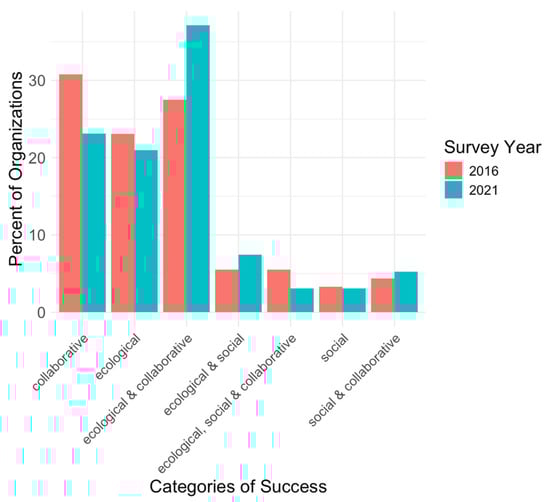
Figure 1.
Percentages of categories of perceived success by year of survey.
Table 5.
Categories of perceived success by year of survey.
Both Ecological-only and Collaborative-only categories of perceived success had statistically significant differences between age categories (p > 0.05). Table 6 shows that older LCIs (16+ years) were more likely to report ecological accomplishments, while younger LCIs emphasized collaborative successes. Across all age groups, a combination of Ecological and Collaborative successes was prevalent, indicating that types of collaborative success (planning, partnership, and funding) are an integral part of LCIs across age categories but may be especially important for younger LCIs.
Table 6.
Categories of perceived success by age of LCI.
Table 7 includes representative quotes for each of the themes of perceived success from both years the survey was conducted. Ecological themes include restoration, land acquisition, policy, data collection/data synthesis for responses that emphasized the ecological aspects of conservation projects and did not include human dimensions. Social/Human themes include recreation access/public education and sustainable land use for responses that emphasized the human involvement or benefit related to conservation projects. Collaboration/Governance themes include planning, partnership, and funding for responses that emphasized these elements of the conservation project.
Table 7.
Themes for LCI accomplishments or biggest successes.
3.4. Factors Influencing Success
Initiatives were asked an open-ended question about the three most important factors contributing to their LCI’s overall success (see Table 8). The themes included staff/leadership, funding, common/clear goals, community relations, maps/data, continuing commitment, political support, diverse partnerships, and trust/respect. Because there was no axial coding to group the factors into broader categories, no quantitative analysis was conducted to compare frequencies by year or age of the LCI. Like the open-ended question on greatest success, respondents could include multiple responses for the factors influencing success, which were coded to individual themes. Table 8 provides example quotes for each of the themes from respondents in 2016 and 2021.
Table 8.
Themes for important factors contributing to LCI success.
4. Discussion
4.1. LCI Focus Areas and Strategies
Identifying threats to landscapes and aligning corresponding focus areas for conservation initiatives is emphasized as critical to achieving conservation goals [7,8,10], yet there is limited understanding of how the focal topics for LCIs change over time and if focus topics differ by the age of the LCI. This study found that LCIs’ top focus areas of Wildlife Habitat conservation, connectivity through Working Lands, and Watershed Protection, which align with previous research as priority areas [28]. While there remains consistency over the five-year period for these three focus areas, there are significant differences between the proportions of each focus area between the two years (2016 and 2021) in which the survey was implemented. Some focus areas were more emphasized in certain years (e.g., Sustainable Community Development and Climate Mitigation/Adaptation were a higher priority in the 2016 survey, while Cultural Heritage Protection and Open Space and Recreation emerged as a higher priority in 2021). Some of these topics may go through ebbs and flows; for example, trends for how climate change is communicated in the media and focused on vary by country and are often influenced by societal and political changes [29]. Additionally, a recent report indicates that globally, there is a small percentage of the United Nations’ Sustainable Development goals showing progress despite advances that may be occurring at a more localized or regional scale [30]. The greater emphasis on open space and recreation may be attributed to the linkage between outdoor recreation and access to nature with mental and physical health benefits [31] and the overall growth and demand for outdoor recreation through open space [32]. These variations indicate the importance of monitoring focus areas over time and assessing how societal trends may influence focal topics for LCIs.
When assessing if the age of the LCI influences the focus area, Wildlife Habitat was present across all LCI age categories, but there were no significant differences, with the small exception of Cultural Heritage Protection (higher emphasis for older LCIs). This finding may suggest that certain topic areas may be influenced by the age of the LCI, when it was established, or that the shift to more integrated focus areas beyond traditional wildlife habitat protection or restoration may be a growing trend in the future. For example, Hoffmann [33] identified several challenges and opportunities to reaching biodiversity and sustainability goals while emphasizing the need for integrated and holistic approaches of social–ecological systems, which are still largely lacking. Older LCIs may have more experience in the integration of cultural aspects with ecological aspects due to their years of building relationships and working in a landscape to understand the complexity and importance of these interactions.
LCIs employ a variety of actions and strategies to address the threats facing their respective landscapes. There were highly significant differences between the strategies used by LCIs over time, with Legislative and Policy Advocacy, Conflict Resolution and Facilitation, and Land Use Planning emerging as top strategies in 2016; meanwhile, the 2021 results indicate a growth toward Networking and Information Sharing. This finding suggests that there may be a shift from emphasis at the formal, policy scale to gaining more support from partnerships and focusing on building meaningful community relations. In the realm of landscape-scale conservation, this may be reflective of a change from institutional and structural power approaches emphasizing policies and structure to more actor-centered and discursive power approaches emphasizing knowledge and relationships [34]. Additionally, the emphasis on networking and information sharing in 2021 may be reflective of the recognized importance of being part of a network, like the NLC, and the nestedness of networking within an LCI and among LCIs.
When assessing the influence of the LCI’s age on strategies, there were no significant differences except for Conservation Easement and Land Acquisition (greater emphasis in older LCIs). Social capital [35] and formal and informal networks [1] may be particularly important for LCIs to achieve short and long-term goals due to the complex interactions of scales. This finding may also reflect the need for established relationships to be in place for successful easement and land acquisition, requiring many years (i.e., older LCIs) of building trust and investing in relationships [36].
4.2. Interpreting LCI Success
Measuring success and efficacy at the landscape-scale can be particularly challenging for conservation initiatives due to the long temporal scales often needed to establish and sustain projects and the complexity of spatial scales, jurisdictions, and governance layers [37]. While our findings indicated that LCIs often focused on wildlife habitat and watershed protection, the perceived biggest successes of the LCIs were most often categorized as distinctly Collaboration or as a combination of both Collaboration/Ecological in both 2016 and 2021. Collaboration included many examples of developing plans and identifying priorities, forming and strengthening partnerships through formal and informal means, and gaining investment through grants and donors that sustain initiatives over time. For both years, only the Ecological metrics of success ranked third. While some of the Ecological successes were focused on restoration of habitats, others were related to protecting the land through acquisition and easements or policies that protected specific land and water areas or species. Data collection and synthesis were focused on ecological data for science, inventory, and monitoring purposes. It is important to note the presence of combinations of different categories in the responses, indicating that there is a recognition of the diverse and intangible forms of success beyond just ecological metrics.
Both Ecological-only and Collaborative-only categories of perceived success had statistically significant differences between age categories, with older LCIs (16+ years) more likely to report ecological accomplishments, while younger LCIs emphasized collaborative successes. Across all age groups, a combination of Ecological and Collaborative successes was prevalent, indicating that it is less common to see only Ecological categories of success for LCIs. Previous studies that found accountability, information sharing, stakeholder engagement, and valuing of diverse perspectives through partnerships as successful outcomes [3,19]. This may be particularly important for newer, younger LCIs that have to build a foundation of trust and relationships for successful governance before they can start to achieve their ecological outcomes. These various Social and Ecological categories of outcomes align with Thomsen and Caplow’s [18] study on large landscape initiatives that emphasized the importance of both governance/human-focused outcomes (i.e., relationship building, planning, and vision) and environmentally focused outcomes (i.e., broad assessments, topic-specific projects, and environmental impacts). There is still a limited understanding of how success is interpreted and measured for landscape conservation, considering the mosaic of cultures, land uses, jurisdictions, and ecosystems [38]. This study contributes to this gap by highlighting the three categories of success, the varied combinations of how success is interpreted, and how interpretations of success can vary with the age of the LCI, with solely Ecological successes being more prevalent in older LCIs. The emphasis on collaboration as a key aspect in success of LCIs may be an indicator of (1) a larger shift in conservation from the separation of humans to achieve conservation to integration of humans in a social–ecological system in tandem with (2) the recognition that meaningful and effective collaboration through participatory approaches is complex and difficult to achieve despite the necessity for sound governance.
4.3. Factors Influencing LCI Success
This study found the following themes to be critical to LCIs achieving their goals: staff/leadership, funding, common/clear goals, community relations, maps/data, continuing commitment, political support, diverse partnerships, and trust/respect. Our findings confirm previous research determined diverse and consistent funding contributes to the long-term resilience and sustainability of organizations [39,40,41,42], yet it remains an ongoing challenge for many LCIs, as often the governance of the LCI requires financial investment in addition to the financial support for the on-the-ground project work. In particular, the spatial and temporal scales of LCIs impose additional challenges to securing funding and can result in limited capacity of many initiatives. Lastly, as LCI efforts increase, they often compete for funding and membership [43,44].
Political and high-level support can influence an organization’s ability to function and sustain itself [45,46,47,48]. Our findings emphasize the need for this “support from all levels of government” from the local to international scales and across jurisdictions and borders, including “bi-partisan support”. When political or administrative changes occur, external support can easily shift towards or away from LCI efforts, inhibiting the ability of organizations to implement long-term planning [49]. Therefore, resilience to the changing political and economic landscape is critical for successful long-term resource management [39,40,50].
Within the social landscape, there is recognition that public support and relationships with communities, landowners, and diverse stakeholders are integral to conservation initiatives, yet many LCIs struggle to engage the public and create awareness of their efforts. Our findings emphasized “productive relationships with private landowners” and a “locally led approach” as important for public support. This has been an issue identified by previous research demonstrating that when organizations operate at larger spatial scales, it can become increasingly difficult to effectively engage and communicate with the entities despite necessity [40,50,51,52]. Having a nested organizational approach may be necessary for LCIs to develop and sustain the community relations within the broader landscape. For example, one respondent stated, “the trust that the community has for the organization has allowed us to move forward.”
Coupled with external challenges are the internal factors that influence the success of LCIs. Staff and leadership emerged as critical to the organizational capacity of LCIs, especially people described as “the backbone organization to lead initiative,” “engaged,” “energetic,” and the “connective tissue for network coordination.” Specifically, LCI leaders should clearly communicate external information to the group [53] and build relationships with influential groups [40]. The findings also support that the capacity of leadership to strategically and proactively adapt to change is necessary and remains a challenge for LCIs [4]. Additionally, many members or representatives of LCIs vary in their available time, skills, and financial resources, which influence their level of participation [47,54,55].
Having a clear vision and mission that is supported and known by members has been found to be influential for an organization’s success [49,56,57]. This study found that having a mission that is “actionable”, and providing “mutual benefits” can be challenging, but these factors make up an important foundation and are linked to commitment and trust. For example, conflicting stakeholder priorities and overcoming institutional barriers can be problematic [16]. Furthermore, prioritizing personal versus collective goals is common, especially as resources are restricted [44].
Maintaining member commitment was identified as a challenge to LCIs. Turnover can affect the capacity of an organization [49,56,57], and operating at larger spatial scales can increase the distance between members, limiting the frequency and type of interactions [58]. Strengthening members’ relationships to each other and to the group can translate to increased benevolence [59] and attitudinal organizational commitment [60]. These strong relationships strengthened their affective or attitudinal organizational commitment, which refers to emotional attachment and identification with the organization [53,61].
The importance of diverse partnerships was emphasized by respondents in 2016 and 2021; further trust and respect were particularly emphasized by 2021 respondents as critical to success. This can be essential when an LCI is operating on a topic or in a landscape with high levels of conflict or working with Indigenous or marginalized groups. Covey and Merrill [62] illuminate how moving at the “speed of trust” is an absolute element for the success of any initiative. Yet, many initiatives have deadlines and pressure to spring into action and obtain quick results, or establishing trust and relationships is not perceived as a valuable outcome of an initiative, despite its importance with respect to leading to other long-term conservation outcomes.
5. Conclusions
This study surveyed Landscape Conservation Initiatives that are connected through the Network for Landscape Conservation in 2016 and again in 2021. Our research presents findings on how the focus of these initiatives, the strategies and approaches employed to achieve goals, the factors that support or challenge the LCI’s success, and how LCIs perceive their biggest successes. The main findings highlight how some of these trends changed over a five-year period and with the age range of the LCI. LCIs implement a range of strategies, ranging from strategic and coordinated conservation planning to land and species protection. LCIs recognize many internal and external factors that can support or impede their success; however, LCIs are finding that collaborative-based strategies and network support can help them overcome these challenges. Lastly, success is defined and interpreted in diverse ways by LCIs that include a combination of Collaboration/Governance, Ecological, and Social/Human categories that interact with one another.
Despite the growth in LCIs and the recognition of their importance to conservation, they are largely understudied, resulting in a limited understanding of the effectiveness of LCIs and what factors influence their success. These findings contribute to our greater understanding of trends that have developed over the past several decades for LCIs within a network. The study serves as a foundation for in-depth research on the key themes/topics that emerged in this research.
The research study is limited by several factors and identifies needs for further research. First, the focus of the NLC is largely concentrated in the United States. The findings provide insight into LCIs and the NLC, though they are limited in the generalizability to other geographic locations. Second, the limited nature of the survey format limited the depth of understanding of topics and the ability to compare some of the data across years. Third, the respondents are reporting on the status of their LCIs, which limits our understanding of how specific LCIs transform over time. It is recommended that subsequent surveys be conducted within the NLC in the future to track these changes and trends, as these findings do not reflect the most current state of the network. Fourth, we were limited in our ability to assess the interactions of multiple variables of individual organizations. Lastly, the lower response rate of online and email surveys and the reduced number of usable surveys after data cleaning are limitations to the generalizability of the findings. A qualitative research study can complement the current survey work and provide a more in-depth analysis through a case study approach.
The global shift in implementing conservation efforts to operate at the landscape-scale is largely stifled by the lack of research and understanding of how LCIs function and the factors influencing their success. Networks are being created as a tool to coordinate and share lessons and information among initiatives, but there is a lack of systematic research on LCIs and networks to understand broader trends. This study fulfills this gap, provides insight into our understanding of a network of LCIs and key differences over a five-year period and across the age of the LCI, and can support future research in this field of study. As complexity increases with the scale of the initiative, it is critical that we investigate the functionality of LCIs to efficiently and effectively combat threats to our global landscapes and increase the efficiency and effectiveness of governance of these initiatives in the future.
Author Contributions
Conceptualization, J.M.T.; Methodology, M.C.M.; Formal analysis, J.M.T. and M.C.M.; Data curation, J.M.T. and M.C.M.; Writing—original draft, J.M.T. and M.C.M.; Visualization, M.C.M.; Project administration, J.M.T. All authors have read and agreed to the published version of the manuscript.
Funding
Funding was provide by the Netowrk for Landscape Conservation for support of the survey implementation.
Data Availability Statement
The raw data supporting the conclusions of this article will be made available by the authors on request.
Conflicts of Interest
The authors declare no conflict of interest.
References
- Scarlett, L.; McKinney, M. Connecting people and places: The emerging role of network governance in large landscape conservation. Front. Ecol. Environ. 2016, 14, 116–125. [Google Scholar] [CrossRef]
- Locke, H. Transboundary cooperation to achieve wilderness protection and large landscape conservation. PARK Sci. 2011, 28, 24–28. [Google Scholar]
- Petersen, B.; Montambault, J.; Koopman, M. The potential for double-loop learning to enable landscape conservation efforts. Environ. Manag. 2014, 54, 782–794. [Google Scholar] [CrossRef]
- Vasilijević, M.; Zunckel, K.; McKinney, M.; Erg, B.; Schoon, M.; Michel, T.R. Transboundary Conservation: A Systematic and Integrated Approach; IUCN Best Practice Protected Area Guidelines Series: Gland, Switzerland, 2015; No. 23. [Google Scholar]
- Noss, R.F.; Dobson, A.P.; Baldwin, R.; Beier, P.; Davis, C.R.; Dellasala, D.A.; Reining, C. Bolder thinking for conservation. Conserv. Biol. 2012, 26, 1–4. [Google Scholar] [CrossRef]
- Trombulak, S.C.; Baldwin, R. (Eds.) Landscape-Scale Conservation Planning; Springer: Dordrecht, The Netherlands, 2010. [Google Scholar]
- Betsill, M.M.; Bulkeley, H. Transnational networks and global environmental governance: The Cities for Climate Protection Program. Int. Stud. Q. 2004, 48, 471–493. [Google Scholar] [CrossRef]
- Estrada-Carmona, N.; Hart, A.K.; DeClerck, F.A.J.; Harvey, C.A.; Milder, J.C. Integrated landscape management for agriculture, rural livelihoods, and ecosystem conservation: An assessment of experience from Latin America and the Caribbean. Landsc. Urban Plan. 2014, 129, 1–11. [Google Scholar] [CrossRef]
- Guerrero, A.M.; McAllister, R.R.J.; Wilson, K.A. Achieving cross-scale collaboration for large scale conservation initiatives. Conserv. Lett. 2015, 8, 107–117. [Google Scholar] [CrossRef]
- Meine, C.; Soulé, M.; Noss, R.F. A mission-driven discipline: The growth of conservation biology. Conserv. Biol. 2006, 20, 631–651. [Google Scholar] [CrossRef]
- Sayer, J.; Campbell, B.; Petheram, L.; Aldrich, M.; Perez, M.R.; Endamana, D.; Burgess, N. Assessing environment and development outcomes in conservation landscapes. Biodivers. Conserv. 2007, 16, 2677–2694. [Google Scholar] [CrossRef]
- Theobald, D.M.; Reed, S.E.; Fields, K.; Soulé, M. Connecting natural landscapes using a landscape permeability model to prioritize conservation activities in the United States. Conserv. Lett. 2012, 5, 123–133. [Google Scholar] [CrossRef]
- Network for Landscape Conservation [NLC] (n.d.). What Is Landscape Conservation? Available online: https://landscapeconservation.org/about/what-is-landscape-conservation/ (accessed on 25 May 2025).
- Rudnick, D.A.; Ryan, S.J.; Beier, P.; Cushman, S.A.; Dieffenbach, F.; Epps, C.W.; Merenlender, A.M. The role of landscape connectivity in planning and implementing conservation and restoration priorities. Issues Ecol. 2012, 16, 1–20. [Google Scholar]
- Bixler, R.P.; Johnson, S.; Emerson, K.; Nabatchi, T.; Reuling, M.; Curtin, C.; Grove, J.M. Networks and landscapes: A framework for setting goals and evaluating performance at the large landscape-scale. Front. Ecol. Environ. 2016, 14, 145–153. [Google Scholar] [CrossRef]
- Jacobson, C.; Robertson, A.L. Landscape conservation cooperatives: Bridging entities to facilitate adaptive co-governance of social-ecological systems. Hum. Dimens. Wildl. 2012, 17, 333–343. [Google Scholar] [CrossRef]
- Wyborn, C.; Bixler, R.P. Collaboration and nested environmental governance: Scale dependency, scale framing, and cross-scale interactions in collaborative conservation. J. Environ. Manag. 2013, 123, 58–67. [Google Scholar] [CrossRef]
- Thomsen, J.M.; Caplow, S.C. Defining success over time for large landscape conservation organizations. J. Environ. Plan. Manag. 2017, 60, 1153–1172. [Google Scholar] [CrossRef]
- Jedd, T.; Bixler, R.P. Accountability in networked governance: Learning from a case of landscape-scale forest conservation. Environ. Policy Gov. 2015, 25, 172–187. [Google Scholar] [CrossRef]
- Hughes, B.B.; Beas-Luna, R.; Barner, A.K.; Brewitt, K.; Brumbaugh, D.R.; Cerny-Chipman, E.B.; Carr, M.H.; Close, S.L.; Coblentz, K.E.; de Nesnera, K.L.; et al. Long-term studies contribute disproportionately to ecology and policy. BioScience 2017, 67, 271–281. [Google Scholar] [CrossRef]
- Baldwin, E.; Thiel, A.; McGinnis, M.; Kellner, E. Empirical research on polycentric governance: Critical gaps and a framework for studying long-term change. Policy Stud. J. 2024, 52, 319–348. [Google Scholar] [CrossRef]
- Scheer, D.; Venghaus, S.; Sardo, S.; Stark, S.; Kuppler, S.; Schmidt, M.W.; Hoyer-Klick, C. No easy way out: Towards a framework concept of long-term governance. Energy Sustain. Soc. 2025, 15, 9. [Google Scholar] [CrossRef]
- Ayambire, R.A.; Rytwinski, T.; Taylor, J.J.; Luizza, M.W.; Muir, M.J.; Cadet, C.; Armitage, D.; Bennett, N.J.; Brooks, J.; Cheng, S.H.; et al. Challenges in assessing the effects of environmental governance systems on conservation outcomes. Conserv. Biol. 2025, 39, e14392. [Google Scholar] [CrossRef]
- Guerrero, A.M.; McAllister, R.R.; Corcoran, J.; Wilson, K.A. Scale mismatches, conservation planning, and the value of social network analyses. Conserv. Biol. 2013, 27, 35–44. [Google Scholar] [CrossRef]
- Pretty, J. Social capital and the collective management of resources. Science 2003, 302, 1912–1914. [Google Scholar] [CrossRef]
- Wyborn, C. Connecting knowledge with action through coproductive capacities: Adaptive governance and connectivity conservation. Ecol. Soc. 2015, 20, 11. [Google Scholar] [CrossRef]
- Williams, M.; Moser, T. The art of coding and thematic exploration in qualitative research. Int. Manag. Rev. 2019, 15, 45–55. [Google Scholar]
- Tilman, D.; Clark, M.; Williams, D.R.; Kimmel, K.; Polasky, S.; Packer, C. Future threats to biodiversity and pathways to their prevention. Nature 2017, 546, 73–81. [Google Scholar] [CrossRef] [PubMed]
- Hase, V.; Mahl, D.; Schäfer, M.S.; Keller, T.R. Climate change in news media across the globe: An automated analysis of issue attention and themes in climate change coverage in 10 countries (2006–2018). Glob. Environ. Change 2021, 70, 102353. [Google Scholar]
- United Nations Department of Economic and Social Affairs. The Sustainable Development Goals Report 2025; United Nations Department of Economic and Social Affairs: New York, NY, USA, 2025. [Google Scholar]
- Thomsen, J.M.; Powell, R.B.; Monz, C. A systematic review of the physical and mental health benefits of wildland recreation. J. Park Recreat. Adm. 2018, 36, 123–148. [Google Scholar] [CrossRef]
- Outdoor Industry Association. Executive Summary: 2025 Outdoor Participation Trends Report. 2025. Available online: https://oia.outdoorindustry.org/exec-summary-outdoor-participation-trends/ (accessed on 29 September 2025).
- Hoffmann, S. Challenges and opportunities of area-based conservation in reaching biodiversity and sustainability goals. Biodivers. Conserv. 2022, 31, 325–352. [Google Scholar] [CrossRef]
- Shackleton, R.T.; Walters, G.; Bluwstein, J.; Djoudi, H.; Fritz, L.; Lafaye de Micheaux, F.; Loloum, T.; Thi Hai Nguyem, V.; Andriamahefazafy, M.R.; Sithole, S.S.; et al. Navigating power in conservation. Conserv. Sci. Pract. 2023, 5, e12877. [Google Scholar]
- Allen, K.E.; McLean, S.; Pessagno, S. Connecting communities, connecting environments: The role of social capital in landscape-scale conservation. Soc. Nat. Resour. 2022, 35, 763–783. [Google Scholar] [CrossRef]
- Rissman, A.R.; Kazer, A.; DeMets, C.; Martell, E. Sustaining land and people over time: Relationships with successor landowners on conservation easements. People Nat. 2023, 5, 542–556. [Google Scholar] [CrossRef]
- Sayer, J.A.; Margules, C.; Boedhihartono, A.K.; Sunderland, T.; Langston, J.D.; Reed, J.; Riggs, R.; Buck, L.E.; Campbell, B.M.; Kusters, K.; et al. Measuring the effectiveness of landscape approaches to conservation and development. Sustain. Sci. 2017, 12, 465–476. [Google Scholar] [CrossRef]
- Quinn, J.E.; Allen, K.E. Governance, values, and conservation processes in multifunctional landscapes. Land 2021, 10, 478. [Google Scholar] [CrossRef]
- Raadgever, G.T.T.; Mostert, E.; Kranz, N.; Interwies, E.; Timmerman, J.G. Assessing management regimes in transboundary river basins: Do they support adaptive management? Ecol. Soc. 2008, 13, 14. [Google Scholar] [CrossRef]
- Margerum, R.D. Beyond Consensus: Improving Collaborative Planning and Management; MIT Press: Cambridge, UK, 2011. [Google Scholar]
- Margerum, R.D. Evaluating collaborative planning: Implications from an empirical analysis of growth management. J. Am. Plan. Assoc. 2002, 68, 179–193. [Google Scholar] [CrossRef]
- Imperial, M.T.; Johnston, E.; Pruett-Jones, M.; Leong, K.; Thomsen, J. Sustaining the useful life of network governance: Life cycles and developmental challenges. Front. Ecol. Environ. 2016, 4, 135–144. [Google Scholar] [CrossRef]
- Sirmon, D.G.; Hitt, M.A.; Ireland, R.D.; Gilbert, B.A. Resource orchestration to create competitive advantage: Breadth, depth, and life cycle effects. J. Manag. 2010, 37, 1390–1412. [Google Scholar] [CrossRef]
- Lester, D.L.; Pamell, J.A.; Carraher, S. Organizational life cycle: A five-stage empirical scale. Int. J. Organ. Anal. 2003, 11, 339–354. [Google Scholar] [CrossRef]
- Leach, W.; Pelkey, N. Making watershed partnerships work: A review of the empirical literature. J. Water Resour. Plan. Manag. 2001, 127, 378–385. [Google Scholar] [CrossRef]
- Gray, B. Collaborating: Finding Common Ground for Multiparty Problems; Jossey-Bass Publishers: San Francisco, CA, USA, 1989. [Google Scholar]
- Yaffee, S.L.; Wondolleck, J.M. Collaborative ecosystem planning processes in the United States: Evolution and challenges. Environments 2003, 31, 59–72. [Google Scholar]
- Uitto, J.; Duda, A. Management of transboundary water resources: Lessons from international cooperation for conflict prevention. Geogr. J. 2002, 168, 365–378. [Google Scholar] [CrossRef]
- Gilbert, P.A. High Performance Agencies: The Entrepreneurial Model for Public Parks, Recreation, and Tourism Organizations; Sagamore Publishing: Urbana, IL, USA, 2014. [Google Scholar]
- Margerum, R.D.; Whitall, D. The challenges and implications of collaborative management on a river basin scale. J. Environ. Plan. Manag. 2004, 47, 409–429. [Google Scholar] [CrossRef]
- Heikkila, T.; Gerlak, A.K. The formation of large-scale collaborative Resource Management institutions: Clarifying the roles of stakeholders, science, and institutions. Policy Stud. 2005, 33, 583–612. [Google Scholar] [CrossRef]
- Stern, M.J.; Predmore, S.A. Decision making, procedural compliance, and outcomes definition in U.S. Forest Service planning processes. Environ. Impact Assess. Rev. 2011, 31, 271–278. [Google Scholar] [CrossRef]
- Robbins, S.P.; Judge, T.A. Organizational Behavior, 12th ed.; Pearson Prentice Hall: Upper Saddle River, NY, USA, 2007. [Google Scholar]
- Kittinger, J.N.; Dowling, A.; Purves, A.R.; Milne, N.A.; Olsson, P. Marine protected areas, multiple-agency management, and monumental surprise in the Northwestern Hawaiian Islands. J. Mar. Biol. 2011, 2011, 241374. [Google Scholar] [CrossRef]
- Thomson, A.M.; Perry, J.L. Collaboration processes: Inside the black box. Public Adm. Rev. 2006, 66, 20–32. [Google Scholar] [CrossRef]
- Elbakidze, M.; Angelstam, P.K.; Sandstrom, C.; Axelsson, R. Multi-stakeholder collaboration in Russian and Swedish model forest initiatives: Adaptive governance toward sustainable forest management? Ecol. Soc. 2010, 15, 14. [Google Scholar] [CrossRef]
- Powell, R.B. Developing institutions to overcome governance barriers to ecoregional conservation. In Landscape-Scale Conservation Planning; Trombulak, S.C., Baldwin, R.F., Eds.; Springer: Dordrecht, The Netherlands, 2010; pp. 53–66. [Google Scholar]
- San Martín-Rodríguez, L.; Beaulieu, M.D.; D’Amour, D.; Ferrada-Videla, M. The determinants of successful collaboration: A review of theoretical and empirical studies. J. Interprof. Care 2005, 1, 132–147. [Google Scholar] [CrossRef]
- Mayer, R.C.; Davis, J.H. The effect of the performance appraisal system on trust for management: A field quasi-experiment. J. Appl. Psychol. 1999, 84, 123–136. [Google Scholar] [CrossRef]
- Powell, R.B.; Cuschnir, A.; Peiris, P. Overcoming governance and institutional barriers to integrated coastal zone, marine protected area, and tourism management in Sri Lanka. Coast. Manag. 2009, 37, 633–655. [Google Scholar] [CrossRef]
- Mayer, R.C.; Davis, J.H.; Schoorman, F.D. An Integrative Model of Organizational Trust. Acad. Manag. Rev. 1995, 20, 709–734. [Google Scholar] [CrossRef]
- Covey, S.M.; Merrill, R.R. The Speed of Trust: The One Thing that Changes Everything; Simon and Schuster: New York, NY, USA, 2006. [Google Scholar]
Disclaimer/Publisher’s Note: The statements, opinions and data contained in all publications are solely those of the individual author(s) and contributor(s) and not of MDPI and/or the editor(s). MDPI and/or the editor(s) disclaim responsibility for any injury to people or property resulting from any ideas, methods, instructions or products referred to in the content. |
© 2025 by the authors. Licensee MDPI, Basel, Switzerland. This article is an open access article distributed under the terms and conditions of the Creative Commons Attribution (CC BY) license (https://creativecommons.org/licenses/by/4.0/).