


Abstract
After nearly forty years of development, China’s land consolidation policies (CLCP) have become an important tool for promoting rural revitalization and sustainable development. However, as a major land management policy, there is still a lack of quantitative evaluation research on its text. This paper establishes an evaluation system for CLCP using text analysis and the PMC-Index model. Based on a reasonable definition of the connotation of land consolidation, this paper collects 313 related policies issued by China’s central government from 1982 to 2022, using text analysis to sort out the characteristics of issuance time, policy types, issuing institutions, and cooperation networks. By combining the outcomes of text mining with the previous research results to set evaluation indicators for the PMC-Index model, it distinguishes between comprehensive policies and specialized policies and separately evaluates them. Then, the PMC-Surface is established to clearly display the calculation results. The results show that the evaluation scores of comprehensive policies and specialized policies showed an upward trend over time. This indicates that the content of CLCP is constantly being enriched and expanded. The evaluation scores for different dimensions of comprehensive policies are relatively balanced, whereas there are significant differences in the evaluation scores of various dimensions of specialized policies. Both comprehensive policies and specialized policies have weaknesses in policy functions, incentives and constraints, and implementation guarantees, so improvements may be needed in these areas in the future. This study provides valuable insights into the advantages and disadvantages of a single land consolidation policy in China.
1. Introduction
In the context of globalization, urbanization, and industrialization, both developed and developing countries are facing various rural issues. These issues include rural population decline, the abandonment of cultivated land, unused rural dwellings, increased environmental pollution, and the decline of rural culture [1]. Many countries consider land consolidation as an important tool to solve the problem of fragmented cultivated land and improve the efficiency of land resource utilization [2,3]. Furthermore, land consolidation is also seen as significant for revitalizing the countryside and promoting sustainable rural development [4]. Land consolidation has a long history in Europe, and the concept was first introduced as a social reform policy in Denmark in the 1850s [5]. Worldwide, concerns about food security and the productive capacity of agricultural products are the primary motivations for countries to promote land consolidation policies [6]. In response to challenges such as the fragmentation of agricultural land, developed countries like Germany, Denmark, the Netherlands, France, and Japan implemented successful land consolidation policies. These countries introduced specific land consolidation laws, encouraged public participation, developed comprehensive land consolidation plans, provided economic incentives such as financial subsidies and credits, promoted the establishment of intermediary services like land consolidation associations and companies, and utilized voluntary agreement-based governance instruments [7,8,9]. From the perspective of specific policy practices, the diversity of land consolidation policy objectives and means is determined by the different natural geographical conditions, cultural traditions, and political and economic backgrounds of countries.
Currently, rural areas in China are also facing problems such as the abandonment of cultivated land, the phenomenon of hollow villages, serious environmental pollution, and a low level of mechanization. The early development approach of “allowing a portion of people to become rich first, and then leading others towards common enrichment” and providing rural support for urban development failed to implement effective measures to address the loss of rural interests. This is especially evident after the implementation of the reform and open policy, as the income gap between urban and rural areas, the disparity in infrastructure, and the difference in living standards have gradually widened. Additionally, a significant number of working-age individuals have flocked to urban areas [10]. The population movement in rural China has had a drastic impact on its spatial carrier, which is land. The massive outflow of working-age laborers has exacerbated the phenomenon of abandoned cultivated land and hollow villages [11], as well as the problems of low agricultural productivity and the decline of traditional culture in the countryside [12,13]. Government-led land consolidation has been the predominant approach to rural land consolidation in China [14], providing a strong basis for agricultural and rural development. In response to the aforementioned issues, the Chinese government has implemented various land consolidation policies (CLCP), such as land reclamation, village construction land consolidation, cultivated land requisition–compensation balance, and an equilibrium between the expansion of urban construction land and the reduction in rural construction land. These policies aimed to enhance the efficiency of land resource utilization, boost agricultural production capacity, and improve farmers’ incomes. It was shown that the land consolidation policies in China over the past decades have played a variety of roles such as supplementing the area of cultivated land, promoting large-scale management, improving the efficiency of land resource utilization, saving production costs, enhancing agricultural infrastructure, improving the rural ecological environment, increasing agricultural productivity, promoting sustainable development, guaranteeing food security, increasing farmers’ income, and alleviating poverty [1,4,10,15,16,17,18,19,20]. Thus, it can be seen that land consolidation, as an important tool to promote the protection of cultivated land resources and rural revitalization, guarantee food security, and construct ecological civilization, will continue to receive the attention and support of academic circles and the government for a long period of time in the future.
The existing studies concluded that land-use policies and systems have a significant impact on regional land-use patterns and their transformation [12]. The lack of coordination between the land consolidation policy and other socio-economic development plans was identified as a crucial factor contributing to the ineffective land consolidation [16]. Therefore, there is an urgent need for China’s rural land consolidation to innovate its rural land policies and system [1] and to strengthen the construction of laws and institutions to more effectively utilize land resources [21]. The main proposed countermeasures are land management and policy innovation [13]. It can be seen that the land consolidation system and policies play an extremely important role in solving practical problems in rural areas of China, especially the policies issued by the central government, which serve as guidelines and indicators for local governments. These policies are of decisive significance for the formulation and implementation of relevant local government policies. However, the current research mostly explores the role and influence of land consolidation [22,23], factors affecting the effectiveness of land consolidation [24,25], and the governance structure of land consolidation [26,27,28] from a micro perspective in a limited research area, and there is a lack of quantitative, objective, and systematic research on the text of land consolidation policies. The Policy Modeling Consistency (PMC)-Index model, proposed by Ruiz Estrada [29], provides a quantitative evaluation method for policy texts. This model was applied in various types of public policy evaluations, including land resource protection policies [30], environmental protection policies [31,32], and industrial development policies [33]. It was proven to be highly generalizable and can be used in quantitative evaluation research on land consolidation policies. In light of this, this article focuses on CLCP from 1982 to 2022 as the research object and attempts to conduct research using text analysis and the PMC-Index model for further investigation. Firstly, it categorizes the external attributes of CLCP, including the publication time, policy type, and publishing department. This categorization is accomplished in three stages: quantity mining, an equal emphasis on quantity and quality, and an emphasis on ecological functions. Then, the ROSTCM6 (Version 5.8.0.603) software is used to analyze the policy text, and a quantitative evaluation framework for CLCP is established. This framework distinguishes and sets different and targeted quantitative evaluation dimensions for comprehensive land remediation policies and special land remediation policies. Six comprehensive policies and six special policies are selected as the research objects, and the results of the policy evaluation are analyzed and discussed.
2. Materials and Methods
2.1. Definition and Data Sources
The main focus of this paper is the analysis of policy documents on land consolidation at the central level in China. These documents primarily include laws, regulations, rules, and normative documents issued by the State Council and its constituent departments that are relevant to land consolidation. Before collecting data from the policy texts, it is necessary to define the concept of land consolidation to ensure the scientific validity of the study. In the traditional sense, land consolidation is often regarded as a spatial engineering technique or land management tool used to reduce land fragmentation [11,34,35], while some researchers define it in a broader sense as an activity that improves the quality of cultivated land and enhances the livelihood capital of farmers [1,23]. Since the 1980s and 1990s, land consolidation has been implemented in China as an engineering measure to expand the cultivated land area and enhance agricultural productivity. With nearly 40 years of land consolidation policy practice, the understanding and scope of it have continued to evolve. Throughout this period, terms such as land consolidation, land reclamation, rural land reclamation, territorial management, territorial comprehensive consolidation, and rehabilitation have been used in the literature. However, there is still no consistent consensus on the conceptual meaning of these terms [36,37,38]. There is also a mixed use of different concepts, cross extension, and ambiguous definitions in policy documents formulated by the government. Meanwhile, in policy practice, land consolidation policy practice encompasses a broad range of contents such as land reclamation, farmland consolidation, high-standard farmland construction, rural residential remediation, reclamation of abandoned industrial and mining land, and land restoration [1,39]. The concept of “land consolidation” is widely accepted by the government and scholars for its comprehensiveness, essentiality, and inclusiveness [40]. This paper adopts the expression of land consolidation and defines it by combining previous research and official normative documents, such as the “Terminology of Land Consolidation” issued by the former Ministry of Land and Resources: land consolidation refers to a series of engineering and property rights adjustment measures taken to meet the needs of agricultural production, construction, and ecological protection, targeting the unused land, inefficient and irrational land, and polluted and damaged land within the entire land space.
In order to comprehensively collect the relevant policy texts, three channels were used to gather data. Firstly, the Peking University Law website (http://www.pkulaw.com (accessed on 15 February 2023)), which is China’s earliest and most professional legal and policy database, covering laws and regulations, judicial cases, and specified references, was used [33,41]. Secondly, the Compilation of Laws and Regulations Related to Land Consolidation in China, compiled by the Land Consolidation Center of the former Ministry of Land and Resources, was consulted. This compilation contains a selection of land consolidation policy texts issued by the national and provincial governments from 1982 to 2013. Lastly, the official websites of the central government and relevant ministries were also accessed.
Select keywords such as “land consolidation”, “land remediation”, “territorial consolidation and rehabilitation”, “comprehensive land consolidation”, “intensive utilization”, “equilibrium between increasing of urban construction land and decreasing of rural construction land”, “high-standard basic farmland”, and “mountains, waters, forests, farmland, lakes, grassland, and deserts” were used to search for policy titles. In the process of constructing the policy literature database, we adhered to the principles of relevance, comprehensiveness, and authoritativeness to select policy texts that meet the requirements through artificial recognition, to ensure the comprehensiveness and credibility of the study. The principle of relevance ensures that the collected policy texts are highly relevant to the concept of land consolidation. The principle of comprehensiveness involves collecting policy texts as comprehensively as possible while maintaining relevance and focusing on the references between policies as a supplement. The principle of authoritativeness involves excluding temporary and routine policy documents, such as notices of meetings, notices of viewing, notices of training, and so on. The earliest policy document that can be collected is the Interim Provisions on Allocation of Funds for Land Consolidation Work, issued by the Ministry of Finance in February 1982, for which release time aligns with the current academic consensus on the start time of China’s land consolidation [4,16,42,43,44]. Therefore, it can be assumed that the data collected for this study were highly reliable. As a result, the research period for this paper was determined to be 1982–2022. Eventually, a literature database of land consolidation policies consisting of 313 policy documents was established.
2.2. Text Analysis
Text analysis, also known as content analysis, is a research method that involves the objective, systematic, and quantitative description of text content [45]. It is an important research method in the field of social sciences. The semi-structured nature of policy texts allows for analysis, and certain important aspects of the policy development process can be observed to some extent through elements such as policy release time, policy type, and issuing organization. Additionally, the high-frequency words used in these texts can reflect the priorities of policy makers and their understanding of the subject matter. According to this principle, the text analysis method is used to count the structural elements such as the release time, issuing organization, and type of official document of China’s land consolidation policies. Additionally, ROSTCM6 software is utilized to mine high-frequency words. The evaluation indexes of the PMC-Index model are established based on the results of word frequency statistics in order to enhance the scientific rigor of the evaluation.
2.3. PMC-Index Model
The Policy Modeling Consistency (PMC)-Index model, a quantitative evaluation method for policy texts, was extensively utilized in different research [30,31,32]. The PMC-Index model is based on the Omnia Mobilis assumption [46], which states that everything in the world is interconnected and in motion. Therefore, it is important to include all relevant variables as much as possible [30]. The PMC-Index model can be used to assess the internal consistency of any policy and conduct multidimensional evaluations and specific analyses of policy effectiveness. It reveals the strengths and weaknesses of policy modeling, and the use of the PMC-Surface can visualize the evaluation results, improve the quality of future policy formulation, and provide a reference for the formulation, implementation, and revision of CLCP.
The general steps of the PMC-Index model application are as follows: (1) selecting first-level and second-level variables, establishing evaluation indexes, and performing parameterization; (2) establishing a multi-input–output table; (3) calculating the PMC-Index; (4) drawing the PMC-Surface. Obtaining raw data and establishing evaluation variables through text mining can significantly reduce subjectivity [47,48] and enhance the reliability of quantitative policy evaluation. Existing studies that utilized the PMC-Index model for policy evaluation concluded that the variable settings of the PMC-Index model can be determined based on the generality and specificity of public policies. This allows for the establishment of more universal standard variables and more targeted non-standard variables [30,49]. As an improvement, this paper explores the division of land policies into specialized and comprehensive policies and sets differentiated evaluation dimensions to address the unique characteristics of each dimension of evaluation. Policy content is used to evaluate comprehensive policies, while functioning hierarchy is used to evaluate specialized policies.
In this paper, we first obtained and analyzed the raw data of CLCP through text analysis and policy text mining. The first-level variables in this research were determined using classical variables, such as policy nature, as proposed by Ruiz Estrad [29]. Additionally, we incorporated improved first-level variables from previous studies [31,32,33,48,50,51,52,53,54,55,56,57,58], as well as the results of high-frequency word summarization. The results of high-frequency word analysis and generalization were used to establish the first-level variable of policy ideas. Additionally, these results were used to populate the second-level variables under the selected first-level variables, completing the indicator system configuration. The multi-input–output table was then established, and the binary system was used to assign values to each secondary variable. Subsequently, the quantitative evaluation results of each policy were calculated. Finally, the PMC-Surface was plotted based on the PMC matrix.
3. Results of Policy Text Analysis
3.1. Statistics on Time of Issuance
In order to better observe and analyze the evolutionary characteristics of CLCP, as well as compare the policy’s characteristics between different stages, this paper draws on the studies of Long [59] and Xu [44] to divide the stages. The development of CLCP is divided into the following three stages for analysis and discussion. 1. The stage of tapping the quantitative potential (1982–2004): this stage primarily focuses on replenishing the quantity of cultivated land to provide sufficient space for industrialization and urbanization. 2. The stage of emphasizing both quantity and quality (2005–2015): during this stage, the policy integrates the increase in cultivated land area and the improvement of its quality. 3. The stage of stressing ecological functions and maximizing urban–rural values (2016–present): this stage increasingly focuses on the ecological functions of land, advocating for “greening” land consolidation and coordinating agricultural and construction land. Consolidating and maximizing urban–rural values can help revitalize the countryside in a comprehensive approach. Figure 1 shows the number and trend of the land consolidation policies issued in China from 1982 to 2022. In general, the volume of land consolidation policies being issued shows a fluctuating upward trend. The number of policy issuances in the three stages are 73, 112, and 128, accounting for 23.3%, 35.8%, and 40.9% of all policy texts, respectively. In the phase of tapping the quantitative potential, there were initially fewer land consolidation policies, which gradually increased over time. After 2000, there was a significant increase in land consolidation policies.
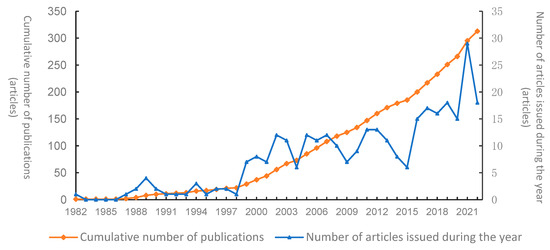
Figure 1.
Volume of land consolidation policy issuance in China (1982–2022).
3.2. Statistics on Types of Policies
Table 1 summarizes the distribution of different policy types during the development of CLCP and the three stages. Overall, the collected policy texts cover 12 types of policies, including notices, measures, opinions, regulations, decisions, outlines, laws, plans, rules, programs, etc. Notices account for the largest proportion of policies, followed by measures and opinions. Rules and decisions have the least representation, accounting for no more than 1% of the total. Combined with the distribution of policy contents and stages, notices, measures, opinions, and program policies mostly propose specific measures for a particular land consolidation issue and require lower-level governments and departments to implement them. This has a significant guiding role in improving the feasibility of the relevant policies. However, there was a lack of program policies during the stage of tapping the quantitative potential, and program policies in the subsequent two stages were maintained at a relatively stable level. The plan, and outline policies stipulate the time sequence and outcome requirements of the relevant land consolidation policies for a specific period in the future. They also re-quire lower-level governments to formulate their plans based on higher-level plans, taking into account local conditions. These policies play a crucial role in coordinating and promoting coherence, particularly considering that the proportion of plan policies in the three phases is 1.37%, 1.79%, and 5.47%, respectively. This indicates that CLCP are be-coming more organized and essential. Legal, regulation, and rules policies have varying degrees of mandatory characteristics. These policies are more effective in stipulating the responsibilities and obligations of relevant parties. Announcement policies, in contrast, primarily serve the purpose of informing society about the technical standards, guidelines, and industry norms related to land consolidation. It can be observed that the proportion of regulation policies gradually decreased as policies developed, while the proportion of announcement policies increased. Additionally, there was a significant increase in the number of legal policies during the stage of focusing on ecological functions. This indicates the increasing level of legalization and importance of China’s land consolidation policies.

Table 1.
Statistics on the types of CLCP texts by phase.
3.3. Analysis of Issuing Departments and Cooperation Networks
CLCP have evolved over a long period of time, undergoing several major institutional reforms and adjustments. As a result, the statistics were initially compiled based on the name of the institution at the time the policy was issued. Subsequently, departments with similar functions or a back-and-forth evolutionary relationship were grouped together. The findings are presented in Table 2. In terms of the total number of issued policies, the authorities responsible for natural resources formulated the majority of land consolidation policies, followed by the Ministry of Finance, the State Council, and the agricultural and rural authorities.
Table 2.
Departmental statistics of published documents from 1982 to 2022.
Among the collected land consolidation policy texts, 81 policies were jointly issued. The social network analysis method is used to construct the cooperation network matrix among departments. Gephi (Version 0.10) software is then utilized to draw the cooperation network diagrams of government departments at each of the three stages, as shown in Figure 2. The size of the nodes and the thickness of the connecting lines in the social network diagrams can intuitively reflect the importance of the departments and the closeness of the relationships. The number of joint articles in the three stages is 10, 26, and 45, respectively. When combined with the departmental cooperation network matrix diagram, it becomes evident that the number of government departments involved in land consolidation has gradually increased. Additionally, the cooperation network has become more complex, indicating a closer relationship between departments. It also shows that although the responsibility for natural resource ownership is uniformly held by the Ministry of Natural Resources, the management of land consolidation affairs is still dispersed among multiple departments [60]. Therefore, it is crucial to determine how to fully utilize the comprehensive function of land consolidation, effectively allocate responsibilities and tasks related to land consolidation, and establish policy synergy. This is a pressing issue that needs to be urgently addressed in the current era of comprehensive land consolidation and rural revitalization.
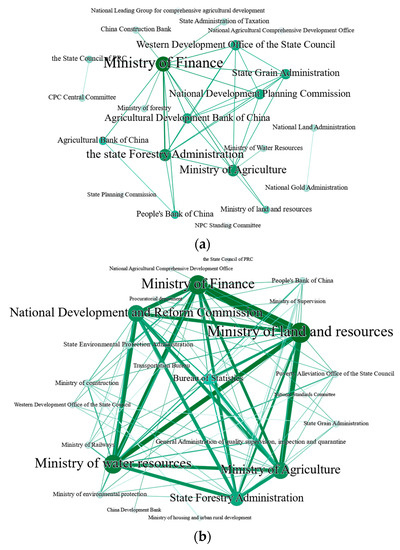
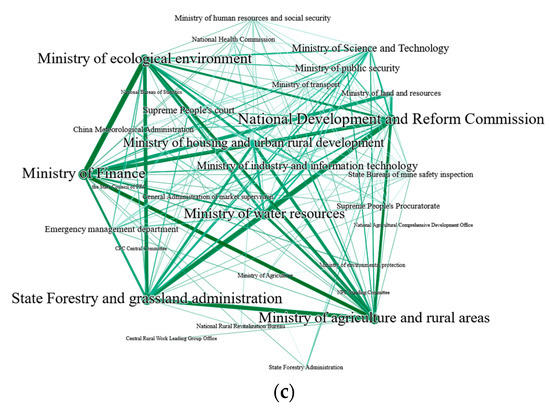
Figure 2.
Cooperation network of CLCP from 1982 to 2022: (a) cooperation network from 1982 to 2004; (b) cooperation network from 2005 to 2015; (c) cooperation network from 2016 to 2022.
3.4. Word Segmentation Extraction and High-Frequency Word Statistics
The policy texts in the literature database of CLCP are organized, and, since some policy documents contain content that is not relevant to the research topic of this paper, the irrelevant parts of the policy texts are excluded to form the policy dataset. ROSTCM6 software is then used to perform the word segmentation process, which involves summarizing words with the same meaning and excluding verbs with no practical meaning, such as “implement” and “carry out”. The high-frequency words that are deemed effective were obtained through screening and organizing. Only words with a frequency greater than 100 were kept, based on their frequency ranking from high to low. These words serve as the foundation for the subsequent analysis of the PMC-Index model. Due to this article’s length limitation, only the first 60 high-frequency words are listed in Table 3.
Table 3.
Partial list of valid vocabulary and word frequencies.
4. Empirical Analysis of the PMC-Index Model
4.1. Selection of Policies to Be Evaluated
In the process of screening policy texts, it is found that CLCP can be categorized into two groups based on their policy objectives and scope of content. One category regards land consolidation as a comprehensive policy system that encompasses various types of land. It proposes targeted measures and uses terms such as “land consolidation”, “land development and consolidation”, and “land remediation” in its titles. Such policies often take the form of plans and planning outlines, which serve as a guide for implementing land consolidation policies over a longer period of time. Another type of policy is formulated with the aim of addressing a single type of problem, for example, making temporary arrangements or provisions for certain aspects of the land consolidation process, such as funding and tenure adjustments. It could also propose policy initiatives to tackle specific issues within the land consolidation policy system, such as restoring forests by returning the grain plough and the renovation of “hollow villages”. Given the distinct characteristics of the two types of policies in terms of the breadth of content and policy targets, the former type is referred to as comprehensive policies, while the latter type is known as specialized policies. This classification was also adopted by scholars in other areas of Chinese public policy research [61,62]. Moreover, separately evaluating the two types of policies also helps to observe and compare the variations and scores of the two types of policies. Comprehensive policies and specialized policies are categorized in the policy text database, and the distribution of the two types of policies across the three stages is presented in Table 4.
Table 4.
Distribution of comprehensive versus specialized policies.
In consideration of the distinct roles, nature, and functions of comprehensive policies and specialized policies and to ensure the study’s scientific rigor and informativeness, different sampling methods and evaluation strategies are employed for each policy type. Two comprehensive policies and two specialized policies are selected at each of the three stages of development. The selection criteria for the former are its representativeness and policy effectiveness [32,51,56]. For the latter, a simple random sampling method is adopted. The selection results of the evaluation targets are shown in Table 5, with the serial numbers labeled according to the chronological order of issuance.
Table 5.
Twelve land remediation policies enacted from 1982 to 2022.
4.2. Variable Selection and Parameter Setting
The setting of the PMC-Index model variables directly affects the evaluation results. Unlike other policy evaluation models, the PMC-Index model tends to consider all relevant or potentially relevant factors [30]. The variables of the PMC-Index model were established by drawing on the sub-variable settings of Ruiz Estrada [29], the evaluation variables utilized in previous studies, and the high-frequency words. The existing research on policy evaluation using the PMC-Index model found that specialized policies, due to their narrower scope, received low scores when evaluated with the same indicators [63]. The variables of the PMC-Index model can be adjusted based on the generality and specificity of the public policy. This allows for the establishment of a more universal standard variable and a more targeted non-standard variable [30,32,49]. Therefore, this study exploratively set up 10 primary variables and 62 secondary variables, as shown in Table 6. The primary variables are as follows: policy nature [29,51,53] (X1), policy function [56,57] (X2), policy ideas (X3), policy instrument [51,58] (X4), incentives and constraints [31,32] (X5), content evaluation [50,55,56] (X6), policy content [53,57] (X7a), functioning hierarchy [32,50,57] (X7b), participating subjects [31,33] (X8), and implementation guarantee [31,48] (X9). Each of these level 1 variables has a number of level 2 variables, as shown in Table 6.
Table 6.
Selection of sub-variables for quantitative evaluation of CLCP.
In the process of establishing the indicator system, the first-level variable, policy nature (X1), is utilized to assess whether the policy has a descriptive, predictive, diagnostic, supervisory, suggestive, or guiding function. Policy function (X2) is used to assess whether the policy has the functions of increasing the quantity of arable land, improving the quality of arable land, and increasing farmers’ income. Policy ideas (X3) refers to whether the content of the policy incorporates the concepts of saving and efficient utilization, integrating urban and rural development, adapting to local conditions, and prioritizing the well-being of people. Policy instrument (X4) utilizes the policy tool trichotomy proposed by Rothwell and Zegveld [64] to ascertain whether the policy includes demand-based, supply-based, or environment-based tools. Incentives and constraints (X5) is used to assess whether the policy provides positive or negative incentives to the policy target through fiscal taxes, financial support, performance assessment, planning constraints, upward mapping, prohibitions, and penalties. Content evaluation (X6) aims to assess clear objectives, a sufficient basis, and detailed planning from four aspects. Policy content (X7a) and functioning hierarchy (X7b) are set as the first-level variables for comprehensive policies and specialized policies, respectively. Policy content is used to evaluate the breadth of the content of comprehensive policies, while functioning hierarchy is used to evaluate the influence of specialized policies on local governments. This is because most comprehensive policies are national-level plans that propose guiding measures and require local governments at all levels to implement them based on local realities. Therefore, there is no need to deliberately emphasize the function level downwards. Under circumstances where the scope of land consolidation is expanding and becoming more complex and challenging, participant subjects (X8) is used to assess whether specific guidance or regulations were implemented by the policy for the relevant administrative departments, provincial governments, municipal and county governments, rural collectives, and other stakeholders. Implementation guarantee (X9) aims to assess whether the land consolidation policy includes safeguard policy measures such as investigation and monitoring, financial guarantees, supervision, and management during the implementation process.
It is found that the first-level variables selected in this study can form a coherent analytical framework for the development of CLCP, as depicted in Figure 3. The gap between the actual function of land resources and the policy goals gained the attention of the central government, which formulated relevant policies under the impact of policy ideas, policy goals, and incentives and constraints. Policies formulated at the central level have a direct impact on the implementation of policies by lower levels of government and the behavior of non-government entities. Additionally, land consolidation has altered the functions of land resources, leading to new problems and demands and further driving changes in policy content.
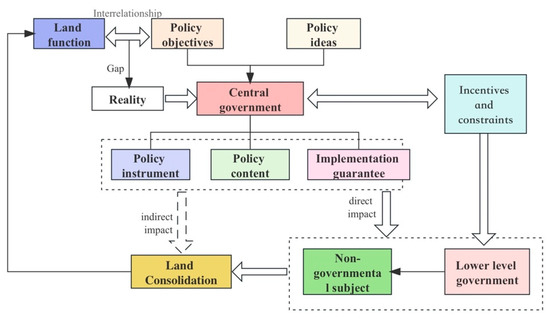
Figure 3.
Logical analysis framework for developing CLCP.
According to Ruiz Estrada [29], each level 1 variable can be composed of an infinite number of level 2 variables. There is no need to rank the weights of each level 2 variable, so all level 2 variables are given the same weight. Therefore, the level 2 variables are assigned binary values. When the policy text contains content that matches a secondary variable, that secondary variable is assigned a value of “1”; otherwise, it is assigned a value of “0”.
4.3. Establishment of Multi-Input–Output Table
The multiple-input–output table is a data analysis framework that quantifies individual variables across multiple dimensions [65]. The value of a first-level variable is determined by assigning a value of “0” or “1” to each second-level variable in the multi-input–output table (refer to Table 7).
Table 7.
Multi-input–output table for 12 land consolidation policies.
4.4. Measurement of PMC-Index
The PMC-Index measurement consists of four steps [29]: firstly, the first-level variables and the second-level variables are put into the multi-input–output table; secondly, the value of each second-level variable is calculated according to Formulas (1) and (2); then, the value of each first-level variable is calculated according to Formula (3); lastly, the PMC-Index of the comprehensive policies and the specialized policies is calculated according to Formulas (4) and (5), respectively.
where t = first-level variable, j = second-level variable.
According to existing studies [33,50,51], the results of the PMC-Index for each policy are graded according to the following intervals: low consistency when the score is in the range of 0–3.99; acceptable consistency when the score is in the range of 4–5.99; good consistency when the score is in the range of 6–7.99; perfect consistency when the score is in the range of 8–9. The results of the evaluation of CLCP are shown in Table 8.
Table 8.
Quantitative evaluation results and ratings of PMC-Index for 12 land consolidation policies.
4.5. Construction of the PMC-Surface
By constructing the PMC-Surface, the calculated PMC-Index can be visualized more intuitively, allowing for a clearer representation of the strengths and weaknesses of the policies. According to Formula (5), the PMC-Surface is constructed based on the scores of the 12 selected CLCP. The results of the six comprehensive policies are shown in Figure 4, Figure 5, Figure 6, Figure 7, Figure 8 and Figure 9, while the results of the six specialized policies are shown in Figure 10, Figure 11, Figure 12, Figure 13, Figure 14 and Figure 15. The five colors of the PMC-Surface correspond to the five score intervals, each with a difference of 0.2. The degrees of concavity and convexity of the PMC-Surface can provide a visual representation of the strengths and weaknesses of policies in a specific dimension, allowing for a more objective evaluation of the policy.
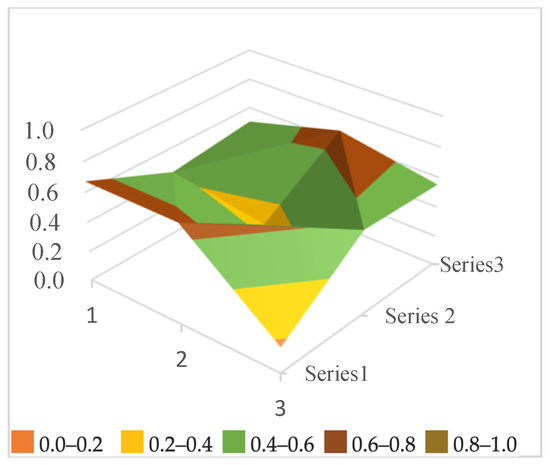
Figure 4.
The PMC-Surface of POL1.
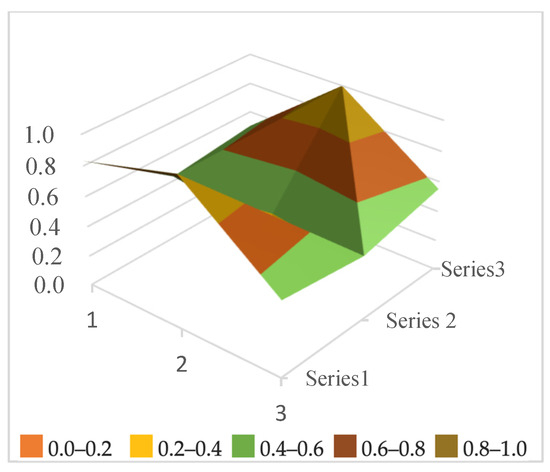
Figure 5.
The PMC-Surface of POL3.
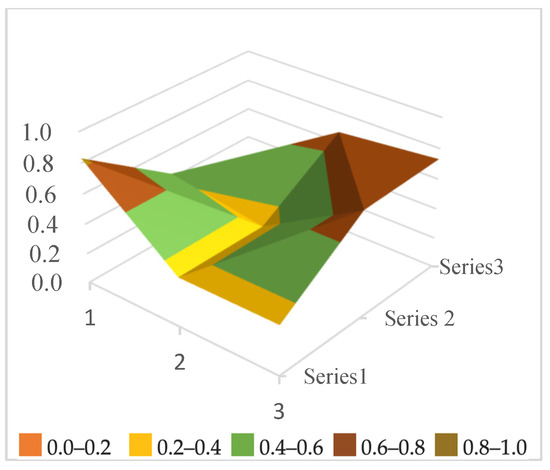
Figure 6.
The PMC-Surface of POL5.
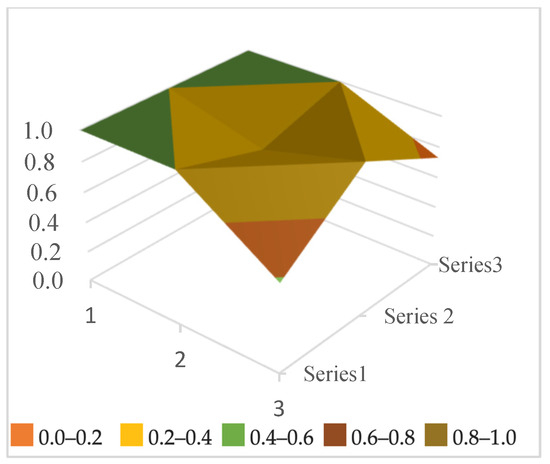
Figure 7.
The PMC-Surface of POL8.
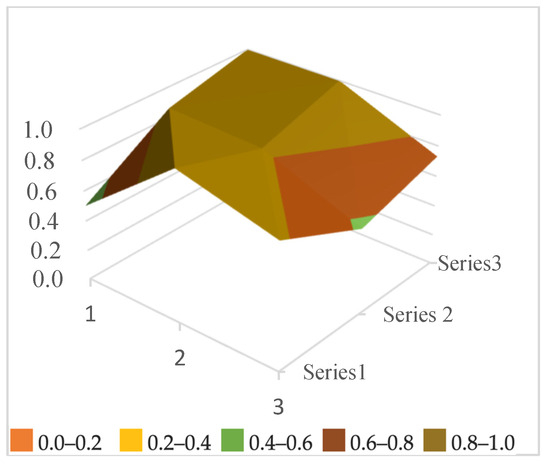
Figure 8.
The PMC-Surface of POL9.
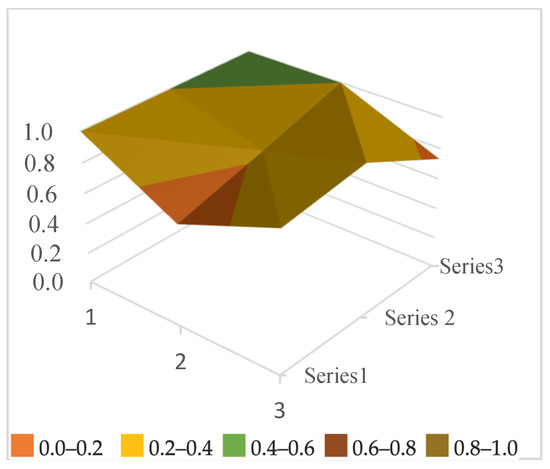
Figure 9.
The PMC-Surface of POL10.
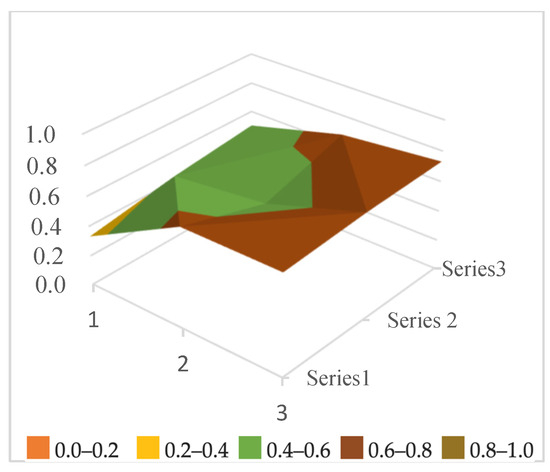
Figure 10.
The PMC-Surface of POL2.
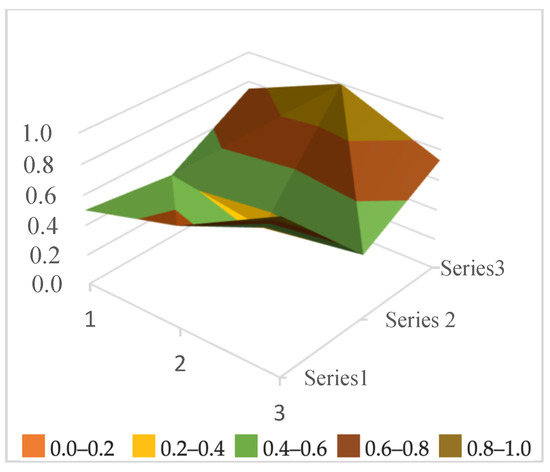
Figure 11.
The PMC-Surface of POL4.
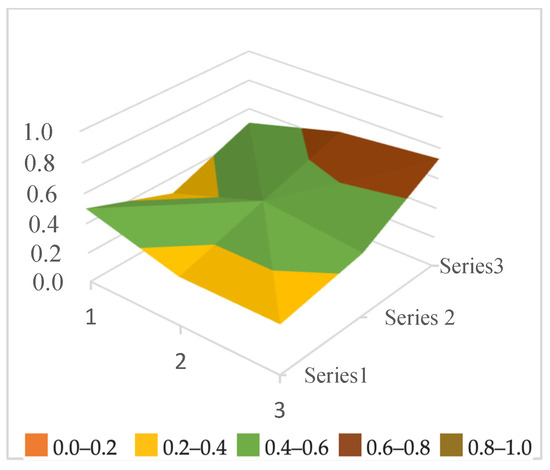
Figure 12.
The PMC-Surface of POL6.
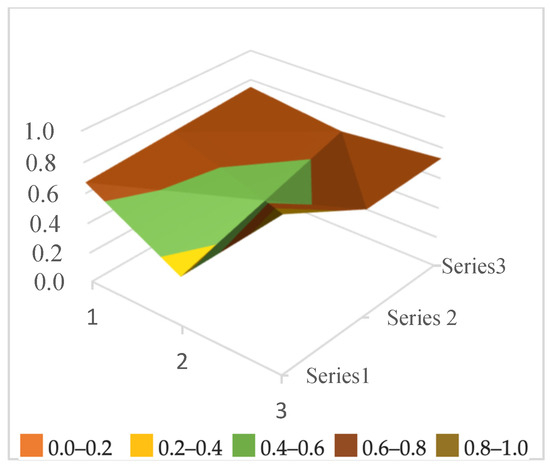
Figure 13.
The PMC-Surface of POL7.
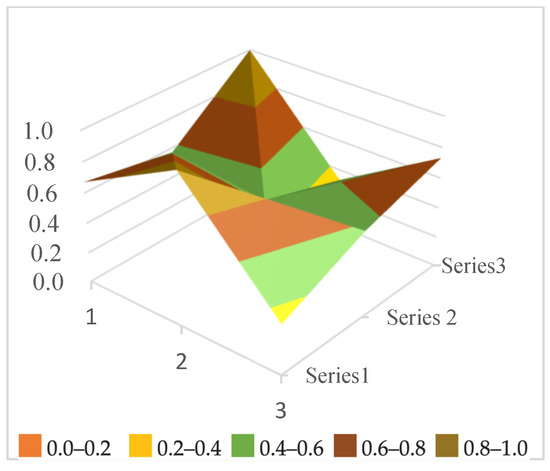
Figure 14.
The PMC-Surface of POL11.
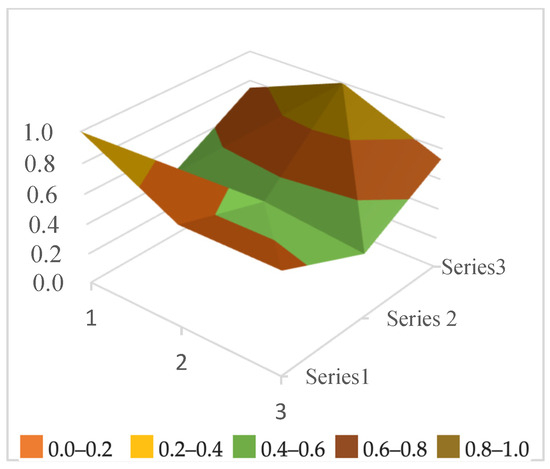
Figure 15.
The PMC-Surface of POL12.
4.6. Analysis of PMC-Index Evaluation Results
4.6.1. Analysis of Overall Policy Evaluation Results
Based on the PMC-Index evaluation results, the average score of the comprehensive policies was 6.45, and the average value of the special policies was 5.27. A line graph of the comprehensive policies and special policies was generated (Figure 16), and the average value was added to the graph.
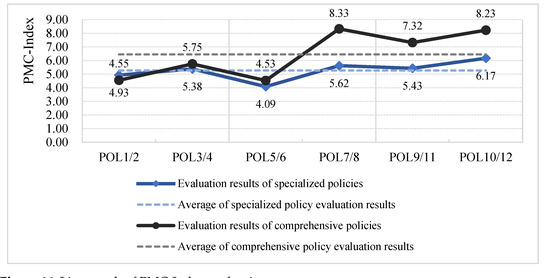
Figure 16.
Line graph of PMC-Index evaluation.
According to the results of the policy evaluation, the evaluation scores are ranked from highest to lowest: the scores of the comprehensive policies are POL8 > POL10 > POL9 > POL3 > POL1 > POL5, and the scores of the special policies are POL12 > POL7 > POL11 > POL4 > POL2 > POL6. The scores of both comprehensive and special policies show an upward trend, indicating that the policies of China’s land consolidation policies are constantly developing and improving, especially during the stage of stressing ecological functions and maximizing urban–rural values, as the evaluation scores of the selected policies are all higher than the average value.
4.6.2. Analysis of PMC-Index Results for Individual Policies
In order to provide a more intuitive comparison of the evaluation results, spider charts were generated for both the selected comprehensive policies and specialized policies based on their respective evaluation results. Figure 17 illustrates the overall changes in the scores of the six comprehensive policies. The average scores for policy nature, policy evaluation, and policy content are higher than 0.8. The average scores for policy function, policy ideas, policy instrument, participating subjects, and implementation guarantee range between 0.6 and 0.8. The dimension of incentives and constraints has the lowest average score at 0.58, indicating the need for improvement in this area. Figure 18 shows the overall changes in the scores of the six specialized policies. The first-level variables with quantitative evaluation scores ranging from 0.6 to 0.8 are policy nature, policy ideas, policy instrument, policy evaluation, and functioning hierarchy. The first-level variables with scores lower than 0.6 are participant subjects, policy functions, incentives and constraints, and implementation guarantee. Future consideration should be given to improving these dimensions with low scores first.
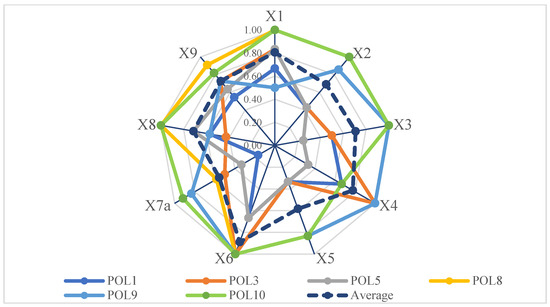
Figure 17.
Spider chart for the selected comprehensive policies.
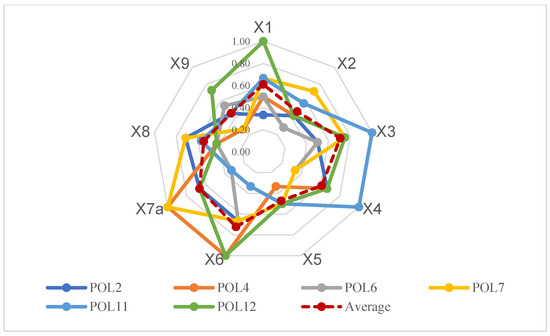
Figure 18.
Spider chart for the selected specialized policies.
a. Perfect consistency policies. Policies belonging to this grade include POL8 and POL10, which have the same scores in terms of policy nature, policy function, policy ideas, incentives and constraints, policy evaluation, and participatory subjects, and the two have the largest difference in scores in the policy content dimension, with POL10 adding aspects of returning cultivated land to forests and grasslands, sand control, soil pollution prevention, and ecological protection and restoration projects compared to POL8. POL3 scored 5.75, with a rating of acceptable consistency, and the planning mainly includes the three main contents of land consolidation, land reclamation, and land development, with engineering measures such as rural and settlement consolidation and industrial and mining waste land reclamation as the main measures, and the replenishment and moderate development of cultivated land as the main goal. From POL3 to POL8 to POL10, the concept of land consolidation changes from land development and reclamation to land consolidation and adjustment. Its connotation and extension are also deepening and expanding, reflecting the evolution of CLCP. In terms of policy content, the inclusion of construction land consolidation, soil pollution control, and ecological protection and restoration is ongoing. The policy function of land consolidation is expanding beyond simply increasing the quantity and improving the quality of cultivated land. It now encompasses the integration of urban and rural development, ecological protection and restoration, and landscape function. Additionally, the nature of land consolidation shifts from being solely a project engineering attribute to a comprehensive social engineering endeavor. At the same time, as the nature of land improvement changes from a pure project to a comprehensive social project, the main body of policy participation gradually diversifies to replace the original government-led single mode.
b. Good consistency policies. Policies belonging to this grade include a comprehensive policy, POL9, and a specialized policy, POL12. POL9 scores higher on the evaluation dimensions of policy function, policy ideas, policy tools, incentives and constraints, and participating subjects, probably because POL9 is a comprehensive policy. The two policies score the same in terms of implementation guarantees, with POL9 lacking in soft measures such as financial guarantees, science and technology, and information dissemination, while POL12 is deficient in legal regulations, improvement of the planning system, and rigid guarantees such as ownership adjustment and management.
c. Acceptable consistency policies. Comprehensive policies belonging to this level are POL1, POL3, and POL5, which have low scores on the dimensions of policy functions, policy ideas, incentives and constraints, policy content, and participating subjects. Specialized policies POL2, POL4, POL6, POL7, and POL11 belong to this category. These policies receive low scores on various dimensions such as policy functions, policy ideas, incentives and constraints, participation subjects, and implementation guarantees. The score of POL1 is 4.55, ranking fifth among the comprehensive policies. The low score of this policy is mainly due to the fact that this policy was introduced in the late 1990s; its policy objective is mainly to increase the area of cultivated land to improve the conditions of agricultural production, and the target of the policy is mainly unutilized land, existing agricultural land, disaster-damaged land, etc. The document was issued by the former Ministry of Land and Resources to its subordinate land resources management departments. The policy is characterized by relatively low effectiveness, as it does not involve interdepartmental cooperation and lacks reasonable incentives. The score of POL6 is 4.09, ranking sixth among the special policies. This policy is a response from the former State Forestry Administration to the Circular on Improving the Policy of Returning Cultivated Land to Forests issued by the State Council. The circular required lower-level forestry departments to address the relevant issues at that time, and it was a temporary policy notice with a shorter policy effectiveness and a lack of positive incentive policy measures. P11, with a score of 5.43, ranked third among the special policies and is a policy issued by the Ministry of Agriculture and Rural Development to revitalize unused rural residence bases and unused dwellings, proposing to support the adoption of methods such as collation, reclamation, and regreening, as well as policies that link urban and rural construction land to increased or decreased land use. These measures aim to provide support for rural construction. Nevertheless, since the Ministry of Natural Resources performs the responsibility of land and other natural resource assets’ ownership and control in a unified manner, it may be difficult for the Ministry of Agriculture and Rural Development to achieve the optimal policy effect with this policy alone, which reminds us to be concerned about the fact that there are still fragmented matters of land consolidation at present, so how to rationally delimit the boundaries of consolidation and strengthen the interdepartmental cooperation relationship to harmonize the decentralized land consolidation projects are still in need of attention.
5. Discussion
In order to further refine the findings and observe the consistency of policy modeling, the Table 9 displays the average scores for each second-level variable. The quantitative evaluation scores for the incentives and constraints (X5) are low for both the comprehensive and specialized policies. Among the comprehensive policies, the average score for financial support (X5:2) is the lowest at 0.17, while the average scores for planning constraints (X5:4) and prohibition and punishment (X5:6) are the highest at 0.83. Among the specialized policies, the three evaluation scores for fiscal and taxation (X5:1), financial support (X5:2), and performance evaluation (X5:3) are all low at 0.33. However, the secondary variable of prohibition and punishment (X5:6) has the highest score of 0.83. From the above results, it can be observed that CLCP emphasize the use of regulatory measures to control the behavior of the relevant parties, with relatively limited economic incentives. Rigid regulatory measures often hinder the initiative and creativity of the government, farmers, and other stakeholders, who are often seen as having a passive role. Nevertheless, there is still a lack of overall coordination and lasting, effective legal and institutional safeguards in China [60]. From the perspective of the development history of land consolidation in developed countries in Europe, specialized land consolidation laws were an important successful experience in overcoming land fragmentation. In China, the law that is most closely related to land consolidation is the Land Management Law. However, there is a lack of a specific land consolidation law that plays an overall coordinating role. Instead, regulatory measures and temporary measures are mostly found in government documents, which are not permanent and can lead to conflicts. At the same time, it should also be noted that the law is not the sole determinant of the success or failure of land consolidation. Attention should also be given to the impact of resource endowment, demographic conditions, the inheritance system, and other structural forces [2]. In China, it is particularly important to pay attention to the household registration system, which is a structural element that affects population mobility. China’s household registration system artificially divides the population into urban and agricultural populations. When rural residents move out of the countryside, their rural housing and farmland are still retained, which seriously impacts land-use efficiency. Therefore, there is a need to improve the household registration system and effectively manage the relationship between farmers and land.
Table 9.
Average scores of second-level variables.
Under the first-level variable of participating subjects (X8), the comprehensive policies and specialized policies have higher average scores for the second-level variables of relevant administrative departments (X8:1), provincial governments (X8:2), and county-level governments (X8:3). The comprehensive policies have the lowest average score of 0.5 for the secondary variables of rural collectives (X8:4) and farmers (X8:5). The specialized policies have the lowest average scores of 0.17 for the two secondary variables of relevant rights and obligations holders (X8:6) and enterprises (X8:7) and 0.5 for the two secondary variables of rural collectives (X8:4) and farmers (X8:6). The above data indicate that CLCP lack sufficient measures to involve entities other than the government. Divided according to the main body of implementation, there are three main models of land consolidation in China: government-led, enterprise-driven, and farmer-initiated [66]. Among these models, government-led land consolidation plays a fundamental role in the development process. Land consolidation in the current era of rural revitalization encompasses various objectives, including enhancing the production and living conditions of villages, improving habitats, promoting rural industrial development, and revitalizing rural culture. The previous reliance on a single government-led model is no longer sustainable, so it is crucial to leverage the market’s decisive role and the farmer’s key role. As early as 2003, the former Ministry of Land and Resources formulated the National Land Development and Consolidation Plan. This plan proposed to “improve the benefit distribution mechanism to meet the requirements of the market economy and attract more funds from society to invest in land development and consolidation”. Additionally, the National Land Consolidation Plan (2010–2015) and National Land Consolidation Plan (2016–2020) also proposed to “improve the benefit distribution mechanism to meet the requirements of the market economy and attract more funds from society to invest in land development and consolidation”. The National Land Consolidation Plan (2010–2015) and National Land Consolidation Plan (2016–2020) once again proposed “encouraging and guiding social funds to participate in land reclamation” and “exploring the market-oriented mechanism of land consolidation”. It has been at least two decades since the proposal to encourage the participation of social forces was put forward. However, in reality, only a few local governments conducted relevant exploration, and no clear incentives and constraints targeting social forces were proposed at the central level. Existing policies and measures neglected the important role of non-governmental entities. In the future, it will be necessary to fully utilize the advantages of the flexibility and diversity offered by enterprises. This can be achieved through complementary financial support policies. Additionally, it will be important to clarify the responsibilities and obligations of enterprises to prevent potential issues such as free-riding. By doing so, we can fully harness the potential of social capital in promoting competition and enhancing efficiency. Ultimately, this will help establish a highly efficient, fair, and sustainable system for aligning interests.
In terms of implementation guarantee (X9), the comprehensive policies scored low on risk prevention and control (X9:5) and information promotion (X9:7). The specialized policies, in contrast, scored low on fund guarantee (X9:2), science and technology (X9:6), improvement of planning system (X9:8), ownership adjustment and management (X9:9), and public participation (X9:10). The active participation of landowners can enhance their awareness of land consolidation policies and improve their satisfaction [67]. Some studies showed that intermediary institutions can better facilitate communication and collaboration among the government, farmers, landowners, and other stakeholders in the region, leading to collective action [68]. The successful implementation of land consolidation as a complex project requires both top-down and bottom-up joint governance [66]. In the context of China’s unique culture and social relations, it is necessary to fully consider the informal power structures and social network relations within villages. It is also important to encourage the establishment of land consolidation organizations and define their powers and obligations. In terms of financial security for land consolidation, government financing still dominates, and rural land consolidation is typically characterized by a single source of funding, limited fundraising, and a low efficiency of the use of funds. There is an urgent need to innovate the investment and financing mechanism and guide the orderly participation of social capital. Strengthening the role of scientific and technological forces in land consolidation operations, several technical regulations have been issued at the national level in recent years. However, due to China’s vast land area and significant variations in natural conditions across regions, it is necessary to further refine land consolidation techniques and standards that are suitable for the specific natural conditions of each region. This will help improve the overall level of land consolidation and enhance the management of land consolidation.
Furthermore, during the construction of the PMC-Index model, this study observed differences in the characteristics of the specialized land consolidation policies and comprehensive land consolidation policies. As a result, the evaluation indicator settings were differentiated to enhance the research methodology, thereby improving the credibility and scientific rigor of the research results. From the evaluation results, the scores for the specialized land consolidation policies are generally lower than the scores for the comprehensive land consolidation policies. The comprehensive policies have higher scores in terms of policy functions, incentives and constraints, participating subjects, and implementation guarantees. Additionally, their scores are more balanced across all evaluation dimensions. This is likely because the comprehensive policies are designed to guide long-term policy development and, therefore, have more comprehensive content and guaranteed measures. This also suggests that when using the PMC-Index model for future policy evaluation, it will be important to consider the diversity of policy contents and characteristics. It is necessary to further refine the evaluation dimensions of policies with different characteristics in the same field of public policy. Additionally, exploring universal generic evaluation dimensions and non-generic evaluation dimensions that are adapted to the characteristics of the policy can enhance the scientific validity of this method.
6. Conclusions
Based on the land consolidation policies issued by the central government of China from 1998 to 2022, this paper adopted the method of text analysis to analyze the policy release time, policy type, issuing department, cooperation network between parts, etc.; utilized ROST CM6 for word segmentation to select high-frequency words; and combined with existing studies to construct a CLCP evaluation system based on the PMC-Index model. The evaluation results revealed that two of the comprehensive policies received a perfect rating, one received a good consistency rating, and three received an acceptable rating. In contrast, the specialized policies generally received lower scores compared to the comprehensive policies. One of the specialized policies received a good consistency rating, while five received an acceptable rating. It was found that the quantitative evaluation results of both the selected comprehensive land consolidation policies and specialized land consolidation policies show an upward trend. This indicated that the content of China’s land consolidation policies is continuously being enriched and expanded. Furthermore, there was an enhancement in the innovation of consolidation ideas, the variety of consolidation methods, and the comprehensiveness of the measures’ effects. Both the comprehensive and specialized policies have weaknesses in terms of policy functions, incentives and constraints, and implementation guarantees. The scores for the policy content dimension of the comprehensive policies and the participant dimension of the specialized policies are low. Therefore, improvements can be made in these areas in the future.
In view of this, this paper argues that CLCP are gradually integrating objectives and functions such as productivity improvement, ecological environmental protection, landscape beautification, cultural continuity, and urban and rural development. They are becoming an important comprehensive tool on the path to rural revitalization. In light of the shortcomings of the current land consolidation policy, it is necessary to review past experiences and establish a dedicated land consolidation law in the future. This will ensure comprehensive consolidation and provide institutional support for land development. In terms of incentives and constraints, the current positive incentives, such as financial taxes and financial support, are clearly inadequate. Therefore, a greater emphasis should be placed on utilizing economic incentives in the future. On the basis of the existing government-led model, rural collectives, farmers, the market, and other diversified subjects should be involved to support the establishment and growth of non-profit land consolidation organizations. Innovative investment and financing mechanisms should be implemented to guide the entry of social capital in an orderly manner. This will lead to the formation of a reasonable, efficient, and fair mechanism of interest linkage, allowing the market to play a decisive role and farmers to play a key role as the main body. In terms of safeguards, it is necessary to respect farmers’ own wishes, fully utilize the potential of science and technology in accordance with local conditions, and prioritize risk prevention and control, as well as information dissemination, during the land consolidation process.
Author Contributions
Conceptualization, X.S. and X.Z.; methodology, X.S. and G.H.; software, G.H.; validation, X.S., X.Z. and G.H.; formal analysis, G.H.; investigation, G.H. and W.G.; resources, G.H.; data curation, G.H.; writing—original draft preparation, X.S., X.Z. and G.H.; writing—review and editing, X.Z. and W.G.; visualization, X.S. and X.Z.; supervision, X.S. and X.Z.; project administration, X.S.; funding acquisition, X.S. and X.Z. All authors have read and agreed to the published version of the manuscript.
Funding
This research was funded by the National Natural Science Foundation of China, grant numbers 71904072 and 72204101, and by the Ministry of Education, grant number 22YJCZH247.
Data Availability Statement
If you need the data used in this paper, please contact us at huanggd21@lzu.edu.cn.
Conflicts of Interest
The authors declare no conflict of interest.
References
- Liu, Y.; Zang, Y.; Yang, Y. China’s rural revitalization and development: Theory, technology and management. J. Geogr. Sci. 2020, 30, 1923–1942. [Google Scholar] [CrossRef]
- Niroula, G.S.; Thapa, G.B. Impacts and causes of land fragmentation, and lessons learned from land consolidation in South Asia. Land Use Policy 2005, 22, 358–372. [Google Scholar] [CrossRef]
- Miranda, D.; Crecente, R.; Alvarez, M.F. Land consolidation in inland rural Galicia, N.W. Spain, since 1950: An example of the formulation and use of questions, criteria and indicators for evaluation of rural development policies. Land Use Policy 2006, 23, 511–520. [Google Scholar] [CrossRef]
- Zhou, Y.; Li, Y.; Xu, C. Land consolidation and rural revitalization in China: Mechanisms and paths. Land Use Policy 2020, 91, 104379. [Google Scholar] [CrossRef]
- Ntihinyurwa, P.D.; De Vries, W.T. Farmland Fragmentation, Farmland Consolidation and Food Security: Relationships, Research Lapses and Future Perspectives. Land 2021, 10, 129. [Google Scholar] [CrossRef]
- Pašakarnis, G.; Maliene, V. Towards sustainable rural development in Central and Eastern Europe: Applying land consolidation. Land Use Policy 2010, 27, 545–549. [Google Scholar] [CrossRef]
- Haldrup, N.O. Agreement based land consolidation—In perspective of new modes of governance. Land Use Policy 2015, 46, 163–177. [Google Scholar] [CrossRef]
- Jiang, Y.; Tang, Y.T.; Long, H.; Deng, W. Land consolidation: A comparative research between Europe and China. Land Use Policy 2022, 112, 105790. [Google Scholar] [CrossRef]
- Wu, S.; Ye, Y.; Lin, Y. Experience and Enlightenment of Multifunctional Land Consolidation in Germany, Japan and Taiwan in China. J. Huazhong Agric. Univ. (Soc. Sci. Ed.) 2019, 3, 65–66,140–148. (In Chinese) [Google Scholar]
- Li, Y.; Wu, W.; Liu, Y. Land consolidation for rural sustainability in China: Practical reflections and policy implications. Land Use Policy 2018, 74, 137–141. [Google Scholar] [CrossRef]
- Long, H. Land consolidation: An indispensable way of spatial restructuring in rural China. J. Geogr. Sci. 2014, 24, 211–225. [Google Scholar] [CrossRef]
- Long, H.; Qu, Y. Land use transitions and land management: A mutual feedback perspective. Land Use Policy 2018, 74, 111–120. [Google Scholar] [CrossRef]
- Liu, Y.; Li, J.; Yang, Y. Strategic adjustment of land use policy under the economic transformation. Land Use Policy 2018, 74, 5–14. [Google Scholar] [CrossRef]
- Guo, Y.; Wang, J. Land Consolidation in Rural China: Historical Stages, Typical Modes, and Improvement Paths. Land 2023, 12, 491. [Google Scholar] [CrossRef]
- Liu, Y.; Fang, F.; Li, Y. Key issues of land use in China and implications for policy making. Land Use Policy 2014, 40, 6–12. [Google Scholar] [CrossRef]
- Jin, X.; Shao, Y.; Zhang, Z.; Resler, L.M.; Campbell, J.B.; Chen, G.; Zhou, Y. The evaluation of land consolidation policy in improving agricultural productivity in China. Sci. Rep. 2017, 7, 2792. [Google Scholar] [CrossRef]
- Jiang, G.; Wang, X.; Yun, W.; Zhang, R. A new system will lead to an optimal path of land consolidation spatial management in China. Land Use Policy 2015, 42, 27–37. [Google Scholar]
- Li, Y.; Li, Y.; Fan, P.; Jian, S.; Liu, Y. Land use and landscape change driven by gully land consolidation project: A case study of a typical watershed in the Loess Plateau. J. Geogr. Sci. 2019, 29, 719–729. [Google Scholar] [CrossRef]
- Wang, Y.; Li, Y. Promotion of degraded land consolidation to rural poverty alleviation in the agro-pastoral transition zone of northern China. Land Use Policy 2019, 88, 104114. [Google Scholar] [CrossRef]
- Zhang, Z.; Zhao, W.; Gu, X. Changes resulting from a land consolidation project (LCP) and its resource–environment effects: A case study in Tianmen City of Hubei Province, China. Land Use Policy 2014, 40, 74–82. [Google Scholar] [CrossRef]
- Wang, J.; Chen, Y.; Shao, X.; Zhang, Y.; Cao, Y. Land-use changes and policy dimension driving forces in China: Present, trend and future. Land Use Policy 2012, 29, 737–749. [Google Scholar] [CrossRef]
- Rafael, C.; Carlos, A.; Urbano, F. Economic, social and environmental impact of land consolidation in Galicia. Land Use Policy 2002, 19, 135–147. [Google Scholar]
- Wu, Z.; Liu, M.; Davis, J. Land consolidation and productivity in Chinese household crop production. China Econ. Rev. 2005, 16, 28–49. [Google Scholar] [CrossRef]
- Zhang, X.; Timo De Vries, W.; Li, G.; Ye, Y.; Zheng, H.; Wang, M. A behavioral analysis of farmers during land reallocation processes of land consolidation in China: Insights from Guangxi and Shandong provinces. Land Use Policy 2019, 89, 104230. [Google Scholar] [CrossRef]
- Sikor, T.; Müller, D.; Stahl, J. Land Fragmentation and Cropland Abandonment in Albania: Implications for the Roles of State and Community in Post-Socialist Land Consolidation. World Dev. 2009, 37, 1411–1423. [Google Scholar] [CrossRef]
- Zhang, X.; Ye, Y.; Wang, M.; Yu, Z.; Luo, J. The micro administrative mechanism of land reallocation in land consolidation: A perspective from collective action. Land Use Policy Int. J. Cover. All Asp. Land Use 2018, 70, 547–558. [Google Scholar] [CrossRef]
- Zhang, X.; De Vries, W.; Li, G.; Ye, Y.; Zhang, L.; Huang, H.; Wu, J. The suitability and sustainability of governance structures in land consolidation under institutional change: A comparative case study. J. Rural Stud. 2021, 87, 276–291. [Google Scholar] [CrossRef]
- Cay, T.; Ayten, T.; Iscan, F. Effects of different land reallocation models on the success of land consolidation projects: Social and economic approaches. Land Use Policy 2010, 27, 262–269. [Google Scholar] [CrossRef]
- Estrada, M.A.R. Policy modeling: Definition, classification and evaluation. J. Policy Model. 2011, 33, 523–536. [Google Scholar] [CrossRef]
- Kuang, B.; Han, J.; Lu, X.; Zhang, X.; Fan, X. Quantitative evaluation of China’s cultivated land protection policies based on the PMC-Index model. Land Use Policy 2020, 99, 105062. [Google Scholar] [CrossRef]
- Dai, S.; Zhang, W.; Lan, L. Quantitative Evaluation of China’s Ecological Protection Compensation Policy Based on PMC Index Model. Int. J. Environ. Res. Public Health 2022, 19, 10227. [Google Scholar] [CrossRef] [PubMed]
- Lu, C.; Wang, B.; Chen, T.; Yang, J. A Document Analysis of Peak Carbon Emissions and Carbon Neutrality Policies Based on a PMC Index Model in China. Int. J. Environ. Res. Public Health 2022, 19, 9312. [Google Scholar] [CrossRef] [PubMed]
- Liu, Y.; Li, J.; Xu, Y. Quantitative Evaluation of High-Tech Industry Policies Based on the PMC-Index Model: A Case Study of China’s Beijing-Tianjin-Hebei Region. Sustainability 2022, 14, 9338. [Google Scholar]
- Long, H.; Zhang, Y.; Tu, S. Land consolidation and rural vitalization. Acta Geogr. Sin. 2018, 73, 1837–1849. (In Chinese) [Google Scholar]
- Coelho, J.; Portela, J.; Pinto, P.A. A social approach to land consolidation schemes: A Portuguese case study: The Valena Project. Land Use Policy 1996, 13, 129–147. [Google Scholar] [CrossRef]
- Xia, F.; Yang, Y.; Yan, J. The Connotation Research Review on Integrated Territory Consolidation of China in Recent Four Decades:Staged Evolution and Developmental Transformation. China Land Sci. 2018, 32, 78–85. (In Chinese) [Google Scholar]
- Han, B.; Jin, X.; Gu, Z.; Yin, Y.; Liu, J.; Zhou, Y. Research progress and key issues of territory consolidation under the target of rural revitalization. J. Nat. Resour. 2021, 36, 3007–3030. (In Chinese) [Google Scholar] [CrossRef]
- Wang, J.; Zhong, L. Literature Analysis on Land Consolidation Research in China. China Land Sci. 2016, 30, 88–97. (In Chinese) [Google Scholar]
- Zhou, J.; Cao, X. What is the policy improvement of China’s land consolidation? Evidence from completed land consolidation projects in Shaanxi Province. Land Use Policy 2020, 99, 104847. [Google Scholar] [CrossRef]
- Jia, W. Harmonization of the concept of land consolidation for its development. China Land 2012, 8, 46–47. (In Chinese) [Google Scholar]
- Yang, S.; Wang, Y.; Fang, Q.; Elliott, M.; Ikhumhen, H.O.; Liu, Z.; Meilana, L. The Transformation of 40-Year Coastal Wetland Policies in China: Network Analysis and Text Analysis. Environ. Sci. Technol. 2022, 56, 15251–15260. [Google Scholar] [CrossRef]
- Wang, J.; Yu, L.; Luo, M.; Zhai, G. Review of land rehabilization research. Areal Res. Dev. 2003, 2, 8–11. (In Chinese) [Google Scholar]
- Yun, W.; Zhu, D.; Tang, H. Reshaping and innovation of China land consolidation strategy. Trans. Chin. Soc. Agric. Eng. 2016, 32, 1–8. (In Chinese) [Google Scholar]
- Xu, H. Research on the Mechanism and Implementation Path of Comprehensive Land Consolidation to Promote Rural Revitalization. Guizhou Soc. Sci. 2021, 5, 144–152. (In Chinese) [Google Scholar]
- Wen, H.; Du, F. The Evolution Logic of Attention, Policy Motivation and Policy Behavior—Based on the Inspection of Process of Central Government’s Environmental Protection Policy from 2008 to 2015. Adm. Trib. 2018, 25, 80–87. (In Chinese) [Google Scholar]
- Ruiz Estrada, M.A.; Yap, S.F.; Nagaraj, S. Beyond the Ceteris Paribus Assumption: Modeling Demand and Supply Assuming Omnia Mobilis; Social Science Electronic Publishing: Rochester, NY, USA, 2010. [Google Scholar]
- Liu, Q.; Jia, M.; Xia, D. Dynamic evaluation of new energy vehicle policy based on text mining of PMC knowledge framework. J. Clean. Prod. 2023, 392, 136237. [Google Scholar] [CrossRef]
- Dai, S.; Zhang, W.; Zong, J.; Wang, Y.; Wang, G. How Effective Is the Green Development Policy of China’s Yangtze River Economic Belt? A Quantitative Evaluation Based on the PMC-Index Model. Int. J. Environ. Res. Public Health 2021, 18, 7676. [Google Scholar] [CrossRef]
- Zhang, Y.; Xi, H. Quantitative Evaluation Innovation Policies of the State Council—Based on the PMC-Index Model. Sci. Technol. Prog. Policy 2017, 34, 127–136. (In Chinese) [Google Scholar]
- Li, Z.; Guo, X. Quantitative evaluation of China’s disaster relief policies: A PMC index model approach. Int. J. Disaster Risk Reduct. 2022, 74, 102911. [Google Scholar] [CrossRef]
- Xiong, Y.; Zhang, C.; Qi, H. How effective is the fire safety education policy in China? A quantitative evaluation based on the PMC-index model. Saf. Sci. 2023, 161, 106070. [Google Scholar] [CrossRef]
- Fang, Y.; Liu, J. Analysis of the State Council’s pension service policies: Exploration and quantitative evaluation based on the PMC-Index model. J. Yunnan Adm. Coll. 2020, 22, 167–176. (In Chinese) [Google Scholar]
- Yang, C.; Yin, S.; Cui, D.; Mao, Z.; Sun, Y.; Jia, C.; An, S.; Wu, Y.; Li, X.; Du, Y.; et al. Quantitative evaluation of traditional Chinese medicine development policy: A PMC index model approach. Front. Public Health 2022, 10, 1041528. [Google Scholar] [CrossRef] [PubMed]
- Zhang, Y.; Qie, H. Quantitative Evaluation of the Impact of Financial Policy Combination to Enterprise Technology Innovation. Sci. Technol. Prog. Policy 2017, 34, 113–121. (In Chinese) [Google Scholar]
- Li, Y.; He, R.; Liu, J.; Li, C.; Xiong, J. Quantitative Evaluation of China’s Pork Industry Policy: A PMC Index Model Approach. Agriculture 2021, 11, 86. [Google Scholar] [CrossRef]
- Xu, J.; Zhang, Z.; Xu, Y.; Liu, L.; Pei, T. Quantitative evaluation of waste sorting management policies in China’s major cities based on the PMC index model. Front. Environ. Sci. 2023, 11, 1065900. [Google Scholar] [CrossRef]
- Yang, T.; Xing, C.; Li, X. Evaluation and analysis of new-energy vehicle industry policies in the context of technical innovation in China. J. Clean. Prod. 2021, 281, 125126. [Google Scholar] [CrossRef]
- Song, D.; Jiao, F.; Fan, S. Quantitative Evaluation of China’s Open and Sharing Policies of Scientific Data: Based on PMC Index Model. J. Intell. 2021, 40, 119–126. (In Chinese) [Google Scholar]
- Long, H.; Zhang, Y.; Tu, S. Rural vitalization in China: A perspective of land consolidation. J. Geogr. Sci. 2019, 29, 517–530. [Google Scholar] [CrossRef]
- Wang, W.; Hu, Y. The new conception and review of territory consolidation based on the past years of reform and opening-up. J. Nat. Resour. 2020, 35, 53–67. (In Chinese) [Google Scholar]
- Fu, L. Social work for common prosperity: What is possible and what can be done? Shandong Soc. Sci. 2022, 7, 15–20. (In Chinese) [Google Scholar]
- Liu, J. Rural Development and Its Planning Management in France: An Experience in Line with the Principle of Urban-rural Development. Urban Plan. Int. 2010, 25, 4–10. (In Chinese) [Google Scholar]
- Dong, J.; Yuan, Q.; Yin, L.; Li, X. Research on Quantitative Evaluation of Single Real Estate Policy Based on PMC Index Model—Taking China’s Housing Rental Policy Since the 13th Five-Year Plan as an Example. Manag. Rev. 2020, 32, 3–13, 75. (In Chinese) [Google Scholar]
- Rothwell, R.; Zegveld, W. Reindustrialization and Technology; Cartermill International: London, UK, 1985. [Google Scholar]
- Zhang, Y.; Zhou, Y. Policy instrument mining and quantitative evaluation of new energy vehicles subsidies. China Popul. Resour. Environ. 2017, 27, 188–197. (In Chinese) [Google Scholar]
- Tong, W.; Lo, K.; Zhang, P. Land Consolidation in Rural China: Life Satisfaction among Resettlers and Its Determinants. Land 2020, 9, 118. [Google Scholar] [CrossRef]
- Lisec, A.; Primožič, T.; Ferlan, M.; Šumrada, R.; Drobne, S. Land owners’ perception of land consolidation and their satisfaction with the results—Slovenian experiences. Land Use Policy 2014, 38, 550–563. [Google Scholar] [CrossRef]
- Bonadonna, A.; Rostagno, A.; Beltramo, R. Improving the Landscape and Tourism in Marginal Areas: The Case of Land Consolidation Associations in the North-West of Italy. Land 2020, 9, 175. [Google Scholar] [CrossRef]
Disclaimer/Publisher’s Note: The statements, opinions and data contained in all publications are solely those of the individual author(s) and contributor(s) and not of MDPI and/or the editor(s). MDPI and/or the editor(s) disclaim responsibility for any injury to people or property resulting from any ideas, methods, instructions or products referred to in the content. |
© 2023 by the authors. Licensee MDPI, Basel, Switzerland. This article is an open access article distributed under the terms and conditions of the Creative Commons Attribution (CC BY) license (https://creativecommons.org/licenses/by/4.0/).