


Abstract
Fieldwork is an intrinsic part of landscape architecture education because it confronts the students with the landscape in real life, shows realised projects, enables different experiences, and provides a direct confrontation with the historical context of the discipline. Here the main goal is to give a first overview of teaching of fieldwork, compare that with other publications, and analyse pedagogical and didactic backgrounds in landscape architectural education in Europe. This study is based mainly on existing publications and complemented with our own experiences with fieldwork in teaching. The research method is based on accumulating existing knowledge on the subject and the principles of case study research. After a short overview of pedagogy and didactics in the context of teaching in design disciplines and how this relates to teaching landscape architecture, we work out the organisation of teaching in the outdoors. The conclusions focus on what can be learned in the outdoors that you cannot be learned indoors. Learning to see, to experience the landscape in real is part of “learning by doing” in which drawing, sketching, measuring plays a key role. In the long run pedagogy and didactics of fieldwork should be developed as domain-specific field of knowledge as part of design education in general.
1. Introduction
Fieldwork has historically always been part of European schools and programs in landscape architecture. Due to the reorganisation of higher education in Europe, the so-called Bologna Declaration, which was decided around the millennium, IFLA Europe and ECLAS have agreed upon a common policy for accreditation and evaluation of programs which is published as “ECLAS guidance on landscape architecture education” [1]. It provides definitions, standards, and modes of evaluation of schools and programs of landscape architecture as a basis for registration. Fieldwork is part of studio teaching, excursions, practical work, and internships. The EU-Land21 report [2] shows an example of Bachelor program in the Estonian University of Life Sciences in which 5% of the time is spent on “excursions” and 12.5% on practical work. On the Master’s level of the same university excursions are only 0.5% and practical work is not included at all. The amount of fieldwork in studio teaching, making up between 40 and 60% of the whole program, is not specified [2]. The program of the school in Versailles, École Nationale Supérieure de Paysage (ENSP), mentions explicitly fieldwork in the form of field trips during the studios, excursions, both in France and abroad, practical work in the school garden and internships at offices [3]. From our experience and knowledge of other European schools we know that in many landscape architectural programs the first week(s) are spent on a field trip outside the university town with all new students and a number of staff members. Girot [4] describes this type of field trip for the School in Versailles (ENSP):
“The only way to confirm or disaffirm a design is for the students to go out and look at the world. This is why we foster several field trips in our curriculum. This year our first year students went on their first field trip to Dunkerque and the abandoned coal mines of Flanders and Artois. This was not a romantic trip, it was cold, grey and windy, but they saw together with Jaques Simon some very interesting things. The problem with landscape architecture is that it is not in the books yet. Therefore, at Versailles, we consider the voyage as the most fundamental text for education.”
Like a medical practitioner learns in a hospital, a landscape architect learns about the landscape in the landscape as everyday environment by observing, experiencing, analysing, and moving around. You cannot educate landscape architects only from books or the studio. Apart from the direct learning experience, such an excursion in the first week gives immediately a good idea of the content, role and importance of fieldwork in the program [3,5,6]. No program in landscape architecture can function without fieldwork because the landscape as such is object of planning and design. Learning about the landscape can partly be done from books, photographs, maps but fully coming to grips with the landscape as object of planning and design, needs a substantial amount of fieldwork. It means that programs that do not include ample time for fieldwork are in fact of no value for education in landscape architecture and for working in practice. Fieldwork implies also a different teaching approach and pedagogy from teaching studios, courses, seminars. In this article we will pay attention to some pedagogical and didactic backgrounds of teaching fieldwork.
Fieldwork is taking place in the outdoors, through direct experience, systematic observation, measuring and analysing form, formation, functioning, and use, to be able to give form to future landscape development. The development of “vision”, learning to see as a designer, is a basic goal in all design education [7,8,9]. Fieldwork has always been a key part of landscape architectural education programs but will also need adaptations and repositioning; at the moment with the rise of e-learning more and different types of teaching fieldwork will be needed as complement to different forms of screen work. The core of learning in the outdoors is learning to see how design problems, assignments, sites look like in real time, and real place besides reading texts about it or seeing images of it (Figure 1). A second issue is learning to see the context, which is basic for any project, design problem, or site [10]. In landscape architecture the outdoor work is mostly implicit, even though it is always there. [11,12].
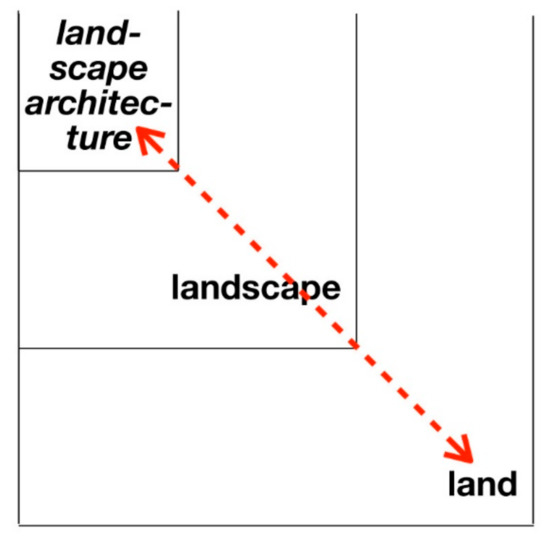
Figure 1.
All fieldwork takes into account the relations between land, landscape, and landscape architecture in sites, landscapes, and projects [13,14,15].
For non-professionals, fieldwork is largely unknown since for them only the end result—the realised plan—is what counts. This is part of the problem of research on fieldwork; it is hard to find examples in publications. In plan descriptions it mostly lacks since clients focus on the plan and on its realisation.
For trained observers, the quality of vision of the landscape as a basis for design, is visible in realised projects that make the invisible, visible such as in the work of the Dutch landscape architect Michael van Gessel [16], in Le Nôtre’s plan for Versailles [17] or in the design of cemeteries in Denmark [18]. How to achieve an advanced level of vision in the education of landscape architects which provides foundations for a high quality of landscape design, is also a key issue in teaching fieldwork. A more philosophical viewpoint on visible/invisible can be found in Burckhardt [19] and Merleau-Ponty [20].
For all fieldwork, notebooks are part of the standard tools for each student, together with mobile phone, measurement tools, compass (mostly on the mobile phone), and (topographic, and soil) maps.
Even though fieldwork is an intrinsic part of landscape architectural education, in some cases the focus of teaching and education is on different areas. For instance, Steinitz [21] in one of his recent articles, does not pay attention to fieldwork at all.
In this article we focus on landscape architectural education at an academic level such as university programs, design schools, and doctoral schools in Europe [1,22]. Birli [23] gives a historic overview of the development of landscape architecture education in Europe, which is used here as background information for European schools.
1.1. Scope
This article is part of a larger research project on fieldwork which includes parts on the state of the art of teaching fieldwork in landscape architecture, the different types of fieldwork, the content, methods, and techniques of teaching fieldwork. The scope of this article is to elaborate some pedagogical and didactic backgrounds of teaching fieldwork. We focus on landscape architectural education in Europe [1,23,24,25] based on our personal experiences, complemented with information from publications on the subject, although we will also sometimes refer to non-European references and cases. We will pay attention to different types of fieldwork in different teaching modes and different phases of the study.
Periods of practice, where students also spend some time (mostly half a year) in an office or design department at a municipality or province, region, are not included in this article.
1.2. Problem Definition and Goal
Fieldwork is not much published on in general and—curiously enough—even not in publications on landscape architecture [26]. In textbooks used in teaching landscape architecture such as Motloch [13] or Holden and Liversedge, [14] fieldwork is not explicitly dealt with but implicitly in text, projects, and history. Doherty [26] states that there is
“[…] a surprisingly large gap in the literature by demonstrating how fieldwork can inspire and inform landscape architecture and planning education. Few courses on fieldwork exist specifically adapted for landscape architects.”
A focus on pedagogical and didactic backgrounds of fieldwork specifically, is rare. Even though every educator in landscape architecture would not deny the importance of fieldwork and field trips as basic to landscape architectural education [10].
Goal of the study is to give an overview of teaching fieldwork and some of the educational backgrounds exemplified in existing programs and schools for landscape architecture as a starting point for further research.
1.3. Research Questions, Methods, and Material
It brings us to the core research questions for this article. In the introduction we start with the first research question, “What is fieldwork in landscape architecture and what is the state of the art in some European schools?” In the first part we will focus on the question, “what are pedagogical and didactic backgrounds of fieldwork in landscape architecture?” The second part will elaborate on, “how is the learning and teaching in the outdoors organised?” The final part will pay attention to “what are practical issues to deal with in fieldwork?”
1.3.1. Research Methodology
Research methods used are diverse and based on the goal of inquiry and type of material. They range from accumulation of existing design knowledge based on logical argumentation to methods based on the principles of case study research, done by comparative analysis based on levels of intervention and design means.
For case studies, the principles of case-study research apply [27,28]. More specifically the study comprises a comparative analysis based on different source materials and plans that are analysed by distinguishing different levels of intervention in landscape architectural design [29]; element (material form), structure (relating landscape structure to designed structure), and process (the strategy for the landscape development in the long run).
Results of the analysis are interpreted and accumulated by means of triangulation between different types of reasoning [28,30,31].
1.3.2. Research Materials
We will start with references, publications, and projects that can be found in libraries, online or in special collections, which give an overview and insight into the state of the art in fieldwork as part of educational programs in landscape architecture. This first overview will be complemented with our own experiences in teaching fieldwork in different settings and different programs over the last twenty years which is based on our own records and materials for teaching. Case studies have been selected on a pragmatic basis; first what we found in existing publications, complemented with material from our own experiences. Finally we will use a number of general references on educational, pedagogical, and didactic backgrounds relevant for design education.
1.4. Terms and Definitions
- Fieldwork
In this article fieldwork comprises the study of the landscape as object of planning and design by means of outdoor teaching modes in the context of landscape architectural education such as: field trips, excursions, site surveys and analysis, working in school gardens, design and build, and observation/perception studies. In landscape architecture fieldwork plays a role in practice [12,15,32,33,34], education [6,10,23,26,35,36,37,38,39,40,41,42,43,44,45,46,47,48,49,50,51,52], and research [24,53,54,55,56,57,58]. The term “fieldwork” is also used in other disciplines such as social sciences, anthropology, and geography [59,60,61,62,63].
- Pedagogy, didactics
Pedagogy: refers to the theoretical basis of educational processes; the science of education. In the context of this article, pedagogy concerns the general principles of teaching fieldwork related to design disciplines, the traditions of a school, its physical and cultural environment, and the educational goals defined by the school. The overall goal of education is personal development.
Didactics: refers to the science of teaching; ways of imparting knowledge. It covers the full range of activities such as teaching modes, assessment practices, human development, and curriculum development.
- Training, learning, education
Training, learning, and education are used in this article to refer to basic teaching models; training for learning skills, learning for acquiring knowledge, and insight into the body of knowledge for landscape architecture and education for learning skills, acquiring knowledge and insight, in a context of values (ethics and aesthetics) needed for personal development and finding one’s place in society.
2. Pedagogy and Didactics Related to Fieldwork
Teaching is a separate knowledge domain and discipline; it is completely different from landscape architecture. It means that a landscape architect who is a good practitioner, researcher, or else is not automatically a good teacher and educator.
The knowledge domains that form the theoretical backgrounds for education and teaching are pedagogy and didactics. Nowadays most teachers in departments of landscape architecture take or have taken some course in pedagogy and/or didactics. In the general knowledge domain of education, pedagogy and didactics in design disciplines, have a special position because teaching design is so different from teaching in other disciplines. In a historical overview of educators [37], design teaching is even not mentioned probably because of its emergence over the last decades.
The teaching of fieldwork takes a special position into the domain of teaching and learning in landscape architecture as design discipline. For this article we will focus on pedagogy and didactics in fieldwork in landscape architecture in the different stages of the program. Fieldwork is part of different teaching modes in landscape architecture and comprises in headlines three different types of approaches (Figure 2):
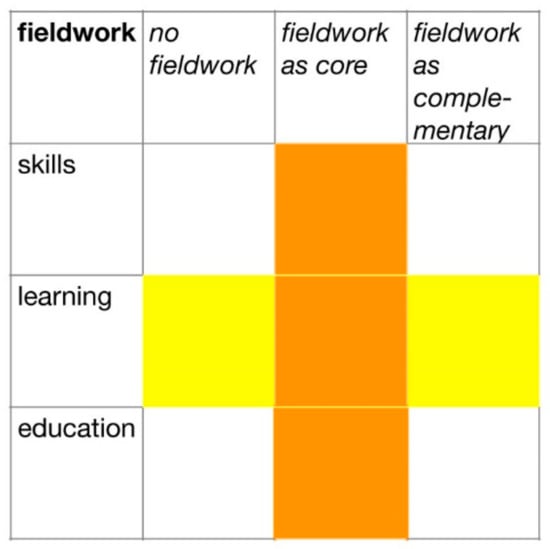
Figure 2.
Overview of headlines of pedagogy of fieldwork in landscape architecture. The types of fieldwork are based on a generic distinction in the role of fieldwork in acquiring the body of knowledge from textbooks that are used in landscape architectural education [13,14,15,64]. The different teaching goals, training skills, acquiring the body of knowledge of a discipline, gaining insight in values as basis for personal development, are distinctions from references on teaching and learning in general [65,66].
- without fieldwork
- where fieldwork is complementary
- where fieldwork is the core
Basically, in most teaching modes fieldwork does play a role, except in learning computer skills. Next to the teaching and learning goal of fieldwork in different teaching modes is important to distinguish:
- learning skills (training)
- acquiring basic design knowledge and insight (learning)
- gaining insight into the body and framework of design knowledge in the context of values as a basis for personal development (education).
Professional vs. academic education
Teaching and learning goals are defined by the different phases in the educational program which leads to the approach and content. At an academic level education is nowadays distinguished in three steps; bachelor, master, and PhD; sometimes referred to as vocational, professional, and theoretical.
There is an important difference between higher professional programs and academic education: a professional program trains students to become practice-defined professionals and mainly focuses on the application of existing knowledge.
University education comprises an academic level and primarily teaches students to learn to think systematically and abstractly and is focused on the development of the discipline at large. At the university, students learn to take a critical look at different theories and acquire new knowledge themselves. Learning is largely done through self-study, design study, and discussion in groups. Such an “academic level of thinking” makes graduates from universities versatile.
The introduction of the Bachelor/Master system in Europe after the Bologna Declaration was based on the distinction between three educational cycles; a first cycle BSc which is vocational, a second cycle MSc which is focused on professional education, and third cycle focusses on research, the PhD [1,2]. This distinction between cycles made the difference between academic and professional more pregnant due to the explicit introduction of research, especially at the Master’s level and exclusively research in the PhD. Consequently it also made the fieldwork in the three cycles different in goals, nature, and content. In the BSc fieldwork is oriented to acquiring knowledge on basics of the landscape as a system (natural, socio-economic, and cultural), while in the MSc the focus is much more on backgrounds and understanding how these systems interact and influence each other in the design process. In the PhD fieldwork is primarily related to the subject and research methods and the development of new design knowledge. In this article we focus on university education in landscape architecture.
2.1. Pedagogy
Pedagogy refers to the theoretical basis of educational processes; the science of education, to the organisational basis of education, to educational objectives rather than to programs and methods [66]. Pedagogy deals with the relation between learning and teaching; as such it includes a strategy for education which is reflected in the program. Wilson and Peterson [66] make clear in a general overview on learning and teaching that over time, learning has become a more active engagement for the students, while the role of the teacher has got more focused on stimulating students in their learning in different ways by taking into account different learning styles [67]. In a study on learning styles of the students and teaching styles of the teachers [68] done at the Department of landscape architecture in Guelph, they found that the preferred learning styles of the landscape architecture students are generally intuitive-thinking and intuitive-feeling types. Rittel [69] gives an overview of the key issues that play a role in setting up a curriculum for architecture schools. Even though pedagogical and didactic backgrounds are partly implicit, it gives also interesting and thoughtful ideas for teaching in landscape architecture.
Bates [70] distinguishes between four types of approaches to teaching and learning:
- behaviourist (stimulus/response, Skinner); e.g., learning plant materials
- cognitivist (thinking and mental processes as core of learning); studio seminar
- constructivist (the student in the centre, the social context of learning); studio, seminar
- connectivist (knowledge is dynamic and depends on connections to different networks outside the individual); all teaching modes and modules
Learning is seen as a function of individual differences in cognitive styles (such as perception and personality) and cognitive strategies (including creativity and motivation). In landscape architectural education all four approaches play a role in different teaching modes and different stages of the study. Hence the different focus on fieldwork; in learning basic materials, in learning to design in the studio and in broadening the horizon by making excursions to other regions and abroad.
Pedagogy also has a normative character; what is and what should be, which comes back in the philosophy of education [71]. For landscape architecture it refers to good and bad (ethics) and to the concept of beauty (aesthetics) which also comes back in fieldwork in the studio and in excursions abroad.
In this article, pedagogy concerns the general principles of teaching fieldwork in landscape architecture [72,73,74], the traditions of a school, its physical and cultural environment, and the educational goals defined by the school.
The culture and tradition of the school (horticulture, art, forestry, architecture, engineering, etc.) also make a difference in pedagogy. It is reflected, for instance, on a focus on sciences (agriculture, horticulture, and life sciences), or on art (design schools and art academies), or on engineering (construction realisation and hydraulics) [23]. Similar tendencies can be observed in schools in Europe where a mixture of cultural context, founders of the program define the overall structure of the program such as Porto, Lisbon [35], Evora in Portugal [35,36,75], TU München in Germany [37], and Ljubljana in Slovenia [51]. Further, in our own experience in studying and teaching at the different schools, we noticed differences in philosophy, approach to pedagogy which is partly based on the history of the program and sometimes on the founders of the program [3,7,39,40,76,77,78].
With the introduction of the Bachelor/Master system in Europe the educational goals of all university programs have been standardised. In the Bachelor the focus is on instruction; learning how and why, while in the Master students define their own problem and approach, the emphasis is on why and how. At the Master’s level there is an explicit requirement to integrate research into the curriculum, also in design disciplines. Research and design knowledge gradually have become more and more important in most Master-programs in landscape architecture. For fieldwork in the Master’s, students will learn to investigate sites and projects by themselves, while in the Bachelor’s site and project visits will have to be more guided and explained on the spot.
We have chosen two issues to illustrate how fieldwork is influenced by pedagogical backgrounds in design education in general and that are characteristic for landscape architectural education; learning in real life and learning by doing. These two characteristics of the pedagogy of teaching in landscape architecture will be used to further elaborate on three types of fieldwork.
2.1.1. Learning in Everyday Landscapes and Real Life Situations
The pedagogy of teaching landscape architecture is completely different from the sciences where the real situation is reduced to a model in which the laws of nature are analysed, studied, and theorised by laboratory experiments based on the scientific method. For landscape architecture, the daily landscape is the main laboratory [37]. The principles of design teaching are to learn in real life in real time [14,79,80,81,82,83,84]. Fieldwork is a major component of the teaching approach to achieve this type of education due to its direct confrontation and experience of the landscape in time and place.
For all landscape architecture schools, the site as learning environment is not only the place of the school building but also the field of study and experimentation. Landscape architecture is a discipline which is always linked to time and space; in projects the existing situation before intervention is always the starting point. The problem is analysed, defined, and studied in real life where the landscape as a natural, socio-economic, and cultural system is the laboratory and where design experiments are made [85].
The European dimension plays an important role in all design schools because in Europe the cultural aspect of landscape and design is omnipresent and diverse [19,86]. This diversity of cultures is one of the rich resources of Europe; for landscape architecture a basis for the identity and significance of landscapes, not only in cultural landscapes but equally in the creation of contemporary landscapes.
2.1.2. Learning by Doing
The comprehensive pedagogical approach in all design education is the principle of “learning by doing”. This principle finds its origin in “master-apprentice” learning, already known in history. The design studio—which is the core of all design programs—mimics the daily work in an office or design department in an institution.
It was Schön who gave this principle of learning by doing an empirical background through his research on teaching in design schools, especially at MIT. In the 1980s, the sociologist Donald Schön emphasised the role of the practitioner, whose understanding and knowledge of a particular area corresponds to a perspective located in the process of praxis. His research was oriented towards an understanding of the nature and origin of knowledge (i.e., epistemology) which is linked to practice [87]. His results lead to the idea of a “reflective practitioner” as the basis for design education. He emphasises the role of experiments, design being ultimately a form of trial and error which is guided by the tacit knowledge of the teacher who uses his/her intuition, teaching experience and design knowledge to guide the student in his/her learning and development process. Waks [88] elaborates on the principles of Schön and extends it to teaching design in which learning by doing, experimenting, and visual thinking play a key role.
In Hungary the tradition of learning by doing in design education has deep roots [89,90] and starts from the recognition of personality-shaping capacity of self-building. Finding the individual’s place in the group is a key issue of the landscape architectural education in Hungary and is applied in “Design and build” projects. If the building process takes place in a small community, the future users also join the work. Participating in such communal constructions, the students acquire not only professional, but even more complex and comprehensive social experiences.
2.1.3. Different Types of Fieldwork
The three different types of fieldwork that were distinguished before (Figure 2.), will be further elaborated; education and teaching without fieldwork, where fieldwork is complementary to the indoors and where fieldwork is the core of teaching and learning.
Fieldwork as Complementary to the Indoors
Csemez et al. [5] in their historical overview of the development of the Faculty of Landscape architecture and urbanism at Budapest, give a series of examples of different types of fieldwork. These examples are partly related to the relations to practice due to practitioners teaching in different departments of the Faculty. Here the teaching of plant materials and applied planting design is mentioned as teaching and learning both from lectures and from the outdoor learning in the arboretum in which the Budapest campus is located [41].
Bolton and Newbury [91], Foskett [92], and Kent et al. [93] deal with teaching and learning through fieldwork in geography and comprises both university programs in geography and teaching geography in secondary schools. Except for the design aspects, the issues and approaches are often similar to fieldwork in landscape architecture.
If fieldwork is complementary to the indoors; what is the pedagogical background? In this category we include excursions for one or more days, working in school gardens. Here the content and approach of fieldwork has additional goals. First of all there is the idea of getting to know a wider perspective, enlarging the horizon of experience of projects and work of landscape architects in other countries. In excursions the relation between land, landscape and landscape architecture in a different region or country is object of study. Secondly there is the aspect of learning special skills such as in working in school gardens. Thirdly there is a goal of personal development of the student; learning to explore new domains and developing personal experience that can help the student to define more clearly what his/her role and place in the future work domain could be.
In this category, the indoor and outdoor teaching and learning have to be closely related in the teaching and learning goals. It demands for a general pedagogic framework as context for didactics and organisation of the program. In teaching plant materials, soil science, or hydrology, for instance, there is always a delicate balance between what is taught indoors (mostly lecture courses or e-learning) and outdoors. The application takes place later on in the studios. The same goes for the social sciences, geodesy, and drawing classes. Have and Toorn [94] focus on the role of hand drawing in basic design education in the digital age. They also include hand drawing in fieldwork as a means of learning to see the form of the landscape and its dynamics of functioning, use, and historical development.
Fieldwork as the Core of Teaching and Learning
Excursions abroad are part of European programs in landscape architecture because of the great cultural diversity between the different European countries. Even though it seems at first to be more needed for small countries, the general goal is to explore “new” landscapes both in literal and in figurative sense. Landscape architecture in general, having explicit cultural influences and impacts, is directly related to these new landscapes with different natural and cultural backgrounds. Here we give two examples from our own experience in teaching and organising excursions abroad; Albert Fekete from Hungary on his excursions to Romania (Transylvania) and Martin van den Toorn from the Netherlands (Wageningen, Delft) on his excursions to Paris.
Albert Fekete organises each year at least one excursion to Romania (Transylvania). His pedagogical background in teaching is partly based on learning to observe, analyse, and comprehend historical gardens, mansions, settlement structures as historical phenomena that can—in most cases—not be restored. It demands for developing a viewpoint and design approach which implies transformation for contemporary use but at the same time showing the historical and cultural context [55]. One of Fekete’s research topics is the history and renovation of Transylvanian gardens, parks, and other designed landscape structures [42,95,96,97].
A second pedagogical background in his teaching approach is learning about the landscape by experiencing it. For instance, by climbing a mountain to study a settlement structure from a higher elevation [43]. Note that a large part of the students (national and international) has never climbed a mountain. Bodily experience of the landscape by climbing mountains, walking for kilometres, boating on a river, walking in dark forests, cycling through Paris, etc., is part of what landscape architects will need in the planning and design of daily environments for people anywhere, anytime. The non-visual aspects of landscape perception have been described and explained by various authors from different viewpoints [56,59,60,61,62,63,98,99,100,101].
The tradition of making excursions abroad in the Department of Landscape architecture in Wageningen is already old. The first professor of landscape architecture, Bijhouwer, started with excursions abroad immediately after the establishment of the new department in 1947. Here we have chosen two examples of excursions to Paris [44,45]; both different in time but similar in goals and organisation. For the Netherlands, Paris is not far (±450 km); it represents one of the major European metropolitan areas and a rich history of landscape architectural projects next to a large and dynamic series of contemporary projects of landscape architects. In these excursions students get to know the Parisian urban landscape both in form, design, use, and experience. The choice of what to see is overwhelming, so every excursion is a selection what you can do in the limited time. In all cases the program includes projects, sites, and landscapes that are typical for the city.
Because students have prepared all projects, sites, and landscapes before, they first of all see and experience the visited sites in real life. Secondly some comparisons are made within the same type such as compare “Place des Vosges” with “Place Vendôme”. Thirdly they learn to relate elements to structures and processes; how is the Louvre related to the axial system and how did this axial system enable urban development towards La Défense [88]. Another major phenomenon on the level of structure is how elements such as the Jardin des Plantes, École Militaire, or the Parc Citroën are related to the river Seine. Travelling in the city is done by foot, metro, and bus, nowadays the bicycle (Vélib) could easily be included and would give a new dimension to the experience of the city.
Working in school gardens Even though the daily environment of the school is always the outdoor laboratory for all landscape architectural education, some schools have even their own garden or other specific space next to the school buildings. In Europe, the landscape architecture departments at the Technical University of Münich [89]; the Swedish University of Agricultural Sciences in Alnarp (SLU), the École Nationale Supérieure de Paysage (ENSP) at Versailles, and the Faculty of Landscape architecture and urbanism at Budapest, all have in some or another form a garden for the students to work, to experiment and to experience the outdoors with its seasonal changes, plant, and animal life.
In the school garden different experiments are possible, even experiments that are impossible outside the school garden. School gardens can have different forms; sometimes the buildings are located on a campus such as for instance the Department of landscape architecture of SLU in Alnarp [46] or at Lisbon. In Budapest the buildings of the Faculty of landscape architecture and urbanism are located in an arboretum, situated at the Buda side of the city. In Versailles (ENSP) the “Potager du Roi” is explicitly part of the program and integrated in the curriculum [3,5]. Students participate in all activities in the garden as part of the program. Taking part in the management and maintenance of the garden is a rich experience for the students [37,41,102]. At Versailles (ENSP) the school garden is also used in different ways such as in the visual research studio “The skin” (La peau), students investigate and analyse the concept of the skin in their own way; it can be figurative or literal, material, or conceptual, drawing, installation, performance, or video. Core of the studio is that students develop their own idea about a ubiquitous phenomenon—the skin—and how to give form to that idea themselves; the assignment is open and has virtually no limitations. Having no limitations is also one of the most difficult aspects of the assignment. Students make use of indoors and outdoors of the school garden—”Le Potager du Roi”—next to the building, depending on their projects and approach (Figure 3). They choose the school garden, which is next to the building, as background, as interactive environment or as stage [103]. Having a school garden as laboratory next to the school is a major asset for a program. Only the program in Versailles (ENSP) is explicitly referring to that in their program and web-site for prospective students.
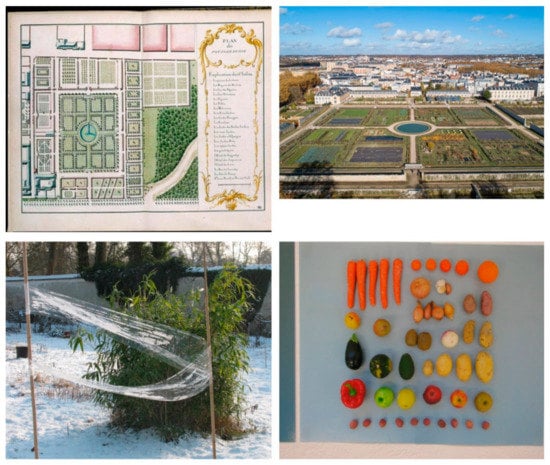
Figure 3.
On top, plan and overview of the “Potager du Roi” at the École Nationale Supérieure de Paysage (ENSP) in Versailles. Below two examples of student work in the visual research studio “La Peau”; on the left in the outside, on the right in the studio [103].
In landscape architecture schools and programs, fieldwork often depends on the foundation of the program or school and depends in many cases on certain teachers who do most of the fieldwork.
2.2. Didactics
Didactics refers to the science of teaching; ways of imparting knowledge and insight. It covers the full range of activities such as teaching modes, assessment practices, human development, and curriculum development. In design schools the teaching of design (studio, seminar, and excursion) forms the core of the program.
The fundamental questions in the teaching of landscape architecture in general are threefold and directly related to the distinction between land, landscape, and landscape architecture (Figure 1). First of all learning to see the landscape as an object of planning and design: the development of observation, perception, vision. A second aspect is to see how the landscape functions and is used by people and how design interventions influence this functioning and use.
Finally, there is the issue of learning how to imagine, conceptualise, and materialise design solutions in plan development: the design process. Didactic background of teaching these three aspects is achieved by relating land, landscape and landscape architecture to different levels of intervention used in the design process. We distinguish the level of element that relates to materialisation of form, the level of structure that relates to landscape structure and water and road systems, and to the level of process that relates to the strategy for the landscape development in the long run [30]. Altogether it comprises the relation between land, landscape and landscape architecture in space and time at different levels of intervention (Figure 4).
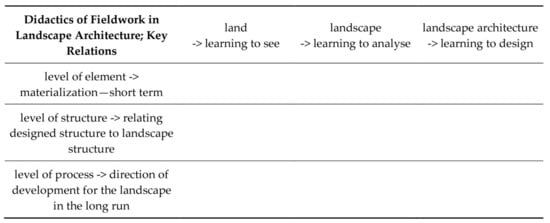
Figure 4.
Didactics of fieldwork is first of all based on the distinction between different levels in sites, landscapes, and projects at different levels of intervention [29].
Here we will pay attention to three specific issues related to didactics of fieldwork; group work and individual work, drawing as a fundamental way of learning to see and the use of notebooks.
2.2.1. Group Work and Individual Work
Students working in groups and individually is a key issue in design education. In studios, seminars but also in fieldwork, a substantial part of the work is done in groups. In studio assignments, problem analysis and site analysis are mostly done in groups. Group work is not only done for reasons of efficiency but also to learn to collaborate and learning to see the specific qualities of others. Especially in international Master’s programs, working in groups enables learning from each other due to the rich and diverse backgrounds of the different students, both in education and culturally. In studios, seminars, in conceptualisation, experimentation, and planning phase, students work individually. It stimulates to develop their own views, approaches, and ultimately accumulates design knowledge on a personal level. It is the integration of both group work and individual work where new design ideas emerge and steps in the personal development of design knowledge are made on the part of the students (Figure 5).
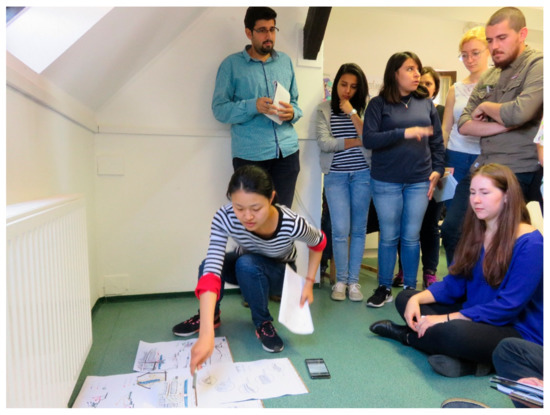
Figure 5.
Group work and individual learning; presenting fieldwork in a Seminar on “Space, theory and practice in landscape architecture” for first year Master’s students at the Faculty of Landscape architecture and urbanism in Budapest. The work of each assignment is presented and discussed in the studio. Learning to present, seeing the work of other students discussing results with all participants and the grades afterwards define the learning effect of each individual student.
In site analysis the working in groups has another important advantage in fieldwork. Different groups observing and analysing different themes in the same site or landscape, is not only more efficient but also shows to everybody the differences in viewpoints and the different aspects of landscape form, functioning, use, and experience. It requires careful preparation before by selecting meaningful themes, subjects, issues, and a strict time-schedule. On site, time is divided for observation, drawing and documentation, short presentation and discussion. Upon return, the groups work out their fieldwork and present it to each other. The work of all groups should give an overall idea of the sites and projects visited according to the goals.
2.2.2. Drawing as Fundamental Way of Learning to See
Schön [104] gives some background to the interactive process of seeing-drawing-thinking:
“A designer sees, moves, and sees again. […] Working in some visual medium—drawing, in my examples—the designer sees what is ‘there’ in some representation of a site, draws in relation to it, and sees what he or she has drawn, thereby informing further designing. In all this ‘seeing’, the designer not only visually registers information but also constructs its meaning—identifies patterns and gives them meanings beyond themselves. Words like “recognise”, “detect”, “discover”, and “appreciate” denote variants of seeing, as do such terms as “seeing that”, “seeing as”, and “seeing in”.
The role of drawing as a way of learning to see, is a key issue in fieldwork because it stimulates and activates the interaction between seeing and thinking, a way of acquiring new knowledge [94]. This process of seeing-drawing-seeing is one kind of example of what he means by designing as a reflective conversation with the materials of a situation.
Pinon [95] in a study on the relation between “reading” and “designing” the urban landscape of public space, presumes also a relation in the teaching of design. Learning to “read” the landscape as object of planning and design is part of the development of vision, of learning to see the relation between form, functioning, and use in its dynamic context.
The danger of the focus exclusively on a visual analysis of the form of the landscape is that landscape architecture is no more than “visual design” as we can see in the work of Cullen [105], in which the visual experience forms the basis for the plan. Still, a visual analysis is a good start for a site or landscape analysis.
In landscape architecture schools drawing is used as a form of visual communication, as a tool for imagining future developments and to represent plans for different audiences such as clients, users, constructors, and decision-makers [71,106,107]. In the US, the landscape architect Laurie Olin is an exceptional example of use of drawing, sketching, diagramming in his design work, research, teaching, and publications [33,34,108].
Supported by the results of research in the cognitive sciences, drawing has been re-established as a fundamental way of acquiring knowledge [109]. In the times of unlimited support for the digital—be it commercially-based or not—this is a remarkable phenomenon. It is based on the importance of the relation between hand and brain in acquiring new knowledge. Hand drawing, but also hand writing and hand work, re-appear on the agenda of the digital crowds. For landscape architecture and the teaching of fieldwork in landscape architecture, it has far-reaching implications because it means that drawing on site can be a way of acquiring new knowledge. Drawing, sketching in the field is based on the cognitive triad of seeing, thinking, learning; apart from the hand-brain connection it intensifies also the observation. Even though the results of cognitive sciences are fairly recent, in the past different educators and researchers have emphasised the importance of drawing and sketching in observation, perception studies and design [33,110,111,112,113].
At the department of landscape architecture in Wageningen, in the past Van Baarsel and colleagues taught a drawing and sketching module in the field [47]. In that module of 1–2 weeks, students got a series of carefully selected assignments on topography, materials, plants, landscape structure, light, human use, and settlement patterns. All together it gave an overview of how to analyse and understand the landscape through drawing. It could be seen as a way of documenting the site from a visual point of view.
Catherine Dee from Sheffield, UK, has a long experience in teaching drawing for landscape architects (Figure 6). She has also published extensively on her approach and methods in teaching drawing [106,107,114].
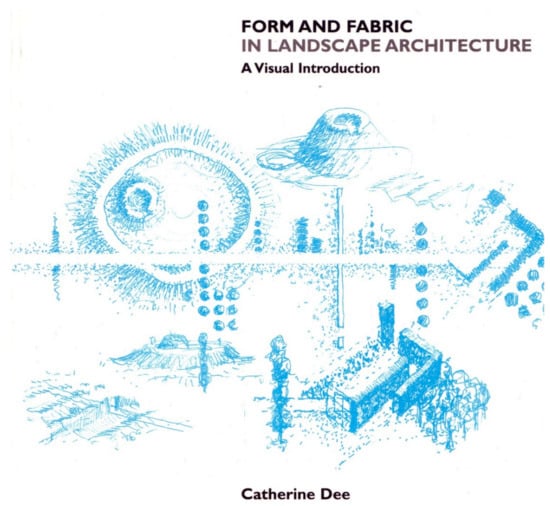
Figure 6.
For teaching the visual analysis of the form of the landscape, Cathy Dee, who teaches landscape architecture in Sheffield, UK, is one of the most experienced teachers in the field. Next to her inspirational form of teaching, her specific didactic approach of stimulating students in their drawing is part of achieving this quality in teaching [106].
At the Faculty of landscape architecture and urbanism in Budapest, Anna Eplényi and her colleagues teach graphics and visual communication as technique, as personal discovery for students and as design tool [102]. In her own work she uses drawing also as research tool [48,57,115].
The French architect Donnadieu [116] has developed a special technique of site analysis by drawing the site from site visits and photographs, which gives an idea for the spatial interpretation of the site.
2.2.3. Use of Notebooks
Notebooks are an important didactic tool both for students and teaching staff. The idea of notebooks is that the daily work and thinking is reflected in notes, drawings, sketches, diagrams; it is a workbook for daily use.
In general notebooks are used as an ideas book, as a sketchbook for documenting forms and places of interest, it functions as a memory store of images for future reference. It functions as a workbook for documenting ideas, for experimenting and trying out, for setting up an outline of a design approach, developing ideas, concepts, and design solutions [46].
Keeping track of the content of daily work gives an idea of the evolution and development of ideas. Especially this last aspect is important; to have a specific place where you can play with ideas and where the experimental and explorative work can be done. Moreover the evolution of thinking on a longer time scale can also be overseen. Notebooks are not only used among designers, engineers but also by scientists; they call them mostly “lab journals”. The goals are partly similar but the content is different.
In fieldwork the acquiring of new knowledge about functioning, form, and use of the landscape is guided by research questions and enabled through interaction between observation, thinking, and sketching. In this learning process on site, the use of notebooks is a crucial research tool used to document, measure, sketch what has been observed on site (Figure 7). This material is later on worked out in drawings, maps, cross sections, obliques, and plans. First observation and perception studies will always result in new research questions. Fieldwork in the form of acquiring skills and knowledge by doing, such as practical work and internships, is based on hand/brain relations often without sketching and drawing.
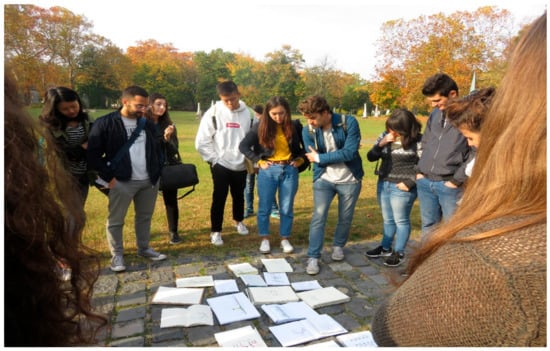
Figure 7.
Presentation and discussion of results of fieldwork from notebooks on site creates a huge learning effect because feedback is given almost immediately for the whole group. It has also a stimulating effect on all students because they see on the spot how others have approached and graphically represented the work on the spot in a limited time.
Needless to say that all forms of fieldwork have an appropriate number of ECTS-points and are all graded on the basis of explicit criteria. We grade also the notebooks.
An important goal of design education at the upper Masters level is that the students themselves are responsible for their personal development [71]. Design education allows the students to develop their own professional development, the program offers an itinerary but personal assistance in teaching each individual is the key issue. Notebooks give the possibility to look back at one’s own work and see the progress and change of content both by oneself and the teaching staff.
Clifford [117] elaborates on use of notes and notebooks in anthropology where principles of observation, drawing, and thinking are similar but where the function of documenting is a central issue and the design component not at all.
2.3. Teaching Fieldwork
In the education and teaching of any discipline, there are always two areas to deal with; an area of knowledge of the discipline in question, but also the way of teaching. The two are, in any case, very different areas of knowledge, which means that someone who is very successful in his/her discipline or in research is not necessarily capable of teaching in that area of knowledge. In design disciplines, this problem is omnipresent and sometimes even painful for famous designers who are not automatically good teachers.
In three schools we know more closely (Wageningen, Versailles, and Budapest) educational experience was paramount and practice and teaching were successfully integrated through the participation of practitioners as part-time or invited professors and specialists for specific purposes and at specific times. Input of such temporary staff takes place not only in the studio’s but also through other forms of education such as seminars but also in fieldwork. Moreover students from Versailles—and other schools and programs—make regular excursions and study tours to the Netherlands and vice versa (Figure 8). The same goes for Budapest with exchanges between departments of landscape architecture from surrounding countries such as Romania, Croatia, and Poland.
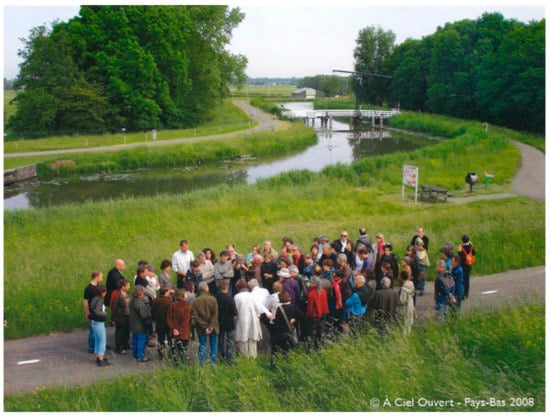
Figure 8.
Students and staff from the École Nationale Supérieure de Paysage (ENSP) in Versailles on excursion to the Netherlands in 2008. Here a visit to the “Zuidplaspolder”, the deepest polder in the country; almost 7 m below sea level. The photograph is taken from the dike.
The introduction of the Bachelor/Master system in Europe has had a major impact on the European education system in general and on education in landscape architecture in particular because of the searching for a balance between standardisation for the overall structure of the program and making use of local situation, historical traditions of the school in a European context [22]. Cultural diversity is a form of inspiration for all design disciplines. It has opened up possibilities for students to follow the Master after a Bachelor in another country and in another school. In this sense, the great cultural diversity in Europe has also been made accessible to landscape architecture and has enriched design and ideas for the discipline at large to a great extent.
Due to the greater diversity of students in the Master and to the increasing number of non-European students, there is a growing demand for foreign teachers in all types of Master in Landscape Architecture education in Europe. With the rise of international Master’s programs in Europe, the problem of finding teachers especially in the English-taught Masters, is becoming more and more important; a professional (practitioner, or researcher) or didactic professional? On this specific point, it is necessary to share more information on experiences from other schools and teachers to better understand the approaches and principles.
The role of the teacher in fieldwork (Figure 9) is crucial; goal, content, preparation, organisation, and presentation are intricately related but on site it is important to point out special issues and structures in the landscape in order to make students sensitive, curious and aware about what can be seen and learned on site [118]. Core of the teaching on site is to stimulate the process of learning to see relations between form, functioning, use, by the students themselves.
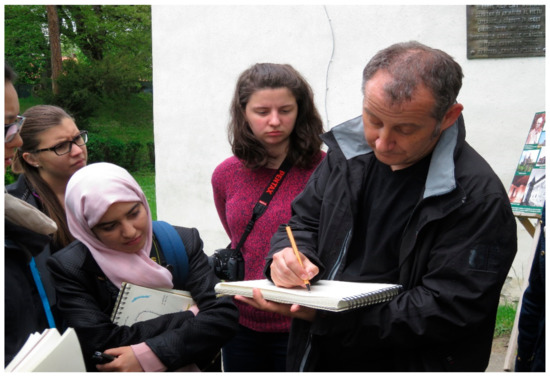
Figure 9.
The role of the teacher in fieldwork is not only leading students from one point to another. Teaching fieldwork demands from the teacher an active attitude in the interaction with students. Here a moment where Albert Fekete finds out that students did not really understand the structure of a park and where he immediately interferes with drawing the structure in a notebook of one of the students. Drawing is in this case a way of explaining a structural principle by a diagram.
The French landscape architect and visual artist Anne-Sophie Perrot, uses different approaches to fieldwork and site analysis in her work and in her teaching [119]. One of the remarkable approaches is that she asks students to visualise with materials from the site their impression and concept of the site analysis (Figure 10). She also describes the tools she used in the field for fieldwork in 2005 (Figure 11). If we compare that with the contemporary tools, we see that the notebook, pens and pencils have remained but that we now have an abundance of digital tools in the mobile phone (Figure 12). Because we have also maps on the phone, we have nowadays far more tools, equipment, and information than before the digital age.
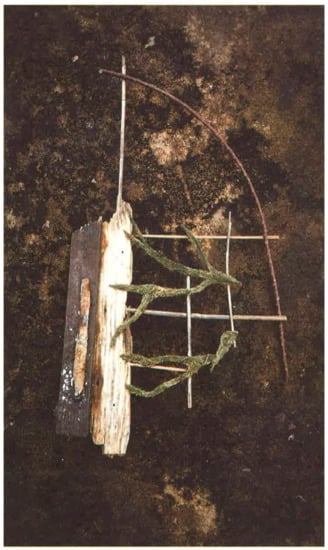
Figure 10.
Fieldwork with result on the spot as visualised by materials found on site by Anne-Sophie Perrot [119].
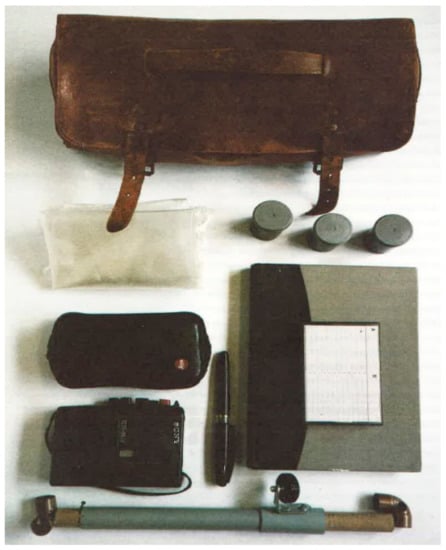
Figure 11.
Tools used for fieldwork in the teaching by Anne-Sophie Perrot and in her own research; notebook, camera, films, pen, optical tool to read levels, distances, and angle.
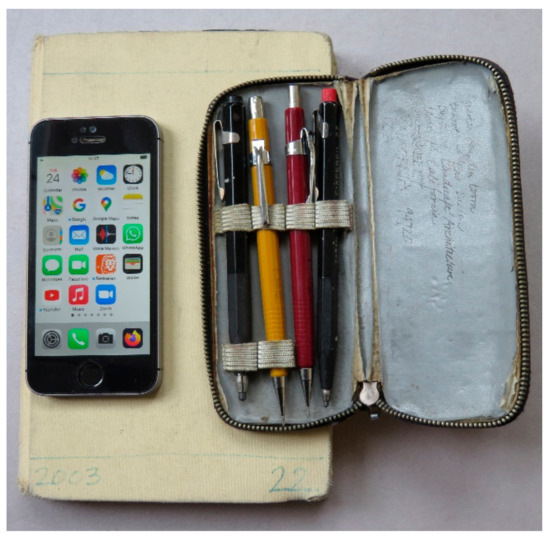
Figure 12.
Contemporary tools needed for fieldwork; notebook, pencils, mobile phone. This mobile phone (iPhone SE) has, Google Earth maps for measuring distances and main contour lines, has a level and measures elevation and altitude, has a camera that can take photographs, time-lapse, panorama’s and video, has a voice recorder. It can define the location which is very handy in unknown areas, also in urban landscapes.
Not only the mobile phone can be used as a new tool in doing fieldwork. Rekittke and Paar [120] describe techniques for doing fieldwork in areas where there are no adequate topographic maps and background information on the site. They give examples of fieldwork in such circumstances by combining the use of Google Earth maps, drones, and mobile phones.
Teaching fieldwork requires the teacher to be a trained observer in the landscape, having an advanced level of reading and using maps. Didactically it demands for the ability to do observations both from the specific to the generic (morphology -> typology) and vice versa. Special attention is needed for a systematic ways of registration and documenting observations and emerging research questions on site and an elaboration of results and interpretations afterwards.
3. The Organisation of Learning and Teaching in the Outdoors
Organisation of fieldwork and content are closely related; to illustrate this issue for this article we have chosen site analysis, learning by doing, and excursions as examples.
3.1. Site Analysis
For site analysis the coming to grips of the form of the landscape and its dynamics, is a first step in the design process [121]. In a given site and a program, it is important to distinguish between the image (the visible form), the formation and forces behind the form (natural, socio-economic, and cultural forces) and the form related to functioning and use. A site analysis can be part of different goals for fieldwork; being an autonomous research, part of analysis of projects or part of a historical analysis (Figure 13).
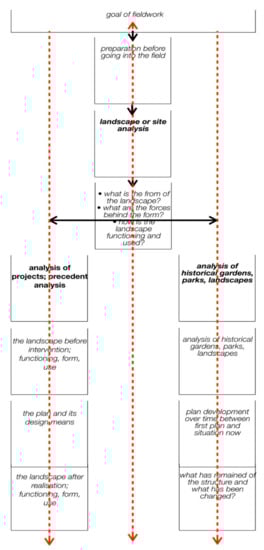
Figure 13.
Diagrammatic overview of three different goals for fieldwork and their content referring either to precedent analysis or analysis of historical gardens and parks.
Lynch [122], Faye et al. [123], Landphair and Motloch [124], Bell [64], and Motloch [13] give a general overview of site analysis and landscape analysis for landscape architecture. For specific assignments special research techniques are needed such as in the case of “behaviour-mapping” [125]. James [126] pays special attention to site analysis at the regional level from a geographical point of view. Sauer [127] already at an early stage, published on geographical backgrounds of site analysis, which he referred to as “survey method”. In a later article he elaborated this issue further and also emphasised the need of fieldwork in geography, both in teaching and research.
Burns and Kahn [128] have edited a study on site matters by authors from different disciplines and different viewpoints.
3.2. Fieldwork in the Context of Learning by Doing Comprises Design and Build, and Design Experiments in the Outdoors
In this case fieldwork emphasises learning to see the relation between plan and realisation, between design means and intervention. In the regular process of plan making, assignment/problem definition and site selection, and plan development and representation, the phase of realisation is only talked about and discussed in drawings. In design and build the focus is on realisation which comprises; site selection, materialisation, and construction [129]. In educational context, usually the plan is developed in the studio, then afterwards in a new teaching module, the plan is to be realised in design and build. Time planning and carefully dividing the work in separate tasks to be done by different groups is the key to success.
Fekete and Sárospataki [42] give examples of projects in the program of the Faculty of landscape architecture in Budapest. The plan is developed in the studio, the realisation—in this case a communal bath in a village—takes place in specific sites, mostly in small communities with the help of local craftsmen. This teaching mode is quite common in the program in Budapest; already more than 50 of such projects have been realised in this way. The authors point out that this way of communal approach to construction of new elements and structures is rooted in a cultural tradition (Figure 14).
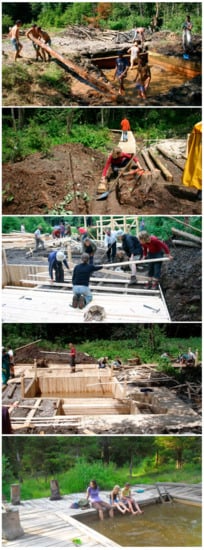
Figure 14.
Design and build of a communal bath in a small village in collaboration with local craftsmen [42].
In the publication of Stergaršek and Rechner Dika [50], a new dimension is added to design and build: learning by doing through international collaboration (Figure 15). Here cases are presented of collaboration between three different universities (University of Washington, University of Ljubliana, University of Zagreb) in different projects. The different activities during the design and construction are described and examples of activities are worked out including technical drawings. The relation with architecture is emphasised; in the choice of projects and in the type of constructions.
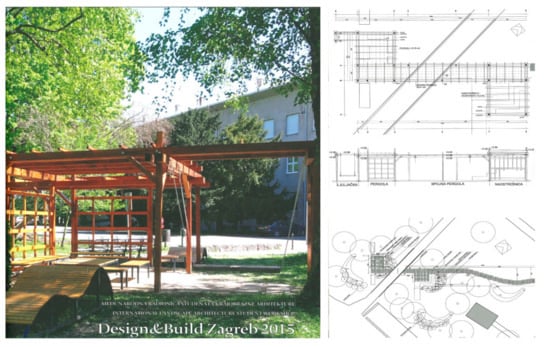
Figure 15.
Design and Build at the Department of landscape architecture in Zagreb. In the upper right a technical drawing, in the lower right the plantation plan [50].
At the Department of Landscape architecture at the Technical University of Münich, Peter Latz has designed a program in which theory and practice are organised around learning by doing. Site analysis in the field, making small technical constructions in the school’s garden and taking part of students in realisation of larger projects outside the university are all part of the curriculum [37]. He considers design as a form of “experimental invention” where constructed objects and elements influence natural processes and where the concept of structure plays a key role. Already at an early stage he integrated climate and energy issues in the buildings and grounds of the department at the university.
3.3. Excursions Abroad
The goal of excursions is not related to a specific assignment, site, or project but has a separate goal of getting to know projects in other regions or countries, historical projects, or other thematic issues. This can be in the form of an excursion abroad but also during the regular program to have excursions of one or more days to investigate different regions or certain themes. For instance in the “International Course Landscape Architecture” (ICLA) at Wageningen in the 90s, students from abroad came to the Netherlands to do an English-taught design studio but also to get an impression of the Dutch landscape and projects of Dutch landscape architects. During the four months, students had a program that included—next to the main part, the design studio—a series of ten dedicated field trips of one or two days to get an impression of land, landscape, and landscape architecture in the Netherlands [129].
The organisation of fieldwork in the context of excursions for one or several days comprises three basic steps: preparation before, the organisation of activities during the fieldwork, and the presentation of results and evaluation afterwards.
Preparation Before
Excursions of several days require serious preparation, while at the site with a group of students there should be no “organisational surprises”. In most cases these excursions are also larger groups; preparations before are also needed to prevent costly mistakes. The preparation includes both the content and the travel, boarding, organisation of access, and transport on the spot (Figure 16, Figure 17, Figure 18 and Figure 19).
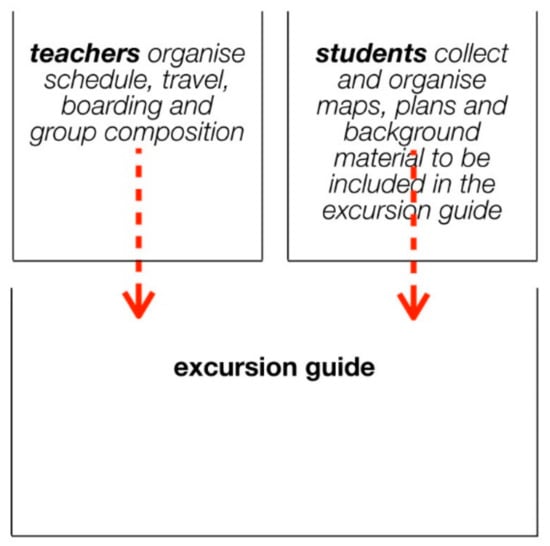
Figure 16.
Preparation before; organisation and making of an excursion guide.
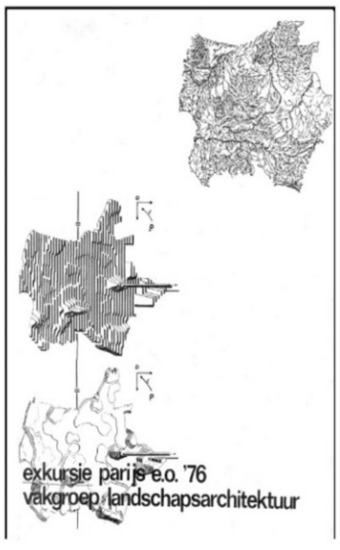
Figure 17.
Excursion guide for landscape architecture students Wageningen to Paris in 1976 [45].
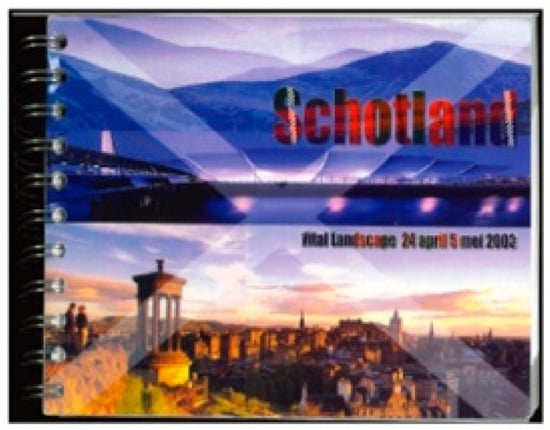
Figure 18.
Excursion guide for town planning students Delft to Scotland in 2003 [53].
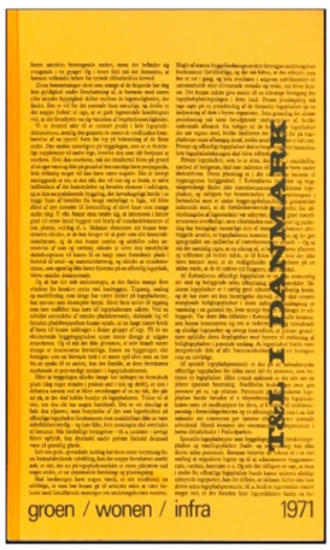
Figure 19.
Excursion guide for landscape architecture students Wageningen to Denmark in 1971 [130].
Every project/site which is included in the program, is observed and analysed by a group of students so that all participants are informed about backgrounds and have sufficient material such as plans, maps, cross sections, etc. (Groups not to be more than 3). Each group gets a theme/subject to study which results in research questions. So every project/site is observed and analysed from different viewpoint and by a different group. For each project/site, groups and subjects vary, depending on what has to be analysed.
3.4. Organisation of Activities during Fieldwork
Travel on the site is mostly by bus but, for instance, in Paris, it is more efficient and far more interesting to travel by metro. In smaller cities and rural settings the bicycle is even better because it takes less time and is more efficient in making stops, in access, and especially, in the experience of being in the landscape. While on site there is a pre-defined organisation of the program for all groups which students are familiar with from the excursion program and guide. Each day is set up in visits of a number of projects which students have prepared before and is documented in the excursion guide.
Depending on the size and complexity of the project, the time is set for all groups before the start. There is a standardised working method; first an orientation and first impression for the group as a whole. All individual students document their first impression in drawing, sketches, diagrams, relevant cross sections in five minutes after the orientation by the whole group. Then the groups start with observing and analysing the subjects in a fixed time schedule. Before starting their work they discuss the approach, focus, divide the work. They reserve time for documenting, summarising, and preparing for presentation on site in their notebooks.
For students who take part in an excursion for the first time, at first they are sometimes a bit surprised. Later on they are getting used to it and it works fluently and efficiently. Needless to say that usually, also depending on the size and complexity of the project to be analysed, a maximum of two/three projects can be done in half a day because the time for travelling from one project to another needs also to be included.
3.5. Presentation, Reporting, and Evaluation Afterwards
Working out fieldwork after return is done by the same groups as did the observations during the site visits. It is based on sketches, measurements, and observations in the notebooks, with additional information from references, maps, and other material that can be helpful. For the excursion to Paris of town planning students from Delft, the different projects, sites and landscapes were worked out by different groups. In the case of “La Grande Borne” in Grigny (1964–1971) designed by the architect Émile Aillaud, the group that worked on “size, scale and proportions” were struck by the difficulty to grasp the size and scale of the “spaghetti-formed patterns” of the buildings and found after analysing the GoogleEarth maps the graphic design pattern (Figure 20) of the same size circles as basic pattern.
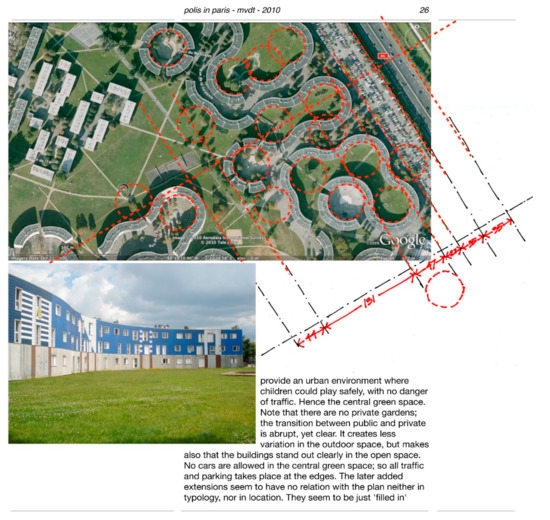
Figure 20.
Excursion to Paris and surroundings by Delft town planning students in 2010; working out size, scale, and proportions from Google Earth map [16].
The result of fieldwork can also be used as a basis for further research as has been done in the case of a study on the future development of settlements, mansions, and parks in a region in Transylvania (Romania) in 2015 [51]. A similar project was done a year earlier for mansions and settlements along the Maros river in Romania. In some cases Albert Fekete gets an explicit demand for research by a mayor or owner of a mansion; in that case the goal of the excursion is defined by such an assignment. For research on approach and methods on fieldwork it is interesting to have the working drawings also available. Only in certain cases working drawings are made available in the final results. An example where working drawings were available is for a visual research on a small settlement in the province of Zeeland in the Netherlands: Kattendijke. The assignment was given by the mayor of Goes to which municipality the small settlement belongs. For Kattendijke a group of architecture students from Delft worked for a week on site. The observation studies, measuring and drawing plans, materials, and cross sections resulted in a well-documented overview of the village (Figure 21a–c). It is also one of the rare examples where working drawings were included in the final publication [58].
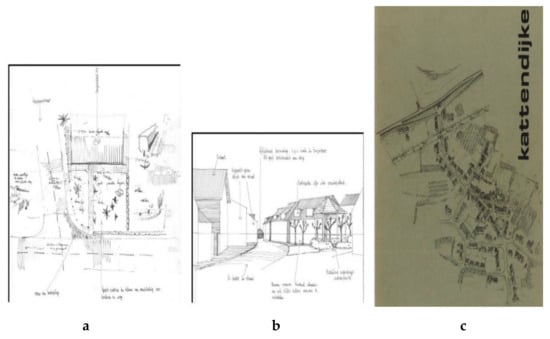
Figure 21.
(a) Study of materials and metalling for visual analysis of small settlement “Kattendijke” [58]. (b) Mass-space study for visual analysis of small settlement “Kattendijke” [58]. (c) Visual analysis of small settlement “Kattendijke” [58].
4. Practical Issues in Fieldwork
Fieldwork has a number of practical issues that need special attention.
First of all the weather conditions; rain, wind, and storm; extreme temperatures are not feasible for doing fieldwork. In that case alternative assignments or exercises have to be provided. Nowadays the digital mapping such as GoogleEarth which is available for anybody, anywhere, offers a wealth of resources both for individual work and group work that can be done indoors when the outdoors is suddenly not possible. In case of bad weather or short field trips and project visits, drawing from photographs in the lecture room or studio can be quite helpful especially if it is related to mapping and map analysis.
Secondly in fieldwork that takes longer than one day the organisation of board and lodging. In most countries youth hostels have been replaced by hostels that are commercially operated but in most cases offer similar facilities. In case of visits to other schools and universities there are sometimes also possibilities in student housing or other university facilities. For small groups it is sometimes also possible to accommodate the visitors with students from the school or universities in their own rooms. Students can organise that among themselves if they can start well in advance.
Thirdly the different types of transportation and distances
Depending on the goal and duration of the fieldwork different distances have to be bridged. This is not only a matter of distance in physical sense but also in terms of experience. If you walk the experience is different from sitting in a bus. So, the speed of movement, and means of transportation, also implies a specific type of experience. In addition, there are also the conditions of the terrain; when there is no road you cannot visit the site with bus, car, or bicycle you will have to walk. In general the best experience of the landscape—be it urban or rural—is on the bicycle; it offers also the best possibilities to explore, stop, and research during the fieldwork.
In the last decade in the Netherlands a new problem has emerged; some of the smaller roads and dikes are closed off for motorised traffic. It requires a different organisation of field trips where students travel by public transport to a location, rent bikes there, and do fieldwork on the bicycle. It is not only far cheaper but also has a major advantage that students see more and experience the landscape directly compared to sitting in a bus. Moreover the cost of a bus plus a driver has grown to such an extent that practically speaking it has become too expensive.
For excursions abroad the distances are too large to do on the bicycle, unless you visit one specific area. One solution is to rent vans for passengers which can take nine people including the driver. For a group of around 20 students three buses will do, students can drive themselves and can change of driver every two hours as was done in the excursion to Scotland in 2003 [52]. In terms of cost this is an excellent solution which is far less expensive. The only disadvantage is that you cannot explain, inform the whole group while travelling in the buses.
The financing of fieldwork
In the last decades, the number of university managers has grown more rapidly than the number of educators and teachers, but most managers do not have any experience in teaching, education, or design. They consider their main function as cutting on budgets for teaching for which they are highly appreciated and well paid by university administrations. Fieldwork has been one of the favoured victims of their work so that budgets for fieldwork of any sort are severely limited or sometimes even disappeared altogether. Most schools and universities have solved this problem by reserving special funds for fieldwork upon the start of the program. So students pay a separate amount of money, apart from fees and tuition, directly to the department or faculty which is reserved exclusively for fieldwork of different sorts.
5. Conclusions
- Fieldwork
The core of fieldwork is learning in real time and in real place; the landscape outdoors is the main laboratory for landscape architecture education. Learning to see can be considered as the first step in the education of vision; to observe the form and use of the landscape at a professional level is impossible without drawing, sketching, measuring, making cross-sections. Physical (bodily) experience of the landscape is an important aspect of coming to grips with the form of the landscape as a designer; walking and cycling distances, climbing mountains, swimming in a river, climbing in a tree, walking through dark forests, or sailing, all contribute to other types of experiences than only visual.
The immediate surroundings of the site of the school is the main working area for teaching in the outdoors, the location of some schools has advantages/disadvantages over other schools. A school garden next to the school is a major asset for any program in landscape architecture. In Europe, several schools do have a school garden but only the school in Versailles (ENSP) draws attention to this resource for prospective students.
- Pedagogy related to fieldwork
The pedagogy of fieldwork should first of all be directed to the distinct difference between what you can learn in the field, in the outdoors and what you cannot learn indoors. What you learn in the outdoors, you cannot learn from books, lectures, or YouTube. Finding a balance between indoors and outdoors learning is a key issue in the overall pedagogy reflected in the program and learning goals. A second issue in the pedagogical goals is that fieldwork should enable a multi-sensory experience of the daily environment in different ways such as the “bodily” experience of the landscape, practical work, and participating in “design and build”. A third goal should focus on the personal development of each student by stimulating curiosity, wonder, and excitement about what you can observe in the daily landscape. Eventually this should lead to students becoming aware of the cognitive principle of “the more you see, the more you know” and vice versa. All together the pedagogy of fieldwork should focus on the broader education of the student and his/her personal development as a landscape architect.
- Didactics of fieldwork
Didactics should first of all focus on a diversity of physical (bodily) experiences of the landscape as an important aspect of coming to grips with the form of the landscape as a designer. Even to see, touch, and smell plants in the outdoors is a different experience than seeing them in a book, on a slide; however, good the quality of the image may be. In fieldwork students are confronted with new experiences, new challenges which they will learn both in individual assignments and in working together in groups. Finding a balance between working in groups and individual work is a key part of the didactic approach. It can be stimulated to emphasise three key steps in the overall experience; observing, registration, and documenting what you see, presenting and discussing the results in the group at large.
One of the limitations of fieldwork is bad weather: rain, cold, heavy wind, and storms. That is why fieldwork needs careful planning and scheduling in the program but also on the short term alternative exercises and assignments indoors are needed in case of sudden changes in the weather conditions. Here the improvisation talents of teachers come to the foreground; being able to find solutions for circumstances and situations that cannot be foreseen.
Teaching and learning in the outdoors is not every teacher or educator’s work. It requires special didactic qualities from educators. Depending on the teaching and learning goals it requires a diversity of competences such as being a trained observer in the landscape, being a generalist rather than a specialist, stimulating students to develop their own capacities and potentials, having a good physical condition and being able to improvise on site if necessary.
- Future of fieldwork
A growing number of today’s students has less direct experience with the outdoors and with nature in general due to increasing time they spend behind the different screens. In architecture schools most of the students no longer have basic knowledge of biology, geography, or applied physics which they used to learn in their secondary education before university, due to the almost universal budget cuts on education by contemporary politics. It means that there will be a growing need for additional education in these areas or extending the prep year for being admitted to the Master’s for those who cannot meet the prerequisites for studying landscape architecture. In all cases fieldwork and learning in the outdoors will be needed more than before.
In Europe, the rich diversity of cultural and historical backgrounds is a specific issue. It fits in the tradition of European programs of landscape architecture to make excursions to other countries, to experience the work of landscape architects and to meet other students with a different cultural background.
Teaching in landscape architecture is becoming more specialised and in need of specific skills and insights depending on the teaching mode. Not everybody is able to function as studio-master to teach a design studio, the same goes for fieldwork. In that context Healey [131] pleads for developing the scholarship of teaching in higher education through the disciplines in two ways; to develop the status of teaching and developing a discipline-based pedagogic research. The distinction between scholarship of the discipline (subject specialists) and the teaching scholarship within the discipline forms the heart of the matter. Important presumption is that the scholarship of teaching needs to be developed within the context of the culture of the disciplines in which it is applied, in this case landscape architecture, with its special and characteristic features of the landscape as the direct living environment and as object of planning and design.
Author Contributions
Conceptualization, M.v.d.T.; methodology, A.F., M.v.d.T.; software, A.F.; validation, A.F., M.v.d.T.; formal analysis, Martin vand den Toorn; investigation, A.F., M.v.d.T.; resources, A.F., M.v.d.T.; data curation, A.F., M.v.d.T.; Writing—Original draft preparation, M.v.d.T.; Writing—Review and editing, A.F., M.v.d.T.; visualization, A.F., M.v.d.T.; supervision, A.F., M.v.d.T.; project administration, A.F., M.v.d.T.; funding acquisition, A.F. All authors have read and agreed to the published version of the manuscript.
Funding
This research received no external funding.
Institutional Review Board Statement
Not applicable.
Informed Consent Statement
Not applicable.
Data Availability Statement
Not applicable.
Acknowledgments
We would like to thank the unknown reviewers and the editors for their reviews, suggestions and remarks. It has greatly improved the content, form and text.
Conflicts of Interest
The authors declare no conflict of interest.
References
- Bruns, D.; Ortacesme, V.; Stiles, R.; de Vries, J.; Holden, R.; Jorgensen, K. ECLAS Guidance on Landscape Architecture Education—Tuning Landscape Architecture Education in Europe; ECLAS, LE:NOTRE: Vienna, Austria, 2010. [Google Scholar]
- EU-Land21—Trans-European Education for Landscape Architects—Output 01: Guidelines on Revising and Developing Study Programmes in Landscape Architecture; IFLA—Europe: Brussels, Belgium, 2017.
- Formation de «Paysagiste DPLG»; Programme pédagogique—Site de Versailles; École Nationale Supérieure de Paysage: Versailles, France, 2009.
- Girot, C. Some thoughts about landscape education at Versailles. In Met bijdrage van J. Schilt Architectuur als discipline; Goldhoorn, B., Ed.; NAi: Rotterdam, The Netherlands, 1996; pp. 23–32. [Google Scholar]
- DPLG Landscape Architect Training Programme; Versailles Site—Academic Year 2009/2010; École Nationale Supérieure de Paysage: Versailles, France, 2009.
- Csemez, A.; Csima, P.; Fekete, A.; Jámbor, I.; Schneller, I. (Eds.) Landscape Architecture in Higher Education—25th Anniversary of the Faculty of Landscape Architecture and Urbanism; Szent István Egyetemi Kiadó Nonprofit Kft.: Budapest, Hungary, 2018. [Google Scholar]
- Kepes, G. Language of Vision; Paul Theobald: Chicago, IL, USA, 1951. [Google Scholar]
- Kepes, G. (Ed.) Education of Vision; Vision + Value—Series; George Braziller: New York, NY, USA, 1965. [Google Scholar]
- Preusser, R. Visual Education for Science and Engineering Students. In Education of Vision, Vision + Value—Series; Kepes, G., Ed.; George Braziller: New York, NY, USA, 1965; pp. 208–220. [Google Scholar]
- Van den Toorn, M. Waarnemingsstudies. In Parijs ’96—Een Studiereis Landschapsarchitectuur 27 April—4 Mei; Geerlings, S., Nas, G., Schoemaker, M., Eds.; Afd Landschapsarchitectuur: Wageningen, The Netherlands, 1996; p. 6. [Google Scholar]
- Oles, T.; Horrigan, P. Learning to Land—On Fieldwork in Landscape Architecture Education. In Landscapes in Flux—ECLAS Conference Tartu 2015—Book of Proceedings; Niin, G., Mishra, H.S., Eds.; Dept. of Landscape Architecture: Tartu, Estonia, 2015; pp. 48–52. [Google Scholar]
- Girot, C. Four Trace Concepts in Landscape Architecture. In Recovering Landscape—Essays in Contemporary Landscape Architecture; Corner, J., Ed.; Princeton UP: New York, NY, USA, 1999; pp. 59–69. [Google Scholar]
- Motloch, J.L. Introduction to Landscape Design, 2nd ed.; John Wiley and Sons, Inc.: New York, NY, USA, 2001. [Google Scholar]
- Holden, R.; Liversedge, J. Landscape Architecture—An Introduction; Laurence King Publishing: London, UK, 2014. [Google Scholar]
- Van den Toorn, M. The POLIS Study Tour to Paris and Surroundings; Faculty of Architecture: Delft, The Netherlands, 2010. [Google Scholar]
- Bertram, C.; de Jong, E. Onzichtbaar Werk—Michael Van Gessel Landschapsarchitect; NAi: Rotterdam, The Netherlands, 2008. [Google Scholar]
- Farhat, G. Modernity: Le Nôtre and Versailles in the twentieth and twenty-first centuries. In André Le Nôtre en Perspectives; Bouchenot-Deechin, P., Farhat, G., Eds.; Hazan/Ét. Public du château, du musée et du domaine national de Versailles: Versailles, France, 2013; pp. 368–384. [Google Scholar]
- Hauxner, M. Open to the Sky—The Second Phase of the Modern Breakthrough 1950–1970—Building and Landscape, Spaces and Works, City Landscapes; The Danish Architectural Press: Copenhagen, Denmark, 2003. [Google Scholar]
- Burckhardt, L. Le Design au–delà du Visible; du Centre Pompidou: Paris, France, 1991. [Google Scholar]
- Merleau-Ponty, M. Le Visible et L’invisible; Gallimard: Paris, France, 2007. [Google Scholar]
- Steinitz, C. On landscape architecture education and professional practice and their future challenges. Land 2020, 9, 228–242. [Google Scholar] [CrossRef]
- Williams, T. Some Thoughts on the Education and Training of Landscape Architects; École d’Architecture de La Villette: Paris, France, 2013; pp. 461–468. [Google Scholar]
- Birli, B. From Professional Training to Academic Discipline—The Role of International Cooperation in the Development of Landscape Architecture at Higher Education Institutions in Europe; TU Wien Fachbereich Landschaftsplanung und Gartenkunst: Vienna, Austria, 2016. [Google Scholar]
- Vroom, M.J. Leren Kijken—Het Wageningse Onderwijs en Onderzoek in de Tuin- en Landschapsarchitectuur; Blauwdruk: Wageningen, The Netherlands, 2014. [Google Scholar]
- Holden, R. Landscape architecture education—A European overview. In De L’enseignement du Paysage en Architecture—Teaching Landscape with Architecture; Laffage, A., Nussaume, Y., Eds.; Éd. de la Villette: Paris, France, 2009; pp. 100–108, 434–439. [Google Scholar]
- Doherty, G. Teaching fieldwork: Fieldwork methods in landscape architectural education and the case of Brexit, borders and the Irish Northwest. In Lessons from the Past, Visions for the Future—Celebrating One Hundred Years of Landscape Architecture Education in Europe—ECLAS Conference 2019—Conference Proceedings; Gao, L., Egoz, S., Eds.; Norwegian University of Life Sciences: As, Norway, 2019; pp. 192–193. [Google Scholar]
- Francis, M. A case study method for landscape architecture. Landsc. J. 2001, 20, 15–29. [Google Scholar] [CrossRef]
- Zeisel, J. Inquiry by Design—Environment/Behavior/Neuroscience in Architecture, Interiors, Landscape and Planning; Norton & Co., rev. ed.: New York, NY, USA, 2006. [Google Scholar]
- Van Nieuwenhuijze, L.; van den Toorn, M.W.M.; Vrijlandt, P. Advies Landschapsbouw Groesbeek—Uitwerking van een Methode voor de Aanpak van Landschapsstructuurplannen; Rijks Instituut Voor Onderzoek in de Bos- en Landschapsbouw ‘De Dorschkamp’: Wageningen, The Netherlands, 1986. [Google Scholar]
- Rittel, H.W. The reasoning of designers. In Proceedings of the International Congress on Planning and Design Theory, Boston, MA, USA, 17–20 August 1987; p. 12. [Google Scholar]
- Dorst, K. The core of ‘design thinking’ and its application. Des. Stud. 2011, 32, 521–532. [Google Scholar] [CrossRef]
- Weilacher, U. Design as experimental invention. In Syntax of Landscape—The Landscape Architecture of Peter Latz and Partners; Weilacher, U., Ed.; Birkhäuser: Basel, Switzerland, 2008; pp. 164–187. [Google Scholar]
- Olin, L. Transforming the Common Place—Selections from Laurie Olin’s Sketchbooks; Harvard GSD: Cambridge, UK, 1996. [Google Scholar]
- Olin, L. Placemaking; The Monacelli Press: New York, NY, USA, 2008. [Google Scholar]
- Cabral, F.C. The education of the landscape architect. In Space for Living—Proceedings of the 7th biennal IFLA congress, Amsterdam, The Netherlands, 1960; Crowe, S., Ed.; Djambatan: Amsterdam, The Netherlands, 1961; pp. 41–45. [Google Scholar]
- Freire, M.; Ramos, I.J. Towards a Different Approach in Teaching Landscape Design—A Cross-Educational, Cultural and Disciplinary Strategy; University of Évora: Évora, Portugal, 2012. [Google Scholar]
- Weilacher, U. Syntax of Landscape—The Landscape Architecture of Peter Latz and Partners; Birkhäuser: Basel, Switzerland, 2008. [Google Scholar]
- Szilágyi, K. Hundred years of education and research in garden history and garden art—From the Institute for Horticultural Education to the Faculty of Landscape Architecture. 4D J. Landsc. Archit. Gard. Art 2013, 29, 22–35. [Google Scholar]
- Vroom, M.J. (Ed.) Buitenruimten—Ontwerpen van Nederlandse Tuin– en Landschapsarchitecten in de Periode na 1945—Outdoor Space—Environments Designed by Dutch Landscape Architects since 1945; Thoth: Amsterdam, The Netherlands, 1992. [Google Scholar]
- Gazvoda, D. Characteristics of modern landscape architecture and its education. Landsc. Urban Plan. 2002, 60, 117–133. [Google Scholar] [CrossRef]
- Szabó, K.; Doma-Tarcsányi, J.; van den Toorn, M. Teaching applied planting design at the Faculty of Landscape Architecture and urbanism in Budapest. In Lessons from the Past, Visions for the Future—Celebrating One Hundred Years of Landscape Architecture Education in Europe—ECLAS Conference 2019—Conference Proceedings, Ås Norway, 16–17 September 2019; Gao, L., Egoz, S., Eds.; Norwegian University of Life Sciences: As, Norway, 2019; pp. 95–96. [Google Scholar]
- Fekete, A.; Sárospataki, M. Education through practice—Landscape renewal/building. In Landscapes in Flux—ECLAS Conference Tartu, Estonia, 21–24 September 2015—Book of Proceedings; Niin, G., Mishra, H.S., Eds.; Dept. of Landscape Architecture: Tartu, Estonia, 2015; pp. 174–176. [Google Scholar]
- Van den Toorn, M. Fieldwork in landscape architectural education: Some personal experiences in teaching and backgrounds. In Landscapes of Conflict. ECLAS Conference 2018, Ghent, Belgium, 9–12 September 2018. Conference Proceedings; Delarue, S., Dufour, R., Eds.; University College Ghent—School of Arts—Landscape & Garden Architecture and Landscape Development: Ghent, Belgium, 2018; pp. 470–477. [Google Scholar]
- Van der Meijden, B.; Struik, J.B.; van den Toorn, M. Buitenlandse Excursie Parijs en Omstreken—Juli 1976; LHW—Vakgroep Landschapsarchitectuur, LH: Wageningen, The Netherlands, 1976. [Google Scholar]
- Geerlings, S.; Nas, G.; Schoemaker, M. Parijs ’96—Een Studiereis Landschapsarchitectuur 27 April—4 Mei; Afd Landschapsarchitectuur: Wageningen, The Netherlands, 1996. [Google Scholar]
- Einla, L. The Notion of Heterotopia in the Practice of Landscape Architecture—The Garden of Education—Alnarp; SLU: Alnarp, Sweden, 2009. [Google Scholar]
- Van Baarsel, J. Veldpracticum Landschapsanalyse—Het Begrijpen van Het Landschap d.m.v. Schetsen; Landschapsarchitectuur: Wageningen, The Netherlands, 1990. [Google Scholar]
- Eplényi, A.; Christian-Oláh, B. A Tájépítészet Grafikai Nyelve—The Language of Landscape Sketching; Faculty of Landscape Architecture and Urbanism, Szent István University: Budapest, Hungary, 2019. [Google Scholar]
- Winterbottom, D. Teaching the craft of landscape architecture: A design/build approach. In Bridging the Gap—ECLAS Conference 2016; Bauer, P., Collender, M., Jakob, M., Ketterer Bonnelame, L., Petschek, P., Siegrist, D., Tschumi, C., Eds.; HSR: Rapperswil, Switzerland, 2016; pp. 429–433. [Google Scholar]
- Rechner Dika, I.; Stergarsek, S. Design and Build –Landscape Architecture Students’ International Summer Workshop; U brošuri je detaljno opisana Design&Build radionica održana na Agronomskom fakultetu Sveučilišta u Zagrebu na kojoj su sudjelovali studenti krajobrazne arhitekture s tri sveučilišta (University of Washington, Sveučilište u Zagrebu i Sveučilište u Ljubljani); University of Zagreb: Zagreb, Croatia, 2015. [Google Scholar]
- Van den Toorn, M.; Fekete, A. Fieldwork in Transylvania—A landscape architectural perspective—Landscape and urban development (Part 2). Transsylvania Nostra 2016, 10, 22–34. [Google Scholar]
- Van Straaten, A.; Cools, D.; Wierenga, E. (Eds.) Schotland—Vital Landscape—24 April—5 Mei; Polis: Delft, The Netherlands, 2003. [Google Scholar]
- Lenzhölzer, S. Designing Atmospheres—Research and Design for Thermal Comfort in Dutch Urban Squares; WUR Landscape Architecture: Wageningen, The Netherlands, 2010. [Google Scholar]
- Lenzhölzer, S.; Brown, R.D. Climate-responsive landscape architecture design education. J. Clean. Prod. 2013, 61, 89–99. [Google Scholar] [CrossRef]
- Fekete, A.; van den Toorn, M. The Maros river and its potential for landscape development. In Greenways and Landscapes in Change—Proceedings of the 5th Fábos Conference on Landscape and Greenway Planning—Budapest, Hungary, 30 June 2016; Valánszki, I., Jombach, S., Filep-Kovács, K., Fábos, J., Ryan, R.L., Lindhult, S., Kollányi, L., Eds.; Szent István University: Gödöllő, Hungary; University of Massachusetts: Amherst, MA, USA, 2016; Volume 1, pp. 333–341. [Google Scholar]
- Weilacher, U.; Weilacher, R. (Eds.) Feldstudien—Zur Neuen Ästhetik Urbaner Landwirtschaft—Field Studies—The New Aesthetics of Urban Agriculture; Birkhäuser: Basel, Switzerland, 2010. [Google Scholar]
- Eplényi, A. Description methods of Kalotaszeg’s landscape character. Acta Ethnogr. Hung. 2017, 62, 221–228. [Google Scholar] [CrossRef]
- Kattendijke—Onderzoek Naar de Ruimtelijke Struktuur en Karakteristiek; THD Bouwkunde: Delft, The Netherlands, 1973.
- Sauer, C.O. The education of a geographer. Ann. Assoc. Am. Geogr. 1956, 46, 288–299. [Google Scholar] [CrossRef]
- Cosgrove, D.; Daniels, S. Fieldwork as Theatre: A Week’s Performance in Venice and its Region. J. Geogr. High. Educ. 1989, 13, 169–183. [Google Scholar] [CrossRef]
- Daniels, S. Chapter 12. The place of landscape: Conversing with cultural geography. In Exploring the Boundaries of Landscape Architecture; Bell, S., Herlin, I.S., Stiles, R., Eds.; Routledge: Abingdon, UK, 2012; pp. 276–297. [Google Scholar]
- Roe, M. Chapter 13 Crossing the boundaries? In Exploring the Boundaries of Landscape Architecture; Bell, S., Herlin, I.S., Stiles, R., Eds.; Routledge: Abingdon, UK, 2012; pp. 299–316. [Google Scholar]
- Rotenberg, R. Chapter 10 Space, place, site and locality: The study of landscape in cultural anthropology. In Exploring the Boundaries of Landscape Architecture; Bell, S., Herlin, I.S., Stiles, R., Eds.; Routledge: Abingdon, UK, 2012; pp. 233–259. [Google Scholar]
- Bell, S. Landscape—Pattern, Perception and Process; Spon: London, UK, 1999. [Google Scholar]
- Palmer, J.A.; Bresler, L.; Cooper, D.E. (Eds.) Fifty Modern Thinkers on Education—From Piaget to the Present; Routledge: Abingdon, UK, 2010. [Google Scholar]
- Wilson, S.M.; Peterson, P.L. Theories of Learning and Teaching—What Do They Mean for Educators? National Education Association (NEA): Washington, DC, USA, 2006. [Google Scholar]
- Eder, W.E. Pedagogics and didactics for engineering design education. In Proceedings of the Tools and Methods of Competitive Engineering (TMCE), Ljublijana, Slovenia, 18–22 April 2006; Horváth, I., Duhovnic, J., Eds.; Delft University of Technology: Delft, The Netherlands, 2006; pp. 1029–1044. [Google Scholar]
- Brown, R.D.; Hallett, M.E.; Stoltz, R.R. Learning and teaching landscape architecture—Student learning styles in landscape architecture education. Landsc. Urban Plan. 1994, 30, 151–157. [Google Scholar] [CrossRef]
- Rittel, H.W.J. Some principles for the design of an educational system for design. Des. Methods Theor. 1986, 20, 359–376. [Google Scholar] [CrossRef]
- Bates, A.W. Teaching in the Digital Age—Guidelines for Designing Teaching and Learning, 2nd ed.; Tony Bates Ass. Ltd.: Vancouver, BC, Canada, 2019. [Google Scholar]
- Melissinopoulis, S. From pedagogy to didactics: Clarifying the discussion on architectural education. In Proceedings of the AAE Conference, Nottingham, UK, 3–5 April 2013; p. 7. [Google Scholar]
- Rowe, P.G. Design Thinking; MIT Press: Cambridge, MA, USA, 1987. [Google Scholar]
- Cross, N. Designerly Ways of Knowing; Birkhäuser: Basel, Switzerland, 2006. [Google Scholar]
- Have, R.; van den Toorn, M. Teaching of visual thinking in design disciplines. In INTED2010 Proceedings; Gómez Chova, L., Martí Belenguer, D., Candel Torres, I., Eds.; IATED: Valencia, Spain, 2010; pp. 5139–5150. [Google Scholar]
- Andresen, T. (Ed.) From the National Stadium to the Gulbenkian Garden—Francesco Caldeira Cabral and the First Generation of Portuguese Landscape Architects (1940–1970); Calouste Gulbenkian Foundation: Lisbon, Portugal, 2003. [Google Scholar]
- Concepts in Landscape Architecture—Theory of the Profession and Its Reflection in Education—ECLAS 1992; School of Landscape Architecture, University of Ljubljana: Ljubljana, Slovenia, 1992.
- Helms, K. The pioneers—Michel Corajoud—learning from Jacques Simon, Reynir Vilhalmsson—learning from Georg Boye. In Fieldwork—Landscape Architecture Europe; Birkhäuser: Basel, Switzerland, 2006; pp. 64–69. [Google Scholar]
- Jámbor, I. Education from garden design to landscape architecture in Hungary. 4D J. Landsc. Archit. Gard. Art 2012, 27, 12–24. [Google Scholar]
- Cross, N. The relevance of cognitive styles in design education. Des. Methods Theor. 1983, 17, 37–49. [Google Scholar]
- Schön, D. The architectural studio as an exemplar of education for reflection-in-action. J. Archit. Educ. 1984, 38, 2–9. [Google Scholar] [CrossRef]
- Schön, D. The Design Studio—An Exploration of Its Traditions and Potentials; RIBA: London, UK, 1985. [Google Scholar]
- Marušič, I. The Conceptual Complexity of Landscape Planning in Practice and Education. In Concepts in Landscape Architecture—Theory of the Profession and its Reflection in Education—ECLAS 1992; School of Landscape Architecture, University of Ljubljana: Ljubljana, Slovenia, 1992. [Google Scholar]
- Spirn, A.W. The Language of Landscape; YUP: New Haven, CT, USA; London, UK, 1998. [Google Scholar]
- Poldma, T. Emerging Dynamics in Design Education: Integrating Theory and Practice as Design in the Making. In Proceedings of the Nordic Design Research Conference, Copenhagen, Denmark, 29–31 May 2005; p. 7. [Google Scholar]
- Deffontaines, J.-P.; Ritter, J.; Deffontaines, B.; Michaud, D. Petit Guide de L’observation du Paysage; Éd. Quae: Paris, France, 2006. [Google Scholar]
- Fernández-Armesto, F. Civilizations; MacMillan: London, UK, 2005. [Google Scholar]
- Schön, D. The Reflective Practitioner—How Professionals Think in Action; Ashgate Publ.: London, UK, 2009. [Google Scholar]
- Waks, L.J. Donald Schön’s philosophy of design and design education. Int. J. Technol. Des. Educ. 2001, 11, 37–51. [Google Scholar] [CrossRef]
- Jakab, C. Building; Nemzetközi Építészeti Biennálé: Velence, Budapest, 2014. [Google Scholar]
- Jakab, C. ÉP-ÍT-ÉS; Hét-fő Bt: Budapest, Hungary, 2017. [Google Scholar]
- Bolton, T.; Newbury, P.A. Geography through Fieldwork; Blandford Press: London, UK, 1967. [Google Scholar]
- Foskett, N. Teaching and learning through fieldwork. In Teaching and Learning Geography; Tilbury, D., Williams, M., Eds.; Routledge: London, UK, 1997; pp. 189–202. [Google Scholar]
- Kent, M.; Gilbertson, D.D.; Hunt, C.O. Fieldwork in geography teaching: A critical review of the literature and approaches. J. Geogr. High. Educ. 1997, 21, 313–332. [Google Scholar] [CrossRef]
- Have, R.; van den Toorn, M. The role of hand drawing in basic design education in the digital age. In Proceedings of the 2012 International Conference on Engineering and Mathematics—Engineering & Mathematics (ENMA), Bilboa, Spain, 18–19 June 2012; Landatxe, J.B., Ed.; University of the Basque Country: Bilbao, Spain, 2012; pp. 72–80. [Google Scholar]
- Fekete, A. Transylvanian Garden History—Castle-Gardens along the Maros River; Művelődés Műhely: Kolozsvár, Romania, 2007. [Google Scholar]
- Fekete, A. Az Erdélyi Kertművészet. Szamos Menti Kastélykertek; Művelődés Műhely: Kolozsvár, Romania, 2012. [Google Scholar]
- Fekete, A. Komponalt Látványok; Szent István Egyetem Nonprofit Kiadó Kft: Budapest, Hungary, 2019. [Google Scholar]
- Bacon, E.N. Bringing Us back to Our Senses: The New Paradigm for Teaching Design; World Society for Ekistics: Athens, Greece; pp. 110–120.
- Lavoie, C. Sketching the landscape: Exploring a sense of place. Landsc. J. 2005, 24, 13–31. [Google Scholar] [CrossRef]
- Nanda, U.; Solovyova, I. The embodiment of the eye in architectural education. In Writings in Architectural Education—How Will the Demands of the Information Society and ‘New Knowledge’ Affect on the Demand of Relevant or Necessary ‘Know-How’ in Architectural Education? Harder, E., Ed.; EAAE: Copenhagen, Denmark, 2005; pp. 150–164. [Google Scholar]
- Brisson, J.-L. L’intuition de la Danse—Ou L’invisible Lenteur; Les Carnets du Paysage: Versailles, France, 2007; pp. 188–204. [Google Scholar]
- Courtois, S. De Le Potager du Roi—The King’s Vegetable Garden; Actes Sud: Versailles, France, 2007. [Google Scholar]
- Marty, O.; Guezengar, C.; van den Toorn, M. Teaching the arts in the context of a design school; the National School of Landscape Architecture (ENSP) Versailles/Marseille. In INTED 2013—Proceedings of the 7th International Technology, Education and Development Conference, Valencia, Spain, 4–6 March 2013; Gómez Chova, L., López Martínez, A., Candel Torres, I., Eds.; IATED: Valencia, Spain, 2013; pp. 2385–2423. [Google Scholar]
- Schön, D.A. Designing as reflective conversation with the materials of design situation. Res. Eng. Des. 1992, 3, 131–147. [Google Scholar] [CrossRef]
- Cullen, G. Townscape, 5th ed.; Arch. Press: London, UK, 1968. [Google Scholar]
- Dee, C. Form and Fabric in Landscape Architecture—A Visual Introduction; Spon Press: London, UK; New York, NY, USA, 2001. [Google Scholar]
- Dee, C. To Design Landscape—Art, Nature & Utility; Routledge: London, UK, 2012. [Google Scholar]
- Olin, L.; Palmer, M. The unstated goal. In Placemaking; Olin, L., Ed.; The Monacelli Press: New York, NY, USA, 2008; pp. 10–21. [Google Scholar]
- van den Toorn, M. Hand drawing as a means of acquiring visual knowledge. In INTED2009 Proceedings; Gómez Chova, L., Martí Belenguer, D., Candel Torres, I., Eds.; IATED: Valencia, Spain, 2009; pp. 677–684. [Google Scholar]
- Bijhouwer, J.T.P. Waarnemen en Ontwerpen in Tuin en Landschap; Argus: Amsterdam, The Netherlands, 1954. [Google Scholar]
- Varnelis, K. The education of the innocent eye. J. Archit. Educ. 1998, 51, 212–223. [Google Scholar] [CrossRef]
- Have, R.; van den Toorn, M. Drawing in design disciplines. In Envisioning architecture EAEA Proceedings 2011; Breen, J., Stellingwerff, M., Eds.; Faculty of Architecture: Delft, The Netherlands, 2011; pp. 299–307. [Google Scholar]
- Hutchison, E. Drawing for Landscape Architecture—Sketch to Screen to Site; Thames & Hudson Ltd.: London, UK, 2019. [Google Scholar]
- Dee, C. Form, utility, and the aesthetics of thrift in design education. Landsc. J. 2010, 29, 21–36. [Google Scholar] [CrossRef]
- Eplényi, A. “Kert-fragmentumok”—Kertművészeti és tájtörténeti értékek Kalotaszegen—“Garden-fragments”—Garden design and historical landscape heritage in Cǎlata region. Transsylvania Nostra 2015, 9, 20–32. [Google Scholar]
- Donnadieu, B. L’apprentissage du Regard — Leçons D’architecture de Dominique Spinetta; Éd. de la Villette: Paris, France, 2006. [Google Scholar]
- Clifford, J. Notes on (field) notes. In Fieldnotes: The Making of Anthropology; Sanjek, R., Ed.; Cornell University Press: Ithaca, NY, USA, 1990; pp. 47–70. [Google Scholar]
- Austerlitz, N.; Aravot, I. Rethinking the education of landscape architecture—Emotional phenomena in the student—instructor relationship. In ECLAS European Conference of Landscape Architecture Schools—Conference Proceedings—Landscape of the Future: The Future of Landscape Architecture Education; Aničić, B., Ed.; Dept. of Landscape Architecture Univ. of Zagreb: Dubrovnik, Croatia, 2000; pp. 179–185. [Google Scholar]
- Perrot-Nani, A.-S. Paysages de Poches; Carnets de Paysage: Versailles, France, 2005; Volume 12, pp. 34–52. [Google Scholar]
- Rekittke, J.; Paar, P. There is no App for that—Ardous fieldwork under mega urban conditions. In Reviewed Proceedings of Digital Landscape Architecture 2010; Buhmann, E., Ed.; Anhalt University of Applied Sciences: Anhalt, Germany, 2010; pp. 26–36. [Google Scholar]
- Halprin, L. The RSVP—Cycles; Creative Processes in the Human Environment, 3rd ed.; George Braziller Inc.: New York, NY, USA, 1973. [Google Scholar]
- Lynch, K. Site Planning, 3rd ed.; MIT: Cambridge, MA, USA, 1974. [Google Scholar]
- Faye, P.; Faye, B.; Tournaire, M.; Godard, A. Sites et Sitologie; Éd. Pauvert: Paris, France, 1974. [Google Scholar]
- Landphair, H.C.; Motloch, J.L. Site Reconnaissance and Engineering: An Introduction for Architects, Landscape Architects and Planners; Elsevier: New York, NY, USA, 1985. [Google Scholar]
- Moore, R.; Cosco, N.G. Using behaviour mapping to investigate healthy outdoor environments for children and families: Conceptual framework, procedures and applications. In Innovative Approaches to Researching Landscape and Health—Open Space: People Space 2; Ward Thompson, C., Aspinall, P., Bell, S., Eds.; Routledge: Abingdon, UK, 2010; pp. 33–73. [Google Scholar]
- James, P.E. Toward a further understanding of the regional concept. Ann. Assoc. Am. Geogr. 1952, 42, 122–195. [Google Scholar] [CrossRef]
- Sauer, C.O. The survey method in geography and its objectives. Ann. Assoc. Am. Geogr. 1924, 14, 17–33. [Google Scholar] [CrossRef]
- Burns, C.J.; Kahn, A. (Eds.) Site Matters—Design Concepts, Histories and Strategies; Routledge: London, UK; New York, NY, USA, 2005. [Google Scholar]
- van den Toorn, M. Studio-Instruction 2—Drawing, Visual Thinking and Design in Landscape Architecture—Lecture Notes International Course Landscape Architecture; ICLA, Dept. of Landscape Architecture: Wageningen, The Netherlands, 2004; pp. 38–69. [Google Scholar]
- Dijkman, G.F.; Lörzing, H.; Moraa, J. Denemarken Excursiegids; T&L/Danmark; Vakgroep Tuin- en Landschapsarchitectuur: Wageningen, The Netherlands, 1971. [Google Scholar]
- Healey, M. Developing the scholarship of teaching in higher education: A discipline-based approach. High. Educ. Res. Dev. (HERDSA) 2000, 19, 169–189. [Google Scholar] [CrossRef]
Publisher’s Note: MDPI stays neutral with regard to jurisdictional claims in published maps and institutional affiliations. |
© 2021 by the authors. Licensee MDPI, Basel, Switzerland. This article is an open access article distributed under the terms and conditions of the Creative Commons Attribution (CC BY) license (http://creativecommons.org/licenses/by/4.0/).