1. Introduction
The reasons for deforestation are manifold and result from a combination of different variables and factors, either regional or cultural, but very much influenced by the institutional setting and the enforcement capacity of the state. The speculation on land, especially after deforestation, is also noted as an important driver of deforestation [
1,
2]. Although important drivers are known, different periods in Brazilian history—with the same institutional settings and market pressures towards forest clearance—present different outcomes for protecting primary forests, with the early 2000s being an important milestone for combating illegal deforestation—a trend that reversed drastically after 2015, even though many of the policies were still in place.
This leads us to the hypothesis that the enforcement capacity can be a determinant in protecting forests but, most importantly, evidence suggests that the current trend of deforestation is largely related to political decisions rather than technological capacity or well-designed public policies. Therefore, the present article discusses the relevant literature on the subject, contrasted with the most recent data on deforestation, discussing the different periods and institutional settings that were successful in reducing deforestation and the reasons for to the drastic change in this trend in recent years. Mostly due to a political shift, the authors present the changes in patterns of land occupation and deforestation, along with the influences that led to this current scenario.
2. Land Regularization, Deforestation, and the Background of the PPCDAm
Historically, the dynamic of occupation in the Amazon occurred via adverse possession and consequent logging of the occupied area; thus, to demonstrate the tenure of specific land, the landowner needs to deforest the area to have rights over it in this Brazilian region. Initially, the Amazon rainforest was occupied by traditional peoples and communities made up of smallholders who carried out extractive activities such as collecting fruits, tree roots, and rubber tapping.
The protection of the forest is something that has had the focus of the Brazilian authorities since at least 1934,
1 when the first Forest Code was created to regulate access to forested regions. However, it was only regulated in 1965 together with many other changes in the Brazilian reality.
Even with this background, the Amazon rainforest remained mostly intact until the 1960s, when a larger part of the Amazon lands was considered public property, even though it did not have a formal cadaster or registry.
As many times in Brazil, contradictory signs were sent, as seen in 1964 after the military coup, when two different sets of legislation were established: one that would help the forest’s preservation, and another that would help the deforestation (the new Land Statute of 1964, and the economic incentives to occupy the Amazon region, respectively).
With the Land Statute, there was a major change in relation to the regulation of property rights, as the state had the obligation to guarantee the rights and access to land for those who lived and worked on it. The Land Statute also introduced the concept of rural property, which must fulfill social functions such as supporting the wellbeing of owners and workers, satisfactory levels of productivity in land use, conservation of natural resources, and compliance with labor laws.
Starting in 1964, the federal government promoted economic exploitation by granting tax incentives—such as the Superintendence for the Development of the Amazon (SUDAM), among others—to private companies interested in exploring the region’s natural and mineral resources. In this context, most of the small farmers, whose occupation was based on traditional/social land tenure, did not have title deeds. Because of that, they could not defend their rights against large companies such as Coca-Cola, Volkswagen, and others, who were interested in transforming the Amazon rainforest into productive land.
This scenario was aggravated in the next decade when SUDAM and the National Integration Program (PIN) created projects that promoted economic exploitation along the Trans-Amazonian Highway (in Rondônia state) and the BR-163 (in Pará state). In this sense, federal highways served as a gateway for the deforestation of the Amazon, tearing up the largest forest in the world to promote the expansion of agricultural and economic activities in the region. In the 1970s, as a response to this model of occupation by large companies, the environmental activist and rubber tapper Francisco Alves Mendes Filho, known as Chico Mendes, led a series of peaceful struggles to stop deforestation
2 in the state of Acre.
The Forest Code approved in 1934 was changed in 1965 and, in addition to other propositions, it established that in the Amazon region 50% of the area of each property should be kept as a mandatory forest reserve. Furthermore, it created different kinds of protected areas. This legislation changed in 2012, obliging the landowners to keep 80% of each property forested
3.
The fight for the forest, in which many different stakeholders took part—such as the indigenous communities and other environmentalists, with the participation of Chico Mendes—brought international attention to the predatory occupation that was occurring in the Amazon rainforest. As a result, in 1988, the leader of the rubber tappers was killed, shocking the international community. In the same year, the new constitution was approved, guaranteeing the rights of the forest landholders with customary land rights (including the indigenous peoples, rubber tappers, and others). All of this stimulated the creation of the first extractive reserves, such as the Resex Chico Mendes and Alto Juruá in Acre, the Resex do Rio Ouro Preto in Rondônia, and the Resex do Rio Cajari in Amapá. It is important to highlight that this category of property rights is, at present, among those that are least deforested in the Brazilian Amazon, revealing the importance of the political struggle led by Chico Mendes in the 1980s.
However, even in the face of the social movements’ achievements for the preservation of the Amazon rainforest, environmental degradation has intensified over the last five decades, as a result of the growth of cities, the opening of roads, and the expansion of agriculture, driven by the incentives of SUDAM. In the 1990s and 2000s, deforestation took place at an accelerated pace, especially in the “Arc of Deforestation” [
3]. Considering this, the present article explores the PPCDAm program as one of the main efforts to reduce deforestation, as shown in the next section.
3. The PPCDAm
In June 2003, the National Institute for Space Research (INPE) released data regarding deforestation in the Legal Amazon in the period between July 2000 and August 2001, noting an increase in deforestation of approximately 40% in relation to the same period of the previous year. Faced with the threat of an increase in the aforementioned index, the Brazilian government launched the Decree of 3 July 2003, which created the Permanent Interministerial Working Group,
4 with the objective of proposing measures and coordinating actions that would allow the reduction in deforestation rates in the Legal Amazon [
4].
As a result of this, in 2004, the Plan of Action for the Prevention and Control of Deforestation in the Amazon (PPCDAm) emerged as a Brazilian government policy, linked to the Sustainable Development Plan for the Amazon (PAS), which placed the problem of deforestation at the highest level of the agenda at the Civil Office. The PPCDAm can be divided into four different phases—2004–2008, 2009–2011, 2012–2015, and 2016–2022—but its main objective was “to promote the reduction of deforestation rates in the Brazilian Amazon, through a set of integrated actions of territorial and land planning, monitoring and control, promotion of productive activities and infrastructure, involving partnerships between federal agencies, state governments, city halls, civil society entities and the private sector” [
5].
In general, the PPCDAm promotes integrated action between the monitoring and control of the National Institute for Space Research (INPE), the Brazilian Institute for the Environment and Renewable Natural Resources (IBAMA), the Federal Police, the Highway Police, and the Brazilian Army, subsidized by the increase in monitoring capacity attributed to the implementation of the INPE’s Real-Time Deforestation Detection System (DETER) [
6].
3.1. 1st Phase (2004–2008)
In 2004, the creation of the PPCDAm was the result of a series of political actions to reduce deforestation, dedicated to increasing command-and-control policies, improving monitoring, expanding protected areas, and limiting credit-promoting interventions in the livestock and soy value chains. Behind these efforts were the efforts of the Public Ministry, the third sector, and the private sector which, in turn, had positive results in reducing deforestation in later years [
7].
To implement this plan, the Brazilian government created the Interministerial Working Group on Deforestation in the Amazon. It could be divided into four groups [
4]:
Monitoring and Control, whose objective was to implement an integrated alert system, which allowed the detection of deforestation almost in real time, through satellite images (DETER, as aforementioned);
Land and Territorial Planning, whose focus was to centralize the federal government’s action along the Deforestation Arc, with emphasis on the area of influence of the BR-163 (Santarém–Cuiabá highway);
Promotion of Sustainable Activities— new guidelines were created for the sustainable use of natural resources, with the improvement of the Green Protocol for its implementation by public and private banks;
Infrastructure—given the direct relationship between investments in infrastructure—especially with the construction of highways—and deforestation in the Legal Amazon, the federal government and state governments promoted coordination of the strategic planning of infrastructure works and prevention, mitigation, and compensation, to be carried out before the contract/operation started.
Another policy from the PPCDAM was the “black-list of municipalities”, in which those with higher deforestation rates in the Legal Amazon should update the cadastral information of the properties with the National Institute of Colonization and Agrarian Reform (INCRA). The cadastral update would allow the gathering of the necessary information to monitor the occurrence of further illegal deforestation. This activity would promote the integration of control and administration elements between agrarian, agricultural, and environmental policies [
8].
“Blacklisted” municipalities had significantly greater reductions in deforestation compared to non-blacklisted municipalities in the period 2009–2011—a trend that continued until 2012. Despite the improvements proposed by the PPCDAm, an evaluation of the program conducted in 2008 found that it still did not have clarity and/or details on the relationships that should be articulated between the competent institutions—especially between state and municipal public authorities, the private sector, and civil society organizations. The evaluation also pointed to the various actions without objectivity, without clear knowledge about the peculiarities of the Amazon region [
4].
As mentioned by Reydon and Reydon [
1], the main command-and-control policies focused on changing the behavior of deforesters were as follows: (a) the federal police operations known as “Curupira” in 2005 and “Arco de Fogo” in 2008, to combat illegal timber extraction; (b) Decree 6321/2007, which restricts the granting of bank loans and obliges owners in municipalities that are the biggest deforesters to register their properties; (c) the creation of conservation units, adding a further 20 million hectares of protected land to the more than 80 million already in existence (totaling 273 units); (d) certification of 87 indigenous territories totaling approximately 18 million hectares; (e) restrictions on agricultural products emanating from municipalities with the highest rates of deforestation. In addition, there were economic incentive policies that used economic mechanisms (e.g., prices or otherwise) to incentivize economic agents to reduce deforestation, such as (a) the federal police operation “Arco Verde” in 2008, and (b) special lines of credit in the North (FNO, Fundo Constitucional de Financiamento Norte), Northeast (FNE, Fundo Constitucional de Financiamento do Nordeste), and Central–West (FCO, Fundo Constitucional de Financiamento Centro Oeste) regions of Brazil for the recovery of degraded areas, reforestation, management, and property regularization in the Legal Amazon.
3.2. 2nd Phase (2009–2011)
Although the first phase of the PPCDAm mentioned the need for agrarian reform
5, land tenure regularization, and the fight against the illegal occupation of public lands, it was only during the second phase—with the creation of the Terra Legal Program through Law 11952 of 2009—that it would have greater effectiveness in this regard [
9].
The operation of the Terra Legal Program starts with the transfer of public lands without designation to municipalities or federal agencies, with a view to the regularization of urban plots, indigenous lands, conservation units, agrarian reform settlements, quilombola territories, and other public purposes. For such purposes, the mentioned law created the Extraordinary Secretariat for Land Regularization in the Legal Amazon (SERFAL), subordinated to the Ministry of Agrarian Development (MDA) [
10]
6. Actions such as this contribute to the reduction in deforestation since, according to Ferreira, Venticinque, and Almeida (2005), the occurrence of deforestation in conservation units (UCs) and indigenous lands (TIs) has been 10–20 times lower than in unprotected areas in the states of Mato Grosso, Rondônia, and Pará.
In order to respond to the slow bureaucratization that previously required the Ministry of Agrarian Development to consult the bodies of the Secretariat of the State Patrimony (SPU), MMA, Brazilian Forest Service (SFB), Chico Mendes Biodiversity Institute (ICMBio), INCRA, National Índio (FUNAI), and state environmental agencies, the Technical Chamber for the Destination and Regularization of Federal Public Lands was created, with the participation of the SPU, MMA, SFB, ICMBio, INCRA, FUNAI, and the Amazon Protection System (Censipam). Through this simplified process in the allocation of federal lands by the MDA to the agencies or to the states, it contributed to the fight against deforestation, due to the expansion of the state’s presence in the region. This initiative guarantees the efficient management of federal lands in the Legal Amazon [
10].
The entire process of land allocation by the Technical Chamber was carried out using a new (at the time) system—the Land Management System (SIGEF). It was developed by the Extraordinary Secretariat for Land Regularization in the Legal Amazon of the Ministry of Agrarian Development (SERFAL/MDA), in partnership with INCRA, to make enable the land allocation process at a faster pace, as it automated the part of the process of consultation and destination of areas [
10].
The inclusion of the Terra Legal Program in the PPCDAm is justified by the fact that it promotes the reduction in deforestation and growth in the productivity of family farmers since, upon receiving the title to the land, the owner needs to comply with the legal requirements, such as maintaining a share of the area for forest preservation or reforesting areas that are mandatory. According to Law 11,952/2009, in the event of irregular deforestation (non-compliance), the title of the domain would be terminated, and the area would be returned to the state [
6].
The PPCDAm contributed significantly to reducing deforestation in the Amazon during its initial years. The success of the plan was more effective in the first two phases—more precisely, until March 2013—when it was still under the coordination of the Presidency of the Republic (represented by the Civil Office). However, due to the economic crisis and budget cuts in agencies linked to the program, the deforestation rate increased again from 2015 to 2016 (from 6207 km2 to almost 8000 km2, respectively).
3.3. 3rd Phase (2012–2015)
The milestone of the third phase of the PPCDAm (2012–2015) was the revision of the Forest Code in 2012, through Law No. 12,651. The new Brazilian Forest Code established that deforestation would only be allowed when authorized by the competent body. This procedure is critical for ensuring legal compliance and sustainable land use, as well as limiting deforestation and reducing its impact. In addition, the new regulation also created the Rural Environmental Cadastre (CAR)
7 as a self-declaratory tool, by which landowners should cadaster the georeferenced boundaries of their properties to allow an environmental assessment. However, it is necessary to note that many landowners use the CAR to claim legal ownership of land, demarcating public lands under their names as private property [
11].
Another aspect of the third phase was the improvement of the DETER in 2015 by the INPE, with the use of images from Sino–Brazilian satellites—whose spatial resolution is between 64 and 55 m—frequently (every 2–3 days), and with the generation of alerts daily. In addition, DETER B also became part of a single clear-cut, forest, and mining exploitation alert system [
12,
13]. In 2018, Censipam, which was part of the Ministry of Defense, also developed SipamSAR with resources from the Amazon Fund. This system used the synthetic-aperture radar (SAR) technology, which enables the penetration of clouds to achieve the most accurate monitoring of the land cover in the most critical months (with heavy rains and cloudy weather) when the control by the optical sensors is inefficient.
It is necessary to highlight that the third phase was marked by the dismantling of the environmental agenda. Still under Dilma’s administration, it suffered from budget and personnel cuts to IBAMA and ICMBio—a trend that was accentuated during the Temer and Bolsonaro governments. As a result, the third phase of the PPCDAm was marked by the beginning of the growth in the deforestation rate.
3.4. 4th Phase (2016–2020)
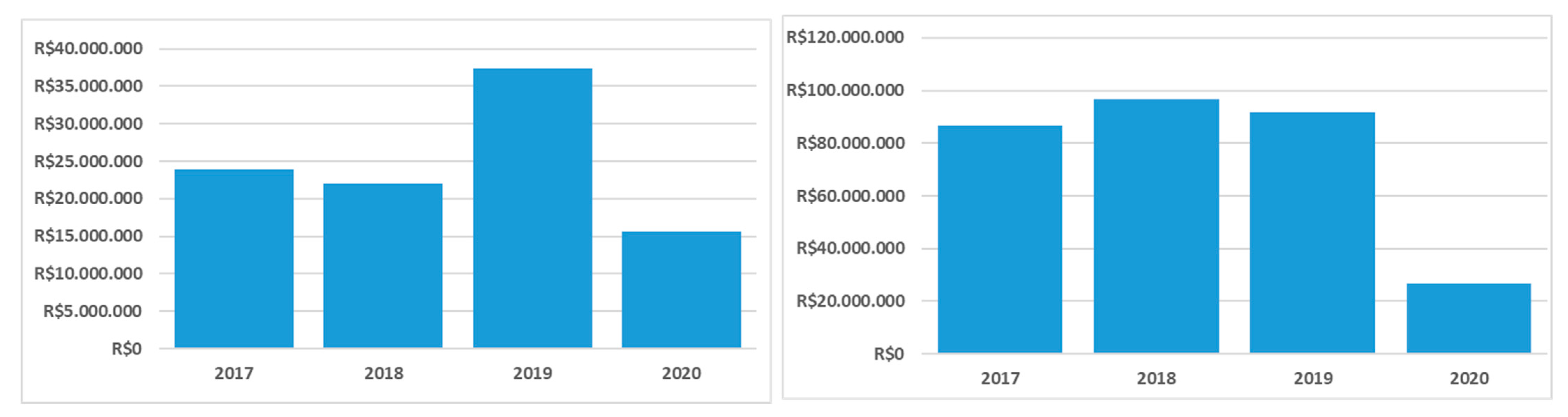
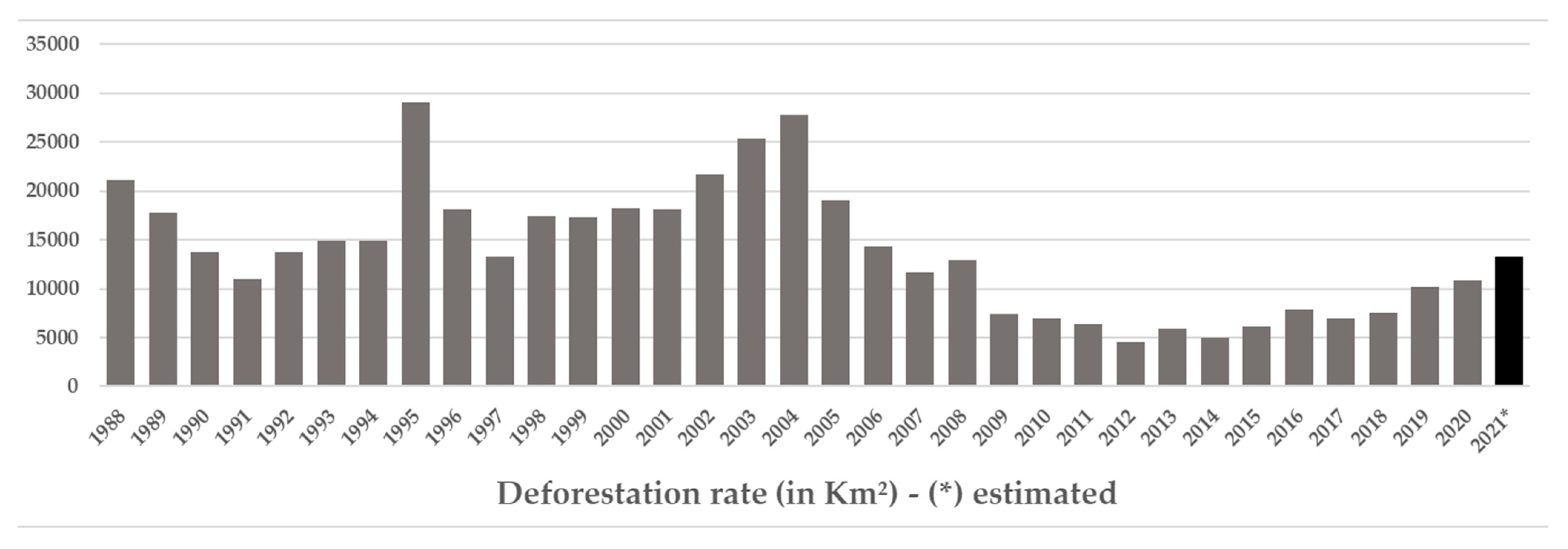
The fourth (and current) phase of the PPCDAm was marked by the dismantling of many relevant policies created in the past and a critical turnover in command-and-control actions. The “innovation” was the protagonism of the military to monitor and provide on-the-ground patrols for preventing environmental crimes instead of the integration of a multi-ministerial task force as was promoted in the past. For that matter, it is important to highlight that, even though the military spent more than BRL 124 million in two months of operation
8 [
14]—almost the same budget that ICMBio and IBAMA had available for the same purpose (see
Figure 1)—more deforestation was perceived, as shown by the results, which speak for themselves (see
Figure 2). Another highlight of this period was the blockage that the Amazon Fund had from the donating countries (especially Germany and Norway), which were accused of not cooperating with the government’s agenda and, therefore, restrained the use of the resources until an agreement was reached—something that it is still pending today.
Further details on the recent history of the PPCDAm and the Brazilian actions to diminish deforestation are provided below, as more focus is given to the evolution of the institutional frameworks during this period, their results, and other actions that were carried out that affected the continuity and effectiveness of the Amazon conservation strategies.
4. Clear Land Rights to Diminish Deforestation
There is enough evidence to support the argument that legitimate land rights help to contain deforestation and protect natural environments, especially when other forms of allocation of land rights are considered in addition to private property, such as communal or indigenous territories, conservation units, and/or mixed forms of use. On the other hand, unallocated public lands and/or regions with poorly defined tenure situations are subject to illegal occupation, land grabbing, and other forms of conflict once perpetrators find valuable resources to be exploited in them (in addition to the land itself)—especially when those regions are distant from administrative centers or located in densely forested areas, which are more difficult to verify or monitor [
15,
16,
17]. Even though there a minority of rural properties are responsible for most deforestation [
18], different forms of recognition of land rights are the first step for the adequate enforcement of the rule of law—which might prevent illegal occupants—and have proven to be an effective way to protect the remaining tropical forests.
A recent study by Pacheco and Meyer [
18] discussed how different land tenure regimes are determinants of tropical deforestation rates in Brazil, even though context-specific factors and on-the-ground government control are also relevant to the matter. After a sophisticated econometric assessment, using the deforestation rates and the different land-use categories as determined by Sparoveck et al. [
19], the authors discovered that in “Brazil-wide analyses, on average, undesignated/untitled regimes increased deforestation between 1985 and 2018 by ~12.4–23.2% relative to all other tenure regimes” [
20] (p. 5), with the undesignated lands having the worst outcomes in terms of forest protection—even worse than private lands, because they are subject to extensive environmental obligations—as was the case especially for remote areas with limited public capacity for control/enforcement. It is important to note that fully protected areas and territories held by indigenous peoples and local communities (IPLCs) had the best forest outcomes when compared to all other land rights regimes.
In a similar argument, Reydon [
21] stated that land governance is a prerequisite for reducing deforestation, as it guarantees land rights (and responsibilities) for different ends, identifies public lands (and, therefore, enables their monitoring), regulates land purchases, and defines zoning for different regions in different contexts, among other outcomes that can have a positive impact on forest protection. Most importantly, the authors showed the importance of land speculation in the process of deforestation, with the clearance of a forested area representing an increase in its value of up to 14-fold, as well as adding the value of timber extraction to the grabbed area at minimal costs. Most importantly, they highlighted how the practice of public land appropriation is associated with “the absence of effective regulation of land property in Brazil, and particularly in the Amazonia” [
21] (p. 6), which is one of the key drivers of deforestation in the region and is an endemic problem due to the lack of cadaster and its effective integration with registered property rights. Without this solid base to enable good land governance in the country, we will continue to see illegal deforestation, as it is a precondition for grabbing public lands, which can be a very profitable business.
In a much broader study, with a worldwide scope, Robinson [
22] conducted a meta-analysis of the available peer-reviewed literature that “specifically include aspects of land tenure related to form or security in assessing forest cover change over time in tropical and subtropical regions” [
22]. Considering its findings, the authors concluded that no form of land tenure assessed (i.e., public, private, communal, or other specific arrangements) is immune from deforestation pressure, especially when socioeconomic and governance factors are considered, which are hard to disentangle. Thus, at an aggregated level, “protected land is associated with positive outcomes in all regions, and public land seems to be particularly vulnerable to negative forest outcomes in South America” [
22] (p. 288). In summary, land tenure security can provide an effective response to deforestation, but it is not a perfect safeguard, as it depends on other socioeconomic and enforcement factors because security plays an important role as a market-based mechanism; however, the protection of other forms of use is also critical.
Moreover, land tenure insecurity also plays an important role in deforestation and environmental degradation, as a byproduct of contentious social relations between large landholders and landless workers—an aggravated scenario, since Brazil is one of the most unequal countries for land distribution. An uneven competition for land can spark negative outcomes—especially violence and conflict, but also deforestation, since it is advantageous for squatters to occupy forested land and for landowners to deforest it once a threat is perceived, as the empirical results from the authors show. Finally, the article highlights the inefficiency and negative environmental impact of a land reform process based on social movement occupation (instead of guided public policies), demonstrating the negative externalities that insecure land rights can pose in the deforestation of the Amazon region.
It is becoming evident that land tenure security and governance play an important role in controlling deforestation in the Brazilian Amazon, but this alone cannot explain the trends observed in the 21st century, since the effects of policies such as the PPCDAm cannot be ignored. To that end, Assunção [
23] argued that commodity prices do have a correlation with deforestation trends but, most importantly, “Brazilian environmental policies had a sizeable direct impact on deforestation levels and have thereby curbed forest clearings” [
23] (p. 32), up to a point that estimates suggest an increase of 56% in deforestation rates from 2005 to 2009 if the policies analyzed were not in place at that time. The authors’ assessment highlights the importance of effective policies and enforcement to tackle complex problems such as the deforestation in the Amazon, especially by interlinking solutions with structural root causes such as land tenure—one of the key aspects of the success of the PPCDAm during its initial phases.
Along with the command-and-control policies and the classification of higher-risk municipalities, the PPCDAm also created many protected areas from conservation units of integral protection and sustainable use, covering an area larger than 520,000 hectares in less than 5 years, which became an important barrier to the advance of further deforestation. Even though this was perceived as a positive response for the conservation of the biome, there are still large portions of public forests yet to be designated—almost 70 million hectares according to Azevedo-Ramos and Moutinho [
16], accounting for 25% of all deforestation recorded for the studied period (2010 to 2015). Most importantly, those are the areas more susceptible to land grabbing and illegal occupation, once they are considered by the authors as “no man’s land”. Moreover, specialists argue that another effort to designate those public spaces for conservation could represent an important stance to prevent further encroachments and deforestation [
24]. Despite the legal provision to do so, a strong political will to do it would also be necessary, especially considering the reverse trends that followed the political downturns in forest conservation observed after the impeachment in 2015/16.
From the lessons learned in the past and the challenges that lie ahead of us in the future, it is important to understand the role that land tenure (and its security) plays along with conservation strategies, as highlighted by Robinson [
17] in an extensive review. As argued by the authors, there is no single form of tenure that can resolve all problems, but most importantly, the landholder’s perception of its tenure security can be influenced by a variety of factors and will consequently influence their decisions towards their holdings—either to a more conservationist approach or not. The determination of land rights and the means to secure them is therefore crucial, so that landholders can feel safe in their decision-making and be influenced by the rule of law and responsible institutions towards sustainable development. Without the clear notion of who owns what, where, and under which conditions, the monitoring and effective command-and-control policies towards conservation are loosened.
Brazil has showed institutional capacity in the past to reverse escalating deforestation rates to record lows in a few years; in addition to the command-and-control policies, the actions devoted to land tenure played an important role, e.g., allocating large portions of the territory to conservation and indigenous communities, or promoting land regularization programs to clarify long-lasting informal situations. Even today, remarkable efforts to formalize land rights are being conducted nationwide, through both public and private ventures; such was the case presented by Reydon [
21], among others.
There is no need to argue about the legal background for the homologation of the pending indigenous territory claims or the constitutional priority given to the conservation of public forests. What we have been missing, especially from 2015 onwards, is the political will (and strength) to carry on conservationist efforts and the designation of public lands to traditional communities—an agenda that had the spotlight in the early years of the PPCDAm but has lost its importance in recent years, mostly due to political reasons; however, we will not elaborate on this in this article.
5. Legal and Institutional Frameworks to Stop Deforestation in the 21st Century, and Their Dismantling
In 2005, one year after the start of the PPCDAm, the deforestation rate in the Legal Amazon achieved a significant reduction—a trend that continued until 2013. It is important to highlight that the declining behavior of this index was linked to a synergy of factors. Furthermore, many authors [
4,
6,
25] argue that the creation of protected areas in the Brazilian Amazon was one of the main causes of the reduction in deforestation in the region. Soares-Filho [
26], for example, estimated that the creation of new conservation units and indigenous lands was responsible for a reduction of 13,400 km
2 (that is, 37%) in the deforestation rate between 2004 and 2006, before the PPCDAm, but the program boosted their expansion, establishing the creation of 50 million hectares in federal and state conservation units and the approval of 10 million hectares of indigenous territories—most of them located in areas under pressure from deforestation [
4].
Other authors [
23], however, argue that the main cause of the reduction in deforestation rates was the implementation of the DETER System, stating that such a command-and-control policy prevented the deforestation of more than 59,500 km
2 of the Amazon rainforest between 2007 and 2011. It is important to highlight that the success of the DETER System was due to the reinforced action of IBAMA agents in the region [
4].
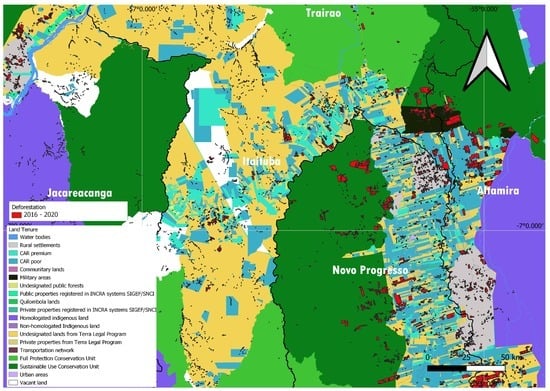
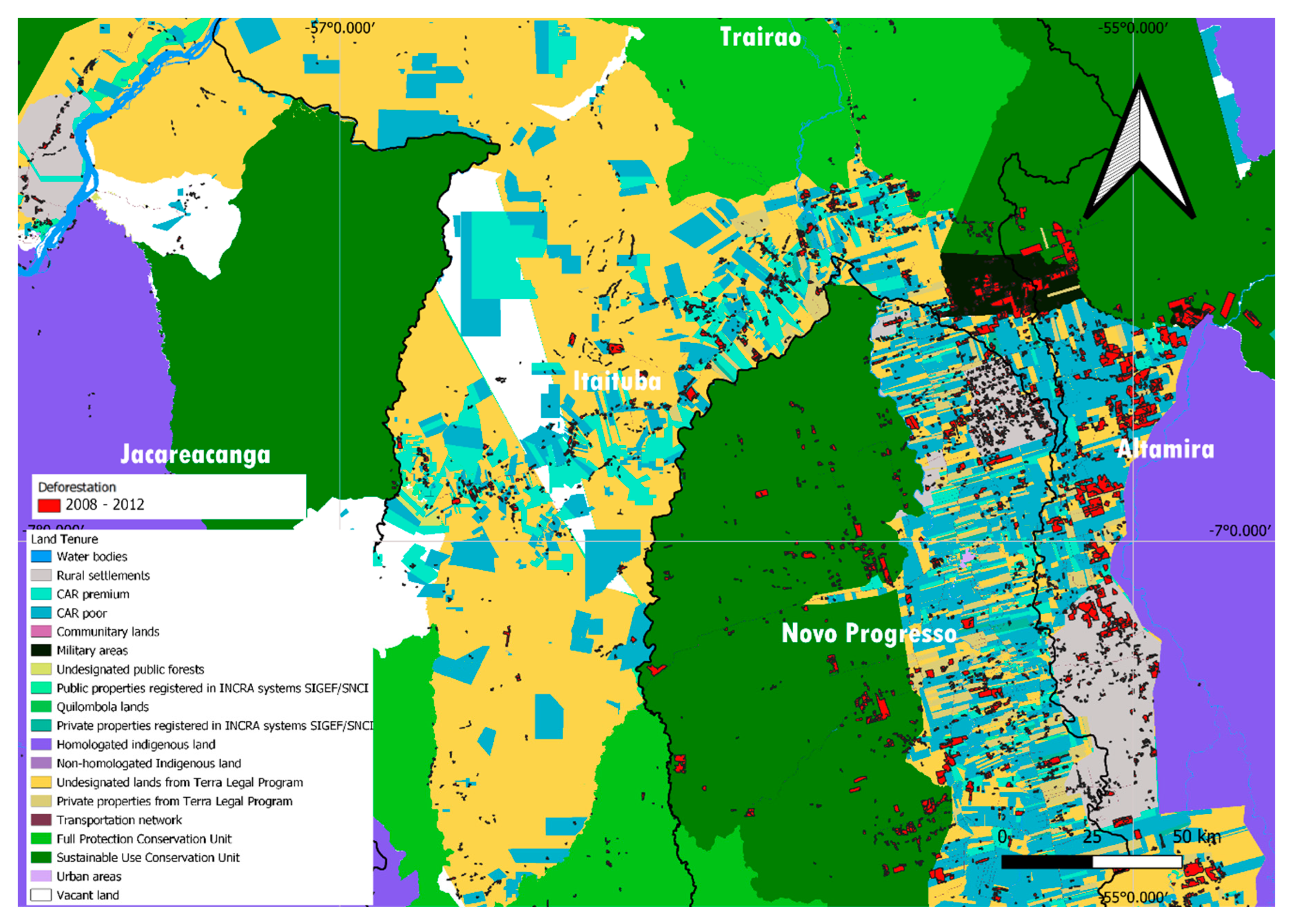
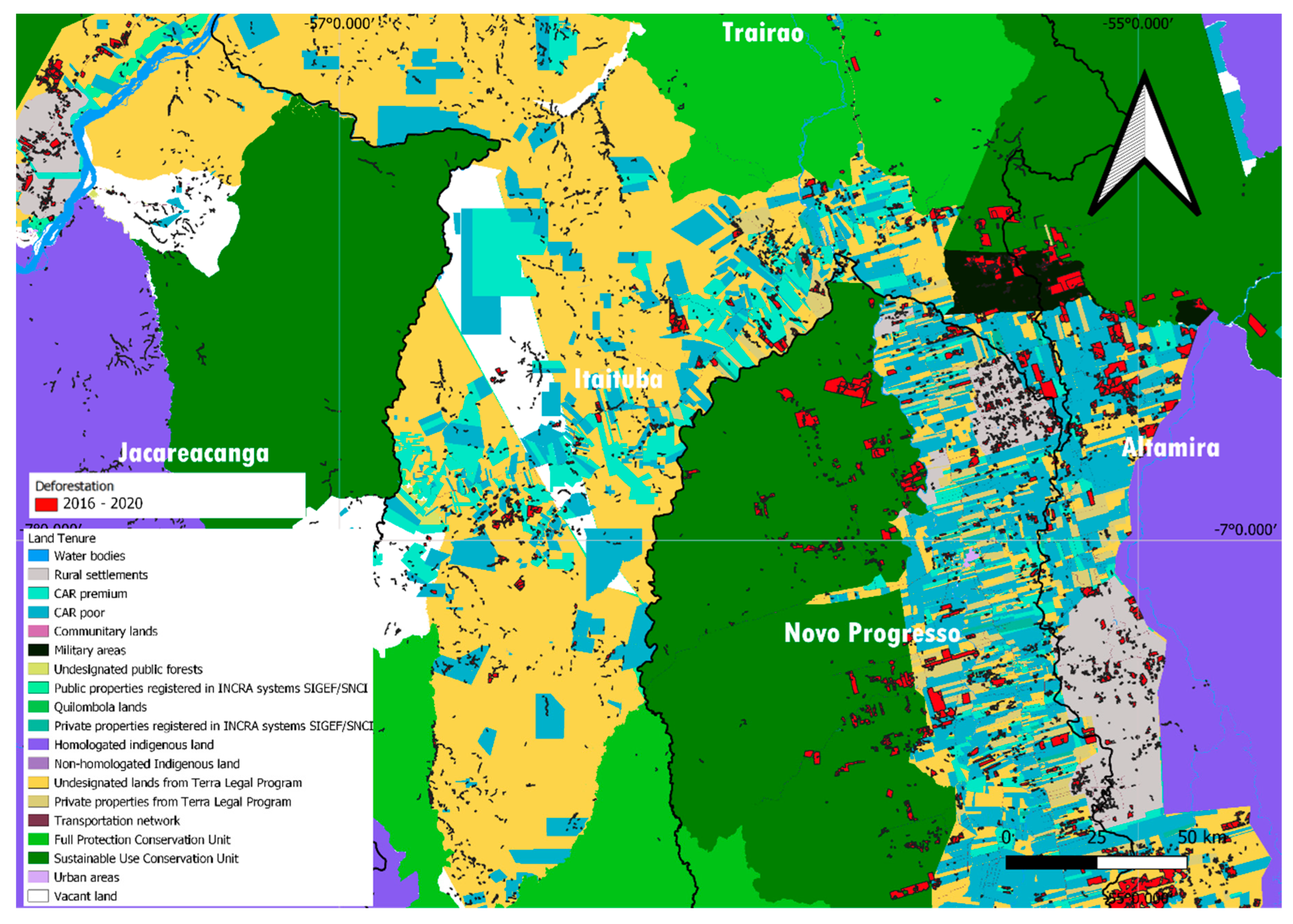
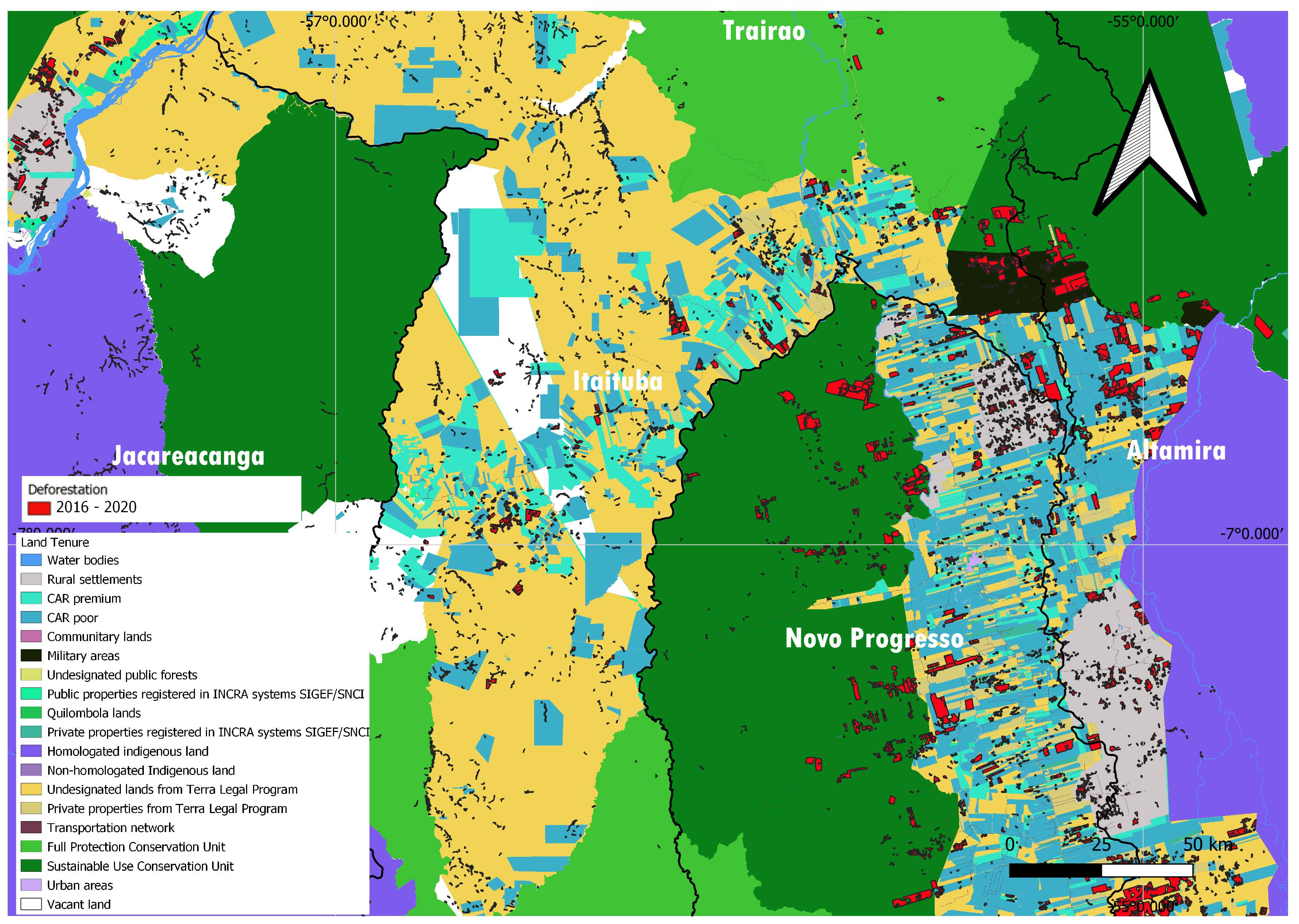
When the guidance of the PPCDAm changes, its consequences are also perceived on the ground—especially in frontier regions and in states with more “deforestation tradition”, as shown in
Figure 3 and
Figure 4, along with the deforestation rates from the main states of the Legal Amazon.
The two figures above show the same region with different categories of land occupation in two very distinct moments: one during the second phase of the PPCDAm, and the other in the most recent period of deforestation recorded, after the command-and-control policies were weakened. In addition to the size of the deforested areas, what calls the attention are the changes in patterns, where the recent period shows more deforested areas in fully protected areas (light green)—and especially indigenous territories (purple)—which is not the case in the first image. Another important change was the occurrence of deforestation in vacant (white) and undesignated lands (light brown), which could indicate land grabbers trying to demarcate land occupations in an attempt to obtain future regularization of them. This belief was enhanced after 2019, with the attempts to review the national law for land regularization, as detailed in the final chapter.
Considering that much of the institutional capacity remained the same, such as the satellite monitoring arrangement and most of the related legislation, it is reasonable to argue that many of the perceived differences were due to the weakening of command-and-control policies, along with the changes in government that not only facilitated the occupation of public lands but stimulated it. Moreover, it is important to note that this recent movement was accompanied by political attacks by Jair Bolsonaro against traditional communities and indigenous people, along with the revision of conservation units and political interventions in agencies dedicated to the protection and conservation of forests. This leads us to the discussion of how the recent deforestation was much more related to damaging changes in the institutional frameworks that were built in the past, along with the political changes that took place Brazil after 2015. This was a small sample, but many other similar regional examples could easily be found.
The consequences of the dismantling of the institutional framework built to suppress the deforestation were clearly perceived by many, including civil society organizations, companies, individuals, and foreigners alike. Nevertheless, in a constant effort to fulfill campaign promises and sustain political support from the influential rural caucus (bancada ruralista), the current government took actions to facilitate private appropriation of public patrimony (e.g., lands, timber, and/or minerals) through decrees and pushed institutional changes in the previous framework to make those natural assets economically available. There are many examples known by specialists that could be used, and many others were reported during the Bolsonaro government, but this article focuses mostly on those related to land rights and deforestation.
5.1. The Draft Laws nº 910 and nº 2633
The first and far most dangerous were the intentions to promote an irresponsible type of land regularization for illegal squatters in recent years—an effort that started shortly after the presidential elections, as early as October 2019, when the Special Secretariat for Land Issues of the Ministry of Agriculture (SEAF/MAPA) announced his intentions to promote a law to ease the regularization process through a self-declaratory process [
19]. Soon after, different organizations and representatives of the civil society strongly lobbied against the proposal, leading to a “smoother” (albeit still dangerous) version of it—the Medida Provisória (MP) nº 910 of 2019. Among other threats, the main environmental risks imposed by the regulation consist of the size of properties that can be regularized (up to 2500 hectares) and the timeframe to allow regularization, which was once 2011 and was pushed to 2018.
Again, the intentions of legal change sparked great concern among specialists and civil society representatives [
25,
27,
28,
29], and after many discussions including deputies and senators in front of public audiences, a much more “acceptable” proposal was agreed upon by the Congress, named the Draft Law (PL) nº 2,633 [
30]. Regardless, it still faced rejection by many, because it simplified the access to public land to a group of “medium” landholders (instead of only small ones, as originally intended). After these discussions, an agreement for the proposal was reached through a democratic process where the civil society imposed itself.
Despite the agreement reached between the interested parties—those who believed that the legislation towards regularization should be (even further) simplified and those who campaigned against it—the Senate overruled these efforts and pushed the PL nº 510 [
31], which brought back the most controversial aspects of its predecessor (MP nº 910). Despite its rejection, the proposal has some institutional advantages compared to PL nº 2633, because it was proposed by the Senate; therefore, there are still chances of its approval during the electoral year of 2022. This movement was perceived as the last chance of changing the current regulations in favor of those who want to economically exploit the Amazon rainforest and have already captured much of this public patrimony by invading public lands, in an attempt to take advantage of the current political condition to perpetuate the long-lasting land-grabbing culture in Brazil.
5.2. The Hindering of the CAR’s Verification Process
Another less publicized proposal that was implemented in 2019—MP nº 884, which withdrew the time limit for the CAR verification process—was later turned into Law nº 13,887 of 2019 [
32].
The CAR is probably one of the most important instruments to sustain command-and-control policies to prevent deforestation, as it is mandatory for all rural households to declare it, with all forested private areas in a single cadaster that can later be checked against other cadastral systems and satellite images to detect illegal deforestation. However, with the current legislation, there is no time limit for this information to be verified by the legal authorities—something that can be done voluntarily by willing private parties and/or in specific cases, but definitely hampers this instrument.
The CAR’s verification process was postponed many times since its creation in 2012, but it needed the right political conjecture to bury it completely. Initially, the verification process would require non-compliant landholders to conform to an “Environmental Recovery Program” (PRA) to access banking credit and other benefits, enabling those who did not join the program to be easily targeted. With the end of the legal obligation, the adherence to the PRA has become a voluntary movement of those who would like to be signed as compliant, leaving those who are speculators or land grabbers out of it, with no obligation to do so. Eventually, companies, banks, and other stakeholders might obligate their counterparts to be part of the program to sustain commercial relationships, but these arrangements do not cover all cases and are limited to the “good will” (or pressure) of those involved.
5.3. The Environment Minister’s Agreement with Sawmills
The will of government representatives to change the Brazilian rule of law with respect to environmental crime and the exploitation of the Amazon rainforest was most evident when a recorded meeting between several ministers was released, showing the (at the time) Minister of Environment Ricardo Salles addressing the possibility of change regulations through decrees during the pandemic, since it would be easier to do it when the public’s attention was diverted to other matters. This meeting, where he described the pandemic as a “good opportunity to
passar a boiada”
12, eventually contributed to his dismissal, but much of the damage had already been done.
Far from being an isolated episode that eventually cost him his position as a minister, there were several investigations into his lobbying for timber companies to “green wash” the export of illegal wood to the United States of America. By acting against the IBAMA’s institutional responsibilities, he lobbied for companies to be able to export produce originating from illegal deforestation in public areas in the State of Amazonas by a dispatch
13—an internal instrument that can be used by directors who were appointed by him
14.
In addition to lobbying in favor of sawmills, Salles represented a cultural niche among which the current administration finds support—those who believe that forested areas represent an economic downturn, since developed countries have deforested most of their territories, and that indigenous or traditional communities pose a barrier to development by holding enormous territories that cannot be exploited by private companies or generate revenue. This perspective was brought to the Ministry of the Environment under his supervision and was expressed many times, in many forms, such as his will/plan to change shape and size of many conservation units that were “barriers” to the logistical infrastructure of northern Brazil [
33].
Possibly more damaging than his passage through the Ministry of the Environment, the impact of Salles’ administration was related to the cultural incentive of this distorted perspective towards biodiversity conservation and the environmental services that it represents. These beliefs have contaminated a fair share of the Brazilian society who feel represented by them, even though many have never set foot in or seen the majestic Amazon rainforest, nor valued its biodiversity or the traditional knowledge that only centuries-old communities hold.
5.4. Legal Arrangements to Discharge Deforestation
Now that the current administration is about to finish, unless we witness Bolsonaro’s reelection, it seems that those who are represented by it are taking their last chances to dismantle the environmental command-and-control policies even further. This predatory movement, much related to the elected president, is seeking political space to further damage the current framework before the political scenario changes once again, as can be seen in many of the states and municipalities.
There are several examples that could be used in that sense, but few of them speak louder than the case of Goiás State, which has just approved Law nº 21,231 of 2022 [
34], which imposes negligible values for illegal deforestation fines, as presented in the
Table 1 and
Table 2 below—especially when considering the value of the timber on the international market and/or the value of the deforested land.
Another worrisome situation is regarding the public lands under the jurisdiction of states such as Pará, Tocantins, or Maranhão, among others, where the timeframe for occupation of public land necessary to obtain the right of regularization has been diminished or remains very short, inevitably attracting land grabbers and speculators towards these areas. This is also the case for the state of Amazonas, which holds the vast majority of undesignated land within its territory and has been facing increasing rates of deforestation—especially on its border with Acre and Rondônia, which has currently became a new region of expansion and deforestation called AMACRO, in a very similar situation as MATOPIBA, where the distance from the capitals and institutional enforcement has led to the disruption of the rule of law in the region.
Other examples of changes to state legislation that have benefited illegal occupants of public lands and the predatory economic exploitation of natural resources could be presented, such as the incentives for the construction of the BR-319 highway in Amazonas State, among others. Either way, it is important to highlight that these movements were made possible due to the political moment that Brazil has been facing in the last few years, which has enabled the private exploitation of the available natural resources.
5.5. Legal Proposal to Enable Mining in Indigenous Territories
Finally, possibly the “last blow” that the main forested areas in Brazil can take is the eventual approval of Draft Law (PL) nº 191 of 2020 [
35], which seeks to regulate the mining activities in indigenous territories in exchange for “fair compensation”. A favorite topic of the Bolsonaro administration, the possibility of economic exploitation of natural resources preserved in the indigenous territories poses a threat to the continuity of these ethnicities and a clear violation of Convention nº 169 from the OIT, preventing the communities from being able to impose themselves against development projects in their territories, since they will receive fair compensation in exchange and there are expected to be public hearings with the affected communities.
Again, much related to lobbying by a few stakeholders and companies that seek this type of venture and mineral resources, the economic exploitation of indigenous territories has been addressed by at least 20 other law projects since the Constitution of 1988, when the power of decision and autonomy was granted to these communities. Unfortunately, now there is also the political will to push this agenda forward—something that goes along with the anti-indigenous statements that the current president seems to be proud of. The potential environmental damage that such measures could provoke—not only from the deforestation and degradation of the soil, but also regarding the contamination of indigenous communities with mercury and other byproducts/residues that affect their water supply and health—should go without saying.
Once we understand this short and summarized context of the current political scenario of Brazil, it is reasonable to say that the increasing deforestation in the past four years—which has reached record levels—is much related to political will and lack of enforcement, influenced by a disruptive agenda where progress is seen only in terms of GDP growth, regardless of the biodiversity losses and social costs it might incur. Of course, the current administration has escalated this scenario a lot, but it is also fair to remember that this trend started previously and was somewhat related to the final years of the Dilma presidency (just before her impeachment) and during the two years of the Temer administration—events that are very much related to the powerful rural caucus that directly benefits from these policies. However, it is also related to the austerity-led macroeconomics guidance that restricted the public budget for conservationist practices in order to facilitate the private–economic appropriation of natural resources.
6. Conclusions
In the present review on the institutional framework that was built and dismantled in Brazil, we sought to clarify that the political will with respect to environmental conservation has changed drastically, leading to the intentional dismantling of previous effective policies and the advancement of predatory exploitation of the remaining Amazon rainforest by sectorial lobbyists. Once we consider the swift combat against deforestation in the early 2000s, it becomes clear that Brazil has all of the resources and capacity required to hinder illegal appropriation of public patrimony if there is the will to do so. On the other hand, the political shift that started in 2015/16 gave strength to a repressed will to exploit the remaining natural resources available—especially the land and everything below or above it—leading to an unprecedented sharp increase in deforestation rates after record lows.
By looking at land rights and land allocation in recent years, we can clearly see the hindering of the creation of protected areas or indigenous territories—or even of the existing national program for land allocation, which is mostly focused on clarifying land rights and promoting the protection of the forests. On the other hand, we found evidence of institutional efforts to change the laws of tenure regularization to benefit recent and illegal occupants of public lands—those who willfully deforested unclaimed lands to secure holdings expecting their validation, as promised by their political representatives. At the same time, this movement was perceived to be beneficial to illegal exploiters of natural resources beyond land, such as timber or minerals, following the same logic that applies to land tenure.
Finally, it is important to highlight that this institutional dismantling provokes tenure insecurity—something the existing literature suggests favors illegal deforestation. Instead of promoting responsible land governance, improving cadastral and registry integration and the clarification of land rights, what Brazil has experienced is the opposite, favoring chaos and conflict for the benefit of few. Eventually, this recent political movement might wear out, and a responsible management of the territory and its resources might be brought back, but it will be very difficult to reverse the damage that has been done. Even worse might be the cultural change that these few years have provoked—something that might represent a barrier to any conservationist movement in the future, meaning a tradeoff that will only cause even further compromise to the largest tropical forest in the world and one of the last biodiversity reservoirs that is still standing.