Abstract
Most land consolidation projects envisage reducing fragmentation and aim at increasing productivity, land use efficiency, and competitiveness of rural areas. However, recent insights suggest that social aspects are crucial as well. Hence, a critical assessment of the conditions under which land consolidation can be socially beneficial is necessary. This article aims to identify values and qualitative indicators to measure social preferences and to assess whether one can optimize decision support tools for land consolidation projects with such indicators. Based on an exploratory and concept-centric qualitative literature review, we propose game applications from experimental economics to measure empirical indicators of social capital. The games help to disclose conflicting social preferences and enable a more accurate response to public policy programs/interventions. This is achieved by assessing commonly shared norms of trust, reciprocity, and cooperation within and across social groups in a targeted area. We posit, however, the disparity among bonding, bridging, and linking dimensions of a social capital could have a differential effect on land consolidation instruments. This experimental method applied in Kakheti, Georgia reveals that 1. the farmer communities have varying combinations of bonding, bridging, and linking social capital; 2. the local farmer societies are the archetype of the collaborative model and sharing economy; 3. only a few municipalities show the highest potential for sustainably managing land consolidation projects. Hence, applying economic games that explore social scenarios helps to derive more favourable solutions for land consolidation.
1. Introduction
Land consolidation is an effective instrument for integrated rural development [1,2] when the aims are improving agriculture productivity, farmland ecology and food security [3], cost efficiency of production and mobility, boosting agriculture productivity, parcel readjustment for village renewal, and aligning land, which needs to be environmentally preserved. One of the historical drivers to opt for land consolidations has been to redress the partitioning after inheritance and the fact that the division of inherited land leads to gradual rights and economic fragmentation of land holdings [4,5,6]. Along with growing demand for land resources, land consolidation projects take place with challenging and conflicting decisions. Land consolidation requires comprehensive decisions to satisfy the balance between the needs of ecology, society, and agrarian efficiency [7,8]. In order to deal with multiple priorities, previous researchers created comprehensive analytical approaches, such as integrating multiple criteria analyses to support decisionmakers in priority-setting for the land consolidation process. However, such proposed analytical frameworks tend to rely on single mathematical optimization models with spatial and cadastral datasets and ignore underlying social preferences of local landowners. Recent socioeconomic insights into household food security and agriculture production diversification show that land fragmentation is not necessarily a requirement for rural development, resulting in a critical assessment of the conditions under which land consolidation can be beneficial [9]. Explanations of growth and development depend on the assumptions made about individual preferences and the willingness to engage in strategic behaviour [10]. This article aims to present a novel perspective, namely to identify what sort of values and qualitative indicators should be employed to measure the social dimension of land fragmentation, and to employ such a novel perspective as a basis for assessing whether land consolidation intervention is appropriate or not. To address this aim, we started with an exploratory and concept-centric qualitative literature review, and gradually learned that game applications could potentially provide an additional insight in which social values play a role in land decision-making. This article presents part of this learning process, which gradually led us to the question of whether we could induce, and, how and under what conditions game applications of experimental economics could be applied to measure empirical indicators of social capital. In order to address these questions, this article is structured as follows: We first discuss the general context of the land consolidation approach as a conventional instrument to reduce land fragmentation and the context in which studying the topic makes sense. The subsequent section reviews and synthesizes the relevant literature on this topic. We then classify different definitions of social capital and review multiple concepts about the role of social capital in various rural development processes. Next, we discuss how and when the application of games could prove useful. In the Section 5, we review results from field visits to the Kakheti administrative region of Georgia, arranged for local medium and small size farmer communities in four municipalities. In the Section 7, we discuss limitations and provide recommendations for further research.
2. Theoretical Review on Land Fragmentation and Consolidation
There is no consistent agreement in the literature that prescribes when and how to execute a land consolidation process or if there is always a need to reduce land fragmentation. Instead, there are various points of view and multiple discourses, which address these issues separately or collectively. We highlight a number of the most seminal articles and prominent opinions.
First of all, a causal relationship between the reduction of land fragmentation and the application of a consolidation approach has become a controversial issue. Conventionally, land fragmentation has been a key requirement to opting for land consolidation. However, recent socioeconomic developments reveal that land fragmentation is no longer a conditional requirement to land consolidation. Ref. [9] critically reviewed causal relationships between fragmentation and defragmentation approaches and added that local-specific social, economic, and ecological backgrounds inform a preferred approach between fragmentation and defragmentation. Refs. [11,12] highlight positive outcomes from land fragmentation in areas where local governments develop risk management strategies to deal with climate change vulnerability and associated food insecurity. Analogously, Ref. [13] added that land fragmentation in Albania is a preferable approach, as it stimulates production diversification and food security at farm household level, where the agriculture sector is more self-consumption-oriented.
Another associated issue with land consolidation is its complexity. According to Ref. [14], the growing number of land use priorities (i.e., not only agricultural improvement, but also incorporating environmental interests, for example) have influenced the debates over whether land consolidation in rural development has become too complicated and has resulted in far too long procedures. This has resulted in hesitance to opt for land consolidation. Investigating the specific conditions and various outcomes from the land consolidation processes in the Czech Republic, Ref. [15] pointed out that drivers to opt for land consolidation (instead of opting for another land intervention approach) are various and shaped by specific conditions in different countries, such as initial historical, natural, cultural, and political development factors. Furthermore, Ref. [16] empirically explored the raising concerns over environmental priorities and studied economic aspects of public parks by statistical model. They found out that public parks have multiple development implications and along with ecological importance, these public amenities stimulate local economic growth. However, their economic effects vary with time. Moreover, there are conflicting interests between the agrarian sector and land preservation. Ref. [17] emphasized that modern profitable agriculture production and nature conservation can no longer be mutually exclusive and can be achieved at the same time on the same land. Adding to this, Ref. [18] illustrated how land consolidation and water management can be strategized to form multifunctional climate resilient rural areas. As opposed to this, Ref. [14] states that balance between agriculture and environmental objectives can be questioned as farmers need larger and functionally tailored farmlands, which leads to a decrease in the environmental attractiveness of landscapes.
In addition, there is a problem of limited acceptability in a land consolidation approach. For example, the land consolidation is perceived negatively in Slovakia. The negative perceptions about land consolidation were associated with miscommunication, lack of trust, and education [19]. According to Ref. [20], past experiences associated with land consolidation in Slovenia reflects the limited acceptability of the land consolidation instrument among landowners. Similarly, regardless of noticeable cost savings from the project’s realization, local farmers of olives in Andalusia, Spain, were reluctant to become involved in the land consolidation process [21].
The complexity of land consolidation projects led to an increased interest from land management researchers to create optimal methodological tools to achieve social consensus among stakeholders and their conflicting priorities. Refs. [14,22,23,24,25] use multicriteria evaluation tools as a decision support framework for selecting land consolidation projects. As opposed to this, Ref. [15] points out that the reliability of any multidisciplinary approach depends on a proper definition of the relevant criteria, which vary across countries due to differences in socioeconomic and natural conditions.
Land consolidation processes should consider social aspects alongside economic aspects. De Vries and Voß [26] clarify some of these social aspects, such as beliefs, values, priorities, and perceptions. Scott [27] furthermore lists that people have certain opinions and views on landscape, which influence the way in which people act and behave in relation to economic and legal rules. In addition, Ref. [14] adds that behaviour cannot be derived or explained based on economic values and rules only. Hence, there is a need to take social aspects into account more seriously in the discourse on land consolidation.
Previous research studied the role of social capital in various socioeconomic activities as it accurately addresses complex theoretical and political issues. Several publications [26,27,28,29] clarify that the social capital concept has become a cornerstone for sustainable development policies and nature’s governance. Others [30,31,32,33,34,35,36] examined to what extent social capital contributed to rural community development, rural revitalization, agriculture and rural development, tourism destination management, and acculturative stress management. Kim et al. [37] addressed that people produce more economic pie in an environment of high trust and positive beliefs. Cardenas and Carpenter [10] analysed the links between behavioural measures and economic outcomes. Hence, there is a need to study and assess qualitative values of social capital and its potential effect on land policy initiatives.
To summarize, the recent research identifies the need to integrate social preferences into measurement methods for land fragmentation. Empirical indicators of social values systems such as trust, cooperation, risk aversion, and time preferences vary across countries and periods, and play important role in people’s wellbeing. Experimental economics games enable the measurement of these social preferences. This informs policymakers about more accurate interventions in terms of choosing between land fragmentation and land consolidation processes.
3. Methodology
We conducted a systematic literature review and used a mapping approach to discover what is known about certain phenomenon—social capital in the land consolidation/defragmentation process. The goal of this first step of data collection to derive relevant and comparable definitions and concepts in other domains, which are relevant to our studies as well as for executing the experiments. As an innovative research method, we used game designs borrowed from the experimental economics discipline and explored and compared conflicting social preferences within and across neighbouring farmer communities. By measuring trust and cooperation potential among local farmers in the Kakheti region of Georgia, we can propose innovative approach to measure qualitative indicators of social capital and to better support the decision-making process in land consolidation projects.
3.1. Search Process and Analysis of Selected Articles
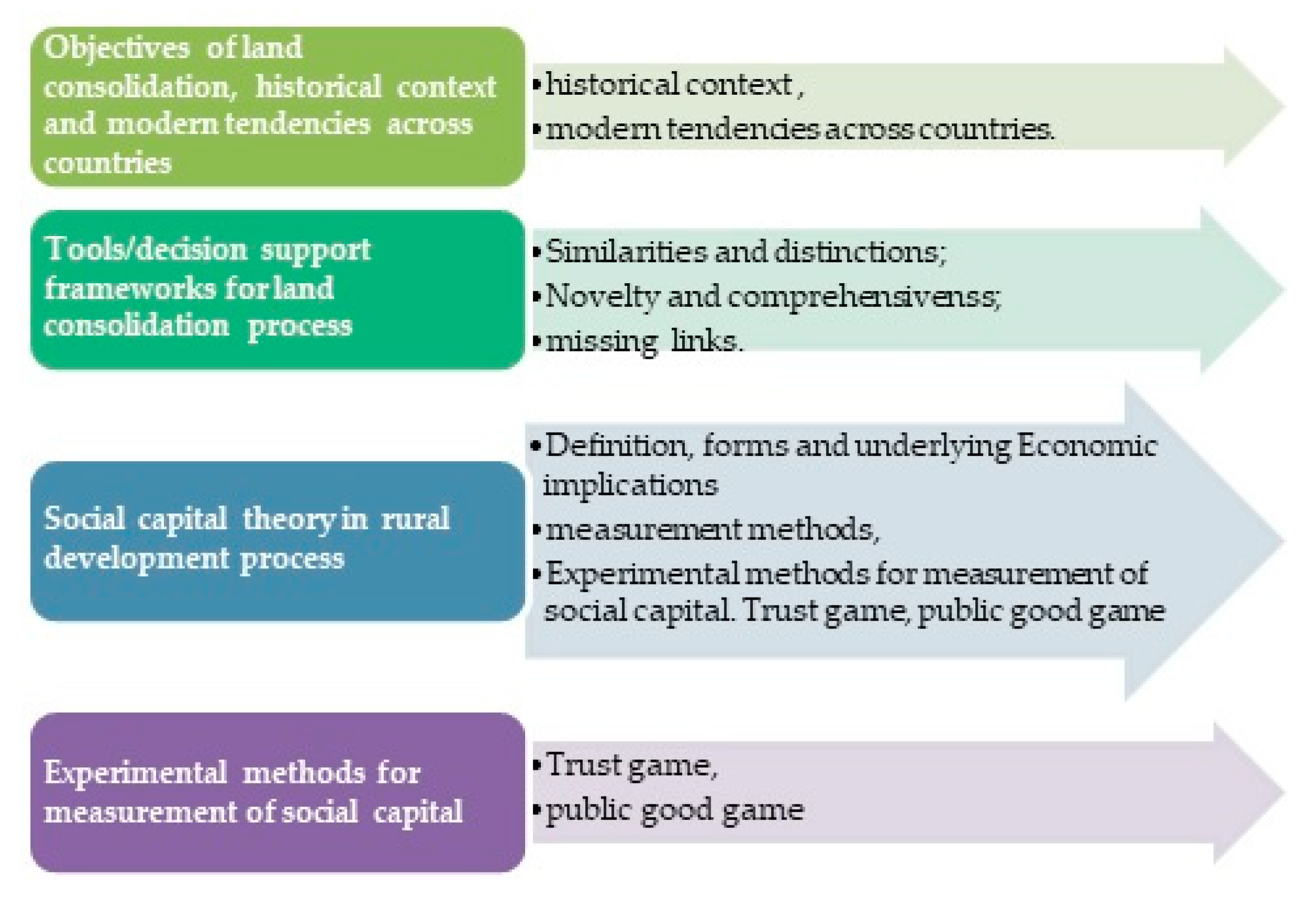
The context of the study was deriving how and when land consolidation could play a role in achieving rural development. This required constructing and using qualitative indicators to justify the initiation of a land consolidation decision. In this context, this study conducted an exploratory and integrative concept-centric qualitative literature review about what sort of values and qualitative indicators should be employed to measure the social dimension of land fragmentation, and to assess whether land consolidation is necessary or not. In order to derive knowledge, we reviewed the previous research about the conventional land consolidation methods across countries as a way to identify recent trends in multiple socioeconomic and environmental priorities. We analysed existing analytical tools and identified missing links in the valuation process. We introduced dimensions of social capital and its measurement techniques. We posit that social capital values are an integral component of the decision-making process, which is necessary to make policy measures more responsive to social preferences at a given location. This study uses a synthesis of the disciplines of land management, social capital theory, and experimental economics.
Figure 1 describes how we collected literature and used key words.
Figure 1.
Description of the data collection process.
The search activities included literature identification and search, preliminary review filtering against relevance and reliability criteria; critical review of selected documentation; analysis and synthesis, summarizing research objectives and topic reconceptualization. The search was limited to peer-reviewed academic journal articles as well as a limited number of working and professional papers from the World Bank and other international academic institutions (Table 1).
Table 1.
Search results of the literature review. Number of articles found from the databases.
It should be noted that the majority of selected articles were found through the Science Direct database; in particular, the Journal of Land Use Policy and Journal of Rural Studies turned out to have high thematic relevance (Table 2).
Table 2.
The number of articles from the Science Direct database.
In our data collection process, we relied on forward and backward literature search techniques, and the following platforms:
- Strategic concepts and public policy reports for integrated rural development and land consolidation in Bavaria, Germany and the EU (such as land market regulations, Bavaria’s bioeconomy, strategic concepts of spatial development in Germany);
- Web-based scientific repositories (Google Scholar, Web of Science, JSTOR, EconStor, Elsevier, ResearchGate, online libraries);
- Published journal articles and working papers by EBRD, World Bank Institute, FAO, UN SGDs, OECD;
- Sector-specific expert knowledge (Ty Turley professor of Experimental Economics and Behavioral Economics courses at the City University of New York, prominent scholars and land experts from the Chair of Land Management at the Technical University of Munich, who make an active contribution to the overall field of knowledge in and management.
Furthermore, we used a concept centric research and explored the case studies in up to 24 countries both in terms of the practical and methodological issues in land management field. This way, we studied and synthesized the experiences of different countries on the conventional land consolidation approach and analysed specific issues with various decision support frameworks. The selected reference papers included various relevant and interesting case studies, some of them carried out in the same country in different years. Bellow, there are summarized case studies both in the context of geographical distribution, by countries, as well as chronologically, by years (Table 3). Overall, the data analysis relied on 52 publications, and the publication periods range from 2000 to 2022. The largest majority was from the period 2014–2020
Table 3.
Selected papers include case studies conducted in 24 countries altogether.
3.2. Game Experimental Design and Procedure
In addition to a systematic literature review, we organized field visits to four Kakheti administrative region municipalities in Georgia and met with up to 40 local farmers. The field study in each municipality was divided into two parts: The first was the experimental design and a survey. The experimental design was conducted in the format of experimental games and was aimed at measuring trust and cooperation potential among farmer communities. These experimental designs consist of two phases: in the first phase farmers play a trust game and in the second phase, as a voluntary contribution mechanism, farmers play a public goods game.
In the trust game, interaction consists of two roles that we refer to as the “sender” and “receiver”. Participant farmers are randomly paired with a partner farmer and are both endowed with 50 tokens at the beginning of the game. The first player (farmer) chooses how many tokens to send to the second player (partner farmer). Any token sent to the receiver by the sender is tripled. Both the sender as well as the receiver are free to send and return anything from 0 to 50. Each player sends and returns money in a double-blind format. Players are completely anonymous during the game. Each player receives a specific amount of money to split with his/her partner. Upon receiving the triple number of tokens, the receiver chooses how many tokens from 0 to triple the amount to return to the sender. These individual and anonymous decisions determine final earnings for all players.
In a public goods game, farmers from the same municipality are grouped with each other. Each farmer is a member of a group consisting of 8, 9, or 11 people. Each of the group members are endowed with 20 tokens at the beginning and each farmer makes a simultaneous decision on how to allot these tokens, in digit amounts, between private and public baskets. Tokens in the public wallet are doubled and divided evenly among participants. At the end of the round, each player’s payoff consists of the tokens in their private wallet plus acquired earnings, distributed evenly. Players are asked to play 6 rounds and we record individual allocation decisions and whether there are strategic changes in decisions.
The second component of the field study was a farmer survey. By collecting and analysing individual responses from the trust game and public goods game, we can measure levels of trust and cooperation among local farmers regardless of their farm business size and activity. In addition, with the survey method we can fill in and quantify other components of social capital as well. Overall, application of these two methods in combination are complementary in terms of reliability and completeness of collected information and results.
In order to study and measure dimensions of social capital among farmers, we selected 4 municipalities in the Kakheti administrative region of Georgia. These were: Gurjaani, Telavi, Kvareli, and Lagodekhi. The field experiments were conducted individually in each municipality. Field experiments in municipalities were designed to individually explore and measure social capital among farmer communities and compare to what extent trust and cooperation differs among neighbouring farmers across municipalities. Based on results from experimental study and survey, we devised a quantitative measure of social capital consisting of 5 dimensions: bonding social capital, bridging social capital, linking social capital, trust and reciprocity (trust game), and cooperation (public goods game).
Finally, we followed recommendations by Ref. [38] where authors describe a preliminary model, which has not yet been tested, and highly encourage the rest of the academic community to evaluate, test, and further develop this model. We tested this measurement model in practice with a radar chart using a scale of 0–5. The proposed tool aims at evaluating bonding, bridging, and linking aspects of social capital and separately showing actual attitudes of participants towards trust, reciprocity, and cooperation in the trust game and public goods game for target social groups. This enables us to quantitatively identify each qualitative aspect of social capital in relation to land consolidation programs. If decisionmakers are sufficiently conversant about areas where dimensions of social capital are not high enough, they can look at these dimensions on a radar chart and therefore reconsider land consolidation projects and opt for land fragmentation. This recommendation encouraged us to convincingly link dimensions of social capital with land consolidation projects.
4. Findings from the Literature
4.1. Definition and Dimensions of Social Capital
Social capital (SC) is a concept concerning social ties that links members of communities with common social, physical, natural, human, and financial attainments. This is a conceptual stock of social trust, networks, and values upon which people can draw in order to improve their livelihoods and to pursue shared objectives [39,40]. SC can be separated into two related components, structural and normative [41]. The structural component of SC consists of bonding, bridging, and linking SC while normative components are trust, reciprocity, and cooperation [42].
Auer et al. [43] classify SC as bonding and bridging capital. Bonding SC refers to the internal ties among relatively homogeneous individuals within the same community or group (family, friends, and neighbours). Bridging SC refers to the relationship with external members from communities or groups. McGillivray [42] discusses the third component of linking capital, which connects people of different levels of authority and power, allowing people to access resources that could not be found alone or by mobilizing the other two types of SC. SC ties are strong in bonding, whereas in bridging SC ties are weak. Bonding SC facilitates cooperation by informal and experiential knowledge sharing, sharing farm labour and farm machinery; bridging and linking social capital allow access to research, innovative experiences, and cutting-edge technologies. Therefore, bonding social capital leads to efficiency improvement and is somewhat limited to the utilization of existing resources, while linking and bridging social capital lead to expanded resource potential and attainment of productivity growth through gaining more resources, better resources, and better technologies. Table 4 summarizes bonding, bridging, and linking social capitals.
Table 4.
Types of social capital, actors and sorts of support provided.
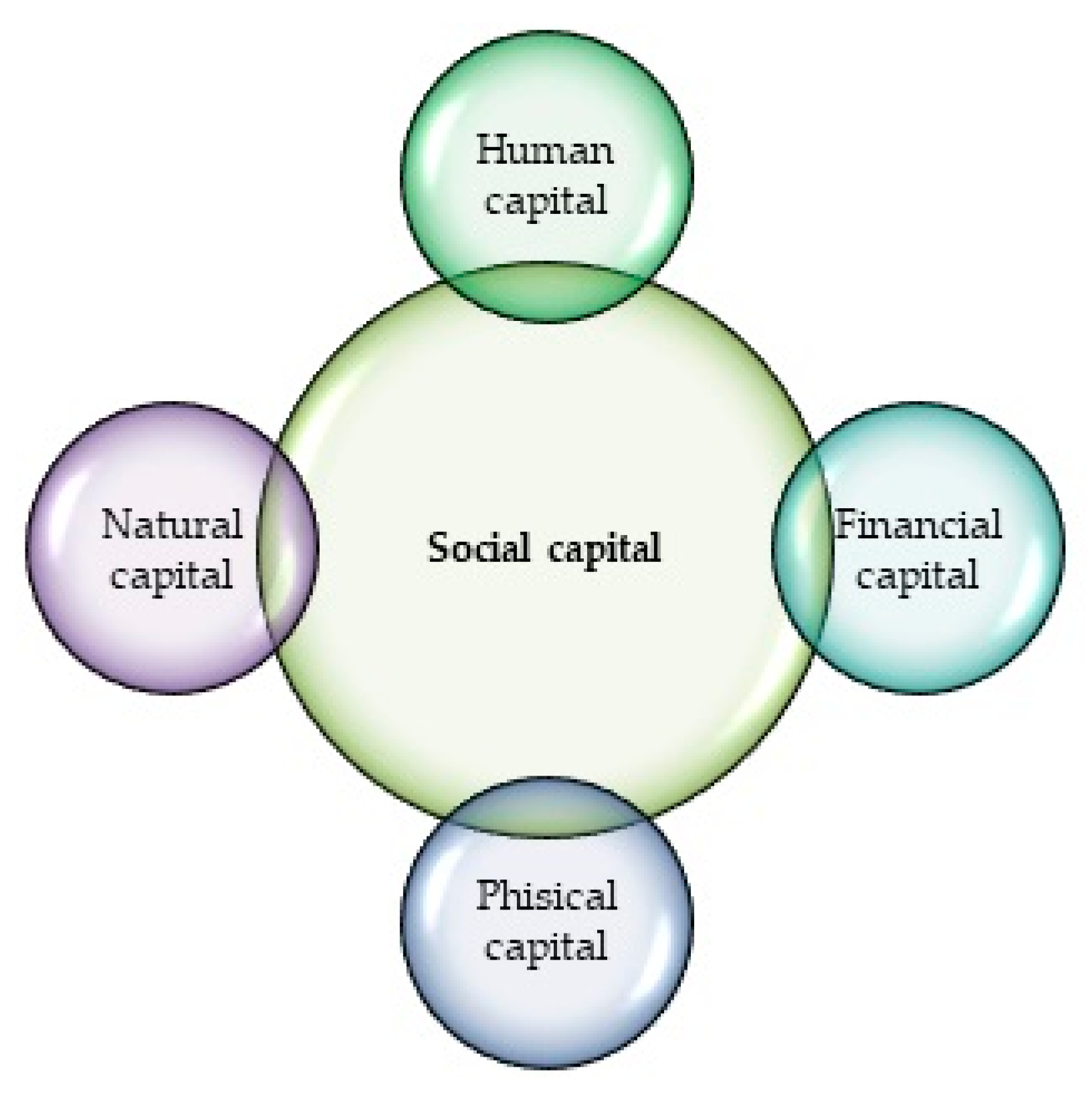
Soulard et al. [32] point out that each community relies on its own specific mix of capitals, with social capital representing the cornerstone of further development. Thus, different communities own different mix of physical, financial, human, natural, and social capitals, where social capital is a core component. Figure 2 depicts this relationship.
Figure 2.
Balance of five forms of capital. Source: adapted from Soulard et al. (2018) [32].
Communities with varying combinations of bonding and bridging social capital characterize differential behaviours. Communities with an imbalance of bridging and bonding capital become either resistant to change (high bonding, low bridging), fractious (low bonding and bridging), or engage in clientelism (low bonding and high bridging).
4.2. Role of Social Capital in the Contexts of Development
Social capital has gained its popularity due to its accuracy in addressing complex political issues [43]. Analysis of previous research findings show that there is a positive relationship between social capital and collective actions. The dimensions of social capital effectively serve different development objectives in the farming business [44]. Furthermore, trust, network, and connection enhance productive efficiency, natural capital conservation, and management [43]. Additionally, positive effects of social capital on various socioeconomic development processes include, amongst others [30,31,32,33,34,35,36,45]: conflict resolution, rural tourism and village capacity enhancement, rural revitalization, increased valuation of land elements, agriculture, and rural development (Table 5).
Table 5.
Role of social capital in various contexts of development.
Hence, social capital should be taken into account where stakeholders’ interests overlap each other and contrasting socioeconomic and ecological priorities cause tensions.
4.3. Measurement Tools for Normative Values of Social Capital
Many social scientists claim that trust plays important role in socioeconomic development processes; however, the measurement for trust has not been fully settled. Some early studies use survey methods [38,43,46,47] for measuring trust. The survey measure of trust is widely used by the American General Social Survey (AGSS), and by the World Values Survey, which measures cross-cultural differences in trust. In addition, the German Socio-Economic Panel utilizes survey measures of trust, risk aversion, and betrayal aversion, where trust, betrayal aversion, risk aversion, and altruism are measured by the questions presented in Table 6.
Table 6.
Survey measures of trust by SOEP in Germany.
Unlike survey measures for trust, experimental games represent behavioural measures of trust, which provide a more accurate and non-intensified response from respondents. In order to measure trust, reciprocity, and cooperation, the experimental design consists of two games, namely the trust game and public goods game. The trust game is a field experiment consisting of two players. A first player, the trustor, is endowed with 50 tokens, and has to decide either to keep the whole amount for herself (i.e., being not trustful), or transferring a certain/whole amount to the secondary players, the trustee (i.e., being trustful). Likewise, the trustee has to decide between keeping the whole amount to herself (being not trustworthy) and giving back more than half of her tokens (being trustworthy). Results from an initially played trust game enables the creation of simulated environments, where manipulated beliefs among group members in a public goods game inspire behavioural response by voluntary contributions and finally suggest that people with high trustful and trustworthy environments contribute more and show high cooperation potential.
5. Results from Field Visits in KAKHETI and the Pilot Trust Game Experiment
The groups of local farmers participating in our field experiment were balanced in terms of gender (67% male and 33% female farmers). In addition, the farmer groups were diverse, in terms of age, education level, farm business activity or size of land. Farming activities comprised 12 directions, including viticulture and winemaking, cereal production and beekeeping, dairy farming and meat farming, berries, fruit orchards, and greenhouses and horticulture. We applied combinations of experimental game design and a survey method to obtain a broad picture of farmers’ social preferences. In the next sub section, we show the general situation in Kakheti’s agriculture sector and then we present results from the carried-out field experiments in targeted municipalities.
5.1. Results—General Socioconomic Situation in Kakheti Municipalities
Kakheti is a wine region of eastern Georgia, which comprises eight administrative municipalities with up to 9% of the total country’s population. Among the eight municipalities in Kakheti, we chose four municipalities for our field experiment, which comprises up to 57% of the total regional population of Kakheti. These municipalities are Gurjaani, Telavi (Capital), Lagodekhi, and Kvareli. It should be noted that Telavi is the administrative capital of the Kakheti region. In this section we draw a socioeconomic picture of the Kakheti region in terms of targeted municipalities and create background portrait for our research objective.
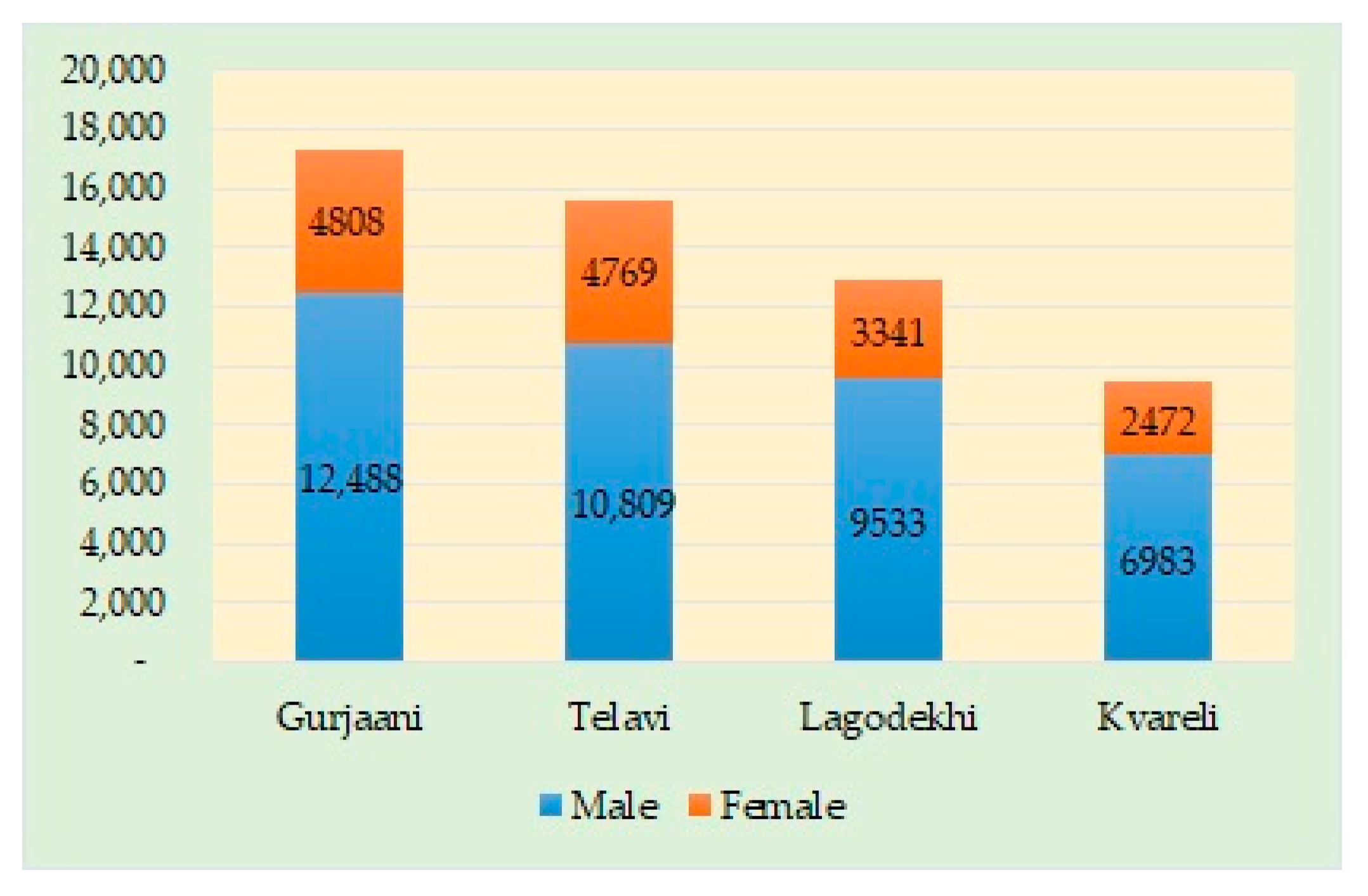
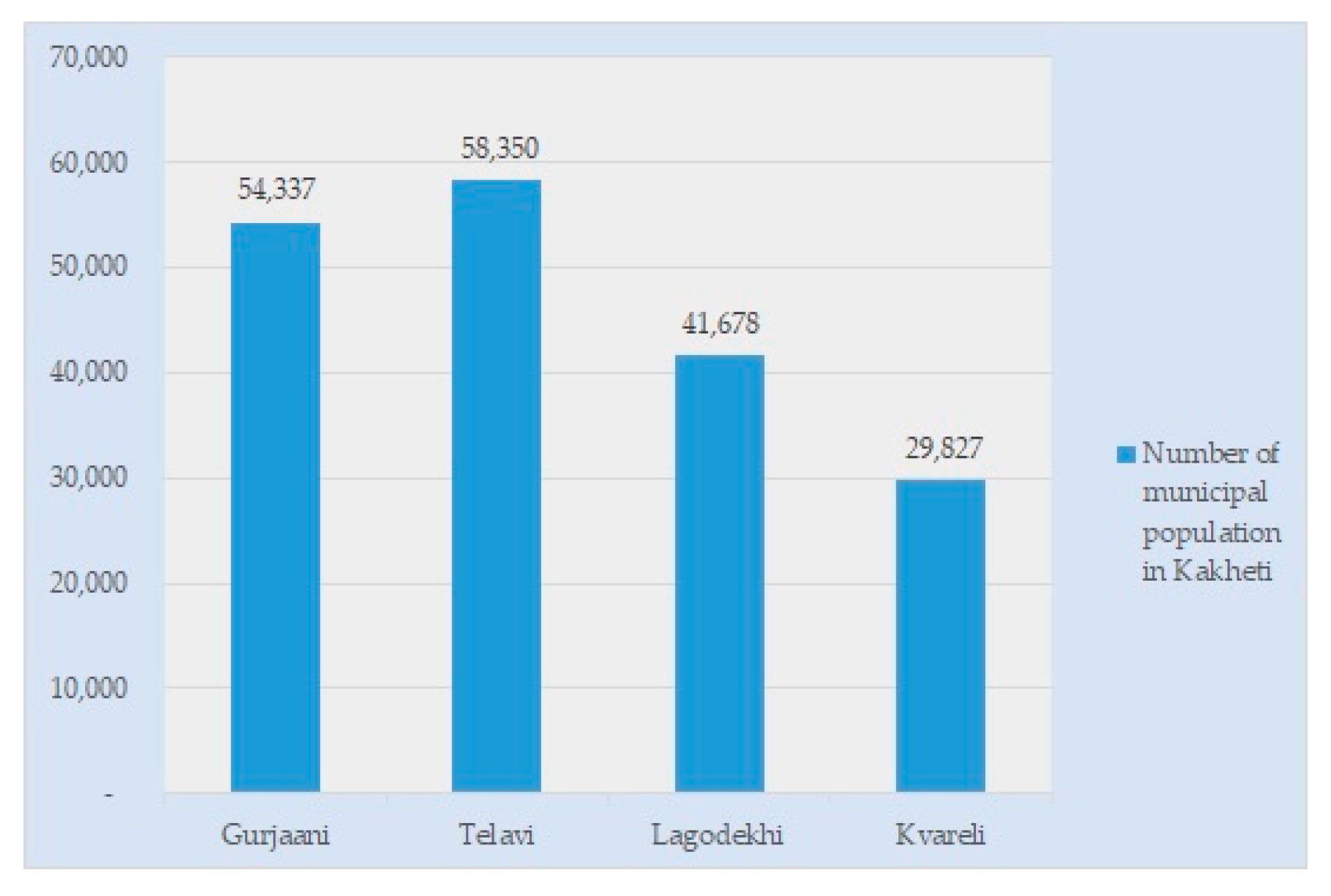
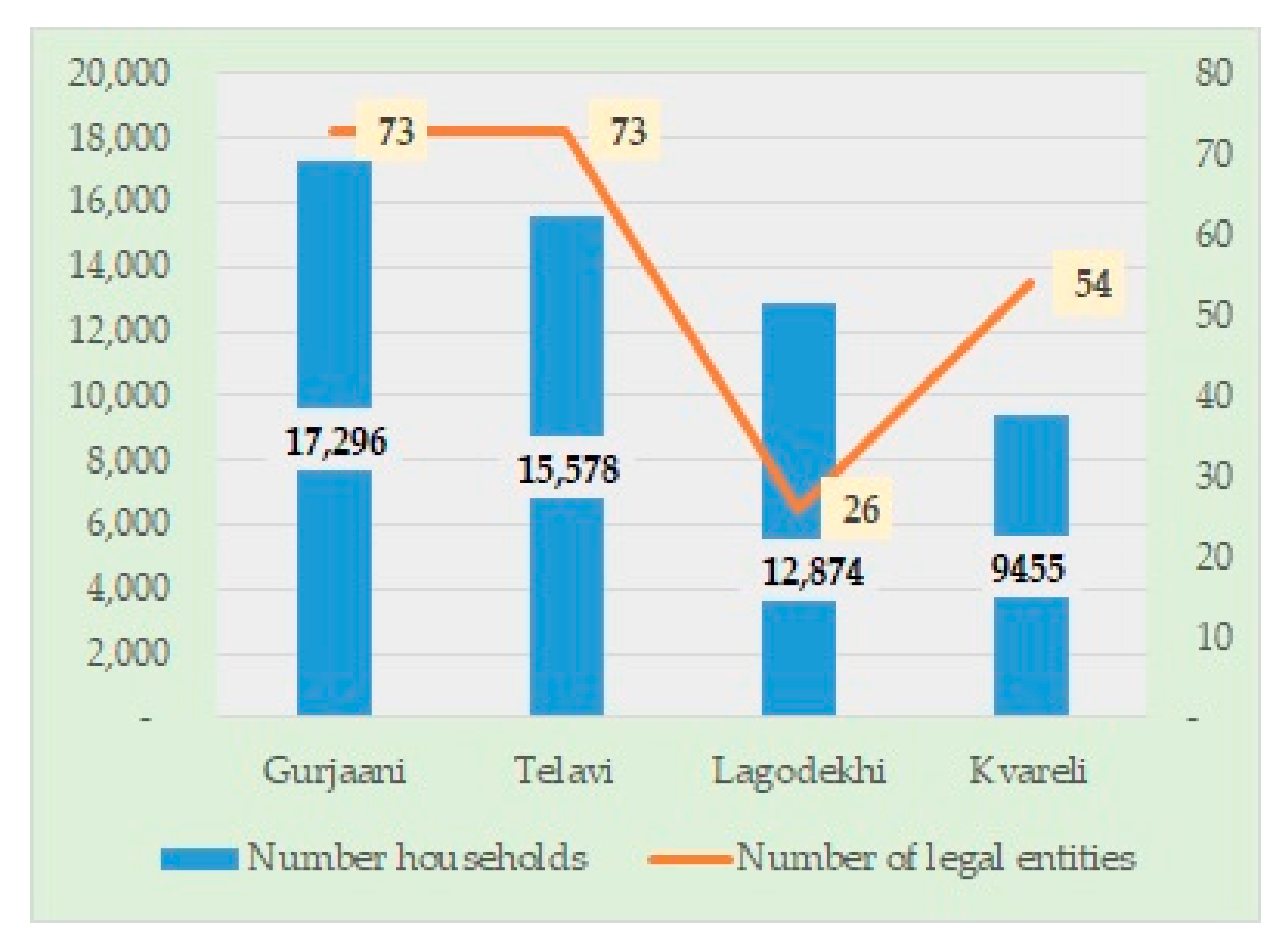
According to the general population census data 1, the municipal population of Kakheti is circa 320,000 people, and number of local households (HHs) is 96,600, which means that on average, number of people per HH is 3. Figure 3 and Figure 4 show that the population distribution and number of HHs headed by a female, where on average 30% of HHs are led by female in Gurjaani, Telavi Lagodekhi, and Kvareli municipalities. The most populated municipality is Telavi with 58,350 people, including urban and rural populations.
Figure 3.
Population in targeted municipalities of Kakheti’s regions (source: Geostat, census 2014).
Figure 4.
Distribution of family holdings in targeted municipalities of Kakheti (source: Geostat, census 2014).
Figure 5 depicts the number of agricultural holdings by legal status of holder in units by targeted municipalities. Only very small number of family farms have legal status, which indicates that agriculture HHs are mostly engaged more in subsistence family farming than being market-oriented farm business entities.
Figure 5.
Number of HHs with registered firm business relative to total number of HHs.
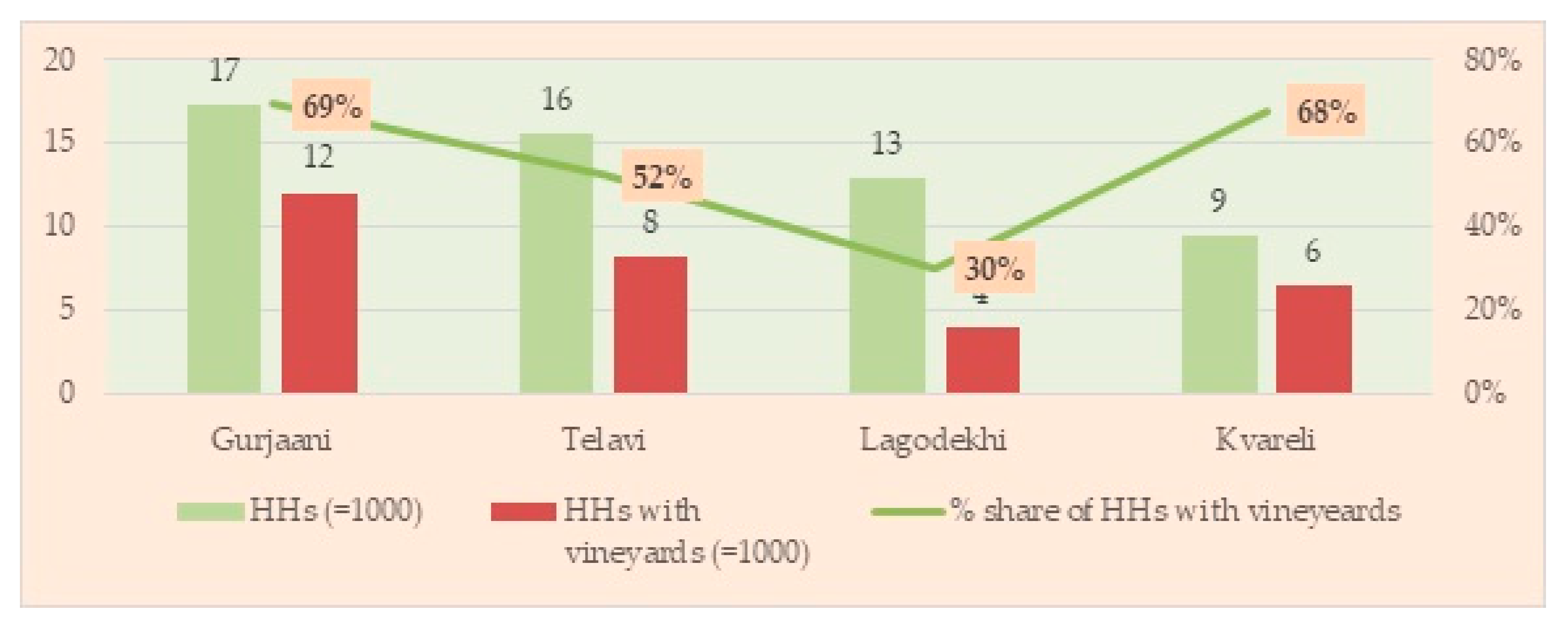
It should be noted that Kakheti is an agriculture-oriented region, which particularly stands out with vineyards and winemaking traditions as an economic activity for the local population. To illustrate this pattern, Figure 6 shows that 68% and 69% of HHs in Gurjaani and Kvareli municipalities, respectively, hold vineyards and most of the vineyard land holdings are less than 5 ha (Table 7), which indicates high fragmentation of agriculture landholdings in each targeted municipality.
Figure 6.
Absolute and percentage number of HHs holding vineyards in targeted municipalities.
Table 7.
Utilization of land cultivation equipment and trucks (number of HHs).
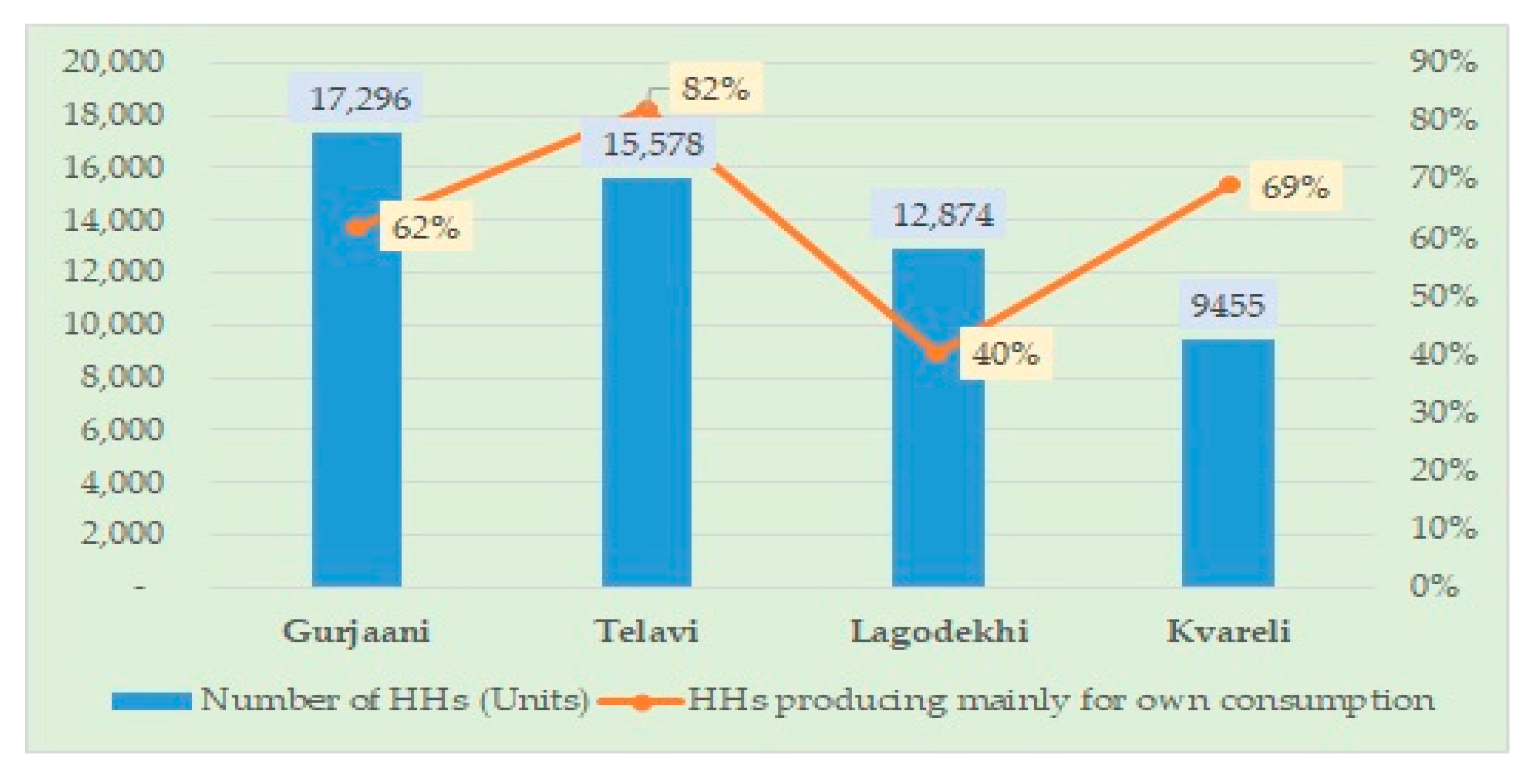
Figure 7 shows percentage number of local family holdings producing agriculture products mainly for its own consumption. For example, 62% and 69% of local HHs in Gurjaani and Kvareli municipalities are engaged more in subsistence farming activities for their household consumption than being toward market-oriented households.
Figure 7.
Percentage share of HHs producing for its own consumption.
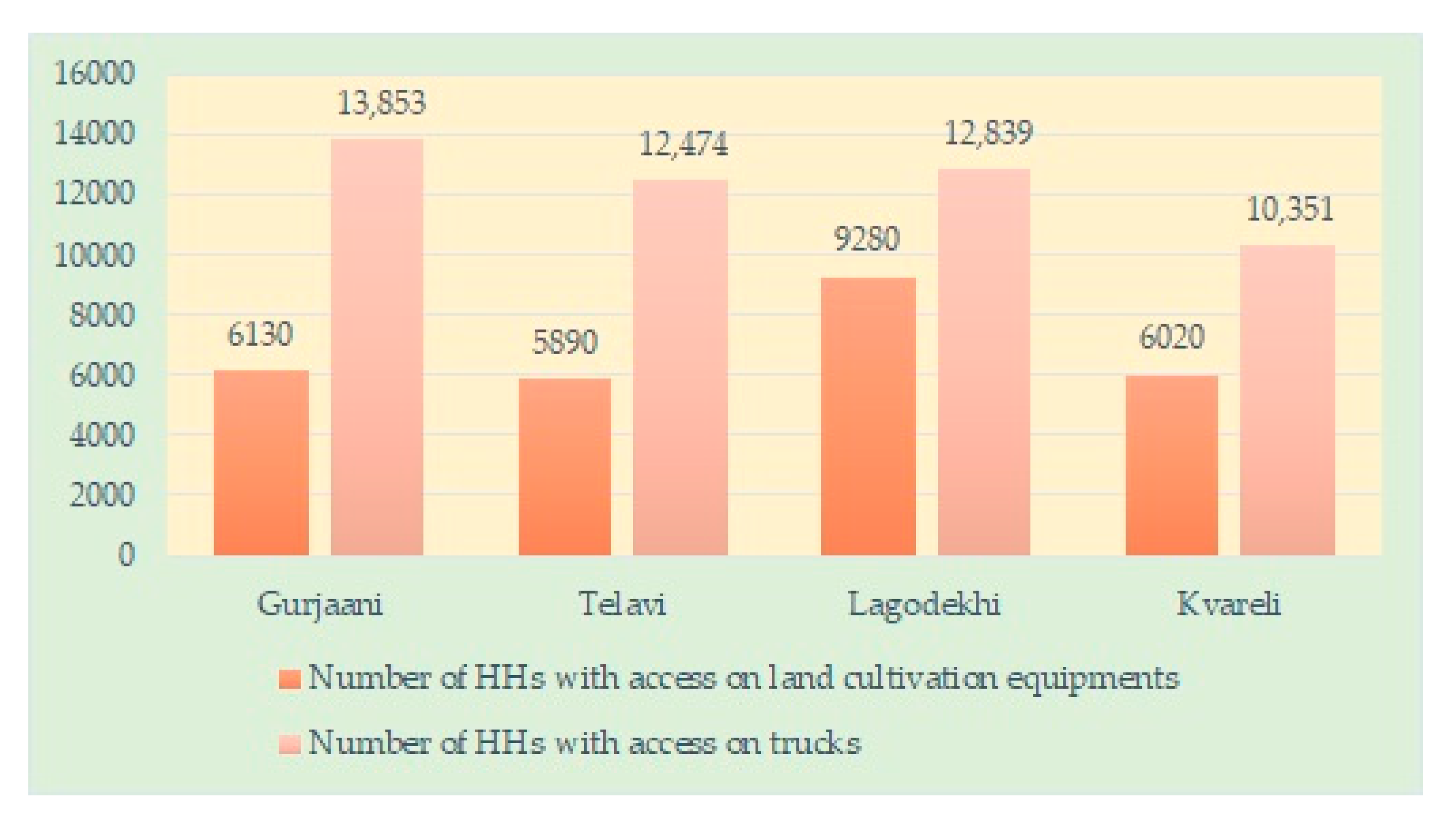
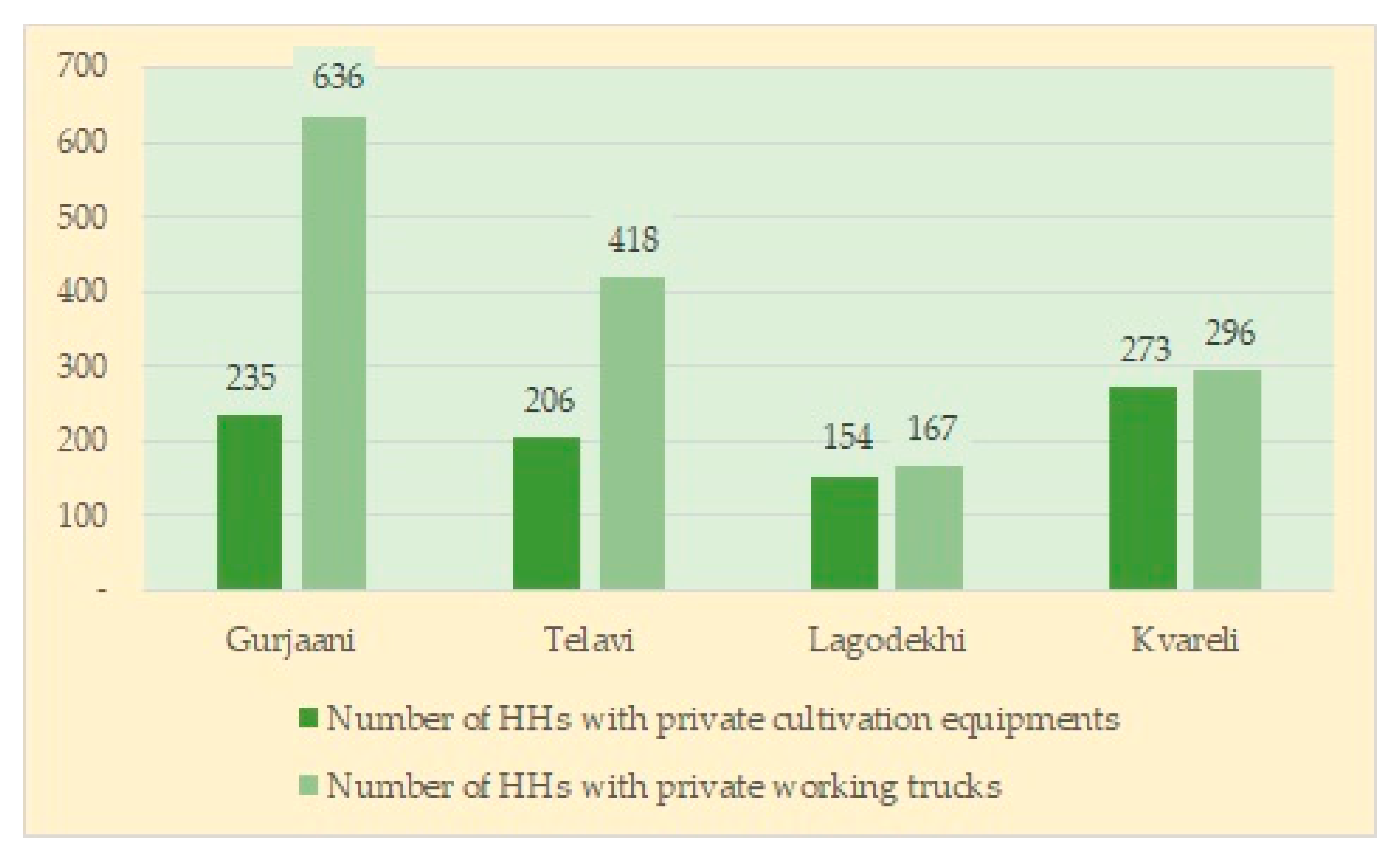
Figure 8 and Figure 9 illustrate the utilization level of land cultivation equipment by local farmers, however, very small number of agriculture farmers (circa 5% of HHs) have utilization equipment in ownership (Figure 9).
Figure 8.
Utilization of land cultivation equipment and trucks (number of HHs).
Figure 9.
Number of HHs with land cultivation and trucks in property.
5.2. Results—Game Experiments
For measuring behavioural trust, reciprocity, and cooperation potential among farmers in Kakheti, Georgia we applied an experimental study of a trust game, public goods game, and a supplementary survey. The main intention was to identify and assess trustful and trustworthy behaviour among farmers and uncover what the motivating factors behind their behaviour in the trust game and public goods game were. Varying levels of trust, beliefs, and preferences can either promote or deter qualitative indicators for collective actions such as land consolidation. The higher the trust, the more opportunity for cooperation; hence, the land consolidation approach could be a preferred approach. Vice versa, the more different the motives, the riskier the collective action can be, in which case fragmentation is a preferred option.
In total, we received responses from 39 farmers. We visited four municipalities in Kakheti, Georgia—Gurjaani, Telavi, Kvareli, and Lagodekhi—and covered various farming activities from winemaking to dairy production. Farmers from different municipalities face different problems and require an individual approach from the government. Water supply and sanitation problems and rehabilitation of rural and municipal roads are the main priorities for farmers of all four municipalities. Along with common difficulties such as unpaved rural road network and water supply problems, the groups of farmers from individual municipalities specified different priorities; these are: Telavi municipality—rural tourism, Gurjaani municipality—waste management, Kvareli municipality—irrigation and rural tourism, and Lagodekhi municipality—waste management and rural tourism.
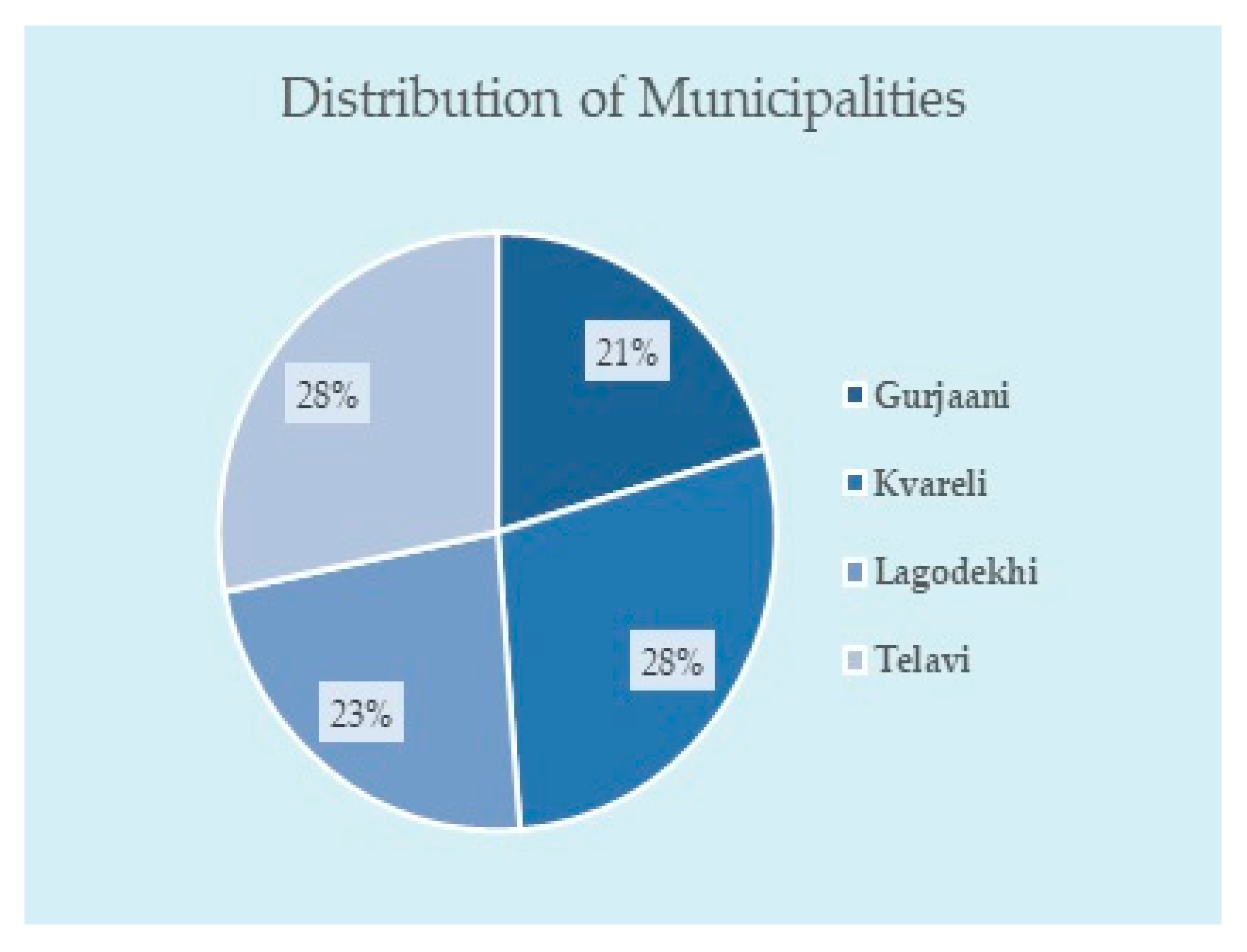
The four municipalities are mostly equally represented in this study (Figure 10).
Figure 10.
Distribution of municipalities of respondents.
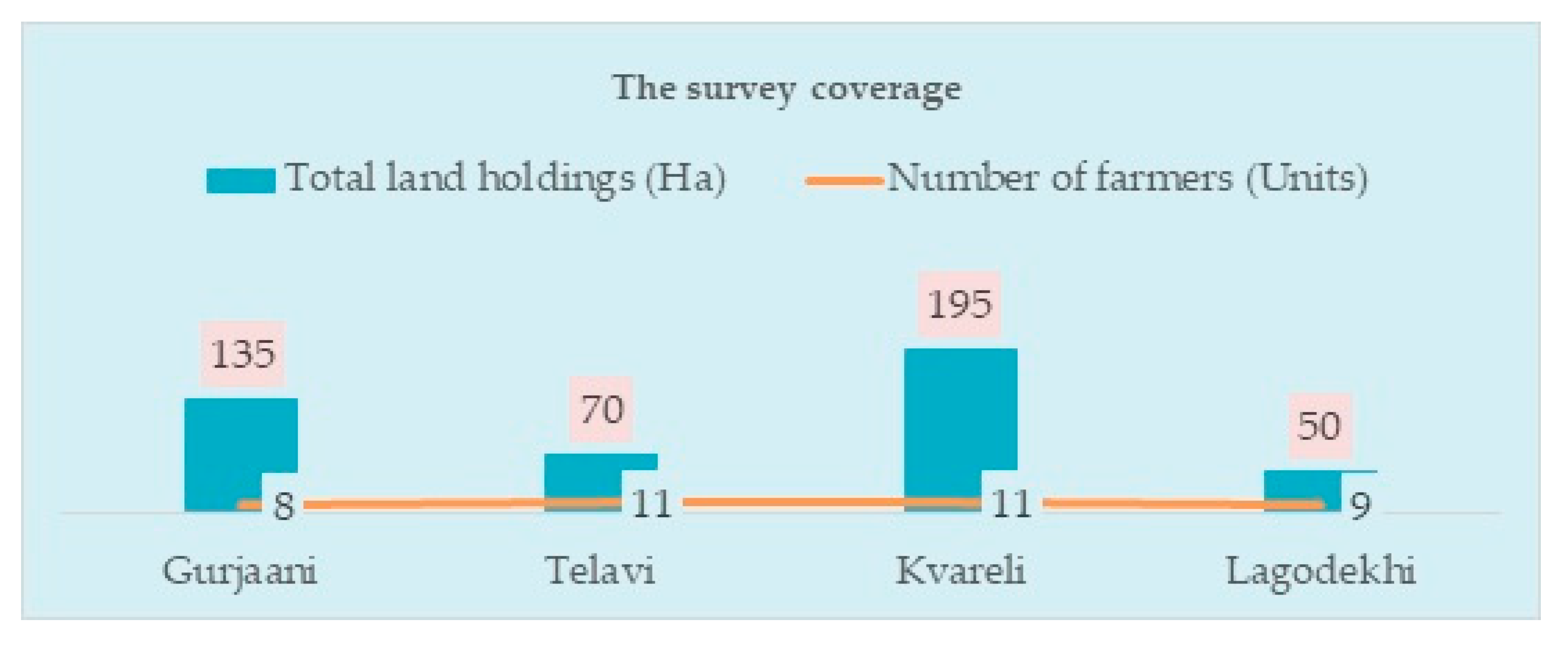
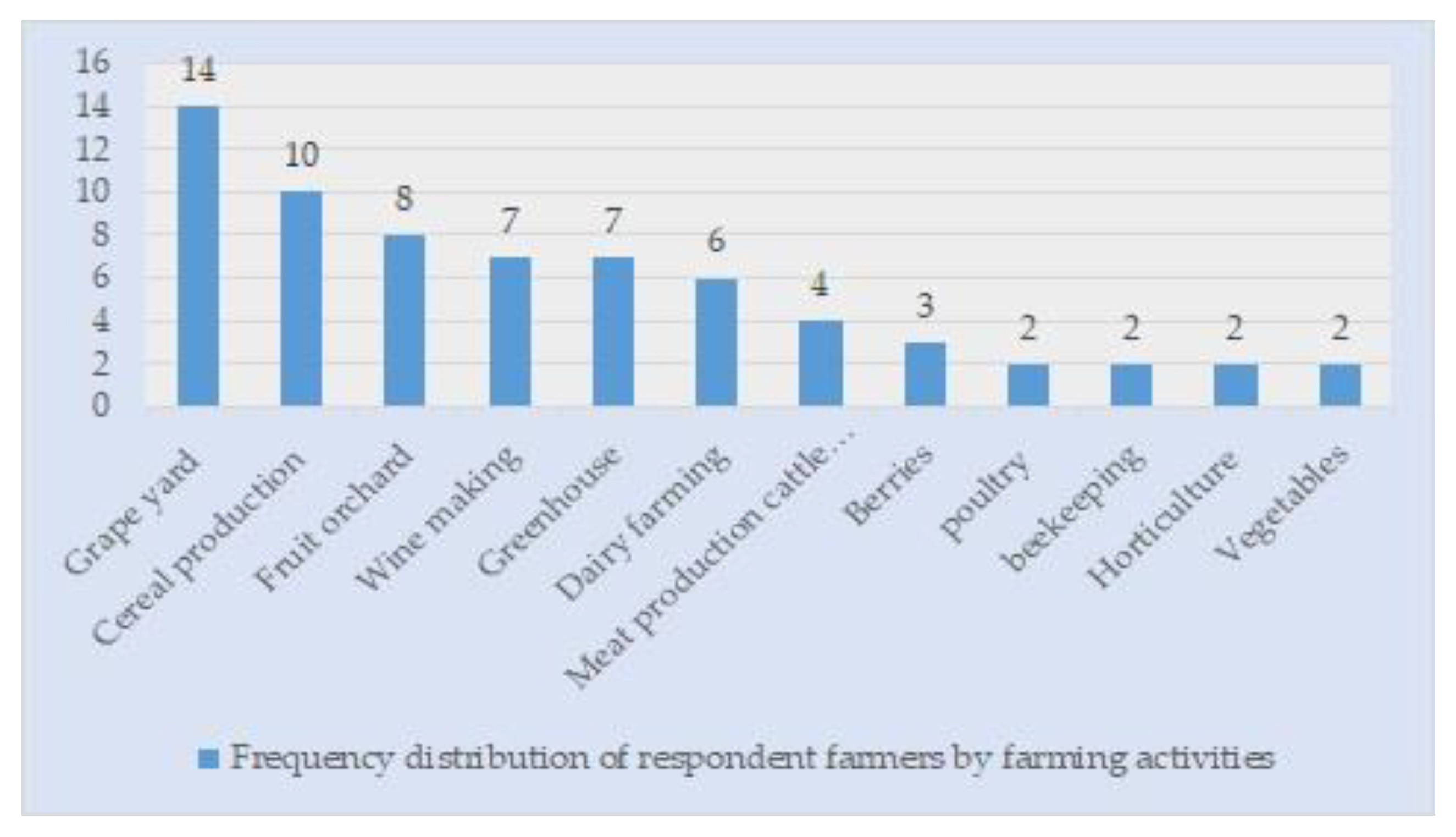
Figure 11 shows the numbers of surveyed farmers and their land holdings and provides a representative picture of the given municipalities in terms of size and the nature of fragmented land ownership prevalent in Kakheti, Georgia. Surveyed farmers represent wide variety of agricultural activity with 35.9% having grape yards but having representatives of fruit orchards, dairy farming, beekeeping, and so on (Figure 12).
Figure 11.
Number of surveyed farmers and total surveyed land holdings in targeted municipalities.
Figure 12.
Frequently named farming activities by surveyed farmers.
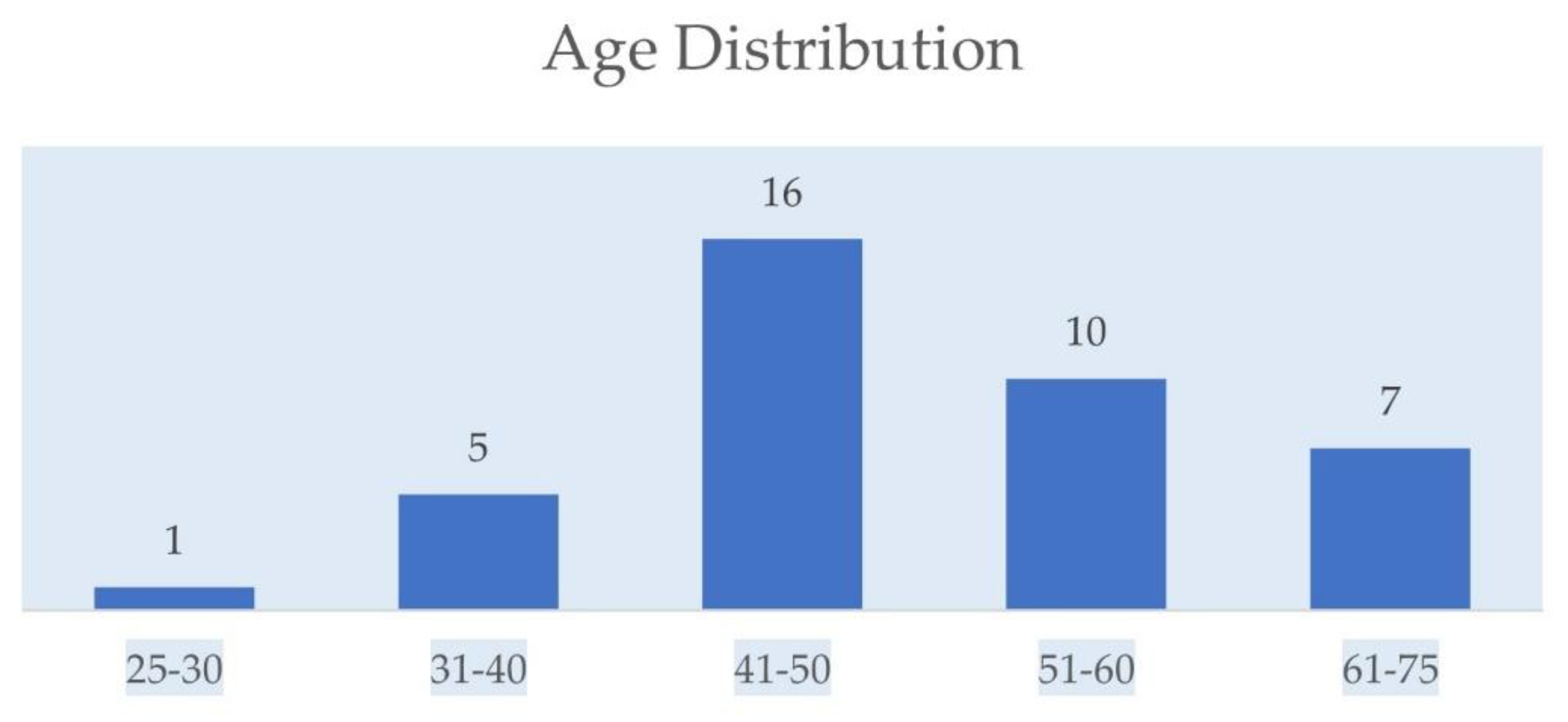
With regard to the age range of farmers, 41% of respondents fall within the 41–50 age interval, with some representatives in each age group (Figure 13). Gender distribution among famers was 67% male and 33% female. Of total respondents, 69% had higher education, while 18% had secondary education.
Figure 13.
Age distribution of respondents.
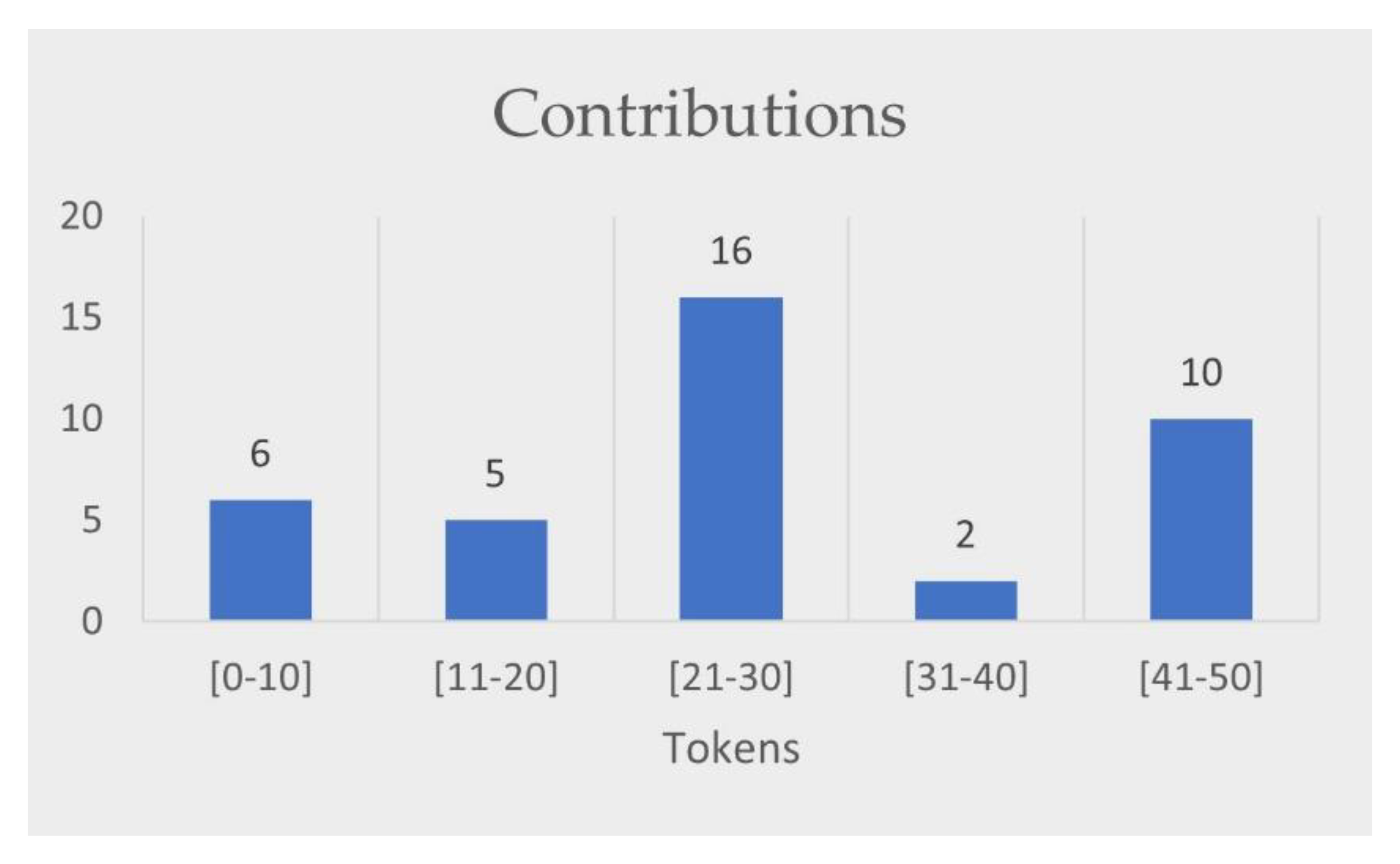
Figure 14 presents the voluntary contribution by senders in the trust game. In particular, 9 out of 39 sending trials (23%) wished to send all 50 tokens. On average, senders sent 29.2 tokens, slightly over 50% of their original endowment (50 tokens). This result contrasts with the results predicted by standard economic theory, which would require players to act selfishly, not giving away anything. Only 15% of senders decided to give 0 to 10 tokens. Most of the players chose numbers around the middle (41%), giving away 20–30 tokens.
Figure 14.
Distribution of sent amounts in the trust game.
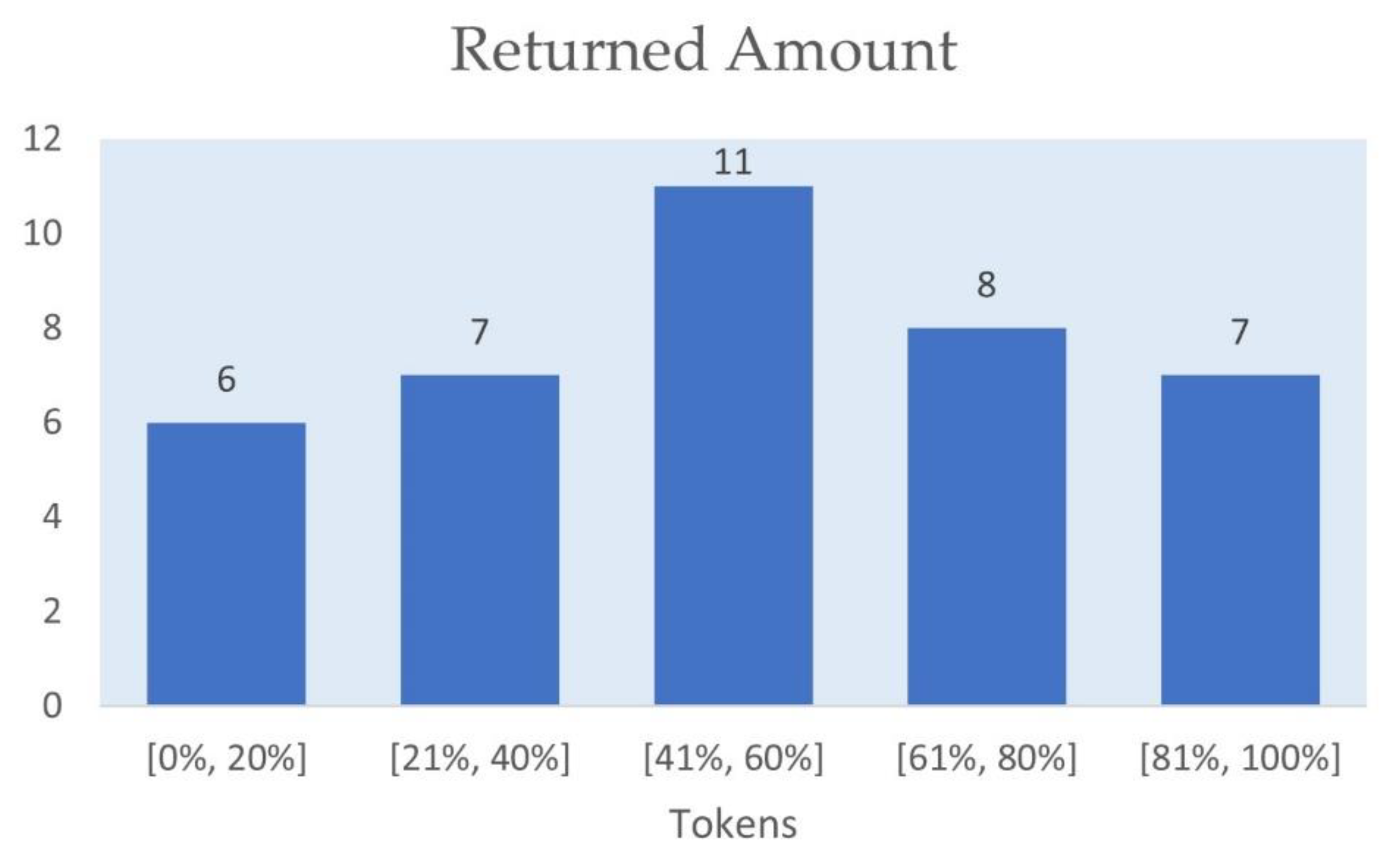
The results of the receivers in response to transfers are varying. Figure 15 shows that most people returned in the range of 40–60% of tokens received, but it is close to even distribution in other ranges too. Five of the receivers (13%) decided not to return anything, while another five (13%) returned 100% of the tripled amount they received. On average, 51% of the received tokens were returned to senders.
Figure 15.
Distribution of returned amounts in the trust game, %.
The results of trust game show that these farmers were inclined to share close to 50% of their initial endowments and close to 50% of (tripled) received transfers with others. The experiment revealed that on average, senders sent 58.4%, while receivers returned 50.1%. This indicates that trust and trustworthiness is high among respondents, yet Georgian farmers revealed higher trustful than trustworthy behaviour.
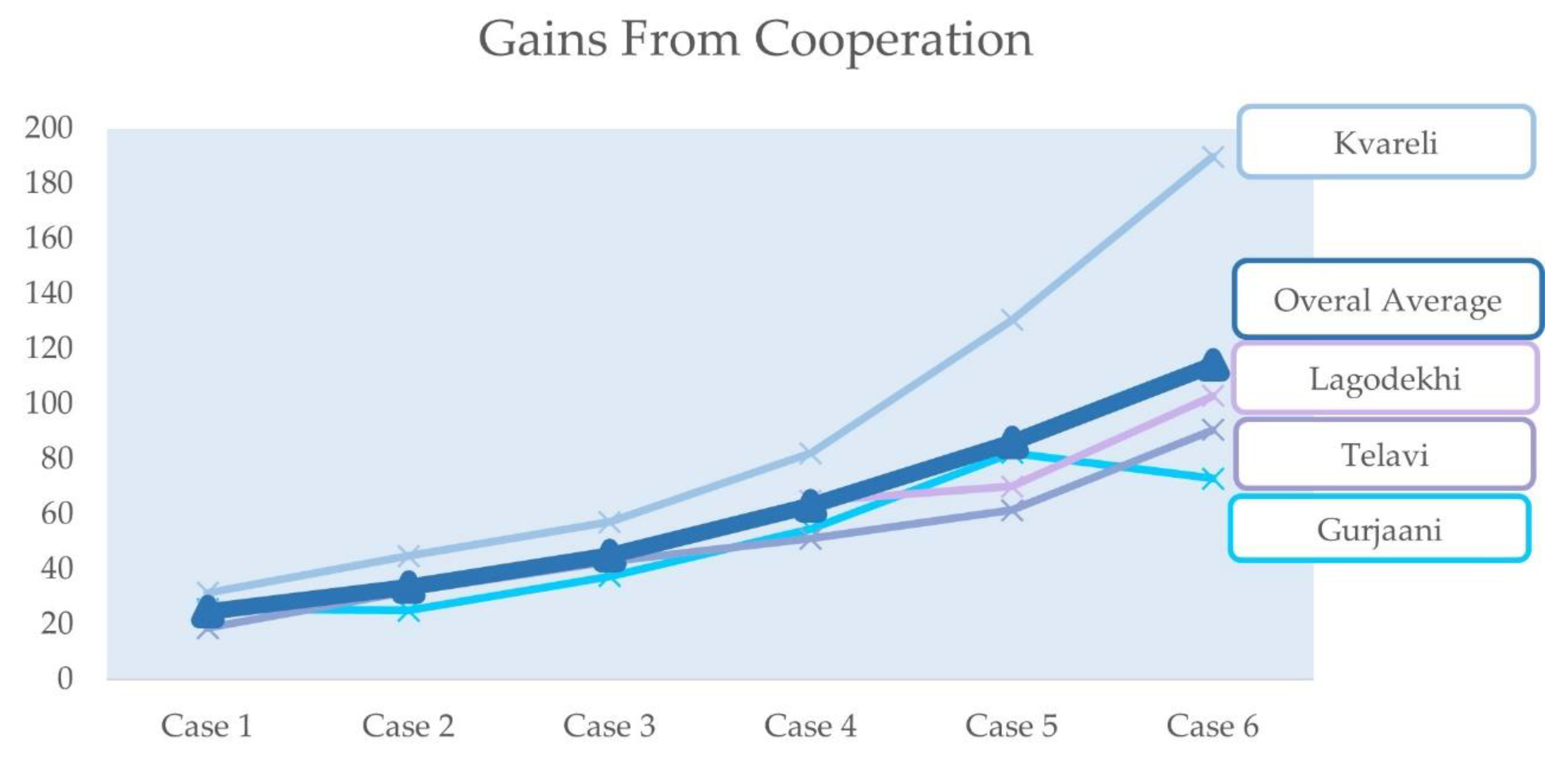
Figure 16 shows the results of the public goods games played among farmers. They played six rounds, and the diagram shows that cooperation increased as the game went to the next stage. Optimizing players would choose to free-ride and not contribute towards the public good, but this results in a worse outcome for everyone. Farmers displayed high cooperation ability, with Kvareli municipality contributing the most over the rounds.
Figure 16.
Distribution of cooperation levels in the public goods games.
The results of the public goods games suggest that Georgian farmers are prone to cooperation and would be willing to share their land and equipment. The fact that there is a high fragmentation and willingness to cooperation suggests that there is friction and barriers to cooperation. These should be addressed by the government if it aims to follow a land consolidation policy.
This finding complements to the trust game results. Only 12.8% expressed selfish behaviour and contributed less than 20% of their allocated tokens towards the public good. Additionally, 23.1% decided to contribute more than 80% of their allocations and displayed high tendency towards cooperation. In other words, by showing trust and sharing their endowment, senders risked others also sharing to benefit everyone.
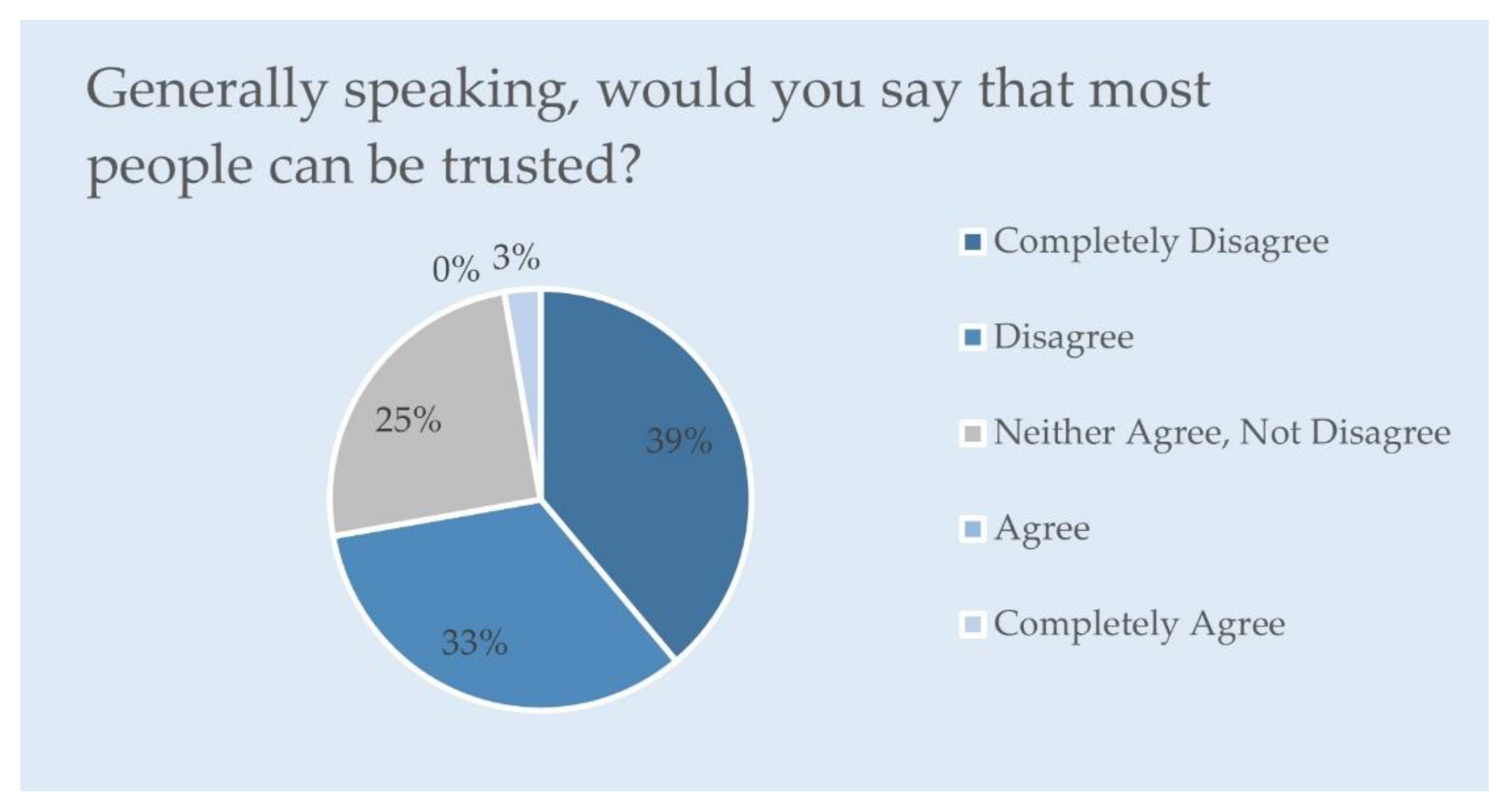
In Figure 17, 72% of farmers don’t think that most people can be trusted. While only 3% of them provide an optimistic response. This is in contrast with studies in other countries where trust levels are much higher.
Figure 17.
Distribution of responses from a survey.
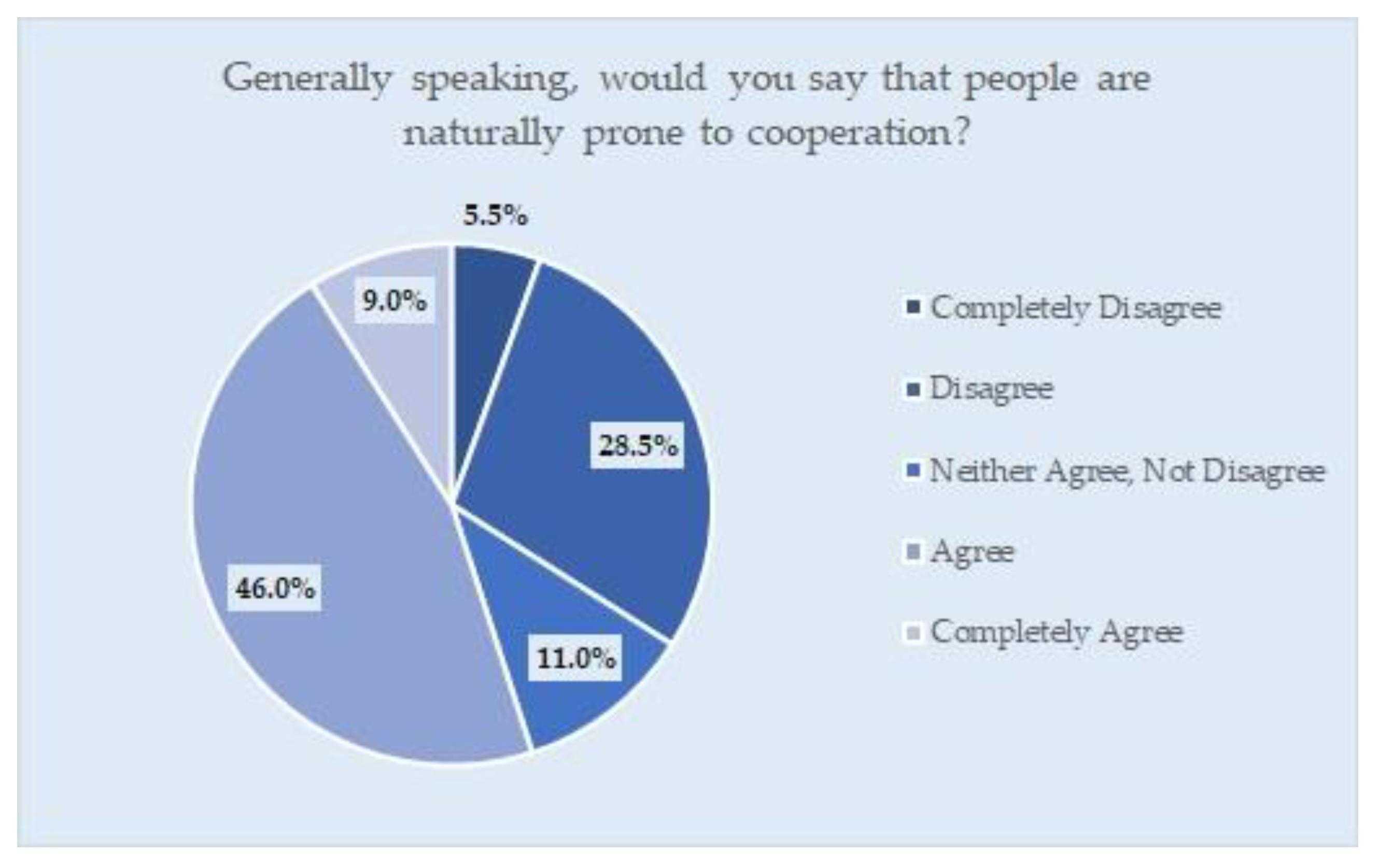
Figure 18 depicts responses regarding cooperation. The study revealed that 34% of farmers have negative expectation for cooperation, while 52% of farmers are inclined towards cooperation.
Figure 18.
Distribution of responses from the survey.
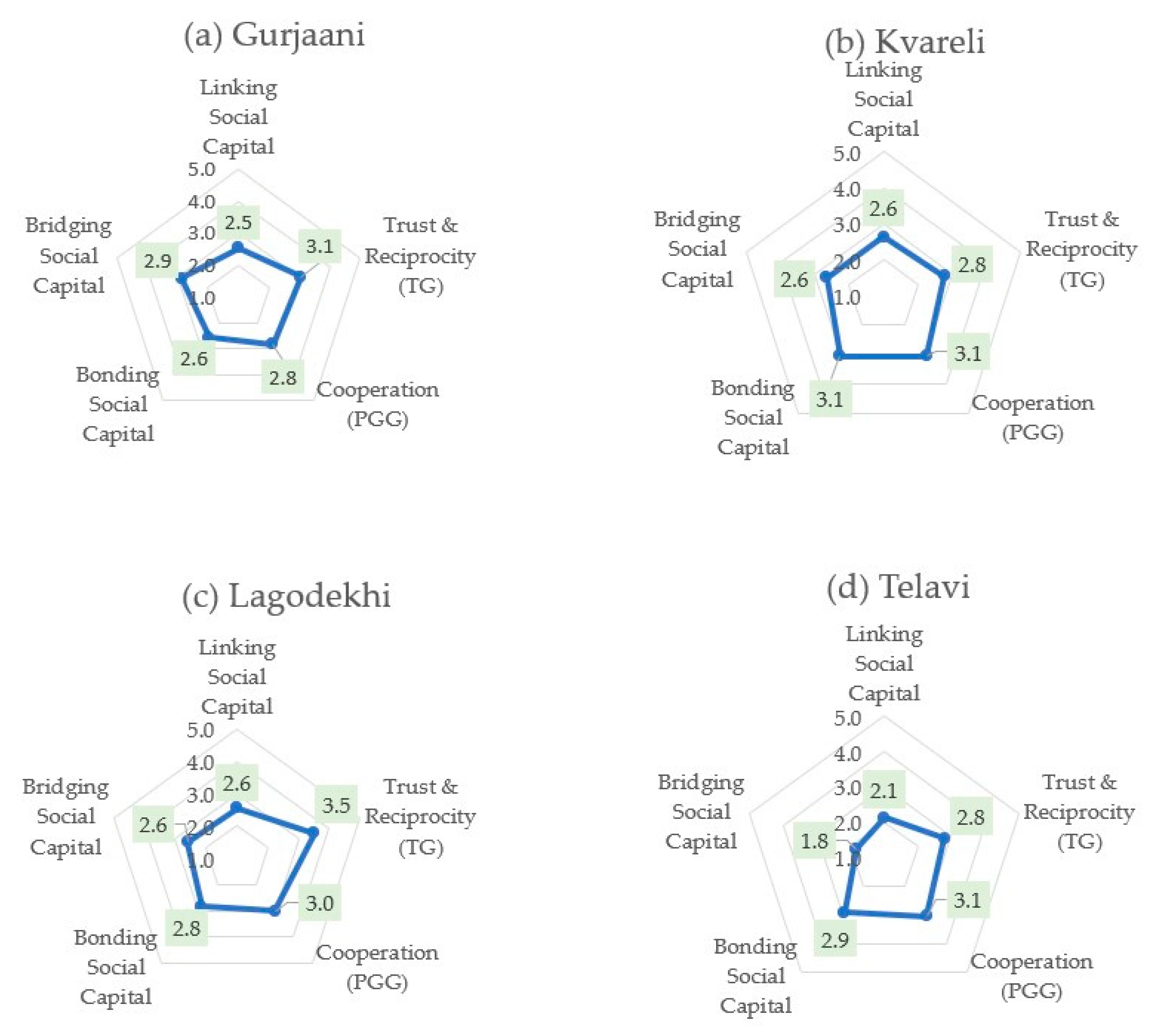
We combined the results of the trust games (TG) and public goods games (PGG) with complementary survey responses and designed a measure of social capital, consisting of five dimensions. We measured bonding social capital, bridging social capital, and linking social capital with relevant survey questions, which had responses on a scale of 1 to 5. Additionally, we measured trust and reciprocity not only from the questionnaire but from an experimental environment using the trust game. We analysed how farmers behaved in an experimental setup and how close their actions were to their answers to complementary questions. Experimental design allows for extraction of information on how people might act when questions can be answered dishonestly. The fifth dimension of the social capital indicator was taken from the public goods game results, which provides an idea of how cooperative people are in experimental design. All five pillars of the measurement are scaled from 1 to 5 and are summarized in a radar chart.
Figure 19 shows radar charts for four municipalities in Kakheti, Georgia. Here, it is clear that social capital is around the middle range and there is a need for significant development. Linking social capital seems to be most lacking, and Telavi has the lowest score of 1.8 in bridging social capital.
Figure 19.
Radar charts of social capital index for different municipalities in Kakheti, Georgia.
We can see that overall scores are around the middle, mostly within two to three points, but game results of trust, reciprocity, and cooperation are overall higher than other scores. These results suggest that Georgian farmers have high potential for cooperation but outside factors prevent them from being able to do so. Therefore, government should focus on making it easier for farmers to cooperate and creating the required infrastructure for it.
6. Discussion
Both the experimental design research and the survey method revealed that there is high social trust and cooperation among farmer communities in Gurjaani municipality. The respondent farmers indicate that they actively cooperate and share agriculture techniques with neighbouring farmers regardless of farm size and farming activity. This archetype of collaborative model forms an important part of sharing economy in the municipality and contributes to the region’s economic development process. Refs. [38,39] propose that local sharing economy platforms can be more sustainable than traditional businesses. Then, it is safe to say that the traditional way of doing business in Kakheti entirely includes the aspects of sustainability and this is cultural feature attributable to this indigenous social group. We assume that free internet access and digital technologies in the municipality such as social networks can be another facilitator of cooperation among farmer communities.
Field experiments in Gurjaani also revealed that bonding SC in terms of trust and cooperation among farmers is higher than bridging SC. Both of these dimensions of social capital are higher than the linking SC though. Linking social capital benefits the target social group by connecting with people of different levels of authority and power, allowing them to access resources that could not otherwise be found alone or cannot be mobilized by the other two dimensions of SC. The lack of linking social capital among Gurjaani farmer communities was confirmed by the farmers when they reported low confidence in civil society organizations and local self-governments. Nevertheless, farmers express a high readiness for public engagement, which would imply a favourable condition for consensus-building with the targeted social groups. We suggest that high indicators of bonding and bridging SC among farmer communities will sustainably serve the possible developments of a land consolidation project in Gurjaani municipality.
The combination of experimental design and survey methods makes the result complete and more consistent in Telavi. Telavi, which stands out as the main urban tourism destination of the region, partitioned lands and diversified farm businesses create synergies with the local hospitality industry. Yet, dimensions of SC appear unbalanced among farmer communities. The Field experiments revealed that bonding SC is higher than bridging and linking dimensions of social capital while the bridging SC is lower than linking SC. Nevertheless, similar to Gurjaani, Telavi suffers from a low linking SC. The bridging dimension of SC consists of support networks of company employees, as well as consulting firms and independent advisors, agriculture service companies to which the respondent farmers report low confidence. To specify the lack of support provided, they highlight ineffective laws and regulations in land registration process, lack of support in start-up initiatives and product marketing, lack of access on vocational and training activities. As opposed to this, all the measured indicators in Telavi indicate a high bonding SC among farm businesses. Therefore, we suppose that farmer communities in Telavi with an imbalance in bridging and bonding SC (high boding and low bridging) seem more resistance to change, and seemingly are engaged in clientelism (higher linking SC than bridging SC). In other words, economic relations are largely based on the mechanism of bilateral exchange in the form of asymmetric relations. This suggestion is supported by the evidence from the trust game, where the indicators of trust and trustworthiness are relatively low among different farm businesses. Drawing deductive inferences with land consolidation projects, such multifaceted social image coupled with multiple priorities in Telavi perhaps create tensions and make spatial planning projects complicated.
Unlike Telavi, social capital indicators in Kvareli seem steadier and more balanced on the radar chart. However, the indicators of trust and cooperation among farmers are still higher than the indicators of bridging SC and linking SC. Research suggests communities with a high bonding SC and low linking SC may become resistant to change.
It is noteworthy is that Lagodekhi farmers effectively practice a sharing economy model by recirculation of agriculture machinery, utilization of cultivation equipment, exchange of farming services, and sharing productive physical assets. This archetype of the collaborative model forms an important part of sharing economy in the municipality and contributes to the whole region’s sustainable economic development process. Additionally, this is an exceptional finding about traditional archetype of sharing economy and sustainable business in Kakheti region. In this model, the municipal community relies on its own mix of capitals with social capital forming the cornerstone of this process.
To summarize results of the empirical research in Kakheti region, the average weighted indicator of bonding SC is high in all four municipalities, which indicates strong and solid ties between the allies included in bonding SC. Adding to this, the weighted average of linking SC of all four municipalities is low. Compared to other municipalities, Lagodekhi municipality has the highest social capital, which is followed by Kvareli. The dimensions of social capital are the most balanced in Kvareli, whereas the practice of cooperation among farmers is high in Lagodekhi. Therefore, the measured indicators of social capital among farmers in Lagodekhi and Kvareli municipalities is a prerequisite for the sustainable development of land consolidation projects in the future.
7. Conclusions and Recommendations
The aim of this article was to identify what sort of values and qualitative indicators should be employed to measure the social dimensions of land consolidation and to assess whether—with such indicators—one can decide if land consolidation is a beneficial solution or not. We found that so far, the existent literature has been unable to formulate empirical indicators of social value systems, which represent social causes of land fragmentation. Yet, measuring qualitative values of social capital related to land consolidation is novel approach, whereby we introduced, applied and tested game applications from experimental economics. Analogous to [48], we applied a combination of game tools and survey measures, which helped to create a complete and reliable set of measurement indicators for the land consolidation of Kakheti (Georgia). Our ultimate goal is to improve decision support mechanisms and propose game tools, which enable accurate responses to public policy programs and interventions. That is why the following recommendations address governmental organizations.
The farmer communities in all municipalities characterize relatively lower linking social capital than bridging and bonding social capitals, which indicates a lack of cooperation and confidence in different formal institutions. The lack of linking social capital will undoubtedly lead to tensions and negative expectations from land consolidation projects in the future. In order to strengthen cooperation with supportive networks outside the farmer communities, it is highly recommended to develop incentive programs [49,50,51,52] that would connect target farmer groups with different social groups aligned with authority and power.
The results of the public goods games suggest that Georgian farmers express high willingness to engage in strategic behaviour. They are ready to share their land and equipment. The practice of cooperation among farmers is remarkably high in Lagodekhi municipality where the farmer communities represent traditional archetype of collaborative model of sharing economy. In this collaborative model, the municipal communities rely on their own pools of resources, where social capital is the cornerstone of this process. Alternatively, the farmer communities in Kvareli have more balanced combinations bonding, bridging, and linking social capital. This suggests a favourable condition for consensus-building with the targeted social groups. Hence, the measured indicators of social capital among farmers in Lagodekhi and Kvareli municipalities create a favourable precondition for sustainably management of land consolidation projects in the future.
As opposed to this, significant imbalance in bonding, bridging, and linking aspects of social capital indicates that Telavi farmer communities seem more resistant to changes. Drawing deductive inferences with land consolidation projects, high disparity in social capital aspects in Telavi, coupled with multiple priorities, perhaps will create tensions and complications in future land consolidation projects.
The field study uncovered that land fragmentation is a serious challenge for Georgian farmers, which leads to multiple inefficiencies. Because of high land fragmentation, a large number of farmers are mostly engaged in subsistence farming rather than being market-oriented. Hence, even though the Government of Georgia has declared land consolidation as a priority policy solution, existing regulations are restricting farmers from land registration under their ownership. The fact that there is a high fragmentation and willingness to cooperation suggests that there is friction and barriers to cooperation. These should be addressed by the government if it aims to follow a land consolidation policy. By starting with simplification of land registration process, the Government of Georgia would better address land fragmentation problem.
Finally, this interdisciplinary research showed a high level of trust and cooperation between farmers. The proposed experiment with game design created incentives for motivated behaviour in a micro-community, which produced accurate and non-incentivized responses from the respondents. Therefore, we highly encourage the researchers, public policy experts and the rest of the academic community to apply and test our innovative research method of experimental game design for future land consolidation projects.
Author Contributions
Conceptualization, M.T. and W.T.d.V.; methodology, M.T., W.T.d.V. and Q.B.; formal analysis, M.T. and Q.B.; investigation, M.T. and Q.B.; writing—original draft preparation, M.T.; writing—review and editing, M.T., W.T.d.V., P.D.D. and Q.B.; visualization, M.T. and Q.B.; supervision, W.T.d.V.; project administration, M.T. All authors have read and agreed to the published version of the manuscript.
Funding
This research was partly supported by LTD Caucasus University (financial support #01-03/2022—field visits in Kakheti municipalities of Georgia, 27–28 October 022).
Data Availability Statement
The data that support the findings of this study are available on reasonable request from the corresponding author.
Acknowledgments
The authors would like to thank the Georgian Farmers’ Association for their support in organizing the groups of farmers in targeted municipalities. Additionally, the authors would like to thank the anonymous reviewers for their comments which helped improving the quality of this manuscript.
Conflicts of Interest
The authors declare no conflict of interest.
Notes
| 1 | National Statistics Office of Georgia, 2014 General population census results: http://census.ge/en/results/agro-census/zogadi-informatsia-meurneobebis-shesakheb (accessed on 13 December 2022). |
References
- Zhang, D.; Yu, L.; Wang, W. Promoting Effect of Whole-Region Comprehensive Land Consolidation on Rural Revitalization from the Perspective of Farm Households: A China Study. Land 2022, 11, 1854. [Google Scholar] [CrossRef]
- Yin, Q.; Zhou, S.; Lv, C.; Zhang, Y.; Sui, X.; Wang, X. Comprehensive Land Consolidation as a Tool to Promote Rural Restructuring in China: Theoretical Framework and Case Study. Land 2022, 11, 1932. [Google Scholar] [CrossRef]
- Lin, Y.; Yang, H.; Ye, Y.; Wen, J.; Chen, D. How Does Land Consolidation Affect Soil Fungal Community Structure? Take Heavy Metal Contaminated Areas in Eastern China for Example. Land 2022, 11, 142. [Google Scholar] [CrossRef]
- Dixon-Gough, R. The role of the State and individual in sustainable land Management. In The Role of the State and Individual in Sustainable Land Management; Dixon-Gough, R., Bloch, P.C., Eds.; Ashgate publishing, Ltd.: Aldershot, UK, 2006; pp. 159–176. [Google Scholar]
- FAO. FAO Land Tenure studies 6. In The Design of Land Consolidation Pilot Projects in Central and Eastern Europe; FAO: Rome, Italy, 2003. [Google Scholar]
- Thomas, J. Property rights, Land fragmentation and the emerging structure of agriculture in Central and Easter European countries. J. Agric. Dev. Econ. 2006, 3, 225–275. [Google Scholar]
- Lisec, A.; Cerjak, M.; Pintar, M. The influence of the land consolidation on the ecological elements in the rural landscape. In Proceedings of the 6th International Conference Environmental Engineering, Vilnius, Lithuania, 26–27 May 2005; Cygas, D., Froehner, K.D., Eds.; Vilnius Gediminas Technical University Press: Vilnius, Lithuania, 2005; pp. 164–177. [Google Scholar]
- Yang, R.; Chen, H.; Chen, S.; Ye, Y. Spatiotemporal evolution and prediction of land use/land cover changes and ecosystem service variation in the Yellow River Basin, China. Ecol. Indic. 2022, 145, 109579. [Google Scholar] [CrossRef]
- Ntihinyurwa, P.D.; de Vries, W.T. Farmland fragmentation and defragmentation nexus: Scoping the causes, impacts, and the conditions determining its management decisions. Ecol. Indic. 2020, 119, 106828. [Google Scholar] [CrossRef]
- Cardenas, J.-C.; Carpenter, J. Behavioural Development Economics: Lessons from Field Labs in the Developing World. J. Dev. Stud. 2008, 44, 311–338. [Google Scholar] [CrossRef]
- Ntihinyurwa, P.D.; de Vries, W.T.; Chigbu, U.E.; Dukwiyimpuhwe, P.A. The positive impacts of farm land fragmentation in Rwanda. Land Use Policy 2018, 81, 565–581. [Google Scholar] [CrossRef]
- Wojewodzic, T.; Janus, J.; Dacko, M.; Pijanowski, J.; Taszakowski, J. Measuring the effectiveness of land consolidation: An economic approach based on selected case studies from Poland. Land Use Policy 2020, 100, 104888. [Google Scholar] [CrossRef]
- Ciaian, P.; Guri, F.; Rajcaniova, M.; Drabik, D.; Paloma, S.G.Y. Land fragmentation and production diversification: A case study from rural Albania. Land Use Policy 2018, 76, 589–599. [Google Scholar] [CrossRef]
- Pašakarnis, G.; Maliene, V.; Dixon-Gough, R.; Malys, N. Decision support framework to rank and prioritise the potential land areas for comprehensive land consolidation. Land Use Policy 2020, 100, 104908. [Google Scholar] [CrossRef]
- Sklenicka, P. Applying evaluation criteria for the land consolidation effect to three contrasting study areas in the Czech Republic. Land Use Policy 2006, 23, 502–510. [Google Scholar] [CrossRef]
- Kim, D.; Marcouiller, D.W. The role of public lands in local economies of the US Lake States: A spatial simultaneous equation approach. Land Use Policy 2020, 100, 104883. [Google Scholar] [CrossRef]
- Farkas, J.Z.; Kovács, A.D. Nature conservation versus agriculture in the light of socio-economic changes over the last half-century–Case study from a Hungarian national park. Land Use Policy 2021, 101, 105131. [Google Scholar] [CrossRef]
- Stańczuk-Gałwiaczek, M.; Sobolewska-Mikulska, K.; Ritzema, H.; van Loon-Steensma, J.M. Integration of water management and land consolidation in rural areas to adapt to climate change: Experiences from Poland and the Netherlands. Land Use Policy 2018, 77, 498–511. [Google Scholar] [CrossRef]
- Muchova, Z.; Hresko, J.; Petrovic, H. Perception of land consolidation by land owners: A case study. Folia Oecol. 2015, 42, 113–121. [Google Scholar]
- Lisec, A.; Primožič, T.; Ferlan, M.; Šumrada, R.; Drobne, S. Land owners’ perception of land consolidation and their satisfaction with the results—Slovenian experiences. Land Use Policy 2014, 38, 550–563. [Google Scholar] [CrossRef]
- Colombo, S.; Perujo-Villanueva, M. A practical method for the ex-ante evaluation of land consolidation initiatives: Fully connected parcels with the same value. Land Use Policy 2018, 81, 463–471. [Google Scholar] [CrossRef]
- Cay, T.; Uyan, M. Evaluation of reallocation criteria in land consolidation studies using the Analytic Hierarchy Process (AHP). Land Use Policy 2012, 30, 541–548. [Google Scholar] [CrossRef]
- Demetriou, D.; Stillwell, J.; See, L. An integrated planning and decision support system (IPDSS) for land consolidation: Theoretical framework and application of the land-redistribution modules. Environ. Plan. B Plan. Des. 2012, 39, 609–628. [Google Scholar] [CrossRef]
- Muchová, Z.; Petrovič, F. Prioritization and Evaluation of Land Consolidation Projects—Žitava River Basin in a Slovakian Case. Sustainability 2019, 11, 2041. [Google Scholar] [CrossRef]
- Tomić, H.; Roić, M.; Ivić, S.M. Land Consolidation Suitability Ranking of Cadastral Municipalities: Information-Based Decision-Making Using Multi-Criteria Analyses of Official Registers’ Data. ISPRS Int. J. Geo-Inf. 2018, 7, 87. [Google Scholar] [CrossRef]
- De Vries, W.T.; Voß, W. Economic versus Social values in land and property management: Two sides of the same coin? Raumforsch. Raumordn. Spat. Res. Plan. 2018, 76, 381–394. [Google Scholar] [CrossRef]
- Scott, A. Assessing Public Perception of Landscape: From Practice to Policy. J. Environ. Policy Plan. 2003, 5, 123–144. [Google Scholar] [CrossRef]
- Ballet, J.; Sirven, N.; Requiers-Desjardins, M. Social Capital and Natural Resource Management. J. Environ. Dev. 2007, 16, 355–374. [Google Scholar] [CrossRef]
- Gutiérrez, N.L.; Hilborn, R.; Defeo, O. Leadership, social capital and incentives promote successful fisheries. Nature 2011, 470, 386–389. [Google Scholar] [CrossRef] [PubMed]
- Pretty, J. Social Capital and the Collective Management of Resources. Science 2003, 302, 1912–1914. [Google Scholar] [CrossRef]
- Pretty, J.; Ward, H. Social Capital and the Environment. World Dev. 2001, 29, 209–227. [Google Scholar] [CrossRef]
- Soulard, J.; Knollenberg, W.; Boley, B.B.; Perdue, R.R.; McGehee, N.G. Social capital and destination strategic planning. Tour. Manag. 2018, 69, 189–200. [Google Scholar] [CrossRef]
- Gallent, N. Bridging social capital and the resource potential of second homes: The case of Stintino, Sardinia. J. Rural. Stud. 2015, 38, 99–108. [Google Scholar] [CrossRef]
- Bae, S.M. The relationship between social capital, acculturative stress and depressive symptoms in multicultural adolescents: Verification using multivariate latent growth modeling. Int. J. Intercult. Relat. 2019, 74, 127–135. [Google Scholar] [CrossRef]
- Wu, B.; Liu, L.; Carter, C.J. Bridging social capital as a resource for rural revitalisation in China? A survey of community connection of university students with home villages. J. Rural. Stud. 2019, 93, 254–262. [Google Scholar] [CrossRef]
- Rivera, M.; Knickel, K.; Díaz-Puente, J.M.; Afonso, A. The Role of Social Capital in Agricultural and Rural Development:Lessons Learnt from Case Studies in Seven Countries. Sociol. Rural. 2018, 59, 66–91. [Google Scholar] [CrossRef]
- Kim, J.; Putterman, L.G.; Zhang, X. Trust, Beliefs and Cooperation: An Experiment; Working Paper, No. 2019-3; Brown University, Department of Economics: Providence, RI, USA, 2019. [Google Scholar]
- Räisänen, J.; Ojala, A.; Tuovinen, T. Building trust in the sharing economy: Current approaches and future considerations. J. Clean. Prod. 2020, 279, 123724. [Google Scholar] [CrossRef]
- Jantke, K.; Hartmann, M.J.; Rasche, L.; Blanz, B.; Schneider, U.A. Agricultural Greenhouse Gas Emissions: Knowledge and Positions of German Farmers. Land 2020, 9, 130. [Google Scholar] [CrossRef]
- Putnam, R.D. Bowling Alone: The Collapse and Revival of Americal Community; Simon and Schuster: New York, NY, USA, 2000; Available online: https://www.socialcapitalgateway.org/content/book/putnam-r-d-2000-bowling-alone-collapse-and-revival-american-community-new-york-simon-sc (accessed on 13 December 2022).
- Nenadovic, M.; Epstein, G. The relationship of social capital and fishers’ participation in multi-level governance arrangements. Environ. Sci. Policy 2016, 61, 77–86. [Google Scholar] [CrossRef]
- MacGillivray, A.E. Leadership as practice meets knowledge as flow: Emerging perspectives for leaders in knowledge-intensive organizations. J. Public Aff. 2018, 18, e1699. [Google Scholar] [CrossRef]
- Auer, A.; Von Below, J.; Nahuelhual, L.; Mastrangelo, M.; Gonzalez, A.; Gluch, M.; Vallejos, M.; Staiano, L.; Laterra, P.; Paruelo, J. The role of social capital and collective actions in natural capital conservation and management. Environ. Sci. Policy 2020, 107, 168–178. [Google Scholar] [CrossRef]
- Cofré-Bravo, G.; Klerkx, L.; Engler, A. Combinations of bonding, bridging, and linking social capital for farm innovation: How farmers configure different support networks. J. Rural. Stud. 2019, 69, 53–64. [Google Scholar] [CrossRef]
- Kupidura, A.; Łuczewski, M.; Home, R.; Kupidura, P. Public perceptions of rural landscapes in land consolidation procedures in Poland. Land Use Policy 2014, 39, 313–319. [Google Scholar] [CrossRef]
- Villalonga-Olives, E.; Adams, I.; Kawachi, I. The development of a bridging social capital questionnaire for use in population health research. SSM Popul. Health 2016, 2, 613–622. [Google Scholar] [CrossRef] [PubMed]
- Fitzsimons, E.; Rodríguez-Lesmes, P.; Stein, D.; Vera-Hernández, M.; Yoshida, S. Building Social Capital: Poor Impacts or Poor Measurements? working paper; El Colegio de México: Mexico City, México, 2019. [Google Scholar]
- Fehr, E. On the economics and biology of trust. J. Eur. Econ. Assoc. 2009, 7, 235–266. [Google Scholar] [CrossRef]
- Espín, L.; Marquina, M.; Hidalgo, V.; Salvador, A.; Gómez-Amor, J. No effects of psychosocial stress on memory retrieval in non-treated young students with Generalized Social Phobia. Psychoneuroendocrinology 2016, 73, 51–62. [Google Scholar] [CrossRef] [PubMed]
- Ban, N.C.; Mills, M.; Tam, J.; Hicks, C.C.; Klain, S.; Stoeckl, N.; Bottrill, M.C.; Levine, J.; Pressey, R.L.; Satterfield, T.; et al. A social–ecological approach to conservation planning: Embedding social considerations. Front. Ecol. Environ. 2013, 11, 194–202. [Google Scholar] [CrossRef] [PubMed]
- Kim, J.; Putterman, L.; Zhang, X. Trust Beliefs and cooperation: Excavating a Foundation of strong economies. Eur. Econ. Rev. 2022, 147, 104166. [Google Scholar] [CrossRef]
- Martin, C.J. The sharing economy: A pathway to sustainability or a nightmarish form of neoliberal capitalism? Ecol. Econ. 2016, 121, 149–159. [Google Scholar] [CrossRef]
Publisher’s Note: MDPI stays neutral with regard to jurisdictional claims in published maps and institutional affiliations. |
© 2022 by the authors. Licensee MDPI, Basel, Switzerland. This article is an open access article distributed under the terms and conditions of the Creative Commons Attribution (CC BY) license (https://creativecommons.org/licenses/by/4.0/).