You are currently viewing a new version of our website. To view the old version click .
Land
  • Review
  • Open Access

17 February 2021

Restoring the Unrestored: Strategies for Restoring Global Land during the UN Decade on Ecosystem Restoration (UN-DER)


1
Institute of Environment and Sustainable Development, Banaras Hindu University, Varanasi 221005, India
2
Agroecosystem Specialist Group, IUCN-Commission on Ecosystem Management, 1196 Gland, Switzerland
This article belongs to the Special Issue Restoring Degraded Lands to Attain UN-SDGs

Abstract

Restoring the health of degraded land is critical for overall human development as land is a vital life-supporting system, directly or indirectly influencing the attainment of the UN Sustainable Development Goals (UN-SDGs). However, more than 33% of the global land is degraded and thereby affecting the livelihood of billions of people worldwide. Realizing this fact, the 73rd session of the UN Assembly has formally adopted a resolution to celebrate 2021–2030 as the UN Decade on Ecosystem Restoration (UN-DER), for preventing, halting, and reversing degradation of ecosystems worldwide. While this move is historic and beneficial for both people and the planet, restoration of degraded land at different scales and levels requires a paradigm shift in existing restoration approaches, fueled by the application of applied science to citizen/community-based science, and tapping of indigenous and local knowledge to advanced technological breakthroughs. In addition, there is a need of strong political will and positive behavioral changes to strengthen restoration initiatives at the grassroot level and involvement of people from all walks of life (i.e., from politicians to peasants and social workers to scientists) are essential for achieving the targets of the UN-DER. Similarly, financing restoration on the ground by the collective contribution of individuals (crowd funding) and institutions (institutional funding) are critical for maintaining the momentum. Private companies can earmark lion-share of their corporate social responsibility fund (CSR fund) exclusively for restoration. The adoption of suitable bioeconomy models is crucial for maintaining the perpetuity of the restoration by exploring co-benefits, and also for ensuring stakeholder involvements during and after the restoration. This review underpins various challenges and plausible solutions to avoid, reduce, and reverse global land degradation as envisioned during the UN-DER, while fulfilling the objectives of other ongoing initiatives like the Bonn Challenge and the UN-SDGs.

1. Land as a Vital Resource for Sustainable Development

Land is a complex biophysical system providing vital ecosystem services for human wellbeing and a good quality of life [1,2,3,4]. It supports primary production for feeding a rapidly growing human population and livestock, maintaining biodiversity and resultant ecological complexities (i.e., from species to ecosystems, and landscapes to biomes) [5,6,7] and plays a central role in cycling of nutrients [8] (i.e., C, N, P), water [9], and other critical elements [3,4,5,6]; and regulating the emission of trace gases (i.e., CH4, CO2, N2O, NO) and the earth’s climate [2,3,4,5,6,7,8,9,10,11]. Moreover, land is perceived as an important production factor (as an economic resource) for overall human development [10] (www.undp.org), and also has enormous social, biocultural, and religious significance [1,2,3,11].
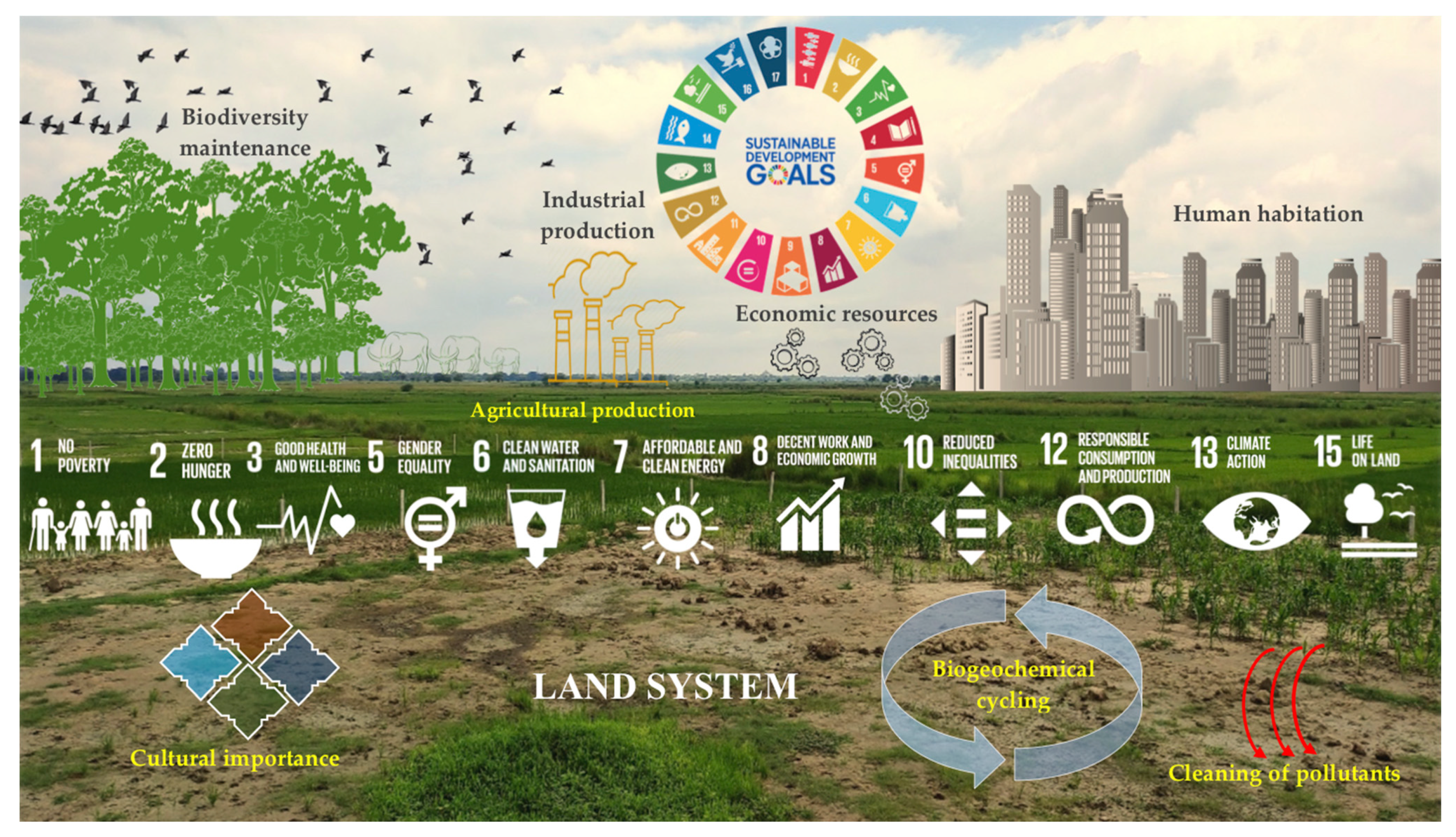
Maintaining the vitality of land resources is therefore essential for environmental sustainability and also for the realization of various global goals [11,12,13] pronounced in the UN Sustainable Development Goals (UN-SDGs) (www.sdgs.un.org). As depicted in Figure 1, the attainment of various SDGs such as no poverty (Goal No.1), zero hunger (Goal No.2), good health and wellbeing (Goal No.3), gender equality (Goal No. 5), clean water and sanitation (Goal No.6), affordable and clean energy (Goal No. 7), decent work and economic growth (Goal No. 8), reduced inequalities (Goal No.10), responsible consumption and production (Goal No. 12), climate action (Goal No. 13), are directly or indirectly depends upon the quality of land, whereas the realization of the Goal No. 15, i.e., life on land (‘protect, restore and promote sustainable use of terrestrial ecosystems, sustainably manage forests, combat desertification, and halt and reverse land degradation and halt biodiversity loss’) and associated SDG targets are exclusively dependent on land resource (www.un.org). Hence, regaining the productivity of land is crucial for the realization of various objectives envisioned for the United Nations Decade on Ecosystem Restoration (UN-DER) [11,12,13], and also, for attaining land degradation neutrality (LDN), as well as various other developmental agendas put forth by the respective nations [14,15,16].
Figure 1. Pictorial depiction of land’s contributions to human well-being and a good quality of life [1,2,3,4]. There is a strong and positive interconnectedness between land system, human development, and the UN-SDGs (www.sdgs.un.org). Land is a vital system for overall human development and also regulates critical planetary functions [1,7,8,9,10,15]. Therefore, protecting land system is essential for protecting our own future.
Unfortunately, more than 33% of the global land resources is already degraded due to various direct and indirect drivers of changes [1,2,3,4,15,16,17,18,19,20,21] including pollution due to rapid agriculturalization [5,6,10], urbanization, and industrialization; unsustainable land use practices [15], deforestation [18], salinization [17], desertification, natural and human induced fires, soil erosion, overexploitation of groundwater and other critical natural resources, mining activities, invasive alien plants, climate change, poor land governance and policy measures, behavioral changes, etc. [7,15,16,17,18,19,20,21]. According to Stocking [22], land degradation is defined as the “temporary or permanent decline in the productive capacity of the land, and the diminution of the productive potential, including its major land uses (e.g., rain-fed arable, irrigation, forests), its farming systems (e.g., smallholder subsistence), and its value as an economic resource” [22].
In simple terms, land degradation refers to “many processes that drive the decline of biodiversity, ecosystem functions or ecosystem services” [15]. As a result, the degradation negatively impacts the ecosystem services provided by the land system for human wellbeing, including social, economic, and cultural dimensions of human development (Figure 2) [22]. Recent studies of various inter-governmental agencies like the United Nations Convention to Combat Desertification (UNCCD) (www.unccd.int), the Intergovernmental Science-Policy Platform on Biodiversity and Ecosystem Services of the United Nations (IPBES) (www.ipbes.net), the United Nations Development Program (UNDP) (www.undp.org), and the Intergovernmental Panel on Climate Change (IPCC) (www.ipcc.ch), reported that the global land degradation directly affects billions of people worldwide (i.e., land degradation affects the livelihood of almost 74% of the poor people) and causing an economic damage amounting to US$6.3 trillion per annum [7,15]. For example, forest degradation directly affects ~1.6 billion people, including 70 million indigenous peoples who are solely dependent on the forest system for their survival [2,3,7,15]. Similarly, it has been estimated that almost 52% of the global agricultural lands are degraded (i.e., moderately or severely), and thereby affecting the livelihood of almost 2.6 billion people, those who are directly dependent on the agriculture for their sustenance (www.undp.org).
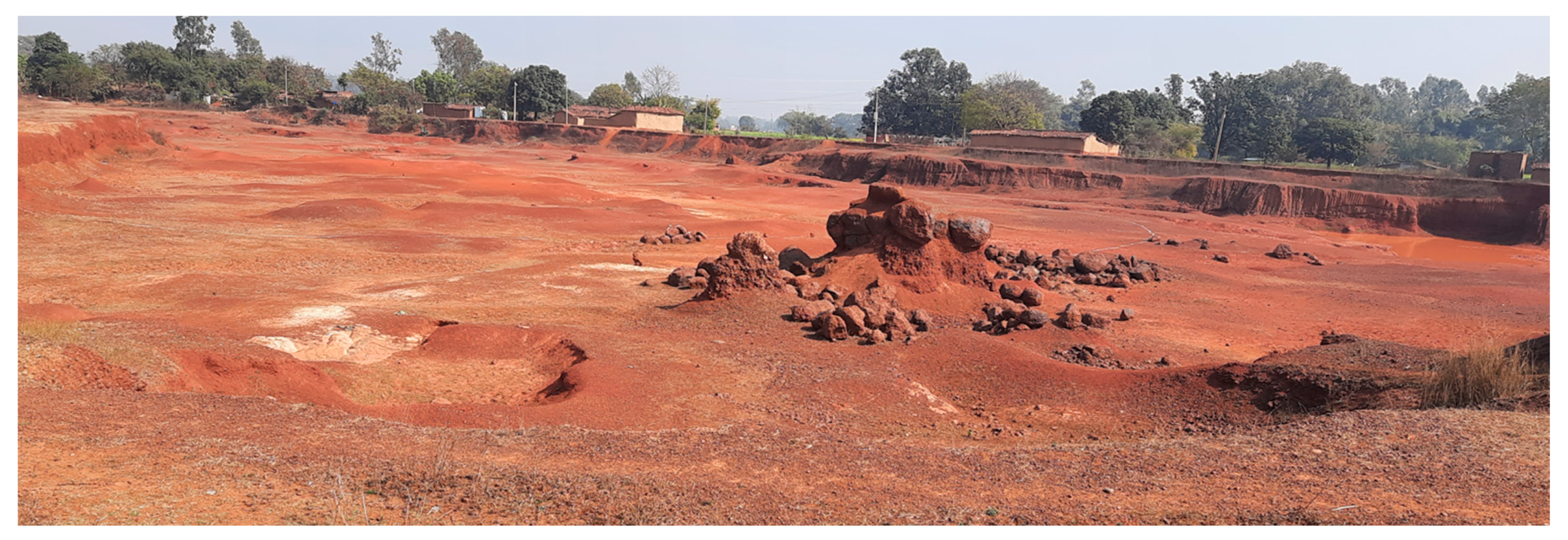
Figure 2. While soil erosion, deforestation, pollution, climate change, and unscientific land use are the major drivers of land degradation [1,2,3,4], land ownership (i.e., public or private) also affects land health. Figure shows an abandoned public land prone to erosion and pollution in Rajagarh, Mirzapur, UP, India.
Therefore, the timely restoration of degraded land is essential for ecosystem resilience, and also for ensuring food and nutritional security of the growing human population [6]. Apart from averting the negative effects on socio-economic system, restoration of degraded land is also pivotal for regaining ecological complexities mediated by land system [23]. In this way, the recent international initiatives such as the Bonn Challenge, the New York Declaration on Forests (NYDF), the UN-SDGs, and the UN-DER, are historic and highly commendable, since all of these initiatives are exclusively or majorly targeted for restoring degraded land for sustainable development. The present review is aimed to highlight the challenges of land restoration for sustainable development and provide inventive measures to avoid, reduce, and reverse global land degradation during the UN-DER (i.e., 2021–2030) and even beyond that.

2. The Challenges of Restoring Degraded Land within the Target Period

While land restoration is a slow process [4], the mounting pressure exerted by a growing human population on finite land resources necessitate easy and immediate ways of restoration. However, the success of land restoration greatly depends upon (i) the time, and also on other important factors such as (ii) the nature and extent of the degradation, (iii) the biodiversity of the area, (iv) the history of the land use pattern, (v) the edaphic and climatic conditions, (vi) the availability of resources, people’s support, and involvement, and importantly, (vii) the effectiveness of the restoration technologies employed [2,3,4,20,21]. Therefore, in strict sense, the objectives of land restoration cannot be completely attained within a short-stipulated time frame, and therefore, restoration activities must be extended for a very long period of time (at least for 50 years) with distinct, and defined short-term (i.e., decadal) as well as long-term restoration targets. Though it may not be possible to restore all of the ecological, economic, and socio-cultural services offered by land in a single go, the combination of short-term as well as long-term efforts will facilitate the attainment of one or more services in a stepwise manner. Therefore, investing ample time is one of the greatest challenges of global land restoration.
The lack of accurate information regarding the extent of land degradation (i.e., the total area of degraded land under different land-use) is another major hurdle for planning sustainable restoration initiatives and also for allocating time, and money incurred for the restoration programs accordingly [20,21,24,25,26,27]. While several agencies have already acknowledged the worsening impact of worldwide land degradation on ecological and economic systems [1,4,15,28,29], the actual level of degradation (by area wise and land use wise) is yet to be quantified. According to the FAO, more than one-third (i.e., 33%) of the global land is degraded (www.fao.org). However, in reality, the actual land area undergoing degradation may be more than this estimate, because it is difficult to quantify the severity of land degradation under various land use. For instance, the IPBES global assessment on land degradation and restoration indicates that 75% of the global land area has been significantly modified, whereas 90% of the total land is predicted to be significantly altered by 2050 [15,29]. These postulations clearly show the alarming trend of anthropogenic pressures on our finite land system and the need of attaining LDN for environmental sustainability.
Since it is comparatively easy to identify the extent of degradation in vegetated system, [30] mainly by assessing the canopy cover (i.e., >75% of canopy cover for the intact forests whereas, <75% for the degraded forest) and biomass (i.e., >75% of aboveground biomass for intact forest) by remote sensing, and also by using other proxy-indicators of degradation such as linear intrusions (i.e., the presence of logging roads, rails etc.), and human settlements etc. [31,32]; there are no well-defined indicators for assessing the extent and severity of degradation in non-forested areas like agroecosystems [6,33] and other land use. In the latter one, the ecological profiling of soil, including physical, chemical, and microbiological profiling is the only way to understand the level of degradation [5,24]. Hence, it will require a considerable amount of time, labor, and other resources for undertaking the soil quality profiling of non-forested areas at a global scale for ascertaining the extent of land quality degradation. Thus, developing simplified protocols for assessing the overall quality of land is essential for devising sustainable management strategies for restoration [5].
Although restoration of degraded land is essential to reduce or reverse the detrimental effects done by humans to nature (www.iis-rio.org), identifying priority areas for immediate restoration is another serious challenge [34,35,36,37]. Since it is not possible to initiate restoration of all degraded land under different land use (i.e., forest, grassland, crop land, marginal, and waste land, etc.) in one go, identifying priority areas are utmost important for the immediate initiation of the UN-DER [35,36]. Though the cost of land degradation is higher than the cost of conservation and restoration, land restoration at the global level requires a considerable amount of resources and commitments [37,38,39]. Therefore, mobilizing financial resources for global land restoration (~US$ 300 to 400 billion per year) is another point of concern [40,41]. As mentioned earlier, identifying priority areas for restoration is a challenging task, because such prioritization must be balanced and based on ecological, economic, and biocultural considerations of the local people. According to Strassburg et al. [34], restoration initiatives in 15% of the converted lands in priority areas of the global South will reduce species extinction by 60%, while sequestering ~ 30% of the atmospheric CO2 (299 gigatons of CO2) [34]. The study also finds that optimizing spatial planning based on multicriteria analysis will reduce the cost of restoration while further improving biodiversity gains by almost 91%, and climate change mitigation by 82% [34,35,36,37]. Since most of the forest conversion has happened for food production (as of 2014, >1.5 billion hectares of natural ecosystems had been converted to croplands [29]), the re-conversion of cropland to forest may jeopardize food security of the growing human population. Hence, land restoration initiatives must be balanced and targeted for both ecological and socio-economic gains.
Last but not least, restoration of polluted land under changing climatic condition is another serious concern, especially for plant and microbial-assisted restoration, because the changing climatic conditions can alter the growth and survival of plant species and associated rhizospheric and soil microorganisms [5,10,21]. The changing climatic conditions can also alter the fate and behavior of pollutants in soil-plant systems including the bioavailability of pollutants [10,24,25]. Moreover, we do not have proper scientific understanding regarding the role of emerging pollutants like micro- and nanoplastics [42], nanoparticles [43], etc., on land degradation. Therefore, deploying site-specific and pollutant-specific strategies are essential for restoring vast stretches of polluted land [5].

3. Ten-Point Action Plan for Global Land Restoration

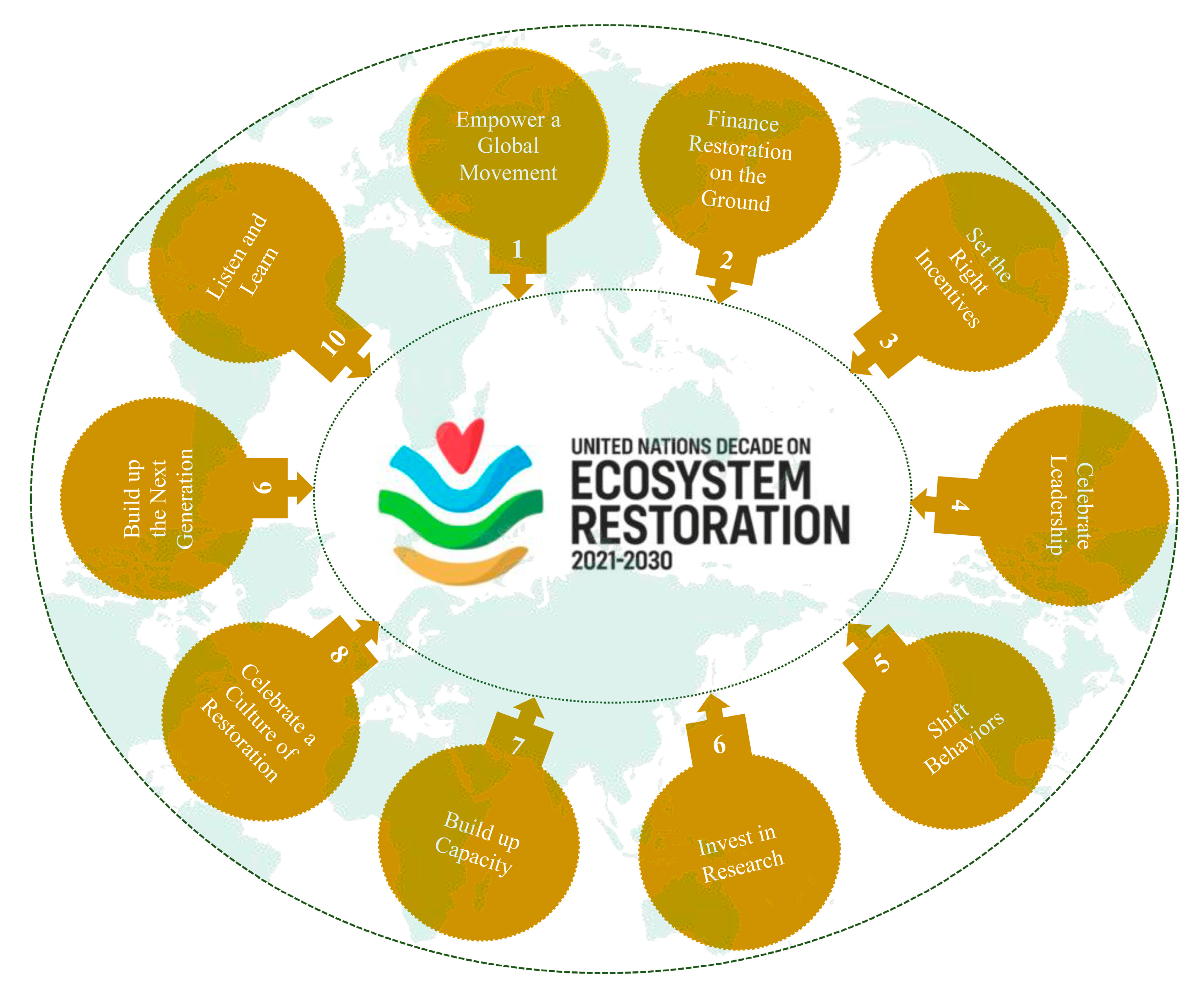
The 10-point strategies suggested by the UN (www.deacdeonrestoration.org) for action during the 10-year period of the UN-DER (2021 to 2030) is depicted in Figure 3. The ensuing subsections critically analyze the global implications of these action plans over the UN-DER period.
Figure 3. Ten-point action plan for restoring the vitality of the global ecosystem during the UN-DER (2021–2030). While these strategies are broadly aimed to create a global movement and solidarity for restoring degraded ecosystem for regaining ecological complexities, there are also co-benefits associated with land restoration such as creating new job avenues, and fighting against climate change, biodiversity loss, and climate-induced disasters (www.deacdeonrestoration.org). Therefore, the timely adoption of these strategies will have far reaching implications on global ecosystem restoration and also for the timely realization of the UN-SDGs.

3.1. Empower A Global Movement

Restoration of degraded land across the globe is not possible with the mere involvement of few individuals and institutions, and therefore, creating a momentum for global solidarity is crucial for the overall success of this mammoth task. Since the ultimate aim of the UN-DER is to halt and reverse the global degradation, it needs the expertise and experience of people from all walks of life (such as policy makers, local peoples, regulatory experts, scientist and technical experts, lawyers, gardeners, engineers, architects, designers, religious leaders, politicians, farmers, women and children, etc.), as well as the collaboration and cooperation of private and public institutions, non-governmental organizations, community/citizen groups, etc. [8,21]. As suggested by the UN (www.deacdeonrestoration.org), it is important to connect and empower the actions of various national, regional, and global initiatives targeted for halting land degradation such as the UN-SDGS (www.sdgs.un.org; as detailed earlier, the Goal No.15 is exclusively for land management, apart from that, several other SDGs and SDG targets are directly or indirectly related to land restoration); the Paris Agreement (www.unfcc.int; the Article 5 (2) of the Paris Agreement underlines the need of ‘policy approaches and positive incentives for activities relating to reducing emissions from deforestation and forest degradation, and the role of conservation, sustainable management of forests and enhancement of forest carbon stocks in developing countries’); the Bonn Challenge (www.bonnchallenge.org; aimed to restore 350 million hectares of global degraded land by the year 2030); the New York Declaration on Forest (www.forestdeclaration.org; ‘a voluntary and non-binding international declaration to take action to halt global deforestation’); The Global Partnership of Forest and Landscape Restoration (www.forestlandscaperestoration.org; an ongoing global initiative by the International Union for Conservation of Nature for restoring degraded forest and landscapes); the Global Restoration Initiative (www.wri.org; an ongoing initiative by the World Resources Institute targeted for the restoration of forest and degraded lands in 17 different landscapes in 50 countries, spanning over three regions, i.e., Asia Pacific, Africa, and Latin America and Caribbean); The Great Green Wall Initiative (www.greatgreenwall.org; an African-led initiate to grow an 8000 km green wall across the entire width of Africa); the AFR100 (www.afr100.org; the African Forest Landscape Restoration Initiative, ‘a country-led effort to bring 100 million hectares of land in Africa into restoration by 2030′); the Initiative 20x20 (www.initiative20x20.org; a country-lead initiative to reduce land degradation in Latin America and the Caribbean); etc., to strengthen the objectives of the UN-DER.

3.2. Finance Restoration on the Ground

Though there are many international initiatives targeted to restore degraded land across the world and several local and regional organizations/communities are willing to carry forward the ethos of restoration, land restoration on the ground needs considerable amounts of resources including financial support [37,38,39,40,41]. Even though the economic benefit of restoration is several folds higher than the cost of restoration (almost 7 to 30-fold, i.e., every US$1 expenditure on land restoration will provide an economic return of US$7–30) [39], huge investments are required for implementing land restoration at the global scale [43,44]. Therefore, restoration on the ground is not possible without financial contributions and active support of all players (www.deacdeonrestoration.org) including government bodies; global lenders such as the International Monetary Fund (IMF), the World Bank (WB), the Asian Development Bank (ADB), the African Development Bank (AFD) etc.; and international development agencies such as the United States Agency for International Development (USAID), the Foreign, Commonwealth and Development Office, UK (FCDO), the Swedish International Development Agency (SIDA), the Canadian International Development Agency (CIDA), the Japan International Cooperation Agency (JICA), the Norwegian Agency for Development Corporation (Norad), the Danish International Development Agency (DANIDA), the French Development Agency (AFD), the Australian Aid (AA), the Federal Ministry of Economic Cooperation and Development, Germany (BMZ), etc., to name a few.
While individuals can support restoration initiatives by generous funding and even through crowd funding, private companies can finance local, regional, or global land restoration initiatives through their ‘Corporate Social Responsibility Funds’ (CSR Funds). Moreover, there is a need to create an exclusive fund for restoration named the ‘Global Restoration Fund’ (GRF), like in the case of the ‘Global Environment Fund’ (GEF) created in 1990 for investing in low carbon initiatives, cleaner and renewable energy-based production, as well as for promoting resources saving industrial operations (www.globalenvironmentfund.com). The national and state government can also allocate a special fund for restoration, as in the case of the Queensland Government’s Land Restoration Fund (LRF) established by the Govt. of Queensland, Australia (www.gld.gov.au) for mobilizing land restoration activities [44]. Furthermore, as recommended by the FAO, integrating land restoration into national accounting is one of the best strategies to garner proper attention of policy makers, and also to allocate adequate funds for land restoration at the national level [45]. The innovative strategies suggested by the WRI [39] for unlocking restoration finance such as (i) diverting revenue generated from carbon taxes (mainly obtained through the Nationally Determined Contributions) for land restoration, (ii) providing robust risk management measures to private players for ensuring their confidence and involvement in restoration projects, (iii) integrating restoration initiatives into the business portfolios of all concerned ministries for better coordination and governance, and importantly, and. (iv) quantifying the actual benefits of land restoration and informing the overall benefits to one and all is essential, so that the general public and other prospective actors can come forward for this common cause [39].
Deriving co-benefits such as bioproducts or phytoproducts during various stages of restoration is considered as an innovative way for supporting a bio-based economy [1,21,46,47,48,49] while maintaining the continuity of restoration and also for ensuring stakeholder involvements [21]. A recent assessment done by the International Resource Panel (IRP) of the UNEP on linking land restoration with the SDGs has clearly articulated the possible co-benefits associated with land restoration while concurrently achieving other SDG targets also. These co-benefits are mainly economic (income generation), social (improving the livelihood opportunities by providing employment in restoration sector), and biocultural (regaining biocultural significance of land) in nature and are directly or indirectly obtainable during or after the land restoration programs. For instance, land restoration with multipurpose plant species (like biomass and biofuel crops) provides an opportunity for extracting phytoproducts i.e., biomass [1], bioplastics, bioethanol, biochar, fuel wood, etc., during restoration for supporting a bio-based enterprise [43]. Land restoration also provides additional revenue generation through carbon crediting, and also by converting degraded landscapes to parks and heritage sites/cultural landscape etc. As depicted in Table 1, well planned and targeted restoration programs will facilitate the attainment of various SDG targets related to social and economic development such as no poverty, zero hunger, good health and wellbeing, gender equality, clean water and sanitation, affordable energy production (mainly through biomass), decent work and economic growth, reduced inequalities, etc. For example, land restoration helps in ending discrimination against women up to a certain extent by providing equal employment opportunities in restoration sector which in turn creates better opportunities for education to their children including girls (www.foreststreesagroforestry.org) [47,48,49]. Restoration initiatives will also result in poverty alleviation by improving financial conditions of the women and also by converting degraded lands into agroforestry-based food production systems [50]. In a nutshell, the benefits of land restoration are enormous and inclusive restoration programs will directly or indirectly support the realization of other SDG targets also [2].
Table 1. Land restoration will not only help in the realization of several SDG targets, but also provide an opportunity for deriving additional benefits (co-benefits) [2,3,7] during or after the restoration stage (i.e., by the end of the UN-DER) [2]. An indicative list of SDG targets (related to land restoration) for which co-benefits are possible or likely obtainable reported by the International Resource Panel (IRP) of the UNEP [2]. The opportunity to harness co-benefits will further encourage world-wide restoration initiatives.

3.3. Set the Right Incentives

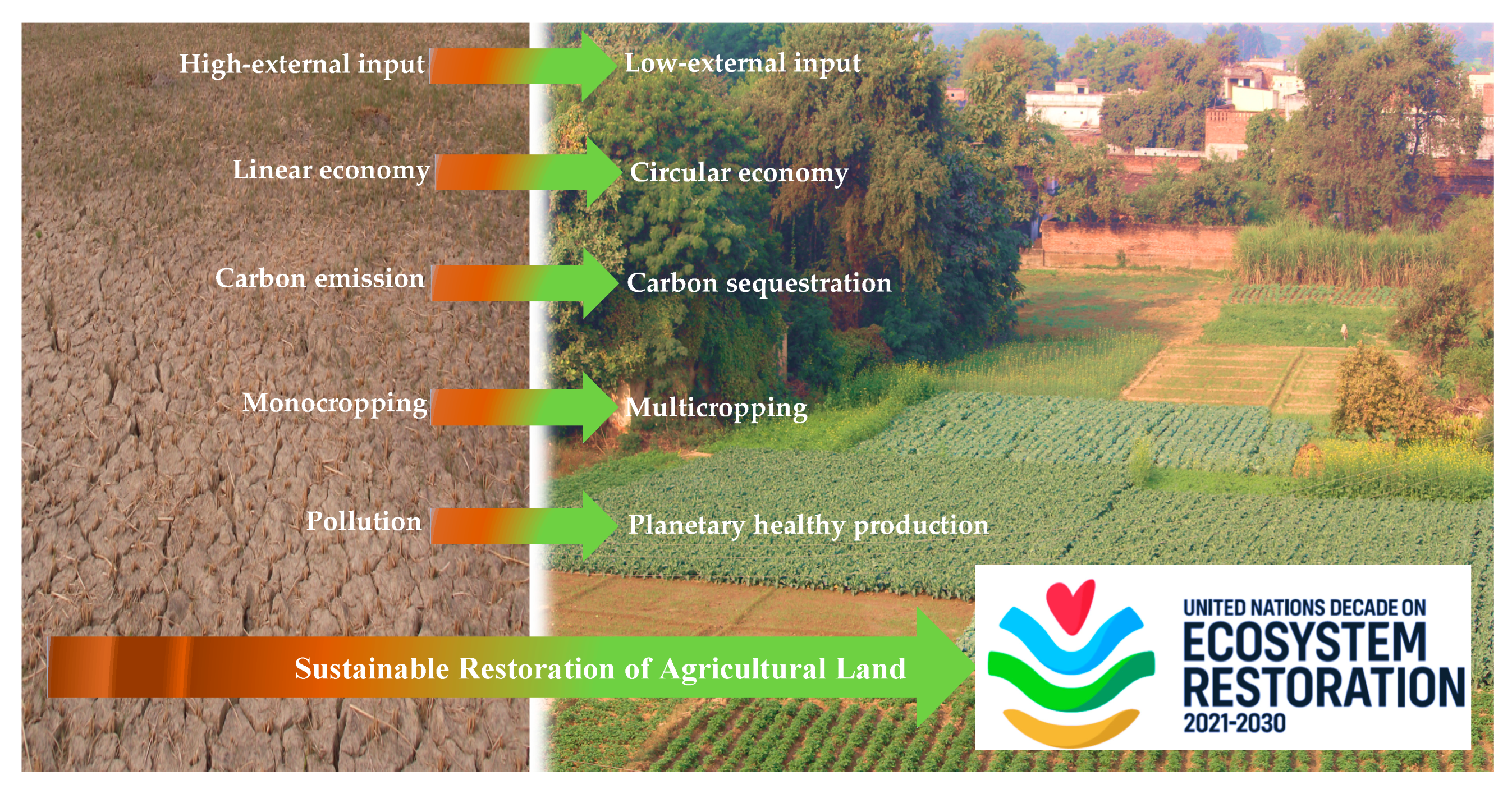
Though the profitability index i.e., the benefit–cost ratio (BCR) of restoration is very high, it will take years to reap the monetary benefits out of land restoration. Therefore, introducing suitable market-based incentives (MBI) like subsidies or loans are essential for attracting more players into land restoration ventures, whereas imposing disincentives such as penalties, taxes, permits, etc., will restrict or penalize the activities which further leads to land degradation [39,51,52]. For instance, a study on the role of MBI for landscape restoration in Shinyanga, Tanzania proved that incentives worked best for privately owned land, whereas disincentives played well for restoring community or public land. As suggested by Chapman and Lindernmayer [53], introducing alternate MBI like revenue-contingent loan (RCL) is suitable for attracting public sector engagement with agricultural land restoration as ‘it has subsidy-reducing properties for government budgets’ [53] as well as flexible repayment opportunities i.e., repayment normally starts with the revenue generation or ‘financial assistance repaid contingent on a farm’s capacity to pay’ [54]. In addition, there is a need to change the way existing incentives are allocated, especially for agricultural activities. Since agrochemicals constitute the major budgetary outlay for marginal and subsistence farmers in developing countries, providing subsidies for fertilizers is often viewed as an economic support to the farmer’s endeavors [55]. Unfortunately, the subsidized price often leads to over-application of fertilizers (due to higher purchasing power of farmers), and subsequent environmental pollution [55]. It has been estimated that synthetic fertilizers (e.g., nitrogenous fertilizers) are one of the major drivers of land degradation and the rampant use of synthetic fertilizers have already crossed the planetary boundaries [56,57,58]. Therefore, setting the right incentives for the right activities is of paramount significance for preventing future land degradation, while diverting the subsidies for activities that facilitate/support land restoration [39]. In this context, the incentives must be set for biofertilizers/organic/sustainable agricultural practices, instead of existing incentives for synthetic/mineral fertilizers (Figure 4).
Figure 4. Setting the right incentives are imperative for promoting planetary healthy food production while reducing pollution from agroecosystems [6,59,60,61,62]. Moreover, good cultivation practices based on circular economy principles will protect agricultural land from further degradation. Therefore, incentives must be provided for framing practices based on low-external input as well as resource conserving practices (mainly replacing synthetic fertilizers by organic and biofertilizers [60,63,64,65,66,67], sustainable utilization of agro-residues), improving soil carbon pool, and also based on multiple cropping patterns targeted to maintain agrobiodiversity for ecological resilience, and food and nutritional security [6].

3.4. Celebrate Leadership

Though there are many national, regional, and multilateral agreements and commitments (both binding and non-binding) are operational across the world and several countries/organizations are committed to restore degraded landscape back to life [68,69], restoration at a global scale needs more leadership and political will, and also the engagement of peoples from various sectors across the world. Therefore, new commitments are essential for strengthening ongoing efforts [69]. So, it is the right time to celebrate leadership, foster commitments, and encourage others to come forward. In this way, the initiative taken by the G-20 countries (i.e., Argentina, Australia, Brazil, Canada, China, France, Germany, India, Indonesia, Italy, Japan, Republic of Korea, Mexico, Russia, Saudi Arabia, South Africa, Turkey, United Kingdom, United States, and the European Union) named the ‘Global Initiative on Reducing Land Degradation and Enhancing Conservation of Terrestrial Habitats’ to restore a 50% of degraded land by 2040, on a voluntary basis, is a welcome step forward [70]. Similarly, other international forums/organizations such as the Common Wealth of Nations, the European Union, the Asia Pacific Economic Cooperation, the Association of Southeast Asian Nations, the SAARC, the BRICS, the South Asia Subregional Economic Cooperation, the Organization of the Petroleum Exporting Countries, the Organization for Economic Co-operation and Development, etc., can also start similar initiatives in line with the G-20 countries for land restoration (www.g20riyadhsummit.org) and formulate explicit financial packages for promoting land restoration activities in their respective regions/member states.

3.5. Shift Behaviors

Shifting behaviors are important for restoration narratives [71]. While land degradation is a local issue, the drivers of land degradation are often connected to the global market system (due to global production and use of goods and services) [71,72]. Therefore, land restoration not only requires money, resources, and technology, but also needs behavioral changes, especially a pragmatic change in the way we manage our land resources as well as the way we produce and consume. Therefore, the behavioral shift towards planet-friendly ways of industrial and agricultural production, green transportation, and consumption patterns (including the consumption of restoration-based products) based on circular economy principles rather than linear economy will prevent future degradation of our landscapes, while supporting regional initiatives for restoration [71,72,73,74,75]. Most importantly, the transition towards a planetarily healthy diet (based on a plant-based diet with flexible amount of fish/animal protein) will enable us to sustainably manage agricultural system while protecting our natural landscapes from further degradation [76].

3.6. Invest in Research

Investing in land restoration research is essential for developing site-specific restoration packages [13,25,75]. Though the drivers of restoration may be common for various land use, successful restoration needs site-specific, and customized efforts [76,77]. Since restoration is a complex processes, it needs scientific advancements of various disciplines such as ecology, agriculture, plant science, forestry, agroforestry, microbiology, zoology, geology, geography, remote sensing, landscape designing, engineering, modelling, economics, planning, sociology, anthropology, law, governance, business management, etc., as well as the sustainable utilization of traditional and indigenous knowledge (including biocultural knowledge) of the concerned people, and also the adoption of citizens science/community science. As mentioned earlier, restoration under changing climatic conditions is a challenging task, and therefore optimizing restoration practices for diverse edaphic and agrometeorological conditions under futuristic climate is a herculean task [25,26,27]. Identifying suitable plant species for revegetation and optimizing their agronomic practices for large-scale cultivation in degraded landscapes needs robust research inputs. Moreover, redesigning of the degraded landscapes are essential for maintaining the biocultural significance of the concerned land. Therefore, coordinating land restoration research at various scales and levels are imperative for developing practical and actionable restoration packages corroborated by nature-based solutions, and ecosystem-based strategies for implementing a successful restoration decade.

3.7. Build up Capacity

While thousands of land restoration programs are already underway (www.deacdeonrestoration.org), involving immediate sufferers of land degradation (especially, women and youth) in restoration ventures and building capacity of such marginalized people [78] to successfully steering restoration during the UN decade is essential for executing restoration on the ground (www.iufro.org). Capacity building will not only empower and educate such groups for this common cause, but also facilitate a platform for networking of like-minded people [79]. Such platforms will also help in imparting awareness regarding ecological, economic, and socio-cultural significance of ecosystem restoration, conducting training on best restoration practices, knowledge and experience sharing, and also for sharing information regarding mobilization of financial resources [80], etc. Therefore, creating a network of interested people, and thereby properly utilizing their expertise, experience, and enthusiasm is essential for the success of land restoration.

3.8. Celebrate a Culture of Restoration

Land restoration is neither a time bound nor an easy target. It needs considerable years of time and efforts to restore a degraded land back to normalcy. For a successful restoration, the support of all players including common people are essential [81]. Therefore, as a global citizen, it is the responsibility of each and every individual to inspire and motivate others to take part in land restoration ventures. Importantly, adopting a culture of restoration in our daily life itself is one of the best strategies to keep the ball rolling [82,83]. Learning the biocultural practices of indigenous and local people from diverse parts of the world is essential to understand the relevance of implying cultural practices for land restoration [81,83] and also for attaining multi-level sustainability goals in a time-bound manner [84].

3.9. Build up the Next Generation

As the consequences of land degradation will greatly impact the youth and future generations, honing the soft and hard skills of the next generation is essential for leading restoration drive forward and also for creating ‘sustainable job opportunities based on a restoration economy’ (www.deacdeonrestoration.org) for their wellbeing. Education for restoration can be imparted through various formal (i.e., specific courses and training programs/field work for School and University students, and also through Massive Online Open Courses (MOOC) etc.) and also through various informal ways (e.g., through mobile apps) [85]. As highlighted by the UN, “education for restoration will turn today’s children into ecosystem ambassadors, provide skills for sustainable jobs and ensure that the UN Decade’s achievements far outlive its timeframe” (www.deacdeonrestoration.org).

3.10. Listen and Learn

Listening and learning from each other and building a culture of sharing knowledge, resources, and expertise for caring land resources is imperative for the success of the UN decade. Respecting others and learning from the success [86] and failures of previous and ongoing land restoration ventures [87] will provide an opportunity for necessary course corrections. Furthermore, it is the high time to re-embrace the forgotten concept of ‘land ethic’ proposed by ‘Aldo Leopold’ [88] and we must change our attitude towards land as a ‘living entity’ rather than a ‘fictitious commodity’. Together, by collective efforts, we can fulfill the ambitious goals of the UN-DER and also other ongoing initiatives targeted for land restoration.

4. Conclusions

Land degradation is one of the major impediments for sustainable development and causing economic damage amounting to US $6.3 trillion per annum. Devising sustainable strategies for restoring degraded land at the local, national, regional, and global level is imperative for the timely realization of the UN-SDGs. The UN-DER opens the floodgates of opportunities for restoring degraded land for the benefit of both people and the planet. However, individuals and institutions must come forward to grab this golden opportunity to restore the health of our dying land for a sustainable future.

Funding

This research received no external funding.

Data Availability Statement

Not applicable.

Acknowledgments

At the very first, I would like to thank ‘Land’ editorial office for giving me this opportunity to write this review on a contemporary topic. I am thankful to my students and collaborators for their kind support and also for many fruitful discussions. I am also thankful to international organizations such as UN-IPBES, IRP-UNEP, and IUCN for giving me an opportunity to be involved with their regional/global assessments on biodiversity and ecosystem services, land degradation and restoration, and regaining land health for sustainable agriculture. All of such involvements have strengthened my knowledge and experience, and helped me a lot in contemplating sustainable strategies for managing land system for attaining the UN-SDGs. Thanks are also due to the Head, DESD and the Director, IESD for encouragement. Last but not least, I dedicate this review to all the unsung warriors of global land restoration.

Conflicts of Interest

The author declares no conflict of interest.

References

  1. Edrisi, S.A.; Abhilash, P.C. Exploring marginal and degraded lands for biomass and bioenergy production: An Indian scenario. Renew. Sustain. Energy Rev. 2016, 54, 1537–1551. [Google Scholar] [CrossRef]
  2. IRP. A think piece of the International Resource Panel. In Land Restoration for Achieving the Sustainable Development Goals: An International Resource Panel Think Piece; Herrick, J.E., Abrahamse, T., Abhilash, P.C., Ali, S.H., Alvarez-Torres, P., Barau, A.S., Branquinho, C., Chhatre, A., Chotte, J.L., Von Maltitz, G.P., Eds.; United Nations Environment Programme: Nairobi, Kenya, 2019. [Google Scholar]
  3. Larbodière, L.; Davies, J.; Schmidt, R.; Magero, C.; Vidal, A.S.A.; Bucher, P.; Maginnis, S.; Cox, N.; Hasinger, O.; Abhilash, P.C.; et al. Common Ground: Restoring Land Health for Sustainable Agriculture; International Union for Conservation of Nature (IUCN): Gland, Switzerland, 2020. [Google Scholar]
  4. Wu, N.; Wang, C.; Ausseil, A.G.; Alhafedh, Y.; Broadhurst, L.; Lin, H.J.; Axmacher, J.; Okubo, S.; Turney, C.; Onuma, A.; et al. Chapter 4: Direct and indirect drivers of change in biodiversity and nature’s contributions to people. In IPBES (2018): The IPBES Regional Assessment Report on Biodiversity and Ecosystem Services for Asia and the Pacific; Karki, M., Sellamuttu, S.S., Okayasu, S., Suzuki, W., Acosta, L.A., Alhafedh, Y., Anticamara, J.A., Ausseil, A.G., Davies, K., Gasparatos, A., et al., Eds.; Secretariat of the Intergovernmental Science-Policy Platform on Biodiversity and Ecosystem Services (IPBES): Bonn, Germany, 2018; pp. 265–370. [Google Scholar]
  5. Tripathi, V.; Edrisi, S.; Chaurasia, R.; Pandey, K.K.; Dinesh, D.; Srivastava, R.; Srivastava, P.; Abhilash, P. Restoring HCHs polluted land as one of the priority activities during the UN-International Decade on Ecosystem Restoration (2021–2030): A call for global action. Sci. Total. Environ. 2019, 689, 1304–1315. [Google Scholar] [CrossRef] [PubMed]
  6. Dubey, P.K.; Singh, A.; Raghubanshi, A.; Abhilash, P.C. Steering the restoration of degraded agroecosystems during the United Nations Decade on Ecosystem Restoration. J. Environ. Manag. 2021, 280, 111798. [Google Scholar] [CrossRef]
  7. Priyadarshini, P.; Abhilash, P.C. Fostering sustainable land restoration through circular economy-governed transitions. Restor. Ecol. 2020, 28, 719–723. [Google Scholar] [CrossRef]
  8. Keesstra, S.; Geissen, V.; Mosse, K.; Piiranen, S.; Scudiero, E.; Leistra, M.; Van Schaik, L. Soil as a filter for groundwater quality. Curr. Opin. Environ. Sustain. 2012, 4, 507–516. [Google Scholar] [CrossRef]
  9. Keesstra, S.; Nunes, J.P.; Saco, P.; Parsons, T.; Poeppl, R.; Masselink, R.; Cerdà, A. The way forward: Can connectivity be useful to design better measuring and modelling schemes for water and sediment dynamics? Sci. Total Environ. 2018, 644, 1557–1572. [Google Scholar] [CrossRef]
  10. Keesstra, S.; Mol, G.; De Leeuw, J.; Okx, J.; Molenaar, C.; De Cleen, M.; Visser, S. Soil-Related Sustainable Development Goals: Four Concepts to Make Land Degradation Neutrality and Restoration Work. Land 2018, 7, 133. [Google Scholar] [CrossRef]
  11. Abhilash, P.C.; Tripathi, V.; Edrisi, S.A.; Dubey, R.K.; Bakshi, M.; Dubey, P.K.; Singh, H.B.; Ebbs, S.D. Sustainability of crop production from polluted lands. Energy Ecol. Environ. 2016, 1, 54–65. [Google Scholar] [CrossRef]
  12. UNEP. Policy Coherence of the Sustainable Development Goals. A Natural Resource Perspective; United Nations Environment Programme: Nairobi, Kenya, 2015. [Google Scholar]
  13. Tripathi, V.; Edrisi, S.A.; Chen, B.; Gupta, V.K.; Vilu, R.; Gathergood, N.; Abhilash, P.C. Biotechnological Advances for Restoring Degraded Land for Sustainable Development. Trends Biotechnol. 2017, 35, 847–859. [Google Scholar] [CrossRef] [PubMed]
  14. WRI. Roots of Prosperity: The Economics and Finance of Restoring Land; Ding, H., Faruqi, S., Wu, A., Altamirano, J.C., Ortega, A.A., Cristales, R.Z., Chazdon, R., Vergara, W., Verdone, M., Eds.; World Resources Institute: Washington, DC, USA, 2017. [Google Scholar]
  15. IPBES. Summary for Policymakers of the Assessment Report on Land Degradation and Restoration of IPBES; Scholes, R., Montanarella, L., Brainich, A., Barger, N., ten Brink, B., Cantele, M., Erasmus, B., Fisher, J., Gardner, T., Holland, T.G., et al., Eds.; Intergovernmental Science-Policy Platform on Biodiversity and Ecosystem Services: Bonn, Germany, 2018. [Google Scholar]
  16. IUCN. Policy Brief on the Economics of Forest Landscape Restoration; International Union for Conservation of Nature: Gland, Switzerland, 2020. [Google Scholar]
  17. Edrisi, S.A.; Tripathi, V.; Chaturvedi, R.K.; Dubey, D.K.; Patel, G.; Abhilash, P.C. Saline Soil Reclamation Index as an efficient tool for assessing restoration progress of saline land. Land Degrad. Dev. 2021, 32, 123–138. [Google Scholar] [CrossRef]
  18. Edrisi, S.A.; El-Keblawy, A.; Abhilash, P.C. Sustainability Analysis of Prosopis juliflora (Sw.) DC Based Restoration of Degraded Land in North India. Land 2020, 9, 59. [Google Scholar] [CrossRef]
  19. Edrisi, S.A.; Tripathi, V.; Abhilash, P.C. Performance Analysis and Soil Quality Indexing for Dalbergia sissoo Roxb. Grown in Marginal and Degraded Land of Eastern Uttar Pradesh, India. Land 2019, 8, 63. [Google Scholar] [CrossRef]
  20. Edrisi, S.A.; Tripathi, V.; Abhilash, P.C. Towards the sustainable restoration of marginal and degraded lands in India. Trop. Ecol. 2018, 59, 397–416. [Google Scholar]
  21. Tripathi, V.; Edrisi, S.A.; Abhilash, P.C. Towards the coupling of phytoremediation with bioenergy production. Renew. Sustain. Energy Rev. 2016, 57, 1386–1389. [Google Scholar] [CrossRef]
  22. Stocking, M. Land Degradation. Int. Encycl. Soc. Behav. Sci. 2001, 8242–8247. [Google Scholar] [CrossRef]
  23. Syktus, J.I.; McAlpine, C.A. More than carbon sequestration: Biophysical climate benefits of restored savanna woodlands. Sci. Rep. 2016, 6, 29194. [Google Scholar] [CrossRef] [PubMed]
  24. Tripathi, V.; Dubey, R.K.; Edrisi, S.A.; Narain, K.; Singh, H.; Singh, N.; Abhilash, P.C. Towards the ecological profiling of a pesticide contaminated soil site for remediation and management. Ecol. Eng. 2014, 71, 318–325. [Google Scholar] [CrossRef]
  25. Abhilash, P.C.; Dubey, R.K.; Tripathi, V.; Srivastava, P.; Verma, J.P.; Singh, H.B. Remediation and management of POPs-contaminated soils in a warming climate: Challenges and perspectives. Environ. Sci. Pollut. Res. 2013, 20, 5879–5885. [Google Scholar] [CrossRef]
  26. Abhilash, P.C.; Jamil, S.; Singh, N. Transgenic plants for enhanced biodegradation of organic xenobiotics. Biotechnol. Adv. 2009, 27, 474–488. [Google Scholar] [CrossRef]
  27. Abhilash, P.C.; Powell, J.; Singh, H.B.; Singh, B. Plant-microbe interactions: Novel applications for exploitation in multipurpose remediation technologies. Trends Biotechnol. 2012, 30, 416–420. [Google Scholar] [CrossRef]
  28. IPCC. Climate Change and Land: An IPCC Special Report on Climate Change, Desertification, Land Degradation, Sustainable Land Management, Food Security, and Greenhouse Gas Fluxes in Terrestrial Ecosystems; Intergovernmental Panel on Climate Change: Geneva, Switzerland, 2019. [Google Scholar]
  29. IPBES. The IPBES Assessment Report on Land Degradation and Restoration; Intergovernmental Platform for Biodiversity and Ecosystem Services: Bonn, Germany, 2018. [Google Scholar]
  30. FAO. Assessing Forest Degradation: Towards the Development of Globally Applicable Guidelines; Forest Resources Assessment Working Paper 177; Food and Agricultural Organization: Rome, Italy, 2011. [Google Scholar]
  31. Wang, C.; Qi, J.; Cochrane, M. Assessment of Tropical Forest Degradation with Canopy Fractional Cover from Landsat ETM+ and IKONOS Imagery. Earth Interact. 2005, 9, 1–18. [Google Scholar] [CrossRef]
  32. Mitchell, A.L.; Rosenqvist, A.; Mora, B. Current remote sensing approaches to monitoring forest degradation in support of countries measurement, reporting and verification (MRV) systems for REDD+. Carbon Balance Manag. 2017, 12, 1–22. [Google Scholar] [CrossRef] [PubMed]
  33. Prăvălie, R.; Patriche, C.; Borrelli, P.; Panagos, P.; Roșca, B.; Dumitraşcu, M.; Nita, I.A.; Săvulescu, I.; Birsan, M.V.; Bandoc, G. Arable lands under the pressure of multiple land degradation processes. A global perspective. Environ. Res. 2021, 194, 110697. [Google Scholar] [CrossRef] [PubMed]
  34. Strassburg, B.B.N.; Iribarrem, A.; Beyer, H.L.; Cordeiro, C.L.; Crouzeilles, R.; Jakovac, C.C.; Junqueira, A.B.; Lacerda, E.; Latawiec, A.E.; Balmford, A.; et al. Global priority areas for ecosystem restoration. Nature 2020, 586, 724–729. [Google Scholar] [CrossRef] [PubMed]
  35. Strassburg, B.B.N.; Beyer, H.L.; Crouzeilles, R.; Iribarrem, A.; Barros, F.; De Siqueira, M.F.; Sánchez-Tapia, A.; Balmford, A.; Sansevero, J.B.B.; Brancalion, P.H.S.; et al. Strategic approaches to restoring ecosystems can triple conservation gains and halve costs. Nat. Ecol. Evol. 2019, 3, 62–70. [Google Scholar] [CrossRef] [PubMed]
  36. Ferrier, S. Prioritizing where to restore Earth’s ecosystems. Nat. Cell Biol. 2020, 586, 680–681. [Google Scholar] [CrossRef]
  37. Sutton, P.C.; Anderson, S.J.; Costanza, R.; Kubiszewski, I. The ecological economics of land degradation: Impacts on ecosystem service values. Ecol. Econ. 2016, 129, 182–192. [Google Scholar] [CrossRef]
  38. Credit Suisse, WWF (World Wildlife Fund), and McKinsey and Company. Conservation Finance: Moving Beyond Donor Funding toward an Investor-Driven Approach. 2014. Available online: https://earthmind.org/library/guidelines/conservation-finance-moving-beyond-donor-funding-toward-investor-driven-approach (accessed on 15 January 2021).
  39. WRI. Roots of Prosperity: The Economics and Finance of Restoring Land. 2017. Available online: https://www.wri.org/publication/roots-of-prosperity (accessed on 15 January 2021).
  40. Nkonya, E.; Mirzabaev, A.; von Braun, J. Economics of Land Degradation and Improvement: A global Assessment for Sustainable Development; Springer: Berlin/Heidelberg, Germany, 2016; Volume 686. [Google Scholar]
  41. Wainaina, P.; Minang, P.A.; Gituku, E.; Duguma, L. Cost-Benefit Analysis of Landscape Restoration: A Stocktake. Land 2020, 9, 465. [Google Scholar] [CrossRef]
  42. Machado, A.A.S.; Lau, C.W.; Till, J.; Kloas, W.; Lehmann, A.; Becker, B.; Rillig, M.C. Impacts of microplastics on the soil biophysical environment. Environ. Sci. Technol. 2018, 52, 9656–9665. [Google Scholar] [CrossRef]
  43. Bakshi, M.; Singh, H.B.; Abhilash, P.C. Unseen impact of nanoparticles: More or less? Cur. Sci. 2014, 106, 350–352. [Google Scholar]
  44. DES. Land Restoration Fund: Priority Investment Plan; Department of Environment and Science Government: Queensland, Australia, 2020. [Google Scholar]
  45. FAO. Sustainable Financing for Forest and Landscape Restoration-Opportunities, Challenges and the Way Forward; Liagre, L., Lara Almuedo, P., Besacier, C., Conigliaro, M., Eds.; Food and Agricultural Organization: Rome, Italy, 2015. [Google Scholar]
  46. Tripathi, V.; Edrisi, S.; O’Donovan, A.; Gupta, V.K.; Abhilash, P.C. Bioremediation for Fueling the Biobased Economy. Trends Biotechnol. 2016, 34, 775–777. [Google Scholar] [CrossRef]
  47. Catacutan, D.C.; Villamor, G.B. Gender Roles and Land Use Preferences—Implications to Landscape Restoration in Southeast Asia. In Land Restoration: Reclaiming Landscapes for a Sustainable Future; Academic Press: London, UK, 2016; pp. 431–440. [Google Scholar]
  48. Yurui, L.; Xuanchang, Z.; Zhi, C.; Zhengjia, L.; Zhi, L.; Yansui, L. Towards the progress of ecological restoration and economic development in China’s Loess Plateau and strategy for more sustainable development. Sci. Total. Environ. 2021, 756, 143676. [Google Scholar] [CrossRef] [PubMed]
  49. Thompson-Hall, M. Land Restoration, Agriculture, and Climate Change: Enriching Gender Programming through Strengthening Intersectional Perspectives. In Land Restoration: Reclaiming Landscapes for a Sustainable Future; Academic Press: London, UK, 2016; pp. 421–430. [Google Scholar]
  50. Robiglio, V.; Reyes, M. Restoration through formalization? Assessing the potential of Peru’s agroforestry concessions scheme to contribute to restoration in agricultural frontiers in the Amazon region. World Dev. Perspect. 2016, 3, 42–46. [Google Scholar] [CrossRef]
  51. Wainaina, P.; Minang, P.A.; Nzyoka, J.; Duguma, L.; Temu, E.; Manda, L. Incentives for landscape restoration: Lessons from Shinyanga, Tanzania. J. Environ. Manag. 2021, 280, 111831. [Google Scholar] [CrossRef] [PubMed]
  52. Huang, W.-Y.; Leblanc, M. Market-Based Incentives for Addressing Non-Point Water Quality Problems: A Residual Nitrogen Tax Approach. Rev. Agric. Econ. 1994, 16, 427–440. [Google Scholar] [CrossRef]
  53. Chapman, B.; Lindenmayer, D.B. A novel approach to the sustainable financing of the global restoration of degraded agricultural land. Environ. Res. Lett. 2019, 14, 124084. [Google Scholar] [CrossRef]
  54. Botterill, L.C.; Chapman, B.; Kelly, S. Revisiting revenue contingent loans for drought relief: Government as risk manager. Aust. J. Agric. Resour. Econ. 2017, 61, 367–384. [Google Scholar] [CrossRef]
  55. Scholz, E.W.; Geissler, B. Feebates for dealing with trade-offs on fertilizer subsidies: A conceptual framework for environmental management. J. Clean. Prod. 2018, 189, 898–909. [Google Scholar] [CrossRef]
  56. Foley, J.A.; Ramankutty, N.; Brauman, K.A.; Cassidy, E.S.; Gerber, J.S.; Johnston, M.; Mueller, N.D.; O’Connell, C.; Ray, D.K.; West, P.C.; et al. Solutions for a cultivated planet. Nature 2011, 478, 337–342. [Google Scholar] [CrossRef] [PubMed]
  57. Zhang, X.; Davidson, E.A.; Mauzerall, D.L.; Searchinger, T.D.; Dumas, P.; Shen, Y. Managing nitrogen for sustainable development. Nature 2015, 528, 51–59. [Google Scholar] [CrossRef]
  58. Rockström, J.; Steffen, W.; Noone, K.; Persson, Å.; Chapin, F.S.; Lambin, E.F.; Lenton, T.M.; Scheffer, M.; Folke, C.; Schellnhuber, H.J.; et al. A safe operating space for humanity. Nature 2009, 461, 472–475. [Google Scholar] [CrossRef]
  59. Willett, W.; Rockström, J.; Loken, B.; Springmann, M.; Lang, T.; Vermeulen, S.; Garnett, T.; Tilman, D.; Declerck, F.; Wood, A.; et al. Food in the Anthropocene: The EAT–Lancet Commission on healthy diets from sustainable food systems. Lancet 2019, 393, 447–492. [Google Scholar] [CrossRef]
  60. Meena, R.S.; Kumar, S.; Datta, R.; Lal, R.; Vijayakumar, V.; Brtnicky, M.; Sharma, M.P.; Yadav, G.S.; Jhariya, M.K.; Jangir, C.K.; et al. Impact of Agrochemicals on Soil Microbiota and Management: A Review. Land 2020, 9, 34. [Google Scholar] [CrossRef]
  61. Rodrigo-Comino, J.; Terol, E.; Mora, G.; Giménez-Morera, A.; Cerdà, A. Vicia sativa Roth. Can reduce soil and water losses in recently llanted vineyards (Vitis vinifera L.). Earth Syst. Environ. 2020, 4, 1–16. [Google Scholar] [CrossRef]
  62. Keesstra, S.; Rodrigo-Comino, J.; Novara, A.; Giménez-Morera, A.; Pulido, M.; Di Prima, S.; Cerdà, A. Straw mulch as a sustainable solution to decrease runoff and erosion in glyphosate-treated clementine plantations in Eastern Spain. An assessment using rainfall simulation experiments. Catena 2019, 174, 95–103. [Google Scholar] [CrossRef]
  63. Dubey, P.K.; Singh, G.S.; Abhilash, P.C. Adaptive Agricultural Practices: Building Resilience in a Changing Climate; Springer: Heidelberg, Germany, 2020; ISBN 978-3-030-15518-6. [Google Scholar]
  64. Dubey, P.K.; Singh, A.; Chaurasia, R.; Abhilash, P.C. Climate Adaptive Agricultural Interventions for Food, Nutritional, Health and Livelihood Security. In Integrated Risk of Pandemic: Covid-19 Impacts, Resilience and Recommendations; Springer International Publishing: Berlin/Heidelberg, Germany, 2020; pp. 267–288. [Google Scholar]
  65. Dubey, R.K.; Dubey, P.K.; Chaurasia, R.; Singh, H.B.; Abhilash, P.C. Climate Adaptive Agricultural Interventions for Food, Nutritional, Health and Livelihood Security. In Nature-based Solutions for Resilient Ecosystems and Societies. Disaster Resilience and Green Growth; Springer International Publishing: Singapore, 2020; pp. 267–288. ISBN 978-981-15-4711-9. [Google Scholar] [CrossRef]
  66. Dubey, R.K.; Dubey, P.K.; Abhilash, P. Sustainable soil amendments for improving the soil quality, yield and nutrient content of Brassica juncea (L.) grown in different agroecological zones of eastern Uttar Pradesh, India. Soil Tillage Res. 2019, 195, 104418. [Google Scholar] [CrossRef]
  67. Sarkar, D.; Kar, S.K.; Chattopadhyay, A.; Shikha; Rakshit, A.; Tripathi, V.K.; Dubey, P.K.; Abhilash, P.C. Low input sustainable agriculture: A viable climate-smart option for boosting food production in a warming world. Ecol. Ind. 2020, 115, 10641. [Google Scholar] [CrossRef]
  68. Boer, B.; Hannam, I. Land Degradation Law. In Oxford Handbook on Comparative Environmental Law 2019; Oxford University Press: Oxford, UK, 2019. [Google Scholar]
  69. Sewell, A.; van der Esch, S.; Löwenhardt, H. Goals and Commitments for the Restoration Decade: A Global Overview of Countries’ Restoration Commitments under the Rio Conventions and Other Pledges; PBL Netherlands Environmental Assessment Agency: The Hague, Netherland, 2020. [Google Scholar]
  70. Leaders’ Declaration. G20 Riyadh Summit, 21–22 November 2020. Available online: https://www.g20riyadhsummit.org/wp-content/uploads/2020/11/G20-Riyadh-Summit-Leaders-Declaration_EN.pdf (accessed on 24 January 2021).
  71. Rare and The Behavioural Insights Team. Behavior Change for Nature: A Behavioral Science Toolkit for Practitioners. Arlington, VA: Rare. 2019. Available online: https://www.bi.team/publications/behavior-change-for-nature-a-behavioral-science-toolkit-for-practitioners/ (accessed on 17 January 2021).
  72. Fisher, B.; Marteau, T.; Balmford, A. Use nudges to change behavior towards conservation. Nature 2019, 569, 630. [Google Scholar] [CrossRef]
  73. Veríssimo, D. Influencing human behavior: An underutilized tool for biodiversity management. Cons. Evide. 2013, 10, 29–31. [Google Scholar]
  74. Vaughan, P.W.; Encalada, H.R.R.; Torres, S.C.; Campos, B. Impact of the “My Community” communications intervention on changing human behavior related to surface water contamination in Loja Province, Ecuador. Cons. Evide. 2013, 10, 53–56. [Google Scholar]
  75. Fischer, J.; Riechers, M.; Loos, J.; Martin-Lopez, B.; Temperton, V.M. Making the UN Decade on Ecosystem Restoration a Social-Ecological Endeavour. Trends Ecol. Evol. 2021, 36, 20–28. [Google Scholar] [CrossRef]
  76. Núñez-Delgado, A.; Zhou, Y.; Anastopoulos, I.; Shaaban, M. Editorial: New Research on Soil Degradation and Restoration. J. Environ. Manag. 2020, 269, 110851. [Google Scholar] [CrossRef]
  77. Han, B.; Jin, X.; Xiang, X.; Rui, S.; Zhang, X.; Jin, Z.; Zhou, Y. An integrated evaluation framework for Land-Space ecological restoration planning strategy making in rapidly developing area. Ecol. Indic. 2021, 124, 107374. [Google Scholar] [CrossRef]
  78. Bloomfield, G.; Meli, P.; Brancalion, P.H.S.; Terris, E.; Guariguata, M.R.; Garen, E. Strategic Insights for Capacity Development on Forest Landscape Restoration: Implications for Addressing Global Commitments. Trop. Conserv. Sci. 2019, 12, 1–11. [Google Scholar] [CrossRef]
  79. Atmadja, S.; Eshete, A.; Boissière, M. Guidelines on Sustainable Forest Management in Drylands of Ethiopia; Food and Agricultural Organization: Rome, Italy, 2019; p. 54. [Google Scholar]
  80. Atmadja, S.S.; Liswanti, N.; Tamara, A.; Lestari, H.; Djoudi, H. Leveraging Climate Finance for Gender Equality and Poverty Reduction: A Comparative Study; Center for International Forestry Research (CIFOR): Bogor, Indonesia, 2020. [Google Scholar]
  81. Wehi, P.M.; Lord, J.M. Importance of including cultural practices in ecological restoration. Conserv. Biol. 2017, 31, 1109–1118. [Google Scholar] [CrossRef]
  82. Bremer, L.L.; Falinski, K.; Ching, C.; Wada, C.A.; Burnett, K.M.; Kukea-Shultz, K.; Reppun, N.; Chun, G.; Oleson, K.L.; Ticktin, T. Biocultural Restoration of Traditional Agriculture: Cultural, Environmental, and Economic Outcomes of Lo‘i Kalo Restoration in He‘eia, O‘ahu. Sustainability 2018, 10, 4502. [Google Scholar] [CrossRef]
  83. van Noordwijk, M.; Gitz, V.; Minang, P.A.; Dewi, S.; Leimona, B.; Duguma, L.; Pingault, N.; Meybeck, A. People-Centric nature-based land restoration through agroforestry: A typology. Land 2020, 9, 251. [Google Scholar] [CrossRef]
  84. Clarke, B.; Thet, A.K.; Sandhu, H.; Dittmann, S. Integrating Cultural Ecosystem Services valuation into coastal wetlands restoration: A case study from South Australia. Environ. Sci. Policy 2021, 116, 220–229. [Google Scholar] [CrossRef]
  85. Soto-Martín, O.; Lodeiro-Santiago, M. Apps in the practice and teaching of conservation and restoration of cultural heritage Pro. Compu. Sci. 2015, 75, 381–389. [Google Scholar]
  86. Lilian, M.; Bastien, C.; José, J.J.; Benayas, J.M.R.; Marie-Lise, B.; Carolina, M.-R.; Alday, J.G.; Renaud, J.; Thierry, D.; Elise, B.; et al. Conceptual and methodological issues in estimating the success of ecological restoration. Ecol. Indic. 2021, 123, 107362. [Google Scholar] [CrossRef]
  87. Masarei, M.I.; Erickson, T.E.; Merritt, D.J.; Hobbs, R.J.; Guzzomi, A.L. Engineering restoration for the future. Ecol. Eng. 2021, 159, 106103. [Google Scholar] [CrossRef]
  88. Leopold, A. A Sand County Almanac, and Sketches Here and There; Oxford University Press: New York, NY, USA, 1949. [Google Scholar]
Publisher’s Note: MDPI stays neutral with regard to jurisdictional claims in published maps and institutional affiliations.

Article Metrics

Citations

Article Access Statistics

Multiple requests from the same IP address are counted as one view.