Skip Content
You are currently on the new version of our website. Access the old version .
WaterWater
  • Article
  • Open Access

5 February 2026

Riverbed Evolution Trends Based on the Channel-Forming Discharge Concept: A Climate Change Scenario Analysis to 2100 for the Ialomița River, Romania


,
,
and
1
Faculty of Geography, University of Bucharest, 1 Nicolae Bălcescu Boulevard, 010041 Bucharest, Romania
2
National Institute of Hydrology and Water Management, 97E București-Ploiești Road, 013686 Bucharest, Romania
3
Faculty of Civil Engineering, Transilvania University of Brașov, No. 5, Turnului Street, 500152 Brașov, Romania
4
Danube Delta National Institute for Research and Development, 165 Babadag Street, 820112 Tulcea, Romania
This article belongs to the Section Water Erosion and Sediment Transport

Abstract

Nowadays, river systems exhibit significant geomorphic changes that primarily reflect their response to the climate signal, driven by ongoing climate change. In this context, detecting future trends in riverbed dynamics is crucial, especially from a river management perspective. The purpose of the study is to identify long-term trends in riverbed evolution at the Băleni gauging station on the Ialomița River, based on the channel-forming discharge concept, through the end of the 21st century. To achieve this, a comprehensive methodology was developed that primarily focuses on calculating the effective discharge (Qe) as a key driver of riverbed dynamics, using discharges simulated by the E–HYPE hydrological model forced by eight EURO–CORDEX EUR–11 ensemble climate projections under the RCP 4.5 and RCP 8.5 scenarios up to 2100. The results of the study indicate Qe values ranging between 7.49 m3/s and 12.79 m3/s for RCP 4.5, and between 5.66 m3/s and 13.94 m3/s for RCP 8.5. Based on the ensemble mean of Qe, different riverbed evolution trends and are identified: a state of dynamic equilibrium under RCP 4.5, suggesting that the riverbed is probable to maintain its geomorphological state similar to the present; and pronounced variability under RCP 8.5, indicating intense erosion processes until mid-century, followed by a slight aggradation trend that may intensify at the end of the century, with Qe being 23.27% lower than the reference period. Overall, the Qe8.5 evolution suggests a potential future alteration of the Ialomița riverbed. Beyond its main findings, this study provides a methodological framework for assessing future effective discharge and may support river management and restoration planning in the study area.

1. Introduction

Rivers are open systems in which energy and matter are responsive to external factors, influencing the internal interactions among system components. The water and sediment inputs from the river’s basin determine the interaction between river flow, sediment transport, and channel morphology, shaping river dynamics [1].
From a scientific point of view, the adjustment between the river channel form and the predominant hydrological–sediment regime is considered to be the normal state of a river system. Practically speaking, only some types and rates of geomorphic changes are considered acceptable from an anthropogenic point of view [2]. In this context, the channel-forming discharge concept appeared as a practical solution for river management and restoration projects.
The channel-forming discharge is theoretically defined as a discharge value that, if it were permanently constant, would create the same channel geometry as the long-term hydrograph of the stable alluvial stream’s natural river flow [3,4,5,6,7]. Generally, this could be estimated through three different approaches [3,8,9,10,11]: (1) The bankfull discharge; (2) Specified recurrence interval discharge (usually 1.5–2 years); and (3) The effective discharge. In this paper, we will use the effective discharge method, which we consider the most suitable for the study’s purpose and objectives. This approach was selected because it incorporates sediment transport, which is particularly relevant from a geomorphic perspective.
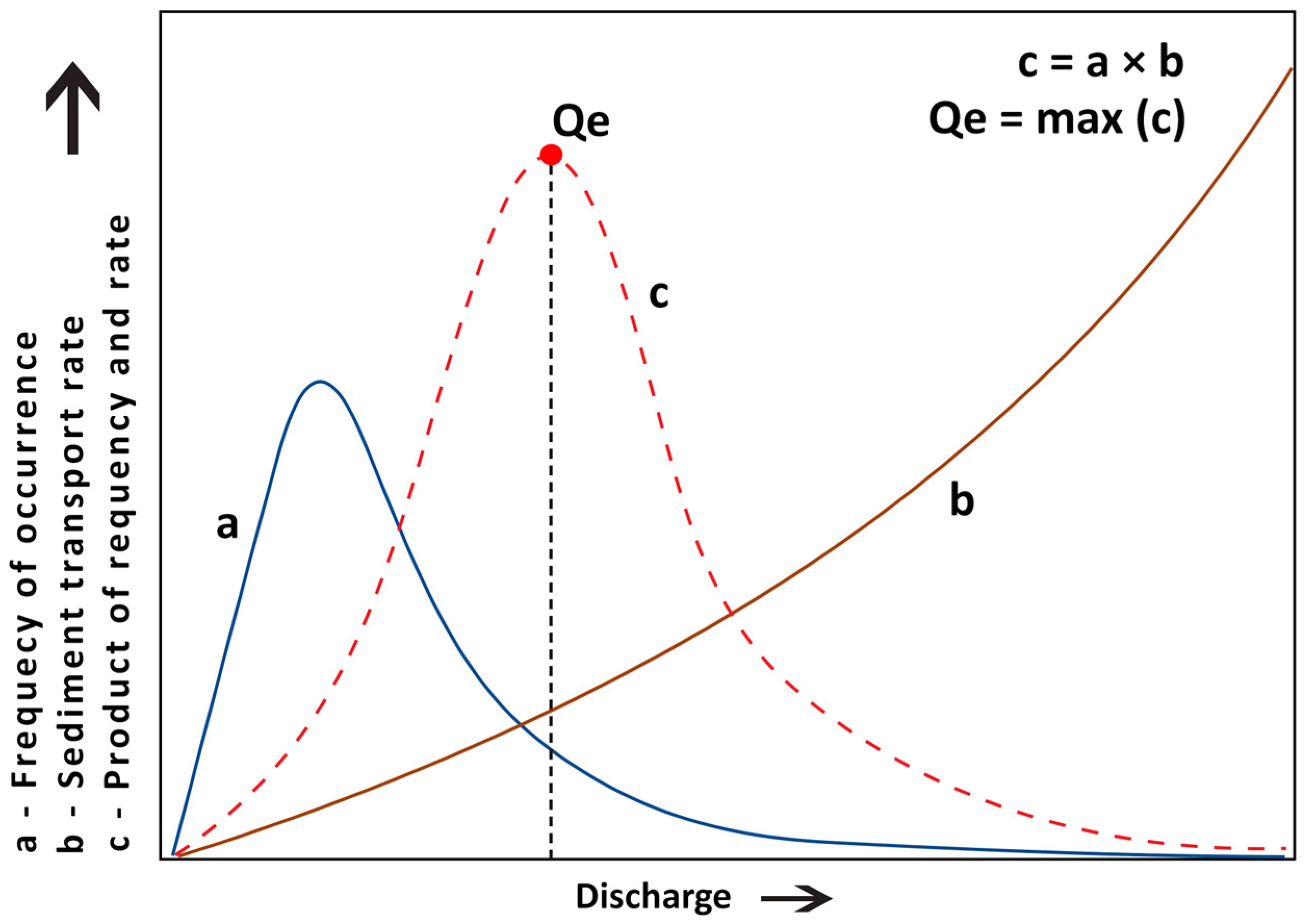
The concept of “effective discharge” was initially introduced by Wolman and Miller [12] as a function of the magnitude and frequency of occurrence of a specific event, which can be characterised as the “geomorphic work” performed by the river. Andrews [13] introduced the actual term of effective discharge [9], which is defined as the increment of discharges that transports the most significant part of the annual sediment load over a time period. In other words, the effective discharge (Qe) represents the product of flow frequency and the sediment transport rate, as shown in Figure 1.
Figure 1. Conceptual plot of the effective discharge (Qe), adapted from Wolman and Miller [12].
Depending on the computation method, the effective discharge can be estimated through two different approaches [14,15]: (1) the class-based (traditional) approach, characterised as the classic magnitude–frequency analysis [3,9,12] and (2) the model-based approach, through diverse analytical solutions developed by several authors such as Nash [16], Goodwin [17], Klonsky and Vogel [18], Sholtes et al. [19], Maheshwari and Chavan [20].
In the last decades, many studies have assessed and analysed the effective discharge in different contexts, with case studies from diverse geographical regions worldwide, such as North America [13,16,21,22,23,24], Europe [25,26,27], South Asia [14], East Asia [28,29], Oceania [30]. Beyond its scientific significance, the effective discharge is commonly employed in a pragmatic context, as a guiding parameter in river channel restoration design [7,10,11,23,31].
In the context of the ongoing anthropogenic environmental degradation and climate change, an alteration of the discharges at local and regional scales worldwide is observed [32]. In Europe, the observed river discharges (1950–2020) showed various trends, depending on the latitude (increasing in the north, mixed in the centre, and decreasing in the south) [33]. In southern Romania, the flow regime trend could be characterised as mixed and decreasing. This is confirmed by the Ialomița River flow regime between 1961 and 2022, which indicates a slight negative trend in the mean annual discharges [34].
A recent study on the Ialomița River’s historical evolution (1856–2021) [34] indicates a general alteration of its riverbed, through the transition from a complex, braided, multi-thread channel to a simple sinuous, single-thread channel, resulting from recent anthropogenic intervention and climate change. The authors expect the Ialomița river channel to continue to degrade and reduce its morphological complexity in the short term, following the climate change signal and increased human intervention.
This work aims to complete the short-term projection with a medium- and long-term forecast of the Ialomița riverbed evolution, using climate change scenario projected discharges, simulated under two Representative Concentration Pathways (RCP) climate scenarios: RCP 4.5 and RCP 8.5. The RCP 2.6 scenario was excluded from the analysis, being less possible to realise, considering that the total effective radiative forcing in 2024 was estimated to be 2.97 W/m2 [35], closer to the peak value of this scenario (~3 W/m2).
We consider the channel-forming discharge to be one of the key drivers for long-term riverbed dynamics. This paper introduces a new approach to assess the effective discharge, using climate change scenario-based modelled discharges.
The study aims to identify long-term trends in Ialomița riverbed evolution based on the channel-forming discharge concept, using the effective discharge approach, until the end of the 21st century. The specific objectives are to: (a) collect and pre-process the climate projections modelled discharges in the period 1991–2100; (b) evaluate the hydrological model capability to reproduce the river discharges between 1991 and 2020; (c) analyse the general evolution trend of river discharges between 1991 and 2100; (d) compute and analyse the effective discharge evolution (1991–2100) and relative change for the future period (2031–2100); (e) identify the Ialomița riverbed evolution trends at Băleni gauging station based on the effective discharge.

2. Materials and Methods

2.1. Study Area

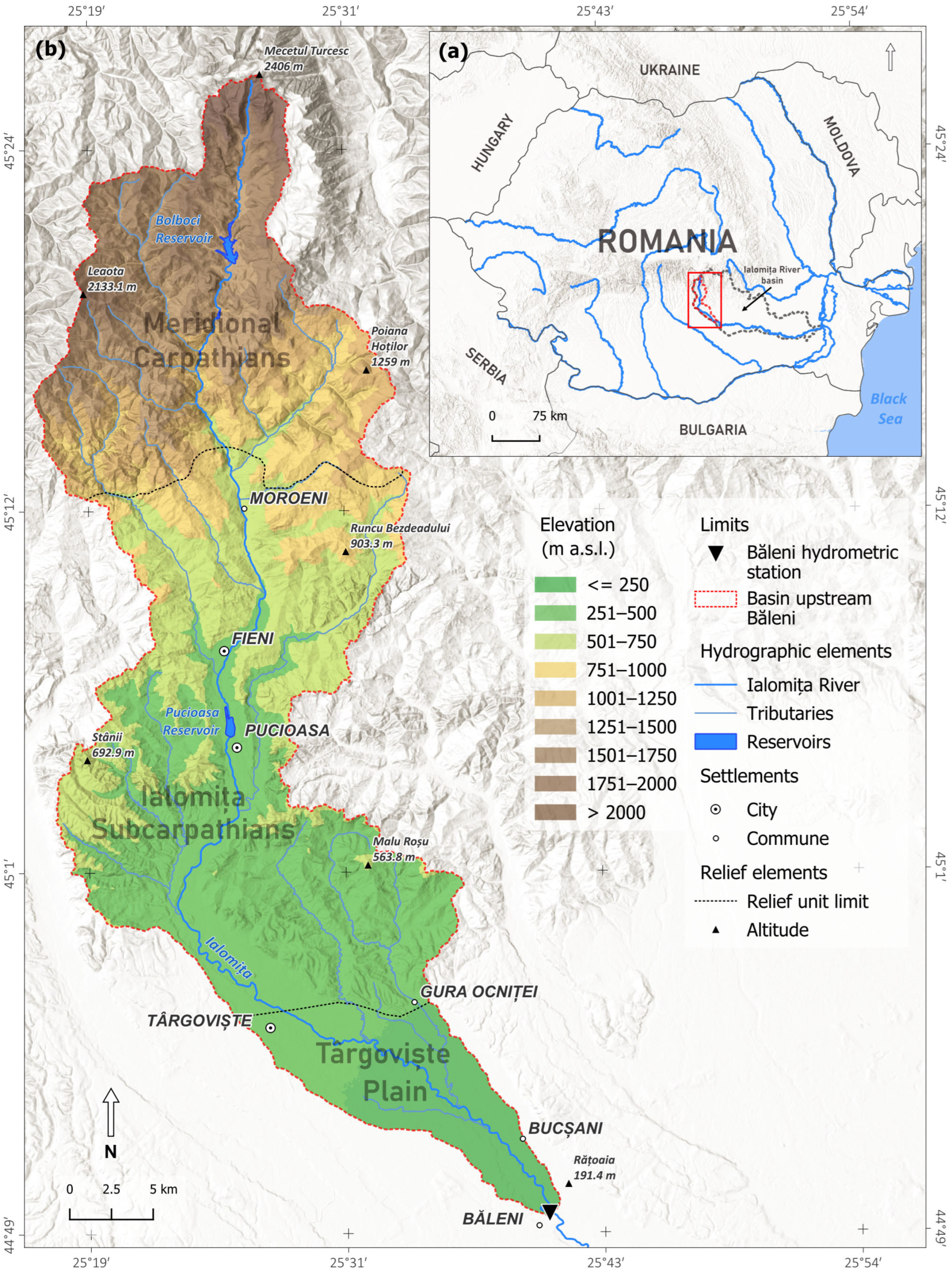
The Ialomița River is a southern Carpathian River, which springs from the Bucegi Mountains (a subunit of the Meridional Carpathians) at an altitude of 2406 m a.s.l. Along its course to the Băleni gauging station, it crosses all the major relief units, continuing with the hilly Ialomița Subcarpathian unit and the Târgoviște Plain (Figure 2). Until the confluence with the Danube River, Ialomița continues its course through the Romanian Plain. The river has a complete length of 417 km, which drains a watershed of 10,350 km2 [36]. The elevation difference within the basin is 2272 m, the sinuosity coefficient is 1.98, and the average slope is 5.35‰ [34].
Figure 2. Study area localisation within (a) Romania and the Ialomița River Basin and (b) the hydrographic basin upstream of Băleni.
The geotectonic setting of the Ialomița River is characterised by the main morpho-structural units over which the territory of Romania overlaps in this zone, namely the Carpathian Orogen and the Moesian Platform [37]. In the study area, the Orogen tectonic units are specific, occurring as nappes (the Infrabucovinic Nappe, the Ceahlău Nappe, the Curbicortical Flysch Nappe, the Macla Nappe, and the Tarcău Nappe) in the northern part of the area, upstream of Pucioasa (Figure 2b). The southern part of the study area lies within the Carpathian Foredeep [38,39]. The relief is diverse and complex, comprising all major relief units: the Meridional Carpathians (with subunits Bucegi and Leaota Mountains) in the north, the hilly Ialomița Subcarpathians in the centre, and the Târgoviște Plain in the south. The maximum elevation is reached at the Mecetul Turcesc Peak (2406 m a.s.l.), and the minimum at the Băleni gauging station of 190 m a.s.l. Thus, the relief energy of the basin is about 2216 m.
The climate is temperate–continental of transitional type [40], highly influenced by the general European atmospheric circulation and the presence of the Carpathian Mountains, which act as an orographic barrier to the air masses. The mean annual precipitation is 745 mm, while the mean annual temperature is 9 °C. These values vary significantly with altitude, given the elevation range of over 2200 m [34].
Regarding the hydrological component, the flow regime of the Ialomița River observed at Băleni gauging station (Figure 2b) is characterised by a mean multiannual (1991–2020) discharge of 7.43 m3/s. Across this period, the discharge varies between a minimum of 1.92 m3/s in 1992 and 18.27 m3/s in 2005. The seasonal variability of the Ialomița River is mainly influenced by the temperate–continental climate and geomorphological character of the catchment. The flow regime is characterised as pluvio-nival, with the nival component strongly influenced by the mountainous relief of the upper basin. Thus, the monthly multiannual (1991–2020) discharges have the highest values in mid and late spring and early summer, with peaks over 11 m3/s in April (11.23 m3/s), May (11.83 m3/s), and June (11.38 m3/s). Then, discharges decrease towards autumn and winter, with mean values below 6 m3/s, except in December. The minimum mean monthly discharges are observed in September (4.75 m3/s) and January (4.68 m3/s).
The seasonal variability of suspended-load discharge closely follows the distribution of the flow regime. The mean multiannual (1991–2020) suspended-load discharge is 14.70 kg/s, with minimum values in October (4.44 kg/s), November (4.53 kg/s), and January (4.86 kg/s) and maximum values in April (21.94 kg/s), May (24.48 kg/s), and June (22.63 kg/s).
However, the flow and sediment regimes are quasi-natural, influenced by anthropogenic interventions in the last century. Major river management projects in the upper Ialomița River basin began in the 1930s and were completed by 1988. Thus, eight dams and their associated reservoirs were constructed in this time period, four of which were located on the main course of the river [41]. Among these, the Bolboci and Pucioasa reservoirs (Figure 2b) exert the most significant influence on both flow and sediment discharge regimes. These reservoirs were commissioned in 1988 and 1975, with dam heights of 55 and 30.5 m, forming lakes with initial total storage capacities of 19.4 and 10.6 million m3 [36]. The Pucioasa Reservoir retains substantial quantities of sediment, as reflected by the decline in multiannual average suspended sediment discharge from 22.09 kg/s in the pre-dam period (1961–1975) to 12.97 kg/s in the post-dam period (1976–2022). The mean annual silting rate is estimated to be 1.88%/year (~200,000 m3/year) [34]. Even under these conditions, the amount of suspended sediment is relatively high, given the sedimentary lithology of the Subcarpathian area, which consists of clays, marls, and sands.
For this study, we calculate the effective discharge at the Băleni gauging station, located at the intersection of 44°49′34″ N latitude and 25°40′7″ E longitude, in the upper basin of the Ialomița River (Figure 2a) and within the Târgoviște Plain, at an altitude of 190 m a.s.l. The study area is the upstream drainage basin of the Băleni gauging station, covering 915 km2 and representing approximately 9% of the entire Ialomița River Basin (Figure 2b).

2.2. Study Workflow

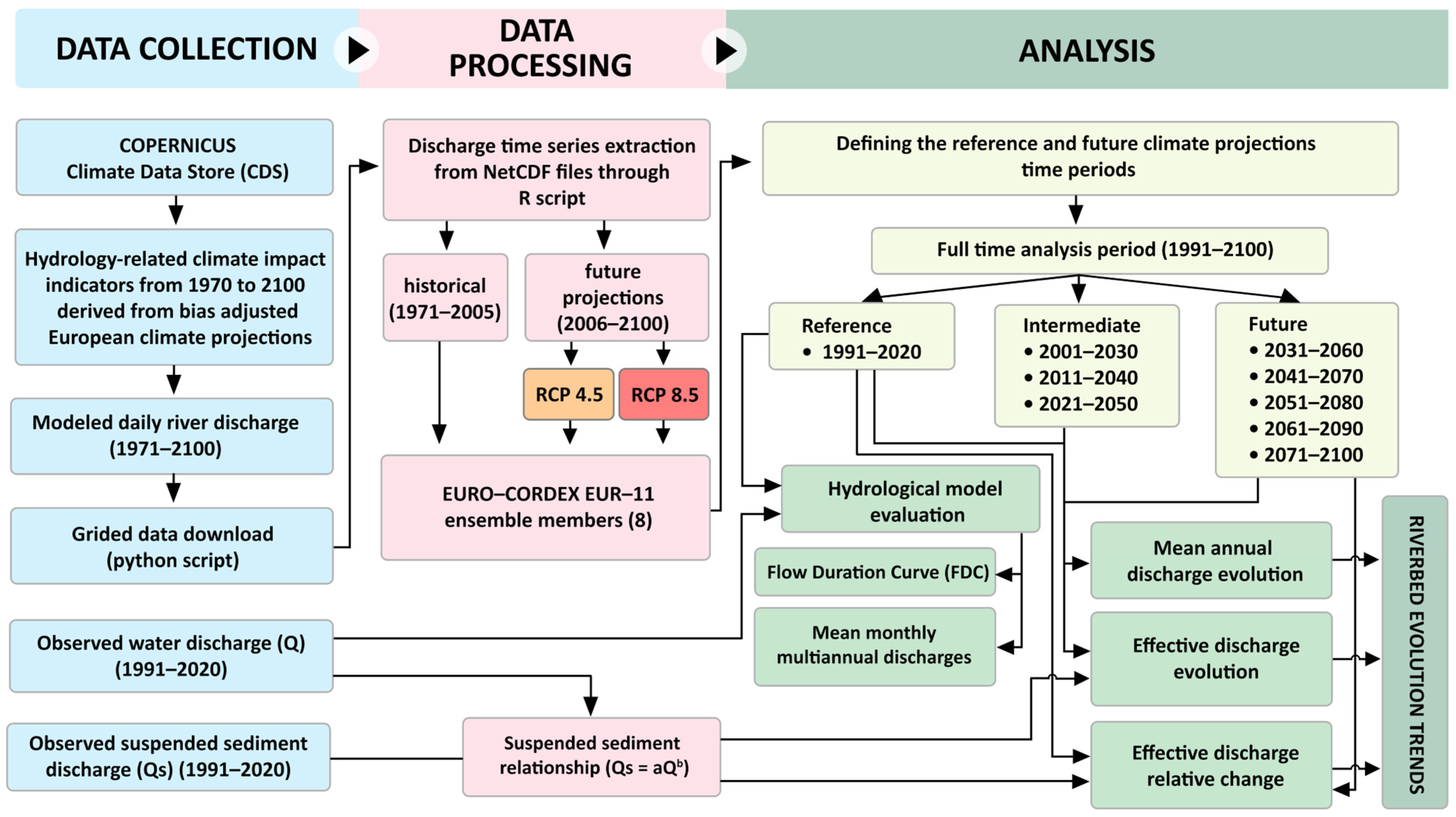
The workflow of this study is presented in Figure 3 and consists of data collection, processing, and analysis, which are the basis of the article’s conclusions.
Figure 3. Flowchart of the study.

2.3. Data Collection

2.3.1. Data Description

For this study, we use the open–access dataset “Hydrology-Related Climate Impact Indicators from 1970 to 2100 Derived from Bias Adjusted European Climate Projections” [42], accessed through the Copernicus Climate Data Store (CDS) platform. This contains daily river discharges as an essential climate variable, along with other climate impact indicators, modelled from 1970 to 2100 using two hydrological models: E–HYPE and VIC–WUR.
For this analysis, the gridded version of the E–HYPE hydrological model was selected, as it is necessary to extract river discharges at the location of the Băleni gauging station, which we analyse in this study. This model was also chosen because its overall performance in the area of Romania surpasses that of the VIC–WUR model [43].
The HYPE model was developed by the Swedish Meteorological and Hydrological Institute (SMHI) as a semi-distributed and physically based catchment model. This is capable of simulating water flow and the route of other substances from the entrance of the precipitation into the watershed to the sea, through storage compartments and fluxes [44,45]. The E–HYPE is the pan-European setup of the HYPE hydrological model [46], configured as a multi-model ensemble catchment model (E–HYPEcatch) or as a grid-based model (E–HYPEgrid), which is used in this study.
The E-HYPEgrid model is configured at a 5 km resolution, using the same grid and parameters of the EFAS modelling system. In this version of the model, each grid cell is considered a subcatchment, the same as in the standard version of the model (E–HYPEcatch) [43]. To perform the hydrological simulations between 1971 and 2100, daily bias-adjusted precipitation and temperature forcing (historical and climate projections) were extracted for 8 members of the EURO–CORDEX EUR–11 ensemble (Table 1) [47]. The bias adjustment process uses the EFAS–Meteo dataset as a reference, for the period 1990–2018 [48].
Table 1. The eight EURO–CORDEX EUR–11 members used in the dataset [42].
Regarding the dataset used for the study, the entire modelling period (1971–2100) is divided into two parts: the historical period between 1971 and 2005 and future climate projections (2006–2100), simulated in three different Representative Concentration Pathways (RCP) climate scenarios: RCP 2.6, RCP 4.5, and RCP 8.5. The RCPs are based on changes in the total radiative forcing, determined by the concentrations of greenhouse gases and aerosols, chemically active gases, and the land use or land cover [49,50]. The RCPs are characterised as:
  • RCP 2.6—the optimistic scenario, with the peak of ~3 W/m2 radiative forcing before 2100, followed by a decrease.
  • RCP 4.5—the intermediate scenario, assuming stabilisation without exceeding ~4.5 W/m2 after 2100.
  • RCP 8.5—the pessimistic scenario, which implies continuous rising, exceeding ~8.5 W/m2 after 2100.
For this study, in addition to the historical simulation, we will utilise for the analysis only river discharges simulated with the RCP 4.5 and 8.5 climate change scenarios, the optimistic one being less likely to be realised. In 2024, the total effective radiative forcing was estimated to be 2.97 W/m2 [35], closer to the peak value of RCP 2.6.
Daily discharges and suspended sediment load, between 1991 and 2020, were provided by the Romanian National Institute of Hydrology and Water Management.

2.3.2. Modelled Data Acquisition and Pre-Processing

The modelled data acquisition and pre-processing process is semi-automated using scripts developed in Python 3.13 and R 4.5. It operates in a loop that is repeated for each year of the dataset time span (1971–2100), for the historical period and each climate model (Table 1), and for both climate change scenarios (RCP 4.5 and RCP 8.5). This approach was adopted to efficiently manage the large volume of data. The complete workflow is illustrated in Figure 4.
Figure 4. Data acquisition and pre–processing loop workflow.
The data is accessed from the Climate Data Store (CDS) Application Programming Interface (API), using the “cdsapi” Python 3.13 package, version 0.7.6 [51]. Using Python 3.13 requests, the data is downloaded in the “netCDF” format for the pan-European domain, as no option is available to subset the data by study area. The next step is to extract the discharge (Q) at the point of interest using the “terra” package in R, which is saved as a “csv” file. At the end of each processing cycle, the file is removed, and the procedure is repeated for the following year.
The final database consists of time series of discharges between 1971 and 2100 modelled using the eight EURO–CORDEX EUR–11 regional climate model members and the two RCPs climate scenarios. For this study, we use the time series between 1991 and 2100.

2.4. Methods

2.4.1. Reference and Future Time Periods Definition

The used dataset [42] provides climate impact indicators as mean values over a 30-year period. The standard time periods are: 1971–2000 (reference), 2011–2040 (early century), 2041–2070 (mid-century), and 2071–2100 (end-century). For this study, we will retain the 30-year window convention, in line with WMO practices, but with changes to the reference interval and the future periods. Therefore, the following periods are used in this study:
  • The reference period: 1991–2020, according to the WMO 30-year reference period for Standard Climatological Normals [52]. This time period provides a more recent and accurate context for understanding climate change [53]. Since the historical simulated data cover only 1971–2005, the period 2006–2020 was completed using the mean values of simulated data from the RCP 4.5 and RCP 8.5 scenarios. The ensemble mean of the eight EURO-CORDEX climate model configurations (Table 1) was computed, the resulting values being averaged between both RCP scenarios. As the 2006–2020 interval lies very close to the historical baseline, a period during which divergence between RCP scenarios is minimal, we consider this approach appropriate for this study.
  • The future periods will begin in 2031, considering that the current decade is halfway through. The periods for projected discharges will maintain the 30-year window, and will advance decadal until 2100. Five future periods are outlined, each overlapping by 20 years: 2031–2060, 2041–2070, 2051–2080, 2061–2090, and 2071–2100. We select this approach because it is suitable for identifying an evolutionary trend and smoothing the variability.
The effective discharge will also be computed for the intermediate periods (2001–2030, 2011–2040, and 2021–2050) to capture the full temporal evolution of Qe.

2.4.2. Hydrological Model Evaluation

To evaluate the hydrological model, we analyse modelled and observed discharges for the reference period (1991–2020). As the E–HYPE model is calibrated and validated at the pan-European scale rather than specifically for the Ialomița basin, conventional hydrological performance metrics (NSE, KGE, PBIAS) show poor performance and are therefore not appropriate indicators of model reliability in this context. To assess the model’s ability to reproduce the flow regime, we employed the Flow Duration Curve (FDC) method, using daily discharges. The FDC is defined as the relationship between magnitude and frequency of streamflow for a specific river basin, representing the percentage of the time in which a given streamflow was equalled or exceeded over a given time period [54]. According to Ridolfi et al. [55], a FDC is built ranking the streamflow values in descending order and then plotting them against their corresponding exceedance probabilities. The probability exceedance (Pi) was calculated using the Weibull plotting position equation:
P i = i n + 1 × 100 ,
where i is the rank of the discharge value, and n is the total number of discharge observations.
Seasonal evaluation was realised by aggregating daily to monthly values and computing the multiannual mean monthly discharges.
In order to quantify the differences between the duration curves and the monthly distribution, we used the Kolmogorov–Smirnov (K–S) non–parametric test [56]. This was performed through the “stats” R package, version 4.5.0 [57]. Considering that we compare observed and modelled discharges, the two-sample K–S statistic (Equation (2)) is used. Thus, the distance D m , n statistic is calculated as:
D m , n = s u p x     F m x G n x  
where x is the possible value of the data values from both samples, sup is the supremum operator, which indicates the largest absolute difference between F m x and G n x , the empirical distribution functions of the two samples.

2.4.3. Evolution Trend

To identify the general evolution trend of the discharges for the entire analysed period and for the forecast period, we use the Mann–Kendall (MK) test [58,59] to detect monotonic trends in the mean annual discharge time series. The MK test was performed using the “Kendall” R package, version 2.2.1 [60].
It was applied to both the RCP 4.5 and RCP 8.5 climate scenarios, using the mean of eight hydrological model runs forced with inputs from the EURO–CORDEX EUR–11 regional climate model ensemble. In addition, 5–95% confidence bands of the ensemble were computed to observe the range of model uncertainty.
The Equations (3)–(7) of the MK test are provided. For time series x 1 , x 2 , …, x n , the MK statistic S is calculated as:
S =   i   =   1 n 1 j   =   i   +   1 n s g n x j x i ,
where n is the total number of data points (years), x j and x i are the discharge values in the time series j and i, with j > i.
The sign function is defined as
s g n x j x i =     1 ,   if   x j x i > 0       0 ,   if   x j x i = 0   1 ,   if   x j x i < 0
The variance of the MK statistic S (Equation (3)) is estimated by Equation (5),
V a r S = n n 1 2 n + 5 i = 1 t t i t i 1 2 t i + 5 18
where n is the number of data points, t is the number of tied groups, t i is the size of the ith tie group. The standardised Z test was calculated using Equation (6) in order to determine the statistical significance. For this analysis, we set the significance level at α = 0.10 for a two-tailed hypothesis test.
Z = S 1 V a r S ,   if   S > 0 0 ,                                   if   S = 0 S + 1 V a r S ,   if   S < 0
The Kendall’s Tau correlation coefficient (τ) shows the strength and the direction of the trend. This is calculated using Equation (7), assuming there are no ties in the data series:
τ   =   C     D n n 1 / 2
where C and D are the numbers of concordant, respectively discordant pairs, and n is the number of data points.

2.4.4. Effective Discharge (Qe) Computation

In this study, we computed the effective discharge using daily values of modelled river discharges (Q) from 1991 to 2100 and observed suspended sediment transport discharges (Qs) between 1991 and 2020, in order to derive a Q–Qs relation which will be used to determine Qs values for the period 2021–2100.
The traditional class-based approach to Qe computation is subject to a degree of subjectivity, the selection of the class interval or the number of classes being a highly debated issue with no generally accepted consensus. Over time, numerous approaches and suggestions have been proposed by various authors, as outlined below:
  • Yevjevich [61]—Equal class intervals, which should be 4 times less than or equal to the standard deviation estimation (SD) of the sample, and the number of classes should be between 10 and 25.
  • Biedenharn et al. [62], Crowder and Knapp [21]—Each class interval should contain at least one flow event.
  • Ma et al. [29]—Equal class intervals corresponding to SD, 0.75 SD, 0.5 SD, and 0.25 SD.
  • Dumitriu [15]—The class intervals corresponding to 0.25 SD/4, 0.5 SD/4, 0.75 SD/4, and SD/4, considering the López-Tarazón and Batalla [26] observation that the smaller the class intervals, the more precise the results.
On the other side, the model-based approach seems to be a better alternative to the traditional approach, thereby eliminating the need to select class intervals. Diverse analytical solutions were developed by authors such as Nash [16], Goodwin [17], Klonsky and Vogel [18], Sholtes et al. [19], and Maheshwari and Chavan [20].
For this study, we use a model-based methodology according to Klonsky and Vogel [18], which implies a kernel density estimation (KDE) for the computation of the effective discharge, in order to eliminate existing inconsistencies generated by the class interval/number selection. This method is an empirical nonparametric approach that is independent of any model assumptions.
The basic concept underlying Qe is the transport effectiveness e(Q), defined initially by Wolman and Miller [12] and expressed through Equation [18]:
e Q = L Q f Q Q
where e Q represents the transport effectiveness (frequency × sediment), L Q is the sediment load as a function of Q and f Q Q is the probability density function of Q.
Sediment data are essential for computing the effective discharge. In this study, we use an analytical approach for the sediment transport [15,16,17,18,19], empirically based on daily suspended sediment data between 1991 and 2020, and computed through a power–law rating curve:
L Q = a Q b
where L Q is the suspended sediment discharge, Q is the water discharge, and a and b are the power–law rating curve coefficient and exponent, respectively.
The discharge frequency distribution ( f Q Q ) is empirically estimated from daily discharges, using the KDE method, according to Parzen [63] equation, adapted for discharge data:
f Q ^ Q = 1 n h i = 1 n K Q Q i h
where n is the number of discharge values, Qi is the discharge at time i, h is the smoothing parameter or bandwidth, and K is the kernel function.
The discharge (Q) that maximises the transport effectiveness (e(Q)) is the effective discharge (Qe), expressed by Equation (11), given below:
Q e = arg max Q   e Q
The calculation of the effective discharge was developed and automated using the R programming language, mainly using the “stats” package [57], version 4.5.0. The graphics for Qe, as well as for the entire study, were generated using the “ggplot2” package [64], version 3.5.2.

3. Results

3.1. Hydrological Model Performance

3.1.1. Flow Regime

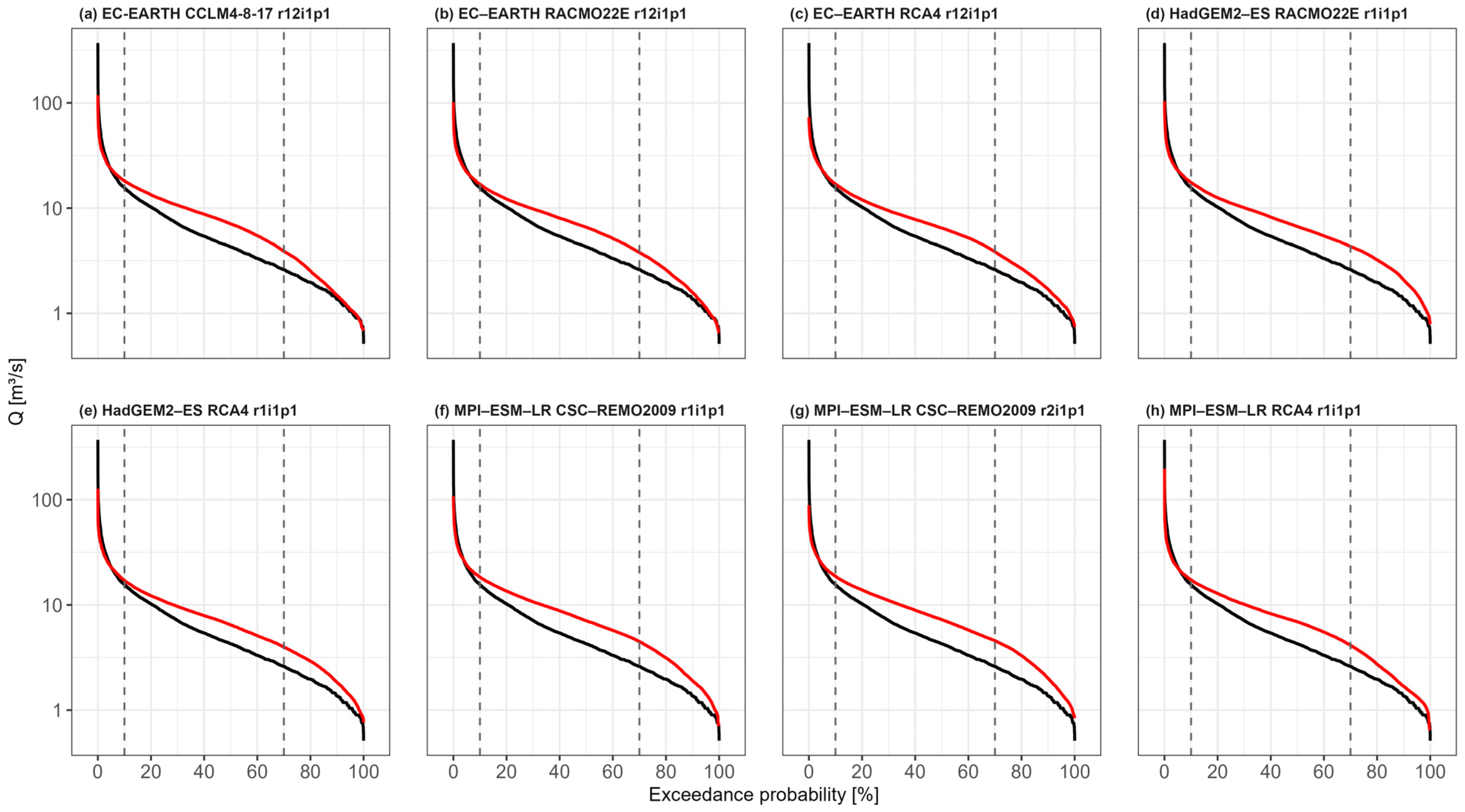
Figure 5 illustrates the comparison between the observed and modelled discharges FDCs for the period 1991–2020 for eight EURO–CORDEX climate model simulations. The simulated discharges are generally overestimated, with peaks underestimated across all models, with a small degree of overestimation of the lowest values. Intermediate and low flows are systematically overestimated by the models, with minor variations between model configurations. In order to identify which of the modelled FDCs is closer to the observed FDC, we perform the K–S test and rank them according to the K–S distance (D) between pairs of FDC, as can be observed in Table S1. The D value ranges between 0.1818 and 0.2336, with HadGEM2–ES RCA4 r1i1p1 being the closest to observed, followed closely by EC–EARTH RACMO22E r12i1p1 and EC–EARTH RCA4 r12i1p1 (Figure 5b,c,e). Even if the statistical differences are higher, these datasets are statistically independent of the observation. The current analysis aims to use the signal of climate change instead of the effectively modelled values.
Figure 5. Flow Duration Curves (FDCs) comparing observed (black line) and modelled mean (red line) discharges for the period 1991–2020 with the eight EURO–CORDEX EUR–11 ensemble members used in this study (ah). The grey dashed vertical lines represent the limits for the high flows (10%) and low flows (70%).

3.1.2. Seasonal Flow Regime

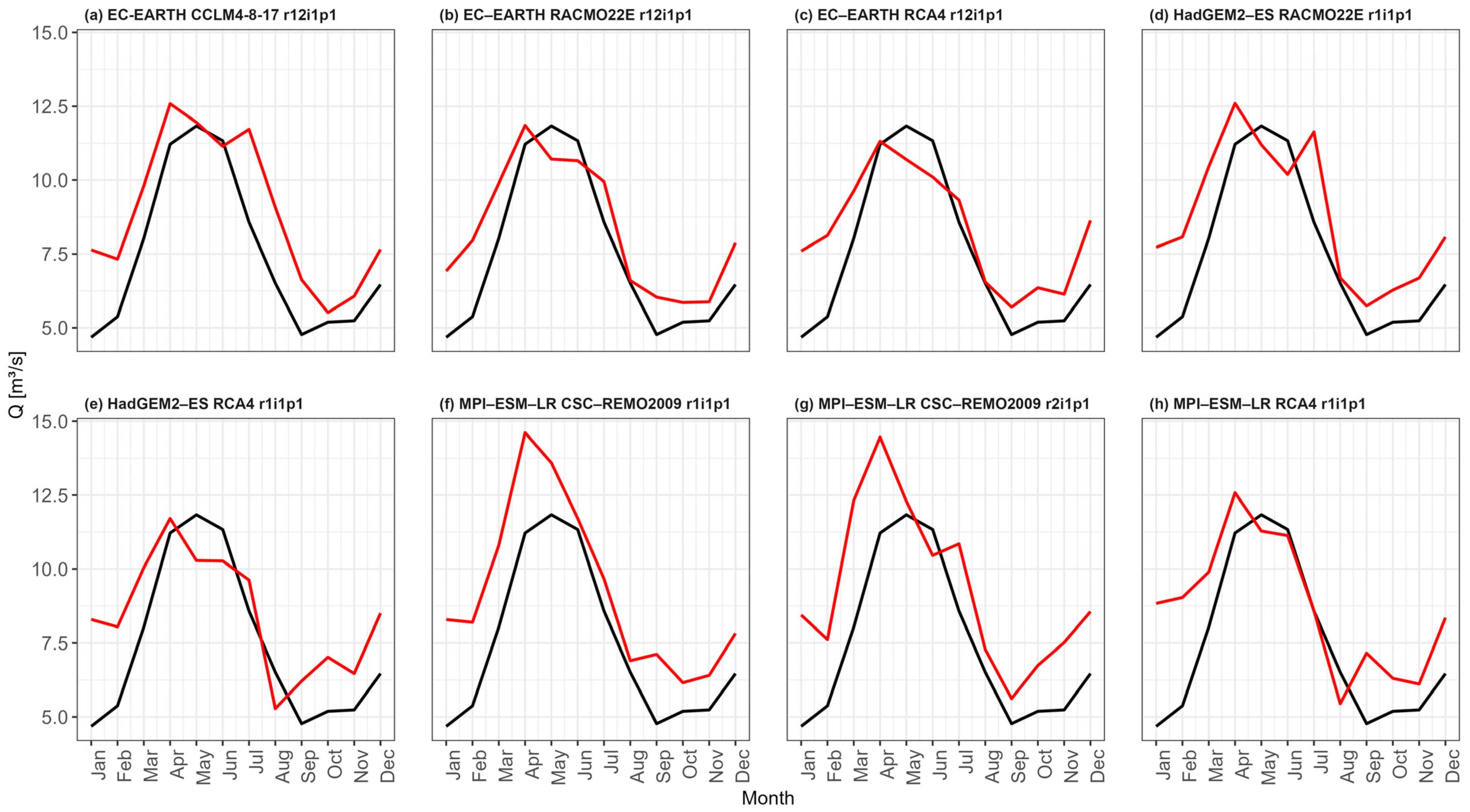
Figure 6 illustrates the comparison between the observed and modelled mean monthly multiannual discharges for the period 1991–2020 across the eight EURO–CORDEX climate model simulations used in this study. In general, the modelled discharges follow the distribution of the observed discharges. However, a systematic overestimation is observed in winter and spring. In contrast, discharges are generally well simulated during late spring and summer by the majority of the models. Some model configurations tend to underestimate the discharges in the spring–summer period (Figure 6a,c–e).
Figure 6. Mean monthly observed (black line) and modelled mean (red line) discharges between 1991 and 2020 with the eight EURO–CORDEX EUR–11 ensemble members used in this study (ah).
For a more accurate view, the K–S test was performed for each month and model, according to Tables S2 and S3. From a monthly perspective, the ensemble mean distance (D) indicates that the discharges in October (0.097), August (0.11), and June (0.13) are closest to the observed. In contrast, January (0.426), February (0.416), and March (0.393) deviate the most from the observations. Considering that the upper part of the analysed watershed is a mountainous area (Figure 2b), the overestimation of the discharges in the winter–spring months is the most probable generated by: the model’s sensitivity to climate change signal (precipitation and air temperature forcing) for the period 2006–2020, which is higher than the observed data, along with the uncertainties of the snow model which can cause this overestimation for the cold season months. Also, the two large reservoirs, Bolboci and Pucioasa, located on the course of the Ialomița River (Figure 2b), can influence model results and seasonal distribution.
The full monthly analysis for each ensemble member is presented in Table S3. The ranking order is slightly changed compared to the FDCs analysis (Table S1), but the top three remain the same.

3.2. General Evolution Trend of River Discharges

3.2.1. Entire Period (1991–2100)

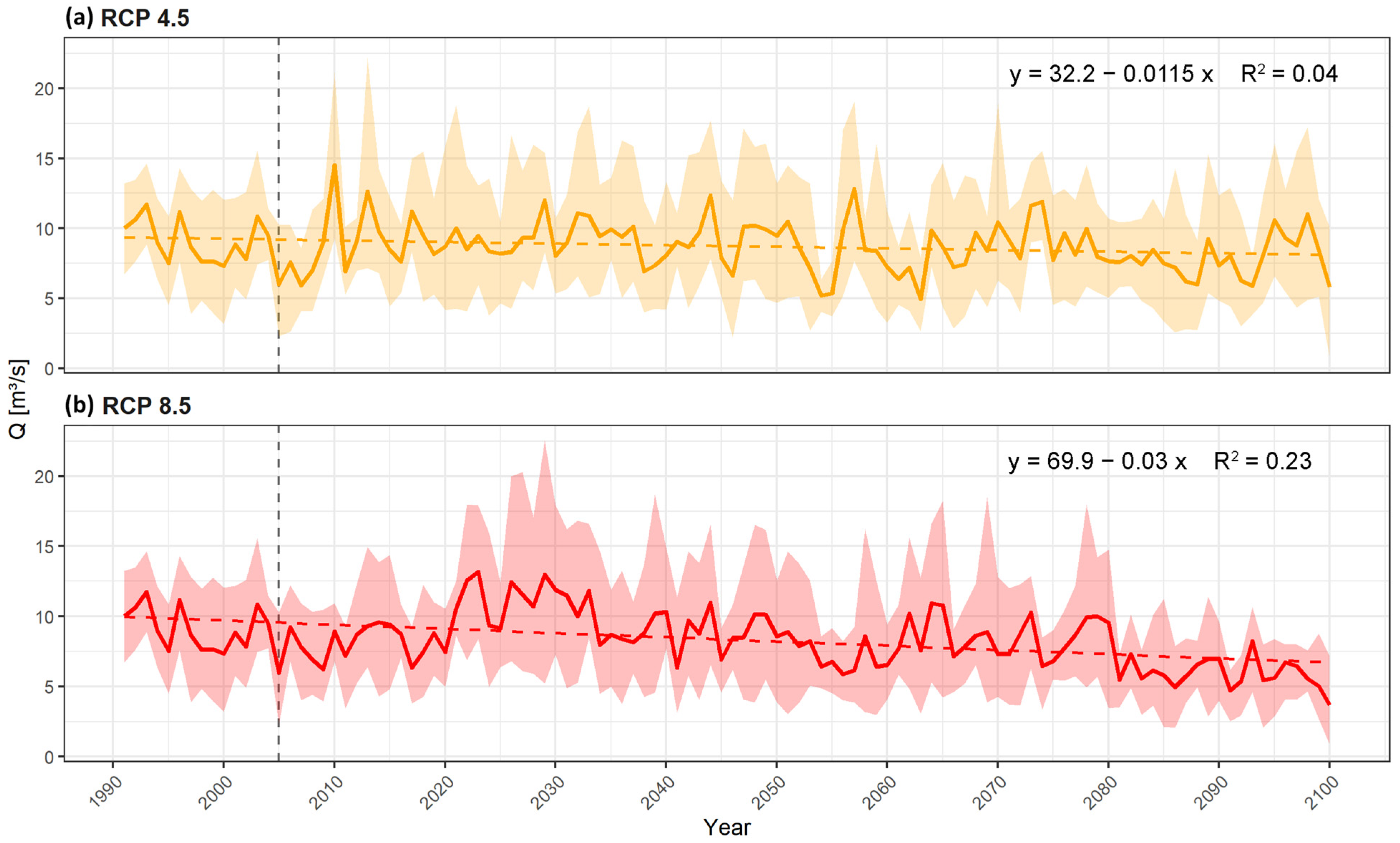
We analyse modelled discharges under the eight EURO–CORDEX EUR–11 climate forcing for the entire time span of the study (1991–2100) by combining the historical dataset (1991–2005) with the RCP 4.5 and 8.5 climate change scenarios (2006–2100) datasets. A general downward trend was observed for both RCPs, according to Figure 7. The MK test confirms this fact, indicating negative rank correlation coefficients (τ) of −0.134 (p-value = 0.038) for RCP 4.5 and −0.335 (p-value = 2.08 × 10⁻⁷) for RCP 8.5.
Figure 7. The annual evolution (solid line) and linear trend (dashed line) of the yearly modelled discharges at Băleni gauging station between 1991 and 2100, in two climate change scenarios: historical combined with (a) RCP 4.5 and (b) RCP 8.5. The grey dashed line is the limit of the historical period of the dataset (2005). The shaded area represents the 5th–95th percentile confidence band of the ensemble.

3.2.2. Future Period (2031–2100)

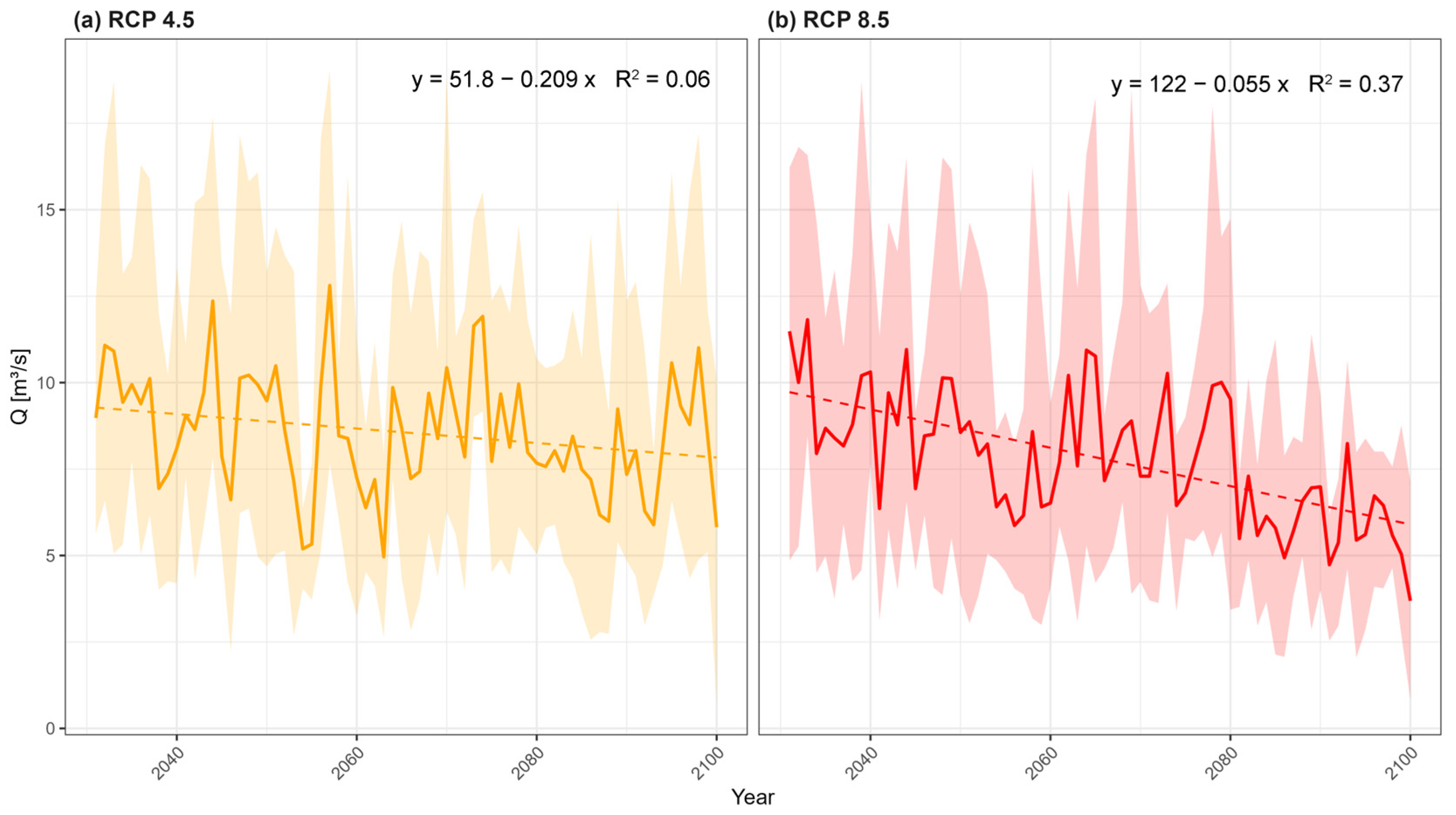
Figure 8 shows the annual evolution of the modelled discharges, with climate forcing from the eight EURO–CORDEX EUR–11 ensemble for the future period, between 2031 and 2100. The general future evolution of discharges at the Băleni gauging station is decreasing for both RCPs, but more pronounced for the RCP 8.5. These negative trends are confirmed by the MK test, which indicates statistically significant rank correlation coefficients (τ) of −0.179 (p-value = 2.85 × 10⁻²) for the RCP 4.5 scenario and −0.423 (p-value = 2.33 × 10⁻⁷) for the RCP 8.5 scenario. Compared to the entire study period (1991–2100), the downward trend is more evident for 2031–2100.
Figure 8. The annual evolution (solid line) and linear trend (dashed line) of the mean yearly discharges at Băleni gauging station between 2031 and 2100, in two climate change scenarios: (a) RCP 4.5 and (b) RCP 8.5. The shaded area represents the 5th–95th percentile confidence band of the ensemble.
The analysis of the annual evolution indicates higher variability under RCP 4.5 relative to RCP 8.5 until 2080, after which both scenarios follow similar trajectories and ensemble confidence variability. Afterwards, RCP 4.5 exhibits an upward trend, while RCP 8.5 shows a clear downward trend and less variability.

3.3. The Effective Discharge (Qe)

We calculated effective discharge for 30-year periods, advancing in 10–year increments from 1991 to 2100, using modelled climate change scenario discharges. Given the availability of data, we use suspended sediment discharge to calculate Qe instead of total sediment load. Thus, we refer to the Qe of suspended sediments rather than total sediments. However, the suspended fraction is considered to represent a significant majority of the total sediment load [29].

3.3.1. Flow Frequency

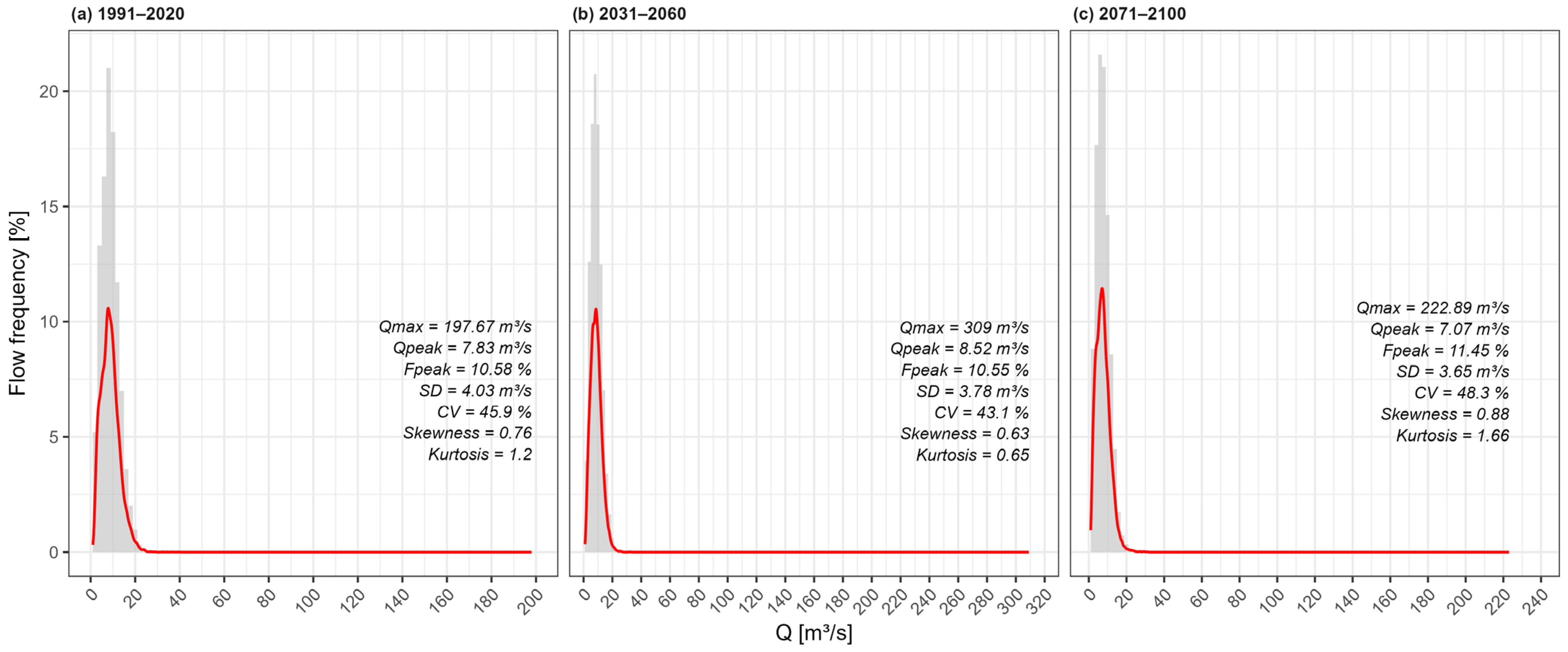
The flow–frequency distribution is based on the ensemble mean of the climate model simulations, averaged between the RCP 4.5 and RCP 8.5 scenarios. At the Băleni gauging station, this indicates a heavy-tailed, right-skewed distribution, as shown in Figure 9, for all the periods: 1991–2020, the reference period (Figure 9a), 2031–2060, mid-century (Figure 9b), and 2071–2100, end of century (Figure 9c). The standard deviation (SD) decreases from 4.03 m3/s (1991–2020) to 3.78 m3/s (2031–2060) and to 3.65 m3/s (2071–2100), indicating a slightly tighter spread of daily discharges. The coefficient of variation (CV) indicates a general moderate variability across all periods, ranging from 45.9% to 43.1% and 48.3%. The skewness is less than 1 for all periods, with the highest value at the end of the century (0.883, Figure 9c). The kurtosis values are below 3 (1.2, 0.65, and 1.66), which indicates a normal distribution [15].
Figure 9. The histogram (grey bars) and kernel density estimation (red line) of the daily climate change scenario modelled discharge ensemble mean for the reference period (a) and future periods: (b) mid-century and (c) end of the century.
The kernel density estimation distribution of river discharges shows slight variations between the three periods. The value of the KDE peak (Qpeak) rises from 7.83 m3/s in the reference period to 8.52 m3/s between 2031 and 2060, and then drops to 7.07 m3/s between 2071 and 2100. The frequency of this peak discharge (Fpeak) is nearly the same in the reference and mid-century (10.58% and 10.55%), rising to 11.45% by the end of the century.

3.3.2. Suspended Sediment Rating Curve

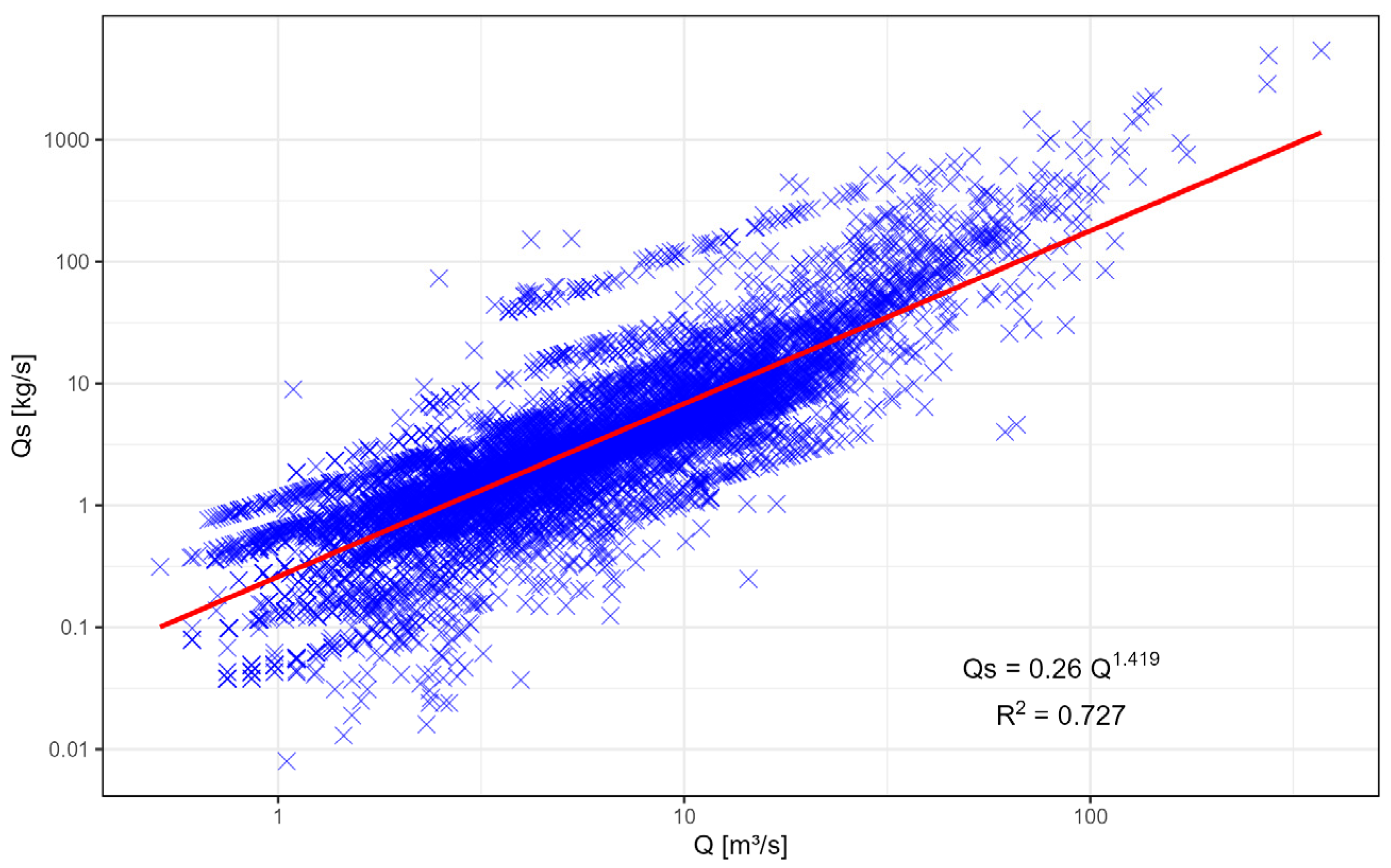
Figure 10 shows the best-fitting power–law correlation between daily water discharge (Q) and suspended sediment load discharge (Qs) at the Băleni gauging station, with a positive, significant relationship. According to the function equation (Qs = 0.26 × Q1.419), the b exponent exceeds unity, indicating that a certain threshold discharge is required to initiate sediment transport [15]. Also, it reflects the type of riverbed material, which in this case indicates a mixed sand–gravel riverbed.
Figure 10. Relationship between water discharge (Q) and suspended sediment load (Qs) at Băleni gauging station between 1991 and 2020. The blue crossesare observed values, and the red line represents the fitted power–law function (Qs = aQb).

3.3.3. Qe Evolution and Trend

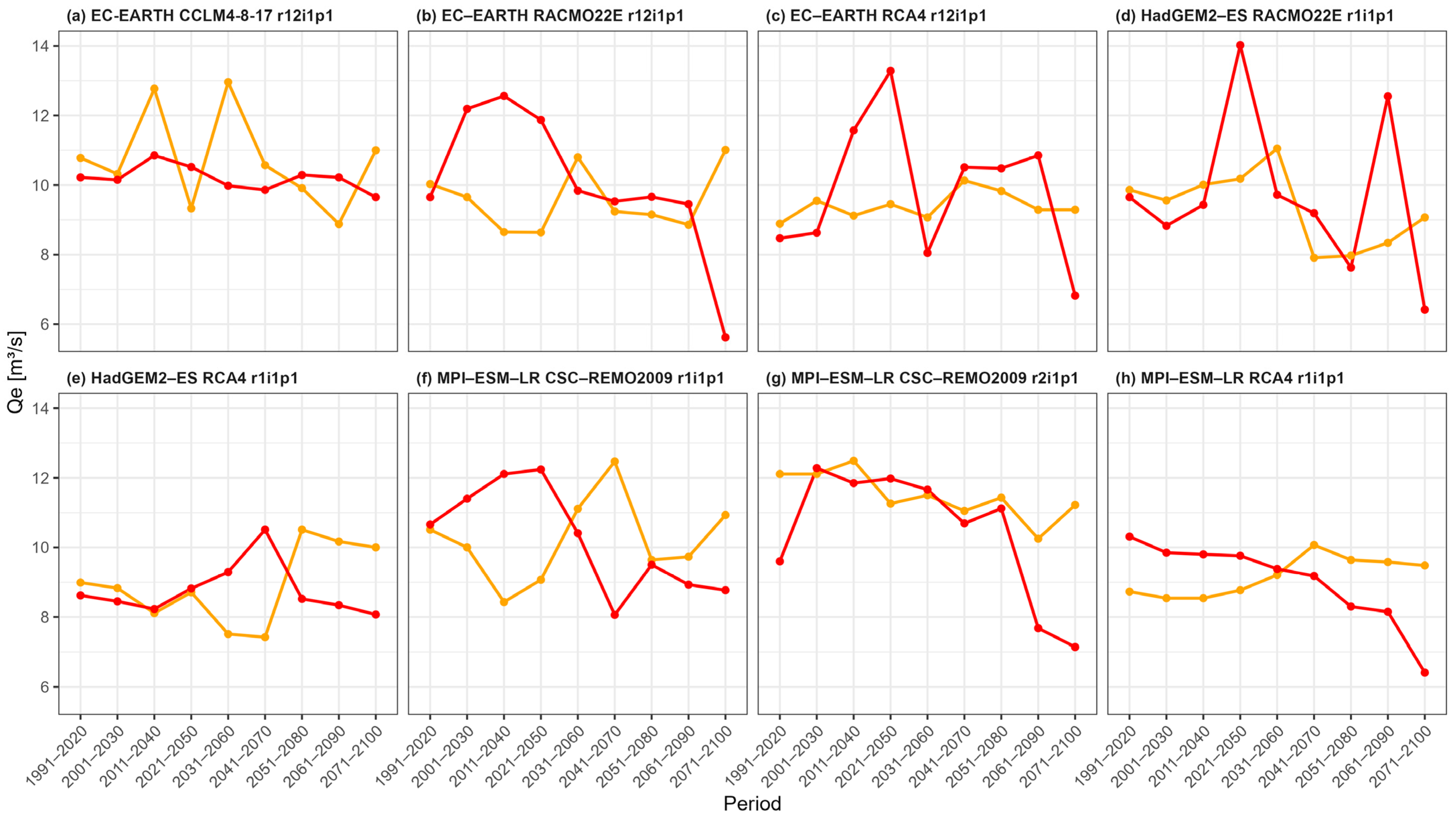
Figure 11 shows the Qe evolution between 1991 and 2100, calculated for 30-year time windows, for each of the eight EURO–CORDEX EUR–11 ensemble members (Table 1) and in both RCP climate change scenarios.
Figure 11. Evolution of the effective discharge (Qe) between 1991 and 2100, calculated with modelled discharges in RCP 4.5 (orange line) and RCP 8.5 (red line) climate change scenarios for the eight EURO–CORDEX EUR–11 ensemble members used in this study (ah).
Qe for the Ialomița River at Băleni gauging station indicate values ranging between 7.49 m3/s (Figure 11e) and 12.79 m3/s (Figure 11b) for RCP 4.5, and 5.66 m3/s (Figure 11c) and 13.94 m3/s (Figure 11d) for RCP 8.5. All Qe values are provided in detail in Table S4.
Significant differences are evident among the RCP scenarios in both inter-period variability and overall evolutionary trajectory. We estimated that the RCP 8.5 forcing is more variable than under RCP 4.5, as observed for the majority of the hydrological model configurations. Notable inter-period deviations are particularly evident for the HadGEM2–ES RACMO22E r1i1p1 and EC–EARTH RCA4 r12i1p1 climate models. Conversely, the MPI–ESM–LR RCA4 r1i1p1 model presents the smoothest evolution for both RCPs (Figure 11g).
Regarding the evolution of Qe, a clear general downward trajectory for all RCP 8.5 simulations is observed, best represented in EC–EARTH RACMO22E r12i1p1, HadGEM2–ES RACMO22E r1i1p1, and in all MPI–ESM–LR models (Figure 11b,d,f–h). RCP 4.5 simulations indicate mixed trends, of decreasing for EC–EARTH CCLM4-8-17 r12i1p1, HadGEM2–ES RACMO22E r1i1p1 and MPI–ESM–LR CSC–REMO2009 r2i1p1 (Figure 11a,d,h) and of increasing in the others.

3.3.4. Qe Relative Change Evolution and Trend

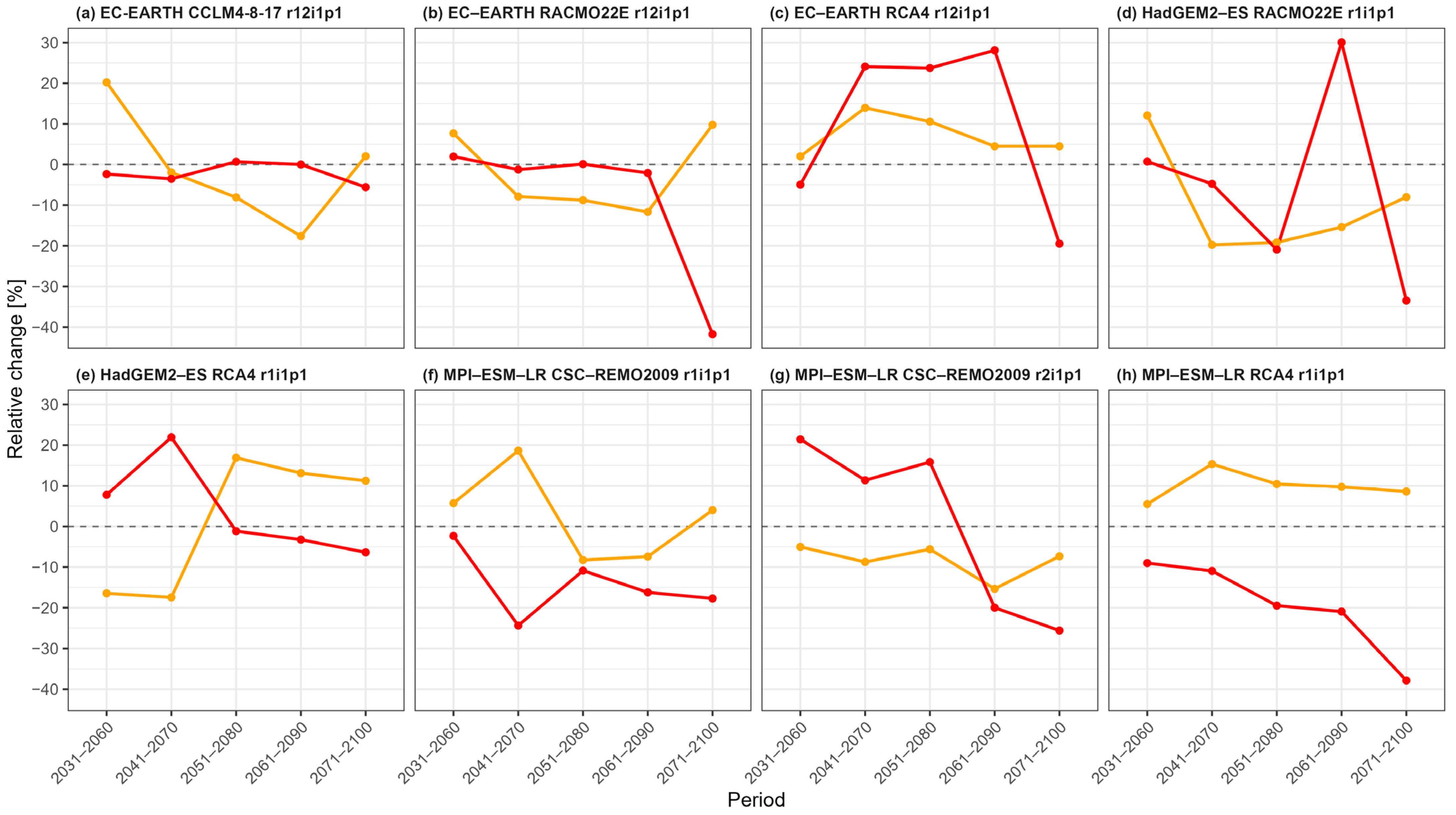
For a clearer understanding of the projected evolution and future trend of effective discharge, Figure 12 presents a comparative analysis of changes in Qe for the future periods (between 2031 and 2100) relative to the reference period (1991–2020).
Figure 12. Relative change evolution of the effective discharge (Qe) between 2031 and 2100, calculated with modelled discharges in RCP 4.5 (orange line) and RCP 8.5 (red line) climate change scenarios for the eight EURO–CORDEX EUR–11 ensemble members used in this study (ah).
The relative change of Qe among the climate model simulations varies between a minimum of −18.5% (Figure 12d) and a maximum of +20.2% (Figure 12a) for the RCP 4.5 climate scenario, and between −41.1% (Figure 12b) and +31.4% (Figure 12d) for the RCP 8.5.
The overall trajectory of relative Qe changes shows a negative trend under the RCP 8.5 scenario, whereas it remains relatively stable or shows a slight increasing tendency under RCP 4.5.
There is no consistent ordering between the two RCPs (Figure 12). In several climate model simulations, RCP 8.5 effective discharges show larger positive relative changes than RCP 4.5, particularly in the near and mid-future (Figure 12a–e,g). On the other hand, certain climate models exhibit the opposite behaviour, especially for two of the three MPI–ESM–LR configurations (Figure 12f–h). In these cases, the Qe values derived from simulated discharges under RCP 4.5 climate change forcing remain consistently higher than those under RCP 8.5, displaying contrary temporal evolution trends.
The late future (2071–2100) clearly shows the impact of the climatic signal on the effective discharge. All RCP 8.5 Qe values are lower than those in the reference period and, consequently, than those modelled with RCP 4.5. Moreover, the majority of models show entirely opposite directions of evolution.

4. Discussion

4.1. Qe of Suspended Sediment Load Representativity for Ialomița River at Băleni

In Wolman and Miller’s [12] initial approach to calculate the effective discharge, suspended sediment load data were used. They analysed sand-bed channels that evolve in a humid or sub-humid temperate climate. Later, some authors [9,13,25,62,65] recommend or use the total sediment load, including both suspended and bed load fractions, to calculate effective discharge, considering that it is more representative. However, these studies calculate Qe for gravel–bed rivers, most of which are located in mountain areas.
Nevertheless, most studies [14,15,20,21,26,28,29,66,67] follow the original Wolman and Miller [12] approach, using suspended sediment data because of its representativeness in the total sediments and because of data availability. According to the studies of Hassan et al. [65] and Ma et al. [29] on effective discharge, suspended sediment represents the vast majority of the total sediment load, while the bed load represents only a minor, negligible proportion. Other studies of mountainous Alpine rivers indicate high suspended sediment transport, as percentages of total sediment reported by Lenzi et al. [68] (76%), Rainato et al. [69] (79%), and Bonfrisco et al. [70] (93.5%). In Romania, according to Dumitriu [15], the suspended sediment for Trotuș (a Carpathian River) ranges between 75% and 95% of the total sediment load.
We estimate the suspended sediment regime of the Ialomița River to be comparable to that of the Trotuș River, both crossing the Subcarpathian zone, a region characterised by rich sediment supply. In addition, because the Băleni gauging station is located in a plain area (at ~190 m a.s.l), where the river has a mixed sand–gravel bed, the proportion of suspended sediment is likely to fall within a narrower range and may reach comparatively higher values than in the case of the Trotuș River.
Based on these considerations, suspended sediment is regarded as representative for the estimation of the Qe for the Ialomița River at Băleni.

4.2. Qe Ensemble Mean Evolution and Trend

This analysis was realised in order to identify future trends in riverbed dynamics, based on the effective discharge evolution, calculated using climate change scenario modelled river discharges. This approach involves an ensemble of eight climate model simulations under two RCP scenarios, which implies a high degree of uncertainty (Figure 11 and Figure 12). Although the performance analysis of these establishes a ranking, based on their ability to simulate annual and seasonal discharges (Figure 5 and Figure 6), the differences among the ensemble of climate models are small (maximum ~ 6%). Therefore, no configuration can be truly considered more accurate than another. In this context, an ensemble mean, with its uncertainty band (90% confidence), would provide a more representative basis for identifying future trends in riverbed dynamics.
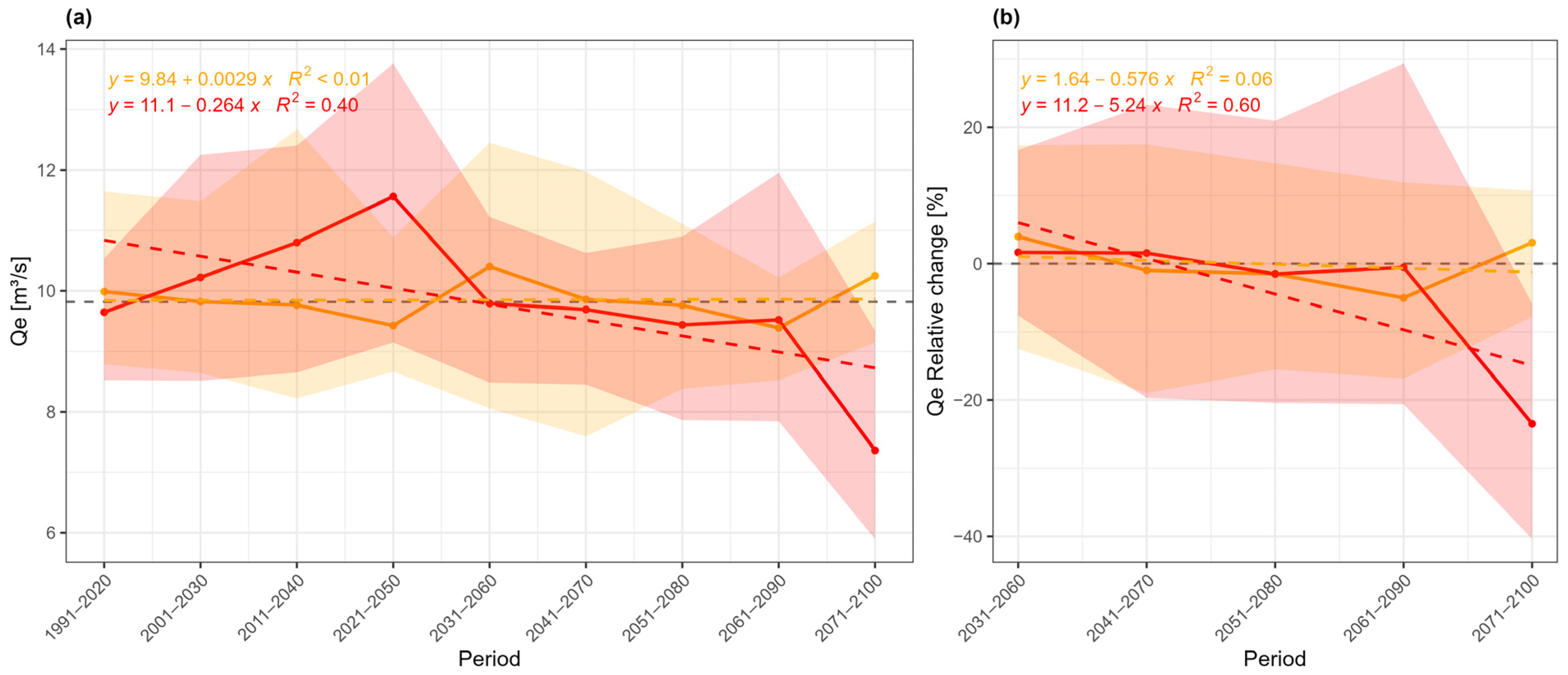
Figure 13 shows the effective discharge evolution and trends of the ensemble mean in the RCP climate change scenarios, with the confidence interval for the absolute values for the entire analysed periods between 1991 and 2100 (Figure 13a) and the relative change (Figure 13b) of the future periods between 2031 and 2100.
Figure 13. The evolution (solid line) and linear trend (dashed line) of the effective discharge (Qe) ensemble mean absolute values (a) and relative change (b), projected in RCP 4.5 (orange) and RCP 8.5 (red) climate change scenarios. The shaded areas represent the 5th–95th percentile confidence bands of the RCP 4.5 (orange) and RCP 8.5 (red) ensembles. The grey dashed line is the reference mean Qe value.
Mean Qe evolution shows oscillations and different trends, depending on each climate change scenario (Figure 13a), the variation of Qe being more accentuated for RCP 8.5 than RCP 4.5. The general evolutionary trajectory of effective discharge indicates a moderate decreasing trend for the RCP 8.5 climate change scenario and a slight decrease for the RCP 4.5. For the RCP 4.5 scenario, Qe slowly decreases from 9.94 m3/s in 1991–2020 to 9.43 m3/s in 2021–2050. An opposite evolutionary trend is observed in RCP 8.5 Qe, which increases from 9.63 m3/s to 11.56 m3/s.
Starting with the mid-century (2031–2060), both RCP scenarios align, and a parallel decline is observed in both trajectories up to 2090 (to 9.39, respectively 9.52 m3/s). At the end of the century, the two scenarios diverge, with RCP 4.5 exhibiting an increase (10.25 m3/s) and RCP 8.5 showing a marked decrease (7.36 m3/s). All ensemble mean Qe values are presented in Table S6.
Regarding the relative change (Figure 13b), Qe deviates from the reference period on average by a maximum positive percentage of +4.48% (2031–2060) and a maximum negative percentage of −23.27% (2071–2100). While for RCP 4.5 the trend remains relatively stationary, for RCP 8.5 the decreasing trend of Qe becomes more pronounced. In the near and medium future, the Qe ensemble mean values will remain relatively constant, with deviations of up to 4.6% compared to the reference period. By the end of the century, Qe projected under the RCP 4.5 scenario is 3.58% higher than during the reference period, whereas under the RCP 8.5 scenario it is significantly lower, with an average decrease of 23.27%. All ensemble mean relative changes of Qe values are presented in Table S7.
The confidence bands for both RCP ensemble mean Qe show a high degree of uncertainty between the model’s configurations and the climate change scenarios. However, the confidence bands for both RCPs narrow toward the end of the century, indicating a stronger convergence and higher agreement among the analysed EURO–CORDEX EUR–11 climate model simulations.

4.3. Limitations and Uncertainties

We are aware of the study’s limitations and uncertainties, generated by both the data and the methods used. Depending on their source, these limitations and uncertainties arise from:
(a)
Climate models and climate change scenarios: The eight climate models used to produce meteorological forcing (temperature and precipitation) for the hydrological model introduce limitations and uncertainties in the simulated outputs. First, using only a subset (eight members) of the EURO–CORDEX EUR–11 ensemble results in an incomplete representation of possible future climate conditions. Structural differences in model formulation, including the representation of physical processes and parametrisation, lead to structural uncertainty, with model outputs varying even under the same climate change scenario forcing. In addition, for the RCP scenarios considered in this study, uncertainties increase with advancing time. Although the climate model outputs are bias-adjusted, uncertainties remain, particularly for high precipitation values.
(b)
The hydrological model: The E-HYPE hydrological model is configured, calibrated, and validated for the entire pan-European domain and is not specifically tailored to the Ialomița basin or to the Băleni gauging station used for calculating Qe. In addition, the model does not explicitly represent anthropogenic influences within the hydrographic basin, particularly those associated with the two large dams located upstream of Băleni (Bolboci and Pucioasa—Figure 2). Another factor that may affect the quality of the hydrological model results is the 5 km spatial resolution, which can be considered relatively coarse for the analysed basin (915 km2) within a pan-European modeling configuration. Considering these aspects, uncertainties arise regarding the hydrological model’s ability to accurately simulate discharges at this location. The analysis realised in Section 2.4.2 indicates that average discharges (10–70% exceedance probability, Figure 5) are generally overestimated by the models. Discharges within this range, combined with sediment data, contribute cumulatively to the calculation of Qe. This may lead to an overestimation of the Qe values. Also, peak values are underestimated. The analysis of mean monthly discharges indicates that the winter–spring months tend to produce systematically overestimated values, most likely due to the model’s limited ability to simulate snow conditions within the watershed.
(c)
Sediment data and methods: A limitation regarding sediments is the use of the suspended fraction of sediments for calculating Qe, rather than total sediment yield, due to data availability constraints. Excluding bedload generally results in lower effective discharge values, as finer suspended sediment is mobilised at lower discharges than coarser bed material. However, we consider it representative for the Băleni gauging station and for the aim of the study, this subject being discussed in Section 4.1. Also, using a linear power–law function to estimate suspended sediment load as a function of discharge can lead to under- or overestimation.
(d)
Methodological constraints and choices: We used the same sediment relationship (equation) derived from observed discharges (1991–2020) for the forecast period’s estimation of Qs, in the absence of available modelled sediment data. This relationship may change in the future due to climatic, land use, or anthropogenic influences. However, we do not expect major anthropogenic variations, as the Ialomița River is already heavily modified by human activity, with two large reservoirs (Pucioasa and Bolboci) and associated hydrotechnical structures that constrain sediment transport. The study by Radu and Comănescu [34] indicates a significant alteration in the sediment regime of the Ialomița River at the Băleni gauging station. After the commissioning of the Pucioasa Dam in 1975, the mean multiannual suspended sediment discharge decreased from 22.09 kg/s between 1961 and 1975 to 12.97 kg/s between 1976 and 2022. Moreover, the Bolboci reservoir, commissioned in 1988, adds additional anthropogenic pressure on the flow and sediment regime.
These limitations and uncertainties must be considered, as they influence the effective discharge values. Nevertheless, this study places greater emphasis on the evolutionary trend of Qe driven by the climatic signal, rather than on changes in the sediment regime, for which data is not available.

4.4. Implication of the Effective Discharge Evolution and Change on Riverbed Dynamics

The effective discharge assessment, as a measure of the channel-forming discharge, provides valuable information about the fluvial processes that shape the riverbed, characterised as the “geomorphic work” performed by the river. Thus, Qe is regarded as one of the key drivers for long-term evolution of the riverbed. However, under future conditions, additional drivers of geomorphic change, such as sediment (dis)connectivity, soil erosion, anthropogenic channel modifications, intrinsic system development, and riparian vegetation dynamics, may also influence the riverbed evolution.
We analyse how Qe evolution and trends under climate change scenarios may indicate potential future riverbed geomorphic evolution from a hydro-climatic and geomorphological perspective, with the caveat that other geomorphic change drivers are not quantitatively considered. Table 2 shows, depending on the future Qe evolution trend, the main influence of this on riverbed dynamics through the core fluvial geomorphic processes that shape the landscape. Conceptual expected riverbed responses are also provided.
Table 2. Effective discharge evolution conceptual geomorphic interpretation as a key driver for riverbed dynamics.
Regarding other drivers that may influence future river dynamics, although quantitative data are not available in this study, we conceptually assessed some of their potential effects on riverbed dynamics as presented in the following:
  • Changes in sediment connectivity (through dams and other transversal structures) influence the sediment supply to the river channel. Poor connectivity favours riverbed incision and degradation, whereas enhanced connectivity may lead to riverbed aggradation and stabilisation.
  • Soil erosion controls sediment availability from hillslopes and tributaries, influencing the balance between the sediment supply and transport. Increased soil erosion promotes deposition, whereas reduced soil erosion enhances erosional processes.
  • Riparian vegetation influences riverbed dynamics through its development: poorly vegetated channels are more susceptible to erosion, particularly bank erosion, whereas densely vegetated channels stabilise the riverbed.
  • Anthropogenic channel modifications also constrain riverbed evolution, depending on the nature of the intervention. From a planform perspective, structures such as levees and embankments confine the channel, resulting in reduced lateral mobility. Conversely, bed-level modifying interventions, such as in-channel gravel mining, lower the river base level and promote riverbed incision, whereas dams and other transversal structures raise the channel bed, leading to riverbed aggradation.
  • The intrinsic evolution of the fluvial system, driven by autogenic processes and internal feedbacks, represents an additional control on riverbed dynamics. These processes may attenuate, amplify, or delay geomorphological responses to external factors, such as those enumerated previously, leading to nonlinear and spatially complex riverbed adjustments.
Before assessing trends in riverbed evolution, it is essential to acknowledge that the Ialomița riverbed is already in an altered state because of human interventions and climate change. According to Radu and Comănescu [34], at present, the Ialomița riverbed in the Băleni station area is generally characterised as a simple, single-thread one, affected by incision, narrowing, and straightening, alternating with intense meandering processes. Based on linear models applied to a set of historical riverbed geomorphological parameters evolution (1856–2021), the authors conclude that the studied river reach will continue to degrade and reduce its morphological complexity in the short term.
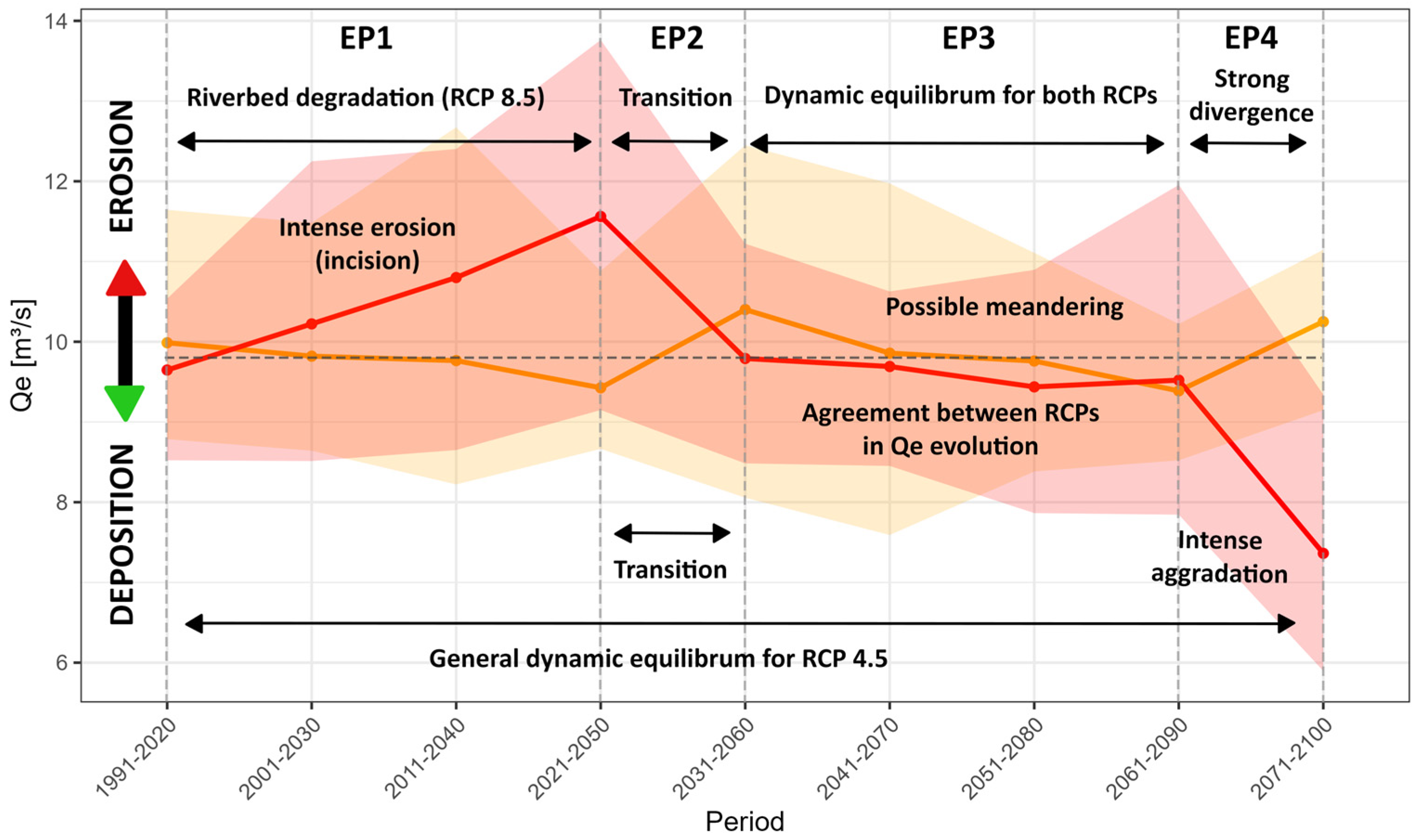
Figure 14 presents the ensemble mean Qe evolution from 1991 to 2100 for both RCP climate change scenarios (Qe4.5 and Qe8.5), along with the basic possible fluvial geomorphic processes that may occur, based on the conceptual interpretation from Table 2.
Figure 14. Riverbed evolution trends based on Qe evolution projected in RCP 4.5 (orange) and RCP 8.5 (red) climate change scenarios. The solid lines represent the ensemble mean evolution of Qe under RCP scenarios. The shaded areas represent the 5th–95th percentile confidence band of the RCP 4.5 (orange) and RCP 8.5 (red) ensembles. The grey dashed line is the reference mean Qe value.
Depending on identified evolution trends, we delineate four evolutionary periods (EP1–EP4). These are characterised as follows:
  • EP1 (up to 2050)—Qe8.5 significantly increase and Qe4.5 slightly decrease. In the RCP 8.5 scenario, the riverbed may degrade through erosion processes (incision and/or bank erosion processes), in a channel which is already highly affected by these processes, as the study of Radu and Comănescu [34] highlights. For RCP 4.5, no significant changes are estimated, as Qe4.5 variability is low.
  • EP2 (up to 2060)—a transition period in the middle of the century, where the two scenarios intersect and change their general direction of evolution. In the RCP 8.5 scenario, the riverbed potential starts a sudden process of deposition in an already incised channel, which will continue until the end of the analysis period. Qe4.5 returns above the reference value, where a slight erosion process can occur.
  • EP3 (up to 2090)—a potential common downward evolution for both RCPs, but close to the reference Qe value. Qe8.5 is consistently below the reference period. In this period, the riverbed tends to be relatively stable (dynamic equilibrium), with weak depositional processes. In this period, it is possible that a sustained lateral channel migration, or meandering, occurs, as the river’s geomorphic effectiveness remains constant.
  • EP4 (up to 2100)—strong divergent evolution, with Qe4.5 rising over the reference (suggesting slight erosion) and Qe8.5 drastically decreasing with more than 2 m3/s compared to the reference period, indicating a possible intense deposition of the sediments in the riverbed. Under conditions of an already deepened riverbed, this aggradation of the riverbed, combined with the development of riparian vegetation, would lead to channel narrowing.

5. Conclusions

This study presents the first channel-forming discharge assessment from a future climate change perspective, using the effective discharge approach. For the Qe calculation, we used simulated discharges with the E–HYPE hydrological model, forced by eight bias-adjusted EURO–CORDEX EUR–11 projections under the RCP 4.5 and RCP 8.5 climate change scenarios up to 2100.
Considering effective discharge as a key driver of riverbed dynamics, we identified potential evolutionary trends of the Ialomița riverbed at the Băleni gauging station. These trajectories show different general directions: one of relative equilibrium, with minor changes, corresponding to RCP 4.5, and one with significant variations, corresponding to RCP 8.5, which oscillates throughout the analysed period and may lead to major changes in riverbed dynamics.
Based on the overall evolution of Qe4.5, we expect the riverbed in this scenario to be in a potential state of dynamic equilibrium, with Qe oscillating around the value in the reference period (9.94 m3/s). Therefore, the riverbed is likely to remain in a similar geomorphological condition or undergo minimal change from its current state, specifically at the end of the century. Here, the Qe value is 10.25 m3/s, with 3.58% higher than in the reference period.
The evolution of the Qe8.5 from 9.63 m3/s in the reference period to 11.56 m3/s for the period 2021–2050 suggests pronounced erosional processes in the riverbed, potentially dominated by channel incision, in a riverbed already deepened. This is in agreement with the forecast assumptions of Radu and Comănescu [34] for the Ialomița River, namely, continued degradation and a reduction of morphological complexity of the riverbed, on a short-term horizon. After mid-century, Qe8.5 suggests relative stability of the riverbed with incipient depositional processes, which may intensify at the end of the century, when the Qe value is 7.36 m3/s, which is 23.27% lower than in the reference period. Overall, Qe8.5 evolution indicates a potential future alteration of the Ialomița riverbed.
This study also presents a complex methodology and a complete semi-automated workflow for calculating the effective discharge, using an open-access dataset and open-source software. This framework may serve as a valuable basis for future studies.
We acknowledge the limitations and uncertainties of the study, which arise in particular from the use of a single historical sediment–transport relationship for the future periods, the variability within the eight EURO–CORDEX EUR–11 climate model simulations, the uncertainty associated with the RCP climate change scenarios, and the hydrological model’s inability to faithfully reproduce the Ialomița River flow regime. Additionally, other drivers of geomorphic change (sediment (dis)connectivity, soil erosion, anthropogenic channel modifications, intrinsic system development, riparian vegetation dynamics) are not quantitatively included in this study.
The results of this study may support future management and restoration planning of the Ialomița River in the area of the Băleni gauging station. As Qe is commonly employed as a guiding parameter in riverbed restoration design, future projects of this type could take these work findings into account. However, the analysis needs to be extended to the entire river, as the current results are valid only for a specific reach.
Further research is needed to integrate future sediment projection data into the computation of effective discharge and to configure, calibrate and validate the hydrological model specifically for the Ialomița River Basin, thereby strengthening the model’s performance. Including additional drivers of geomorphic change may further enhance the analysis.

Supplementary Materials

The following supporting information can be downloaded at: https://www.mdpi.com/article/10.3390/w18030420/s1, Table S1: Ranking of the eight EURO-CORDEX EUR-11 climate models based on the K–S distance (D) of the FDCs; Table S2: Ranking of the monthly models’ performance based on the mean monthly K–S distance (D); Table S3: Ranking of the eight EURO-CORDEX EUR-11 climate model performances based on the mean monthly K–S distance (D); Table S4: Effective discharge (Qe) values for the EURO-CORDEX EUR-11 climate models and scenarios used in the study over the full period (1991–2100); Table S5: Relative change (%) in effective discharge (Qe) for the EURO-CORDEX EUR-11 climate models and scenarios used in this study over the future period (2031–2100); Table S6: Ensemble mean effective discharge (Qe) for the full period (1991–2100) under the RCP 4.5 and RCP 8.5 scenarios; Table S7: Ensemble mean relative change (%) in effective discharge (Qe) for the future period (2031–2100) under the RCP 4.5 and RCP 8.5 scenarios.

Author Contributions

Conceptualization, A.R. and L.C.; methodology, A.R., L.C., N.C. and R.C.; software, A.R.; validation, L.C., N.C. and R.C.; formal analysis, A.R., L.C., N.C. and R.C.; data curation, A.R.; writing—original draft preparation, A.R. and L.C.; writing—review and editing, A.R., L.C., N.C. and R.C.; visualization, A.R.; supervision, L.C. All authors have read and agreed to the published version of the manuscript.

Funding

This research received no external funding.

Data Availability Statement

The simulated discharge data was extracted from the “Hydrology-related climate impact indicators from 1970 to 2100 derived from bias adjusted European climate projections” dataset, which is freely available from the Copernicus Climate Change Service (C3S) (https://cds.climate.copernicus.eu/datasets/sis-hydrology-variables-derived-projections (accessed on 6 August 2025)). The observed hydrological data between 1991 and 2020 were obtained from The National Institute of Hydrology and Water Management and are not available for sharing. All other raw data supporting the conclusions of this article will be made available by the authors on request.

Conflicts of Interest

The authors declare no conflicts of interest.

Abbreviations

The following abbreviations are used in this manuscript:
GCMGlobal Climate Model
RCMRegional Climate Model
RCPRepresentative Concentration Pathway
RIPRealisation-Initialization-Physics code
E–HYPEEuropean Hydrological Predictions for the Environment
VIC-WURVariable Infiltration Capacity (VIC) model, developed at Wageningen University & Research (WUR)
EFASEuropean Flood Awareness System
CORDEXCoordinated Regional Climate Downscaling Experiment
EC–EARTHEuropean Community Earth System Model
HadGEM2–ESHadley Centre Global Environment Model version 2—Earth System configuration
MPI-ESM–LRMax Planck Institute Earth System Model—Low Resolution
CCLM4–8–17Consortium for Small-scale Modeling (COSMO) Model (version 4–8–17)
RACMO22ERoyal Netherlands Meteorological Institute’s regional climate model, version 2.2.1
RCA4Rossby Centre Regional Atmospheric Climate Model, version 4
REMO2009Regional Climate Model, year 2009
Qe4.5Effective discharge computed with RCP 4.5 climate–change scenario discharges
Qe8.5Effective discharge computed with RCP 8.5 climate–change scenario discharges

References

  1. Rhoads, B.L. Introduction. In River Dynamics: Geomorphology to Support Management; Cambridge University Press: Cambridge, UK, 2020; pp. 1–14. [Google Scholar] [CrossRef][Green Version]
  2. Rhoads, B.L. Magnitude-Frequency Concepts and the Dynamics of Channel-Forming Events. In River Dynamics: Geomorphology to Support Management; Cambridge University Press: Cambridge, UK, 2020; pp. 134–163. [Google Scholar] [CrossRef]
  3. Copeland, R.R.; Biedenharn, D.S.; Fischenich, J.C. Channel-Forming Discharge; Technical Note ERDC/CHL CHETN-VIII-5; U.S. Army Corps of Engineers: Washington, DC, USA, 2000. [Google Scholar]
  4. Copeland, R.; Soar, P.; Thorne, C. Channel-forming discharge and hydraulic geometry width predictors in meandering sand-bed river. In Impacts of Global Climate Change; American Society of Civil Engineers: Reston, VA, USA, 2005; Volume 1, pp. 1–12. [Google Scholar] [CrossRef]
  5. FISRWG (The Federal Interagency Stream Restoration Working Group). Stream Corridor Restoration: Principles, Processes, and Practices; USDA-National Resources Conservation Service: Washington, DC, USA, 1998.
  6. Benson, M.A.; Thomas, D.M. A definition of dominant discharge. Bull. Int. Assoc. Sci. Hydrol. 1966, 11, 76–80. [Google Scholar] [CrossRef]
  7. Copeland, R.R.; Mccomas, D.N.; Thorne, C.R.; Soar, P.J.; Jonas, M.M.; Fripp, J.B. Hydraulic Design of Stream Restoration Projects; Coastal and Hydraulics Laboratory: Washington, DC, USA, 2001. [Google Scholar]
  8. Brayshaw, D.D. Bankfull and Effective Discharge in Small Mountain Streams of British Columbia. Ph.D. Thesis, University of British Columbia, Vancouver, BC, Canada, 2012. [Google Scholar]
  9. Biedenharn, D.S.; Thorne, C.R.; Soar, P.J.; Hey, R.D.; Watson, C.C. Effective discharge calculation guide. Int. J. Sediment Res. 2001, 16, 445–459. [Google Scholar]
  10. Doyle, M.W.; Shields, D.; Boyd, K.F.; Skidmore, P.B.; Dominick, D. Channel-Forming Discharge Selection in River Restoration Design. J. Hydraul. Eng. 2007, 133, 831–837. [Google Scholar] [CrossRef]
  11. Soar, P.J.; Thorne, C.R. Channel Restoration Design for Meandering Rivers; ERDC/CHL CR-01-1; U.S. Army Corps of Engineers: Washington, DC, USA, 2001. [Google Scholar]
  12. Wolman, M.G.; Miller, J.P. Magnitude and Frequency of Forces in Geomorphic Processes. J. Geol. 1960, 68, 54–74. [Google Scholar] [CrossRef]
  13. Andrews, E.D. Effective and bankfull discharges of streams in the Yampa River Basin, Colorado and Wyoming. J. Hydrol. 1980, 46, 311–330. [Google Scholar] [CrossRef]
  14. Roy, N.G.; Sinha, R. Effective Discharge for Suspended Sediment Transport of the Ganga River and Its Geomorphic Implication. Geomorphology 2014, 227, 18–30. [Google Scholar] [CrossRef]
  15. Dumitriu, D. Sub-Bankfull Flow Frequency versus Magnitude of Flood Events in Outlining Effective Discharges. Case Study: Trotuș River (Romania). Water 2018, 10, 1292. [Google Scholar] [CrossRef]
  16. Nash, D.B. Effective Sediment-Transporting Discharge from Magnitude-Frequency Analysis. J. Geol. 1994, 102, 79–95. [Google Scholar] [CrossRef]
  17. Goodwin, P. Analytical Solutions for Estimating Effective Discharge. J. Hydraul. Eng. 2004, 130, 729–738. [Google Scholar] [CrossRef]
  18. Klonsky, L.; Vogel, R.M. Effective Measures of “Effective” Discharge. J. Geol. 2011, 119, 1–14. [Google Scholar] [CrossRef]
  19. Sholtes, J.; Werbylo, K.; Bledsoe, B. Physical context for theoretical approaches to sediment transport magnitude-frequency analysis in alluvial channels. Water Resour. Res. 2014, 50, 7900–7914. [Google Scholar] [CrossRef]
  20. Maheshwari, S.; Chavan, S.R. A Modified Approach to Determine Suspended Sediment Transport Effectiveness in Indian Rivers. J. Hydrol. 2022, 605, 127284. [Google Scholar] [CrossRef]
  21. Crowder, D.W.; Knapp, H.V. Effective discharge recurrence intervals of Illinois streams. Geomorphology 2005, 64, 167–184. [Google Scholar] [CrossRef]
  22. Basso, S.; Frascati, A.; Marani, M.; Schirmer, M.; Botter, G. Climatic and Landscape Controls on Effective Discharge. Geophys. Res. Lett. 2015, 42, 8441–8447. [Google Scholar] [CrossRef]
  23. Tranmer, A.W.; Caamaño, D.; Clayton, S.R.; Giglou, A.N.; Goodwin, P.; Buffington, J.M.; Tonina, D. Testing the effective-discharge paradigm in gravel-bed river restoration. Geomorphology 2022, 403, 108139. [Google Scholar] [CrossRef]
  24. Bunte, K.; Abt, S.R.; Swingle, K.W.; Cenderelli, D.A. Effective discharge in Rocky Mountain headwater streams. J. Hydrol. 2014, 519, 2136–2147. [Google Scholar] [CrossRef]
  25. Lenzi, M.A.; Mao, L.; Comiti, F. Effective discharge for sediment transport in a mountain river: Computational approaches and geomorphological effectiveness. J. Hydrol. 2006, 326, 257–276. [Google Scholar] [CrossRef]
  26. López-Tarazón, J.A.; Batalla, R.J. Dominant discharges for suspended sediment transport in a highly active Pyrenean river. J. Soils Sediments 2014, 14, 2019–2030. [Google Scholar] [CrossRef]
  27. Tena, A.; Batalla, R.J.; Vericat, D.; López-Tarazón, J.A. Suspended sediment dynamics in a large regulated river over a 10-year period (the lower Ebro, NE Iberian Peninsula). Geomorphology 2011, 125, 73–84. [Google Scholar] [CrossRef]
  28. Chen, F.; Chen, L.; Zhang, W.; Yuan, J.; Zhang, K. Variations in the effective and bankfull discharge for suspended sediment transport due to dam construction. Front. Earth Sci. 2022, 16, 446–464. [Google Scholar] [CrossRef]
  29. Ma, Y.; Huang, H.Q.; Xu, J.; Brierley, G.J.; Yao, Z. Variability of Effective Discharge for Suspended Sediment Transport in a Large Semi-Arid River Basin. J. Hydrol. 2010, 388, 357–369. [Google Scholar] [CrossRef]
  30. Gomez, B.; Coleman, S.E.; Sy, V.W.K.; Peacock, D.H.; Kent, M. Channel change, bankfull and effective discharges on a vertically accreting, meandering, gravel-bed river. Earth Surf. Process. Landf. 2006, 32, 770–785. [Google Scholar] [CrossRef]
  31. Soar, P.J.; Thorne, C.R. Design discharge for river restoration. In Stream Restoration in Dynamic Fluvial Systems; Simon, A., Bennett, S.J., Castro, J.M., Eds.; Geophysical Monograph Series 194; Wiley: Hoboken, NJ, USA, 2011; pp. 123–149. [Google Scholar]
  32. Eyring, V.; Gillett, N.P.; Achuta Rao, K.M.; Barimalala, R.; Barreiro Parrillo, M.; Bellouin, N.; Cassou, C.; Durack, P.J.; Kosaka, Y.; McGregor, S.; et al. Human Influence on the Climate System. In Climate Change 2021: The Physical Science Basis. Contribution of Working Group I to the Sixth Assessment Report of the Intergovernmental Panel on Climate Change; Masson-Delmotte, V., Zhai, P., Pirani, A., Connors, S.L., Péan, C., Berger, S., Caud, N., Chen, Y., Goldfarb, L., Gomis, M.I., et al., Eds.; Cambridge University Press: Cambridge, UK; New York, NY, USA, 2021; pp. 423–552. [Google Scholar] [CrossRef]
  33. Caretta, M.A.; Mukherji, A.; Arfanuzzaman, M.; Betts, R.A.; Gelfan, A.; Hirabayashi, Y.; Lissner, T.K.; Liu, J.; Gunn, E.L.; Morgan, R.; et al. Water. In Climate Change 2022: Impacts, Adaptation and Vulnerability. Contribution of Working Group II to the Sixth Assessment Report of the Intergovernmental Panel on Climate Change; Pörtner, H.-O., Roberts, D.C., Tignor, M., Poloczanska, E.S., Mintenbeck, K., Alegría, A., Craig, M., Langsdorf, S., Löschke, S., Möller, V., et al., Eds.; Cambridge University Press: Cambridge, UK; New York, NY, USA, 2022; pp. 551–712. [Google Scholar] [CrossRef]
  34. Radu, A.; Comănescu, L. Historical Evolution and Future Trends of Riverbed Dynamics Under Anthropogenic Impact and Climatic Change: A Case Study of the Ialomița River (Romania). Water 2025, 17, 2151. [Google Scholar] [CrossRef]
  35. Forster, P.M.; Smith, C.; Walsh, T.; Lamb, W.F.; Lamboll, R.; Cassou, C.; Hauser, M.; Hausfather, Z.; Lee, J.-Y.; Palmer, M.D.; et al. Indicators of Global Climate Change 2024: Annual Update of Key Indicators of the State of the Climate System and Human Influence. Earth Syst. Sci. Data 2025, 17, 2641–2680. [Google Scholar] [CrossRef]
  36. Buzău-Ialomița Water Basin Administration Flood Risk Management Plan—Updated. Available online: https://inundatii.ro/wp-content/uploads/2022/10/PMRI_actualizat_ciclul-II_ABA-Buzau-Ialomita_versiune-preliminara-1.pdf (accessed on 17 September 2025).
  37. Mutihac, V.; Stratulat, M.L.; Fechet, R.M. Geologia Romaniei (Geology of Romania); Editura Didactică şi Pedagogică: Bucureşti, Romania, 2004. [Google Scholar]
  38. Geological Map of Romania, Sc. 1:200,000; Romanian Geological Institute: Bucharest, Romania, 1968.
  39. Geological Map of Romania, Sc. 1:200,000, Explanatory Note of Târgoviște Map Sheet L-35-XXVI; Romanian Geological Institute: Bucharest, Romania, 1968.
  40. Clima României (Romania’s Climate). Available online: https://www.meteoromania.ro/clima/clima-romaniei/ (accessed on 22 August 2025).
  41. Murărescu, O.; Bretcan, P. Management of Water Resources in Upper Ialomiţa River Basin (Carpathians, Sub-Carpathians, Romania). In Proceedings of the International Symposium on Water Management and Hydraulic Engineering, Faculty of Civil Engineering, Department of Hydraulics, Hydrology and River Engineering, University of Ss. Cyril and Methodius, Skopje, North Macedonia, 1–5 September 2009. [Google Scholar]
  42. Berg, P.; Photiadou, C.; Bartosova, A.; Biermann, J.; Capell, R.; Chinyoka, S.; Fahlesson, T.; Franssen, W.; Hundecha, Y.; Isberg, K.; et al. Hydrology related climate impact indicators from 1970 to 2100 derived from bias adjusted European climate projections. In Copernicus Climate Change Service (C3S) Climate Data Store (CDS); Climate Data Store: Reading, UK, 2021. [Google Scholar] [CrossRef]
  43. Hundecha, Y.; Berg, P.; Capell, R.; Photiadou, C.; Nauta, L.; Ludwig, F.; van der Linden, E.; Franssen, W.; Biermann, J.; Chinyoka, S. Hydrological Model Specification: Multi-Model Ensemble of Hydrological Models at the European Scale with E-HYPE and VIC-WUR; ECMWF C3S Knowledge Base (CKB); European Centre for Medium-Range Weather Forecasts (ECMWF): Reading, UK, 2023; Available online: https://confluence.ecmwf.int/pages/viewpage.action?pageId=283570322 (accessed on 16 September 2025).
  44. Lindström, G.; Pers, C.; Rosberg, J.; Strömqvist, J.; Arheimer, B. Development and Testing of the HYPE (Hydrological Predictions for the Environment) Water Quality Model for Different Spatial Scales. Hydrol. Res. 2010, 41, 295–319. [Google Scholar] [CrossRef]
  45. About the HYPE Model. Available online: https://hypeweb.smhi.se/about-us/about-the-model (accessed on 6 August 2025).
  46. Donnelly, C.; Andersson, J.C.M.; Arheimer, B. Using flow signatures and catchment similarities to evaluate the E-HYPE multi-basin model across Europe. Hydrol. Sci. J. 2016, 61, 255–273. [Google Scholar] [CrossRef]
  47. Berg, P.; Photiadou, C.; Nauta, L.; Ludwig, F. Hydrology Related Climate Impact Indicators from 1970 to 2100 Derived from Bias Adjusted European Climate Projections: Product User Guide, Specification and Workflow; ECMWF C3S Knowledge Base (CKB); European Centre for Medium-Range Weather Forecasts (ECMWF): Reading, UK, 2024; Available online: https://confluence.ecmwf.int/pages/viewpage.action?pageId=283549812 (accessed on 16 September 2025).
  48. Berg, P.; Mook, R.; Bosshard, T.; Photiadou, C.; Nauta, L. Bias Adjustment of EURO-CORDEX Data; ECMWF C3S Knowledge Base (CKB); European Centre for Medium-Range Weather Forecasts (ECMWF): Reading, UK, 2023; Available online: https://confluence.ecmwf.int/display/CKB/Bias+adjustment+of+Euro-CORDEX+data (accessed on 15 September 2025).
  49. Moss, R.H.; Edmonds, J.A.; Hibbard, K.A.; Manning, M.R.; Rose, S.K.; van Vuuren, D.P.; Carter, T.R.; Emori, S.; Kainuma, M.; Kram, T.; et al. The next Generation of Scenarios for Climate Change Research and Assessment. Nature 2010, 463, 747–756. [Google Scholar] [CrossRef] [PubMed]
  50. IPCC DDC Glossary—Definition of Terms Used Within the DDC Pages. Available online: https://www.ipcc-data.org/guidelines/pages/glossary/glossary_r.html (accessed on 30 September 2025).
  51. Copernicus Climate Change Service (C3S). cdsapi: Climate Data Store API Python Client. PyPI. Available online: https://pypi.org/project/cdsapi/ (accessed on 6 June 2025).
  52. WMO Climatological Normals. Available online: https://community.wmo.int/site/knowledge-hub/programmes-and-initiatives/climate-services/wmo-climatological-normals (accessed on 14 September 2025).
  53. Dembélé, M.; Vrac, M.; Ceperley, N.; Zwart, S.J.; Larsen, J.; Dadson, S.J.; Mariéthoz, G.; Schaefli, B. Contrasting Changes in Hydrological Processes of the Volta River Basin under Global Warming. Hydrol. Earth Syst. Sci. 2022, 26, 1481–1506. [Google Scholar] [CrossRef]
  54. Vogel, R.M.; Fennessey, N.M. Flow-Duration Curves. I: New Interpretation and Confidence Intervals. J. Water Resour. Plan. Manag. 1994, 120, 485–504. [Google Scholar] [CrossRef]
  55. Ridolfi, E.; Kumar, H.; Bárdossy, A. A Methodology to Estimate Flow Duration Curves at Partially Ungauged Basins. Hydrol. Earth Syst. Sci. 2020, 24, 2043–2060. [Google Scholar] [CrossRef]
  56. Massey, F.J. The Kolmogorov-Smirnov test for goodness of fit. J. Am. Stat. Assoc. 1951, 46, 68–78. [Google Scholar] [CrossRef]
  57. R Core Team. R Package, Version 4.5.0. stats: The R Statistics Package. R Core Team: Vienna, Austria, 2024. Available online: https://stat.ethz.ch/R-manual/R-devel/library/stats/html/00Index.html (accessed on 7 September 2025).
  58. Mann, H.B. Nonparametric Tests Against Trend. Econometrica 1945, 13, 245–259. [Google Scholar] [CrossRef]
  59. Kendall, M.G. Rank Correlation Methods, 4th ed.; Charles Griffin: London, UK, 1975. [Google Scholar]
  60. McLeod, A.I. R Package, Version 2.2.1. Kendall: Kendall Rank Correlation and Mann-Kendall Trend Test. R Core Team: Vienna, Austria, 2005. [CrossRef]
  61. Yevjevich, V. Probability and Statistics in Hydrology; Water Resources Publications: Fort Collins, CO, USA, 1972. [Google Scholar]
  62. Biedenharn, D.S.; Copeland, R.R.; Thorne, C.R.; Soar, P.J.; Hey, R.D.; Watson, C.C. Effective Discharge Calculation: A Practical Guide; Engineer Research and Development Center: Vicksburg, MS, USA, 2000. [Google Scholar]
  63. Parzen, E. On Estimation of a Probability Density Function and Mode. Ann. Math. Stat. 1962, 33, 1065–1076. [Google Scholar] [CrossRef]
  64. Wickham, H. R Package, Version 3.5.2. ggplot2: Elegant Graphics for Data Analysis. Springer: New York, NY, USA, 2016. [CrossRef]
  65. Hassan, M.A.; Brayshaw, D.; Alila, Y.; Andrews, E. Effective Discharge in Small Formerly Glaciated Mountain Streams of British Columbia: Limitations and Implications. Water Resour. Res. 2014, 50, 4440–4458. [Google Scholar] [CrossRef]
  66. Sichingabula, H.M. Magnitude-frequency characteristics of effective discharge for suspended sediment transport, Fraser River, British Columbia, Canada. Hydrol. Process. 1999, 13, 1361–1380. [Google Scholar] [CrossRef]
  67. Zakwan, M.; Pham, Q.B.; Zhu, S. Effective Discharge Computation in the Lower Drava River. Hydrol. Sci. J. 2021, 66, 826–837. [Google Scholar] [CrossRef]
  68. Lenzi, M.A.; Mao, L.; Comiti, F. Interannual Variation of Suspended Sediment Load and Sediment Yield in an Alpine Catchment. Hydrol. Sci. J. 2003, 48, 899–915. [Google Scholar] [CrossRef]
  69. Rainato, R.; Mao, L.; García-Rama, A.; Picco, L.; Cesca, M.; Vianello, A.; Preciso, E.; Scussel, G.; Lenzi, M. Three decades of monitoring in the Rio Cordon instrumented basin: Sediment budget and temporal trend of sediment yield. Geomorphology 2017, 291, 45–56. [Google Scholar] [CrossRef]
  70. Bonfrisco, M.; Coviello, V.; Vignoli, G.; Miyata, S.; Piantini, M.; Engel, M.; Nadalet, R.; Dinale, R.; Comiti, F. Temporal variability of bedload vs suspended sediment load and respective hysteresis cycles in a glacier-fed Alpine river. J. Hydrol. 2025, 660, 133215. [Google Scholar] [CrossRef]
Disclaimer/Publisher’s Note: The statements, opinions and data contained in all publications are solely those of the individual author(s) and contributor(s) and not of MDPI and/or the editor(s). MDPI and/or the editor(s) disclaim responsibility for any injury to people or property resulting from any ideas, methods, instructions or products referred to in the content.

Article Metrics

Citations

Article Access Statistics

Article metric data becomes available approximately 24 hours after publication online.