Tackling Urban Water Resilience: Exploiting the Potential of Smart Water Allocation in the Lisbon Living Lab



Abstract
1. Introduction
2. Materials and Methods
2.1. The Lisbon Living Lab of the B-WaterSmart Project
- Government—Lisbon Municipality (LM), with the role of LL owner, i.e., it was the stakeholder who “owned” the challenge to be addressed.
- Research—National Laboratory for Civil Engineering (LNEC), with the role of LL mentor, and the Institute of Social Sciences of the University of Lisbon.
- Industry—Águas do Tejo Atlântico (AdTA), the Lisbon’s wastewater utility; ADENE and Lisboa E-Nova, national and local agencies for energy efficiency, respectively; and Baseform, the registered trademark of BF Software, Ltd. (Lisbon, Portugal).
- Civil society was represented in the CoP through key stakeholders and replicators.
2.2. Framework for Smart Water Allocation in Non-Potable Uses
2.2.1. Rationale
- Alignment with strategic water management planning and with climate action and urban sustainability policies.
- Definition of water allocation alternatives based on strategies for water resilience.
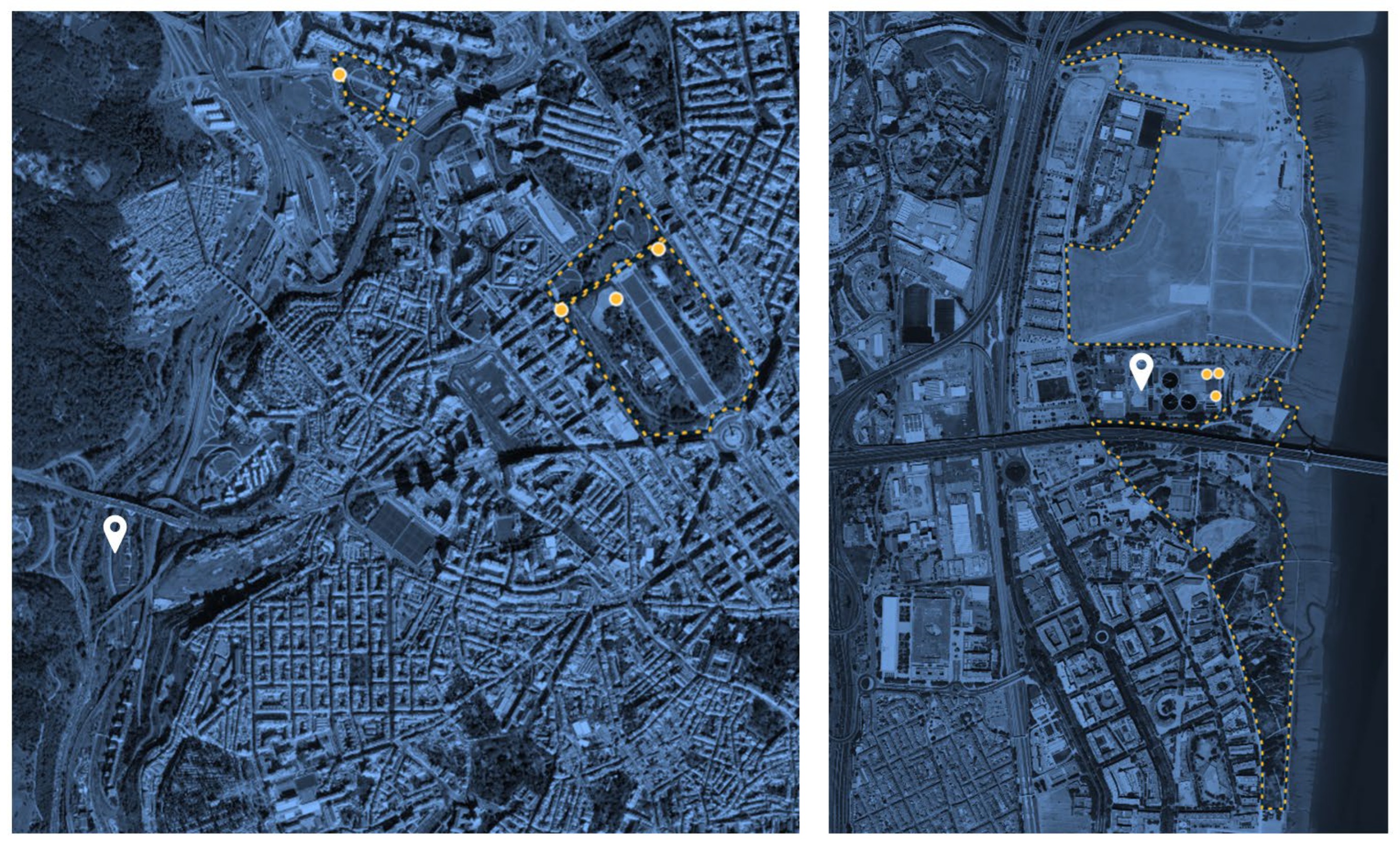
- Establishment of non-potable water demand clusters, e.g., groups of green areas, to facilitate investment scheduling over time. Clusters should be defined with water reuse in mind and, therefore, be organized around existing or planned water resource recovery facilities (WRRFs).
- Safeguarding human health and the environment in the case of water reuse.
- Matching a fit-for-purpose water supply having in mind the demand requirements for water quality and quantity—the core of smart allocation.
- Rank different water allocation alternatives at a cluster level, and then, based on these rankings, prioritize which clusters in a city or region need the most attention for water management.
2.2.2. Smart Water Allocation Process
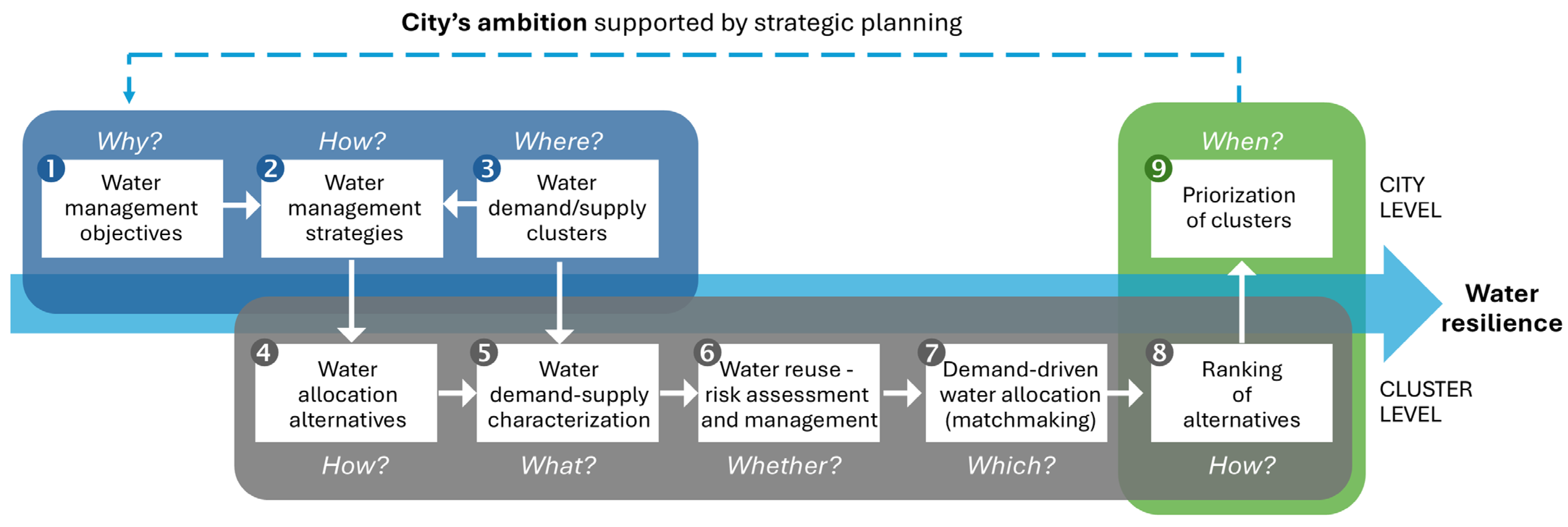
- Objectives, the “why”—should be supported by strategic planning for smart water management (including climate scenario forecasts for the short, medium and long term) and should be aligned with relevant policies for urban sustainability.
- Strategies, the “how”—should outline the approaches to achieve the stated objectives.
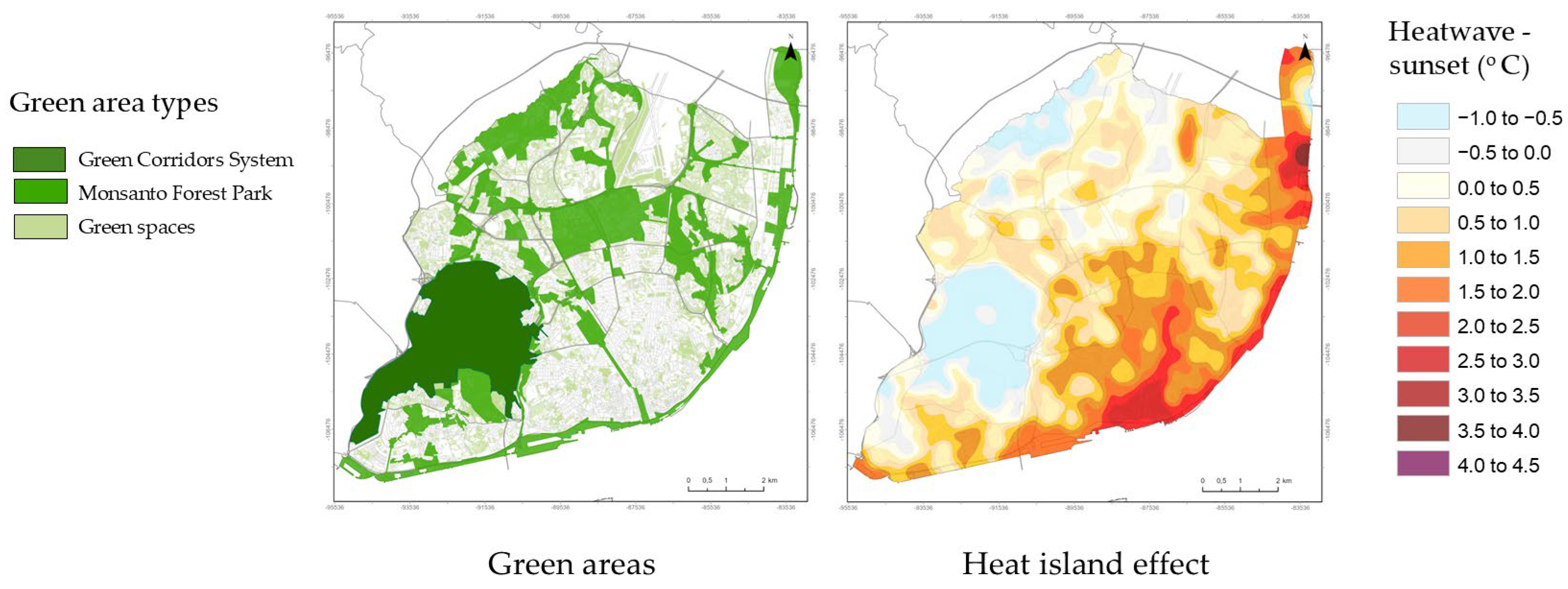
- Clusters, the “where”—should reflect the spatial organization of the (existing and planned) water demands (e.g., irrigated green areas needed to fight the heat island effect and to improve the citizens’ quality of life) and water supplies.
- 4.
- Alternatives, the “how”—should outline the specific course of action to implement the strategies.
- 5.
- Information, the “what”—should compile data from a variety of sources about the different water demand sites (including values on water consumption and fertilization) and water supplies (including values on volume, cost, phosphorus content, and water losses), as well as on the investments to be made.
- 6.
- Water reuse, the “whether”—should assess and manage risk to human health and the environment whenever water reuse is considered.
- 7.
- Demand–supply matchmaking, the “which”—should be demand-driven and use the following order from the water portfolio:
- (i)
- Select the water supply most directly associated with the alternative being analysed (e.g., select reclaimed water if the alternative is about water circularity).
- (ii)
- If water demand is not yet satisfied throughout the planning period, select other non-potable water supply to meet the remaining demand (e.g., groundwater).
- (iii)
- Drinking water should be the last supply to be considered for non-potable uses.
- 8.
- Ranking of alternatives, the “how”—should evaluate alternatives based on the smart water allocation metrics to rank them.
- 9.
- Prioritisation of clusters, the “when”—should compare the results of alternatives, ranking for each cluster, and then decide on investment scheduling for improving water resilience.
- Understanding current and future performance and risks: diagnosis (including SWOT analysis) and prospective planning (SWAP steps 1 to 3);
- Defining and evaluating alternatives: definition of alternatives and evaluation of alternatives (current and prospective planning) (SWAP steps 4 to 8);
- Defining course of action: strategies to be implemented and monitoring progress (SWAP steps 8 to 9).
2.2.3. Smart Water Allocation Metrics
- SO A—Ensuring water for all relevant uses, using the A.1.3—Compliant reclaimed water metric (A.1—Safe and secure fit-for-purpose water provision criterion).
- SO B—Safeguarding ecosystems and their services to society, using the B.3.2—Carbon footprint metric (B.3—Resource efficiency criterion).
- SO C—Boosting value creation around water, using the C.3.2—Fertilizer production avoided and C.3.3—Reclaimed water used metrics (C.3—Resource recovery and use criterion).
2.3. Software Tools for Smart Water Allocation in Non-Potable Uses
3. Case Study
4. Results and Discussion
4.1. Understanding Current and Future Performance and Risks
4.2. Defining and Evaluating Alternatives
- A0 Water Efficiency (to implement the Water Conservation strategy)—This baseline alternative aims to reduce water consumption by applying the “water efficiency” principle which, according to the European Water Resilience Strategy [8], is key and must come first. Emphasis is placed on actions that promote water conservation and efficient water use, such as renovating the irrigation network, using more efficient water devices and intelligent irrigation scheduling, and sealing ornamental lakes.
- A1 Water Variety (to implement the Water Redundancy strategy)—This alternative aims to reduce the use of drinking water for non-potable purposes by applying the “fit-for-purpose” principle (e.g., [43]). Emphasis is placed on actions that promote the use of local freshwater supplies (e.g., rehabilitation of boreholes and renewal of the aqueduct water distribution network).
- A2 Water Circularity (to implement the Water Reuse strategy)—This alternative aims to explore the value associated with reclaimed water by applying the “circulate products and materials” principle [44]. Emphasis is placed on actions that boost value creation around water and keep water in use as a product, such as water reuse for the irrigation and fertilization of urban green areas.
- Water demand—the result of water efficiency measures: it is assumed to be an annual reduction of 1% in water consumption, even though a higher volume of losses due to evapotranspiration and evaporation is expected (climate change impact).
- Water supply—severe 4-year drought scenario (2047/2050): (a) the application of a measure to restrict the supply of drinking water in 2049 and 2050, limiting supply to 50% of the amount made available in 2048, and (b) decreased productivity of boreholes and water springs, respectively, from 2048 to 2050 (75% of the amount made available in 2048).
- Water supply—risk management (Forest cluster): irrigation in the greenhouse is always done with groundwater (i.e., water reuse is excluded).
- Water supply—entry into operation of additional sources (Forest cluster): reclaimed water in January 2030, and spring water in January 2035.
- Water supply—water losses in distribution systems (to estimate abstracted or treated water volumes): 7% for drinking water, 0% for groundwater, 6% for spring water, and 5% and 0% for reclaimed water in Forest and River clusters, respectively.
- Costs: valuated with constant prices (2025, reference year).
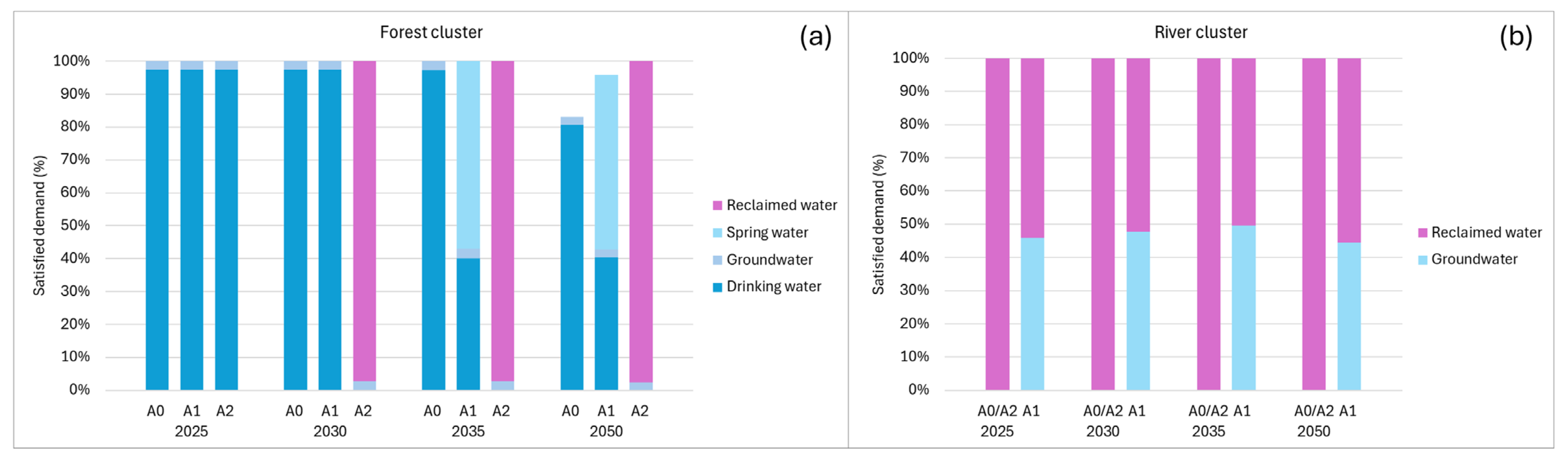
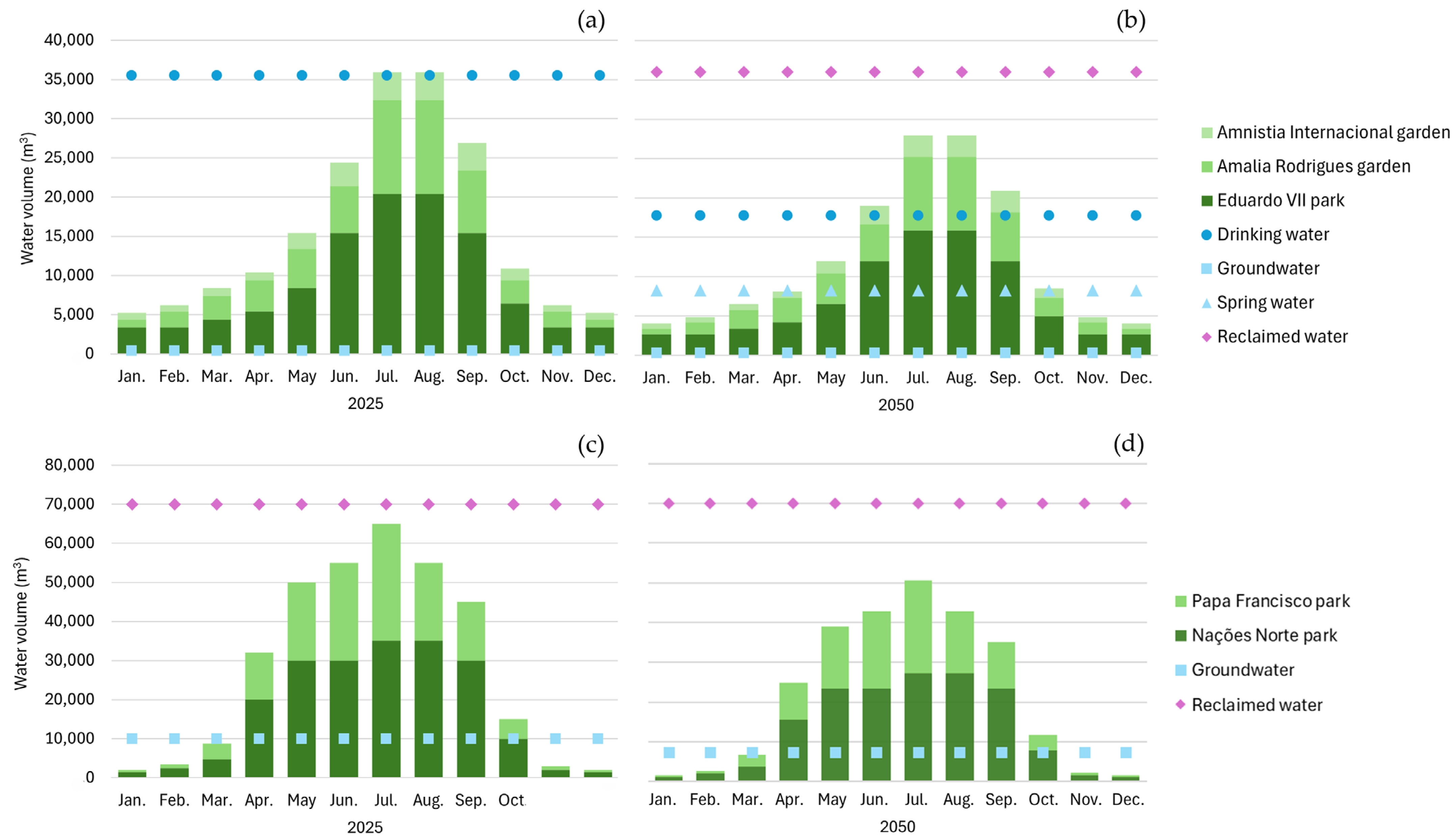
- Satisfied demand—This metric reflects a critical aspect for demand-driven water allocation: maintaining healthy vegetation is crucial because it limits the urban heat island effect through shading and evapotranspiration. According to the conditions considered in the strategic plan, in the Forest cluster, the use of additional freshwater sources (alternative A1) is not sufficient to meet the demand for non-potable water in a situation where drinking water restrictions may be applied to the irrigation of green areas—resilience scenario (prolonged drought). As expected, water reuse (alternative A2) is the only water supply that ensures water resilience in a severe drought scenario.
- Reclaimed water used—Because water reuse is a key element in increasing resilience against climate change, the smart water allocation evaluation system includes four metrics to analyse it. This first metric indicates the relative importance of water reuse in meeting demand. In the case study, it is possible to fully meet the water demand through reuse. However, the use of groundwater for greenhouse irrigation is always maintained for risk management reasons. This is why water reuse in the Forest cluster represents 98% of total consumption in 2050 (Alternative A2).
- Risk—Safeguarding health and environmental protection is the basic condition for water reuse; thus, risk assessment is a prerequisite for the design and establishment of a water reuse project. Whenever water reuse is considered, risk control measures are integrated in the irrigation system and in the green areas to ensure that risks are kept at a low level—namely, Class-A quality [51,52,53] is ensured at the sprinkler outlets and other devices. The other supplies of water pose a low risk to human health and the environment.
- Compliant reclaimed water—Post-disinfection (a measure to control the risk associated with water reuse) by adding chlorine to the irrigation network, whenever justified by its length, is included in the risk management system defined through risk assessment. Therefore, the quality of reclaimed water is expected to be ensured at the points of application (e.g., at the sprinklers’ outlet).
- Phosphorus fertilizer production avoided—This metric refers to exploiting the fertilizing potential of reclaimed water. In the assumption made in Table 9, the green area soils are rich in phosphorus, and half the dose of fertilizer recommended in general lawn fertilisation requirements was considered. For that reason, it appears that P is supplied in quantities greater than necessary. This possibility should be clarified through a thorough analysis of soil conditions. In any case, the new European legislation [9] will require the phosphorus concentration at the wastewater treatment plants’ effluent not to exceed 0.5 g/m3, i.e., 1/6 of the value currently considered.
- Carbon footprint consumed energy—Good energy performance can only be achieved when using spring water, as this is sent to Lisbon through a network built in the 18th century (Sistema das Águas Livres), which operates through gravitational flow. The carbon footprint of reclaimed water production is evident in the application of alternative A1 in the River cluster: as groundwater supply is selected first (constant value until the scarcity scenario) and demand decreases over the years due to water efficiency measures, the overall carbon footprint decreases because the contribution of reclaimed water is lower; in 2050, as a result of a 25% reduction in borehole productivity, water reuse becomes more prevalent and, thus, the energy consumption associated with water supply to this cluster also increases. Again, this is likely to improve soon due to the mandatory energy neutrality in wastewater treatment [9].
- Total cost—The drinking water tariff paid in Lisbon by commercial customers in 2025 (2 EUR/m3, Table 9) was used as a reference value for the total cost analysis; based on this value, the results associated with this criterion are classified as “poor.” As negotiations on reclaimed water prices are ongoing and the supply of spring water is still under consideration, it was decided to assign them a price related to the drinking water tariff (25% and 12.5% of this tariff for reclaimed water and spring water, respectively). The value below which results are considered “good” is also related to the drinking water tariff: 1 EUR/m3 or 50% of the tariff. Regardless of operating costs, the rehabilitation of the irrigation network in some green areas (baseline alternative and measure integrated into the other alternatives) contributes significantly to the total cost of water used in the non-potable urban areas considered. It is interesting to note that, since the available volume of spring water does not allow for the complete replacement of drinking water (Forest cluster), the total cost recorded in Alternative A1 is higher than that recorded with water reuse, despite the latter having additional costs (post-chlorination and quality monitoring). Once again, the expected decrease in the productivity of freshwater sources requires greater use of the remaining source—drinking water. In the case of the River cluster, the higher value observed in alternative A2 results from the fact that the reclaimed water price is higher than for groundwater.
4.3. Defining Course of Action
5. Conclusions
- Greater ease in understanding and assessing the dimensions involved (performance, cost, and risk) in using different water sources for non-potable uses and how the application of different water resilience strategies impacts adaptation to climate change—e.g., the use of water sources more independent of rainfall to support the implementation of green structures to combat the heat island effect, as well as their mitigation—i.e., it is important to consider the energy consumption involved in water treatment and distribution, depending on its source.
- Promoting stakeholder engagement by making the decision-making process more transparent, particularly in terms of urban water management strategic planning.
- Evidence-based decision-making, which requires a serious effort to compile and manage information from various sectors and entities. The fact that the matchmaking tool can also function as an information repository can help combat data silos and a lack of communication between different sectors of the same entity (e.g., between the green areas management sector and the sector involved in climate action).
- The LL quadruple-helix model leverages the systematic integration of scientific knowledge in an iterative, challenge-driven way to produce practical outcomes. Lisbon LL accelerated co-creation by engaging from the outset: academia (conceptual and methodological development), government (defining challenges and validating solutions), industry (software development and data provision), and society (feedback and discussion).
- Living labs provide the contextual insights essential to handle urban challenges. To foster water resilience in a city and across diverse regions, it is essential to establish adaptive planning methods that respond to shifting conditions through regular supply-and-demand verification, by recalibrating actions across different timeframes. From its inception, the Lisbon LL prioritized the replicability and scalability of the smart water allocation framework, leading to more systematic analysis and the development of user-friendly tools.
Author Contributions
Funding
Data Availability Statement
Acknowledgments
Conflicts of Interest
Abbreviations
| AdTA | Águas do Tejo Atlântico |
| CAPEX | Capital Expenditures |
| CoP | Community of Practice |
| EPAL | Empresa Portuguesa das Águas Livres |
| FC | Forest Cluster |
| LL | Living Lab |
| LM | Lisbon Municipality |
| LNEC | Laboratório Nacional de Engenharia Civil (National Laboratory for Civil Engineering) |
| OPEX | Operational Expenditures |
| RC | River Cluster |
| SO | Strategic Objective |
| SWAP | Smart Water Allocation Process |
| SWOT | Strengths, Weaknesses, Opportunities, Threats |
| WAF | Water-smartness Assessment Framework |
| WRRF | Water Resource Recovery Facility |
References
- Angelakis, A.N.; Capodaglio, A.G.; Kumar, R.; Valipour, M.; Ahmed, A.T.; Baba, A.; Güngör, E.B.; Mandi, L.; Tzanakakis, V.A.; Kourgialas, N.N.; et al. Water Supply Systems: Past, Present Challenges, and Future Sustainability Prospects. Land 2025, 14, 619. [Google Scholar] [CrossRef]
- Espinosa, L.A.; Portela, M.M.; Matos, J.P.; Gharbia, S. Climate change trends in a European coastal metropolitan area: Rainfall, temperature, and extreme events (1864–2021). Atmosphere 2022, 13, 1995. [Google Scholar] [CrossRef]
- Nel, J.B.; Mativenga, P.T.; Marnewick, A.L. A framework to support the selection of an appropriate water allocation planning and decision support scheme. Water 2022, 14, 1854. [Google Scholar] [CrossRef]
- Gleick, P.H.; Cooley, H. Freshwater scarcity. Annu. Rev. Environ. Resour. 2021, 46, 319–348. [Google Scholar] [CrossRef]
- Wang, M.; Bodirsky, B.L.; Rijneveld, R.; Beier, F.; Bak, M.P.; Batool, M.; Droppers, B.; Popp, A.; van Vliet, M.T.H.; Strokal, M. A triple increase in global river basins with water scarcity due to future pollution. Nat. Commun. 2024, 15, 880. [Google Scholar] [CrossRef]
- Capodaglio, A.G. Urban Water Supply Sustainability and Resilience under Climate Variability: Innovative Paradigms, Approaches and Technologies. ACS ES&T Water 2024, 4, 5185–5206. [Google Scholar] [CrossRef]
- Quon, H.; Jiang, S. Decision making for implementing non-traditional water sources: A review of challenges and potential solutions. npj Clean Water 2023, 6, 56. [Google Scholar] [CrossRef]
- European Commission: European Water Resilience Strategy. Communication from the Commission to the European Parliament, The Council, The European Economic and Social Committee and the Committee of the Regions, COM/2025/280 Final. 2025. Available online: https://eur-lex.europa.eu/legal-content/EN/TXT/?uri=CELEX%3A52025DC0280&qid=1750857768458 (accessed on 29 October 2025).
- Directive (EU) 2024/3019 of the European Parliament and of the Council of 27 November 2024 concerning urban wastewater treatment (recast). 2024. Available online: https://eur-lex.europa.eu/eli/dir/2024/3019/oj/eng (accessed on 17 October 2025).
- Conrad, A.; Schieren, J.; Cardoso, M.A.; Rosa, M.J.; Xevgenos, D.; Bilyaminu, A.; Stroutza, D. Accelerating Water Smartness by Successfully Implementing the EU Water Reuse Regulation (2020/741). Policy Brief, B-WaterSmart. 2024. Available online: https://b-watersmart.eu/download/b-watersmart-policy-brief-accelerating-water-reuse/# (accessed on 29 October 2025).
- Luthy, R.G.; Wolfand, J.M.; Bradshaw, J.L. Urban water revolution: Sustainable water futures for California cities. J. Environ. Eng. 2020, 146, 04020065. [Google Scholar] [CrossRef]
- del Villar, A.; García-López, M. The potential of wastewater reuse and the role of economic valuation in the pursuit of sustainability: The Case of the Canal de Isabel II. Sustainability 2023, 15, 843. [Google Scholar] [CrossRef]
- Garcia, M.; Koebele, E.; Deslatte, A.; Ernst, K.; Manago, K.F.; Treuer, G. Towards urban water sustainability: Analyzing management transitions in Miami, Las Vegas, and Los Angeles. Glob. Environ. Change 2019, 58, 101967. [Google Scholar] [CrossRef]
- Bouwma, I.; Wigboldus, S.; Potters, J.; Selnes, T.; Van Rooij, S.; Westerink, J. Sustainability transitions and the contribution of living labs: A framework to assess collective capabilities and contextual performance. Sustainability 2022, 14, 15628. [Google Scholar] [CrossRef]
- Innella, C.; Ansanelli, G.; Barberio, G.; Brunori, C.; Cappellaro, F.; Civita, R.; Fiorentino, G.; Mancuso, E.; Pentassuglia, R.; Sciubba, L.; et al. A methodological framework for the implementation of urban living lab on circular economy co-design activities. Front. Sustain. Cities 2024, 6, 1400914. [Google Scholar] [CrossRef]
- Esashika, D.; Masiero, G.; Mauger, Y. Living labs contributions to smart cities from a quadruple-helix perspective. J. Sci. Commun. 2023, 22, A02. [Google Scholar] [CrossRef]
- Ribeiro, R.; Rosa, M.J. The Role of Scenario-Building in Risk Assessment and Decision-Making on Urban Water Reuse. Water 2024, 16, 2674. [Google Scholar] [CrossRef]
- Costa, J.; Mesquita, E.; Ferreira, F.; Rosa, M.J.; Viegas, R.M.C. Identification and modelling of chlorine decay mechanisms in reclaimed water containing ammonia. Sustainability 2021, 13, 13548. [Google Scholar] [CrossRef]
- Costa, J.; Mesquita, E.; Ferreira, F.; Figueiredo, D.; Rosa, M.J.; Viegas, R.M. Modelling Chlorine Decay in Reclaimed Water Distribution Systems—A Lisbon Area Case Study. Sustainability 2023, 15, 16211. [Google Scholar] [CrossRef]
- Silva, C.; Cardoso, M.A.; Rosa, M.J.; Alegre, H.; Ugarelli, R.; Bosco, C.; Raspati, G.; Azrague, K.; Bruaset, S.; Damman, S.; et al. Final Version of the Water-Smartness Assessment Framework. B-WaterSmart Deliverable D6.3. 2023. 276p. Available online: https://b-watersmart.eu/download/final-version-of-the-water-smartness-assessment-framework-pdf-deliverable-6-3/ (accessed on 16 October 2025).
- Rosa, M.J.; Ribeiro, R.; Viegas, R.; Oliveira, M.; Teixeira, P.; Figueiredo, D.; Lourinho, R.; Mendes, R.; Coelho, S.T.; Vitorino, D.; et al. B-WaterSmart Solutions for Lisbon—Summary Report. B-WaterSmart Deliverable D2.15. 2024. 43p. Available online: https://b-watersmart.eu/download/b-watersmart-solutions-for-lisbon-d2-15/ (accessed on 16 October 2025).
- Smart Water Management in Lisbon’s Municipal Irrigation System—Strategic Plan 2025–2050. 2025; (Unpublished document, in Portuguese).
- Evans, P.; Schuurman, D.; Ståhlbröst, A.; Vervoort, K. Living Lab Methodology Handbook; U4IoT Consortium: Geneva, Switzerland, 2017; Available online: https://zenodo.org/records/1146321 (accessed on 16 October 2025).
- Damman, S.; Schmuck, A.; Oliveira, R.; Koop, S.S.H.; Almeida, M.C.; Alegre, H.; Ugarelli, R.M. Towards a water-smart society: Progress in linking theory and practice. Util. Policy 2023, 85, 101674. [Google Scholar] [CrossRef]
- Water Europe Marketplace. Product: Water-Energy-Phosphorous Balance Planning Module. 2024. Available online: https://mp.uwmh.eu/d/Product/55 (accessed on 16 October 2025).
- Water Europe Marketplace. Product: Risk Assessment for Urban Water Reuse Module. 2024. Available online: https://mp.uwmh.eu/d/Product/67 (accessed on 16 October 2025).
- Water Europe Marketplace. Product: Reclaimed Water Distribution Network Water Quality Model. 2024. Available online: https://mp.uwmh.eu/d/Product/51 (accessed on 16 October 2025).
- Water Europe Marketplace. Product: Environment for Decision Support and Alternative Course Selection. 2024. Available online: https://mp.uwmh.eu/d/Product/66 (accessed on 16 October 2025).
- Portrait of Municipalities—Lisbon. Available online: https://retratos.pordata.pt/populacao/lisboa (accessed on 14 October 2025). (In Portuguese)
- Lisbon. Available online: https://www.upperprojecteu.eu/cities-regions/lisbon/ (accessed on 14 October 2025).
- Lisbon Tourism Statistics. Available online: https://roadgenius.com/statistics/tourism/portugal/lisbon/#Lisbon_Tourism_Statistics_2024_International_and_Domestic (accessed on 14 October 2025).
- Lopes, A.; Oliveira, A.; Correia, E.; Reis, C. Identification of Urban Heat Islands and Simulation for Critical Areas in the City of Lisbon. Lisbon Municipality. 2020. Available online: https://www.lisboa.pt/fileadmin/portal/temas/ambiente/alteracoes_climaticas/ondas_calor/IdentificacaoICU_ATUAL_Fase1.pdf (accessed on 17 October 2025). (In Portuguese)
- Lopes, H.S.; Vidal, D.G.; Cherif, N.; Silva, L.; Remoaldo, P.C. Green infrastructure and its influence on urban heat island, heat risk, and air pollution: A case study of Porto (Portugal). J. Environ. Manag. 2025, 376, 124446. [Google Scholar] [CrossRef]
- Sondermann, M.N.; de Oliveira, R.P. Using the WEI+ index to evaluate water scarcity at highly regulated river basins with conjunctive uses of surface and groundwater resources. Sci. Total Environ. 2022, 836, 155754. [Google Scholar] [CrossRef]
- Assessment of Water Availability by Water Body and Application of the WEI+ Scarcity Index, with a View to Complementing the Assessment of the Status of Water Bodies—Final Report. 2023. Available online: https://apambiente.pt/sites/default/files/_SNIAMB_Agua/DRH/PlaneamentoOrdenamento/PGRH/2022-2027/APA_WEIPLUS_RelatorioFinal_Dez2023.pdf (accessed on 17 October 2025). (In Portuguese)
- Lisbon Municipal Strategy for Adaptation to Climate Change. 2017. Available online: https://www.lisboa.pt/fileadmin/portal/temas/ambiente/documentos/EMAAC_2017.pdf (accessed on 17 October 2025). (In Portuguese)
- Lisbon General Drainage Plan 2016–2030. 2015. Available online: https://planodrenagem.lisboa.pt/sobre-o-plano (accessed on 17 October 2025). (In Portuguese)
- Lisbon Municipality. Lisbon’s Climate City Contract. 2024. Available online: https://netzerocities.app/resource-4423 (accessed on 17 October 2025).
- C40 Cities. C40 Commitment. Available online: https://www.c40.org/what-we-do/raising-climate-ambition/1-5c-climate-action-plans/ (accessed on 17 October 2025).
- C40 Cities, Water Safe Cities Accelerator. Available online: https://www.c40.org/accelerators/water-safe-cities/ (accessed on 17 October 2025).
- Transforming Our World: The 2030 Agenda for Sustainable Development. Available online: https://sdgs.un.org/2030agenda (accessed on 17 October 2025).
- European Commission: Directorate-General for Climate Action. Going Climate-Neutral by 2050—A Strategic Long-Term Vision for a Prosperous, Modern, Competitive and Climate-Neutral EU Economy. 2019. Available online: https://data.europa.eu/doi/10.2834/02074 (accessed on 17 October 2025).
- International Water Association. The Journey to Water-Wise Cities. Available online: https://www.iwa-network.org/water-wise-cities (accessed on 17 October 2025).
- Ellen MacArthur Foundation. Circulate Products and Materials. Available online: https://www.ellenmacarthurfoundation.org/circulate-products-and-materials (accessed on 17 October 2025).
- Bigelow, C.A.; Tudor, W.T.; Nemitz, J.R. Facts About Phosphorus and Lawns. Purdue Agronomy-Turf Science, AY-334-W. N.d. Available online: www.agry.purdue.edu/turf (accessed on 17 October 2025).
- Águas de Portugal. Sustainability Report 2024. Available online: https://www.adp.pt/sustentabilidade/Documentos%20Partilhados/Sustainable%20Reports/AdP%20Sustainability%20Report%202024.pdf (accessed on 3 December 2025).
- Areosa, I.; Martins, T.A.; Lourinho, R.; Batista, M.; Brito, A.G.; Amaral, L. Treated wastewater reuse for irrigation: A feasibility study in Portugal. Sci. Total Environ. 2024, 954, 176698. [Google Scholar] [CrossRef]
- Nowtricity. Real Time Live Emissions from Energy Production by Country—Portugal. Available online: https://www.nowtricity.com/country/portugal/ (accessed on 3 December 2025).
- EPAL. Sales Prices of Water in Lisbon. Available online: https://www.epal.pt/EPAL/en/menu/customers/tariff/water (accessed on 3 December 2025).
- Expósito, A.; Lorenzo Lopez, A.M.; Berbel, J. How much does reclaimed wastewater cost? A comprehensive analysis for irrigation uses in the European Mediterranean context. Water Reuse 2024, 14, 434–447. [Google Scholar] [CrossRef]
- Decree-Law 119/2019 on Water Reuse. 2019. Available online: https://diariodarepublica.pt/dr/detalhe/decreto-lei/119-2019-124097549 (accessed on 17 October 2025). (In Portuguese)
- ISO 16075-2:2020; Guidelines for Treated Wastewater Use for Irrigation Projects. Part 2: Development of the Project, 2nd ed. International Standards Organization: Geneva, Switzerland, 2020. Available online: https://www.iso.org/standard/73483.html?browse=tc (accessed on 17 October 2025).
- Regulation (EU) 2020/741 of the European Parliament and of the Council of 25 May 2020 on Minimum Requirements for Water Reuse. 2020. Available online: https://eur-lex.europa.eu/eli/reg/2020/741/oj/eng (accessed on 17 October 2025).



| Systemic Innovation Process [23] | Actions for Co-Creation and Collaboration Within the Lisbon LL (Participants) |
|---|---|
Phase 1—Exploration
|
|
Phase 2—Experimentation
|
|
Phase 3—Evaluation
|
|
| Elements | Variables and Indicators (Units) | Type |
|---|---|---|
| Candidate water supplies | Water available at the source per supply (m3/month) | Series, input |
| Water loss in the distribution system (from source to demand site) per supply (%) | Series, input | |
| Water price per supply (purchase price to third party or own production cost) (EUR/m3) | Series, input | |
| Energy consumption per supply (kWh/m3) | Series, input | |
| Energy mix per supply (kg CO2eq/kWh) | Series, input | |
| Energy price (EUR/kWh) | Series, input | |
| P concentration in water per supply (g P/m3) | Series, input | |
| Unit operation cost with chlorination, monitoring, and others (CMO) (EUR/m3) | Series, input | |
| Water demand sites | Water demand per site (m3/month) 1 | Series, input |
| Total P used as fertilizer per site (kg P/month) | Series, input | |
| Matchmaking alternatives | Per water demand site 2: Water used per supply, 1st selection (m3/month) Water used per supply, 2nd selection (m3/month) Water used per supply, etc. (m3/month) Total water used (m3/month) | Series, calculated Series, calculated Series, calculated Series, calculated |
| Per alternative: Investment cost (EUR/year) Operation cost with water purchase or production (EUR/month) Operation cost with energy in water distribution (source to demand site) (EUR/month) Operation cost with CMO (EUR/month) | Value, input Series, calculated Series, calculated Series, calculated | |
| OPEX (EUR/m3) 3 | Value, calculated | |
| CAPEX (EUR/m3) 4 | Value, calculated |
| Ranking Metrics | Reference Values | Strategic Alignment (Reference) | |||
|---|---|---|---|---|---|
| Name (Units) | Formulation | Poor | Fair | Good | |
| Satisfied demand (%) | Total water used (m3/year)/ Water demand (m3/year) × 100 | [0, 90[ | [90, 99[ | [99, 100] | SO A |
| Compliant reclaimed water (%) | Compliant reclaimed water samples (No.)/Reclaimed water samples (No.) × 100 | [0, 90[ | [90, 95[ | [95; 100] | SO A (metric A.1.3 [20]) |
| Risk | Qualification of risk level | high | moderate | low | SO A |
| Carbon footprint (kg CO2eq/m3) | Energy consumption (kWh/m3) × Energy mix (kg CO2eq/kWh) | ]0.7, +∞[ | ]0.3, 0.7] | [0.3, 0] | SO B (metric B.3.2 [20]) |
| Reclaimed water used (%) 1 | Reclaimed water used (m3/year)/ Water consumption (m3/year) × 100 | [0, 10[ | [10, 20[ | [20, 100] | SO C (metric C.3.3 [20]) |
| P-fertilizer production avoided (%) | P conc. in reclaimed water used (g P/m3) × reclaimed water used (m3/month)/ P used as fertilizer (g P/month) | [0, 5[ | [5, 30[ | [30, 100] | SO C (metric C.3.2 [20]) |
| Total cost (EUR/m3) 2 | OPEX (EUR/m3) + CAPEX (EUR/m3) | [2.0, +∞[ | [1.0, 2.0[ | ]1.0, 0] | SOs A and C |
| Designation | Description | |
|---|---|---|
| Water–Energy–Phosphorus Balance Planning module (matchmaking tool) | Goal | Design supply solutions to a set of non-potable water uses, using a quantitative evaluation system to assess performance, risk, and cost of the alternatives for improving water resilience. |
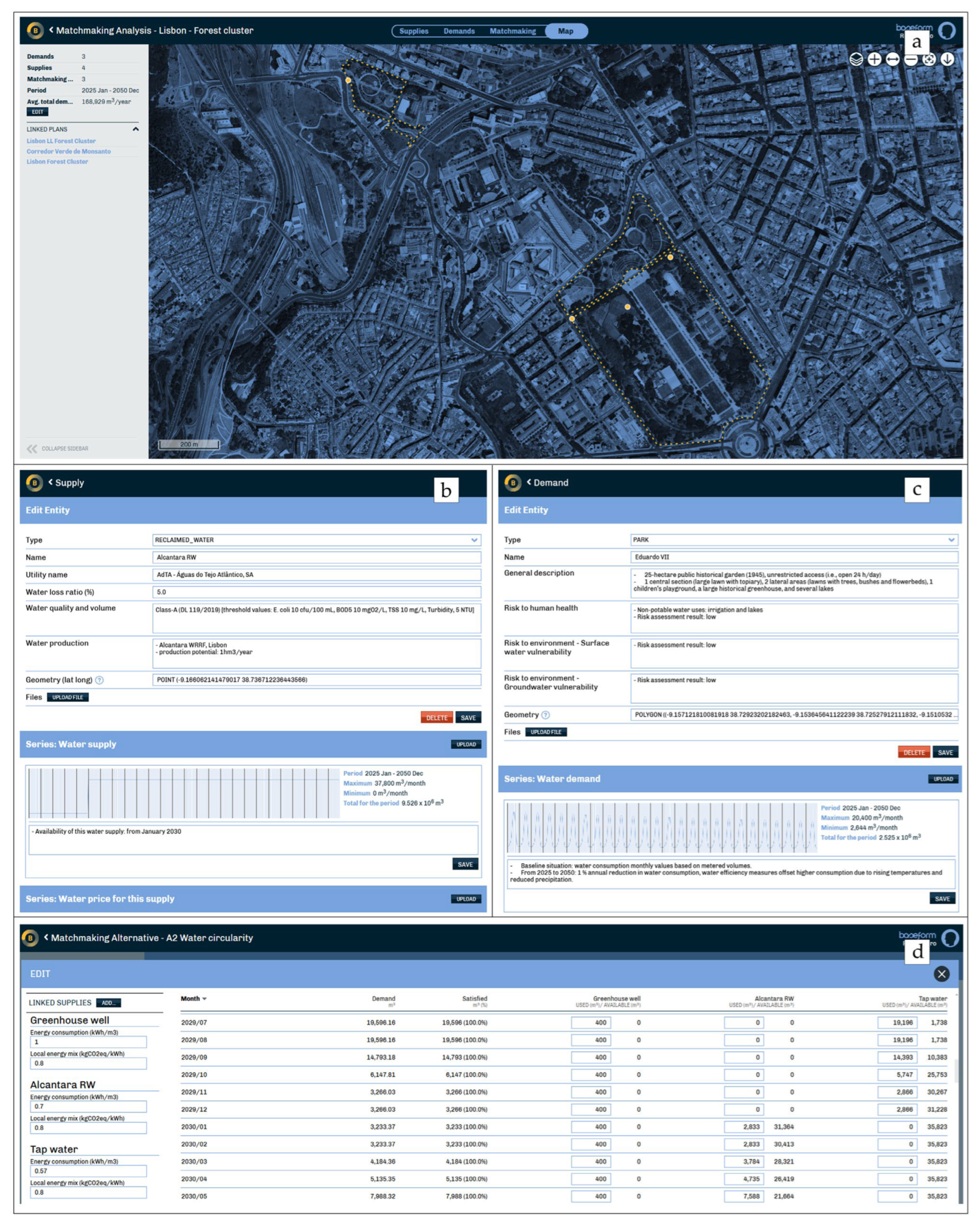
| Main features | Geographic representation of water sources and demands; simple-to-use analysis; calculation of metrics related to sustainability, circular economy, and climate change, based on input monthly variables of water volume, energy, phosphorus and other nutrients, and cost. This tool provides a new ability to match water supply to demand (water, energy, the critical nutrient phosphorus, and cost), with full GIS-compatible georeferenced capabilities. This solution was developed within the B-WaterSmart project, based on the concept created by LNEC. The software was developed by Baseform. Screenshots presented in Section 4.3. Additional information: [21,25] | |
| SWAP | Steps 5 and 7—the “where” and “which” in Figure 1. | |
| Risk Assessment for Urban Water Reuse module | Goal | User-friendly risk assessment framework for water reuse in non-potable purposes. |
| Main features | The human health and environmental (groundwater and surface water) risk assessment methodology is based on relevant standardization and regulation. The framework for health risk assessment and its application in a case study is presented in [17]. This tool provides a new and sound ability to develop urban water risk assessment in a user-friendly way, fully aligned with ISO standards and the European regulation on water reuse. This solution was developed within the B-WaterSmart project, based on the concept created by LNEC. The software was developed by Baseform. Additional information: [21,26] | |
| SWAP | Step 6—the “whether” in Figure 1. | |
| Reclaimed Water Quality Model in the Distribution Network | Goal | Complete water quality extended-period simulation model for pressure flow networks, specifically designed for reclaimed water. |
| Main features | Implementation of a new, innovative algorithm for modelling (bulk and wall) chlorine decay, as a function of key water quality parameters, as the reclaimed water travels in distribution networks, on top of a standard hydraulic model. The reclaimed water quality model is described in [18,19]. This solution was developed within the B-WaterSmart project, based on the concept created by LNEC. The software adds reclaimed water quality modelling capabilities to the Baseform software universe. Additional information: [21,27] | |
| SWAP | Step 6—the “whether” in Figure 1. | |
| Environment for Decision Support and Selection of Alternative Courses of Action (plan tool) | Goal | Intuitive numerical and visual decision environment for enabling the assessment and ranking of planning alternatives through objective-guided metrics. |
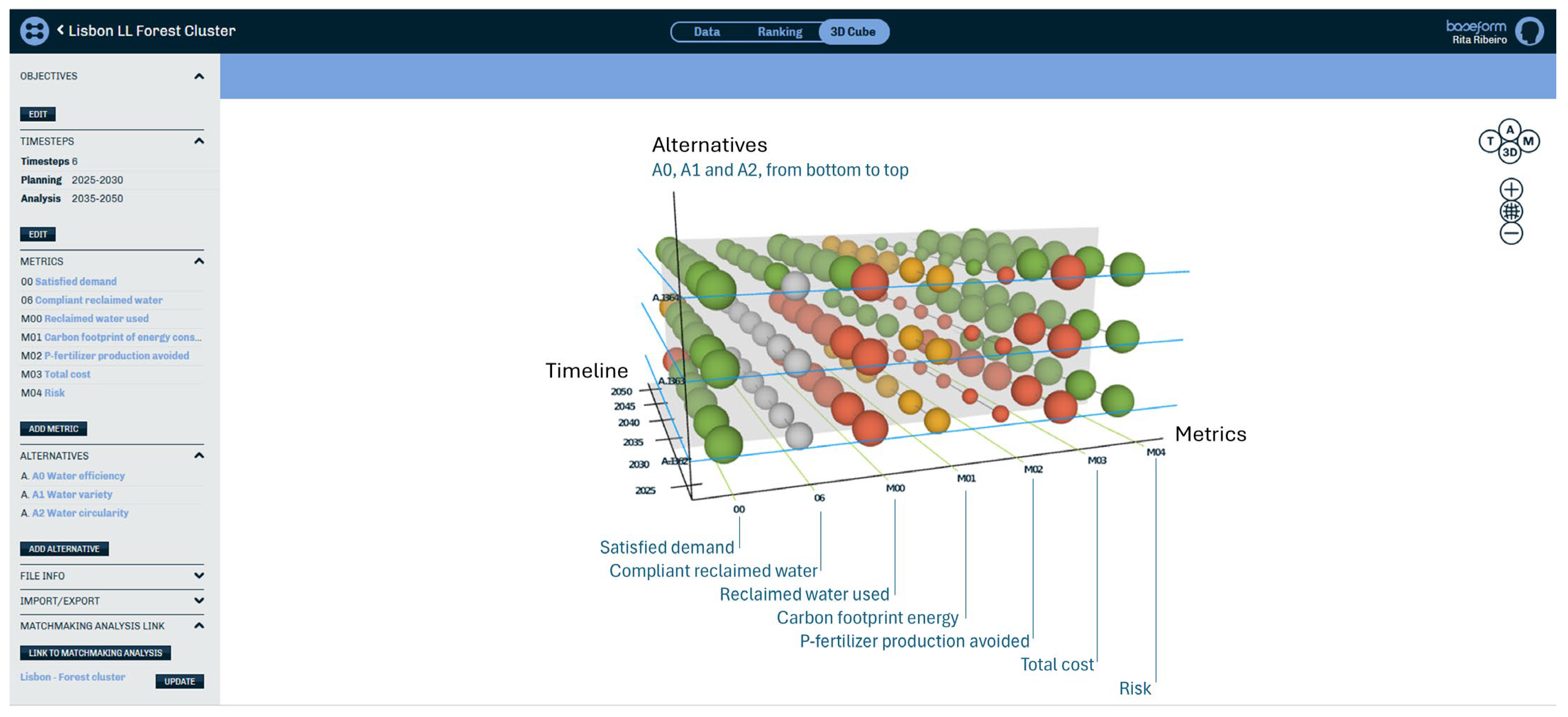
| Main features | Quantification over time of the impact of each matchmaking alternative; assessment based on a range of standardized, user-selected metrics of performance, risk, and cost, complementing those employed to qualify the initial selection in the matchmaking tool. This tool implements a curated set of specifically designed metrics for the strategic and tactical prioritization of regional or urban supply–demand solutions involving potable and non-potable water. This solution was developed within the B-WaterSmart project, adding to the Baseform software universe a strategic and tactical prioritization environment specific to the planning of urban non-potable water uses with a focus on water reuse. Screenshot presented in Section 4.3. Additional information: [21,28] | |
| SWAP | Steps 8 and 9—the “how” and “when” in Figure 1. | |
| Designation | Description | |
|---|---|---|
| Forest cluster | Eduardo VII Park |
|
| Amália Rodrigues Garden |
| |
| Amnistia Internacional Garden |
| |
| Drinking water |
| |
| Groundwater |
| |
| Spring water |
| |
| Reclaimed water |
| |
| River cluster | Nações Norte Park |
|
| Papa Francisco Park |
| |
| Reclaimed water |
| |
| Groundwater |
|
| C40 Cities Network | Lisbon LL | |
|---|---|---|
| Scope | City (i.e., territory governance) | Urban water system (i.e., service provision) |
| Ambition | Tackling water scarcity resulting from climate change | Tackling water scarcity resulting from climate change and increased demand |
| Objectives (SWAP step 1) | 1.5 °C Climate Action Plan [39], key component:
| Strategic objectives [22]:
|
| Targets | Water Safe Cities Accelerator [40], pathways for achieving “equitable universal access to clean water efficiently by 2030”:
| Smart water allocation metrics (targets) [22]:
|
| Strategies (SWAP step 2) |
|
|
| Plan Element | Designation | Description |
|---|---|---|
| SWOT analysis | Internal factors | Strengths: green-blue infrastructure expansion, vision alignment among stakeholders |
| Weaknesses: limited funding opportunities for the reclaimed water distribution system, governance model under development | ||
| External factors | Opportunities: increased quality requirements for treated wastewater discharge (European Urban Wastewater Directive recast [9]), growing market for reclaimed water | |
| Threats: drought, temperature rise, geopolitical instability | ||
| Timeline | Time steps |
|
| Resilience scenario | Event | Severe 4-year drought from 2047 to 2050; WEI+ (annual value) > 0.7 from 2048 onwards |
| Element | Data Input (Information Type and Source) | |
|---|---|---|
| Water balance | Water demand |
|
| Water supply |
| |
| Phosphorus balance | P used as fertilizer |
|
| P concentration |
| |
| Energy balance | Energy consumption | |
| Local energy mix |
| |
| Costs | Water prices 1 (delivered to green areas) |
|
| Other costs |
| |
| Investment |
| |
| Clusters | Alternatives | Water Portfolio 1 | |||
|---|---|---|---|---|---|
| Reclaimed Water | Groundwater | Spring Water | Drinking Water | ||
| Forest | A0 | ✓ | ✓✓✓ | ||
| A1 | ✓ | ✓✓✓ | ✓ | ||
| A2 | ✓✓✓ | ✓ | |||
| River | A0/A2 | ✓✓✓ | |||
| A1 | ✓✓✓ | ✓✓ | |||
| Alternatives | Ranking Metrics | Units | 2025 | 2030 | 2035 | 2050 |
|---|---|---|---|---|---|---|
| A0 Water efficiency (baseline) | Satisfied demand | % | 100 | 100 | 100 | 84 |
| Compliant reclaimed water | % | N/A | N/A | N/A | N/A | |
| Risk | -- | low | low | low | low | |
| Carbon footprint energy | kg CO2eq/m3 | 0.46 | 0.47 | 0.47 | 0.47 | |
| Reclaimed water used | % | 0 | 0 | 0 | 0 | |
| P-fertilizer production avoided | % | 0 | 0 | 0 | 0 | |
| Total cost | €/m3 | 2.32 | 2.32 | 2.32 | 2.38 | |
| A1 Water variety | Satisfied demand | % | 100 | 100 | 100 | 97 |
| Compliant reclaimed water | % | N/A | N/A | N/A | N/A | |
| Risk | -- | low | low | low | low | |
| Carbon footprint energy | kg CO2eq/m3 | 0.46 | 0.47 | 0.24 | 0.25 | |
| Reclaimed water used | % | 0 | 0 | 0 | 0 | |
| P-fertilizer production avoided | % | 0 | 0 | 0 | 0 | |
| Total cost | €/m3 | 2.32 | 2.32 | 1.19 | 1.25 | |
| A2 Water circularity | Satisfied demand | % | 100 | 100 | 100 | 100 |
| Compliant reclaimed water | % | N/A | 100 | 100 | 100 | |
| Risk | -- | low | low | low | low | |
| Carbon footprint energy | kg CO2eq/m3 | 0.46 | 0.57 | 0.57 | 0.57 | |
| Reclaimed water used | % | 0 | 98 | 98 | 98 | |
| P-fertilizer production avoided | % | 0 | 260 | 247 | 213 | |
| Total cost | €/m3 | 2.32 | 0.89 | 0.89 | 0.92 |
| Alternatives | Ranking Metrics | Units | 2025 | 2030 | 2035 | 2050 |
|---|---|---|---|---|---|---|
| A0 Water efficiency (baseline) and A2 Water circularity | Satisfied demand | % | 100 | 100 | 100 | 100 |
| Compliant reclaimed water | % | 100 | 100 | 100 | 100 | |
| Risk | -- | low | low | low | low | |
| Carbon footprint energy | kg CO2eq/m3 | 0.56 | 0.56 | 0.56 | 0.56 | |
| Reclaimed water used | % | 100 | 100 | 100 | 100 | |
| P-fertilizer production avoided | % | 250 | 238 | 226 | 195 | |
| Total cost | €/m3 | 0.79 | 0.79 | 0.79 | 0.80 | |
| A1 Water variety | Satisfied demand | % | 100 | 100 | 100 | 100 |
| Compliant reclaimed water | % | 100 | 100 | 100 | 100 | |
| Risk | -- | low | low | low | low | |
| Carbon footprint energy | kg CO2eq/m3 | 0.34 | 0.33 | 0.31 | 0.35 | |
| Reclaimed water used | % | 54 | 52 | 50 | 55 | |
| P-fertilizer production avoided | % | 135 | 124 | 114 | 108 | |
| Total cost | €/m3 | 0.52 | 0.51 | 0.50 | 0.54 |
Disclaimer/Publisher’s Note: The statements, opinions and data contained in all publications are solely those of the individual author(s) and contributor(s) and not of MDPI and/or the editor(s). MDPI and/or the editor(s) disclaim responsibility for any injury to people or property resulting from any ideas, methods, instructions or products referred to in the content. |
© 2026 by the authors. Licensee MDPI, Basel, Switzerland. This article is an open access article distributed under the terms and conditions of the Creative Commons Attribution (CC BY) license.
Share and Cite
Ribeiro, R.; Teixeira, P.; Silva, C.; Freitas, C.; Rosa, M.J. Tackling Urban Water Resilience: Exploiting the Potential of Smart Water Allocation in the Lisbon Living Lab. Water 2026, 18, 337. https://doi.org/10.3390/w18030337
Ribeiro R, Teixeira P, Silva C, Freitas C, Rosa MJ. Tackling Urban Water Resilience: Exploiting the Potential of Smart Water Allocation in the Lisbon Living Lab. Water. 2026; 18(3):337. https://doi.org/10.3390/w18030337
Chicago/Turabian StyleRibeiro, Rita, Pedro Teixeira, Catarina Silva, Catarina Freitas, and Maria João Rosa. 2026. "Tackling Urban Water Resilience: Exploiting the Potential of Smart Water Allocation in the Lisbon Living Lab" Water 18, no. 3: 337. https://doi.org/10.3390/w18030337
APA StyleRibeiro, R., Teixeira, P., Silva, C., Freitas, C., & Rosa, M. J. (2026). Tackling Urban Water Resilience: Exploiting the Potential of Smart Water Allocation in the Lisbon Living Lab. Water, 18(3), 337. https://doi.org/10.3390/w18030337