
Article

Source Apportionment and Seasonal Variation in Nitrate in Baiyangdian Lake After Restoration Projects Based on Dual Stable Isotopes and MixSIAR Model

1
Institute of Geographical Sciences, Hebei Academy of Sciences, Shijiazhuang 050011, China
2
Hebei Technology Innovation Center for Geographic Information Application, Shijiazhuang 050011, China
3
Hebei Key Laboratory of New Energy Environmental Safety and Resource Utilization, Department of Environmental Science & Engineering, North China Electric Power University, Baoding 071000, China
4
Postdoctoral Scientific Research Station of Geography, Hebei Normal University, Shijiazhuang 050024, China
5
Hebei Academy of Sciences, Shijiazhuang 050081, China
6
Environmental Microbial Remediation Engineering Laboratory, Hebei Institute of Microbiology Co., Ltd., Baoding 071051, China
*
Author to whom correspondence should be addressed.
These authors contributed equally to this work.
Water 2026, 18(3), 338; https://doi.org/10.3390/w18030338
Submission received: 9 December 2025 / Revised: 16 January 2026 / Accepted: 27 January 2026 / Published: 29 January 2026
(This article belongs to the Section Water Quality and Contamination)

Abstract

Nitrate in Baiyangdian Lake is directly linked to the sustainability of watershed ecological functions, acting as a key priority for regional ecological protection. Subsequent to the completion of a series of ecological restoration projects, its sources have undergone inevitable shifts, rendering the original pollution control framework incompatible with the new context. Thus, accurate identification of nitrate sources and their seasonal variation characteristics constitutes a core prerequisite for enhancing the targeting of pollution management. This study integrated dual stable isotopes (δ15N-NO3 and δ18O-NO3) in water and potential source samples, along with hydrochemical data, and applied the Bayesian stable isotope mixing model (MixSIAR) to elucidate the sources of NO3 in Baiyangdian Lake. The results indicated that denitrification exerted a weak influence on the isotopic composition of NO3 in Baiyangdian Lake. Plots of the NO3/Cl versus Cl ratios for water samples and δ15N-NO3 versus δ18O-NO3 ratios for both water samples and potential sources confirmed anthropogenic sources as the primary nitrate contributors. The δ15N-NO3 vs. 1/[NO3] plot revealed that the number of NO3 sources exceeded two. The MixSIAR model demonstrated that wastewater treatment plant (WWTP) discharge was the dominant source throughout the four seasons, accounting for 49–62% with the highest contribution in winter and the lowest in summer. Soil nitrogen release contributed 19–32%, reaching its annual peak in summer. Sediment release accounted for 11–13%, maintaining a relatively low contribution across all seasons. Chemical fertilizer, manure, and sewage (M&S), and atmospheric deposition each contributed less than 6.5%, with negligible contributions. A significant reduction in the contributions of sediment release and M&S reflected the optimization effect of long-term regional ecological restoration efforts. WWTPs point source discharge and seasonal non-point source input from soil nitrogen collectively constituted the core sources of nitrate in Baiyangdian Lake. These findings provide crucial scientific support for the precise source apportionment and differentiated management of nitrate pollution in the basin.

1. Introduction

Excessive nitrogen input into lakes and rivers represents a primary driver of water quality degradation and eutrophication [1,2,3]. As the largest freshwater wetland in North China, Baiyangdian Lake performs pivotal ecological functions, encompassing pollution abatement, regional climate regulation, biodiversity conservation, and the sustenance of ecological equilibrium [4,5]. Since the 1960s, socioeconomic development and human activities have caused marked water quality deterioration, constraining its ecological services [6]. To mitigate water quality issues in Baiyangdian Lake, the Chinese government implemented the “National Major Science and Technology Program for Water Pollution Control and Treatment” during the 11th and 13th Five-Year Plans, launching comprehensive basin-wide remediation [7]. Following the 2017 establishment of Xiong’an New Area, Baiyangdian became a core ecological pillar, prompting the promulgation of key policies such as the Plan for the Ecological Environment Governance and Protection of Baiyangdian Lake (2018–2035) [8], the Regulations on the Ecological Environment Governance and Protection of Baiyangdian Lake [9], and the Water Pollutant Discharge Standards for the Daqing River Basin [10].
While sustained efforts have improved water quality and eutrophication status, as one of China’s “New Three Lakes”, Baiyangdian Lake’s eutrophication level remains substantially higher than that of Erhai Lake and Danjiangkou Reservoir [11,12,13]. Zhang et al. [13] analyzed the total nitrogen (TN) concentrations at 16 sampling sites in the Baiyangdian Lake area during the normal period, flood period, and dry period. The results demonstrated that the TN concentrations at two, three, and five sampling sites exceeded the Class III standard limit (1.0 mg/L) specified in the Environmental Quality Standard of Surface Water of China (GB 3838-2002) [14] during the three hydrological periods, respectively. Given that natural nitrogen sources ultimately persist stably as NO3-N in aquatic systems, identifying NO3-N sources and regulating their input is paramount to controlling nitrogen pollution in surface waters [15].
Scholars have developed diverse nitrogen tracing methods, including hydrochemical analysis [16], receptor models [17], and isotope tracing [18,19,20]. The isotope tracing method relies on natural abundance differences of nitrogen isotopes from distinct sources to infer pollution origins. It has emerged as a robust tool for nitrogen source identification globally, owing to its unique capacity to directly distinguish pollution sources and quantify their contribution ratios. Zhao et al. [19] used δ15N-NO3 and δ18O-NO3 to identify chemical fertilizers and soil organic nitrogen as primary nitrate sources in the Three Gorges Reservoir. However, despite its widespread application and proven merits, isotope tracing still harbors inherent limitations that cannot be overlooked. First and foremost, overlapping isotopic ratios among different nitrogen sources constitute a fundamental constraint. This impedes the effective differentiation of distinct pollution sources. Furthermore, in most previous nitrate sources studies, isotopic ratios of potential sources were predominantly derived from the literature data. There were no concurrent in situ measurements of end-member values in the study area. This represents a critical oversight, as it compromises the accuracy and reliability of tracing results in region-specific contexts.
While prior studies on Baiyangdian Lake (e.g., pollution load models, isotope analyses) identified point sources (industrial/urban sewage) and non-point sources (agriculture, rural sewage) as key nitrogen contributors [21,22], these findings are largely outdated. Since the establishment of the Xiong’an New Area in 2017, a series of large-scale remediation measures (aquaculture bans, centralized sewage treatment, river restoration, ecological replenishment) have been implemented to enhance water quality [23]. With the completion of these landmark projects in 2023, the sources of nitrate pollution in Baiyangdian Lake have inevitably shifted. Yet, a critical knowledge gap persists: existing studies have failed to systematically quantify the changes in nitrate sources following these transformative remediation efforts. Given that nitrate serves as a core constituent of total nitrogen (TN), its unclear sources directly impede the sustained compliance of TN with Class III of the Environmental Quality Standard of Surface Water of China (GB3838-2002), a research gap that particularly underscores the urgent need for updated nitrate source apportionment for Baiyangdian Lake.
In light of the aforementioned research gaps and persistent environmental challenges, this study aims to accomplish the following: (1) investigate the seasonal dynamics of nitrate by monitoring water quality parameters and nitrate nitrogen and oxygen isotope (δ15N-NO3, δ18O-NO3) signatures in Baiyangdian Lake; (2) explore seasonal variations in nitrate sources through the integration of major ions, nitrogen and oxygen isotopes, and Bayesian mixing models. The findings of this study are expected to provide actionable insights for targeted nitrogen pollution control and sustainable ecological management of Baiyangdian Lake.

2. Materials and Methods

2.1. Study Area

Baiyangdian Lake is situated in central Hebei Province (115°38′–116°07′ E, 38°43′–39°02′ N). As the largest freshwater lake group and a typical inland wetland ecosystem on the North China Plain, it covers approximately 366 km2, comprising 143 lakes of varying sizes and over 3700 ditches; the region is characterized by a warm temperate continental monsoon climate with distinct four seasons, where the annual average temperature attains 12.1 °C and annual precipitation aggregates to 525 mm—around 80% of which concentrates between July and September; eight major inflowing rivers feed Baiyangdian Lake, namely the Zhulong River, Xiaoyi River, Tang River, Fu River, Cao River, Bao River, Ping River, and Baigou Diversion River, arranged from south to north. As the core ecological barrier of the Xiong’an New Area, this region performs multiple critical ecological functions—including flood regulation, water purification, and biodiversity conservation—whose ecological quality directly underpins the sustainable development of the regional ecosystem [24]. Following comprehensive basin-wide remediation implemented during the 11th to 13th Five-Year Plans, coupled with targeted governance measures subsequent to the establishment of the Xiong’an New Area, the water quality of Baiyangdian Lake has been significantly improved. However, the eutrophication risk induced by nitrate nitrogen pollution remains not fully mitigated.
Based on variations in topography, hydrological connectivity, and pollution sources within the lake area, representative monitoring sites were strategically deployed across the entire lake basin, covering inflow/outflow zones, the lake center, and key surrounding functional areas. Concurrently, potential pollution sources were sampled to systematically elucidate the distribution patterns and source attribution characteristics of nitrate nitrogen in different regions.

2.2. Sample Collection

Sampling sites (n = 38, Figure 1) were strategically and evenly distributed across the entire Baiyangdian Lake, spanning critical functional zones and divided into four distinct regions: (1) inflowing river confluences; (2) outflow discharge areas; (3) former aquaculture legacy sites; (4) rural high-density populated zones. Water samples were collected in pre-cleaned 1L high-density polyethylene (HDPE) bottles (Shanghai Mosu Scientific Instruments Co., Ltd., Shanghai, China) across spring, summer, autumn, and winter 2024. Prior to sampling, bottles were rinsed thoroughly 3–5 times with ambient water to eliminate cross-contamination. Samples were taken at 10–50 cm below the water surface, with triplicate samples collected per site to ensure data reliability. In situ measurements of temperature, pH, DO, salinity, and electrical conductivity were performed using a YSI ProQuatro Portable Water Quality Meter (YSI Inc., Yellow Springs, OH, USA)—calibrated with standard solutions prior to fieldwork.
This study involved a total of six potential nitrate pollution sources. Among them, samples of five potential pollution sources, including sediment (n = 28), urban wastewater treatment plant (WWTP) effluent (n = 6), mixed samples of rural manure and domestic sewage (n = 5), soil samples (n = 14), and atmospheric deposition (n = 4), were collected on-site in the study area. Detailed sampling locations are provided in Table S1. The nitrogen and oxygen isotope data of fertilizer were obtained from previous studies.
After collection, all water samples were filtered through 0.45 μm cellulose filter membranes (Tianjin Jinteng Experimental Equipment Co., Ltd., Tianjin, China). Samples for anion analysis were stored at 4 °C until analysis (storage period ≤ 7 days). To prevent isotopic fractionation caused by biological processes, samples for δ15N-NO3 and δ18O-NO3 analysis were frozen and hermetically stored at −20 °C.

2.3. Analytical Procedures

NO3 and Chloride (Cl) concentrations were determined by ion chromatography (Thermo Scientific DIONEX ICS-1100, Thermo Fisher Scientific, Waltham, MA, USA), with uncertainties of ±5%. δ15N-NO3 and δ18O-NO3 were determined using the denitrifier method—a technique that leverages the metabolic activity of denitrifying bacteria [25,26]. Briefly, NO3 was first reduced to nitrous oxide (N2O) via bacterial metabolism, followed by the determination of its δ15N and δ18O compositions using an isotope ratio mass spectrometer (IRMS) (MAT-253 Plus, Thermo Fisher Scientific, Bremen, Germany). All isotopic measurements were performed in triplicate. For quality control (QC), four internationally recognized calibration standards (IAEA-NO3 (International Atomic Energy Agency, Vienna, Austria), USGS-3, USGS-34, and USGS-2 (United States Geological Survey, Reston, CO, USA)) were employed for normalization. The analytical precision was ±0.2‰ for δ15N-NO3 and ±0.8‰ for δ18O-NO3.
All stable isotope results are reported as δ values, which denote the deviation relative to their respective reference standards in units of per mil (‰). The calculation follows Equation (1):
δ (‰) = 1000 × (Rsample/Rstandard) − 1
where Rsample and Rstandard represent the measured isotopic ratios (15N/14N or 18O/16O) of the sample and reference standard, respectively. For nitrate, the 15N/14N ratio is denoted as δ15N-NO3, with atmospheric N2 serving as the reference standard, while the 18O/16O ratio is referenced to Vienna Standard Mean Ocean Water (VSMOW)—the internationally recognized reference for oxygen isotopes.

2.4. Data Analyses

Proportional contributions of NO3 pollution sources were quantitatively assessed using MixSIAR (version 3.1.12), a Bayesian stable isotope mixing model software implemented in the R environment [27]. Grounded in the principles of Bayesian stable isotope mixing models, this software is specifically designed for isotopic source apportionment in complex pollution scenarios. Its core advantages are twofold: firstly, it incorporates isotopic fractionation effects, enabling correction of isotopic ratio deviations induced by processes such as nitrification and denitrification through preset fractionation factors, thereby mitigating uncertainties in the results; secondly, it facilitates the simultaneous quantification of three or more potential pollution sources, rendering it particularly suitable for source apportionment of the multi-source composite pollution in Baiyangdian Lake. The impacts of isotopic fractionation during nitrification (microbial conversion of ammonia to nitrate) and denitrification (reduction of nitrate to gaseous nitrogen) within the nitrogen cycle are elaborated in Section 3.3.2.

3. Results and Discussion

3.1. Nitrogen Concentrations in Baiyangdian in Different Seasons

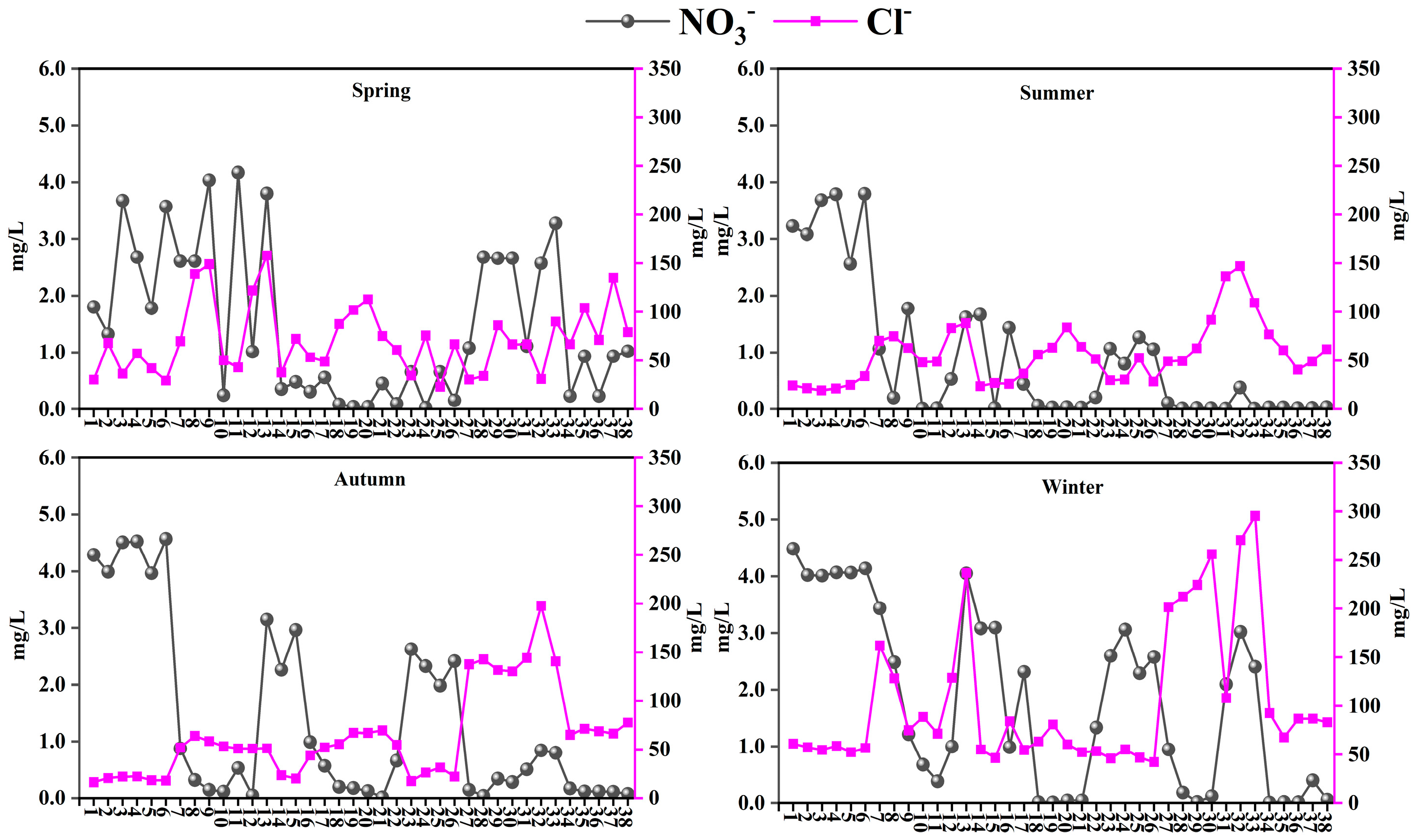
The nitrogen concentrations at all sampling sites in different season are summarized in Figure 2. The concentration range of NO3 in water samples from Baiyangdian Lake was 0.01–4.48 mg/L, with an average value of 1.40 ± 1.45 mg/L. There were significant differences in NO3 concentration among the four seasons (Friedman’s t-test, p < 0.001). The NO3 concentration was the highest in winter (1.81 ± 1.57 mg/L), followed by spring (1.49 ± 1.33 mg/L), autumn (1.37 ± 1.57 mg/L), and summer (0.90 ± 1.22 mg/L). NO3 concentrations observed in this study are higher than those reported by Zhang et al. [13], primarily due to differences in sampling site density. The sampling sites in this study include not only areas with extensive water surfaces and favorable hydraulic connectivity but also zones with poor hydrological exchange where NO3 tends to accumulate. The core driving mechanism underlying this seasonal variation might be associated with the seasonal coupling of three key processes: the external input intensity of NO3, the consumption of NO3 by aquatic organisms, and the internal biogeochemical transformation of NO3 [28,29]. Beyond the summer season, the NO3 concentration alone across the remaining three seasons exceeds the total nitrogen (TN) threshold (1 mg·L−1) for Class III surface water, as stipulated in the Environmental Quality Standard of Surface Water of China (GB3838-2002)—the regulatory standard for Baiyangdian Lake. Notably, in winter, the NO3 concentration further surpasses the criteria for Class IV surface water, indicating a more pronounced deviation from the required water quality benchmarks. A comparison (Table S2) showed that the NO3 concentrations in Baiyangdian Lake were higher than those of mostly disturbed lakes, e.g., Chaohu Lake [28], Dianchi Lake [29], Erhai [30], and Danjiankou [31], and were comparable with Poyang Lake [32], but lower than Lake Michigan and Lake Superior [33]. Based on the aforementioned findings, and in light of the regional hydro-environmental background, ecosystem sensitivity, and water quality control objectives, it is critically imperative to undertake a comprehensive nitrate source apportionment analysis in this aquatic system, with explicit consideration of seasonal variations.

3.2. δ15N-NO3 and δ18O-NO3 Values in Baiyangdian and Potential Sources

The results of δ15N-NO3 and δ18O-NO3 in Baiyangdian Lake are shown in Table 1. δ15N-NO3 values ranged from +1.91‰ to +5.70‰ (mean of +3.82‰) in spring, from +1.67‰ to +5.69‰ (mean of +3.39‰) in summer, from +1.62‰ to +4.76‰ (mean of +3.05‰) in autumn, and from +1.58‰ to +5.70‰ (mean of +3.49‰) in winter. Its temporal distribution characteristics are the highest in spring and the lowest in autumn. The values of δ18O-NO3 in four seasons for Baiyangdian Lake varied from −5.31‰ to +2.69‰ (spring), −4.27‰ to +3.36‰ (summer), −2.48‰ to +2.40‰ (autumn) and –3.20‰ to +2.39‰ (winter), respectively. The δ18O-NO3 spanned a wide range in spring but it was relatively narrower in autumn. The δ15N-NO3, δ18O-NO3 values in this study are generally lower than those reported by Zhang et al. [18], primarily attributed to significant differences in hydrological backgrounds. This study covers a complete annual cycle across four seasons, with data reflecting the baseline isotopic characteristics of Baiyangdian Lake under normal conditions. In contrast, the latter focused on the 2023 extreme flood period and the short-term post-flood stage, during which the lake water was affected by the concentrated input of sewage driven by the flood.
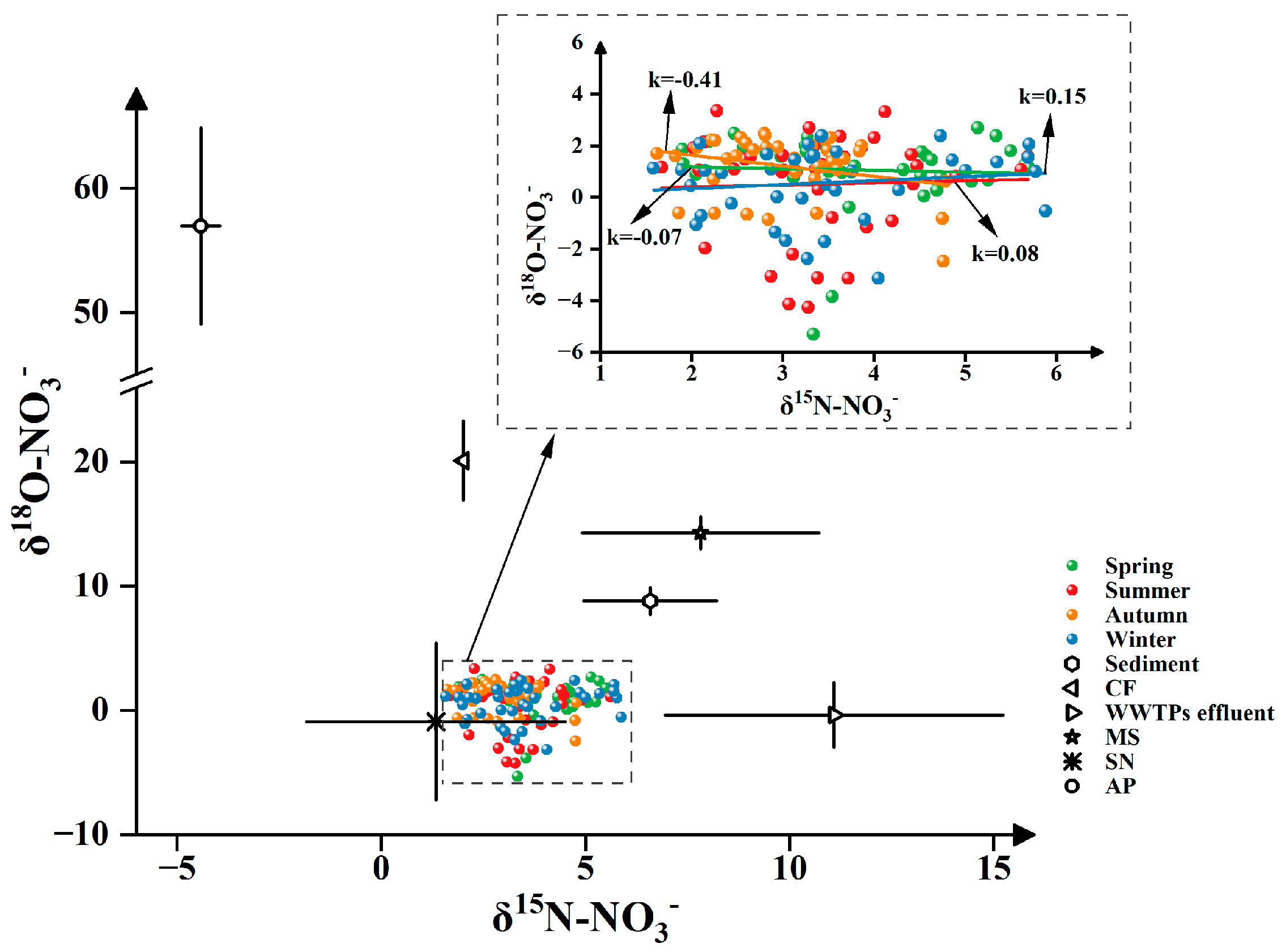
Rivers and lakes receive nitrate inputs from a multiplicity of sources, encompassing atmospheric deposition, sediment release, domestic sewage discharge, chemical fertilizer runoff, livestock manure effluents, wastewater treatment plant (WWTP) effluents, soil leaching, industrial discharges, and aquaculture activities [3,19,34]. In light of the local characteristics, six potential pollution sources were screened for the present study. The details of the pollution sources from local and other references are shown in Table 2. Studies have demonstrated that the internal loading of nitrate from sediments may serve as a significant source of nitrate in lakes [35,36]. Based on the isotope determination results of sediment samples collected from Baiyangdian Lake, δ15N-NO3 and δ18O-NO3 values were 6.59‰ ± 1.64‰ and 8.81‰ ± 1.13‰, respectively. Effluent from WWTPs is another key anthropogenic nitrogen input to the lake, with the mean δ15N-NO3 and δ18O-NO3 values measured at 11.09‰ ± 4.15‰ and −0.37‰ ± 2.63‰, respectively. To ameliorate water quality, rural settlements in the vicinity of Baiyangdian Lake have implemented a centralized collection and treatment system for rural wastewater—encompassing domestic sewage and livestock wastewater—prior to its discharge into the aquatic environment. Consequently, this composite wastewater, which integrates domestic sewage and livestock wastewater, was designated as the manure and sewage (M&S) source within the study area. For the M&S source, the mean values of δ15N-NO3 and δ18O-NO3 were determined to be +7.82‰ and 14.29‰, respectively. This value was intermediate between previously reported domestic sewage and manure values [37,38]. The δ15N-NO3 and δ18O-NO3 values of soil nitrogen were 1.34‰ ± 3.17‰ and −0.89‰ ± 6.35‰, respectively. The mean value of δ15N-NO3 and δ18O-NO3 in atmospheric precipitation were −4.42‰ and 56.94‰. These results are consistent with the findings reported in previous studies [39,40]. Unutilized chemical fertilizers in fertilized farmland also transport NO3 to the lake via pathways such as surface runoff carriage and subsurface leaching infiltration. The δ15N-NO3 and δ18O-NO3 value of the chemical fertilizer source in this study were derived from the research conducted by Wu et al. [41].

3.3. Identification of Nitrate Sources

3.3.1. Nitrate Sources Interpreted by Chemical Indicators

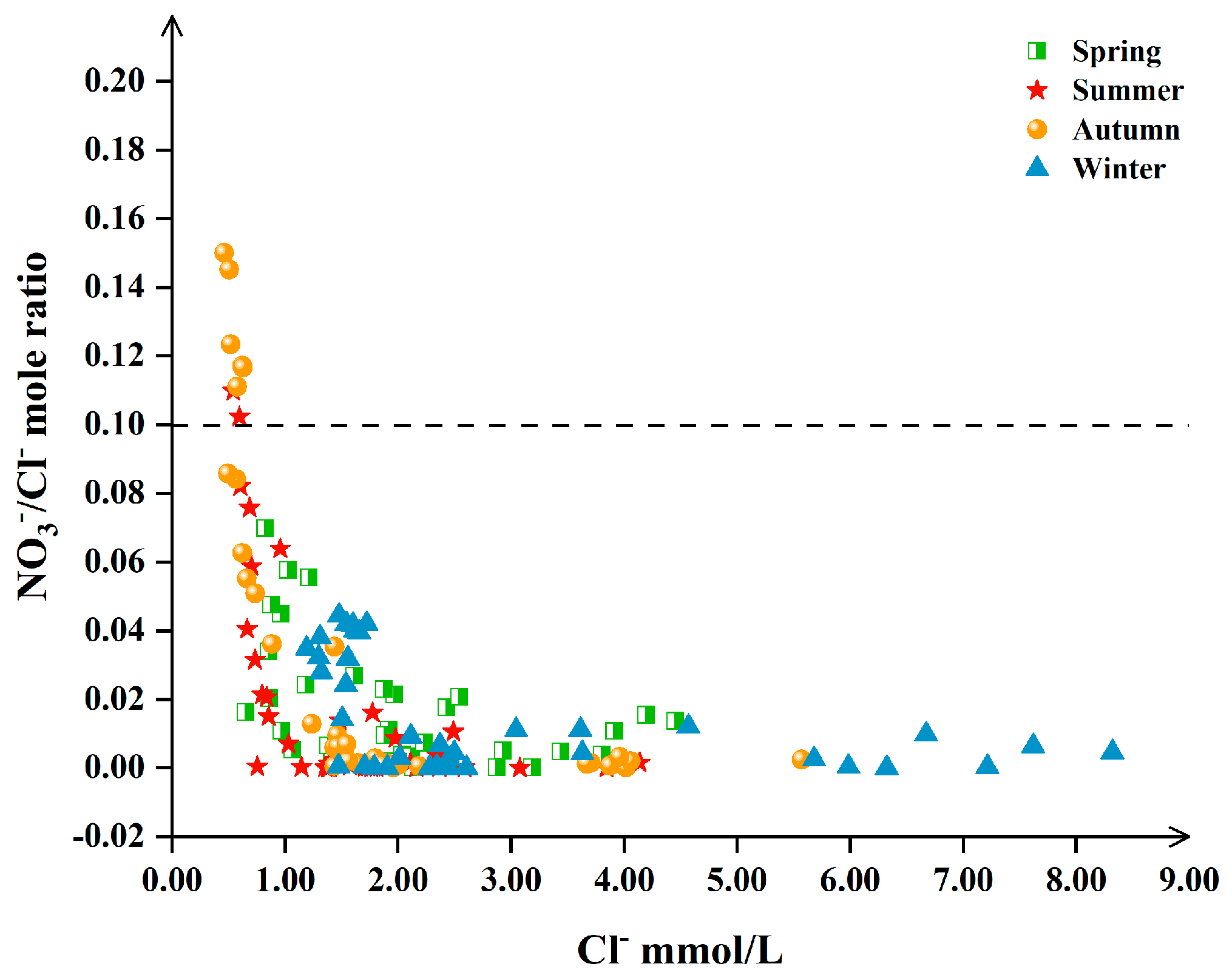
Due to the biological and chemical conservatism of Cl, the Cl concentration serves as an important auxiliary indicator when studying the variation in the NO3 concentration in rivers and lakes. The molar ratio range of NO3 to Cl is often used to identify the sources of nitrate pollution [42]. Figure 3 shows that the ratio range of NO3 to Cl in Baiyangdian waters is 0.0001–0.1500, with the average values in the four seasons being 0.0179 (spring), 0.0305 (summer), 0.0327 (autumn), and 0.0162 (winter), respectively. Among them, the NO3/Cl ratios are relatively higher in autumn and summer, and lower in spring and winter.
From the perspective of pollution source characteristics, domestic sewage is characterized by elevated Cl concentrations alongside low NO3/Cl molar ratios, with the latter typically ranging between 0.001 and 0.1 [43]. Notably, this ratio tends to rise post-treatment of domestic sewage in WWTPs [44]. In contrast, agricultural fertilizers and atmospheric precipitation are distinguished by low Cl concentrations, accompanied by comparatively higher NO3/Cl molar ratios. For these sources, Cl molar concentrations are typically below 0.1 mmol/L, whereas the NO3/Cl molar ratio spans 0.1–10 [43]. According to the official information released by the Xiongan New Area Government of China (https://www.xiongan.gov.cn/2024-09/29/c_1212401339.htm (accessed on 1 December 2025)), during the 2024 flood season (1 June to 22 September), the average precipitation in Xiongan New Area reached 568.1 mm, representing a 68.5% increase compared to the multi-year average for the same period. Affected by regional hydrological connectivity and surface runoff characteristics, part of the rainfall converges directly or indirectly into Baiyangdian Lake. Additionally, excessive rainfall causes severe waterlogging in farmlands adjacent to the lake; farmland waterlogging carrying unutilized fertilizers from agricultural activities is diverted by residents into nearby rivers and eventually discharges into Baiyangdian Lake. Such excessive rainfall and the consequent inflow of farmland waterlogging into the lake may contribute to the relatively high NO3/Cl molar ratios observed in the summer and autumn. Overall, the NO3/Cl molar ratios across all four seasons are consistently below 0.1. The initial indicators imply that nitrate sources within the study area could be derived from non-natural sources generated by human-induced processes [45].

3.3.2. Nitrate Sources and Biogeochemical Processes in Baiyangdian Lake

Key determinants regulating the nitrogen and oxygen isotopic compositions of NO3 in aquatic systems encompass biogeochemical processes such as the mixing of NO3 from diverse sources, assimilatory uptake, nitrification, and denitrification. Assimilatory uptake is distinguished by a low isotopic fractionation coefficient and imposes merely a slight influence on δ15N-NO3, with the nitrogen-rich environment of the lake area further attenuating its fractionation effect; nitrification is constrained by the ready dilution of newly formed nitrate by external nitrate inputs and strict aerobic conditions. Both processes exert weak regulatory control over the overall isotopic signatures [27,46]. Denitrification results in a considerable decrease in NO3 concentration, while simultaneously elevating the δ15N-NO3 and δ18O-NO3 values of the residual nitrate [47]. Thus, the subsequent precise identification of potential nitrate sources in Baiyangdian Lake relies upon the presence, absence, and intensity of denitrification. Currently, the identification of denitrification in aquatic environments can be accomplished through approaches such as dissolved oxygen (DO) concentration measurements, the abundance ratio of δ15N-NO3 to δ18O-NO3, and correlation analyses between δ15N-NO3, δ18O-NO3 and 1/[NO3] (the reciprocal of the NO3 concentration) [48].
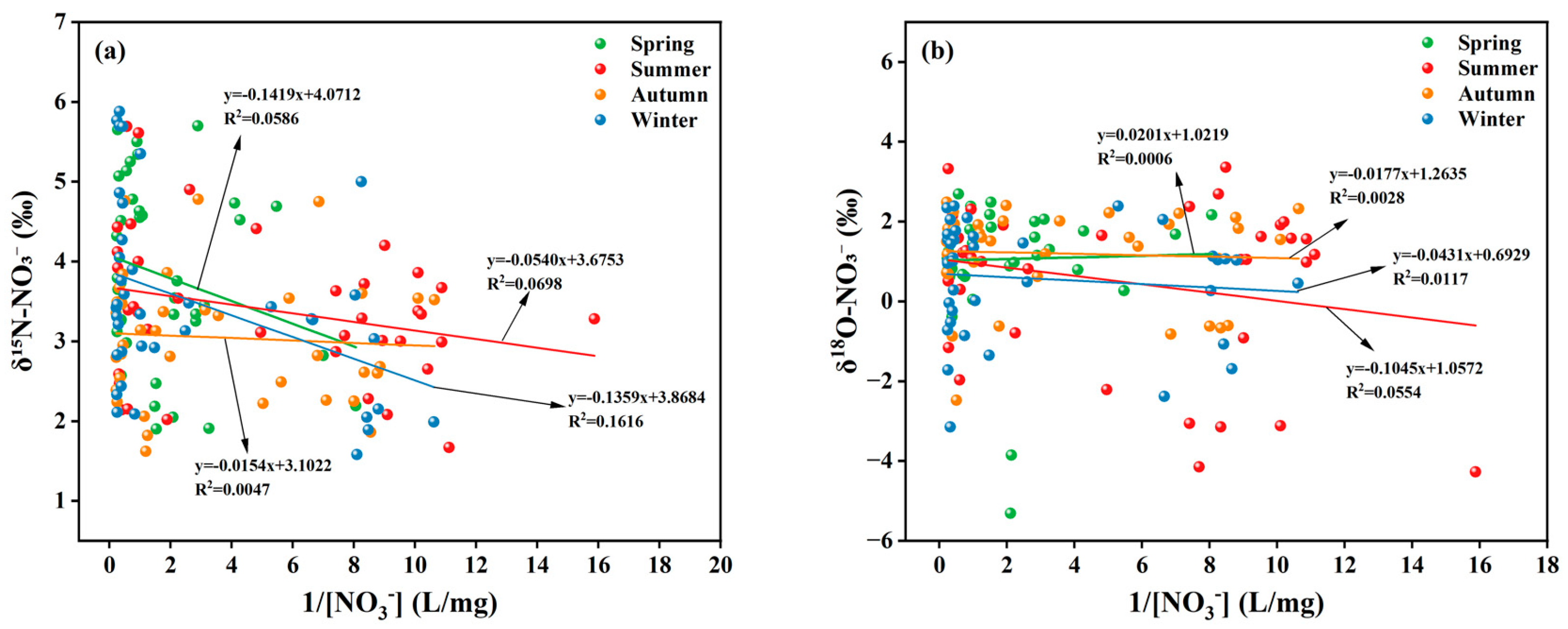
Studies have demonstrated that denitrification is environmentally feasible only when aquatic DO concentrations fall below 2 mg/L (particularly <0.5 mg/L, i.e., “anaerobic conditions”). While denitrification may occur at DO concentrations slightly above 2 mg/L, it proceeds at a low rate and exerts a negligible impact on the nitrogen and oxygen isotopic abundances of nitrate [49]. Analysis of DO concentrations in Baiyangdian Lake across four seasons revealed that the average values were 8.40 ± 1.17, 2.2 ± 0.50, 2.1 ± 0.73, and 4.18 ± 1.86 mg/L (Table S3) for spring, summer, autumn, and winter, respectively, all exceeding 2 mg/L. When denitrification occurs in the aquatic environment, anaerobic microorganisms preferentially utilize the lighter isotopes of NO3 [1]. This selective metabolic behavior results in elevated enrichment levels of δ15N-NO3 and δ18O-NO3 values as the nitrate concentration declines. In other words, denitrification can be characterized when δ15N-NO3 and δ18O-NO3 exhibit a linear positive correlation (the enrichment ratio of denitrification is approximately 2.1:1, meaning that δ18O is enriched by 1‰ synchronously for every 2.1‰ enrichment of δ15N) [50], or when they show a significant negative correlation with ln (NO3). As shown in Figure 4, δ15N-NO3 and δ18O-NO3 presented a negative correlation in spring (−0.07) and summer (−0.41), failing to meet the positive correlation characteristic required for denitrification. Although a positive correlation was observed in autumn and winter, the corresponding enrichment ratios were 1:0.08 and 1:0.15, which deviated from 2.1:1. These results indicated that no denitrification occurred in the surface water of the study area. This study utilized the relationships between δ15N-NO3, δ18O-NO3 and 1/[NO3] to further assess the potential occurrence of denitrification in Baiyangdian Lake (Figure 5). The δ15N-NO3 and δ18O-NO3 exhibited no significant linear correlations with 1/[NO3] across all four seasons. The correlation coefficients (R2) were 0.0586 (p > 0.05) and 0.0006 (p > 0.05) for spring, 0.0698 (p > 0.05) and 0.0554 (p > 0.05) for summer, 0.0047 (p > 0.05) and 0.0028 (p > 0.05) for autumn, and 0.1616 (p < 0.05) and 0.0117 (p > 0.05) for winter. This confirms the absence of denitrification in Baiyangdian Lake.
Overall, the temporal variations in the nitrogen and oxygen isotopes of nitrate in Baiyangdian Lake across the four seasons were primarily driven by the mixing of diverse nitrate sources.
We applied the plot of δ15N-NO3 vs. 1/[NO3] to study the number of N-NO3 sources in Baiyangdian Lake. The δ15N-NO3 of samples in four seasons were not related to 1/[NO3] (R2 = 0.0586 (spring), 0.0698 (summer), 0.0047 (autumn), 0.1616 (winter), Figure 5a), indicating that N-NO3 in Baiyangdian Lake came from more than two sources with different N-NO3 isotopic constitutions in each season [19].
The δ15N-NO3 and δ18O-NO3 of different pollution sources vary distinctly. Thus, the primary sources of NO3 in Baiyangdian Lake be identified by comparing with the nitrate isotopic signatures of several potential pollution sources. Bivariate plots of δ15N-NO3 versus δ18O-NO3 (Figure 4) illustrate that sample points cluster closest to the isotopic ranges of WWTP discharge, sediment release, and SN. This indicates that these three sources are the major contributors of nitrate in Baiyangdian Lake. The sample points are followed by those of chemical fertilizers and M&S, suggesting that these two sources act as secondary contributors to nitrate pollution in the lake. In contrast, the sample points are relatively distant from the isotopic range of atmospheric deposition, which confirms that this source exerts a weak influence on the nitrate in Baiyangdian Lake.

3.3.3. Apportionment of NO3 Sources Based on the MixSIAR Model

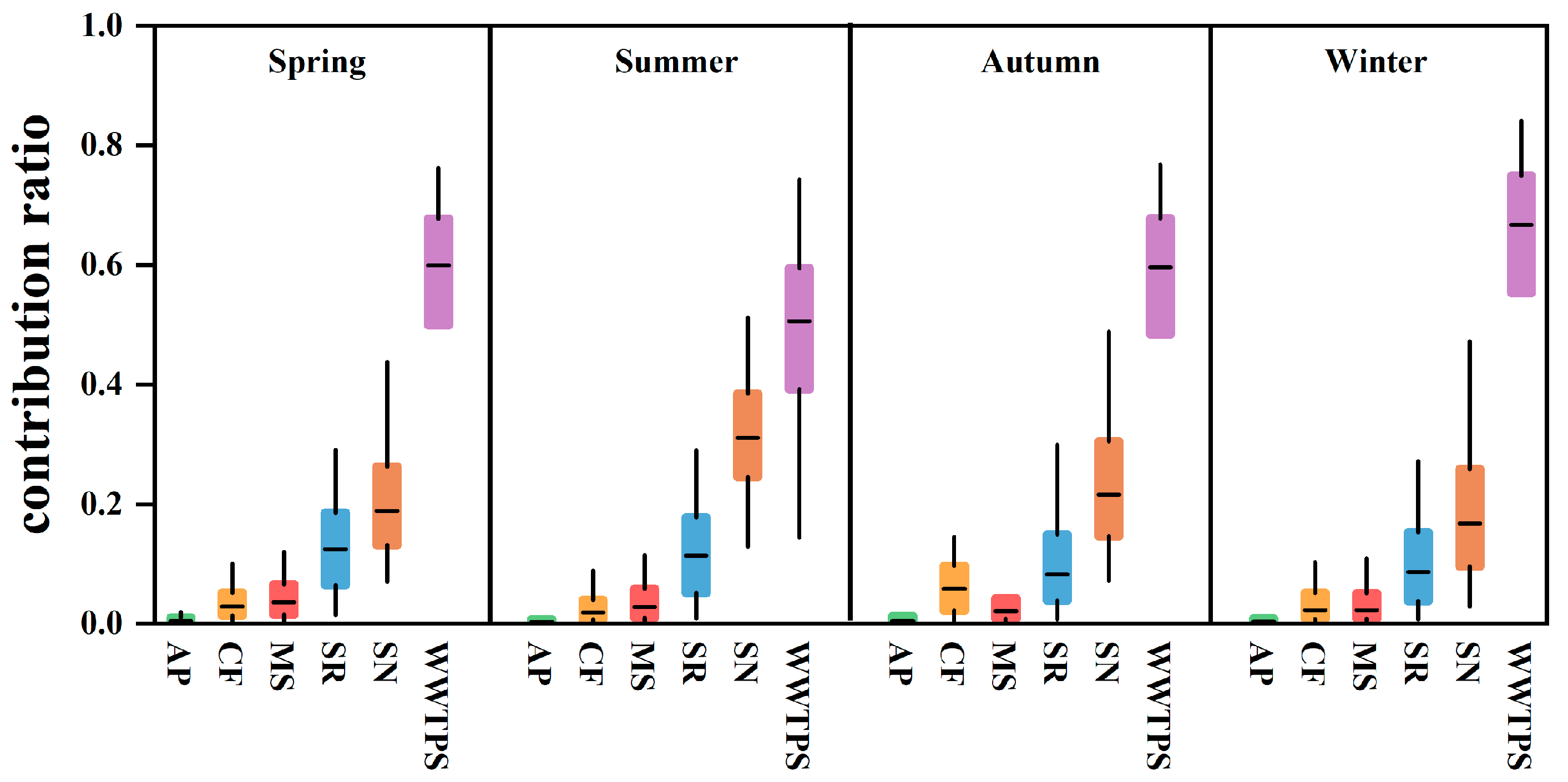
MixSIAR was used to quantitatively assess the contributions of various potential nitrate sources to the water column of Baiyangdian Lake. Consistent with the findings presented in Section 3.3.2, denitrification was deemed to exert no significant influence on the isotopic composition of nitrate, prompting the setting of fractionation factors to zero. The model calculations incorporated two isotopes (J = 2) (δ15N-NO3 and δ18O-NO3) and six potential nitrate sources (K = 6) (Sediment, CF, WWTP effluent, M&S, SN, AP). MixSIAR results revealed significant seasonal variations in the contribution ratios of these six potential sources (Figure 6). The nitrogen pollution sources in Baiyangdian Lake exhibit a distinct general characteristic: a stable dominant source and fluctuating secondary sources.
WWTP discharge was the absolute dominant source throughout the four seasons, accounting for 49% to 62% of the total nitrate load, which was highly consistent with the pollution-bearing characteristics of the main inflowing rivers into Baiyangdian Lake. The effluent from WWTPs in surrounding towns was discharged into the lake through the Fuhe River, Xiaoyi River, and Baigou Diversion River, forming stable point-source pollution pathways: as the core sewage discharge and flood control channel of Baoding urban area, the Fuhe River was lined with large-scale WWTPs and served as the key carrier for pollution input; the Xiaoyi River received effluent from county-level WWTPs, while the Baigou Diversion River had both water conveyance and sewage discharge functions, with both enhancing the stability of point-source input. Such effluent was characterized by stable flow, continuous discharge, and no direct seasonal impact. Particularly in winter, with reduced precipitation, low runoff, and weakened dilution effect, its contribution ratio reached 62%, highlighting its dominant role in maintaining the baseline nitrate level of the lake.
Soil nitrogen release (SN) was the primary secondary source, with a contribution ratio ranging from 19% to 32%. Its fluctuation pattern was closely coupled with the distribution of surrounding farmland, seasonal farming practices, and precipitation-runoff processes. The core areas of the Baiyangdian Basin, including Baoding City, Dingzhou City and Xiong’an New Area in Hebei Province, are among the major grain-producing regions on the North China Plain. The wheat–maize rotation serves as the dominant cropping system, with agricultural cultivation conducted on a large scale and over a wide area [7]. During large-scale farming practices, activities such as chemical fertilizer application and straw returning to the field can result in the considerable accumulation of nitrogen in the soil, forming a potential source of nitrogen release. During the 2024 flood season, the average precipitation in Xiong’an New Area reached 568.1 mm, an increase of 68.5% compared with the multi-year average for the same period. Intense rainfall-induced surface runoff thus drove the contribution ratio of soil nitrogen release to an annual peak of 32% in summer, making it a key supplement to nitrogen input. This is consistent with the research conclusion of Zhang et al. [18] that surface runoff during floods in Baiyangdian Lake enhances soil nitrogen input and increases the contribution to nitrate load.
The contribution ratio of sediment release (SR) was 11% to 13%, and its contribution was closely related to the accumulation of sediment and nitrogen carried by inflowing rivers. Specifically, the annual soil erosion in the basin exceeded 16 million tons [51]. A large amount of sediment entered and deposited in the lake via inflowing rivers, and the nitrogen accumulated in the deposited sediment supplemented lake nitrate through sediment release. Therefore, sediment release and soil nitrogen release together constituted the core of secondary sources. In addition, when the water temperature rose to 10~20 °C in spring, the activity of nitrifying bacteria in the sediment was activated, and the contribution ratio of sediment release reached 13%, the highest level of internal source release across all seasons. Sediment internal nitrogen release was once an important source of nitrogen in the water of Baiyangdian Lake. Notably, since the implementation of ecological dredging in 2019, a total of 11.94 million cubic meters of contaminated sediment has been removed, reducing the nitrogen diffusion flux at the sediment–water interface by more than 50% compared with that before dredging, thus significantly cutting down the nitrogen accumulation pool in the sediment [21].
Chemical fertilizer (CF), domestic sewage and manure (M&S), and atmospheric deposition (AP) all contributed less than 6.5%, with weak impacts. Previously, domestic sewage and livestock manure from surrounding villages were important nitrogen sources, but the contribution ratio of M&S was significantly lower in this study, which was closely related to regional ecological construction. The construction of numerous small-scale rural sewage treatment stations has elevated the treatment rate of M&S to 96.5%, effectively intercepting the direct inflow of such wastewater into the lake [52]. The implementation of precision management measures such as soil testing-based formulated fertilization and straw returning in farmlands around villages reduced the risk of chemical fertilizer nitrogen loss. Collectively, these measures promoted the optimization of the nitrogen pollution source structure.

3.4. Pollution Control Suggestions

Based on the seasonal differentiation of nitrogen sources in Baiyangdian Lake, basin-scale nitrogen pollution mitigation should adhere to the core principle of “seasonally differentiated and precision-targeted strategies”:
(1)
Year-round priority of WWTPs: Optimize advanced nitrogen removal technologies for WWTPs along key inflowing rivers, strictly enforce discharge standards, and strengthen real-time monitoring of tailwater nitrogen concentration and flow to reduce baseline input.
(2)
Summer focus on agricultural non-point sources: For high-risk agricultural areas around the inflowing rivers, promote contour plowing and cover cropping to reduce soil erosion, build ecological ditches and runoff interceptors, and adjust fertilization timings to avoid overlapping with heavy rainfall periods, thereby curbing soil nitrogen loss.
(3)
Spring and autumn emphasis on sediment management: Strengthen dynamic monitoring of the sediment–water interface, especially in dredged areas, to prevent sediment resuspension and nitrogen release rebound, maintaining the long-term effect of ecological dredging.

3.5. Limitations and Future Work

This study only quantified the overall seasonal contribution of WWTP discharges but failed to distinguish the individual contributions of each WWTP along different inflowing rivers (e.g., Fuhe River, Xiaoyi River, Baigou Diversion River). Due to differences in plant scale, treatment processes, and sewage discharge volume among various WWTPs, their respective impacts on lake nitrate loads may vary significantly, which limits the refinement of point source control strategies. In addition, regarding the farmland runoff interception measures targeting summer soil nitrogen loss, the study only clarified the seasonal variation in soil nitrogen contribution but failed to identify the key source areas of farmland runoff within the basin. The lack of spatial difference data on soil nitrogen leaching intensity (e.g., differences between upstream farmlands and lakeside farmlands) makes it difficult to determine the priority of runoff interception projects.
Therefore, future research should focus on the following two aspects: First, conduct studies on precise source tracing and efficiency optimization of WWTPs. For key WWTPs along the Fuhe River, Xiaoyi River, and Baigou Diversion River, carry out long-term tracking surveys by combining hydrological and water quality monitoring data with hydrochemical tracing technology to quantify the nitrate contribution of individual WWTPs and identify core management and control objects. Meanwhile, systematically compare the operational differences in WWTPs with different scales and processes from the perspectives of nitrogen removal efficiency, energy consumption, and sludge production, and propose targeted technological upgrading schemes such as advanced nitrogen removal process transformation to provide data support for refined point source management and control. Second, conduct research on the identification of key source areas of farmland runoff and optimization of interception technologies. Combine remote sensing interpretation with field sampling to cover farmlands in different geomorphic units within the basin, quantify the spatial differentiation characteristics of soil nitrogen leaching intensity, and clarify the high-risk areas of summer soil nitrogen loss. Based on the distribution of key source areas, design in situ simulation experiments of interception measures such as ecological ditches and vegetative buffer strips, analyze the influence mechanism of nitrogen application rate, water management, and other factors on interception efficiency, and optimize the layout and implementation priority of engineering projects. These efforts will integrate differentiated governance with the seasonal dynamics of nitrogen sources, so as to achieve the precise control of nitrogen pollution and the sustained improvement of aquatic ecological quality in the Baiyangdian Basin.

4. Conclusions

Targeting the practical challenge of nitrate in Baiyangdian Lake failing to sustain compliance with Class III of the Environmental Quality Standard of Surface Water of China (GB3838-2002), this study systematically clarified the source composition, seasonal differentiation mechanisms, and response characteristics to ecological restoration of nitrate in this shallow lake wetland through coupled analysis of dual stable isotopes (δ15N-NO3, δ18O-NO3) and hydrochemistry. Nitrate in Baiyangdian Lake exhibited a multi-source pattern characterized by “point source dominance and seasonal non-point source supplementation.” WWTP discharge was the dominant source throughout the four seasons, and the spatiotemporal coupling characteristics between its contribution rate and nitrate concentrations—higher in winter (1.81 ± 1.57 mg/L) and lower in summer (0.90 ± 1.22 mg/L)—confirmed that both point source emission intensity and the seasonal non-point source, and soil nitrogen release (SN) reached a contribution rate of 32% in summer due to intense precipitation-driven runoff scouring, serving as the main driving factor for fluctuations in nitrate concentrations during the rainy season. In contrast, the contribution rates of sediment release and M&S consistently remained at a low level, challenging the historical understanding that “sedimentary endogenous sources and M&S are important nitrogen sources.” The significant reduction in the contribution rates of SR and M&S directly verified the long-term pollution source control effects of regional ecological dredging and the full coverage project of rural sewage treatment stations, providing a practical paradigm for optimizing the nitrogen source structure of shallow lake wetlands through engineering measures. The core target for nitrate pollution control in Baiyangdian Lake should focus on advanced nitrogen removal in WWTPs year-round, while simultaneously strengthening farmland runoff interception during the peak period of soil nitrogen loss in summer, forming a “point source–non-point source” synergistic control system. This study not only provides an accurate source apportionment basis for addressing the challenge of stable nitrate compliance in Baiyangdian Lake but also offers scientific reference for nitrogen pollution source tracing and differentiated management of similar shallow lakes on the North China Plain.

Supplementary Materials

The following supporting information can be downloaded at: https://www.mdpi.com/article/10.3390/w18030338/s1, Table S1: Sampling site; Table S2: The concentrations of NO3 in other lakes; Table S3: Variation characteristics of the main hydrochemical parameters in the study area.

Author Contributions

Conceptualization, M.S.; Methodology, Y.S., H.W., S.M., M.S., L.M., K.Z., L.W., and Y.Z.; Software, S.M.; Validation, L.M., Y.W., L.W., and Y.Z.; Formal analysis, Y.S. and H.W.; Writing—original draft, Y.S. and H.W.; Writing—review and editing, Y.S., Hao Wang, and M.S.; Funding acquisition, M.S. All authors have read and agreed to the published version of the manuscript.

Funding

This work was kindly funded by the Pilot Project of Basic Research Business Expense System of Hebei Academy of Sciences (2024PF10) and the Science and Technology Plan Project of Hebei Academy of Sciences (25104).

Data Availability Statement

The original contributions presented in this study are included in the article. Further inquiries can be directed to the corresponding author.

Conflicts of Interest

Author Liyuan Wang was employed by the company Environmental Microbial Remediation Engineering Laboratory, Hebei Institute of Microbiology Co., Ltd. The remaining authors declare that the research was conducted in the absence of any commercial or financial relationships that could be construed as potential conflicts of interest.

References

  1. Zhang, Q.Q.; Wang, L.; Wang, H.W.; Zhang, X.Q. Nitrogen dynamics in multi-source recharge lakes: A comprehensive exploration using multi-isotopic tracing, Bayesian mixing models and structural equation models. Environ. Technol. Innov. 2025, 40, 104482. [Google Scholar] [CrossRef]
  2. Kang, L.J.; Zhu, M.Y.; Zhu, G.W.; Xu, H.; Zou, W.; Xiao, M.; Guo, C.X.; Zhang, Y.L.; Qin, B.Q. Decreasing denitrification rates poses a challenge to further decline of nitrogen concentration in Lake Taihu, China. Water Res. 2024, 256, 121565. [Google Scholar] [CrossRef]
  3. Chen, X.; Jiang, C.L.; Zheng, L.G.; Dong, X.L.; Chen, Y.C.; Li, C. Identification of nitrate sources and transformations in basin using dual isotopes and hydrochemistry combined with a Bayesian mixing model: Application in a typical mining city. Environ. Pollut. 2020, 267, 115651. [Google Scholar] [CrossRef] [PubMed]
  4. Zhang, L.; Bai, J.H.; Zhai, Y.J.; Zhang, K.G.; Wang, Y.Q.; Tang, R.X.; Xiao, R.; Jorquera, M.A. Seasonal changes in N-cycling functional genes in sediments and their influencing factors in a typical eutrophic shallow lake, China. Front. Microbiol. 2024, 15, 1363775. [Google Scholar] [CrossRef] [PubMed]
  5. Zhao, Y.T.; Zhang, J.F.; Shi, K.; Zhou, S.L. Divergent responses of nitrogen and phosphorus speciation to sediment dissolved organic matter dynamics in Baiyangdian Lake during pre- and post-flood periods. J. Environ. Chem. Eng. 2025, 13, 119071. [Google Scholar] [CrossRef]
  6. Liu, X.; Shi, B.; Meng, J.; Zhou, Y.Q.; Ke, X.; Wang, T.Y. Spatio-temporal Variations in the Characteristics of Water Eutrophication and Sediment Pollution in Baiyangdian Lake. Environ. Sci. 2020, 41, 2127–2136. [Google Scholar]
  7. Yang, W.B. Temporal and Spatial Characteristics of Nitrogen and Phosphorus Nutrient Flows and Losses in the Crop-Livestock System in Baiyangdian Basin. Master’s Thesis, Hebei Agricultural University, Baoding, China, 2022. [Google Scholar]
  8. Baiyangdian Ecological Environment Management and Protection Plan (2018–2035). People’s Government of Hebei Province, China. 2019. Available online: https://global.chinadaily.com.cn/a/201901/07/WS5c329142a31068606745f1f1.html (accessed on 1 December 2025).
  9. Regulations on the Ecological Environment Management and Protection of Baiyangdian. Standing Committee of the Hebei Provincial People’s Congress, China. 2021. Available online: http://www.hbrd.gov.cn/system/2021/03/01/100611012.shtml (accessed on 1 December 2025).
  10. DB 13/2795-2018; Water Pollutant Discharge Standard for the Daqing River Basin. Hebei Provincial Department of Ecology and Environment: Shijiazhuang, China, 2018.
  11. Lin, S.S.; Shen, S.L.; Zhou, A.; Lyu, H.M. Assessment and management of lake eutrophication: A case study in Lake Erhai, China. Sci. Total Environ. 2020, 751, 141618. [Google Scholar] [CrossRef]
  12. Wan, Y.S.; Zhang, L.Q.; Fu, X.; Jin, H.Y. Assessment of eutrophication degree and its prevention in Danjiangkou Reservoir. J. Beijing Norm. Univ. (Nat. Sci.) 2020, 56, 275–281. [Google Scholar]
  13. Zhang, Q.; Xu, S.; Yang, L. Spatiotemporal Variation Characteristics and Source Identification of Nitrogen in the Baiyangdian Lake Water, China. Water 2024, 16, 2969. [Google Scholar] [CrossRef]
  14. GB 3838-2002; Environmental Quality Standard for Surface Water. China Environmental Science Press: Beijing, China, 2002.
  15. Liu, W.J.; Jiang, H.; Guo, X.; Li, Y.C.; Xu, Z.F. Time-series monitoring of river hydrochemistry and multiple isotope signals in the Yarlung Tsangpo River reveals a hydrological domination of fluvial nitrate fluxes in the Tibetan Plateau. Water Res. 2022, 225, 119098. [Google Scholar] [CrossRef]
  16. Zhao, Y.; Lu, W.X.; Xiao, C.N. Mixed integer optimization approach to groundwater pollution source identification problems. Environ. Forensics 2016, 17, 355–360. [Google Scholar] [CrossRef]
  17. Ran, X.B.; Bouwman, L.; Yu, Z.G.; Beusen, A.; Chen, H.T.; Yao, Q.Z. Nitrogen transport, transformation, and retention in the Three Gorges Reservoir: A mass balance approach. Limnol. Ocean. 2017, 62, 2323–2337. [Google Scholar] [CrossRef]
  18. Zhang, Y.; Hou, X.; Meng, L.; Wang, Y.; Ma, S.; Cao, J. The Impact of Catastrophic Flooding on Nitrogen Sources Composition in an Intensively Human-Impacted Lake: A Case Study of Baiyangdian Lake. Water 2025, 17, 3309. [Google Scholar] [CrossRef]
  19. Zhao, Y.Y.; Zheng, B.H.; Jia, H.F.; Chen, Z.X. Determination sources of nitrates into the Three Gorges Reservoir using nitrogen and oxygen isotopes. Sci. Total Environ. 2019, 687, 128–136. [Google Scholar] [CrossRef]
  20. Yang, Y.Y.; Toor, G.S. Sources and mechanisms of nitrate and orthophosphate transport in urban stormwater runoff from residential catchments. Water Res. 2017, 112, 176–184. [Google Scholar] [CrossRef]
  21. Li, C.Y.; Cheng, L.; Wang, T.F.; Li, L.Q.; Liao, G.Y.; Zhang, W.J.; Wang, D.S. Nitrogen and phosphorus diffusive fluxes across the sediment-water interface before and after dredging typical areas of Baiyangdian Lake. Acta Sci. Circumst. 2021, 41, 1401–1409. [Google Scholar]
  22. Tao, Y.; Liu, J.; Guan, X.Y.; Chen, H.R.; Ren, X.Q.; Wang, S.L.; Ji, M.Z. Estimation of potential agricultural non-point source pollution for Baiyangdian Basin, China, under different environment protection policies. PLoS ONE 2020, 15, e0239006. [Google Scholar] [CrossRef]
  23. Hao, P.X.; Yang, J.; Liu, X.; Strokal, M.; van Wijk, D.; Bai, Z.H.; Ma, L. Optimizing nitrogen management for pollution control in Lake Baiyangdian following water replenishment. J. Environ. Manag. 2024, 327, 123374. [Google Scholar] [CrossRef]
  24. Wang, N.; Xu, Q.H.; Zhang, S.R.; Yang, X.L.; Wang, D.D.; Sun, Y.H.; Wang, T. Climatic and environmental evolution of the Baiyangdian area since the Lateglacial. Acta Geogr. Sin. 2022, 77, 1195–1210. [Google Scholar]
  25. Weigand, M.A.; Foriel, J.; Barnett, B.; Oleynik, S.; Sigman, D.M. Updates to instrumentation and protocols for isotopic analysis of nitrate by the denitrifier method. Rapid Commun. Mass Spectrom. 2016, 30, 1365–1383. [Google Scholar] [CrossRef]
  26. Casciotti, K.L.; Sigman, D.M.; Hastings, M.G.; Böhlke, J.K.; Hilkert, A. Measurement of the oxygen isotopic composition of nitrate in seawater and freshwater using the denitrifier method. Anal. Chem. 2002, 74, 4905–4912. [Google Scholar] [CrossRef] [PubMed]
  27. Zaryab, A.; Nassery, H.R.; Knoeller, K.; Alijani, F.; Minet, E. Determining nitrate pollution sources in the Kabul Plain aquifer (Afghanistan) using stable isotopes and Bayesian stable isotope mixing model. Sci. Total Environ. 2022, 823, 153749. [Google Scholar] [CrossRef] [PubMed]
  28. Zheng, L.L.; Jiang, C.L.; Chen, X.; Li, Y.H.; Li, C. Combining hydrochemistry and hydrogen and oxygen stable isotopes to reveal the influence of human activities on surface water quality in Chaohu Lake Basin. J. Environ. Manag. 2022, 312, 114933. [Google Scholar] [CrossRef] [PubMed]
  29. Cao, G.X.; Huang, L.C.; Liu, C.Q.; Zhang, Z.Z.; Zhu, Y.; Pan, M. Effects of different water environments in Dianchi Lake on the Kinetic Parameters of Chlorophyll Fluorescence induction of Potamogeton wrightii Morong. Acta Ecol. Sinica 2024, 44, 8520–8531. [Google Scholar]
  30. She, W.J.; Jiao, Y.M.; Lu, R.T.; Chai, Y.; Chen, F.; Shen, J.; Zhang, H.S.; Liao, H.J.; Xu, Q.E. Quantification of nitrate sources and its spatial heterogeneity by dual isotopes. Ecosyst. Health Sust. 2024, 10, 0201. [Google Scholar] [CrossRef]
  31. Zhang, Y.Y.; Zhang, D.H.; Li, Y.; Han, X.Q.; Wang, X.Y.; Zhang, J.A.; Gu, K.D.; Sun, S.J.; Liu, Q.G.; Lv, J. Spatiotemporal dynamics of nitrogen and phosphorus in the water and sediment from the source reservoir of the Mid-Route of China’s South-to-North Water Diversion Project. Water 2025, 17, 1824. [Google Scholar] [CrossRef]
  32. Liu, Z.J.; Wang, X.H.; Jia, S.Q.; Mao, B.Y. Multi-methods to investigate spatiotemporal variations of nitrogen-nitrate and its risks to human health in China’s largest fresh water lake (Poyang Lake). Sci. Total Environ. 2023, 863, 160975. [Google Scholar] [CrossRef]
  33. Rani, A.; Ranjan, R.; Bonina, S.M.C.; Izadmehr, M.; Giesy, J.P.; Li, A.; Sturchio, N.C.; Rockne, K.J. Aqueous geochemical controls on the sestonic microbial community in Lakes Michigan and Superior. Microorganisms 2023, 11, 16. [Google Scholar] [CrossRef]
  34. Jing, Y.; Liu, X.; Strokal, M.; Kroeze, C.; Hao, P.X.; Bai, Z.H.; Ma, L. Sources of nitrogen in reservoirs of the Haihe basin (China) 2012–2017. J. Environ. Manag. 2023, 345, 118667. [Google Scholar] [CrossRef]
  35. Yang, C.H.; Yang, P.; Geng, J.; Yin, H.B.; Chen, K.N. Sediment internal nutrient loading in the most polluted area of a shallow eutrophic lake (Lake Chaohu, China) and its contribution to lake eutrophication. Environ. Pollut. 2020, 262, 114292. [Google Scholar] [CrossRef]
  36. Yao, X.L.; Ding, R.N.; Zhou, Y.Q.; Wang, Z.W.; Liu, Y.A.; Zhang, L. How internal nutrient loading forms in shallow lakes: Insights from benthic organic matter mineralization. Water Res. 2023, 245, 120544. [Google Scholar] [CrossRef] [PubMed]
  37. Su, D.; Zhou, Z.F.; Gong, X.H.; Yan, L.H.; Ding, S.J.; Dong, H.; Zhang, Y.; Wang, X.D. Identification of nitrate sources and transformation in karst cave water using hydrochemistry and NO3 isotopes (δ15N/δ18O) combined with a Bayesian mixing model. All Earth 2023, 36, 2356138. [Google Scholar]
  38. Jin, Z.F.; Cen, J.R.; Hu, Y.M.; Li, L.J.; Shi, Y.S.; Fu, G.W.; Li, F.L. Quantifying nitrate sources in a large reservoir for drinking water by using stable isotopes and a Bayesian isotope mixing model. Environ. Sci. Pollut. Res. 2018, 26, 20364–20376. [Google Scholar] [CrossRef] [PubMed]
  39. Saccon, P.; Leis, A.; Marca, A.; Kaiser, J.; Campisi, L.; Böttcher, M.E.; Savarino, J.; Escher, P.; Eisenhauer, A.; Erbland, J. Multi-isotope approach for the identification and characterisation of nitrate pollution sources in the Marano lagoon (Italy) and parts of its catchment area. Appl. Geochem. 2013, 34, 75–89. [Google Scholar] [CrossRef]
  40. Ding, J.T.; Xi, B.D.; Gao, R.T.; He, L.S.; Liu, H.L.; Dai, X.L.; Yu, Y.J. Identifying diffused nitrate sources in a stream in an agricultural field using a dual isotopic approach. Sci. Total Environ. 2014, 484, 10–18. [Google Scholar] [CrossRef]
  41. Wu, W.H.; He, X.J.; Wu, H.L.; Wang, X.Z.; Shen, J. Identification of sources of nitrate in the Yongan River with isotopic technology. J. Ecol. Nat. Environ. 2016, 32, 802–807. [Google Scholar]
  42. Jiang, H.; Zhang, Q.Q.; Liu, W.J.; Zhang, J.Y.; Pan, K.; Zhao, T.; Xu, Z.F. Isotopic compositions reveal the driving forces of high nitrate level in an urban river: Implications for pollution control. J. Clean. Prod. 2021, 298, 126693. [Google Scholar] [CrossRef]
  43. Li, Z.T.; Xiao, H.W.; Wu, Z.T.; Ma, Y.; Xiao, Y.N.; Chen, Z.P.; Tao, J.H. Hydrochemistry, nitrogen and oxygen isotope composition of nitrate to trace its source and transformation in Poyang Lake. Chin. Environ. Sci. 2022, 42, 4315–4322. [Google Scholar]
  44. Li, C.; Li, S.L.; Yue, F.J.; Liu, J.; Zhong, J.; Yan, Z.F.; Zhang, R.C.; Wang, Z.J.; Xu, S. Identification of sources and transformations of nitrate in the Xijiang River using nitrate isotopes and Bayesian model. Sci. Total Environ. 2019, 646, 801–810. [Google Scholar] [CrossRef]
  45. Yin, C.; Yang, H.Q.; Chen, J.A.; Guo, J.Y.; Wang, J.F.; Zhang, Z.; Tang, X.Y. Tracing nitrate sources with dual isotopes and hydrochemical characteristics during wet season in Lake Caohai, Guizhou Province. J. Lake Sci. 2020, 32, 989–998. [Google Scholar] [CrossRef]
  46. Kumar, A.; Ajay, A.; Dasgupta, B.; Bhadury, P.; Sanyal, P. Deciphering the nitrate sources and processes in the Ganga river using dual isotopes of nitrate and Bayesian mixing model. Environ. Res. 2023, 216, 114744. [Google Scholar] [CrossRef]
  47. Hocaoglu, S.M.; Insel, G.; Cokgor, E.U.; Orhon, D. Effect of sludge age on simultaneous nitrification and denitrification in membrane. Bioresour. Technol. 2011, 102, 6665–6672. [Google Scholar] [CrossRef]
  48. Xue, D.M.; Botte, J.; De Baets, B.; Accoe, F.; Nestler, A.; Taylor, P.; Van Cleemput, O.; Berglund, M.; Boeckx, P. Present limitations and future prospects of stable isotope methods for nitrate source identification in surface and groundwater. Water Res. 2009, 43, 1159–1170. [Google Scholar] [CrossRef]
  49. Ogrinc, N.; Tamse, S.; Zavadlav, S.; Vrzel, J.; Jin, L.X. Evaluation of geochemical processes and nitrate pollution sources at the ljubljansko Polje aquifer (Slovenia): A stable isotope perspective. Sci. Total Environ. 2019, 646, 1588–1600. [Google Scholar] [CrossRef]
  50. Böttcher, J.; Strebel, O.; Voerkelius, S.; Schmidt, H.L. Using isotope fractionation of nitrate-nitrogen and nitrate-oxygen for evaluation of microbial denitrification in a sandy aquifer. J. Hydrol. 1990, 114, 413–424. [Google Scholar] [CrossRef]
  51. Wu, X. The analysis and protection of Baiyangdian Marsh’s water environment quality. Heilongjiang Sci. Technol. Water Conserv. 2013, 41, 191–192. [Google Scholar]
  52. Work Committee of Xiong’an New Area; Administrative Committee of Xiong’an New Area. Press Conference on Ecological Environment Governance and Protection of Baiyangdian Lake. 2023. Available online: https://www.xiongan.gov.cn/2023-12/07/c_1212311777.htm (accessed on 1 December 2025).
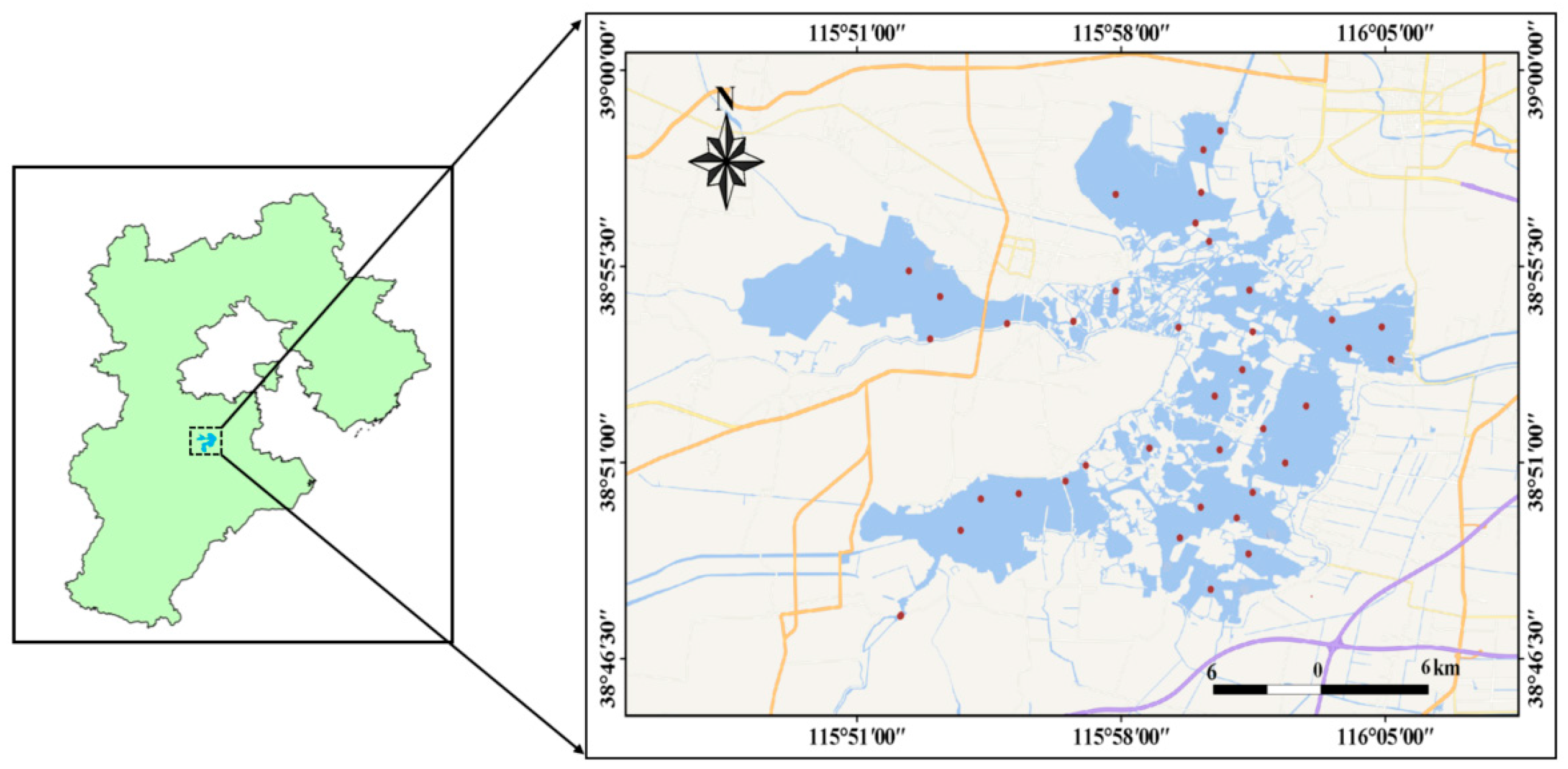
Figure 1. The distribution of water sampling sites in Baiyangdian Lake.
Water 18 00338 g001
Figure 2. The concentrations of NO3and Cl of Baiyangdian Lake in four seasons.
Water 18 00338 g002
Figure 3. Relationship between Cl and NO3/Cl.
Water 18 00338 g003
Figure 4. δ15N-NO3 versus δ18O-NO3 in water samples from Baiyangdian Lake and potential pollution sources.
Water 18 00338 g004
Figure 5. Relationship between (a) δ15N-NO3 and (b) δ18O-NO3 versus 1/[NO3] of water samples in four seasons.
Water 18 00338 g005
Figure 6. Contribution ratios of the main potential NO3 sources estimated by the MixSIAR model (boxplots illustrate the 25th, 50th, and 75th percentiles; the whiskers indicate 5th and 95th percentiles).
Water 18 00338 g006
Table 1. Isotopic compositions of δ15N-NO3 and δ18O-NO3 in different seasons.
Waterδ15N-NO3 (‰)δ18O-NO3 (‰)
RangMeanSDRangMeanSD
Spring+1.91~+5.703.821.11−5.31~+2.691.061.53
Summer+1.67~+5.693.390.93−4.27~+3.360.512.02
Autumn+1.62~+4.763.050.78−2.48~+2.401.21.17
Winter+1.58~+5.703.491.18−3.20~+2.390.571.39
Table 2. Possible characteristic potential sources isotope values of δ15N-NO3 and δ18O-NO3.
Sourceδ15N-NO3 (‰)δ18O-NO3 (‰)
MeanSDMeanSD
Sediment release (SR)6.591.648.811.13
Chemical fertilizer (CF) [41]2.010.1220.13.21
Wastewater treatment plant (WWTP) effluent11.094.15−0.372.63
Manure and sewage (M&S)7.822.9114.291.32
Soil nitrogen (SN)1.343.17−0.896.35
Atmospheric precipitation (AP)−4.420.4856.947.94
Disclaimer/Publisher’s Note: The statements, opinions and data contained in all publications are solely those of the individual author(s) and contributor(s) and not of MDPI and/or the editor(s). MDPI and/or the editor(s) disclaim responsibility for any injury to people or property resulting from any ideas, methods, instructions or products referred to in the content.