Numerical Investigation of the Hydrodynamic Performance of a V-Type Wave Dissipation System and Amphibious Landing Equipment Under Different Combined Fields


Abstract
1. Introduction
2. Fundamental Numerical Theory
2.1. RANS Equations
2.2. Turbulence Model
2.3. Numerical Calculation Methods
3. Three-Dimensional Numerical Wave Tank Calculation Validation
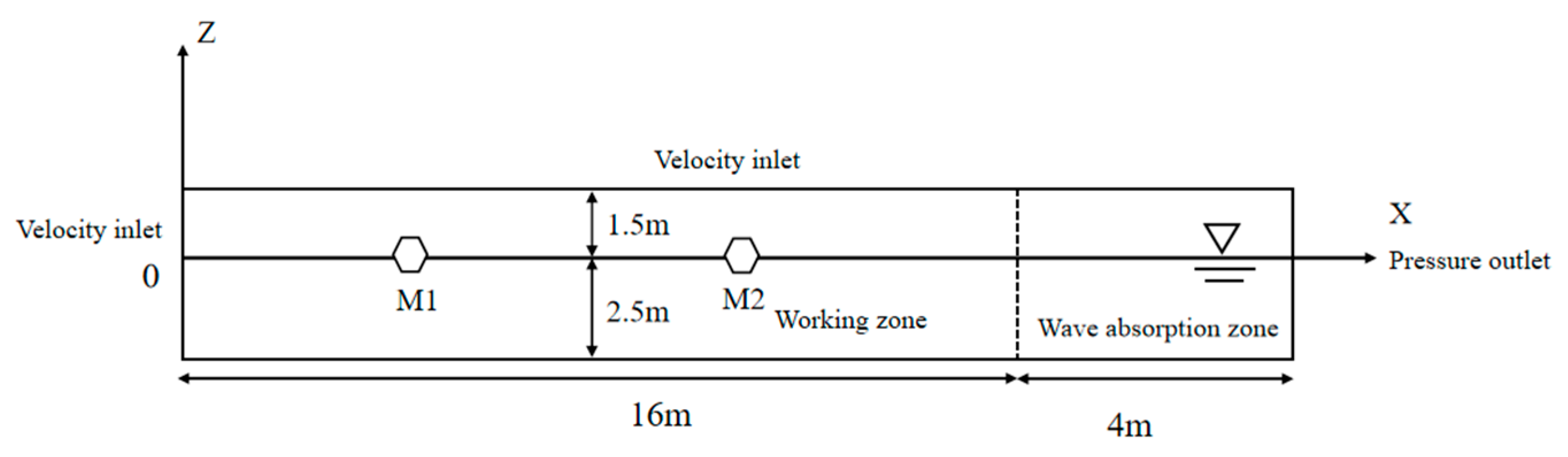
3.1. Model Parameters and Wave Generation Method
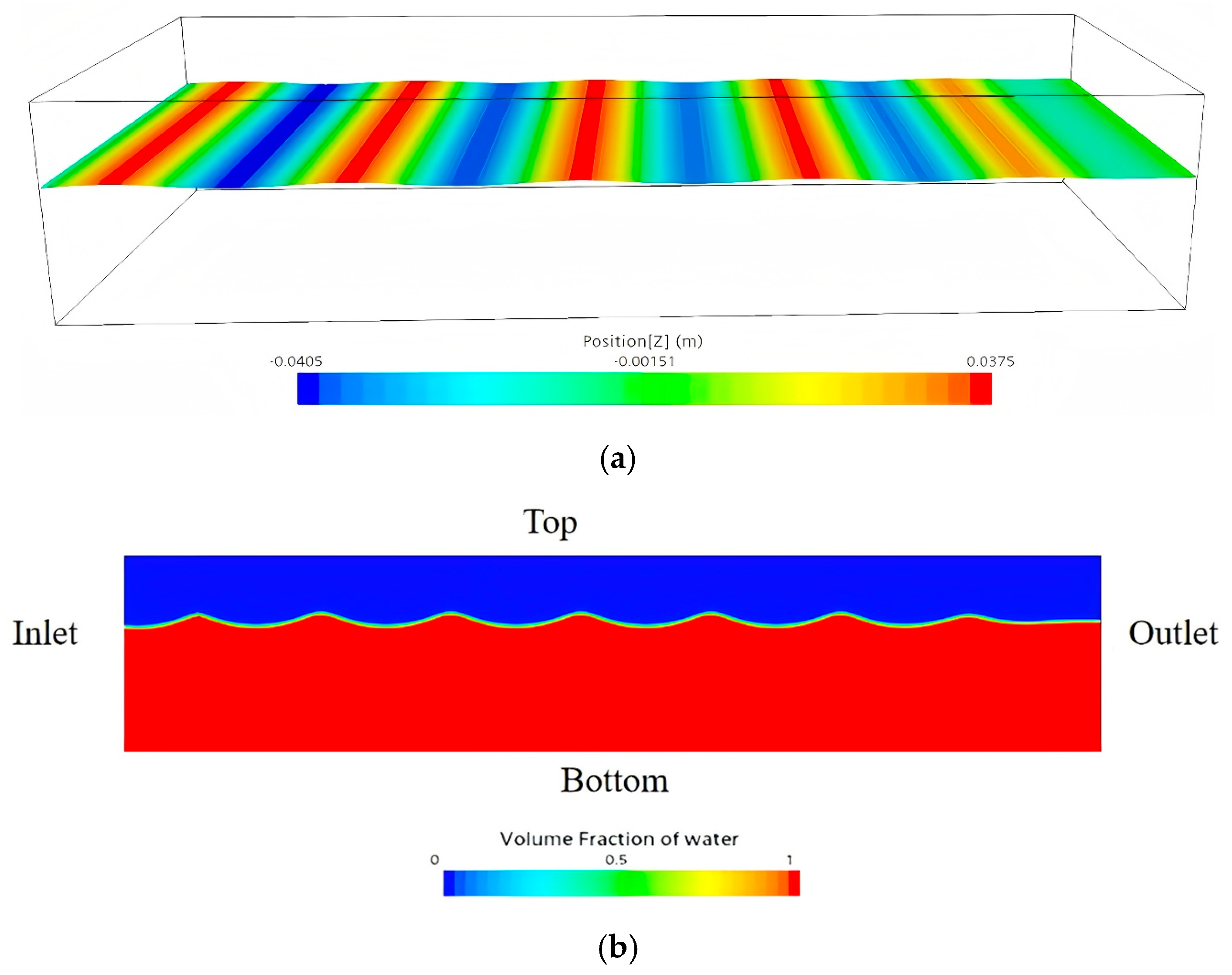
3.2. Grid Division and Boundary Condition Settings
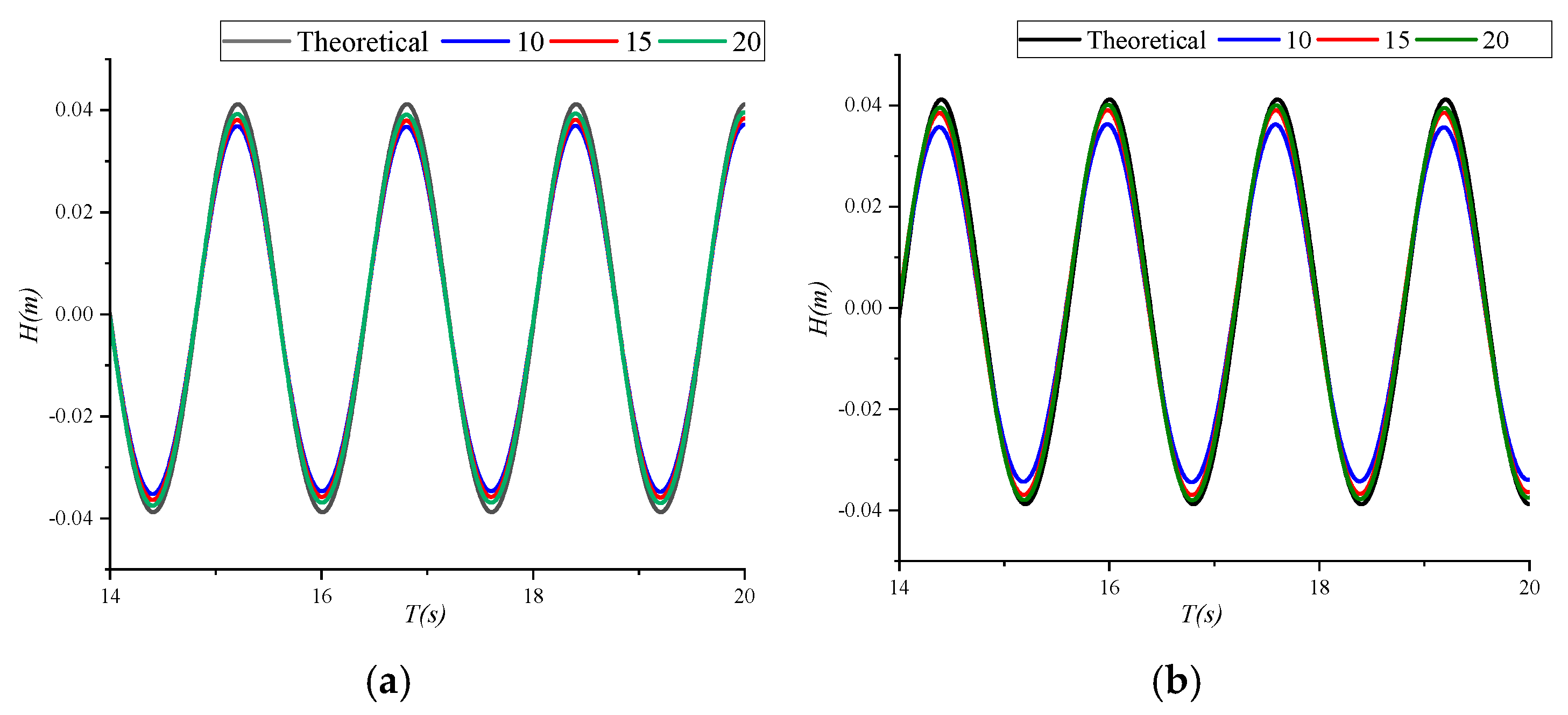
3.3. Grid Sensitivity Analysis
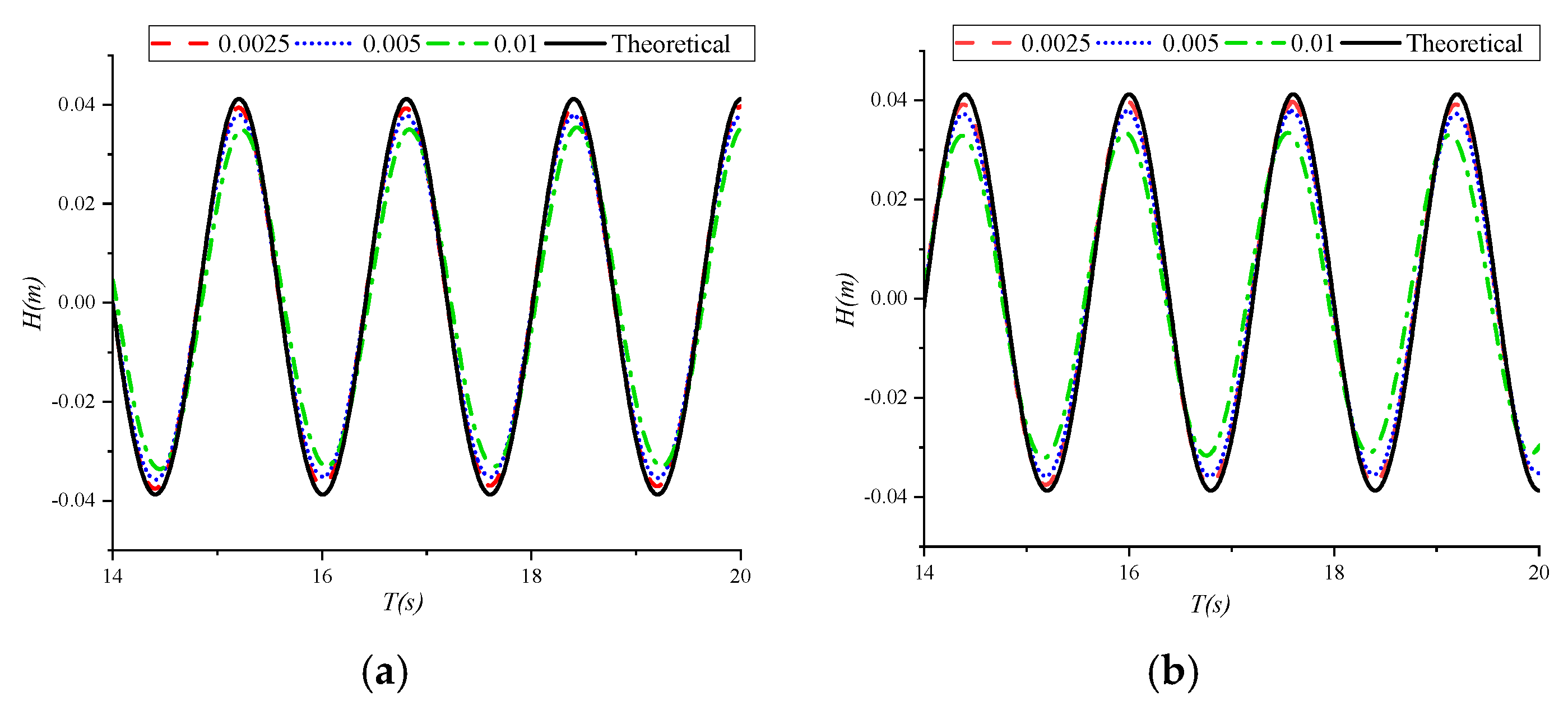
3.4. Time Step Sensitivity Analysis
4. Numerical Wave Tank Wave Dissipation System Validation Study
4.1. Model Parameters
4.2. Numerical Results Analysis
5. Selection of Optimal Hydrodynamic Performance for Different Configurations of V-Type Wave Dissipation Systems
5.1. Model Parameters
5.2. Layout and Grid Division
5.3. Numerical Results Analysis
6. Numerical Results of the V-Type Wave Dissipation System and Amphibious Landing Equipment Under Different Combined Fields
6.1. Parameters of the Numerical Wave Tank Model Under Different Combined Fields
6.2. Analysis of Numerical Results in the Combined Wave-Current Field
6.3. Analysis of Numerical Results in the Combined Wind-Wave Field
6.4. Analysis of Numerical Results in the Combined Wind-Wave-Current Field
6.4.1. Wave Height Numerical Results Analysis
6.4.2. Hydrodynamic Performance Analysis of Amphibious Landing Equipment
6.5. Comparison and Analysis of Numerical Results for Wave Dissipation Performance Under Different Combined Fields
7. Analysis and Discussion
8. Conclusions
- (1)
- A three-dimensional numerical wave tank was constructed, and the numerical results were validated against theoretical values. Using grid sensitivity and time step sensitivity analyses, it is found that the number of grid points in the free surface range significantly affects the accuracy of numerical wave generation. Setting 15 layers of grids within the wave height range provides high computational efficiency and accuracy. A time step of 0.005 s or 0.0025 s yields high numerical wave-generation precision.
- (2)
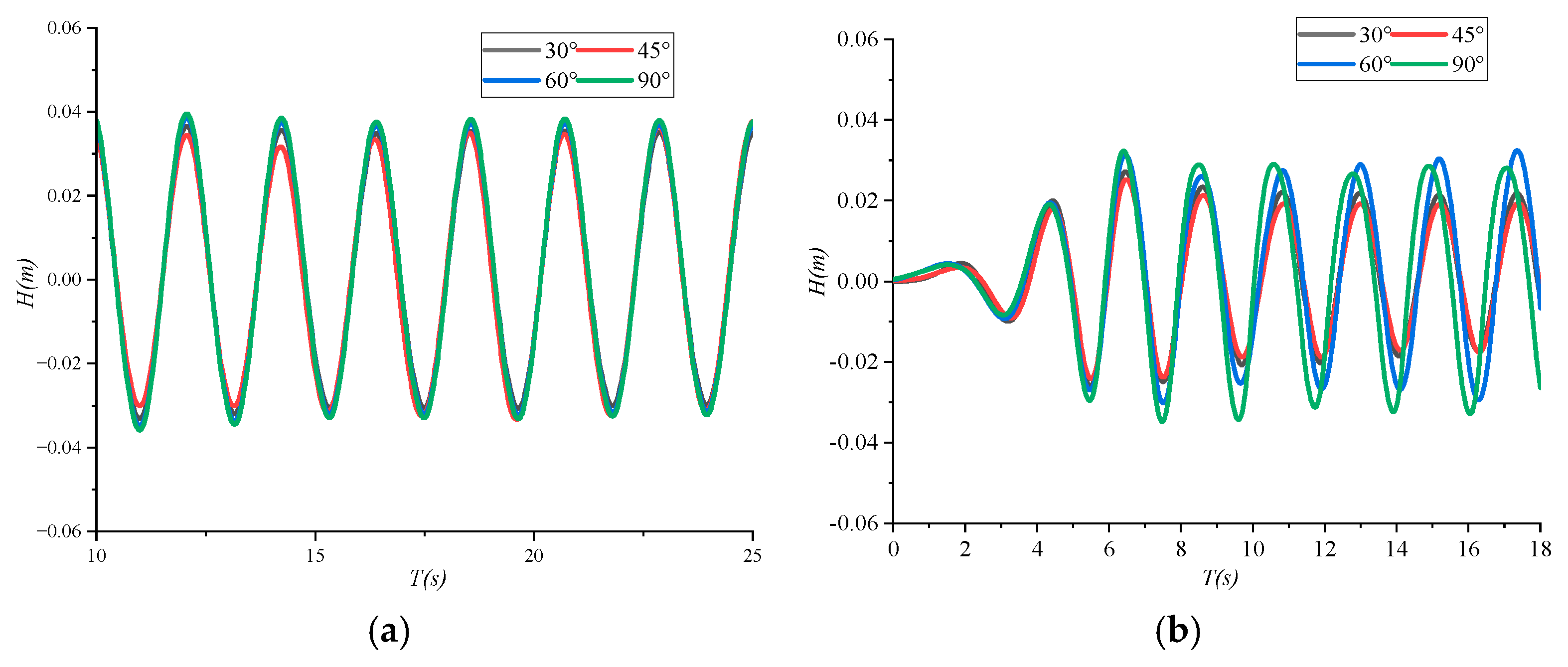
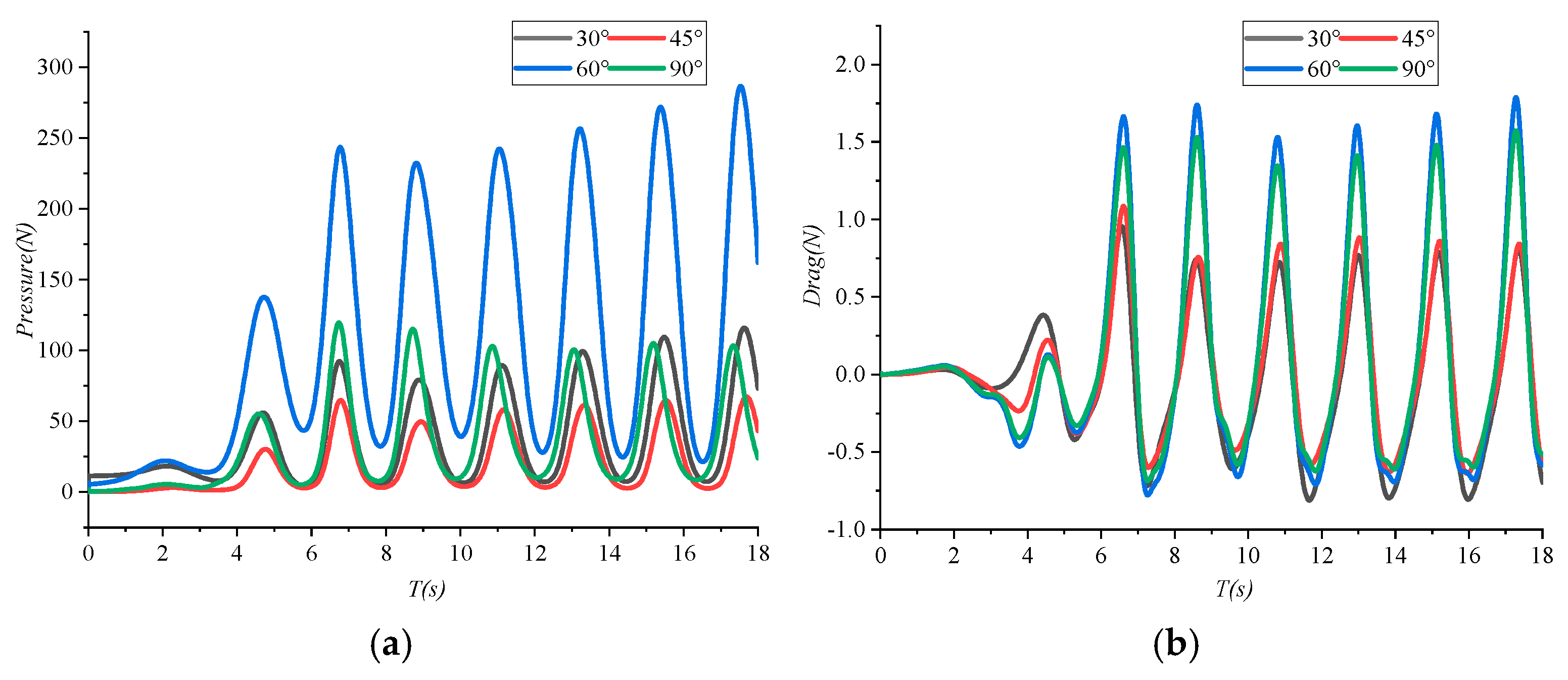
- The hydrodynamic characteristics of the V-type wave dissipation system under four different layout angles were studied under wave-only field conditions. The results show that the wave dissipation efficiency of the V-type system is relatively high for the 30° and 45° arrangements, reaching 42.46% and 42.25%, respectively. Combined with the hydrodynamic characteristics of the amphibious landing equipment, these configurations prove to be more favorable for the flow field and the amphibious landing equipment positioned behind.
- (3)
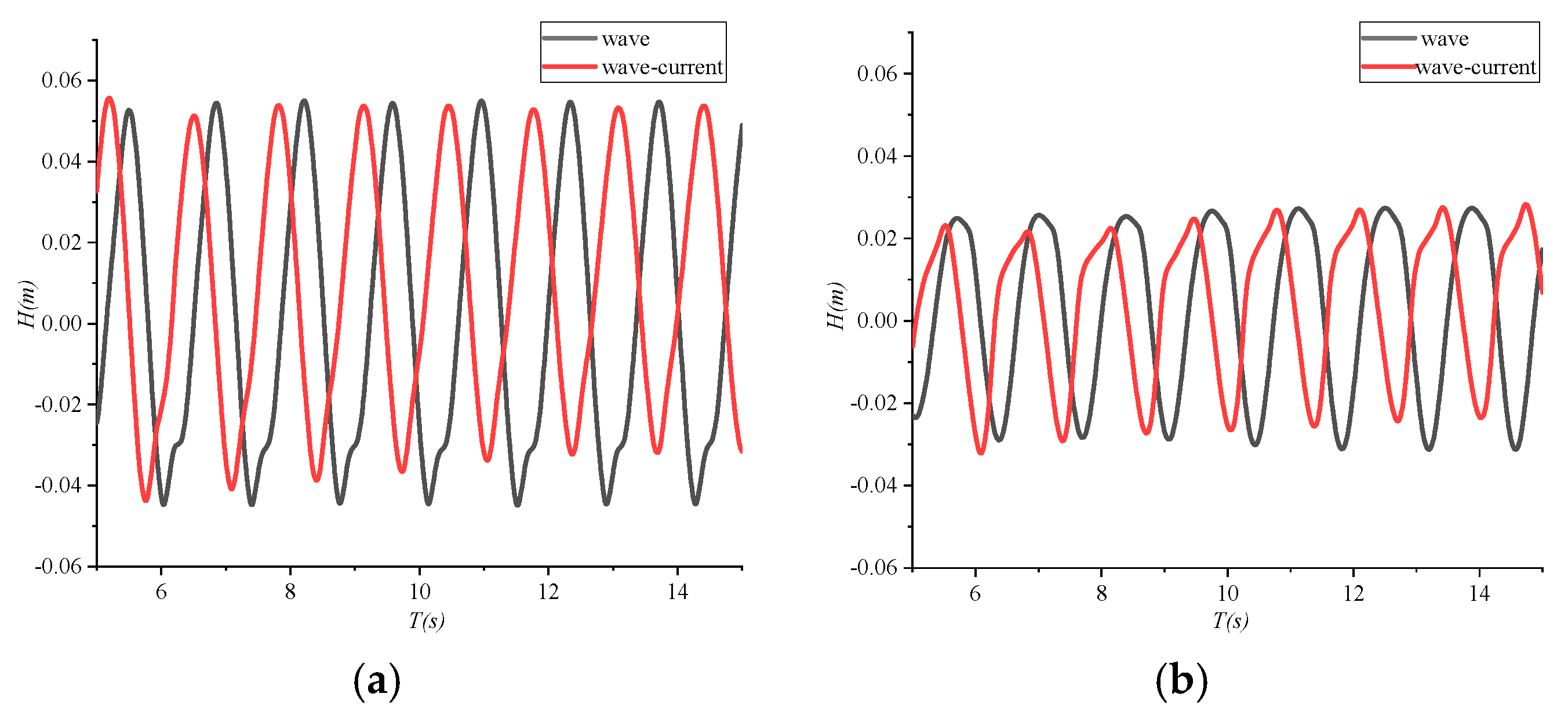
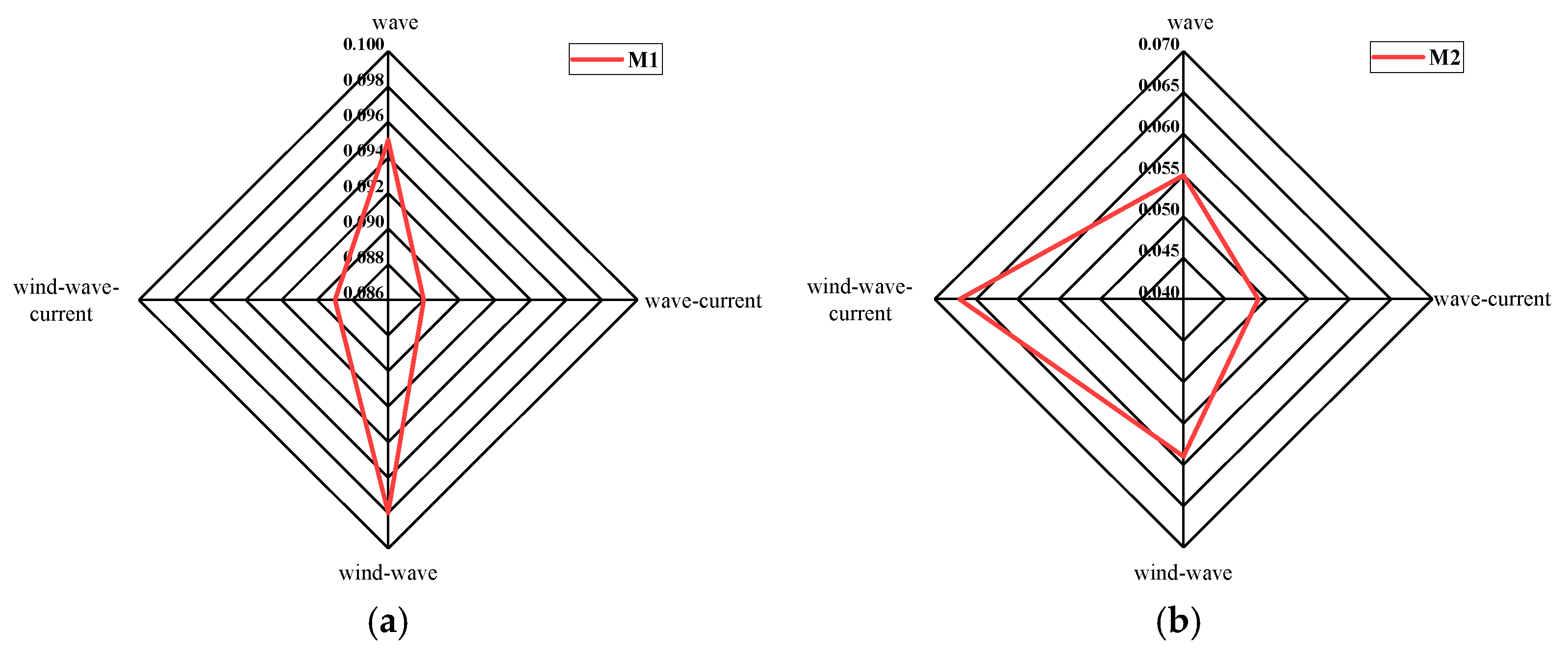
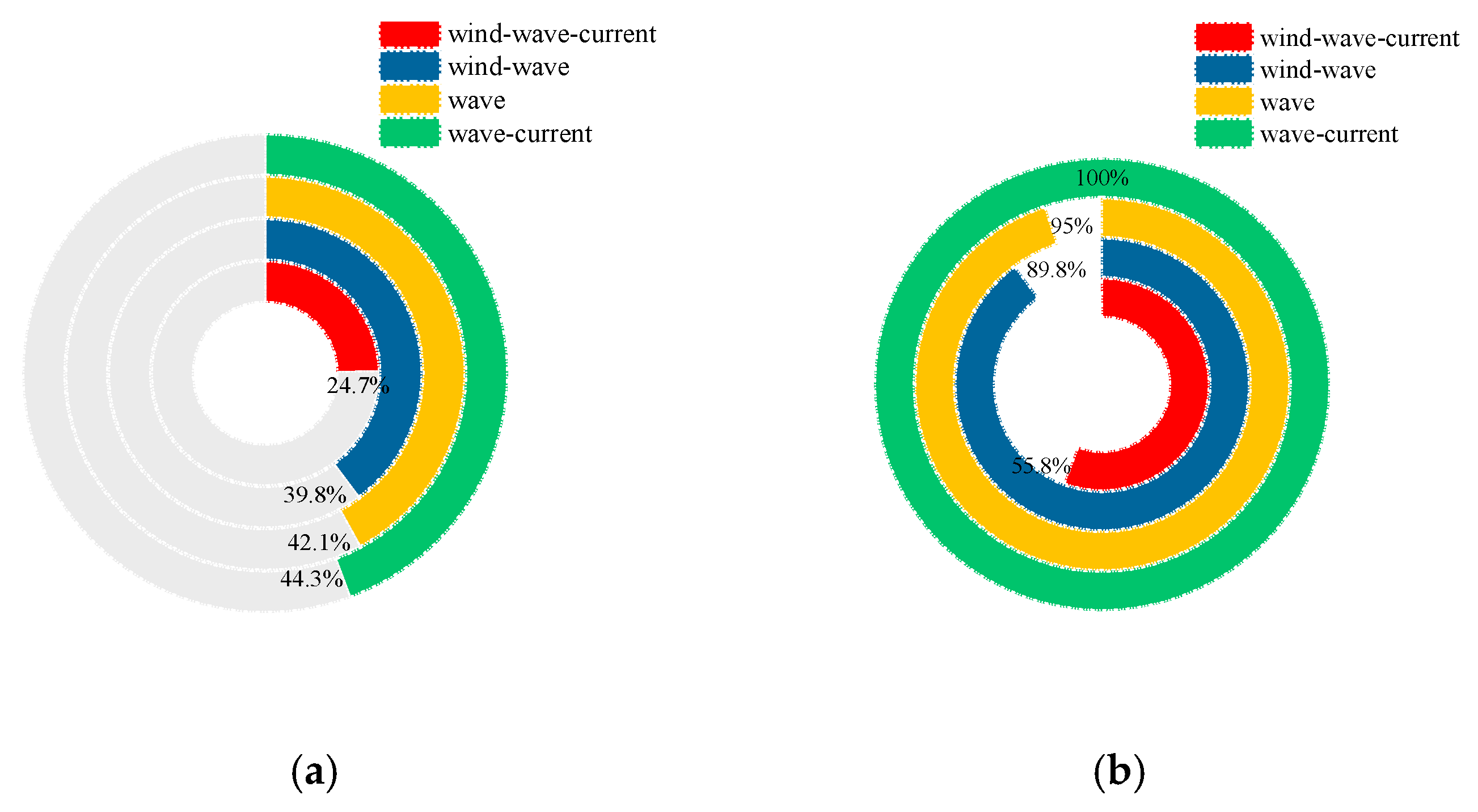
- Wave-dissipation performance and applicable scenarios of the V-type wave dissipation system arranged at the 30° angle under four different combined fields were evaluated numerically. The results indicate that the highest wave dissipation efficiency, 44.3%, is achieved under the wave-current combined field, followed by 42.1% under the wave-only field. The efficiency is lowest under the wind-wave-current combined field at 24.7%. Based on the present study, the selected V-type dissipation system is more suitable for wave-current combined and wave-only conditions, providing a valuable reference for its engineering application.
Author Contributions
Funding
Data Availability Statement
Conflicts of Interest
References
- Han, L.A.; Xi, Y.Y. Port Hydraulic Engineering Structures; China Communications Press: Beijing, China, 2010. [Google Scholar]
- Wang, Y.X.; Wang, G.Y. Research Progress and Engineering Applications of Nearshore Floating Breakwater Structures. Shipbuild. China 2002, 43, 314–321. [Google Scholar]
- Zhou, L.; Chen, K.; Zhai, S.; Niu, Z.; Hu, M. Experimental Study of the Effects of Different Floating Breakwater on Wave Absorbing. Adv. Struct. Eng. 2014, 16, 1683–1700. [Google Scholar]
- Ji, C.Y.; Bian, X.Q.; Hou, F.L.; Guo, J.T.; Lian, Z.X.; Yuan, Z.M. Experimental study on hydrodynamic characteristics of a new type floating breakwater with opening pass and wing structure. Ocean. Eng. 2022, 259, 111923. [Google Scholar] [CrossRef]
- Koraim, A.S.; Rageh, O.S. Effect of under connected plates on the hydrodynamic efficiency of the floating breakwater. China Ocean. Eng. 2014, 28, 349–362. [Google Scholar] [CrossRef]
- Loukogeorgaki, E.; Yagci, O.; Kabdasli, M.S. 3D Experimental investigation of the structural response and the effectiveness of a moored floating breakwater with flexibly connector modules. Ocean. Eng. 2014, 91, 164–180. [Google Scholar]
- He, F.; Li, J.D.; Pan, J.P.; Yuan, Z.M. An experimental study of a rectangular floating breakwater with vertical plates as wave-dissipating components. Appl. Ocean. Res. 2023, 133, 103497. [Google Scholar] [CrossRef]
- Wang, G.Y.; Ren, B.; Wang, Y.X. Experimental study on hydrodynamic performance of arc plate breakwater. Ocean. Eng. 2016, 111, 593–601. [Google Scholar] [CrossRef]
- Wang, F.J. Computational Fluid Dynamics Analysis: Principles and Applications of CFD Software; Tsinghua University Press: Beijing, China, 2004. [Google Scholar]
- Finnegan, W.; Goggins, J. Numerical simulation of linear water waves and wave-structure interaction. Ocean. Eng. 2012, 43, 23–31. [Google Scholar] [CrossRef]
- Li, Y.; Lin, M. Regular and irregular wave impacts on floating body. Ocean. Eng. 2012, 42, 93–101. [Google Scholar] [CrossRef]
- Peng, J.; Liu, Y.; Liu, J.; Li, Y. Research of Numerical Wave Generation and Wave Absorption Simulation Based on Momentum Source Method. Int. J. Digit. Content Technol. Its Appl. 2013, 121, 66–76. [Google Scholar]
- Chen, Y.L.; Hsiao, S.C. Generation of 3D water waves using mass source wavemaker applied to Navier–Stokes model. Coast. Eng. 2016, 109, 76–95. [Google Scholar] [CrossRef]
- Prasad, D.D.; Ahmed, M.R.; Lee, Y.H.; Sharma, R.N. Validation of a piston type wave-maker using Numerical Wave Tank. Ocean. Eng. 2017, 131, 57–67. [Google Scholar] [CrossRef]
- Zhang, X.S.; Ma, S.; Duan, W.Y. A new L type floating breakwater derived from vortex dissipation simulation. Ocean. Eng. 2018, 164, 455–464. [Google Scholar] [CrossRef]
- Christensen, E.D.; Bingham, H.B.; Friis, A.P.S.; Larsen, A.K.; Jensen, K.L. An experimental and numerical study of floating breakwaters. Coast. Eng. 2018, 137, 43–58. [Google Scholar] [CrossRef]
- Li, X.Y.; Wang, Q.; You, Z.J.; Guo, W.J.; Zhang, Z.B.; Zhan, C.; Zhang, Z.C.; Wang, L.X.; Li, Q. Wave attenuation performance and the influencing factors of a lower arc-plate breakwater. China Ocean. Eng. 2020, 34, 89–98. [Google Scholar] [CrossRef]
- Abdullah, S.F.; Fitriadhy, A. Application of genetic algorithm for optimum hydrodynamic performance of twin pontoon floating breakwater. J. Waterw. Port Coast. Ocean. Eng. 2020, 146, 04019040. [Google Scholar] [CrossRef]
- Zhang, C.; Magee, A.R. Effectiveness of floating breakwater in special configurations for protecting nearshore infrastructures. J. Mar. Sci. Eng. 2021, 9, 785. [Google Scholar] [CrossRef]
- Ran, X.L.; Wang, B.; Duan, W.J.; Chen, K.; Gan, J. Study on Wave Attenuation Performance of V-shaped Flexible Floating Breakwater. J. Wuhan Univ. Technol. (Transp. Sci. Eng.) 2021, 45, 76–81. [Google Scholar]
- Sun, B.; Zhang, H.J.; Yang, S.L.; Yang, L.; Chen, S.Z.; Li, C. The hydraulic characteristics and shape optimisation of submerged Box-type floating breakwater. Ships Offshore Struct. 2022, 17, 2329–2339. [Google Scholar] [CrossRef]
- Yuan, P.Y.; Zhao, Y.; Zhang, X.Y. Study on the Nonlinear Wave Climbing Characteristics of Floating Breakwaters in a Numerical Water Tank. Shipbuild. China 2023, 64, 134–142. [Google Scholar]
- Ji, C.Y.; Bian, X.Q.; Xu, S.; Guo, J.T.; Huo, F. Numerical study on the hydrodynamic performance of floating breakwaters with complex configurations. Ocean. Eng. 2023, 273, 114032. [Google Scholar] [CrossRef]
- Cartwright, B.; Renilson, G.; Macfarlane, G.; McGuckin, D.; Esi, A.P.; Cannon, S. Motions of a landing craft in a flooded well dock-effect of well dock design. In Proceedings of the International Conference on Military Support Ships, Sydney, Australia, 3–5 October 2007. [Google Scholar]
- Yoon, S.-H.; Seo, K.-H. Well Dock Design and Assessment of Relative Motions During the Operation of the Landing Crafts Within Well Dock. J. Soc. Nav. Archit. Korea 2012, 49, 164–173. [Google Scholar] [CrossRef]
- Hu, X.Q. Hydrodynamic Performance Analysis of Ships with Hold Compartments; Jiangsu University of Science and Technology: Zhenjiang, China, 2019. [Google Scholar]
- Ji, C.Y.; Yong, C.; Ke, Y.; Gaidai, O. Numerical and experimental investigation of hydrodynamic performance of a cylindrical dual pontoon-net floating breakwater. Coast. Eng. 2017, 129, 1–16. [Google Scholar] [CrossRef]
- Chorin, A.J. A numerical method for solving incompressible viscous flow problems. J. Comput. Phys. 1967, 2, 12–26. [Google Scholar] [CrossRef]
- Versteeg, H.K.; Malalasekera, W. An Introduction to Computation Fluid Dynamics: The Finite Volume Method; Wigley: New York, NY, USA, 1995. [Google Scholar]
- Menrer, F.R.; Kuntz, M.; Langtry, R. Ten years of industrial experience with the SST turbulence model. Turbul. Heat Mass Transf. 2003, 4, 35–42. [Google Scholar]
- Wilcos, D.C. Multi Scale Model for Turbulence Flows. In Proceedings of the AIAA 24th Aeropace Sciences Meeting, Reno, NV, USA, 6–9 January 1986; American Institute of Aeronautics and Astronautics: Reston, VA, USA, 1986. [Google Scholar]
- Hu, J.M.; Li, T.L.; Lin, Y.; Guan, G.; Zheng, Z.B. Prediction of ship power and speed performance based on RANS method. Int. Shipbuild. Prog. 2017, 64, 51–78. [Google Scholar] [CrossRef]
- Issa, R.I. Solution of the implicitly discretised fluid flow equations by operator-splitting. J. Comput. Phys. 1986, 62, 40–65. [Google Scholar] [CrossRef]
- Hirt, C.W.; Nichols, B.D. Volume of fluid (VOF) method for the dynamics of free boundary. J. Comput. Phys. 1981, 39, 201–225. [Google Scholar] [CrossRef]
- Su, L.; Lin, X.R.; Wang, X.G. Numerical simulation of airbag type floating breakwater on wave blocking and wave elimination. Port Waterw. Eng. 2021, 8, 1–7. [Google Scholar]
- Ke, S.T.; Wang, S.; Zhang, W.; Wang, Y.; Wang, T.G. Comparative analysis on wave propagation and evolution mechanism under the coupling effect of wind, wave and current fields. J. Harbin Eng. Univ. 2021, 42, 9. [Google Scholar]
- Wang, K.; Wan, Y.C.; Liu, T.H.; Fan, T.H.; Mai, Z.H.; Wu, H. Study on the joint distribution of wind and wave in offshore wind farms of Guangdong sea area. Shipbuild. China 2022, 6, 273–284. [Google Scholar]
- Chen, Y.Q.; Chen, A.R.; Ma, R.J. A joint probabilistic model of design wave and wind parameters for offshore structures under typhoon circumstances. J. Highw. Transp. Res. Dev. 2016, 33, 89–94. [Google Scholar]




| Wave Model | Wave Length | Wave Height | Water Depth | Wave Period |
|---|---|---|---|---|
| Fifth-order Stokes wave | 4 m | 0.08 m | 2.5 m | 1.6 s |
| Grid Conditions | Grid Spacing in the Z Direction | Grid Spacing in the X Direction | Number of Grids |
|---|---|---|---|
| 10-layer grid | A/10 | 6 × A/10 | 387,000 |
| 15-layer grid | A/15 | 6 × A/15 | 724,992 |
| 20-layer grid | A/20 | 6 × A/20 | 1,236,992 |
| Operating Conditions | Monitoring Points | Numerical Value (Ht/m) | Experimental Value (Ht/m) | Numerical Value (/%) | Experimental Value (/%) |
|---|---|---|---|---|---|
| Case 1 | M1 (3 m) | 0.0247 | 0.0249 | 67.07 | 66.80 |
| M2 (5 m) | 0.0395 | 0.0400 | 47.33 | 46.67 | |
| Case 2 | M1 (3 m) | 0.0424 | 0.0422 | 43.47 | 43.73 |
| M2 (5 m) | 0.0483 | 0.0491 | 35.60 | 34.53 |
| Model | Berm Width (m) | Berm Length (m) | Berm Height (m) |
|---|---|---|---|
| Original Model | 8 m | 60 m | 8 m |
| Numerical Model | 0.4 m | 3 m | 0.4 m |
| Model | Vehicle Length (m) | Width (m) | Height (m) | Combat Weight (t) |
|---|---|---|---|---|
| Original Model | 8.435 m | 3.2 m | 3.122 m | 18.4 t |
| Numerical Model | 0.42175 m | 0.16 m | 0.1561 m | 0.0023 t |
| Layout Angles | 30° | 45° | 60° | 90° |
|---|---|---|---|---|
| M1 | 0.0365 m | 0.0355 m | 0.0364 m | 0.0365 m |
| M2 | 0.021 m | 0.0205 m | 0.028 m | 0.030 m |
| 42.46% | 42.25% | 23.07% | 17.81% |
| Conditions | Model | Wind Velocity | Current Velocity | Wave Height | Test Period (s) |
|---|---|---|---|---|---|
| Original sea conditions | 20:1 | 6 m/s | 0.62 m/s | 2 m | 4.95 s |
| Experimental conditions | 1.341 m/s | 0.1386 m/s | 0.1 m | 1.108 s |
| Conditions | Average Wave Height at M1 | Average Wave Height at M2 | Dissipation Efficiency δ = (1 − M2/M1) |
|---|---|---|---|
| Wave-only field | 0.095 m | 0.055 m | 42.1% |
| Combined Wave-current field | 0.088 m | 0.049 m | 44.3% |
| Conditions | Average Wave Height at M1 | Average Wave Height at M2 | Dissipation Efficiency δ = (1 − M2/M1) |
|---|---|---|---|
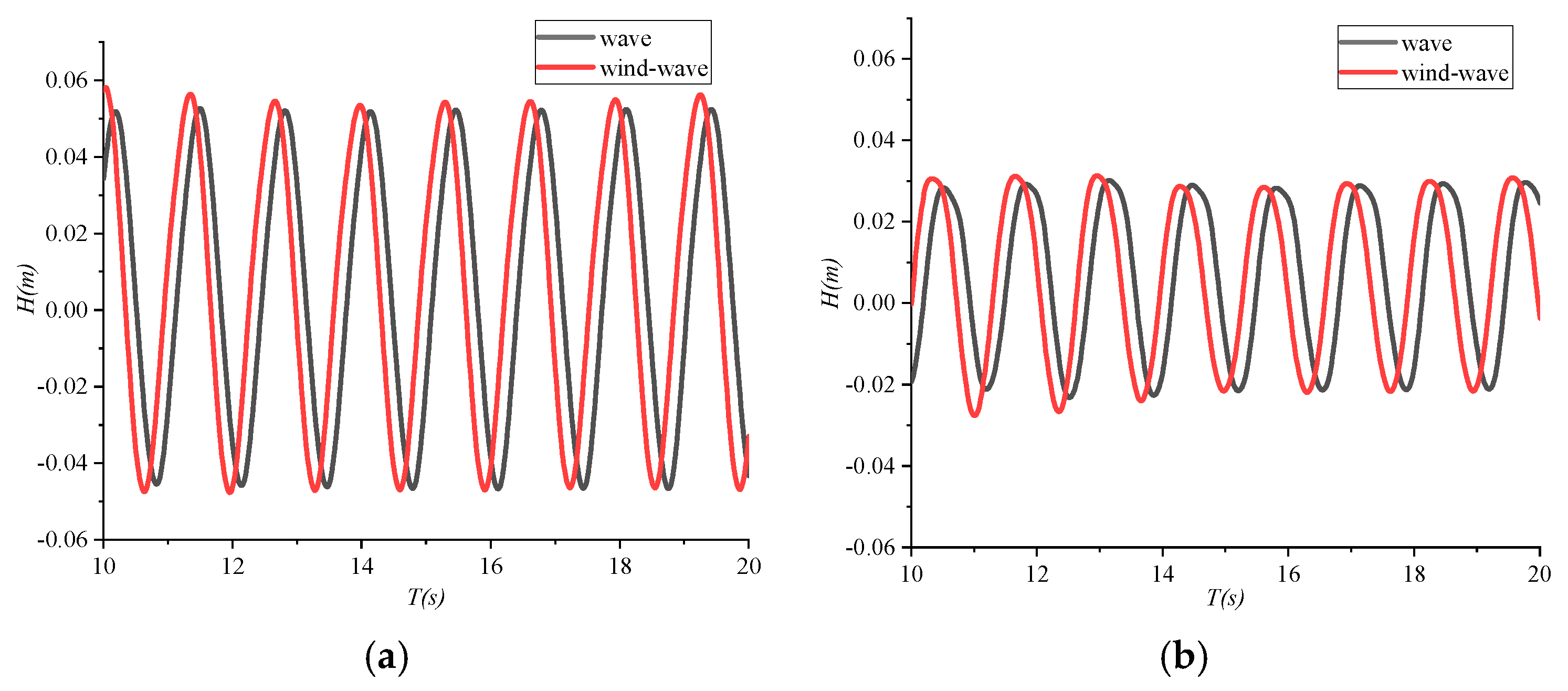
| Wave-only Field | 0.095 m | 0.055 m | 42.1% |
| Combined Wind-Wave Field | 0.098 m | 0.059 m | 39.8% |
| Conditions | Average Wave Height at M1 | Average Wave Height at M2 | Dissipation Efficiency δ = (1 − M2/M1) |
|---|---|---|---|
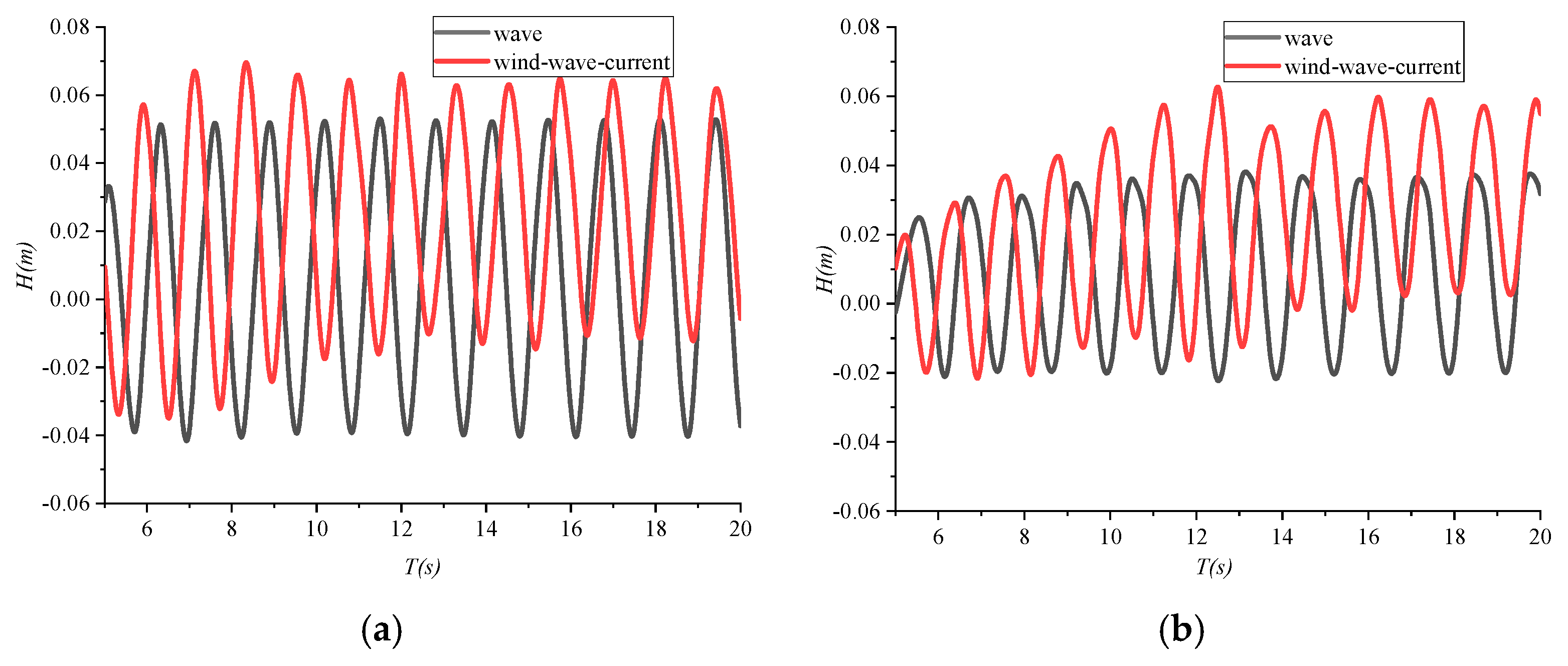
| Wave-only field | 0.095 m | 0.055 m | 42.1% |
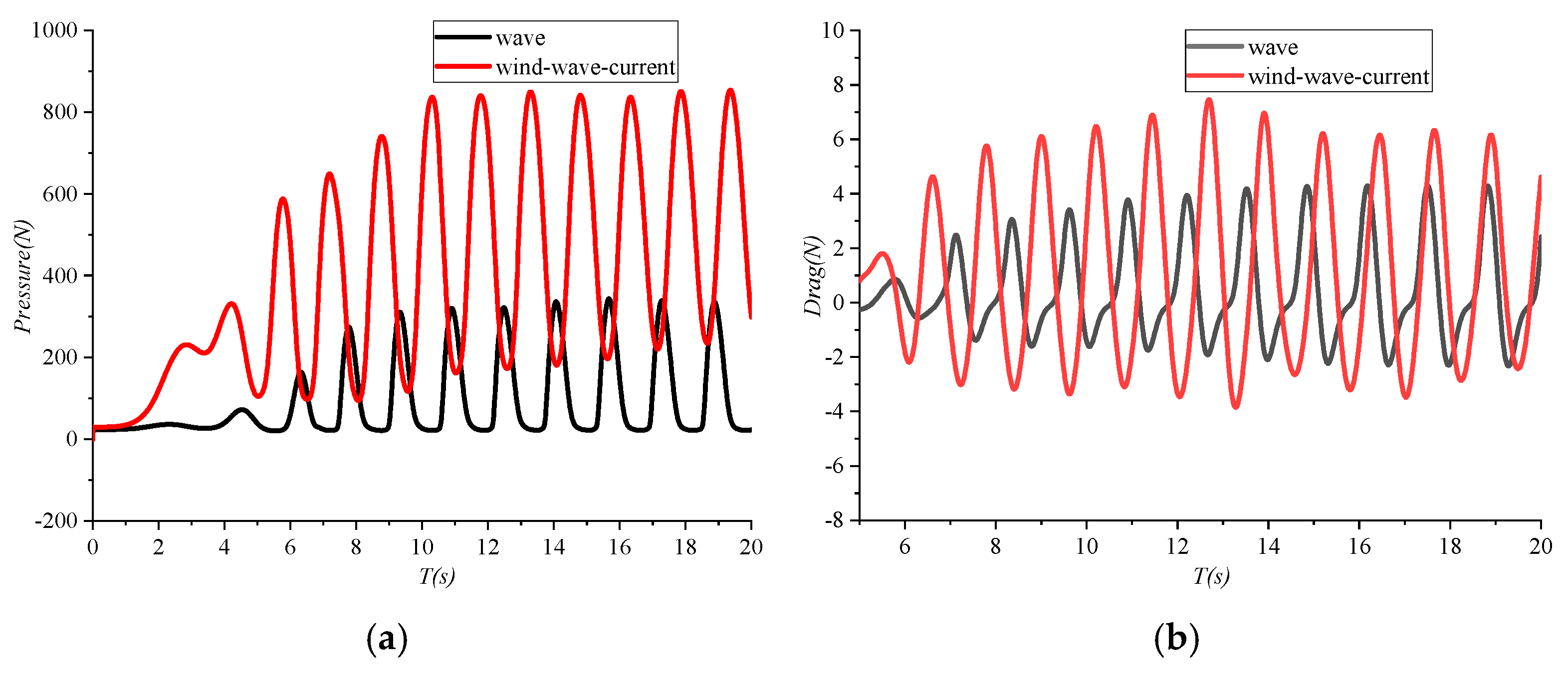
| Combined Wind-wave-current field | 0.089 m | 0.067 m | 24.7% |
Disclaimer/Publisher’s Note: The statements, opinions and data contained in all publications are solely those of the individual author(s) and contributor(s) and not of MDPI and/or the editor(s). MDPI and/or the editor(s) disclaim responsibility for any injury to people or property resulting from any ideas, methods, instructions or products referred to in the content. |
© 2026 by the authors. Licensee MDPI, Basel, Switzerland. This article is an open access article distributed under the terms and conditions of the Creative Commons Attribution (CC BY) license.
Share and Cite
Hu, J.; Song, C.; Deng, J.; Yu, X.; Zhang, D. Numerical Investigation of the Hydrodynamic Performance of a V-Type Wave Dissipation System and Amphibious Landing Equipment Under Different Combined Fields. Water 2026, 18, 309. https://doi.org/10.3390/w18030309
Hu J, Song C, Deng J, Yu X, Zhang D. Numerical Investigation of the Hydrodynamic Performance of a V-Type Wave Dissipation System and Amphibious Landing Equipment Under Different Combined Fields. Water. 2026; 18(3):309. https://doi.org/10.3390/w18030309
Chicago/Turabian StyleHu, Junming, Chengshuai Song, Jiaxian Deng, Xueying Yu, and Daiyu Zhang. 2026. "Numerical Investigation of the Hydrodynamic Performance of a V-Type Wave Dissipation System and Amphibious Landing Equipment Under Different Combined Fields" Water 18, no. 3: 309. https://doi.org/10.3390/w18030309
APA StyleHu, J., Song, C., Deng, J., Yu, X., & Zhang, D. (2026). Numerical Investigation of the Hydrodynamic Performance of a V-Type Wave Dissipation System and Amphibious Landing Equipment Under Different Combined Fields. Water, 18(3), 309. https://doi.org/10.3390/w18030309