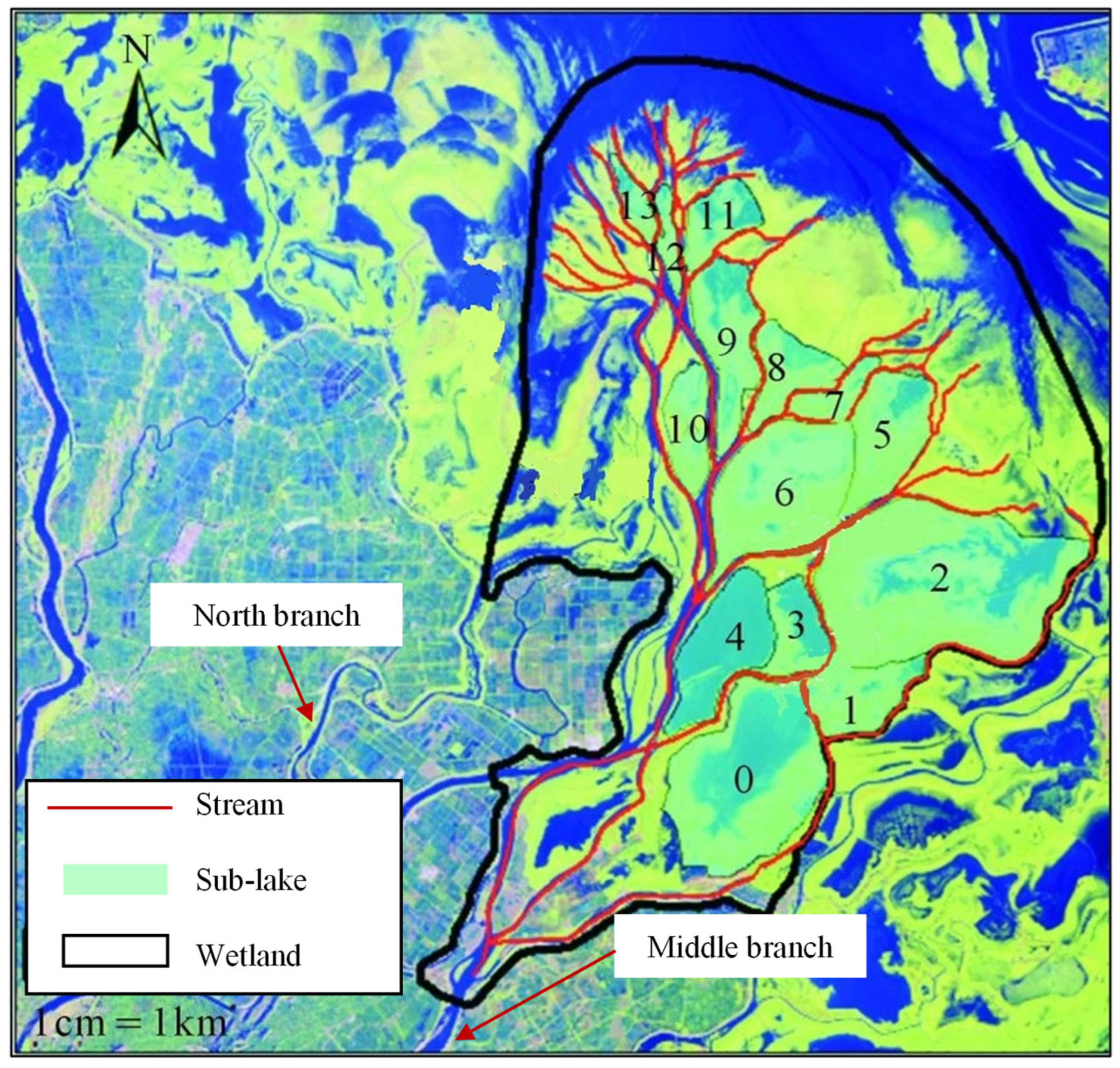
3.1. Analysis of Hydrological Situation in Flood–Dry Transition Period at the GJRT
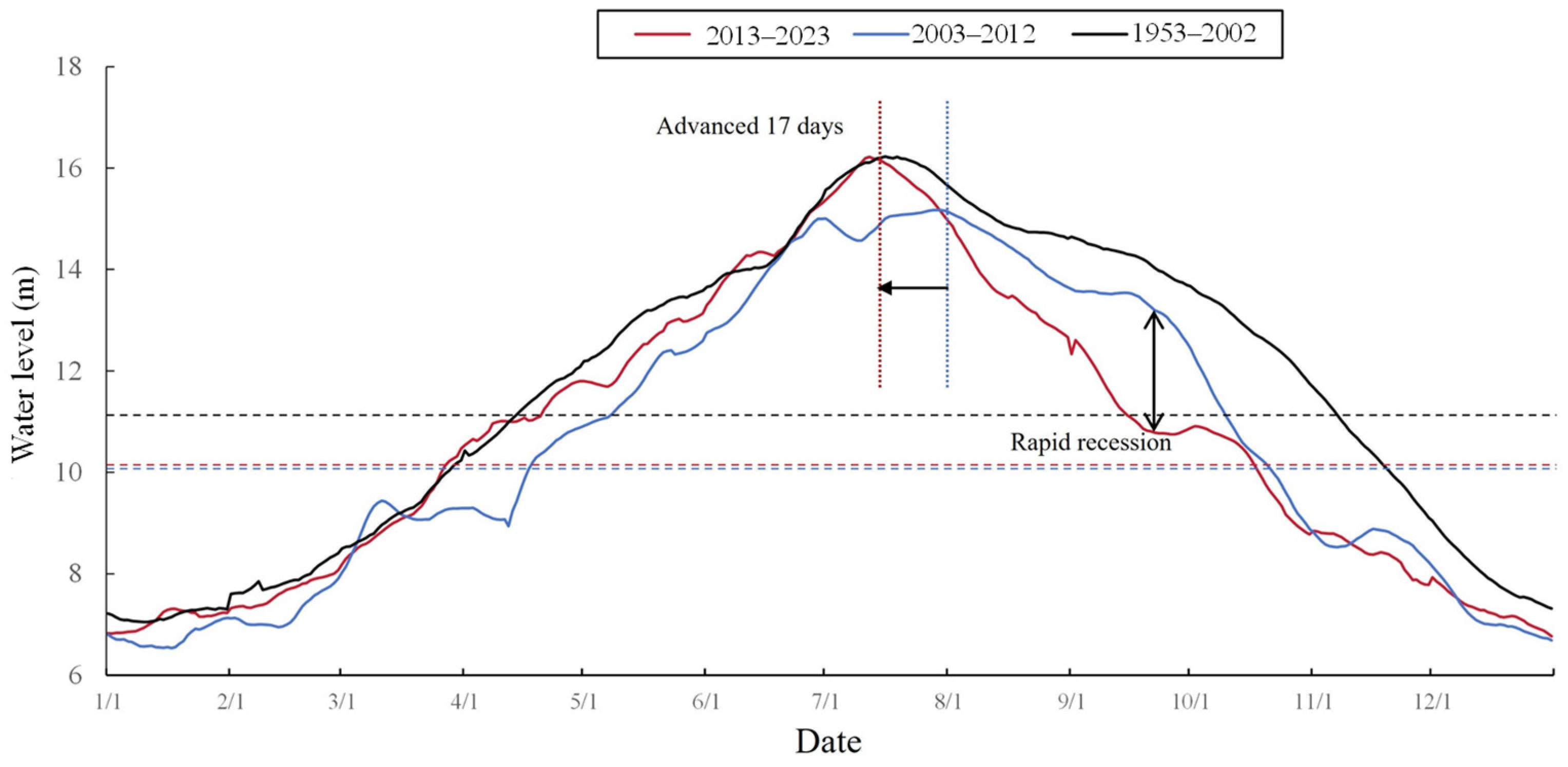
To effectively utilize water resources at the end of the flood season and cope with the dry event, the transition stage between flood season and dry season is a critical phase for regulating the water conservation project group. Given that the flood season at the GJRT is from April to June, the flood–dry transition period is from May to October.
- (1)
Water level
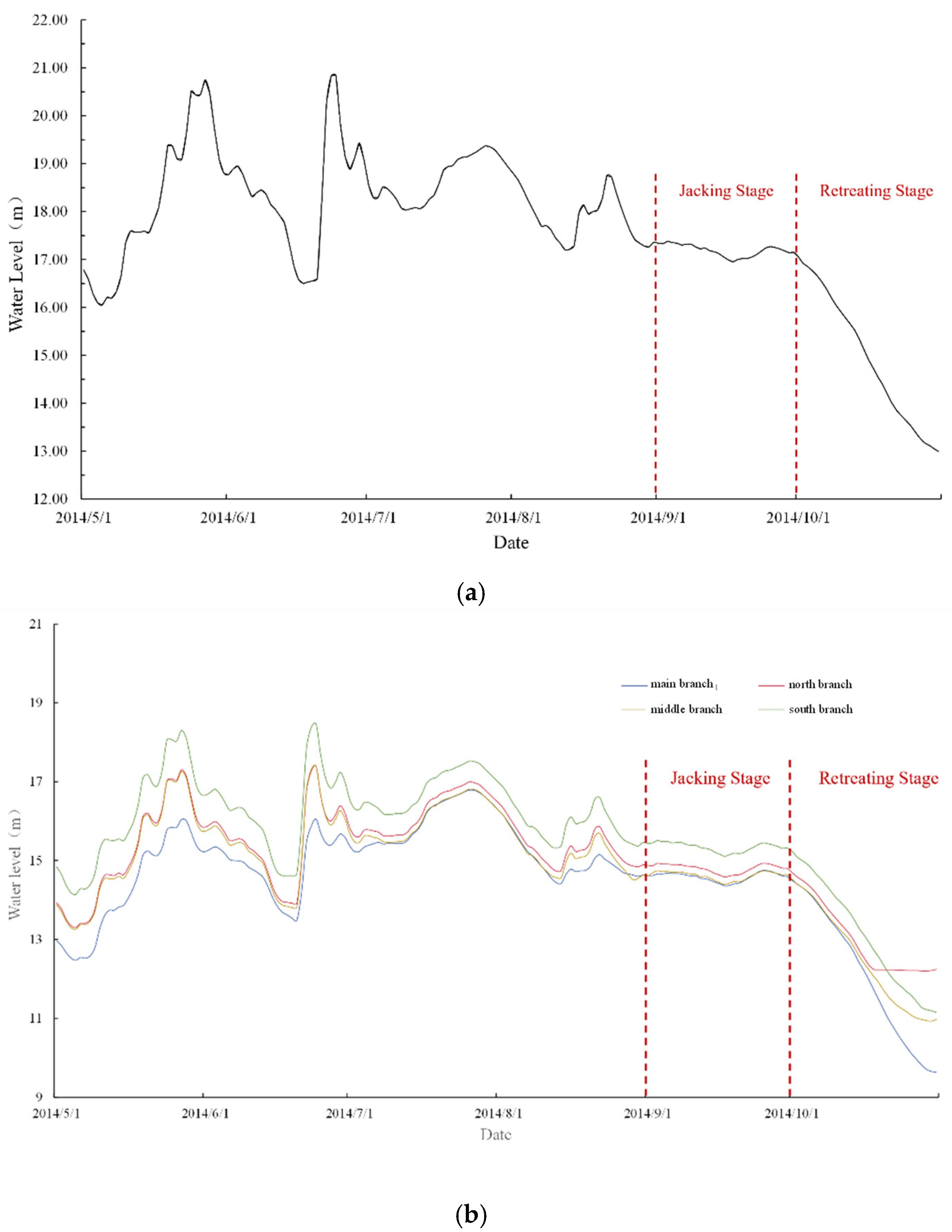
The water level variation process from May to October is shown in
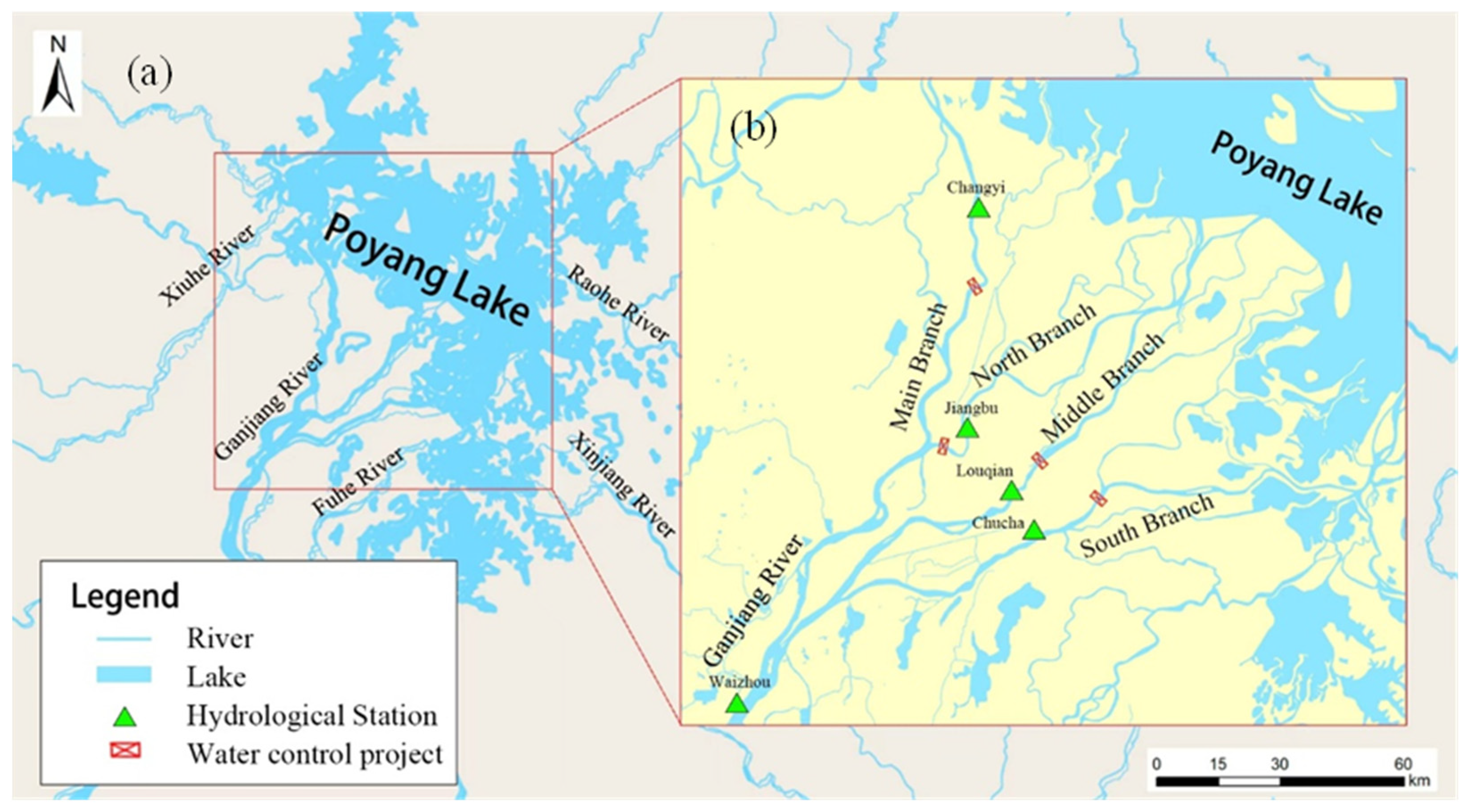
Figure 6. From 1 May to 31 August, the water level of Waizhou Station experienced several significant increases, reaching a peak water level of 21 m. May and June were the flood season for the Ganjiang River, while July and August were the flood season of Poyang Lake. The alternating occurrence of floods in the Ganjiang River and Poyang Lake led to significant fluctuations in the water level at the GJRT.
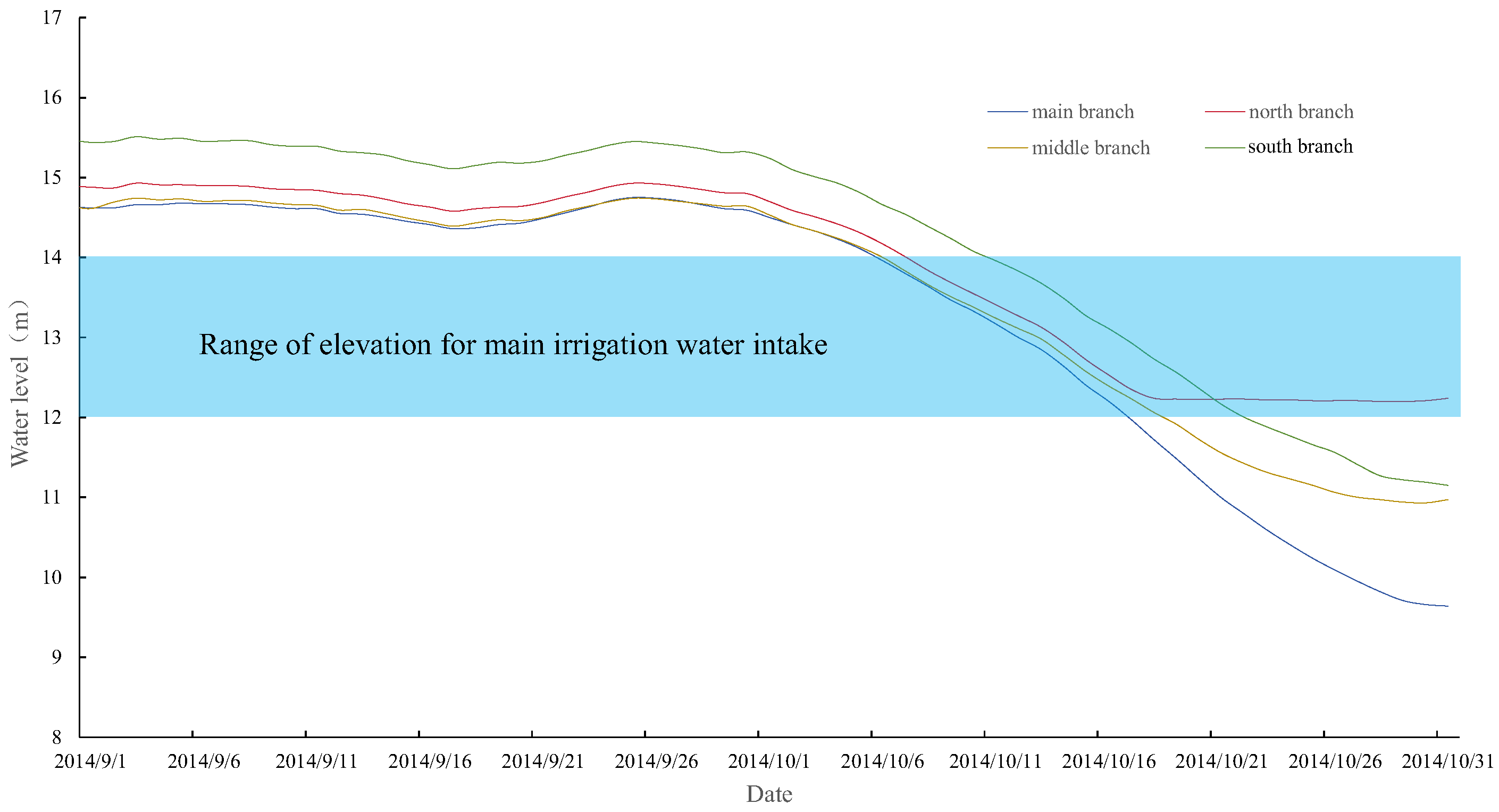
From 1 to 30 September, the water level at Waizhou Station remained stable at around 17.2 m, which is associated with the jacking effect of Poyang Lake. As the retreating process of Poyang Lake has not yet ended in September, the jacking of Poyang Lake on the GJRT hindered the retreat of this area. From 1 to 31 October, the GJRT entered the retreating stage, with a sharp drop in water level. During the flood–dry transition period, the water level process of each branch of the GJRT was basically consistent with that of Waizhou Station. The water level dropping in the GJRT would influence the growth of wetland vegetation. Tan [
20] revealed that the grassland area in the southern part of Poyang Lake (e.g., the GJRT) exhibited greater sensitivity to fluctuations in water levels compared to other regions within the lake basin.
- (2)
Discharge
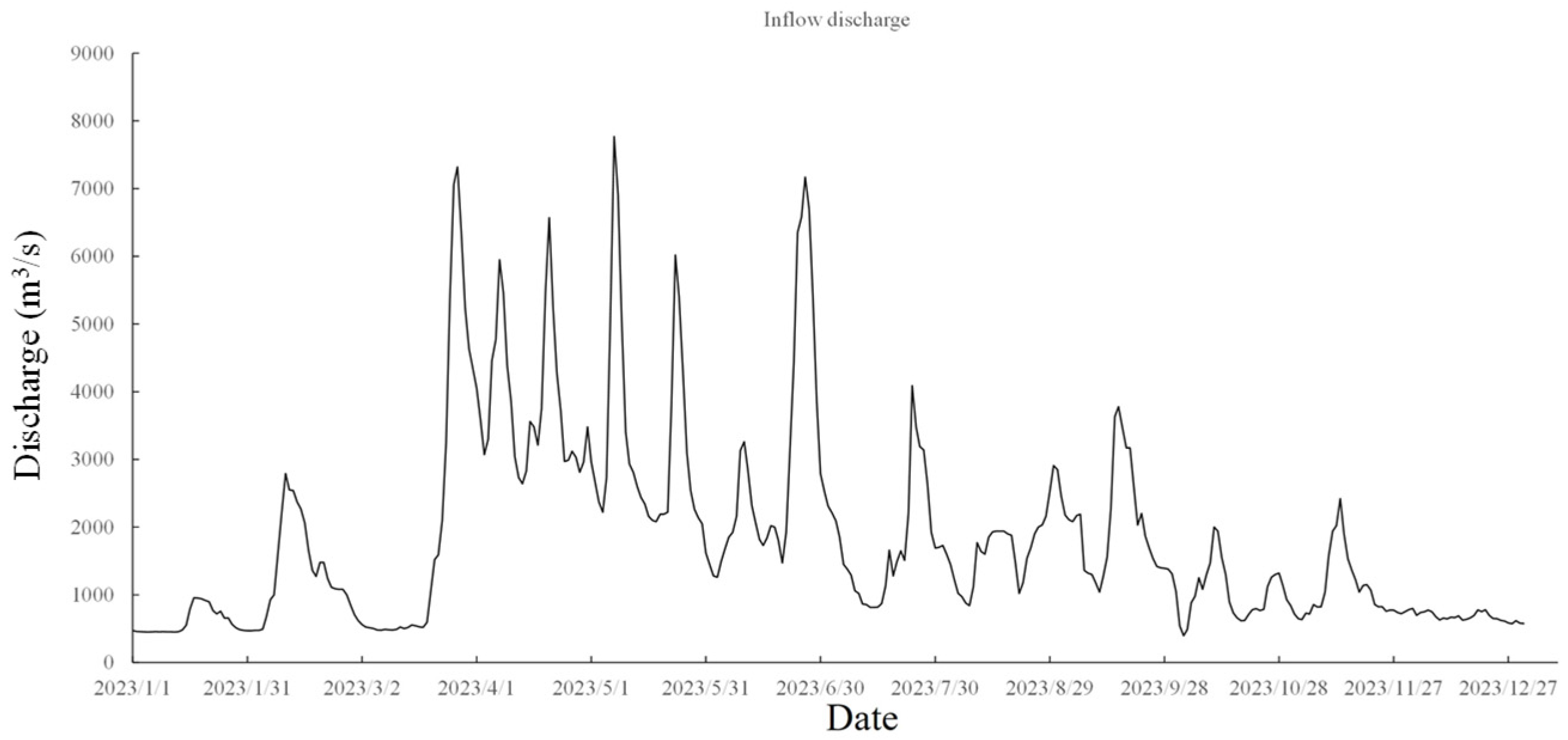
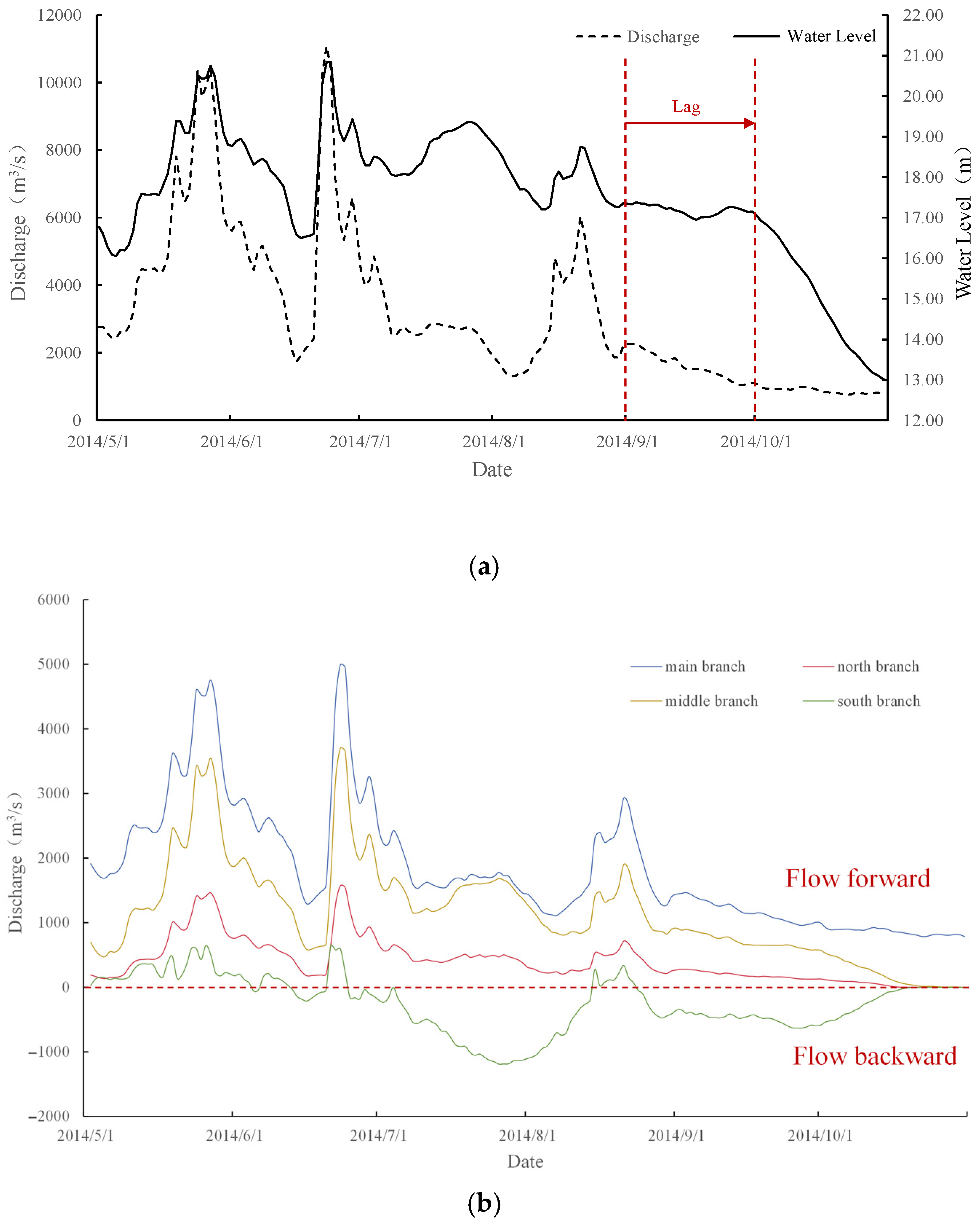
The discharge varying process from May to October was shown in
Figure 7a. Before 1 September, the water level and discharge showed synchronous changes. After 1 September, the discharge of Waizhou Station gradually decreased. Unlike the trend of discharge, the water level at Waizhou Station began to decrease on 1 October. After September, the inconsistency in the trend of water level and discharge changes at Waizhou Station is mainly due to the jacking effect of Poyang Lake.
The discharge of each branch exhibited the same trend as that of Waizhou Station. Specifically, the discharge of the south branch turned negative after July, indicating that the jacking effect of Poyang Lake in flood season led to the backflow of lake water into the south branch (
Figure 7b).
3.2. The Joint Regulation Strategy of Water Conservation Hub Group at the GJRT
- (1)
Regulation Objectives
According to the “GJRT Improvement Plan”, the regulation objectives include ensuring the overall water level of the GJRT and discharge of each branch in the braided river channel. The water level requirement for the GJRT is that the water level of Waizhou Station is not less than 15.5 m. The discharge demand for the GJRT is as follows:
(1). When the discharge of Waizhou Station is 488.7 m3/s, it could meet the ecological, production and living, and navigation demands during the dry season.
(2). When the discharge of the main branch is 341 m3/s, it could meet the ecological and navigation demands during the dry season.
(3). When the discharge of the northern branch is 5.1 m3/s, it could meet the ecological water demand during the dry season.
(4). When the discharge of the middle branch is 60.4 m3/s, it could meet the ecological and production and living water demands during the dry season.
(5). When the discharge of the southern branch is 61 m3/s, it could meet the ecological and navigation demands.
- (2)
Regulation Scenarios
The principle of the regulation scenario is to fully utilize the incoming water during flood–dry transition period to ensure the water level and discharge demand during the dry season. The water level decreases rapidly after 1 October (
Figure 6a), which makes water storage more challenging. The starting time for the hub regulation should be set on 1 October, as the discharge of Waizhou Station was 800 m
3/s. The regulating timing is associated with the influence of Three Gorges Dam (TGA) on Poyang Lake water level. After the operation of the TGA in 2003, the relationship between the Yangtze River and Poyang Lake underwent significant changes. Due to the impoundment of TGA at the end of the flood season, Poyang Lake water level in October–December decreased [
21].
Setting the input discharge as 800 m
3/s, we conducted the regulation numerical experiment by adjusting the water level before the gate of each project. To satisfy the overall water level demand (15.5 m), we synchronously set the water levels before each gate to 13.5, 14.5, 15.5, and 16.5 m for RS-1 to RS-4, respectively (
Table 3).
Table 4 shows the regulation effect for equal water level scenarios. For RS-1 and RS-2, under the condition of the water level in front of each gate lower than 15.5 m, the water level at Waizhou Station could not reach the regulation target. The discharge of the main branch was 324.27 m
3/s for RS-3, which decreases to 289.82 m
3/s for RS-4. For RS-3 and RS-4, raising the water level before each gate could effectively improve the water level of Waizhou Station, but it could not meet the discharge demand of the main branch. The evaluation of regulation scenarios (RS1-RS-4) is shown in
Table 5. The result shows that adopting the equal water level scenarios would face the problem of unreasonable discharge distribution in the multi-level branching river in the GJRT.
To increase the discharge of the main branch while ensuring the water level demand of Waizhou Station, this paper proposes different water level scenarios for water levels before each gate (
Table 6). The principle of the scenario is to lower the water level in the main branch (RS-8) or raise the water level in other three branches (RS-5 to RS-7). For RS-5 to RS-7, as the water level of the south branch, the middle branch, and the north branch increased by the same range (from 15.5 m to 15.6 m), the discharge of the main branch increased to 336.51 m
3/s, 344.21 m
3/s, and 358.1 m
3/s, respectively (
Table 7). The evaluation of regulation scenarios (RS5-RS-8) is shown in
Table 8, which indicates that RS6-RS8 could achieve the regulation objectives. However, the main branch’s discharge sensitivity to water level changes in the other three branches varies. Specifically, adjusting the water level of the north branch—closer to the main branch—has a more significant impact on the main branch’s discharge than adjusting that of the south branch, which is farther away. For RS-8, the discharge of the main branch was 384.55 m
3/s, significantly higher than that of RS-5 to RS-7. To increase the main branch’s discharge, lowering its water level is more effective than raising the water level of the other three branches. This may be attributed to the fact that the discharge of each branch is primarily related to its water surface gradient. By lowering the water level upstream of the main branch’s gate, the water surface gradient of the main branch could be effectively increased. However, raising the water levels upstream of other branches’ gates has a very limited effect on increasing the water level in the upper reaches of the main branch, thus making it difficult to significantly enhance the discharge of the main branch.