


Abstract
To solve the problems of s arehigh operating costs and excessive electricity consumption of cascade water supply pump stations in large-scale water transfer projects, this paper develops three optimized operation models for pump station group. Model 1 aims to minimize the daily total electricity cost, Model 2 aims to minimize the daily total electricity consumption, and Model 3 considers both time-of-use electricity prices and regulation and storage of canal section. The dynamic programming algorithm was employed to solve the optimized models. Taking the cascade pump station group of the Yellow River to Qingdao Water Regulation Project in China as an example, application research was conducted under average daily pumping flow of 8 m3/s; 16 m3/s; 24 m3/s; and 32 m3/s. Results indicate that all models exhibit excellent economic performance. Among them, the best performance was achieved by the Model 3 scenario, which consumed 98,700 kWh, 195,600 kWh, 293,400 kWh, and 394,500 kWh of electricity, and reduced the operating costs by 37,100, 38,100, 34,300, and 4400 USD, respectively, compared with the fixed-flow condition.
1. Introduction
Cascade pump stations serve as the primary power source for water regulation projects. These stations elevate water in a series configuration, overcoming topographical constraints to facilitate long-distance water conveyance, thereby effectively alleviating the uneven spatial and temporal distribution of water resources [1]. However, the process of water conveyance results in substantial energy consumption, with electricity usage accounting for more than 95% of the total consumption [2]. To comply with the directives of the ‘Work Plan for Energy and Resource Conservation in Public Institutions’, it is necessary to investigate optimized schemes for cascade pump stations, with the objective of achieving energy savings and emission reductions [3].
The objective of optimal regulation in cascade pump station water conveyance systems is to identify the most energy-efficient operational strategy while adhering to the constraints of pipe loss, flow rate, and head range under specified flow conditions. Zhang et al. [4] proposed an optimized regulation method for cascade pump stations based on the improved Harris Hawks algorithm and established a model for the water diversion system in Beijing, which effectively enhanced the operational efficiency of the cascade pump station system and reduced the operational costs. Gao et al. [2] took head, time-of-use electricity pricing, and control frequency into account, constructing a flow distribution model for the Bozhou pump station group, which effectively decreased the operational expenses. Guo et al. [5] developed a two-layer daily economic optimization model for single-stage pump stations, consisting of a daily economic optimization model and an operational efficiency optimization model, which effectively reduced the operational costs by 18%. Xu et al. [6] developed a flow optimization allocation model for the Liyuzhou pumping station to address the insufficient reliability and practicality of flow optimization allocation schemes caused by flow monitoring errors during the pumping process. The model revealed the response patterns of the number of pump stations and overall efficiency to flow monitoring errors and identified sensitive areas for the optimal number of pump stations. To improve the economic efficiency of the pumping station, Michał [7] analyzed the relationship between the operating electricity cost and electricity price of the pumping station by predicting and analyzing energy consumption and obtained a scientific profit ratio of the pumping station system for different periods. Aiming at the significant energy consumption of water supply pump stations annually, Chen et al. [8], based on a dynamic level feedback control method and NSGA-II algorithm, established a simulated two-stage system for water intake and supply pump stations, which can effectively decrease the total energy consumption and carbon dioxide emissions. Aimed to enhance the economic efficiency of pump station operations in Ningbo, China, Chen et al. [9] applied a fuzzy optimization method to optimize the effective volume of the pump station reservoir by integrating daily electricity costs, pump start-stop frequencies, and submergence depths, providing theoretical support for the economic operation of drainage pump stations. In these studies, dynamic programming, as a powerful optimization tool, has been widely used in the field of economic operation of terrace pump stations.
Synthesizing the existing research results, the exploration in the field of economic operation of pumping stations covers the following key areas: (1) algorithm improvement, such as the Harris Hawks algorithm [4], Runge–Kutta algorithm [10], and sparrow search algorithm [11]; (2) comprehensive consideration, which includes factors such as head, time-of-use electricity pricing, control frequency [2], inverter and motor losses [12], dynamic water level adjustments over short periods [1], erosion of the pump station outlet pool by outflow [13], characteristics of pipe loss [14], and calculation of the optimal startup combination [15]; (3) multi-layer models, such as two-layer model (daily economic optimization model and operational efficiency optimization model [5], flow distribution prediction model and coordinated dynamic planning model [16]), three-layer model (flow optimization model of single stage unit, flow optimization model of pump station, and daily economic operation model of pump station group [17]); (4) other aspects, such as identifying the sensitive areas for the optimal number of operational pumps [6].
The above research has made some progress in reducing the operating costs of pumping stations. However, further investigation remains necessary in the following areas: (1) How to appropriately consider historical operation data in the process of model construction? (2) How to achieve the joint regulation of gates and pumps in an open channel? (3) How to coordinate the competitive contradictions of multiple objectives to obtain a reasonable operation scheme and conduct a detailed analysis of the optimal scheme.
The Yellow River to Qingdao Water Regulation Project (YQWRP) in Shandong Province, China, is a critical infrastructure project that ensures the security and allocation of water resources for the Jiaodong region. YQWRP includes six consecutive pump stations along its open channel [18]. Shandong Province has implemented spot electricity market trading, including the time-of-use electricity pricing policy for industrial and commercial users [19]. By optimizing the intraday operational patterns of each pump station and coordinating the interaction between stations, the total pumping costs of the project could be effectively reduced [20]. Currently, however, the hydraulic structures along the canal sections of YQWRP are primarily controlled by the subjective experience of the management personnel. The application of economic operation for pump stations has not been systematically implemented [21]. Aiming at the problem of high operation costs of water supply pumping stations in large-scale water conservancy regulation projects, this study took the YQWRP as an example and conducted systematic research on the operation optimization of its pumping station group. First of all, by conducting an in-depth analysis of the historical operation data of the pump station group, the relationship between the efficiency and flow rate of each pump station unit under different working conditions was studied. On this basis, three optimized operation models for the pump station group were developed to solve the problems of high operating costs and excessive electricity consumption of cascade water supply pump stations in large-scale water transfer projects.
2. Study Area and Data
2.1. Study Area
Shandong Province has implemented spot trading in the electricity market, exhibiting pronounced intraday variations in electricity price. The electricity price structure is segmented into the following periods: from 00:00 to 10:00 represents the flat rate period, from 10:00 to 16:00 represents the valley rate period, and from 16:00 to 24:00 represents the peak rate period, as illustrated in Figure 1.
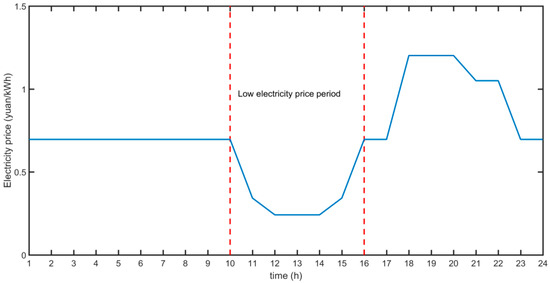
Figure 1.
Segmented intraday electricity price in Shandong Province.
Taking YQWRP as an example for a case study. The YQWRP is a large-scale, long-distance, cross-basin water regulation project in Shandong Province, China, which transfers the water resources of the Yellow River to Qingdao City and provides strong support for the industrial and agricultural development of Qingdao City [22]. The geographical location and distribution of pump stations for the research area are shown in Figure 2. The project comprises six pump stations. The operational parameters of each pump station are shown in Table 1.
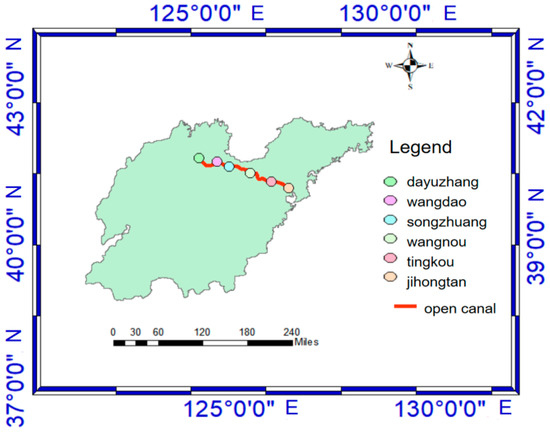
Figure 2.
Location of pumping stations for YQWRP.

Table 1.
Parameters of pumping stations for YQWRP.
Figure 2 illustrates the upstream and downstream layout of the step pumping station, where the upstream pumping station raises the water level and supplies water to the downstream pumping station, thus creating a continuous water flow delivery system. This layout optimizes the distribution and use of water resources while improving energy efficiency.
The YQWRP is characterized by huge energy consumption, multiple objectives, and multiple water conservancy facilities [23].
- (1)
- Huge energy consumption: The pumping stations and gates along YQWRP are currently controlled on-site based on the subjective experience of the management personnel, resulting in high operational costs. By optimizing the intraday operational strategies of each pump station and enhancing the coordination of the pumping station group, the time-of-use electricity pricing strategy that delineates peak and off-peak intervals can be optimally utilized, ultimately resulting in a decrease in total pumping costs. Furthermore, the participation of the gates between canal sections in hydraulic control facilitates the pumping head management. This strategy would facilitate the operation of all pump stations along the channel predominantly during periods of low electricity prices, thereby further decreasing the operational energy consumption.
- (2)
- Multiple objectives: To reduce the energy consumption of actual operation, the regulation objectives include minimizing electricity consumption, minimizing power consumption, and minimizing the number of regulation times.
- (3)
- Multiple water conservancy facilities: This project has 5 formal pump stations and 1 temporary pump station, starting from Dayuzhang pump station, passing through Wangdao pump station, Songzhuang pump station, Wangnou pump station, Tingkou pump station, Jihongtan pump station, and reaching Baisha Water Plant, with a total length of 291 km [24].
The Yellow River to Qingdao Water Regulation Project (YQWRP), selected for this study, is a highly representative case. YQWRP not only demonstrates the optimal regulation of pumping stations under specific conditions, but also reflects the general challenges of achieving energy efficiency and cost control in large-scale water resource allocation. Therefore, the case study of YQWRP not only provides in-depth empirical insights, but also provides valuable references and lessons for similar projects.
2.2. Analysis of Historical Regulation Scenarios
By analyzing the historically measured operational data of pump stations, under specific head conditions, the efficiency of each pump unit reaches its maximum value, with the flow distribution shown in Figure 3 and the power distribution shown in Figure 4. Operational parameters for each pump unit are presented in Table 2.
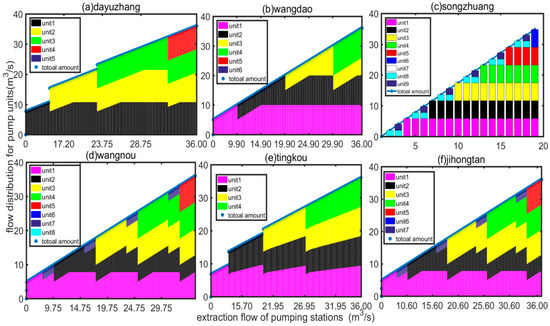
Figure 3.
Flow distribution of each pump unit at maximum efficiency.
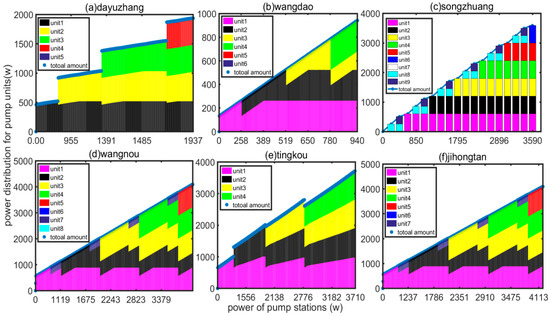
Figure 4.
Power distribution of each pump unit at maximum efficiency.
Table 2.
Operation parameters of pump unit.
Through in-depth analysis of the historical data, the optimal combination allocation scheme for each flow condition is derived, i.e., intra-station optimization, and then the optimal flow allocation table is formed. These data will be used in the subsequent model construction process to achieve inter-station optimization. First, the maximum and minimum flow values of the pump station group are extracted from the historical data to serve as the constraints of the model. Secondly, in the process of model construction, the flow distribution scheme of the pump station group is calculated based on the historical data, i.e., the specific distribution method for each flow unit, which can be directly obtained from the flow distribution table. This method effectively links intra-station and inter-station optimization, forming a two-stage optimization process that constitutes the main innovation of this study.
2.3. Data Sources
The geographical locations, design parameters of the pumping stations, and historical measures involved in the study were provided by the Jiaodong Water Diversion Bureau of Shandong Province.
3. Construction of Optimization Regulation Model for Cascade Pump Stations
Considering the actual conditions of the spot electricity market trading in Shandong Province, three optimization regulation models for cascade pump stations were constructed.
- (1)
- Model 1: The main objective of Model 1 is to minimize the total daily electricity cost and the number of pumping station adjustments. The model assumes that gates between channels are not involved in the regulation and storage of water resources.
- (2)
- Model 2: The main objective of Model 2 is to minimize electricity consumption and the number of pump station adjustments. The model assumes that gates between channels are not involved in the regulation and storage of water resources.
- (3)
- Model 3: Model 3 aims to minimize the total daily electricity cost and the number of pumping station adjustments. Regulators should implement regulations to make sure the hydraulic transmission times between consecutive pump stations align with integer multiples of 24-h cycles. This strategy would facilitate the operation of all pump stations along the channel, predominantly during periods of low electricity prices.
3.1. Model 1
- (1)
- Objective function: The regulation objective is to minimize the total daily electricity cost of the cascade pumping station group and minimize the number of pump station adjustments, given a specific daily average flow.where cj is the electricity price for pumping during the j-th time period; Nij is the pumping power of the i-th pump station in the j-th time period; Δt is the interval between time periods; Qij is the pumping flow of the i-th pump station during the j-th time period; H is operation head; ρ is water density; g is gravitational acceleration; n is operation efficiency of the pumping station; T is the number of regulation time periods; N is the total number of unit adjustments; ni,k is the adjustment number of the i-th pump station of k-th pump unit.
- (2)
- Constraints:
- (1)
- Pumping flow constraint: The pumping flow of each pump unit does not exceed its maximum operation flow and does not fall below the minimum operation flow:where Qi,k is the pumping flow of the k-th pump unit of the i-th pump station; Qi,k,min is the minimum value of operation flow of the k-th pump unit of the i-th pump station; Qi,k,max is the maximum value of operation flow of the k-th pump unit of the i-th pump station.Qi,k,min ≤ Qi,k ≤ Qi,k,max
- (2)
- Pumping power constraint: The pumping power of each pump unit does not exceed its maximum operation power and does not fall below the minimum operation power:where Pi,k is the pumping power of the k-th pump unit of the i-th pump station, Pi,k,min is the minimum value of the operation power of the k-th pump unit of the i-th pump station; Pi,k,max is the maximum value of the operation power of the k-th pump unit of the i-th pump station.Pi,k,min ≤ Pi,k ≤ Pi,k,max
- (3)
- Constraint of total water regulation volume: The total pumping flow of the pump station group is less than the total water regulation volume:where Q is the total water regulation volume.
3.2. Model 2
- (1)
- Objective function: The objective of the regulation is to minimize the electricity consumption and minimize the number of pump station adjustments (same as Formula (2)):where H is total power consumption of cascade pumping station group.
- (2)
- Constraints: Constraints are the same as (3)–(5).
3.3. Model 3
(1) Objective function: The objective function is the same as (1) and (2).
(2) Constraints: In Model 3, a constraint on hydraulic transmission time is added to control the hydraulic transmission time between successive pump stations to be an integer multiple of 24 h, facilitating the operation of all pump stations along the channel predominantly during periods of low electricity prices.
where Ti−(i+1) is the hydraulic propagation time between the i-th pump station and the (i + 1)-th pump station.
The other constraints are the same as (3)–(5).
3.4. Model Solution
The model was solved using dynamic programming. The principle of dynamic programming involves transforming a multi-stage decision-making problem into a series of inter-related single-stage decision-making problems that are solved stage by stage [25]. The optimal solution for each stage is determined first, and then, by employing a recursive algorithm, the optimal solution path for the complex problem can be obtained ultimately [26]. Dynamic programming is known for its reliability and wide use, applied in many areas such as water resources allocation [27], hydropower station dispatching [28], optimal reservoir operation [29], and agricultural management [30]. In the intra-station-inter-station two-phase regulation problem, dynamic programming improves the efficiency of the algorithm by efficiently utilizing the results of previous computations and avoiding repeated computations.
The basic equation of the dynamic programming algorithm is founded on the principle of optimality, which assumes that to solve an optimization problem, n decision variables D1, D2, …, Dn must be made sequentially. If this sequence of decision variables is optimal, then for any integer k, (1 < k < n), the subsequent optimal decision variables will only depend on the current state determined by the previous decision variables. Consequently, the subsequent decision variables Dk+1, Dk+2, …, Dn will also be optimal [27].
From the principle of optimality, the following relationship can be derived:
where vk (sk, dk) is the stage indicator.
Formula (9) can be expressed as follows:
where fk (sk) is the optimal value function for the entire strategy.
Assuming the initial cost is:
Then, Equations (9) and (10) are used to calculate the value function of the strategy, and they are referred to as the basic equations of dynamic programming. The principle of the dynamic programming algorithm solution is illustrated in Figure 5.
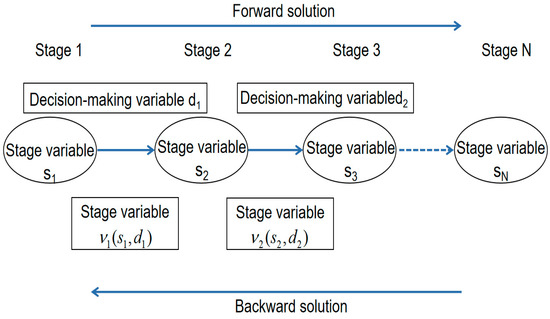
Figure 5.
Schematic diagram of the dynamic programming algorithm.
3.5. Research Process
The research flowchart is shown in Figure 6.
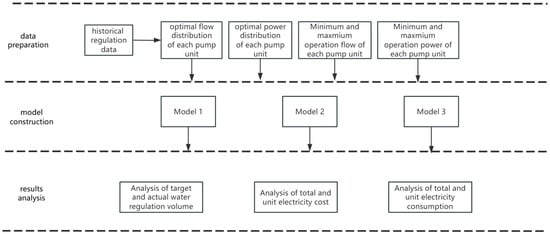
Figure 6.
Research flowchart.
- (1)
- Data preparation: This phase involves the collection and analysis of historical operational data, design parameters, and real-time flow conditions to provide a solid foundation for model development.
- (2)
- Model construction: This phase involves three optimization regulation models for the cascade pumping station to alleviate its operating costs and excessive electricity consumption.
- (3)
- Result analysis: This phase involves comparing the optimized operational schemes with traditional fixed-flow methods to highlight the benefits of the proposed models in terms of cost savings, energy efficiency, and overall system performance.
4. Result and Analysis
4.1. Results of Optimization Regulation Model
Research was conducted on the application of Model 1, Model 2, and Model 3 under four operating conditions with daily average pumping flows of 8 m3/s, 16 m3/s, 24 m3/s, and 32 m3/s. The flow results of the optimal regulation scheme are presented in Figure 7. The power results of the optimal regulation scheme are presented in Figure 8.
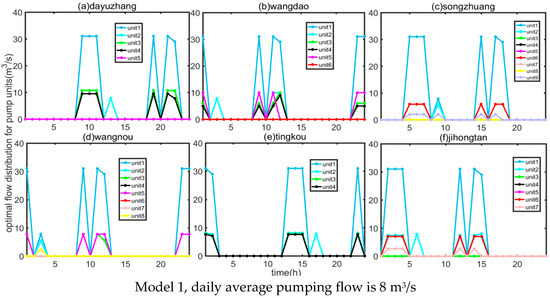
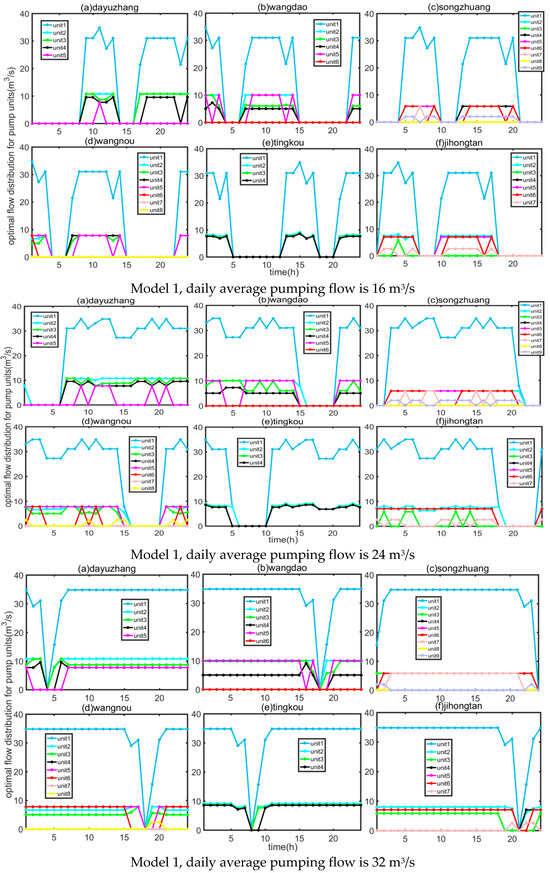
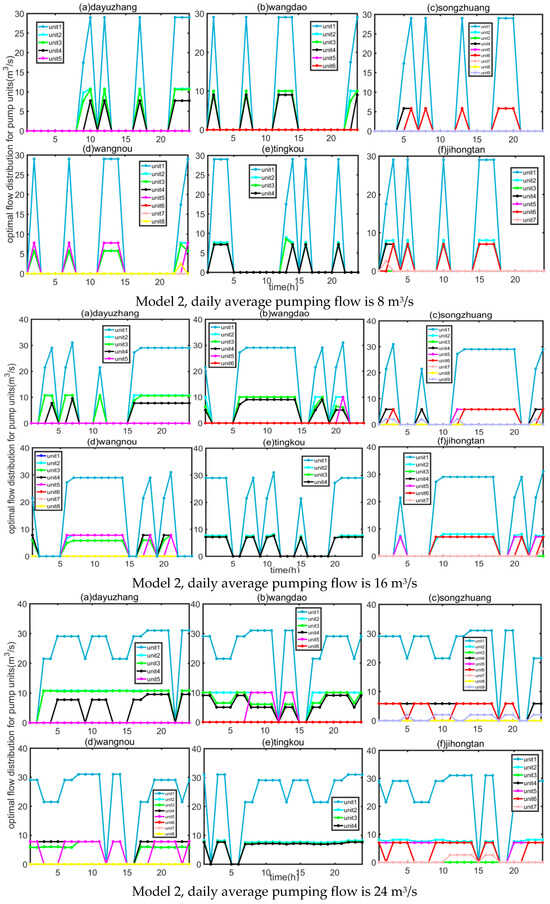
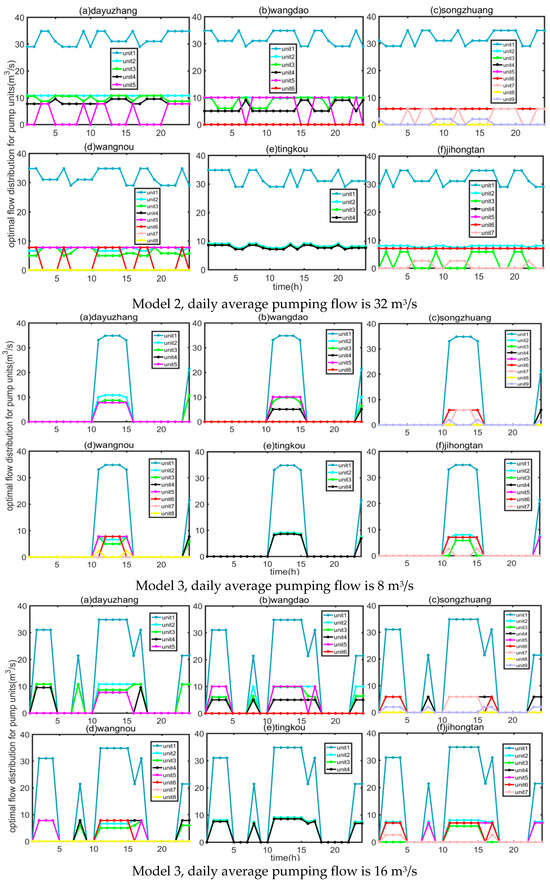
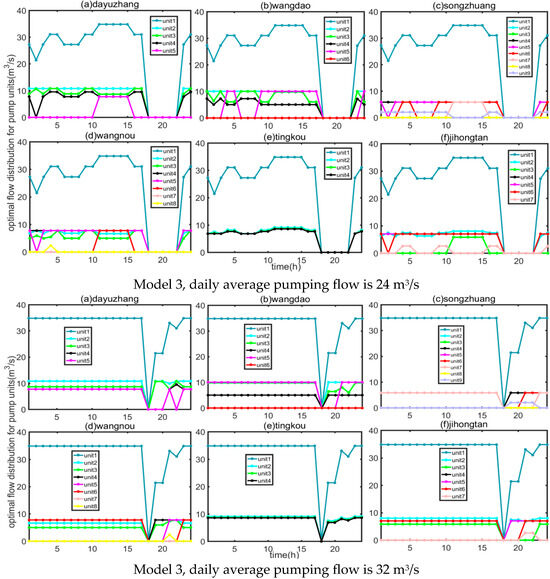
Figure 7.
Flow results of optimal regulation scheme.
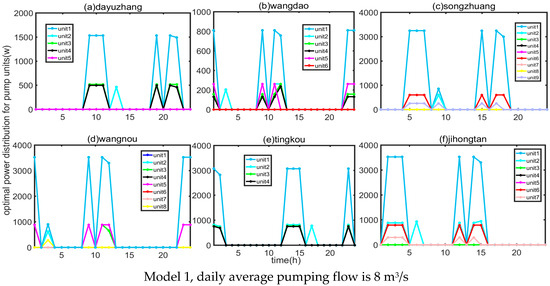
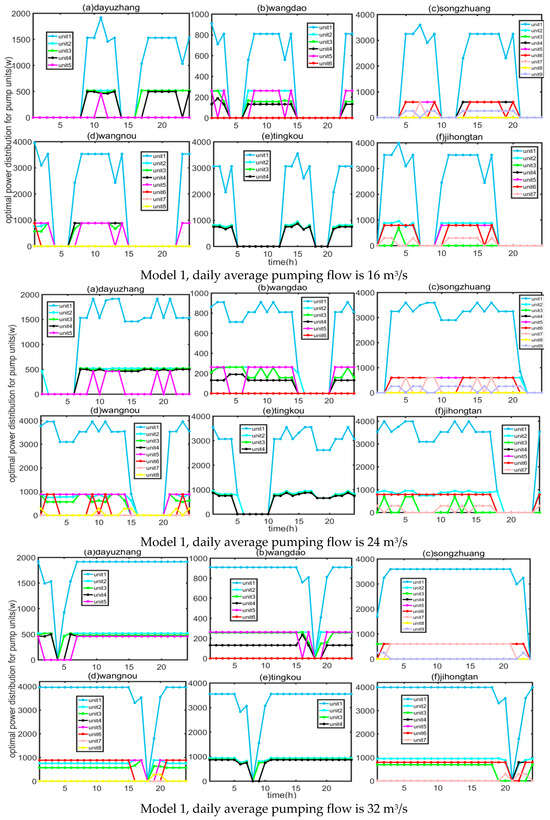
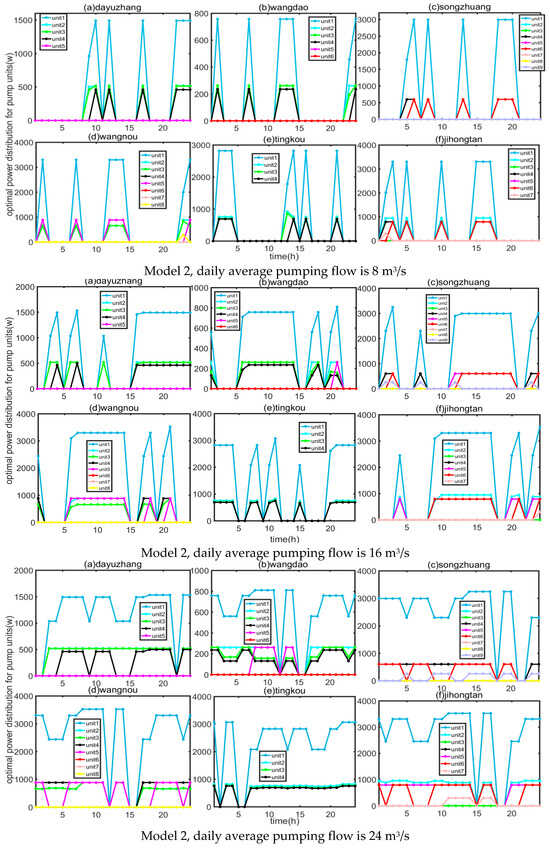
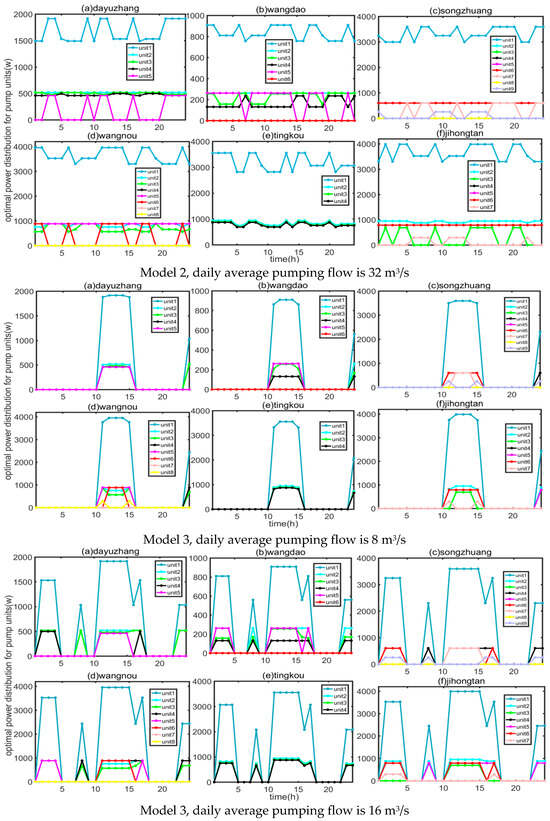
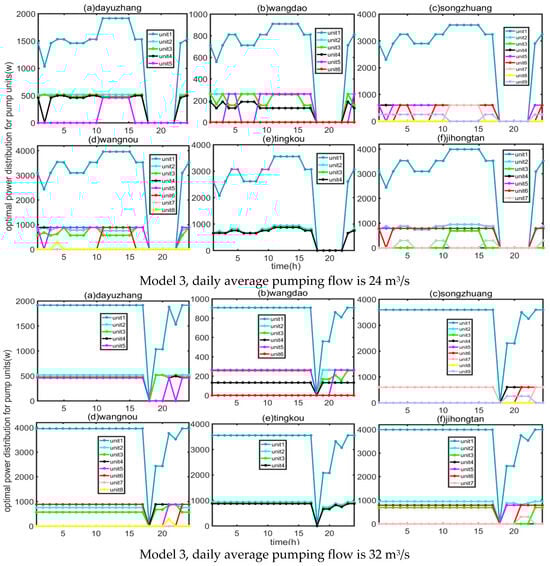
Figure 8.
Power results of the optimal regulation scheme.
4.2. Result Analysis
- (1)
- Analysis of target and actual water regulation volume
The comparative analysis between the target and the actual water regulation volume is shown in Table 3.
Table 3.
Analysis of target and actual water regulation volume.
According to Table 3, all optimized schemes can achieve good regulation results. The water regulation completion rate of the optimized schemes is higher than that of the fixed flow scheme.
- (2)
- Analysis of total and unit electricity cost
The comparative analysis between the total and unit electricity costs is shown in Table 4.
Table 4.
Analysis of total and unit electricity cost.
The data in Table 4 show that all optimization scenarios achieved significant results in reducing the operating costs of the pumping station. Model 1 effectively reduces the energy consumption during the high electricity price hours by optimizing the operation time and power allocation of the pumping station, which significantly reduces the total electricity cost and unit electricity cost under different flow conditions. For example, under the flow condition of 8 m3/s, the unit electricity cost of Model 1 is reduced by 18.9% compared with the fixed flow scenario, which shows a strong economic performance.
However, the optimization strategy of Model 3 is more advanced. It not only considers the optimization of pumping station operations, but also incorporates the regulation and storage capacity of channel gates into the overall regulation scheme. This integrated optimization strategy enables the pumping station to fully utilize channel water storage during low tariff periods and reduce operation demand during high tariff periods, thus further reducing the electricity cost. Under the same 8 m3/s flow condition, the unit of electricity cost of Model 3 is only RMB 0.0467/m3, which is 43.9% and 44.3% lower compared to Models 1 and 2, respectively, showing its significant advantage in economy. This demonstrates that Model 3 not only achieves lower operating costs but also enhances the flexibility and stability of the system through synergistic optimization of pumping stations and gates, providing a better solution for the economic operation of large-scale water transfer projects.
- (3)
- Analysis of total and unit electricity consumption
The comparative analysis between the total and unit electricity consumption is shown in Table 5.
Table 5.
Analysis of total and unit electricity consumption.
According to Table 5, all the optimized schemes demonstrate significant improvements in reducing the operating consumption of the pump stations, highlighting the effectiveness of the proposed optimization models. Specifically, Model 3’s regulation scheme stands out as it achieves a more pronounced reduction in electricity consumption compared to Model 1 and Model 2. This is evident across all tested flow conditions.
- (4)
- Innovation analysis
This research delves into the optimization of pumping stations, revealing strategies for enhancing their operational efficiency under varying flow conditions. Traditional operation modes often overlook the synergistic potential of pumping stations, leading to an all-or-nothing approach—stations either run at full capacity or shut down entirely when flow demands fluctuate. This gap in systematic optimization is addressed by the proposed new operation mode, which fine-tunes the start-up combinations of pumping stations based on real-time flow requirements. This innovative approach not only maximizes the synergy between pumping stations but also significantly boosts their operational efficiency, offering robust theoretical support for the economic management of cascade pumping systems.
Moreover, the study explores the temporal coordination in pumping station operations. Without considering time-of-day tariffs, stations typically fail to capitalize on the variability of electricity prices to minimize costs. By incorporating time-of-day tariffs into the operational strategy, this research optimizes the regulation of pumping stations to prioritize operation during off-peak hours when tariffs are lower. By employing this meticulous time management, the pumping stations can ensure uninterrupted water supply while achieving maximum cost-effectiveness. This approach provides a novel framework for the optimal regulation of cascade pumping stations, balancing operational efficiency with economic sustainability.
4.3. Discussion
- (1)
- Limitations of the Study
Firstly, this study does not incorporate ecological factors, such as the impact of water transfer on local ecosystems or the potential for environmental protection measures. Additionally, this study does not fully consider real-time constraints like equipment failures, or emergency situations, which could affect the practical implementation of the proposed strategies. Lastly, the models do not account for the impacts of climate change on water availability and demand, which is increasingly important for long-term water resource planning.
- (2)
- Application prospects
The data used in this study are limited to the YQWRP in Shandong Province, China, but the model construction approach is also applicable to the economic operation of cascade pumping stations in large-scale water regulation projects around the world. The optimized regulation scheme of Model 2 achieves a significantly higher reduction in operational cost compared to that of Model 1. However, Model 2 necessitates the collaborative involvement of regulators for hydraulic regulation, thus making it more applicable to research areas where control structures are well-established.
5. Conclusions
To reduce the operational costs of cascade pump stations in large-scale water regulation projects, this study takes the YQWRP as a case study and develops three optimization regulation models. Model 1 aims to minimize the daily total electricity cost, Model 2 aims to minimize the daily total electricity consumption, and Model 3 considers both time-of-use electricity prices and regulation and storage of canal sections. A dynamic programming algorithm was employed to solve for the optimal operation scheme of each pumping station. The main research conclusions are as follows:
- (1)
- Analysis of Historical Data: The YQWRP has been constructed for more than 30 years. There are deviations between the actual operational conditions of the project and its design values. The constraint design of this study is determined based on the measured historical operation data of the pump station group, which is more in line with the actual regulation process. This study proposes an innovative optimization method for pump station operation that covers both intra-station and inter-station regulation levels. At the intra-station level, the method breaks the traditional all-open or all-stop operation mode of pumping stations through a systematic optimization scheme, and achieves effective synergy between pumping stations. At the inter-station level, the study optimizes the operation strategy of the pumping station in different tariff periods by considering the time-sharing tariff factor, allowing the pumping station to operate during the lowest-cost periods, thus ensuring the safety of water supply while significantly improving the economic rationality. This optimization method, which integrates intra- and inter-station regulation, provides a new theoretical framework and practical guidance for the economic operation of step pumping stations.
- (2)
- Advantages and suggestions of joint regulation of pump stations and gates: The optimization regulation scheme of Model 3, which considers both time-of-use electricity pricing and regulation and storage of water resources, is the most economical operation scheme. Under various average daily pumping flow conditions, the reduction in operational costs for Model 3 is significantly higher than that of Model 1 and Model 2. However, due to the requirement of Model 3 for the collaborative involvement of gates in hydraulic control, it is recommended for application in research areas where hydraulic installations are well-developed.
- (3)
- Application effect: All models can fully utilize the intraday peak-valley time-of-use electricity pricing policy, effectively reducing the operational costs of the pump station group in the water regulation project. Results indicated that Model 3 scheme performs the best. The application was conducted under conditions of average daily pumping flows of 8 m3/s, 16 m3/s, 24 m3/s, and 32 m3/s, respectively. The operating costs of Model 3 were reduced by 37,100, 38,100, 34,300, and 4400 CNY RMB, respectively, compared to the fixed flow condition.
Author Contributions
Conceptualization, Y.G. and Y.Z.; methodology, Y.Z.; validation, Y.Z.; formal analysis, C.W. and Y.G.; investigation, Y.Z.; resources, H.W. and Y.G.; writing, T.G. and Y.Z.; visualization, C.W. and Y.Z.; supervision, H.W. and Y.G.; project administration, H.W. and Y.G.; funding acquisition, H.W. and Y.G. All authors have read and agreed to the published version of the manuscript.
Funding
This work was supported by the National Natural Science Foundation of China (52394234); Key Research and Development Project (2022YFC3204603); Major Science and Technology Projects of the Ministry of Water Resources (SKS-2022117, SKR-2022057).
Data Availability Statement
Data cannot be made publicly available; readers should contact the corresponding author for details.
Acknowledgments
We wish to thank the Shandong Province Jiaodong Water Transfer Bureau for providing the required data. We also thank the reviewers and editors for their insightful comments and suggestions that improved the clarity of the paper.
Conflicts of Interest
The authors declare no conflicts of interest.
References
- Du, M.; Zhang, Z.; Li, G.; Lei, X. Short-term optimal scheduling scheme of cascade pumping stations in large-seale hydraulic engineering. J. Drain. Irrig. Mach. Eng. 2024, 42, 194–200. [Google Scholar]
- Gao, Z.; Zhang, Z.; Si, Q.; Xue, P.; Lei, X.; Li, Y.; Du, M. Optimization of economic operation mode of pumping staion-reservoir raw wateltransfer system. J. Drain. Irrig. Mach. Eng. 2024, 42, 201–208. [Google Scholar]
- Souza, R.G.; Meirelles, G.; Brentan, B.; Izquierdo, J. Rehabilitation in intermittent water distribution networks for optimal operation. Water 2022, 14, 88. [Google Scholar] [CrossRef]
- Zhang, L.; Hou, X.; Liu, X.; Tian, Y. Optimal scheduling of cascade pumping stations based on improved Harris hawks optimization algorithm. J. Zhejiang Univ. Eng. Ed. 2023, 57, 2501–2512. [Google Scholar]
- Gou, Y.; Zhang, H.; Zhu, X. Daily Economic Operation Optimization Model of Single-stage Pumping Station Based on the Dynamic Programming Method. China Rural. Water Hydropower 2020, 1, 192–196. [Google Scholar]
- Xu, S.; Zhang, Z.; Lei, X.; Du, M.; Jing, X.; Fan, H. Sensitivity Analysis of Optimal Flow Distribution Scheme for A Water Diversion Pump Station. Available online: http://ckyyb.crsri.cn/EN/10.11988/ckyyb.20240514 (accessed on 23 January 2025).
- Napierała, M. A Study on Improving Economy Efficiency of Pumping Stations Based on Tariff Changes. Energies 2022, 15, 799. [Google Scholar] [CrossRef]
- Chen, W.-P.; Tao, T.; Zhou, A.-J.; Zhang, L.; Liao, L.; Wu, X.-M.; Yang, K.; Li, C.-X.; Zhang, T.C.; Li, Z. Genetic optimization toward operation of water intake-supply pump stations system. J. Clean. Prod. 2021, 279, 123573. [Google Scholar]
- Chen, J.; Liu, J.; Huang, B.; David, Z.; Jin, C.; Zhang, H. Optimization of the effective volume of urban sewage pumping station based on the fuzzy optimization method. Water Infrastruct. Ecosyst. Soc. 2024, 73, 2031. [Google Scholar]
- Li, Z.; Zhang, L.; Liu, X. A New Remote Intelligent Monitoring System for Strong Earthquakes in Dams. Water Resour. Power 2024, 42, 164–167+141. [Google Scholar]
- Ma, X.; Zhang, L.; Liu, X.; Tian, Y.; Wang, X.; Deng, X. Optimal scheduling of cascade pumping stations based on sparrow search algorithm. J. Hydroelectr. Eng. 2024, 43, 43–53. [Google Scholar]
- Wang, T.; Liu, J.; Wei, B.; Ye, G.; Liu, H.; Li, J.; Zhu, D. Optimal Operation and Dispatch of Water Supply Pump Station in T City. Water Resour. Power 2021, 39, 120–132. [Google Scholar]
- Zhu, B.; Gong, Y.; Chen, Z.; Wang, S.; Chen, Y. Multi-objective Optimization of Cross-basin Water Pump Station Solved by the Pareto Method. J. Irrig. Drain. 2022, 41, 131–139. [Google Scholar]
- Sun, T.; Wang, Z.; Zhu, B. Research on optimization of ShaanGanNing Yanhuanding Yellow River pumping cascade pump station. Eng. J. Wuhan Univ. 2022. [Google Scholar] [CrossRef]
- Sun, T.; Wang, Z.; Zhu, B. Optimization study on the operation of No. Five Pumping Station in theYanhuan Dingyang Yellow River irrigation district. J. China Inst. Water Resour. Hydropower Res. 2024, 22, 97–107. [Google Scholar]
- Zhang, K.; Cui, G. Research on the Group Level Scheduling Model of Water Intake Pump Stations Based on Decomposition Coordination. Water Wastewater Eng. 2019, 45, 126–130. [Google Scholar]
- Qu, X.; Zhang, Z.; Bai, C.; Du, M.; Tu, Y. Daily optimization scheduling study of parallel pumping stations considering time-of-use electricity pricing. Hydro-Sci. Eng. 2024, 2024, 157–168. [Google Scholar]
- Lu, L.; Chen, Y.; Li, M.; Lei, X.; Ni, Q.; Liu, Z. Spatiotemporal characteristics and potential pollution factors of water quality in the eastern route of the South-to-North Water Diversion Project in China. J. Hydrol. 2024, 638, 131523. [Google Scholar] [CrossRef]
- Zhao, R.; Gan, T.; Wang, X.; Wang, H. Research on Parameters Optimization of optimal schedule model of water resources for Jiaodong Water Transfer Project Based on ICCP model. Water 2023, 15, 2731. [Google Scholar] [CrossRef]
- Gan, T.; Jiang, Y.; Zhao, H.; He, J.; Duan, H. Research on Low Energy Consumption Automatic Regulation of Cascade Gates and Pump in Open-Canal Based on Reinforcement Learning. J. Hydroinformatics 2024, 26, 1673–1691. [Google Scholar]
- Sun, A.; Hu, D.; Shan, C.; Wang, J. Automatic scheduling and control technology of pump gate clusters of regional water conservancy project. Desalination Water Treat. 2023, 293, 82–88. [Google Scholar]
- Lin, W.; Feng, Q.I.; Yi-Ke, S.; Li, X. Screening Water Quality Safety Risks in Catchment from Yellow River to Qingdao by KCFs Recognition Method. China Water Wastewater 2019, 35, 72–77. [Google Scholar]
- Ding, N.; Yang, Y.-Y.; Wan, N.-X.; Xu, A.-L.; Ge, J.-H.; Song, Z.-W. Seasonal Variation and Influencing Factors of Bacterial Communities in Storage Reservoirs. Environ. Sci. 2023, 44, 1484–1496. [Google Scholar]
- Li, Z.-Q.; Yang, X.-L.; Wang, Y. Optimization of operation and decision of Songzhuang pumping station of Jiaodong Water Diversion Project. Water Sci. Eng. Technol. 2017. [Google Scholar] [CrossRef]
- Ghilardi, L.; Naik, S.; Martelli, E.; Casella, F.; Biegler, L.T. Nonlinear dynamic optimization for gas pipelines operation. Comput. Aided Chem. Eng. 2024, 53, 1657–1662. [Google Scholar]
- Jiang, Y.; Jiang, Z.-P. Global Adaptive Dynamic Programming for Nonlinear Polynomial Systems; John Wiley & Sons, Inc.: Hoboken, NJ, USA, 2017; pp. 54–56. [Google Scholar]
- Suo, M.; Xia, F.; Fan, Y. A Fuzzy-Interval Dynamic Optimization Model for Regional Water Resources Allocation under Uncertainty. Sustainability 2022, 14, 1096. [Google Scholar] [CrossRef]
- Wu, X.; Xu, D.; Guo, R.; Wang, M.; Ying, Q. Long-Term Optimal Dispatching of Hydropower Station Based onControlling the Frequency of Reservoir Level Fluctuation. Math. Probl. Eng. 2022, 1–9. [Google Scholar] [CrossRef]
- Mohanavelu, A.; Soundharajan, B.-S.; Kisi, O. Modeling Multi-objective Pareto-optimal Reservoir Operation Policies Using State-of-the-art Modeling Techniques. Water Resour. Manag. 2022, 36, 3107–3128. [Google Scholar]
- Nozari, H.; Liaghat, A.M.; Azadi, S. Management of agricultural saline drainage using system dynamics approach. Water Environ. J. 2022, 36, 299–307. [Google Scholar]
Disclaimer/Publisher’s Note: The statements, opinions and data contained in all publications are solely those of the individual author(s) and contributor(s) and not of MDPI and/or the editor(s). MDPI and/or the editor(s) disclaim responsibility for any injury to people or property resulting from any ideas, methods, instructions or products referred to in the content. |
© 2025 by the authors. Licensee MDPI, Basel, Switzerland. This article is an open access article distributed under the terms and conditions of the Creative Commons Attribution (CC BY) license (https://creativecommons.org/licenses/by/4.0/).