


Abstract
Water reuse is gaining momentum as a beneficial practice to address the water crisis, especially in the agricultural sector as the largest water consumer worldwide. With recent advancements in wastewater treatment technologies, it is possible to produce almost any water quality. However, the main human and environmental concerns are still to determine what constituents must be removed and to what extent. The main objectives of this study were to compile, evaluate, and compare the current agricultural water reuse regulations and guidelines worldwide, and identify the gaps. In total, 70 regulations and guidelines, including Environmental Protection Agency (EPA), International Organization for Standardization (ISO), Food and Agriculture Organization of the United Nations (FAO), World Health Organization (WHO), the United States (state by state), European Commission, Canada (all provinces), Australia, Mexico, Iran, Egypt, Tunisia, Jordan, Palestine, Oman, China, Kuwait, Israel, Saudi Arabia, France, Cyprus, Spain, Greece, Portugal, and Italy were investigated in this study. These regulations and guidelines were examined to compile a comprehensive database, including all of the water quality monitoring parameters, and necessary treatment processes. In summary, results showed that the regulations and guidelines are mainly human-health centered, insufficient regarding some of the potentially dangerous pollutants such as emerging constituents, and with large discrepancies when compared with each other. In addition, some of the important water quality parameters such as some of the pathogens, heavy metals, and salinity are only included in a small group of regulations and guidelines investigated in this study. Finally, specific treatment processes have been only mentioned in some of the regulations and guidelines, and with high levels of discrepancy.
1. Introduction
Climate change, industrialization, high rate of urbanization, and population growth are among the main reasons that have made many countries, especially in the arid and semi-arid areas, suffer from the water crisis [1]. For instance, water scarcity in Australia has caused population losses in north-eastern, south-eastern, and western rural areas. These areas have experienced further unemployment, lack of success in local businesses, and downtrend in irrigation [2]. Countries in the Middle East, Central Asia, and some parts of Southeast Asia have been struggling on water-related issues. It is anticipated that these struggles may result in conflicts over shared water resources in these regions [3]. Considering the adverse consequences of the water crisis, countries around the world have been trying to increasingly cope with this problem by implementing sustainable water management plans and looking for alternative water supply sources [1]. Water conservation, water reuse, and desalination of seawater and brackish groundwater are among those strategies that have been tried to address the water crisis [1].
In recent years, more and more countries are considering water reuse as an alternative water supply to supplement the freshwater sources [1,4,5]. Water reuse decreases the pressure on the freshwater resources, reduces the pollution that is being discharged to water bodies, and can be a reliable source compared to other water resources that are directly dependent on rainfall [1]. Due to these advantages and along with the recent developments in wastewater treatment technologies, scientists reported that the worldwide volume of recycled water in the 2010–2015 period was increased from 33.7 (million m3/d) to 54.5 (million m3/d) [6].
1.1. Water Reuse History
Water reuse has been practiced by humans for a very long time, of course, sometimes not in an appropriate way. Ancient civilizations during the Bronze age, 3200–1100 BC, used their domestic wastewater to irrigate their crops [7]. Ancient Greeks conveyed their domestic wastewater to a storage chamber using a sewer system in public latrines [8]. Moreover, Greeks and Romans used wastewater in agricultural irrigation, preparing fertilizer for crops and orchards [9]. During early modern history (1550–1700), direct use of wastewater in agriculture was being applied in Germany, Scotland, and England [8]. Beginning in the 19th century, irrigation with wastewater gained more popularity in some European and U.S. cities such as Paris, London, and Boston [8]. About the same time, the first wastewater irrigation in agriculture happened in Australia [9,10]. However, conveying and discharging the untreated wastewater in urban fields caused waterborne disease epidemics, such as cholera and typhoid fever outbreaks [8]. Unsafe application of wastewater in urban and agricultural areas, industrialization, and urbanization resulted in unhealthy situations for the societies in the 19th century [8]. To address the existing problems, some helpful efforts were as follows: (1) establishing the Great Britain’s Public Health Act, (2) holding a lot of sanitary conferences on sanitation and demography, (3) the constitution of International Office of Public Hygiene, and (4) constructing the underground sewage systems [8].
Generally, the application of recycled water can be divided into seven categories including urban reuse, agricultural reuse, impoundments, environmental reuse, industrial reuse, groundwater recharge/non-potable reuse, and potable reuse [11]. Of note is water reuse applications are different in various countries and depend on several factors such as levels of treatment, the conditions of water resources, environmental status, and public willingness [11]. Agricultural water reuse, by far, is the most dominant application of water reuse in the world [1]. In total, 91% of the recycled water in this section is allocated for crops and pastures irrigation, including the growing of fruit, tree nut, vegetables, cotton, and grain farming [1]. The residual 9% is dedicated to the cleaning of piggeries, and drinking water for stock and dairy [1].
Agricultural water reuse has multiple advantages such as reducing pressure on fresh water sources [8,12], nutrients management and recovery [13,14], and higher reliability due to constant yield [12,15]. However, wastewater needs to be adequately treated to be used for agricultural irrigation, especially for food crop irrigation due to potential health risks [16]. Other major limiting factors in agricultural water reuse include technical feasibility (e.g., treatment technologies and management), economic factors (e.g., water distribution cost), social factors (e.g., social acceptance and consumer response), and regulatory considerations (e.g., lack of regulations or guidelines) [17,18]. Of note is while the focus of this study was agricultural water reuse, there might be some other challenges in the future related to water reuse in general (such as developing methods of coupling advanced wastewater treatment with seawater desalination facilities; developing efficient methods of risk assessment for water reuse practices; establishing regulations and guidelines which ensure promoting and regulating water reuse practices) [19]. A list of benefits and constraints of water reuse in agriculture is provided in Table 1. It should be noted that not every water reuse project will result in all of these benefits immediately, nor will face all of these challenges at the same time [4].

Table 1.
Benefits and challenges of agricultural water reuse (adapted from [4] and modified).
1.2. Current Status of Water Reuse
FAO (Food and Agriculture Organization of the United Nations) has estimated that 3.928 × 10¹² m3 of freshwater was withdrawn from existing water sources in the world in 2010. In total, 11% of the total water withdrawal in the world was municipal water demand, of which 3% was consumed and 8% was discharged as municipal wastewater [53]. There was 2.75 × 10⁶ million m2 of land consisting of irrigated agriculture worldwide, of which about 15% (4 × 10⁵ million m2) could be irrigated by the municipal wastewater [53]. Moreover, 32% of the world wide water withdrawal was discharged as agricultural wastewater and drainage [53]. The majority of wastewater that is recycled in agriculture is municipal wastewater, but these results show the need to change the focus of water reuse policies and plans from municipal wastewater management to sustainable management of municipal and agricultural (drainage and return flow) wastewater [1]. Furthermore, approximately, 5 × 10⁴ to 2 × 10⁵ million m2 of the irrigated land is irrigated by raw and diluted wastewater, with the largest portion being in China [53]. This just includes 2–7% of the world’s total irrigated area. Accordingly, there is a great potential for implementing planned and safe water reuse in agriculture.
While irrigation with recycled water is recognized as an alternative source to reduce the pressure on fresh water sources, the ultimate goal is safe implementation of water reuse practices [1]. One of the basic necessities for safe application of recycled water is to make sure that it has the desired quality and poses no harm to human health and the environment [16]. Started by the state of California in 1918, countries around the world alongside international organizations (e.g., World Health Organization (WHO) and FAO) have started to establish their water reuse regulations and guidelines to ensure safe water reuse practices [7]. In general, countries and organizations have taken different approaches to establish regulations and guidelines [54]. For instance, some countries like Canada, Australia, and many states in the U.S. have issued more restrictive regulations, while others have chosen to take less restrictive approaches to develop water reuse regulations and guidelines. Of note is that there is no federal regulation or guideline for agricultural water reuse in the U.S. [11]. It is up to the states to establish their own regulations or guidelines [11].
When compared in more details, it becomes apparent that current agricultural water reuse regulations and guidelines vary significantly [1]. For instance, some of the regulations and guidelines do not consider some of the biological and microbial quality parameters, and some others do not consider some of the physico-chemical parameters. Furthermore, even in regulations and guidelines that do consider the same parameters, the threshold levels for those parameters vary significantly. As water reuse in agriculture is becoming popular as a beneficial approach to address the water scarcity, the disparity in regulations and guidelines may become a source of problems, at both regional and global levels [54]. At the regional level, the absence of unified or at least relatively comparable water reuse regulations and guidelines may result in uncertainty among stakeholders (e.g., farmers, consumers, and policy-makers), thereby slowing down the promotion of water reuse in agriculture. The U.S. is a good example in that respect. In the U.S. there are 42 and 28 states that have regulation or guideline for nonfood crop/processed food crop, and food crop irrigation, respectively [11]. Eight states do not have any type of regulation or guideline for agricultural water reuse [11]. When looked at in more details, the water quality parameters and the threshold levels in those regulations and guidelines are different. This not only may create uncertainty among stakeholders, but also may increase the risk of public acceptance, thereby slowing down the process of implementing agricultural water reuse [1]. In addition, agriculture has a global market and agricultural commodities are being imported/exported all around the world. As a result, the difference in regulations and guidelines between the countries of origin and the end-use countries may pose major obstacles in food safety, market acceptability, and import/export relationships.
To date, there are very few studies which investigate and compare the existing agricultural water reuse regulations and guidelines in the U.S. and worldwide. The main objectives of our research were to compile and compare the existing agricultural water reuse regulations and guidelines around the world, and to identify the gaps in those regulations and guidelines. To achieve this goal, the most up to date regulations and guidelines that were issued by national and international organizations (e.g., Environmental Protection Agency (EPA), International Organization for Standardization (ISO), FAO, WHO, European Commission), and by pioneering countries in water reuse (e.g., U.S., Canada, Mexico, Iran, Egypt, Tunisia, Jordan, Israel, Oman, China, Kuwait, Saudi Arabia, Australia, France, Greece, Portugal, Cyprus, Spain, and Italy) were obtained and investigated in this study. In addition, the water quality criteria in those regulations and standards were compared, and the major differences between those criteria were identified. Results from this study identify the discrepancies in the current regulations and guidelines. They also highlight the challenging areas that need to be addressed to promote the agricultural water reuse with respect to the existing regulations and guidelines.
2. Methodology
In order to compile a complete worldwide agricultural water reuse regulations and guidelines database, Google Scholar search engine was used as the first step of this study. In this step, key words including “water reuse”, “water reclamation”, “water recycling”, “wastewater reuse”, “wastewater recycling”, “recycled water”, “reclaimed water”, “agriculture”, “regulation”, “guideline”, “standard”, and “criteria” were used. Peer reviewed journal articles related to agricultural water reuse regulations and guidelines were compiled and reviewed. In the second step, based on the results obtained from the first step, study cases were identified (e.g., countries, international organizations, and state agencies that have issued/established agricultural water reuse regulations or guidelines). In the third step, the official website of the organizations (e.g., state agencies, ministries, governmental institutes, etc.) were investigated. Moreover, official representatives at organizations/agencies were contacted if needed to make sure that the obtained regulations and guidelines were the latest version. In total, 70 agricultural water reuse regulations and guidelines were gathered for this study. All of these regulations and guidelines were thoroughly analyzed and compared in this study.
2.1. Definitions and Terminologies
2.1.1. Technical Definitions and Terminologies
The use of treated wastewater for beneficial purposes is generally called water reuse [5]. However, there are different terminologies that have been used in various water reuse regulations and guidelines such as water reuse, water recycling, water purification, reclaimed water, recycled water, reused water, repurified water, NEWater, and more. To clarify, in this manuscript, water reuse refers to treatment or processing of wastewater and then the application of the treated wastewater in agriculture. In addition, recycled or reclaimed water refer to the treated wastewater that is used for different applications. Of note is that “recycled” and “reclaimed” water have been used in this manuscript interchangeably.
2.1.2. Legal Definitions and Terminologies
Similar to scientific and technical terminologies, different legal terminologies have been used for water reuse regulations. While the main focus of this manuscript was technical and scientific aspects of agricultural water reuse, it is helpful to clarify these legal terminologies, which are commonly used in the reference documents (Table 2).
Table 2.
The definition of standard, criteria, guideline, and regulation [5].
3. Results and Discussion
In total, 70 regulations, guidelines, standards, criteria, and acts were obtained and included in this study (Table 3). The State of California in the U.S. was the first to issue a specific regulation for agricultural water reuse in 1918. After 48 years, the next regulation document was issued by the state of Iowa in the U.S. in 1966, followed by Mexico’s standard in 1971. WHO is the first international organization that issued a guideline for agricultural water reuse in 1973. As illustrated in Table 3, among the 70 investigated documents, there were 30 regulations, 29 guidelines, six standards, four criteria, and one act. It was found that most of these regulations and guidelines were issued after 1973, and the majority of them were issued after 1998. Starting from the 1970s and 1980s, international organizations including WHO, FAO, and the World Bank tried to effectively notify countries and organizations around the world the importance of safe water reuse practices, resulting in the propagation of establishing water reuse regulations and guidelines [1].
Table 3.
Agricultural water reuse regulations or guidelines included in this study.
3.1. Reference Regulations and Guidelines
In this section, the pioneer agricultural water reuse regulations and guidelines which have been the source of inspiration and adoption for many of other states, countries, and organizations are discussed. They include WHO, EPA, FAO, Australian Guideline for Water Recycling (AGWR) guidelines, ISO standard, California, and European Commission regulations.
3.1.1. World Health Organization (WHO) guideline
WHO issued three guidelines for water reuse in 1973, 1989, and 2006. The first document was published in 1973 entitled “Reuse of effluents: methods of wastewater treatment and health safeguards”, which became one of the main references for other international standards. The main goals of this document were to protect the public health and to guide the safe application of wastewater and excreta in agriculture and aquaculture. However, the document had minimal health risk approach and lacked epidemiological studies [8]. Later, the WHO updated its prior guideline in 1989 by implementing a complete epidemiological studies analysis. In this version, entitled “Health guidelines for the use of wastewater in agriculture and aquaculture”, WHO focused on the microbiological quality of the recycled water for irrigation. Additionally, risk assessment and necessary information to determine the societies’ tolerable risks were included. This guideline lacked to give any information about surveillance guidelines [8]. WHO’s final guideline was published in 2006, entitled “Safe use of wastewater, excreta, and greywater”, to contribute to forming governmental guidelines, standards, and regulations relating to wastewater management for each country regarding its specific situation. There are significant improvements regarding risk assessment in this guideline including microbiological analysis, based on the information gathered from present pathogens, and health risk management, estimations were made based on person per year (PPY) and disability-adjusted life year (DALY) [8].
This risk-based guideline is mainly focused at microbial health risks, but it also contains recommended maximum tolerable soil concentrations for various organic and inorganic pollutants which are assessed by QMRA (Quantitative Microbial Risk Assessment) and epidemiological evidence. The DALYs are used in this guideline in order to compare the results of a disease from one exposure pathway to another pathway. WHO indicated the determination of DALYs as follows: “DALYs are calculated by adding the years of life lost to premature death to the years lived with a disability”, accounting for acute and chronic health effects [60]. A water-borne disease burden of 10−6 DALYs per person per year is determined as the tolerable risk by WHO [60]. Critics claim that this is not the most appropriate value to use, especially in low-income countries [123]. In this guideline (volume 2, section 4.5), it is mentioned that the appropriate value is less than 10−4 or 10−5 DALY (loss) per person per year which Mara et al. supports less than 10−4 DALY to be used for water reuse in agriculture [123]. Moreover, this guideline defines two exposure scenarios for agricultural irrigation including unrestricted irrigation and restricted irrigation, suggesting the required log pathogen reductions for each of them (Table S1). Regarding physico-chemical quality of the water, WHO refers to the FAO’s requirements for irrigation practices. Of note is that the WHO guideline requires no specific type of treatment for the restrictions mentioned above.
3.1.2. FAO Guideline
FAO issued two guidelines for water reuse in 1987 and 1999. In the latest version, FAO divides the application of recycled water in agriculture into three categories, including (A) Irrigation of crops likely to be eaten uncooked, sports fields, and public parks, (B) Irrigation of cereal crops, industrial crops, fodder crops, pasture, and trees, and (C) localized irrigation of crops in category B if exposure of workers and the public does not occur [67]. Moreover, FAO drafts some requirements for interpretation of water quality for irrigation (Table S2) including three degrees of restriction including severe, slight to moderate, and none, on use of the recycled water based on its quality. Additionally, threshold levels of trace elements for crop production are introduced by FAO in its last guideline in 1999 [67].
In terms of microbial parameters, FAO follows a less restrictive approach, similar to WHO, considering epidemiological evidence. FAO recommends stabilization ponds, category A and B, and at least primary sedimentation, category C. In unrestricted category, A, FAO recommends stricter limitations for fruit trees as Fecal Coliforms <200/100 mL. For physico-chemical parameters, FAO guideline has been the leading guideline to which the standards, criteria, guidelines, and regulations of other organizations, countries, and states agencies have referred.
3.1.3. Environmental Protection Agency (EPA) Guideline
EPA developed four guidelines for water reuse in 1980, 1992, 2004, and 2012. The first guideline was issued as a technical research report in 1980. Later in 1992, EPA updated the first version by including toxicity in crops that were irrigated with wastewater [8]. This version was provided for project planners and state regulatory officials in order to develop water reuse systems in different states. EPA included two new scopes in its updated guideline in 2004 consisting of “indirect potable reuse” and “industrial reuse”. New treatment and disinfection technologies, concerning pathogens and emerging chemicals, information about economics, research actions, funding alternatives, and data sources were also elaborated in the 2004 document [8].
The EPA along with the United States Agency for International Development (USAID) issued an updated version of the 2004 EPA guideline in 2012 (Table S3). The ultimate goal of this guideline was to make the water reuse process easy to implement based on global databases. In addition, EPA and USAID included the progresses made in the technologies of wastewater treatment, regional variations of water reuse, best management practices (BMPs) in communities’ involvement, case studies of water reuse around the world, and development of safe and sustainable water reuse. In this guideline, EPA suggests some requirements for each of the water reuse categories mentioned in the guideline [8]. Regarding agricultural water reuse, EPA divides agricultural water reuse into two categories including water reuse for food crops and water reuse for processed food crops/nonfood crops irrigation. This guideline also provides some suggestions for the required treatments, recycled water quality, recycled water monitoring, setback distances, and chemical constituents’ limits [11]. Secondary treatment, filtration, and disinfection are the required treatments for food crops and secondary treatment and disinfection are the required treatments for processed food crops/nonfood crops which were the most common treatments in existing regulations and guidelines. Furthermore, EPA used a very high-demanding approach for its microbial requirements, resulting in being a restrictive guideline in terms of microbial water quality. Moreover, EPA recommends FAO’s water quality criteria for irrigation.
3.1.4. Australian Guideline for Water Recycling (AGWR)
As a national guideline, supply and use of recycled water has been regulated through Australian Guideline for Water Recycling: Managing Health and Environmental Risks (AGWR). This guideline was issued by the Australia’s Environment Protection and Heritage Council and the Natural Resource Management Ministerial Council in 2006 to address water crisis, as a result of widespread droughts and population growth in Australia [124]. In order to manage the risks to human and the environment, the guideline focuses on two situations, namely, the effluent of a centralized wastewater treatment plant and recycled water from greywater recycling. The guideline helps to identify major health risks and recommends preventive practices to lower those risks to an acceptable level [124].
Regarding human health, AGWR focuses on microbial risks which are addressed using DALYs. The tolerable risks in AGWR, like WHO 2006 guideline, is 10−6 DALYs per person per year. Reference pathogens, including Campylobacter for bacteria, rotavirus and adenovirus for viruses, and Cryptosporidium parvum for protozoa and helminths, are used for risk identification [124]. Additionally, two categories of intended and unintended use are included in the exposure consideration. Moreover, maximum risk, risk with no preventive practices, residual risk, and remaining risk with the presence of preventive practices, are considered for risk characterization in AGWR. For environmental risks, instead of DALYs and health-based targets, environmental values which are related to the impacts on specific endpoints in the environment are used (e.g., native tree species and specific grasses). Eighteen environmental hazards were identified by AGWR, including Boron, Cadmium, Chlorine disinfection residuals, hydraulic loading (water), Nitrogen, Phosphorus, salinity, Chloride and Sodium, Ammonia, Aluminum, Arsenic, Copper, Lead, Mercury, Nickel, and Surfactants [124].
3.1.5. California’s Regulation
As was mentioned before, California’s regulation (the first version) was the first water reuse regulation worldwide issued in 1918 by the California Department of Health Services. As a pioneer in water reuse regulations, California’s regulation has been the basis for many other state agencies as well as other countries and international organizations. This regulation has been considered a very comprehensive and restrictive regulation as it covers a wide range of water quality parameters and other requirements in terms of type of crops and irrigation types (Table S4). Similar to EPA guidelines, California’s regulation requires a high level of disinfection along with total coliform inactivation of <2.2 (total coliform/100 mL). Although this regulation is one of the most developed regulations in terms of water quality monitoring, treatment train design, and operation, it lacks any requirement for irrigation rates or storage requirements [4].
Since its first edition establishment, California’s agricultural water reuse regulation has been continuously studied and revised. The terms “reclaimed water” and “water reuse” in earlier versions of the regulation have been changed to “recycled water” and “water recycling” in more recent versions, respectively. Additionally, oxidized wastewater which is undisinfected secondary treated wastewater was chosen as the requirement for industrial crops [4]. Moreover, turbidity requirements for high-level recycled water uses were added. Of note is that this regulation requires no other physico-chemical water quality parameter.
3.1.6. International Organization for Standardization (ISO) Standard
The first ISO standard for water reuse was issued in 2010 based on a request from Israel for water reuse in agriculture, titled PC 253 [109]. The next ISO standard for water reuse was proposed by Japan to be established along with Israel and China, titled TC 282, in 2015. WHO guideline (2006), Australian national water reuse regulations (2006), Israeli regulations for agricultural irrigation (1978, 1999, and 2005), and California Code of Regulations (Title 22, division 4, chapter 3, water recycling criteria (2000)) were the references in order to establish the ISO standard [109]. ISO standard consists of three sections: (1) Treated wastewater use for irrigation, (2) Treated wastewater use in urban area, and (3) Risk and performance evaluation of water reuse systems. In the first section, ISO introduces 5 categories of water quality for water reuse applications for irrigation, A: Very high quality treated wastewater, B: High quality treated wastewater, C: Good quality treated wastewater, D: Medium quality treated wastewater, and E: Extensively treated wastewater [109].
As required treatments, combinations of secondary treatment, filtration, and disinfection are used in this guideline, depending on the water quality [109]. Although disinfection is needed for A, B, and C categories, there was no requirements for residual chlorine in this guideline. The microbial approach in this standard is close to the restrictive approach but it also includes the intestinal nematodes. For a higher quality water, A and B, the low concentrations of thermo-tolerant coliforms are considered adequate to make sure the water is suitable for unrestricted and restricted food crops irrigation. Irrigation of nonfood, industrial, and seeded crops, C, D and E, are regulated by thermo-tolerant coliforms and intestinal nematode restrictions. For physico-chemical qualities, ISO includes biological oxygen demand (BOD5) and total suspended solids (TSS) restrictions, while turbidity is used only for category A recycled water [109].
3.1.7. European Commission Regulation
A proposal has been put forward by European Commission in order to stablish a European regulation for agricultural water reuse, since May 2018 [125]. The proposal goals are to encourage the application of recycled water and to help address the water crisis in Europe [125]. As an EU-wide project, it has been estimated that the project can decrease the water stress in Europe by 5% through increasing the application of recycled water from 1.7 billion m3 to 6.6 billion m3, annually [125].
The references used to establish the proposal included a commission impact assessment for the 2012 Blueprint communication [126], a study on guidelines, needs, and barriers related to water reuse [127], a 2017 report on minimum quality requirements for wastewater reuse [128], a 2017 hydro-economic analysis [129], a 2013 report on wastewater reuse in the EU [130], a 2015 report on optimizing water reuse in the EU [131], a 2016 report on EU-level instruments on water reuse [132], and a 2017 report on the patterns of unplanned water reuse [133].
The proposal requires the operators of water reuse practices to comply with minimum recycled water quality requirements summarized in Table S5. Moreover, the proposal requires the operators to establish a risk management plan to ensure addressing the potential additional dangers [125]. The Committee on Environment, Public Health, and Food Safety (ENVI) is the responsible committee for this proposal in the European Parliament.
3.2. Recycled Water Quality Standards
In most cases, agricultural water reuse regulations and guidelines include three categories of water quality, treatment processes, and irrigation technologies [46]. Recycled water quality can be categorized into three groups including human-health parameters, agronomic parameters, and physico-chemical parameters, each of which consists of many specific water quality parameters [4] (Figure 1).
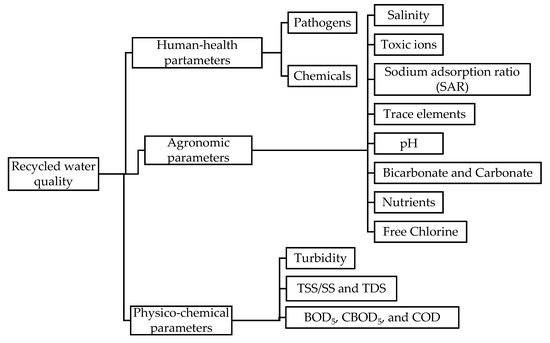
Figure 1.
Agricultural water quality parameters.
3.2.1. Human-Health Parameters
Human-health parameters are of prominent importance in safe agricultural water reuse practices. The health of farmers, workers, consumers, and people who live in the close vicinity of farms have to be considered for safe agricultural water reuse practices. This issue has been addressed mainly by including microbial and chemical water quality parameters related to human health.
Pathogens
The presence of pathogens is the main health concern when recycled water is used for irrigation. Scientists and experts have concluded that it is not practical to monitor the existence of all of the pathogens in recycled water. Therefore, the indicator organism concept has been used to monitor the pathogens in a more practical manner [4]. There are many waterborne pathogens and their microbiological indicators, which have been included in the regulations and guidelines. In general, there are two major approaches to microbial water quality including “no fecal indicator bacteria” and “no real risk of infection”.
No Fecal Indicator Bacteria in the Water:
In this approach, the assumption is that it is not viable to monitor all of the pathogenic microorganisms [134]. Therefore, coliforms are considered as substitute parameters. Fecal coliforms are the most common bacteria of thermo-tolerant coliforms. Additionally, E. coli is the most common fecal indicator bacterium used by different organizations and countries. Under this approach, no detectable fecal indicator is required using fecal indicator as the microbial indicator. The advantage of this approach is that there is no need to monitor all of the pathogenic microorganisms. The disadvantage of this approach is that it is so strict and costly even though there is no need to monitor all of pathogenic microorganisms [134]. Shuval et al. argued that using this approach would increase cost per case of disease averted [135]. They estimated that the cost of using no detectable fecal coliform/100 mL was near US $330 million more than using 1000 fecal coliform/100 mL per each case of an infectious disease (i.e., hepatitis A) prevented [135]. As the level of endemic enteric diseases in developed counties are low, this higher cost may be justified. However, other countries with high levels of endemic enteric diseases which usually are transmitted through low levels of sanitation and hygiene may not justify this higher cost [134]. Of note is in most cases, the state of California’s regulation has been widely used as the benchmark regulation under this approach by other organizations and agencies. In this study, we call regulations and guidelines which used this approach “restrictive”.
From the Epidemiological Point of View; no Real Risk of Infection:
According to this approach, epidemiological evidence must be used to issue any microbial quality requirement [134]. The advantage of using this method is that the risk assessment process is done by studying the infection between exposed people to the recycled water. In this method, people exposed to different recycled water qualities would be studied to determine what level of recycled water quality results in no more excess infection cases in the study population. On the other hand, this approach is only valid for the specific time and place that the risk assessment has been conducted. Therefore, to use the results in regulations and guidelines, they must be extrapolated, which requires making some assumptions about the changes to the variables, making it less precise. Additionally, conducting epidemiological studies are not always easy, especially in developing countries. For example, there are critics about insufficiency of these studies and existence of some groups of people who have been immunized to many enteric infections. In addition, there may be a lack of health risk assessment methodologies which were used before for these types of studies [134]. The other disadvantage of this method is that epidemiological studies do not consider the secondary transmission [134]. Of note is in most cases, the WHO guideline has been considered as the benchmark guideline under this approach by other organizations and agencies. In this study, we call regulations and guidelines which used this approach “less restrictive”.
Among the regulations and guidelines that were evaluated for this study, there were 49 documents that were considered restrictive, and 15 documents that were less restrictive (Table 4 and Table 5). The microbial quality parameters in restrictive agricultural water reuse regulations and guidelines were Fecal Coliforms (25 documents), E. coli (21 documents), Total Coliforms (7 documents), Intestinal Nematodes (6 documents), Thermo-tolerant Coliforms (5 documents), Enterococci (2 documents), Somatic Coliphages (2 documents), Clostridium Perfringens (1 document), and F-RNA Bacteriophages (1 document). In general, the threshold limits for food crops irrigation and unrestricted public access categories have lower limits compared to processed food crops/non-food crops irrigation and restricted public access categories. When compared, regulations and guidelines established by different organizations and agencies sometimes had different threshold levels for the same parameters (Table 4). The comparison also showed a considerable level of discrepancy among the restrictive regulations and guidelines with respect to microbial water quality (Table 4). It was apparent that restrictive regulations or guidelines have been adopted by developed countries in the world due to their costs and high-tech requirements. It was estimated that restrictive regulations and guidelines cost an additional $3–30 million per prevented enteric disease [135].
Table 4.
Restrictive agricultural water reuse regulations and guidelines.
Table 5.
Less restrictive agricultural water reuse regulations and guidelines.
Fifteen documents were gathered under less restrictive regulations and guidelines (Table 5). The indicator parameters in these regulations and guidelines included Fecal Coliforms (11 documents), Intestinal Nematodes (6 documents), E. coli (3 documents), Total Coliforms (2 documents), and Enterococci (1 document). Similar to restrictive regulations and guidelines, the threshold limits for food crops irrigation and unrestricted public access categories had lower values than processed food crops/non-food crops and restricted public access categories. In addition, threshold levels for same parameters are sometimes very different, when regulations and guidelines are compared with each other (Table 5).
BY comparing the required microbial quality thresholds, one can simply notice large discrepancies among the existing regulations and guidelines. Of note is that none of the less restrictive regulations and guidelines used thermo-tolerant Coliforms in their documents. To have a better idea of these thresholds, common pathogen indicators were analyzed using descriptive statistical analysis (Table 6). Fecal Coliform was used more than the other indicators in the regulations and guidelines (Table 6). E. Coli thresholds had the largest range, 100,000, among the indicators. Additionally, the most frequent threshold of Fecal Coliform, E. Coli, Total Coliform, Thermo-Tolerant Coliform, Intestinal Nematodes, Enterococci, Coliphages, Clostridia, and F-RNA Bacteriophages were 200, 1000, 23, 1000, 1, 35, 1, 1, and 1, respectively (Table 6).
Table 6.
Descriptive statistical analysis of common pathogen indicators included in agricultural water reuse regulations and guidelines.
One of the main human health concerns related to water reuse is intestinal parasitic infections [136]. Verbyla et al. [137] showed that the consumption of lettuce irrigated with river water, contaminated with fecal contamination, resulted in an estimated median health burden that represented 37% of Bolivia’s overall diarrheal disease burden. However, irrigation with filtered riverbank resulted in an estimated health burden that was only 1.1% of this overall diarrheal disease burden. Median concentrations of different contaminants in the river water were as follows: 3.2 × 10⁸ adenovirus copies/L, 6.4 × 10⁷ pepper mild mottle virus copies/L, 1.8 × 10⁷ E. Coli cfu/L, 1.4 × 10⁷ human-specific HF183 Bacteroides copies/L, 3.6 × 10⁶ human rotavirus group A copies/L, 1.1 × 10⁵ Coliphage pfu/L, 530 Giardia cysts/L, and 4.0 Cryptosporidium oocysts/L [137]. The following contaminants were detected in the filtered riverbank (lower median concentrations): 1.1 × 10⁵ adenovirus copies/L, 7.7 × 10⁴ pepper mild mottle virus copies/L, 3.0 × 10³ E. coli cfu/L, 4.5 × 101 human-specific HF183 Bacteroides copies/L, 5.9 × 10² Coliphage pfu/L, 2.0 Giardia cysts/L, and 0.04 Cryptosporidium oocysts/L [137].
Based on Table 5 and the study by Verbyla et al. [137] it is apparent that the microbial parameters and their thresholds in the existing regulations and guidelines are not adequate to make sure agricultural water reuse practices are safe for human health. For example, E. Coli threshold set by WHO and France is 100,000 cfu/100mL, however other studies showed that irrigation with a water with E. Coli concentration of 18,000 cfu/mL caused an estimated median health burden that represented 37% of Bolivia’s overall diarrheal disease burden [137].
It has also been reported that the greatest health risk in developing countries is the high concentration of Nematode eggs (>1 Egg/L) when water reuse is practiced using spray irrigation technology, especially in case of vegetables eaten raw by children [4]. Among the regulations and guidelines that were evaluated in this study, only 12 documents have included intestinal nematodes including ISO, Cyprus, E.U., Saudi Arabia, Tunisia, and NSW, from the restrictive group, and FAO, WHO, Spain, Iran, China, and Oman from the less restrictive group (Table 4 and Table 5).
Chemicals
Another human health concern related to recycled water use is potential contamination of crops and groundwater by chemical constituents that may be present in water. These chemicals may include heavy metals, pharmaceuticals, personal care products, and compounds which exert endocrine disruption properties such as hormones or other chemicals including PCBs, Octilphenol, Nonilphenol, etc. [4]. These hazardous chemicals are of great concern for human health especially in heavily polluted industrial wastewater [4]. On the other hand, there is still a huge data gap in terms of characterization and treatment of these chemicals which their concentrations are very low in concerning waters. Only a few agricultural water reuse regulations and guidelines included the chemical constituents in their documents (Table 7). Despite the potential negative consequences of these chemical constituents, only 17 regulations and/or guidelines included some of these chemical parameters (Table 7). Among the studied regulations and guidelines, Italy, China, Oman, and AGWR have included the highest number of chemical constituents in their documents (32, 22, 21, and 20 chemical parameters respectively, Table 7).
Table 7.
Chemicals and trace elements thresholds in agricultural water reuse regulations and guidelines (numbers in parentheses show the threshold level of chemical constituents and trace elements).
3.2.2. Agronomic Parameters
Agronomic parameters are of prominent importance in safe agricultural water reuse practices. Crops quality and yield, soil productivity, and ecological health have to be considered in safe agricultural water reuse practices.
pH
As the indicator of water acidity and alkalinity, pH is one of the water quality parameters that can be easily measured, and can be an indicator of the presence of toxic ions [4,67]. Although the normal pH range for safe irrigation is 6.5–8.4 [67], different pH ranges are used in the agricultural water reuse regulations and guidelines (Table 8 and Figure 2). Recycled water outside the normal pH range might result in nutritional imbalance, which may alter the crops growth and health, and facilitate the corrosion in pipelines, sprinklers, and control valves [4,138,139,140,141]. Lower pH makes heavy metals move easier in the soil, contaminating crops, and water bodies [142]. Out of 70 agricultural water reuse regulations and guidelines studied in this research, 34 documents included pH as one of their requirements (Table 8). The most common ranges are 6–9 and 6.5–8.5 (Figure 2).
Table 8.
pH ranges in the agricultural water reuse regulations and guidelines.
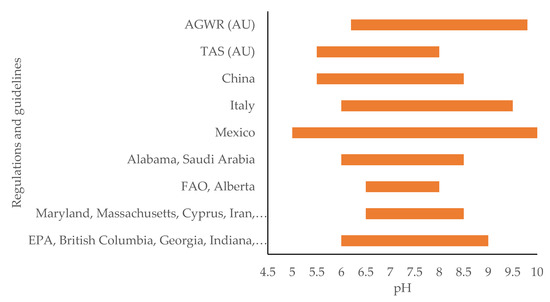
Figure 2.
Required pH ranges in agricultural water reuse regulations and guidelines.
Salinity
It has been reported that salinity is one of the most important recycled water quality parameters for agricultural water reuse practices. This is due to the fact that high concentration of dissolved salts increases the soil water pressure, requiring more energy from plants to take up water from soil and also resulting in specific ion toxicity [4,142,143,144,145]. The salinity of irrigation water often determines the salinity in the soil. Total dissolved solids (TDS (mg/L)) or electric conductivity (EC (dS/m)) are often used as indicators of salinity. While each of these parameters are important individually, there is an approximate correlation between TDS and EC, as shown by Equation (1) [4].
Three categories for EC and TDS thresholds are included in FAO’s guideline based on the water use restriction as none, slight to moderate, and severe negative impact (Table 9 and Figure 3). Only 13 and 10 regulations and guidelines (out of 70) have included EC and TDS in their agricultural water reuse requirements, respectively (Table 9). FAO, Saskatchewan, Iran, Jordan, Oman, ACT, and AGWR regulations and guidelines have included both of EC and TDS thresholds in their documents. In addition, Kuwait, Saudi Arabia, and China have only included TDS in their regulations and guidelines. Of note is that none of the U.S. states included EC and TDS thresholds in their agricultural water reuse regulations and guidelines.
Table 9.
Salinity (electric conductivity (EC) and total dissolved solids (TDS)) thresholds in agricultural water reuse regulations and guidelines.
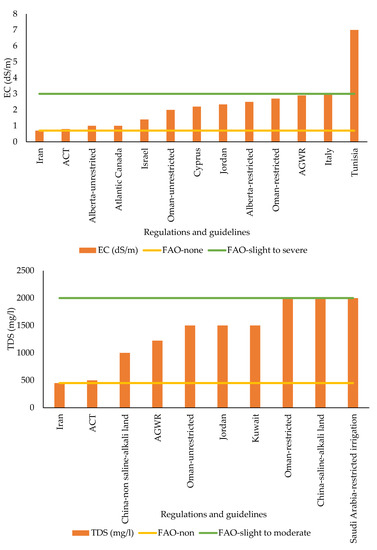
Figure 3.
Salinity (electric conductivity (EC) and total dissolved solids (TDS)) thresholds in agricultural water reuse regulations and guidelines.
Sodium Adsorption Ratio (SAR)
Sodium is one of the important ions in irrigation water which has to be regulated for agricultural practices. Its presence in the exchangeable form in soil causes harmful effects on the physical and chemical properties of the soil. Excessive amounts of Sodium results in particle dispersion and reduction of water and air infiltration into the soil [4,143,144,145,146]. The most common Sodium indicator which has been used in literature was the sodium adsorption ratio (SAR) index, calculated by Equation (2).
In this equation, SAR is the amount of Sodium adsorption ration, Na, Ca, and Mg are the concentrations of Sodium, Calcium, and Magnesium in me/L, respectively. There are no states in the U.S. with SAR threshold in their regulations or guidelines. In Canada, provinces of Alberta, Atlantic Canada, and Saskatchewan have included SAR thresholds for restricted and unrestricted agricultural water reuse practices (Table 10 and Figure 4). In Iran’s guideline, the SAR threshold is set as 3 when the EC < 0.7 dS/m, which is its required EC threshold. Additionally, Iran includes other SAR thresholds when EC > 0.7 dS/m. Moreover, the highest SAR thresholds we issued by Italy and Oman. In total, 7 out of 70 regulations and guidelines investigated in this study have included SAR in their requirements.
Table 10.
The SAR thresholds in the agricultural water reuse regulations and guidelines.
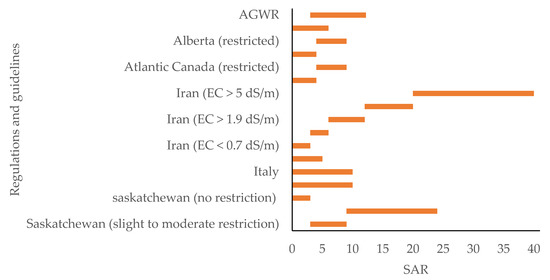
Figure 4.
Required sodium adsorption ratio (SAR) ranges in agricultural water reuse regulations and guidelines.
Ions: Chloride, Sodium, and Boron
Resulting in crops growth and yield reduction, morphology changes, and death, the presence of toxic ions can be detrimental to crops if their concentrations are more than the desired levels [147]. Despite this potential negative impact, these ions are beneficial at relatively low concentrations. Among these ions, Sodium (Na), Chloride (Cl−), and Boron (B) are of great significance. The crop is affected by these ions which can be either direct by interference with the metabolic processes or indirect by influencing other nutrients [4]. Roots and leaves are the main parts of crops by which Sodium and Chloride can be absorbed. Usually, when the ion is absorbed by leaves, it increases the rate of absorption which results in toxic ion accumulation and can be the primary toxicity source [148].
Due to extensive use of perborate as a bleaching agent, residential wastewater often contains considerable amounts of Boron. While 1 mg/L of Boron is essential for crop growth, if its concentration reaches 2 mg/L or more, most of the crops will suffer from Boron toxicity [4]. The highest and lowest thresholds for Boron were issued by Atlantic Canada and Israel as 6.5 and 0.4 mg/L, respectively. Even though Boron concentrations of more than 2 mg/L can result in toxic crops, Tunisia and Atlantic Canada have set their Boron thresholds as 3 and 6.5 mg/L, respectively. Excess of Chloride can result in acute physiological dysfunctions. A salty taste is another result of more than desired amounts of Chloride, which affects crops market negatively [149]. The lowest chloride thresholds have been issued by Iran and Saudi Arabia, 100 mg/L, and the highest one has been issued by Tunisia, 2000 mg/L (Table 11). Additionally, among the U.S. states, only Delaware has included Chloride in its regulation. Extra Sodium increases osmotic stress and can kill crop cells [150]. For Sodium, just 6 documents out of 70 investigated documents have included Sodium among their water quality parameters. The lowest thresholds were issued by FAO, and Iran as 69 and 70 mg/L, respectively, and highest were issued by AGWR as 312 mg/L, and by Oman for non-food crops as 300 mg/L. Of note is none of the U.S. states have included Sodium thresholds in their regulations and guidelines.
Table 11.
Toxic ions (Chloride, Sodium, and Boron) thresholds in agricultural water reuse regulations and guidelines.
Trace Elements
As mentioned before, trace elements (such as lead, cadmium, mercury, etc.) exist in low concentrations in wastewater but are hardly included in routine irrigation water analysis. Industrial and urban wastewater may contain considerable amount of trace elements and may result in accumulating of these compounds in soil and plants, reducing crop growth and polluting groundwater [4,151,152]. Trace elements accumulation in soils depends on their chemical form, consisting exchangeable, sorbed, organic-bound, carbonate, and sulfide. The uptake of these elements by plants mostly depend on rhizosphere environment, plant root system features, and soil characteristics. The soil pH has the most effect on the plant’s uptake. Toxicities caused by trace elements have been mostly reported in acidic soils [4].
The threshold levels indicated by agricultural water reuse regulations and guidelines were issued using limited research by different agencies which have made these thresholds relatively restrictive (Table 7). Therefore, if the suggested threshold is not met, it does not mean that it will always result in phytotoxicity.
Trace elements thresholds were issued to help practice a safe and sustainable agriculture, but as these elements are used extensively nowadays, these thresholds need to be updated regularly. Additionally, more regulations and guidelines should include trace elements. Currently, at the best case, only 17 out of 70 investigated documents include trace elements. Of note is the discrepancies among the trace elements thresholds ranges in the documents. Cadmium (0.0001–0.2 mg/L), Arsenic (0.004–0.1 mg/L), Lead (0.001–0.5 mg/L), Copper (0.002–1 mg/L), and Mercury (0.0001–0.2) are some of the most frequent trace elements in current regulations and guidelines with 17, 16, 16, 16, and 11 number of mentions, respectively (Table 7).
Bicarbonate and Carbonate
Bicarbonate and Carbonate are among important ions for plant health. High concentrations of these ions in the recycled water for irrigation can cause different consequences [153,154,155,156]. Irrigation of crops by recycled water which has high concentrations of Bicarbonate and Carbonate, using overhead sprinklers, leaves white lime deposits on the crops leaves during hot irrigation days. These white deposits not only reduce the crops sells due to undesirable look but also result in clogging in the irrigation appurtenances, including spray nozzles and drip emitters [4]. Another issue is increasing the SAR levels in soil. If Bicarbonate ions bond with chemical elements such as Magnesium and Calcium, resulting in its precipitation as Magnesium Carbonate or Calcium Carbonate, it will increase the soil SAR levels owing to dissolved Calcium concentration decrease [67]. Finally, high concentration of Bicarbonate along with Carbonate may result in increase of soil pH, influencing soil permeability [67,156]. Despite these aforementioned consequences of Bicarbonate and Carbonate, they are mentioned in only three agricultural water reuse regulations and guidelines that were investigated including FAO, Iran, and Jordan (Table 12). Of note is only Iran includes Carbonate in its guideline.
Table 12.
Bicarbonate and Carbonate thresholds in agricultural water reuse regulations and guidelines.
Nutrients and Micronutrients
Important nutrients and micronutrients for crop growth include Nitrogen (N), Phosphorus (P), Potassium (K), Zinc (Zn), and Sulfur (S). Although Nitrogen is the most important nutrient for crop growth, high concentrations of this nutrient may result in over stimulation of plant growth, lodging, poor crop quality, maturity postponement, and excessive foliar growth [67,157,158]. Additionally, as a long-term consequence of Nitrogen high concentration, stalks, stems, and branches of crops go weak which make the crop incapable to support the weight of vegetation in the case of winds and rain [4]. Moreover, the pasture which has been irrigated with high Nitrogen levels may be an unsafe source for feeding the livestock. Phosphorous is also important for crop and livestock production. However, excess amounts of Phosphorous can increase the rate of eutrophication. EPA identified eutrophication as the major problem of surface waters in the U.S. This phenomenon decreases the amount of available water source for different applications and decreases dissolved Oxygen and sunlight in water which put aquatic health in danger. Groundwater contamination and eutrophication in coastal areas are among other consequences of high concentrations of nutrients [159]. Potassium can stimulate algae and bacteria growth, resulting in clogging the irrigation system [160]. High concentrations of Zinc can cause phytoxicity, including hindering crops and their roots growth, chlorosis, decreasing crops productivity, and killing leaf tips [161]
Comparing all of the nutrients (Table 13), it is apparent that Zinc, Boron, and Nitrogen have gained more attention than other nutrients in existing agricultural water reuse regulations and guidelines. Zinc and Boron were discussed in previous sections. Total Nitrogen and Nitrate have been mentioned more than other Nitrogen forms (Table 13). The common concentrations of total Nitrogen, Nitrate, Ammonium, and total Phosphorus are 20–85 mg/L, 0–30 mg/L, 5–40 mg/L, and 4–15 mg/L, respectively [4]. Regarding total Nitrogen, Jordan almost set its threshold near the common concentration of total Nitrogen in wastewater, however other regulations and guidelines require lower levels of total Nitrogen. Oman and FAO, for restricted irrigation, require almost the same or higher concentrations of Nitrate, but the other regulations and guidelines set relatively lower levels of Nitrate for irrigation by recycled water. For Ammonium, all of the existing regulations and guidelines require lower levels of Ammonium than its common concentration in wastewater. Phosphorus thresholds in the existing regulations and guidelines are also much lower than its average levels in wastewater. Phosphate was mentioned more than total Phosphorous in the studied documents. Comparing countries which issued Phosphate or Phosphorous threshold, of note is developed countries (such as Canada, Israel, Australia, and Italy) are more restrictive than developing countries (such as Iran, Jordan, and Kuwait).
Table 13.
Nutrients thresholds in agricultural water reuse regulations and guidelines.
Free Chlorine
Chlorine is used in wastewater treatment plants to disinfect the effluent. Its quantity usually is determined in such a way that there will be some free Chlorine in the treated wastewater to ensure water is protected from recontamination by pathogens in the piping and storage system. The average amount of allowable free Chlorine in recycled water for irrigation is 1 mg/L which does not impose any threat on crops, although there are some sensitive crops which are affected by higher that 0.5 mg/L of free Chlorine. If the concentration of free Chlorine goes higher than the accepted level, severe crop damage will occur including chlorosis, plant growth decrease, leaf discoloration, etc. [162,163]. Due to the free Chlorine nature, high-reactivity, and instability, if the recycled water is stored for a few hours before use, its excess free Chlorine will dissipate [4].
The most residual Chlorine threshold that are set in regulations and guidelines are 1 mg/L with 12 out of 25 regulations and guidelines and 0.5 mg/L with 6 out of 25 regulations and guidelines (Table 14). Moreover, China (1.5 mg/L) and two Australian guidelines, NT and WA (2 mg/L), require higher concentrations of 1 mg/L for residual Chlorine. Totally, 25 out of 70 regulations and guidelines require residual Chlorine monitoring as a part of their recycled water quality requirements.
Table 14.
Residual Chlorine thresholds in agricultural water reuse regulations and guidelines.
3.2.3. Physico-Chemical Parameters
Turbidity
Turbidity is among important parameters with both human-health and agronomic significance. Disturbance to irrigation facilities, reduction in soil hydraulic conductivity, and polluting soil surface are among the potential negative impacts of excessive turbidity in recycled water [164,165]. One of the main reasons why suspended solids are measured and controlled in recycled water is that germs are able to move along with soils particles by attaching to them. So, agencies considered turbidity, TSS or SS in their agricultural water reuse regulations and guidelines as an indicator parameter. In total, 27 out of 70 regulations and guidelines included turbidity as one of their requirements (Table 15). There are five different methods of monitoring turbidity in the regulations and guidelines including 24-h average, more than 5% of the time in a 24-h period, maximum of anytime, maximum of anytime in case of using membranes and monthly average (Table 15). For the 24-h average, 2 NTU (Nephelometric Turbidity Units) is used in all of the regulations and guidelines, EPA, ISO, Arizona, Hawaii, Idaho, Maryland, Massachusetts, Minnesota, Oregon, Utah, Virginia, Washington, and NSW.
Table 15.
Turbidity thresholds in agricultural water reuse regulations and guidelines.
Regarding the second category, more than 5% of the time in a 24-h period, 2 NTU is used by Australian states, NT, QLD, and WA, and 5 NTU is used by the U.S. states, Hawaii, Massachusetts, Oregon, and European Commission. The next category, maximum of anytime, is used more than the others by 27 regulations and guidelines. In this category, Pennsylvania requires the highest threshold and British Columbia, California, New Jersey, Rhode Island, Greece, and ACT require the lowest threshold for turbidity in agricultural water reuse practices. The last two categories are not used as the others. Hawaii and EPA, as two of the restrictive guidelines, set 0.2 NTU for their turbidity threshold when membranes are used for treating the recycled water. The monthly average is only used by the state of Pennsylvania, 10 NTU.
Total Suspended Solids (TSS)/SS and TS
The TS consists of total suspended solids (TSS) and TDS which are separated from each other by a filtration process. Solids which remain on the filter are suspended solids and those that pass the filter are dissolved solids. According to WHO [60], TSS consists of a diverse range of materials, namely industrial waste, decaying plants and animal matter, and silts, while TDS consists of dissolved organic matter and inorganic salts in water. As these two parameters are easily measured and they can be used as indicators of recycled water quality, many organizations and agencies have included them in their agricultural water reuse regulations and guidelines (Table 16 and Table 9). Of note is that the allowable concentration of TDS in those regulations and guidelines which included both TDS and TSS thresholds are much higher than the allowable concentration of TSS for using recycled water in agriculture (Figure 5), preventing erosion, corrosion, and clogging in irrigation facilities, and damaging crops. In total, TSS is mentioned in agricultural water reuse regulations and guidelines by 43 documents.
Table 16.
TSS/SS thresholds in agricultural water reuse regulations and guidelines.
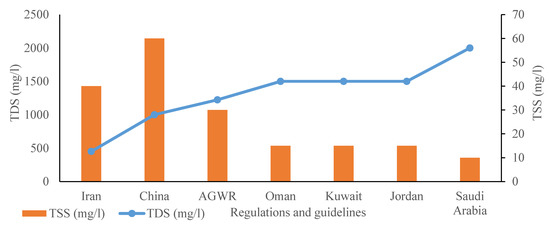
Figure 5.
Comparison of the TDS and selected total suspended solids (TSS) thresholds, required in agricultural water reuse regulations and guidelines which included both of TDS and TSS thresholds.
Biological Oxygen Demand (BOD5), Carbonaceous Oxygen Demand (CBOD5), and Chemical Oxygen Demand (COD)
Biological oxygen demand (BOD), carbonaceous oxygen demand (CBOD), and chemical oxygen demand (COD) are different indicators of organic matter in water. Organic matter in the water may alter the water’s color and odor, provide nutrients for microbial growth, and negatively impact the disinfection process [142]. To prevent these adverse effects, different organizations and agencies have included BOD5, CBOD5, and COD thresholds in their regulations and guidelines (Table 17, Table 18 and Table 19). In total, 7, 42, and 8 regulations and guidelines included CBOD5, BOD5, and COD in their requirements, respectively. The highest and lowest CBOD5 thresholds are issued by Alberta (restricted and unrestricted public access) and Texas (food crops) as 100 and 5 mg/L, respectively (Table 17). The highest BOD5 thresholds is issued by Egypt (C: industrial oil crops and wood trees) as 400 mg/L (Table 18). The lowest BOD5 threshold are issued by Texas (food crops), Hawaii (food crops), and Georgia (non-food crops/processed food crops), and ISO (unrestricted/food crops) as 5 mg/L (Table 18). The highest and lowest COD thresholds are issued by Jordan (B: fruit trees, landscaped roadsides of highways and C: industrial crops, forest trees) China (vegetables) as 500 and 40 mg/L, respectively (Table 19).
Table 17.
CBOD5 thresholds in agricultural water reuse regulations and guidelines.
Table 18.
BOD5 thresholds in agricultural water reuse regulations and guidelines.
Table 19.
COD thresholds in agricultural water reuse regulations and guidelines.
3.3. Treatment Levels
As it was mentioned before, one of the main considerations of water reuse practices is to ensure that the recycled water is safe for reuse. Appropriate treatment technologies must be used to provide a biologically and chemically safe water for use in agriculture. Accordingly, different agencies and organizations have required various treatment technologies in their agricultural water reuse regulations and guidelines, considering recycled water quality, type of crops, irrigation methods, soil characteristics, and public access (Table 20 and Table 21). The secondary treatment is the most frequent treatment requirement mentioned in the regulations and guidelines. Of note is that 38 out of 70 regulations and guidelines have required disinfection as part of the treatment process. When compared, it is obvious that there is a large discrepancy in the required treatment methods in the regulations and guidelines (Table 20). As different treatment methods are able to remove different contaminants from wastewater, it likely results in treated water with significantly different water quality. Therefore, there is more investigation that need to be done in terms of required treatment methods in the regulations and guidelines by agencies.
Table 20.
Required treatment technologies in agricultural water reuse regulations and guidelines.
Table 21.
The number of regulations and guidelines which indicated different treatments.
4. Summary of Findings
4.1. Constituents in Reclaimed Water
In general, the occurrence of constituents in reclaimed water are subject to treatment processes in wastewater treatment plants. Constituents in wastewater can be divided into three groups of conventional, nonconventional, and emerging. The constituents that have been the basis of the design of most conventional wastewater treatment plants are expected to be mostly removed during the treatment processes (e.g., TSS, BOD, Nitrate, Nitrite, Phosphorus, and Bacteria) [166]. There is also a group of constituents that may be removed or reduced using the advanced treatment processes (e.g., metals, TDS) [166]. Finally, there are the emerging constituents that are present in micro or nanogram/L, which may pose negative health and environmental concerns [167]. These compounds sometimes cannot be removed effectively even with advanced treatment processes [4]. In what follows, the knowledge gaps related to microbial constituents, agronomic, and physico-chemical properties, and emerging constituents of reclaimed water that are of concern in water reuse for agricultural irrigation were briefly discussed. In addition, the findings from the investigation of regulations and guidelines with respect to each of these groups of constituents were summarized.
4.1.1. Microbial Quality
As noted in Section 3.2.1., in the vast majority of the regulations and guidelines, Total Coliforms, Fecal coliforms, and E. coli were used as the indicator microorganism to assess the microbial quality of the reclaimed water for irrigation. In the regulations and guidelines investigated in this study, Fecal Coliform, E. Coli, and Total Coliform were the most frequent indicator microorganisms with 36, 24, and 9 cases, respectively (Figure 6). However, indicator microorganisms do not represent all of the existing pathogens in the recycled water. Regulations and guidelines need to consider the fact that pathogens in recycled water are part of larger microbial communities [168,169]. Kulkarni et al. claimed that microbial communities in the recycled water can be affected by “wastewater treatment processes, operational parameters, organic and inorganic wastewater constituents, and water reuse site practices” [168].
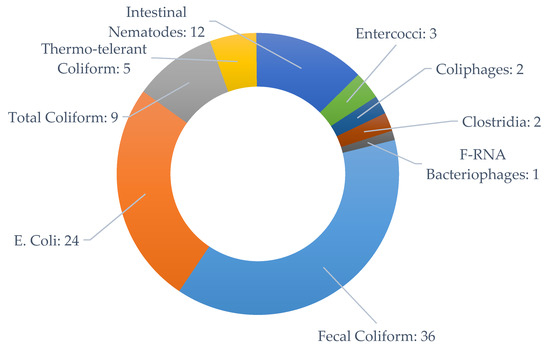
Figure 6.
The number of regulations and guidelines which indicated different indicator microorganisms.
Another shortcoming of bacterial indicators is in the prediction of parasites and viruses, which can be more resistant to disinfection. In addition, the information derived from the microbiological analysis is not immediate and it is not obtained in a continuous manner as well. These drawbacks have motivated the development of more preventive approaches, such as the Water Safety Plans proposed by the WHO [170]. The recent advancement in detection methods such as use of molecular markers and real-time monitoring techniques necessitates the modification of existing official detection methods in regulations and guidelines [171,172]. In summary, more information is still needed to assist regulatory agencies in improving or verifying the effectiveness of their criteria for microbial quality of recycled water such as:
- Better selection of indicator organisms for estimation of microbial pathogens in reclaimed water
- Improvement in risk assessment methodologies to make it more useful during the regulation development
- Development of real-time biomonitoring methods
- Better verification of treatment effectiveness and reliability of removal of microbial pathogens during various treatment processes
4.1.2. Agronomic and Physico-Chemical Parameters
The agronomic and physico-chemical parameters that were evaluated in this study comprise a complete list of the necessary parameters, which can increase the safety of crops, soil, and in general agricultural water reuse practices. However, those parameters were not used by all of the regulations and guidelines investigated in this study. For instance, pH (34), free Chlorine (25), and nutrients (21) were the most frequent parameters respectively (Figure 7). TSS (43), BOD5 (42), and turbidity (27) were the most frequent among physico-chemical parameters used in the studied regulations and guidelines (Figure 8). In addition, even in the regulations and guidelines that have included these parameters, large discrepancies exist in the threshold levels. This not only could be a threat to recycled water irrigation practices, but also might affect the farmers’ tendency toward implementing water reuse.
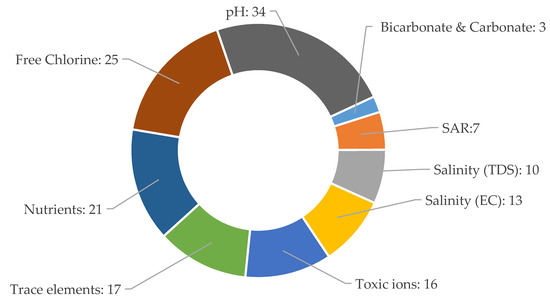
Figure 7.
The number of regulations and guidelines which included different agronomic parameters.
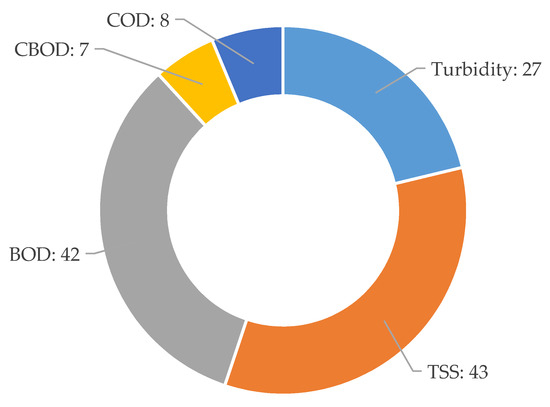
Figure 8.
The number of regulations and guidelines which used different physico-chemical parameters.
Based on the results (Section 3.2.2 and Section 3.2.3), the main gap of agricultural water reuse regulations and guidelines regarding the agronomic and physico-chemical parameters are the absence of some of the important parameters, and the discrepancies among their existing thresholds. Due to the importance of agriculture and technological advancements, there is significant knowledge and expertise about these parameters, their measurement methods and instruments. So, regulations and guidelines need to include all of these parameters with similar thresholds. For instance, the potential negative impacts of low or high pH was clearly clarified in this paper according to literature. Additionally, pH measurement is one of the easiest tests that can be done. However, only about half of the investigated regulations and guidelines (34 out of 70) have included pH as one of the water quality parameters.
4.1.3. Constituents of Emerging Concern
With the advancement of analytical instrumentation, it is now possible to measure a long list of trace constituents in the environment. Contaminants of emerging concern (CECs) include a wide range of trace constituents such as pharmaceuticals, personal care products, household products, drugs, flame retardants, etc. [173]. Many of these compounds are found in raw wastewater in considerable concentrations [173]. Conventional wastewater treatment technologies are not able to remove many of these compounds during the treatment process because they are not designed to do so. In addition, many of these constituents are not included in the discharge regulations, thus, are not monitored by the wastewater treatment facilities. As a result, many of these CECs could be present in the treated water (Table 22).
Table 22.
Some of the existing contaminants of emerging concern (CECs) in recycled water reported by literature [174].
Despite their potential negative effects on the ecological and public health (e.g., abnormalities in the reproductive systems of creatures, increasing the resistance of humans and animals to antibiotics, and changing the development processes of creatures), none of the regulations or guidelines have included CECs [175,176,177,178,179,180]. It should be noted that there is an enormous variety of these compounds, which make their assessment a very challenging task. For instance, Huang et al. reported that there are approximately 7700 pharmaceuticals that humans use, which may potentially end up in the residential wastewater. In addition, these constituents have a wide range of physio-chemical properties and biodegradability [181]. Agencies should consider several factors including rates of consumption, risks to human/ecological health, physio-chemical properties, biodegradability, pharmacological class, and sustainability index, in order to include the CECs in the regulations and guidelines [182,183]. As a result, an enormous effort is still required to close the regulatory gaps with respect to emerging contaminants.
In a nutshell, this study highlights some of the large discrepancies among current agricultural water reuse regulations and guidelines. Brissaud [54] argued that the countries rationale for setting up or adapting other regulations or guidelines are not clear. Most of the countries’ rationale reflect a perception of a risk hierarchy (which is different among various countries) instead of using an scientifically based rationale [54]. In order to address this challenge, Brissaud [54] suggested that countries should base their agricultural regulations and guidelines on epidemiologic studies and quantitative microbiological health risk assessment. This will pave the way for countries to share their knowledge and experiences, find common policies, and determine the uncertainties of their regulations and guidelines, which will shed light on the needs for future scientific research [54]. Moreover, these discrepancies might be the result of differences between countries and states approach to their public health; their economic, development, and education status; as well as their local climatic and geographical conditions. In general, countries and states with high economic status can afford high level technologies for treating wastewater to meet restrictive thresholds. Therefore, regulations and guidelines in high economic status societies are most likely to be more restrictive. In addition, people who live in semi-arid or arid areas of the world usually deal with water crisis in their everyday life, making them more interested in agricultural water reuse practices [31]. As they are more interested, their government is forced to issue agricultural water reuse regulations or guidelines. The state of California can be a good example for this, as this state is in a semi-arid area and its citizens are well aware and interested in agricultural water reuse practices. It should be mentioned that public health, economic, development, and education statuses of this state are high which has made this state one of the pioneers of agricultural water reuse practices with a restrictive regulation.
5. Conclusions
With recent advancements in wastewater treatment technologies, it is possible to produce almost any water quality. However, the main human and environmental concerns are still to determine what constituents must be removed and to what extent. To ensure safe water reuse practices, different national and international organizations and agencies have issued their own regulations and guidelines. To do a comprehensive and comparative study of the existing water reuse regulations and guidelines, this paper has evaluated the current status of existing regulations and guidelines for water reuse in agriculture throughout the world. In total, 83 cases were studied, among which 70 regulations and guidelines for agricultural water reuse were identified, and the latest version of the documents were obtained. These regulations and guidelines were collected from EPA, ISO, FAO, WHO, U.S. (statewide), European Commission, Canada (by provinces), Australia, Mexico, Iran, Egypt, Tunisia, Jordan, Israel, Palestine, Oman, China, Kuwait, Saudi Arabia, France, Cyprus, Spain Greece, Portugal, and Italy. The main focus of this study was to evaluate, compare, and identify the gaps in the current agricultural water reuse regulations and guidelines.
Recycled water quality parameters were categorized into three major groups, including human-health parameters (pathogens and chemicals), agronomic parameters (salinity, toxic ions, SAR, trace elements, pH, Bicarbonate/Carbonate, nutrients, and free Chlorine), and physico-chemical parameters (turbidity, TSS, BOD5, CBOD5 and COD). Regulations and guidelines were categorized into two groups based on their microbiological requirements. Those which were high-cost/low-risk, requiring zero detection of microbial indicators in recycled water, were named as “restrictive” regulations and guidelines with California’s regulation be their benchmark regulation. On the other hand, those which were low-cost/high-risk, requiring no real risk of infection, were named as “less restrictive” regulations and guidelines with WHO’s guideline be their benchmark guideline.
Results showed that, to a larger extent, water reuse regulations and guidelines are mainly based on the control of conventional water quality parameters such as coliforms, BOD5, turbidity, and TSS. Thus, most of the existing regulations and guidelines do not include emerging pathogens (such as salmonella and hepatitis), heavy metals or contaminants of emerging concern. Pathogen thresholds were indicated by 64 out of 70 regulations and guidelines. The most frequent microbial indicator used by regulations and guidelines was Fecal Coliforms. Despite a wide range of chemicals and trace elements that have been detected in treated wastewater, only a few of them have been regulated in agricultural water reuse regulations and guidelines. Among the long list of trace elements and chemicals, Chromium, Cadmium, and Nickel had the maximum number of indications with inclusion in only 17 out of 70 regulation and guidelines investigated in this study. Considering the detrimental effects of chemicals and trace elements on human and environmental health, agricultural regulations and guidelines need to include more chemicals and trace elements in their requirements.
Thirty-four out of seventy regulations and guidelines included pH, most of which considered 6.5–8 range to be the best pH range for agricultural water reuse practices. Although salinity, reported as EC and TDS thresholds, is the most important agronomic parameter, none of the U.S. states’ regulations and guidelines included EC and TDS thresholds in their agricultural water reuse regulations and guidelines. SAR thresholds were included in only 7 out of 70 regulations and guidelines investigated in this study, none of which were from U.S. states. Canadian provinces and Iran’s guideline contain the most comprehensive SAR thresholds Compared with others. As the most frequent indicated nutrients in regulations and guidelines, Zinc, Boron, and total Nitrogen ranges in regulations and guidelines were in severe restriction range of FAO’s guideline. Turbidity, TSS, and BOD were mostly used by U.S. states as water quality indicators in the regulations and guidelines (17, 19, and 19 documents, respectively). Secondary treatment and tertiary treatment are the most frequent treatment processes required by different regulations and guidelines. In summary, the most frequent recycled water quality parameters required by the regulations and guidelines were as follows: (1) Pathogens; (2) TSS; (3) BOD5; (4) pH; (5) Turbidity; (6) Chemicals/trace elements; (7) Nutrients; (8) Free Chlorine; (9) EC; (10) TDS; (11) COD; (12) CBOD5; (13) SAR and Bicarbonate/Carbonate.
To summarize, results showed that the regulations and guidelines are mainly human-health centered, insufficient regarding some of the potentially dangerous pollutants such as emerging constituents, and with large discrepancies when compared with each other. In addition, some of the important water quality parameters such as some of the pathogens, heavy metals, and salinity are only included in a few of regulations and guidelines investigated in this study. Finally, specific treatment processes have been only mentioned in some of the regulations and guidelines, and with high levels of discrepancy. While agricultural water reuse gives us a means to address the water crisis, the discrepancies in regulations and guidelines are one of the main barriers for successful implementation of water reuse practices. However, this does not mean that the practice of water reuse in agriculture should be construed as unsafe compared to other sources of available water such as rivers, streams, and pond water. The focus rather should be on defining the acceptable level of risks by the regulatory agencies and endorsing by the public to promote the water reuse as part of the integrated water resources management. As to all types of water sources, special care is required to ensure recycled water quality is matched to crop needs, public health is protected, salinity is controlled, and both soil and groundwater conditions are kept sustainable.
Supplementary Materials
The following are available online at https://www.mdpi.com/2073-4441/12/4/971/s1, Table S1: Health-based targets for recycled water use in agriculture, Table S2: Water quality for irrigation, Table S3: EPA guideline for agricultural water reuse, Table S4: Water quality for irrigation in California’s regulation, Table S5: The E.U. commission proposal for minimum recycled water quality in order to use in agriculture.
Author Contributions
Conceptualization, M.N.-A. and F.S.; methodology, M.N.-A. and F.S.; investigation, F.S.; resources, F.S.; data curation, F.S.; writing—original draft preparation, F.S.; writing—review and editing, M.N.-A.; visualization, F.S.; supervision, M.N.-A.; project administration, M.N.-A.; funding acquisition, M.N.-A. All authors have read and agreed to the published version of the manuscript.
Funding
This research was funded by the United States Department of Agriculture-National Institute of Food and Agriculture, Grant number 2016-68007-25064, which established CONSERVE: A Center of Excellence at the Nexus of Sustainable Water Reuse, Food and Health.
Conflicts of Interest
The authors declare no conflict of interest. The funders had no role in the design of the study; in the collection, analyses, or interpretation of data; in the writing of the manuscript, or in the decision to publish the results.
References
- Urban Water Reuse Handbook; Eslamian, S., Ed.; CRC Press: Boca Raton, FL, USA, 2016; ISBN 9781482229158. [Google Scholar]
- Hogan, A.; Young, M. Visioning a future for rural and regional Australia. Cambridge J. Reg. Econ. Soc. 2013, 6, 319–330. [Google Scholar] [CrossRef]
- IISS (The International Institute for Strategic Studies) Global water shortages. Strateg. Comments 1999, 5, 1–2.
- Lazarova, V.; Bahri, A. Water Reuse for Irrigation: Agriculture, Landscapes, and Turf Grass; CRC Press: Boca Raton, FL, USA, 2004; ISBN 0203499409. [Google Scholar]
- Asano, T.; Burton, F.L.; Leverenz, H.L.; Tsuchihashi, R.; Tchobanoglous, G. Water Reuse: Issues, Technologies, and Applications; McGraw-Hill: New York, NY, USA, 2007; ISBN 9780071459273. [Google Scholar]
- Pearce, G.K. UF/MF pre-treatment to RO in seawater and wastewater reuse applications: a comparison of energy costs. Desalination 2008, 222, 66–73. [Google Scholar] [CrossRef]
- Angelakis, A.N.; Gikas, P. Water reuse: Overview of current practices and trends in the world with emphasis on EU states. Water Util. J. 2014, 8, 67–78. [Google Scholar]
- Jaramillo, M.F.; Restrepo, I. Wastewater Reuse in Agriculture: A Review about Its Limitations and Benefits. Sustainability 2017, 9, 1734. [Google Scholar] [CrossRef]
- Tzanakakis, V.E.; Paranychianaki, N.V.; Angelakis, A.N. Soil as a wastewater treatment system: Historical development. Water Sci. Technol. Water Supply 2007, 7, 67–75. [Google Scholar] [CrossRef]
- Tzanakakis, V.; Koo-Oshima, S.; Haddad, M.; Apostolidis, N.; Angelakis, A. The history of land application and hydroponic systems for wastewater treatment and reuse. In Evolution of Sanitation and Wastewater Technologies through the Centuries; IWA Publishing: London, UK, 2014; Volume 1, p. 457. [Google Scholar]
- USEPA (US Environmental Protection Agency). Guidelines for Water Reuse; US Environmental Protection Agency: Anchorage, AK, USA, 2012.
- Rahman, M.M.; Hagare, D.; Maheshwari, B. Use of recycled water for irrigation of open spaces: benefits and risks. In Balanced Urban Development: Options and Strategies for Liveable Cities; Springer: Berlin/Heidelberg, Germany, 2016; pp. 261–288. [Google Scholar]
- Hanjra, M.A.; Drechsel, P.; Wichelns, D.; Qadir, M. Transforming urban wastewater into an economic asset: Opportunities and challenges. In Wastewater; Springer: Berlin/Heidelberg, Germany, 2015; pp. 271–278. [Google Scholar]
- Miller-Robbie, L.; Ramaswami, A.; Amerasinghe, P. Wastewater treatment and reuse in urban agriculture: exploring the food, energy, water, and health nexus in Hyderabad, India. Environ. Res. Lett. 2017, 12, 075005. [Google Scholar] [CrossRef]
- Chen, Z.; Ngo, H.H.; Guo, W. A critical review on sustainability assessment of recycled water schemes. Sci. Total Environ. 2012, 426, 13–31. [Google Scholar] [CrossRef]
- Khan, N. Natural Ecological Remediation and Reuse of Sewage Water in Agriculture and Its Effects on Plant Health. Sewage 2018, 1, 1. [Google Scholar]
- Bixio, D.; Thoeye, C.; Wintgens, T.; Ravazzini, A.; Miska, V.; Muston, M.; Chikurel, H.; Aharoni, A.; Joksimovic, D.; Melin, T. Water reclamation and reuse: implementation and management issues. Desalination 2008, 218, 13–23. [Google Scholar] [CrossRef]
- Urkiaga, A.; De las Fuentes, L.; Bis, B.; Chiru, E.; Balasz, B.; Hernández, F. Development of analysis tools for social, economic and ecological effects of water reuse. Desalination 2008, 218, 81–91. [Google Scholar] [CrossRef]
- Angelakis, A.N.; Asano, T.; Bahri, A.; Jimenez, B.E.; Tchobanoglous, G. Water reuse: From ancient to modern times and the future. Front. Environ. Sci. 2018, 6, 26. [Google Scholar] [CrossRef]
- Qadir, M.; Sharma, B.R.; Bruggeman, A.; Choukr-Allah, R.; Karajeh, F. Non-conventional water resources and opportunities for water augmentation to achieve food security in water scarce countries. Agric. Water Manag. 2007, 87, 2–22. [Google Scholar] [CrossRef]
- Easa, M.E.S.; Shereif, M.M.; Shaaban, A.I.; Mancy, K.H. Public health implications of waste water reuse for fish production. Water Sci. Technol. 1995, 32, 145–152. [Google Scholar] [CrossRef]
- Alderson, M.P.; dos Santos, A.B.; Mota Filho, C.R. Reliability analysis of low-cost, full-scale domestic wastewater treatment plants for reuse in aquaculture and agriculture. Ecol. Eng. 2015, 82, 6–14. [Google Scholar] [CrossRef]
- Zarghami, M.; Akbariyeh, S. System dynamics modeling for complex urban water systems: Application to the city of Tabriz, Iran. Resour. Conserv. Recycl. 2012, 60, 99–106. [Google Scholar] [CrossRef]
- Zhu, Z.J.Y.; McBean, E.A. Selection of water treatment processes using Bayesian decision network analyses. J. Environ. Eng. Sci. 2007, 6, 95–102. [Google Scholar] [CrossRef]
- Scott, C.; Bailey, C.; Marra, R.; Woods, G.; Ormerod, K.J.; Lansey, K. Scenario Planning to Address Critical Uncertainties for Robust and Resilient Water–Wastewater Infrastructures under Conditions of Water Scarcity and Rapid Development. Water 2012, 4, 848–868. [Google Scholar] [CrossRef]
- Almasri, M.N.; McNeill, L.S. Optimal planning of wastewater reuse using the suitability approach: A conceptual framework for the West Bank, Palestine. Desalination 2009, 248, 428–435. [Google Scholar] [CrossRef]
- Vergine, P.; Salerno, C.; Libutti, A.; Beneduce, L.; Gatta, G.; Berardi, G.; Pollice, A. Closing the water cycle in the agro-industrial sector by reusing treated wastewater for irrigation. J. Clean. Prod. 2017, 164, 587–596. [Google Scholar] [CrossRef]
- Alkhamisi, S.A.; Abdelrahman, H.A.; Ahmed, M.; Goosen, M.F.A. Assessment of reclaimed water irrigation on growth, yield, and water-use efficiency of forage crops. Appl. Water Sci. 2011, 1, 57–65. [Google Scholar] [CrossRef]
- Sakellariou-Makrantonaki, M.; Tentas, I.; Koliou, A.; Kalfountzos, D.; Vyrlas, P. Irrigation of ornamental shrubs with treated municipal wastewater. In Proceedings of the 8th International Conference on Environmental Science and Technology, Myrina, Greece, 8–10 September 2003; Volume B, pp. 707–714. [Google Scholar]
- Zozaya, S.; Rock, C.M.; Onumajuru, C.; Brassill, N.; Goldstein, R.R.; Suri, M.R.; Dery, J.L. Understanding grower perceptions and attitudes on the use of nontraditional water sources, including reclaimed or recycled water, in the semi-arid Southwest United States. Environ. Res. 2018, 170, 500–509. [Google Scholar]
- Suri, M.R.; Dery, J.L.; Pérodin, J.; Brassill, N.; He, X.; Ammons, S.; Gerdes, M.E.; Rock, C.; Goldstein, R.E.R. U.S. farmers’ opinions on the use of nontraditional water sources for agricultural activities. Environ. Res. 2019, 172, 345–357. [Google Scholar] [CrossRef]
- Maloupa, E.; Traka-Mavrona, K.; Papadopoulos, A.; Papadopoulos, F.; Pateras, D. Wastewater re-use in horticultural crops growing in soil and soilless media. Acta Hortic. 1999, 481, 603–607. [Google Scholar] [CrossRef]
- Mahesh, J.; Amerasinghe, P.; Pavelic, P. An integrated approach to assess the dynamics of a peri-urban watershed influenced by wastewater irrigation. J. Hydrol. 2015, 523, 427–440. [Google Scholar] [CrossRef]
- Hanjra, M.A.; Blackwell, J.; Carr, G.; Zhang, F.; Jackson, T.M. Wastewater irrigation and environmental health: Implications for water governance and public policy. Int. J. Hyg. Environ. Health 2012, 215, 255–269. [Google Scholar] [CrossRef]
- Falkenberg, T.; Saxena, D.; Kistemann, T. Impact of wastewater-irrigation on in-household water contamination. A cohort study among urban farmers in Ahmedabad, India. Sci. Total Environ. 2018, 639, 988–996. [Google Scholar] [CrossRef]
- Capodaglio, A. Integrated, Decentralized Wastewater Management for Resource Recovery in Rural and Peri-Urban Areas. Resources 2017, 6, 22. [Google Scholar] [CrossRef]
- Chu, J.; Chen, J.; Wang, C.; Fu, P. Wastewater reuse potential analysis: Implications for China’s water resources management. Water Res. 2004, 38, 2746–2756. [Google Scholar] [CrossRef]
- Nazari, R.; Eslamian, S.; Khanbilvardi, R. Water reuse and sustainability. Ecol. Water Qual. Treat. Reuse 2012, 1, 241–254. [Google Scholar]
- Massey, D.T. Features of Federal Law That Encourage Adoption of Land Application of Wastewater. J. Water Resour. Plan. Manag. 1983, 109, 121–133. [Google Scholar] [CrossRef]
- Fatta-Kassinos, D.; Kalavrouziotis, I.K.; Koukoulakis, P.H.; Vasquez, M.I. The risks associated with wastewater reuse and xenobiotics in the agroecological environment. Sci. Total Environ. 2011, 409, 3555–3563. [Google Scholar] [CrossRef]
- Gallegos, E.; Warren, A.; Robles, E.; Campoy, E.; Calderon, A.; Sainz, M.G.; Bonilla, P.; Escolero, O. The effects of wastewater irrigation on groundwater quality in Mexico. In Proceedings of the Water Science and Technology; Elsevier: Amsterdam, The Netherlands, 1999; Volume 40, pp. 45–52. [Google Scholar]
- Matos, C.; Pereira, S.; Amorim, E.V.; Bentes, I.; Briga-Sá, A. Wastewater and greywater reuse on irrigation in centralized and decentralized systems - An integrated approach on water quality, energy consumption and CO 2 emissions. Sci. Total Environ. 2014, 493, 463–471. [Google Scholar] [CrossRef] [PubMed]
- Alarcón, J.; Pedrero, F. Effects of treated wastewater irrigation on lemon trees. Desalination 2009, 246, 631–639. [Google Scholar]
- Drechsel, P.; Cofie, O.O.; Van Veenhuizen, R.; Larbi, T.O. Linking research, capacity building, and policy dialogue in support of informal irrigation in urban West Africa. Irrig. Drain. 2008, 57, 268–278. [Google Scholar] [CrossRef]
- Quist-Jensen, C.A.; Macedonio, F.; Drioli, E. Membrane technology for water production in agriculture: Desalination and wastewater reuse. Desalination 2015, 364, 17–32. [Google Scholar] [CrossRef]
- Angelakis, A.N.; Marecos Do Monte, M.H.F.; Bontoux, L.; Asano, T. The status of wastewater reuse practice in the Mediterranean basin: Need for guidelines. Water Res. 1999, 33, 2201–2217. [Google Scholar] [CrossRef]
- Okun, D.A. Distributing reclaimed water through dual systems. J. Am. Water Work. Assoc. 1997, 89, 52–64. [Google Scholar] [CrossRef]
- Anwar, H.N.; Nosheen, F.; Hussain, S.; Nawaz, W. Socio-economics consequences of reusing wastewater in agriculture in Faisalabad. Pakistan J. Life Soc. Sci. 2010, 8, 102–105. [Google Scholar]
- Borboudaki, K.E.; Paranychianakis, N.V.; Tsagarakis, K.P. Integrated wastewater management reporting at tourist areas for recycling purposes, including the case study of Hersonissos, Greece. Environ. Manag. 2005, 36, 610–623. [Google Scholar] [CrossRef] [PubMed]
- Rao, K.; Hanjra, M.A.; Drechsel, P.; Danso, G. Business models and economic approaches supporting water reuse. In Wastewater: Economic Asset in an Urbanizing World; Springer: Heidelberg, The Netherlands, 2015; pp. 195–216. ISBN 9789401795456. [Google Scholar]
- Marecos do Monte, H.; Silva e Sousa, M.; Silva Neves, A. Effects on Soil and Crops of Irrigation with Primary and Secondary Effluents. Water Sci. Technol. 1989, 21, 427–434. [Google Scholar] [CrossRef]
- Afshar, A.; Mariño, M.A. Optimization Models for Wastewater Reuse in Irrigation. J. Irrig. Drain. Eng. 1989, 115, 185–202. [Google Scholar] [CrossRef]
- WWAP (United Nations World Water Assessment Programme). The United Nations World Water Development Report 2017. Wastewater: The Untapped Resource; United Nations World Water Assessment Programme: Paris, France, 2017; ISBN 9789231002014. [Google Scholar]
- Brissaud, F. Criteria for water recycling and reuse in the Mediterranean countries. Desalination 2008, 218, 24–33. [Google Scholar] [CrossRef]
- California Code of Regulations. Available online: https://govt.westlaw.com/calregs/Browse/Home/California/CaliforniaCodeofRegulations?guid=IE8ADB4F0D4B911DE8879F88E8B0DAAAE&originationContext=documenttoc&transitionType=Default&contextData= (accessed on 17 November 2019).
- California legislative Information (Water Code). Available online: https://leginfo.legislature.ca.gov/faces/codes_displayText.xhtml?lawCode=WAT&division=7.&title=&part=&chapter=7.&article=7 (accessed on 13 November 2019).
- NPDES Rules. Available online: https://www.iowadnr.gov/environmental-protection/water-quality/npdes-wastewater-permitting/npdes-rules (accessed on 13 November 2019).
- Wastewater reuse for Agricultural Irrigation and Its Impact on Health. Available online: http://cepis.org.pe/wastewater-reuse-agricultural-irrigation/ (accessed on 13 November 2019).
- Peasey, A.; Blumenthal, U.; Mara, D.; Ruiz-Palacios, G. A review of policy and standards for wastewater reuse in agriculture: A Latin American perspective. WELL Study Task 2000, 68, 1–74. [Google Scholar]
- World Health Organization. Guidelines for the Safe Use of Wastewater, Excreta and Greywater; World Health Organization: Paris, France, 2006; Volume II, p. 182. [Google Scholar]
- Alabama Environmental Regulations and Laws. Available online: http://www.adem.state.al.us/alEnviroRegLaws/default.cnt (accessed on 13 November 2019).
- Water Regulations & Standards: Water Pollution Control Permits. Available online: https://www.scdhec.gov/environment/water-quality/water-regulations-standards/water-regulations-standards-water-pollution (accessed on 13 November 2019).
- Barbagallo, S.; Cirelli, G.L.; Indelicato, S. Wastewater reuse in Italy. Water Sci. Technol. 2001, 43, 43–50. [Google Scholar] [CrossRef]
- Arizona Administrative Code|Table of Contents by Title. Available online: https://apps.azsos.gov/public_services/CodeTOC.htm#ID18 (accessed on 13 November 2019).
- 7101 Regulations Governing the Design, Installation and Operation of On-Site Wastewater Treatment and Disposal Systems. Available online: http://regulations.delaware.gov/AdminCode/title7/7000/7100/7101.shtml (accessed on 13 November 2019).
- Wisconsin Legislature: Chapter NR 206-LAND DISPOSAL OF MUNICIPAL AND DOMESTIC WASTEWATERS. Available online: http://docs.legis.wisconsin.gov/code/admin_code/nr/200/206 (accessed on 13 November 2019).
- Wastewater quality guidelines for agricultural use. Available online: http://www.fao.org/3/t0551e/t0551e04.htm (accessed on 11 November 2019).
- North Dakota Administrative Code- Title 33. Available online: https://www.legis.nd.gov/information/acdata/html/33-16.html (accessed on 13 November 2019).
- Bahri, A. Water reuse in Tunisia: stakes and prospects. In Proceedings of the Atelier du PCSI (Programme Commun Systèmes Irrigués) sur une Maîtrise des Impacts Environnementaux de l’Irrigation; Cirad-IRD-Cemagref: Montpellier, France, 2001; p. 11-p. [Google Scholar]
- Marzougui, N.; Sabbahi, S.; Guasmi, F.; Hammami, A.; Haddad, M.; Rejeb, S. Effects of wastewater quality on Henna (Lawsonia inermis L.) germination and seedling growth: a case study, Tunisia. Int. J. Environ. Agric. Biotechnol. 2018, 3, 147–157. [Google Scholar] [CrossRef]
- Oregon Secretary of State- Department of Environmental Quality. Available online: https://secure.sos.state.or.us/oard/displayDivisionRules.action?selectedDivision=1470 (accessed on 13 November 2019).
- Florida Administrative Rules- Rule Chapter 62-610. Available online: https://www.flrules.org/gateway/ChapterHome.asp?Chapter=62-610 (accessed on 13 November 2019).
- Paranychianakis, N.V.; Salgot, M.; Snyder, S.A.; Angelakis, A.N. Water reuse in EU states: necessity for uniform criteria to mitigate human and environmental risks. Crit. Rev. Environ. Sci. Technol. 2015, 45, 1409–1468. [Google Scholar] [CrossRef]
- Plans and Specifications - South Dakota Department of Environment and Natural Resources. Available online: https://denr.sd.gov/plansprg.aspx (accessed on 13 November 2019).
- Washington State Legislature- Chapter 90.46. Available online: https://app.leg.wa.gov/rcw/default.aspx?cite=90.46&full=true (accessed on 13 November 2019).
- Ministerial Decision No. 145 of 1993 issuing the Regulations on waste water reuse and discharge. Available online: https://www.ecolex.org/details/legislation/ministerial-decision-no-145-of-1993-issuing-the-regulations-on-waste-water-reuse-and-discharge-lex-faoc044940/ (accessed on 13 November 2019).
- Part 372, Illinois design standards for slow rate land application of treated wastewater. Available online: http://www.ilga.gov/commission/jcar/admincode/035/03500372sections.html (accessed on 13 November 2019).
- Montana Department of Environmental Quality. Available online: http://deq.mt.gov/Water/Resources/circulars (accessed on 13 November 2019).
- Atlantic Canada Wastewater Guidelines Manual | Government of Prince Edward Island. Available online: https://www.princeedwardisland.ca/en/publication/atlantic-canada-wastewater-guidelines-manual (accessed on 13 November 2019).
- Texas Administrative Code. Available online: https://texreg.sos.state.tx.us/public/readtac$ext.ViewTAC?tac_view=4&ti=30&pt=1&ch=210 (accessed on 13 November 2019).
- Indiana Administrative Code. Available online: https://casetext.com/regulation/indiana-administrative-code/title-327-water-pollution-control-division/article-61-land-application-of-biosolid-industrial-waste-product-and-pollutant-bearing-water (accessed on 13 November 2019).
- Power, K. Recycled Water Use in Australia: Regulations, Guidelines and Validation Requirements for A National Approach; National Water Commission Canberra: Canberra, Australia, 2010; ISBN 1921107936. [Google Scholar]
- B.C. Irrigation Management Guide -Province of British Columbia. Available online: https://www2.gov.bc.ca/gov/content/industry/agriculture-seafood/agricultural-land-and-environment/water/irrigation/irrigation-management-guide (accessed on 13 November 2019).
- Inbar, Y. New standards for treated wastewater reuse in Israel. In Wastewater Reuse–Risk Assessment, Decision-Making and Environmental Security; Springer: Berlin/Heidelberg, Germany, 2007; pp. 291–296. [Google Scholar]
- Becker, N. Is desalination the most sustainable alternative for water-shortage mitigation in Israel? Int. J. Sustain. Econ. 2011, 3, 410–424. [Google Scholar]
- Aharoni, A.; Cikurel, H. Mekorot’s research activity in technological improvements for the production of unrestricted irrigation quality effluents. Desalination 2006, 187, 347–360. [Google Scholar] [CrossRef]
- Guidelines for municipal wastewater irrigation. Available online: https://open.alberta.ca/publications/0778511502 (accessed on 13 November 2019).
- Water Quality Control Commission regulations- Colorado Department of Public Health and Environment. Available online: https://www.colorado.gov/pacific/cdphe/water-quality-control-commission-regulations (accessed on 13 November 2019).
- Angelakis, A.N.; Tsagarakis, K.P.; Kotselidou, O.N.; Vardakou, E. The Necessity for Establishment of Greek Regulations on Wastewater Reclamation and Reuse. Rep. Minist. Public Work. Environ. Hell. Union Munic. Enterp. Water Supply Sewage. Larissa-Greece 2000, 1, 110. [Google Scholar]
- Ilias, A.; Panoras, A.; Angelakis, A. Wastewater recycling in greece: The case of thessaloniki. Sustainability 2014, 6, 2876–2892. [Google Scholar] [CrossRef]
- Al-Jasser, A.O. Saudi wastewater reuse standards for agricultural irrigation: Riyadh treatment plants effluent compliance. J. King Saud Univ. Sci. 2011, 23, 1–8. [Google Scholar] [CrossRef]
- Abusam, A.; Shahalam, A.B. Wastewater reuse in Kuwait: opportunities and constraints. WIT Trans. Ecol. Environ. 2013, 179, 745–754. [Google Scholar]
- Lyu, S.; Chen, W.; Zhang, W.; Fan, Y.; Jiao, W. Wastewater reclamation and reuse in China: Opportunities and challenges. J. Environ. Sci. 2016, 39, 86–96. [Google Scholar] [CrossRef]
- State of Hawaii, Department of Health-Wastewater Branch. Available online: https://health.hawaii.gov/wastewater/home/reuse/ (accessed on 13 November 2019).
- World Health Organization. A Compendium of Standards for Wastewater Reuse in the Eastern Mediterranean Region; World Health Organization: Cairo, Egypt, 2006. [Google Scholar]
- Maryland Department of Environment- Wastewater permits-Guidelines for Use of Reclaimed Water. Available online: https://mde.maryland.gov/programs/Water/wwp/Pages/WaterReuseGuidelines.aspx (accessed on 14 November 2019).
- Mimi, Z.; Abu Madi, M. Building a participatory national consensus on wastewater reclamation and reuse in Palestine. In Second International Conference on the Palestinian Environment; An-Najah National University: Nablus, Palestine, 2009. [Google Scholar]
- Water Security Agency Treated Municipal Wastewater Irrigation Guidelines-EPB 235. Available online: http://www.saskh20.ca/dwbinder/epb235.pdf (accessed on 14 November 2019).
- Abdel-Shafy, H.I.; Mansour, M.S.M. Overview on water reuse in Egypt: present and future. Sustain. Sanit. Pract. 2013, 14, 17–25. [Google Scholar]
- Technical Manuals and Guidance Documents. Available online: https://www.state.nj.us/dep/dwq/techman.htm (accessed on 14 November 2019).
- Spanish Regulations for Water Reuse- Royal Decree 1620/2007 of 7 December. Available online: http://www.boe.es/boe/dias/2007/12/08/pdfs/A50639-50661.pdf (accessed on 14 November 2019).
- Australian Guidelines for Water Recycling. Available online: https://www.nhmrc.gov.au/about-us/publications/australian-guidelines-water-recycling (accessed on 14 November 2019).
- Marecos do Monte, M.H.F. Guidelines for good practice of water reuse for irrigation: Portuguese standard NP 4434. In Wastewater Reuse–Risk Assessment, Decision-Making and Environmental Security; Springer: Berlin/Heidelberg, Germany, 2007; pp. 253–265. [Google Scholar]
- Ohio Laws and Rules. Available online: http://codes.ohio.gov/oac/3745-42-13 (accessed on 14 November 2019).
- Idaho Department of Environmental Quality. Available online: https://www.deq.idaho.gov/media/516329-guidance_reuse_0907.pdf (accessed on 14 November 2019).
- Virginia Administrative Code. Available online: https://law.lis.virginia.gov/admincode/title9/agency25/chapter740/ (accessed on 14 November 2019).
- 314 CMR 20: Reclaimed Water Permit Program and Standards. Available online: https://www.mass.gov/regulations/314-CMR-20-reclaimed-water-permit-program-and-standards (accessed on 14 November 2019).
- Iran Ministry of Energy- Guidelines for wastewater reuse. Available online: http://waterstandard.wrm.ir/SC.php?type=component_sections&id=278&sid=299 (accessed on 14 November 2019).
- ISO 16075-2:2015 - Guidelines for treated wastewater use for irrigation projects. Available online: https://www.iso.org/standard/62758.html (accessed on 11 November 2019).
- Minnesota Pollution Control Agency. Available online: https://www.pca.state.mn.us/sites/default/files/wq-wwr1-01.pdf (accessed on 14 November 2019).
- Kansas EPA 503 Land Application of Septage. Available online: http://www.kdheks.gov/nps/lepp/KDHE_BOWLandAppof503DomesticSeptageDocwithCover.pdf (accessed on 14 November 2019).
- North Carolina Office of Administrative Hearings. Available online: http://ncrules.state.nc.us/searchRules.asp?searchCriteria=treatment&title=&chapter=&returnType=Rule&resultsPage=20 (accessed on 14 November 2019).
- Wastewater Technical & Environmental Review Guidance and Forms. Available online: https://epd.georgia.gov/forms-permits/watershed-protection-branch-forms-permits/wastewater-permitting/wastewater-technical (accessed on 14 November 2019).
- Point and Nonpoint Source Management. Available online: http://www.depgreenport.state.pa.us/elibrary/GetFolder?FolderID=4618 (accessed on 14 November 2019).
- WWTF - Operations & Maintenance- Rhode Island -Department of Environmental Management. Available online: http://www.dem.ri.gov/programs/water/wwtf/wwtf-operations-maintenance.php (accessed on 14 November 2019).
- Wyoming Adminstration Rules. Available online: https://rules.wyo.gov/DownloadFile.aspx?source_id=8701&source_type_id=81&doc_type_id=110&include_meta_data=Y&file_type=pdf&filename=8701.pdf&token=011159243183231055190169193045157099155057074237 (accessed on 14 November 2019).
- Liquid Waste Disposal and Treatment. Available online: http://164.64.110.134/parts/title20/ (accessed on 14 November 2019).
- Utah Administrative Code- R317. Environmental Quality, Water Quality. Available online: https://rules.utah.gov/publicat/code/r317/r317.htm (accessed on 14 November 2019).
- Rules and Regulations - Oklahoma Department of Environmental Quality. Available online: https://www.deq.ok.gov/asd/rules-and-regulations/ (accessed on 14 November 2019).
- Chapter 445a-Water Controls. Available online: https://www.leg.state.nv.us/NAC/NAC-445A.html (accessed on 15 November 2019).
- Minimum quality requirements for water reuse in agricultural irrigation and aquifer recharge - Towards a water reuse regulatory instrument at EU level Réédition. Available online: https://ec.europa.eu/jrc/en/publication/eur-scientific-and-technical-research-reports/minimum-quality-requirements-water-reuse-agricultural-irrigation-and-aquifer-recharge (accessed on 15 November 2019).
- Nebraska Administrative Code- Nebraska Department of Environmental Quality. Available online: http://deq.ne.gov/RuleAndR.nsf/RuleAndReg.xsp?documentId=D538E1B3F1ECD8BF862567600058E475&action=openDocument (accessed on 15 November 2019).
- Mara, D.; Hamilton, A.; Sleigh, A.; Karavarsamis, N. Discussion paper: options for updating the 2006 WHO guidelines. WHO FAO IDRC IWMI 2010, 1, 1–8. [Google Scholar]
- NRMMC; EPHC; NHMRC. Australian Guidelines for Water Recycling: Managing Health and Environmental Risks (Phase 1). Prot. Herit. Counc. Aust. Heal. 2006, 1, 389. [Google Scholar]
- Didier, B. EU Legislation in Progress Water reuse Setting minimum requirements; European Parliamentary Research Service: Brussels, Belgium, 2018; Volume 169, pp. 1–8.
- Proposal for a Regulation of the European Parliament and of the Council on minium requirements for water reuse. Available online: https://ec.europa.eu/info/law/better-regulation/have-your-say/initiatives/1774-Proposal-for-a-Regulation-of-the-European-Parliament-and-of-the-Council-on-minium-requirements-for-water-reuse (accessed on 27 February 2020).
- Alcalde Sanza, L.; Gawlik, B.M. Water Reuse in Europe. Relev. Guidel. Needs Barriers Innov. 2014, 1, 1–51. [Google Scholar]
- JRC. Minimum Quality Requirements for Water Reuse in Agricultural Irrigation and Aquifer Recharge; Joint Research Centre: Luxembourg, 2017; ISBN 978-92-79-77176-7. [Google Scholar]
- Pistocchi, A.; Aloe, A.; Dorati, C.; Alcalde Sanz, L.; Bouraoui, F.; Gawlik, B.; Grizzetti, B.; Pastori, M.; Vigiak, O. The Potential of Water Reuse for Agricultural Irrigation in the EU A Hydro-Economic Analysis; Publications Office of the European Union: Luxembourg, 2018; ISBN 9789279772108.
- Raso, J. Updated Report On Wastewater Reuse in The European Union; TYPSA Consulting Engineers and Architects: Barcelona, Spain, 2013. [Google Scholar]
- Knox, J.; Jeffrey, P.; Van Long, L.; McNeil, D.; Smith, H.; Haines, R.; Mudgal, S.; Saïdi, N. Optimising Water Reuse in the EU-Final Report prepared for the European Commission (DG ENV)-Part I; BIO by Deloitte: Luxembourg, 2015. [Google Scholar]
- EU level instrument on water reuse-Final report EU-level instruments on water reuse Final report to support the Commission’s Impact Assessment. Available online: https://ec.europa.eu/environment/water/blueprint/pdf/EU_level_instruments_on_water-2nd-IA_support-study_AMEC.pdf (accessed on 27 February 2020).
- Drewes, J.E.; Hübner, U.; Zhiteneva, V.; Karakurt, S. Characterization of unplanned water reuse in the EU; Technical University of Munich: Garching, Germany, 2017; pp. 1–61. [Google Scholar]
- Blumenthal, U.J.; Mara, D.D.; Peasey, A.; Ruiz-Palacios, G.; Stott, R. Guidelines for the microbiological quality of treated wastewater used in agriculture: Recommendations for revising WHO guidelines. Bull. World Health Organ. 2000, 78, 1104–1116. [Google Scholar]
- Shuval, H.; Lampert, Y.; Fattal, B. Development of a risk assessment approach for evaluating wastewater reuse standards for agriculture. Water Sci. Technol. 1997, 35, 15–20. [Google Scholar] [CrossRef]
- Adegoke, A.A.; Amoah, I.D.; Stenström, T.A.; Verbyla, M.E.; Mihelcic, J.R. Epidemiological evidence and health risks associated with agricultural reuse of partially treated and untreated wastewater: A review. Front. Public Heal. 2018, 6, 337. [Google Scholar] [CrossRef] [PubMed]
- Verbyla, M.E.; Symonds, E.M.; Kafle, R.C.; Cairns, M.R.; Iriarte, M.; Mercado Guzmán, A.; Coronado, O.; Breitbart, M.; Ledo, C.; Mihelcic, J.R. Managing Microbial Risks from Indirect Wastewater Reuse for Irrigation in Urbanizing Watersheds. Environ. Sci. Technol. 2016, 50, 6803–6813. [Google Scholar] [CrossRef] [PubMed]
- Anugoolprasert, O.; Kinoshita, S.; Naito, H.; Shimizu, M.; Ehara, H. Effect of low pH on the growth, physiological characteristics and nutrient absorption of sago palm in a hydroponic system. Plant Prod. Sci. 2012, 15, 125–131. [Google Scholar] [CrossRef]
- Renan de Souza Santos, K.; Jacinavicius, F.R.; Leite, C. Effects of the pH on growth and morphology of Anabaenopsis elenkinii Miller (Cyanobacteria) isolated from the alkaline shallow lake of the Brazilian Pantanal. Fottea 2011, 11, 119–126. [Google Scholar] [CrossRef]
- Kang, Y.-I.; Park, J.-M.; Kim, S.-H.; Kang, N.-J.; Park, K.-S.; Lee, S.-Y.; Jeong, B.R. Effects of root zone pH and nutrient concentration on the growth and nutrient uptake of tomato seedlings. J. Plant Nutr. 2011, 34, 640–652. [Google Scholar] [CrossRef]
- Ruan, J.; Gerendás, J.; Härdter, R.; Sattelmacher, B. Effect of nitrogen form and root-zone pH on growth and nitrogen uptake of tea (Camellia sinensis) plants. Ann. Bot. 2007, 99, 301–310. [Google Scholar] [CrossRef]
- Jeong, H.; Kim, H.; Jang, T. Irrigation water quality standards for indirect wastewater reuse in agriculture: A contribution toward sustainablewastewater reuse in South korea. Water (Switzerland) 2016, 8, 169. [Google Scholar] [CrossRef]
- McNeal, B.L.; Coleman, N.T. Effect of solution composition on soil hydraulic conductivity. Soil Sci. Soc. Am. J. 1966, 30, 308–312. [Google Scholar] [CrossRef]
- McNeal, B.L.; Layfield, D.A.; Norvell, W.A.; Rhoades, J.D. Factors influencing hydraulic conductivity of soils in the presence of mixed-salt solutions. Soil Sci. Soc. Am. J. 1968, 32, 187–190. [Google Scholar] [CrossRef]
- McNeal, B.L. Prediction of the effect of mixed-salt solutions on soil hydraulic conductivity. Soil Sci. Soc. Am. J. 1968, 32, 190–193. [Google Scholar] [CrossRef]
- Suarez, D.L.; Wood, J.D.; Lesch, S.M. Effect of SAR on water infiltration under a sequential rain–irrigation management system. Agric. water Manag. 2006, 86, 150–164. [Google Scholar] [CrossRef]
- Edelstein, M.; Ben-Hur, M.; Cohen, R.; Burger, Y.; Ravina, I. Boron and salinity effects on grafted and non-grafted melon plants. Plant Soil 2005, 269, 273–284. [Google Scholar] [CrossRef]
- Ayers, R.S.; Westcot, D.W. Water Quality for Agriculture; FAO irrigation and drainage paper; Food and Agriculture Organization of the United Nations: Rome, Italy, 1985; ISBN 9789251022634. [Google Scholar]
- Geilfus, C.-M. Review on the significance of chlorine for crop yield and quality. Plant Sci. 2018, 270, 114–122. [Google Scholar] [CrossRef]
- Munns, R. Comparative physiology of salt and water stress. Plant. Cell Environ. 2002, 25, 239–250. [Google Scholar] [CrossRef]
- Hussain, A.; Alamzeb, S.; Begum, S. Accumulation of heavy metals in edible parts of vegetables irrigated with waste water and their daily intake to adults and children, District Mardan, Pakistan. Food Chem. 2013, 136, 1515–1523. [Google Scholar]
- Jiang, W.; Hou, Q.; Yang, Z.; Yu, T.; Zhong, C.; Yang, Y.; Fu, Y. Annual input fluxes of heavy metals in agricultural soil of Hainan Island, China. Environ. Sci. Pollut. Res. 2014, 21, 7876–7885. [Google Scholar] [CrossRef]
- Alhendawi, R.A.; Römheld, V.; Kirkby, E.A.; Marschner, H. Influence of increasing bicarbonate concentrations on plant growth, organic acid accumulation in roots and iron uptake by barley, sorghum, and maize. J. Plant Nutr. 1997, 20, 1731–1753. [Google Scholar] [CrossRef]
- Alcántara, E.; Romera, F.J.; De la Guardia, M.D. Genotypic differences in bicarbonate-induced iron chlorosis in sunflower. J. Plant Nutr. 1988, 11, 65–75. [Google Scholar] [CrossRef]
- Kosegarten, H.U.; Hoffmann, B.; Mengel, K. Apoplastic pH and Fe3+ reduction in intact sunflower leaves. Plant Physiol. 1999, 121, 1069–1079. [Google Scholar] [CrossRef]
- Shahabi, A.; Malakouti, M.J.; Fallahi, E. Effects of bicarbonate content of irrigation water on nutritional disorders of some apple varieties. J. Plant Nutr. 2005, 28, 1663–1678. [Google Scholar] [CrossRef]
- Thomidis, T.; Zioziou, E.; Koundouras, S.; Karagiannidis, C.; Navrozidis, I.; Nikolaou, N. Effects of nitrogen and irrigation on the quality of grapes and the susceptibility to Botrytis bunch rot. Sci. Hortic. (Amsterdam). 2016, 212, 60–68. [Google Scholar] [CrossRef]
- Sainju, U.M.; Ghimire, R.; Pradhan, G.P. Nitrogen Fertilization I: Impact on Crop, Soil, and Environment. In Nitrogen in Agricultural Systems; IntechOpen: London, UK, 2019. [Google Scholar]
- Sharpley, A.; Beegle, D. Managing Phosphorus for Agriculture and the Environment. Pennsylvania State Univ. 2001, 1, 1–16. [Google Scholar]
- Shatanawi, M.; Fayyad, M. Effect of Khirbet As-Samra treated effluent on the quality of irrigation water in the Central Jordan Valley. Water Res. 1996, 30, 2915–2920. [Google Scholar] [CrossRef]
- Rout, G.R.; Das, P. Effect of metal toxicity on plant growth and metabolism: I. Zinc. In Sustainable Agriculture; Springer: Berlin/Heidelberg, Germany, 2009; pp. 873–884. [Google Scholar]
- Schreuder, M.D.J.; Brewer, C.A. Effects of short-term, high exposure to chlorine gas on morphology and physiology of Pinus ponderosa and Pseudotsuga menziesii. Ann. Bot. 2001, 88, 187–195. [Google Scholar] [CrossRef][Green Version]
- Karaivazoglou, N.A.; Papakosta, D.K.; Divanidis, S. Effect of chloride in irrigation water and form of nitrogen fertilizer on Virginia (flue-cured) tobacco. F. Crop. Res. 2005, 92, 61–74. [Google Scholar] [CrossRef]
- Ragusa, S.R.; De Zoysa, D.S.; Rengasamy, P. The effect of microorganisms, salinity and turbidity on hydraulic conductivity of irrigation channel soil. Irrig. Sci. 1994, 15, 159–166. [Google Scholar] [CrossRef]
- Vinten, A.J.A.; Mingelgrin, U.; Yaron, B. The Effect of Suspended Solids in Wastewater on Soil Hydraulic Conductivity: II. Vertical Distribution of Suspended Solids 1. Soil Sci. Soc. Am. J. 1983, 47, 408–412. [Google Scholar] [CrossRef]
- Metcalf and Eddy, I.; Asano, T.; Burton, F.L.; Leverenz, H.; Tsuchihashi, R.; Tchobanoglous, G. Water Reuse; McGraw-Hill Professional Publishing: New York, NY, USA, 2007; ISBN 0071508775. [Google Scholar]
- Helmecke, M.; Fries, E.; Schulte, C. Regulating water reuse for agricultural irrigation: risks related to organic micro-contaminants. Environ. Sci. Eur. 2020, 32, 1–10. [Google Scholar] [CrossRef]
- Kulkarni, P.; Olson, N.D.; Paulson, J.N.; Pop, M.; Maddox, C.; Claye, E.; Goldstein, R.E.R.; Sharma, M.; Gibbs, S.G.; Mongodin, E.F. Conventional wastewater treatment and reuse site practices modify bacterial community structure but do not eliminate some opportunistic pathogens in reclaimed water. Sci. Total Environ. 2018, 639, 1126–1137. [Google Scholar] [CrossRef]
- Marcus, I.M.; Wilder, H.A.; Quazi, S.J.; Walker, S.L. Linking microbial community structure to function in representative simulated systems. Appl. Environ. Microbiol. 2013, 79, 2552–2559. [Google Scholar] [CrossRef] [PubMed]
- Figueras, M.; Borrego, J.J. New perspectives in monitoring drinking water microbial quality. Int. J. Environ. Res. Public Health 2010, 7, 4179–4202. [Google Scholar] [CrossRef] [PubMed]
- Tortorello, M.L. Indicator organisms for safety and quality—uses and methods for detection: minireview. J. AOAC Int. 2003, 86, 1208–1217. [Google Scholar] [PubMed]
- Pachepsky, Y.; Kierzewski, R.; Stocker, M.; Sellner, K.; Mulbry, W.; Lee, H.; Kim, M. Temporal stability of Escherichia coli concentrations in waters of two irrigation ponds in Maryland. Appl. Environ. Microbiol. 2018, 84, e01876-17. [Google Scholar]
- Pennington, M.J.; Rothman, J.A.; Jones, M.B.; McFrederick, Q.S.; Gan, J.; Trumble, J.T. Effects of contaminants of emerging concern on Myzus persicae (Sulzer, Hemiptera: Aphididae) biology and on their host plant, Capsicum annuum. Environ. Monit. Assess. 2018, 190, 125. [Google Scholar] [CrossRef]
- Anderson, P.D.; Denslow, N.D.; Drewes, J.E.; Olivieri, A.W.; Schlenk, D.; Scott, G.I.; Snyder, S.A. Monitoring Strategies for Chemicals of Emerging Concern (CECs) in Recycled Water. Costa Mesa CA: South. Calif. Coast. Water Res. Proj. 2010, 1, 219. [Google Scholar]
- Kidd, K.A.; Blanchfield, P.J.; Mills, K.H.; Palace, V.P.; Evans, R.E.; Lazorchak, J.M.; Flick, R.W. Collapse of a fish population after exposure to a synthetic estrogen. Proc. Natl. Acad. Sci. USA 2007, 104, 8897–8901. [Google Scholar] [CrossRef]
- Nash, J.P.; Kime, D.E.; Van der Ven, L.T.M.; Wester, P.W.; Brion, F.; Maack, G.; Stahlschmidt-Allner, P.; Tyler, C.R. Long-term exposure to environmental concentrations of the pharmaceutical ethynylestradiol causes reproductive failure in fish. Environ. Health Perspect. 2004, 112, 1725–1733. [Google Scholar] [CrossRef]
- Novo, A.; André, S.; Viana, P.; Nunes, O.C.; Manaia, C.M. Antibiotic resistance, Antimicrobial residues and bacterial community composition in urban wastewater. Water Res. 2013, 47, 1875–1887. [Google Scholar] [CrossRef]
- Rizzo, L.; Manaia, C.; Merlin, C.; Schwartz, T.; Dagot, C.; Ploy, M.C.; Michael, I.; Fatta-Kassinos, D. Urban wastewater treatment plants as hotspots for antibiotic resistant bacteria and genes spread into the environment: A review. Sci. Total Environ. 2013, 447, 345–360. [Google Scholar] [CrossRef]
- Fent, K.; Weston, A.A.; Caminada, D. Ecotoxicology of human pharmaceuticals. Aquat. Toxicol. 2006, 76, 122–159. [Google Scholar] [CrossRef] [PubMed]
- Flaherty, C.M.; Dodson, S.I. Effects of pharmaceuticals on Daphnia survival, growth, and reproduction. Chemosphere 2005, 61, 200–207. [Google Scholar] [CrossRef] [PubMed]
- Huang, R.; Southall, N.; Wang, Y.; Yasgar, A.; Shinn, P.; Jadhav, A.; Nguyen, D.T.; Austin, C.P. The NCGC pharmaceutical collection: A comprehensive resource of clinically approved drugs enabling repurposing and chemical genomics. Sci. Transl. Med. 2011, 3, 80ps 16. [Google Scholar] [CrossRef] [PubMed]
- Carballa, M.; Omil, F.; Lema, J.M. Removal of cosmetic ingredients and pharmaceuticals in sewage primary treatment. Water Res. 2005, 39, 4790–4796. [Google Scholar] [CrossRef] [PubMed]
- Removal of pharmaceuticals and personal care products - results of the Poseidon project. Available online: https://www.dora.lib4ri.ch/eawag/islandora/object/eawag%3A12147 (accessed on 12 November 2019).
© 2020 by the authors. Licensee MDPI, Basel, Switzerland. This article is an open access article distributed under the terms and conditions of the Creative Commons Attribution (CC BY) license (http://creativecommons.org/licenses/by/4.0/).