Abstract
The time series prediction of visibility in terms of various meteorological variables, such as relative humidity, temperature, atmospheric pressure, and wind speed, is presented in this paper using Single-Variable Regression Analysis (SVRA), Artificial Neural Network (ANN), and Hybrid Adaptive Neuro-fuzzy Inference System (ANFIS) techniques for several sub-tropical locations. The initial method used for the prediction of visibility in this study was the SVRA, and the results were enhanced using the ANN and ANFIS techniques. Throughout the study, neural networks with various algorithms and functions were trained with different atmospheric parameters to establish a relationship function between inputs and visibility for all locations. The trained neural models were tested and validated by comparing actual and predicted data to enhance visibility prediction accuracy. Results were compared to assess the efficiency of the proposed systems, measuring the root mean square error (RMSE), coefficient of determination (R2), and mean bias error (MBE) to validate the models. The standard statistical technique, particularly SVRA, revealed that the strongest functional relationship was between visibility and RH, followed by WS, T, and P, in that order. However, to improve accuracy, this study utilized back propagation and hybrid learning algorithms for visibility prediction. Error analysis from the ANN technique showed increased prediction accuracy when all the atmospheric variables were considered together. After testing various neural network models, it was found that the ANFIS model provided the most accurate predicted results, with improvements of 31.59%, 32.70%, 30.53%, 28.95%, 31.82%, and 22.34% over the ANN for Durban, Cape Town, Mthatha, Bloemfontein, Johannesburg, and Mahikeng, respectively. The neuro-fuzzy model demonstrated better accuracy and efficiency by yielding the finest results with the lowest RMSE and highest R2 for all cities involved compared to the ANN model and standard statistical techniques. However, the statistical performance analysis between measured and estimated visibility indicated that the ANN produced satisfactory results. The results will find applications in Optical Wireless Communication (OWC), flight operations, and climate change analysis.
1. Introduction
Weather prediction is an interesting focus due to its significant influence and applications in various fields, such as flight operations, wireless communications (such as Optical Wireless Communication (OWC) and Radio Frequency (RF) transmission systems), and climate change. Visibility is an atmospheric parameter that is related to some of the aforementioned fields. Numerous atmospheric variables (including relative humidity (RH), temperature (T), pressure (P), wind speed (WS), etc.) can greatly impact its state and seasonal pattern. One of the most important scientific goals of predicting visibility is to be able to provide continuous sufficient data to scholars or officers responsible for wireless transmission systems and airport services. According to the information provided in [1,2], connections between high RH and low visibility were observed, indicating that high RH directly affects the extinction coefficient of atmospheric particles, which impacts visibility. Usman et al. [3] observed a linear relationship between visibilities and both relative humidity and temperature. Boudala and Isaac [4] used data on liquid water equivalent snowfall rate (S), cloud ceiling, RH, T, and WS from various sources to study the relationships between visibility and these parameters during the winter seasons of 2005–2007. They found a strong link between S and visibility, while correlations between visibility and the other parameters were weaker.
Several scholars have suggested various techniques to predict time series, such as Simple Moving Average (SMA), Simple Regression Analysis (SRA), Artificial Neural Network (ANN), Multi-variant Regression Analysis (MRA), Auto-Regressive Integrated Moving Average (ARIMA), and Adaptive Neuro-fuzzy Inference System (ANFIS), in order to address the challenges of achieving accurate and efficient time series prediction [5,6,7]. Based on past studies on time series prediction of weather parameters using ANN, it has been determined that this AI technique is effective for handling complex weather predictions. Colabone et al. (2015) [7] also used ANN to predict fog occurrences in Pirassununga, Sao Paulo State, Brazil. Their work showed that the Multilayer Perceptron Neural Network (MLPNN) had about 95% reliability compared to the collected data after training the MLPNN with 19 years of weather variables. For predicting atmospheric variables like rainfall, ANN was found to be the most efficient and competent model [8,9]. However, in certain areas of data analysis, such as short-term stream flow forecasting, studies have noted limitations in the performance of ANN. Kumarasiri and Sonnadara conducted a study in 2006 that revealed that ANN had the capability to forecast short-term stream flow but faced challenges with processing certain input variables and the dimensions of hidden layers [10]. Comparing the ANFIS model to ANN and ARMA models for time series prediction of stream flow, ANFIS was found to forecast results more accurately for 2 days ahead of time [11,12]. Additionally, in other research, it was found that ANFIS performed competitively for monthly data analysis of stream flow, outperforming the ARMA model [13]. This indicates that both ANN and ANFIS models have advantages over other systems, as they are more reliable and competitive.
However, there have not been sufficient studies on the use of AI techniques to predict atmospheric visibility. The aim of this work is to forecast visibility and provide information to other scientific fields, such as wireless communication system or aerospace activities. This work also aims to demonstrate the relationships between various weather-related data (such as RH, T, WS, and P) and visibility using Artificial Intelligence (AI) techniques, specifically ANN and ANFIS, across six different locations in South Africa. The focus is not on determining the best ANN and ANFIS method or architecture but rather on revealing how all atmospheric variables are related to the measured visibility values. Therefore, among the various available Neural Network (NN) types, the Feedforward Backpropagation Neural Network (FF-BPNN) was selected for its simplicity and flexibility, with the Levenberg–Marquardt (LM) training algorithm. Additionally, a hybrid machine learning technique combining ANN and Fuzzy Logic System was utilized in this study. The dependent parameter in this study is visibility, while the independent factors are the meteorological variables mentioned earlier. Meteorological data from six distinct locations in South Africa were used for this investigation. The initial method used for determining the relationship between the dependent variable and the independent variables is Single-Variable Regression Analysis (SVRA). Performance metrics such as Root Mean Square Error (RMSE), Mean Bias Error (MBE), and coefficient of determination were evaluated for the ANN and ANFIS approaches in this study.
2. Prediction of Visibility Using ANN and ANFIS
Atmospheric particles such as water drops and fog cause light wave extinction leading to reduced visibility. These particles have states that can be described by values of related weather variables [1,4,14]. This suggests a complex association exists between these weather variables and visibility. The lack of proper analysis when using SVRA or Standard Statistical Techniques (SSTs) to address the complex link has prompted the need to apply ANN and ANFIS techniques in this work.
While the connection between atmospheric variables and airfield visibility has been extensively studied, research on predicting visibility and Free Space Optics (FSOs) losses for Optical Wireless Communication (OWC) applications in terms of atmospheric variables is limited. This study aims to fill this gap by improving FSO link designs through more accurate visibility predictions. Real-time visibility data are essential for maintaining optimal optical link performance, but collecting such data is often challenging due to technical and logistical constraints. Additionally, our modeling approach could help address data deficiencies in other sectors.
This paper introduces AI-driven models that utilize ANN and ANFIS trained on various meteorological data using a back-propagation-based Multilayer Perceptron Neural Network (MLPNN) and neuro-fuzzy architecture, respectively, to forecast visibility across South African provinces. In essence, this study involves predicting visibility using ANN and optimizing the result using the ANFIS model.
2.1. ANN Architecture Description and Its Applications
Obtaining reliable parametric connections among several meteorological factors poses significant challenges. Conventional statistical methods such as standard statistical techniques (SST) often lead to complications and inaccuracies when forecasting meteorological parameters like visibility, primarily due to the complex interplay between independent and dependent variables. For instance, modeling the relationship between visibility and critical elements such as RH, T, P, and WS is notoriously difficult when using standard techniques. These SST methods regularly do not account for the complex and non-linear characteristics in atmospheric data, leaving several issues unresolved. These challenges can be handled by a data analysis approach that relies on AI techniques such as ANN. This technique yields high accuracy and is capable of dealing with intricate data relations, thereby serving as an alternative to SST.
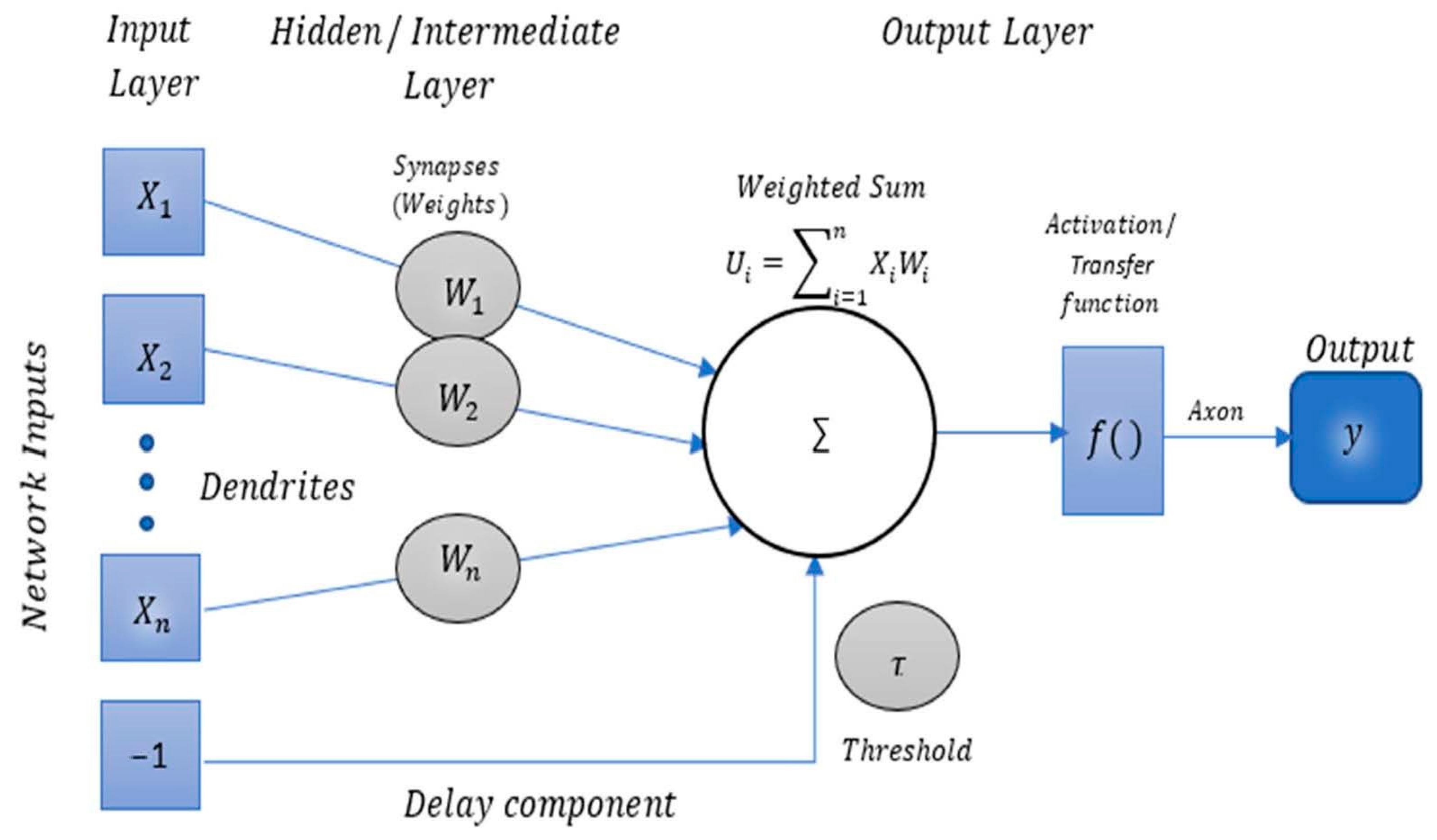
The ANN is a modeling method uniquely designed to predict several erratic and non-linear activities, like atmospheric events, or handle cumbersome data that simple statistical or numerical methods cannot easily handle [7,15]. This technique can carry out special tasks like recognizing, connecting, and generalizing trends based on its ability and enhancement processes, which involve its data learning functions to technically imitate the dimensions of the human brain [7,16]. A characteristic ANN network groups and controls the network inputs to attain a proper response for a predictable output within a reliability limit. The general model of the ANN technique is illustrated in Figure 1, which is in the form of a nodal network. This comprises certain nodes that are trained through several pieces of information arising from internal or external conditions of the system. Firstly, the inputs are allotted random weights, which are always altered until the output is attained at a suitable error level. Therefore, this training process of the network, which involves the conversion of the obtained weighted sum, ends when an expected error margin is achieved. The weighted sum is the addition of the multiplication of each of the entries and the allocated weights. In cases where a suitable error has not been attained, the training process continues with new estimations through an error correction of data entries referred to as the back propagation scheme [7,15,16].
Figure 1.
Schematic diagram of a typical ANN model.
Once the neural network training eventually yields the expected output, the derived design is tested and validated using another set of input data. This architecture tends to reduce the loss function with regard to weights and biases [7,16,17]. Typically, about 70% of the input is utilized for training the model, while the other 30% is split between network testing and validation.
2.2. Adaptive Neuro-Fuzzy Inference System

The ANFIS is a sophisticated and efficient machine learning network that is sometimes used in place of the ANN due to its focus on simplifying the process of obtaining the required result. This hybrid system combines neural network architecture and fuzzy logic networks to process a set of input data. The neurons, which operate as nodes, process the input data based on rules provided by the fuzzy logic model. The inputs and outputs suggest the rules to be used by the neuro-fuzzy system for each action that occurs.
2.2.1. ANFIS Architecture
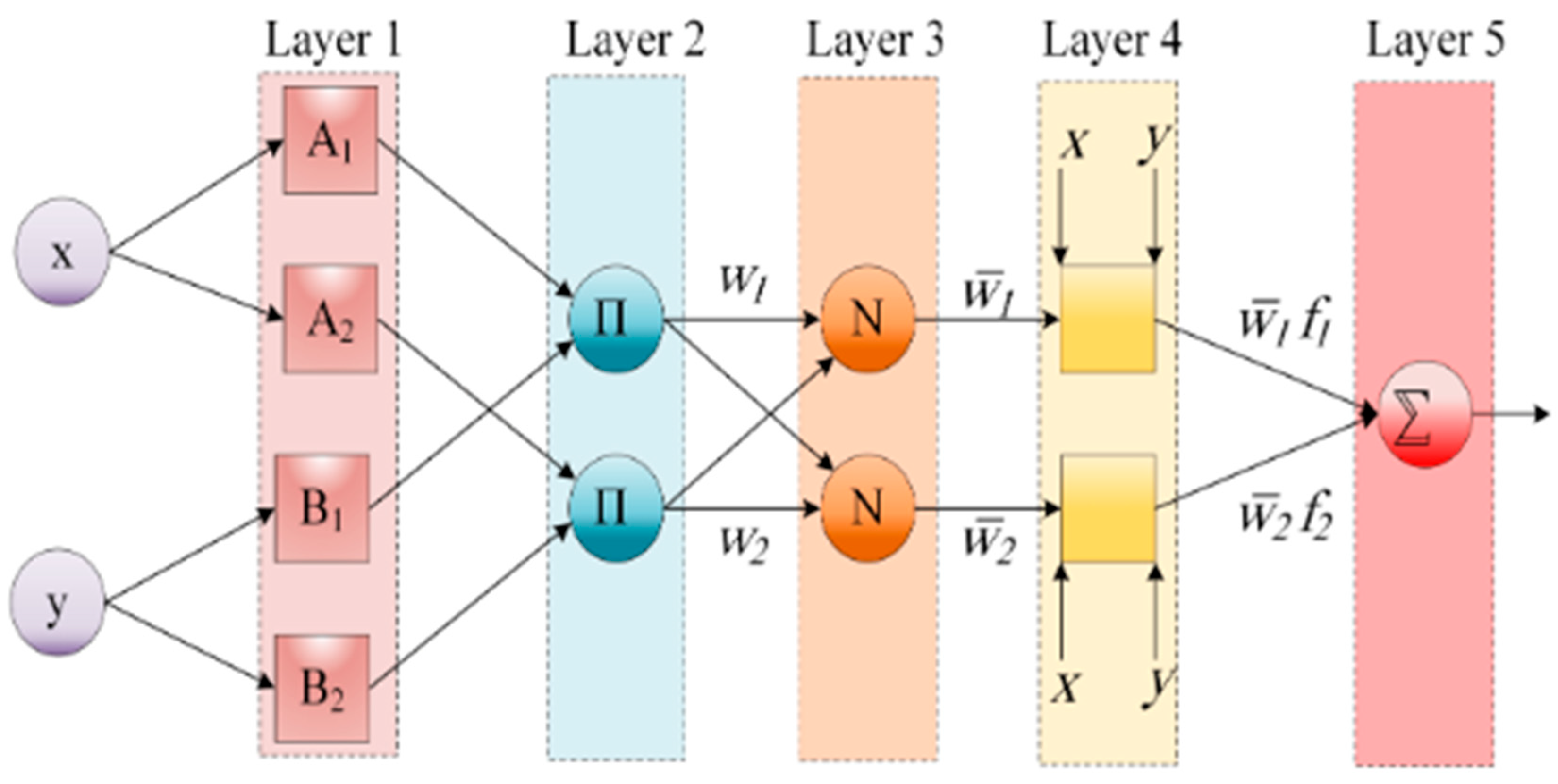
A typical ANFIS network displaying two inputs with five layers is shown in Figure 2. The rules generated and implemented by this model are utilized to produce accurate results and are important for achieving optimal efficiency in future data [18].
Figure 2.
The basic two-input five-layer ANFIS architecture.
The fuzzy section in Figure 2 comprises the first-order Sugeno inference system. The linear regression output variables and are obtained by executing several fuzzy rules to fuzzy sets of input variables [19,20].
where , , , and are the non-linear parameters, and , , , , , and are the linear parameters.
The layers of the ANFIS model are explained as follows:
- 1.
- Layer 1: Membership Function or Fuzzy layer
The first layer consists of a certain number of nodes . The outputs, which are reliant on the number of inputs for a set of linguistic labels and , are given as follows:
where and are the inputs and and are the membership functions of the linguistic labels, given as , , , and . For instance, the membership function for is given as follows:
- 2.
- Layer 2: Rules Layer
The second layer of the ANFIS architecture consists of fixed nodes, and its output is computed using:
- 3.
- Layer 3: Normalized Firing Strength (NFS)
Each node in the third layer is also fixed. The normalized firing strength is the ratio of the output from layer 2 to the total output from layer 2, and it is given as follows:
- 4.
- Layer 4: Defuzzification
The weight obtained from the previous layer and the linear regression function of order one gives the output of this layer, which is given as follows:
- 5.
- Layer 5: Addition Layer
The output of layer 5 is given as:
2.2.2. Hybrid Learning Algorithm
In 1993, Jang introduced the hybrid learning algorithm used to train the ANFIS model by effectively calibrating its parameters. This is achieved by integrating both least square estimation and gradient descent, making it suitable for situations with both linear and non-linear properties. This allows for the management of non-linear properties in the first layer and the generation of a linear relationship in the fourth layer through the dual method [21]. As a result, each rule produces a linear function of the input variables, as shown in Equations (1) and (2). By applying gradient descent, the error estimate is given as:
where represents the component of the target and is the component of the actual output vector. The total error estimate obtained by the sum of squared errors is:
3. Site, Data, and Methods
3.1. Site Study and Meteorological Data
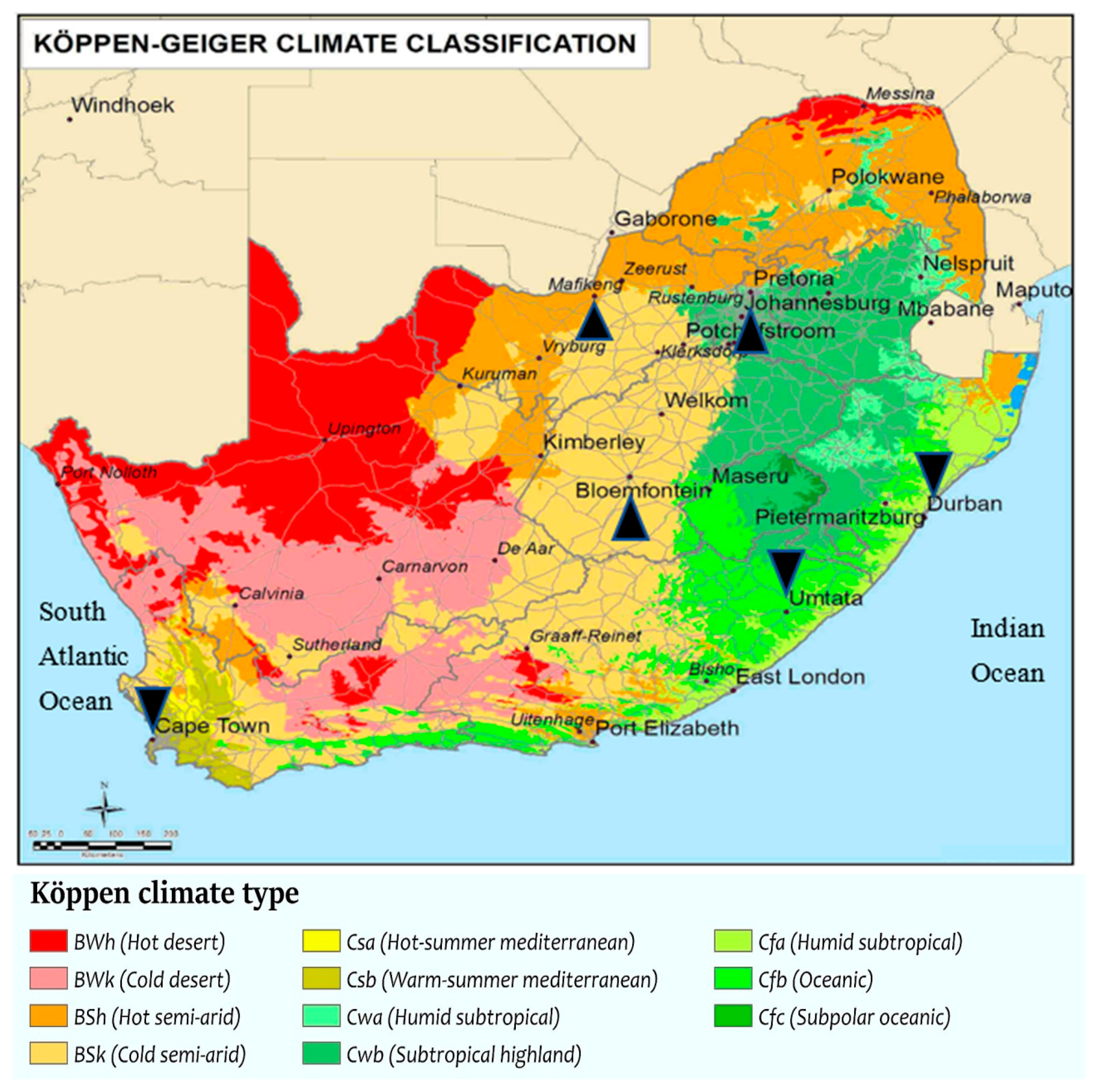
The study sites cover six selected areas, across six different provinces in South Africa, which are Durban (DBN), Cape Town (CPT), Mthatha (MTA), Bloemfontein (BFT), Johannesburg (JHB), and Mahikeng (MHK). These areas comprise two coastline locations, one near-coastline location, and three inland locations. The map of South Africa showing the study sites is displayed in Figure 3. South Africa, which has many climatic classifications, is categorized as having a sub-tropical climate. In this study, one-year data were collected from both the National Centre for Environmental Information (NCEI) and the South African Weather Services (SAWS). These atmospheric data span from 1 January 2013 to 31 December 2013 and include hourly data of relative humidity (RH), temperature (T), wind speed (WS), pressure (P), and visibility (V) for the regions under consideration.
Figure 3.
Map of the climatic zones of South Africa, showing the study sites ([22]).
3.2. ANN Approach to Predict Visibility Range
3.2.1. Feed-Forward Neural Network
The Feed-Forward Neural Network (FFNN) can be described as a kind of multi-layer ANN that can be implemented to learn the association that occurs between the available inputs and the output. Just as its name implies, this type of network does not have any loop existing within its system [17,23,24,25,26]. Considering the input and output , this network estimates its output in terms of a function approximation, such that , and to obtain the perfect function approximation, it learns the values of [27].
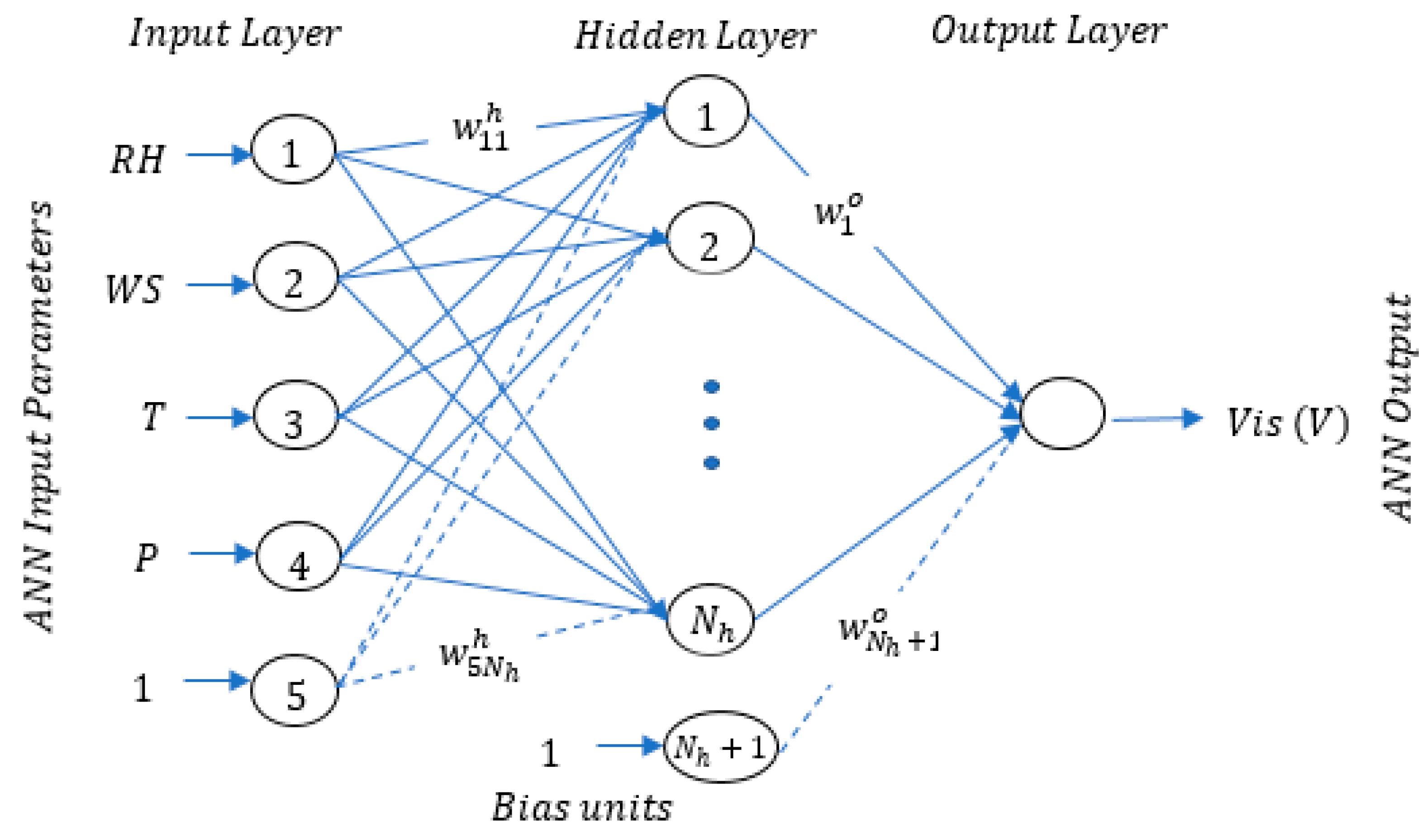
In this type of multi-layer neural network (shown in Figure 4), there are three main layers (i.e., input, intermediate or hidden, and output layers), which are the nodes connected by a certain amount of network neurons. These neurons perform the processing and then calculate the output based on the established connection existing between the three layers and the weights as well as the biases . As shown in Figure 4, the input variables are RH, T, P, and WS, while the output variable is visibility .
Figure 4.
A typical multi-layer perceptron based on FFNN.
The ANN architecture for visibility parameterization will be achieved using MATLAB version R2023a, whereby 70% of the entire data will be used for training, 15% for testing, and the remaining 15% for validation of the network. Considering the entire one-year dataset of 8760 samples for each of the atmospheric variables, this division corresponds, respectively, to 6132, 1314, and 1314 samples of each atmospheric variable.
The Back Propagation algorithm was utilized in this work to give the coordination between the input layer data and the intermediate layer using necessary weight adjustments, as well as to reduce the estimation error [17,25]. The output (i.e., visibility) of the FFNN is given as follows [1,16]:
where and are the weights associating the input unit to the intermediate unit and intermediate unit to the output unit, respectively, and represent input and iteration parameters, respectively, and , , and symbolize the hidden layer, number of hidden neurons, and the output layer, respectively.
The ANN structure presented in Figure 4 provides the proposed FF-BPNN system used in this work to determine the visibility based on several independent variables with different weights attached to them.
3.2.2. Selection of ANN Model Parameters
The number of neurons in the input and output is dependent on the number of input and output variables. The choice of the number of hidden neurons ( is an important factor that is solely based on achieving acceptable performance during dataset validation. The desired produces the necessary iterations to determine the relationship that exists between the various input variables and visibility. One of the major aims of this work is to compute the dependence of on the input variables rather than to differentiate between different ANN models or select the best ANN training function among many. Therefore, due to its fast convergence features, the Gauss–Newton-based Levenberg–Marquardt training method was used in this work. The other model parameters chosen for this study are presented in Table 1.
Table 1.
Selected ANN model properties.
3.3. Accuracy Measurement Methods
To determine the accuracy level of the output of the SST, ANN, and ANFIS models, some metrics were utilized, including , RMSE, and MBE. These metrics can be estimated using the following expressions [28,29,30,31,32]:
where and are, respectively, the visibility prediction and observation, is the mean of the measured visibility data, and represents the number of samples. The acceptable range for is between and , where unity indicates a perfect fit or strong functional relationship [28,29]. The RMSE and MBE determine the errors, such that the RMSE deals with the squared deviations and the MBE deals with over-estimation or under-estimation [32].
4. Results and Discussion
In this section, we first analyzed the functional dependence of visibility on several meteorological variables that were taken as independent observables using standard statistical techniques. This analysis was then followed by the ANN and ANFIS approaches. Under each subsection, the analysis for each of the six South African cities (Durban, Cape Town, Mthatha, Bloemfontein, Johannesburg, and Mahikeng) will be discussed in that order.
4.1. Standard Statistical Techniques
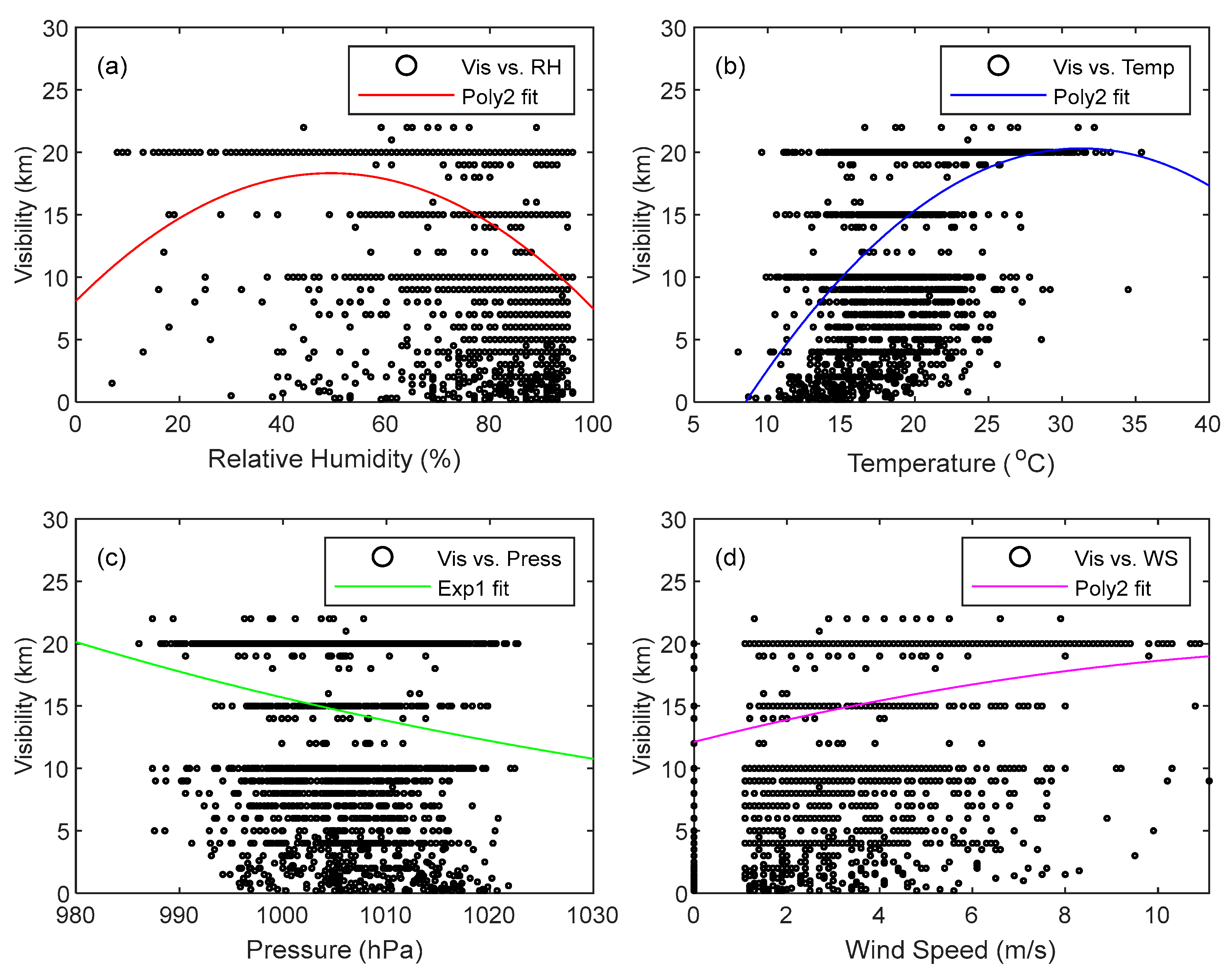
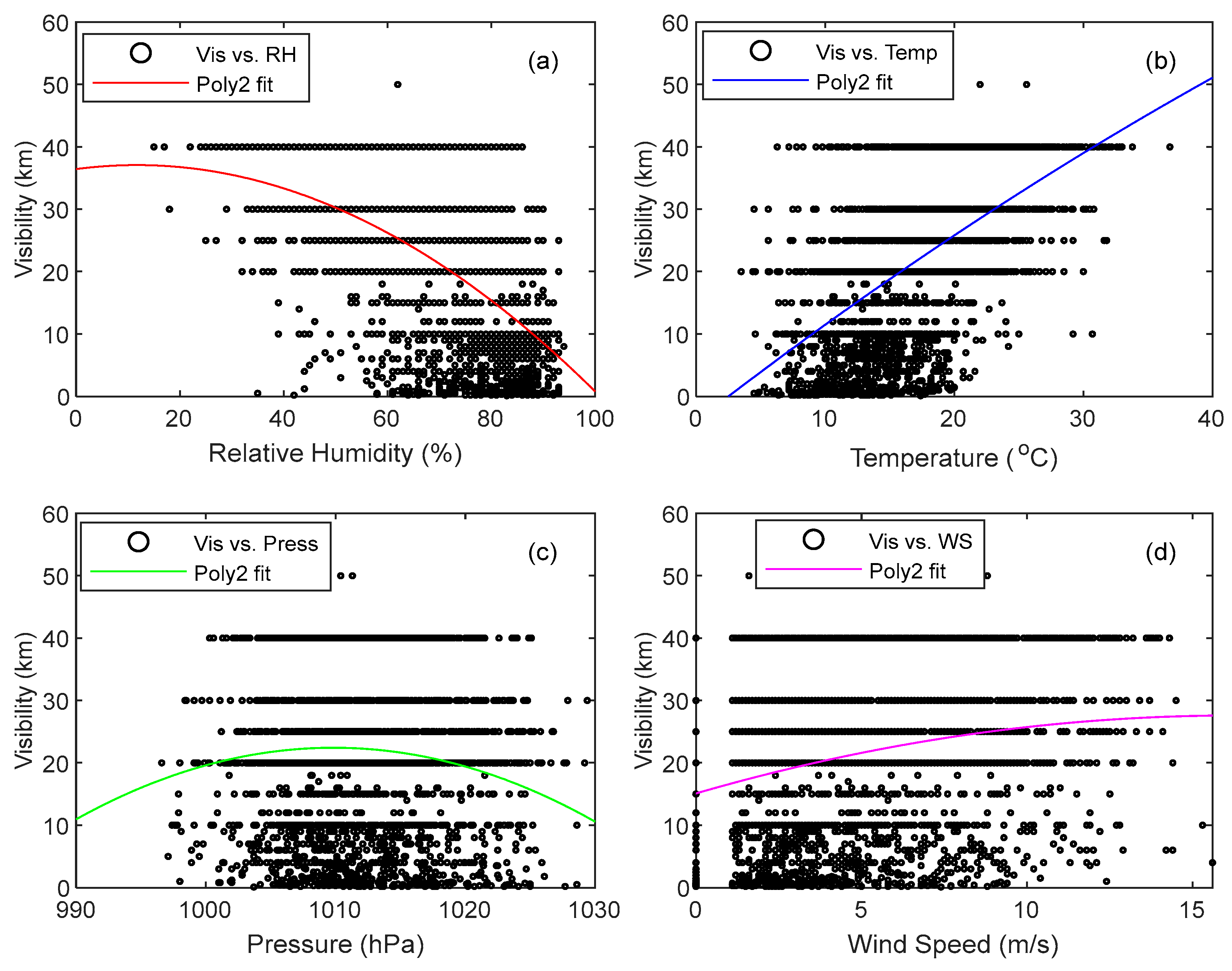
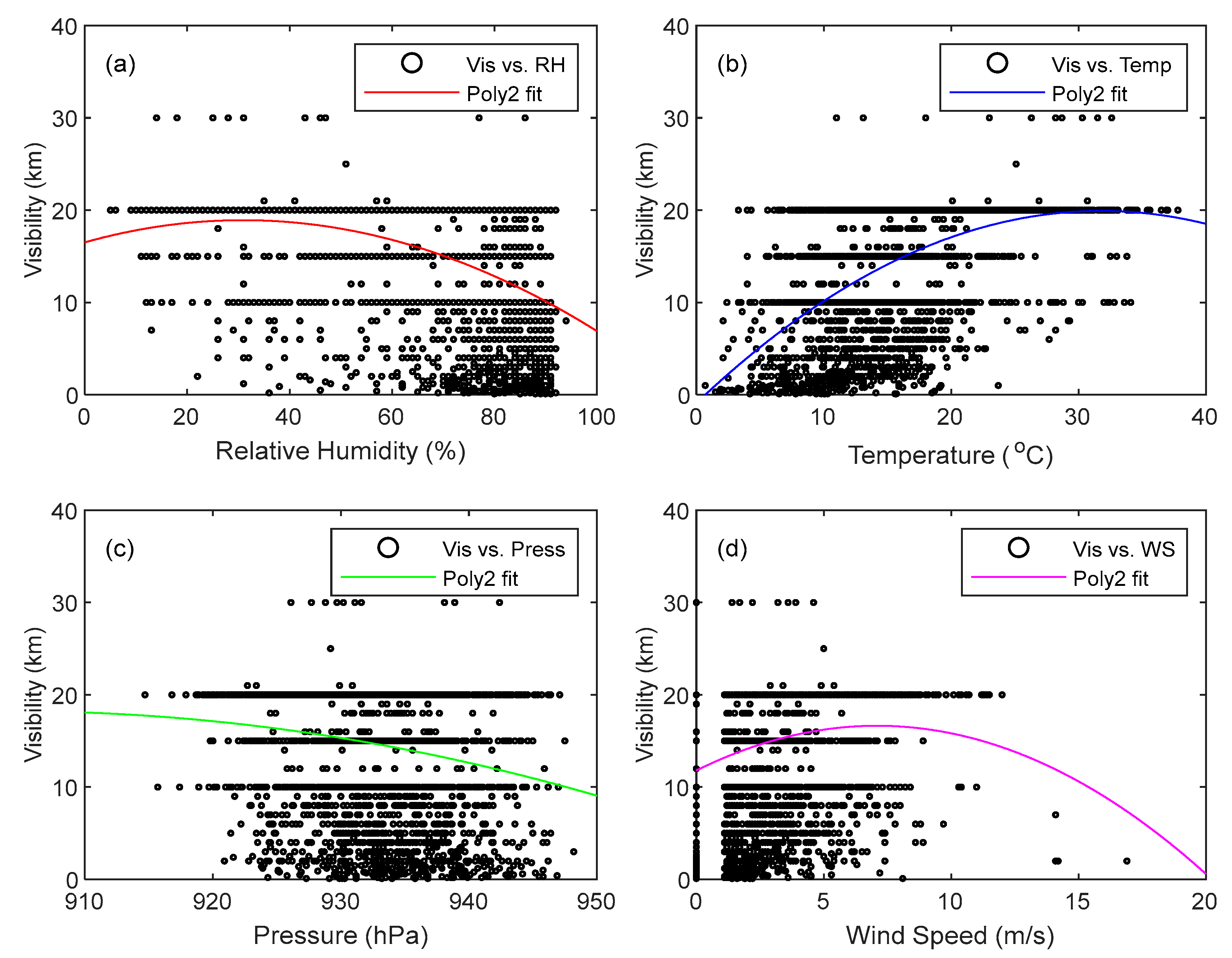
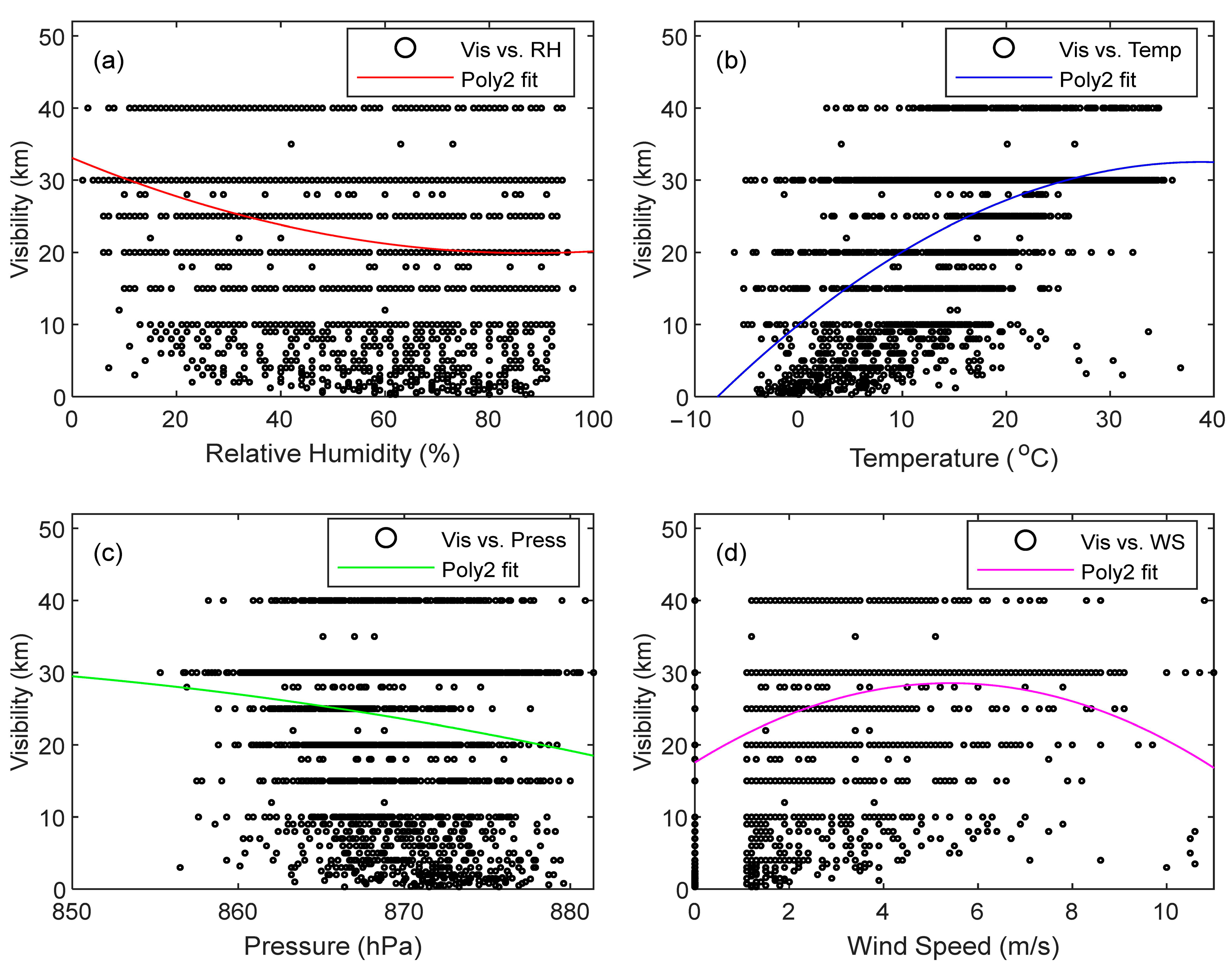
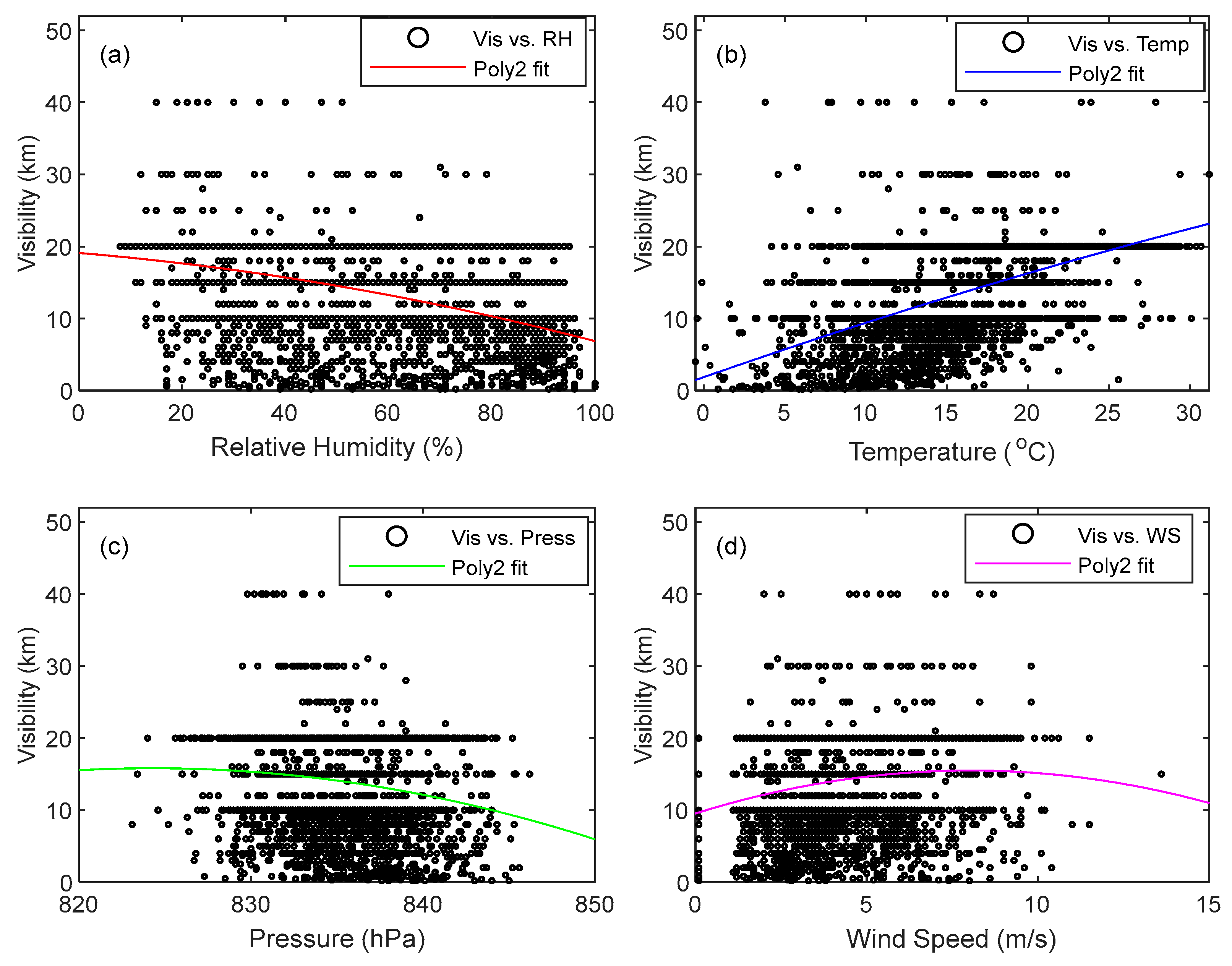
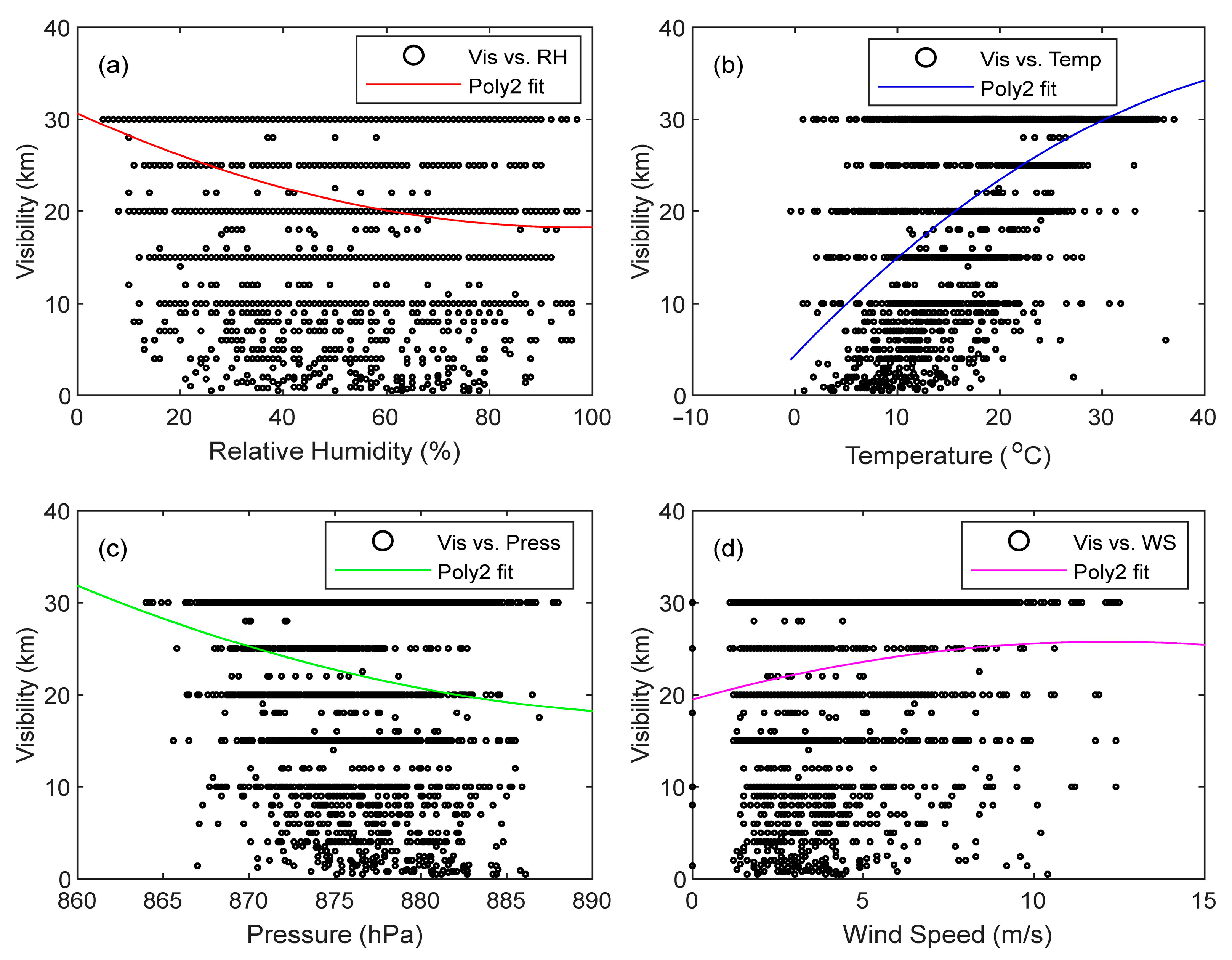
The SST—specifically, the SVRA—was used to determine any apparent relationship between and all considered meteorological variables. This was accompanied by regressing the visibility phenomenon against the various meteorological variables. Figure 5, Figure 6, Figure 7, Figure 8, Figure 9 and Figure 10 show the non-linear relationships between various atmospheric parameters and visibility using the SST throughout the year 2013 for all cities considered in this study. The error results of these non-linear regression fits, in terms of , are presented in Table 2.
Figure 5.
Relationship between visibility and different atmospheric parameters: (a) RH; (b) T; (c) P; and (d) WS, using SST throughout the year 2013 for Durban.
Figure 6.
Relationship between visibility and different atmospheric parameters: (a) RH; (b) T; (c) P; and (d) WS, using SST throughout the year 2013 for Cape Town.
Figure 7.
Relationship between visibility and different atmospheric parameters: (a) RH; (b) T; (c) P; and (d) WS, using SST throughout the year 2013 for Mthatha.
Figure 8.
Relationship between visibility and different atmospheric parameters: (a) RH; (b) T; (c) P; and (d) WS, using SST throughout the year 2013 for Bloemfontein.
Figure 9.
Relationship between visibility and different atmospheric parameters: (a) RH; (b) T; (c) P; and (d) WS, using SST throughout the year 2013 for Johannesburg.
Figure 10.
Relationship between visibility and different atmospheric parameters: (a) RH; (b) T; (c) P; and (d) WS, using SST throughout the year 2013 for Mahikeng.
Table 2.
Error estimation results of the SST performances based on the appropriate curve fitting type.
Figure 5 presents the functional relationship between visibility and the four meteorological parameters, RH, T, P, and WS, throughout the year 2013 for the city of Durban. A visual inspection of these plots for Durban from the SST results proposes that visibility is linearly independent from all meteorological variables, indicating a lack of linear correlation between them after comparing various regression analyses. Therefore, the various non-linear fits provided in each category under Figure 5 show the relationship between visibility and all the atmospheric variables considered. Based on the estimated from the various non-linear regression fits, the results showed that the visibility variability explained by RH, T, P, and WS are approximately and respectively. Figure 5a shows the highest value, indicating a relatively stronger correlation between and RH compared to the others, while Figure 5b,d shows weaker dependence of on T and on WS, respectively. However, these values are not significant enough to be considered. This implies a lack of reasonable and substantial correlation between and all these parameters, especially between and P, which has the lowest value. The SST results of the non-linear regression fits for Cape Town during the year 2013, presented in Figure 6, show that the values of the visibility variability due to the meteorological variables are approximately and for RH, T, P, and WS respectively. Similarly, these percentages reveal that the correlation between and RH (as shown in Figure 6a) has the highest value, while the dependence of V on both T and WS (Figure 6b,d), respectively, have weak correlations, with very close values. The correlation between and P has the lowest value, and it is quite insignificant amongst all the error values. The non-linear regression fit results of the SST for Mthatha, presented in Figure 6, show that the values of the visibility variability due to the meteorological variables are approximately and for RH, T, P, and WS, respectively. Likewise, it can be observed in terms of these percentages that the non-linear relationship between V and RH (Figure 7a) is the strongest, followed by the visibility variability due to T and WS (as shown in Figure 7b,d), respectively. The values obtained from the reliance of on both T and WS individually showed weak interactions, while the lowest correlation was between and P. The results of the non-linear regression fits for Bloemfontein for the same year, presented in Figure 8, show that the values of the visibility variability explained by the various meteorological variables are approximately and for RH, T, P, and WS, respectively. According to these percentages, Figure 8a,d show relatively higher values, which indicates relatively strong correlations between and RH as well as and WS, respectively. However, these values are not significant enough to be considered. On the other hand, the relationship between and T shows weaker correlations, and that of and P exhibits a very weak or insignificant correlation when compared to the other percentage values. Figure 9a–d present the functional relationship between visibility and all the atmospheric variables for the city of Johannesburg during the year 2013. The estimated from the various non-linear regression fits in Figure 9 are approximately , and which correspond to the visibility variability explained by RH, T, P, and WS, respectively. The estimates provided in Table 2 show that the strongest non-linear correlation is between and RH, while T and WS showed relatively weaker and close relationships with . The results of the non-linear regression fits for Mahikeng, given in Figure 10, show that the values of the visibility variability described by the various meteorological variables are approximately and for RH, T, P, and WS respectively. Based on these percentages, Figure 10a shows the highest value, suggesting a relatively strong correlation between and RH. While the dependence of on WS is slightly stronger than that of on T, both functions show weak correlations.
According to the statistical results of the performances of the SVRA presented in Table 2 for diverse meteorological parameters, it was observed across all the cities that there is a relatively strong parametric relationship between visibility and relative humidity and a fairly significant relationship between visibility and both temperature and wind speed individually. The variability in visibility in terms of explained by relative humidity ranges from , and that of wind speed, temperature, and pressure ranges from , and respectively, over all the sites considered. In summary, the average visibility variability explained by RH, WS, T, and P for all the cities is 0.3043, 0.1306, 0.1283, and 0.0443, respectively. These results suggest that among the four atmospheric variables considered in this study, the functional dependence of visibility in South Africa is strongest on relative humidity and weakest on atmospheric pressure. The mean visibility variability described by both temperature and wind speed suggests that they contribute partially and almost equally to changes in visibility in these locations. The strong relationship between relative humidity (RH) and visibility is physically grounded in atmospheric processes. As RH increases, the air approaches saturation, leading to condensation of water vapor into tiny droplets that form haze, mist, or fog, key contributors to reduced visibility. Additionally, high RH enhances the hygroscopic growth of aerosol particles, increasing their size and scattering efficiency, which further diminishes horizontal visibility. This explains why RH consistently emerges as the dominant variable influencing visibility across all locations in this study. Even though atmospheric pressure displays a weak direct relationship, this does not mean pressure has no important role in visibility variation. Pressure frequently regulates certain systems with low- and high-pressure trends that in turn regulate humidity, wind power, and wind direction. Small changes in pressure can indirectly impact the formation of fog by changing wind fields and stability profiles in areas where local topography intensifies pressure gradients. Thus, in this case, pressure may act as an unseen contributor to the other directly pertinent elements. Nevertheless, its local variability demands further high-resolution studies. Therefore, in general, this technique has established the functional dependence of visibility on atmospheric variables. However, the outcomes showed a lack of strong correlation between them using the SST approach.
4.2. Artificial Neural Network Simulation and Results
In this section, the ANN approach was implemented for visibility prediction using various meteorological parameters. Based on the universal performance of the ANN model, it can be concluded that the proposed model is capable of providing accurate forecasts for random variables. Therefore, it is likely to achieve reasonable accuracy in estimating visibility and other weather parameters using the ANN.
In this study, four meteorological variables (i.e., the input variables) were grouped into five input cases for data training and visibility prediction, as shown in Table 3. These input cases include one or more input parameters. Input Case-A (with RH as the sole input parameter) is considered the base case, while Input Case-E, a combination of all input variables, is considered as the saturated case. Relative humidity was selected as the base case for the ANN input configurations based on the findings of the SST analysis, which identified RH as the most significant meteorological parameter for predicting visibility. Wind speed (WS) and temperature (T) were considered the next significant parameters, with very close overall mean error values, while pressure (P) was deemed the least significant parameter in visibility prediction. Therefore, WS and T were labeled as secondary input parameters.
For each location, independent meteorological time series datasets were loaded as input time series according to the input cases, with visibility time series loaded as the target time series. The ANN model’s activation was based on a uniformly random distribution method, where a portion of the input dataset was assigned to training, validation, and testing processes. The data sharing method used for dividing input data from various locations was as follows: 70% for training, 15% for validation, and 15% for testing. This division was applied to each meteorological dataset within each input case.
4.2.1. ANN Simulation Procedure
The ANN model simulations were achieved through use of the Neural Network (NN) non-linear time series application tool provided in MATLAB by MathWorks, Natick, MA, USA. To perform a non-linear test on the visibility time series, the non-linear autoregressive network with external input, which uses dynamic neural networks, was selected, among other options. In other words, the Nonlinear Autoregressive Exogenous network (NARX), a non-linear neural network technique, was employed to accurately predict the visibility range.
The initial step during the simulation process and case evaluation was accomplished by analyzing the performance of the ANN model when is gradually increased from to and when the input case containing all four input variables are considered for each of the cities. These analyses revealed that at for Cape Town and at for the other stations, each of the ANN ensembles for the corresponding cities performed quite close to one another, with similar values of , RMSE, and MAE, respectively. For instance, the ANN ensembles at for Durban showed that each ANN simulation for different values of had , RMSE, and MBE to be approximately , and respectively, and for Cape Town at , the values of , RMSE, and MBE are approximately , and respectively. In general, as the value of is decreasing, a slight reduction was gradually noticed in the values of and an increase was observed in the RMSE values. Thus, according to the results obtained from these analyses, it is imperative to set the optimum value of to 15, which indicates the common converging point where the performances of all the ANN models for the respective cities become similar. The number of hidden neurons () is crucial for balancing model complexity and generalization: too few neurons limit the network’s ability to learn non-linear patterns (underfitting), while too many can capture noise (overfitting). We optimized via cross-validation, selecting the value that maximized R2 on the validation set without inflating RMSE, thereby ensuring the ANN achieves its best predictive accuracy. Also, in order to accomplish the simulation and computation of each ANN architecture, the functions and parameters presented in Table 1 were used.
The last task in the ANN investigation is to choose the best input case based on accuracy and error estimations and analyze the importance of atmospheric variables to the predicted target values. Forward adding, which involves finding the functional dependence of visibility on the base case (RH) before adding other parameters, was used to build different input cases. These input cases were loaded into the Neural Network time series application one after another for each location considered, and the results of each ANN architecture were recorded.
Ten trainings were performed for each ANN architecture with different numbers of inputs and a fixed number of hidden layers and hidden neurons to avoid local minima problems resulting from random weight initializations. By averaging the statistical indicators before comparisons, the accuracy of predicted results is increased, and predicted values are smoothed out. The statistical indicators presented in this analysis are the mean of all 10 accuracy or error statistics observed by , RMSE, and MBE, along with the SD of the averaged RMSE and MBE values.
The analysis of the ANN architecture is considered complete when hidden units are fixed to an optimal value and input cases are simulated, analyzed, and compared for each location. The best input configuration for predicting can be chosen after analyzing all input configurations to determine the relationship between and atmospheric variables.
The Student’s t-interval for a mean was used to determine the t-based CI for a mean of several ANN trainings. In this case, there are 10 R2 values (one per training); therefore, it is important to compute the 95% CI on the mean R2 using [28,30]:
where s is the sample standard deviation across 10 trainings, is the number of trainings (such that ), the standard error (SE) of the mean of independent estimates is given as , and denotes the t-critical statistic at a degree of freedom .
The statistical significance in terms of p-value for each mean R2 value was obtained by testing each against zero through the t-test, given as [28,31]:
where N is the number of samples. Therefore, with degrees of freedom, the two-tailed p-value can be computed using [28,31]:
where represents the Cumulative Distribution Function (CDF) of the t-distribution with degrees of freedom.
4.2.2. ANN Prediction Results
The minimum and maximum R2 values for each of the input configurations for each of the locations are presented in Table 3. The mean R2 values, Confidence Intervals (CI), and the statistical significance (p-value) of the 10 different trainings for each input case are also recorded in the table.
Table 3.
Confidence intervals and statistical significance of the performances of the ANN models for different input configurations.
Table 3.
Confidence intervals and statistical significance of the performances of the ANN models for different input configurations.
| City | Input Cases | Input Variables | Approx. 95% CI for Mean R2 | p-Value | |||
|---|---|---|---|---|---|---|---|
| DBN | Case—A | RH | 0.4771 | 0.5291 | 0.5156 | [0.5063, 0.5249] | <0.001 |
| Case—B | RH, WS | 0.5794 | 0.6122 | 0.6065 | [0.6006, 0.6124] | <0.001 | |
| Case—C | RH, T, P | 0.5797 | 0.6301 | 0.6219 | [0.6129, 0.6309] | <0.001 | |
| Case—D | RH, WS, P | 0.5988 | 0.6644 | 0.6450 | [0.6333, 0.6567] | <0.001 | |
| Case—E | RH, T, P, WS (All Variables) | 0.6388 | 0.6725 | 0.6701 | [0.6641, 0.6761] | <0.001 | |
| CPT | Case—A | RH | 0.4911 | 0.5401 | 0.5368 | [0.5280, 0.5456] | <0.001 |
| Case—B | RH, WS | 0.6042 | 0.6498 | 0.6335 | [0.6254, 0.6416] | <0.001 | |
| Case—C | RH, T, P | 0.6155 | 0.6734 | 0.6573 | [0.6469, 0.6677] | <0.001 | |
| Case—D | RH, WS, P | 0.6213 | 0.6811 | 0.6760 | [0.6653, 0.6867] | <0.001 | |
| Case—E | RH, T, P, WS (All Variables) | 0.6702 | 0.7185 | 0.7002 | [0.6916, 0.7089] | <0.001 | |
| MTA | Case—A | RH | 0.4772 | 0.5297 | 0.5191 | [0.5097, 0.5285] | <0.001 |
| Case—B | RH, WS | 0.5599 | 0.6033 | 0.5964 | [0.5886, 0.6042] | <0.001 | |
| Case—C | RH, T, P | 0.5719 | 0.6288 | 0.6178 | [0.6076, 0.6280] | <0.001 | |
| Case—D | RH, WS, P | 0.6077 | 0.6512 | 0.6384 | [0.6306, 0.6462] | <0.001 | |
| Case—E | RH, T, P, WS (All Variables) | 0.6279 | 0.6853 | 0.6612 | [0.6509, 0.6715] | <0.001 | |
| BFT | Case—A | RH | 0.4588 | 0.5096 | 0.4955 | [0.4864, 0.5046] | <0.001 |
| Case—B | RH, WS | 0.5589 | 0.5974 | 0.5792 | [0.5723, 0.5861] | <0.001 | |
| Case—C | RH, T, P | 0.5612 | 0.6060 | 0.5912 | [0.5832, 0.5992] | <0.001 | |
| Case—D | RH, WS, P | 0.5677 | 0.6195 | 0.6001 | [0.5908, 0.6094] | <0.001 | |
| Case—E | RH, T, P, WS (All Variables) | 0.6023 | 0.6541 | 0.6322 | [0.6229, 0.6415] | <0.001 | |
| JHB | Case—A | RH | 0.4711 | 0.5189 | 0.5073 | [0.4988, 0.5158] | <0.001 |
| Case—B | RH, WS | 0.5587 | 0.6001 | 0.5899 | [0.5825, 0.5973] | <0.001 | |
| Case—C | RH, T, P | 0.5701 | 0.6216 | 0.6132 | [0.6040, 0.6224] | <0.001 | |
| Case—D | RH, WS, P | 0.6165 | 0.6412 | 0.6221 | [0.6177, 0.6265] | <0.001 | |
| Case—E | RH, T, P, WS (All Variables) | 0.6275 | 0.6813 | 0.6658 | [0.6562, 0.6754] | <0.001 | |
| MHK | Case—A | RH | 0.4485 | 0.4911 | 0.4798 | [0.4722, 0.4874] | <0.001 |
| Case—B | RH, WS | 0.5556 | 0.5945 | 0.5714 | [0.5645, 0.5783] | <0.001 | |
| Case—C | RH, T, P | 0.5683 | 0.6101 | 0.5955 | [0.5881, 0.6029] | <0.001 | |
| Case—D | RH, WS, P | 0.5703 | 0.6235 | 0.6011 | [0.5916, 0.6106] | <0.001 | |
| Case—E | RH, T, P, WS (All Variables) | 0.6102 | 0.6583 | 0.6235 | [0.6149, 0.6321] | <0.001 |
For each site, the mean R2 across 10 independent ANN trainings for each input case were computed alongside the sample standard deviation. For every input case, the 95% confidence intervals on using the t-distribution (, ) were derived and the statistical significance was confirmed via two-tailed tests with degrees of freedom, yielding an all . A two-tailed t-test against zero with degrees of freedom confirmed all correlations are highly significant . The narrow intervals and uniformly low p-values reinforce the robustness of our correlation findings, from single-variable (RH-only) to full-variable (RH + T + P + WS) cases, across all six South African cities.
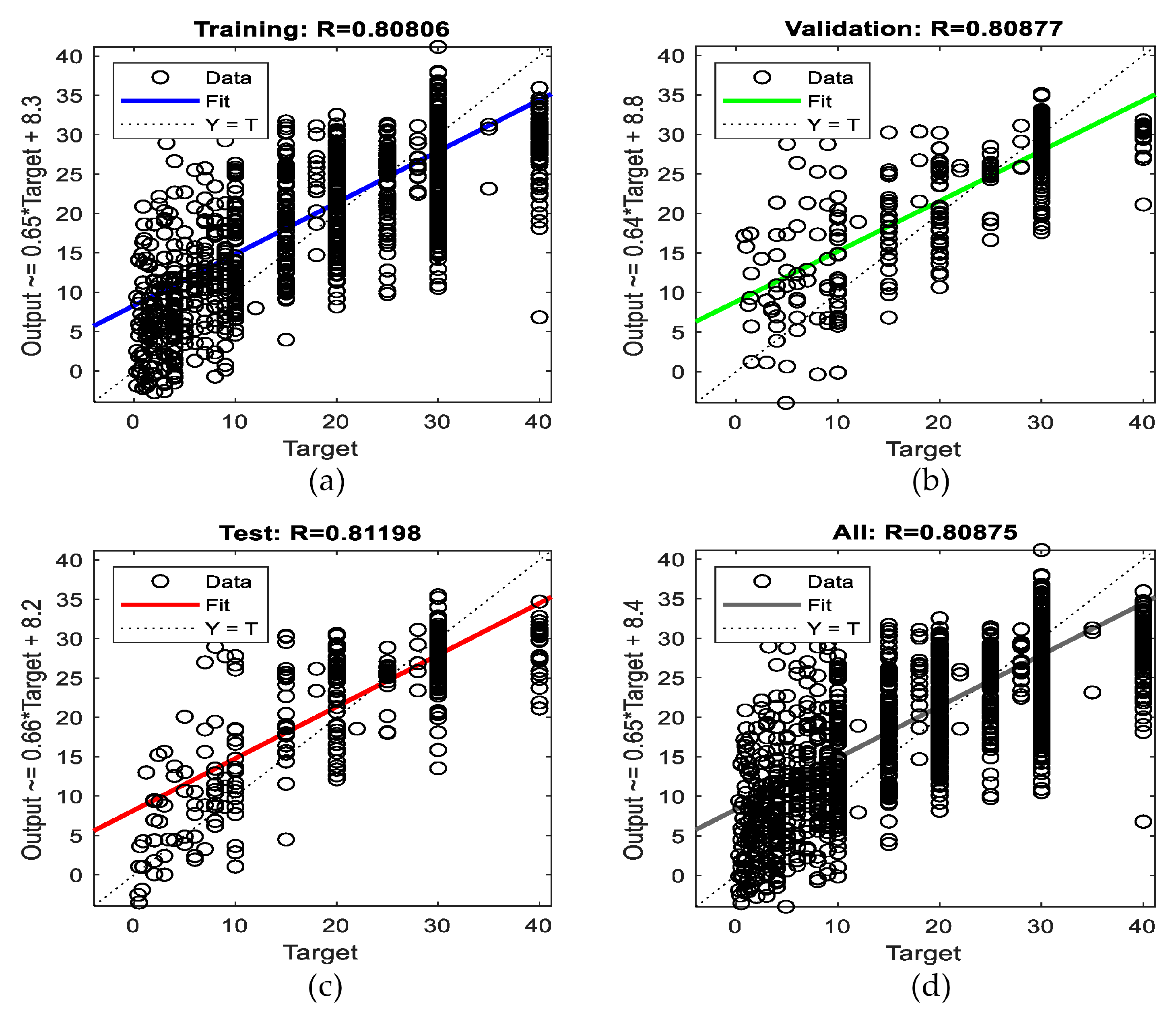
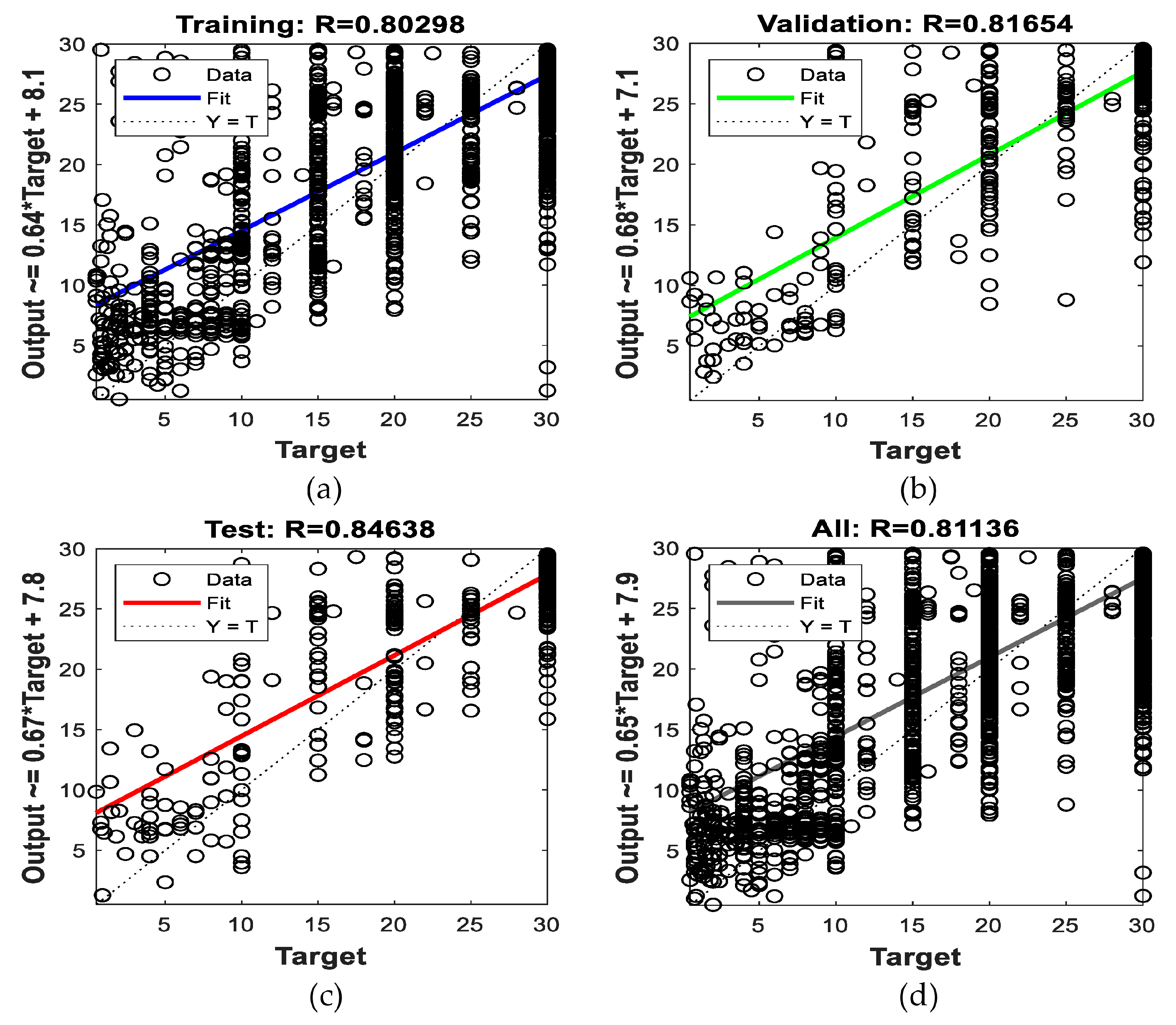
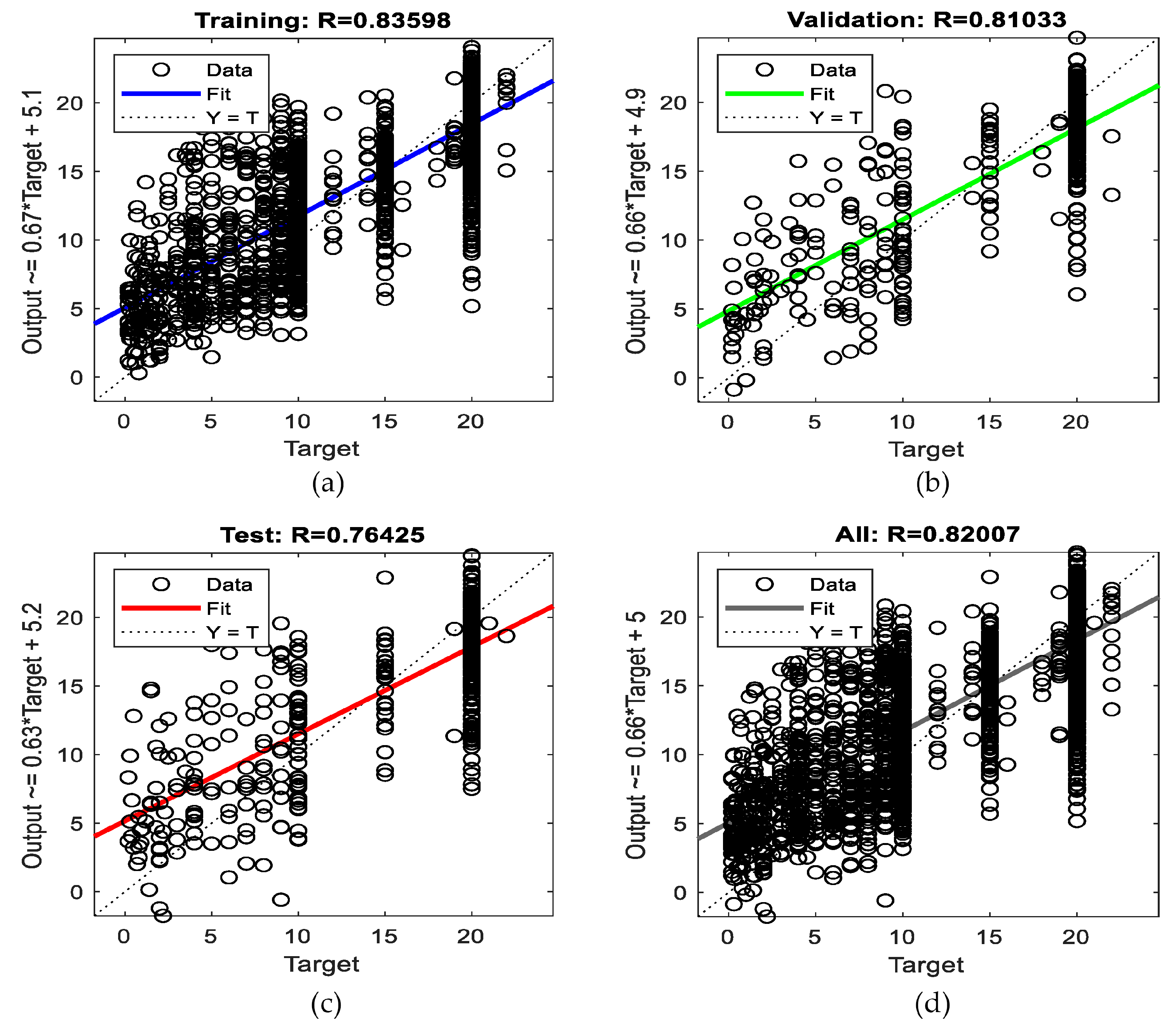
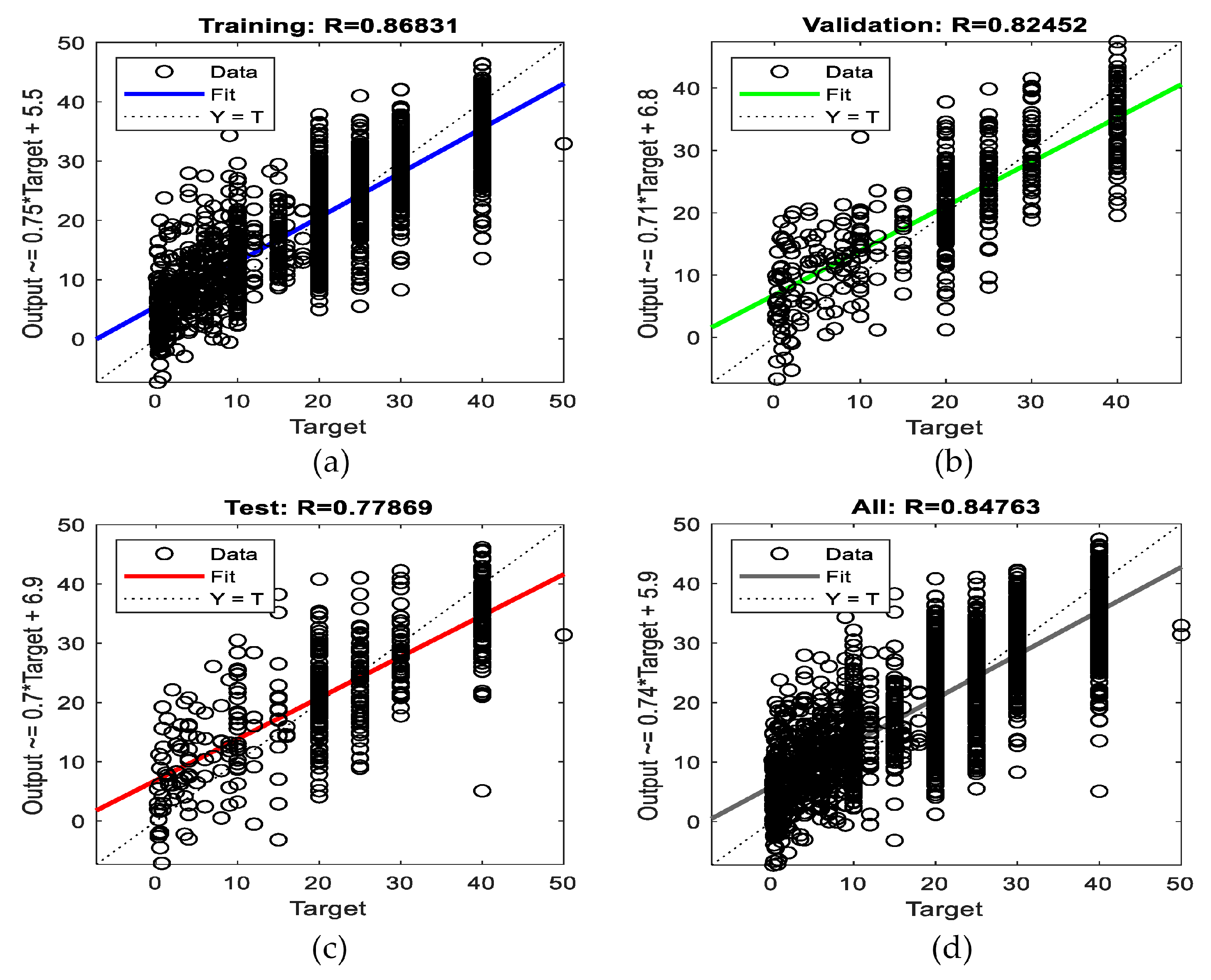
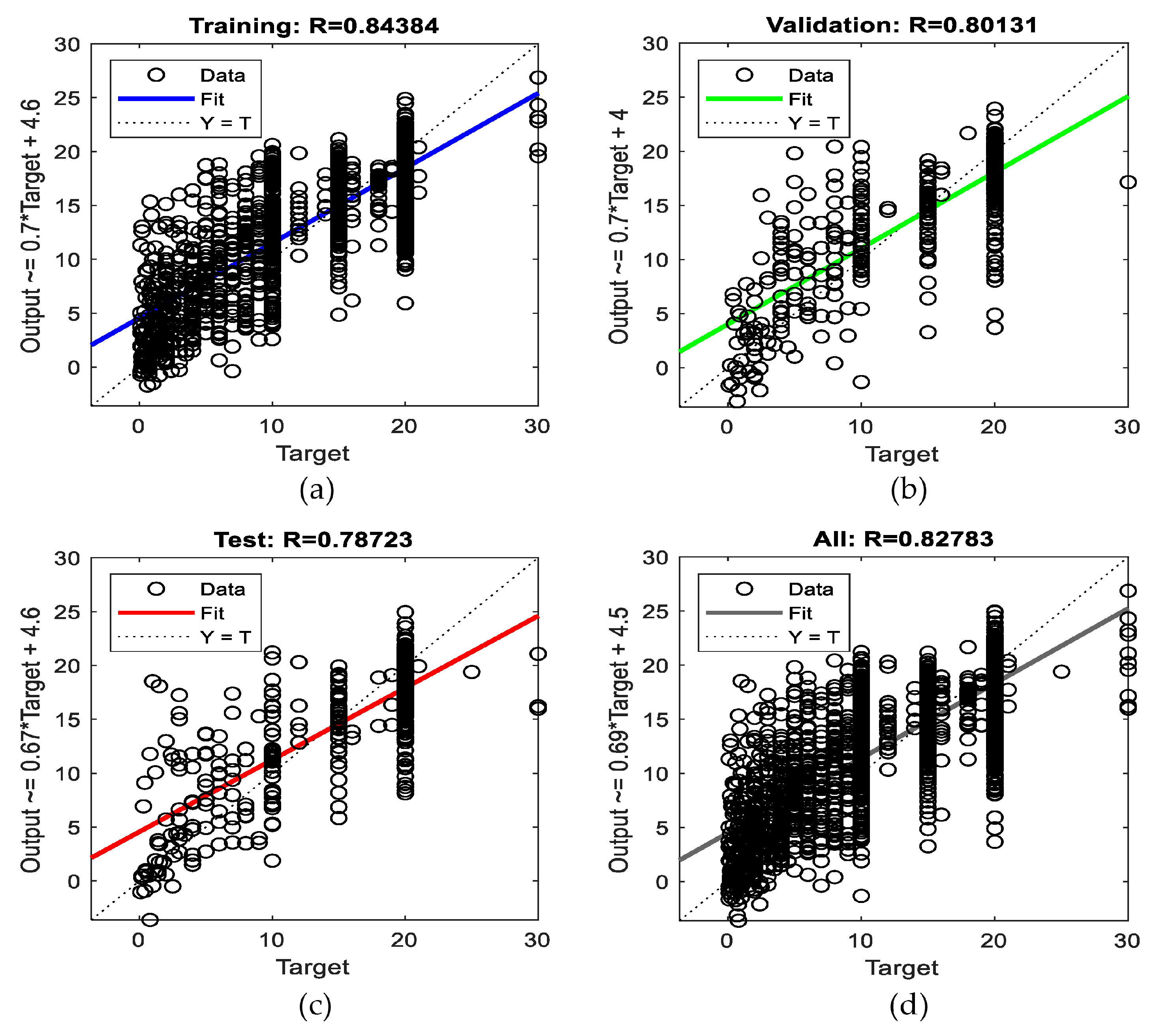
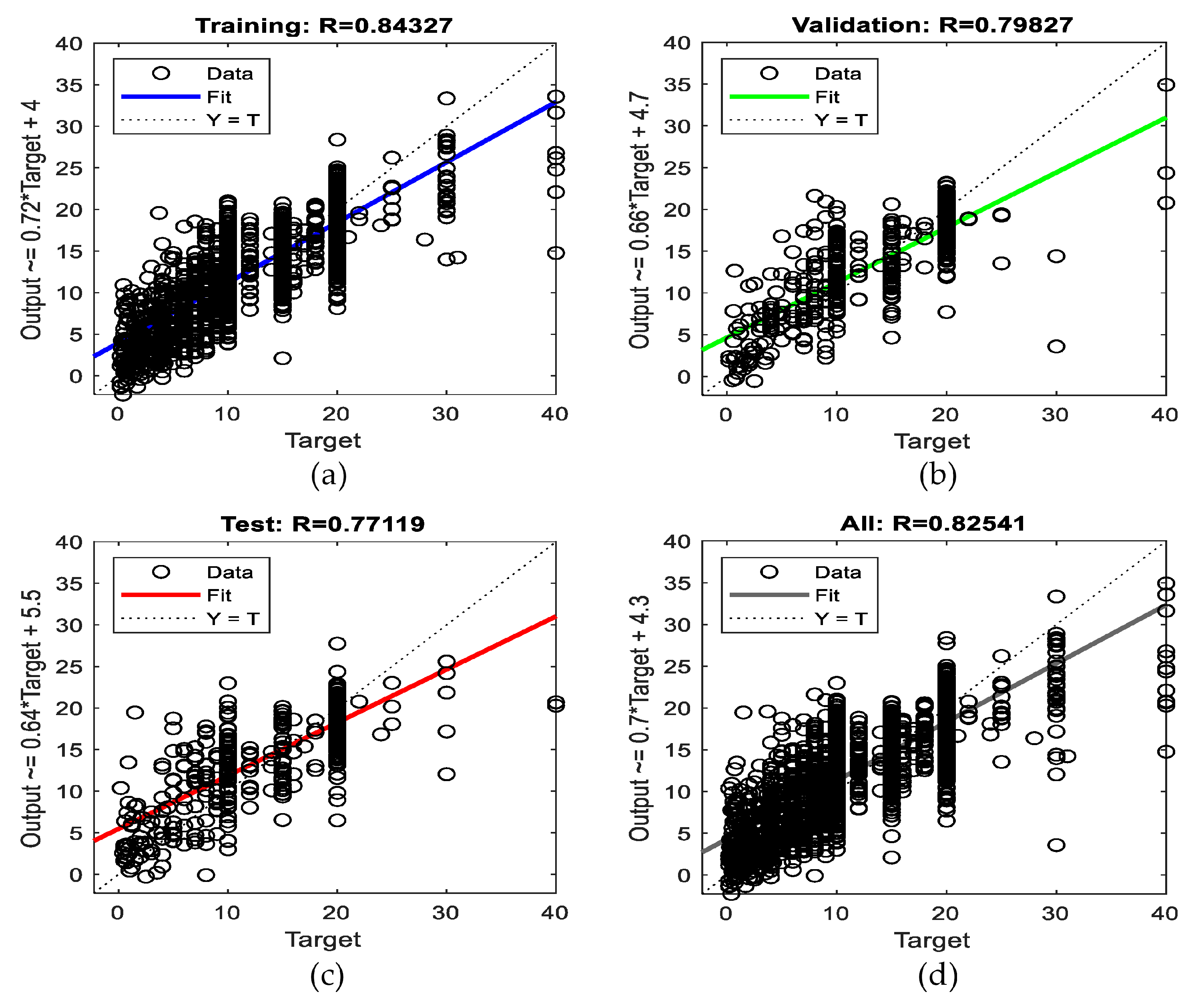
Figure 11, Figure 12, Figure 13, Figure 14, Figure 15 and Figure 16 display the regression plots for neural network training, validation, and testing, applying 70%, 15%, and 15% of the atmospheric datasets for the entire year of 2013 across all sites in the study. However, Figure 11d, Figure 12d, Figure 13d, Figure 14d, Figure 15d, Figure 16d show regression results for visibility prediction at each station using all atmospheric data. The values and model equations are provided for each station in these plots, illustrating the relationship between predicted and measured visibility. Each regression plot includes scatter and linear plots of predicted visibility versus measured visibility, with data points distributed around the average line given by the linear fit and centered on the 45-degree line of perfect fit. Colored lines in the plots represent results from network training, validation, testing, and overall forecasting, with equations indicating the determined results, while dotted lines show expected visibility outcomes. To streamline the presentation, only regression plots for Case-E, where all input variables were used to determine visibility dependence, are shown. These plots highlight the periods where the highest values were achieved among the 10 different trainings conducted for each Case-E input.
Figure 11.
ANN model regression plots for (a) training; (b) validation; (c) testing; and (d) all data throughout the year 2013 for Durban.
Figure 12.
ANN model regression plots for (a) training; (b) validation; (c) testing; and (d) all data throughout the year 2013 for Cape Town.
Figure 13.
ANN model regression plots for (a) training; (b) validation; (c) testing; and (d) all data throughout the year 2013 for Mthatha.
Figure 14.
ANN model regression plots for (a) training; (b) validation; (c) testing; and (d) all data throughout the year 2013 for Bloemfontein.
Figure 15.
ANN model regression plots for (a) training; (b) validation; (c) testing; and (d) all data throughout the year 2013 for Johannesburg.
Figure 16.
ANN model regression plots for (a) training; (b) validation; (c) testing; and (d) all data throughout the year 2013 for Mahikeng.
After the network training and estimation of visibility, the outcomes of the proposed ANN models (illustrated in Figure 11, Figure 12, Figure 13, Figure 14, Figure 15 and Figure 16) attained satisfactory reliabilities of about , , , , and with of the atmospheric data for DBN, CPT, MTA, BFT, JHB, and Mahikeng, respectively. When using of the atmospheric data for the neural network validation, the proposed neural network achieved a satisfactory reliability of about , , , , and for DBN, CPT, MTA, BFT, JHB, and MHK, respectively. Although a perfect or better ANN model architecture should have reliability higher than the values recorded in this work, the reliability results obtained are above and better than that obtained using SST. Therefore, it is assumed that the outcomes are quite satisfactory.
The results presented in Table 4 are the mean of all the error estimations after 10 different trainings for each input case. It should be noted that these results were achieved when all the data for the entire year under study were used to determine visibility. The mean showed that the accuracy increases from the base case to when all the variables were integrated. The percentage Mean RMSE was provided along with standard deviation values. It can be observed that the Mean RMSE was quite lower for all the input Case-E for all the locations. However, their standard deviations were observed to be the highest among all the input cases. The Mean Bias Error (MBE) was calculated to compare measured and estimated visibility over a one-year period of meteorological data. The MBE, which assesses the accuracy of predicted visibility, determines if data from the ANN model is over- or under-estimated. While not typically used as a model error measure, it can help evaluate bias in the ANN model and identify necessary corrections. The focus is on how much the model over- or under-estimates visibility rather than the MBE magnitude. MBE values from the ANN model for all input cases are shown in Table 4. For Case-E, bias values (in %) were , , , , and for DBN, CPT, MTA, BFT, JHB, and MHK, respectively. Results in Table 4 indicate that the generated ANN models did not over-estimate visibility, as MBE values were below zero. Note that the systematic negative MBEs (presented in Table 4) reflect a mild under-prediction bias in our ANN. This underestimation likely arises from the network’s regularization and loss-minimization strategy, which penalizes large errors and thus pulls extreme forecasts toward the mean. While conservative estimates can be preferable in safety-critical forecasting, future work could apply a simple bias-correction layer or adjust the loss function (e.g., using asymmetric penalties) to further reduce this residual under-estimation.
Table 4.
Statistical results of the performances of the ANN models using different input configurations.
Comparing SST and ANN methods for predicting visibility based on RH data alone, the ANN model outperformed SST. Mean coefficients of determination when using only RH datasets to predict visibility improved from to , to , to , to , to and to for DBN, CPT, MTA, BFT, JHB, and MHK, respectively. Despite using only RH for forecasting visibility, the developed ANN model showed improvement over the SST approach. This demonstrates that the ANN approach establishes a stronger relationship between meteorological variables and visibility for the cities analyzed. The ANN’s superior performance over single-variable regression analysis (SVRA/SST) stems from its capacity to model complex, non-linear interactions and to integrate multiple atmospheric inputs simultaneously. Unlike SST, which fits only a straight-line relationship between visibility and one predictor, the ANN’s multi-layer architecture captures synergistic effects among RH, WS, T, and P, transforming subtle joint dependencies into improved predictive skill.
Using the meteorological data that consist of RH, T, WS, and P for each of the locations considered, the generated ANN model equation for the visibility range in km is given as follows:
where denotes predicted visibility, represents measured visibility, and and are parametric constants, which are a function of the four meteorological variables (i.e., RH, T, WS, and P) considered in this study. The model parameters for each of the locations, obtained from the regression plots in Figure 11, Figure 12, Figure 13, Figure 14, Figure 15 and Figure 16 are shown in Table 5.
Table 5.
Generated model equation and parameters for visibility using meteorological parameters based on input Case-E.
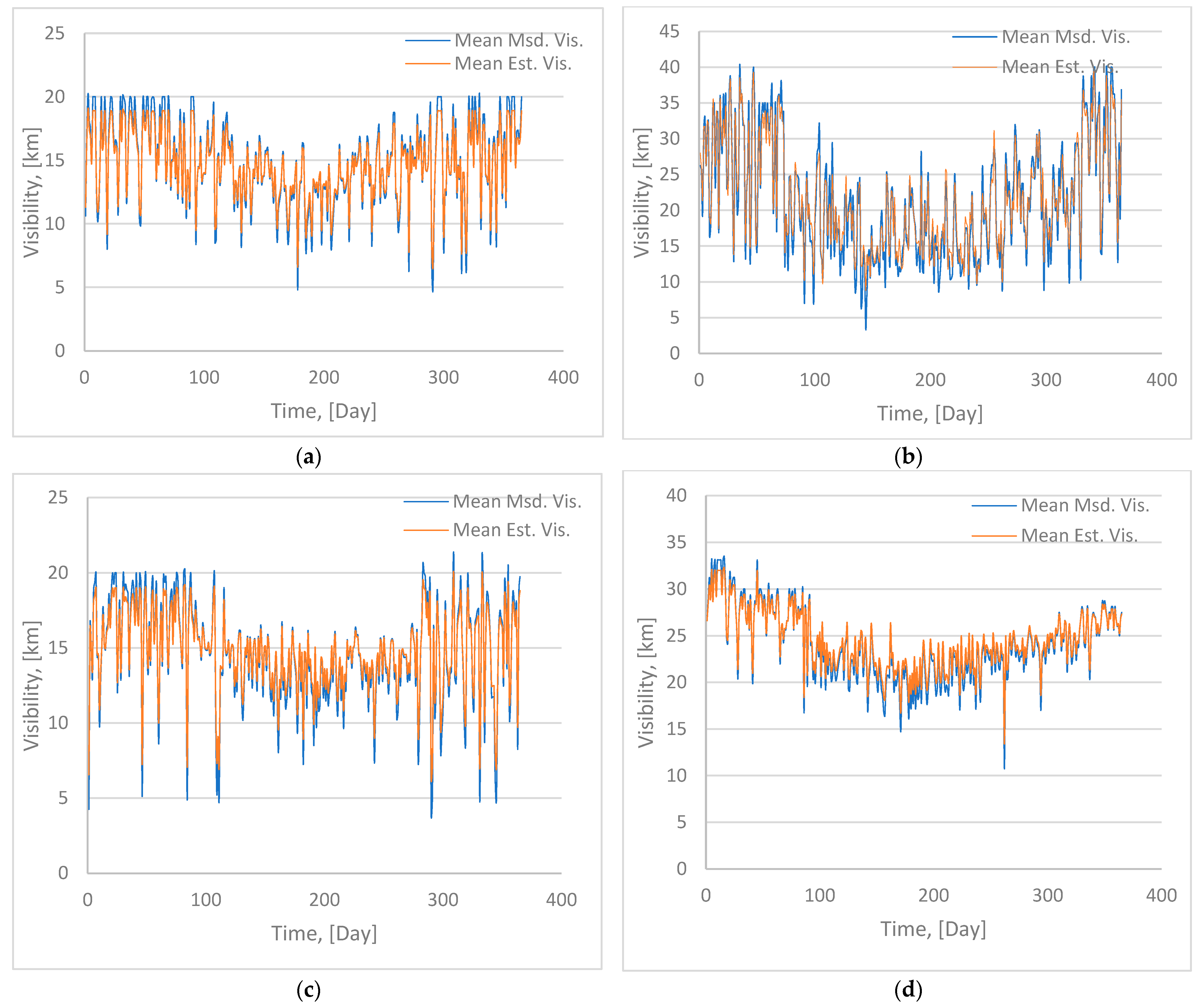
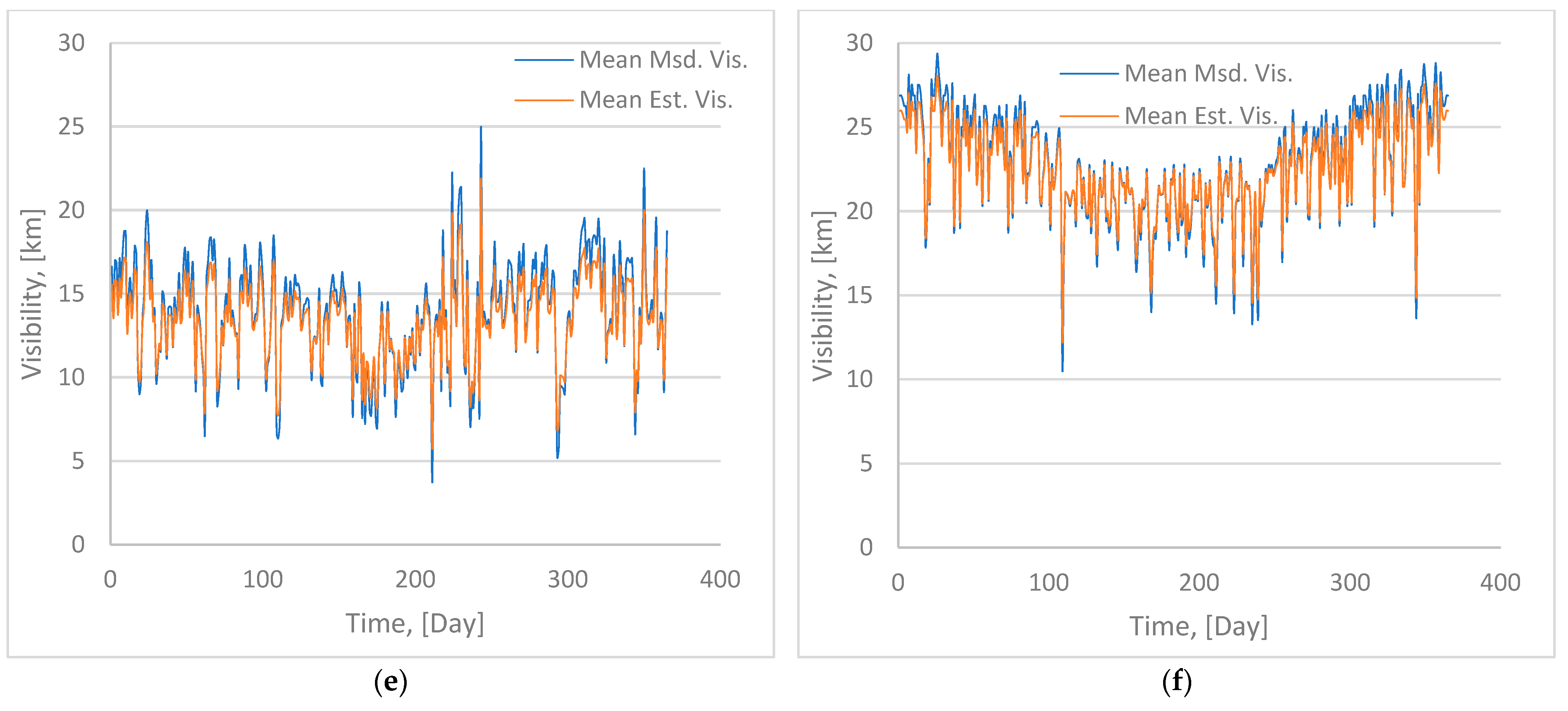
Figure 17a–f show time series plots that illustrate daily evolution of both predicted and measured visibilities throughout the year 2013 for DBN, CPT, MTA, BFT, JHB, and MHK, respectively. The results indicate that the proposed Artificial Neural Network (ANN) models were able to accurately replicate the daily visibility fluctuations for each city. These time series profiles were generated using the ANN model equation and the specific α and β values (both in kilometers) for each city. It is important to note that the estimated visibility in these plots is based on all meteorological variables.

Figure 17.
Time series analysis of the measured and estimated visibilities (in terms of daily mean) using the ANN model with all the atmospheric parameters throughout the year 2013 for (a) DBN; (b) CPT; (c) MTA; (d) BFT; (e) JHB; and (f) MHK.
4.3. ANFIS Simulation and Results
4.3.1. ANFIS Simulation Procedure and Analysis
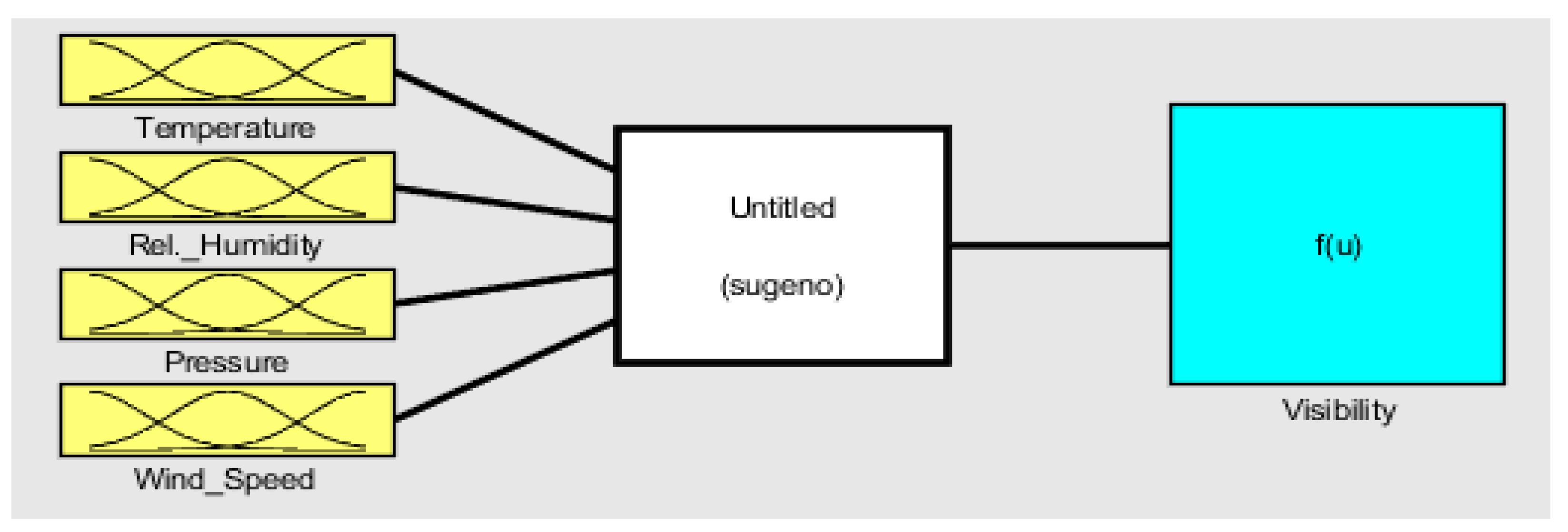
In this section, the input and output variables are trained using the ANFIS network for each of the sites independently. This network is designed to predict the visibility range by employing the datasets with inputs and output from previous records. As earlier mentioned in this study, visibility prediction is a non-linear system. Therefore, the ANFIS configuration is appropriate for making this prediction through training, testing, and checking the algorithm with various functions. The input data are manually inserted into the ANFIS algorithm, allotting about 70% and 30% of the input data for training and testing, respectively. Afterwards, the ANFIS model is monitored with various FIS algorithms, as well as with certain error tolerance and epochs in order to arrive at the best prediction. This ANFIS model is aimed at reducing the errors between the actual and the forecasted output. Figure 18 illustrates the block diagram of the ANFIS input–output configuration using the Sugeno machine, which serves as the type of FIS that incorporates the input parameters to produce the output. This network depicts a four-input and one-output ANFIS system where visibility is predicted from T, RH, P, and WS.
Figure 18.
Block diagram illustrating the ANFIS model.
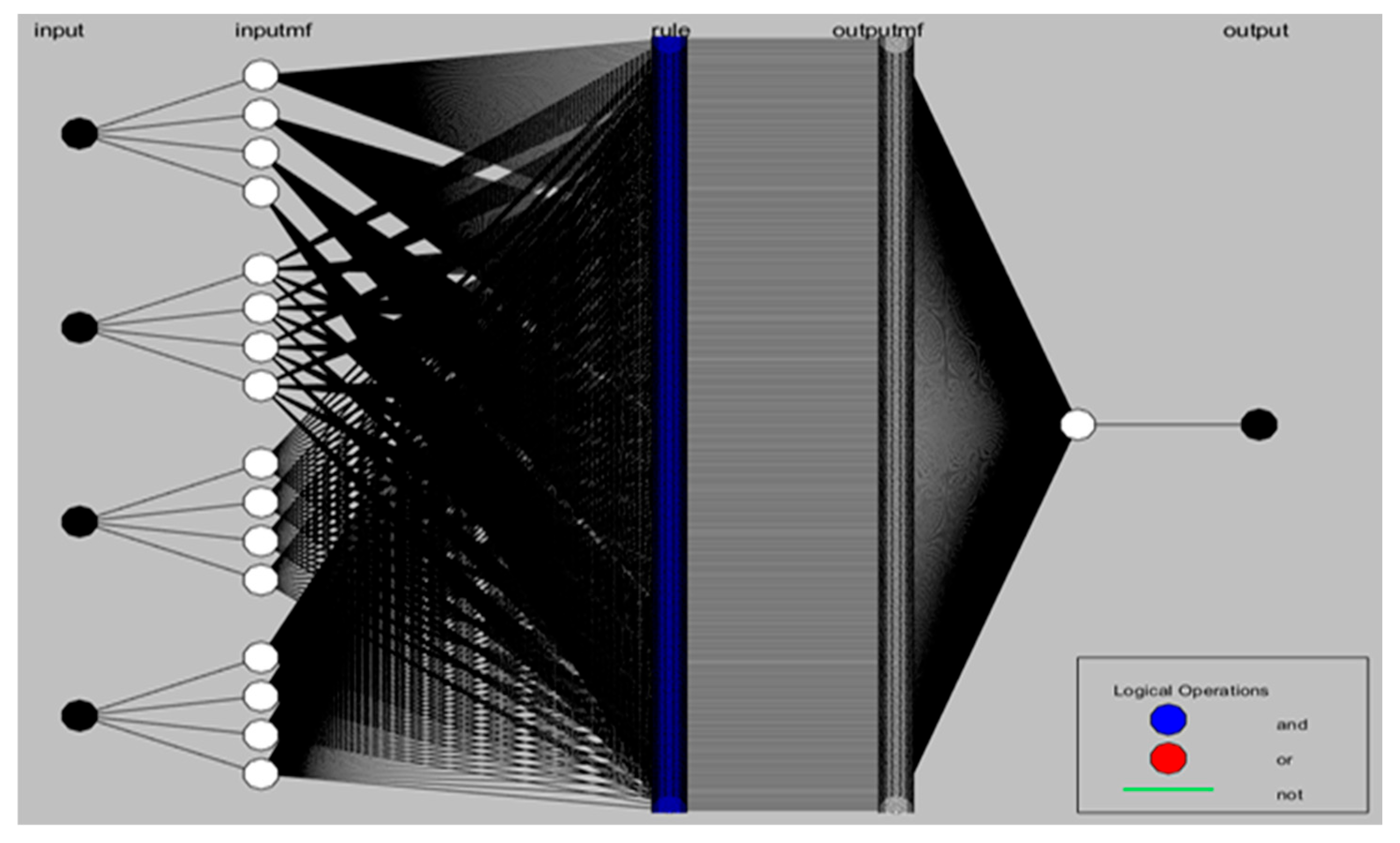
Figure 19 shows the proposed ANFIS model architecture used in this study. This ANFIS design incorporates four input criteria for each of the four input variables, which is referred to as the ‘4444’ FIS configuration. Consequently, there are 256 rules governing the operation of this ANFIS algorithm, as illustrated in Figure 19. Throughout this research, it was determined that an error tolerance of 0.001 and 100 epochs were suitable for training the preferred ANFIS model. The ANFIS architecture employs gaussmf as the input mf type and a linear function as the output mf type, detailed in Table 6.
Figure 19.
The proposed ANFIS model architecture with input membership function of a 4444 configuration.
Table 6.
Estimated training RMSE after ANFIS Training.
4.3.2. ANFIS Prediction Results
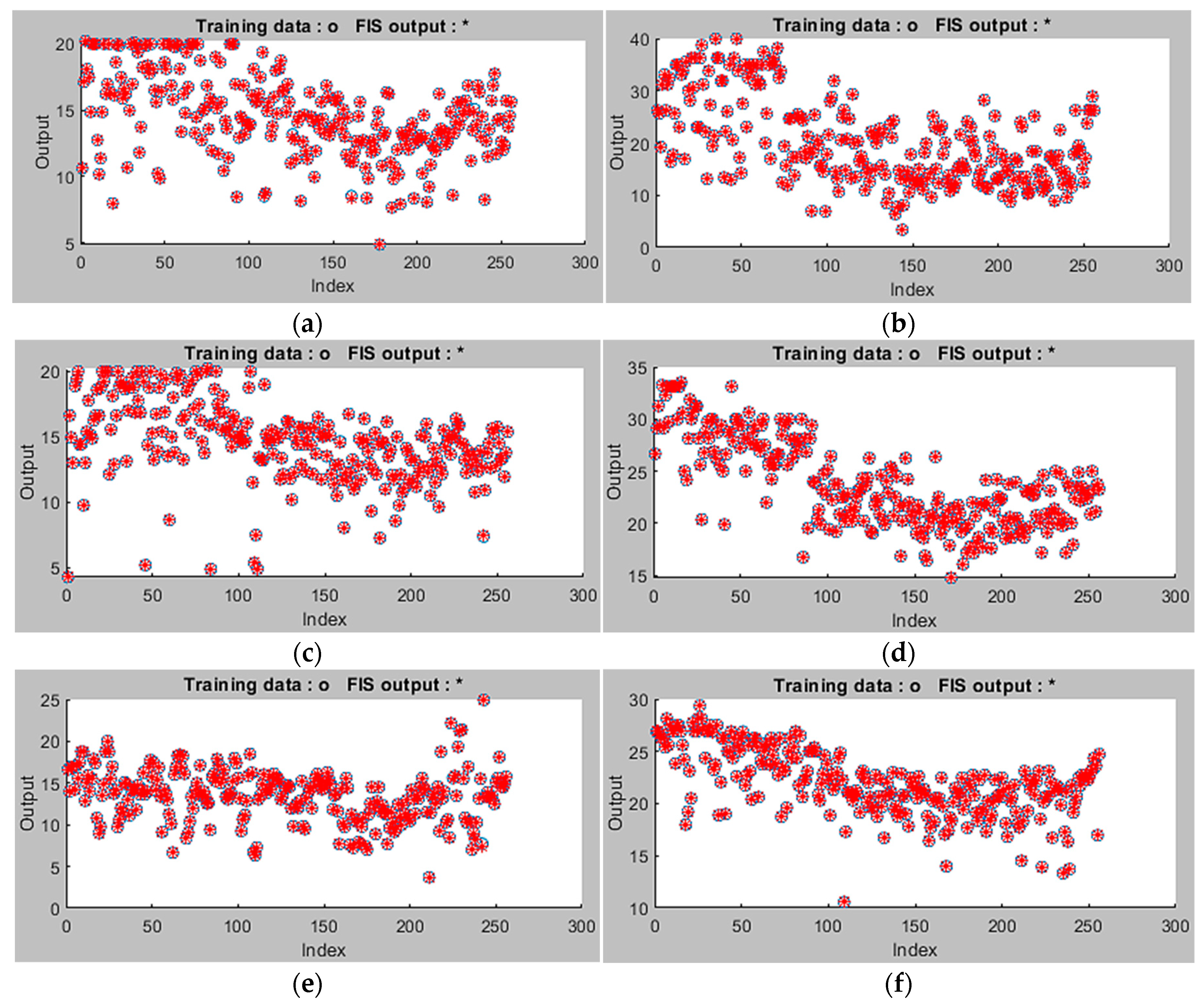
The ANFIS network, as shown in Figure 18, was applied to each of the selected locations using the hybrid architecture in Figure 19. Daily average atmospheric data from the year 2013 were used in this section of the work to predict corresponding visibility data. Time series charts were created by plotting both the training data and FIS output for each city studied in this work against the time index, as shown in Figure 20a–f. This figure displays only 70% of the input data allocated for training, equivalent to the first 256 days within the whole period considered. It was observed that after training, there was a high relationship between the two datasets suggesting very low RMSE value. The estimated training RMSE value for the ANFIS network is shown in Table 6.
Figure 20.
Time series plot of the training data ( and ANFIS output (*) over the daily time index for visibility range for (a) Durban; (b) Cape Town; (c) Mthatha; (d) Bloemfontein; (e) Johannesburg; and (f) Mahikeng.
The training RMSE of the proposed ANFIS model for DBN, CPT, MTA, BFT, JHB, and MHK with four inputs and one output were obtained as 0.0262, 0.0132, 0.0139, 0.0097, 0.0182, and 0.0068, respectively. These values were obtained after completing the training, testing, and checking processes involved in designing the proposed ANFIS model. The low RMSE values suggest that the ANFIS model is ideal for predicting visibility.
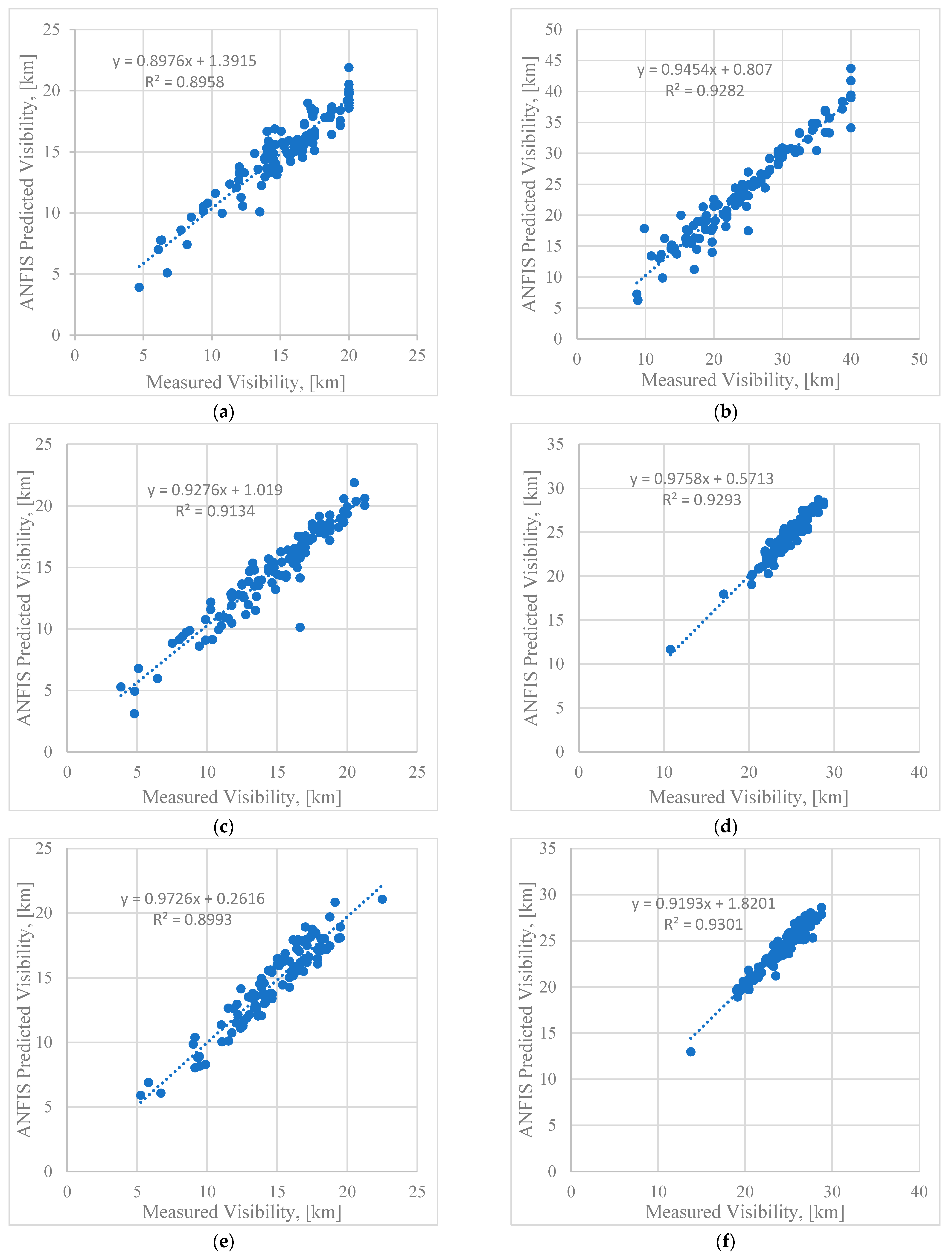
Approximately 30% of the total study period was dedicated to testing the proposed ANFIS model to determine if it was suitable for predicting visibility in this sub-tropical region. Figure 21a–f displays the regression plots of ANFIS-predicted visibility compared to measured visibility data using the allocated testing data. The estimated values for the model testing from the figures are 0.8958, 0.9282, 0.9134, 0.9293, 0.8993, and 0.9301 for DBN, CPT, MTA, BFT, JHB, and MHK, respectively. Therefore, based on the results of the testing data, it was observed that there is a high correlation between the measured and predicted results.
Figure 21.
Regression plots of the proposed ANFIS model using the testing data throughout the year 2013 for (a) Durban; (b) Cape Town; (c) Mthatha; (d) Bloemfontein; (e) Johannesburg; and (f) Mahikeng.
Table 7 illustrates the values obtained for each location using ANN and ANFIS models after training, testing, and validation. The table shows that the ANFIS model demonstrates the most effective training results, with improvement values of 31.54%, 26.76%, 30.33%, 35.43%, 30.57%, and 36.67% for DBN, CPT, MTA, BFT, JHB, and MHK, respectively. Additionally, the testing results showed that the ANFIS model performed better in forecasting visibility. However, both models still exhibited some inadequacies in accurately predicting visibility in this region. This study suggests that there are additional atmospheric parameters that need to be considered in order to achieve a perfect relationship or estimation.
Table 7.
Coefficient of determination for the training, testing and validation data by FF-BPNN and ANFIS models for the study locations.
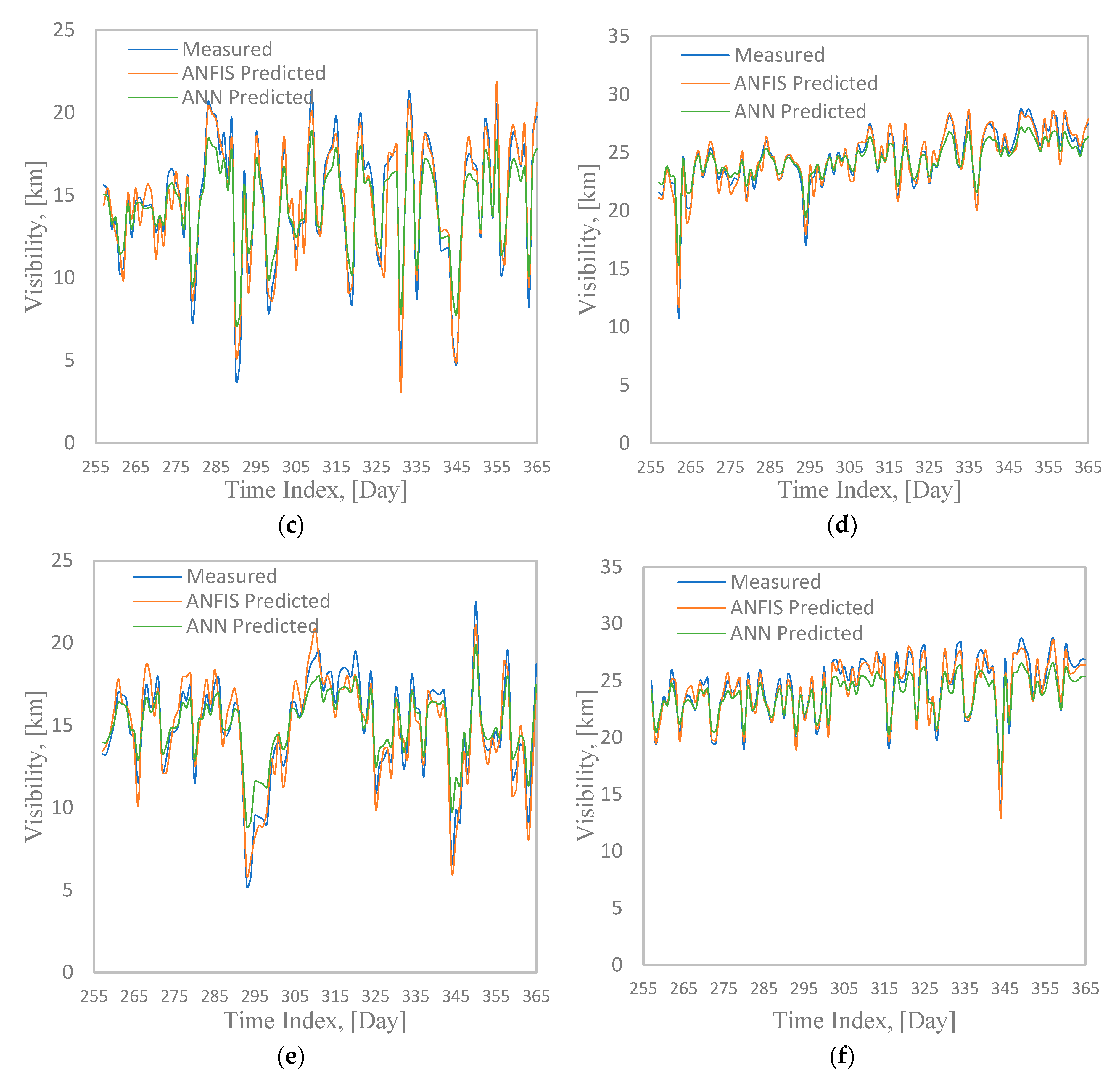
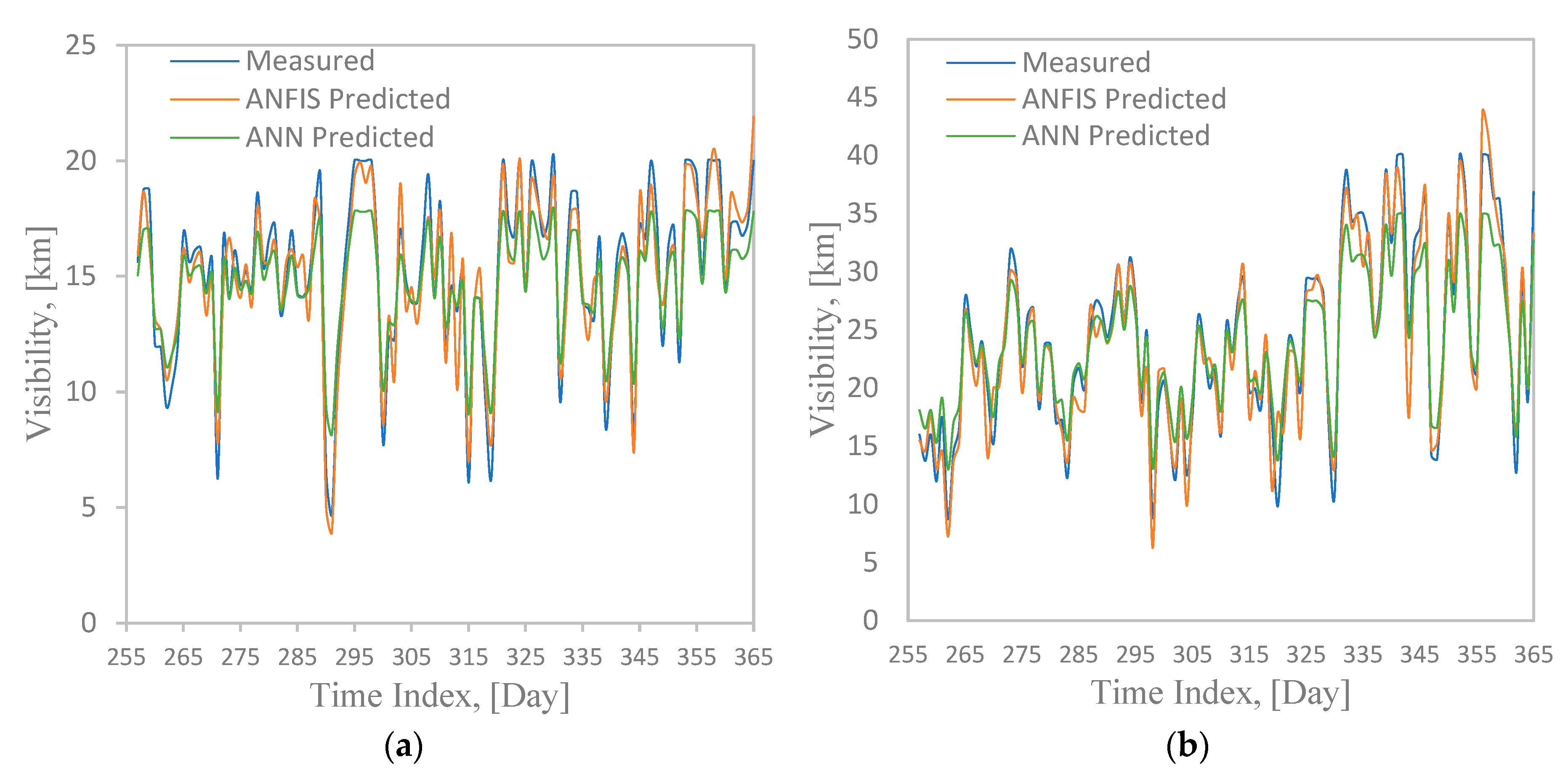
Figure 22a–f illustrates time series prediction results comparing measured and predicted data by both the ANN and ANFIS models for all locations. The actual and predicted data in this case are the testing data, which represent 30% of the entire study year. Thus, the time index on the x-axis spans from the 257th day to the 365th day of the study year. These results demonstrate differences between the measured and predicted data utilizing the two AI models. The outcomes show better estimation using the hybrid algorithm over the ANN algorithm for all the locations using the testing data. The ANFIS model showed more accuracy over ANN in predicting visibility. Table 8 shows the RMSE of the results predicted by both the ANN and ANFIS algorithms. The testing RMSE for the ANFIS algorithm was quite lower than that of the ANN algorithm for all cities considered. For example, the RMSE of Durban using the hybrid algorithm was as low as 0.1172 compared to a higher RMSE of about 1.4051 by the ANN model during testing. Therefore, a similar improvement was consistently observed for all other cities considered.

Figure 22.
Time series analysis profile of the measured, ANFIS-predicted, and ANN-predicted visibilities (in terms of daily mean) using the testing data throughout the year 2013 for (a) Durban; (b) Cape Town; (c) Mthatha; (d) Bloemfontein; (e) Johannesburg; and (f) Mahikeng.
Table 8.
Estimated RMSE values after testing for ANN and ANFIS models.
Using the SVRA, similar trends were observed across cities from coastal to inland, with relative humidity consistently showing the strongest correlation with visibility and assigning only a minor role to atmospheric pressure. Despite the geographic and climatic differences among our six South African sites, the two modeling approaches (ANN and hybrid ANFIS) yield remarkably consistent patterns. Finally, the application of ANFIS boosted the combined R2 further. Crucially, this progression from SVRA through ANN to ANFIS, and the gains seen when moving from single- to multi-variable inputs, were uniformly observed across all six South African sites (coastal Durban and Cape Town, near-coastal Mthatha, and inland Bloemfontein, Johannesburg, and Mahikeng), demonstrating a smooth, humidity-anchored mechanism that each method and location share. Coastal sites experience stronger sea-breeze cycles and aerosol–humidity interactions, whereas inland sites are more meteorologically homogeneous. This concordance across locations and techniques highlights the robustness of our findings and justifies combining insights for regional visibility forecasting.
5. Conclusions
Visibility is one of the most significant natural phenomena that is crucial for flight operations and wireless communications. Due to fluctuating climatic conditions, it is important to monitor visibility conditions in order to make the most of the outcomes. To monitor visibility, a standard and precise model needs to be generated for prediction. Predicting visibility is essential to provide information to personnel for safe flight operations and optimal wireless link performance. To address issues related to low visibility, a system to forecast visibility is important, especially utilizing AI such as neural and neural-fuzzy networks. This study employed standard statistical techniques, back propagation (ANN), and hybrid (ANFIS) algorithms to predict visibility from specific atmospheric variables.
The results from the SST were not accurate in predicting visibility, indicating the need for more advanced techniques like an AI model. Among the four inputs, only RH showed a fairly strong relationship with visibility according to the SST, which is why it was chosen as the base case (Case-A) for the ANN analysis. The statistical error analysis from the ANN model revealed increased prediction accuracy when WS, T, and P were added to the base case. A comparison of results in Table 2 and Table 3 showed that the ANN technique outperformed the SST method. The proposed ANN models achieved an average reliability of about 68.44%, 73.23%, 69.66%, 64.56%, 69.41%, and 63.32% for Durban, Cape Town, Mthatha, Bloemfontein, Johannesburg, and Mahikeng, respectively. The hybrid ANFIS model demonstrated even higher reliability, with improvements ranging from 22.34% to 32.70% over the ANN models.
The aim of this study was not to determine the best ANN or ANFIS architecture but to identify the best combination and level of correlation between meteorological variables and visibility. The analysis revealed that the relationship between visibility and RH was the strongest, followed by WS and T, with P showing the lowest correlation. Despite the improved performance of the ANFIS model, it showed a slight shortfall in the prediction, indicating further room for improvement by including other atmospheric components like solar radiation and gas-related variables.
In conclusion, visibility prediction using atmospheric variables was analyzed, considering time series analysis and visibility prediction for different cities. The ANFIS model was chosen for its effective prediction investigation capabilities, leading to accurate visibility predictions with minimal error compared to ANN and SST models. These results show that the neuro-fuzzy technique is an effective algorithm for prediction investigation. Looking ahead, integrating our ANN/ANFIS framework with real-time observational streams (e.g., automated weather stations or satellite-derived humidity products) could enable continuous visibility nowcasting. Deploying such a system in an operational setting would test its robustness under live data feeds and support timely decision-making for wireless communication systems, aviation, and road-traffic safety.
Author Contributions
Conceptualization, O.A.L. and P.A.O.; methodology, O.A.L.; software, O.A.L. and P.A.O.; validation, O.A.L. and P.A.O.; formal analysis, O.A.L. and J.S.O.; investigation, O.A.L.; resources, P.A.O.; data curation, O.A.L.; writing—original draft preparation, O.A.L.; writing—review and editing, O.A.L., P.A.O., and J.S.O.; visualization, O.A.L. and J.S.O.; supervision, P.A.O. and J.S.O.; project administration, P.A.O.; funding acquisition, O.A.L. and P.A.O. All authors have read and agreed to the published version of the manuscript.
Funding
This research received no external funding.
Institutional Review Board Statement
Not applicable.
Informed Consent Statement
Not applicable.
Data Availability Statement
The two different sets of data used for this study are openly available in National Centers for Environmental Information (NCEI) at https://www.ncei.noaa.gov/access/search/data-search/global-hourly?dataTypes=VIS&stations=68592099999&pageNum=1 (accessed on 11 March 2018) and South African Weather Service (SAWS) at https://www.weathersa.co.za/ (accessed on 15 March 2018).
Conflicts of Interest
The authors declare no conflicts of interest.
References
- Lopez, G.; Bosch, J.L.; Pulido-Calco, I.; Gueymard, C.A. Visibility Estimates from Atmospheric and Radiometric Variables using Artificial Neural Networks. WIT Trans. Ecol. Environ. 2017, 211, 129–136. [Google Scholar]
- Lundgren, D.A.; Cooper, D.W. Effect of Humidity on light-scattering methods of measuring particle concentration. J. Air Pollut. Control Assoc. 1969, 19, 243–247. [Google Scholar] [CrossRef]
- Usman, A.; Olaore, K.O.; Ismaila, G.S. Estimating Visibility using some Meteorological Data at Sokoto, Nigeria. Int. J. Basic Appl. Sci. 2013, 1, 810–815. [Google Scholar]
- Boudala, F.S.; Isaac, G.A. Parametrization of Visibility in Snow: Application in Numerical Weather Prediction Models. J. Geophys. Res. 2009, 114, D19202. [Google Scholar]
- Zhao, J.; Mo, H.; Deng, Y. An Efficient Network Method for Time Series Forecasting Based on the DC Algorithm and Visibility Relation. IEEE Access 2020, 8, 7598–7608. [Google Scholar] [CrossRef]
- Salman, A.G.; Kanigoro, B. Visibility Forecasting Using Autoregressive Integrated Moving Average (ARIMA) Models. Procedia Comput. Sci. 2021, 179, 252–259. [Google Scholar] [CrossRef]
- Colabone, R.O.; Ferrari, A.L.; Vecchia, F.A.S.; Tech, A.R.B. Application of Artificial Neural Network for Fog Forecast. J. Aerosp. Technol. Manag. 2015, 7, 240–246. [Google Scholar] [CrossRef]
- Alhashimi, S.A.M. Prediction of Monthly Rainfall in Kirkuk using Artificial Neural Network and Time Series Model. J. Eng. Dev. 2014, 18, 129–143. [Google Scholar]
- Shaikh, L.; Sawlani, K. A Rainfall Prediction Model using Artificial Neural Network. Int. J. Tech. Res. Appl. 2017, 5, 45–48. [Google Scholar]
- Kumarasiri, A.; Sonnadara, D. Rainfall Forecasting: An Artificial Neural Network Approach. In Proceedings of the Technical Sessions, Institute of Physics, Colombo, Sri Lanka, 24 March 2006. [Google Scholar]
- Mittal, P.; Chowdhury, S.; Roy, S.; Bhatia, N.; Strivastav, R. Dual Artificial Neural Network for Rainfall-Runoff Forecasting. J. Water Resour. Prot. 2012, 4, 1024–1028. [Google Scholar] [CrossRef][Green Version]
- Nayak, D.R.; Mahapatra, A.; Mishra, P. A Survey on Rainfall Prediction using Artificial Neural Network. Int. J. Comput. Appl. 2013, 72, 32–40. [Google Scholar] [CrossRef]
- Karimi, S.; Shiri, J.; Kisi, O.; Shiri, O.O. Short-term and Long-term Streamflow Prediction by using ‘Wavelet-gene Expression’ Programming Approach. ISH J. Hydraul. Eng. 2016, 22, 148–162. [Google Scholar] [CrossRef]
- Chen, J.; Zhao, C.S.; Ma, N.; Liu, P.F.; Gobel, T.; Hallbauer, E.; Deng, Z.Z.; Ran, L.; Xu, W.Y.; Liang, Z.; et al. A Parameterization of Low Visibilities for Hazy Days in the North China Plain. Atmos. Chem. Phys. 2012, 12, 4935–4950. [Google Scholar] [CrossRef]
- Tafner, M.A.; Xerez, M.; Rodrigues, F.W. Redes Neurais Artificiais: Introdução e Princípios de Neurocomputação [Artificial Neural Networks: Introduction and Principles of Neurocomputing]; FURB: Blumenau, Brazil, 1996; ISBN 8571140502. [Google Scholar]
- Russel, S.J.; Norvig, P. Artificial Intelligence: A Modern Approach, 3rd ed.; Prentice Hall: Saddle River, NJ, USA, 2009; pp. 727–737. [Google Scholar]
- Dixon, M.F.; Halperin, I.; Bilokon, P. Feedforward Neural Networks. In Machine Learning in Finance; Springer: Cham, Switzerland, 2020; pp. 111–166. [Google Scholar]
- Wahyuni, I.; Mahmudy, W.F.; Iriany, A. Rainfall Prediction using Hybrid Adaptive Nuero Fuzzy Inference System (ANFIS) and Genetic Algorithm. J. Telecommun. Electron. Comput. Eng. 2017, 9, 51–56. [Google Scholar]
- Atmaca, H.; Cetisli, B.; Yavuz, A. The Comparison of Fuzzy Inference Systems and Neural Network Approaches with ANFIS for Fuel Consumption Data. In Proceedings of the Second International Conference on Electrical and Electronics Engineering Papers ELECO 2001, Bursa, Turkey, 7–11 November 2001. [Google Scholar]
- Cakmakci, M.; Kinaci, C.; Bayramoglu, M.; Yildirim, Y. A Modeling Approach for Iron Concentration in Sand Filtration Effluent using Adaptive Neuro-Fuzzy model. Expert Syst. Appl. 2010, 37, 1369–1373. [Google Scholar] [CrossRef]
- Faulina, R.; Suhartono, P. Hybrid ARIMA-ANFIS for Rainfall Prediction in Indonesia. Int. J. Sci. Res. 2013, 2, 159–162. [Google Scholar]
- Conradie, D.C.U. Designing for South African Climate and Weather. In The Green Building Handbook of South Africa, the Essential Guide; Green Building Media (Pty) Ltd.: Johannesburg, South Africa, 2012; Volume 4, pp. 181–195. [Google Scholar]
- Urso, A.; Fiannaca, A.; La Rosa, M.; Ravi, V.; Rizzo, R. Data Mining: Classification and Prediction. In Encyclopedia of Bioinformatics and Computational Biology; Academic Press: Cambridge, MA, USA; Elsevier: Amsterdam, The Netherlands, 2019; Volume 1, pp. 384–401. ISBN 9780128114322. [Google Scholar]
- Zeil, A. Simulation Neuronaler Netze [Simulation of Neural Networks], 1st ed.; Addison-Wesley: Boston, MA, USA, 1994; p. 73. ISBN 3-89319-554-8. (In Germany) [Google Scholar]
- Lavine, B.K.; Blank, T.R. Feed-Forward Neural Network. In Comprehensive Chemometrics; Elsevier: Amsterdam, The Netherlands, 2009; Volume 3, pp. 571–586. ISBN 9780444527011. [Google Scholar]
- Schmidhuber, J. Deep learning in neural networks: An Overview. Neural Netw. 2005, 61, 85–117. [Google Scholar] [CrossRef] [PubMed]
- Goodfellow, I.; Bengio, Y.; Courville, A. Deep Learning; MIT Press: Cambridge, MA, USA, 2016; pp. 164–172. [Google Scholar]
- Moore, D.S.; Notz, W.I.; Flinger, M.A. The Basic Practice of Statistics, 6th ed.; W. H. Freeman and Company: New York, NY, USA, 2013; p. 138. [Google Scholar]
- Henseler, J.; Ringle, C.; Sinkovics, R. The use of partial least squares path modelling in international marketing. Adv. Int. Mark. (AIM) 2009, 20, 277–320. [Google Scholar]
- Moore, D.S.; McCabe, G.P.; Craig, B.A. Introduction to the Practice of Statistics, 9th ed.; W. H. Freeman and Company: New York, NY, USA, 2017. [Google Scholar]
- Anderson, T.W. An Introduction to Multivariate Statistical Analysis, 2nd ed.; Wiley: New York, NY, USA, 1958; pp. 156–190. [Google Scholar]
- Pal, R. Predictive Modeling of Drug Sensitivity; Academic Press: Cambridge, MA, USA; Elsevier: Amsterdam, The Netherlands, 2017; pp. 83–107. ISBN 9780128052747. [Google Scholar]
Disclaimer/Publisher’s Note: The statements, opinions and data contained in all publications are solely those of the individual author(s) and contributor(s) and not of MDPI and/or the editor(s). MDPI and/or the editor(s) disclaim responsibility for any injury to people or property resulting from any ideas, methods, instructions or products referred to in the content. |
© 2025 by the authors. Licensee MDPI, Basel, Switzerland. This article is an open access article distributed under the terms and conditions of the Creative Commons Attribution (CC BY) license (https://creativecommons.org/licenses/by/4.0/).