Abstract
Statistics in the inertial energy transfer range (IETR) of d-dimensional turbulence ( ) are studied using a Lagrangian renormalized approximation (LRA). The LRA suggests that the energy spectrum in the IETR is given by , where is a constant and is the energy flux across wave-number k; the energy transfer is forward for but inverse for , where ; at , diverges and the skewness of the longitudinal velocity difference vanishes; and the d-dependence of the two-time Lagrangian velocity correlation spectra under appropriate normalization is weak in the IETR.
Keywords:
d-dimensional turbulence; inertial energy transfer range; Lagrangian renormalized approximation PACS:
47.27.Ak; 47.27.Jv; 47.27.Gs; 05.20.Jj
1. Introduction
It was at an IUTAM Symposium held at Kyoto on 1983 when the second author (Y.K.) first met Jack Herring, while it was in 1990 at Boulder when the first author (T.G.) first met him. Since then, both authors have had chances to enjoy discussions with Jack, including during the workshops of the Geophysical Turbulence Program at the National Center for Atmospheric Research and his visits to Nagoya. The discussions covered various topics, but particularly statistical theories of turbulence. Our common interests included the spectral closure theories, in particular two-point two-time closure approximations. We were inspired by his works, especially those on spectral closure approaches. The discussions with him have been friendly and stimulating.
In this paper, we consider the application of a spectral closure approach to turbulence in the d space dimension with . In practice, we use a spectral closure theory based on a view point of Lagrangian renormalization. The closure theory is called Lagrangian renormalized approximation (LRA) [1] here. The LRA is a two-point two-time Lagrangian closure approximation free from any adjustment parameter, and similar in this sense to the abridged Lagrangian-history direct-interaction approximation (ALHDIA) of Kraichnan [2] and strain-based ALHDIA of Kraichnan and Herring [3] and Herring and Kraichnan [4]. The equations of the LRA are simpler than those of the ALHDIA and strain-based ALHDIA.
In general, the dynamics of a fluid may be fundamentally different in different space dimension. For example, vortex stretching plays important dynamic roles in three, but not two, dimensions. It is not surprising that, given such observations, the statistics of turbulence may differ fundamentally in different space dimensions. Indeed, studies so far suggest that energy in the so-called inertial energy cascade range is transferred in opposite directions in two and three dimensions, i.e., from large to small eddies (scales) (forward) in three dimensions, but from small to large scales (backward or inverse) in two dimensions, if the turbulence has a sufficiently large Reynolds number . One may ask: What happens in spaces of noninteger dimension d between two and three dimensions?
It is difficult to realize turbulence in such noninteger dimension by experiments or numerical simulation, so that one might think that such a question is purely academic. However, the history of the statistical mechanics of critical phenomena suggests that understanding the physics of noninteger dimension may improve our understanding of physics in three (and two) dimensions, as noted by Fournier and Frisch [5] in a pioneering study of turbulence in noninteger dimension. The study of turbulence in noninteger dimension via a closure-theoretical approach may extend the field of the applications of spectral closures in which both Jack Herring and the authors were/are interested.
In this paper, we begin by considering the homogeneous and isotropic turbulences (HIT) of an incompressible fluid that obeys the Navier–Stokes (NS) equation in integer dimensions d with . After reviewing certain exact relations in physical and wave-vector spaces of d-dimension in Section 2, we briefly review, in Section 3, the LRA equations for HIT in d-dimensions, following Gotoh et al. [6]. In the LRA equations, the parameter d representing the space dimension plays a key role. The dimension d is limited to integers in Section 2 and Section 3. In Section 4, we take a bold step; we relax d to allow noninteger values. Assuming that the LRA equations are applicable to noninteger values d, we analyze (in Section 4) the statistics in the wavenumber range wherein the energy flux across wavenumber k is independent of k. Here, we refer to this range as the inertial energy transfer range (IETR). A particular attention is paid to statistics associated with Lagrangian two-point two-time velocity correlation and the skewness factor of the longitudinal velocity increment in the ITER; two-time statistics are, in general, not captured in single time closures such as the eddy-damped quasinormal Markovian (EDQNM) approximation [7] used in [5,8].
2. Exact Relations
2.1. Navier–Stokes Equation in d-Dimension with
We begin with the NS equation for an incompressible fluid
and the incompressibility condition
in d-dimensional space () where and are the components of the velocity u, the position x, and the external force in the i-th Cartesian direction (), respectively, t is the time, p is the pressure divided by the constant fluid density, and is the kinematic viscosity. Throughout, we employ the summation convention for repeated indices.
Multiplying Equation (1) by and taking the summation over i gives
under the incompressibility condition Equation (2). Integrating Equation (1) over the fluid domain V, one obtains
where the energy dissipation rate and energy injection rate at position x are defined by
and the integration over the boundary surface of the domain V is assumed to be negligible. This assumption can be justified under the assumption of periodic boundary conditions, for example.
2.2. Spectral Relations
In homogeneous and isotropic turbulence (HIT), the single-time two-point velocity correlation depends on x and only via , and its Fourier transform with respect to r may be written in the form
where depends on k only via and . The Fourier transform of with respect to r is related to by
in which the integration is over the entire k-space. The total energy is given by
where the energy spectral density is defined as
and is the surface area of a d-dimensional sphere of unit radius. The brackets indicate an appropriate average such as the ensemble or space average.
According to the NS equation, Equation (1), the energy spectrum obeys
where is the energy injected by the external force . is the so-called energy transfer function that represents the energy transfer attributable to nonlinear triad interactions in the wave-vector space. The energy conservation by the nonlinear term in the NS equation implies that
The so-called energy flux across k is defined by
The average energy dissipation rate per unit mass is given by
and the average energy injection rate per unit mass is given by
Here and hereinafter, we omit the time-arguments at will.
2.3. Statistics in the Inertial Energy Transfer Ranges of Wave-Vector and Physical Spaces
Equations (11) and (13) imply that
Suppose that is very large, so that , i.e., the sum of the three terms in the integrand of Equation (16) is negligibly small (in an appropriate sense) over a certain range of , say . Equation (16) then implies that the energy flux is almost constant independent of k, and we may therefore approximate it as
over the range wherein we have set the constant to . We assume here that the time dependence of is negligible.
As shown in Appendix A, if such a range k is sufficiently wide, we obtain the approximation
over the corresponding range of r, i.e., (), where is the third-order structure function of the longitudinal velocity increment . We call this range inertial energy transfer range (IETR), and the wave-number range is called the IET wave-number range (simply, IETR). The relation (18) with can be derived from a generalization of the Kármán–Howarth–Kolmogorov (KHK) equation for to any arbitrary integer for freely decaying turbulence with [9,10,11].
For freely decaying turbulence in three dimensions (), Equation (18) with gives Kolmogorov’s 4/5-th law [12],
Kolmogorov noted that under the assumption that the skewness S of defined by
is constant, Equation (19) gives
where , is a nondimensional constant, and we have used . A similar statement holds true for , i.e., if the skewness factor is constant, then Equation (18) gives
where is a nondimensional constant, but may depend on d. Here, we use instead of to allow the possibility that may be negative.
In spectral space, Equation (21) gives
provided that the IETR is sufficiently wide, where is a nondimensional constant that may depend on d. Straightforward algebra shows that is related to by
where is the gamma function [6]. Equations (18), (20), (22) and (24) then give
where we have replaced S in Equation (20) by .
3. LRA Equations in Integer Dimension
3.1. LRA Equations
One of the main interests in the study of turbulence is how to theoretically predict the transfer . Extensive studies have been made on this problem. Readers may refer to, for example, the review by Zhou [13] for a recent and comprehensive review of the studies.
The LRA is one of the closure theories that give approximations for the transfer [1]. Let be the two-time two-point Lagrangian velocity correlation defined by
and is the Lagrangian response function defined by
where is the generalized velocity defined as the fluid velocity at time t of the fluid particle that was at position x at time s, is an infinitesimal force term added to the right-hand side of Equation (1), and denotes functional differentiation. Since is just the Eulerian velocity , we have .
In statistically homogeneous turbulence, and depend on x and only via . Let the Fourier transforms with respect to r of and after an appropriate normalization be, respectively, and . The LRA gives a closed set of equations for and . (Since the pressure in Equation (1) kills the compressible part of , it is shown that . The latter expression instead of the former was used in Kaneda (1981)). In HIT, they may be written in the form
where and depend on k only via k. Since , as noted above, and the fluid is incompressible, we have , where is the Fourier transform of with respect to . For , Equation (28) with therefore reduces to Equation (7). The same closure equations as those in the LRA were derived by Kida and Goto [14] for .
We quote here the LRA equations for , and in integer dimension from Gotoh et al. [6] as follows. Readers may refer to their paper for the details of the derivation, and to Kaneda [15] for the basic ideas and properties of the LRA.
The single time correlation obeys
where
and
denotes the integral over the domain of such that can be the length of the sides of a triangle, and denotes the cosines of the interior angles opposite the triangle sides , respectively. Here, we assume that the time t is large enough, so that we may let the lower bound of the time integral in Equation (31) be .
The Lagrangian two-time velocity correlation satisfies the fluctuation–dissipation relation
and the Lagrangian response function satisfies and
where
F is Gauss’ hypergeometric function and B is the beta function. Here, we omit terms that disappear when .
According to Equation (31), the energy flux is given by
in the LRA. It can be confirmed that, as in three dimensions, the detailed balance and the energy conservation by the nonlinear term in the NS equation hold in the LRA in any integer dimensions .
3.2. LRA Equations in the IETR
A simple dimensional analysis using the idea of Kolmogorov’s similarity theory [16] suggests that and in the IETR, where Equation (17) holds, are given by the following similarity forms:
where is the Kolmogorov constant in d-dimension. Here and hereafter we assume the statistical stationarity in the IETR.
The LRA equations are confirmed to be consistent with the similarity forms in Equation (42). Upon substitution of the similarity forms (42) of Equation (10) into Equation (37), the integral converges appropriately at small and large wave-number limits. Via substitution, one can reduce Equation (36) to
Similarly, by substituting the similarity forms, one can reduce the expression Equation (41) for the energy flux in the IETR to
where
and is the triple relaxation time defined by
4. Statistics in the IETR for
Up to this point, we have assumed that the space dimension d is an integer, and we derived the relations in Section 2 and Section 3. We now take the bold step of assuming that we can continue to use Equation (25) and the LRA equations in a noninteger dimension d with . If so, we can solve Equation (43) to obtain numerically for any noninteger dimension d, in , in the same way as in Refs. [17,18,19]. Note that Expression (9) in Ref. [18] for a damping factor is too small by a factor of 2; thus, some factors must be corrected. For example, C ( in the present notation) is too small by a factor of , and, thus, should be .
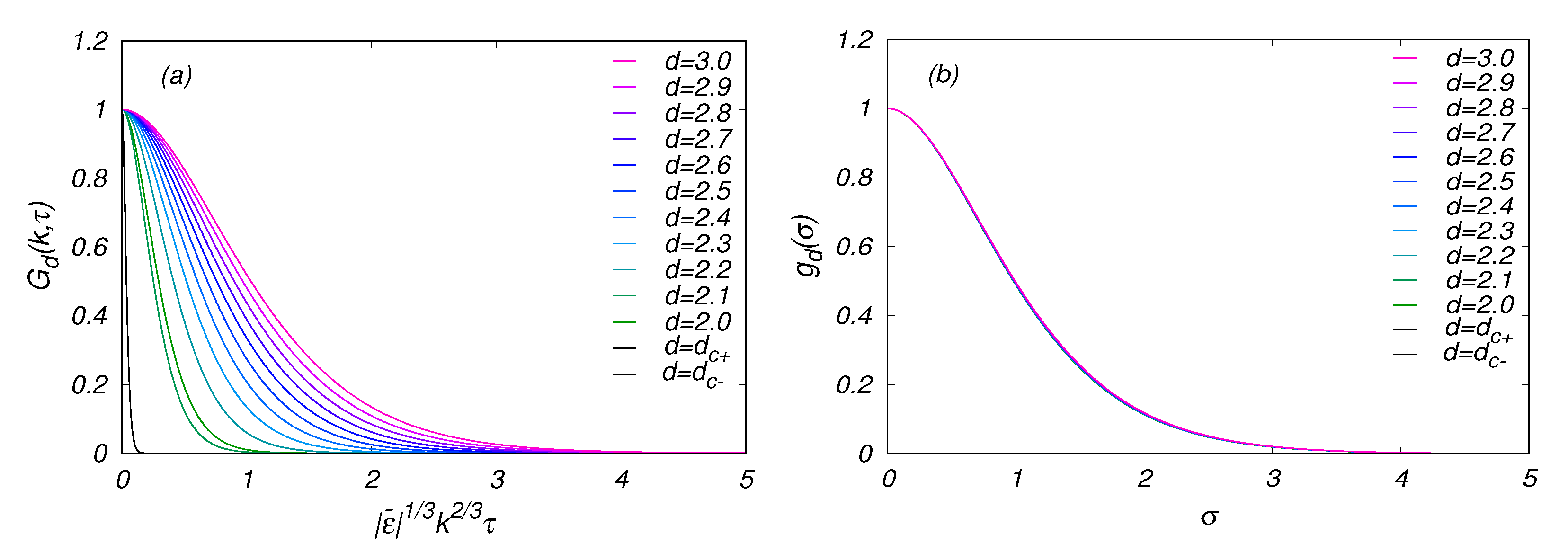
Figure 1a shows the response function plotted against for and , where . The function decays more rapidly as d decreases from 3 and rapidly moves to zero just above and below . However, it decays more slowly as d changes from to 2. Figure 1b shows that the values of as a function of are almost independent of d. Given the fluctuation–dissipation relation (35), this implies that the normalized two-point two-time Lagrangian-correlation spectrum is also almost independent of d under an appropriate normalization of time.
Figure 1.
Response function for and and . (a) plotted against . (b) Normalized response function .
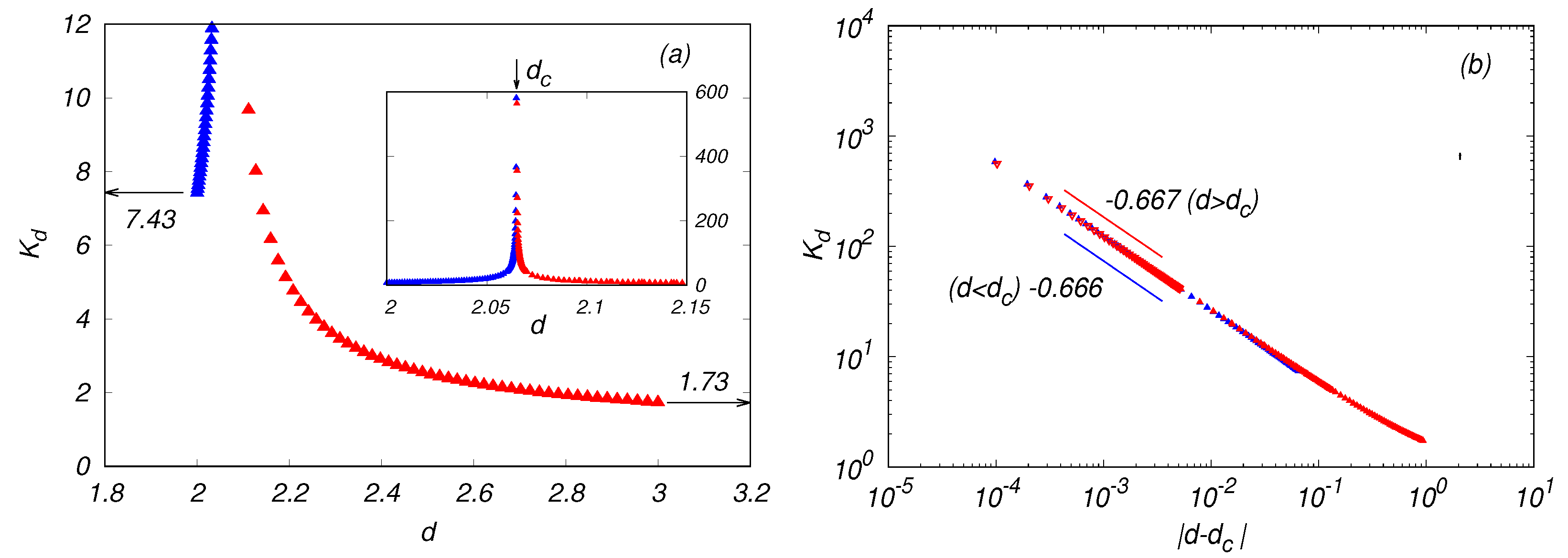
Substituting the values of thus obtained and integrating Equation (41) numerically, we derive estimates of for the given d, as in previous studies. The numerical code used in this study is based on that of Ref. [6]. The values of thus obtained are plotted in Figure 2a,b. It is seen that as a function of d tends to for and for , respectively, and diverges at a point . These numerical estimates, and , are in agreement with the estimates and [6,14,17,18,19] within a difference of less than .
Figure 2.
Variation of by d. (a) vs. d for . Values at () are shown in red (blue). The numbers are and . The inset figure shows a close-up of near . (b) vs. in logarithms. The numbers are the slopes (red: , blue: ).
It is numerically clear that is positive, so given by Equation (44) is, thus, also positive; the energy transfer is forward at but negative (backward) at . If one assumes at small , we obtain with , which is in good agreement with the numerical result of Figure 2b and agrees also with that of Fouriner and Frisch [5], who argued that diverges at and the exponent is , on the basis of the EDQNM approximation, where , which is very close to noted above. In the EDQNM approximation in Fouriner and Frisch [5], in the IETR is given by Equation (44) but with in Equation (42) replaced by , and represents the local eddy turnover time and is given by
and is an adjusting parameter. The critical dimension is seen to be independent of the choice of .
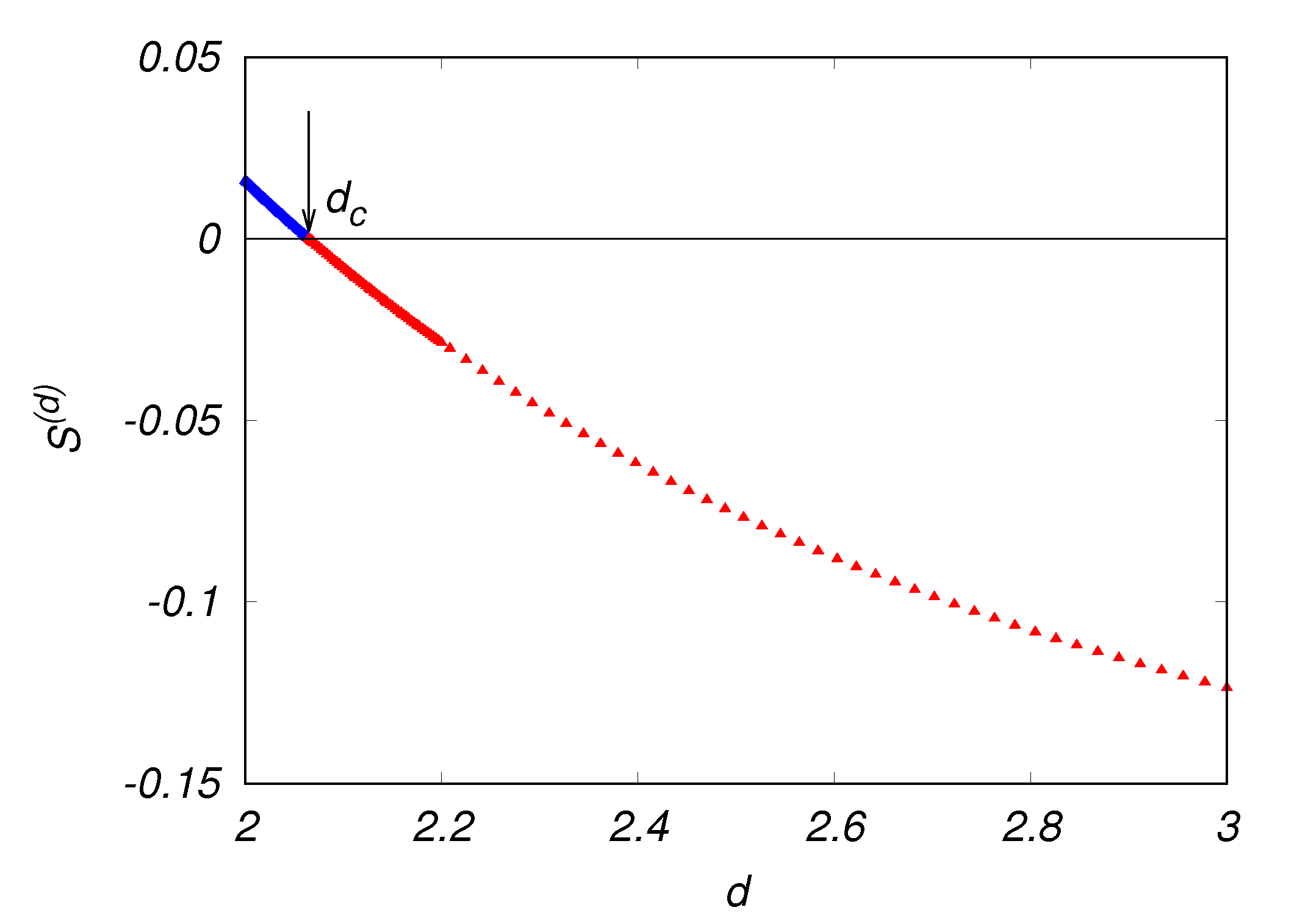
Substitution of the values of thus obtained from Equation (25) gives the values of the skewness factor , which are plotted in Figure 3. It is seen that decreases as d decreases from , and changes its sign at where diverges.
Figure 3.
Variation of the skewness factor with d. Values at () are shown in red (blue). The arrow indicates .
5. Discussion
The overlap of the curves of for different d in Figure 1b is impressive. This implies that the time dependence of the normalized Lagrangian two-point two-time correlation and that of the Lagrangian response function under an appropriate normalization of time are insensitive to the difference in the space dimension. It would be interesting to explore the physics behind the overlap and implications thereof.
The skewness of the velocity increment must be 0 if the statistics of the velocity field are Gaussian. Hence, is a measure of the degree of the non-Gaussianity of the turbulence statistics. The results in Section 4 show that monotonically approaches the Gaussian value, i.e., 0, with the departure of the dimension d from 3, in the range , and increases from 0 in the range .
Recently studies have been made on turbulence in noninteger space dimensions using a fractal Fourier decimation model; see, for example, [20,21,22,23,24,25], and references cited therein. Studies so far made suggest that the non-Gaussianity of small-scale statistics depends on the space dimension d. In this respect, the results in Section 4 noted above are consistent with this, although the model used here is based on continuation of the LRA at integer dimensions to noninteger dimension ; this differs from the decimation model. It would be interesting to apply the LRA to the decimation model to see if the LRA can well capture the influence of d on the statistics related to the skewness in the model.
Author Contributions
Both authors contributed equally to this work. All authors have read and agreed to the published version of the manuscript.
Funding
This work was supported by JSPS KAKENHI Grant Numbers JP20H00225 and JP23K03245.
Institutional Review Board Statement
Not applicable.
Informed Consent Statement
Not applicable.
Data Availability Statement
No data were used.
Acknowledgments
This paper is dedicated to the memory of Jack Herring. Y.K. is grateful to S.S. Ray for informing Y.K. of references [20,21,22,23,24,25], and for interesting discussions on the fractal Fourier decimation model, which stimulated Y.K.’s interest in turbulence in noninteger dimension. Y.K. would also like to thank the Isaac Newton Institute for Mathematical Sciences, Cambridge, for support and hospitality during the program “Mathematical aspects of turbulence: Where do we stand?” when work on this paper was undertaken. This work was supported by EPSRC grant number EP/R014604/1.
Conflicts of Interest
The authors declare no conflict of interest.
Appendix A. Relation between Π d (k) and D LLL (r)
In this Appendix, we consider the relation between the energy flux in wavenumber space and the third-order moment of the longitudinal velocity increment. Let us consider the following quantity [26],
In terms of , the energy transfer flux in the wavenumber space is given by
where () denotes the surface of the unit sphere centered at in the d-dimensional physical (wave-vector ) space. If statistical isotropy is assumed, we can write and perform the surface integrals. The result is
where is the -th-order Bessel function. The function for the isotropic turbulence is expressed in terms of the cubic moment of the longitudinal velocity increment as
Substituting Equation (A4) into Equation (A3) and performing integration by parts, assuming that the integrands rapidly move to zero for small and large r, we obtain
Conversely, can also be expressed in terms of as
Substituting Equation (A4) into the above equation, and integrating in r over the domain under the conditions for , we obtain
Expressionsin terms of the transfer function were obtained for by [27] and for integer dimensions by [8]. Equation (A7) indicates that the skewness changes sign depending on , being negative in the forward energy cascade range, but negative in the inverse energy cascade range.
References
- Kaneda, Y. Renormalized expansions in the theory of turbulence with the use of the Lagrangian position function. J. Fluid Mech. 1981, 107, 131–145. [Google Scholar] [CrossRef]
- Kraichnan, R.H. Lagrangian-history closure approximation for turbulence. Phys. Fluids 1965, 8, 575–598, Erratum in Phys. Fluids 1966, 9, 1884. [Google Scholar] [CrossRef]
- Kraichnan, R.H.; Herring, J.R. A strain-based Lagrangian-history turbulence theory. J. Fluid Mech. 1978, 88, 355–367. [Google Scholar] [CrossRef]
- Herring, J.R.; Kraichnan, R.H. Numerical comparison of velocity-based and strain-based Lagrangian-history turbulence approximations. J. Fluid Mech. 1979, 91, 581–597. [Google Scholar] [CrossRef]
- Fournier, J.D.; Frisch, U. d-dimensional turbulence. Phys. Rev. A 1978, 17, 747–762. [Google Scholar] [CrossRef]
- Gotoh, T.; Watanabe, Y.; Shiga, Y.; Nakano, T.; Suzuki, E. Statistical properties of four-dimensional turbulence. Phys. Rev. E 2007, 75, 016310. [Google Scholar] [CrossRef]
- Orszag, S.A. Analytical theories of turbulence. J. Fluid Mech. 1970, 41, 363–386. [Google Scholar] [CrossRef]
- Clark, D.; Ho, R.D.; Berera, A. Effect of spatial dimension on a model of fluid turbulence. J. Fluid Mech. 2021, 912, A40. [Google Scholar] [CrossRef]
- Fukayama, D.; Oyamada, T.; Nakano, T.; Gotoh, T.; Yamamoto, K. Longitudinal structure functions in decaying and forced turbulence. J. Phys. Soc. Jpn. 2000, 69, 701–715. [Google Scholar] [CrossRef]
- Hill, R.J. Equations relating structure functions of all orders. J. Fluid Mech. 2001, 434, 379–388. [Google Scholar] [CrossRef]
- Yakhot, V. Mean-field approximation and small parameter in turbulence theory. Phys. Rev. E 2001, 63, 026307. [Google Scholar] [CrossRef]
- Kolmogorov, A.N. Dissipation of energy in locally isotropic turbulence. C. R. Acad. Sci. USSR 1941, 32, 16–18. [Google Scholar]
- Zhou, Y. Turbulence theories and statistical closure approaches. Phy. Rep. 2021, 935, 1–117. [Google Scholar]
- Kida, S.; Goto, S. A Lagrangian direct-interaction approximation for homogeneous isotropic turbulence. J. Fluid Mech. 1997, 345, 307–345. [Google Scholar] [CrossRef]
- Kaneda, Y. Lagrangian renormalized approximation of turbulence. Fluid Dyn. Res. 2007, 39, 526–551. [Google Scholar] [CrossRef]
- Kolmogorov, A.N. The local structure of turbulence in incompressible viscous fluid for very Large Reynolds numbers. C. R. Acad. Sci. USSR 1941, 30, 301–305. [Google Scholar]
- Kaneda, Y. Inertial range structure of turbulent velocity and scalar fields in a Lagrangian renormalized approximation. Phys. Fluids 1986, 29, 701–708. [Google Scholar] [CrossRef]
- Kaneda, Y. Inertial range of two-dimensional turbulence in a Lagrangian renormalized approximation. Phys. Fluids 1987, 30, 2672–2675. [Google Scholar] [CrossRef]
- Gotoh, T. Passive scalar diffusion in two dimensional turbulence in the Lagrangian renormalized approximation. J. Phys. Soc. Jpn. 1989, 58, 2365–2379. [Google Scholar] [CrossRef]
- Frisch, U.; Pomyalov, A.; Procaccia, I.; Ray, S.S. Turbulence in noninteger dimensions by fractal Fourier Decimation. Phys. Rev. Lett. 2012, 108, 074501. [Google Scholar] [CrossRef] [PubMed]
- Lanott, A.S.; Benzi, R.; Malapaka, S.K.; Toschi, F.; Biferale, L. Turbulence on a fractal Fourier set. Phys. Rev. Lett. 2015, 115, 264502. [Google Scholar] [CrossRef] [PubMed]
- Buzzicotti, M.; Biferale, L.; Frisch, U.; Ray, S.S. Intermittency in fractal Fourier hydrodynamics: Lessons from the Burgers equation. Phys. Rev. E 2016, 93, 033109. [Google Scholar] [CrossRef] [PubMed]
- Buzzicotti, M.; Bhatnagar, A.; Biferale, L.; Lanotte, A.S.; Ray, S.S. Lagrangian statistics for Navier–Stokes turbulence under Fourier mode reduction: Fractal and homogeneous decimation. New J. Phys. 2016, 18, 113047. [Google Scholar] [CrossRef]
- Ray, S.S. Non-intermittent turbulence: Lagrangian chaos and irreversibility. Phys. Rev. Fluids 2018, 3, 072601. [Google Scholar] [CrossRef]
- Picardo, J.R.; Bhatnagar, A.; Ray, S.S. Lagrangian irreversibility and Eulerian dissipation in fully developed turbulence. Phys. Rev. Fluids 2020, 5, 042601. [Google Scholar] [CrossRef]
- Frisch, U. Turbulence; Cambridge University Press: Cambridge, UK, 1995. [Google Scholar]
- Cerbus, R.T.; Chakraborty, P. The third-order structure function in two dimensions: The Rashomon effect. Phys. Fluids 2017, 29, 111110. [Google Scholar] [CrossRef]
Disclaimer/Publisher’s Note: The statements, opinions and data contained in all publications are solely those of the individual author(s) and contributor(s) and not of MDPI and/or the editor(s). MDPI and/or the editor(s) disclaim responsibility for any injury to people or property resulting from any ideas, methods, instructions or products referred to in the content. |
© 2023 by the authors. Licensee MDPI, Basel, Switzerland. This article is an open access article distributed under the terms and conditions of the Creative Commons Attribution (CC BY) license (https://creativecommons.org/licenses/by/4.0/).