


Abstract
The interest in radiation protection in industrial sectors involving Naturally Occurring Radioactive Materials (NORM) is increasingly growing. This is due also to the recent implementation of the European Council Directive 59/2013/Euratom which in Italy and in the other European Union Member States extends the field of application to industrial sectors never involved before. This paper reports main results of a research project on radiation protection in industries involving NORM carried out in Italy aimed to provide useful tools for stakeholders to comply new legal obligations. The project activities were mainly focused on different aspects relevant to the NORM involving industries, accounting for the positive list reported in the Italian law. Firstly, the inventory of the industries currently operating in Italy in order to identify the industrial sectors with an important radiological impact on population and workers was updated. Based on this information, a general methodology was elaborated taking into account a graded approach. The first phase consists in the identification and characterization of the most critical exposure scenarios and of the radiological content of NORMs involved in the different phases of the industrial processes. In the second phase calculation methods were developed for dose estimation for workers and members of public. These tools require the use of existing and well tested calculation codes, and the development of a dedicated user-friendly software.
1. Introduction
Some radionuclides occur naturally in the environment, since present in the terrestrial crust, and in many materials, used directly (e.g., building materials) or as raw materials for industry [1]. These materials of terrestrial origin are referred to as naturally occurring radioactive material (NORM). Certain industrial activities can increase the potential for human exposure to the NORM radionuclides, sometimes generating residues with radionuclide concentrations above natural background levels. The number of industrial sectors involving NORM is large, for example non uranium extraction activities, coal combustion plants, water treatment plants, zircon and zirconia industry, geothermal energy production, etc. Radionuclides of most concern are elements of the U-238 and Th-232 decay series, and K-40. NORMs can occur in active industries, as well as in former facilities and activities (i.e., legacy sites). If NORMs are not properly managed, they can determine exposures of radiological concern for workers, members of the public, and the environment. From some decades International Bodies and Institutions, like IAEA [2], European Union [3] and ICRP [4] have addressed the “NORM issue” and published many guidelines, documents, recommendations and regulations. As consequence of that international interest, many countries have developed national legislations to ensure proper management of NORM. However, even in some European Union Member States characterized by a well-developed radiation protection regulatory system, there are still challenging issues associated with the management of NORM involving industries. An extensive body of literature relevant to NORM management is available, including documents prepared by IAEA [5,6,7,8,9,10,11,12] and by European Commission [13,14,15].
In Italy, with the transposition of Council Directive 59/2013/Euratom [3]—also defined as Euratom Basic Safety Standard (EU-BSS)—the regulatory system on radiation protection introduced some novelties regarding exposure in industries involving NORM [16]. The most notable ones are: (i) considering the NORM industries as Planned Exposure Situations (PES); (ii) extension of the field of application to new industrial sectors compared to the list of NORM activities from the previous regulation [17] (iii) the introduction of Exemption and Clearance Levels (EL/CL), in terms of activity concentration and dose, as operational radioprotection tools.
Given the large number of industrial sectors, there is a need of a general methodological approach providing indications about the characterization of exposure scenarios and of protocols to be adapted to the specific industries of interest. Concerning the general methodology, it can support the involved stakeholders to address many aspects of the NORM issue management, such as: identification of the matrices of interest, the choice of the appropriate measurement methods, the sampling techniques, the models to be applied for the dose assessment. In this context, a research project aimed to develop technical-scientific tools useful for the implementation of the Italian legislation on radiation protection was launched involving some Italian institutions. This paper presents deliverables of the project and discusses about further perspectives.
2. Italian Legislative Framework
According to the EU-BSS 2013, the Italian regulation on NORM introduces two types of ELs/CLs: the first is defined in terms of activity concentration and applies to solid matrices, such as raw materials, intermediates and residues. Table 1 and Table 2 summarize activity concentration values set as general and specific ELs/CLs, respectively.

Table 1.
General Exemption and Clearance Levels (ELs and CLs).
Table 2.
Specific ELs and CLs for particular materials or residue destination.
In particular, in Table 1 the value of both the clearance and the exemption levels is equal to 1 kBq/kg for the uranium and thorium series if they are in secular equilibrium with their descendants. If not, the value remains the same except for Po-210 and Pb-210, which becomes 5 kBq/kg. The clearance and exemption level for potassium is 10 kBq/kg.
Values given in Table 2 also consider those situations in which segments of the decay chains are not in equilibrium with the parent radionuclides, situation that frequently occurs in NORM residues. A practice involving NORM is exempted from notification, and the descendant obligations, when NORM activity concentrations comply with ELs and CLs reported in Table 1 and Table 2.
In case NORMs do not comply with ELs and CLs in terms of activity concentration, the application of the graded approach allows to demonstrate the compliance with ELs and CLs in terms of annual effective dose for workers and members of the public (see Table 3). The dose criterion for workers is the same established in EU-BSS (1 mSv per year), while for members of the public, Italy, along with few other European countries [18], has adopted a more conservative dose criterion of 0.3 mSv per year. This value takes into account all pathways of exposure, including airborne or liquid effluents and contribution to dose from the disposal or recycling of solid residues.
Table 3.
ELs and CLs in terms of annual effective dose.
Analogously to the case of activity concentrations of solids below ELs from Table 1 and Table 2, a practice involving NORM is exempted from notification, and the descendant obligations, when NORM activity concentrations comply with ELs and CLs reported in Table 3.
For residues disposed in landfill or used for road construction, specific activity concentration values have been set at 50% of the general CLs (see Table 2), since the CLs of 1 kBq/kg does not always comply with the dose criterion of 0.3 mSv/y for members of the public.
3. Material and Methods
3.1. Overview and Inventory of NORM Sites and Exposure Scenarios in Italy
International Bodies, like UNSCEAR [19] encourage the construction and continuous updating of national inventories of NORM involving industries. In 2017, under the auspices of the IAEA ENVIRONET network (Network on Environmental Management and Remediation), the NORM project called “Promoting Good Practices and Providing Knowledge Transfer Applicable to the Management of NORM Residues and Wastes” started. A task group has been set aimed at drafting a “Guidance on how to establish a NORM Inventory”, to support IAEA Member States in dealing with the challenges related to the radiation protection management of NORM involving industrial sectors [20]. It is worth noting that in the last two decades outcomes of some national inventories were published [21,22,23,24,25]. Indeed, this activity is a useful tool to gather information to assess the radiological impact of NORM involving industries on workers, the public and the environment. Moreover, the national inventory allows to identify still active industrial sectors and relevant secondary processes. The European Project RadoNORM, involving 57 institutions from 22 countries, includes also an activity providing a comprehensive overview of existing NORM sites and their characteristics at the European level and to evaluate the most relevant NORM exposure scenarios and scientific and regulatory questions related to them [26]. As regards the Italian inventory, information about the number of operating NORM involving industries in Italy, their characteristics and distribution at regional and national level, and basic information about the radioactivity content of raw materials and residues was collected.
3.2. The Approach Adopted to Elaborate a General Methodology for the Characterization of the Exposure Sources for Workers and Population from NORM Involving Industries
For practices, the EU-BSS 2013 [3] requires that “the application of a graded approach to regulatory control, which should be commensurate with the magnitude and likelihood of exposures resulting from the practices, and commensurate with the impact that regulatory control may have in reducing such exposures or improving the safety of installations”. Later on, the International Basic Safety Standards, published in 2014 by IAEA [2], indicates that “The application of the requirements (…) shall be in accordance with the graded approach and shall also conform to any requirements specified by the regulatory body”. The concept of graded approach is defined as “(…) a process or method in which the stringency of the control measures and conditions to be applied is commensurate, to the extent practicable, with the likelihood and possible consequences of, and the level of risk associated with, a loss of control.” The common position of EU-BSS 2013 and the International BSS origin from the ICRP Recommendations 103 of 2007 [27] which reports that “a graded burden of obligation must be foreseen according to the amenability of a particular source or exposure situation to regulatory controls, and the level of exposure/risk associated with that source or situation.”
In order to introduce the graded approach in the regulatory control of Italian NORM involving practices, a methodology was developed to characterize the exposure scenarios. This methodology can help stakeholders to assess and manage the NORM involving activities of radiological impact. It is worth noting that stakeholders can be not only the employers of NORM involving industries, but also radiation protection experts, technical figures involved in the control phases, and other possible actors.
Once identified the exposure scenarios, the methodology allows answer some main questions, such as:
- What are the NORM matrices of radiological concern to be analysed in laboratory and the radionuclide activity concentration to be measured?
- What are the most suitable analysis methods to be used?
- Are simplified methods available to assess the exposure of workers and members of the public?
4. Results and Discussion
4.1. Inventory of Italian Industries Involving NORM
A national inventory of industries involving NORM has been built, considering the list of industrial sectors given in the Italian regulation [16] shown in Table 4. It updates and increases data collected in 2014 [28]. From preliminary results (Table 5), a general decrease of number of NORM involving plants emerges. Moreover, some NORM involving sectors (e.g., tile production) are present in the inventory for the first time and for other industries, such as Oil&Gas sector, information is more detailed.
Table 4.
List of NORM involving industrial sectors and type/class of practices included in the Italian legislation.
Table 5.
Results of the 2022 inventory about industries involving NORM in Italy compared with the survey carried out in 2014.
In order to complete information about the radiological impact of Italian NORM involving industries, Table 6 reports mean values of radionuclides activity concentrations in some raw materials and residues, taken from scientific literature and reports of Italian national institutions.
Table 6.
Radiological characterization of some NORM raw materials and residues.
An important result of the survey is that in Italy there are currently no active industries in the following sectors:
- Extraction of rare earths from monazite;
- Extraction of tin, lead and copper;
- Extraction of iron-niobium from pyrochlore;
- Niobite/tantalite processing;
- Production of thorium compounds and manufacture of thorium-containing products.
4.2. Description of General Methodology
The proposed general methodology consists of two Phases, each of one divided into 4 consecutive steps, which, applying the ‘graded approach’, allow to identify the most critical exposure scenarios and to verify the level of exposure of workers and members of the public, to be compared with the relevant ELs. The Phase 1 is finalized to verify the compliance of solid matrix activity concentrations with ELs in terms of kBq/kg (see Table 1 and Table 2). If the exemption is not demonstrated in the Phase 1, the compliance with the ELs in terms of effective dose has to be assessed in the Phase 2. Details of these procedures are described in the following sections.
4.2.1. Phase 1
The four steps of Phase 1 are shown in Figure 1. The first step is aimed to identify the “practice”: where the regulation indicates as a practice the entire industrial process, an in-depth study of the industrial process allows identifying the most critical exposure situations.

Figure 1.
Scheme of Phase 1 of the general methodology to identify the most critical exposure scenarios in NORM involving industrial process.
In step 2, the identification of NORM matrices of interest is carried out: the Italian legislation defines “matrix” as “any substance or material that may be contaminated with radioactive materials; this definition includes environmental matrices (including air, water and soil) and food.” Accordingly, raw materials, residues, liquid and gaseous effluents, and final products may be matrices to be considered in the industrial sectors involving NORM. Figure 2 shows a summary of the main categories of matrices of interest. Step 2 is focused on identifying the solid matrices involved in the industrial process and the relevant radionuclide activity concentrations to be measured.
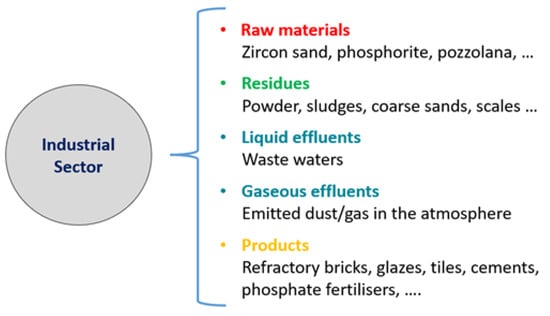
Figure 2.
Scheme of NORM matrices considered in the procedure for a certain industrial sector.
Once identified the matrix of interest, measurements of the relevant radionuclide activity concentration are carried out (step 3). In case of a raw material of natural origin, the secular equilibrium among radionuclides of the 238U and 232Th series can be expected. Otherwise, if the raw material has undergone previous industrial processes, the secular equilibrium of radionuclides is not guaranteed. Indeed, it is worthy to note that the chemical/physical characteristics of the industrial processes can determine the disequilibrium of decay chains and influence the activity concentration of single radionuclides (step 3).
Finally, in the step 4, the results of measurements are compared with relevant ELs, shown in Table 1 and Table 2.
Table 7 represents the general scheme to support the application of Phase 1; the table items must be specified case by case accounting for the particular industrial sector under analysis.
Table 7.
The general scheme to support Phase 1.
4.2.2. Phase 2
If the radiological content of radionuclides in solid matrices exceeds ELs in terms of activity concentration, the Phase 2 starts. Indeed, in this situation it is necessary to proceed with the assessment of doses to workers and members of the public to be compared with the relevant ELs in terms of effective dose. The four steps of Phase 2 are shown in Figure 3.
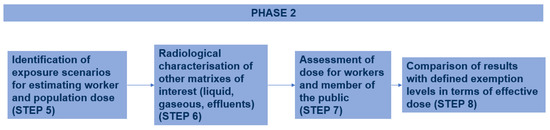
Figure 3.
Steps of Phase 2 of the general methodology.
The assessment of dose for members of the public requires to consider many different exposure scenarios and pathways, including those involving liquid and gaseous effluents (steps 5); it is worth noting that, for workers, the selection of the most significant exposure scenarios takes into account the entire industrial process. Therefore, depending on the industrial process, it might be necessary to extend identification and radiological characterization of additional matrices of interest (steps 6).
In step 7, the dose assessment for workers and members of the public is carried out, taking into account all information, data and measurement results gathered in the previous steps. Finally, in step 8, the estimated doses are compared with ELs.
Table 8 presents the general categories of the exposure scenarios relevant to workers and members of the public; this is a useful tool for the application of Phase 2, likewise Table 7 is a supporting tool for the application of Phase 1.
Table 8.
The general scheme to support Phase 2.
Specifically, Table 8 shows, for a generic industrial sector/practice involving NORM, the main categories of matrix of interest involved, and, for each of them, the possible significant exposure scenarios for workers and members of the public. It is worth noting that, limited to worker exposure, final products could be considered as matrix of concern since the finishing processes, or packaging or transport can be significant exposure scenarios.
In order to estimate the effective dose for workers, for each exposure scenario present in Table 8, Table 9 provide a detailed information to be gathered about matrices and the most relevant exposure pathways.
Table 9.
Exposure scenario for dose assessment of workers.
As regards the dose assessment for members of the public, the Table 10 plays the role covered by the Table 9 for workers. It is important to note that for this category of exposed individual effluents can give a significant contribution to dose, contrary to what happens for workers.
Table 10.
Exposure scenario for dose assessment of members of the public.
5. Conclusions and Perspectives
By adopting the graded approach, already recommended by ICRP publication 103, and endorsed by the EU-BSS and by the Italian legislation, a general methodology for characterizing the exposure scenarios relevant to NORM involving industries was developed. This methodology, made up of two phases each of which involves four consecutive steps, consists in a general approach which can be customized to fit a given industrial sector and/or scenario. In this paper some tables are presented as operational tools of the general methodology, in order to facilitate and coordinate an effective series of actions finalized to exempt or not a NORM involving industry. The application of the general methodology to some plants of different industrial sectors has been allowing the verification of its completeness and effectiveness. Results of these specific applications will be published in dedicated papers.
Author Contributions
Conceptualization, R.T., S.B., F.L., C.N. and F.T.; methodology, R.T., S.B., E.C., I.P., G.P., F.T., R.U. and G.V.; resources, S.B., C.N. and F.T.; data curation, G.L.V. and L.L.; formal analysis, M.A. and A.B.; investigation, G.L.V., F.L. and L.L.; validation, S.B., E.C., C.N., I.P., F.P., G.P., F.T., R.U. and G.V.; writing—original draft preparation, R.T., G.L.V., F.L. and L.L.; writing—review and editing, M.A., A.B., S.B., E.C., C.N., I.P., F.P., G.P., F.T., R.U., G.V. and M.P; visualization, R.T. and F.L.; supervision, R.T. and M.P.; project administration, R.T. and M.P.; funding acquisition, M.P. All authors have read and agreed to the published version of the manuscript.
Funding
This work was carried out with the financial support of INAIL—BRIC 2019 ID 30. “Protocolli operativi e metodologie di calcolo per l’attuazione della nuova normativa di radioprotezione, recepimento della direttiva 59/2013/EURATOM, in settori industriali NORM di particolare impatto radiologico”.
Institutional Review Board Statement
Not applicable.
Informed Consent Statement
Not applicable.
Data Availability Statement
Not applicable.
Acknowledgments
This work has been supported by the research project of the National Institute for Insurance against Accidents at Work (INAIL) titled “Interventions for the effective protection of workers in Naturally Occurring Radioactive Materials (NORM): implementation of an integrated system of technical-operational, training and information tools”.
Conflicts of Interest
The authors declare no conflict of interest. The funders had no role in the design of the study; in the collection, analyses, or interpretation of data; in the writing of the manuscript; or in the decision to publish the results.
References
- UNSCEAR. Exposures of the Public and Workers from Various Sources of Radiation (Annex B of Source and Effects of Ionizing Radiation-UNSCEAR 2008 Report Vol. I). 2010. Available online: https://www.unscear.org/unscear/en/publications/2008_1.html (accessed on 20 January 2023).
- IAEA. Radiation Protection and Safety of Radiation Sources: International Basic Safety Standards. No. GSR Part 3. IAEA Safety Standards. 2014. Available online: https://www-pub.iaea.org/MTCD/Publications/PDF/Pub1578_web-57265295.pdf (accessed on 20 January 2023).
- European Commission. Council Directive 2013/59/Euratom laying down basic safety standards for protection against the dangers arising from exposure to ionising radiation, and repealing Directives 89/618/Euratom, 90/641/Euratom, 96/29/Euratom, 97/43/Euratom and 2003/122/Euratom. Off. J. Eur. Union 2014, 13, 1–73. [Google Scholar]
- Lecomte, J.-F.; Shaw, P.; Liland, A.; Markkanen, M.; Egidi, P.; Andresz, S.; Mrdakovic-Popic, J.; Liu, F.; da Costa Lauria, D.; Okyar, H.B.; et al. ICRP Publication 142: Radiological protection from Naturally Occurring Radioactive Material (NORM) in industrial processes. Ann. ICRP 2019, 48, 5–67. [Google Scholar] [CrossRef]
- IAEA. Application of a Graded Approach in Regulating the Safety of Radiation Sources. IAEA-Tecdoc-1974. 2021. Available online: https://www-pub.iaea.org/MTCD/Publications/PDF/TE-1974web.pdf (accessed on 20 January 2023).
- IAEA. Management of Norm Residues. IAEA-Tecdoc-1712. 2013. Available online: https://www-pub.iaea.org/MTCD/Publications/PDF/TE-1712_web.pdf (accessed on 20 January 2023).
- IAEA. Occupational Radiation Protection. General Safety Guide No. GSG-7. 2018. Available online: https://www-pub.iaea.org/MTCD/Publications/PDF/PUB1785_web.pdf (accessed on 20 January 2023).
- IAEA. Radiation Protection and NORM Residues Management in the Zircon and Zirconia Industries. Safety Report Series 51. 2007. Available online: https://www-pub.iaea.org/MTCD/Publications/PDF/Pub1289_Web.pdf (accessed on 20 January 2023).
- IAEA. Radiation Protection and Management of NORM Residues in the Phosphate Industry. Safety Reports Series No. 78. 2013. Available online: https://www-pub.iaea.org/MTCD/Publications/PDF/Pub1582_web.pdf (accessed on 20 January 2023).
- IAEA. Radiation Protection and NORM Residue Management in the Titanium Dioxide and Related Industries. Safety Reports Series 76. 2012. Available online: https://www-pub.iaea.org/MTCD/Publications/PDF/Pub1568_web.pdf (accessed on 20 January 2023).
- IAEA. Assessing the Need for Radiation Protection Measures in Work Involving Minerals and Raw Materials. Safety Reports Series 49. 2006. Available online: https://www-pub.iaea.org/MTCD/Publications/PDF/Pub1257_web.pdf (accessed on 20 January 2023).
- IAEA. Radiation Protection and NORM Residue Management in the Production of Rare Earths from Thorium Containing Minerals. Safety Reports Series 68. 2011. Available online: https://www-pub.iaea.org/MTCD/Publications/PDF/Pub1512_web.pdf (accessed on 20 January 2023).
- European Commission. Establishment of Reference Levels for Regulatory Control of Workplaces Where Materials Are Processed Which Contain Enhanced Levels of Naturally-Occurring Radionuclides. Radiation Protection 107. 1999. Available online: https://op.europa.eu/en/publication-detail/-/publication/bcc40eea-c4b2-4cbe-97e9-585f641bf24f (accessed on 20 January 2023).
- European Commission. Effluent and Dose Control from European Union Norm Industries Assessment of Current Situation and Proposal for a Harmonised Community Approach. Radiation Protection 135. Volume 2, Appendices. 2003. Available online: https://op.europa.eu/en/publication-detail/-/publication/53947c50-26f2-11e6-86d0-01aa75ed71a1 (accessed on 20 January 2023).
- European Commission. Practical Use of the Concepts of Clearance and Exemption. Radiation Protection 122 Part II. 2002. Available online: https://energy.ec.europa.eu/system/files/2014-11/122_part2_0.pdf (accessed on 20 January 2023).
- Republica Italiana. Decreto Legislativo 101/2020; Gazzetta Ufficiale Della Repubblica Italiana: Rome, Italy, 2020. (In Italian) [Google Scholar]
- European Commission. Council Directive 96/29/Euratom of 13 May 1996 Laying Down Basic Safety Standards for the Protection of the Health of Workers and the General Public against the Dangers Arising from Ionizing Radiation. Off. J. Eur. Union 1996, 159, 1–114. [Google Scholar]
- HERCA. Application of the Concepts of Exemption and Clearance to the Regulation of Naturally Occurring Radioactive Materials (NORM) across HERCA Countries. 2021. Available online: https://www.herca.org/download/8328/ (accessed on 20 January 2023).
- UNSCEAR. UNSCEAR’s Global Survey of Radiation Exposure. Available online: https://www.survey.unscear.org/ (accessed on 20 January 2023).
- IAEA. ENVIRONET-IAEA Network of Environmental Management and Remediation. Available online: https://nucleus.iaea.org/sites/connect/environetpublic/SitePages/Home.aspx (accessed on 20 January 2023).
- Kallio, A.P.A.; Leikoski, N.; Pelkonen, M. Building the NORM-Inventory in Finland. In Proceedings of the Management of Naturally Occurring Radioactive Material (NORM) in Industry, Vienna, Austria, 18–30 October 2020. [Google Scholar]
- Vaasma, T.; Kiisk, T.; Leier, M.; Suursoo, S.; Jantsikene, A.; Putk, K. NORM-Related Industrial Activities in Estonia—Establishing National Norm Inventory. J. Sustain. Min. 2019, 18, 86–93. [Google Scholar] [CrossRef]
- Trotti, F.; Zampieri, C.; Caldognetto, E.; Tacconi, A.; Filipozzi, L.; Lanciai, M.; Clauser, G.; Facchinelli, M.; Desideri, D.; Gaidolfi, L. The Inventory and Radiological Impact of Naturally Occurring Radionuclides in Some Italian Non-Nuclear Industries. In Proceedings of the Naturally Occurring Radioactive Materials (NORM IV) Conference, Szczyrk, Poland, 17–21 May 2004; pp. 480–487. [Google Scholar]
- Organo, C.; Fenton, D. Radiological Assessment of Norm Industries in Ireland-Radiation Doses to Workers and Members of the Public. 2008. Available online: https://inis.iaea.org/collection/NCLCollectionStore/_Public/41/081/41081231.pdf (accessed on 20 January 2023).
- European Commission. Effluent and Dose Control from European Union Norm Industries Assessment of Current Situation and Proposal for a Harmonised Community Approach. Radiation Protection 135. Volume 1: Main Report. 2003. Available online: https://op.europa.eu/it/publication-detail/-/publication/99c70673-26f1-11e6-86d0-01aa75ed71a1 (accessed on 20 January 2023).
- Kulka, U.; Birschwilks, M.; Fevrier, L.; Madas, B.; Salomaa, S.; Froňka, A.; Perko, T.; Wojcik, A.; Železnik, N. Radonorm—Towards Effective Radiation Protection Based on Improved Scientific Evidence and Social Considerations—Focus on Radon and Norm. EPJ Nucl. Sci. Technol. 2022, 8, 38. [Google Scholar] [CrossRef]
- ICRP. The 2007 Recommendations of the International Commission on Radiological Protection. ICRP Publication 103. Ann. ICRP 2007, 37, 1–332. [Google Scholar]
- Cappai, M.; Gaidolfi, L.; Vitucci, L.; Pantalone, C. Censimento Attività/Siti con NORM e Raccolta delle Analisi di Rischio; 2014; Task 03.01.01. Available online: https://www.isinucleare.it/sites/default/files/contenuto_redazione_isin/censimento_attivita_siti_con_norm_e_raccolta_delle_analisi_di_rischio.pdf (accessed on 20 January 2023). (In Italian).
- Trotti, F.; Caldognetto, E.; Garavaglia, M.; Giovani, C.; Rusconi, R.; Chiaberto, E.; Serena, E.; Magnoni, M.; Bucci, S.; Peroni, I.; et al. Valutazione Di Impatti Radiologici Da Norm; Ministero dell’Ambiente e della Tutela del Territorio e del Mare: Rome, Italy, 2015; Task 03.02.01. Available online: https://www.isprambiente.gov.it/files/snpa/consiglio-federale/Task03.02.01ValutazioneimpattodaNORMRev.13.pdf (accessed on 20 January 2023). (In Italian)
- Trotti, F.; Liziero, F.; Zampieri, C.; De Zolt, S. Impact to Public and Environment of Norm Industries in Italy. Radiat. Prot. Dosim. 2009, 137, 310–313. [Google Scholar] [CrossRef]
- Trotti, F.; Zampieri, C.; Caldognetto, E.; Ocone, R.; Di Lullo, A.; Magro, L.; Jia, G.; Torri, G. A Study Concerning NORM in Integrated Steelworks. In Proceedings of the Naturally Occurring Radioactive Material (NORM V) Symposium, Seville, Spain, 19–22 March 2007; pp. 351–354. [Google Scholar]
Disclaimer/Publisher’s Note: The statements, opinions and data contained in all publications are solely those of the individual author(s) and contributor(s) and not of MDPI and/or the editor(s). MDPI and/or the editor(s) disclaim responsibility for any injury to people or property resulting from any ideas, methods, instructions or products referred to in the content. |
© 2023 by the authors. Licensee MDPI, Basel, Switzerland. This article is an open access article distributed under the terms and conditions of the Creative Commons Attribution (CC BY) license (https://creativecommons.org/licenses/by/4.0/).