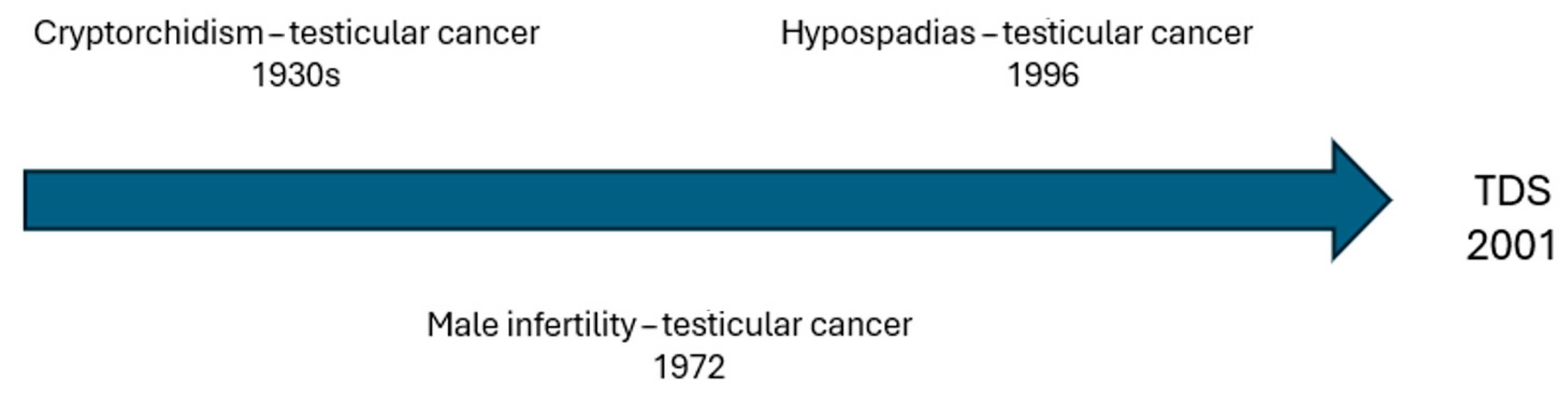
Genetic, Epigenetic, and Non-Genetic Factors in Testicular Dysgenesis Syndrome: A Narrative Review

 , , and
Abstract
1. Introduction
2. Materials and Methods
3. Genetic and Epigenetic Causes of TDS
3.1. Cryptorchidism
3.2. Hypospadias
3.3. Testicular Cancer
3.4. Male Infertility
4. Maternal and Fetal Factors Associated with TDS
4.1. Characteristics of Pregnancy
4.2. Birth Weight
4.3. Systemic Arterial Hypertension and Diabetes Mellitus
4.4. Maternal Weight and Physical Activity
4.5. Smoking Habit
4.6. Alcohol and Caffeine
4.7. Assisted Reproductive Technology
4.8. Drugs
4.9. Socioeconomic Status
5. Paternal Factors Associated with TDS
6. Endocrine-Disrupting Chemicals
6.1. Mechanism of Action
6.2. Evidence Regarding TDS
7. Shared Risk Factors Among TDS Components
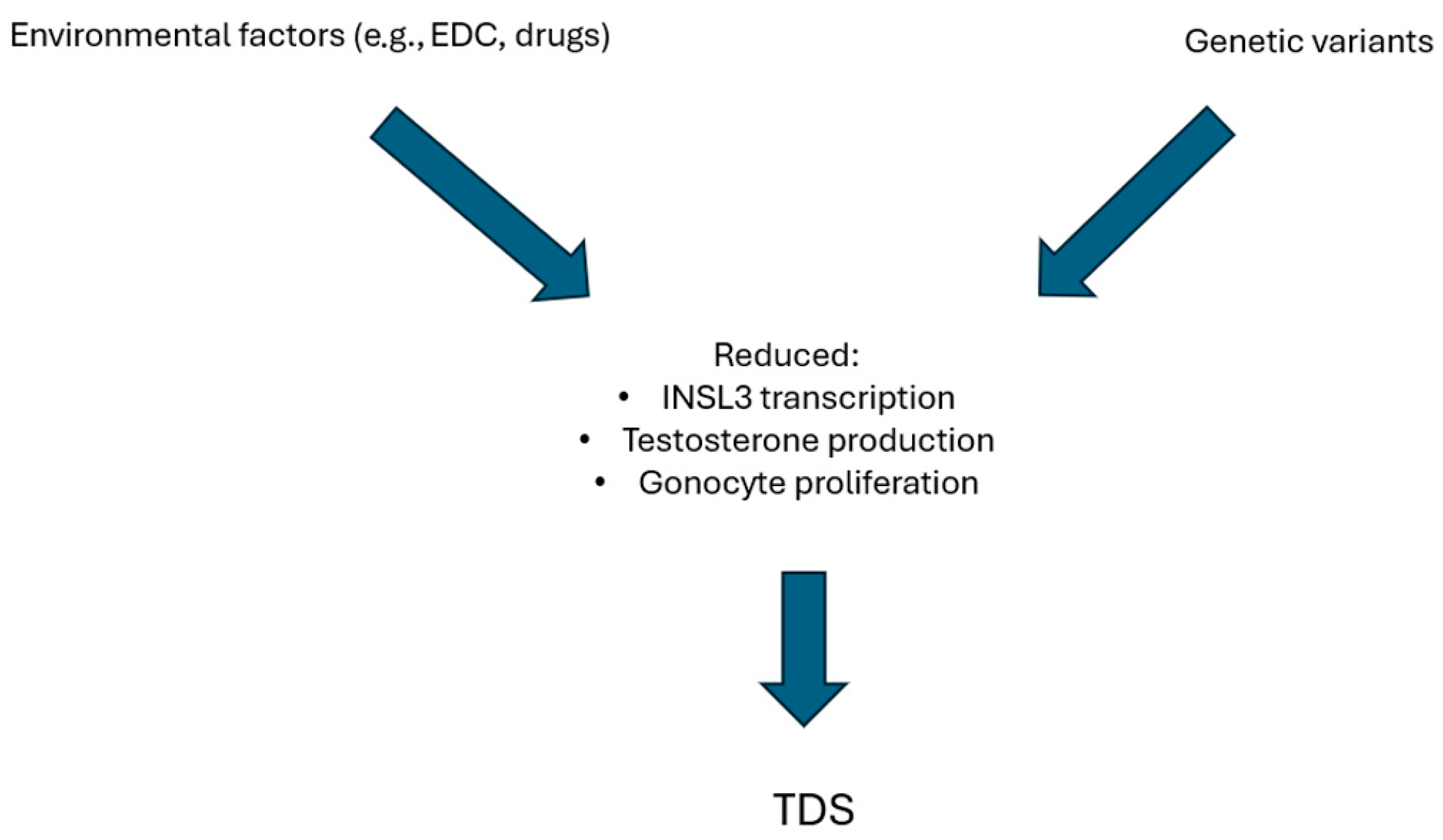
8. Possible Mechanistic Models of Synergic Effect of Environmental Factors and Genetic Background on Pathogenesis of TDS
9. Conclusions
Author Contributions
Funding
Institutional Review Board Statement
Informed Consent Statement
Data Availability Statement
Conflicts of Interest
Abbreviations
| TDS | Testicular dysgenesis syndrome |
| GCTs | Germ cells tumors |
| AGD | Anogenital distance |
| INSL3 | Insulin-like factor 3 |
| AR | Androgen receptor |
| EDCs | Endocrine-disrupting chemicals |
| DSDs | Disorders of sex development |
| KCTD13 | Potassium-channel-tetramerization-domain-containing-13 |
| GWAS | Genome-wide association studies |
| SF1 | Steroidogenic Factor 1 |
| DMRT1 | Doublesex and Mab-3 Related Transcription Factor 1 |
| SNP | Single Nucleotide Polimorphism |
| MPW | Male programming window |
| WES | Whole-exome sequencing |
| DHT | Dihydrotestosterone |
| DMRs | Differentially methylated regions |
| WHO | World Health Organization |
| GCNIS | Germ cell neoplasia in situ |
| CIS | Carcinoma-in situ |
| IGCNU | Intratubular germ cell neoplasia unclassified |
| TIN | Testicular intra-epithelial neoplasia |
| ASEX | Arizona Sexual Experiences Scale |
| SFRP1 | Secreted frizzled-related protein 1 |
| IGFBP6 | Insulin-like growth factor binding protein-6 |
| HDAC3 | Histone deacetylase 3 |
| DCN | Decorin |
| ESCs | Embryonic stem cells |
| HDP | Hypertensive disorders of pregnancy |
| LBW | Low birth weight |
| SGA | Small for gestational age |
| ROS | Reactive oxygen species |
| hCG | Human Chorionic Gonadotrophin |
| ART | Assisted Reproductive Technology |
| IVF | In Vitro Fertilization |
| ICSI | Intracytoplasmic Sperm Injection |
| NSAIDs | Non-Steroidal Anti-inflammatory Drugs |
| PFAS | Per- and polyfluoroalkyl Substances |
| PCBs | Polychlorinated biphenyls |
| BPA | Bisphenol A |
| ER | Estrogen receptor |
| DDT | Dichlorodiphenyltrichloroethane |
| DEHP/DBP | Di-2-ethylhexyl phthalate/dibutyl phthalate |
| LH | Luteinizing hormone |
| DES | Diethylstilbestrol |
| DINP | Diisononyl phthalate |
| PFOA | Perfluorooctanoic acid |
| PFOS | Perfluorooctanesulfonic acid |
References
- Thorup, J.; McLachlan, R.; Cortes, D.; Nation, T.R.; Balic, A.; Southwell, B.R.; Hutson, J.M. What Is New in Cryptorchidism and Hypospadias—A Critical Review on the Testicular Dysgenesis Hypothesis. J. Pediatr. Surg. 2010, 45, 2074–2086. [Google Scholar] [CrossRef]
- Xing, J.-S.; Bai, Z.-M. Is Testicular Dysgenesis Syndrome a Genetic, Endocrine, or Environmental Disease, or an Unexplained Reproductive Disorder? Life Sci. 2018, 194, 120–129. [Google Scholar] [CrossRef]
- Hua, X.-G.; Hu, R.; Hu, C.-Y.; Li, F.-L.; Jiang, W.; Zhang, X.-J. Associations between Hypospadias, Cryptorchidism and Anogenital Distance: Systematic Review and Meta-Analysis. Andrologia 2018, 50, e13152. [Google Scholar] [CrossRef]
- Chavarriaga, J.; Nappi, L.; Papachristofilou, A.; Conduit, C.; Hamilton, R.J. Testicular Cancer. Lancet 2025, 406, 76–90. [Google Scholar] [CrossRef] [PubMed]
- Skakkebæk, N.E. Abnormal Morphology of Germ Cells in Two Infertile Men. Acta Pathol. Microbiol. Scand. Sect. A Pathol. 1972, 80A, 374–378. [Google Scholar] [CrossRef]
- Prener, A.; Engholm, G.; Jensen, O.M. Genital Anomalies and Risk for Testicular Cancer in Danish Men. Epidemiology 1996, 7, 14–19. [Google Scholar] [CrossRef]
- Schnack, T.H.; Poulsen, G.; Myrup, C.; Wohlfahrt, J.; Melbye, M. Familial Coaggregation of Cryptorchidism, Hypospadias, and Testicular Germ Cell Cancer: A Nationwide Cohort Study. J. Natl. Cancer Inst. 2010, 102, 187–192. [Google Scholar] [CrossRef]
- Trabert, B.; Zugna, D.; Richiardi, L.; McGlynn, K.A.; Akre, O. Congenital Malformations and Testicular Germ Cell Tumors: Congenital Malformations and TGCT. Int. J. Cancer 2013, 133, 1900–1904. [Google Scholar] [CrossRef] [PubMed]
- Skakkebaek, N.; De Meyts, E.R.; Main, K.M. Testicular Dysgenesis Syndrome: An Increasingly Common Developmental Disorder with Environmental Aspects. APMIS 2001, 109, S22–S30. [Google Scholar] [CrossRef]
- Hughes, I.A. Consensus Statement on Management of Intersex Disorders. Arch. Dis. Child. 2005, 91, 554–563. [Google Scholar] [CrossRef]
- Jacobson, J.D.; Willig, L.K.; Gatti, J.; Strickland, J.; Egan, A.; Saunders, C.; Farrow, E.; Heckert, L.L. High Molecular Diagnosis Rate in Undermasculinized Males with Differences in Sex Development Using a Stepwise Approach. Endocrinology 2020, 161, bqz015. [Google Scholar] [CrossRef]
- Jorgensen, A.; Svingen, T.; Miles, H.; Chetty, T.; Stukenborg, J.-B.; Mitchell, R.T. Environmental Impacts on Male Reproductive Development: Lessons from Experimental Models. Horm. Res. Paediatr. 2023, 96, 190–206. [Google Scholar] [CrossRef]
- Eisenberg, M.L.; Hsieh, T.-C.; Pastuszak, A.W.; McIntyre, M.G.; Walters, R.C.; Lamb, D.J.; Lipshultz, L.I. The Relationship between Anogenital Distance and the Androgen Receptor CAG Repeat Length. Asian J. Androl. 2013, 15, 286–289. [Google Scholar] [CrossRef]
- Lawaetz, A.C.; Almstrup, K. Involvement of Epigenetic Modifiers in the Pathogenesis of Testicular Dysgenesis and Germ Cell Cancer. Biomol. Concepts 2015, 6, 219–227. [Google Scholar] [CrossRef]
- Virtanen, H.; Rajpertdemeyts, E.; Main, K.; Skakkebaek, N.; Toppari, J. Testicular Dysgenesis Syndrome and the Development and Occurrence of Male Reproductive Disorders. Toxicol. Appl. Pharmacol. 2005, 207, 501–505. [Google Scholar] [CrossRef]
- Allali, S.; Muller, J.-B.; Brauner, R.; Lourenço, D.; Boudjenah, R.; Karageorgou, V.; Trivin, C.; Lottmann, H.; Lortat-Jacob, S.; Nihoul-Fékété, C.; et al. Mutation Analysis of NR5A1 Encoding Steroidogenic Factor 1 in 77 Patients with 46, XY Disorders of Sex Development (DSD) Including Hypospadias. PLoS ONE 2011, 6, e24117. [Google Scholar] [CrossRef] [PubMed]
- Cai, Z.; Zhang, J.; Xiong, J.; Ma, C.; Yang, B.; Li, H. New Insights into the Potential Mechanisms of Spermatogenic Failure in Patients with Idiopathic Azoospermia. Mol. Human Reprod. 2020, 26, 469–484. [Google Scholar] [CrossRef]
- Wyrwoll, M.J.; Van Der Heijden, G.W.; Krausz, C.; Aston, K.I.; Kliesch, S.; McLachlan, R.; Ramos, L.; Conrad, D.F.; O’Bryan, M.K.; Veltman, J.A.; et al. Improved Phenotypic Classification of Male Infertility to Promote Discovery of Genetic Causes. Nat. Rev. Urol. 2024, 21, 91–101. [Google Scholar] [CrossRef] [PubMed]
- Toppari, J. Trends in the Incidence of Cryptorchidism and Hypospadias, and Methodological Limitations of Registry-Based Data. Hum. Reprod. Update 2001, 7, 282–286. [Google Scholar] [CrossRef] [PubMed]
- Bhartiya, D.; Kaushik, A. Testicular Stem Cell Dysfunction Due to Environmental Insults Could Be Responsible for Deteriorating Reproductive Health of Men. Reprod. Sci. 2021, 28, 649–658. [Google Scholar] [CrossRef]
- Stewart, M.K.; Mattiske, D.M.; Pask, A.J. Exogenous Oestrogen Impacts Cell Fate Decision in the Developing Gonads: A Potential Cause of Declining Human Reproductive Health. Int. J. Mol. Sci. 2020, 21, 8377. [Google Scholar] [CrossRef]
- Calivarathan, L.; Mathur, P.P. Effect of Endocrine Disruptors on Testicular Function. In Molecular Male Reproductive Medicine; Advances in Experimental Medicine and Biology; Cheng, C.Y., Sun, F., Eds.; Springer Nature: Cham, Switzerland, 2025; Volume 1469, pp. 115–125. ISBN 978-3-031-82989-5. [Google Scholar]
- Bergman, Å.; Heindel, J.; Jobling, S.; Kidd, K.; Zoeller, R.T. State-of-the-science of endocrine disrupting chemicals. Toxicol. Lett. 2012, 211, S3. [Google Scholar] [CrossRef]
- Sarath Josh, M.K.; Pradeep, S.; Adarsh, V.K.; Vijayalekshmi Amma, K.S.; Sudha Devi, R.; Balachandran, S.; Sreejith, M.N.; Abdul Jaleel, U.C.; Benjamin, S. In Silico Evidences for the Binding of Phthalates onto Human Estrogen Receptor α, β Subtypes and Human Estrogen-Related Receptor γ. Mol. Simul. 2014, 40, 408–417. [Google Scholar] [CrossRef]
- Luo, Q.; Liu, Z.; Yin, H.; Dang, Z.; Wu, P.; Zhu, N.; Lin, Z.; Liu, Y. Global Review of Phthalates in Edible Oil: An Emerging and Nonnegligible Exposure Source to Human. Sci. Total Environ. 2020, 704, 135369. [Google Scholar] [CrossRef]
- Ullah, S.; Ahmad, S.; Guo, X.; Ullah, S.; Ullah, S.; Nabi, G.; Wanghe, K. A Review of the Endocrine Disrupting Effects of Micro and Nano Plastic and Their Associated Chemicals in Mammals. Front. Endocrinol. 2023, 13, 1084236. [Google Scholar] [CrossRef]
- Lasaneya, A.; Saikia, Q.; Dutta, S.; Kalita, J.C. Impact of Endocrine Disruptors in Cosmetics on Reproductive Function in Males and Females. J. Environ. Sci. Health C 2025, 43, 184–207. [Google Scholar] [CrossRef] [PubMed]
- Nicolella, H.D.; De Assis, S. Epigenetic Inheritance: Intergenerational Effects of Pesticides and Other Endocrine Disruptors on Cancer Development. Int. J. Mol. Sci. 2022, 23, 4671. [Google Scholar] [CrossRef] [PubMed]
- Gonsioroski, A.; Mourikes, V.E.; Flaws, J.A. Endocrine Disruptors in Water and Their Effects on the Reproductive System. Int. J. Mol. Sci. 2020, 21, 1929. [Google Scholar] [CrossRef]
- Seli, D.A.; Taylor, H.S. The Impact of Air Pollution and Endocrine Disruptors on Reproduction and Assisted Reproduction. Curr. Opin. Obstet. Gynecol. 2023, 35, 210–215. [Google Scholar] [CrossRef]
- Li, X.; Wen, Z.; Wang, Y.; Mo, J.; Zhong, Y.; Ge, R.-S. Bisphenols and Leydig Cell Development and Function. Front. Endocrinol. 2020, 11, 447. [Google Scholar] [CrossRef] [PubMed]
- Romao, R.L.P.; Dodds, L.; Ashley-Martin, J.; Monnier, P.; Arbuckle, T.E. Prenatal Exposure to Phthalates and Male Reproductive System Development: Results from a Canadian Pregnancy Cohort Study. Reprod. Toxicol. 2020, 95, 11–18. [Google Scholar] [CrossRef]
- Mongraw-Chaffin, M.L.; Cohn, B.A.; Anglemyer, A.T.; Cohen, R.D.; Christianson, R.E. Maternal Smoking, Alcohol, and Coffee Use during Pregnancy and Son’s Risk of Testicular Cancer. Alcohol 2009, 43, 241–245. [Google Scholar] [CrossRef] [PubMed]
- Yang, L.; Wang, H.; Yang, L.; Zhao, M.; Guo, Y.; Bovet, P.; Xi, B. Maternal Cigarette Smoking before or during Pregnancy Increases the Risk of Birth Congenital Anomalies: A Population-Based Retrospective Cohort Study of 12 Million Mother-Infant Pairs. BMC Med. 2022, 20, 4. [Google Scholar] [CrossRef] [PubMed]
- Arendt, L.H.; Ramlau-Hansen, C.H.; Lindhard, M.S.; Henriksen, T.B.; Olsen, J.; Yu, Y.; Cnattingius, S. Maternal Overweight and Obesity and Genital Anomalies in Male Offspring: A Population-Based Swedish Cohort Study. Paediatr. Perinat. Epidemiol. 2017, 31, 317–327. [Google Scholar] [CrossRef]
- Levine, H.; Jørgensen, N.; Martino-Andrade, A.; Mendiola, J.; Weksler-Derri, D.; Jolles, M.; Pinotti, R.; Swan, S.H. Temporal Trends in Sperm Count: A Systematic Review and Meta-Regression Analysis of Samples Collected Globally in the 20th and 21st Centuries. Hum. Reprod. Update 2023, 29, 157–176. [Google Scholar] [CrossRef]
- Lokeshwar, S.D.; Patel, P.; Fantus, R.J.; Halpern, J.; Chang, C.; Kargi, A.Y.; Ramasamy, R. Decline in Serum Testosterone Levels Among Adolescent and Young Adult Men in the USA. Eur. Urol. Focus 2021, 7, 886–889. [Google Scholar] [CrossRef]
- Santi, D.; Spaggiari, G.; Furini, C.; Griseta, V.; Zizzi, E.A.; Granata, A.R.M.; Simoni, M. Temporal Trends in Serum Testosterone and Luteinizing Hormone Levels Indicate an Ongoing Resetting of Hypothalamic-Pituitary-Gonadal Function in Healthy Men: A Systematic Review. J. Endocrinol. Investig. 2025, 48, 2721–2734. [Google Scholar] [CrossRef]
- Tanaka, T.; Kojo, K.; Suetomi, T.; Nagumo, Y.; Midorikawa, H.; Matsuda, T.; Nakazono, A.; Shimizu, T.; Fujimoto, S.; Ikeda, A.; et al. Distinct Clusters of Testosterone Levels, Symptoms, and Serum Trace Elements in Young Men: A Cross-Sectional Analysis. Nutrients 2025, 17, 867. [Google Scholar] [CrossRef] [PubMed]
- Wdowiak, N.; Wójtowicz, K.; Wdowiak-Filip, A.; Pucek, W.; Wróbel, A.; Wróbel, J.; Wdowiak, A. Environmental Factors as the Main Hormonal Disruptors of Male Fertility. J. Clin. Med. 2024, 13, 1986. [Google Scholar] [CrossRef]
- Woodruff, T.J. Health Effects of Fossil Fuel–Derived Endocrine Disruptors. N. Engl. J. Med. 2024, 390, 922–933. [Google Scholar] [CrossRef]
- Mambrini, S.P.; Menichetti, F.; Ravella, S.; Pellizzari, M.; De Amicis, R.; Foppiani, A.; Battezzati, A.; Bertoli, S.; Leone, A. Ultra-Processed Food Consumption and Incidence of Obesity and Cardiometabolic Risk Factors in Adults: A Systematic Review of Prospective Studies. Nutrients 2023, 15, 2583. [Google Scholar] [CrossRef]
- Petre, G.; Francini-Pesenti, F.; De Toni, L.; Di Nisio, A.; Mingardi, A.; Cosci, I.; Passerin, N.; Ferlin, A.; Garolla, A. Role of Mediterranean Diet and Ultra-Processed Foods on Sperm Parameters: Data from a Cross-Sectional Study. Nutrients 2025, 17, 2066. [Google Scholar] [CrossRef] [PubMed]
- Ceretti, E.; Bonaccio, M.; Iacoviello, L.; Di Castelnuovo, A.; Ruggiero, E.; Donato, F.; Lorenzetti, S.; Zani, D.; Montano, L. Consumption of Ultra-Processed Foods and Semen Quality in Healthy Young Men Living in Italy. Nutrients 2024, 16, 4129. [Google Scholar] [CrossRef]
- Baethge, C.; Goldbeck-Wood, S.; Mertens, S. SANRA—A Scale for the Quality Assessment of Narrative Review Articles. Res. Integr. Peer Rev. 2019, 4, 5. [Google Scholar] [CrossRef]
- Kolon, T.F.; Herndon, C.D.A.; Baker, L.A.; Baskin, L.S.; Baxter, C.G.; Cheng, E.Y.; Diaz, M.; Lee, P.A.; Seashore, C.J.; Tasian, G.E.; et al. Evaluation and Treatment of Cryptorchidism: AUA Guideline. J. Urol. 2014, 192, 337–345. [Google Scholar] [CrossRef]
- Soerensen, R.R.; Johannsen, T.H.; Skakkebaek, N.E.; Rajpert-De Meyts, E. Leydig Cell Clustering and Reinke Crystal Distribution in Relation to Hormonal Function in Adult Patients with Testicular Dysgenesis Syndrome (TDS) Including Cryptorchidism. Hormones 2016, 15, 518–526. [Google Scholar] [CrossRef]
- Nistal, M.; Gonzalez-Peramato, P.; De Miguel, M.P. Sertoli Cell Dedifferentiation in Human Cryptorchidism and Gender Reassignment Shows Similarities between Fetal Environmental and Adult Medical Treatment Estrogen and Antiandrogen Exposure. Reprod. Toxicol. 2013, 42, 172–179. [Google Scholar] [CrossRef] [PubMed]
- Ivell, R.; Anand-Ivell, R. Biology of Insulin-like Factor 3 in Human Reproduction. Hum. Reprod. Update 2009, 15, 463–476. [Google Scholar] [CrossRef]
- Abou EL-Ella, S.S.; Tawfik, M.A.; Abd El-Aziz, T.F.; Shalaby, A.M.A.; Barseem, N.F. Correction to: The G178A Polymorphic Variant of INSL3 May Be Linked to Cryptorchidism among Egyptian Pediatric Cohort. Pediatr. Surg. Int. 2020, 36, 1395. [Google Scholar] [CrossRef]
- Fénichel, P.; Chevalier, N.; Lahlou, N.; Coquillard, P.; Wagner-Mahler, K.; Pugeat, M.; Panaïa-Ferrari, P.; Brucker-Davis, F. Endocrine Disrupting Chemicals Interfere with Leydig Cell Hormone Pathways During Testicular Descent in Idiopathic Cryptorchidism. Front. Endocrinol. 2018, 9, 786. [Google Scholar] [CrossRef]
- Ferlin, A.; Pepe, A.; Gianesello, L.; Garolla, A.; Feng, S.; Facciolli, A.; Morello, R.; Agoulnik, A.I.; Foresta, C. New Roles for INSL3 in Adults. Ann. N. Y. Acad. Sci. 2009, 1160, 215–218. [Google Scholar] [CrossRef]
- Jedidi, I.; Ouchari, M.; Yin, Q. Autosomal Single-Gene Disorders Involved in Human Infertility. Saudi J. Biol. Sci. 2018, 25, 881–887. [Google Scholar] [CrossRef]
- Seabra, C.M.; Quental, S.; Neto, A.P.; Carvalho, F.; Gonçalves, J.; Oliveira, J.P.; Fernandes, S.; Sousa, M.; Barros, A.; Amorim, A.; et al. A Novel Alu-Mediated Microdeletion at 11p13 Removes WT1 in a Patient with Cryptorchidism and Azoospermia. Reprod. Biomed. Online 2014, 29, 388–391. [Google Scholar] [CrossRef][Green Version]
- Tirabassi, G.; Corona, G.; Falzetti, S.; Delli Muti, N.; Maggi, M.; Balercia, G. Influence of Androgen Receptor Gene CAG and GGC Polymorphisms on Male Sexual Function: A Cross-Sectional Study. Int. J. Endocrinol. 2016, 2016, 5083569. [Google Scholar] [CrossRef]
- Seth, A.; Rivera, A.; Chahdi, A.; Choi, I.; Medina-Martinez, O.; Lewis, S.; O’Neill, M.; Ridgeway, A.; Moore, J.; Jorgez, C.; et al. Gene Dosage Changes in KCTD13 Result in Penile and Testicular Anomalies via Diminished Androgen Receptor Function. FASEB J. 2022, 36, e22567. [Google Scholar] [CrossRef] [PubMed]
- Hadziselimovic, F.; Verkauskas, G.; Stadler, M.B. Epigenetics, Cryptorchidism, and Infertility. Basic Clin. Androl. 2023, 33, 24. [Google Scholar] [CrossRef] [PubMed]
- Chen, H.; Guo, X.; Xiao, X.; Ye, L.; Huang, Y.; Lu, C.; Su, Z. Identification and Functional Characterization of microRNAs in Rat Leydig Cells during Development from the Progenitor to the Adult Stage. Mol. Cell. Endocrinol. 2019, 493, 110453. [Google Scholar] [CrossRef] [PubMed]
- Dujardin, E.; André, M.; Dewaele, A.; Mandon-Pépin, B.; Poulat, F.; Frambourg, A.; Thépot, D.; Jouneau, L.; Jolivet, G.; Pailhoux, E.; et al. DMRT1 Is a Testis-Determining Gene in Rabbits and Is Also Essential for Female Fertility. Elife 2023, 12, RP89284. [Google Scholar] [CrossRef]
- Zhou, B.; Tang, T.; Chen, P.; Pu, Y.; Ma, M.; Zhang, D.; Li, L.; Zhang, P.; Song, Y.; Zhang, L. The Variations in the AXIN1 Gene and Susceptibility to Cryptorchidism. J. Pediatr. Urol. 2015, 11, 132.e1–132.e5. [Google Scholar] [CrossRef]
- Hadziselimovic, F.; Hadziselimovic, N.O.; Demougin, P.; Oakeley, E.J. Decreased Expression of Genes Associated with Memory and X-Linked Mental Retardation in Boys with Non-Syndromic Cryptorchidism and High Infertility Risk. Mol. Syndromol. 2014, 5, 76–80. [Google Scholar] [CrossRef]
- Docampo, M.J.; Hadziselimovic, F. Molecular Pathology of Cryptorchidism-Induced Infertility. Sex. Dev. 2015, 9, 269–278. [Google Scholar] [CrossRef] [PubMed]
- Zhou, X.; Zhang, X.; Zhou, X.; Abulimiti, G.; Wang, Y.; Zhang, Q.; Cong, R.; Ji, C.; Luan, J.; Yao, L.; et al. Identification of Endocrine-Disrupting Chemicals Targeting the Genes and Pathways of Genital Anomalies in Males. Ecotoxicol. Environ. Saf. 2022, 247, 114241. [Google Scholar] [CrossRef]
- Holmboe, S.A.; Beck, A.L.; Andersson, A.-M.; Main, K.M.; Jørgensen, N.; Skakkebæk, N.E.; Priskorn, L. The Epidemiology of Cryptorchidism and Potential Risk Factors, Including Endocrine Disrupting Chemicals. Front. Endocrinol. 2024, 15, 1343887. [Google Scholar] [CrossRef] [PubMed]
- van der Horst, H.J.R.; de Wall, L.L. Hypospadias, All There Is to Know. Eur. J. Pediatr. 2017, 176, 435–441. [Google Scholar] [CrossRef]
- Dalgaard, M.D.; Weinhold, N.; Edsgärd, D.; Silver, J.D.; Pers, T.H.; Nielsen, J.E.; Jørgensen, N.; Juul, A.; Gerds, T.A.; Giwercman, A.; et al. A Genome-Wide Association Study of Men with Symptoms of Testicular Dysgenesis Syndrome and Its Network Biology Interpretation. J. Med. Genet. 2012, 49, 58–65. [Google Scholar] [CrossRef]
- Lavoie, C.; Chun, B.; Au, M.; Do, C.; Baker, Z.; Cortessis, V.; Sparks, S.S.; Syed, H.; Chang, A.Y. Comparing the Incidence of Hypospadias across the United States: A Contemporary Analysis. J. Pediatr. Urol. 2025, 21, 627–632. [Google Scholar] [CrossRef]
- Springer, A.; van den Heijkant, M.; Baumann, S. Worldwide Prevalence of Hypospadias. J. Pediatr. Urol. 2016, 12, 152.e1–152.e7. [Google Scholar] [CrossRef] [PubMed]
- Wood, D.; Wilcox, D. Hypospadias: Lessons Learned. An Overview of Incidence, Epidemiology, Surgery, Research, Complications, and Outcomes. Int. J. Impot. Res. 2023, 35, 61–66. [Google Scholar] [CrossRef]
- Sheriff, F.R.; Lopez, A.; Lupo, P.J.; Seth, A.; Jorgez, C.; Agopian, A.J. Maternal Hypertension and Hypospadias in Offspring: A Systematic Review and Meta-Analysis. Birth Defects Res. 2019, 111, 9–15. [Google Scholar] [CrossRef]
- van den Driesche, S.; Kilcoyne, K.R.; Wagner, I.; Rebourcet, D.; Boyle, A.; Mitchell, R.; McKinnell, C.; Macpherson, S.; Donat, R.; Shukla, C.J.; et al. Experimentally Induced Testicular Dysgenesis Syndrome Originates in the Masculinization Programming Window. JCI Insight 2017, 2, e91204. [Google Scholar] [CrossRef]
- Sharpe, R.M. Androgens and the Masculinization Programming Window: Human-Rodent Differences. Biochem. Soc. Trans. 2020, 48, 1725–1735. [Google Scholar] [CrossRef]
- Giagulli, V.A.; Carbone, M.D.; De Pergola, G.; Guastamacchia, E.; Resta, F.; Licchelli, B.; Sabbà, C.; Triggiani, V. Could Androgen Receptor Gene CAG Tract Polymorphism Affect Spermatogenesis in Men with Idiopathic Infertility? J. Assist. Reprod. Genet. 2014, 31, 689–697. [Google Scholar] [CrossRef] [PubMed]
- Xiao, F.; Lan, A.; Lin, Z.; Song, J.; Zhang, Y.; Li, J.; Gu, K.; Lv, B.; Zhao, D.; Zeng, S.; et al. Impact of CAG Repeat Length in the Androgen Receptor Gene on Male Infertility—A Meta-Analysis. Reprod. Biomed. Online 2016, 33, 39–49. [Google Scholar] [CrossRef]
- Parada-Bustamante, A.; Lardone, M.C.; Madariaga, M.; Johnson, M.C.; Codner, E.; Cassorla, F.; Castro, A. Androgen Receptor CAG and GGN Polymorphisms in Boys with Isolated Hypospadias. J. Pediatr. Endocrinol. Metab. 2012, 25, 157–162. [Google Scholar] [CrossRef]
- Huang, G.; Shan, W.; Zeng, L.; Huang, L. Androgen Receptor Gene CAG Repeat Polymorphism and Risk of Isolated Hypospadias: Results from a Meta-Analysis. Genet. Mol. Res. 2015, 14, 1580–1588. [Google Scholar] [CrossRef]
- Adamovic, T.; Nordenskjöld, A. The CAG Repeat Polymorphism in the Androgen Receptor Gene Modifies the Risk for Hypospadias in Caucasians. BMC Med. Genet. 2012, 13, 109. [Google Scholar] [CrossRef] [PubMed]
- Jørgensen, N.; Rajpert-De Meyts, E.; Main, K.M.; Skakkebaek, N.E. Testicular Dysgenesis Syndrome Comprises Some but Not All Cases of Hypospadias and Impaired Spermatogenesis. Int. J. Androl. 2010, 33, 298–303. [Google Scholar] [CrossRef]
- Luppino, G.; Wasniewska, M.; Coco, R.; Pepe, G.; Morabito, L.A.; Li Pomi, A.; Corica, D.; Aversa, T. Role of NR5A1 Gene Mutations in Disorders of Sex Development: Molecular and Clinical Features. Curr. Issues Mol. Biol. 2024, 46, 4519–4532. [Google Scholar] [CrossRef]
- Köhler, B.; Lin, L.; Mazen, I.; Cetindag, C.; Biebermann, H.; Akkurt, I.; Rossi, R.; Hiort, O.; Grüters, A.; Achermann, J.C. The Spectrum of Phenotypes Associated with Mutations in Steroidogenic Factor 1 (SF-1, NR5A1, Ad4BP) Includes Severe Penoscrotal Hypospadias in 46,XY Males without Adrenal Insufficiency. Eur. J. Endocrinol. 2009, 161, 237–242. [Google Scholar] [CrossRef]
- Joodi, M.; Amerizadeh, F.; Hassanian, S.M.; Erfani, M.; Ghayour-Mobarhan, M.; Ferns, G.A.; Khazaei, M.; Avan, A. The Genetic Factors Contributing to Hypospadias and Their Clinical Utility in Its Diagnosis. J. Cell. Physiol. 2019, 234, 5519–5523. [Google Scholar] [CrossRef]
- Köhler, B.; Biebermann, H.; Friedsam, V.; Gellermann, J.; Maier, R.F.; Pohl, M.; Wieacker, P.; Hiort, O.; Grüters, A.; Krude, H. Analysis of the Wilms’ Tumor Suppressor Gene (WT1) in Patients 46,XY Disorders of Sex Development. J. Clin. Endocrinol. Metab. 2011, 96, E1131–E1136. [Google Scholar] [CrossRef] [PubMed][Green Version]
- Bouty, A.; Ayers, K.L.; Pask, A.; Heloury, Y.; Sinclair, A.H. The Genetic and Environmental Factors Underlying Hypospadias. Sex. Dev. 2015, 9, 239–259. [Google Scholar] [CrossRef] [PubMed]
- Kalfa, N.; Gaspari, L.; Ollivier, M.; Philibert, P.; Bergougnoux, A.; Paris, F.; Sultan, C. Molecular Genetics of Hypospadias and Cryptorchidism Recent Developments. Clin. Genet. 2019, 95, 122–131. [Google Scholar] [CrossRef]
- Skakkebaek, N.E.; Rajpert-De Meyts, E.; Buck Louis, G.M.; Toppari, J.; Andersson, A.-M.; Eisenberg, M.L.; Jensen, T.K.; Jørgensen, N.; Swan, S.H.; Sapra, K.J.; et al. Male Reproductive Disorders and Fertility Trends: Influences of Environment and Genetic Susceptibility. Physiol. Rev. 2016, 96, 55–97. [Google Scholar] [CrossRef]
- Vottero, A.; Minari, R.; Viani, I.; Tassi, F.; Bonatti, F.; Neri, T.M.; Bertolini, L.; Bernasconi, S.; Ghizzoni, L. Evidence for Epigenetic Abnormalities of the Androgen Receptor Gene in Foreskin from Children with Hypospadias. J. Clin. Endocrinol. Metab. 2011, 96, E1953–E1962. [Google Scholar] [CrossRef] [PubMed][Green Version]
- Richard, M.A.; Sok, P.; Canon, S.; Nembhard, W.N.; Brown, A.L.; Peckham-Gregory, E.C.; Ton, M.; Ehli, E.A.; Kallsen, N.A.; Peyton, S.A.; et al. Altered Mechanisms of Genital Development Identified through Integration of DNA Methylation and Genomic Measures in Hypospadias. Sci. Rep. 2020, 10, 12715. [Google Scholar] [CrossRef]
- van Bever, Y.; Boers, R.G.; Brüggenwirth, H.T.; van IJcken, W.F.; Magielsen, F.J.; de Klein, A.; Boers, J.B.; Looijenga, L.H.; Brosens, E.; Gribnau, J.; et al. Genome-Wide Methylation Analysis in Patients with Proximal Hypospadias—A Pilot Study and Review of the Literature. Epigenetics 2024, 19, 2392048. [Google Scholar] [CrossRef]
- Yıldız, S.; Inanç, I.; Zhuri, D.; Atlı, E.; Avlan, D. The Possible Role of Epigenetics in the Etiology of Hypospadias. J. Pediatr. Urol. 2024, 20, 877–883. [Google Scholar] [CrossRef]
- Selvi, I.; Ozturk, E.; Yikilmaz, T.N.; Sarikaya, S.; Basar, H. Effects of Testicular Dysgenesis Syndrome Components on Testicular Germ Cell Tumor Prognosis and Oncological Outcomes. Int. Braz. J. Urol. 2020, 46, 725–740. [Google Scholar] [CrossRef]
- Demirci, A.; Başar, H. Effects of Epidemiological Risk Factors on Prognosis in Testicular Cancer. Int. Urol. Nephrol. 2022, 55, 51–59. [Google Scholar] [CrossRef] [PubMed]
- Znaor, A.; Skakkebæk, N.E.; Rajpert-De Meyts, E.; Laversanne, M.; Kuliš, T.; Gurney, J.; Sarfati, D.; McGlynn, K.A.; Bray, F. Testicular Cancer Incidence Predictions in Europe 2010–2035: A Rising Burden despite Population Ageing. Int. J. Cancer 2020, 147, 820–828. [Google Scholar] [CrossRef] [PubMed]
- Ruf, C.G.; Isbarn, H.; Wagner, W.; Fisch, M.; Matthies, C.; Dieckmann, K.-P. Changes in Epidemiologic Features of Testicular Germ Cell Cancer: Age at Diagnosis and Relative Frequency of Seminoma Are Constantly and Significantly Increasing. Urol. Oncol. 2014, 32, 33.e1–33.e6. [Google Scholar] [CrossRef] [PubMed]
- Kojo, K.; Kawai, K.; Kawahara, T.; Kimura, T.; Kandori, S.; Nagumo, Y.; Nitta, S.; Kojima, T.; Okuyama, A.; Higashi, T.; et al. Recent Malignant Testicular Tumor Trend in Japan, a Country with an Aging Population: A Large-Scale Study of 2012–2015 Hospital-Based Cancer Registry Data. Jpn. J. Clin. Oncol. 2020, 50, 1201–1208. [Google Scholar] [CrossRef]
- Smith, Z.L.; Werntz, R.P.; Eggener, S.E. Testicular Cancer. Med. Clin. N. Am. 2018, 102, 251–264. [Google Scholar] [CrossRef]
- Tateo, V.; Thompson, Z.J.; Gilbert, S.M.; Cortessis, V.K.; Daneshmand, S.; Masterson, T.A.; Feldman, D.R.; Pierorazio, P.M.; Prakash, G.; Heidenreich, A.; et al. Epidemiology and Risk Factors for Testicular Cancer: A Systematic Review. Eur. Urol. 2025, 87, 427–441. [Google Scholar] [CrossRef]
- Moch, H.; Amin, M.B.; Berney, D.M.; Compérat, E.M.; Gill, A.J.; Hartmann, A.; Menon, S.; Raspollini, M.R.; Rubin, M.A.; Srigley, J.R.; et al. The 2022 World Health Organization Classification of Tumours of the Urinary System and Male Genital Organs—Part A: Renal, Penile, and Testicular Tumours. Eur. Urol. 2022, 82, 458–468. [Google Scholar] [CrossRef]
- Skakkebæk, N. Possible Carcinoma-In-Situ of The Testis. Lancet 1972, 300, 516–517. [Google Scholar] [CrossRef]
- Berney, D.M.; Looijenga, L.H.J.; Idrees, M.; Oosterhuis, J.W.; Rajpert-De Meyts, E.; Ulbright, T.M.; Skakkebaek, N.E. Germ Cell Neoplasia in Situ (GCNIS): Evolution of the Current Nomenclature for Testicular Pre-invasive Germ Cell Malignancy. Histopathology 2016, 69, 7–10. [Google Scholar] [CrossRef] [PubMed]
- Jørgensen, A.; Lindhardt Johansen, M.; Juul, A.; Skakkebaek, N.E.; Main, K.M.; Rajpert-De Meyts, E. Pathogenesis of Germ Cell Neoplasia in Testicular Dysgenesis and Disorders of Sex Development. Semin. Cell Dev. Biol. 2015, 45, 124–137. [Google Scholar] [CrossRef]
- Kathrins, M.; Kolon, T.F. Malignancy in Disorders of Sex Development. Transl. Androl. Urol. 2016, 5, 794–798. [Google Scholar] [CrossRef]
- Hoei-Hansen, C.E. Identification of Genes Differentially Expressed in Testes Containing Carcinoma in Situ. Mol. Hum. Reprod. 2004, 10, 423–431. [Google Scholar] [CrossRef] [PubMed]
- Palmer, R.D.; Murray, M.J.; Saini, H.K.; Van Dongen, S.; Abreu-Goodger, C.; Muralidhar, B.; Pett, M.R.; Thornton, C.M.; Nicholson, J.C.; Enright, A.J.; et al. Malignant Germ Cell Tumors Display Common MicroRNA Profiles Resulting in Global Changes in Expression of Messenger RNA Targets. Cancer Res. 2010, 70, 2911–2923. [Google Scholar] [CrossRef]
- Skakkebæk, N.E.; Berthelsen, J.G.; Giwercman, A.; Müller, J. Carcinoma-in-situ of the Testis: Possible Origin from Gonocytes and Precursor of All Types of Germ Cell Tumours except Spermatocytoma. Int. J. Androl. 1987, 10, 19–28. [Google Scholar] [CrossRef]
- Almstrup, K.; Hoei-Hansen, C.E.; Wirkner, U.; Blake, J.; Schwager, C.; Ansorge, W.; Nielsen, J.E.; Skakkebæk, N.E.; Meyts, E.R.-D.; Leffers, H. Embryonic Stem Cell-Like Features of Testicular Carcinoma in Situ Revealed by Genome-Wide Gene Expression Profiling. Cancer Res. 2004, 64, 4736–4743. [Google Scholar] [CrossRef]
- Sonne, S.B.; Almstrup, K.; Dalgaard, M.; Juncker, A.S.; Edsgard, D.; Ruban, L.; Harrison, N.J.; Schwager, C.; Abdollahi, A.; Huber, P.E.; et al. Analysis of Gene Expression Profiles of Microdissected Cell Populations Indicates That Testicular Carcinoma In Situ Is an Arrested Gonocyte. Cancer Res. 2009, 69, 5241–5250. [Google Scholar] [CrossRef]
- Ottesen, A.M.; Skakkebæk, N.E.; Lundsteen, C.; Leffers, H.; Larsen, J.; Rajpert-De Meyts, E. High-resolution Comparative Genomic Hybridization Detects Extra Chromosome Arm 12p Material in Most Cases of Carcinoma in Situ Adjacent to Overt Germ Cell Tumors, but Not before the Invasive Tumor Development. Genes Chromosomes Cancer 2003, 38, 117–125. [Google Scholar] [CrossRef] [PubMed]
- Hoei-Hansen, C.E.; Holm, M.; Rajpert-De Meyts, E.; Skakkebaek, N.E. Histological Evidence of Testicular Dysgenesis in Contralateral Biopsies from 218 Patients with Testicular Germ Cell Cancer. J. Pathol. 2003, 200, 370–374. [Google Scholar] [CrossRef]
- O’Dowd, J.; Gaffney, E.F.; Young, R.H. Malignant Sex Cord–Stromal Tumour in a Patient with the Androgen Insensitivity Syndrome. Histopathology 1990, 16, 279–282. [Google Scholar] [CrossRef]
- Slowikowska-Hilczer, J.; Szarras-Czapnik, M.; Duranteau, L.; Rapp, M.; Walczak-Jedrzejowska, R.; Marchlewska, K.; Oszukowska, E.; Nordenstrom, A. Risk of Gonadal Neoplasia in Patients with Disorders/Differences of Sex Development. Cancer Epidemiol. 2020, 69, 101800. [Google Scholar] [CrossRef]
- Ferlin, A.; Calogero, A.E.; Krausz, C.; Lombardo, F.; Paoli, D.; Rago, R.; Scarica, C.; Simoni, M.; Foresta, C.; Rochira, V.; et al. Management of Male Factor Infertility: Position Statement from the Italian Society of Andrology and Sexual Medicine (SIAMS): Endorsing Organization: Italian Society of Embryology, Reproduction, and Research (SIERR). J. Endocrinol. Invest. 2022, 45, 1085–1113. [Google Scholar] [CrossRef]
- Tüttelmann, F.; Wyrwoll, M.J.; Steingröver, J.; Wieacker, P. The Genetics of Female and Male Infertility. Dtsch. Ärzteblatt Int. 2025, 122, 115–120. [Google Scholar] [CrossRef]
- Metin Mahmutoglu, A.; Hurre Dirie, S.; Hekim, N.; Gunes, S.; Asci, R.; Henkel, R. Polymorphisms of Androgens-related Genes and Idiopathic Male Infertility in Turkish Men. Andrologia 2022, 54, e14270. [Google Scholar] [CrossRef]
- Osadchuk, L.; Vasiliev, G.; Kleshchev, M.; Osadchuk, A. Androgen Receptor Gene CAG Repeat Length Varies and Affects Semen Quality in an Ethnic-Specific Fashion in Young Men from Russia. Int. J. Mol. Sci. 2022, 23, 10594. [Google Scholar] [CrossRef]
- Sharestani, S.; Mehdi Kalantar, S.; Ghasemi, N.; Farashahi Yazd, E. CAG Repeat Polymorphism in Androgen Receptor and Infertility: A Case-Control Study. Int. J. Reprod. BioMed. 2021, 19, 845–850. [Google Scholar] [CrossRef]
- Welsh, M.; Suzuki, H.; Yamada, G. The Masculinization Programming Window. In Endocrine Development; Hiort, O., Ahmed, S.F., Eds.; S. Karger AG: Basel, Switzerland, 2014; Volume 27, pp. 17–27. ISBN 978-3-318-02558-3. [Google Scholar]
- Moreno-Mendoza, D.; Casamonti, E.; Riera-Escamilla, A.; Pietroforte, S.; Corona, G.; Ruiz-Castañe, E.; Krausz, C. Short Anogenital Distance Is Associated with Testicular Germ Cell Tumour Development. Andrology 2020, 8, 1770–1778. [Google Scholar] [CrossRef] [PubMed]
- Eisenberg, M.L.; Shy, M.; Chanc Walters, R.; Lipshultz, L.I. The Relationship between Anogenital Distance and Azoospermia in Adult Men. Int. J. Androl. 2012, 35, 726–730. [Google Scholar] [CrossRef] [PubMed]
- Tsutida, C.A.; Veiga, A.C.B.; Martino-Andrade, A.J.; Andrade, D.P.D.; Mello, R.G.; Müller, J.C. Association between Late Manifestations of Testicular Dysgenesis Syndrome and Anogenital Distance: A Systematic Review and Meta-Analysis. J. Hum. Reprod. Sci. 2023, 16, 174–184. [Google Scholar] [CrossRef]
- Priskorn, L.; Kreiberg, M.; Bandak, M.; Lauritsen, J.; Daugaard, G.; Petersen, J.H.; Aksglaede, L.; Juul, A.; Jørgensen, N. Testicular Cancer Survivors Have Shorter Anogenital Distance That Is Not Increased by 1 Year of Testosterone Replacement Therapy. Hum. Reprod. 2021, 36, 2443–2451. [Google Scholar] [CrossRef] [PubMed]
- Uchida, M.; Iwamoto, T.; Yamasaki, K.; Kariya, F.; Konishi, S. The Ratio of 2nd to 4th Digit Length and Reproductive Function of Infertile Male Patients. Reprod. Med. Biol. 2023, 22, e12500. [Google Scholar] [CrossRef]
- Stephen, M.A.; Burke, C.R.; Steele, N.; Pryce, J.E.; Meier, S.; Amer, P.R.; Phyn, C.V.C.; Garrick, D.J. Genome-Wide Association Study of Anogenital Distance and Its (Co)Variances with Fertility in Growing and Lactating Holstein-Friesian Dairy Cattle. J. Dairy Sci. 2023, 106, 7846–7860. [Google Scholar] [CrossRef]
- Souali-Crespo, S.; Condrea, D.; Vernet, N.; Féret, B.; Klopfenstein, M.; Grandgirard, E.; Alunni, V.; Cerciat, M.; Jung, M.; Mayere, C.; et al. Loss of NR5A1 in Mouse Sertoli Cells after Sex Determination Changes Cellular Identity and Induces Cell Death by Anoikis. Development 2023, 150, dev201710. [Google Scholar] [CrossRef]
- Sathyanarayana, S.; Swan, S.H.; Farin, F.M.; Wilkerson, H.-W.; Bamshad, M.; Grady, R.; Zhou, C.; Schwartz, S.M. A Pilot Study of the Association between Genetic Polymorphisms Involved in Estrogen Signaling and Infant Male Genital Phenotypes. Asian J. Androl. 2012, 14, 766–772. [Google Scholar] [CrossRef]
- Ciarloni, A.; Delli Muti, N.; Ambo, N.; Perrone, M.; Rossi, S.; Sacco, S.; Salvio, G.; Balercia, G. Contribution of Androgen Receptor CAG Repeat Polymorphism to Human Reproduction. DNA 2025, 5, 9. [Google Scholar] [CrossRef]
- Ghadirkhomi, E.; Abdolhamid Angaji, S.; Khosravi, M.; Reza Mashayekhi, M. Association Study of Novel Single Nucleotide Polymorphisms of Androgen Receptor and Estrogen Receptor-α Genes with Male Infertility in Northwest of Iran: A Case-Control Study. Int. J. Reprod. BioMed. 2022, 20, 501–510. [Google Scholar] [CrossRef]
- Syryn, H.; Van De Velde, J.; De Clercq, G.; Verdin, H.; Dheedene, A.; Peelman, F.; Sinclair, A.; Ayers, K.L.; Bathgate, R.A.D.; Cools, M.; et al. Biallelic RXFP2 Variants Lead to Congenital Bilateral Cryptorchidism and Male Infertility, Supporting a Role of RXFP2 in Spermatogenesis. Hum. Reprod. 2024, 39, 2353–2363. [Google Scholar] [CrossRef] [PubMed]
- Huang, X.; Jia, J.; Sun, M.; Li, M.; Liu, N. Mutational Screening of the INSL3 Gene in Azoospermic Males with a History of Cryptorchidism. Andrologia 2016, 48, 835–839. [Google Scholar] [CrossRef] [PubMed]
- Dicke, A.-K.; Albrethsen, J.; Hoare, B.L.; Wyrwoll, M.J.; Busch, A.S.; Fietz, D.; Pilatz, A.; Bühlmann, C.; Juul, A.; Kliesch, S.; et al. Bi-Allelic Variants in INSL3 and RXFP2 Cause Bilateral Cryptorchidism and Male Infertility. Hum. Reprod. 2023, 38, 1412–1423. [Google Scholar] [CrossRef]
- Fabbri-Scallet, H.; Sousa, L.M.; Maciel-Guerra, A.T.; Guerra-Júnior, G.; Mello, M.P. Mutation Update for the NR5A1 Gene Involved in DSD and Infertility. Hum. Mutat. 2020, 41, 58–68. [Google Scholar] [CrossRef]
- Behvarz, M.; Rahmani, S.A.; Siasi Torbati, E.; Danaei Mehrabad, S.; Bikhof Torbati, M. Correlación entre el polimorfismo de los genes LHCGR y NR5A1y el riesgo de infertilidad masculina. Actas Urológicas Españolas 2024, 48, 246–253. [Google Scholar] [CrossRef]
- Saucedo, L.; Rumpel, R.; Sobarzo, C.; Schreiner, D.; Brandes, G.; Lustig, L.; Vazquez-Levin, M.H.; Grothe, C.; Marín-Briggiler, C. Deficiency of Fibroblast Growth Factor 2 (FGF-2) Leads to Abnormal Spermatogenesis and Altered Sperm Physiology. J. Cell. Physiol. 2018, 233, 9640–9651. [Google Scholar] [CrossRef]
- Hadziselimovic, F.; Verkauskas, G.; Stadler, M. A Novel Role for CFTR Interaction with LH and FGF in Azoospermia and Epididymal Maldevelopment Caused by Cryptorchidism. Basic Clin. Androl. 2022, 32, 10. [Google Scholar] [CrossRef]
- McCallie, B.R.; Parks, J.C.; Griffin, D.K.; Schoolcraft, W.B.; Katz-Jaffe, M.G. Infertility Diagnosis Has a Significant Impact on the Transcriptome of Developing Blastocysts. MHR Basic Sci. Reprod. Med. 2017, 23, 549–556. [Google Scholar] [CrossRef] [PubMed]
- Mehta, P.; Singh, P.; Gupta, N.J.; Sankhwar, S.N.; Chakravarty, B.; Thangaraj, K.; Rajender, S. Mutations in the Desert Hedgehog (DHH) Gene in the Disorders of Sexual Differentiation and Male Infertility. J. Assist. Reprod. Genet. 2021, 38, 1871–1878. [Google Scholar] [CrossRef]
- Zhang, M.-F.; Wan, S.-C.; Chen, W.-B.; Yang, D.-H.; Liu, W.-Q.; Li, B.-L.; Aierken, A.; Du, X.-M.; Li, Y.-X.; Wu, W.-P.; et al. Transcription Factor Dmrt1 Triggers the SPRY1-NF-κB Pathway to Maintain Testicular Immune Homeostasis and Male Fertility. Zool. Res. 2023, 44, 505–521. [Google Scholar] [CrossRef]
- Li, Z.; Zhuang, X.; Zeng, J.; Tzeng, C.-M. Integrated Analysis of DNA Methylation and mRNA Expression Profiles to Identify Key Genes in Severe Oligozoospermia. Front. Physiol. 2017, 8, 261. [Google Scholar] [CrossRef]
- Zhang, X.; Zhang, T.-J.; Liu, W.; Ning, Y.-N.; Bian, Y.-H.; Cao, Y.-Z.; Liu, H.-B.; Ma, J.-L.; Zhang, H.-B. Mutational Analysis of the GATA4 Gene in Chinese Men with Nonobstructive Azoospermia. Asian J. Androl. 2021, 23, 205–210. [Google Scholar] [CrossRef]
- Jin, C.; Zhang, Y.; Wang, Z.-P.; Wang, X.-X.; Sun, T.-C.; Li, X.-Y.; Tang, J.-X.; Cheng, J.-M.; Li, J.; Chen, S.-R.; et al. EZH2 Deletion Promotes Spermatogonial Differentiation and Apoptosis. Reproduction 2017, 154, 615–625. [Google Scholar] [CrossRef]
- Cardoso, H.J.; Figueira, M.I.; Correia, S.; Vaz, C.V.; Socorro, S. The SCF/c-KIT System in the Male: Survival Strategies in Fertility and Cancer: SCF/c-KIT System in Male Fertility and Cancer. Mol. Reprod. Dev. 2014, 81, 1064–1079. [Google Scholar] [CrossRef]
- Wang, X.; Lin, D.-H.; Yan, Y.; Wang, A.-H.; Liao, J.; Meng, Q.; Yang, W.-Q.; Zuo, H.; Hua, M.-M.; Zhang, F.; et al. The PIWI-Specific Insertion Module Helps Load Longer piRNAs for Translational Activation Essential for Male Fertility. Sci. China Life Sci. 2023, 66, 1459–1481. [Google Scholar] [CrossRef]
- Alankarage, D.; Lavery, R.; Svingen, T.; Kelly, S.; Ludbrook, L.; Bagheri-Fam, S.; Koopman, P.; Harley, V. SOX9 Regulates Expression of the Male Fertility Gene Ets Variant Factor 5 (ETV5) during Mammalian Sex Development. Int. J. Biochem. Cell Biol. 2016, 79, 41–51. [Google Scholar] [CrossRef] [PubMed]
- Roshan, M.M.; Azizi, H.; Majelan, M.A.; Tabar, A.N. Sox9 Downregulation in Non-Obstructive Azoospermia by UTF1 and Mediator Role of POU5F1. BMC Res. Notes 2024, 17, 77. [Google Scholar] [CrossRef]
- Basu, S.; Arya, S.P.; Usmani, A.; Pradhan, B.S.; Sarkar, R.K.; Ganguli, N.; Shukla, M.; Mandal, K.; Singh, S.; Sarda, K.; et al. Defective Wnt3 Expression by Testicular Sertoli Cells Compromise Male Fertility. Cell Tissue Res. 2018, 371, 351–363. [Google Scholar] [CrossRef]
- Xu, J.; Jiang, L.; Yu, W.; Guo, H.; Zhang, H.; Wei, D.; Liang, L.; Feng, K.; Song, X.; Liu, Q.; et al. A Novel Functional Variant in Wilms’ Tumor 1 (WT1) Is Associated with Idiopathic Non-obstructive Azoospermia. Mol. Reprod. Dev. 2017, 84, 222–228. [Google Scholar] [CrossRef]
- Sharifi, N.; Boroujeni, P.B.; Haratian, K.; Sabbaghian, M.; Meybodi, A.M. WT1 Pathogenic Variant in Azoospermic Infertile Men with an Isolated Undescended Testis. Clin. Exp. Reprod. Med. 2025, 52, 394–400. [Google Scholar] [CrossRef] [PubMed]
- Zakaria, M.; Azab, S.; El Baz, M.; Fawaz, L.; Bahagat, A. Cryptorchidism in Egyptian Neonates. J. Pediatr. Urol. 2013, 9, 815–819. [Google Scholar] [CrossRef]
- Mavrogenis, S.; Urban, R.; Czeizel, A.E.; Ács, N. Possible Association of Maternal Factors with the Higher Risk of Isolated True Undescended Testis: A Population-based Case-control Study. Congenit. Anom. 2014, 54, 178–183. [Google Scholar] [CrossRef] [PubMed]
- Møller, H.; Skakkebæk, N.E. Testicular Cancer and Cryptorchidism in Relation to Prenatal Factors: Case-Control Studies in Denmark. Cancer Causes Control 1997, 8, 904–912. [Google Scholar] [CrossRef]
- Aschim, E.L.; Haugen, T.B.; Tretli, S.; Daltveit, A.K.; Grotmol, T. Risk Factors for Hypospadias in Norwegian Boys—Association with Testicular Dysgenesis Syndrome? Int. J. Androl. 2004, 27, 213–221. [Google Scholar] [CrossRef] [PubMed]
- Wang, Y.; Wang, L.; Yang, Z.; Chen, F.; Liu, Z.; Tang, Z. Association between Perinatal Factors and Hypospadias in Newborns: A Retrospective Case–Control Study of 42,244 Male Infants. BMC Pregnancy Childbirth 2022, 22, 579. [Google Scholar] [CrossRef]
- Westergaard, T.; Andersen, P.K.; Pedersen, J.B.; Frisch, M.; Olsen, J.H.; Melbye, M. Testicular Cancer Risk and Maternal Parity: A Population-Based Cohort Study. Br. J. Cancer 1998, 77, 1180–1185. [Google Scholar] [CrossRef]
- Hjertkvist, M.; Damber, J.E.; Bergh, A. Cryptorchidism: A Registry Based Study in Sweden on Some Factors of Possible Aetiological Importance. J. Epidemiol. Community Health 1989, 43, 324–329. [Google Scholar] [CrossRef]
- Cook, M.B.; Akre, O.; Forman, D.; Madigan, M.P.; Richiardi, L.; McGlynn, K.A. A Systematic Review and Meta-Analysis of Perinatal Variables in Relation to the Risk of Testicular Cancer—Experiences of the Mother. Int. J. Epidemiol. 2009, 38, 1532–1542. [Google Scholar] [CrossRef]
- Nijsten, K.; Jansen, L.A.W.; Limpens, J.; Finken, M.J.J.; Koot, M.H.; Grooten, I.J.; Roseboom, T.J.; Painter, R.C. Long-Term Health Outcomes of Children Born to Mothers with Hyperemesis Gravidarum: A Systematic Review and Meta-Analysis. Am. J. Obstet. Gynecol. 2022, 227, 414–429.e17. [Google Scholar] [CrossRef] [PubMed]
- Sijstermans, K.; Hack, W.W.M.; Meijer, R.W.; Voort-Doedens, L.M.V.D. The Frequency of Undescended Testis from Birth to Adulthood: A Review. Int. J. Androl. 2008, 31, 1–11. [Google Scholar] [CrossRef]
- Zhang, T.-N.; Huang, X.-M.; Zhao, X.-Y.; Wang, W.; Wen, R.; Gao, S.-Y. Risks of Specific Congenital Anomalies in Offspring of Women with Diabetes: A Systematic Review and Meta-Analysis of Population-Based Studies Including over 80 Million Births. PLoS Med. 2022, 19, e1003900. [Google Scholar] [CrossRef]
- Arendt, L.H.; Lindhard, M.S.; Henriksen, T.B.; Olsen, J.; Cnattingius, S.; Petersson, G.; Parner, E.T.; Ramlau-Hansen, C.H. Maternal Diabetes Mellitus and Genital Anomalies in Male Offspring: A Nationwide Cohort Study in 2 Nordic Countries. Epidemiology 2018, 29, 280–289. [Google Scholar] [CrossRef]
- Virtanen, H.E.; Tapanainen, A.E.; Kaleva, M.M.; Suomi, A.-M.; Main, K.M.; Skakkebaek, N.E.; Toppari, J. Mild Gestational Diabetes as a Risk Factor for Congenital Cryptorchidism. J. Clin. Endocrinol. Metab. 2006, 91, 4862–4865. [Google Scholar] [CrossRef][Green Version]
- Wu, Y.; Liu, B.; Sun, Y.; Du, Y.; Santillan, M.K.; Santillan, D.A.; Snetselaar, L.G.; Bao, W. Association of Maternal Prepregnancy Diabetes and Gestational Diabetes Mellitus with Congenital Anomalies of the Newborn. Diabetes Care 2020, 43, 2983–2990. [Google Scholar] [CrossRef] [PubMed]
- Zhang, L.; Wang, X.-H.; Zheng, X.-M.; Liu, T.-Z.; Zhang, W.-B.; Zheng, H.; Chen, M.-F. Maternal Gestational Smoking, Diabetes, Alcohol Drinking, Pre-Pregnancy Obesity and the Risk of Cryptorchidism: A Systematic Review and Meta-Analysis of Observational Studies. PLoS ONE 2015, 10, e0119006. [Google Scholar] [CrossRef] [PubMed]
- Adams, S.V.; Hastert, T.A.; Huang, Y.; Starr, J.R. No Association between Maternal Pre-Pregnancy Obesity and Risk of Hypospadias or Cryptorchidism in Male Newborns. Birth Defects Res. A Clin. Mol. Teratol. 2011, 91, 241–248. [Google Scholar] [CrossRef]
- Waller, D.K. Prepregnancy Obesity as a Risk Factor for Structural Birth Defects. Arch. Pediatr. Adolesc. Med. 2007, 161, 745. [Google Scholar] [CrossRef]
- Indriasari, V.; Diposarosa, R.; Syukriani, Y.F.; Rachmadi, D. Nongenetic Risk Factors of Severe Hypospadias: A Case–Control Study. J. Indian Assoc. Pediatr. Surg. 2024, 29, 488–491. [Google Scholar] [CrossRef]
- Carmichael, S.L.; Rasmussen, S.A.; Shaw, G.M. Prepregnancy Obesity: A Complex Risk Factor for Selected Birth Defects. Birth Defects Res. 2010, 88, 804–810. [Google Scholar] [CrossRef]
- Wang, Z.; Niu, J.; Ji, H.; Miao, M.; Yang, L.; Chen, X.; Li, X.; Song, X.; Chen, A.; Liang, H.; et al. Association of Pre-Pregnancy Body Mass Index and Gestational Weight Gain with Neonatal Anogenital Distance in a Chinese Birth Cohort. Reprod. Health 2022, 19, 152. [Google Scholar] [CrossRef]
- North, K.; Golding, J. The Alspac Study Team a Maternal Vegetarian Diet in Pregnancy is Associated with Hypospadias. BJU Int. 2000, 85, 107–113. [Google Scholar] [CrossRef]
- Carmichael, S.L.; Ma, C.; Feldkamp, M.L.; Munger, R.G.; Olney, R.S.; Botto, L.D.; Shaw, G.M.; Correa, A. Nutritional Factors and Hypospadias Risks. Paediatr. Perinat. Epidemiol. 2012, 26, 353–360. [Google Scholar] [CrossRef]
- Evenson, K.R.; Mowla, S.; Olshan, A.F.; Shaw, G.M.; Ailes, E.C.; Reefhuis, J.; Joshi, N.; Desrosiers, T.A.; The National Birth Defects Prevention Study and Birth Defects Study to Evaluate Pregnancy exposureS. Maternal Physical Activity, Sitting, and Risk of Non-Cardiac Birth Defects. Pediatr. Res. 2024, 95, 334–341. [Google Scholar] [CrossRef] [PubMed]
- Ye, Z.-H.; Chen, H.-S.; Zhang, Z.-C.; Wang, X.; Liu, X.; Wei, G.-H. Parental Smoking and Risk of Hypospadias: An Updated Meta-Analysis of Observational Studies. Front. Pediatr. 2023, 11, 1003037. [Google Scholar] [CrossRef] [PubMed]
- Hackshaw, A.; Rodeck, C.; Boniface, S. Maternal Smoking in Pregnancy and Birth Defects: A Systematic Review Based on 173 687 Malformed Cases and 11.7 Million Controls. Hum. Reprod. Update 2011, 17, 589–604. [Google Scholar] [CrossRef]
- Yu, C.; Wei, Y.; Tang, X.; Liu, B.; Shen, L.; Long, C.; Lin, T.; He, D.; Wu, S.; Wei, G. Correction to: Maternal Smoking during Pregnancy and Risk of Cryptorchidism: A Systematic Review and Meta-Analysis. Eur. J. Pediatr. 2019, 178, 299–300. [Google Scholar] [CrossRef] [PubMed]
- Jensen, M.S.; Toft, G.; Thulstrup, A.M.; Bonde, J.P.; Olsen, J. Cryptorchidism According to Maternal Gestational Smoking. Epidemiology 2007, 18, 220–225. [Google Scholar] [CrossRef]
- Lindbo, D.; Arendt, L.H.; Ernst, A.; Lunddorf, L.L.H.; Brix, N.; Ramlau-Hansen, C.H. Maternal Cigarette Smoking During Pregnancy and Genital Anomalies in Boys: A Register-Based Cohort and Sibling-Matched Design Study. Clin. Epidemiol. 2022, 14, 901–910. [Google Scholar] [CrossRef]
- Carmichael, S.L.; Shaw, G.M.; Laurent, C.; Lammer, E.J.; Olney, R.S.; The National Birth Defects Prevention Study. Hypospadias and Maternal Exposures to Cigarette Smoke. Paediatr. Perinat. Epidemiol. 2005, 19, 406–412. [Google Scholar] [CrossRef]
- Akre, O.; Boyd, H.A.; Ahlgren, M.; Wilbrand, K.; Westergaard, T.; Hjalgrim, H.; Nordenskjöld, A.; Ekbom, A.; Melbye, M. Maternal and Gestational Risk Factors for Hypospadias. Environ. Health Perspect. 2008, 116, 1071–1076. [Google Scholar] [CrossRef]
- Kjersgaard, C.; Arendt, L.H.; Ernst, A.; Lindhard, M.S.; Olsen, J.; Henriksen, T.B.; Strandberg-Larsen, K.; Ramlau-Hansen, C.H. Lifestyle in Pregnancy and Cryptorchidism in Sons: A Study within Two Large Danish Birth Cohorts. Clin. Epidemiol. 2018, 10, 311–322. [Google Scholar] [CrossRef] [PubMed]
- Tuomisto, J.; Holl, K.; Rantakokko, P.; Koskela, P.; Hallmans, G.; Wadell, G.; Stattin, P.; Dillner, J.; Ogmundsdottir, H.M.; Vartiainen, T.; et al. Maternal Smoking during Pregnancy and Testicular Cancer in the Sons: A Nested Case-Control Study and a Meta-Analysis. Eur. J. Cancer 2009, 45, 1640–1648. [Google Scholar] [CrossRef] [PubMed]
- Zhang, Z.; Liu, X.; Wei, C.; Luo, J.; Shi, Y.; Lin, T.; He, D.; Wei, G. Assisted Reproductive Technologies and the Risk of Congenital Urogenital Tract Malformations: A Systematic Review and Meta-Analysis. J. Pediatr. Urol. 2021, 17, 9–20. [Google Scholar] [CrossRef]
- Bang, J.K.; Lyu, S.W.; Choi, J.; Lee, D.R.; Yoon, T.K.; Song, S.-H. Does Infertility Treatment Increase Male Reproductive Tract Disorder? Urology 2013, 81, 644–648. [Google Scholar] [CrossRef] [PubMed]
- Lind, D.V.; Main, K.M.; Kyhl, H.B.; Kristensen, D.M.; Toppari, J.; Andersen, H.R.; Andersen, M.S.; Skakkebæk, N.E.; Jensen, T.K. Maternal Use of Mild Analgesics during Pregnancy Associated with Reduced Anogenital Distance in Sons: A Cohort Study of 1027 Mother-Child Pairs. Hum. Reprod. 2017, 32, 223–231. [Google Scholar] [CrossRef]
- Navarro-Lafuente, F.; Arense-Gonzalo, J.; Adoamnei, E.; Prieto-Sánchez, M.; Sánchez-Ferrer, M.; García-Marcos, L.; Morales, E.; Mendiola, J.; Torres-Cantero, A.; The NELA Study Group. Is Maternal Use of Paracetamol during Pregnancy Associated with Anogenital Distance in Male Newborns? The Results from the NELA Birth Cohort. Int. J. Environ. Res. Public Health 2021, 18, 6338. [Google Scholar] [CrossRef]
- Hoeltzenbein, M.; Stieler, K.; Panse, M.; Wacker, E.; Schaefer, C. Allopurinol Use during Pregnancy—Outcome of 31 Prospectively Ascertained Cases and a Phenotype Possibly Indicative for Teratogenicity. PLoS ONE 2013, 8, e66637. [Google Scholar] [CrossRef]
- Kozenko, M.; Grynspan, D.; Oluyomi-Obi, T.; Sitar, D.; Elliott, A.M.; Chodirker, B.N. Potential Teratogenic Effects of Allopurinol: A Case Report. Am. J. Med. Genet. A 2011, 155, 2247–2252. [Google Scholar] [CrossRef]
- Veroniki, A.A.; Cogo, E.; Rios, P.; Straus, S.E.; Finkelstein, Y.; Kealey, R.; Reynen, E.; Soobiah, C.; Thavorn, K.; Hutton, B.; et al. Comparative Safety of Anti-Epileptic Drugs during Pregnancy: A Systematic Review and Network Meta-Analysis of Congenital Malformations and Prenatal Outcomes. BMC Med. 2017, 15, 95. [Google Scholar] [CrossRef]
- Wu, Y.; Yao, J.; Xu, L.; Chen, M.; Wan, L. Risk of Congenital Malformations in Offspring of Women Using Β-blockers during Early Pregnancy: An Updated Meta-analysis of Observational Studies. Br. J. Clin. Pharmacol. 2021, 87, 806–815. [Google Scholar] [CrossRef] [PubMed]
- Yakoob, M.Y.; Bateman, B.T.; Ho, E.; Hernandez-Diaz, S.; Franklin, J.M.; Goodman, J.E.; Hoban, R.A. The Risk of Congenital Malformations Associated with Exposure to β-Blockers Early in Pregnancy: A Meta-Analysis. Hypertension 2013, 62, 375–381. [Google Scholar] [CrossRef]
- Keskin-Arslan, E.; Erol, H.; Uysal, N.; Karadas, B.; Temiz, T.; Kaplan, Y.C. Pregnancy Outcomes Following Maternal Macrolide Use: A Systematic Review and Meta-Analysis. Reprod. Toxicol. 2023, 115, 124–146. [Google Scholar] [CrossRef]
- Moller, H.; Skakkebæk, N.E. Risks of Testicular Cancer and Cryptorchidism in Relation to Socio-Economic Status and Related Factors: Case-Control Studies in Denmark. Int. J. Cancer 1996, 66, 287–293. [Google Scholar] [CrossRef]
- Levine, H.; Keinan-Boker, L.; Leiba, A.; Derazne, E.; Rais, A.; Kark, J.D. Paternal Age and Risk of Testicular Germ Cell Tumors: A Cohort Study of 1,000,000 Men. Andrology 2017, 5, 1124–1130. [Google Scholar] [CrossRef] [PubMed]
- Kaltsas, A.; Moustakli, E.; Zikopoulos, A.; Georgiou, I.; Dimitriadis, F.; Symeonidis, E.N.; Markou, E.; Michaelidis, T.M.; Tien, D.M.B.; Giannakis, I.; et al. Impact of Advanced Paternal Age on Fertility and Risks of Genetic Disorders in Offspring. Genes 2023, 14, 486. [Google Scholar] [CrossRef]
- Estors Sastre, B.; Campillo Artero, C.; González Ruiz, Y.; Fernández Atuan, R.L.; Bragagnini Rodríguez, P.; Frontera Juan, G.; Gracia Romero, J. Occupational Exposure to Endocrine-Disrupting Chemicals and Other Parental Risk Factors in Hypospadias and Cryptorchidism Development: A Case–Control Study. J. Pediatr. Urol. 2019, 15, 520.e1–520.e8. [Google Scholar] [CrossRef]
- Yu, B.; Zhang, C.A.; Chen, T.; Mulloy, E.; Shaw, G.M.; Eisenberg, M.L. Congenital Male Genital Malformations and Paternal Health: An Analysis of the US Claims Data. Andrology 2023, 11, 1114–1120. [Google Scholar] [CrossRef]
- Sharpe, R.M.; Skakkebaek, N.E. Are Oestrogens Involved in Falling Sperm Counts and Disorders of the Male Reproductive Tract? Lancet 1993, 341, 1392–1396. [Google Scholar] [CrossRef]
- Hilz, E.N.; Gore, A.C. Endocrine-Disrupting Chemicals: Science and Policy. Policy Insights Behav. Brain Sci. 2023, 10, 142–150. [Google Scholar] [CrossRef]
- Matsushima, A.; Kakuta, Y.; Teramoto, T.; Koshiba, T.; Liu, X.; Okada, H.; Tokunaga, T.; Kawabata, S.-i.; Kimura, M.; Shimohigashi, Y. Structural Evidence for Endocrine Disruptor Bisphenol A Binding to Human Nuclear Receptor ERR. J. Biochem. 2007, 142, 517–524. [Google Scholar] [CrossRef]
- Bouskine, A.; Nebout, M.; Brücker-Davis, F.; Benahmed, M.; Fenichel, P. Low Doses of Bisphenol a Promote Human Seminoma Cell Proliferation by Activating PKA and PKG via a Membrane G-Protein–Coupled Estrogen Receptor. Environ. Health Perspect. 2009, 117, 1053–1058. [Google Scholar] [CrossRef] [PubMed]
- Wang, C.; Zhang, J.; Li, Q.; Zhang, T.; Deng, Z.; Lian, J.; Jia, D.; Li, R.; Zheng, T.; Ding, X.; et al. Low Concentration of BPA Induces Mice Spermatocytes Apoptosis via GPR30. Oncotarget 2017, 8, 49005–49015. [Google Scholar] [CrossRef] [PubMed]
- Rehan, M.; Ahmad, E.; Sheikh, I.A.; Abuzenadah, A.M.; Damanhouri, G.A.; Bajouh, O.S.; AlBasri, S.F.; Assiri, M.M.; Beg, M.A. Androgen and Progesterone Receptors Are Targets for Bisphenol A (BPA), 4-Methyl-2,4-Bis-(P-Hydroxyphenyl)Pent-1-Ene—A Potent Metabolite of BPA, and 4-Tert-Octylphenol: A Computational Insight. PLoS ONE 2015, 10, e0138438. [Google Scholar] [CrossRef]
- Kundakovic, M.; Champagne, F.A. Epigenetic Perspective on the Developmental Effects of Bisphenol A. Brain Behav. Immun. 2011, 25, 1084–1093. [Google Scholar] [CrossRef]
- Zhuang, S.; Zhang, J.; Wen, Y.; Zhang, C.; Liu, W. Distinct Mechanisms of Endocrine Disruption of DDT-Related Pesticides toward Estrogen Receptor α and Estrogen-Related Receptor γ. Environ. Toxicol. Chem. 2012, 31, 2597–2605. [Google Scholar] [CrossRef]
- Zhang, Z.; Hu, J. Effects of p,P′ -DDE Exposure on Gonadal Development and Gene Expression in Japanese Medaka (Oryzias latipes). J. Environ. Sci. 2008, 20, 347–352. [Google Scholar] [CrossRef]
- Li, X.; Ye, L.; Wang, X.; Wang, X.; Liu, H.; Qian, X.; Zhu, Y.; Yu, H. Molecular Docking, Molecular Dynamics Simulation, and Structure-Based 3D-QSAR Studies on Estrogenic Activity of Hydroxylated Polychlorinated Biphenyls. Sci. Total Environ. 2012, 441, 230–238. [Google Scholar] [CrossRef] [PubMed]
- Mennigen, J.A.; Thompson, L.M.; Bell, M.; Tellez Santos, M.; Gore, A.C. Transgenerational Effects of Polychlorinated Biphenyls: 1. Development and Physiology across 3 Generations of Rats. Environ. Health 2018, 17, 18. [Google Scholar] [CrossRef]
- Oyovwi, M.O.; Oyelami, J.O.; Babawale, K.H.; Ben-Azu, B. Preventive Antioxidant Strategies to Reduce the Effects of Phthalate Exposure on Reproductive Health. Discov. Environ. 2025, 3, 76. [Google Scholar] [CrossRef]
- Engel, A.; Buhrke, T.; Imber, F.; Jessel, S.; Seidel, A.; Völkel, W.; Lampen, A. Agonistic and Antagonistic Effects of Phthalates and Their Urinary Metabolites on the Steroid Hormone Receptors ERα, ERβ, and AR. Toxicol. Lett. 2017, 277, 54–63. [Google Scholar] [CrossRef]
- Wang, S.-W.; Wang, S.S.-W.; Wu, D.-C.; Lin, Y.-C.; Ku, C.-C.; Wu, C.-C.; Chai, C.-Y.; Lee, J.-N.; Tsai, E.-M.; Lin, C.-L.; et al. Androgen Receptor-Mediated Apoptosis in Bovine Testicular Induced Pluripotent Stem Cells in Response to Phthalate Esters. Cell Death Dis. 2013, 4, e907. [Google Scholar] [CrossRef]
- Amir, S.; Shah, S.T.A.; Mamoulakis, C.; Docea, A.O.; Kalantzi, O.-I.; Zachariou, A.; Calina, D.; Carvalho, F.; Sofikitis, N.; Makrigiannakis, A.; et al. Endocrine Disruptors Acting on Estrogen and Androgen Pathways Cause Reproductive Disorders through Multiple Mechanisms: A Review. Int. J. Environ. Res. Public Health 2021, 18, 1464. [Google Scholar] [CrossRef]
- Schug, T.T.; Janesick, A.; Blumberg, B.; Heindel, J.J. Endocrine Disrupting Chemicals and Disease Susceptibility. J. Steroid Biochem. Mol. Biol. 2011, 127, 204–215. [Google Scholar] [CrossRef]
- Blaauwendraad, S.M.; Jaddoe, V.W.; Santos, S.; Kannan, K.; Dohle, G.R.; Trasande, L.; Gaillard, R. Associations of Maternal Urinary Bisphenol and Phthalate Concentrations with Offspring Reproductive Development. Environ. Pollut. 2022, 309, 119745. [Google Scholar] [CrossRef] [PubMed]
- Kilcoyne, K.R.; Mitchell, R.T. Effect of Environmental and Pharmaceutical Exposures on Fetal Testis Development and Function: A Systematic Review of Human Experimental Data. Hum. Reprod. Update 2019, 25, 397–421. [Google Scholar] [CrossRef] [PubMed]
- Fernández, M.F.; Arrebola, J.P.; Jiménez-Díaz, I.; Sáenz, J.M.; Molina-Molina, J.M.; Ballesteros, O.; Kortenkamp, A.; Olea, N. Bisphenol A and Other Phenols in Human Placenta from Children with Cryptorchidism or Hypospadias. Reprod. Toxicol. 2016, 59, 89–95. [Google Scholar] [CrossRef]
- Gaspari, L.; Soyer-Gobillard, M.O.; Kerlin, S.; Paris, F.; Sultan, C. Early Female Transgender Identity after Prenatal Exposure to Diethylstilbestrol: Report from a French National Diethylstilbestrol (DES) Cohort. J. Xenobiotics 2024, 14, 166–175. [Google Scholar] [CrossRef] [PubMed]
- Ristori, J.; Cocchetti, C.; Romani, A.; Mazzoli, F.; Vignozzi, L.; Maggi, M.; Fisher, A.D. Brain Sex Differences Related to Gender Identity Development: Genes or Hormones? Int. J. Mol. Sci. 2020, 21, 2123. [Google Scholar] [CrossRef] [PubMed]
- Klip, H.; Verloop, J.; Van Gool, J.D.; Koster, M.E.; Burger, C.W.; Van Leeuwen, F.E. Hypospadias in Sons of Women Exposed to Diethylstilbestrol in Utero: A Cohort Study. Lancet 2002, 359, 1102–1107. [Google Scholar] [CrossRef]
- Giordano, F.; Abballe, A.; De Felip, E.; Di Domenico, A.; Ferro, F.; Grammatico, P.; Ingelido, A.M.; Marra, V.; Marrocco, G.; Vallasciani, S.; et al. Maternal Exposures to Endocrine Disrupting Chemicals and Hypospadias in Offspring. Birth Defects Res. 2010, 88, 241–250. [Google Scholar] [CrossRef]
- Agopian, A.J.; Lupo, P.J.; Canfield, M.A.; Langlois, P.H. Case–C Ontrol Study of Maternal Residential Atrazine Exposure and Male Genital Malformations. Am. J. Med. Genet. A 2013, 161, 977–982. [Google Scholar] [CrossRef]
- The National Birth Defects Prevention Study; Winston, J.J.; Emch, M.; Meyer, R.E.; Langlois, P.; Weyer, P.; Mosley, B.; Olshan, A.F.; Band, L.E.; Luben, T.J. Hypospadias and Maternal Exposure to Atrazine via Drinking Water in the National Birth Defects Prevention Study. Environ. Health 2016, 15, 76. [Google Scholar] [CrossRef] [PubMed]
- Dugas, J.; Nieuwenhuijsen, M.J.; Martinez, D.; Iszatt, N.; Nelson, P.; Elliott, P. Use of Biocides and Insect Repellents and Risk of Hypospadias. Occup. Environ. Med. 2010, 67, 196–200. [Google Scholar] [CrossRef]
- McGlynn, K.A.; Guo, X.; Graubard, B.I.; Brock, J.W.; Klebanoff, M.A.; Longnecker, M.P. Maternal Pregnancy Levels of Polychlorinated Biphenyls and Risk of Hypospadias and Cryptorchidism in Male Offspring. Environ. Health Perspect. 2009, 117, 1472–1476. [Google Scholar] [CrossRef]
- Rignell-Hydbom, A.; Lindh, C.H.; Dillner, J.; Jönsson, B.A.G.; Rylander, L. A Nested Case-Control Study of Intrauterine Exposure to Persistent Organochlorine Pollutants and the Risk of Hypospadias. PLoS ONE 2012, 7, e44767. [Google Scholar] [CrossRef]
- Choi, H.; Kim, J.; Im, Y.; Lee, S.; Kim, Y. The Association between Some Endocrine Disruptors and Hypospadias in Biological Samples. J. Environ. Sci. Health A 2012, 47, 2173–2179. [Google Scholar] [CrossRef]
- Chevrier, C.; Petit, C.; Philippat, C.; Mortamais, M.; Slama, R.; Rouget, F.; Calafat, A.M.; Ye, X.; Silva, M.J.; Charles, M.-A.; et al. Maternal Urinary Phthalates and Phenols and Male Genital Anomalies. Epidemiology 2012, 23, 353–356. [Google Scholar] [CrossRef]
- Jensen, M.S.; Anand-Ivell, R.; Nørgaard-Pedersen, B.; Jönsson, B.A.G.; Bonde, J.P.; Hougaard, D.M.; Cohen, A.; Lindh, C.H.; Ivell, R.; Toft, G. Amniotic Fluid Phthalate Levels and Male Fetal Gonad Function. Epidemiology 2015, 26, 91–99. [Google Scholar] [CrossRef]
- Raghavan, R.; Romano, M.E.; Karagas, M.R.; Penna, F.J. Pharmacologic and Environmental Endocrine Disruptors in the Pathogenesis of Hypospadias: A Review. Curr. Environ. Health Rep. 2018, 5, 499–511. [Google Scholar] [CrossRef]
- Gurney, J.K.; Florio, A.A.; Znaor, A.; Ferlay, J.; Laversanne, M.; Sarfati, D.; Bray, F.; McGlynn, K.A. International Trends in the Incidence of Testicular Cancer: Lessons from 35 Years and 41 Countries. Eur. Urol. 2019, 76, 615–623. [Google Scholar] [CrossRef] [PubMed]
- Elad, D.; Jaffa, A.J.; Grisaru, D.; Leibovitch, I. In Utero Programming of Testicular Cancer. J. Dev. Biol. 2021, 9, 35. [Google Scholar] [CrossRef]
- Fénichel, P.; Chevalier, N. Is Testicular Germ Cell Cancer Estrogen Dependent? The Role of Endocrine Disrupting Chemicals. Endocrinology 2019, 160, 2981–2989. [Google Scholar] [CrossRef] [PubMed]
- Faja, F.; Esteves, S.; Pallotti, F.; Cicolani, G.; Di Chiano, S.; Delli Paoli, E.; Lenzi, A.; Lombardo, F.; Paoli, D. Environmental Disruptors and Testicular Cancer. Endocrine 2022, 78, 429–435. [Google Scholar] [CrossRef] [PubMed]
- McGlynn, K.A.; Quraishi, S.M.; Graubard, B.I.; Weber, J.-P.; Rubertone, M.V.; Erickson, R.L. Persistent Organochlorine Pesticides and Risk of Testicular Germ Cell Tumors. J. Natl. Cancer Inst. 2008, 100, 663–671. [Google Scholar] [CrossRef]
- Uldbjerg, C.S.; Rantakokko, P.; Lim, Y.-H.; Petersen, J.H.; Sørensen, K.M.; Coull, B.A.; Lindh, C.; Hauser, R.; Bräuner, E.V.; Skakkebæk, N.E.; et al. Prenatal Exposure to Organochlorine Pesticides and Polychlorinated Biphenyls and Risk of Testicular Germ Cell Cancer Later in Life. Sci. Total Environ. 2025, 970, 179054. [Google Scholar] [CrossRef]
- Modica, R.; Benevento, E.; Colao, A. Endocrine-Disrupting Chemicals (EDCs) and Cancer: New Perspectives on an Old Relationship. J. Endocrinol. Invest. 2022, 46, 667–677. [Google Scholar] [CrossRef]
- Cheng, Z.; Zhang, X.; Bassig, B.; Hauser, R.; Holford, T.R.; Zheng, E.; Shi, D.; Zhu, Y.; Schwartz, S.M.; Chen, C.; et al. Serum Polychlorinated Biphenyl (PCB) Levels and Risk of Testicular Germ Cell Tumors: A Population-Based Case-Control Study in Connecticut and Massachusetts. Environ. Pollut. 2021, 273, 116458. [Google Scholar] [CrossRef]
- Cheng, Z.; Zhang, X.; Bassig, B.; Hauser, R.; Holford, T.R.; Zheng, E.; Shi, D.; Zhu, Y.; Schwartz, S.M.; Chen, C.; et al. Dataset of Testicular Germ Cell Tumors (TGCT) Risk Associated with Serum Polychlorinated Biphenyl (PCB) by Age at Diagnosis and Histologic Types. Data Brief 2021, 36, 107014. [Google Scholar] [CrossRef]
- Uldbjerg, C.S.; Lim, Y.-H.; Beck, A.L.; Petersen, J.H.; Sørensen, K.M.; Kristensen, D.M.; Rantakokko, P.; Coull, B.A.; Lindh, C.; Skakkebæk, N.E.; et al. Exposure to Per- and Polyfluoroalkyl Substances during Fetal Development and Risk of Testicular Germ Cell Cancer in Adulthood. Environ. Int. 2025, 203, 109762. [Google Scholar] [CrossRef]
- Bräuner, E.V.; Lim, Y.-H.; Koch, T.; Uldbjerg, C.S.; Gregersen, L.S.; Pedersen, M.K.; Frederiksen, H.; Petersen, J.H.; Coull, B.A.; Andersson, A.-M.; et al. Endocrine Disrupting Chemicals and Risk of Testicular Cancer: A Systematic Review and Meta-Analysis. J. Clin. Endocrinol. Metab. 2021, 106, e4834–e4860. [Google Scholar] [CrossRef]
- Wittassek, M.; Angerer, J. Phthalates: Metabolism and Exposure. Int. J. Androl. 2008, 31, 131–138. [Google Scholar] [CrossRef] [PubMed]
- Rochester, J.R.; Bolden, A.L. Bisphenol S and F: A Systematic Review and Comparison of the Hormonal Activity of Bisphenol A Substitutes. Environ. Health Perspect. 2015, 123, 643–650. [Google Scholar] [CrossRef]
- Mnif, W.; Hassine, A.I.H.; Bouaziz, A.; Bartegi, A.; Thomas, O.; Roig, B. Effect of Endocrine Disruptor Pesticides: A Review. Int. J. Environ. Res. Public Health 2011, 8, 2265–2303. [Google Scholar] [CrossRef]
- Ritter, R.; Scheringer, M.; MacLeod, M.; Moeckel, C.; Jones, K.C.; Hungerbühler, K. Intrinsic Human Elimination Half-Lives of Polychlorinated Biphenyls Derived from the Temporal Evolution of Cross-Sectional Biomonitoring Data from the United Kingdom. Environ. Health Perspect. 2011, 119, 225–231. [Google Scholar] [CrossRef] [PubMed]
- Sunderland, E.M.; Hu, X.C.; Dassuncao, C.; Tokranov, A.K.; Wagner, C.C.; Allen, J.G. A Review of the Pathways of Human Exposure to Poly- and Perfluoroalkyl Substances (PFASs) and Present Understanding of Health Effects. J. Expo. Sci. Environ. Epidemiol. 2019, 29, 131–147. [Google Scholar] [CrossRef] [PubMed]
- Heger, N.E.; Hall, S.J.; Sandrof, M.A.; McDonnell, E.V.; Hensley, J.B.; McDowell, E.N.; Martin, K.A.; Gaido, K.W.; Johnson, K.J.; Boekelheide, K. Human Fetal Testis Xenografts Are Resistant to Phthalate-Induced Endocrine Disruption. Environ. Health Perspect. 2012, 120, 1137–1143. [Google Scholar] [CrossRef]
- Van Den Driesche, S.; Macdonald, J.; Anderson, R.A.; Johnston, Z.C.; Chetty, T.; Smith, L.B.; McKinnell, C.; Dean, A.; Homer, N.Z.; Jorgensen, A.; et al. Prolonged Exposure to Acetaminophen Reduces Testosterone Production by the Human Fetal Testis in a Xenograft Model. Sci. Transl. Med. 2015, 7, 288ra80. [Google Scholar] [CrossRef] [PubMed]
- Qigen, X.; Kai, X.; Haiming, C.; Zhe, X.; Yong, G.; Chunhua, D. Genetic Variants (LhcgrW495X/+) and Environmental Toxicants (DEHP) Synergistically Induce DSD by Interfering with Steroidogenic Gene Expression. Biol. Sex Differ. 2025, 16, 70. [Google Scholar] [CrossRef] [PubMed]



| Gene | Function/Pathway | Documented Role | Evidence/Notes Regarding Cryptorchidism |
|---|---|---|---|
| INSL3 | Fetal hormone involved in transabdominal testicular descent | Rare mutations associated with bilateral cryptorchidism; essential in mouse models [49,51] | Recessive variants can cause isolated cryptorchidism |
| RXFP2 | Receptor of INSL3 | Mutations linked to persistent or bilateral cryptorchidism; limited role in sporadic cases [52] | Some variants confirmed in families with autosomal recessive inheritance |
| AR | Androgen receptor | CAG/GGN repeat polymorphisms linked to reduced androgen sensitivity [55] | Association with cryptorchidism remains poorly replicable |
| NR5A1 | SF-1, regulator of steroidogenesis | Mutations linked to DSD, infertility, and variable phenotypes; occasionally present in cryptorchidism [53,54] | Responsible for ~10–15% of DSD cases; cryptorchidism often part of broader phenotype |
| WT1, SOX9, GATA4, DHH | Testicular development and gonadal differentiation | Variants associated with gonadal dysgenesis and testicular dysfunction [53,54] | Indirect or secondary role in cryptorchidism |
| KCTD13 | Unknown role in genitourinary tract. Loss of KCTD13 in germ lines was associated with decreased intracellular AR levels. | Prevalence of variants significantly higher in patients with genitourinary abnormalities in comparison to control [56] | Haploinsufficiency and homozygote deletion in mice caused cryptorchidism. |
| DMRT1 | Germ cell regulation and Sertoli cell differentiation | Deletions/mutations linked to gonadal dysgenesis and infertility; possible link to testicular cancer [59] | Limited direct evidence for cryptorchidism involvement |
| AXIN1 | WNT pathway | SNPs associated with increased risk of cryptorchidism [60] | Evidence derived from small cohorts |
| ATRX, PIWIL1, CPEB1, DAZL | Spermatogenesis regulation and germ cell development | Prioritized from gene network analysis and human/mouse expression data [61,62] | Indirect but potentially relevant contribution |
| Germ Cell Tumors | |
|---|---|
| Derived from GCNIS | Unrelated to GCNIS |
| Seminoma | Spermatocytic tumor Yolk sac tumor (prepubertal-type) Teratoma (prepubertal-type) Testicular NET |
Non seminomatous GCTs
| |
| Sex Cord Stromal Tumors | |
| Leydig cell tumor | |
| Sertoli cell tumor | |
| Granulosa cell tumor | |
| The fibroma thecoma family of tumors | |
| Mixed and other sex cord stromal tumors | |
| Class | Main Uses | Current Regulatory Status (Banned/Restricted) | Metabolism and Exposure |
|---|---|---|---|
| Phthalates | Plasticizers in packaging, medical devices, toys, and personal care products. | Some (e.g., diethylhexyl phthalate, dibutyl phthalate) restricted or banned in the EU and USA due to reproductive toxicity. | Rapid metabolism: hydrolyzed to monoesters and conjugated; excreted in urine. Exposure occurs via ingestion, inhalation, and dermal contact [237]. |
| Phenols (e.g., Bisphenol A, Bisphenol S) | Used in the production of polycarbonate plastics, epoxy resins, food packaging, and thermal paper. | Bisphenol A banned in baby bottles and food-contact materials in the EU and several countries; BPS and BPF increasingly monitored as substitutes. | Relatively rapid metabolism through conjugation (glucuronidation/sulfation); exposure mainly via ingestion, inhalation of dust, and dermal contact [238] |
| Pesticides | Insecticides, herbicides, and fungicides used in agriculture and public health. | Many banned or restricted in the EU and North America; some persistent organic pollutants still detected globally. | Variable: organophosphates are metabolized quickly, while organochlorines are persistent and bioaccumulative. Exposure through food, air, and occupational contact [239] |
| Polychlorinated Biphenyls (PCBs) | Formerly used as dielectric fluids in transformers, capacitors, and lubricants. | Banned worldwide since the 1970s–1980s under the Stockholm Convention, but residues persist in the environment. | Very slow metabolism; lipophilic and bioaccumulative in adipose tissue; exposure mainly via diet (fish, meat, dairy) [240]. |
| Per- and polyfluoroalkyl substances PFAS | Water- and oil-repellent coatings, firefighting foams, textiles | Perfluorooctanoic acid (PFOA) and Perfluorooctanesulfonic acid (PFOS) restricted or banned in EU and USA for certain industrial uses | Highly persistent, bioaccumulative; main exposure via food and water [241] |
Disclaimer/Publisher’s Note: The statements, opinions and data contained in all publications are solely those of the individual author(s) and contributor(s) and not of MDPI and/or the editor(s). MDPI and/or the editor(s) disclaim responsibility for any injury to people or property resulting from any ideas, methods, instructions or products referred to in the content. |
© 2025 by the authors. Licensee MDPI, Basel, Switzerland. This article is an open access article distributed under the terms and conditions of the Creative Commons Attribution (CC BY) license.
Share and Cite
Ciarloni, A.; delli Muti, N.; Sacco, S.; Ambo, N.; Di Giacomi, V.; Perrone, M.; Rossi, S.; Balercia, M.; Salvio, G.; Balercia, G. Genetic, Epigenetic, and Non-Genetic Factors in Testicular Dysgenesis Syndrome: A Narrative Review. Genes 2026, 17, 40. https://doi.org/10.3390/genes17010040
Ciarloni A, delli Muti N, Sacco S, Ambo N, Di Giacomi V, Perrone M, Rossi S, Balercia M, Salvio G, Balercia G. Genetic, Epigenetic, and Non-Genetic Factors in Testicular Dysgenesis Syndrome: A Narrative Review. Genes. 2026; 17(1):40. https://doi.org/10.3390/genes17010040
Chicago/Turabian StyleCiarloni, Alessandro, Nicola delli Muti, Sara Sacco, Nicola Ambo, Valentina Di Giacomi, Michele Perrone, Silvia Rossi, Marinella Balercia, Gianmaria Salvio, and Giancarlo Balercia. 2026. "Genetic, Epigenetic, and Non-Genetic Factors in Testicular Dysgenesis Syndrome: A Narrative Review" Genes 17, no. 1: 40. https://doi.org/10.3390/genes17010040
APA StyleCiarloni, A., delli Muti, N., Sacco, S., Ambo, N., Di Giacomi, V., Perrone, M., Rossi, S., Balercia, M., Salvio, G., & Balercia, G. (2026). Genetic, Epigenetic, and Non-Genetic Factors in Testicular Dysgenesis Syndrome: A Narrative Review. Genes, 17(1), 40. https://doi.org/10.3390/genes17010040