CAR-NK Engineering to Overcome TME Barriers


Abstract
1. Introduction
2. NK Cells in the TME
3. Targeting Antigen Heterogeneity in Solid Tumors and Overcoming Immune Escape
4. Modulating Trogocytosis to Enhance CAR-NK Function
5. Addressing Tumor Stroma and Extracellular Matrix (ECM) Resistance
6. Enhancing CAR-NK Cell Infiltration and Homing to Tumors
7. Modulating Hypoxia and Immunosuppressive Factors in the TME
8. Improving NK Cell Persistence and Survival
9. Incorporating Immune Checkpoint Inhibitors
9.1. PD-1
9.2. PD-L1
9.3. Human Leukocyte Antigen-G (HLA-G)
9.4. B7-H3 (CD276)
9.5. CD47/Signal Regulatory Protein Alpha (SIRPα)
10. Clinical Translation and Ongoing Trials
11. Manufacturing Challenges and Limitations of CAR NK Therapy
12. Conclusions
Funding
Institutional Review Board Statement
Data Availability Statement
Acknowledgments
Conflicts of Interest
Abbreviations
| 2B4 | CD244; SLAM family co-receptor on NK and T cells |
| 5T4 | oncofetal trophoblast glycoprotein |
| A2A | adenosine A2A receptor |
| ADAM | a disintegrin and metalloproteinase |
| AI-CAR | dual CAR (activating ROR1/CD19 CAR and CS1 inhibitory CAR) |
| AMPK | adenosine monophosphate-activated protein kinase |
| AXL | AXL receptor tyrosine kinase |
| B7-H3 | B7 homolog 3 |
| BCL-2 | B cell lymphoma 2 |
| BCL-XL | B cell lymphoma-extra large |
| BiKE | bispecific killer engager |
| CAFs | cancer-associated fibroblasts |
| CAR | chimeric antigen receptor |
| Cas9 | CRISPR-associated nuclease 9 |
| CCR | CC motif chemokine receptor |
| CD | cluster of differentiation |
| CIS | cytokine-inducible SH2-containing protein |
| CISH | cytokine-inducible SH2-containing protein gene |
| CRISPR | clustered regularly interspaced short palindromic repeat |
| CXCR | CXC motif chemokine receptor |
| DAP10, 12 | adaptor proteins for activating NK receptors |
| DLL3 | delta-like ligand 3 |
| DNAM-1 | DNAX accessory molecule 1 |
| ECM | extracellular matrix |
| EGFR | epidermal growth factor receptor |
| FAP | fibroblast activation protein |
| GD2 | disialoganglioside GD2 |
| GBM | glioblastoma |
| GPC3 | glypican-3 |
| haNK | high-affinity NK cell |
| HER2 | human epidermal growth factor receptor 2 |
| HIFs | hypoxia-inducible factors |
| HLA-G | human leukocyte antigen-G |
| ICD | intracellular domain |
| IDO | indoleamine 2,3-dioxygenase |
| IFN | interferon |
| IL | interleukin |
| ILT2 | immunoglobulin-like transcript 2 |
| KIR | killer cell immunoglobulin-like receptor |
| KO | knockout |
| LAG-3 | lymphocyte activation gene 3 |
| MDSCs | myeloid-derived suppressor cells |
| MICA/B | major histocompatibility complex class I-related protein A/B |
| MMPs | matrix metalloproteinases |
| mTOR | mechanistic target of rapamycin |
| MUC1 | mucin-1 |
| NK | natural killer |
| NKp30, 44, 46 | natural cytotoxicity receptors |
| NKG2A | natural killer group 2 member A |
| NKG2D | natural killer group 2 member D |
| NSCLC | non-small cell lung cancer |
| PD-1 | programmed cell death protein 1 |
| PD-L1 | programmed death ligand 1 |
| PGC-1α | peroxisome proliferator-activated receptor gamma coactivator 1-alpha |
| PGE2 | prostaglandin E2 |
| PSMA | prostate-specific membrane antigen |
| ROBO1 | roundabout homolog 1 |
| ROR1 | receptor tyrosine kinase-like orphan receptor 1 |
| ROS | reactive oxygen species |
| RNA | ribonucleic acid |
| scFvs | single-chain variable fragments |
| SIRPα/γ | signal regulatory protein-alpha/gamma |
| SLC1A5/SLC3A2/SLC7A5 | amino acid transporters |
| STING | stimulator of interferon genes |
| TAAs | tumor-associated antigens |
| TAMs | tumor-associated macrophages |
| TGF | transforming growth factor |
| TGFβR | TGF-β receptor |
| TIGIT | T cell immunoreceptor with Ig and ITIM domains |
| TIM-3 | T cell immunoglobulin and mucin domain containing-3 |
| TM | transmembrane domain |
| TME | tumor microenvironment |
| TriKEs | trispecific killer cell engagers |
| TROP2 | trophoblast cell surface antigen-2 |
References
- Balkhi, S.; Zuccolotto, G.; Di Spirito, A.; Rosato, A.; Mortara, L. CAR-NK cell therapy: Promise and challenges in solid tumors. Front. Immunol. 2025, 16, 1574742. [Google Scholar] [CrossRef] [Scilit]
- Jia, H.; Yang, H.; Xiong, H.; Luo, K.Q. NK cell exhaustion in the tumor microenvironment. Front. Immunol. 2023, 14, 1303605. [Google Scholar] [CrossRef] [Scilit]
- Maalej, K.M.; Merhi, M.; Inchakalody, V.P.; Mestiri, S.; Alam, M.; Maccalli, C.; Cherif, H.; Uddin, S.; Steinhoff, M.; Marincola, F.M.; et al. CAR-cell therapy in the era of solid tumor treatment: Current challenges and emerging therapeutic advances. Mol. Cancer 2023, 22, 20. [Google Scholar] [CrossRef] [Scilit]
- Patel, S.A.; Nilsson, M.B.; Yang, Y.; Le, X.; Tran, H.T.; Elamin, Y.Y.; Yu, X.; Zhang, F.; Poteete, A.; Ren, X.; et al. IL6 Mediates Suppression of T- and NK-cell Function in EMT-associated TKI-resistant EGFR-mutant NSCLC. Clin. Cancer Res. 2023, 29, 1292–1304. [Google Scholar] [CrossRef] [Scilit] [PubMed]
- Xu, Y.; Zeng, H.; Jin, K.; Liu, Z.; Zhu, Y.; Xu, L.; Wang, Z.; Chang, Y.; Xu, J. Immunosuppressive tumor-associated macrophages expressing interlukin-10 conferred poor prognosis and therapeutic vulnerability in patients with muscle-invasive bladder cancer. J. Immunother. Cancer 2022, 10, e003416. [Google Scholar] [CrossRef] [Scilit] [PubMed]
- Chaudhry, K.; Geiger, A.; Dowlati, E.; Lang, H.; Sohai, D.K.; Hwang, E.I.; Lazarski, C.A.; Yvon, E.; Holdhoff, M.; Jones, R.; et al. Co-transducing B7H3 CAR-NK cells with the DNR preserves their cytolytic function against GBM in the presence of exogenous TGF-beta. Mol. Ther. Methods Clin. Dev. 2022, 27, 415–430. [Google Scholar] [CrossRef] [Scilit] [PubMed]
- Patterson, C.; Hazime, K.S.; Zelenay, S.; Davis, D.M. Prostaglandin E2 impacts multiple stages of the natural killer cell antitumor immune response. Eur. J. Immunol. 2024, 54, e2350635. [Google Scholar] [CrossRef] [Scilit]
- Shukla, S.; Dalai, P.; Agrawal-Rajput, R. Metabolic crosstalk: Extracellular ATP and the tumor microenvironment in cancer progression and therapy. Cell Signal 2024, 121, 111281. [Google Scholar] [CrossRef] [Scilit]
- Caforio, M.; Sorino, C.; Caruana, I.; Weber, G.; Camera, A.; Cifaldi, L.; De Angelis, B.; Del Bufalo, F.; Vitale, A.; Goffredo, B.M.; et al. GD2 redirected CAR T and activated NK-cell-mediated secretion of IFNgamma overcomes MYCN-dependent IDO1 inhibition, contributing to neuroblastoma cell immune escape. J. Immunother. Cancer 2021, 9, e001502. [Google Scholar] [CrossRef] [Scilit]
- Fang, X.; Guo, L.; Xing, Z.; Shi, L.; Liang, H.; Li, A.; Kuang, C.; Tao, B.; Yang, Q. IDO1 can impair NK cells function against non-small cell lung cancer by downregulation of NKG2D Ligand via ADAM10. Pharmacol. Res. 2022, 177, 106132. [Google Scholar] [CrossRef] [Scilit]
- Mariotti, F.R.; Quatrini, L.; Munari, E.; Vacca, P.; Moretta, L. Innate Lymphoid Cells: Expression of PD-1 and Other Checkpoints in Normal and Pathological Conditions. Front. Immunol. 2019, 10, 910. [Google Scholar] [CrossRef] [Scilit]
- Pesce, S.; Trabanelli, S.; Di Vito, C.; Greppi, M.; Obino, V.; Guolo, F.; Minetto, P.; Bozzo, M.; Calvi, M.; Zaghi, E.; et al. Cancer Immunotherapy by Blocking Immune Checkpoints on Innate Lymphocytes. Cancers 2020, 12, 3504. [Google Scholar] [CrossRef] [Scilit]
- Domagala, J.; Lachota, M.; Klopotowska, M.; Graczyk-Jarzynka, A.; Domagala, A.; Zhylko, A.; Soroczynska, K.; Winiarska, M. The Tumor Microenvironment-A Metabolic Obstacle to NK Cells’ Activity. Cancers 2020, 12, 3542. [Google Scholar] [CrossRef] [Scilit]
- Joshi, S.; Sharabi, A. Targeting myeloid-derived suppressor cells to enhance natural killer cell-based immunotherapy. Pharmacol. Ther. 2022, 235, 108114. [Google Scholar] [CrossRef] [Scilit]
- Melaiu, O.; Lucarini, V.; Cifaldi, L.; Fruci, D. Influence of the Tumor Microenvironment on NK Cell Function in Solid Tumors. Front. Immunol. 2019, 10, 3038. [Google Scholar] [CrossRef] [Scilit] [PubMed]
- Castriconi, R.; Dondero, A.; Bellora, F.; Moretta, L.; Castellano, A.; Locatelli, F.; Corrias, M.V.; Moretta, A.; Bottino, C. Neuroblastoma-derived TGF-beta1 modulates the chemokine receptor repertoire of human resting NK cells. J. Immunol. 2013, 190, 5321–5328. [Google Scholar] [CrossRef] [Scilit] [PubMed]
- Hegde, P.S.; Chen, D.S. Top 10 Challenges in Cancer Immunotherapy. Immunity 2020, 52, 17–35. [Google Scholar] [CrossRef] [Scilit]
- Qian, K.; Li, G.; Zhang, S.; Fu, W.; Li, T.; Zhao, J.; Lei, C.; Wang, Y.; Hu, S. CAR-T-cell products in solid tumors: Progress, challenges, and strategies. Interdiscip. Med. 2024, 2, e20230047. [Google Scholar] [CrossRef] [Scilit]
- Grzywa, T.; Mehta, N.; Cossette, B.; Romanov, A.; Paruzzo, L.; Ramasubramanian, R.; Cozzone, A.; Morgan, D.; Sukaj, I.; Bergaggio, E.; et al. Directed evolution-based discovery of ligands for in vivo restimulation of CAR-T cells. bioRxiv 2024. [Google Scholar] [CrossRef] [Scilit]
- Martarelli, N.; Capurro, M.; Mansour, G.; Jahromi, R.V.; Stella, A.; Rossi, R.; Longetti, E.; Bigerna, B.; Gentili, M.; Rosseto, A.; et al. Artificial Intelligence-Powered Molecular Docking and Steered Molecular Dynamics for Accurate scFv Selection of Anti-CD30 Chimeric Antigen Receptors. Int. J. Mol. Sci. 2024, 25, 7231. [Google Scholar] [CrossRef] [Scilit]
- Ramalingam, P.S.; Premkumar, T.; Sundararajan, V.; Hussain, M.S.; Arumugam, S. Design and development of dual targeting CAR protein for the development of CAR T-cell therapy against KRAS mutated pancreatic ductal adenocarcinoma using computational approaches. Discov. Oncol. 2024, 15, 592. [Google Scholar] [CrossRef] [Scilit]
- Franca, R.K.A.; Studart, I.C.; Bezerra, M.R.L.; Pontes, L.Q.; Barbosa, A.M.A.; Brigido, M.M.; Furtado, G.P.; Maranhao, A.Q. Progress on Phage Display Technology: Tailoring Antibodies for Cancer Immunotherapy. Viruses 2023, 15, 1903. [Google Scholar] [CrossRef] [Scilit]
- Liu, Z.; Kim, D.; Kang, S.; Jung, J.U. A Detailed Protocol for Constructing a Human Single-Chain Variable Fragment (scFv) Library and Downstream Screening via Phage Display. Methods Protoc. 2024, 7, 13. [Google Scholar] [CrossRef] [Scilit]
- Eitler, J.; Freudenberg, K.; Montero, P.O.; Rackwitz, W.; Wels, W.; Tonn, T. 216 Dual targeting of CAR-NK cells to PD-L1 and ErbB2 facilitates specific elimination of cancer cells of solid tumor origin and overcomes immune escape by antigen loss. J. Immunother. Cancer 2022, 10, A230. [Google Scholar] [CrossRef] [Scilit]
- Kravchenko, Y.E.; Frolova, E.I.; Chumakov, S.P. Dual CAR-Targeted Natural Killer Cell Lines Demonstrate Potent Cytotoxic Properties Towards Breast Cancer Cells. Int. J. Appl. Exerc. Physiol. 2020, 9, 13–19. [Google Scholar]
- Wang, J.; Toregrosa-Allen, S.; Elzey, B.D.; Utturkar, S.; Lanman, N.A.; Bernal-Crespo, V.; Behymer, M.M.; Knipp, G.T.; Yun, Y.; Veronesi, M.C.; et al. Multispecific targeting of glioblastoma with tumor microenvironment-responsive multifunctional engineered NK cells. Proc. Natl. Acad. Sci. USA 2021, 118, e2107507118. [Google Scholar] [CrossRef] [Scilit] [PubMed]
- Genβler, S.; Burger, M.C.; Zhang, C.; Oelsner, S.; Mildenberger, I.; Wagner, M.; Steinbach, J.P.; Wels, W.S. Dual targeting of glioblastoma with chimeric antigen receptor-engineered natural killer cells overcomes heterogeneity of target antigen expression and enhances antitumor activity and survival. Oncoimmunology 2016, 5, e1119354. [Google Scholar] [CrossRef] [Scilit]
- Huan, T.; Guan, B.; Li, H.; Tu, X.; Zhang, C.; Tang, B. Principles and current clinical landscape of NK cell engaging bispecific antibody against cancer. Hum. Vaccin. Immunother. 2023, 19, 2256904. [Google Scholar] [CrossRef] [Scilit] [PubMed]
- Zhang, C.; Roder, J.; Scherer, A.; Bodden, M.; Pfeifer Serrahima, J.; Bhatti, A.; Waldmann, A.; Muller, N.; Oberoi, P.; Wels, W.S. Bispecific antibody-mediated redirection of NKG2D-CAR natural killer cells facilitates dual targeting and enhances antitumor activity. J. Immunother. Cancer 2021, 9, e002980. [Google Scholar] [CrossRef] [Scilit]
- Kiefer, A.; Prufer, M.; Roder, J.; Pfeifer Serrahima, J.; Bodden, M.; Kuhnel, I.; Oberoi, P.; Wels, W.S. Dual Targeting of Glioblastoma Cells with Bispecific Killer Cell Engagers Directed to EGFR and ErbB2 (HER2) Facilitates Effective Elimination by NKG2D-CAR-Engineered NK Cells. Cells 2024, 13, 246. [Google Scholar] [CrossRef] [Scilit]
- Yi, E.; Lee, E.; Park, H.J.; Lee, H.H.; Yun, S.H.; Kim, H.S. A chimeric antigen receptor tailored to integrate complementary activation signals potentiates the antitumor activity of NK cells. J. Exp. Clin. Cancer Res. 2025, 44, 86. [Google Scholar] [CrossRef] [Scilit]
- Ruppel, K.E.; Fricke, S.; Kohl, U.; Schmiedel, D. Taking Lessons from CAR-T Cells and Going Beyond: Tailoring Design and Signaling for CAR-NK Cells in Cancer Therapy. Front. Immunol. 2022, 13, 822298. [Google Scholar] [CrossRef] [Scilit] [PubMed]
- Schoutrop, E.; Renken, S.; Micallef Nilsson, I.; Hahn, P.; Poiret, T.; Kiessling, R.; Wickstrom, S.L.; Mattsson, J.; Magalhaes, I. Trogocytosis and fratricide killing impede MSLN-directed CAR T cell functionality. Oncoimmunology 2022, 11, 2093426. [Google Scholar] [CrossRef] [Scilit] [PubMed]
- Li, Y.; Basar, R.; Wang, G.; Liu, E.; Moyes, J.S.; Li, L.; Kerbauy, L.N.; Uprety, N.; Fathi, M.; Rezvan, A.; et al. KIR-based inhibitory CARs overcome CAR-NK cell trogocytosis-mediated fratricide and tumor escape. Nat. Med. 2022, 28, 2133–2144. [Google Scholar] [CrossRef] [Scilit]
- Hudrisier, D.; Aucher, A.; Puaux, A.L.; Bordier, C.; Joly, E. Capture of target cell membrane components via trogocytosis is triggered by a selected set of surface molecules on T or B cells. J. Immunol. 2007, 178, 3637–3647. [Google Scholar] [CrossRef] [Scilit]
- Franzen, A.S.; Boulifa, A.; Radecke, C.; Stintzing, S.; Raftery, M.J.; Pecher, G. Next-Generation CEA-CAR-NK-92 Cells against Solid Tumors: Overcoming Tumor Microenvironment Challenges in Colorectal Cancer. Cancers 2024, 16, 388. [Google Scholar] [CrossRef] [Scilit] [PubMed]
- Mao, X.; Xu, J.; Wang, W.; Liang, C.; Hua, J.; Liu, J.; Zhang, B.; Meng, Q.; Yu, X.; Shi, S. Crosstalk between cancer-associated fibroblasts and immune cells in the tumor microenvironment: New findings and future perspectives. Mol. Cancer 2021, 20, 131. [Google Scholar] [CrossRef] [Scilit]
- Lee, Y.E.; Go, G.Y.; Koh, E.Y.; Yoon, H.N.; Seo, M.; Hong, S.M.; Jeong, J.H.; Kim, J.C.; Cho, D.; Kim, T.S.; et al. Synergistic therapeutic combination with a CAF inhibitor enhances CAR-NK-mediated cytotoxicity via reduction of CAF-released IL-6. J. Immunother. Cancer 2023, 11, e006130. [Google Scholar] [CrossRef] [Scilit]
- Caruana, I.; Savoldo, B.; Hoyos, V.; Weber, G.; Liu, H.; Kim, E.S.; Ittmann, M.M.; Marchetti, D.; Dotti, G. Heparanase promotes tumor infiltration and antitumor activity of CAR-redirected T lymphocytes. Nat. Med. 2015, 21, 524–529. [Google Scholar] [CrossRef] [Scilit]
- Xiong, X.; Xi, J.; Liu, Q.; Wang, C.; Jiang, Z.; Yue, S.Y.; Shi, L.; Rong, Y. Co-expression of IL-7 and PH20 promote anti-GPC3 CAR-T tumour suppressor activity in vivo and in vitro. Liver Int. 2021, 41, 1033–1043. [Google Scholar] [CrossRef] [Scilit]
- Zhao, R.; Cui, Y.; Zheng, Y.; Li, S.; Lv, J.; Wu, Q.; Long, Y.; Wang, S.; Yao, Y.; Wei, W.; et al. Human Hyaluronidase PH20 Potentiates the Antitumor Activities of Mesothelin-Specific CAR-T Cells Against Gastric Cancer. Front. Immunol. 2021, 12, 660488. [Google Scholar] [CrossRef] [Scilit]
- He, J.; Yan, Y.; Zhang, J.; Wei, Z.; Li, H.; Xing, L. Synergistic treatment strategy: Combining CAR-NK cell therapy and radiotherapy to combat solid tumors. Front. Immunol. 2023, 14, 1298683. [Google Scholar] [CrossRef] [Scilit]
- Dolor, A.; Szoka, F.C., Jr. Digesting a Path Forward: The Utility of Collagenase Tumor Treatment for Improved Drug Delivery. Mol. Pharm. 2018, 15, 2069–2083. [Google Scholar] [CrossRef] [Scilit]
- Liu, Y.; Xiao, L.; Yang, M.; Chen, X.; Liu, H.; Wang, Q.; Guo, M.; Luo, J. CAR-armored-cell therapy in solid tumor treatment. J. Transl. Med. 2024, 22, 1076. [Google Scholar] [CrossRef] [Scilit] [PubMed]
- Yoon, J.H.; Yoon, H.N.; Kang, H.J.; Yoo, H.; Choi, M.J.; Chung, J.Y.; Seo, M.; Kim, M.; Lim, S.O.; Kim, Y.J.; et al. Empowering pancreatic tumor homing with augmented anti-tumor potency of CXCR2-tethered CAR-NK cells. Mol. Ther. Oncol. 2024, 32, 200777. [Google Scholar] [CrossRef] [Scilit]
- Ng, Y.Y.; Tay, J.C.K.; Wang, S. CXCR1 Expression to Improve Anti-Cancer Efficacy of Intravenously Injected CAR-NK Cells in Mice with Peritoneal Xenografts. Mol. Ther. Oncolytics 2020, 16, 75–85. [Google Scholar] [CrossRef] [Scilit] [PubMed]
- Muller, N.; Michen, S.; Tietze, S.; Topfer, K.; Schulte, A.; Lamszus, K.; Schmitz, M.; Schackert, G.; Pastan, I.; Temme, A. Engineering NK Cells Modified with an EGFRvIII-specific Chimeric Antigen Receptor to Overexpress CXCR4 Improves Immunotherapy of CXCL12/SDF-1alpha-secreting Glioblastoma. J. Immunother. 2015, 38, 197–210. [Google Scholar] [CrossRef] [Scilit]
- Li, F.; Sheng, Y.; Hou, W.; Sampath, P.; Byrd, D.; Thorne, S.; Zhang, Y. CCL5-armed oncolytic virus augments CCR5-engineered NK cell infiltration and antitumor efficiency. J. Immunother. Cancer 2020, 8, e000131. [Google Scholar] [CrossRef] [Scilit] [PubMed]
- Yang, L.; Huang, C.; Wang, C.; Zhang, S.; Li, Z.; Zhu, Y.; Li, D.; Gao, L.; Ge, Z.; Su, M.; et al. Overexpressed CXCR4 and CCR7 on the surface of NK92 cell have improved migration and anti-tumor activity in human colon tumor model. Anti-Cancer Drugs 2020, 31, 333–344. [Google Scholar] [CrossRef] [Scilit] [PubMed]
- Dubois, S.; Conlon, K.C.; Muller, J.R.; Hsu-Albert, J.; Beltran, N.; Bryant, B.R.; Waldmann, T.A. IL15 Infusion of Cancer Patients Expands the Subpopulation of Cytotoxic CD56(bright) NK Cells and Increases NK-Cell Cytokine Release Capabilities. Cancer Immunol. Res. 2017, 5, 929–938. [Google Scholar] [CrossRef] [Scilit]
- Polentarutti, N.; Allavena, P.; Bianchi, G.; Giardina, G.; Basile, A.; Sozzani, S.; Mantovani, A.; Introna, M. IL-2-regulated expression of the monocyte chemotactic protein-1 receptor (CCR2) in human NK cells: Characterization of a predominant 3.4-kilobase transcript containing CCR2B and CCR2A sequences. J. Immunol. 1997, 158, 2689–2694. [Google Scholar] [CrossRef] [Scilit] [PubMed]
- Mailliard, R.B.; Alber, S.M.; Shen, H.; Watkins, S.C.; Kirkwood, J.M.; Herberman, R.B.; Kalinski, P. IL-18-induced CD83+CCR7+ NK helper cells. J. Exp. Med. 2005, 202, 941–953. [Google Scholar] [CrossRef] [Scilit]
- Ma, R.; Li, Z.; Chiocca, E.A.; Caligiuri, M.A.; Yu, J. The emerging field of oncolytic virus-based cancer immunotherapy. Trends Cancer 2023, 9, 122–139. [Google Scholar] [CrossRef] [Scilit] [PubMed]
- Bae, W.K.; Lee, B.C.; Kim, H.J.; Lee, J.J.; Chung, I.J.; Cho, S.B.; Koh, Y.S. A Phase I Study of Locoregional High-Dose Autologous Natural Killer Cell Therapy with Hepatic Arterial Infusion Chemotherapy in Patients with Locally Advanced Hepatocellular Carcinoma. Front. Immunol. 2022, 13, 879452. [Google Scholar] [CrossRef] [Scilit] [PubMed]
- Xiao, L.; Cen, D.; Gan, H.; Sun, Y.; Huang, N.; Xiong, H.; Jin, Q.; Su, L.; Liu, X.; Wang, K.; et al. Adoptive Transfer of NKG2D CAR mRNA-Engineered Natural Killer Cells in Colorectal Cancer Patients. Mol. Ther. 2019, 27, 1114–1125. [Google Scholar] [CrossRef] [Scilit]
- Wang, W.; Liu, Y.; He, Z.; Li, L.; Liu, S.; Jiang, M.; Zhao, B.; Deng, M.; Wang, W.; Mi, X.; et al. Breakthrough of solid tumor treatment: CAR-NK immunotherapy. Cell Death Discov. 2024, 10, 40. [Google Scholar] [CrossRef] [Scilit]
- Garces-Lazaro, I.; Kotzur, R.; Cerwenka, A.; Mandelboim, O. NK Cells Under Hypoxia: The Two Faces of Vascularization in Tumor and Pregnancy. Front. Immunol. 2022, 13, 924775. [Google Scholar] [CrossRef] [Scilit]
- Teng, R.; Wang, Y.; Lv, N.; Zhang, D.; Williamson, R.A.; Lei, L.; Chen, P.; Lei, L.; Wang, B.; Fu, J.; et al. Hypoxia Impairs NK Cell Cytotoxicity through SHP-1-Mediated Attenuation of STAT3 and ERK Signaling Pathways. J. Immunol. Res. 2020, 2020, 4598476. [Google Scholar] [CrossRef] [Scilit]
- Husain, Z.; Huang, Y.; Seth, P.; Sukhatme, V.P. Tumor-derived lactate modifies antitumor immune response: Effect on myeloid-derived suppressor cells and NK cells. J. Immunol. 2013, 191, 1486–1495. [Google Scholar] [CrossRef] [Scilit]
- Laskowski, T.J.; Biederstadt, A.; Rezvani, K. Natural killer cells in antitumour adoptive cell immunotherapy. Nat. Rev. Cancer 2022, 22, 557–575. [Google Scholar] [CrossRef] [Scilit]
- Ni, J.; Wang, X.; Stojanovic, A.; Zhang, Q.; Wincher, M.; Bühler, L.; Arnold, A.; Correia, M.P.; Winkler, M.; Koch, P.-S.; et al. Single-Cell RNA Sequencing of Tumor-Infiltrating NK Cells Reveals that Inhibition of Transcription Factor HIF-1α Unleashes NK Cell Activity. Immunity 2020, 52, 1075-1087.e8. [Google Scholar] [CrossRef] [Scilit]
- Kaplinsky, N.; Williams, K.; Watkins, D.; Adams, M.; Stanbery, L.; Nemunaitis, J. Regulatory role of CD39 and CD73 in tumor immunity. Future Oncol. 2024, 20, 1367–1380. [Google Scholar] [CrossRef] [Scilit] [PubMed]
- Wang, J.; Lupo, K.B.; Chambers, A.M.; Matosevic, S. Purinergic targeting enhances immunotherapy of CD73+ solid tumors with piggyBac-engineered chimeric antigen receptor natural killer cells. J. Immunother. Cancer 2018, 6, 136. [Google Scholar] [CrossRef] [Scilit]
- Chambers, A.M.; Lupo, K.B.; Wang, J.; Cao, J.; Utturkar, S.; Lanman, N.; Bernal-Crespo, V.; Jalal, S.; Pine, S.R.; Torregrosa-Allen, S.; et al. Engineered natural killer cells impede the immunometabolic CD73-adenosine axis in solid tumors. elife 2022, 11, e73699. [Google Scholar] [CrossRef] [Scilit]
- Giuffrida, L.; Sek, K.; Henderson, M.A.; Lai, J.; Chen, A.X.Y.; Meyran, D.; Todd, K.L.; Petley, E.V.; Mardiana, S.; Molck, C.; et al. CRISPR/Cas9 mediated deletion of the adenosine A2A receptor enhances CAR T cell efficacy. Nat. Commun. 2021, 12, 3236. [Google Scholar] [CrossRef] [Scilit] [PubMed]
- Zaiatz-Bittencourt, V.; Finlay, D.K.; Gardiner, C.M. Canonical TGF-beta Signaling Pathway Represses Human NK Cell Metabolism. J. Immunol. 2018, 200, 3934–3941. [Google Scholar] [CrossRef] [Scilit]
- Kim, T.D.; Lee, S.U.; Yun, S.; Sun, H.N.; Lee, S.H.; Kim, J.W.; Kim, H.M.; Park, S.K.; Lee, C.W.; Yoon, S.R.; et al. Human microRNA-27a* targets Prf1 and GzmB expression to regulate NK-cell cytotoxicity. Blood 2011, 118, 5476–5486. [Google Scholar] [CrossRef] [Scilit]
- Thangaraj, J.L.; Coffey, M.; Lopez, E.; Kaufman, D.S. Disruption of TGF-b; signaling pathway is required to mediate effective killing of hepatocellular carcinoma by human iPSC-derived NK cells. Cell Stem Cell 2024, 31, 1327-1343.e5. [Google Scholar] [CrossRef] [Scilit]
- Shaim, H.; Shanley, M.; Basar, R.; Daher, M.; Gumin, J.; Zamler, D.B.; Uprety, N.; Wang, F.; Huang, Y.; Gabrusiewicz, K.; et al. Targeting the alphav integrin/TGF-beta axis improves natural killer cell function against glioblastoma stem cells. J. Clin. Investig. 2021, 131, e142116. [Google Scholar] [CrossRef] [Scilit]
- Slattery, K.; Woods, E.; Zaiatz-Bittencourt, V.; Marks, S.; Chew, S.; Conroy, M.; Goggin, C.; MacEochagain, C.; Kennedy, J.; Lucas, S.; et al. TGFbeta drives NK cell metabolic dysfunction in human metastatic breast cancer. J. Immunother. Cancer 2021, 9, e002044. [Google Scholar] [CrossRef] [Scilit] [PubMed]
- Liu, Y.; Chen, J.; Tian, J.; Hao, Y.; Ma, X.; Zhou, Y.; Feng, L. Engineered CAR-NK Cells with Tolerance to H2O2 and Hypoxia Can Suppress Postoperative Relapse of Triple-Negative Breast Cancers. Cancer Immunol. Res. 2024, 12, 1574–1588. [Google Scholar] [CrossRef] [Scilit]
- Kennedy, P.R.; Arvindam, U.S.; Phung, S.K.; Ettestad, B.; Feng, X.; Li, Y.; Kile, Q.M.; Hinderlie, P.; Khaw, M.; Huang, R.S.; et al. Metabolic programs drive function of therapeutic NK cells in hypoxic tumor environments. Sci. Adv. 2024, 10, eadn1849. [Google Scholar] [CrossRef] [Scilit]
- Van den Eynde, A.; Gehrcken, L.; Verhezen, T.; Lau, H.W.; Hermans, C.; Lambrechts, H.; Flieswasser, T.; Quatannens, D.; Roex, G.; Zwaenepoel, K.; et al. IL-15-secreting CAR natural killer cells directed toward the pan-cancer target CD70 eliminate both cancer cells and cancer-associated fibroblasts. J. Hematol. Oncol. 2024, 17, 8. [Google Scholar] [CrossRef] [Scilit]
- Zhu, H.; Blum, R.H.; Bernareggi, D.; Ask, E.H.; Wu, Z.; Hoel, H.J.; Meng, Z.; Wu, C.; Guan, K.L.; Malmberg, K.J.; et al. Metabolic Reprograming via Deletion of CISH in Human iPSC-Derived NK Cells Promotes In Vivo Persistence and Enhances Anti-tumor Activity. Cell Stem Cell 2020, 27, 224–237.e226. [Google Scholar] [CrossRef] [Scilit] [PubMed]
- Pan, R.; Ryan, J.; Pan, D.; Wucherpfennig, K.W.; Letai, A. Augmenting NK cell-based immunotherapy by targeting mitochondrial apoptosis. Cell 2022, 185, 1521–1538.e1518. [Google Scholar] [CrossRef] [Scilit]
- Nachef, M.; Ali, A.K.; Almutairi, S.M.; Lee, S.-H. Targeting SLC1A5 and SLC3A2/SLC7A5 as a Potential Strategy to Strengthen Anti-Tumor Immunity in the Tumor Microenvironment. Front. Immunol. 2021, 12, 624324. [Google Scholar] [CrossRef] [Scilit] [PubMed]
- Guo, C.; Wang, X.; Zhang, H.; Zhi, L.; Lv, T.; Li, M.; Lu, C.; Zhu, W. Structure-based rational design of a novel chimeric PD1-NKG2D receptor for natural killer cells. Mol. Immunol. 2019, 114, 108–113. [Google Scholar] [CrossRef] [Scilit]
- Lu, C.; Guo, C.; Chen, H.; Zhang, H.; Zhi, L.; Lv, T.; Li, M.; Niu, Z.; Lu, P.; Zhu, W. A novel chimeric PD1-NKG2D-41BB receptor enhances antitumor activity of NK92 cells against human lung cancer H1299 cells by triggering pyroptosis. Mol. Immunol. 2020, 122, 200–206. [Google Scholar] [CrossRef] [Scilit]
- Li, M.; Zhi, L.; Yin, M.; Guo, C.; Zhang, H.; Lu, C.; Zhu, W. A novel bispecific chimeric PD1-DAP10/NKG2D receptor augments NK92-cell therapy efficacy for human gastric cancer SGC-7901 cell. Biochem. Biophys. Res. Commun. 2020, 523, 745–752. [Google Scholar] [CrossRef] [Scilit] [PubMed]
- Xu, D.L.; He, Y.Q.; Xiao, B.; Si, Y.; Shi, J.; Liu, X.A.; Tian, L.; Ren, Q.; Wu, Y.S.; Zhu, Y. A Novel Sushi-IL15-PD1 CAR-NK92 Cell Line with Enhanced and PD-L1 Targeted Cytotoxicity Against Pancreatic Cancer Cells. Front. Oncol. 2022, 12, 726985. [Google Scholar] [CrossRef] [Scilit]
- Pomeroy, E.J.; Hunzeker, J.T.; Kluesner, M.G.; Lahr, W.S.; Smeester, B.A.; Crosby, M.R.; Lonetree, C.L.; Yamamoto, K.; Bendzick, L.; Miller, J.S.; et al. A Genetically Engineered Primary Human Natural Killer Cell Platform for Cancer Immunotherapy. Mol. Ther. 2020, 28, 52–63. [Google Scholar] [CrossRef] [Scilit]
- Fabian, K.P.; Padget, M.R.; Donahue, R.N.; Solocinski, K.; Robbins, Y.; Allen, C.T.; Lee, J.H.; Rabizadeh, S.; Soon-Shiong, P.; Schlom, J.; et al. PD-L1 targeting high-affinity NK (t-haNK) cells induce direct antitumor effects and target suppressive MDSC populations. J. Immunother. Cancer 2020, 8, e000450. [Google Scholar] [CrossRef] [Scilit]
- Lee, M.Y.; Robbins, Y.; Sievers, C.; Friedman, J.; Abdul Sater, H.; Clavijo, P.E.; Judd, N.; Tsong, E.; Silvin, C.; Soon-Shiong, P.; et al. Chimeric antigen receptor engineered NK cellular immunotherapy overcomes the selection of T-cell escape variant cancer cells. J. Immunother. Cancer 2021, 9, e002128. [Google Scholar] [CrossRef] [Scilit]
- Yazdanpanah-Samani, M.; Ramezani, A.; Sheikhi, A.; Mostafavi-Pour, Z.; Erfani, N. Anti-PD-L1 chimeric antigen receptor natural killer cell: Characterization and functional analysis. APMIS 2024, 132, 1115–1127. [Google Scholar] [CrossRef] [Scilit]
- Bajor, M.; Graczyk-Jarzynka, A.; Marhelava, K.; Burdzinska, A.; Muchowicz, A.; Goral, A.; Zhylko, A.; Soroczynska, K.; Retecki, K.; Krawczyk, M.; et al. PD-L1 CAR effector cells induce self-amplifying cytotoxic effects against target cells. J. Immunother. Cancer 2022, 10, e002500. [Google Scholar] [CrossRef] [Scilit]
- Li, S.; Siriwon, N.; Zhang, X.; Yang, S.; Jin, T.; He, F.; Kim, Y.J.; Mac, J.; Lu, Z.; Wang, S.; et al. Enhanced Cancer Immunotherapy by Chimeric Antigen Receptor-Modified T Cells Engineered to Secrete Checkpoint Inhibitors. Clin. Cancer Res. 2017, 23, 6982–6992. [Google Scholar] [CrossRef] [Scilit]
- Cherkassky, L.; Morello, A.; Villena-Vargas, J.; Feng, Y.; Dimitrov, D.S.; Jones, D.R.; Sadelain, M.; Adusumilli, P.S. Human CAR T cells with cell-intrinsic PD-1 checkpoint blockade resist tumor-mediated inhibition. J. Clin. Investig. 2016, 126, 3130–3144. [Google Scholar] [CrossRef] [Scilit] [PubMed]
- Shi, X.; Zhang, D.; Li, F.; Zhang, Z.; Wang, S.; Xuan, Y.; Ping, Y.; Zhang, Y. Targeting glycosylation of PD-1 to enhance CAR-T cell cytotoxicity. J. Hematol. Oncol. 2019, 12, 127. [Google Scholar] [CrossRef] [Scilit] [PubMed]
- Carosella, E.D.; Rouas-Freiss, N.; Tronik-Le Roux, D.; Moreau, P.; LeMaoult, J. HLA-G: An Immune Checkpoint Molecule. Adv. Immunol. 2015, 127, 33–144. [Google Scholar] [CrossRef] [Scilit] [PubMed]
- Jan, C.I.; Huang, S.W.; Canoll, P.; Bruce, J.N.; Lin, Y.C.; Pan, C.M.; Lu, H.M.; Chiu, S.C.; Cho, D.Y. Targeting human leukocyte antigen G with chimeric antigen receptors of natural killer cells convert immunosuppression to ablate solid tumors. J. Immunother. Cancer 2021, 9, e003050. [Google Scholar] [CrossRef] [Scilit]
- Yang, S.; Cao, B.; Zhou, G.; Zhu, L.; Wang, L.; Zhang, L.; Kwok, H.F.; Zhang, Z.; Zhao, Q. Targeting B7-H3 Immune Checkpoint with Chimeric Antigen Receptor-Engineered Natural Killer Cells Exhibits Potent Cytotoxicity Against Non-Small Cell Lung Cancer. Front. Pharmacol. 2020, 11, 1089. [Google Scholar] [CrossRef] [Scilit] [PubMed]
- Grote, S.; Chan, K.C.-H.; Baden, C.; Bösmüller, H.; Sulyok, M.; Frauenfeld, L.; Ebinger, M.; Handgretinger, R.; Schleicher, S. CD276 as a novel CAR NK-92 therapeutic target for neuroblastoma. Adv. Cell Gene Ther. 2021, 4, e105. [Google Scholar] [CrossRef] [Scilit]
- Willingham, S.B.; Volkmer, J.-P.; Gentles, A.J.; Sahoo, D.; Dalerba, P.; Mitra, S.S.; Wang, J.; Contreras-Trujillo, H.; Martin, R.; Cohen, J.D.; et al. The CD47-signal regulatory protein alpha (SIRPa) interaction is a therapeutic target for human solid tumors. Proc. Natl. Acad. Sci. USA 2012, 109, 6662–6667. [Google Scholar] [CrossRef] [Scilit]
- Deuse, T.; Hu, X.; Agbor-Enoh, S.; Jang, M.K.; Alawi, M.; Saygi, C.; Gravina, A.; Tediashvili, G.; Nguyen, V.Q.; Liu, Y.; et al. The SIRPalpha-CD47 immune checkpoint in NK cells. J. Exp. Med. 2021, 218, e20200839. [Google Scholar] [CrossRef] [Scilit]
- Ni, Y.; Soliman, A.; Joehlin-Price, A.; Abdul-Karim, F.; Rose, P.G.; Mahdi, H. Immune cells and signatures characterize tumor microenvironment and predict outcome in ovarian and endometrial cancers. Immunotherapy 2021, 13, 1179–1192. [Google Scholar] [CrossRef] [Scilit]
- Zheng, L.; Ding, Y.; Xu, X.; Wang, H.; Shi, G.; Li, Y.; He, Y.; Gong, Y.; Zhang, X.; Wei, J.; et al. CDH17-targeting CAR-NK cells synergize with CD47 blockade for potent suppression of gastrointestinal cancers. Acta Pharm. Sin. B 2025, 15, 2559–2574. [Google Scholar] [CrossRef] [Scilit]
- Shu, R.; Evtimov, V.J.; Hammett, M.V.; Nguyen, N.N.; Zhuang, J.; Hudson, P.J.; Howard, M.C.; Pupovac, A.; Trounson, A.O.; Boyd, R.L. Engineered CAR-T cells targeting TAG-72 and CD47 in ovarian cancer. Mol. Ther. Oncolytics 2021, 20, 325–341. [Google Scholar] [CrossRef] [Scilit]
- Beckett, A.N.; Chockley, P.; Pruett-Miller, S.M.; Nguyen, P.; Vogel, P.; Sheppard, H.; Krenciute, G.; Gottschalk, S.; DeRenzo, C. CD47 expression is critical for CAR T-cell survival in vivo. J. Immunother. Cancer 2023, 11, e005857. [Google Scholar] [CrossRef] [Scilit] [PubMed]
- Chen, H.; Yang, Y.; Deng, Y.; Wei, F.; Zhao, Q.; Liu, Y.; Liu, Z.; Yu, B.; Huang, Z. Delivery of CD47 blocker SIRPalpha-Fc by CAR-T cells enhances antitumor efficacy. J. Immunother. Cancer 2022, 10, e003737. [Google Scholar] [CrossRef] [Scilit]
- Bettadapur, A.; Miller Hannah, W.; Ralston Katherine, S. Biting Off What Can Be Chewed: Trogocytosis in Health, Infection, and Disease. Infect. Immun. 2020, 88, e00930-19. [Google Scholar] [CrossRef] [Scilit] [PubMed]
- Zhai, Y.; Du, Y.; Li, G.; Yu, M.; Hu, H.; Pan, C.; Wang, D.; Shi, Z.; Yan, X.; Li, X.; et al. Trogocytosis of CAR molecule regulates CAR-T cell dysfunction and tumor antigen escape. Signal Transduct. Target. Ther. 2023, 8, 457. [Google Scholar] [CrossRef] [Scilit]
- Henke, E.; Nandigama, R.; Ergun, S. Extracellular Matrix in the Tumor Microenvironment and Its Impact on Cancer Therapy. Front. Mol. Biosci. 2019, 6, 160. [Google Scholar] [CrossRef] [Scilit] [PubMed]
- Gascard, P.; Tlsty, T.D. Carcinoma-associated fibroblasts: Orchestrating the composition of malignancy. Genes Dev. 2016, 30, 1002–1019. [Google Scholar] [CrossRef] [Scilit]
- Fang, Y.; Wang, Y.J.; Zhao, H.L.; Huang, X.; Fang, Y.N.; Chen, W.Y.; Han, R.Z.; Zhao, A.; Gao, J.M. Development of FAP-Targeted Chimeric Antigen Receptor NK-92 Cells for Non-Small Cell Lung Cancer. Discov. Med. 2023, 35, 405–417. [Google Scholar] [CrossRef] [Scilit]
- Polten, R.; Kutle, I.; Stalp, J.L.; Hachenberg, J.; Seyda, A.K.; Neubert, L.; Kamp, J.C.; von Kaisenberg, C.; Schaudien, D.; Hillemanns, P.; et al. Anti-FAP CAR-NK cells as a novel targeted therapy against cervical cancer and cancer-associated fibroblasts. Oncoimmunology 2025, 14, 2556714. [Google Scholar] [CrossRef] [Scilit]
- Carlsten, M.; Levy, E.; Karambelkar, A.; Li, L.; Reger, R.; Berg, M.; Peshwa, M.V.; Childs, R.W. Efficient mRNA-Based Genetic Engineering of Human NK Cells with High-Affinity CD16 and CCR7 Augments Rituximab-Induced ADCC against Lymphoma and Targets NK Cell Migration toward the Lymph Node-Associated Chemokine CCL19. Front. Immunol. 2016, 7, 105. [Google Scholar] [CrossRef] [Scilit] [PubMed]
- Wennerberg, E.; Kremer, V.; Childs, R.; Lundqvist, A. CXCL10-induced migration of adoptively transferred human natural killer cells toward solid tumors causes regression of tumor growth in vivo. Cancer Immunol. Immunother. 2015, 64, 225–235. [Google Scholar] [CrossRef] [Scilit]
- Moustaki, A.; Argyropoulos, K.V.; Baxevanis, C.N.; Papamichail, M.; Perez, S.A. Effect of the simultaneous administration of glucocorticoids and IL-15 on human NK cell phenotype, proliferation and function. Cancer Immunol. Immunother. 2011, 60, 1683–1695. [Google Scholar] [CrossRef] [Scilit]
- Somanchi, S.S.; Somanchi, A.; Cooper, L.J.; Lee, D.A. Engineering lymph node homing of ex vivo-expanded human natural killer cells via trogocytosis of the chemokine receptor CCR7. Blood 2012, 119, 5164–5172. [Google Scholar] [CrossRef] [Scilit]
- White, L.G.; Goy, H.E.; Rose, A.J.; McLellan, A.D. Controlling Cell Trafficking: Addressing Failures in CAR T and NK Cell Therapy of Solid Tumours. Cancers 2022, 14, 978. [Google Scholar] [CrossRef] [Scilit] [PubMed]
- Zhang, Y.; Guo, F.; Wang, Y. Hypoxic tumor microenvironment: Destroyer of natural killer cell function. Chin. J. Cancer Res. 2024, 36, 138–150. [Google Scholar] [CrossRef] [Scilit]
- Bui, B.P.; Nguyen, P.L.; Lee, K.; Cho, J. Hypoxia-Inducible Factor-1: A Novel Therapeutic Target for the Management of Cancer, Drug Resistance, and Cancer-Related Pain. Cancers 2022, 14, 6054. [Google Scholar] [CrossRef] [Scilit]
- Qannita, R.A.; Alalami, A.I.; Harb, A.A.; Aleidi, S.M.; Taneera, J.; Abu-Gharbieh, E.; El-Huneidi, W.; Saleh, M.A.; Alzoubi, K.H.; Semreen, M.H.; et al. Targeting Hypoxia-Inducible Factor-1 (HIF-1) in Cancer: Emerging Therapeutic Strategies and Pathway Regulation. Pharmaceuticals 2024, 17, 195. [Google Scholar] [CrossRef] [Scilit]
- He, H.; Liao, Q.; Zhao, C.; Zhu, C.; Feng, M.; Liu, Z.; Jiang, L.; Zhang, L.; Ding, X.; Yuan, M.; et al. Conditioned CAR-T cells by hypoxia-inducible transcription amplification (HiTA) system significantly enhances systemic safety and retains antitumor efficacy. J. Immunother. Cancer 2021, 9, e002755. [Google Scholar] [CrossRef] [Scilit]
- Zhu, X.; Chen, J.; Li, W.; Xu, Y.; Shan, J.; Hong, J.; Zhao, Y.; Xu, H.; Ma, J.; Shen, J.; et al. Hypoxia-Responsive CAR-T Cells Exhibit Reduced Exhaustion and Enhanced Efficacy in Solid Tumors. Cancer Res. 2024, 84, 84–100. [Google Scholar] [CrossRef] [Scilit]
- Juillerat, A.; Marechal, A.; Filhol, J.M.; Valogne, Y.; Valton, J.; Duclert, A.; Duchateau, P.; Poirot, L. An oxygen sensitive self-decision making engineered CAR T-cell. Sci. Rep. 2017, 7, 39833. [Google Scholar] [CrossRef] [Scilit] [PubMed]
- Kosti, P.; Opzoomer, J.W.; Larios-Martinez, K.I.; Henley-Smith, R.; Scudamore, C.L.; Okesola, M.; Taher, M.Y.M.; Davies, D.M.; Muliaditan, T.; Larcombe-Young, D.; et al. Hypoxia-sensing CAR T cells provide safety and efficacy in treating solid tumors. Cell Rep. Med. 2021, 2, 100227. [Google Scholar] [CrossRef] [Scilit]
- Keerthana, C.K.; Rayginia, T.P.; Shifana, S.C.; Anto, N.P.; Kalimuthu, K.; Isakov, N.; Anto, R.J. The role of AMPK in cancer metabolism and its impact on the immunomodulation of the tumor microenvironment. Front. Immunol. 2023, 14, 1114582. [Google Scholar] [CrossRef] [Scilit] [PubMed]
- Parihar, R.; Rivas, C.; Huynh, M.; Omer, B.; Lapteva, N.; Metelitsa, L.S.; Gottschalk, S.M.; Rooney, C.M. NK Cells Expressing a Chimeric Activating Receptor Eliminate MDSCs and Rescue Impaired CAR-T Cell Activity against Solid Tumors. Cancer Immunol. Res. 2019, 7, 363–375. [Google Scholar] [CrossRef] [Scilit] [PubMed]
- Zhang, P.; Zhao, S.; Wu, C.; Li, J.; Li, Z.; Wen, C.; Hu, S.; An, G.; Meng, H.; Zhang, X.; et al. Effects of CSF1R-targeted chimeric antigen receptor-modified NK92MI & T cells on tumor-associated macrophages. Immunotherapy 2018, 10, 935–949. [Google Scholar] [CrossRef] [Scilit]
- Young, A.; Ngiow, S.F.; Barkauskas, D.S.; Sult, E.; Hay, C.; Blake, S.J.; Huang, Q.; Liu, J.; Takeda, K.; Teng, M.W.L.; et al. Co-inhibition of CD73 and A2AR Adenosine Signaling Improves Anti-tumor Immune Responses. Cancer Cell 2016, 30, 391–403. [Google Scholar] [CrossRef] [Scilit] [PubMed]
- Young, A.; Ngiow, S.F.; Gao, Y.; Patch, A.M.; Barkauskas, D.S.; Messaoudene, M.; Lin, G.; Coudert, J.D.; Stannard, K.A.; Zitvogel, L.; et al. A2AR Adenosine Signaling Suppresses Natural Killer Cell Maturation in the Tumor Microenvironment. Cancer Res. 2018, 78, 1003–1016. [Google Scholar] [CrossRef] [Scilit]
- Yvon, E.S.; Burga, R.; Powell, A.; Cruz, C.R.; Fernandes, R.; Barese, C.; Nguyen, T.; Abdel-Baki, M.S.; Bollard, C.M. Cord blood natural killer cells expressing a dominant negative TGF-beta receptor: Implications for adoptive immunotherapy for glioblastoma. Cytotherapy 2017, 19, 408–418. [Google Scholar] [CrossRef] [Scilit]
- Sarkar, S.; Germeraad, W.T.V.; Rouschop, K.M.A.; Steeghs, E.M.P.; Gelder, M.v.; Bos, G.M.J.; Wieten, L. Hypoxia Induced Impairment of NK Cell Cytotoxicity against Multiple Myeloma Can Be Overcome by IL-2 Activation of the NK Cells. PLoS ONE 2013, 8, e64835. [Google Scholar] [CrossRef] [Scilit]
- Balsamo, M.; Manzini, C.; Pietra, G.; Raggi, F.; Blengio, F.; Mingari, M.C.; Varesio, L.; Moretta, L.; Bosco, M.C.; Vitale, M. Hypoxia downregulates the expression of activating receptors involved in NK-cell-mediated target cell killing without affecting ADCC. Eur. J. Immunol. 2013, 43, 2756–2764. [Google Scholar] [CrossRef] [Scilit]
- Li, L.; Mohanty, V.; Dou, J.; Huang, Y.; Banerjee, P.P.; Miao, Q.; Lohr, J.G.; Vijaykumar, T.; Frede, J.; Knoechel, B.; et al. Loss of metabolic fitness drives tumor resistance after CAR-NK cell therapy and can be overcome by cytokine engineering. Sci. Adv. 2023, 9, eadd6997. [Google Scholar] [CrossRef] [Scilit] [PubMed]
- Velasquez, S.Y.; Killian, D.; Schulte, J.; Sticht, C.; Thiel, M.; Lindner, H.A. Short Term Hypoxia Synergizes with Interleukin 15 Priming in Driving Glycolytic Gene Transcription and Supports Human Natural Killer Cell Activities. J. Biol. Chem. 2016, 291, 12960–12977. [Google Scholar] [CrossRef] [Scilit] [PubMed]
- Gleason, M.K.; Verneris, M.R.; Todhunter, D.A.; Zhang, B.; McCullar, V.; Zhou, S.X.; Panoskaltsis-Mortari, A.; Weiner, L.M.; Vallera, D.A.; Miller, J.S. Bispecific and Trispecific Killer Cell Engagers Directly Activate Human NK Cells through CD16 Signaling and Induce Cytotoxicity and Cytokine Production. Mol. Cancer Ther. 2012, 11, 2674–2684. [Google Scholar] [CrossRef] [Scilit]
- Demaria, O.; Gauthier, L.; Vetizou, M.; Blanchard Alvarez, A.; Vagne, C.; Habif, G.; Batista, L.; Baron, W.; Belaid, N.; Girard-Madoux, M.; et al. Antitumor immunity induced by antibody-based natural killer cell engager therapeutics armed with not-alpha IL-2 variant. Cell Rep. Med. 2022, 3, 100783. [Google Scholar] [CrossRef] [Scilit]
- Gauthier, L.; Morel, A.; Anceriz, N.; Rossi, B.; Blanchard-Alvarez, A.; Grondin, G.; Trichard, S.; Cesari, C.; Sapet, M.; Bosco, F.; et al. Multifunctional Natural Killer Cell Engagers Targeting NKp46 Trigger Protective Tumor Immunity. Cell 2019, 177, 1701-1713.e16. [Google Scholar] [CrossRef] [Scilit]
- Cooper, M.A.; Fehniger, T.A.; Caligiuri, M.A. The biology of human natural killer-cell subsets. Trends Immunol. 2001, 22, 633–640. [Google Scholar] [CrossRef] [Scilit] [PubMed]
- Zhong, Y.; Liu, J. Emerging roles of CAR-NK cell therapies in tumor immunotherapy: Current status and future directions. Cell Death Discov. 2024, 10, 318. [Google Scholar] [CrossRef] [Scilit]
- Zhang, L.; Meng, Y.; Feng, X.; Han, Z. CAR-NK cells for cancer immunotherapy: From bench to bedside. Biomark. Res. 2022, 10, 12. [Google Scholar] [CrossRef] [Scilit] [PubMed]
- Hsu, J.; Hodgins, J.J.; Marathe, M.; Nicolai, C.J.; Bourgeois-Daigneault, M.C.; Trevino, T.N.; Azimi, C.S.; Scheer, A.K.; Randolph, H.E.; Thompson, T.W.; et al. Contribution of NK cells to immunotherapy mediated by PD-1/PD-L1 blockade. J. Clin. Investig. 2018, 128, 4654–4668. [Google Scholar] [CrossRef] [Scilit]
- Robbins, Y.; Greene, S.; Friedman, J.; Clavijo, P.E.; Van Waes, C.; Fabian, K.P.; Padget, M.R.; Abdul Sater, H.; Lee, J.H.; Soon-Shiong, P.; et al. Tumor control via targeting PD-L1 with chimeric antigen receptor modified NK cells. elife 2020, 9, e54854. [Google Scholar] [CrossRef] [Scilit]
- Liu, W.N.; So, W.Y.; Harden, S.L.; Fong, S.Y.; Wong, M.X.Y.; Tan, W.W.S.; Tan, S.Y.; Ong, J.K.L.; Rajarethinam, R.; Liu, M.; et al. Successful targeting of PD-1/PD-L1 with chimeric antigen receptor-natural killer cells and nivolumab in a humanized mouse cancer model. Sci. Adv. 2022, 8, eadd1187. [Google Scholar] [CrossRef] [Scilit] [PubMed]
- Ghaedrahmati, F.; Akbari, V.; Seyedhosseini-Ghaheh, H.; Esmaeil, N. Strong capacity of differentiated PD-L1 CAR-modified UCB-CD34+ cells and PD-L1 CAR-modified UCB-CD34+-derived NK cells in killing target cells and restoration of the anti-tumor function of PD-1-high exhausted T Cells. Stem Cell Res. Ther. 2024, 15, 257. [Google Scholar] [CrossRef] [Scilit]
- Chang, Y.; Jin, G.; Luo, W.; Luo, Q.; Jung, J.; Hummel, S.N.; Torregrosa-Allen, S.; Elzey, B.D.; Low, P.S.; Lian, X.L.; et al. Engineered human pluripotent stem cell-derived natural killer cells with PD-L1 responsive immunological memory for enhanced immunotherapeutic efficacy. Bioact. Mater. 2023, 27, 168–180. [Google Scholar] [CrossRef] [Scilit]
- Janakiram, M.; Shah, U.A.; Liu, W.; Zhao, A.; Schoenberg, M.P.; Zang, X. The third group of the B7-CD28 immune checkpoint family: HHLA2, TMIGD2, B7x, and B7-H3. Immunol. Rev. 2017, 276, 26–39. [Google Scholar] [CrossRef] [Scilit]
- Golubovskaya, V.; Berahovich, R.; Zhou, H.; Xu, S.; Harto, H.; Li, L.; Chao, C.C.; Mao, M.M.; Wu, L. CD47-CAR-T Cells Effectively Kill Target Cancer Cells and Block Pancreatic Tumor Growth. Cancers 2017, 9, 139. [Google Scholar] [CrossRef] [Scilit]
- La, H.T.; Tran, D.B.T.; Tran, H.M.; Nguyen, L.T. Third-Generation Anti-CD47-Specific CAR-T Cells Effectively Kill Cancer Cells and Reduce the Genes Expression in Lung Cancer Cell Metastasis. J. Immunol. Res. 2021, 2021, 5575260. [Google Scholar] [CrossRef] [Scilit]
- Chikaev, A.; Gorchakov, A.; Kulemzin, S.; Belovezhets, T.; Matvienko, D.; Volkova, O.; Taranin, A. CAR-modified natural killer cell line expressing CD47/SIRPa blockers as a combined approach for solid cancer therapy. Ann. Oncol. 2018, 29, x12. [Google Scholar] [CrossRef] [Scilit]
- Dacek, M.M.; Kurtz, K.G.; Wallisch, P.; Pierre, S.A.; Khayat, S.; Bourne, C.M.; Gardner, T.J.; Vogt, K.C.; Aquino, N.; Younes, A.; et al. Potentiating antibody-dependent killing of cancers with CAR T cells secreting CD47-SIRPalpha checkpoint blocker. Blood 2023, 141, 2003–2015. [Google Scholar] [CrossRef] [Scilit]
- Martins, T.A.; Kaymak, D.; Tatari, N.; Gerster, F.; Hogan, S.; Ritz, M.F.; Sabatino, V.; Wieboldt, R.; Bartoszek, E.M.; McDaid, M.; et al. Enhancing anti-EGFRvIII CAR T cell therapy against glioblastoma with a paracrine SIRPgamma-derived CD47 blocker. Nat. Commun. 2024, 15, 9718. [Google Scholar] [CrossRef] [Scilit]
- Cioffi, M.; Trabulo, S.; Hidalgo, M.; Costello, E.; Greenhalf, W.; Erkan, M.; Kleeff, J.; Sainz, B., Jr.; Heeschen, C. Inhibition of CD47 Effectively Targets Pancreatic Cancer Stem Cells via Dual Mechanisms. Clin. Cancer Res. 2015, 21, 2325–2337. [Google Scholar] [CrossRef] [Scilit] [PubMed]
- Sallman, D.A.; Al Malki, M.M.; Asch, A.S.; Wang, E.S.; Jurcic, J.G.; Bradley, T.J.; Flinn, I.W.; Pollyea, D.A.; Kambhampati, S.; Tanaka, T.N.; et al. Magrolimab in Combination with Azacitidine in Patients with Higher-Risk Myelodysplastic Syndromes: Final Results of a Phase Ib Study. J. Clin. Oncol. 2023, 41, 2815–2826. [Google Scholar] [CrossRef] [Scilit]
- Peng, L.; Sferruzza, G.; Yang, L.; Zhou, L.; Chen, S. CAR-T and CAR-NK as cellular cancer immunotherapy for solid tumors. Cell. Mol. Immunol. 2024, 21, 1089–1108. [Google Scholar] [CrossRef] [Scilit] [PubMed]
- Christodoulou, I.; Ho, W.J.; Marple, A.; Ravich, J.W.; Tam, A.; Rahnama, R.; Fearnow, A.; Rietberg, C.; Yanik, S.; Solomou, E.E.; et al. Engineering CAR-NK cells to secrete IL-15 sustains their anti-AML functionality but is associated with systemic toxicities. J. Immunother. Cancer 2021, 9, e003894. [Google Scholar] [CrossRef] [Scilit] [PubMed]
- Wolter, T.; Wang, Y.; Hu, Q. Engineering strategies to mitigate toxicities associated with CAR-T cell therapy. BMEMat 2025, 3, e12109. [Google Scholar] [CrossRef] [Scilit]
- Heipertz, E.L.; Zynda, E.R.; Stav-Noraas, T.E.; Hungler, A.D.; Boucher, S.E.; Kaur, N.; Vemuri, M.C. Current Perspectives on “Off-The-Shelf” Allogeneic NK and CAR-NK Cell Therapies. Front. Immunol. 2021, 12, 732135. [Google Scholar] [CrossRef] [Scilit]
- Zhang, Y.; Hu, R.; Xie, X.; Li, Y. Expanding the frontier of CAR therapy: Comparative insights into CAR-T, CAR-NK, CAR-M, and CAR-DC approaches. Ann. Hematol. 2025, 104, 4305–4317. [Google Scholar] [CrossRef] [Scilit]
- Yu, Y.; Ho, M. CAR NK cell therapy for solid tumors: Potential and challenges. Antib. Ther. 2025, 8, 275–289. [Google Scholar] [CrossRef] [Scilit]
- Wu, X.; Matosevic, S. Gene-edited and CAR-NK cells: Opportunities and challenges with engineering of NK cells for immunotherapy. Mol. Ther. Oncolytics 2022, 27, 224–238. [Google Scholar] [CrossRef] [Scilit]
- Lin, X.; Sun, Y.; Dong, X.; Liu, Z.; Sugimura, R.; Xie, G. IPSC-derived CAR-NK cells for cancer immunotherapy. Biomed. Pharmacother. 2023, 165, 115123. [Google Scholar] [CrossRef] [Scilit] [PubMed]
- Cichocki, F.; Bjordahl, R.; Goodridge, J.P.; Mahmood, S.; Gaidarova, S.; Abujarour, R.; Davis, Z.B.; Merino, A.; Tuininga, K.; Wang, H.; et al. Quadruple gene-engineered natural killer cells enable multi-antigen targeting for durable antitumor activity against multiple myeloma. Nat. Commun. 2022, 13, 7341. [Google Scholar] [CrossRef] [Scilit]
- Lee, J.; Kim, M.; Jeong, H.; Noh, I.; Park, J. Recent advances in feeder-free NK cell expansion as a future direction of adoptive cell therapy. Front. Immunol. 2025, 16, 1675353. [Google Scholar] [CrossRef] [Scilit]
- Mark, C.; Czerwinski, T.; Roessner, S.; Mainka, A.; Horsch, F.; Heublein, L.; Winterl, A.; Sanokowski, S.; Richter, S.; Bauer, N.; et al. Cryopreservation impairs 3-D migration and cytotoxicity of natural killer cells. Nat. Commun. 2020, 11, 5224. [Google Scholar] [CrossRef] [Scilit]
- Shahzadi, M.; Rafique, H.; Waheed, A.; Naz, H.; Waheed, A.; Zokirova, F.R.; Khan, H. Artificial intelligence for chimeric antigen receptor-based therapies: A comprehensive review of current applications and future perspectives. Ther. Adv. Vaccines Immunother. 2024, 12, 25151355241305856. [Google Scholar] [CrossRef] [Scilit] [PubMed]
- Li, J.; Hu, H.; Lian, K.; Zhang, D.; Hu, P.; He, Z.; Zhang, Z.; Wang, Y. CAR-NK cells in combination therapy against cancer: A potential paradigm. Heliyon 2024, 10, e27196. [Google Scholar] [CrossRef] [Scilit] [PubMed]


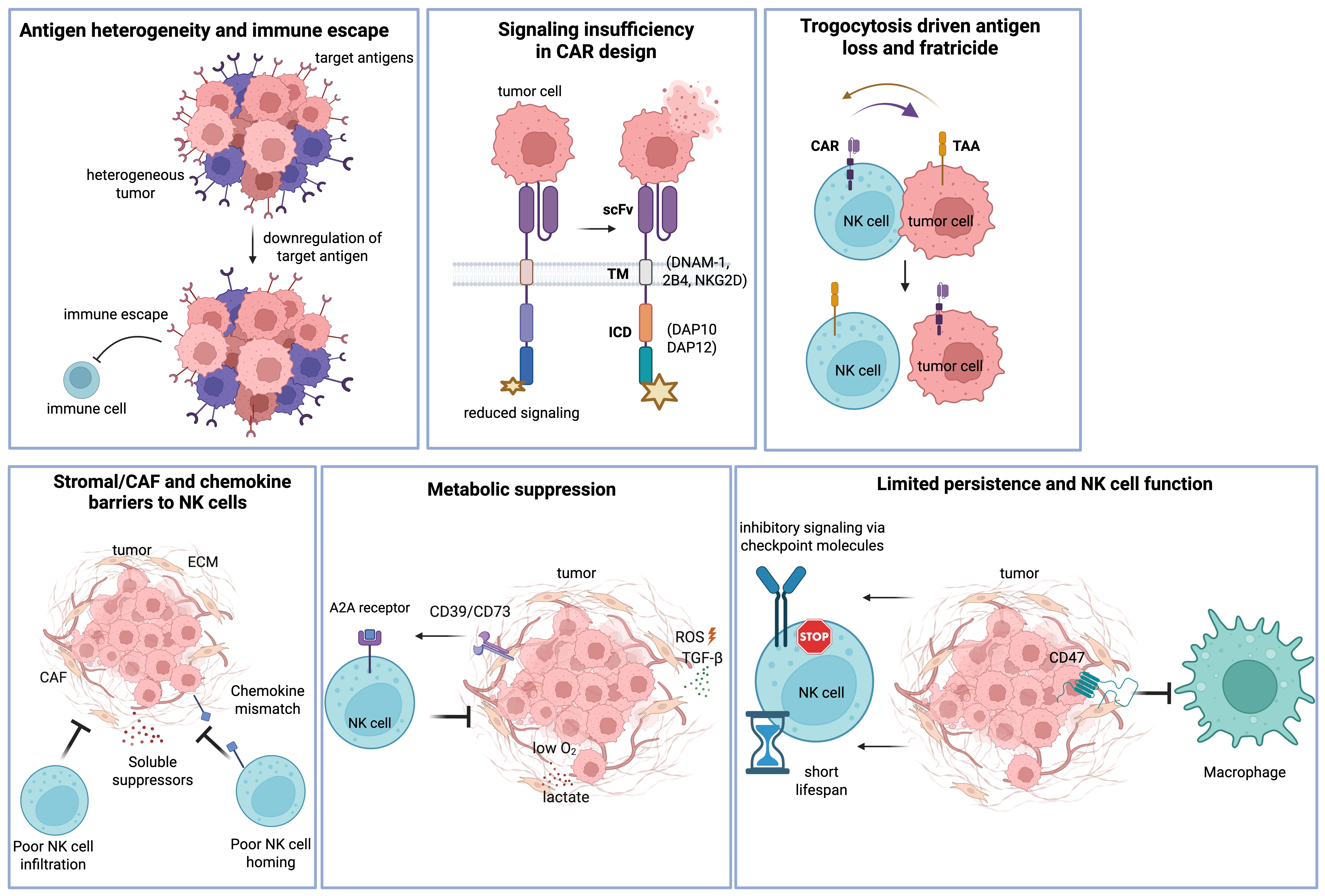
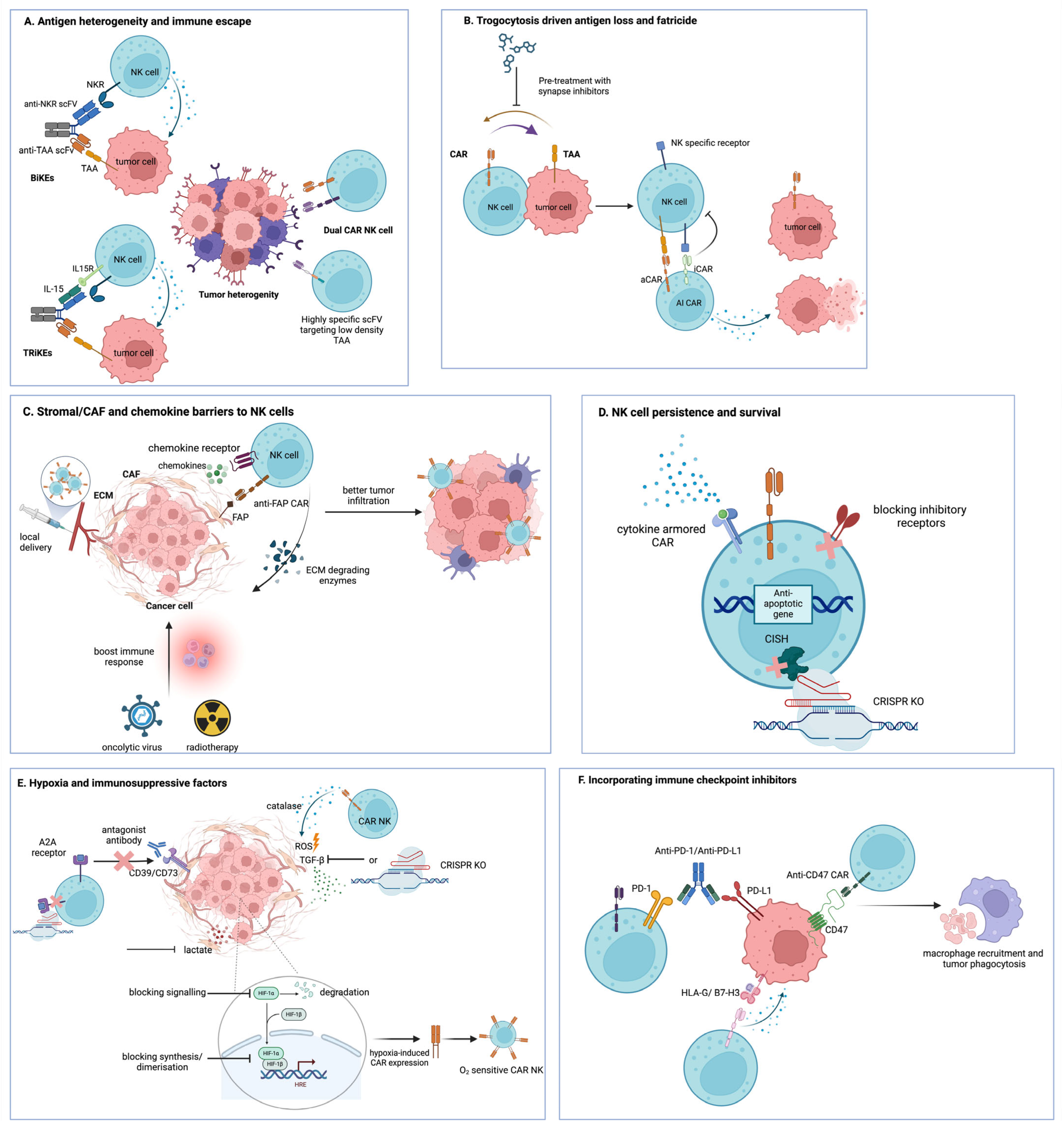
| TME Barrier/Resistance Mechanism | CAR-NK Impairment in the TME | CAR-NK Engineering Strategy | Outcome | References |
|---|---|---|---|---|
| Antigen heterogeneity and immune escape | Loss of, or low density of TAAs, reduces CAR engagement; heterogeneous tumors evade recognition | Higher affinity scFvs (using directed evolution, computational modeling, and phage display); multi-targeting CARs; multi-specific engagers | Enhanced recognition and killing of low antigen tumors; reduced escape; improved efficacy (IL-15 in TriKEs) | [2,3,4,5,6,7,8,9,10,11,12,13] |
| Signaling insufficiency in CAR design | Suboptimal activation/costimulation | NK cell-specific signaling domains (2B4, DNAM-1, NKG2D); adaptor-coupled signaling (DAP10/DAP12) | Improved activation and cytotoxicity | [14,15] |
| Trogocytosis-driven antigen loss and fratricide | CAR-NK exhaustion (upregulated LAG-3/TIM-3); metabolic dysregulation (downregulated glycolysis) | Dual AI-CAR to deliver self-recognition “don’t-eat-me” signals; pretreat with synapse inhibitors (Latrunculin A, Cytochalasin D) | Prevents fratricide; preserves CAR density; decreases trogocytosis | [16,17,18,19] |
| Stroma/ECM rigidity and CAF-mediated suppression | Physical exclusion; soluble suppressors (IL-6, PGE2, IDO, TGF-β, MMPs) impair cytotoxicity | Anti-fibrotic agents (Nintedanib); FAP-CAR NK to target CAFs; CAR-NK secreting ECM-degrading enzymes | Improved tumor infiltration; reduced tumor growth; increased CAR-NK killing in solid tumor models | [20,21,22,23,24,25,26] |
| Chemokine dysregulation limits NK trafficking | Poor homing/infiltration to tumor beds | Engineer tumor matched chemokine receptors (CXCR1/2/4, CCR4/5/7); tune expansion cytokines (IL-2/15/18) to shape receptor profiles; oncolytic viruses/radiotherapy to condition TME; local delivery | Enhanced migration and infiltration; improved cytotoxicity and tumor control in xenografts; safe and effective local injection | [19,25,27,28,29,30,31,32,33,34,35,36,37,38] |
| Hypoxia (HIF-driven) and metabolic stress (lactate, nutrient depletion) | ↓NKG2D/NKp30/NKp44/NKp46; ↓CD107a, perforin, granzyme B, IFN-γ; mitochondrial damage; apoptosis | Block HIF-1α; glycolysis/lactate dehydrogenase blockade; metabolic rewiring (AMPK/PGC-1α); hypoxia-responsive CAR control elements | Restored activation and degranulation; improved specificity to hypoxic TMEs; enhanced survival/effector function | [39,40,41,42,43,44] |
| Hypoxia-induced modulation of the adenosine axis (CD39/CD73 via A2A receptor) | A2A receptor signaling suppresses NK cell activity | Anti-CD73 antibodies or CD73 CAR-NK; A2A receptor deletion | Lower adenosine in the TME; increased CAR-NK infiltration and cytotoxicity | [45,46,47,48] |
| TGF-β-mediated suppression and ROS | ↓NKG2D/DNAM-1/NKp30; ↓IFN-γ; ROS-reduced NK cell activity | TGF-β pathway inhibition; dominant-negative, CAR-NK with high-affinity TGFβR; co-expression of catalase to detoxify H2O2 | Resistance to TGF-β; improved cytotoxicity and cytokine production; better function within the oxidative TME | [49,50,51,52,53,54,55] |
| Limited persistence/survival of NK cells | Short lifespan; exhaustion from chronic stimulation; poor metabolic fitness | Treatment with cytokines; armoring (IL-15 ± IL-12/18/21); CISH knockout (KO); anti-apoptotic genes (BCL-2/BCL-XL); increase essential amino acid transport (SLC1A5/SLC3A2/SLC7A5 complex) | Improved proliferation, metabolic fitness (↑mitochondria, mTOR), persistence, and anti-tumor activity | [56,57,58] [59,60] |
| PD-1/PD-L1 axis | Inhibitory signaling via PD-1/PD-L1 reduces NK effector function | PD-1 signal converter CAR-NK; PD-1 or ADAM-17 KO; PD-L1-CAR NK (±IL-15), combinations with immune checkpoint inhibitors/N-803; dual CARs (PD-L1 + HER2) | Increased cytotoxicity, pyroptosis/apoptosis of tumor cells; reduced suppressive myeloid cells; better control of heterogeneous tumors | [7,61,62,63,64,65,66,67,68,69,70,71,72] |
| Other checkpoints (HLA-G, B7-H3) | ILT2/KIR2DL4 (HLA-G) and B7-H3 signaling dampen NK function | HLA-G CAR NK with DAP12; B7-H3 CAR-NK | Potent in vitro/in vivo cytotoxicity across multiple solid tumor models; resilience to low pH/hypoxia/suppressive factors | [73,74,75,76] |
| CD47/SIRPα axis | Macrophage phagocytosis blocked; NK function reduced; poor patient survival outcomes correlate with high CD47 | Block CD47/SIRPα with antibodies or soluble blockers (SIRPα-Fc, CV1); CD47 CAR-NK; engineer CAR cells to secrete blocking agents | Restored innate immunity (↑phagocytosis, M2→M1); improved CAR-NK efficacy and resistance | [77,78,79,80,81,82,83] |
| Solid Tumor | CAR Structure | Target | Phase | NCT Number | Study Title |
|---|---|---|---|---|---|
| Advanced head and neck cancer | TROP2 CAR/IL-15 TGFβR-2 KO NK | TROP2 | I | NCT07101432 | Phase I study of preconditioning radiation therapy with IL-15 transduced TGFBR2 KO CAR.TROP2-engineered cord blood-derived NK cells in patients with advanced head and neck cancer (RADIANCE-NK) |
| Clear cell carcinoma | TGFβR-2 KO CD70 CAR NK | CD70 | I | NCT07072234 | Phase I study of allogeneic transforming growth factor-beta receptor type 2 KO CD70 CAR NK cells in treatment refractory clear cell renal cell carcinoma |
| Advanced gastric or colorectal cancer | PD-1-M1-NK | PD-1 | I | NCT07031011 | An early clinical study to investigate the safety, pharmacokinetics, and efficacy of PD-1-M1-NK cells (YC-T-001) in patients with advanced gastric or colorectal cancer failed or intolerant to at least second-line therapy |
| Advanced solid tumors with liver metastases | NKG2D CAR-NK | NKG2D ligands | I | NCT07021534 | Hepatic artery transfusion of NKG2D CAR-NK cells followed by intravenous infusion of NKG2D CAR-T Cells to treat patients with advanced solid tumors with liver metastases who have failed standard treatments: a phase I exploratory clinical trial |
| Pancreatic cancer | CL-NK-001 | N/A | I | NCT06816823 | A clinical study of CAR-NK Cells (CL-NK-001) in patients with advanced pancreatic cancer |
| Advanced solid tumors | Universal NK cell (NK042) | N/A | I | NCT06773091 | An open-label, single-arm, multicenter phase I clinical study to evaluate the safety and preliminary efficacy of NK042 cell injection (Universal NKR + NK) in advanced solid tumors |
| Hepatocellular carcinoma | SN301A CAR NK | GPC3 | I | NCT06652243 | An early clinical study to evaluate the safety and efficacy of SN301A cell injection in the treatment of subjects with Glypican-3 (GPC3)-positive advanced hepatocellular carcinoma |
| Pancreatic cancer non-resectable | NKG2D CAR NK | NKG2D ligands | I | NCT06503497 | A single-center, single-arm, open-label, dose-escalation clinical study to evaluate the safety and anti-tumor efficacy of second-line systemic chemotherapy sequential NKG2D CAR-NK cell therapy for pancreatic cancer |
| Pancreatic cancer non-resectable | NKG2D CAR NK | NKG2D ligands | I | NCT06478459 | A single-center, single-arm, open-label, dose-escalation clinical study to evaluate the safety and anti-tumor efficacy of intratumoral NKG2D CAR-NK cell injection guided by EUS in the treatment of locally advanced pancreatic cancer |
| Gastric cancer, pancreatic adenocarcinoma | CB CAR-NK182 cell | Claudin18.2 | I | NCT06464965 | A phase I clinical study of cord blood-derived CAR-NK cells targeting Claudin18.2 in the treatment of advanced gastric cancer and advanced pancreatic cancer |
| Non-small cell lung cancer | Anti-TROP2 universal CAR-NK | TROP2 | I/II | NCT06454890 | An investigator-initiated trial evaluating the efficacy and safety of anti-TROP2 universal CAR-NK(U-CAR-NK) cells therapy combined with chemotherapy for relapsed/refractory non-small cell lung cancer (NSCLC) |
| Colorectal cancer with minimal residual disease | TROP2 CAR-NK | TROP2 | I | NCT06358430 | Phase I dose escalation and expansion study of TROP2 CAR engineered IL-15-transduced cord blood-derived NK cells in combination with cetuximab in patient with colorectal cancer (CRC) with minimal residual disease (MRD) |
| Solid tumors | TROP2 CAR-NK | TROP2 | I | NCT06066424 | Phase I dose escalation and expansion study of TROP2 CAR engineered IL15-transduced cord blood-derived NK cells in patients with advanced solid tumors (TROPIKANA) |
| Pancreatic, ovarian, adenocarcinoma | TROP2 CAR/IL15-transduced CB-NK | TROP2 | I/II | NCT05922930 | Phase I/II study of TROP2 CAR engineered IL15-transduced cord blood-derived NK cells delivered intraperitoneally for the management of platinum resistant ovarian cancer, mesonephric-like adenocarcinoma, and pancreatic cancer |
| Ovarian epithelial carcinoma | SZ011 CAR-NK | SZ011 | I | NCT05856643 | Single-arm, open-label clinical study of SZ011 in the treatment of ovarian epithelial |
| Ovarian cancer | NKG2D CAR-NK | NKG2D ligands | N/A | NCT05776355 | NKG2D CAR-NK cell therapy for patients with platinum-resistant recurrent ovarian cancer |
| Advanced renal cell carcinoma, mesothelioma, and osteosarcoma | CAR.70/IL15-transduced CB-derived NK | CD70 | I/II | NCT05703854 | Phase I/II study of CAR.70-engineered IL15-transduced cord blood-derived NK cells in conjunction with lymphodepleting chemotherapy for the management of advanced renal cell carcinoma, mesothelioma and osteosarcoma |
| Triple-negative breast cancer | SZ011 CAR NK | SZ011 | I | NCT05686720 | Single-arm, open-label clinical study of SZ011 in the treatment of advanced triple negative breast cancer |
| Relapsed/refractory extensive-stage small cell lung cancer | DLL3 CAR-NK | DLL3 | I | NCT05507593 | A multicenter phase I trial on the safety and preliminary efficacy of DLL3 CAR-NK cells in the treatment of relapsed/refractory extensive stage small cell lung cancer |
| Stage IV ovarian cancer, testis cancer refractory, endometrial cancer recurrent | Claudin6, GPC3, mesothelin, or AXL targeting CAR-NK | Claudin6, GPC3, mesothelin, or AXL | I | NCT05410717 | Phase I trial to evaluate safety and preliminary efficacy of CLDN6/GPC3/Mesothelin/AXL-CAR-NK in patients with CLDN6/GPC3/Mesothelin/AXL-positive advanced solid tumors |
| Refractory metastatic colorectal cancer | NKG2D CAR-NK | NKG2D ligands | I | NCT05213195 | NKG2D CAR-NK cell therapy in patients with refractory metastatic colorectal cancer |
| Advanced solid tumors | Anti-5T4 CAR-NK | 5T4 | I | NCT05194709 | Clinical trial of anti-5T4 oncofetal trophoblast glycoprotein (5T4) conjugated antibody redirecting natural killer (CAR-NK) cells in advanced solid tumors |
| Gastroesophageal junction cancers, advanced head and neck squamous cell carcinoma | PD-L1 CAR-NK | PD-L1 | II | NCT04847466 | A Phase II study of immunotherapy combination: Irradiated PD-L1 CAR-NK cells plus pembrolizumab plus N-803 for subjects with recurrent/metastatic gastric or head and neck cancer |
| Pancreatic cancer | ROBO1 CAR-NK | ROBO1 | I/II | NCT03941457 | Clinical research of ROBO1 specific BiCAR-nk cells on patients with pancreatic cancer |
| Solid tumors | ROBO1 CAR-NK | ROBO1 | I/II | NCT03940820 | Clinical research of ROBO1 specific CAR-NK Cells on patients with solid tumors |
| Malignant tumors | BiCAR-NK/T cells (ROBO1 CAR-NK/T cells) | ROBO1 | I/II | NCT03931720 | Clinical research of ROBO1 specific CAR-NK Cells on patients with malignant tumor |
| Metastatic castration-resistant prostate cancer | Anti-PSMA CAR NK | PSMA | I | NCT03692663 | Clinical study on the safety and efficacy of anti-PSMA CAR NK cells in metastatic castration-resistant prostate cancer (mCRPC) |
| Epithelial ovarian cancer | Anti-mesothelin CAR NK | Mesothelin | I | NCT03692637 | Clinical study on the safety and efficacy of anti-mesothelin CAR NK cells with epithelial ovarian cancer |
| Solid tumors | NKG2D ligand targeted CAR-NK | NKG2D ligands | I | NCT03415100 | Pilot study of NKG2D-ligand targeted CAR-NK Cells in patients with metastatic solid tumours |
| Advanced refractory or relapsed solid tumor | Anti-MUC1 CAR-pNK cells | MUC1 | I/II | NCT02839954 | Study evaluating the efficacy and safety of chimeric antigen receptor-modified pNK cells in MUC1 positive advanced refractory or relapsed solid tumor |
Disclaimer/Publisher’s Note: The statements, opinions and data contained in all publications are solely those of the individual author(s) and contributor(s) and not of MDPI and/or the editor(s). MDPI and/or the editor(s) disclaim responsibility for any injury to people or property resulting from any ideas, methods, instructions or products referred to in the content. |
© 2025 by the authors. Licensee MDPI, Basel, Switzerland. This article is an open access article distributed under the terms and conditions of the Creative Commons Attribution (CC BY) license.
Share and Cite
Islam, F.; Pupovac, A.; Boyd, R.L.; Trounson, A.O. CAR-NK Engineering to Overcome TME Barriers. Cells 2026, 15, 21. https://doi.org/10.3390/cells15010021
Islam F, Pupovac A, Boyd RL, Trounson AO. CAR-NK Engineering to Overcome TME Barriers. Cells. 2026; 15(1):21. https://doi.org/10.3390/cells15010021
Chicago/Turabian StyleIslam, Fahmida, Aleta Pupovac, Richard L. Boyd, and Alan O. Trounson. 2026. "CAR-NK Engineering to Overcome TME Barriers" Cells 15, no. 1: 21. https://doi.org/10.3390/cells15010021
APA StyleIslam, F., Pupovac, A., Boyd, R. L., & Trounson, A. O. (2026). CAR-NK Engineering to Overcome TME Barriers. Cells, 15(1), 21. https://doi.org/10.3390/cells15010021