Oxford Nanopore Full-Length Transcriptome Reveals Alternative Splicing and Its Functional Diversity in Regulating Fruit Ripening in Peach (Prunus persica)

 ,
,
Abstract
1. Introduction
2. Materials and Methods
2.1. Plant Materials
2.2. Nanopore RNA-Seq cDNA Library Construction
2.3. Oxford Nanopore Technologies Long Read Processing
2.4. Fusion Transcript Identification
2.5. Structure Analysis
2.6. Functional Annotation
2.7. Expression Quantification and Differential Expression Analysis
2.8. RT-qPCR Validation
2.9. Construction of Expression Vectors
2.10. Dual Luciferase Assays
2.11. Assessment of Binding Specificity of MADS-Box Proteins
3. Results
3.1. Peach ONT Transcriptome Sequencing
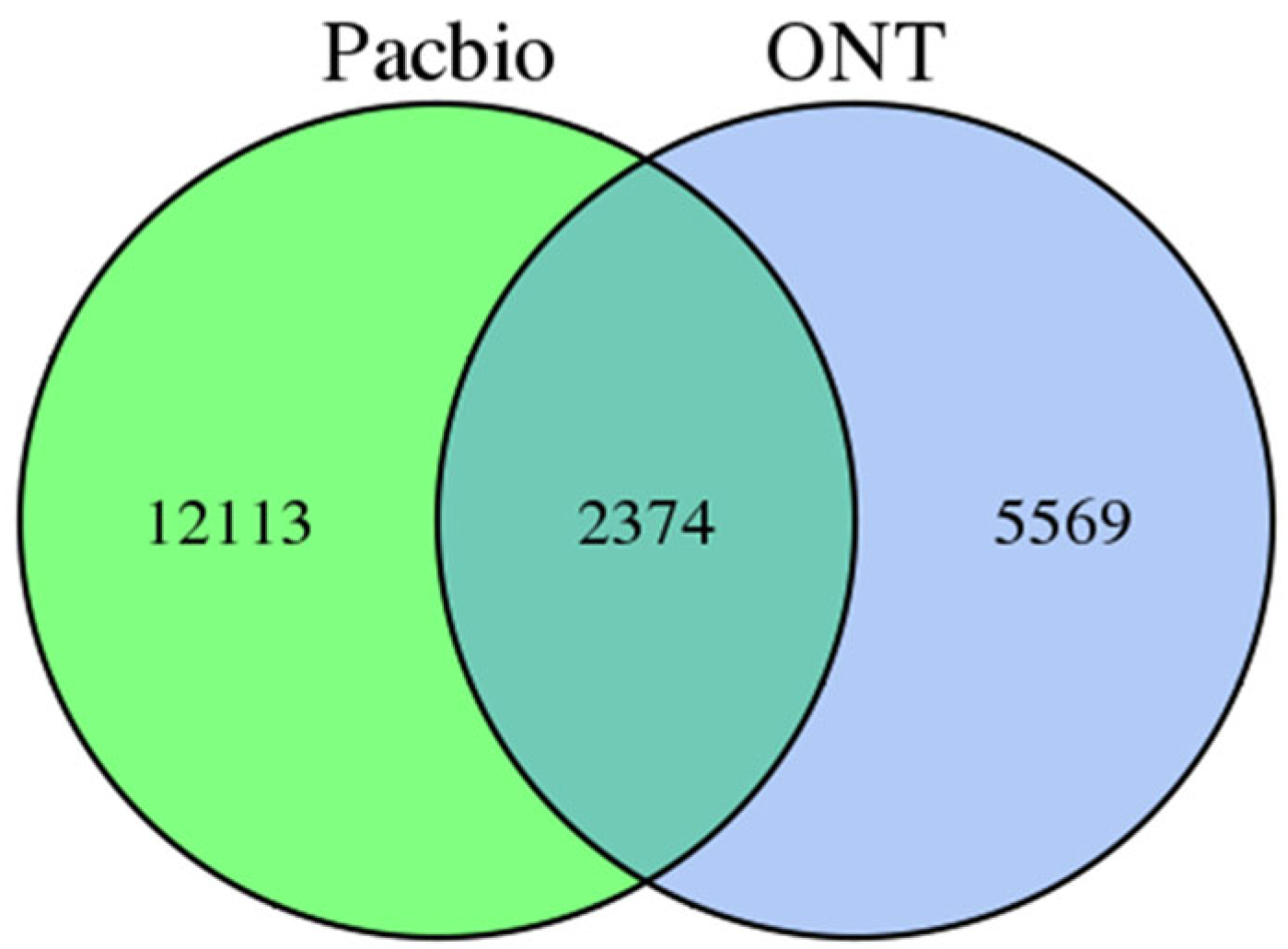
3.2. Annotation of Novel Genes and Isoforms
3.3. Discovery of Fusion Transcripts
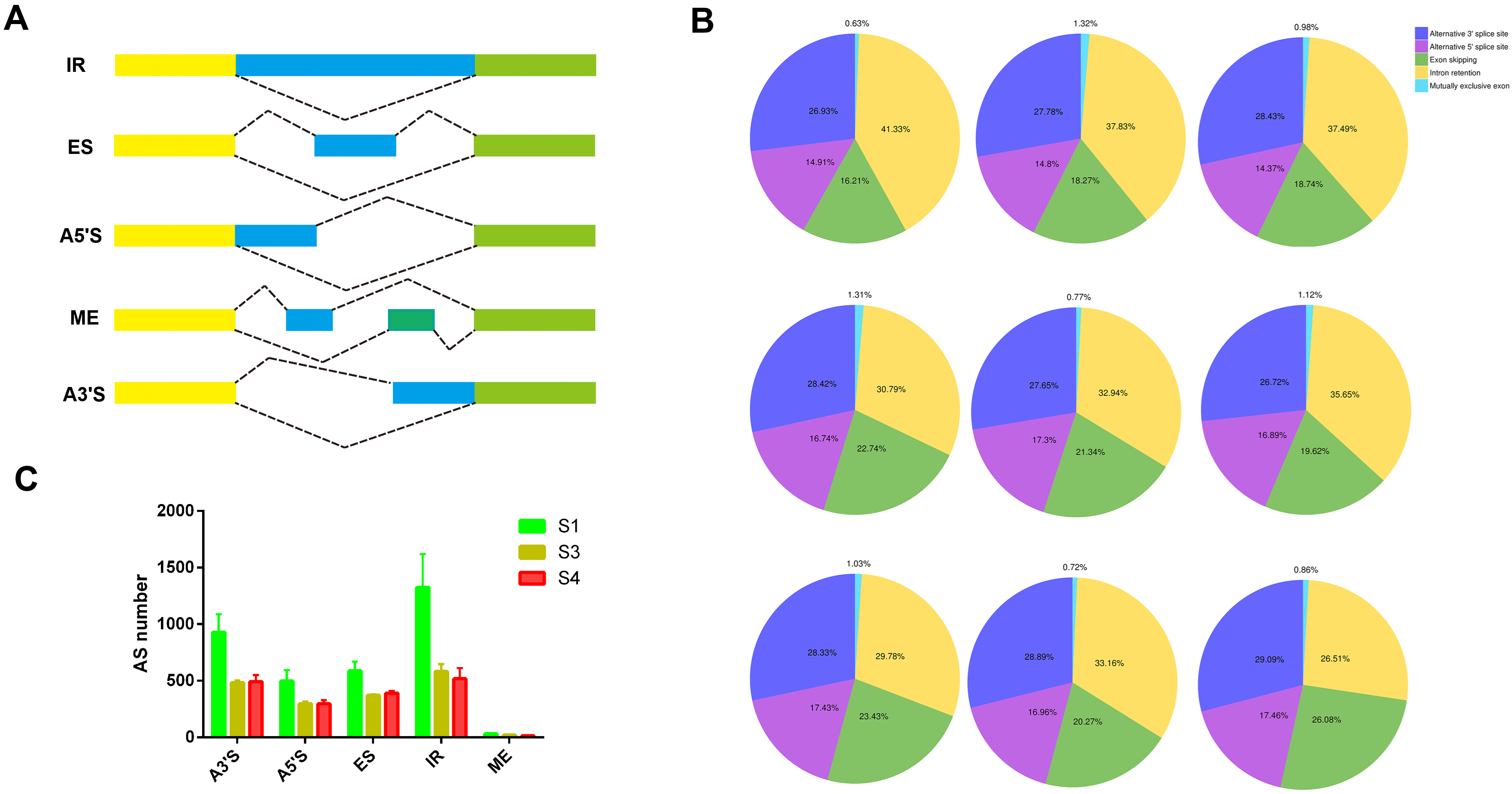
3.4. Analysis of as Events
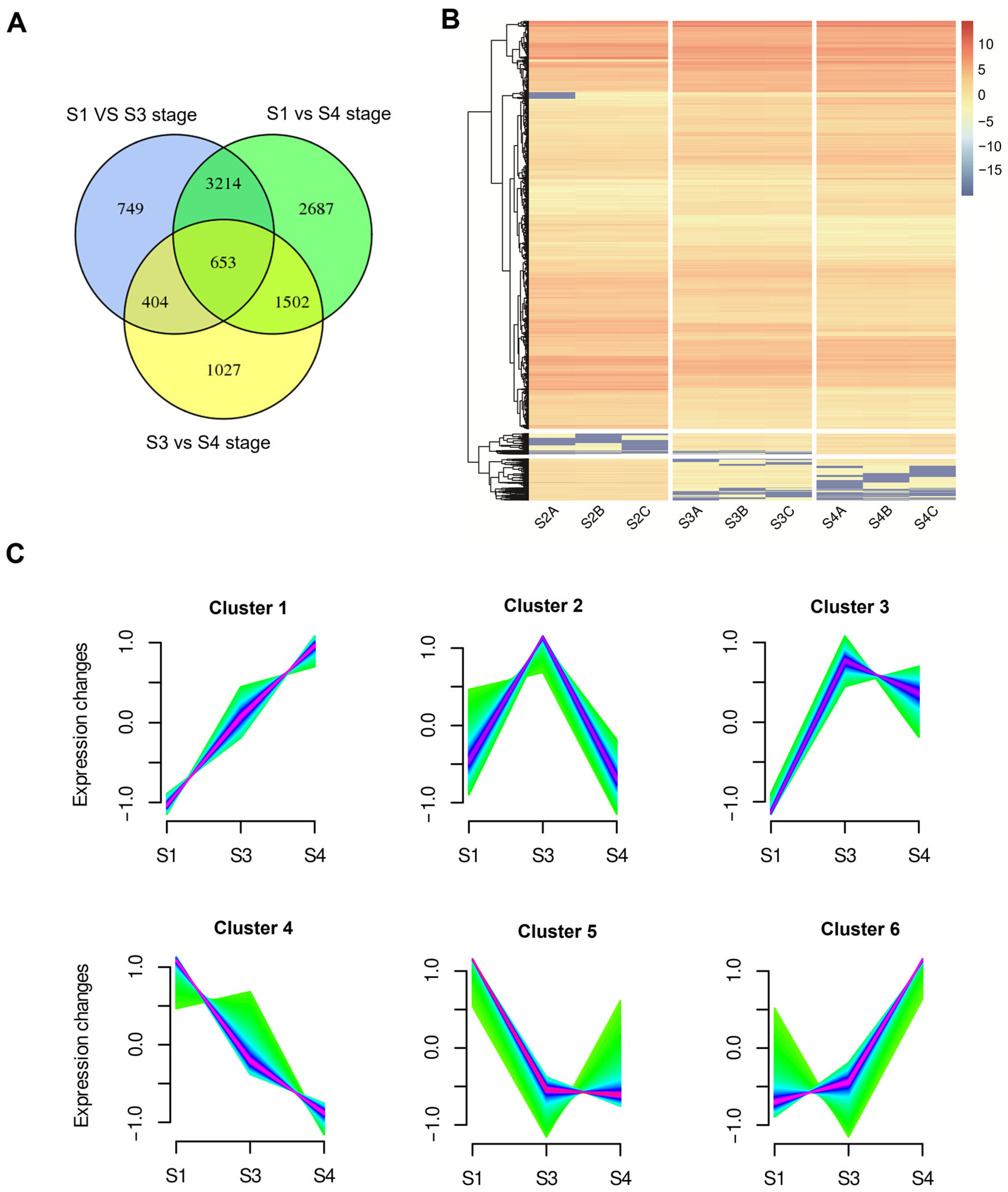
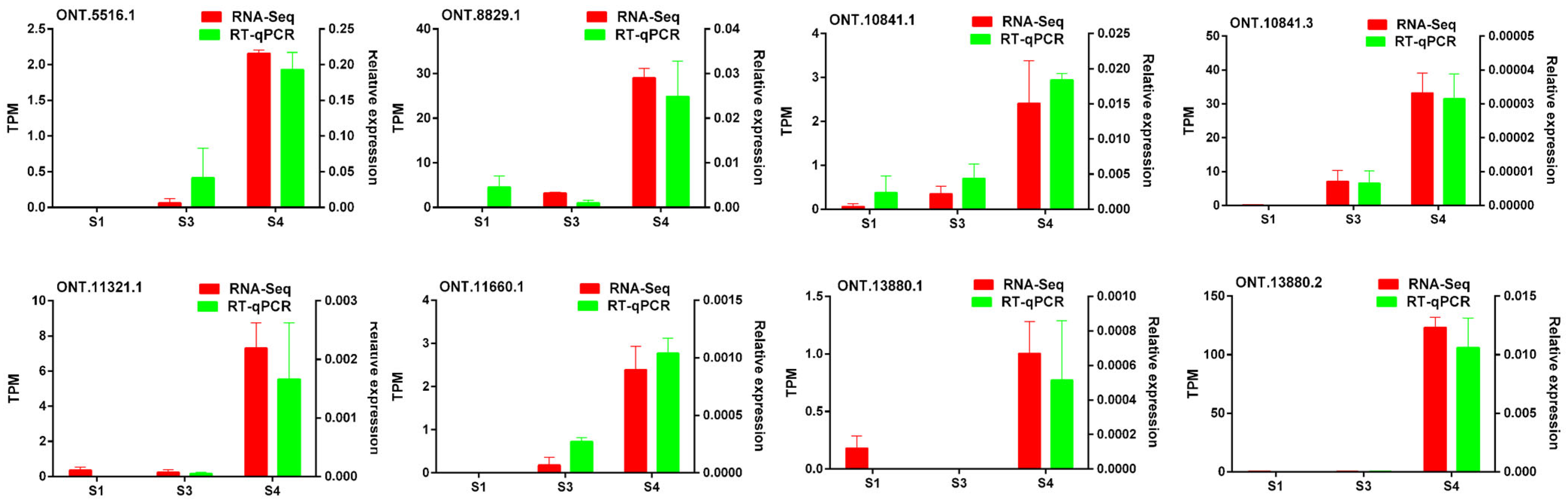
3.5. Identification of Differentially Expressed Transcripts (DETs)
3.6. Identification of Fruit Ripening Related as Events in the PpMADS6 Locus
4. Discussion
4.1. Comprehensive Characterization of Alternative Splicing Landscapes Using Oxford Nanopore Transcriptome Sequencing in Peach
4.2. As Orchestrates Transcriptional Diversity in Fruit
4.3. MADS-Box TFs Participate Contribute to Fruit Ripening
5. Conclusions
Supplementary Materials
Author Contributions
Funding
Institutional Review Board Statement
Informed Consent Statement
Data Availability Statement
Conflicts of Interest
Abbreviation
References
- Parenteau, J.; Abou Elela, S. Introns: Good day junk is bad day treasure. Trends Genet. 2019, 35, 923–934. [Google Scholar] [CrossRef] [Scilit]
- Ressayre, A.; Glemin, S.; Montalent, P.; Serre-Giardi, L.; Dillmann, C.; Joets, J. Introns Structure Patterns of Variation in Nucleotide Composition in Arabidopsis thaliana and Rice Protein-Coding Genes. Genome Biol. Evol. 2015, 7, 2913–2928. [Google Scholar] [CrossRef] [Scilit]
- Pan, Q.; Shai, O.; Lee, L.J.; Frey, B.J.; Blencowe, B.J. Deep surveying of alternative splicing complexity in the human transcriptome by high-throughput sequencing. Nat. Genet. 2008, 40, 1413–1415. [Google Scholar] [CrossRef] [Scilit]
- Zhu, F.-Y.; Chen, M.-X.; Ye, N.-H.; Shi, L.; Ma, K.-L.; Yang, J.-F.; Cao, Y.-Y.; Zhang, Y.; Yoshida, T.; Fernie, A.R.; et al. Proteogenomic analysis reveals alternative splicing and translation as part of the abscisic acid response in Arabidopsis seedlings. Plant J. 2017, 91, 518–533. [Google Scholar] [CrossRef] [Scilit]
- Reddy, A.S.; Marquez, Y.; Kalyna, M.; Barta, A. Complexity of the alternative splicing landscape in plants. Plant Cell 2013, 25, 3657–3683. [Google Scholar] [CrossRef] [Scilit]
- Filichkin, S.; Priest, H.D.; Megraw, M.; Mockler, T.C. Alternative splicing in plants: Directing traffic at the crossroads of adaptation and environmental stress. Curr. Opin. Plant Biol. 2015, 24, 125–135. [Google Scholar] [CrossRef] [Scilit] [PubMed]
- Kalyna, M.; Simpson, C.G.; Syed, N.H.; Lewandowska, D.; Marquez, Y.; Kusenda, B.; Marshall, J.; Fuller, J.; Cardle, L.; McNicol, J.; et al. Alternative splicing and nonsense-mediated decay modulate expression of important regulatory genes in Arabidopsis. Nucleic Acids Res. 2012, 40, 2454–2469. [Google Scholar] [CrossRef] [Scilit] [PubMed]
- Alhabsi, A.; Ling, Y.; Crespi, M.; Reddy, A.S.N.; Mahfouz, M. Alternative Splicing Dynamics in Plant Adaptive Responses to Stress. Annu. Rev. Plant Biol. 2025, 76, 687–717. [Google Scholar] [CrossRef] [Scilit] [PubMed]
- He, T.; Sun, G.; He, S.; Zhang, Z.; Dong, J.; Zhu, X.; Dai, J.; Wang, K.; Xing, J. Full-Length Transcriptome Analysis of Sesbania cannabina Stem Response to Waterlogging Stress. Agronomy 2025, 15, 1197. [Google Scholar] [CrossRef] [Scilit]
- Yang, S.; Tang, F.; Zhu, H. Alternative splicing in plant immunity. Int. J. Mol. Sci. 2014, 15, 10424–10445. [Google Scholar] [CrossRef] [Scilit]
- Muhammad, S.; Xu, X.; Zhou, W.; Wu, L. Alternative splicing: An efficient regulatory approach towards plant developmental plasticity. WIREs RNA 2023, 14, e1758. [Google Scholar] [CrossRef] [Scilit]
- Qin, Z.; Wu, J.; Geng, S.; Feng, N.; Chen, F.; Kong, X.; Song, G.; Chen, K.; Li, A.; Mao, L.; et al. Regulation of FT splicing by an endogenous cue in temperate grasses. Nat. Commun. 2017, 8, 14320. [Google Scholar] [CrossRef] [Scilit]
- Capovilla, G.; Symeonidi, E.; Wu, R.; Schmid, M. Contribution of major FLM isoforms to temperature-dependent flowering in Arabidopsis thaliana. J. Exp. Bot. 2017, 68, 5117–5127. [Google Scholar] [CrossRef] [Scilit] [PubMed]
- Lee, J.H.; Ryu, H.-S.; Chung, K.S.; Posé, D.; Kim, S.; Schmid, M.; Ahn, J.H. Regulation of Temperature-Responsive Flowering by MADS-Box Transcription Factor Repressors. Science 2013, 342, 628–632. [Google Scholar] [CrossRef] [Scilit]
- Wang, Y.Y.; Xiong, F.; Ren, Q.P.; Wang, X.L. Regulation of flowering transition by alternative splicing: The role of the U2 auxiliary factor. J. Exp. Bot. 2020, 71, 751–758. [Google Scholar] [CrossRef] [Scilit]
- Shen, Y.; Qin, Z.; Ren, G.; Deng, P.; Ji, W.; Jiao, C.; Wu, L. Complexity and regulation of age-dependent alternative splicing in Brachypodium distachyon. Plant Physiol. 2023, 192, 2703–2722. [Google Scholar] [CrossRef] [Scilit]
- Wang, H.L.; Zhang, Y.; Wang, T.; Yang, Q.; Yang, Y.; Li, Z.; Li, B.; Wen, X.; Li, W.; Yin, W.; et al. An alternative splicing variant of PtRD26 delays leaf senescence by regulating multiple NAC transcription factors in Populus. Plant Cell 2021, 33, 1594–1614. [Google Scholar] [CrossRef] [Scilit]
- Chechanovsky, N.; Hovav, R.; Frenkel, R.; Faigenboim, A.; Eselson, Y.; Petreikov, M.; Moy, M.; Shen, S.; Schaffer, A.A. Low temperature upregulates cwp expression and modifies alternative splicing patterns, increasing the severity of cwp-induced tomato fruit cuticular microfissures. Hortic. Res. 2019, 6, 122. [Google Scholar] [CrossRef] [Scilit] [PubMed]
- Jiang, G.; Zhang, D.; Li, Z.; Liang, H.; Deng, R.; Su, X.; Jiang, Y.; Duan, X. Alternative splicing of MaMYB16L regulates starch degradation in banana fruit during ripening. J. Integr. Plant Biol. 2021, 63, 1341–1352. [Google Scholar] [CrossRef] [Scilit] [PubMed]
- Gao, L.; Wang, W.; Li, H.; Li, H.; Yang, Y.; Zheng, H.; Tao, J. Anthocyanin accumulation in grape berry flesh is associated with an alternative splicing variant of VvMYBA1. Plant Physiol. Biochem. 2023, 195, 1–13. [Google Scholar] [CrossRef] [Scilit] [PubMed]
- Colanero, S.; Tagliani, A.; Perata, P.; Gonzali, S. Alternative Splicing in the Anthocyanin Fruit Gene Encoding an R2R3 MYB Transcription Factor Affects Anthocyanin Biosynthesis in Tomato Fruits. Plant Commun. 2020, 1, 100006. [Google Scholar] [CrossRef] [Scilit]
- Li, C.; Krishnan, S.; Zhang, M.; Hu, D.; Meng, D.; Riedelsberger, J.; Dougherty, L.; Xu, K.; Pineros, M.A.; Cheng, L. Alternative Splicing Underpins the ALMT9 Transporter Function for Vacuolar Malic Acid Accumulation in Apple. Adv. Sci. 2024, 11, e2310159. [Google Scholar] [CrossRef] [Scilit]
- Lombardo, V.A.; Osorio, S.; Borsani, J.; Lauxmann, M.A.; Bustamante, C.A.; Budde, C.O.; Andreo, C.S.; Lara, M.V.; Fernie, A.R.; Drincovich, M.F. Metabolic profiling during peach fruit development and ripening reveals the metabolic networks that underpin each developmental stage. Plant Physiol. 2011, 157, 1696–1710. [Google Scholar] [CrossRef] [Scilit]
- Rodriguez, C.E.; Bustamante, C.A.; Budde, C.O.; Müller, G.L.; Drincovich, M.F.; Lara, M.V. Peach fruit development: A comparative proteomic study between endocarp and mesocarp at very early stages underpins the main differential biochemical processes between these tissues. Front. Plant Sci. 2019, 10, 715. [Google Scholar] [CrossRef] [Scilit]
- Zhou, H.; Sheng, Y.; Qiu, K.; Ren, F.; Shi, P.; Xie, Q.; Guo, J.; Pan, H.; Zhang, J. Improved Annotation of the Peach (Prunus persica) Genome and Identification of Tissue- or Development Stage-Specific Alternative Splicing through the Integration of Iso-Seq and RNA-Seq Data. Horticulturae 2023, 9, 175. [Google Scholar] [CrossRef] [Scilit]
- Li, H. Minimap2: Pairwise alignment for nucleotide sequences. Bioinformatics 2018, 34, 3094–3100. [Google Scholar] [CrossRef] [Scilit] [PubMed]
- Foissac, S.; Sammeth, M. ASTALAVISTA: Dynamic and flexible analysis of alternative splicing events in custom gene datasets. Nucleic Acids Res. 2007, 35, W297–W299. [Google Scholar] [CrossRef] [Scilit]
- Anders, S.; Huber, W. Differential expression of RNA-Seq data at the gene level–the DESeq package. Heidelb. Ger. Eur. Mol. Biol. Lab. (EMBL) 2012, 10, f1000research. [Google Scholar]
- Verde, I.; Jenkins, J.; Dondini, L.; Micali, S.; Pagliarani, G.; Vendramin, E.; Paris, R.; Aramini, V.; Gazza, L.; Rossini, L.; et al. The Peach v2.0 release: High-resolution linkage mapping and deep resequencing improve chromosome-scale assembly and contiguity. BMC Genom. 2017, 18, 225. [Google Scholar] [CrossRef] [Scilit] [PubMed]
- Wang, W.; Wang, Y.; Chen, T.; Qin, G.; Tian, S. Current insights into posttranscriptional regulation of fleshy fruit ripening. Plant Physiol. 2023, 192, 1785–1798. [Google Scholar] [CrossRef] [Scilit]
- Lü, P.; Yu, S.; Zhu, N.; Chen, Y.-R.; Zhou, B.; Pan, Y.; Tzeng, D.; Fabi, J.P.; Argyris, J.; Garcia-Mas, J.; et al. Genome encode analyses reveal the basis of convergent evolution of fleshy fruit ripening. Nat. Plants 2018, 4, 784–791. [Google Scholar] [CrossRef] [Scilit] [PubMed]
- Zhou, H.; Zhang, W.; Sheng, Y.; Qiu, K.; Liao, L.; Shi, P.; Xie, Q.; Pan, H.; Zhang, J.; Han, Y. A large-scale behavior of allelic dropout and imbalance caused by DNA methylation changes in an early-ripening bud sport of peach. New Phytol. 2023, 239, 13–18. [Google Scholar] [CrossRef] [Scilit]
- Xu, Y.; Zhang, L.; Ma, R. Functional characterization and mapping of two MADS box genes from peach (Prunus persica). Sci. Bull. 2008, 53, 853–859. [Google Scholar] [CrossRef] [Scilit]
- Tatsuki, M.; Haji, T.; Yamaguchi, M. The involvement of 1-aminocyclopropane-1-carboxylic acid synthase isogene, Pp-ACS1, in peach fruit softening. J. Exp. Bot. 2006, 57, 1281–1289. [Google Scholar] [CrossRef] [Scilit]
- Gu, C.; Wang, L.; Wang, W.; Zhou, H.; Ma, B.; Zheng, H.; Fang, T.; Ogutu, C.; Vimolmangkang, S.; Han, Y. Copy number variation of a gene cluster encoding endopolygalacturonase mediates flesh texture and stone adhesion in peach. J. Exp. Bot. 2016, 67, 1993–2005. [Google Scholar] [CrossRef] [Scilit] [PubMed]
- Ward, R.M.; Schmieder, R.; Highnam, G.; Mittelman, D. Big data challenges and opportunities in high-throughput sequencing. Syst. Biomed. 2013, 1, 29–34. [Google Scholar] [CrossRef] [Scilit]
- Tyagi, P.; Singh, D.; Mathur, S.; Singh, A.; Ranjan, R. Upcoming progress of transcriptomics studies on plants: An overview. Front. Plant Sci. 2022, 13, 1030890. [Google Scholar] [CrossRef] [Scilit]
- Zhang, G.; Sun, M.; Wang, J.; Lei, M.; Li, C.; Zhao, D.; Huang, J.; Li, W.; Li, S.; Li, J.; et al. PacBio full-length cDNA sequencing integrated with RNA-seq reads drastically improves the discovery of splicing transcripts in rice. Plant J. 2019, 97, 296–305. [Google Scholar] [CrossRef] [Scilit]
- Udaondo, Z.; Sittikankaew, K.; Uengwetwanit, T.; Wongsurawat, T.; Sonthirod, C.; Jenjaroenpun, P.; Pootakham, W.; Karoonuthaisiri, N.; Nookaew, I. Comparative Analysis of PacBio and Oxford Nanopore Sequencing Technologies for Transcriptomic Landscape Identification of Penaeus monodon. Life 2021, 11, 862. [Google Scholar] [CrossRef] [Scilit]
- Cui, J.; Shen, N.; Lu, Z.; Xu, G.; Wang, Y.; Jin, B. Analysis and comprehensive comparison of PacBio and nanopore-based RNA sequencing of the Arabidopsis transcriptome. Plant Methods 2020, 16, 85. [Google Scholar] [CrossRef] [Scilit] [PubMed]
- Yan, X.; Bai, D.; Song, H.; Lin, K.; Pang, E. Alternative splicing during fruit development among fleshy fruits. BMC Genom. 2021, 22, 762. [Google Scholar] [CrossRef] [Scilit]
- Sablok, G.; Powell, B.; Braessler, J.; Yu, F.; Min, X.J. Comparative landscape of alternative splicing in fruit plants. Curr. Plant Biol. 2017, 9–10, 29–36. [Google Scholar] [CrossRef] [Scilit]
- Tang, W.; Zheng, Y.; Dong, J.; Yu, J.; Yue, J.; Liu, F.; Guo, X.; Huang, S.; Wisniewski, M.; Sun, J.; et al. Comprehensive Transcriptome Profiling Reveals Long Noncoding RNA Expression and Alternative Splicing Regulation during Fruit Development and Ripening in Kiwifruit (Actinidia chinensis). Front. Plant Sci. 2016, 7, 335. [Google Scholar] [CrossRef] [Scilit] [PubMed]
- Wang, B.B.; Brendel, V. Genomewide comparative analysis of alternative splicing in plants. Proc. Natl. Acad. Sci. USA 2006, 103, 7175–7180. [Google Scholar] [CrossRef] [Scilit]
- Mockenhaupt, S.; Makeyev, E.V. Non-coding functions of alternative pre-mRNA splicing in development. Semin. Cell Dev. Biol. 2015, 47-48, 32–39. [Google Scholar] [CrossRef] [Scilit]
- Light, S.; Elofsson, A. The impact of splicing on protein domain architecture. Curr. Opin. Struct. Biol. 2013, 23, 451–458. [Google Scholar] [CrossRef] [Scilit] [PubMed]
- Laine, E.; Freiberger, M.I. Toward a comprehensive profiling of alternative splicing proteoform structures, interactions and functions. Curr. Opin. Struct. Biol. 2025, 90, 102979. [Google Scholar] [CrossRef] [Scilit]
- Nayar, S.; Thangavel, G. CsubMADS1, a lag phase transcription factor, controls development of polar eukaryotic microalga Coccomyxa subellipsoidea C-169. Plant J. 2021, 107, 1228–1242. [Google Scholar] [CrossRef] [Scilit]
- Lightfoot, D.J.; Malone, K.M.; Timmis, J.N.; Orford, S.J. Evidence for alternative splicing of MADS-box transcripts in developing cotton fibre cells. Mol. Genet. Genom. 2008, 279, 75–85. [Google Scholar] [CrossRef] [Scilit]
- Severing, E.I.; van Dijk, A.D.; Morabito, G.; Busscher-Lange, J.; Immink, R.G.; van Ham, R.C. Predicting the impact of alternative splicing on plant MADS domain protein function. PLoS ONE 2012, 7, e30524. [Google Scholar] [CrossRef] [Scilit]
- Zhou, H.; Lin-Wang, K.; Wang, H.; Gu, C.; Dare, A.P.; Espley, R.V.; He, H.; Allan, A.C.; Han, Y. Molecular genetics of blood-fleshed peach reveals activation of anthocyanin biosynthesis by NAC transcription factors. Plant J. 2015, 82, 105–121. [Google Scholar] [CrossRef] [Scilit]
- Zhang, R.X.; Liu, Y.; Zhang, X.; Chen, X.; Sun, J.; Zhao, Y.; Zhang, J.; Yao, J.L.; Liao, L.; Zhou, H.; et al. Two adjacent NAC transcription factors regulate fruit maturity date and flavor in peach. New Phytol. 2023, 241, 632–649. [Google Scholar] [CrossRef] [Scilit]
- Cao, X.; Li, X.; Su, Y.; Zhang, C.; Wei, C.; Chen, K.; Grierson, D.; Zhang, B. Transcription factor PpNAC1 and DNA demethylase PpDML1 synergistically regulate peach fruit ripening. Plant Physiol. 2024, 194, 2049–2068. [Google Scholar] [CrossRef] [Scilit]
- Xu, Y.; Zhang, L.; Xie, H.; Zhang, Y.Q.; Oliveira, M.M.; Ma, R.C. Expression analysis and genetic mapping of three SEPALLATA-like genes from peach (Prunus persica (L.) Batsch). Tree Genet. Genomes 2008, 4, 693–703. [Google Scholar] [CrossRef] [Scilit]
- Wei, C.; Yang, H.; Ye, B.; Wei, W.; Shan, W.; Chen, J.; Chen, K.; Li, X.; Deng, Z.; Zhang, B. Ubiquitination of the PpMADS2 transcription factor controls linalool production during UV-B irradiation in detached peach fruit. Plant Physiol. 2025, 198, kiaf159. [Google Scholar] [CrossRef] [Scilit] [PubMed]
- Li, J.; Li, F.; Qian, M.; Han, M.; Liu, H.; Zhang, D.; Ma, J.; Zhao, C. Characteristics and regulatory pathway of the PrupeSEP1 SEPALLATA gene during ripening and softening in peach fruits. Plant Sci. 2017, 257, 63–73. [Google Scholar] [CrossRef] [Scilit] [PubMed]
- Zhang, S.; Wang, X.; Xu, Z.; Shi, P.; Gu, M.; Kang, T.; Li, Q.; Zhang, D.; Zhao, C. PrupeFUL4 regulates ripening and softening of peach fruits through ethylene biosynthesis. Acta Physiol. Plant. 2022, 44, 23. [Google Scholar] [CrossRef] [Scilit]
- Lai, X.; Daher, H.; Galien, A.; Hugouvieux, V.; Zubieta, C. Structural Basis for Plant MADS Transcription Factor Oligomerization. Comput. Struct. Biotechnol. J. 2019, 17, 946–953. [Google Scholar] [CrossRef] [Scilit]



| SampleID | ReadNum | MeanLength | MaxLength | Clean Reads | Full-Length Percentage |
|---|---|---|---|---|---|
| S1_rep1 | 5,841,309 | 1301 | 12,530 | 5,765,879 | 0.7848 |
| S1_rep2 | 5,575,180 | 1195 | 10,745 | 5,509,725 | 0.7333 |
| S1_rep3 | 5,102,038 | 1161 | 10,087 | 5,043,301 | 0.738 |
| S3_rep1 | 5,519,868 | 1098 | 9881 | 5,465,833 | 0.7514 |
| S3_rep2 | 5,353,968 | 1127 | 9927 | 5,299,482 | 0.7479 |
| S3_rep3 | 5,286,179 | 1185 | 9100 | 5,224,814 | 0.7516 |
| S4_rep1 | 5,205,734 | 1124 | 9599 | 5,152,439 | 0.7627 |
| S4_rep2 | 5,628,959 | 1189 | 12,746 | 5,565,727 | 0.7449 |
| S4_rep3 | 5,458,163 | 1048 | 9747 | 5,402,163 | 0.7422 |
Disclaimer/Publisher’s Note: The statements, opinions and data contained in all publications are solely those of the individual author(s) and contributor(s) and not of MDPI and/or the editor(s). MDPI and/or the editor(s) disclaim responsibility for any injury to people or property resulting from any ideas, methods, instructions or products referred to in the content. |
© 2026 by the authors. Licensee MDPI, Basel, Switzerland. This article is an open access article distributed under the terms and conditions of the Creative Commons Attribution (CC BY) license.
Share and Cite
Zhou, H.; Wang, X.; Jiang, L.; Shi, P.; Sheng, Y.; Wang, Y.; Xie, Q.; Zhang, J.; Pan, H. Oxford Nanopore Full-Length Transcriptome Reveals Alternative Splicing and Its Functional Diversity in Regulating Fruit Ripening in Peach (Prunus persica). Agronomy 2026, 16, 197. https://doi.org/10.3390/agronomy16020197
Zhou H, Wang X, Jiang L, Shi P, Sheng Y, Wang Y, Xie Q, Zhang J, Pan H. Oxford Nanopore Full-Length Transcriptome Reveals Alternative Splicing and Its Functional Diversity in Regulating Fruit Ripening in Peach (Prunus persica). Agronomy. 2026; 16(2):197. https://doi.org/10.3390/agronomy16020197
Chicago/Turabian StyleZhou, Hui, Xiao Wang, Liuqiong Jiang, Pei Shi, Yu Sheng, Yunyun Wang, Qingmei Xie, Jinyun Zhang, and Haifa Pan. 2026. "Oxford Nanopore Full-Length Transcriptome Reveals Alternative Splicing and Its Functional Diversity in Regulating Fruit Ripening in Peach (Prunus persica)" Agronomy 16, no. 2: 197. https://doi.org/10.3390/agronomy16020197
APA StyleZhou, H., Wang, X., Jiang, L., Shi, P., Sheng, Y., Wang, Y., Xie, Q., Zhang, J., & Pan, H. (2026). Oxford Nanopore Full-Length Transcriptome Reveals Alternative Splicing and Its Functional Diversity in Regulating Fruit Ripening in Peach (Prunus persica). Agronomy, 16(2), 197. https://doi.org/10.3390/agronomy16020197