Chemical Composition and Expression Analysis of Oil-Related Genes in Upland Cottonseeds

 ,
,
Abstract
1. Introduction
2. Materials and Methods
2.1. Experimental Materials
2.2. Determination of Cottonseed Oil Content, Protein Content, and Gossypol Content
2.3. Quantitative Real-Time Polymerase Chain Reaction (qRT-PCR) Analysis
2.4. Data Analysis
3. Results and Discussion
3.1. Parameter Statistics and Coefficient of Variation (CV) Analysis of the Main Traits of Cotton Seed
3.2. Correlation Analysis Between Nutritional Qualities of Cottonseeds
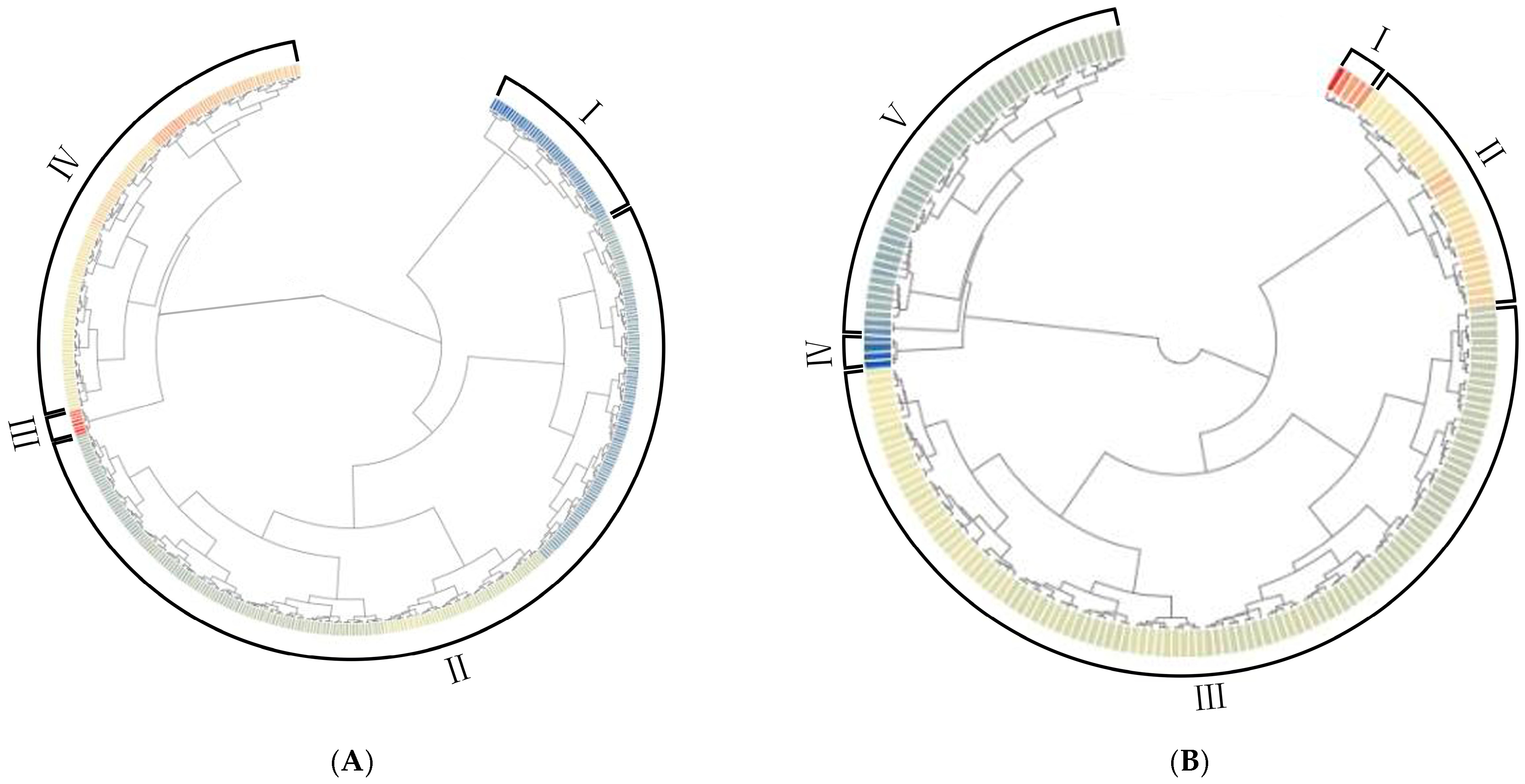
3.3. Cluster Analysis of Cottonseed Oil Content
3.4. Analysis of Cottonseed Oil Content, Phenotypic Statistics, and Variation
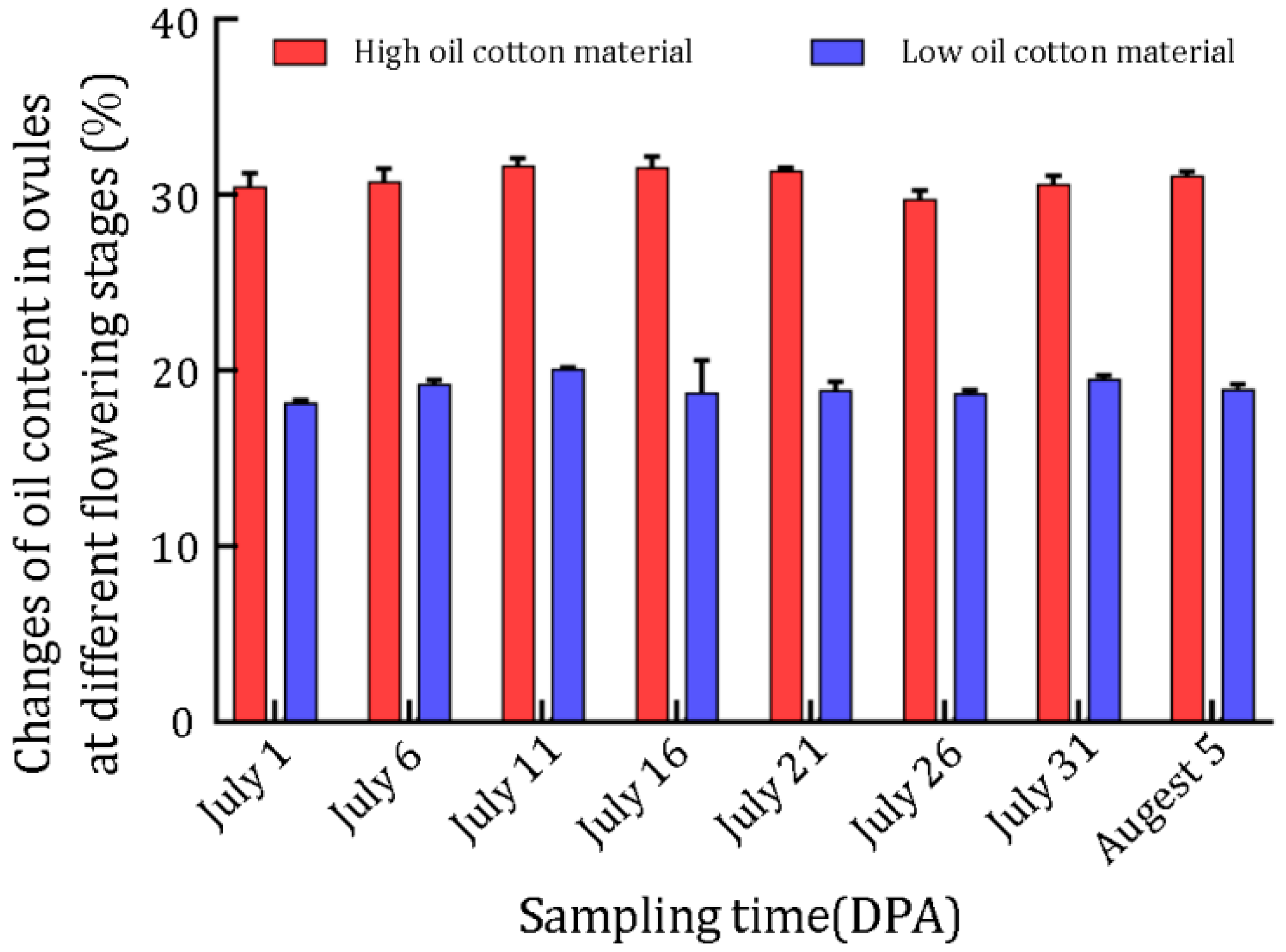
3.5. Dynamic Changes of Oil Content at Different Flowering Dates
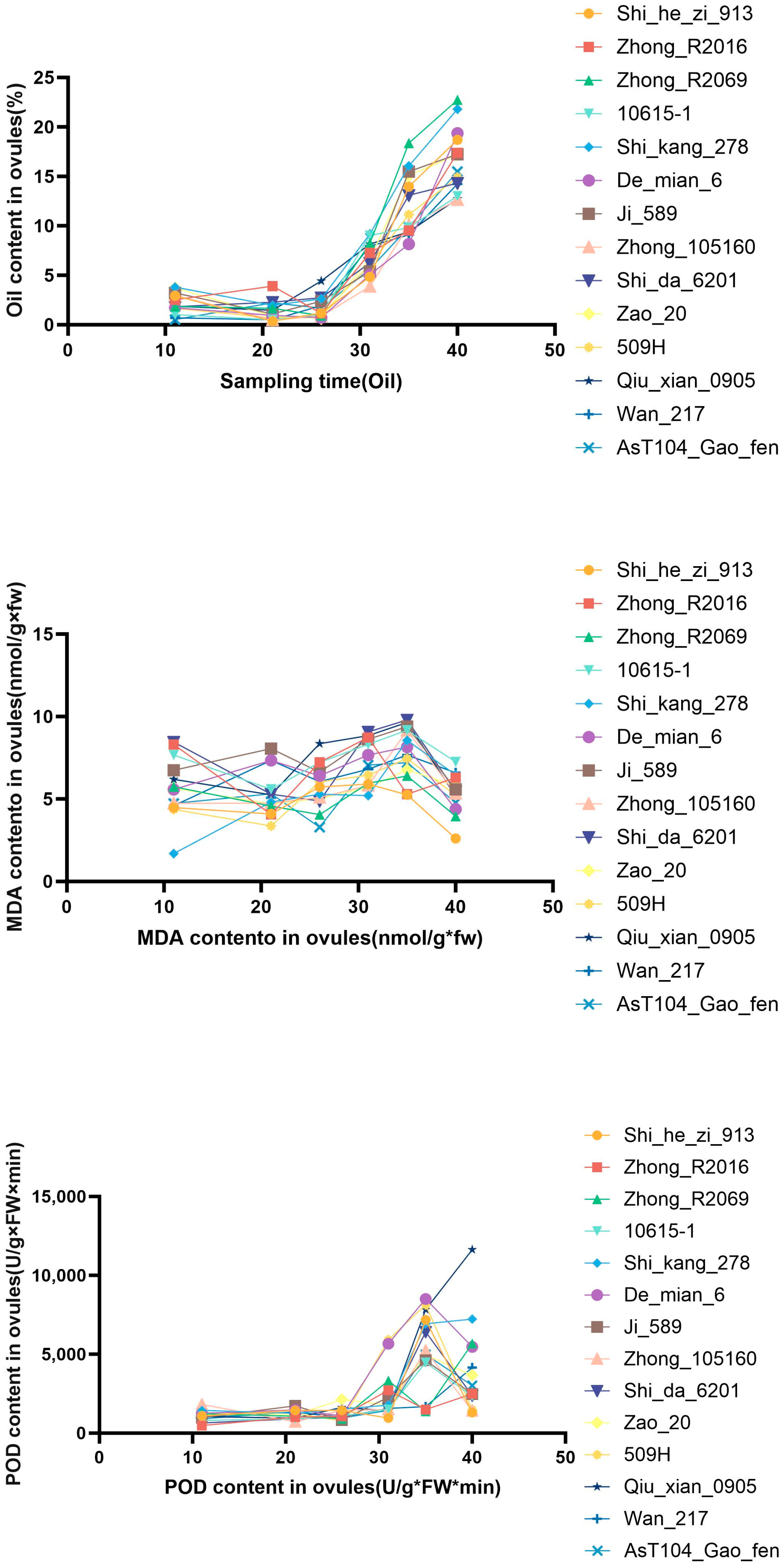
3.6. Dynamics of Oil Accumulation and Physiological Indexes at Different Flowering Dates
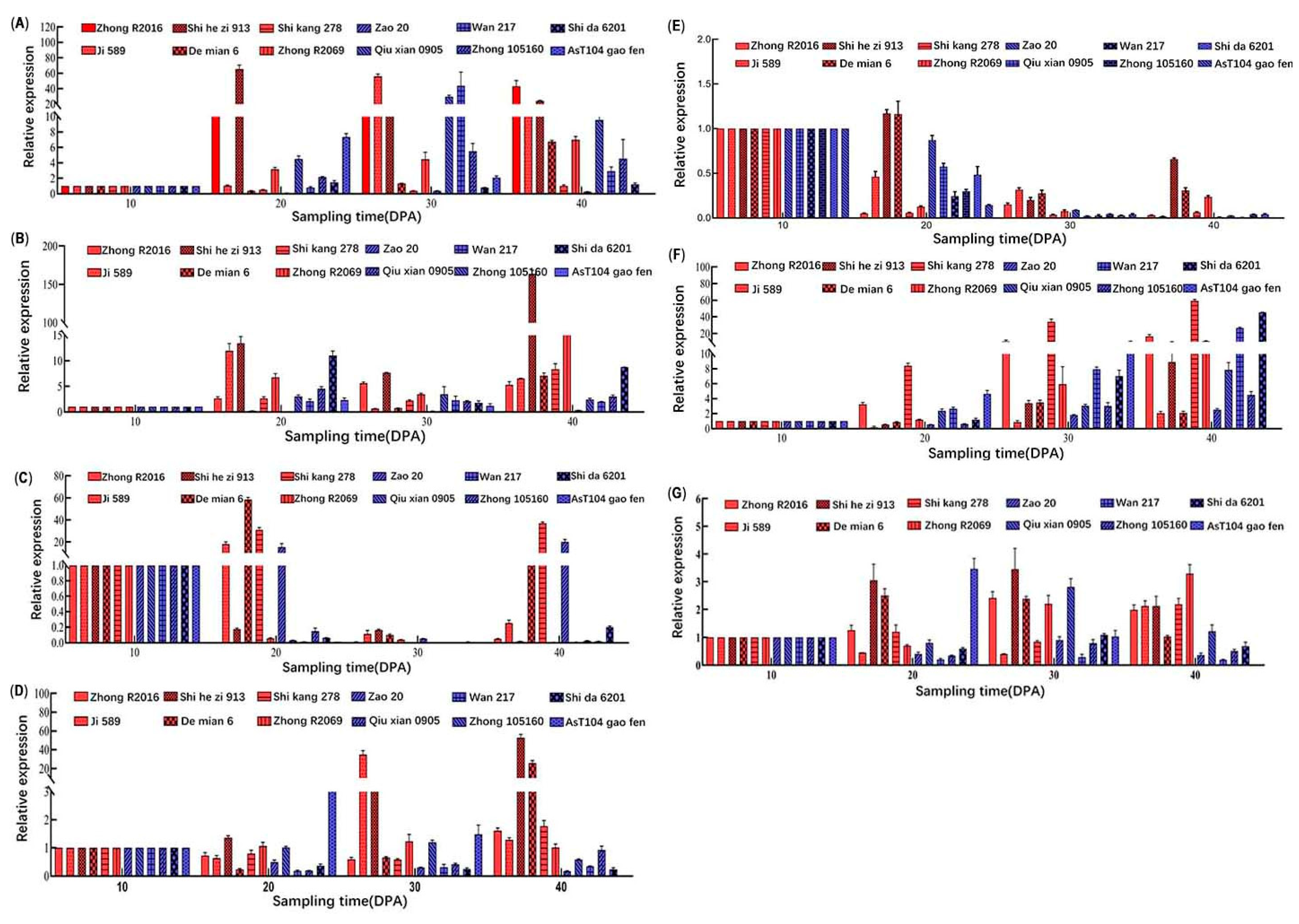
3.7. Screening Genes Related to Oil Content Accumulation
4. Conclusions
Supplementary Materials
Author Contributions
Funding
Data Availability Statement
Conflicts of Interest
Abbreviations
| ANOVA | Analysis of variance |
| CSM | Cottonseed meal |
| CV | Coefficient of variation |
| DPA | Days post anthesis |
| FBN | Fruit branch number |
| LP | Lint percentage |
| MDA | Malondialdehyde |
| MLP | Median lint percentage |
| MMT | Million metric tons |
| MOC | Median oil content |
| NFFB | Node of first fruiting branch |
| NIRS | Near-infrared reflectance spectroscopy |
| OC | Oil content |
| POD | Peroxidase |
| PH | Plant height |
| qRT-PCR | Quantitative real-time polymerase chain reaction |
| SD | Standard deviation |
| SI | Seed index |
| TBN | Total boll numbers |
References
- Zameer, R.; Ali, M.; Jalal, A.S.; Fiaz, S.; Attia, K.A.; Li, C.; Yu, C.; Azeem, F.; Li, Z.-F. Reproductive meristem (REM) family genes GhREM1 and GhREM5. 4 act as potential regulators of temperature stress response in cotton. Plant Physiol. Biochem. 2025, 224, 109767. [Google Scholar] [CrossRef]
- Sun, X.; Qin, A.; Wang, X.; Ge, X.; Liu, Z.; Guo, C.; Yu, X.; Zhang, X.; Lu, Y.; Yang, J. Spatiotemporal transcriptome and metabolome landscapes of cotton fiber during initiation and early development. Nat. Commun. 2025, 16, 858. [Google Scholar] [CrossRef]
- Naveed, S.; Gandhi, N.; Billings, G.; Jones, Z.; Campbell, B.T.; Jones, M.; Rustgi, S. Alterations in growth habit to channel end-of-season perennial reserves towards increased yield and reduced regrowth after defoliation in upland cotton (Gossypium hirsutum L.). Int. J. Mol. Sci. 2023, 24, 14174. [Google Scholar] [CrossRef]
- Li, Y.; Si, Z.; Wang, G.; Shi, Z.; Chen, J.; Qi, G.; Jin, S.; Han, Z.; Gao, W.; Tian, Y. Genomic insights into the genetic basis of cotton breeding in China. Mol. Plant 2023, 16, 662–677. [Google Scholar] [CrossRef]
- Zhou, Y.; Li, F.; Xin, Q.; Li, Y.; Lin, Z. Historical variability of cotton yield and response to climate and agronomic management in Xinjiang, China. Sci. Total Environ. 2024, 912, 169327. [Google Scholar] [CrossRef]
- Huang, G.; Zhu, Y.-X. Breeding cotton with superior fiber quality: Identification and utilization of multiple elite loci and exotic genetic resources. Sci. China Life Sci. 2021, 64, 1197–1198. [Google Scholar] [CrossRef]
- Huang, G.; Huang, J.-Q.; Chen, X.-Y.; Zhu, Y.-X. Recent advances and future perspectives in cotton research. Annu. Rev. Plant Biol. 2021, 72, 437–462. [Google Scholar] [CrossRef]
- Aslam, S.; Khan, S.H.; Ahmed, A.; Dandekar, A.M. The tale of cotton plant: From wild type to domestication, leading to its improvement by genetic transformation. Am. J. Mol. Biol. 2020, 10, 91–127. [Google Scholar] [CrossRef]
- Iqbal, A.; Aslam, S.; Ahmed, M.; Khan, F.; Ali, Q.; Han, S. Role of actin dynamics and GhACTIN1 gene in cotton fiber development: A prototypical cell for study. Genes 2023, 14, 1642. [Google Scholar] [CrossRef]
- Haigler, C.H.; Betancur, L.; Stiff, M.R.; Tuttle, J.R. Cotton fiber: A powerful single-cell model for cell wall and cellulose research. Front. Plant Sci. 2012, 3, 104. [Google Scholar] [CrossRef]
- Lee, J.J.; Woodward, A.W.; Chen, Z.J. Gene expression changes and early events in cotton fibre development. Ann. Bot. 2007, 100, 1391–1401. [Google Scholar] [CrossRef]
- Wang, J.; Wang, Q.; Huang, X.; Hu, W.; Wang, S.; Zhou, Z. Phosphorus-induced greater enhancement in carbon supply and storage for oil synthesis during the crucial period made cottonseed kernel oil yield have a higher increment than protein. Plant Physiol. Biochem. 2023, 200, 107781. [Google Scholar] [CrossRef] [PubMed]
- Tao, A.; Wang, J.; Luo, B.; Liu, B.; Wang, Z.; Chen, X.; Zou, T.; Chen, J.; You, J. Research progress on cottonseed meal as a protein source in pig nutrition: An updated review. Anim. Nutr. 2024, 18, 220–233. [Google Scholar] [CrossRef]
- Prater, M.C.; Cooper, J.A. Is Cottonseed Oil the Next Healthy Oil? J. Med. Food 2024, 27, 1141–1144. [Google Scholar] [CrossRef]
- Sharif, I.; Farooq, J.; Chohan, S.M.; Saleem, S.; Kainth, R.A.; Mahmood, A.; Sarwar, G. Strategies to enhance cottonseed oil contents and reshape fatty acid profile employing different breeding and genetic engineering approaches. J. Integr. Agric. 2019, 18, 2205–2218. [Google Scholar] [CrossRef]
- Zhang, Y.; Gong, H.; Cui, X.; Gao, C.; Li, N.; Pu, Y.; Zhang, X.; Zhao, J. Integrated lipidomic and transcriptomic analyses reveal the mechanism of lipid biosynthesis and accumulation during seed development in sesame. Front. Plant Sci. 2023, 14, 1211040. [Google Scholar] [CrossRef]
- Hu, Y.; Han, Z.; Shen, W.; Jia, Y.; He, L.; Si, Z.; Wang, Q.; Fang, L.; Du, X.; Zhang, T. Identification of candidate genes in cotton associated with specific seed traits and their initial functional characterization in Arabidopsis. Plant J. 2022, 112, 800–811. [Google Scholar] [CrossRef]
- Le, Y.; Zhao, W.; Liu, X.; Chen, M.; Xiong, X.; Zhang, X.; Lin, Z. Natural variation in GhKASI_A05 modulates cottonseed oil content in Gossypium hirsutum L. Plant Physiol. Biochem. 2024, 216, 109159. [Google Scholar] [CrossRef]
- Gutierrez, J.; Komarnytsky, S. Cottonseed oil composition and its application to skin health and personal care. Front. Pharmacol. 2025, 16, 1559139. [Google Scholar] [CrossRef]
- Ekanayake-Mudiyanselage, S.; Thiele, J. Sebaceous glands as transporters of vitamin E. Hautarzt Z. Dermatol. Venerol. Verwandte Geb. 2006, 57, 291–296. [Google Scholar] [CrossRef]
- Cao, H.; Sethumadhavan, K.; Wu, X.; Zeng, X.; Zhang, L. Cottonseed extracts regulate gene expression in human colon cancer cells. Sci. Rep. 2022, 12, 1039. [Google Scholar] [CrossRef]
- Hinze, L.L.; Horn, P.J.; Kothari, N.; Dever, J.K.; Frelichowski, J.; Chapman, K.D.; Percy, R.G. Nondestructive measurements of cottonseed nutritional trait diversity in the US National Cotton Germplasm Collection. Crop Sci. 2015, 55, 770–782. [Google Scholar] [CrossRef]
- Yin, X.; Chen, M.; Yang, C.; Duan, C.; Ji, S.; Yan, H.; Liu, Y.; Zhang, Y. Effects of Replacing Soybean Meal with Cottonseed Meal, Peanut Meal, Rapeseed Meal, or Distillers’ Dried Grains with Solubles on the Growth Performance, Nutrient Digestibility, Serum Parameters, and Rumen Fermentation in Growing Lambs. Vet. Sci. 2024, 11, 322. [Google Scholar] [CrossRef]
- Yu, J.; Yang, Z.; Yang, H.; Wang, Z. Effects of cottonseed meal on growth performance, liver redox status, and serum biochemical parameters in goslings at 1 to 28 days of age. BMC Vet. Res. 2022, 18, 347. [Google Scholar] [CrossRef]
- Yu, J.; Yang, H.; Sun, Q.; Xu, X.; Yang, Z.; Wang, Z. Effects of cottonseed meal on performance, gossypol residue, liver function, lipid metabolism, and cecal microbiota in geese. J. Anim. Sci. 2023, 101, skad020. [Google Scholar] [CrossRef]
- Tan, C.F.; Kwan, S.H.; Lee, C.S.; Soh, Y.N.A.; Ho, Y.S.; Bi, X. Cottonseed meal protein isolate as a new source of alternative proteins: A proteomics perspective. Int. J. Mol. Sci. 2022, 23, 10105. [Google Scholar] [CrossRef]
- Xu, Y.X.; Ding, Z.L.; He, X.H.; Fei, H. Cottonseed protein concentrate as fish meal substitution in fish diet: A review. Fish Physiol. Biochem. 2025, 51, 112. [Google Scholar] [CrossRef]
- Zhang, L.; Zheng, H.; Zhang, X.; Chen, X.; Liu, Y.; Tang, Y.; Zhang, W.; Wang, Z.; Zhao, L.; Guo, Y. Effective degradation of free gossypol in defatted cottonseed meal by bacterial laccases: Performance and toxicity analysis. Foods 2024, 13, 566. [Google Scholar] [CrossRef]
- Han, X.; Xing, Y.; Zhu, Y.; Luo, L.; Liu, L.; Zhai, Y.; Wang, W.; Shao, R.; Ren, M.; Li, F. GhMYC2 activates cytochrome P450 gene CYP71BE79 to regulate gossypol biosynthesis in cotton. Planta 2022, 256, 63. [Google Scholar] [CrossRef]
- Mattison, C.P.; He, Z.; Zhang, D.; Dupre, R.; Lloyd, S.W. Cross-serological reaction of glandless cottonseed proteins to peanut and tree nut allergic IgE. Molecules 2023, 28, 1587. [Google Scholar] [CrossRef]
- Han, Q.; Zhu, G.; Qiu, H.; Li, M.; Zhang, J.; Wu, X.; Xiao, R.; Zhang, Y.; Yang, W.; Tian, B. Quality traits drive the enrichment of Massilia in the rhizosphere to improve soybean oil content. Microbiome 2024, 12, 224. [Google Scholar] [CrossRef]
- Wu, M.; Pei, W.; Wedegaertner, T.; Zhang, J.; Yu, J. Genetics, breeding and genetic engineering to improve cottonseed oil and protein: A review. Front. Plant Sci. 2022, 13, 864850. [Google Scholar] [CrossRef]
- Ma, Z.; He, S.; Wang, X.; Sun, J.; Zhang, Y.; Zhang, G.; Wu, L.; Li, Z.; Liu, Z.; Sun, G. Resequencing a core collection of upland cotton identifies genomic variation and loci influencing fiber quality and yield. Nat. Genet. 2018, 50, 803–813. [Google Scholar] [CrossRef]
- Baran, N.; Shimira, F.; Nadeem, M.A.; Altaf, M.T.; Andirman, M.; Baloch, F.S.; Gültekin Temiz, M. Exploring the genetic diversity and population structure of upland cotton germplasm by iPBS-retrotransposons markers. Mol. Biol. Rep. 2023, 50, 4799–4811. [Google Scholar] [CrossRef]
- Li, Q.; Zhang, H.; Zhou, W.; Liu, R.; Dong, X.; Jin, G. Rapid and non-destructive determination of oil content in fuzzy cottonseeds via near-infrared reflectance spectroscopy. Microchem. J. 2024, 207, 112005. [Google Scholar] [CrossRef]
- Saun, N.K.; Mehta, P.; Gupta, R. Purification and physicochemical properties of lipase from thermophilic Bacillus aerius. J. Oleo Sci. 2014, 63, 1261–1268. [Google Scholar] [CrossRef]
- Liu, Z.; Pan, J. A practical method for extending the biuret assay to protein determination of corn-based products. Food Chem. 2017, 224, 289–293. [Google Scholar] [CrossRef]
- Li, Y.; Li, Y.; Wang, Q.; Jia, M.; Qian, W. Determination of free gossypol content in cotton products at different drying temperatures. Feed Res. 2022, 45, 108–112. [Google Scholar]
- He, W.; Ke, X.; Li, T.; Wu, Y.; Tang, X.; Chen, W.; Liu, T.; Du, H. Comparison and improvement of RNA extraction methods in Sargassum (Phaeophyta). J. Phycol. 2023, 59, 822–834. [Google Scholar] [CrossRef]
- Yuan, D.; Tang, Z.; Wang, M.; Gao, W.; Tu, L.; Jin, X.; Chen, L.; He, Y.; Zhang, L.; Zhu, L.; et al. The genome sequence of Sea-Island cotton (Gossypium barbadense) provides insights into the allopolyploidization and development of superior spinnable fibres. Sci. Rep. 2015, 5, 17662. [Google Scholar] [CrossRef]
- Bellaloui, N.; Turley, R.B.; Stetina, S.R. Cottonseed protein, oil, and minerals in cotton (Gossypium hirsutum L.) lines differing in curly leaf morphology. Plants 2021, 10, 525. [Google Scholar] [CrossRef]
- Campbell, B.T.; Chapman, K.D.; Sturtevant, D.; Kennedy, C.; Horn, P.; Chee, P.W.; Lubbers, E.; Meredith, W.R.; Johnson, J.; Fraser, D.; et al. Genetic Analysis of Cottonseed Protein and Oil in a Diverse Cotton Germplasm. Crop Sci. 2016, 56, 2457–2464. [Google Scholar] [CrossRef]
- Singh, A.; Kaur, A. Comparative studies on seed protein characteristics in eight lines of two Gossypium species. J. Cotton Res. 2019, 2, 6. [Google Scholar] [CrossRef]
- Yu, J.; Yu, S.; Fan, S.; Song, M.; Zhai, H.; Li, X.; Zhang, J. Mapping quantitative trait loci for cottonseed oil, protein and gossypol content in a Gossypium hirsutum× Gossypium barbadense backcross inbred line population. Euphytica 2012, 187, 191–201. [Google Scholar] [CrossRef]
- Kandel, S.; Holguin, F.O.; Galvan, C.; Zhu, Y.; Dever, J.; Kelly, C.; Whitelock, D.; Zhang, J. Improvement of Cottonseed Oil and Fatty Acids Through Introgression Breeding in Upland Cotton. Plants 2025, 14, 3078. [Google Scholar] [CrossRef]
- Tefera, N.T.; Nallamothu, R.B.; Lakew, G.A.; Kurse, T.K. Optimization of biodiesel production from cottonseed oil using response surface methodology and artificial neural network techniques. Sci. Afr. 2025, 28, e02665. [Google Scholar] [CrossRef]
- Xu, Z.; Li, J.; Guo, X.; Jin, S.; Zhang, X. Metabolic engineering of cottonseed oil biosynthesis pathway via RNA interference. Sci. Rep. 2016, 6, 33342. [Google Scholar] [CrossRef]
- Paunovic, D.; Rajkovic, J.; Novakovic, R.; Grujic-Milanovic, J.; Mekky, R.H.; Popa, D.; Calina, D.; Sharifi-Rad, J. The potential roles of gossypol as anticancer agent: Advances and future directions. Chin. Med. 2023, 18, 163. [Google Scholar] [CrossRef]
- Yuan, Y.; Wang, X.; Wang, L.; Xing, H.; Wang, Q.; Saeed, M.; Tao, J.; Feng, W.; Zhang, G.; Song, X.L.; et al. Genome-Wide Association Study Identifies Candidate Genes Related to Seed Oil Composition and Protein Content in Gossypium hirsutum L. Front. Plant Sci. 2018, 9, 1359. [Google Scholar] [CrossRef]
- Hu, W.; Chen, M.-l.; Zhao, W.-q.; Chen, B.-l.; Wang, Y.-h.; Wang, S.-s.; Meng, Y.-l.; Zhou, Z.-g. The effects of sowing date on cottonseed properties at different fruiting-branch positions. J. Integr. Agric. 2017, 16, 1322–1330. [Google Scholar] [CrossRef][Green Version]
- Pabuayon, I.L.B.; Kelly, B.R.; Mitchell-McCallister, D.; Coldren, C.L.; Ritchie, G.L. Cotton boll distribution: A review. Agron. J. 2021, 113, 956–970. [Google Scholar] [CrossRef]
- Pettigrew, W.T.; Dowd, M.K. Varying Planting Dates or Irrigation Regimes Alters Cottonseed Composition. Crop Sci. 2011, 51, 2155–2164. [Google Scholar] [CrossRef]
- Saini, D.K.; Impa, S.M.; McCallister, D.; Patil, G.B.; Abidi, N.; Ritchie, G.; Jaconis, S.Y.; Jagadish, K.S.V. High day and night temperatures impact on cotton yield and quality—Current status and future research direction. J. Cotton Res. 2023, 6, 16. [Google Scholar] [CrossRef]
- Jiao, X.; Zhao, X.; Zhou, X.R.; Green, A.G.; Fan, Y.; Wang, L.; Singh, S.P.; Liu, Q. Comparative transcriptomic analysis of developing cotton cotyledons and embryo axis. PLoS ONE 2013, 8, e71756. [Google Scholar] [CrossRef]
- Hasanuzzaman, M.; Raihan, M.R.H.; Masud, A.A.C.; Rahman, K.; Nowroz, F.; Rahman, M.; Nahar, K.; Fujita, M. Regulation of Reactive Oxygen Species and Antioxidant Defense in Plants under Salinity. Int. J. Mol. Sci. 2021, 22, 9326. [Google Scholar] [CrossRef]
- Liu, Y.-H.; Zhang, M.; Sze, S.-H.; Smith, C.W.; Zhang, H.-B. Analysis of the genes controlling cotton fiber length reveals the molecular basis of plant breeding and the genetic potential of current cultivars for continued improvement. Plant Sci. 2022, 321, 111318. [Google Scholar] [CrossRef]
- Chen, B.; Wang, J.; Zhang, G.; Liu, J.; Manan, S.; Hu, H.; Zhao, J. Two types of soybean diacylglycerol acyltransferases are differentially involved in triacylglycerol biosynthesis and response to environmental stresses and hormones. Sci. Rep. 2016, 6, 28541. [Google Scholar] [CrossRef]
- Yin, X.; Guo, X.; Hu, L.; Li, S.; Chen, Y.; Wang, J.; Wang, R.R.-C.; Fan, C.; Hu, Z. Genome-wide characterization of DGATs and their expression diversity analysis in response to abiotic stresses in Brassica napus. Plants 2022, 11, 1156. [Google Scholar] [CrossRef]
- Verwoert, I.I.; van der Linden, K.H.; Nijkamp, H.J.J.; Stuitje, A.R. Developmental specific expression and organelle targeting of the Escherichia coli fabD gene, encoding malonyl coenzyme A-acyl carrier protein transacylase in transgenic rape and tobacco seeds. Plant Mol. Biol. 1994, 26, 189–202. [Google Scholar] [CrossRef]
- Dwiyanti, M.S.; Yamada, T.; Sato, M.; Abe, J.; Kitamura, K. Genetic variation of γ-tocopherol methyltransferase gene contributes to elevated α-tocopherol content in soybean seeds. BMC Plant Biol. 2011, 11, 152. [Google Scholar] [CrossRef]
- Song, J.; Pei, W.; Wang, N.; Ma, J.; Xin, Y.; Yang, S.; Wang, W.; Chen, Q.; Zhang, J.; Yu, J. Transcriptome analysis and identification of genes associated with oil accumulation in upland cotton. Physiol. Plant. 2022, 174, e13701. [Google Scholar] [CrossRef]
- Torabi, S.; Sukumaran, A.; Dhaubhadel, S.; Johnson, S.E.; LaFayette, P.; Parrott, W.A.; Rajcan, I.; Eskandari, M. Effects of type I Diacylglycerol O-acyltransferase (DGAT1) genes on soybean (Glycine max L.) seed composition. Sci. Rep. 2021, 11, 2556. [Google Scholar] [CrossRef]
- Zhao, Y.-P.; Wu, N.; Li, W.-J.; Shen, J.-L.; Chen, C.; Li, F.-G.; Hou, Y.-X. Evolution and characterization of acetyl coenzyme A: Diacylglycerol acyltransferase genes in cotton identify the roles of GhDGAT3D in oil biosynthesis and fatty acid composition. Genes 2021, 12, 1045. [Google Scholar] [CrossRef]
- Zheng, P.; Allen, W.B.; Roesler, K.; Williams, M.E.; Zhang, S.; Li, J.; Glassman, K.; Ranch, J.; Nubel, D.; Solawetz, W. A phenylalanine in DGAT is a key determinant of oil content and composition in maize. Nat. Genet. 2008, 40, 367–372. [Google Scholar] [CrossRef]
- Zou, J.; Wei, Y.; Jako, C.; Kumar, A.; Selvaraj, G.; Taylor, D.C. The Arabidopsis thaliana TAG1 mutant has a mutation in a diacylglycerol acyltransferase gene. Plant J. 1999, 19, 645–653. [Google Scholar] [CrossRef]
- Shockey, J.; Parchuri, P.; Thyssen, G.N.; Bates, P.D. Assessing the biotechnological potential of cotton type-1 and type-2 diacylglycerol acyltransferases in transgenic systems. Plant Physiol. Biochem. 2023, 196, 940–951. [Google Scholar] [CrossRef]
- Wang, H.; Fan, M.; Shen, Y.; Zhao, H.; Weng, S.; Chen, Z.; Xiao, G. GhFAD3-4 Promotes Fiber Cell Elongation and Cell Wall Thickness by Increasing PI and IP3 Accumulation in Cotton. Plants 2024, 13, 1510. [Google Scholar] [CrossRef]
- Liu, Q.; Wu, M.; Zhang, B.; Shrestha, P.; Petrie, J.; Green, A.G.; Singh, S.P. Genetic enhancement of palmitic acid accumulation in cotton seed oil through RNA i down-regulation of gh KAS 2 encoding β-ketoacyl-ACP synthase II (KASII). Plant Biotechnol. J. 2017, 15, 132–143. [Google Scholar] [CrossRef]
- Wang, J.; Wang, X.; Wang, L.; Nazir, M.F.; Fu, G.; Peng, Z.; Chen, B.; Xing, A.; Zhu, M.; Ma, X. Exploring the regulatory role of non-coding RNAs in fiber development and direct regulation of GhKCR2 in the fatty acid metabolic pathway in upland cotton. Int. J. Biol. Macromol. 2024, 266, 131345. [Google Scholar] [CrossRef]
- Pidkowich, M.S.; Nguyen, H.T.; Heilmann, I.; Ischebeck, T.; Shanklin, J. Modulating seed β-ketoacyl-acyl carrier protein synthase II level converts the composition of a temperate seed oil to that of a palm-like tropical oil. Proc. Natl. Acad. Sci. USA 2007, 104, 4742–4747. [Google Scholar] [CrossRef]



| Parameter | Traditional Classical Method | Near-Infrared Reflectance Spectroscopy | |||||
|---|---|---|---|---|---|---|---|
| Oil Content/% | Protein Content/% | Gossypol Content/mg/g | Protein + Oil Content/% | Oil Content/% | Protein Content/% | Protein + Oil Content/% | |
| Upland cotton | |||||||
| Maximum | 43.56 | 49.79 | 2.07 | 71.82 | 31.47 | 38.49 | 59.57 |
| Minimum | 12.74 | 15.53 | 0.06 | 32.81 | 12.56 | 11.90 | 30.56 |
| Average | 21.23 | 23.63 | 1.47 | 44.86 | 19.78 | 24.37 | 44.15 |
| SD | 3.98 | 4.63 | 0.21 | 6.07 | 2.04 | 2.10 | 2.67 |
| CV/% | 18.76 | 19.59 | 14.02 | 13.54 | 10.30 | 8.64 | 6.04 |
| Sea island cotton | |||||||
| Maximum | 41.43 | 39.00 | 2.08 | 71.95 | 28.70 | 27.68 | 52.50 |
| Minimum | 14.64 | 18.84 | 1.22 | 40.47 | 17.66 | 19.69 | 41.10 |
| Average | 24.82 | 25.75 | 1.60 | 50.56 | 22.27 | 22.97 | 45.24 |
| SD | 6.15 | 2.09 | 0.15 | 6.44 | 2.04 | 1.90 | 1.42 |
| CV/% | 24.78 | 8.13 | 9.48 | 12.74 | 9.18 | 8.25 | 3.13 |
| Main Content | Traditional Classical Method | Near-Infrared Reflectance Spectroscopy | |||
|---|---|---|---|---|---|
| Protein Content/% | Oil Content/% | Gossypol Content/mg/g | Protein Content/% | Oil Content/% | |
| Upland cotton | |||||
| Protein content/% | 1 | −0.125 ** | −0.375 ** | 1 | −0.171 ** |
| Oil content/% | −0.125 ** | 1 | 0.409 ** | −0.171 ** | 1 |
| Gossypol content/mg/g | −0.375 ** | 0.409 ** | 1 | - | - |
| Sea island cotton | |||||
| Protein content/% | 1 | −0.028 | 0.003 | 1 | −0.744 ** |
| Oil content/% | −0.028 | 1 | 0.038 | −0.744 ** | 1 |
| Index | Oil Content/% | SI/g | LP/% | PH/cm | BSH/cm | FBN | TBN |
|---|---|---|---|---|---|---|---|
| Minimum | 18.15 | 8.00 | 29.58 | 49.00 | 12.20 | 7.40 | 6.00 |
| Median | 26.04 | 9.29 | 36.68 | 61.00 | 16.00 | 8.20 | 7.90 |
| Maximum | 34.29 | 13.00 | 40.07 | 76.00 | 19.40 | 9.60 | 15.20 |
| Average | 25.64 | 9.72 | 36.16 | 60.44 | 15.91 | 8.21 | 8.24 |
| SD | 6.61 | 1.30 | 3.06 | 7.86 | 2.12 | 0.62 | 2.24 |
| CV/% | 25.77 | 13.41 | 8.46 | 13.00 | 13.32 | 7.61 | 27.22 |
| Index | MOC/% | OC/% | MSI | SI | MLP | LP | PH | NFFB | FBN | TBN |
|---|---|---|---|---|---|---|---|---|---|---|
| MOC/% | 1 | 0.986 ** | 0.861 ** | 0.826 ** | −0.163 | −0.249 | −0.281 | −0.196 | 0.274 | −0.058 |
| OC/% | 0.986 ** | 1 | 0.851 ** | 0.831 ** | −0.128 | −0.217 | −0.267 | −0.162 | 0.273 | −0.039 |
| MSI | 0.861 ** | 0.851 ** | 1 | 0.950 ** | 0.035 | −0.02 | −0.037 | 0.067 | 0.261 | −0.071 |
| SI | 0.826 ** | 0.831 ** | 0.950 ** | 1 | 0.087 | 0.006 | −0.045 | 0.045 | 0.328 | 0.014 |
| MLP | −0.163 | −0.128 | 0.035 | 0.087 | 1 | 0.938 ** | 0.432 | 0.493 | 0.257 | 0.17 |
| LP | −0.249 | −0.217 | −0.02 | 0.006 | 0.938 ** | 1 | 0.564 * | 0.522 | 0.258 | 0.217 |
| PH | −0.281 | −0.267 | −0.037 | −0.045 | 0.432 | 0.564 * | 1 | 0.761 ** | 0.585 * | 0.646 * |
| NFFB | −0.196 | −0.162 | 0.067 | 0.045 | 0.493 | 0.522 | 0.761 ** | 1 | 0.254 | 0.413 |
| FBN | 0.274 | 0.273 | 0.261 | 0.328 | 0.257 | 0.258 | 0.585 * | 0.254 | 1 | 0.836 ** |
| TBN | −0.058 | −0.039 | −0.071 | 0.014 | 0.17 | 0.217 | 0.646 * | 0.413 | 0.836 ** | 1 |
| Varieties | Pollination Date (Month-Day) | |||||||
|---|---|---|---|---|---|---|---|---|
| 07-01 | 07-06 | 07-11 | 07-16 | 07-21 | 07-26 | 07-31 | 08-05 | |
| High oil cotton materials | ||||||||
| Shi he zi 913 | 31.15 ab | 30.82 ab | 32.56 ab | 33.78 a | 32.20 ab | 31.00 ab | 29.51 b | 31.95 ab |
| Zhong R2016 | 33.58 a | 34.38 a | 34.54 a | 34.00 a | 34.72 a | 35.24 a | 34.45 a | 32.71 a |
| Zhong R2069 | 28.19 ab | 30.29 a | 24.71 cd | 25.36 cd | 24.36 d | 23.38 d | 26.83 bc | 28.56 ab |
| 10615-1 | 27.49 c | 28.69 c | 28.22 c | 28.85 bc | 30.17 abc | 28.74 c | 32.03 a | 31.46 ab |
| Shi kang 278 | 25.28 cd | 26.38 bc | 25.30 cd | 27.77 ab | 27.74 ab | 24.36 d | 28.08 ab | 29.49 a |
| De mian 6 | 32.48 b | 29.63 c | 34.52 a | 34.90 a | 33.03 b | 32.25 b | 34.74 a | 32.87 b |
| Ji 589 | 35.41 ab | 35.44 ab | 34.51 ab | 33.10 b | 37.56 a | 33.51 b | 36.21 ab | 34.28 ab |
| Low oil cotton materials | ||||||||
| Zhong 105160 | 18.93 ab | 19.42 ab | 18.99 ab | 19.20 ab | 17.77 b | 19.05 ab | 20.71 ab | 22.82 a |
| Shi da 6201 | 17.55 ab | 18.42 a | 17.51 ab | 17.09 ab | 16.62 bc | 15.85 c | 18.24 ab | 18.32 ab |
| Zao 20 | 16.31 d | 18.25 bc | 18.32 bc | 18.22 bc | 20.66 a | 18.09 bc | 19.10 b | 17.16 cd |
| 509 H | 19.27 c | 19.11 c | 21.82 ab | 18.93 c | 20.56 bc | 19.13 c | 22.74 a | 20.56 bc |
| Qiu xian 0905 | 18.81 abc | 19.64 ab | 19.34 ab | 19.12 abc | 17.05 b | 20.02 a | 19.24 abc | 17.46 bc |
| Wan 217 | 21.03 a | 20.74 a | 21.55 a | 21.81 a | 20.66 a | 21.21 a | 20.40 a | 20.06 a |
| AsT104 gao fen | 16.44 c | 19.21 b | 19.15 b | 18.45 b | 18.99 b | 17.22 c | 20.43 a | 18.32 b |
| Varieties | Content | Pollination Date (Month-Day) | |||||
|---|---|---|---|---|---|---|---|
| 07-11 | 07-21 | 07-26 | 07-31 | 08-05 | 08-10 | ||
| Shi he zi 913 | Oil/% | 2.92 d | 0.37 e | 1.17 e | 4.84 c | 13.97 b | 18.70 a |
| MDA nmol/g × Fw | 4.48 c | 4.09 d | 5.73 a | 5.91 a | 5.26 b | 2.60 e | |
| POD U/g × Fw × min | 1093.33 b | 1440.00 b | 1440.00 b | 960.00 b | 7186.67 a | 1306.67 b | |
| Zhong R2016 | Oil/% | 2.53 d e | 3.91 d | 1.16 e | 7.25 c | 9.54 b | 17.39 a |
| MDA nmol/g × Fw | 8.30 ab | 4.07 e | 7.23 bc | 8.73 a | 5.29 d | 6.29 cd | |
| POD U/g × Fw × min | 480.00 d | 1013.33 c | 1066.67 c | 2720.00 a | 1493.33 b | 2493.33 a | |
| Zhong R2069 | Oil/% | 1.86 d | 1.65 d | 0.92 d | 8.23 c | 18.37 b | 22.74 a |
| MDA nmol/g × Fw | 5.74 a | 4.57 b | 4.06 b | 5.96 a | 6.40 a | 3.95 b | |
| POD U/g × Fw × min | 1226.67 c | 1066.67 c | 906.67 c | 3333.33 b | 1386.67 c | 5680 a | |
| 10615-1 | Oil/% | 1.04 c | 0.52 b | 1.03 b | 9.00 b | 9.84 b | 13.00 a |
| MDA nmol/g × Fw | 7.67 c | 5.60 d | 7.22 c | 8.32 b | 9.17 a | 7.25 c | |
| POD U/g × Fw × min | 800.00 c | 906.67 c | 1093.33 c | 1506.67 c | 4480.00 a | 2346.67 b | |
| Shi kang 278 De mian 6 | Oil/% | 3.80 d | 1.96 e | 2.61 e | 9.18 c | 16.06 b | 21.81 a |
| MDA nmol/g × Fw | 1.69 a | 4.82 c | 5.29 c | 5.21 c | 8.55 a | 6.47 b | |
| POD U/g × Fw × min | 1440.00 b | 1253.33 b | 1520.00 b | 1786.67 b | 6933.33 a | 7226.67 a | |
| Oil/% | 1.71 d | 0.95 d e | 0.71 e | 5.06 c | 8.16 b | 19.36 a | |
| MDA nmol/g × Fw | 5.58 e | 7.34 c | 6.41 d | 7.67 b | 8.16 a | 4.38 f | |
| POD U/g × Fw × min | 1253.33 c | 1466.67 c | 1093.33 c | 5666.67 b | 8506.67 a | 5466.67 b | |
| Ji 589 | Oil/% | 3.21 d | 1.10 e | 2.39 d, e | 5.38 c | 15.48 b | 17.24 a |
| MDA nmol/g × Fw | 6.74 d | 8.06 c | 6.63 d | 8.62 b | 9.39 a | 5.58 e | |
| POD U/g × Fw × min | 986.67 d | 1733.33 c | 826.67 d | 2266.67 bc | 4613.33 a | 2480.00 b | |
| Zhong 105160 | Oil/% | 2.97 c | 0.49 d | 0.87 d | 3.87 c | 10.04 b | 12.64 a |
| MDA nmol/g × Fw | 4.73 c | 4.75 c | 5.09 bc | 5.82 b | 9.15 a | 5.33 bc | |
| POD U/g × Fw × min | 1813.33 b | 720.00 c | 1440.00 b | 1493.33 b | 5226.67 a | 1413.33 b | |
| Shi da 6201 | Oil/% | 1.82 c | 2.28 c | 2.74 c | 6.24 b | 13.10 a | 14.33 a |
| MDA nmol/g × Fw | 8.46 c | 5.29 de | 4.88 e | 9.07 b | 9.79 a | 5.47 d | |
| POD U/g × Fw × min | 640.00 d | 906.67 d | 1013.33 d | 1573.33 c | 6413.33 a | 2386.67 b | |
| Zao 20 | Oil/% | 3.72 d | 0.88 e | 0.63 e | 6.67 c | 15.09 b | 17.20 a |
| MDA nmol/g × Fw | 5.66 b | 4.70 c | 5.03 bc | 5.70 b | 6.77 a | 5.81 b | |
| POD U/g × Fw × min | 1173.33 d | 1146.67 d | 2133.33 c | 1786.67 cd | 4960.00 a | 3680.00 b | |
| 509H | Oil/% | 1.66 d | 0.69 d | 0.97 d | 6.07 c | 11.14 b | 14.91 a |
| MDA nmol/g × Fw | 4.37 e | 3.37 f | 6.04 c | 6.44 b | 7.45 a | 5.23 d | |
| POD U/g × Fw × min | 1280.00 c | 1253.33 c | 773.33 c | 5920.00 b | 8133.33 a | 1493.33 e | |
| Qiu xian 0905 | Oil/% | 1.87 d | 1.47 d | 4.42 c | 8.15 b | 9.40 b | 12.73 a |
| MDA nmol/g × Fw | 6.19 d | 5.25 e | 8.36 c | 8.84 b | 9.64 a | 5.18 e | |
| POD U/g × Fw × min | 1040.00 c | 960.00 c | 1626.67 c | 1413.33 c | 7826.67 b | 11626.67 a | |
| Wan 217 | Oil/% | 0.70 e | 0.50 e | 1.93 d | 7.95 c | 9.10 b | 14.24 a |
| MDA nmol/g × Fw | 4.60 e | 7.34 ab | 6.06 d | 6.80 bc | 7.67 a | 6.59 cd | |
| POD U/g × Fw × min | 1013.33 c | 1333.33 bc | 1013.33 c | 1573.33 b | 1680.00 b | 4160.00 a | |
| AsT104 Gao fen | Oil/% | 0.54 e | 2.22 d | 1.68 d | 5.63 c | 9.86 b | 15.48 a |
| MDA nmol/g × Fw | 4.73 c | 5.32 b | 3.30 d | 7.05 a | 7.21 a | 4.78 c | |
| POD U/g × Fw × min | 906.67 c | 1360.00 c | 960.00 c | 1440.00 c | 4986.67 a | 3013.33 b | |
Disclaimer/Publisher’s Note: The statements, opinions and data contained in all publications are solely those of the individual author(s) and contributor(s) and not of MDPI and/or the editor(s). MDPI and/or the editor(s) disclaim responsibility for any injury to people or property resulting from any ideas, methods, instructions or products referred to in the content. |
© 2025 by the authors. Licensee MDPI, Basel, Switzerland. This article is an open access article distributed under the terms and conditions of the Creative Commons Attribution (CC BY) license.
Share and Cite
Liu, P.; Wang, Z.; Lu, X.; Chang, Y.; Zheng, K.; Zu, Q.; Deng, X. Chemical Composition and Expression Analysis of Oil-Related Genes in Upland Cottonseeds. Agronomy 2026, 16, 56. https://doi.org/10.3390/agronomy16010056
Liu P, Wang Z, Lu X, Chang Y, Zheng K, Zu Q, Deng X. Chemical Composition and Expression Analysis of Oil-Related Genes in Upland Cottonseeds. Agronomy. 2026; 16(1):56. https://doi.org/10.3390/agronomy16010056
Chicago/Turabian StyleLiu, Pengfei, Zhong Wang, Xiaoshuang Lu, Yujie Chang, Kai Zheng, Qianli Zu, and Xiaojuan Deng. 2026. "Chemical Composition and Expression Analysis of Oil-Related Genes in Upland Cottonseeds" Agronomy 16, no. 1: 56. https://doi.org/10.3390/agronomy16010056
APA StyleLiu, P., Wang, Z., Lu, X., Chang, Y., Zheng, K., Zu, Q., & Deng, X. (2026). Chemical Composition and Expression Analysis of Oil-Related Genes in Upland Cottonseeds. Agronomy, 16(1), 56. https://doi.org/10.3390/agronomy16010056