Research on Regional Adaptability and Stability of Maize Hybrids in Mid-to-High Altitude Areas of Yunnan Province Based on GGE Biplot Analysis


Abstract
1. Introduction
2. Materials and Methods
2.1. Experimental Materials, Sites, and Design
2.2. Trait Measurement
2.3. Data Analysis
3. Results
3.1. Variance Analysis (ANOVA) for Maize Yield
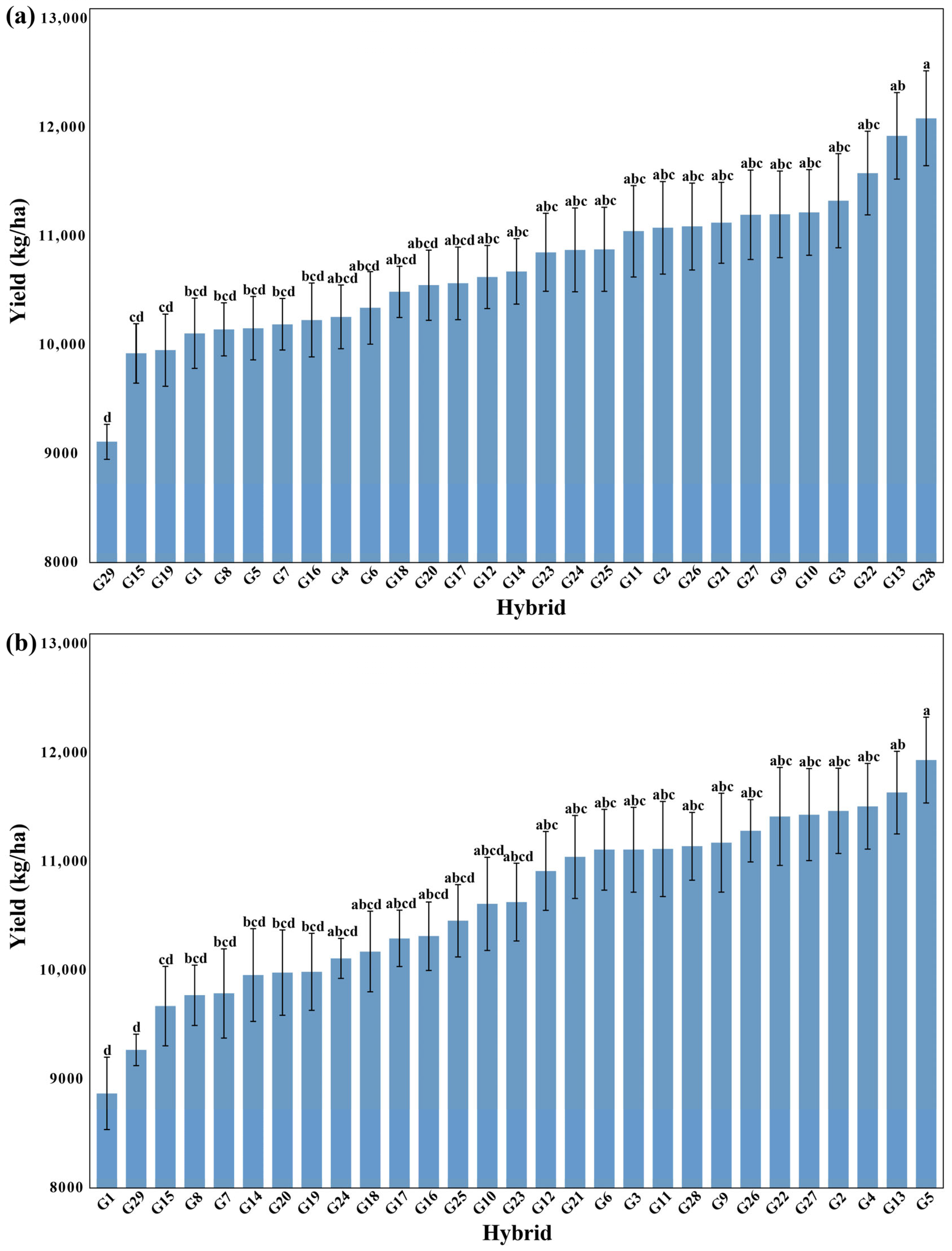
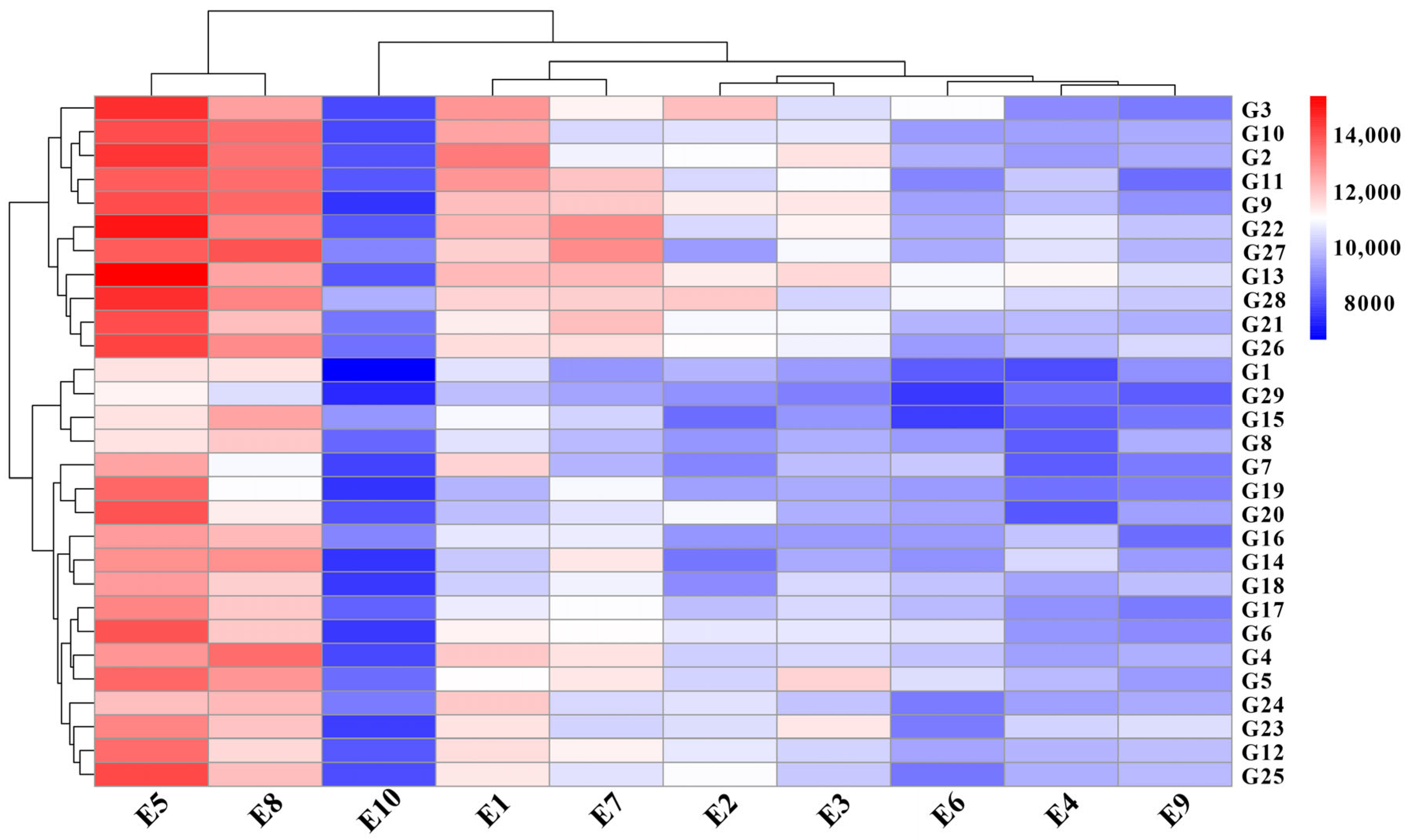
3.2. Comprehensive Visualization of Yield Bar Chart and Yield–Environment–Cultivar Relationship Heatmap
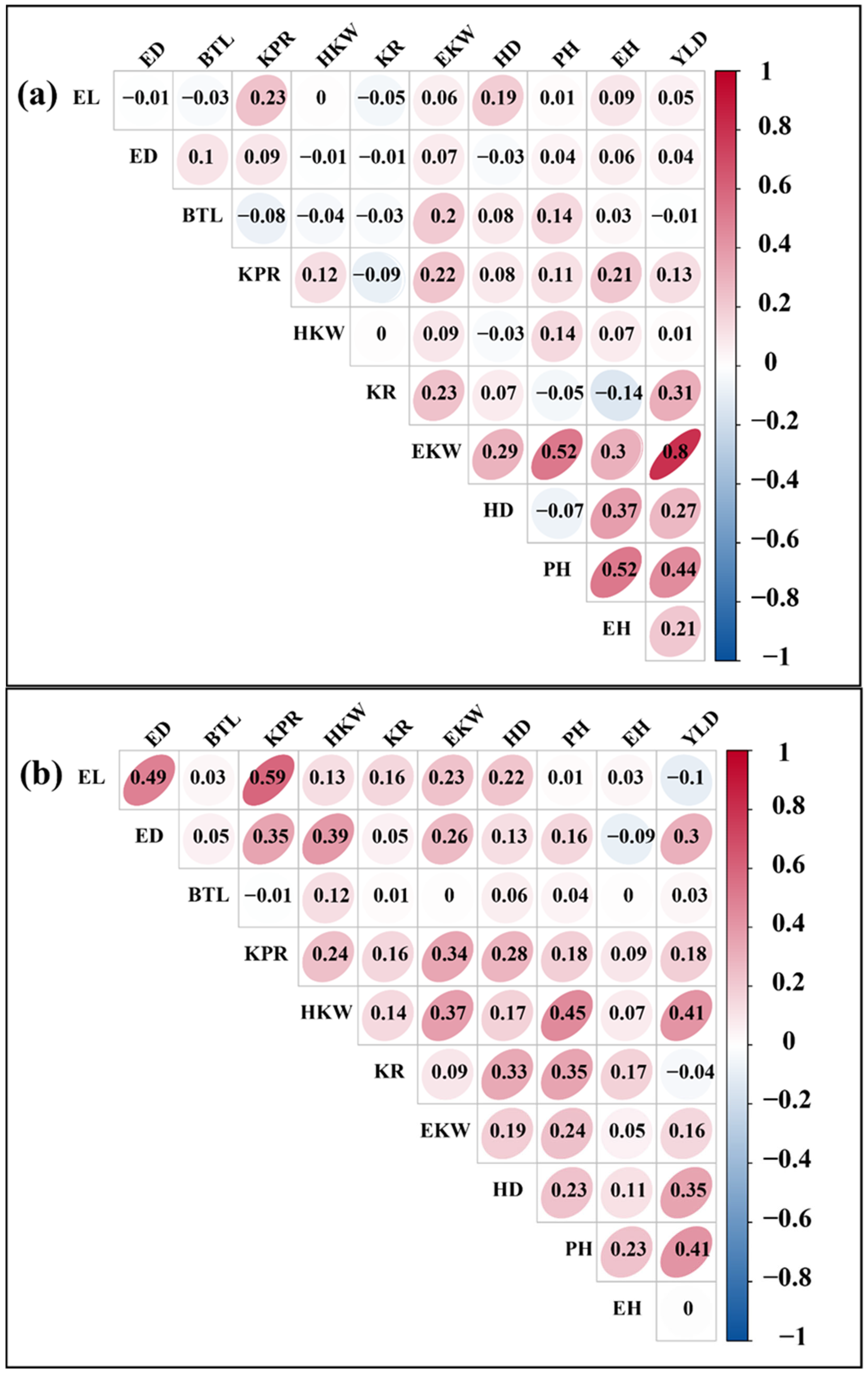
3.3. Analysis of Correlation Between Agronomic Traits and Yield
3.4. GGE Biplot Analysis
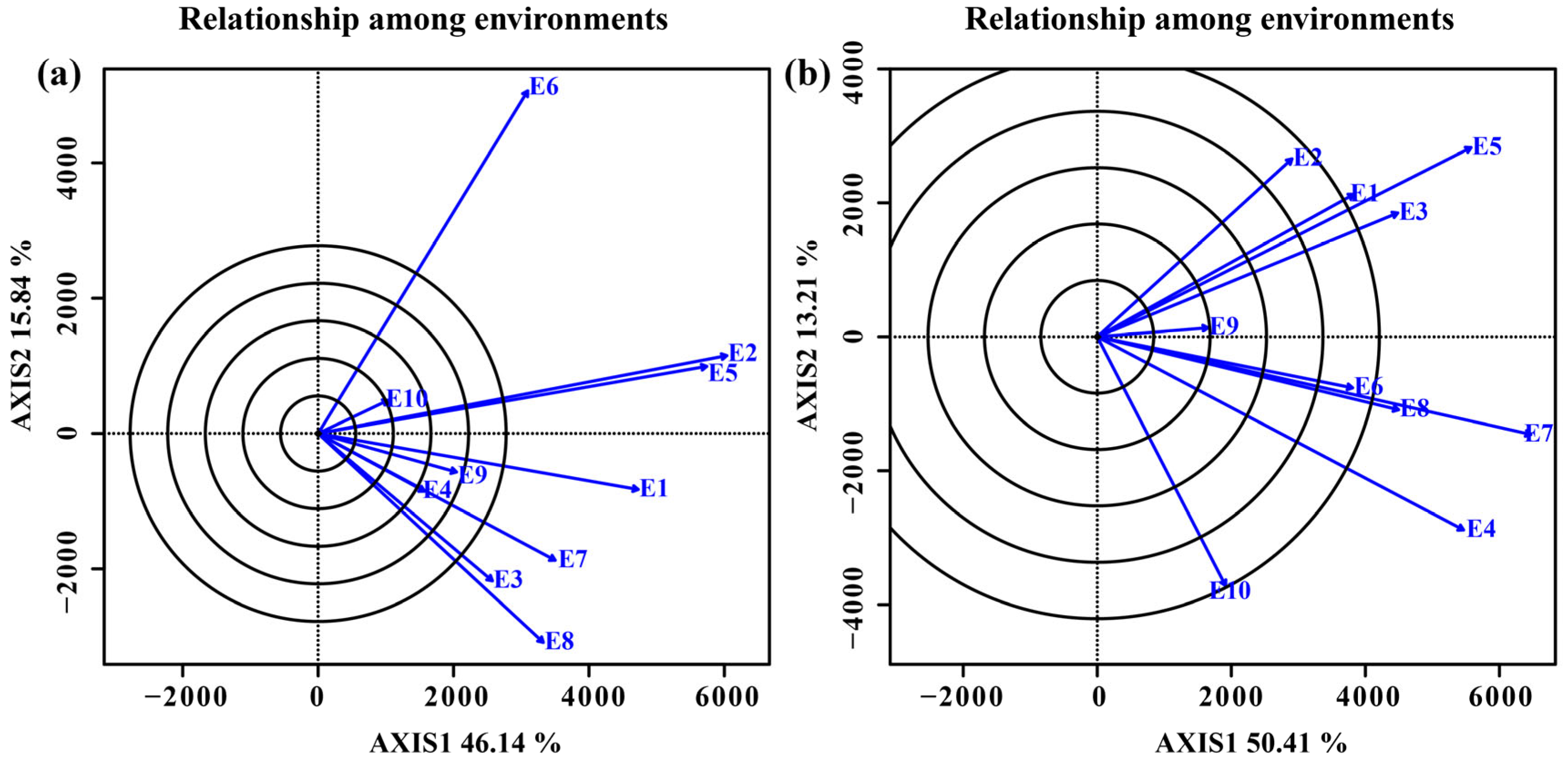
3.4.1. Relationship Among Test Environments
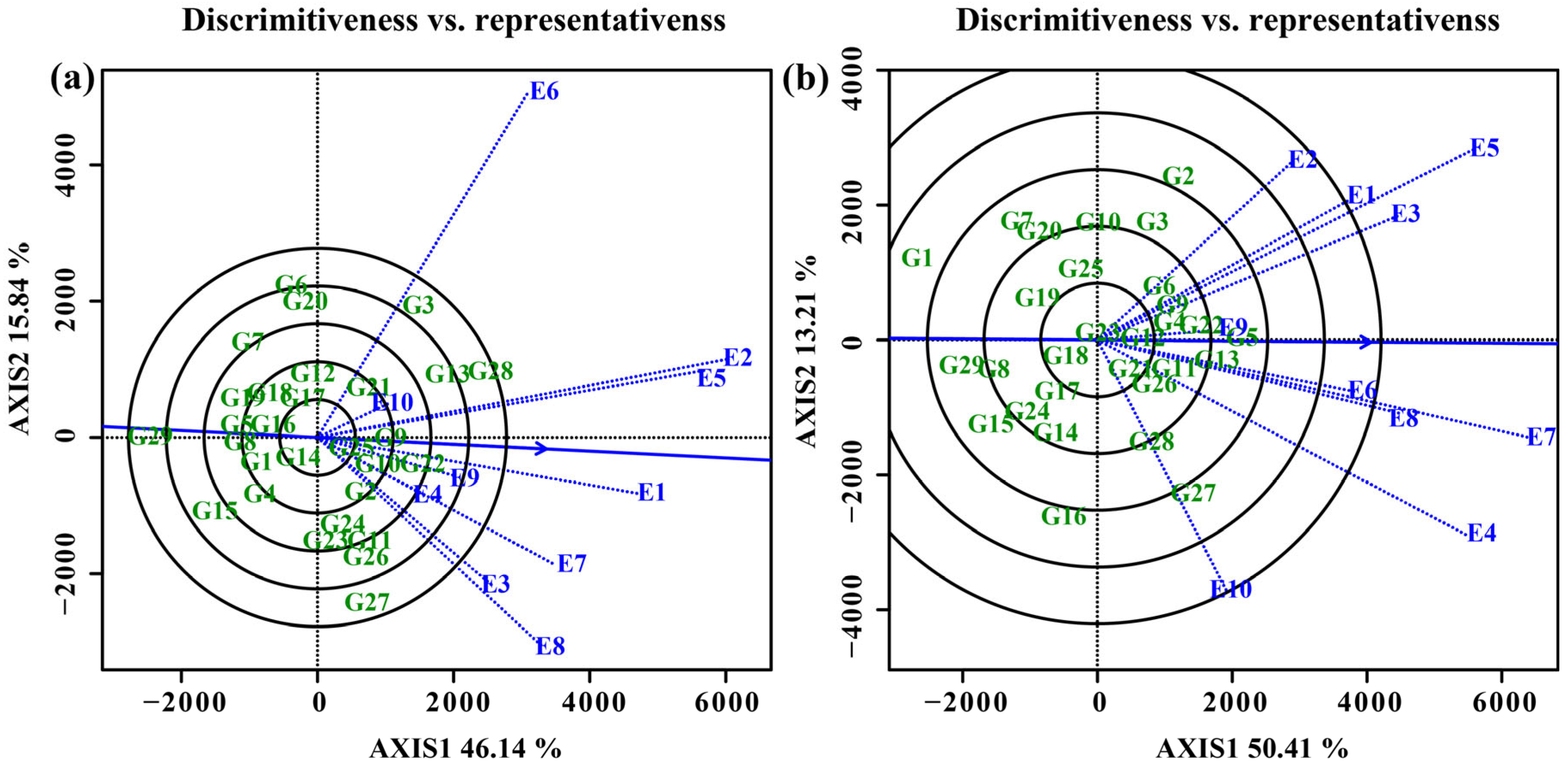
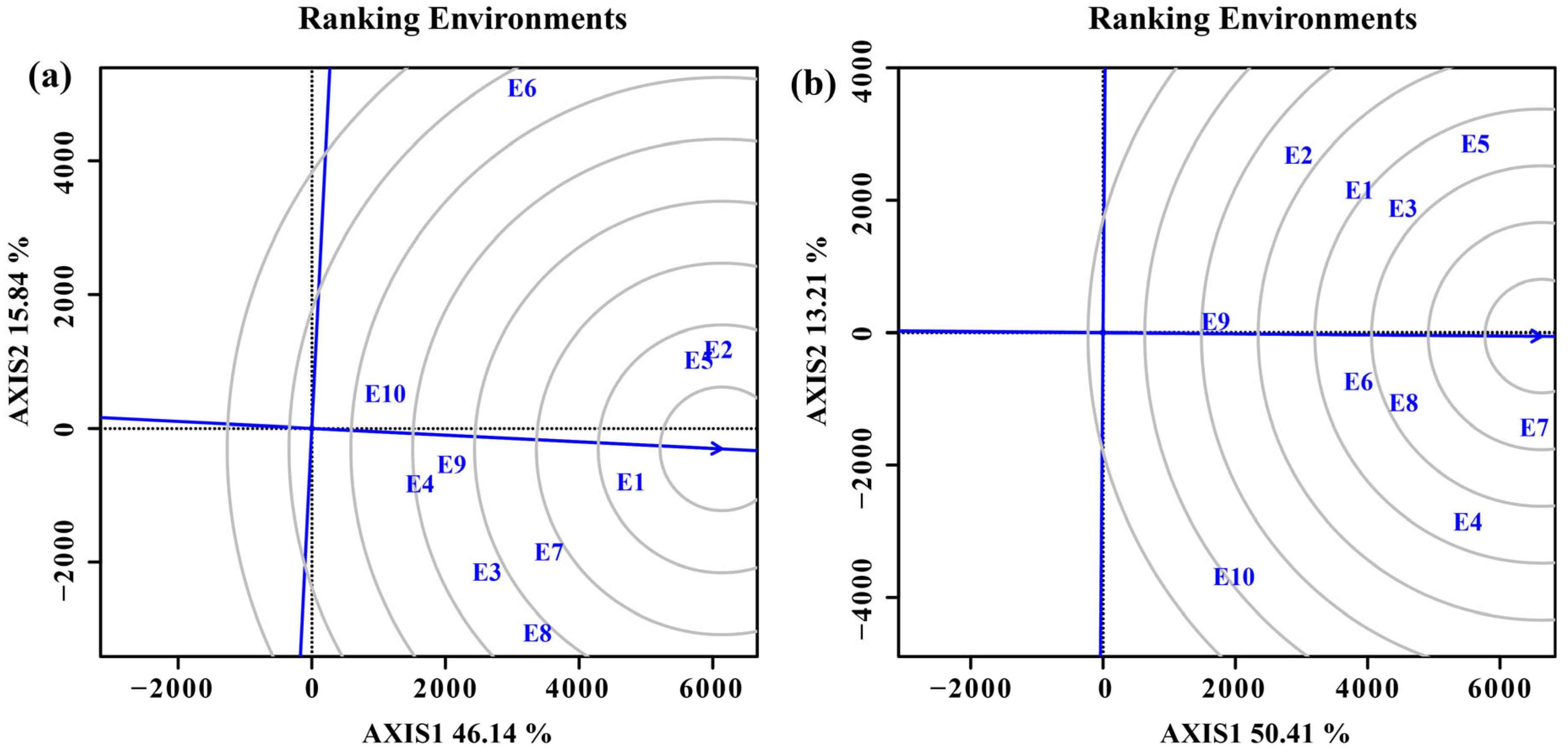
3.4.2. Selection of Ideal Test Environments
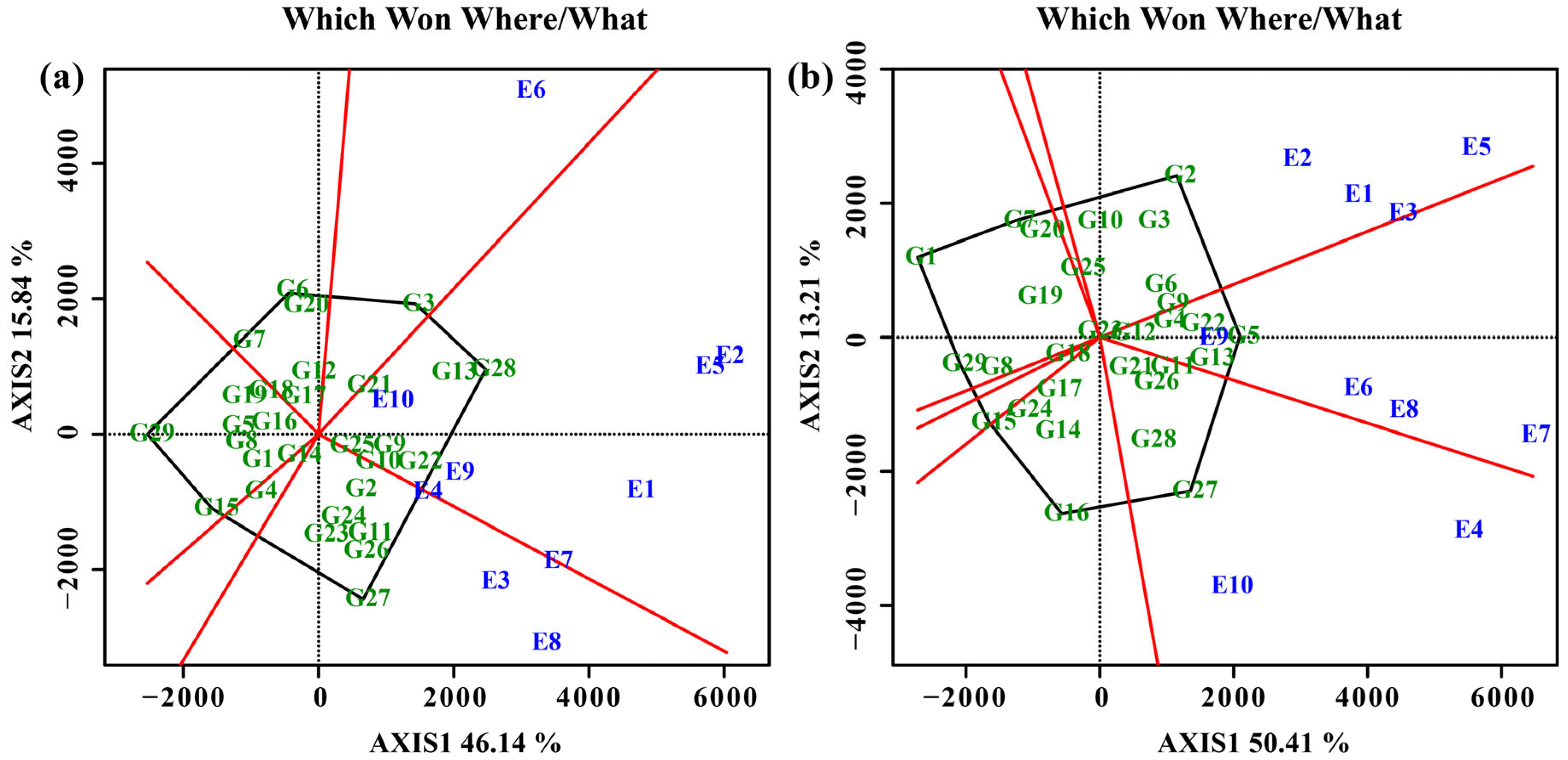
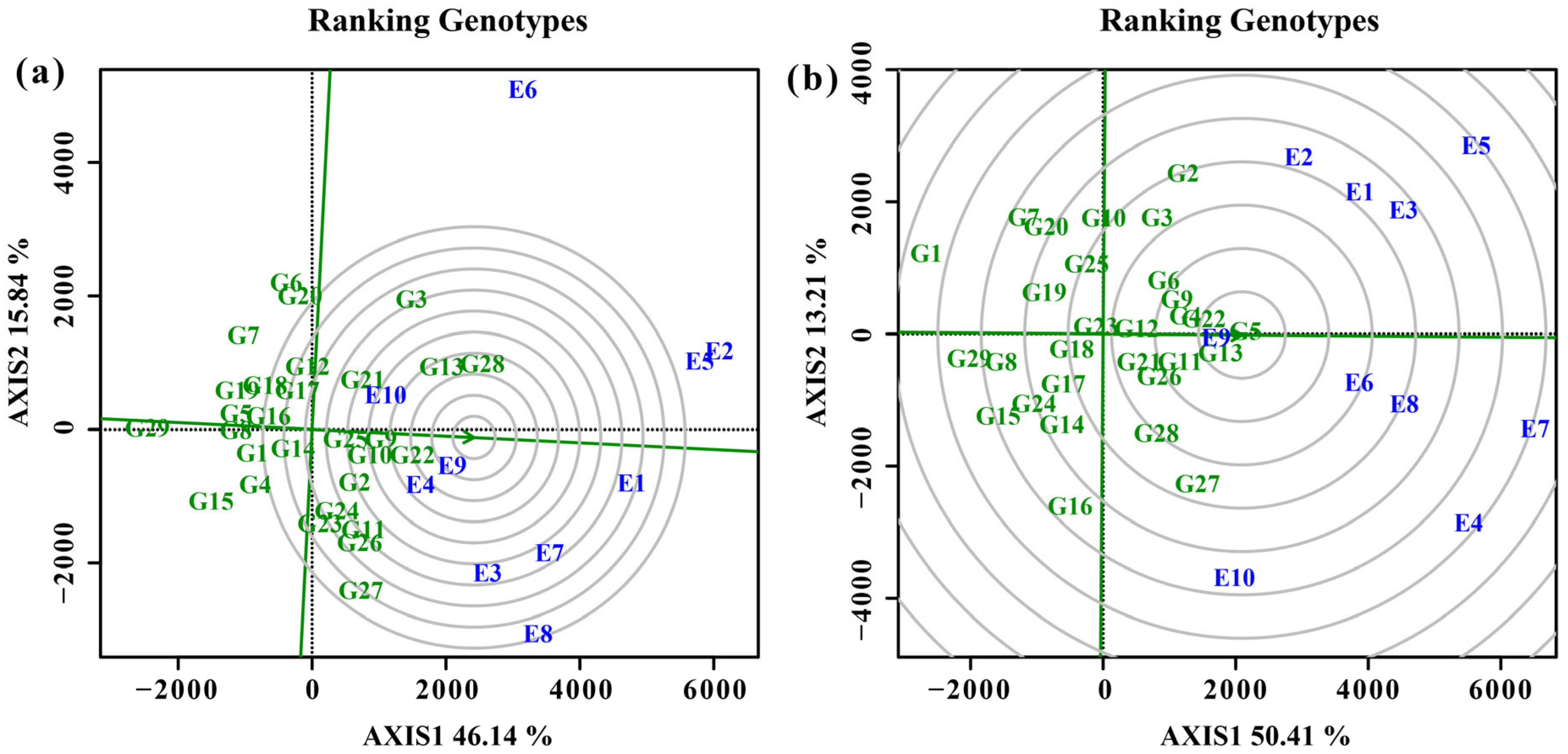
3.4.3. Screening of Elite Cultivars Under Test Environments
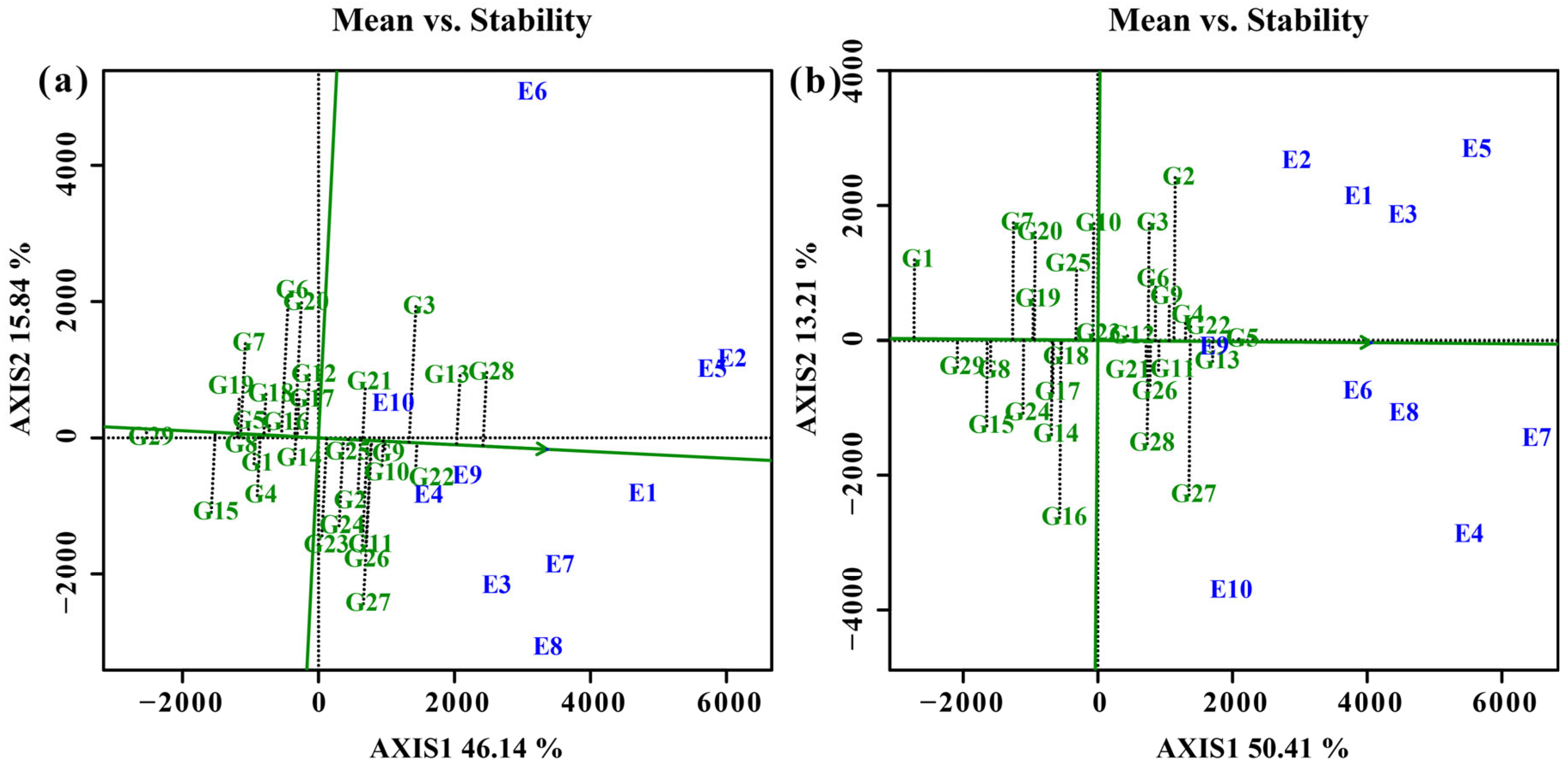
3.4.4. Selection of Hybrids with High Stability and Productivity
4. Discussion
4.1. Yield Variance Analysis
4.2. Evaluation of Ideal Test Environments
4.3. Evaluation of Ideal Genotypes
4.4. Study Limitations
5. Conclusions
Supplementary Materials
Author Contributions
Funding
Data Availability Statement
Acknowledgments
Conflicts of Interest
References
- Revilla, P.; Alves, M.L.; Andelković, V.; Balconi, C.; Dinis, I.; Mendes-Moreira, P.; Redaelli, R.; Ruiz de Galarreta, J.I.; Vaz Patto, M.C.; Žilić, S. Traditional foods from maize (Zea mays L.) in Europe. Front. Nutr. 2022, 8, 683399. [Google Scholar] [CrossRef]
- Erenstein, O.; Jaleta, M.; Sonder, K.; Mottaleb, K.; Prasanna, B.M. Global maize production, consumption and trade: Trends and R&D implications. Food Secur. 2022, 14, 1295–1319. [Google Scholar] [CrossRef]
- Luo, N.; Meng, Q.; Feng, P.; Qu, Z.; Yu, Y.; Liu, D.L.; Müller, C.; Wang, P. China can be self-sufficient in maize production by 2030 with optimal crop management. Nat. Commun. 2023, 14, 2637. [Google Scholar] [CrossRef]
- Ru, Y.; Blankespoor, B.; Wood-Sichra, U.; Thomas, T.; You, L.; Kalvelagen, E. Estimating local agricultural gross domestic product (AgGDP) across the world. Earth Syst. Sci. Data 2023, 15, 1357–1387. [Google Scholar] [CrossRef]
- Xin, Q.; Zhang, L.; Qu, Y.; Geng, H.; Li, X.; Peng, S. Satellite mapping of maize cropland in one-season planting areas of China. Sci. Data 2023, 10, 437. [Google Scholar] [CrossRef] [PubMed]
- Zhang, P.; Xia, L.; Sun, Z.; Zhang, T. Analysis of spatial and temporal changes and driving forces of arable land in the Weibei dry plateau region in China. Sci. Rep. 2023, 13, 20618. [Google Scholar] [CrossRef]
- Yan, Y.; Duan, F.; Li, X.; Zhao, R.; Hou, P.; Zhao, M.; Li, S.; Wang, Y.; Dai, T.; Zhou, W. Photosynthetic capacity and assimilate transport of the lower canopy influence maize yield under high planting density. Plant Physiol. 2024, 195, 2652–2667. [Google Scholar] [CrossRef]
- Li, Y.; Bao, H.; Xu, Z.; Hu, S.; Sun, J.; Wang, Z.; Yu, X.; Gao, J. AMMI an GGE biplot analysis of grain yield for drought-tolerant maize hybrid selection in Inner Mongolia. Sci. Rep. 2023, 13, 18800. [Google Scholar] [CrossRef] [PubMed]
- Bocianowski, J.; Nowosad, K.; Rejek, D. Genotype-environment interaction for grain yield in maize (Zea mays L.) using the additive main effects and multiplicative interaction (AMMI) model. J. Appl. Genet. 2024, 65, 653–664. [Google Scholar] [CrossRef] [PubMed]
- Oladosu, Y.; Rafii, M.Y.; Abdullah, N.; Magaji, U.; Miah, G.; Hussin, G.; Ramli, A. Genotype× Environment interaction and stability analyses of yield and yield components of established and mutant rice genotypes tested in multiple locations in Malaysia. Acta Agric. Scand. Sect. B-Soil Plant Sci. 2017, 67, 590–606. [Google Scholar] [CrossRef]
- Chauhan, P.; Shrivastava, M.K.; Kumar, V.; Patel, N.; Biswal, M. Stability Analysis in Wheat (Triticum aestivum L.) Genotypes under Different Environmental Conditions. Int. J. Plant Soil Sci. 2023, 35, 1218–1223. [Google Scholar] [CrossRef]
- Pour-Aboughadareh, A.; Barati, A.; Gholipoor, A.; Zali, H.; Marzooghian, A.; Koohkan, S.A.; Shahbazi-Homonloo, K.; Houseinpour, A. Deciphering genotype-by-environment interaction in barley genotypes using different adaptability and stability methods. J. Crop Sci. Biotechnol. 2023, 26, 547–562. [Google Scholar] [CrossRef]
- Ligarreto–Moreno, G.; Pimentel–Ladino, C. Grain yield and genotype x environment interaction in bean cultivars with different growth habits. Plant Prod. Sci. 2021, 25, 232–241. [Google Scholar] [CrossRef]
- Daemo, B.B.; Wolancho, G.B.; Arke, Z.A.; Wakalto, D.D.; Onu, M.H.; Rahimi, M. Performance Evaluation and Stability of Maize (Zea mays L.) Genotypes for Grain Yield Using AMMI and GGE Biplot. Int. J. Agron. 2024, 2024, 8801999. [Google Scholar] [CrossRef]
- Mafouasson, H.N.A.; Gracen, V.; Yeboah, M.A.; Ntsomboh-Ntsefong, G.; Tandzi, L.N.; Mutengwa, C.S. Genotype-by-Environment Interaction and Yield Stability of Maize Single Cross Hybrids Developed from Tropical Inbred Lines. Agronomy 2018, 8, 62. [Google Scholar] [CrossRef]
- Muthoni, J.; Shimelis, H.; Melis, R. Genotype x Environment Interaction and Stability of Potato Tuber Yield and Bacterial Wilt Resistance in Kenya. Am. J. Potato Res. 2015, 92, 367–378. [Google Scholar] [CrossRef]
- Ma, C.; Liu, C.; Ye, Z. Influence of Genotype × Environment Interaction on Yield Stability of Maize Hybrids with AMMI Model and GGE Biplot. Agronomy 2024, 14, 1000. [Google Scholar] [CrossRef]
- Santos, A.d.; Amaral, A.T.d.; Kurosawa, R.d.N.F.; Gerhardt, I.F.S.; Fritsche, R. GGE Biplot projection in discriminating the efficiency of popcorn lines to use nitrogen. Ciência E Agrotecnologia 2017, 41, 22–31. [Google Scholar] [CrossRef]
- Jandong, E.; Uguru, M.; Oyiga, B. Determination of yield stability of seven soybean (Glycine max) genotypes across diverse soil pH levels using GGE biplot analysis. J. Appl. Biosci. 2011, 43, 2924–2941. [Google Scholar]
- Zhang, P.-P.; Hui, S.; Yang, L.; Yang, Q.; Wang, S.; Zheng, D.-F. GGE biplot analysis of yield stability and test location representativeness in proso millet (Panicum miliaceum L.) genotypes. J. Integr. Agric. 2016, 15, 1218–1227. [Google Scholar] [CrossRef]
- Teodoro, P.; Almeida Filho, J.; Daher, R.; Menezes, C.; Cardoso, M.; Godinho, V.; Torres, F.; Tardin, F. Identification of sorghum hybrids with high phenotypic stability using GGE biplot methodology. Genet. Mol. Res. GMR 2016, 15. [Google Scholar] [CrossRef]
- Bocci, R.; Bussi, B.; Petitti, M.; Franciolini, R.; Altavilla, V.; Galluzzi, G.; Di Luzio, P.; Migliorini, P.; Spagnolo, S.; Floriddia, R. Yield, yield stability and farmers’ preferences of evolutionary populations of bread wheat: A dynamic solution to climate change. Eur. J. Agron. 2020, 121, 126156. [Google Scholar] [CrossRef]
- Lu, Y.; Zhang, Z.; Lu, Z.; Wang, S.; Hao, D.; Li, P.; Xu, Y.; Xu, C.; Lu, H.; Yang, Z. Analysis of the regional trial for sweet maize in Jiangsu province based on the AMMI model and GGE biplot. Mol. Plant Breed. 2022, 20, 6939–6946. [Google Scholar]
- Wei, P.; Chen, D.; Luo, Y.; Zheng, Y.; Yang, J.; Luo, S.; Cheng, Y.; Wang, A.; Song, B. Evaluation of the high yield, stability and pilot discriminative power of spring maize in different ecological areas of Guizhou based on AMMI and GGE-biplot. J. Maize Sci. 2023, 31, 22–31. [Google Scholar]
- Wei, C.; Xu, W.; Xing, Y.; Song, W.; Li, G.; Chen, G.; Zhou, W. Application of AMMI model and GGE biplot of sweet maize varieties in Huang-Huai-Hai regional. Mol. Plant Breed. 2021, 19, 5909–5916. [Google Scholar]
- Gao, H.; Bian, G.; Huang, S.; Yang, G.; Zhang, H.; Gao, S.; Bai, X. Analysis on the stability of national sugar beet varieties by AMMI model. China Beet Sugar 2008, 4, 10–14. [Google Scholar]
- Li, X.; Ding, Y.; Zuo, S.; Chen, Z.; Xu, M.; Zhao, Y.; Li, P.; Xu, Y.; Xu, C.; Yang, Z. Evaluation and analysis of the results from the regional trial of medium Japonica hybrid rice of Jiangsu province in 2018 based on the AMMI model and GGE biplot. Hybrid Rice 2021, 36, 96–102. [Google Scholar]
- Yan, W.; Kang, M.S.; Ma, B.; Woods, S.; Cornelius, P.L. GGE biplot vs. AMMI analysis of genotype-by-environment data. Crop Sci. 2007, 47, 643–653. [Google Scholar] [CrossRef]
- Bing, W.; HUANG, Y.-b. Yield stability of maize hybrids evaluated in national maize cultivar regional trials in Southwestern China using parametric methods. Agric. Sci. China 2011, 10, 1323–1335. [Google Scholar] [CrossRef]
- Oskouei, B.; Sheidaei, S.; Hamidi, A.; Sadeghi, H.; Divsalar, M.; Rezvani, E.; Zare, L.; Momeni, J. Evaluation of vigour, protein, starch content variations and seed health of hybrid maize (Zea mays L.) under effect of various planting dates and different harvest moisture contents in Moghan area. Iran. J. Seed Sci. Res. 2018, 5, fa109–fa122. [Google Scholar]
- Hailemariam Habtegebriel, M. Adaptability and stability for soybean yield by AMMI and GGE models in Ethiopia. Front. Plant Sci. 2022, 13, 950992. [Google Scholar] [CrossRef]
- Taak, Y.; Patel, M.K.; Chaudhary, R.; Basu, S.R.; Pardeshi, P.; Adhikari, S.; Nanjundan, J.; Saini, N.; Vasudev, S.; Yadava, D.K. Determining Drought-and Heat-Tolerant Genotypes in Indian Mustard [Brassica juncea] Employing GGE Biplot Analysis. Agric. Res. 2025, 1–12. [Google Scholar] [CrossRef]
- Gonçalves, V.M.L.; Crevelari, J.A.; Catarina, R.S.; de Souza, Y.P.; Pereira, M.G. Adaptability and stability analysis via GGE biplot in single, double, and interpopulation maize hybrids. Sci. Rep. 2025, 15, 5065. [Google Scholar] [CrossRef] [PubMed]
- Liu, C.; Ma, C.; Lü, J.; Ye, Z. Yield stability analysis in maize hybrids of southwest china under genotype by environment interaction using GGE biplot. Agronomy 2022, 12, 1189. [Google Scholar] [CrossRef]
- Zendrato, Y.; Azizah, Y.; Humam, B.; Marwiyah, S.; Ritonga, A.; Azrai, M.; Efendi, R.; Suwarno, W. Maize hybrids’ response to optimum and suboptimum abiotic environmental conditions using genotype by environment interaction analysis. SABRAO J. Breed. Genet 2025, 57, 447–458. [Google Scholar]
- Neelam, S.; Bhoga, J.; Venkata, N.K.M.; Dharavath, B.; Kumari, V.; Kachhapur, R.M.; Dinasarapu, S.; Phagna, R.K.; Appavoo, D. Navigating Hybrid-Environment Interaction in Maize Evaluation: Parametric and Non-Parametric Insights. Crop Breed. Genet. Genom. 2025, 7, e250008. [Google Scholar]
- Nišavić, N.; Čamdžija, Z.; Živanović, T.; Božinović, S.; Grčić, N.; Radinović, I.; Božović, D. Impact of genotype × environment interactions on the yield and stability of maize hybrids in Serbia. Rom. Agric. Res. 2025, 42, 4221. [Google Scholar] [CrossRef]
- Sharif, I.; Aleem, S.; Junaid, J.A.; Aleem, M.; Jamshaid, K.; Saleem, H.; Rizwan, M.; Chohan, S.M.; Sohail, S.; Akram, S. Evaluation of Genotype× Environment Interaction and Yield Stability of Cotton (Gossypium hirsutum L) Genotypes Under Heat Stress Conditions. J. Crop Health 2025, 77, 16. [Google Scholar] [CrossRef]
- Yan, W. A systematic narration of some key concepts and procedures in plant breeding. Front. Plant Sci. 2021, 12, 724517. [Google Scholar] [CrossRef]
- Mullualem, D.; Tsega, A.; Mengie, T.; Fentie, D.; Kassa, Z.; Fassil, A.; Wondaferew, D.; Gelaw, T.A.; Astatkie, T. Genotype-by-environment interaction and stability analysis of grain yield of bread wheat (Triticum aestivum L.) genotypes using AMMI and GGE biplot analyses. Heliyon 2024, 10, e32918. [Google Scholar] [CrossRef]
- Kona, P.; Ajay, B.; Gangadhara, K.; Kumar, N.; Choudhary, R.R.; Mahatma, M.; Singh, S.; Reddy, K.K.; Bera, S.; Sangh, C. AMMI and GGE biplot analysis of genotype by environment interaction for yield and yield contributing traits in confectionery groundnut. Sci. Rep. 2024, 14, 2943. [Google Scholar] [CrossRef]
- Tiwari, J.K.; Rai, N.; Singh, M.K.; Reddy, Y.S.; Kumar, R. Delineating genotype × environment interaction for horticultural traits in tomato using GGE and AMMI biplot analysis. Sci. Rep. 2025, 15, 23796. [Google Scholar] [CrossRef] [PubMed]
- Zhao, H.; Zhang, L.; Wan, N.; Avenson, T.J.; Welch, S.M.; Lin, X. Sensitivity changes of US maize yields to extreme heat through timely precipitation patterns. Environ. Res. Commun. 2024, 6, 071009. [Google Scholar] [CrossRef]
- Kusmec, A.; Schnable, P.S. Phenological adaptation is insufficient to offset climate change-induced yield losses in US hybrid maize. Glob. Change Biol. 2024, 30, e17539. [Google Scholar] [CrossRef]
- Ruswandi, D.; Syafii, M.; Wicaksana, N.; Maulana, H.; Ariyanti, M.; Indriani, N.P.; Suryadi, E.; Supriatna, J.; Yuwariah, Y. Evaluation of high yielding maize hybrids based on combined stability analysis, sustainability index, and GGE biplot. BioMed Res. Int. 2022, 2022, 3963850. [Google Scholar] [CrossRef] [PubMed]
- Badu-Apraku, B.; Abubakar, A.M.; Adu, G.B.; Yacoubou, A.-M.; Adewale, S.; Adejumobi, I.I. Enhancing genetic gains in grain yield and efficiency of testing sites of early-maturing maize hybrids under contrasting environments. Genes 2023, 14, 1900. [Google Scholar] [CrossRef]
- Chaudhary, D.; Jeena, A.S.; Singh, N.K.; Pant, U.; Rohit, R.; Gaur, S. GGE biplot analysis for cane yield and sugar yield in advanced clones of sugarcane (Saccharum sp. complex). J. Appl. Genet. 2025, 66, 279–291. [Google Scholar] [CrossRef]
- Sanadya, S.K.; Sood, V.K.; Kumar, S.; Sharma, G.; Sood, R.; Katna, G.; Enyew, M.; Sahoo, S. Stability Indices, AMMI and GGE Biplots Analysis of Forage Oat Germplasm Under Variable Growing Regimes in the Northwestern Himalayas. Agric. Res. 2025, 1–10. [Google Scholar] [CrossRef]
- Rusinamhodzi, L.; Makumbi, D.; Njeru, J.M.; Kanampiu, F. Performance of elite maize genotypes under selected sustainable intensification options in Kenya. Field Crops Res. 2020, 249, 107738. [Google Scholar] [CrossRef]
- Dang, X.; Hu, X.; Ma, Y.; Li, Y.; Kan, W.; Dong, X. AMMI and GGE biplot analysis for genotype× environment interactions affecting the yield and quality characteristics of sugar beet. PeerJ 2024, 12, e16882. [Google Scholar] [CrossRef]
- Yan, W.; Tinker, N.A. Biplot analysis of multi-environment trial data: Principles and applications. Can. J. Plant Sci. 2006, 86, 623–645. [Google Scholar] [CrossRef]
- Kumar, B.; Choudhary, M.; Kumar, P.; Kumar, S.; Sravani, D.; Vinodhana, N.K.; Kumar, G.S.; Gami, R.; Vyas, M.; Jat, B.S. GGE biplot analysis and selection indices for yield and stability assessment of maize (Zea mays L.) genotypes under drought and irrigated conditions. Indian J. Genet. Plant Breed. 2024, 84, 209–215. [Google Scholar] [CrossRef]
- Nagesh, P.; Takalkar, S.A.; Mohan, S.M.; Naidu, P.B.; Lohithaswa, C.H.; Kachapur, R.M.; Kuchanur, P.; Injeti, S.K.; Singh, N.K.; Kanwade, D.G. Genotype and environmental interactions in Maize (‘Zea mays L.’) across regions of India: Implications for hybrid testing locations in South Asia. Aust. J. Crop Sci. 2025, 19, 773–783. [Google Scholar] [CrossRef]



| Hybrids | Code | Parental | Source |
|---|---|---|---|
| ZHY-103 | G1 | ZH808 × ZH194 | Yunnan Zu Feng Seed Industry Co., Ltd., Dali, China |
| ZF-2302 | G2 | ZF3089 × ZF3375 | Yunnan Zu Feng Seed Industry Co., Ltd., Dali, China |
| ZF-2303 | G3 | ZF1868 × H974 | Yunnan Zu Feng Seed Industry Co., Ltd., Dali, China |
| XR-17 | G4 | E168 × JS1196 | Yunnan Xuanrui Seed Industry Co., Ltd., Qujing, China |
| XR-18 | G5 | JS3051 × N4822 | Yunnan Xuanrui Seed Industry Co., Ltd., Qujing, China |
| DY-604 | G6 | DY6029 × DY7112 | Yunnan Di Yu Seed Industry Co., Ltd., Qujing, China |
| YBY-201 | G7 | DY201 × XY9A-1 | Yunnan Yundan Seed Technology Co., Ltd., Xiangyun, China |
| LS-2301 | G8 | LFM10-31 × LFLB-1 | Yunnan Linfeng Seed Industry Co., Ltd., Shilin, China |
| LS-2303 | G9 | LFM68-164 × LFD109 | Yunnan Linfeng Seed Industry Co., Ltd., Shilin, China |
| MS-2301 | G10 | GM3073 × GM901 | Yunnan Guangmao Seed Industry Co., Ltd., Binchuan, China |
| ZF-2304 | G11 | ZF1410 × ZF3375 | Yunnan Zu Feng Seed Industry Co., Ltd., Dali, China |
| ZF-2305 | G12 | HK48 × ZF1807 | Yunnan Zu Feng Seed Industry Co., Ltd., Dali, China |
| XR-399 | G13 | B1196 × JS1196 | Yunnan Xuanrui Seed Industry Co., Ltd., Qujing, China |
| DY-801 | G14 | DY1156 × DY8119 | Yunnan Di Yu Seed Industry Co., Ltd., Qujing, China |
| YBY-202 | G15 | DY202 × XY9A-1 | Yunnan Yundan Seed Technology Co., Ltd., Xiangyun, China |
| SS-2201 | G16 | SFH04 × SFY01 | Yunnan Shi Feng Seed Industry Co., Ltd., Shilin, China |
| SS-2202 | G17 | SFH05 × SFY01 | Yunnan Shi Feng Seed Industry Co., Ltd., Shilin, China |
| JG-1872 | G18 | LX751 × LX1845 | Mile Jin Gu Seed Industry Co., Ltd., Mile, China |
| JG-1881 | G19 | XYD3 × LX2614 | Mile Jin Gu Seed Industry Co., Ltd., Mile, China |
| MS-2302 | G20 | GM23B × GM1681 | Yunnan Guangmao Seed Industry Co., Ltd., Binchuan, China |
| LS-2304 | G21 | LFM68-174 × LFJM181804 | Yunnan Linfeng Seed Industry Co., Ltd., Shilin, China |
| LS-2305 | G22 | LFM10 × LF984 | Yunnan Linfeng Seed Industry Co., Ltd., Shilin, China |
| JG-1356 | G23 | LX201 × 1F28 | Mile Jin Gu Seed Industry Co., Ltd., Mile, China |
| JG-1865 | G24 | LX750 × 1F38 | Mile Jin Gu Seed Industry Co., Ltd., Mile, China |
| SS-2203 | G25 | SFCM03 × SFCM02 | Yunnan Shi Feng Seed Industry Co., Ltd., Shilin, China |
| SS-2204 | G26 | SFCM03 × SFCQ42 | Yunnan Shi Feng Seed Industry Co., Ltd., Shilin, China |
| SS-2205 | G27 | SFZY14 × SFZY16 | Yunnan Shi Feng Seed Industry Co., Ltd., Shilin, China |
| SS-2206 | G28 | SFZY15 × SFZY17 | Yunnan Shi Feng Seed Industry Co., Ltd., Shilin, China |
| WG-3861(CK) | G29 | WG6320 × WG646 | Gansu Wugu Seed Industry Co., Ltd., Lanzhou, China |
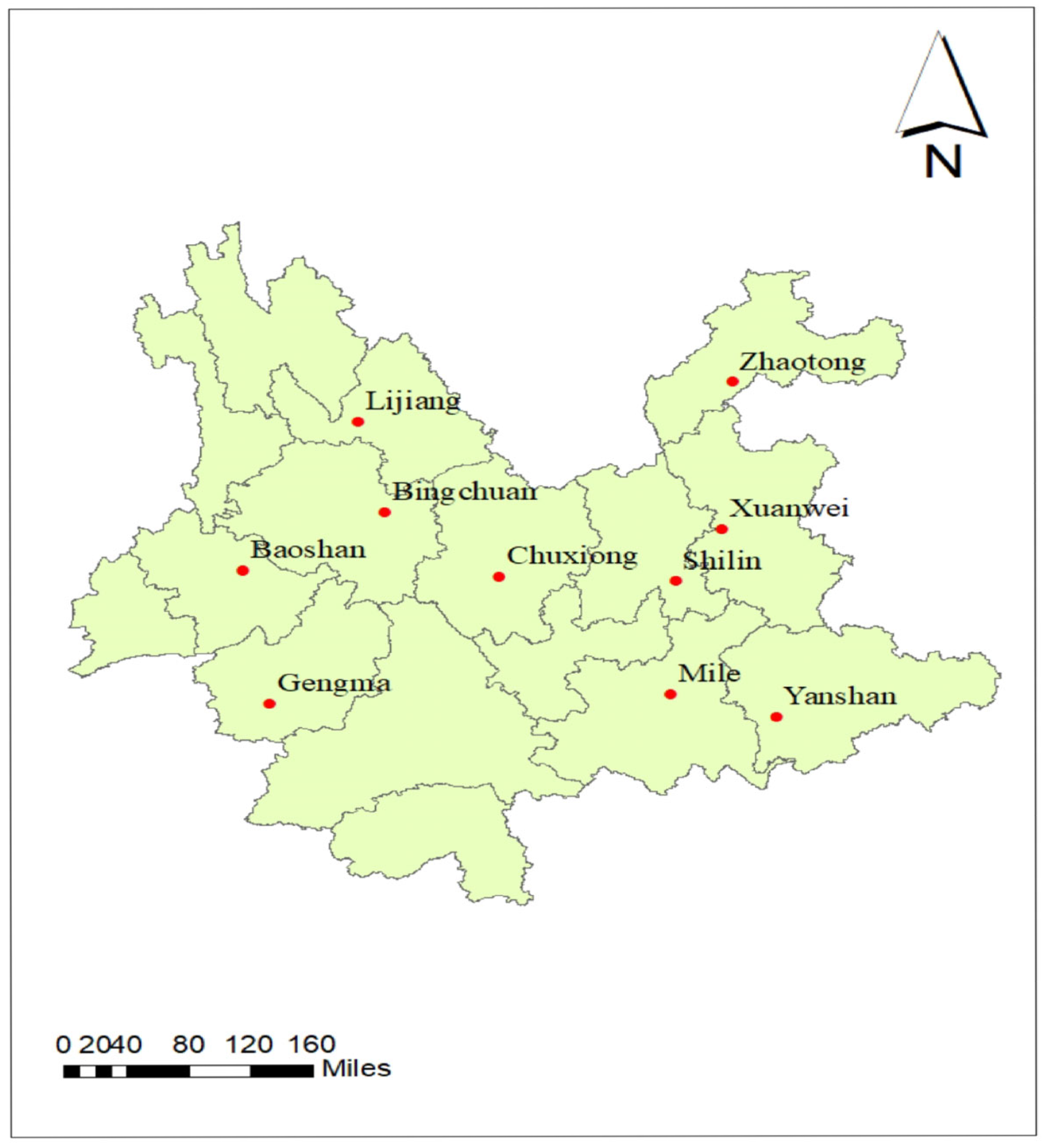
| Location | Code | Latitude (N) | Longitude (E) | Altitude (m) |
|---|---|---|---|---|
| Baoshan | E1 | 25°09′ | 99°13′ | 1592 |
| Binchuan | E2 | 25°48′ | 100°35′ | 1430 |
| ChuXiong | E3 | 25°08′ | 101°18′ | 1767 |
| Gengma | E4 | 23°21′ | 99°48′ | 1340 |
| Lijiang | E5 | 26°58′ | 100°3′ | 1819 |
| Mile | E6 | 24°27′ | 103°31′ | 1543 |
| Shilin | E7 | 24°41′ | 103°27′ | 1927 |
| Xuanwei | E8 | 26°15′ | 104°8′ | 1980 |
| Yanshan | E9 | 23°07′ | 104°34′ | 1490 |
| Zhaotong | E10 | 27°19′ | 103°42′ | 1920 |
| Source of Variation | Degrees of Freedom (DF) | Sum of Squares (SS) | Mean Squares | F-Calculated | Proportion of SS (%) |
|---|---|---|---|---|---|
| Environments (E) | 9 | 2,386,119 | 265,124,355.8 | 576.3844 *** | 63.79 |
| Genotypes (G) | 28 | 4,921,447 | 17,576,597.05 | 38.2117 *** | 13.16 |
| G × E Interaction | 252 | 5,684,386 | 2,255,708.6 | 4.9039 *** | 15.2 |
| Replication | 2 | 2,246,726 | 22,467.26 | 0.0488 | 0 |
| Residuals | 639 | 2,939,261 | 459,978.29 | 7.86 | |
| Total | 929 | 3,740,651 | 100 |
| Source of Variation | Degrees of Freedom (DF) | Sum of Squares (SS) | Mean Squares | F-Calculated | Proportion of SS (%) |
|---|---|---|---|---|---|
| Environments (E) | 9 | 2,642,420,060 | 293,602,228.9 | 773.4477 *** | 64.15 |
| Genotypes (G) | 28 | 605,018,462 | 21,607,802.2 | 56.9222 *** | 14.69 |
| G × E Interaction | 252 | 625,274,846 | 2,481,249.4 | 6.5364 *** | 15.18 |
| Replication | 2 | 4,503,161 | 2,251,580.4 | 5.9314 | 0.11 |
| Residuals | 638 | 242,186,004 | 379,601.9 | 5.88 | |
| Total | 929 | 4,119,402,533 | 100 |
Disclaimer/Publisher’s Note: The statements, opinions and data contained in all publications are solely those of the individual author(s) and contributor(s) and not of MDPI and/or the editor(s). MDPI and/or the editor(s) disclaim responsibility for any injury to people or property resulting from any ideas, methods, instructions or products referred to in the content. |
© 2025 by the authors. Licensee MDPI, Basel, Switzerland. This article is an open access article distributed under the terms and conditions of the Creative Commons Attribution (CC BY) license.
Share and Cite
Zi, Q.; Ye, Z.; Ma, C.; Liu, C. Research on Regional Adaptability and Stability of Maize Hybrids in Mid-to-High Altitude Areas of Yunnan Province Based on GGE Biplot Analysis. Agronomy 2026, 16, 54. https://doi.org/10.3390/agronomy16010054
Zi Q, Ye Z, Ma C, Liu C. Research on Regional Adaptability and Stability of Maize Hybrids in Mid-to-High Altitude Areas of Yunnan Province Based on GGE Biplot Analysis. Agronomy. 2026; 16(1):54. https://doi.org/10.3390/agronomy16010054
Chicago/Turabian StyleZi, Qingyan, Zhilan Ye, Chenyu Ma, and Chaorui Liu. 2026. "Research on Regional Adaptability and Stability of Maize Hybrids in Mid-to-High Altitude Areas of Yunnan Province Based on GGE Biplot Analysis" Agronomy 16, no. 1: 54. https://doi.org/10.3390/agronomy16010054
APA StyleZi, Q., Ye, Z., Ma, C., & Liu, C. (2026). Research on Regional Adaptability and Stability of Maize Hybrids in Mid-to-High Altitude Areas of Yunnan Province Based on GGE Biplot Analysis. Agronomy, 16(1), 54. https://doi.org/10.3390/agronomy16010054