


Abstract
Alfalfa (Medicago sativa) is a globally important forage crop; however, improvements in its biomass yield have stagnated due to its complex genetic architecture and the costly, labor-intensive phenotyping. This study evaluated the potential of the normalized difference vegetation index (NDVI) to predict biomass yield and enhance selection efficiency in alfalfa breeding programs. Specifically, nineteen alfalfa experimental populations (AEXP 1–19) and one control cultivar (OS 66) were evaluated over two growing seasons in Croatia. NDVI was measured at four development stages using a GreenSeeker sensor and compared with forage yield, dry matter yield, and plant height. NDVI values varied significantly among genotypes, years, and growth stages, ranging from 0.23 to 0.87, and increased consistently from early to late vegetative phases. Strong positive correlations were observed between NDVI and forage yield (r = 0.543–0.843) and plant height (r = 0.537–0.738) at early vegetative, late vegetative, and early bud stages. Conversely, NDVI at the mid-vegetative stage correlated negatively with yield and height (r = –0.622 to –0.794). High-performing populations (AEXP 2, AEXP 15, AEXP 18) also exhibited the highest NDVI values. NDVI is a reliable, non-destructive indicator for early selection of high-yielding alfalfa genotypes, although multi-location validation is advised to confirm its broader applicability.
1. Introduction
Alfalfa (Medicago sativa) is a highly valuable perennial legume species grown worldwide, owing to its exceptional forage yield, high nutritional quality, broad adaptability, nitrogen fixation, and a host of beneficial environmental services [1,2,3,4,5].
Increasing biomass yield has been and continues to be a predominant objective in forage breeding programs. Alfalfa is an allogamous, autotetraploid species (2n = 4x = 32), and its cultivars are synthetic populations consisting of heterozygous plants [6]. Forage yield is a quantitative genetic trait controlled by genetic and environmental factors [7]. The rate of genetic gain in forage crops (0.25–0.7% per year) is lower than that of the major cereal crops (1.3% per year), and in alfalfa, it has approached stagnation in the past few decades [8,9,10]. Breeding progress for alfalfa yielding ability is hindered by several factors. These include the perennial nature of the crop (long selection cycles), small breeding investment, the harvesting of the entire plant (and hence the inability to make gains in harvest index), multiple harvests per year, as well as other factors such as high genotype by environment interaction, low heritability, the inability to select real hybrids or pure lines (owing to severe inbreeding depression), the high costs of phenotyping, tetrasomic inheritance, and the high level of non-additive variance [1,6,11,12,13,14,15].
Common alfalfa breeding programs to improve biomass yield are typically conducted through phenotypic recurrent selection, with or without progeny testing, to accumulate beneficial alleles of specific genes within a population. During the selection process, numerous accessions from the alfalfa germplasm collection are evaluated to identify the diversity of the core collection based on their phenotypic characteristics. Traditional field phenotyping for biomass yield in alfalfa and other perennial forage crops is a demanding, time-consuming, labor-intensive, and expensive process, whether conducted on individually spaced plants in breeding nurseries or on material sown in experimental plots [16,17,18,19,20]. To accurately assess forage yield, experimental units must be harvested, dried, and weighed to estimate dry matter content across multiple harvests and years, resulting in up to 40 total harvests over the lifetime of a trial [21].
Plant phenotyping plays a central role in plant breeding, and the accurate and rapid acquisition of phenotypic data is valuable for exploring the association between genotypes and phenotypes [21]. Crop breeders are looking for tools that enable early yield prediction to facilitate and accelerate the selection of desirable genotypes within a group of selection candidates in field trials. Over the last two decades, a significant boom in the use of remote-sensing tools for agricultural purposes has occurred [22]. Tedesco et al. [23] emphasize that remote sensing technologies can significantly contribute to obtaining production and quality insights, providing scalability, and supporting complex decision-making in farming. They also highlight the value of these technologies in further research and the development of handheld sensors to assess alfalfa biomass and quality.
The Normalized Difference Vegetation Index (NDVI) is a commonly used vegetation index in various crops, known for its ease of use and its ability to quickly provide crop information such as nitrogen levels, moisture stress, grain yield, biomass yield, and other traits [24,25,26,27,28,29,30]. Among proximal sensors, the GreenSeeker handheld (Trimble Inc., Sunnyvale, CA, USA) has been one of the most commonly used in agricultural research, as it measures canopy reflectance at specific bands in the red (670 nm) and near-infrared (780 nm) spectral regions and displays the Normalized Difference Vegetation Index (NDVI), which is a valuable measure of plant productivity [31]. It is an active canopy sensor, which permits the collection of reflectance data at any time of day, regardless of ambient light conditions or cloud cover [32]. This remote sensing method is fast, non-destructive, and easy to apply under field conditions, and it could be used as an additional selection criterion in the assessment of crop biomass at different development stages.
Recent studies have started to explore remote-sensing tools for estimating alfalfa biomass and yield. For example, in their review, Tedesco et al. [23] summarized multiple studies showing that vegetation indices from terrestrial, UAV, and satellite platforms can be used to estimate alfalfa biomass, with terrestrial and UAV platforms being the most frequently applied. Li et al. [33] used satellite data, reflectance from different spectral bands, and vegetation indices, along with statistical and machine learning algorithms (Random Forest and Support Vector Machine), to predict alfalfa forage yield and aboveground biomass. Their results showed that multi-parameter models combined with machine learning achieved the highest accuracy, with R2 values of 0.65 and low RMSE, while moisture-related vegetation indices also provided satisfactory predictions in single-parameter models. Nguyen et al. [34] used an unmanned ground vehicle equipped with a LiDAR sensor to measure plant volume and two GreenSeeker sensors to record NDVI in perennial ryegrass field trials. While the GreenSeeker sensors were used to capture NDVI across plots, the study did not report any relationship between NDVI and biomass yield. Instead, LiDAR-derived plant volume showed a strong correlation with actual fresh biomass (R2 = 0.71–0.73).
The objectives of this research were as follows:
- (a)
- To determine the variation in NDVI values in alfalfa populations/cultivar at different development stages,
- (b)
- To estimate the relationship between NDVI and forage biomass yields and plant height, and
- (c)
- To explore the potential of NDVI measurement as an additional tool for application in our alfalfa breeding to improve data collection and decision-making ability for the early prediction of highly productive populations.
2. Materials and Methods
2.1. Plant Materials
The plant material for this research consisted of nineteen alfalfa experimental populations (AEXP 1–19), and the standard Croatian cultivar OS 66 was used as the control in the trial. The experimental populations were developed after three cycles of phenotypic selection from breeding nurseries, containing diverse alfalfa germplasm, in which superior individual plants had been selected for higher forage biomass yield and persistency. All alfalfa materials were created at the Department of Forage Crops Breeding and Genetics, Agricultural Institute Osijek, Croatia.
2.2. Research Site
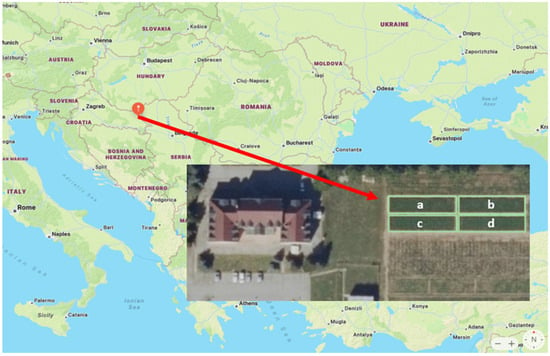
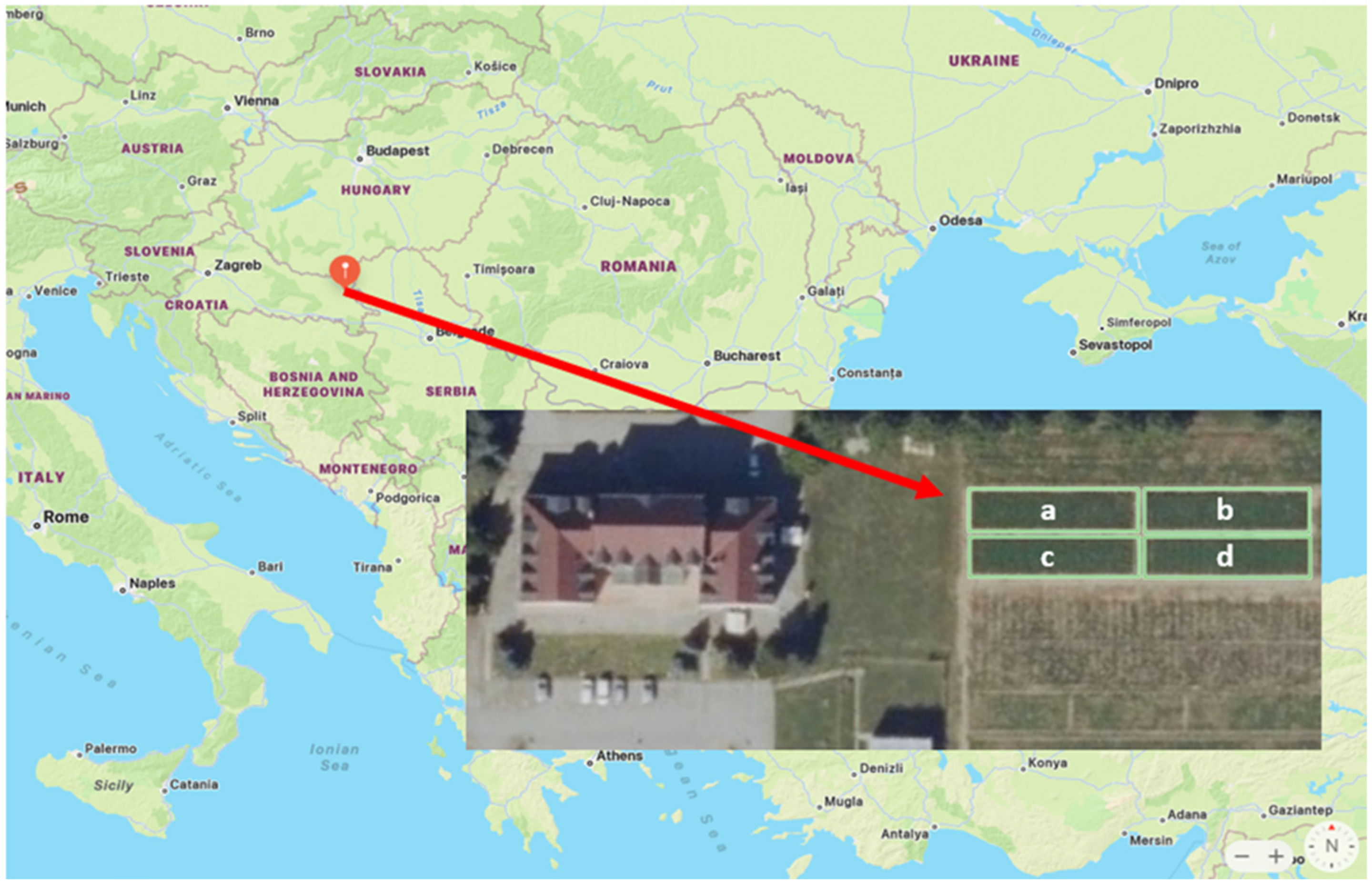
The experiment was located at the Agricultural Institute Osijek, Juzno predgradje 17, 31000 Osijek, Croatia (N 45°32′25.82″ E 18°44′12.00″) at an altitude of 90 m (Figure 1). The soil type was eutric brown soil (eutric Cambisol), and according to a 2024 soil analysis conducted by the Croatian Agency for Agriculture and Food, the soil texture was light sandy soil, slightly acidic (pH in H2O = 6.1), weak in humus content (1.75%), well supplied with phosphorus (P2O5 = 14.70 mg kg−1), and richly supplied with potassium (K2O = 25.90 mg kg−1). The area of eastern Croatia is dominated by a temperate continental climate, with a multi-annual average temperature of 11.13 °C for the period of 1899–2023 and a multi-annual average precipitation of 693.2 mm for the same annual period [35].
Figure 1.
Experimental site location–Agricultural Institute Osijek, Croatia (N 45°32′25.82″ E 18°44′12.00″) and established field trial plots.
2.3. Experimental Design
The field experiment was sown in March 2024 in a trial with four replications in a randomized complete block design (Figure 1). Alfalfa experimental populations/cultivar were sown by hand into a conventionally prepared seedbed to a depth of 1.5 cm, with a planting rate of 15 kg ha−1. The basic plot area was 7.2 m2 (1.2 m × 6 m) with row spacing of 20 cm. No irrigation water was applied during the entire experimental period. Weeds and pests were controlled using recommended pesticides. Crop management was kept uniform in all the experimental plots.
2.4. Field Data Collection
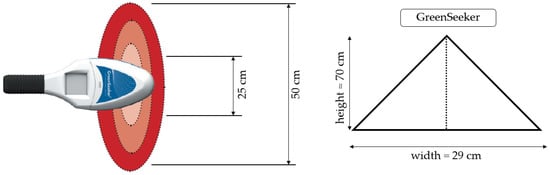
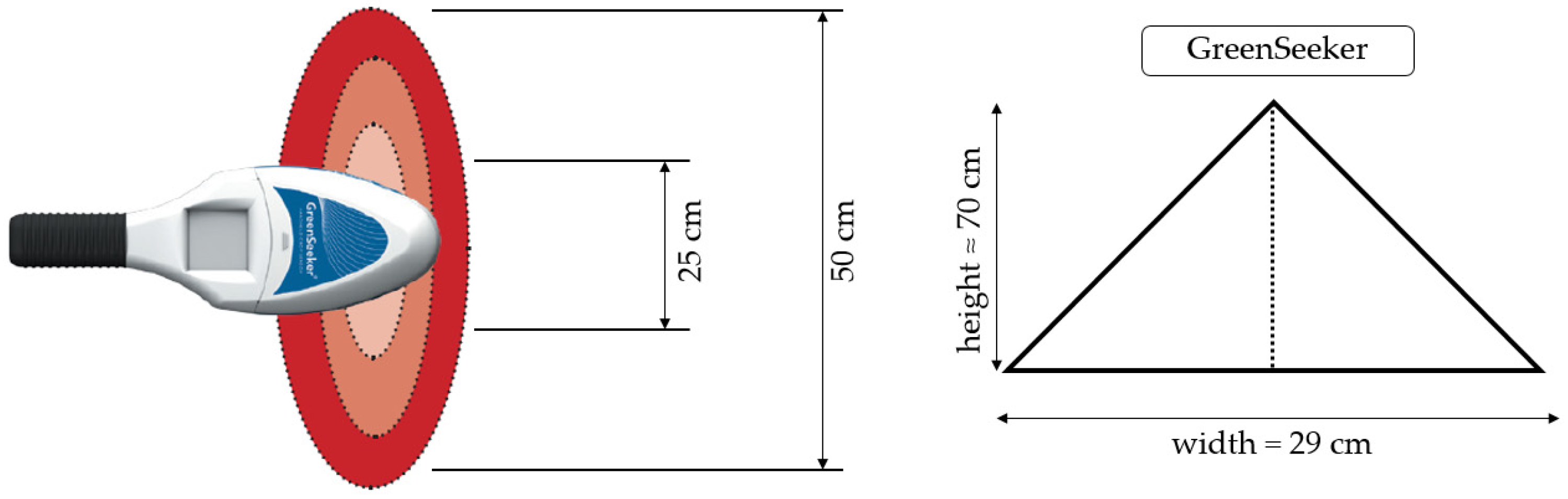
The data for this research were collected during the first and second alfalfa growing seasons in 2024 and 2025. A GreenSeeker (Trimble Navigation Limited, Sunnyvale, CA, USA) handheld active optical sensor unit was used to obtain NDVI values from crop canopies. The sensor emits brief bursts of red and infrared light, then measures the amount of each type of light reflected from the plant. The sensor displays the measured value as an NDVI reading (ranging from 0.00 to 0.99) on its LCD display screen. Because active sensors such as the GreenSeeker have their own light source and are not affected by ambient radiation, they can be used at any time of day or night, in different areas, and under different ambient radiation conditions. According to the quick reference card [36] for the GreenSeeker handheld crop sensor, its field of view is oval (Figure 2). This means that at a height of 60 cm, its field of view is 25 cm wide, while at a height of 120 cm, its field of view is 50 cm. In-field reflectance from the alfalfa crop canopies was obtained by holding the sensor approximately 70 cm above the canopy and walking at a constant speed through the middle of each experimental plot. Because the sensor’s field of view at a height of 70 cm is only 29 cm, the 120-cm plot was covered using four passes—two in one direction and two in the opposite direction. The collected data represent the mean value of these four passes. The field-of-view value was calculated using a proportional relationship between the sensor height and field of view length, based on the manufacturer’s reference measurements. The instantaneous field-of-view value was calculated using a proportional relationship between sensor height and field of view width, based on the manufacturer’s reference measurements, as follows:
IFOV/H = k
IFOV = (25/61) × 70 ≈ 29 cm
Figure 2.
Oval field of the sensor according to the quick reference card of the GreenSeeker sensor [36] and the field of view shown by the geometric diagram.
- IFOV—field of view
- H—sensor height above the surface
- k—proportionality constant
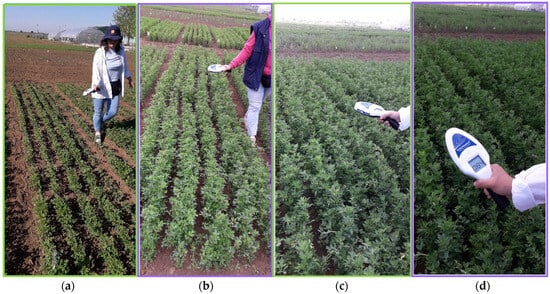
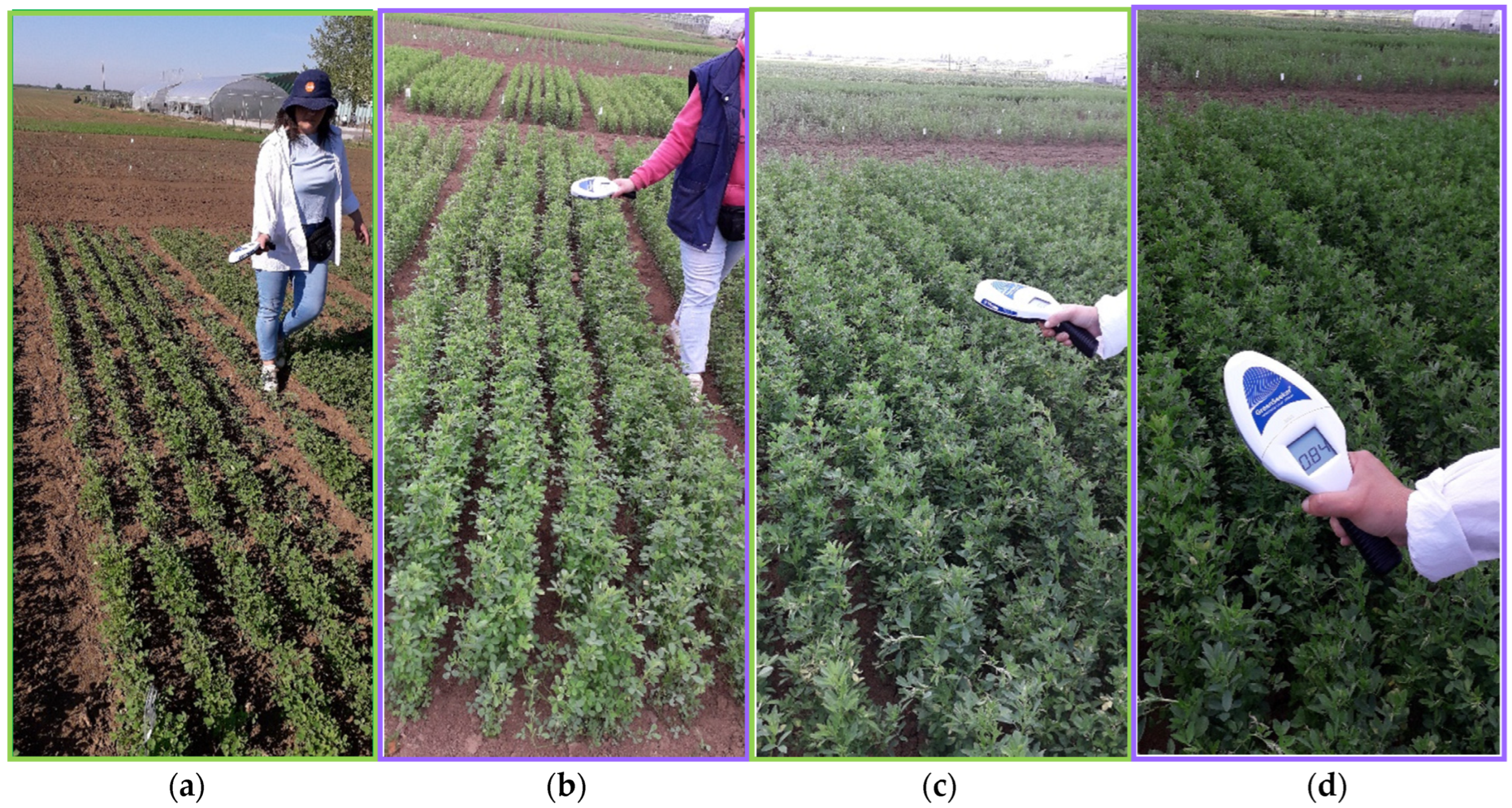
NDVI readings were collected four times in all experimental plots of all populations in both years of the study, at four different alfalfa development stages: early vegetative (EVS), mid-vegetative (MVS), late vegetative (LVS), and early bud (EBS) [37]. NDVI measurements were collected on 11 May 2024 and 17 May 2025 for EVS; 24 May 2024 and 23 May 2025 for MVS; 7 June 2024 and 29 May 2025 for LVS; and 16 June 2024 and 5 June 2025 for EBS (Figure 3).
Figure 3.
Using the GreenSeeker handheld to collect NDVI measurements on alfalfa experimental populations at different development stages: (a) early vegetative stage, (b) mid-vegetative stage, (c) late vegetative stage, (d) early bud stage.
After the NDVI values had been read, yields of green forage and dry matter and plant height were determined in all experimental plots of all alfalfa populations/cultivar in both study years. Green forage yield was measured by cutting the whole plot area using a forage plot harvester with an electronic weigh system (Hege Model 212, Wintersteiger AG, Waldenburg, Germany) at the development stage of plants from late budding to early flowering (data collected on 22 June 2024 and 12 June 2025). Immediately before cutting, subsamples of approximately 500 g of green mass were taken from the middle of each plot, weighed fresh, dried in a dryer at 105 °C for 48 h, and weighed dry to determine dry matter content in order to calculate dry matter yield. Data obtained per plot were converted to tons per hectare (t ha−1), and yields of green forage and dry matter were expressed per one cut. Green forage yield (GFY) expressed in t ha−1 was calculated using the following formula: GFY in kg per plot × 10,000/plot area in m2/1000. Dry matter yield (DMY) expressed in t ha−1 was calculated as DMY in kg per plot × 10,000/plot area in m2/1000; DMY in kg per plot = GFY in kg per plot × dry matter content (DMC). Plant height (cm) was measured directly before cutting on all plots of each population on ten randomly selected plants (from the ground to the top of the inflorescence) from the middle row of the plot.
The analysis of the collected experimental data was performed using the STAR v. 2.0.1 software [38]. The data were subjected to analysis of variance (ANOVA) to enable LSD calculation. Fisher’s protected LSD test was used at the 0.05 and 0.01 probability levels to identify significant differences between the mean values of populations/cultivar and years. Phenotypic correlations between the studied traits were calculated as Pearson’s correlation coefficients, and the significance of the relationships was determined using the mentioned statistical software.
3. Results and Discussion
Significant variations were obtained between alfalfa experimental populations/cultivar in NDVI values at different development stages in both study years, as well as in other observed traits, except for green forage yield in the first cut of the second growing season (Table 1 and Table 2, Figure 4). Analysis of variance also revealed a significant effect of year on all research parameters in both growing seasons (Figure 5).
Table 1.
NDVI values at four development stages of alfalfa and green forage yield (GFY), dry matter yield (DMY), and plant height (PH) of 20 alfalfa experimental populations/cultivar in the first cut of the first growing season (2024).
Table 2.
NDVI values at four development stages of alfalfa, and green forage yield (GFY), dry matter yield (DMY), and plant height (PH) of 20 alfalfa experimental populations/cultivar in the first cut of the second growing season (2025).
Figure 4.
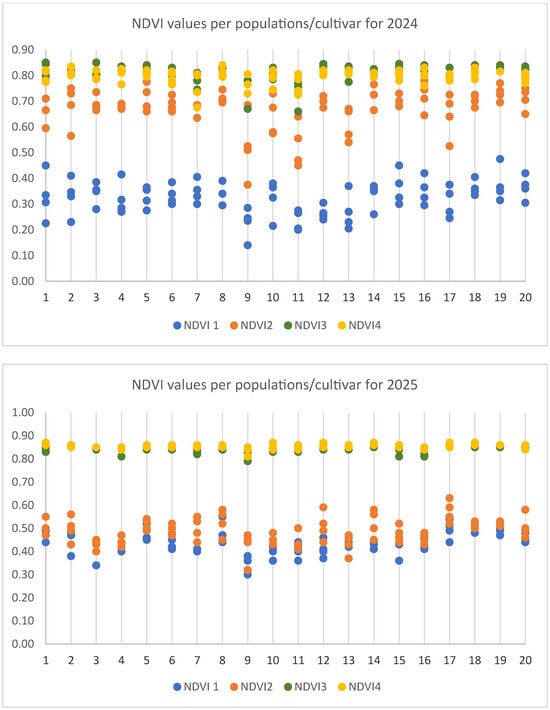
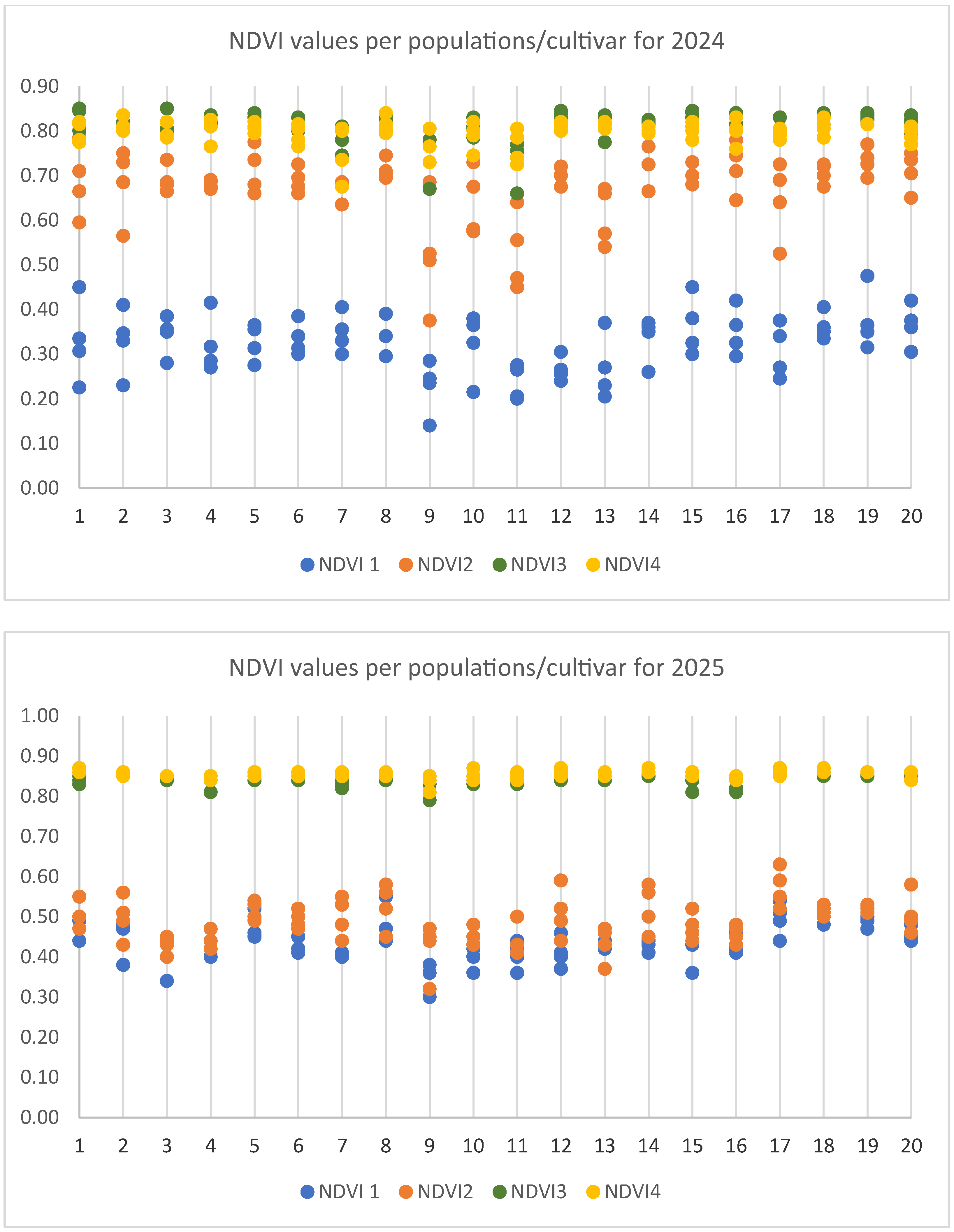
Scatter plot diagrams for the NDVI values and populations/cultivar per year.
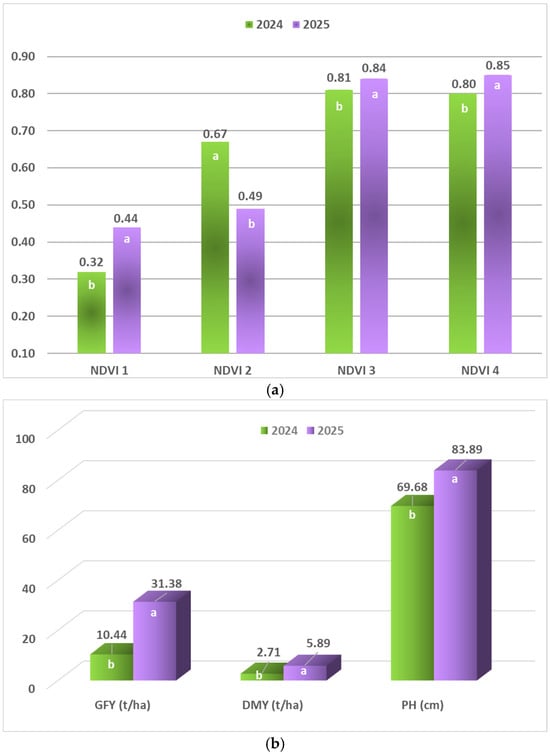
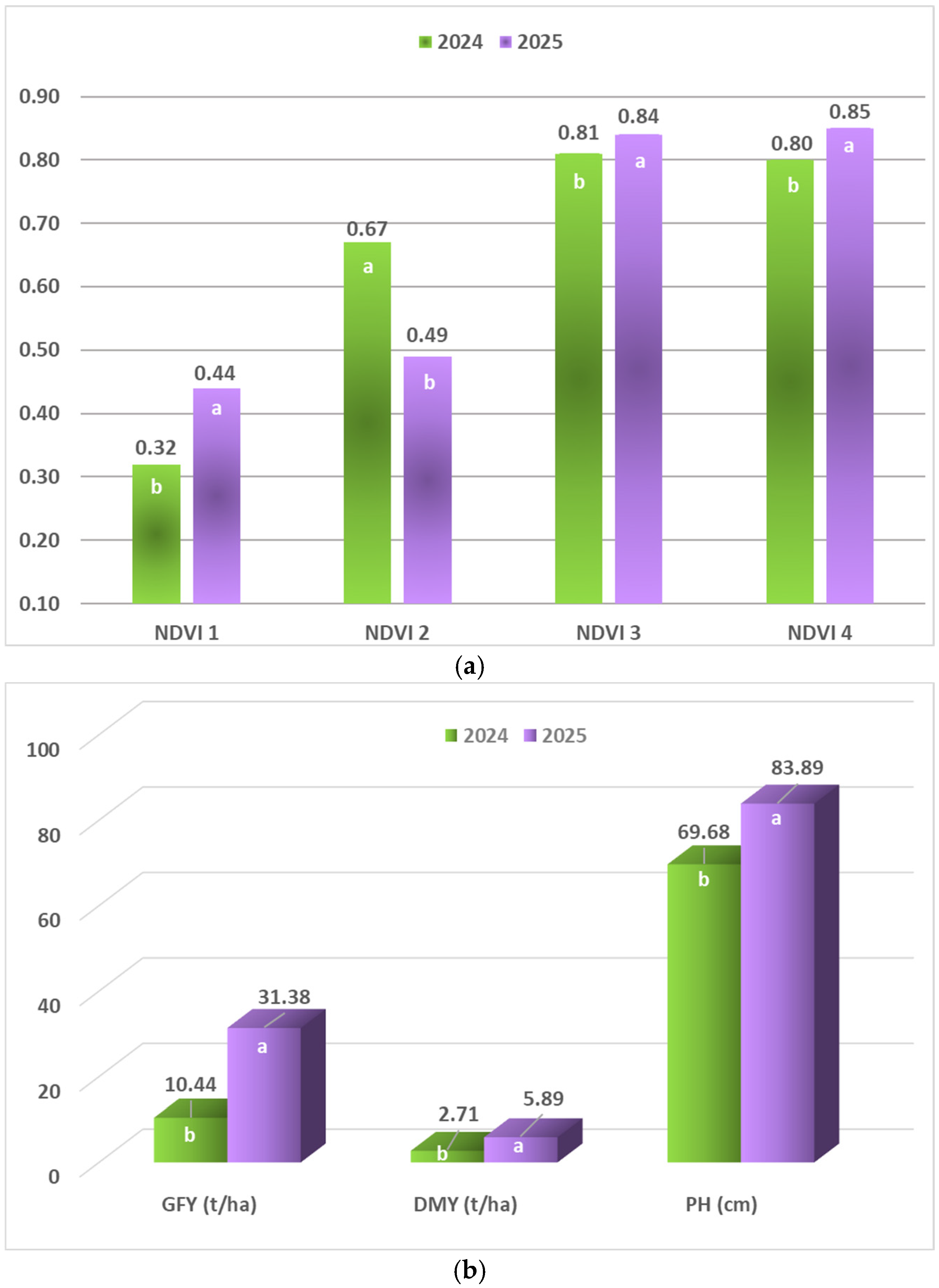
Figure 5.
Average annual values of the NDVI indexes (a) and investigated traits in the first cut in both studied years (b), (NDVI 1–early vegetative stage, NDVI 2–mid-vegetative stage, NDVI 3–late vegetative stage, NDVI 4–early bud stage; GFY–green forage yield, DMY–dry matter yield, PH–plant height). Different letters indicate a significant difference between years at p < 0.01 according to the LSD test.
Scatter plot diagrams were generated to illustrate the relations between the tested populations/cultivar and NDVI values measured at different vegetative stages of alfalfa (Figure 4). The numbers 1 to 20 represent the populations/cultivar in the same order as shown in Table 1 and Table 2.
In the first growing season, during the early vegetative development stage of alfalfa, the highest NDVI value was determined in the experimental population AEXP 18 (0.38). High NDVI values were also observed in the experimental populations AEXP 2, 15, and 11 (Table 1, Figure 4). In the mid-vegetative stage, the highest NDVI value was recorded for the experimental population AEXP 18 (0.73), which was not significantly higher than the measurements recorded in the experimental populations AEXP 2 and 15. A similar ranking trend of experimental alfalfa populations was obtained when measuring NDVI in both the late vegetative and early bud stages, and the highest values were recorded at AEXP 2 (0.84 and 0.81), 18 (0.83 and 0.82), 15 (0.83 and 0.81), and 11 (0.83 and 0.81) in both development phases, which were not significantly higher compared to most of the other observed experimental populations. The statistically lowest NDVI values were obtained in the experimental populations AEXP 10 and 8 in the early, mid, late vegetative, and early bud stages, and additionally, the lowest value was also recorded in the experimental population AEXP 6 at the early bud stage. The results of this paper showed significant population variability in NDVI values at all development stages of alfalfa. These results confirm the findings of previous studies on numerous crop species across various research, where NDVI showed high levels of genetic variation, whether measured at one or multiple plant growth stages [25,39,40,41,42,43,44].
The average NDVI value of all experimental alfalfa populations/cultivar shown in Table 1 and Table 2 ranged from 0.32 and 0.44 (early vegetative stage) to 0.81 and 0.84 (late vegetative stage and early bud stage). A consistent rise in NDVI values from early to later growth stages is expected and is associated with the plant growth rate and greater biomass accumulation, which leads to increased density and vigor of the alfalfa crop. Bostan et al. [45] used the NDVI index to capture the temporal dynamics at different phenological stages of alfalfa and also detected that the values of the NDVI index increased until the sprouting phenophase, when green mass was mowed for fodder. Chen et al. [46] found that NDVI increased with increasing alfalfa yield.
The highest average coefficient of variation of NDVI values was found in the earliest vegetative growth stage (15.98%), which is most likely related to uneven seed germination after sowing and, consequently, to uneven growth and development of young alfalfa plants (Table 1).
In the first cut of the first growing season, the significantly highest green forage yield was recorded in AEXP 15 (11.45 t ha−1), while the highest values for dry matter yield and plant height (3.06 t ha−1 and 75.17 cm) were recorded in AEXP 2 (Table 1). The superior populations in all examined agronomic traits were also AEXP 11 and AEXP 18. High population differences in forage yields indicate that genetic diversity within advanced populations can provide a valuable source of variation for further yield improvement. The lowest yields of green forage and dry matter (8.74 and 2.30 t ha−1) were determined in AEXP 10, while AEXP 6 had the lowest plant height (64.25 cm). Low values of the tested agronomic traits were also observed in AEXP 8, 4, and 9.
In the first cut of the second growing season, NDVI values ranged from 0.50 (AEXP 2) to 0.34 (AEXP 8) in the early vegetative stage, from 0.57 (AEXP 15) to 0.42 (AEXP 8) in the mid-vegetative stage, from 0.86 (AEXP 18) to 0.81 (AEXP 8) in the late vegetative stage, and from 0.87 (AEXP 18) to 0.84 (AEXP 8) in the early bud stage (Table 2, Figure 4). The highest green forage yield was achieved by AEXP 2 (33.55 t ha−1), which was not statistically significantly higher than the yields observed in the other studied populations, while AEXP 8 recorded the lowest yield value (28.90 t ha−1). The statistically highest dry matter yield (6.37 t ha−1) was determined in AEXP 2, while the highest plant height was achieved in AEXP 18 (90.75 cm). The lowest dry matter yield and plant height values (5.31 t ha−1 and 76.42 cm) were observed in AEXP 8.
In both years of the study, experimental alfalfa populations that were superior in forage yield and plant height generally also exhibited the highest and/or elevated NDVI values across all observed development stages. The results of this study suggest that NDVI measurements could be effectively utilized for the early prediction and indirect identification of desirable alfalfa populations. Moreover, NDVI demonstrates potential as a supplementary tool for breeders in supporting decision-making and selecting materials for further breeding processes aimed at the development of new, higher-yielding cultivars.
Several authors also reported a positive relationship between yield and NDVI. Klimek-Kopyra et al. [39] evaluated NDVI at different growth stages to indicate the productivity in pea crops, while Yildirim et al. [43] assessed bread wheat genotypes based on their physiological traits and NDVI measured at various growth stages. Similarly, Zsebő et al. [22] used NDVI values from GreenSeeker and MicaSense Cameras at different phenological stages to predict winter wheat yield.
The average annual values of the NDVI indexes at all development stages of alfalfa were statistically higher in the second year of the study, except at the mid-vegetative stage, where a higher value was recorded in the first growth year (Figure 5a). In the second year of the study, significantly higher average yields of green forage and dry matter (31.38 and 5.89 t ha−1, respectively), as well as plant height (83.89 cm), were recorded in the first cut compared to the first growing season (Figure 5b). Forage yields achieved in the first cut of the second year of the study were over 50% higher compared to the year of alfalfa establishment. This result is expected, considering that alfalfa is a perennial crop and that the expression of its agronomic properties, in addition to the genetic potential of the cultivar, is strongly influenced by the stand age of the crop [14]. Cavero et al. [47] also reported that the maximum alfalfa forage yield was lower in the first year compared to the following two growth years.
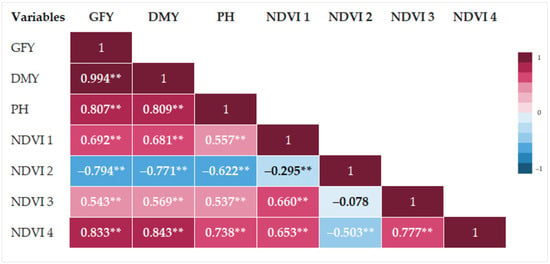
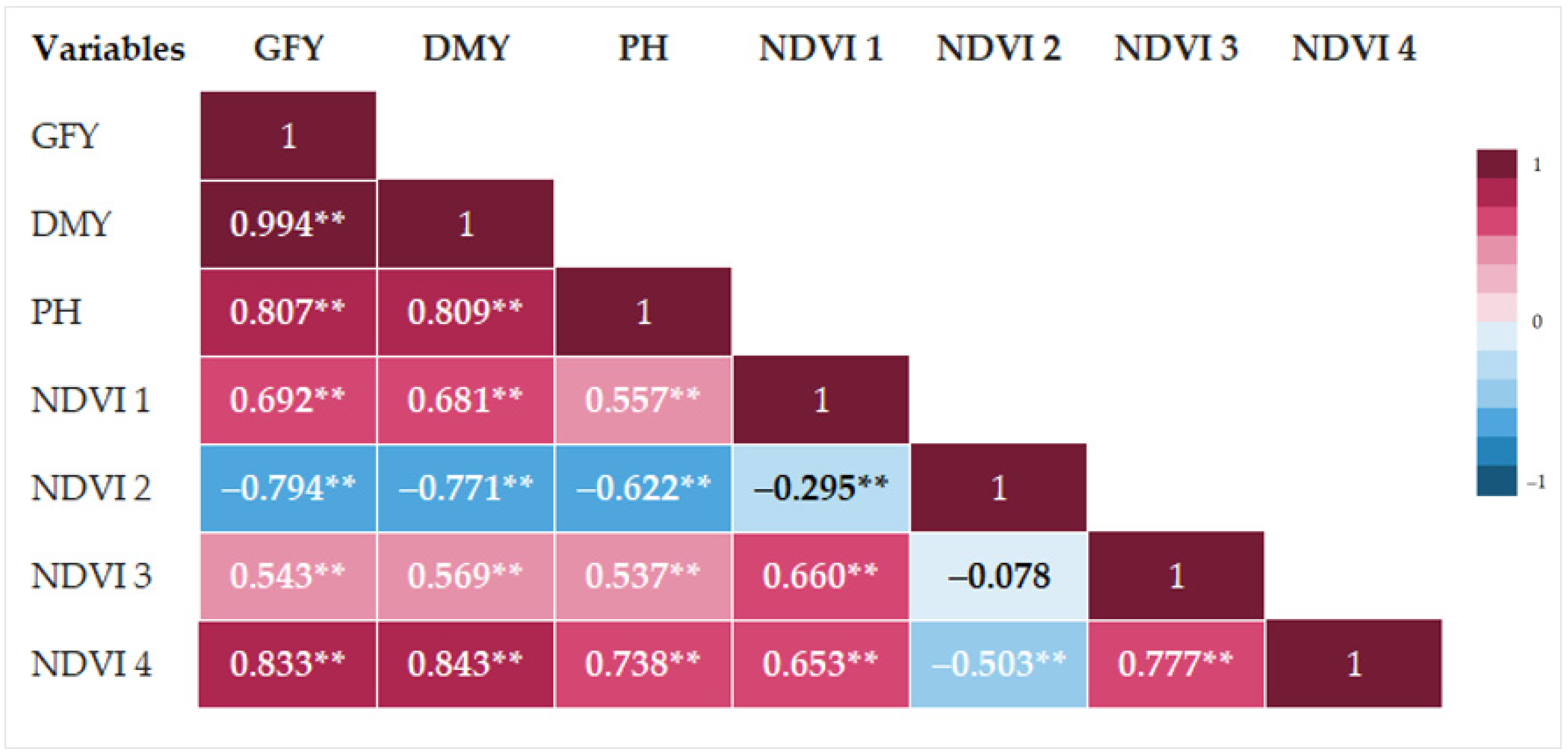
Correlations between traits observed in this study are shown in Figure 6. The results of this research revealed that strong, significant positive correlations were observed between green forage and dry matter yields (0.994), and between plant height and forage yields (0.807 and 0.809). These results are in line with findings of Tucak et al. [48], Andrade et al. [13], Acharya et al. [12], Jia et al. [49], and Greveniotis et al. [50], who studied the relationships between the mentioned agronomic traits in various alfalfa research studies. NDVI 1, 3, and 4 had positive correlations with forage yields, ranging from 0.543 (NDVI 3 and GFY) to 0.843 (NDVI 4 and DMY), indicating that NDVI measurements in these vegetative stages could be used for indirect selection of high-yielding alfalfa breeding materials. NDVI 4 was recorded during the early bud stage, when the plants had developed proportional leaf and structural biomass. At this stage, the growth of leaves and stems and the accumulation of dry matter progress in parallel, so NDVI 4 reflects the total biomass of the plant well. Consistent with this, the highest coefficients of determination (R2) for DMY, GFY, and PH were obtained at the early bud stage, corresponding to NDVI 4, with respective R2 values of 0.71, 0.69, and 0.54. Kayad et al. [51] used Landsat 8 satellite imagery to analyze NIR reflectance and calculate multiple vegetation indices (including NDVI and SAVI) in different alfalfa phenophases. The highest correlations were found between the actual dry matter yield and the predicted yield using NIR reflectance, SAVI, and NDVI, with maximum correlation coefficients of 0.69, 0.68, and 0.63, respectively. A comprehensive literature review revealed no studies reporting NDVI measurements in alfalfa using the GreenSeeker or similar device with correlations as strong as those observed in this dataset, underscoring its uniqueness and value. The particularly high correlation may reflect homogeneous field conditions, precise DMY measurements, and well-timed field data collection. Further research across multiple locations is needed to evaluate the broader applicability of these findings. Plant height showed a similar trend, with significant positive correlations with NDVI 1, 3, and 4, which ranged from 0.537 (NDVI 3) to 0.738 (NDVI 4). Significant positive relationships were also found between NDVI 1, 3, and 4, indicating that alfalfa populations with high NDVI at one stage tend to maintain high NDVI throughout most of the growing season. NDVI 2 values exhibited a significant negative correlation with all evaluated parameters, with correlation coefficients ranging from –0.078 (between NDVI 2 and NDVI 3) to –0.794 (between NDVI 2 and GFY). NDVI 2 showed negative correlations, most likely because the data were collected in the mid-vegetative phase, when alfalfa exhibited high leaf volume and high moisture content, which elevated the NDVI values. At that stage, there was not yet a proportional increase in stem, height, and total (structural) biomass. NDVI primarily reflects the intensity of greenery, while yield and height depend primarily on the accumulation of structural biomass. This phenological discrepancy leads to a negative correlation, and NDVI is therefore not suitable for yield prediction at this phenological stage in our current study. NDVI 1, 3, and 4 were measured during phases in which leaf development and stem and height growth occurred in parallel, resulting in a positive correlation.
Figure 6.
Correlation coefficient between observed traits of the alfalfa experimental populations. For the traits description, see titles of Figure 5. ** Significant at p < 0.01.
4. Conclusions
The results showed statistically significant variation among alfalfa experimental populations/cultivar in NDVI values at different development stages in both studied years, as well as in other observed traits, except for green forage yield in the first cut of the second growing season. A significant influence of year on all investigated parameters was observed in both growing seasons.
The average NDVI value of all alfalfa experimental populations/cultivar in both years of the study consistently increased from earlier to later growth stages, which is expected, and is associated with the plant growth rate and greater biomass accumulation, leading to increased crop density and vigor in alfalfa. The average annual values of the NDVI indexes at all alfalfa development stages were statistically higher in the second year of the study, except for the mid-vegetative stage, where the higher value was recorded in the first growth year. Meanwhile, the average annual yields of green forage and dry matter and plant height in the first cut of the second year of the study were statistically higher compared to the values achieved in the first year. In both years of the study, the alfalfa experimental populations that were superior in forage yield and plant height, in most cases, also had the highest and/or high NDVI values across all observed plant development stages. The results obtained in this study suggest that NDVI measurements could be used for early prediction and indirect identification of desirable alfalfa populations, and that NDVI has potential as an additional tool to support breeders in decision-making and selection of materials for further breeding processes in the development of new, more productive cultivars. Positive correlations between NDVI measurements at early vegetative, late vegetative, and early bud stages with forage biomass yields and plant height confirm the possibility of using NDVI as an additional tool for application in our alfalfa breeding program to improve data collection and decision-making ability for early prediction of highly productive populations. To establish broader applicability, further research should be carried out across multiple locations.
Author Contributions
Conceptualization, M.T. and M.R.; methodology, M.T. and M.I.; formal analysis, T.Č.; investigation, M.T. and K.P.; data curation, G.K.; writing—original draft preparation, M.T. and K.P.; writing—review and editing, K.P., T.Č., G.K., L.A., M.I., M.R. and V.M.; visualization, L.A.; supervision, M.T. and V.M. All authors have read and agreed to the published version of the manuscript.
Funding
This paper is the result of research within the institutional research project “Breeding development of alfalfa and red clover germplasm adapted to climate changes–ALFRED BREED, 2024–2027”, which is funded by the European Union–Next Generation EU through the National Recovery and Resilience Plan 2021–2026.
Data Availability Statement
The original contributions presented in this study are included in the article. Further inquiries can be directed to the corresponding authors.
Conflicts of Interest
The authors declare no conflicts of interest.
References
- Julier, B.; Gastal, F.; Louarn, G.; Badenhausser, I.; Annicchiarico, P.; Crocq, G.; le Chatelier, D.; Guillemot, E.; Emile, J.C. Lucerne (alfalfa) in European cropping systems. In Legumes in Cropping Systems; Murphy-Bokern, D., Stoddard, F.L., Watson, C.A., Eds.; CABI: Wallingford, UK, 2017; pp. 168–192. [Google Scholar]
- Tucak, M.; Ravlić, M.; Horvat, D.; Čupić, T. Improvement of Forage Nutritive Quality of Alfalfa and Red Clover through Plant Breeding. Agronomy 2021, 11, 2176. [Google Scholar] [CrossRef] [Scilit]
- Pégard, M.; Barre, P.; Delaunay, S.; Surault, F.; Karagić, D.; Milić, D.; Zorić, M.; Ruttink, T.; Julier, B. Genome-wide genotyping data renew knowledge on genetic diversity of a worldwide alfalfa collection and give insights on genetic control of phenology traits. Front. Plant Sci. 2023, 14, 1196134. [Google Scholar] [CrossRef] [Scilit] [PubMed]
- Tlahig, S.; Neji, M.; Atoui, A.; Seddik, M.; Dbara, M.; Yahia, H.; Nagaz, K.; Najari, S.; Khorchani, T.; Loumerem, M. Genetic and seasonal variation in forage quality of lucerne (Medicago sativa L.) for resilience to climate change in arid environments. J. Agric. Food Res. 2024, 15, 100986. [Google Scholar] [CrossRef] [Scilit]
- Perić, K.; Čupić, T.; Krizmanić, G.; Tokić, B.; Andrić, L.; Ravlić, M.; Meglič, V.; Tucak, M. The Role of Crop Wild Relatives and Landraces of Forage Legumes in Pre-Breeding as a Response to Climate Change. Agronomy 2024, 14, 1385. [Google Scholar] [CrossRef] [Scilit]
- Annicchiarico, P.; Pecetti, L. Comparison among nine alfalfa breeding schemes based on actual biomass yield gains. Crop Sci. 2021, 61, 2355–2370. [Google Scholar] [CrossRef] [Scilit]
- Ren, L.; Bennett, J.A.; Coulman, B.; Liu, J.; Biligetu, B. Forage yield trend of alfalfa cultivars in the Canadian prairies and its relation to environmental factors and harvest management. Grass Forage Sci. 2021, 76, 390–399. [Google Scholar] [CrossRef] [Scilit]
- Ray, D.K.; Mueller, N.D.; West, P.C.; Foley, J.A. Yield trends are insufficient to double global crop production by 2050. PLoS ONE 2013, 8, e66428. [Google Scholar] [CrossRef] [Scilit]
- Casler, M.D.; Vogel, K.P. Forage Breeding. In Forages: The Science of Grassland Agriculture; Moore, K.J., Collins, M., Nelson, C.J., Redfearn, D.D., Eds.; Publications from USDA-ARS/UNL Faculty; John Wiley & Sons Ltd.: Hoboken, NJ, USA, 2020; Volume II, pp. 553–567. Available online: https://digitalcommons.unl.edu/usdaarsfacpub/2482 (accessed on 22 September 2025).
- Gebremedhin, A.; Badenhorst, P.E.; Wang, J.; Spangenberg, G.C.; Smith, K.F. Prospects for Measurement of Dry Matter Yield in Forage Breeding Programs Using Sensor Technologies. Agronomy 2019, 9, 65. [Google Scholar] [CrossRef] [Scilit]
- Annicchiarico, P.; Barrett, B.; Brummer, E.C.; Julier, B.; Marshall, A.H. Achievements and challenges in improving temperate perennial forage legumes. Crit. Rev. Plant Sci. 2015, 34, 327–380. [Google Scholar] [CrossRef] [Scilit]
- Acharya, J.P.; Lopez, Y.; Gouveia, B.T.; de Bem Oliveira, I.; Resende, M.F.R., Jr.; Muñoz, P.R.; Rios, E.F. Breeding Alfalfa (Medicago sativa L.) Adapted to Subtropical Agroecosystems. Agronomy 2020, 10, 742. [Google Scholar] [CrossRef] [Scilit]
- Andrade, M.H.M.L.; Acharya, J.P.; Benevenuto, J.; de Bem Oliveira, I.; Lopez, Y.; Munoz, P.; Resende, M.F.R.; Rios, E.F. Genomic prediction for canopy height and dry matter yield in alfalfa using family bulks. Plant Genome 2022, 15, e20235. [Google Scholar] [CrossRef] [Scilit] [PubMed]
- Tucak, M.; Horvat, D.; Čupić, T.; Krizmanić, G.; Ravlić, M. Assessment of Alfalfa Populations for Forage Productivity and Seed Yield Potential under a Multi-Year Field Trial. Agronomy 2023, 13, 349. [Google Scholar] [CrossRef] [Scilit]
- Thapa, R.; Kunze, K.H.; Hansen, J.; Pierce, C.; Moore, V.; Ray, I.; Wickes-Do, L.; Morales, N.; Sabadin, F.; Santantonio, N.; et al. Remote sensing for estimating genetic parameters of biomass accumulation and modeling stability of growth curves in alfalfa. G3 Genes|Genomes|Genet. 2024, 14, jkae200. [Google Scholar] [CrossRef] [Scilit]
- Wang, J.; Badenhorst, P.; Phelan, A.; Pembleton, L.; Shi, F.; Cogan, N.; Spangenberg, G.; Smith, K. Using Sensors and Unmanned Aircraft Systems for High-Throughput Phenotyping of Biomass in Perennial Ryegrass Breeding Trials. Front. Plant Sci. 2019, 10, 1381. [Google Scholar] [CrossRef] [Scilit] [PubMed]
- Cazenave, A.B.; Shah, K.; Trammell, T.; Komp, M.; Hoffman, J.; Motes, C.M.; Maria, J.; Monteros, M.J. High-Throughput Approaches for Phenotyping Alfalfa Germplasm under Abiotic Stress in the Field. Plant Phenome J. 2019, 2, 1–13. [Google Scholar] [CrossRef] [Scilit]
- Feng, L.; Zhang, Z.; Ma, Y.; Du, Q.; Williams, P.; Drewry, J.; Luck, B. Alfalfa Yield Prediction Using UAV-Based Hyperspectral Imagery and Ensemble Learning. Remote Sens. 2020, 12, 2028. [Google Scholar] [CrossRef] [Scilit]
- Tang, Z.; Parajuli, A.; Chen, C.J.; Hu, Y.; Revolinski, S.; Medina, C.A.; Lin, S.; Zhang, Z.; Yu, L.X. Validation of UAV-based alfalfa biomass predictability using photogrammetry with fully automatic plot segmentation. Sci. Rep. 2021, 11, 3336. [Google Scholar] [CrossRef] [Scilit] [PubMed]
- Cheng, T.; Zhang, D.; Zhang, G.; Wang, T.; Ren, W.; Yuan, F.; Liu, Y.; Wang, Z.; Zhao, C. High-throughput phenotyping techniques for forage: Status, bottleneck, and challenges. Artif. Intell. Agric. 2025, 15, 98–115. [Google Scholar] [CrossRef] [Scilit]
- Biswas, A.; Andrade, M.H.M.L.; Acharya, J.P.; de Souza, C.L.; Lopez, Y.; de Assis, G.; Shirbhate, S.; Singh, A.; Munoz, P.; Rios, E.F. Phenomics-Assisted Selection for Herbage Accumulation in Alfalfa (Medicago sativa L.). Front. Plant Sci. 2021, 12, 756768. [Google Scholar] [CrossRef] [Scilit]
- Zsebő, S.; Bede, L.; Kukorelli, G.; Kulmány, I.M.; Milics, G.; Stencinger, D.; Teschner, G.; Varga, Z.; Vona, V.; Kovács, A.J. Yield Prediction Using NDVI Values from GreenSeeker and MicaSense Cameras at Different Stages of Winter Wheat Phenology. Drones 2024, 8, 88. [Google Scholar] [CrossRef] [Scilit]
- Tedesco, D.; Nieto, L.; Hernández, C.; Rybecky, J.F.; Min, D.; Sharda, A.; Hamilton, K.J.; Ciampitti, I.A. Remote Sensing on Alfalfa as an Approach to Optimize Production Outcomes: A Review of Evidence and Directions for Future Assessments. Remote Sens. 2022, 14, 4940. [Google Scholar] [CrossRef] [Scilit]
- Andersson, K.; Trotter, M.; Robson, A.; Schneider, D.; Frizell, L.; Saint, A.; Lamb, D.; Blore, C. Estimating pasture biomass with active optical sensors. Adv. Anim. Biosci. Precis. Agric. (ECPA) 2017, 8, 754–757. [Google Scholar] [CrossRef] [Scilit]
- Abičić, I.; Lalić, A.; Galić, V.; Mlinarić, S.; Begović, L. Application of biomass sensor in the winter barley selection. In Proceedings of the 54th Croatian & 14th International Symposium on Agriculture, Vodice, Croatia, 14–22 February 2019; pp. 179–183. [Google Scholar]
- Naser, M.A.; Khosla, R.; Longchamps, L.; Dahal, S. Using NDVI to Differentiate Wheat Genotypes Productivity Under Dryland and Irrigated Conditions. Remote Sens. 2020, 12, 824. [Google Scholar] [CrossRef] [Scilit]
- Koc, A.B.; MacInnis, B.M.; Aguerre, M.J.; Chastain, J.P.; Turner, A.P. Alfalfa Biomass Estimation Using Crop Surface Modeling and NDVI. Appl. Eng. Agric. 2023, 39, 251–264. [Google Scholar] [CrossRef] [Scilit]
- Lima, C.d.S.; Junior, D.F.U.; Carvalho, I.R.; Bredemeier, C. Use of Phenomics in the Selection of UAV-Based Vegetation Indices and Prediction of Agronomic Traits in Soybean Subjected to Flooding. AgriEngineering 2024, 6, 3261–3278. [Google Scholar] [CrossRef] [Scilit]
- Gracia-Romero, A.; Segarra, J.; Rezzouk, F.Z.; Aparicio, N.; Kefauver, S.C.; Araus, J.L. In-Field Phenotyping Using the Low-Cost and Open Access Fluorescence PhotosynQ Multispeq Sensor Together with NDVI: A Case Study with Durum Wheat. Agriculture 2025, 15, 385. [Google Scholar] [CrossRef] [Scilit]
- Petrović, I.; Vučajnk, F.; Spanic, V. Detection of Fusarium Head Blight in Wheat Using NDVI from Multispectral UAS Measurements and Its Correlation with DON Contamination. AgriEngineering 2025, 7, 37. [Google Scholar] [CrossRef] [Scilit]
- Rehman, T.H.; Lundy, M.E.; Linquist, B.A. Comparative Sensitivity of Vegetation Indices Measured via Proximal and Aerial Sensors for Assessing N Status and Predicting Grain Yield in Rice Cropping Systems. Remote Sens. 2022, 14, 2770. [Google Scholar] [CrossRef] [Scilit]
- Saberioon, M.M.; Amin, M.S.M.; Gholizadeh, A.; Ezri, M.H. A Review of Optical Methods for Assessing Nitrogen Contents during Rice Growth. Appl. Eng. Agric. 2014, 30, 657–669. [Google Scholar] [CrossRef] [Scilit]
- Li, J.; Wang, R.; Zhang, M.; Wang, X.; Yan, Y.; Sun, X.; Xu, D. A Method for Estimating Alfalfa (Medicago sativa L.) Forage Yield Based on Remote Sensing Data. Agronomy 2023, 13, 2597. [Google Scholar] [CrossRef] [Scilit]
- Nguyen, P.; Badenhorst, P.E.; Shi, F.; Spangenberg, G.C.; Smith, K.F.; Daetwyler, H.D. Design of an Unmanned Ground Vehicle and LiDAR Pipeline for the High-Throughput Phenotyping of Biomass in Perennial Ryegrass. Remote Sens. 2021, 13, 20. [Google Scholar] [CrossRef] [Scilit]
- Croatian Meteorological and Hydrological Service, Mean Monthly Values and Extremes. Available online: https://meteo.hr/klima.php?section=klima_podaci¶m=k1&Grad=osijek (accessed on 17 March 2025).
- Trimble Navigation Limited. GreenSeeker Handheld Crop Sensor Quick Reference Card; Trimble Navigation Limited: Sunnyvale, CA, USA, 2013; Available online: https://ascommunications.co.uk/wp-content/uploads/2021/11/Greenseeker-Handheld-Quick-Reference-Guide-VEW.pdf (accessed on 22 September 2025).
- Kalu, B.A.; Fick, G.W. Morphological stage of development as a predictor of alfalfa herbage quality. Crop Sci. 1983, 23, 1167–1172. [Google Scholar] [CrossRef] [Scilit]
- IRRI. Statistical Tool for Agricultural Research (STAR), Version 2.0.1; International Rice Research Institute: Los Baños, Philippines, 2013. [Google Scholar]
- Klimek-Kopyra, A.; Zając, T.; Oleksy, A.; Kulig, B.; Ślizowska, A. The value of different vegetative indices (NDVI, GAI) for the assessment of yield potential of pea (Pisum sativum L.) at different growth stages and under varying management practices. Acta Agrobot. 2018, 71, 1733. [Google Scholar] [CrossRef] [Scilit]
- Mirosavljević, M.; Momčilović, V.; Čanak, P.; Aćin, V.; Jocković, B.; Vujošević, B. Variation in NDVI values and relationship with grain yield in two-rowed winter barley. Ratar. Povrt. 2018, 55, 118–124. [Google Scholar] [CrossRef] [Scilit]
- Dong, X.; Feng, G.; Zemach, I. Using normalized difference vegetation index to estimate sesame drydown and seed yield. J. Crop Improv. 2021, 35, 508–521. [Google Scholar] [CrossRef] [Scilit]
- Inostroza, L.; Espinoza, S.; Barahona, V.; Gerding, M.; Humphries, A.; del Pozo, A.; Ovalle, C. Phenotypic Diversity and Productivity of Medicago sativa Subspecies from Drought-Prone Environments in Mediterranean Type Climates. Plants 2021, 10, 862. [Google Scholar] [CrossRef] [Scilit]
- Yildirim, M.; Özkan, R.; Bayhan, M.; Eliş, S.; Tebrizli, N.; Kizilgeçi, F. Investigation of The Relationship Between NDVI, SPAD and CM1000 Chlorophyll Meter Measured at Different Developmental Stages of Bread Wheat Genotypes. Wheat Stud. 2024, 13, 54–63. [Google Scholar] [CrossRef] [Scilit]
- Nazeer, S.; Akram, M.Z. Elucidating Genotypic Variation in Quinoa via Multidimensional Agronomic, Physiological, and Biochemical Assessments. Plants 2025, 14, 2332. [Google Scholar] [CrossRef] [Scilit]
- Bostan, C.; Horablaga, N.M.; Rechiţean, D.; Rain, P.; Istrate–Schiller, C.M.; Horablaga, A.; Copăcean, L.; Agapie, A.; Bostan-Pînișoară, N.; Cojocariu, L. Normalized difference vegetation index (NDVI) in the evaluation of phenological dynamics in Dactylis glomerata L. and Medicago sativa L. Life Sci. Sustain. Dev. J. 2022, 3, 106–112. [Google Scholar] [CrossRef] [Scilit]
- Chen, J.; Yu, T.; Cherney, J.H.; Zhang, Z. Optimal Integration of Optical and SAR Data for Improving Alfalfa Yield and Quality Traits Prediction: New Insights into Satellite-Based Forage Crop Monitoring. Remote Sens. 2024, 16, 734. [Google Scholar] [CrossRef] [Scilit]
- Cavero, J.; Faci, M.; Medina, E.T.; Martínez-Cob, A. Alfalfa forage production under solid-set sprinkler irrigation in a semiarid climate. Agric. Water Manag. 2017, 191, 184–192. [Google Scholar] [CrossRef] [Scilit]
- Tucak, M.; Popović, S.; Grljušić, S.; Čupić, T.; Kozumplik, V.; Šimić, B. Variability and relationships of important alfalfa germplasm agronomic traits. Period. Biol. 2008, 110, 311–315. [Google Scholar]
- Jia, X.; Zhang, Z.; Wang, Y. Forage Yield, Canopy Characteristics, and Radiation Interception of Ten Alfalfa Varieties in an Arid Environment. Plants 2022, 11, 1112. [Google Scholar] [CrossRef] [Scilit]
- Greveniotis, V.; Bouloumpasi, E.; Skendi, A.; Korkovelos, A.; Kantas, D.; Zotis, S.; Ipsilandis, C.G. Modeling Stability of Alfalfa Yield and Main Quality Traits. Agriculture 2024, 14, 542. [Google Scholar] [CrossRef] [Scilit]
- Kayad, A.G.; Al-Gaadi, K.A.; Tola, E.; Madugundu, R.; Zeyada, A.M.; Kalaitzidis, C. Assessing the spatial variability of alfalfa yield using satellite imagery and ground-based data. PLoS ONE 2016, 11, e0157166. [Google Scholar] [CrossRef] [Scilit]

Disclaimer/Publisher’s Note: The statements, opinions and data contained in all publications are solely those of the individual author(s) and contributor(s) and not of MDPI and/or the editor(s). MDPI and/or the editor(s) disclaim responsibility for any injury to people or property resulting from any ideas, methods, instructions or products referred to in the content. |
© 2025 by the authors. Licensee MDPI, Basel, Switzerland. This article is an open access article distributed under the terms and conditions of the Creative Commons Attribution (CC BY) license.