Assessing the Impact of Genotype-by-Environment Interactions on Agronomic Traits in Elite Cowpea Lines across Agro-Ecologies in Nigeria


 , ,
, ,
Abstract
1. Introduction
2. Materials and Methods
2.1. Genetic Materials
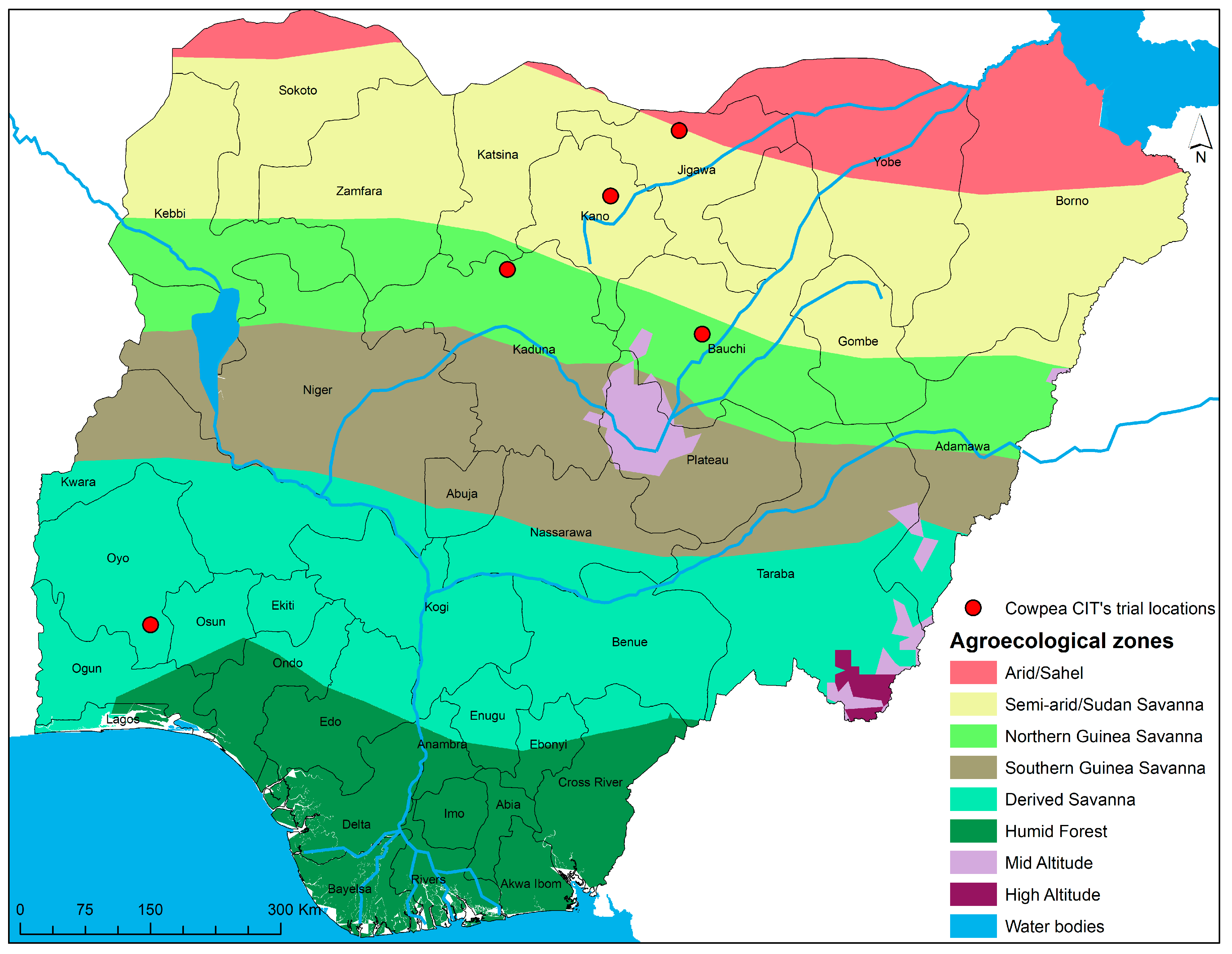
2.2. Description of the Study Environments
2.3. Experimental Layout and Data Collection
3. Data Analysis
3.1. Stability Measures
- Wricke’s ecovalence (Wi) [34] is a quantitative assessment of the consistency of a specific genotype’s performance across test environments, where a low ecovalence value indicates greater stability, meaning that environmental variations influence the genotype’s performance less and consistently perform well under diverse conditions.where Wi = ecovalence of the i-th cultivar;
- Yij = the observed phenotypic value of the i-th cultivar in the j-th environment;
- Yi. = mean of i-th cultivar across the entire environment;
- Y.j = mean of j-th environment;
- Y.. = grand mean.
- The cultivar superiority (Pi) by Lin and Binns [35] is defined as the mean square distance between the cultivar’s response and the maximum response averaged over all locations.where Pi = superiority index of the i-th cultivar;
- Xij = yield of the i-th cultivar in the j-th environment;
- Mj = maximum response obtained among all the cultivars in the j-th environment;
- n = number of environments.
- Shukla’s stability (1972) [36] measure was calculated as the difference between the genotype’s observed performance and its expected performance across all environments divided by the overall mean performance across all genotypes and environments. The formula for Shukla’s stability measure is as follows:where S is the stability measure for genotype I;
- Yi. = the average performance of genotype i across all environments;
- = the overall mean performance across all genotypes and environments;
- Yij = the performance of genotype I in environment j.
3.2. Genotype Main Effect plus Genotype-by-Environment Interaction (GGE) Biplot Analysis
4. Results
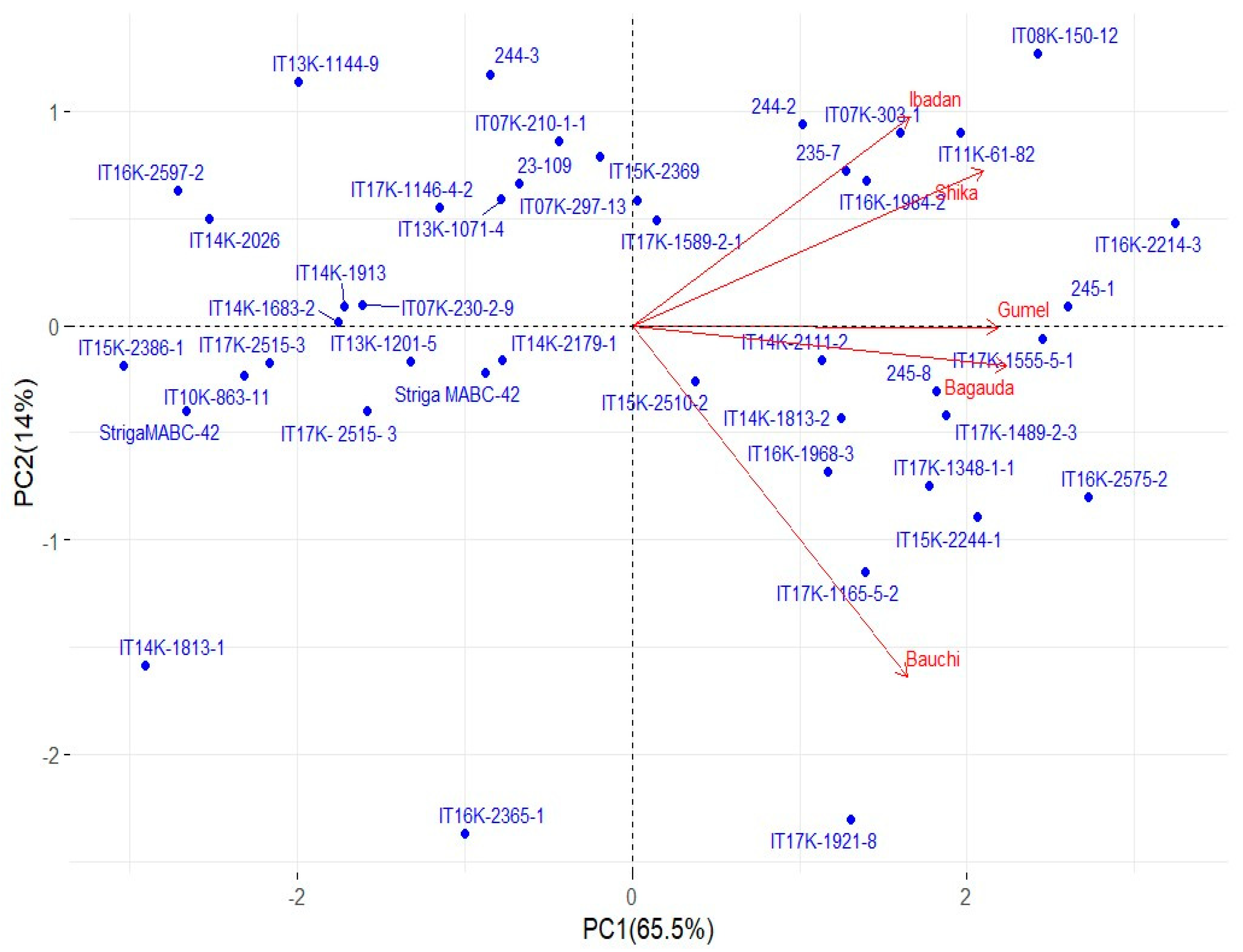
4.1. Principal Components
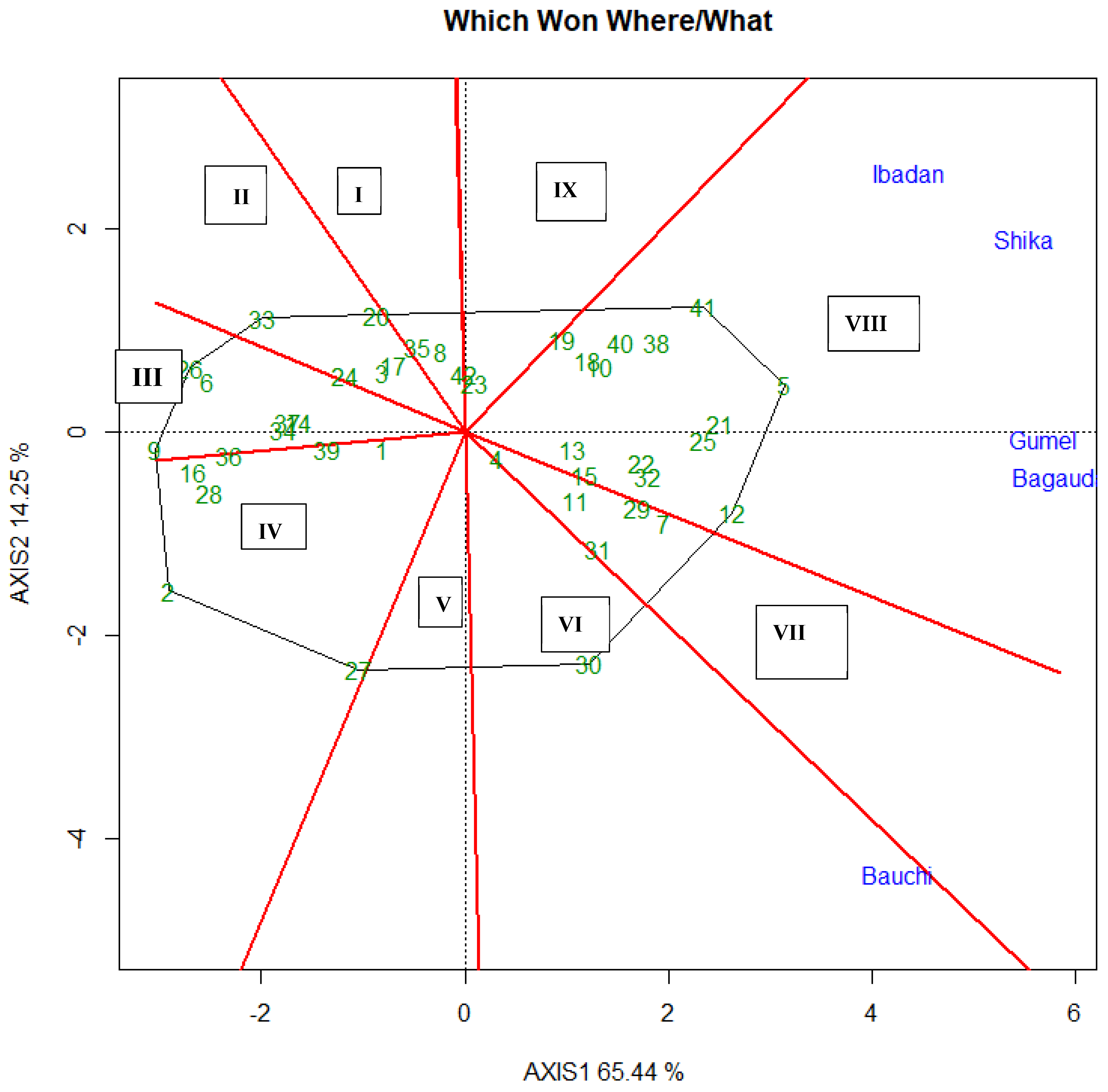
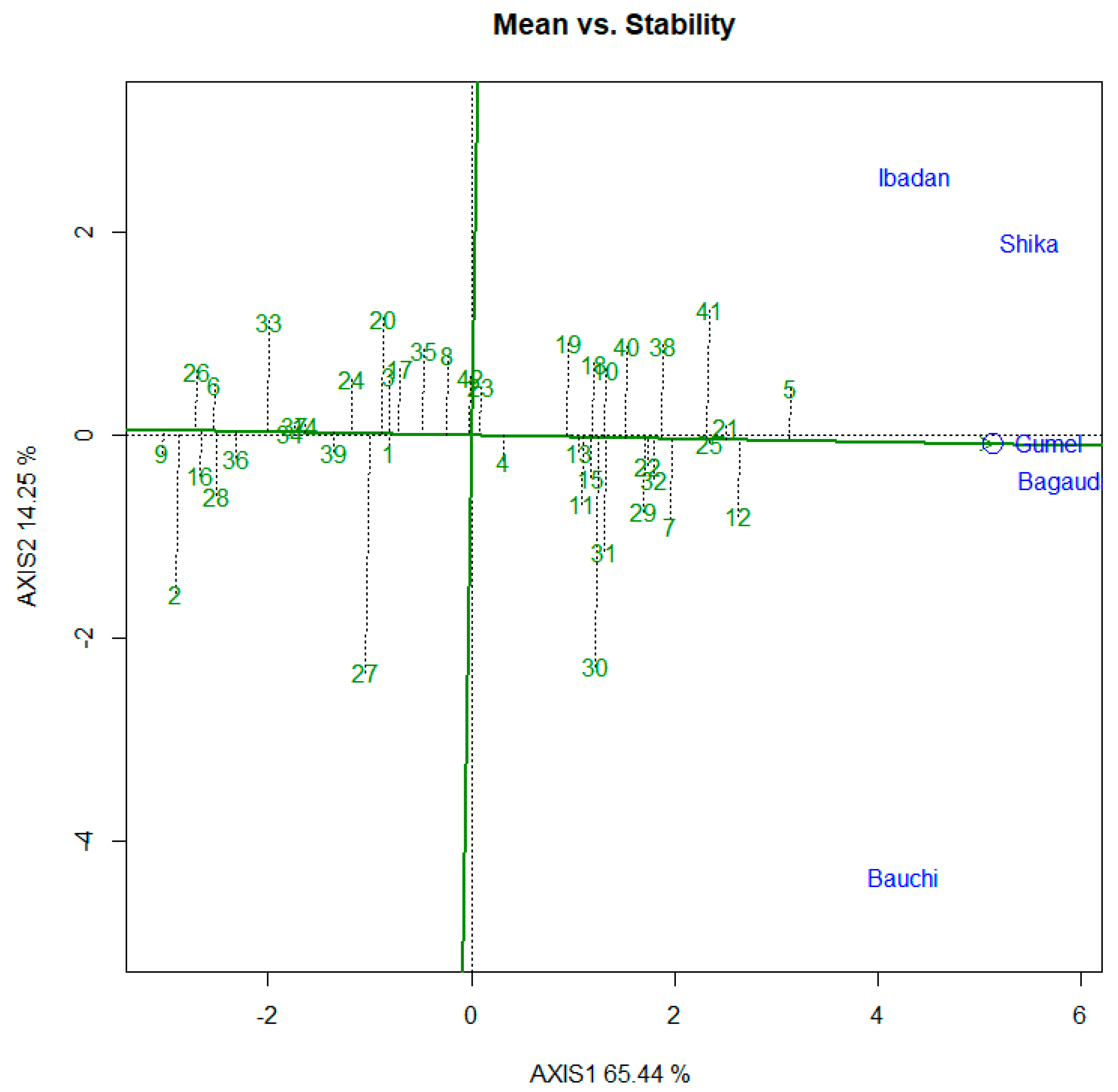
4.2. Main Genotype Effect plus Genotype by Environment Interaction (GGE) Biplot Analysis
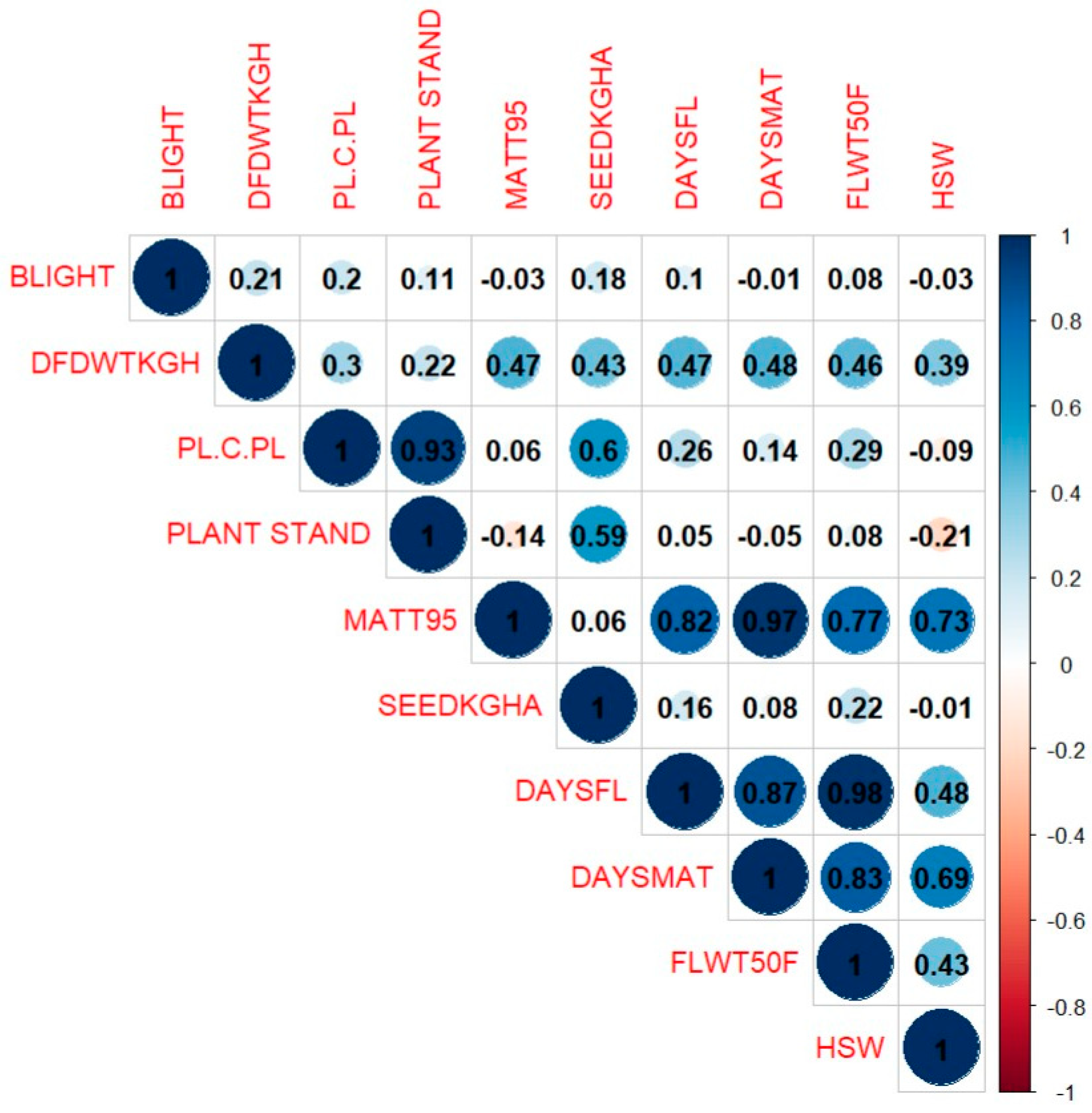
4.3. Correlations among Traits
5. Discussion
6. Conclusions
Author Contributions
Funding
Data Availability Statement
Acknowledgments
Conflicts of Interest
References
- Boukar, O.; Belko, N.; Chamarthi, S.; Togola, A.; Batieno, J.; Owusu, E.; Haruna, M.; Diallo, S.; Umar, M.L.; Olufajo, O.; et al. Cowpea (Vigna unguiculata): Genetics, genomics and breeding. Plant Breed. 2019, 138, 415–442. [Google Scholar] [CrossRef]
- Jayathilake, C.; Visvanathan, R.; Deen, A.; Bangamuwage, R.; Jayawardana, B.C.; Nammi, S.; Liyanage, R. Cowpea: An overview on its nutritional facts and health benefits. J. Sci. Food Agric. 2018, 98, 4793–4806. [Google Scholar] [CrossRef]
- Omoigui, L.O.; Kamara, A.Y.; Kamai, N.; Ekeleme, F.; Aliyu, K.T. Guide to Cowpea Production in Northern Nigeria; IITA: Ibadan, Nigeria, 2020; 48p. [Google Scholar]
- Samireddypalle, A.; Boukar, O.; Grings, E.; Fatokun, C.A.; Kodukula, P.; Devulapalli, R.; Okike, I.; Blummel, M. Cowpea and Groundnut Haulms Fodder Tradding and Its Lessons for Multidimensional Cowpea Improvement for Mixed crop Livestock Systems in West Africa. Front. Plant Sci. 2017, 8, 30. [Google Scholar] [CrossRef] [PubMed]
- Singh, B. Cowpea: The Food Legume of the 21st Century; Crop Science Society of America: Madison, WI, USA, 2014. [Google Scholar]
- Duke, J.A. Introduction to food legumes. In Insect Pests of Tropical Legumes; Singh, S.R., Ed.; John Wiley and Sons Ltd.: Chichester, UK, 1990; pp. 1–42. [Google Scholar]
- Singh, B.B.; Ajeigbe, H.A.; Tarawali, S.A.; Fernandez-Rivera, S.; Abubakar, M. Improving the production and utilization of cowpea as food and fodder. Field Crop. Res. 2003, 84, 169–177. [Google Scholar] [CrossRef]
- Dugje, I.Y.; Omoigui, L.O.; Ekeleme, F.; Kamara, A.Y.; Ajeigbe, H. Farmers’ Guide to Cowpea Production in West Africa; IITA: Ibadan, Nigeria, 2009; p. 20. [Google Scholar]
- FAOStat. FAOSTAT, Statistical Data Base; Food and Agricultural Organizations of the United Nations: Rome, Italy, 2021. [Google Scholar]
- Hill, S. Cowpea Adaptability to Southeastern Organic Farming Systems: Forage Productivity and Charcoal Rot Susceptibility. Master’s Thesis, University of Tennessee, Knoxville, TN, USA, 2015. [Google Scholar]
- Noubissietchiagm, J.B.; Bell, J.M.; Guissaibirwe, S.; Gonne, S.; Youmbi, E. Varietal response of cowpea (Vigna unguiculata L. Walp.) to striga gesnerioides (wild.) vatke race SG5 infestation. Horti Agrobot. Cluj-Napoca 2010, 38, 33–41. [Google Scholar]
- Baidoo, P.K.; Mochiah, M.B. Varietal susceptibility of improved cowpea Vigna unguiculata (L.) (walp.) cultivars to field and storage pests. Sustain. Agric. Res. 2014, 3, 69. [Google Scholar] [CrossRef]
- Chamarthi, S.K.; Belko, N.; Togola, A.; Fatokun, C.A.; Boukar, O. Genomics-Assisted Breeding for Drought Tolerance in Cowpea. In Genomics Assisted Breeding of Crops for Abiotic Stress Tolerance, Vol. II; Sustainable Development and Biodiversity; Rajpal, V., Sehgal, D., Kumar, A., Raina, S., Eds.; Springer: Cham, Switzerland, 2019; pp. 187–209. [Google Scholar] [CrossRef]
- Horn, L.; Shimelis, H.; Laing, M. Participatory appraisal of production constraints, preferred traits and farming system of cowpea in the northern Namibia: Implications for breeding. Legume Res. 2015, 38, 691–700. [Google Scholar] [CrossRef]
- Maureen, F.A.K. Genetic Analysis of Traits Related to Biological Nitrogen Fixation in Cowpea [Vigna unguiculata L. WALP] under Low Soil Phosphorus. Ph.D. Thesis, University of Ghana, Legonm, Ghana, 2015. [Google Scholar]
- Mohammed, S.B.; Dzidzienyo, D.K.; Umar, M.L.; Ishiyaku, M.F.; Tongoona, P.B.; Gracen, V. Appraisal of cowpea cropping systems and farmers’ perceptions of production constraints and preferences in the dry savannah areas of Nigeria. CABI Agric. Biosci. 2021, 2, 25. [Google Scholar] [CrossRef]
- Olufajo, O.O.; Singh, B.B. Advances in cowpea cropping systems research. In Challenges and Opportunities for Enhancing Sustainable Cowpea Production; Fatokun, C.A., Tarawali, S.A., Singh, B.B., Kormawa, P.M., Tamo, M., Eds.; Institute of Tropic Agriculture, (IITA): Ibadan, Nigeria, 2002; Volume 4, pp. 267–277. [Google Scholar]
- Hall, A.E.; Cisse, N.; Thiaw, S.; Hassan, O.A.E.; Ehlers, J.D.; Ismail, A.M.; Fery, R.L.; Roberts, P.A.; Kitch, L.W.; Murdock, L.L.; et al. Development of cowpea cultivars and germplasm by the Bean/Cowpea CRSP. Field Crop. Res. 2003, 82, 103–134. [Google Scholar] [CrossRef]
- Adewale, B.D.; Adeigbe, O.; Aremu, C. Genetic distance and diversity among some cowpea (Vigna unguiculata L. Walp) genotypes. Int. J. Res. Pharm. Sci. 2011, 1, 9–14. [Google Scholar]
- Ali, Y.; Aslam, Z.; Hussain, F.; Shakur, A. Genotype and environmental interaction in cowpea (Vigna unguiculata-L) for yield and disease resistance. Int. J. Environ. Sci. Technol. 2004, 1, 119–123. [Google Scholar] [CrossRef]
- Goa, Y.; Mohammed, H.; Worku, W.; Urage, E. Genotype by environment interaction and yield stability of cowpea (Vigna unguiculata (L.) Walp.) genotypes in moisture limited areas of Southern Ethiopia. Heliyon 2022, 8, e09013. [Google Scholar] [CrossRef] [PubMed]
- Gumede, M.T.; Gerrano, A.S.; Modi, A.T.; Thungo, Z. Influence of genotype and environment on grain yield among cowpea (Vigna unguiculata (L.) Walp) genotypes under dry land farming system. Acta Agric. Scand. Sect. B—Soil Plant Sci. 2022, 72, 709–719. [Google Scholar] [CrossRef]
- Horn, L.; Shimelis, H.; Sarsu, F.; Mwadzingeni, L.; Laing, M.D. Genotype-by-environment interaction for grain yield among novel cowpea (Vigna unguiculata L.) selections derived by gamma irradiation. Crop J. 2018, 6, 306–313. [Google Scholar] [CrossRef]
- Adewale, B.D.; Okonji, C.; Oyekanmi, A.A.; Akintobi DA, C.; Aremu, C.O. Genotypic variability and stability of some grain yield components of Cowpea. Afr. J. Agric. Res. 2010, 5, 874–880. [Google Scholar]
- Sarvamangala, C.; Uma, M.S.; Birada, S.; Salimath, P.M. Stability analysis for yield and yield components over seasons in cowpea (Vigna unguiculata L. Walp). Electron. J. Plant Breed. 2010, 1, 1392–1395. [Google Scholar]
- Nunes, H.F.; Filho, F.R.F.; Ribeiro, V.Q.; Gomes, R.L.F. Grain yield adaptability and stability of black-eyed cowpea genotypes under rainfed agriculture in Brazil. Afr. J. Agric. Res. 2014, 9, 255–261. [Google Scholar]
- Yan, W.; Kang, M.S.; Ma, B.; Woods, S.; Cornelius, P.L. GGE Biplot vs. AMMIAnalysis of Genotype-by-Environment Data. Crop Sci. 2007, 47, 643–653. [Google Scholar] [CrossRef]
- Gauch, H.; Zobel, W. AMMI analysis of yield trials. In Genotypes by Environment Interaction; Kang, S., Gauch, H., Eds.; CRC: New York, NY, USA, 1996. [Google Scholar]
- Bandeira, M.; Jackson, K.; de Moura, M.; Angelo, J.; Raphaelle, L. Genotype by environment interaction in cowpea lines using GGE biplot method. Rev. Caatinga 2018, 31, 64–71. [Google Scholar]
- International Institute of Tropical Agriculture (IITA). Geographic Information System (GIS); International Institute of Tropical Agriculture: Ibadan, Nigeria, 2023. [Google Scholar]
- FAO. Digital Soil Map of the World; FAO: Rome, Italy, 1991. [Google Scholar]
- R Core Team. A Language and Environment for Statistical Computing; R. Foundation for Statistical Computing: Vienna, Austria, 2023; Available online: http://www.R.Project.org (accessed on 23 November 2023).
- ViTSel, Version 1.0; Breeding and Germplasm Tool. Africa Rice Centre (AfricaRice), Centro Internacional de Mejoramiento de Maiz y Trigo (CIMMYT), and International Institute of Tropical Agriculture (IITA). 2020. Available online: https://www.iita.org/digital-tools/appdetails?app=ViTSel (accessed on 23 November 2023).
- Wricke, G. Übereine Methodezur Erfassung der ökologischen Streubreite in Feldversuchen. Z. Pflanzenzuecht. 1962, 47, 92–96. [Google Scholar]
- Lin, C.S.; Binns, M.R. A superiority measure of cultivar performance for cultivar x location data. Can. J. Plant Sci. 1988, 68, 193–198. [Google Scholar] [CrossRef]
- Shukla, G.K. Some statistical aspects of partitioning genotype environmental components of variability. Heredity 1972, 29, 237–245. [Google Scholar] [CrossRef] [PubMed]
- Dia, M.; Wehner, T.C.; Arellano, C. RGxE: An R Program for Genotype x Environment Interaction Analysis. Am. J. Plant Sci. 2017, 8, 1672–1698. [Google Scholar] [CrossRef]
- Singh, R.K.; Chaudhary, S.D. Biometrical Methods in Quantitative Genetic Analysis; Kalyan Publishers: New Delhi, India, 1985; pp. 205–214. [Google Scholar]
- Hanson, C.H.; Robinson, H.F.; Comstock, R.E. Biometrical studies of yield in segregating populations of Korean lespedeza 1. Agron. J. 1956, 48, 268–272. [Google Scholar] [CrossRef]
- Falconer, D.S.; Mackay, T.C.F. Introduction to Quantitative Genetics; Longman: London, UK, 1996. [Google Scholar]
- Lynch, M.; Walsh, B. Genetics and Analysis of Quantitative Traits; Sinauer Associates: Sunderland, MA, USA, 1998. [Google Scholar]
- Robinson, H.F.; Comstock, R.E.; Harvey, P.H. Estimates of heritability and the degree of dominance in corn 1. Agron. J. 1949, 41, 353–359. [Google Scholar] [CrossRef]
- Allard, R.W. Principles of Plant Breeding; John Wiley and Sons, Inc.: New York, NY, USA, 1960. [Google Scholar]
- Johnson, H.W.; Robinson, H.F.; Comstock, R.E. Estimates of genetic and environmental variability in soybeans 1. Agron. J. 1955, 47, 314–318. [Google Scholar] [CrossRef]
- Mofokeng, M.A.; Mashilo, J.; Rantso, P.; Shimelis, H. Genetic variation and genetic advance in cowpea based on yield and yield-related traits. Acta Agric. Scand. Sect. B Soil Plant Sci. 2020, 70, 381–391. [Google Scholar] [CrossRef]
- Manggoel, W.; Uguru, M.I.; Ndam, O.N.; Dasbak, M.A. Genetic Variability, Correlation and Path Coefficient Analysis of some Yield Components of Ten Cowpea [Vigna unguiculata (L.) Walp] accessions. J. Plant Breed. Crop Sci. 2002, 4, 80–86. [Google Scholar] [CrossRef]
- Kumawat, K.C.; Raje, R.S.; Kumhar, B.L. Genetic variation in yield and yield components in cowpea [Vigna unguiculata L. (Walp.)]. Ann. Agri-Bio Res. 2005, 10, 21–23. [Google Scholar]
- Narayanankutty, C.; Mili, R.; Jaikumaran, U. Variability and genetic divergence in vegetable cowpea. J Maharashtra Agric. Univ. 2003, 28, 26–29. [Google Scholar]
- Vidya, C.; Oommen, S.K.; Vijayaraghava, K. Genetic variability and heritability of yield and related characters in yard-longbean. J. Trop. Agric. 2002, 40, 11–13. [Google Scholar]
- Mohammed, I.; Victoria, M.Y.; Singh, B.B.; Olufajo, O.; Zaria, A.A. Phenotypic stability for selected traits of some cowpea lines in Nigerian agro-ecologies. Plant Biol. Biotechnol. 2017, 5, 67–77. [Google Scholar]
- Tadesse, T.; Sefera, G.; Asmare, B.; Teklaign, A. Application of AMMI for grain yield stability analysis in large speckled bean genotypes grown in midlands of bale zone. Chem. Biomol. Eng. 2018, 3, 17–21. [Google Scholar] [CrossRef]
- Asfaw, A.; Assefa, T.; Amsalu, B.; Negash k Alemayehu, F.; Gurum, F.; Rezene, Y.; Finenissa, C.; Atnafi, M.; Daba, C. Adaptation and yield stability of small red beans elite lines in Ethiopia. Int. J. Plant Breed. Genet. 2008, 2, 51–63. [Google Scholar] [CrossRef]
- Abou-Khater, L.; Maalouf, F.; Jighly, A.; Rubiales, D.; Kumar, S. Adaptability and Stability of Faba Bean (Vicia faba L.) Accessions under Diverse Environments and Herbicide Treatments. Plants 2022, 11, 251. [Google Scholar] [CrossRef] [PubMed]
- Gerrano, A.S.; van Rensburg, W.S.J.; Kutu, F.R. Agronomic evaluation and identification of potential cowpea (Vigna unguiculata L. Walp) genotypes in South Africa. Acta Agric. Scand. Sect. B Soil Plant Sci. 2019, 69, 295–303. [Google Scholar] [CrossRef]
- Martos-Fuentes, M.; Fernández, J.A.; Ochoa, J.; Carvalho, M.; Carnide, V.; Rosa, E.; Pereira, G.; Barcelos, C.; Bebeli, P.J.; Egea-Gilabert, C. Genotype by environment interactions in cowpea (Vigna unguiculata L. Walp.) grown in the Iberian Peninsula. Crop Past. Sci. 2017, 68, 924–931. [Google Scholar] [CrossRef]
- Ddamulira, G.; Santos, C.A.F.; Alanyo, M.; Ramathani, I.; Maphosa, M. Maturity, protein content and yield stability of cowpea in Uganda. SA J Plant Soil. 2017, 34, 255–261. [Google Scholar] [CrossRef]
- Yan, W.; Kang, M.S. GGE biplot analysis: A graphical tool for breeders. In Geneticists, and Agronomists; Kang, M.S., Ed.; CRC Press: Boca Raton, FL, USA, 2003; pp. 63–88. [Google Scholar]
- Yan, W.; Tinker, N.A. Biplot analysis of multi-environment trial data: Principles and applications. Can. J. Plant Sci. 2006, 86, 623–645. [Google Scholar] [CrossRef]
- Hall, A.E.; Thiaw, S.; Ismael, A.M.; Ehlers, J.D. Water-use efficiency and drought adaptation in cowpea. In Advances in Cowpea Research; Singh, B.B., Mohan Raj, D.R., Dashiell, K.E., Jackai, L.E.N., Eds.; Co-publication of International Institute of Tropical Agriculture (IITA) and Japan International Research Center for Agricultural Sciences (JIRCAS): Tsukuba, Japan; IITA: Ibadan, Nigeria, 1997; pp. 87–98. [Google Scholar]
- Kindie, Y.; Tesso, B.; Amsalu, B. Genotype X Environment Interaction and Yield Stability in Early-Maturing Cowpea (Vigna unguiculata (L.) Walp.) Landraces in Ethiopia. Adv. Agric. 2021, 2021, 3786945. [Google Scholar] [CrossRef]
- Santos, A.; Ceccn, G.; Rodrigues, E.V.; Teodoro, P.E.; Makimo, P.A.; Alves, V.B.; Silva, J.F.; Correa, A.M.; Alvares, R.C.F.; Torres, F.E. Adaptability and stability of cowpea genotypes to Brazilian Midwest. Afr. J. Agric. Res. 2015, 10, 3901–3908. [Google Scholar]
- Moges, A. Genotype by Environment Interaction on Yield and Micronutrient Concentration of Biofortified Common Bean (Phaseolus vulgaris L.) in Ethiopia. MSc Thesis, Haramaya University, Haramaya, Ethiopia, 2017. [Google Scholar]
- El-Shaieny, A.A.H.; Abdel-Ati, Y.A.A.; El-Damarany, M.E.D.; Rashwan, M.R. Stability analysis of components characters in cowpea (Vigna unguiculata (L.) Walp). J. Hortic. For. 2002, 7, 24–35. [Google Scholar] [CrossRef]
- Firew, M. Simultaneous selection for high yield and stability in common bean (Phaseolus vulgaris) genotypes. J. Agric. Sci. 2002, 138, 249–253. [Google Scholar]
- Mesfin, H.M. Genotype x Environment Interaction and Stability Analysis in Soybean [Glycine max (L.) Merrill] for Grain Yield in Ethiopia. Master’s Thesis, Department of Horticulture and Plant Science, Jimma University College of Agriculture and Veterinary Medicine, Jimma University, Jimma, Ethiopia, 2017. [Google Scholar]
- Sharma, P.; Baranda, B.; Haritwal, S.; Sharma, M. Character association for seed yield and its components in cowpea [Vigna unguiculata (L.) Walp]. Int. J. Curr. Microbiol. Appl. Sci. 2017, 6, 967–975. [Google Scholar]
- Owusu, E.Y.; Karikari, B.; Kusi, F.; Haruna, M.; Richard AAmoah, R.A.; Attamah, P.; GAdazebra, G.; Sie, E.K.; Issahaku, M. Genetic variability, heritability and correlation analysis among maturity and yield traits in Cowpea (Vigna unguiculata (L) Walp) in Northern Ghana. Heliyon 2021, 7, e07890. [Google Scholar] [CrossRef]



| Genotype Code | Genotype | Entry Type | Source |
|---|---|---|---|
| G1 | 23-109 | T | IITA |
| G2 | 235-7 | T | IITA |
| G3 | 244-2 | T | IITA |
| G4 | 244-3 | T | IITA |
| G5 | 245-1 | T | IITA |
| G6 | 245-8 | T | IITA |
| G7 | IT07K-210-1-1 | T | IITA |
| G8 | IT07K-230-2-9 | T | IITA |
| G9 | IT07K-297-13 | C | IITA |
| G10 | IT07K-303-1 | T | IITA |
| G11 | IT08K-150-12 | C | IITA |
| G12 | IT10K-863-11 | T | IITA |
| G13 | IT13K-1071-4 | T | IITA |
| G14 | IT13K-1144-9 | T | IITA |
| G15 | IT13K-1201-5 | T | IITA |
| G16 | IT14K-1683-2 | T | IITA |
| G17 | IT14K-1813-1 | T | IITA |
| G18 | IT14K-1813-2 | T | IITA |
| G19 | IT14K-1913 | T | IITA |
| G20 | IT14K-2026 | T | IITA |
| G21 | IT14K-2111-2 | T | IITA |
| G22 | IT14K-2179-1 | T | IITA |
| G23 | IT15K-2244-1 | T | IITA |
| G24 | IT15K-2369 | T | IITA |
| G25 | IT15K-2386-1 | T | IITA |
| G26 | IT15K-2510-2 | T | IITA |
| G27 | IT16K-1968-3 | T | IITA |
| G28 | IT16K-1984-2 | T | IITA |
| G29 | IT16K-2214-3 | T | IITA |
| G30 | IT16K-2365-1 | T | IITA |
| G31 | IT16K-2575-2 | T | IITA |
| G32 | IT16K-2597-2 | T | IITA |
| G33 | IT17K-1146-4-2 | T | IITA |
| G34 | IT17K-1165-5-2 | T | IITA |
| G35 | IT17K-1348-1-1 | T | IITA |
| G36 | IT17K-1489-2-3 | T | IITA |
| G37 | IT17K-1555-5-1 | T | IITA |
| G38 | IT17K-1589-2-1 | T | IITA |
| G39 | IT17K-1921-8 | T | IITA |
| G40 | IT17K-2515-3 | T | IITA |
| G41 | IT11K-61-82 | T | IITA |
| G42 | StrigaMABC-42 | T | IITA |
| Location | State | Latitude | Longitude | Elevation | Agroecology | * Annual Rainfall (Min–Max) mm | Rainfall Duration (Months) | Temperature °C Min–Max | Soil Type † |
|---|---|---|---|---|---|---|---|---|---|
| Bagauda | Kano | 11.945 | 8.6736 | 499 m | Semi-arid/Sudan savanna | 552–1093 mm | June–November | 19–33 °C | Regosol |
| Gubi (ATBU) | Bauchi | 10.439722 | 9.8131 | 602 m | Northern Guinea savanna | 779–1192 mm | June–November | 19–32 °C | Lixisol |
| Gumel | Jigawa | 12.622611 | 9.384 | 371 m | Semi-arid/Sudan savanna | 293–662 mm | June–November | 20–35 °C | Cambisol |
| Shika | Kaduna | 11.1825 | 7.6044 | 692 m | Northern Guinea savanna | 818–1242 mm | May–November | 18–32 °C | Lixisol |
| IITA-Ibadan | Oyo | 7.501424 | 3.90992 | 235 m | Derived savanna | 939–1681 mm | March–November | 21–31 °C | Lixisol |
| Traits | Mean ± SE | LSD | CV | Env (p) a | Gen (p) b | Gen Env (p) c | H2 | GCV | PCV | GA | GAM |
|---|---|---|---|---|---|---|---|---|---|---|---|
| DFDWTKGH | 585.72 ± 41.50 | 31.25 | 210.31 | <0.001 | <0.001 | <0.001 | 0.70 | 265.11 | 756.26 | 252.80 | 43.16 |
| DAYSFL | 42.07 ± 0.35 | 4.13 | 1.04 | <0.001 | <0.001 | <0.001 | 0.85 | 23.68 | 26.82 | 2.99 | 7.09 |
| FLWT50F | 45.24 ± 0.49 | 4.04 | 1.67 | <0.001 | <0.001 | <0.001 | 0.83 | 22.99 | 27.22 | 3.05 | 6.75 |
| DAYSMAT | 60.52 ± 0.48 | 3.51 | 1.48 | <0.001 | <0.001 | <0.001 | 0.82 | 21.95 | 27.32 | 3.47 | 5.74 |
| MATT95 | 70.33 ± 0.53 | 4.05 | 1.62 | <0.001 | <0.001 | <0.001 | 0.83 | 23.56 | 27.82 | 3.87 | 5.50 |
| SEEDKGHA | 809.85 ± 45.1 | 15.44 | 176.65 | <0.001 | <0.001 | <0.001 | 0.49 | 218.33 | 439.55 | 117.48 | 14.51 |
| HSW | 15.85 ± 0.31 | 15.83 | 0.93 | <0.001 | <0.001 | <0.001 | 0.97 | 59.89 | 63.02 | 4.97 | 31.35 |
| Codes | Genotype | Mean Yield Kg/ha | Wricke’s | Rank | Superiority | Rank | Shukla | Rank |
|---|---|---|---|---|---|---|---|---|
| G1 | 23-109 | 779 | 14,640.4 | 35 | 13,889.9 | 17 | 130,529.5 | 27 |
| G2 | 235-7 | 838 | 5720.6 | 16 | 5812.2 | 30 | 152,917.5 | 11 |
| G3 | 244-2 | 832 | 8974.7 | 27 | 6415.5 | 28 | 141,084.7 | 19 |
| G4 | 244-3 | 774 | 10,655.6 | 31 | 15045 | 16 | 130,905.7 | 26 |
| G5 | 245-1 | 883 | 1630.3 | 3 | 1990.7 | 41 | 135,443.2 | 20 |
| G6 | 245-8 | 854 | 5016.8 | 13 | 4445.9 | 34 | 155,050.1 | 8 |
| G7 | IT07K-210-1-1 | 786 | 5792.8 | 17 | 12,472.4 | 19 | 134,847.8 | 21 |
| G8 | IT07K-230-2-9 | 746 | 810.9 | 1 | 18,924.6 | 11 | 130,938.1 | 25 |
| G9 | IT07K-297-13 | 798 | 6274.1 | 19 | 11,215.3 | 21 | 148,205 | 15 |
| G10 | IT07K-303-1 | 854 | 7959.8 | 25 | 4338 | 35 | 125,047.1 | 36 |
| G11 | IT08K-150-12 | 882 | 14,682.1 | 36 | 2713.5 | 40 | 128,136.7 | 31 |
| G12 | IT10K-863-11 | 723 | 3666.6 | 8 | 23865 | 7 | 125,369.7 | 35 |
| G13 | IT13K-1071-4 | 774 | 13,294.6 | 34 | 15,595.6 | 15 | 129,386.8 | 30 |
| G14 | IT13K-1144-9 | 736 | 11,084.8 | 32 | 22,167.2 | 8 | 13,0487.1 | 28 |
| G15 | IT13K-1201-5 | 751 | 4839.2 | 11 | 18,230.7 | 12 | 157,702.8 | 6 |
| G16 | IT14K-1683-2 | 737 | 1231.3 | 2 | 20,746.7 | 10 | 149,091.2 | 14 |
| G17 | IT14K-1813-1 | 704 | 17,762.5 | 38 | 29,515.3 | 2 | 124,258.8 | 38 |
| G18 | IT14K-1813-2 | 835 | 4919.7 | 12 | 6191.8 | 29 | 152,944.5 | 10 |
| G19 | IT14K-1913 | 738 | 3218.2 | 7 | 20,836.7 | 9 | 155,423.6 | 7 |
| G20 | IT14K-2026 | 714 | 2574.7 | 6 | 25,994.5 | 6 | 143,071.1 | 18 |
| G21 | IT14K-2111-2 | 830 | 6686 | 21 | 6893.7 | 26 | 166,058.1 | 5 |
| G22 | IT14K-2179-1 | 778 | 7463.9 | 24 | 13,727.8 | 18 | 111,934.1 | 42 |
| G23 | IT15K-2244-1 | 859 | 10,185.8 | 30 | 4577.1 | 33 | 168,061.9 | 3 |
| G24 | IT15K-2369 | 789 | 7427.7 | 23 | 12,210.1 | 20 | 152,805.2 | 12 |
| G25 | IT15K-2386-1 | 696 | 2385.6 | 5 | 30,111.9 | 1 | 150,840.3 | 13 |
| G26 | IT15K-2510-2 | 812 | 1963.8 | 4 | 8352.7 | 24 | 130,070.9 | 29 |
| G27 | IT16K-1968-3 | 828 | 23,184.4 | 40 | 8551.3 | 23 | 184,234.9 | 1 |
| G28 | IT16K-1984-2 | 840 | 23,148 | 39 | 6864.7 | 27 | 172,334.4 | 2 |
| G29 | IT16K-2214-3 | 904 | 6143.1 | 18 | 1174.3 | 42 | 143,311 | 17 |
| G30 | IT16K-2365-1 | 769 | 36,503.9 | 42 | 18,190.1 | 13 | 112,864.2 | 41 |
| G31 | IT16K-2575-2 | 888 | 9776 | 29 | 2902.4 | 39 | 132,825.8 | 22 |
| G32 | IT16K-2597-2 | 714 | 9702.7 | 28 | 26,524.5 | 5 | 115,398 | 40 |
| G33 | IT17K-1146-4-2 | 762 | 6348.8 | 20 | 16242.4 | 14 | 130,955.9 | 24 |
| G34 | IT17K-1165-5-2 | 845 | 11,552.3 | 33 | 5082.2 | 31 | 126,792.1 | 32 |
| G35 | IT17K-1348-1-1 | 860 | 15,014.4 | 37 | 5042.1 | 32 | 116,379.4 | 39 |
| G36 | IT17K-1489-2-3 | 862 | 4514 | 10 | 3523.5 | 37 | 124,381.2 | 37 |
| G37 | IT17K-1555-5-1 | 873 | 8859.7 | 26 | 3206.3 | 38 | 166,962.5 | 4 |
| G38 | IT17K-1589-2-1 | 805 | 3767.8 | 9 | 9092.7 | 22 | 126,547.8 | 33 |
| G39 | IT17K-1921-8 | 839 | 24,239.1 | 41 | 7604.6 | 25 | 145,405.1 | 16 |
| G40 | IT17K-2515-3 | 703 | 5698.8 | 15 | 28,214.5 | 4 | 131,408.5 | 23 |
| G41 | IT11K-61-82 | 860 | 7302.6 | 22 | 4219.2 | 36 | 153,340.1 | 9 |
| G42 | StrigaMABC-42 | 704 | 5286.3 | 14 | 28,253.9 | 3 | 126,285.6 | 34 |
Disclaimer/Publisher’s Note: The statements, opinions and data contained in all publications are solely those of the individual author(s) and contributor(s) and not of MDPI and/or the editor(s). MDPI and/or the editor(s) disclaim responsibility for any injury to people or property resulting from any ideas, methods, instructions or products referred to in the content. |
© 2024 by the authors. Licensee MDPI, Basel, Switzerland. This article is an open access article distributed under the terms and conditions of the Creative Commons Attribution (CC BY) license (https://creativecommons.org/licenses/by/4.0/).
Share and Cite
Popoola, B.O.; Ongom, P.O.; Mohammed, S.B.; Togola, A.; Ishaya, D.J.; Bala, G.; Fatokun, C.; Boukar, O. Assessing the Impact of Genotype-by-Environment Interactions on Agronomic Traits in Elite Cowpea Lines across Agro-Ecologies in Nigeria. Agronomy 2024, 14, 263. https://doi.org/10.3390/agronomy14020263
Popoola BO, Ongom PO, Mohammed SB, Togola A, Ishaya DJ, Bala G, Fatokun C, Boukar O. Assessing the Impact of Genotype-by-Environment Interactions on Agronomic Traits in Elite Cowpea Lines across Agro-Ecologies in Nigeria. Agronomy. 2024; 14(2):263. https://doi.org/10.3390/agronomy14020263
Chicago/Turabian StylePopoola, Bosede Olufunke, Patrick Obia Ongom, Saba B. Mohammed, Abou Togola, Daniel Jockson Ishaya, Garba Bala, Christian Fatokun, and Ousmane Boukar. 2024. "Assessing the Impact of Genotype-by-Environment Interactions on Agronomic Traits in Elite Cowpea Lines across Agro-Ecologies in Nigeria" Agronomy 14, no. 2: 263. https://doi.org/10.3390/agronomy14020263
APA StylePopoola, B. O., Ongom, P. O., Mohammed, S. B., Togola, A., Ishaya, D. J., Bala, G., Fatokun, C., & Boukar, O. (2024). Assessing the Impact of Genotype-by-Environment Interactions on Agronomic Traits in Elite Cowpea Lines across Agro-Ecologies in Nigeria. Agronomy, 14(2), 263. https://doi.org/10.3390/agronomy14020263