


Abstract
Apples have long been known for their beneficial effects on human health due to the presence of various bioactive compounds. It is therefore very important to understand the biophysical properties of apple cuticle that dictate apples’ storability and quality. The purpose of this work was to determine the roughness, hydrophobicity, surface potential, and color of various autochthonous and new apple cultivars. The surface roughness was measured by optical profilometer, hydrophobicity by tensiometer, zeta potential by electro kinetic analyser, and surface color by chroma meter. Measurements reveal that the new cultivar Elstar has the roughest surface while the autochthonous cultivar Crown Prince Rudolph has the lowest roughness. Under normal physiological conditions, all apple surfaces were negatively charged, with Wax apple having the lowest and Crown Prince Rudolph the highest values; most cultivars had an isoelectric point at around pH = 3. The surfaces of the new cultivars were slightly more hydrophobic than those of the autochthonous. We conclude that autochthonous and new apple cultivars differ in biophysical surface properties, which might impact transpiration, bacterial/fungi adhesion and, consequently, apple storage and shelf life potential.
1. Introduction
Apples have long been well known for their beneficial effects against cardiovascular diseases [1], cancer [2], diabetes type 2 [3], and obesity. In terms of phenolic compounds, apples are a good source of quercetin, catechin, chlorogenic acid, and anthocyanins, all showing potent antioxidant and anti-inflammatory effects [4]. Phenolic compounds are mainly present in peel, protecting the fruit interior against environmental stressors such as light, heat, and injuries caused by insects. The outer layer of apple organs synthesizes a cuticle made of cutin and waxes in order to protect plants from uncontrolled water loss [5]. The fruit cuticle is a hydrophobic outermost layer that mediates the fruit’s response to environmental stress, thus maintaining textural strength, preventing non-stomatal water loss, and shielding the fruit against UV light [6]. Cuticle formation is influenced by environmental factors such as temperature, UV radiation, storage atmosphere composition, light, humidity, and the presence of ozone [7]. Physicochemical characteristics of the cuticle may vary among cultivars, and play a crucial role in the pre- and post-harvest susceptibility of fruits to various physiological and microbiological diseases.
In recent decades, new apple cultivars have become more popular among consumers worldwide, replacing the cultivation of older varieties. New apple crosses and selections follow consumer preferences for sweet, non-astringent, aromatic apples with a suitable sugar/acid ratio [8]. In terms of antioxidant content, the flesh and peel of old cultivars have shown higher antioxidative potential compared with new cultivars [8]. An Italian study showed that the peel of traditional cultivar, ‘Mela Rosa dei Monti Sibillini’ had significantly higher antioxidant and anti-inflammatory activity compared with traditional ‘Golden Delicious’ and ‘Granny Smith’ varieties [9]. Moreover, authors Wojdylo et al. [10] showed that some new apple cultivars, i.e., Ozark Gold, Julyred, and Jester, contain more bioactive compounds than traditional varieties, i.e., Golden Delicious, Idared, and Jonagold.
In the past, there have been some attempts to characterize the apple surface. Leide et al. [11] focused on the microscopic functional and chemical characteristics of the Malus domestica cuticle. Cuticle composition varies between species and even between cultivars of the same species [11]. Comparing early and late season apple cultivars ‘Prima’ and ‘Florina’, the two cultivars differed in cuticle thickness but contained the same quantity of wax, had a similar contact angle, and demonstrated the same water permeance [11]. Late harvested ‘Florina’ showed a higher amount of alkanols and alkanals as well as C16 aliphatic monomers, which might be responsible for their better storage potential compared with ‘Prima’, characterized by low storability potential [11].
In addition to apple peel’s chemical composition, surface characteristics of the cuticle (outer peel layer) might be important quality parameters. Surface characteristics like roughness, hydrophobicity, and surface charge play a role in fruit susceptibility to transpiration and microbial colonization. Peel microstructure affects the attachment of bacteria that attach preferentially to the stem-bowl and calyx sections [12]. The usual attachment sites are microcracks and the lenticel surface of trichomes [12]. Cuticular wax is of great importance since during its redistribution it may seal microcracks provoked by brushing or heat treatment of fruit [13].
Apple surface characteristics are accessible by different techniques. Surface topography can be measured by optical profilometry and atomic force microscopy (AFM). Roughness parameters are determined from the topography data and represented as amplitude or height parameters, using statistical analysis [14]. Surface hydrophobicity is a measure that determines how repellent or attractive is the interaction between surface and water molecules. Hydrophobicity is analyzed through contact angle measurements [15], where a liquid droplet is put on the surface and the contact angle between the droplet and the surface is measured. The surface charge reflects the presence of charged groups on the surface, and can be estimated from the zeta potential calculated from the measured streaming potential [16] using an electro-kinetic analyzer. Surface color is measured with a colorimeter that delivers color parameters L*, a* and b*. The apple color reflects the peel pigment composition, i.e., chlorophyll, carotenoids, and anthocyanins.
Storage of apples is characterized by changes in epicuticular wax composition and wax morphology, which can lead to skin greasiness, the extent being strongly cultivar-dependent [17]. The above-mentioned changes can reduce microbial diseases caused by Penicillium digitatum, for example, in orange fruit (Citrus sinensis) where the formation of newly synthesized waxes as a result of ethylene treatment may partially cover cracks or areas lacking wax [18].
The biophysical properties of the fruit surface change during fruit storage and shelf life, and might be used to predict fruit storage potential. Surface roughness facilitates the adhesion of microorganisms [19] while the streaming potential of the apple surface also affects their adhesion [19]. The contact angle depends on the presence of non-polar wax, with a higher wax content resulting in a higher contact angle. Wax present on the cuticle prevents water loss through transpiration, and also reduces microbial adhesion.
Apple cuticle has a modulating role in several aspects of postharvest quality, and cuticle properties are economically relevant. This preliminary study aimed to investigate the cuticular characteristics of various autochthonous and new apple cultivars as determined by measurements of optical profilometry, contact angle, and zeta potential. Date in the literature regarding apple cuticle characteristics are scarce, although these characteristics affect the quality, storage, and shelf life of agricultural products.
2. Materials and Methods
2.1. Plant Material and Preparation of Apple Surfaces
Autochthonous apple cultivars Crown Prince Rudolph, Wax apple, Parker’s Pippin, and Green Renette were kindly donated by local producers. Commercial cultivars Granny Smith, Elstar, Idared, and Golden Delicious were provided by commercial producers. Paraffin wax was obtained from a commercial candle, and bees’ wax was donated by a local beekeeper.
2.2. Optical Profilometry
Optical profilometry was used as a non-contact method for imaging the topography and extracting surface texture statistics (e.g., roughness). The Zygo Zegage Pro HR optical profilometer (Zygo Corporation, Middlefield, CT, USA) uses the principle of coherence scanning interferometry; the light from a white LED illuminator was split into a path directing the light onto the apple surface and a path directing the light to an internal reference. Reflections from the two surfaces were recombined and projected onto an array detector, which produced interference fringes and a resulting 3D modelling of the surface.
2.3. Apparent Static and Dynamic Contact Angle Measurements
The hydrophobicity of the apple surfaces was determined from water contact angle () measurements. A drop shape analysis system Theta Attension Optical Tensiometer (Biolin Scientific, Gothenburg, Sweden) equipped with a steel syringe needle was applied. A sessile drop of distilled water was placed on the apple surface and photos were taken with the CCD camera of the goniometer, then saved to a personal computer. The droplet’s contour on the apple surface was mathematically evaluated by the Young–Laplace equation, and the contact angle was determined as the slope of the contour line at the three-phase contact point.
The advancing () and receding () contact angles were measured according to the standard protocol.
2.4. Streaming Potential Measurements
The zeta potential of apple surfaces was measured with an electro-kinetic analyzer (SurPASS, Anton Paar GmbH, Graz, Austria). Under standard conditions, 1 mM phosphate-buffered saline (PBS) solution was forced to flow through a capillary tube and electrical (streaming) potential was produced between the ends of the capillary tube.
2.5. Color Measurements
The skin ground color was measured by means of a CR-400 Minolta colorimeter (Conica Minolta, Kyoto, Japan). The Commission Internationale de l’Eclairage (CIE) parameters (L*, a*, b*) were determined on the equatorial section of the apples. L* indicates lightness (100 light, 0 dark), a* is the red/green coordinate (red positive and green negative values), and b* is the yellow/blue coordinate (yellow positive and blue negative values). All analyses described above were carried out on the equatorial regions of the apples.
2.6. Statistical Analyses
For statistical analysis of contact angles, the MATLAB software (2016, USA) was used. The autochthonous and new apple cultivars were compared by Student’s t-test at 5% probability level.
Statistical analyses of zeta potential and roughness were carried out in the Orange Data Mining (version 3.32, University of Ljubljana-Faculty of Computer and Information Science-Biolab, Ljubljana, Slovenia) [20]. The data was analyzed with linear models using generalized least squares and applying variance functions to model unequal variances. Tukey’s post hoc test was used for pairwise comparisons between the different cultivars. The significance level was set to α = 0.05.
3. Results
3.1. Apple Photos
Figure 1 shows the autochthonous (Crown Prince Rudolph, Wax apple, Parker’s Pippin, and Green Renette) and commercial (Granny Smith, Elstar, Idared, and Golden Delicious) apple cultivars used in this study.
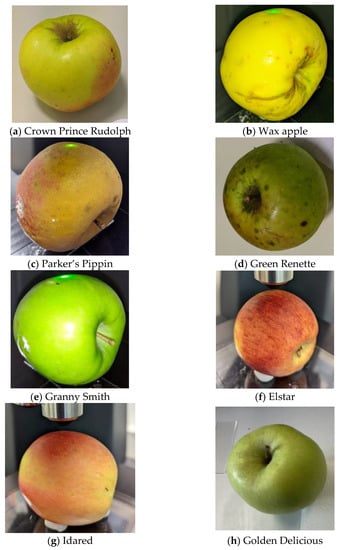
Figure 1.
Autochthonous apple cultivars: (a) Crown Prince Rudolph, (b) Wax apple, (c) Parker’s Pippin, and (d) Green Renette; commercial cultivars: (e) Granny Smith, (f) Elstar, (g) Idared, and (h) Golden Delicious.
3.2. Optical Profilometry
The results of surface roughness are given in Table 1. The roughness was measured at the equatorial region of the apple (Table 1). The surface roughness lay between 0.46 μm and 1.40 μm.

Table 1.
Root mean square (RMS) roughness of all cultivars measured on the equatorial region, I-interval between 25% and 75% of measured values, N- number of measurements.
Only measurements without clear artefacts in the surface texture were included for the roughness calculation. All analyzed zones were selected by the area where the measurement was taken and by the structure of the peel. All points were taken from the equatorial part of the apples on firm peel and in the absence of clearly visual artefacts in the resulting surface profile. This way a representative dataset of 272 analysis zones was obtained.
Optical micrographs of the least rough and roughest apple surfaces are shown in Figure 2: left: Crown Price Rudolph, right: Elstar.
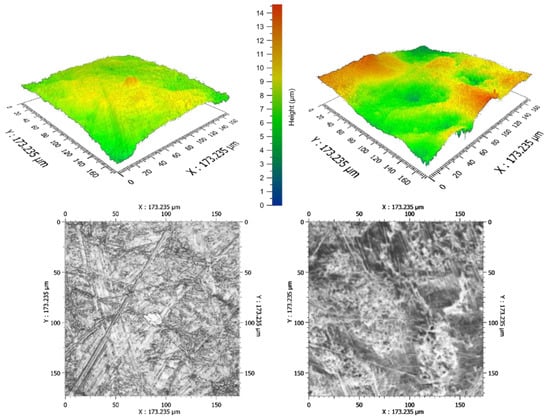
Figure 2.
Optical micrographs of the least rough and roughest apple surfaces ((left): Crown Price Rudolph, (right): Elstar).
Orange Data Mining software was used to compare the topography of the peels of different cultivars. The Student’s t-test showed that there was a statistically significant difference in the surface roughness in the equatorial area between new and autochtonous cultivars (0.05 level).
3.3. Contact Angle
The results of contact angles are given in Table 2. Generally, the autochthonous apple cuticles were more hydrophilic, with contact angles lower than 85°. The commercial apple cuticles were more hydrophobic, with contact angles greater than 90° (with some exceptions). A comparative example of advancing and receding angles of water droplets is shown on one autochtonous apple cuticle (Crown Prince Rudolph) and one new apple cuticle (Idared) (Figure 3).
Table 2.
Contact angles θw of all cultivars used (measured on the equatorial region). The volume of the water droplet varied between 4.1 µL and 6.3 µL.
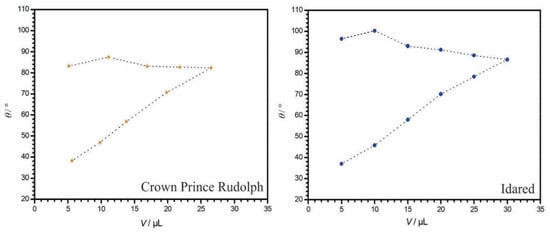
Figure 3.
Advancing and receding angles of water droplets on the surface of Crown Prince Rudolph and Idared.
The average contact angle of autochthonous apple cultivars was 80.38° ± 1.78° whereas the average contact angle of new apple cultivars was 91.33° ± 5.25°. Both apple groups were compared by Student’s t-test at 5% probability level. A t-test analysis showed that the contact angle on the autochthonous apple cultivar surfaces was significantly lower than the contact angle on new apple cultivar surfaces.
3.4. Streaming Potential
The measured zeta potentials as a function of pH are shown in Figure 4. For most cultivars, the isoelectric point was at pH = 3. For lower pH values, the surfaces were positively charged, while for higher pH values the surfaces were negatively charged. At neutral pH, the potential reached—60 mV. Crown Prince Rudolph had the highest and Wax apple the lowest value.
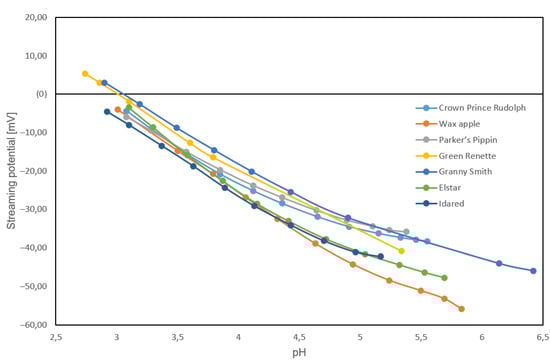
Figure 4.
Zeta potentials of all cultivars as a function of pH (measured on the equatorial region). Autochthonous apple cultivars: Crown Prince Rudolph, Wax apple, Parker’s Pippin and Green Renette; commercial cultivars: Granny Smith, Elstar and Idared.
At higher pH most autochthonous apple cultivars showed less negative zeta potential compared to new cultivars. Two-way ANOVA testing showed statistically significant difference in zeta potential for Wax apple, Elstar, and Idared compared to other cultivars (0.05 level).
3.5. Color Parameters
CIE color parameters of apple cuticles are given in Table 3. Among the autochthonous cultivars, Parker’s Pippin had the darkest color (lowest L* value), Green Renette had the most intense green color (lowest a* value) and also the most intense yellow color (highest b* value). Of the new commercial cultivars, Idared had the darkest (lowest L* value) and the most intense red color (high a* value) and Granny Smith had the most intense yellow color (highest b* value). Overall, Wax apple had the highest L* value, which corresponds to a very bright surface, while Idared had the lowest L* value and was the darkest among all the cultivars studied.
Table 3.
CIE color parameters.
4. Discussion
Fruit cuticle represents a barrier between aerial plant organs and the surrounding biotic and abiotic conditions. As such, cuticle prevents fruit fusion, limits water loss and uptake, protects against UV radiation, restricts pathogen infection, and provides mechanical support [20]. As in the preharvest period, cuticle also has an important role in postharvest for limiting desiccation and preventing microbial infection [20]. Storage potential of horticultural produce depends on a variety of factors, including cuticle characteristics and storage environment, which involves temperature and atmosphere composition [17]. Fruit ripening results in constant changes of fruit surface characteristics, including roughness, topography, wax accumulation, and wax composition [18,19]. During storage, the thickness of outer peel layer cuticle increases, the increase being dependant on the genetic background, preharvest climatic conditions and storage conditions [21].
Due to the overall importance of fruit cuticle, we hereby characterised the roughness, hydrophobicity, surface potential, and color of various autochthonous and new apple cultivars.
As seen from the literature data, in addition to physical properties, old and new cultivars also differ in biochemical properties [8,9], old apple cultivars having more antioxidative compounds compared with new cultivars.
The new most recent apples varieties, i.e., Ozark Gold, Julyred, and Jester, had the same or higher content of bioactive compounds than older varieties, i.e., Golden Delicious, Idared, and Jonagold [10]. In contrast, Dobrowolska-Iwanekand and co-workers [22] found no differences in the content of bioactive compounds in juice from modern and traditional apple cultivars.
Surface roughness is a very important parameter especially with regard to the adhesion of various molecules, bacteria, or fungi to apple surfaces. It has been found that very smooth surfaces do not favour adhesion, whereas very rough surfaces promote adhesion. The surface roughness of apple skin lies in the micrometer range, between 0.5 μm and 1.5 μm for the cultivars used in this study, which corresponds to rough surfaces. These roughness measurements were close to the literature data. Bhide et al. [23] reported that apples have a roughness approximately in the range of 5 μm, which is at least three times more.
The contact angles of a water droplet on different apples’ surfaces were measured using optical tensiometry. Several measurements were performed for each apple surface, including advancing and receding angles. For contact angles larger than 90°, surfaces are hydrophobic, while surfaces lower than 90° are hydrophilic. Measurements show that autochthonous apple cuticles were more hydrophilic, with contact angles lower than 85°. Commercial apple cuticles were more hydrophobic, with contact angles greater than 90° (with some exceptions). Commercial apple surfaces contain several wax groups, which increase the contact angle. Sanchez-Ortega et al. [24] studied the hydrophobicity of tomato surfaces and found a hydrophilic character, with a contact angle of 60°. The contact angle of Golden Delicious surfaces was found to be 77.27° ± 5° [25], 10° lower than the present measurements shown. On the other hand, the contact angle of the Florina cuticula was 104.2° ± 7.6° and the contact angle of Prima was 101.8° ± 3.4° [11].
Epicuticular wax often positively correlates with contact angles, i.e., a higher wax content results in a more hydrophobic lettuce surface [26]. This was confirmed by the present measurements for paraffin (90.33° ± 5.75°) and bees wax (86.34° ± 2.52°) (data not shown). A higher wax content is connected to lower transpiration, an important characteristic that affects weight loss of agricultural produce [11]. In addition, a higher wax content of vegetables results in less rough leaf surfaces and, consequently, increased E. coli K12 adhesion may occur [26]. Literature data show that non-fruit surface roughness positively correlates with microbial adhesion, a higher roughness enabling more microbial adhesion and more difficult microbial removal [14,19].
Surface charge should be measured in order to understand the interaction with variously charged objects. Negatively charged surfaces are repulsive to a negatively charged surface. In contrast, there is an electrostatic attraction between positively charged objects and negatively charged objects. It is therefore very important to measure surface charge for better understanding the possible adhesion of microorganisms to the apple skin surface. The isoelectric point of an apple surface lies at around pH = 3. At lower pH values, the potential is positive, whereas at higher pH values the potential is negative. The results are in a qualitative agreement with colloidal systems similar to apple surfaces. Negatively charged groups enable the adsorption of positively charged polyelectrolytes, which decrease the possibility of bacterial and fungi adhesion. Alternatively, the nature of a fruit or vegetable surface can be evaluated by calculating the net amount of basic and acidic sites on it. In their research, Pathak and co-workers [27] calculated the ratio of basic to acidic sites on fruit and vegetable peel. A ratio lower than 1 indicated a more acidic peel character, and thus a positive surface charge [27]. Fruit and vegetable peel have in general more acidic sites, which favour the adhesion of cationic compounds and might be utilized to adsorb cationic pollutants [27].
The fruit’s surface charge is a mechanical characteristic that also affects microbial attachment. Microbial attachment thus depends on the fruit’s zeta potential and that of the microorganism [28]. Recently, considerable research has been undertaken in an attempt to modulate fruit surface characteristics in order to minimize microbial attachment. Various nanocoatings enriched with antimicrobial natural compounds have been applied for that purpose [29].
In order to minimize microbial adhesion onto apple surfaces, various substances with positive surface charges can be electrostatically adsorbed by apples. Among existing substances, edible polyelectrolytes are very promising and can be adsorbed by an oppositely charged apple surface. The alternate adsorption of positively and negatively charged polyelectrolytes from solutions onto a charged apple surface leads to polyelectrolyte multilayers. The application of polyelectrolyte multilayers with tunable properties makes possible the preparation of surfaces with anti-bacterial or anti-fungal-adhesion properties [19,30]. Polyelectrolyte multilayers may impact the shelf life of apples.
The biophysical properties of fruit cuticle in general are important from the point of view of water loss through transpiration during storage, and especially during fruit shelf life in shops, where humidity is not usually controlled. The thicker cuticle of Jonagold apples cultivar demonstrated less weight loss during storage compared with Szampion cultivar’s thinner cuticle [21]. Another aspect of biophysical properties is related to the adhesion of microorganisms, especially moulds, their adhesion rate being dependent primarily on the apple’s surface roughness [14] and streaming potential [19] and also indirectly on the contact angle.
5. Conclusions
Apple cuticle inevitably affects the water loss, storage potential, and sensory qualities of apples. This study revealed differences in the investigated biophysical properties of the surfaces of autochthonous and new apple cultivars. Differences in roughness and contact angles among cultivars were more pronounced than differences of surface charge. Roughness values showed the highest fluctuations, followed by contact angle and surface charge, which showed the smallest differences among the studied cultivars. Cultivar Elstar had the highest roughness and contact angle, and a rather lower surface charge. Higher hydrophobicity was found in new cultivars, which are generally known to have longer storage and shelf-life potential. Cuticle biophysical properties reflect the physiological state of fruit and undoubtedly affect microbiological aspects of apples. Among potential future lines of research, it will be worth investigating apple surface properties during maturation, storage, and shelf life.
Author Contributions
Conceptualization, K.B. and R.V.; data curation, R.V., R.Š., N.V.d.V. and A.A.; investigation, K.B., R.Š., A.A., I.J., N.V.d.V. and R.V. All authors have read and agreed to the published version of the manuscript.
Funding
This research was funded by ARRS trough the project »Modulation of fruit polyphenolic profile by sustainable postharvest physical treatments«, J7-2595.
Institutional Review Board Statement
Not applicable.
Informed Consent Statement
Not applicable.
Data Availability Statement
Not applicable.
Acknowledgments
K.B. thanks ARRS for support through the program “Mechanisms of health maintenance for financial support”. K.B., R.Š., A.A., I.J., N.V.V., R.V. thank ARRS for support through the project «Modulation of fruit polyphenolic profile by sustainable postharvest physical treatments», J7-2595.
Conflicts of Interest
The authors declare no conflict of interest.
References
- Bondonno, N.P.; Bondonno, C.P.; Ward, N.C.; Hodgson, J.M.; Croft, K.D. The cardiovascular health benefits of apples: Whole fruit vs. isolated compounds. Trends Food Sci. 2017, 69, 243–256. [Google Scholar] [CrossRef]
- Tu, S.-H.; Chen, L.-C.; Ho, Y.-S. An apple a day to prevent cancer formation: Reducing cancer risk with flavonoids. J. Food Drug Anal. 2017, 25, 119–124. [Google Scholar] [CrossRef]
- Ogura, K.; Ogura, M.; Shoji, T.; Sato, Y.; Tahara, Y.; Yamano, G.; Sato, H.; Sugizaki, K.; Fujita, N.; Tatsuoka, H. Oral administration of apple procyanidins ameliorates insulin resistance via suppression of pro-inflammatory cytokine expression in liver of diabetic ob/ob mice. J. Agric. Food Chem. 2016, 64, 8857–8865. [Google Scholar] [CrossRef] [PubMed]
- Yang, G.; Yu, R.; Geng, S.; Xiong, L.; Yan, Q.; Kumar, V.; Wen, C.; Peng, M. Apple polyphenols modulates the antioxidant defense response and attenuates inflammatory response concurrent with hepatoprotective effect on grass carp (Ctenopharyngodon idellus) fed low fish meal diet. Aquaculture 2021, 534, 736284. [Google Scholar] [CrossRef]
- Kunst, L.; Samuels, A.L. Biosynthesis and secretion of plant cuticular wax. Prog. Lipid Res. 2003, 42, 51–80. [Google Scholar] [CrossRef]
- Schuster, A.-C.; Burghardt, M.; Alfarhan, A.; Bueno, A.; Hedrich, R.; Leide, J.; Thomas, J.; Riederer, M. Effectiveness of cuticular transpiration barriers in a desert plant at controlling water loss at high temperatures. AoB Plants 2016, 8, plw027. [Google Scholar] [CrossRef]
- Tafolla-Arellano, J.C.; Báez-Sañudo, R.; Tiznado-Hernández, M.E. The cuticle as a key factor in the quality of horticultural crops. Sci. Hortic. 2018, 232, 145–152. [Google Scholar] [CrossRef]
- Kschonsek, J.; Wolfram, T.; Stöckl, A.; Böhm, V. Polyphenolic compounds analysis of old and new apple cultivars and contribution of polyphenolic profile to the in vitro antioxidant capacity. Antioxidants 2018, 7, 20. [Google Scholar] [CrossRef]
- Wandjou, J.G.N.; Lancioni, L.; Barbalace, M.C.; Hrelia, S.; Papa, F.; Sagratini, G.; Vittori, S.; Dall’Acqua, S.; Caprioli, G.; Beghelli, D. Comprehensive characterization of phytochemicals and biological activities of the Italian ancient apple ‘Mela Rosa dei Monti Sibillini’. Food Res. Int. 2020, 137, 109422. [Google Scholar] [CrossRef]
- Wojdyło, A.; Oszmiański, J.; Laskowski, P. Polyphenolic compounds and antioxidant activity of new and old apple varieties. J. Agric. Food Chem. 2008, 56, 6520–6530. [Google Scholar] [CrossRef]
- Leide, J.; de Souza, A.X.; Papp, I.; Riederer, M. Specific characteristics of the apple fruit cuticle: Investigation of early and late season cultivars ‘Prima’and ‘Florina’ (Malus domestica Borkh.). Sci. Hortic. 2018, 229, 137–147. [Google Scholar] [CrossRef]
- Pietrysiak, E.; Ganjyal, G.M. Apple peel morphology and attachment of Listeria innocua through aqueous environment as shown by scanning electron microscopy. Food Control. 2018, 92, 362–369. [Google Scholar] [CrossRef]
- Fallik, E.; Grinberg, S.; Alkalai, S.; Yekutieli, O.; Wiseblum, A.; Regev, R.; Beres, H.; Bar-Lev, E. A unique rapid hot water treatment to improve storage quality of sweet pepper. Postharvest Biol. Technol. 1999, 15, 25–32. [Google Scholar] [CrossRef]
- Bohinc, K.; Dražić, G.; Oder, M.; Jevšnik, M.; Nipič, D.; Godič-Torkar, K.; Raspor, P. Available surface dictates microbial adhesion capacity. Int. J. Adhes. Adhes. 2014, 50, 265–272. [Google Scholar] [CrossRef]
- Good, R.J. Contact angle, wetting, and adhesion: A critical review. J. Adhes. Sci. Technol. 1992, 6, 1269–1302. [Google Scholar] [CrossRef]
- Lorenzetti, M.; Luxbacher, T.; Kobe, S.; Novak, S. Electrokinetic behaviour of porous TiO2-coated implants. J. Mater. Sci. Mater. Med. 2015, 26, 1–4. [Google Scholar] [CrossRef]
- Yang, Y.; Zhou, B.; Zhang, J.; Wang, C.; Liu, C.; Liu, Y.; Zhu, X.; Ren, X. Relationships between cuticular waxes and skin greasiness of apples during storage. Postharvest Biol. Technol. 2017, 131, 55–67. [Google Scholar] [CrossRef]
- Cajuste, J.F.; González-Candelas, L.; Veyrat, A.; García-Breijo, F.J.; Reig-Armiñana, J.; Lafuente, M.T. Epicuticular wax content and morphology as related to ethylene and storage performance of ‘Navelate’orange fruit. J. Postharvest Biol. Technol. 2010, 55, 29–35. [Google Scholar] [CrossRef]
- Bohinc, K.; Kukić, L.; Štukelj, R.; Zore, A.; Abram, A.; Klačić, T.; Kovačević, D. Bacterial adhesion capacity of uropathogenic Escherichia coli to polyelectrolyte multilayer coated urinary catheter surface. Coatings 2021, 11, 630. [Google Scholar] [CrossRef]
- Martin, L.B.; Rose, J.K.J.J.o.E.B. There’s more than one way to skin a fruit: Formation and functions of fruit cuticles. J. Exp. Bot. 2014, 65, 4639–4651. [Google Scholar] [CrossRef] [Green Version]
- Konarska, A.J.P. The structure of the fruit peel in two varieties of Malus domestica Borkh. (Rosaceae) before and after storage. Protoplasma 2013, 250, 701–714. [Google Scholar] [CrossRef]
- Dobrowolska-Iwanek, J.; Gąstoł, M.; Adamska, A.; Krośniak, M.; Zagrodzki, P. Traditional versus modern apple cultivars—A comparison of juice composition. Folia Hortic. 2015, 27, 33–41. [Google Scholar] [CrossRef]
- Bhide, S.; Salvi, D.; Schaffner, D.W.; Karwe, M.V.J. Effect of surface roughness in model and fresh fruit systems on microbial inactivation efficacy of cold atmospheric pressure plasma. J. Food Prot. 2017, 80, 1337–1346. [Google Scholar] [CrossRef] [PubMed]
- Sánchez-Ortega, I.; García-Almendárez, B.E.; Santos-López, E.M.; Reyes-González, L.R.; Regalado, C. Characterization and antimicrobial effect of starch-based edible coating suspensions. Food Hydrocoll. 2016, 52, 906–913. [Google Scholar] [CrossRef]
- Wang, H.; Feng, H.; Liang, W.; Luo, Y.; Malyarchuk, V. Effect of surface roughness on retention and removal of Escherichia coli O157: H7 on surfaces of selected fruits. J. Food Sci. 2009, 74, E8–E15. [Google Scholar] [CrossRef]
- Palma-Salgado, S.; Ku, K.-M.; Dong, M.; Nguyen, T.H.; Juvik, J.A.; Feng, H. Adhesion and removal of E. coli K12 as affected by leafy green produce epicuticular wax composition, surface roughness, produce and bacterial surface hydrophobicity, and sanitizers. Int. J. Food Microbiol. 2020, 334, 108834. [Google Scholar] [CrossRef] [PubMed]
- Pathak, P.D.; Mandavgane, S.A.; Kulkarni, B.D. Characterizing fruit and vegetable peels as bioadsorbents. Curr. Sci. 2016, 2114–2123. [Google Scholar] [CrossRef]
- Maillard, A.P.F.; Espeche, J.C.; Maturana, P.; Cutro, A.C.; Hollmann, A. Zeta potential beyond materials science: Applications to bacterial systems and to the development of novel antimicrobials. Biochim. Et Biophys. Acta -Biomembr. 2021, 1863, 183597. [Google Scholar] [CrossRef]
- He, Q.; Zhang, L.; Yang, Z.; Ding, T.; Ye, X.; Liu, D.; Guo, M. Antibacterial mechanisms of thyme essential oil nanoemulsions against Escherichia coli O157: H7 and Staphylococcus aureus: Alterations in membrane compositions and characteristics. Innov. Food Sci. Emerg. Technol. 2022, 75, 102902. [Google Scholar] [CrossRef]
- Kovačević, D.; Pratnekar, R.; Godič Torkar, K.; Salopek, J.; Dražić, G.; Abram, A.; Bohinc, K. Influence of polyelectrolyte multilayer properties on bacterial adhesion capacity. Polymers 2016, 8, 345. [Google Scholar] [CrossRef]
Publisher’s Note: MDPI stays neutral with regard to jurisdictional claims in published maps and institutional affiliations. |
© 2022 by the authors. Licensee MDPI, Basel, Switzerland. This article is an open access article distributed under the terms and conditions of the Creative Commons Attribution (CC BY) license (https://creativecommons.org/licenses/by/4.0/).