Durum and Bread Wheat Flours. Preliminary Mineral Characterization and Its Potential Health Claims


 and
and 
Abstract
1. Introduction
2. Materials and Methods
2.1. Wheat Samples
2.2. Milling Process
2.3. Standards and Reagents
2.4. Total Mineral Content (Ashes) and Mineral Elements Analysis
2.5. Statistical Analysis
3. Results and Discussion
3.1. Mineral Composition in Durum and Bread Flours
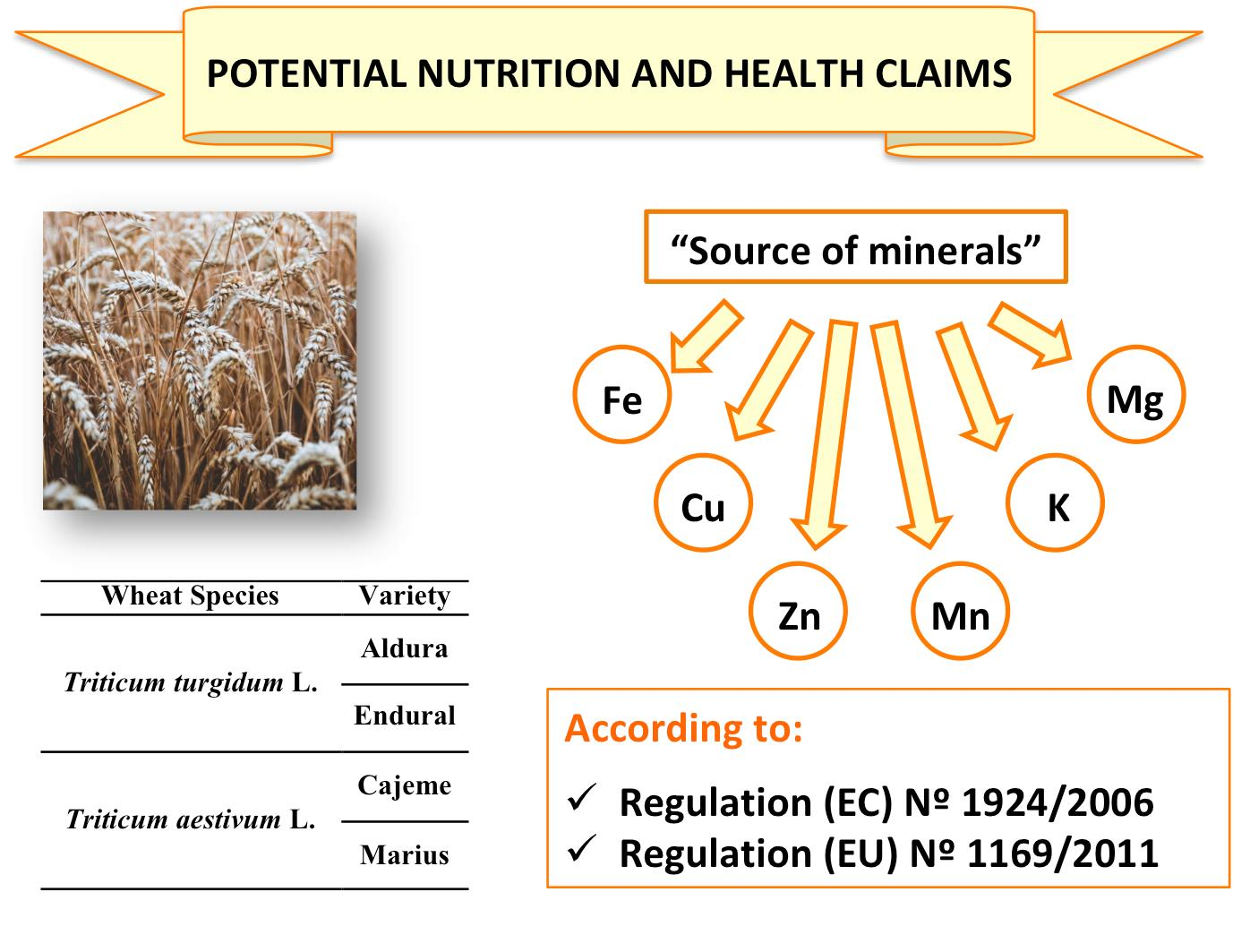
3.2. Potential Nutritional and Health Claims of Analysed Durum and Bread Wheat Flours
4. Conclusions
Author Contributions
Funding
Acknowledgments
Conflicts of Interest
References
- Ortega, R.M.; Aparicio Vizuete, A.; Jiménez Ortega, A.I.; Rodríguez Rodríguez, E. Cereales de grano completo y sus beneficios sanitarios. Nutr. Hosp. 2015, 32, 25–31. [Google Scholar] [PubMed]
- Mataix Verdú, J. Nutrición y Alimentación Humana, 2nd ed.; Ergon: Madrid, Spain, 2009. [Google Scholar]
- FAO. Food and Agriculture Organization of the United Nations. Crop Prospects and Food Situation-Quarterly Global Report No. 3; FAO: Rome, Italy, 2020. [Google Scholar]
- Lv, J.; Yub, L.; Lu, Y.; Niu, Y.; Liu, L.; Costa, J.; Yu, L. Phytochemical compositions, and antioxidant properties, and antiprolifera-tive activities of wheat flour. Food Chem. 2012, 135, 325–331. [Google Scholar] [CrossRef] [PubMed]
- Ciudad-Mulero, M.F.H.; Barros, L.; Fernandes, Â.; Ferreira, I.C.; Callejo, M.J.; Matallana-González, M.C.; Fernández-Ruiz, V.; Morales, P.; Carrillo, J.M. Potential Health Claims of Durum and Bread Wheat Flours as Functional Ingredients. Nutrients 2020, 12, 504. [Google Scholar] [CrossRef] [PubMed]
- Taccari, M.; Aquilanti, L.; Polverigiani, S.; Osimani, A.; Garofalo, C.; Milanović, V.; Clementi, F. Microbial Diversity of Type I Sourdoughs Prepared and Back-Slopped with Wholemeal and Refined Soft (Triticum aestivum) Wheat Flours. J. Food Sci. 2016, 81, M1996–M2005. [Google Scholar] [CrossRef]
- Visioli, G.; Comastri, A.; Imperiale, D.; Paredi, G.; Faccini, A.; Marmiroli, N. Gel-Based and Gel-Free Analytical Methods for the Detection of HMW-GS and LMW-GS in Wheat Flour. Food Anal. Methods 2016, 9, 469–476. [Google Scholar] [CrossRef]
- Chaquilla-Quilca, G.; Balandrán-Quintana, R.R.; Huerta-Ocampo, J.A.; Ramos-Clamont Montfort, G.; Luna-Valdez, J.G. Identifi-cation of proteins contained in aqueous extracts of wheat bran through a proteomic approach. J. Cereal Sci. 2018, 80, 31–36. [Google Scholar] [CrossRef]
- Rasane, P.; Jha, A.; Sabikhi, L.; Kumar, A.; Unnikrishnan, V.S. Nutritional advantages of oats and opportunities for its processing as value added foods—A review. J. Food Sci. Technol. 2013, 52, 662–675. [Google Scholar] [CrossRef]
- Gong, L.; Cao, W.; Chi, H.; Wang, J.; Zhang, H.; Liu, J.; Sun, B. Whole cereal grains and potential health effects: Involvement of the gut microbiota. Food Res. Int. 2018, 103, 84–102. [Google Scholar] [CrossRef]
- Finnie, S.; Atwell, W.A. Wheat Flour, 2nd ed.; AACC International: Eagan, MN, USA, 2016. [Google Scholar]
- Abbaspour, N.; Hurrell, R.; Kelishadi, R. Review on iron and its importance for human health. J. Res. Med. Sci. 2014, 19, 164–174. [Google Scholar]
- Garcia-Oliveira, A.L.; Chander, S.; Ortiz, R.; Menkir, A.; Gedil, M. Genetic Basis and Breeding Perspectives of Grain Iron and Zinc Enrichment in Cereals. Front. Plant Sci. 2018, 9, 937. [Google Scholar] [CrossRef]
- Carocho, M.; Rodrigues, P.; Ciudad-Mulero, M.; Fernández-Ruiz, V.; Ferreira, E.; Heleno, S.; Rodrigues, P.; Barros, L.; Ferreira, I.C. Comparison of different bread types: Chemical and physical parameters. Food Chem. 2020, 310, 125954. [Google Scholar] [CrossRef] [PubMed]
- Krzywoszyńska, K.; Witkowska, D.; Swiatek-Kozlowska, J.; Szebesczyk, A.; Kozłowski, H. General Aspects of Metal Ions as Sig-naling Agents in Health and Disease. Biomolecules 2020, 10, 1417. [Google Scholar] [CrossRef] [PubMed]
- Nriagu, J. Reference Module in Earth. Systems and Environmental Sciences; Elsevier: Amsterdam, The Netherlands, 2018. [Google Scholar]
- Zoroddu, M.A.; Aaseth, J.; Crisponi, G.; Medici, S.; Peana, M.; Nurchi, V.M. The essential metals for humans: A brief overview. J. Inorg. Biochem. 2019, 195, 120–129. [Google Scholar] [CrossRef] [PubMed]
- Fernández-Ruiz, V.; Olives, A.I.; Cámara, M.; Sánchez-Mata, M.C.; Torija, M.E. Mineral and trace elements content in 30 acces-sions of tomato fruits (Solanum lycopersicum L.) and wild relatives (Solanum pimpinellifolium L., Solanum cheesmaniae L. Riley, and Solanum habrochaites S. Knapp & D.M. Spooner). Biol. Trace Elem. Res. 2011, 141, 329–339. [Google Scholar] [PubMed]
- Vignola, M.B.; Moiraghi, M.; Salvucci, E.; Baroni, M.; Perez, G.T. Whole meal and white flour from Argentine wheat genotypes: Mineral and arabinoxylan differences. J. Cereal Sci. 2016, 71, 217–223. [Google Scholar] [CrossRef]
- Jaskulska, I.; Jaskulski, D.; Gałęzewski, L.; Knapowski, T.; Kozera, W.; Wacławowicz, R. Mineral Composition and Baking Value of the Winter Wheat Grain under Varied Environmental and Agronomic Conditions. J. Chem. 2018, 2018, 1–7. [Google Scholar] [CrossRef]
- Simsek, S.; Budak, B.; Schwebach, C.S.; Ovando-Martínez, M. Historical vs. modern hard red spring wheat: Analysis of the chem-ical composition. Cereal Chem. 2019, 96, 937–949. [Google Scholar] [CrossRef]
- Swamy, B.M.; Samia, M.; Boncodin, R.; Marundan, S.; Rebong, D.B.; Ordonio, R.L.; Miranda, R.T.; Rebong, A.T.O.; Alibuyog, A.Y.; Adeva, C.C.; et al. Compositional analysis of genetically engineered GR2E “Golden Rice” in compari-son to that of conventional rice. J. Agric. Food Chem. 2019, 67, 7986–7994. [Google Scholar] [CrossRef]
- Wang, F.; Zhao, H.; Yu, C.; Tang, J.; Wu, W.; Yang, Q. Determination of the geographical origin of maize (Zea mays L.) using min-eral element fingerprints. J. Sci. Food Agric. 2020, 100, 1294–1300. [Google Scholar] [CrossRef]
- Chappell, A.; Scott, K.P.; Griffiths, I.A.; Cowan, A.A.; Hawes, C.; Wishart, J.; Martin, P. The agronomic performance and nutri-tional content of oat and barley varieties grown in a northern maritime environment depends on variety and growing condi-tions. J. Cereal Sci. 2017, 74, 1–10. [Google Scholar] [CrossRef]
- Maximino, J.V.D.O.; Barros, L.M.; Pereira, R.M.; De Santi, I.I.; Aranha, B.C.; Busanello, C.; Viana, V.E.; Freitag, R.A.; Batista, B.L.; De Oliveira, A.C.; et al. Mineral and Fatty Acid Content Variation in White Oat Genotypes Grown in Brazil. Biol. Trace Element Res. 2020, 1–13. [Google Scholar] [CrossRef]
- Panizo-Casado, M.; Déniz-Expósito, P.; Rodríguez-Galdón, B.; Afonso-Morales, D.; Ríos-Mesa, D.; Díaz-Romero, C.; Rodríguez-Rodríguez, E.M. The chemical composition of barley grain (Hordeum vulgare L.) landraces from the Canary Islands. J. Food Sci. 2020, 85, 1725–1734. [Google Scholar] [CrossRef] [PubMed]
- Bağci, A.; Gecgel, Ü.; Dursun, N.; Özcan, M.M.; Tamkoç, A.; Özer, İ.; Özcan, M.M. The Oil Yield, Mineral Content, and Fatty Acid Compositions of Some Rye (Secale cereale) Grains. Iran J. Chem. Chem. Eng. 2019, 38, 285–292. [Google Scholar]
- Cubadda, F.; Aureli, F.; Raggi, A.; Carcea, M. Effect of milling, pasta making and cooking on minerals in durum wheat. J. Cereal Sci. 2009, 49, 92–97. [Google Scholar] [CrossRef]
- Anjum, F.M.; Butt, M.S.; Ahmad, N.; Ahmad, I. Phytate and mineral content in different milling fractions of some Pakistani spring wheats. Int. J. Food Sci. Technol. 2002, 37, 13–17. [Google Scholar] [CrossRef]
- De Brier, N.; Gomand, S.V.; Donner, E.; Paterson, D.; Delcour, J.A.; Lombi, E.; Smolders, E. Distribution of Minerals in Wheat Grains (Triticum aestivum L.) and in Roller Milling Fractions Affected by Pearling. J. Agric. Food Chem. 2015, 63, 1276–1285. [Google Scholar] [CrossRef] [PubMed]
- Rodríguez, L.H.; Morales, D.A.; Rodríguez, E.R.; Romero, C.D. Minerals and trace elements in a collection of wheat landraces from the Canary Islands. J. Food Compos. Anal. 2011, 24, 1081–1090. [Google Scholar] [CrossRef]
- Shi, R.; Zhang, Y.; Chen, X.; Sun, Q.; Zhang, F.; Römheld, V.; Zou, C. Influence of long-term nitrogen fertilization on micronutrient density in grain of winter wheat (Triticum aestivum L.). J. Cereal Sci. 2010, 51, 165–170. [Google Scholar] [CrossRef]
- Roye, C.; Bulckaen, K.; De Bondt, Y.; Liberloo, I.; Van De Walle, D.; Dewettinck, K.; Courtin, C. Side-by-side comparison of composition and structural properties of wheat, rye, oat, and maize bran and their impact on in vitro fermentability. Cereal Chem. J. 2020, 97, 20–33. [Google Scholar] [CrossRef]
- Wang, M.; Kong, F.; Liu, R.; Fan, Q.; Zhang, X. Zinc in Wheat Grain, Processing, and Food. Front. Nutr. 2020, 7, 124. [Google Scholar] [CrossRef]
- Benincasa, P.; Galieni, A.; Manetta, A.C.; Pace, R.; Guiducci, M.; Pisante, M.; Stagnari, F. Phenolic compounds in grains, sprouts and wheatgrass of hulled and non-hulled wheat species. J. Sci. Food Agric. 2015, 95, 1795–1803. [Google Scholar] [CrossRef] [PubMed]
- Ficco, D.B.M.; Riefolo, C.; Nicastro, G.; De Simone, V.; Di Gesù, A.M.; Beleggia, R.; Platani, C.; Cattivelli, L.; De Vita, P. Phytate and mineral elements concentration in a collection of Italian durum wheat cultivars. Field Crops Res. 2009, 111, 235–242. [Google Scholar] [CrossRef]
- European Comission. Commission Regulation (EU) No 432/2012 of 16 May, L136/1:40 (25/5/2012). Establishing a list of permitted health claims made on foods, other than those referring to the reduction of disease risk and to children’s development and health. Off. J. Eur. Union 2012, 136, 1–40. [Google Scholar]
- European Parliament & Council of the European Union. Regulation (EC) No 1924/2006 of the European Parliament and of the Council of 20 December 2006 on nutrition and health claims made on foods. Off. J. Eur. Union 2006, 304, 18–63. [Google Scholar]
- European Parliament & Council of the European Union. Regulation (EU) No 1169/2011 of the European Parliament and of the Council of 25 October 2011 on the provision of food information to consumers. Off. J. Eur. Union 2011, 50, 18–63. [Google Scholar]

| Species | Variety | Harvesting Year | Sample Code |
|---|---|---|---|
| White Flour | |||
| Triticum turgidum L. | Aldura | 2013 | D-A#1-WF |
| 2014 | D-A#2-WF | ||
| Endural | 2013 | D-E#1-WF | |
| 2014 | D-E#2-WF | ||
| Triticum aestivum L. | Cajeme | 2013 | S-C#1-WF |
| 2014 | S-C#2-WF | ||
| Marius | 2013 | S-M#1-WF | |
| 2014 | S-M#2-WF | ||
| Whole Grain Flour | |||
| Triticum turgidum L. | Aldura | 2013 | D-A#1-WGF |
| 2014 | D-A#2-WGF | ||
| Endural | 2013 | D-E#1-WGF | |
| 2014 | D-E#2-WGF | ||
| Triticum aestivum L. | Cajeme | 2013 | S-C#1-WGF |
| 2014 | S-C#2-WGF | ||
| Marius | 2013 | S-M#1-WGF | |
| 2014 | S-M#2-WGF | ||
| Bran | |||
| Triticum turgidum L. | Aldura | 2013 | D-A#1-Bran |
| 2014 | D-A#2- Bran | ||
| Endural | 2013 | D-E#1- Bran | |
| 2014 | D-E#2- Bran | ||
| Triticum aestivum L. | Cajeme | 2013 | S-C#1- Bran |
| 2014 | S-C#2- Bran | ||
| Marius | 2013 | S-M#1- Bran | |
| 2014 | S-M#2- Bran | ||
| Sample Code | Extraction Rate (%) | |
|---|---|---|
| Triticum turgidum L. | D-A#1-WF | 63 |
| D-A#2-WF | 58 | |
| D-E#1-WF | 63 | |
| D-E#2-WF | 59 | |
| Triticum aestivum L. | S-C#1-WF | 68 |
| S-C#2-WF | 70 | |
| S-M#1-WF | 67 | |
| S-M#2-WF | 69 |
| Sample Code | Ash | Fe | Cu | Mn | Zn | Mg | Ca | Na | K | |
|---|---|---|---|---|---|---|---|---|---|---|
| White Flour | ||||||||||
| Triticum turgidum L. | D-A#1-WF | 0.8 ± 0.0 b,A | 2.9 ± 0.2 e,B | nd | 0.1 ± 0.0 a,A | 2.2 ± 0.1 b,A | 69.0 ± 1.2 b,A | 5.8 ± 0.3 a,A | 15.8 ± 4.0 b,B | 107.6 ± 4.6 a,A |
| D-A#2-WF | 0.9 ± 0.0 b,A | 1.3 ± 0.0 b,A | 1.0 ± 0.1 cd | 0.3 ± 0.0 b,B | 4.1 ± 0.2 d,B | 197.9 ± 8.7 e,B | 19.6 ± 1.2 d,B | 3.5 ± 0.2 a,A | 168.8 ± 0.6 b,B | |
| D-E#1-WF * | - | - | - | - | - | - | - | - | - | |
| D-E#2-WF | 1.2 ± 0.1 c | 2.8 ± 0.1 de | 1.1 ± 0.0 d | 0.3 ± 0.0 b | 4.7 ± 0.2 e | 223.0 ± 4.9 f | 18.6 ± 0.4 d | 2.7 ± 0.1 a | 165.6 ± 7.2 b | |
| Triticum aestivum L. | S-C#1-WF | 1.2 ± 0.1 c,B | 2.5 ± 0.0 d,B | 0.5 ± 0.1 a,A | 0.6 ± 0.0 f,B | 2.7 ± 0.2 c,A | 70.6 ± 3.4 b,A | 12.0 ± 0.9 b,A | 43.6 ± 1.9 d,B | 122.6 ± 8.6 a,A |
| S-C#2-WF | 0.7 ± 0.0 a,A | 0.7 ± 0.1 a,A | 1.0 ± 0.0 c,B | 0.4 ± 0.0 e,A | 3.0 ± 0.0 c,A | 118.8 ± 0.3 d,B | 18.5 ± 1.0 d,B | 3.1 ± 0.4 a,A | 111.7 ± 10.9 a,A | |
| S-M#1-WF | 0.9 ± 0.1 b,B | 2.1 ± 0.3 c,B | nd | 0.4 ± 0.0 d,B | 1.6 ± 0.1 a,A | 50.1 ± 2.7 a,A | 10.6 ± 0.4 b,A | 21.4 ± 0.2 c,B | 125.1 ± 14.0 a,A | |
| S-M#2-WF | 0.6 ± 0.0 a,A | 0.8 ± 0.1 a,A | 0.9 ± 0.0 b | 0.3 ± 0.0 c,A | 2.8 ± 0.1 c,B | 108.8 ± 3.0 c,B | 15.2 ± 0.2 c,B | 2.4 ± 0.1 a,A | 109.9 ± 5.9 a,A | |
| Whole Grain Flour | ||||||||||
| Triticum turgidum L. | D-A#1-WGF | 1.5 ± 0.1 ab,A | 4.5 ± 0.0 c,B | 2.4 ± 0.1 g,B | 1.5 ± 0.0 a,A | 5.6 ± 0.1 b,A | 138.0 ± 3.5 b,A | 6.1 ± 0.2 a,A | 47.8 ± 1.6 d,B | 408.1 ± 10.0 e,B |
| D-A#2-WGF | 1.9 ± 0.2 c,B | 2.8 ± 0.0 b,A | 1.6 ± 0.1 de,A | 2.3 ± 0.2 b,B | 7.8 ± 0.1 e,B | 318.9 ± 1.4 d,B | 25.5 ± 0.6 e,B | 3.8 ± 0.0 a,A | 342.9 ± 6.4 bc,A | |
| D-E#1-WGF | 1.4 ± 0.0 a,A | 4.6 ± 0.1 c,A | 0.6 ± 0.0 a,A | 1.2 ± 0.0 a,A | 6.6 ± 0.0 c,A | 163.0 ± 3.6 c,A | 5.4 ± 0.2 a,A | 43.9 ± 3.1 d,B | 408.9 ± 3.9 e,B | |
| D-E#2-WGF | 2.2 ± 0.0 d,B | 6.6 ± 0.0 e,B | 1.3 ± 0.1 bc,B | 2.7 ± 0.1 c,B | 8.0 ± 0.0 e,B | 344.2 ± 2.4 e,B | 29.7 ± 1.9 f,B | 3.4 ± 0.1 a,B | 332.6 ± 11.7 ab,A | |
| Triticum aestivum L. | S-C#1-WGF | 1.9 ± 0.0 c,B | 5.7 ± 0.2 d,B | 1.9 ± 0.2 f,B | 3.2 ± 0.0 d,B | 5.8 ± 0.1 b,A | 114.5 ± 2.7 a,A | 14.3 ± 0.2 c,A | 24.3 ± 1.9 b,B | 383.5 ± 2.6 de,B |
| S-C#2-WGF | 1.6 ± 0.0 b,A | 4.2 ± 0.5 c,A | 1.4 ± 0.0 cd,A | 2.4 ± 0.2 b,A | 9.5 ± 0.3 f,B | 315.7 ± 1.5 d,B | 23.8 ± 0.3 de,B | 3.7 ± 0.2 a,A | 304.2 ± 2.6 a,A | |
| S-M#1-WGF | 1.9 ± 0.1 c,A | 2.2 ± 0.1 a,A | 1.9 ± 0.3 ef,B | 2.9 ± 0.1 c,B | 4.6 ± 0.1 a,A | 112.0 ± 3.7 a,A | 12.2 ± 0.9 b,A | 36.3 ± 3.0 c,B | 553.5 ± 31.6 f,B | |
| S-M#2-WGF | 2.1 ± 0.0 d,B | 2.7 ± 0.3 b,B | 1.0 ± 0.0 b,A | 2.4 ± 0.0 b,A | 7.3 ± 0.2 d,B | 385.1 ± 2.4 f,B | 22.1 ± 0.2 d,B | 3.9 ± 0.1 a,A | 368.1 ± 21.2 cd,A | |
| Bread and Durum Wheat Bran | |||||||||||
|---|---|---|---|---|---|---|---|---|---|---|---|
| Sample Code | Ash | Fe | Cu | Mn | Zn | Mg | Ca | Na | K | ||
| Triticum turgidum L. | D-A#1-Bran | Mean | 2.8 | 7.1 | 6.4 | 3.8 | 11.3 | 255.6 | 6.5 | 47.7 | 919.8 |
| Range | 2.6–3.0 | 6.9–7.3 | 6.1–6.7 | 3.7–3.9 | 11.0–11.6 | 246.3–264.9 | 5.9–7.1 | 43.0–52.4 | 898.9–940.7 | ||
| D-A#2- Bran | Mean | 3.5 | 4.8 | 2.5 | 5.2 | 12.8 | 486.0 | 33. | 3.6 | 583.3 | |
| Range | 3.2–3.8 | 4.7–4.9 | 2.3–2.7 | 4.8–5.6 | 12.4–13.2 | 475.7–496.3 | 32.0–35.2 | 3.2–4.0 | 569.0–597.6 | ||
| D-E#2- Bran | Mean | 3.7 | 12.1 | 1.6 | 6.2 | 12.6 | 518.8 | 43.1 | 6.3 | 572.9 | |
| Range | 3.6–3.9 | 12.0–12.2 | 1.5–1.7 | 5.9–6.5 | 12.2–13.0 | 508.0–529.6 | 41.6–44.6 | 5.7–6.9 | 529.6–529.6 | ||
| Triticum aestivum L. | S-C#1- Bran | Mean | 3.4 | 12.6 | 4.9 | 8.8 | 12.2 | 207.9 | 20.3 | 60.6 | 937.9 |
| Range | 3.3–3.5 | 12.0–13.2 | 4.4–5.4 | 8.7–8.9 | 11.9–12.5 | 206.7–209.1 | 18.5–22.1 | 54.2–67.0 | 911.6–964.2 | ||
| S-C#2- Bran | Mean | 3.9 | 12.8 | 2.3 | 6.8 | 24.4 | 775.2 | 35.7 | 5.7 | 753.4 | |
| Range | 3.8–4.0 | 11.8–13.8 | 2.2–2.4 | 6.2–7.4 | 23.3–25.5 | 769.6–780.8 | 32.5–38.9 | 5.0–6.4 | 715.4–791.4 | ||
| S-M#1- Bran | Mean | 3.8 | 2.3 | 5.3 | 8.1 | 10.6 | 237.8 | 16.6 | 65.8 | 1371.5 | |
| Range | 3.6–4.0 | 2.2–2.4 | 4.9–5.7 | 7.8–8.4 | 10.4–10.8 | 231.5–244.1 | 15.5–17.7 | 59.7–71.9 | 1326.2–1416.8 | ||
| S-M#2- Bran | Mean | 5.5 | 6.5 | 1.3 | 7.0 | 17.2 | 1000.1 | 37.4 | 5.4 | 920.0 | |
| Range | 5.4–5.6 | 5.7–7.3 | 1.2–1.4 | 6.9–7.1 | 16.2–18.2 | 986.7–1.013.5 | 36.3–38.5 | 5.0–5.8 | 880.9–959.1 | ||
| Mineral | Approved Health Claims | Conditions of Use of the Claims | Samples Which Met the Conditions of Use of the Claims |
|---|---|---|---|
| Iron | “Iron contributes to normal cognitive function, normal energy-yielding metabolism, normal formation of red blood cells and haemoglobin, normal oxygen transport in the body, normal function of the immune system and to the reduction of tiredness and fatigue.” | The claim may be used only for food which is at least a source of iron (at least 2.1 mg of iron per 100 g of food, fw) according to Regulation (EC) No 1924/2006 [38] and Regulation (EU) No 1169/2011 [39]. | White flours: samples D-A#1-WF, D-E#2-WF, and S-C#1-WF. |
| “Iron has a role in the process of cell division.” | Whole grain flours: all analysed samples (with the exception of sample S-M#1-WGF). | ||
| Bran fractions: all analysed samples. | |||
| Copper | “Copper contributes to maintenance of normal connective tissues.” | The claim may be used only for food which is at least a source of copper (at least 0.15 mg of copper per 100 g of food, fw) according to Regulation (EC) No 1924/2006 [38] and Regulation (EU) No 1169/2011 [39]. | White flours: all analysed samples (with the exception of D-A#1-WF and S-M#1-WF). |
| “Copper contributes to normal energy-yielding metabolism, normal functioning of the nervous system, normal hair pigmentation, normal iron transport in the body, normal skin pigmentation, normal functioning of the immune system.” | Whole grain flours: all analysed samples. | ||
| “Copper contributes to the protection of cells from oxidative stress.” | Bran fractions: all analysed samples. | ||
| Manganese | “Manganese contributes to normal energy-yielding metabolism and normal formation of connective tissue.” | The claim may be used only for food which is at least a source of manganese (at least 0.3 mg of manganese per 100 g of food, fw) according to Regulation (EC) No 1924/2006 [38] and Regulation (EU) No 1169/2011 [39]. | White flours: samples S-C#1-WF, S-C#2-WF, and S-M#1-WF. |
| “Manganese contributes to the maintenance of normal bones.” | Whole grain flours: all analysed samples. | ||
| “Manganese contributes to the protection of cells from oxidative stress.” | Bran fractions: all analysed samples. | ||
| Zinc | “Zinc contributes to normal acid-base metabolism, normal metabolism of carbohydrate, macronutrients, fatty acids, and vitamin A.” | The claim may be used only for food which is at least a source of zinc (at least 1.5 mg of zinc per 100 g of food, fw) according to Regulation (EC) No 1924/2006 [38] and Regulation (EU) No 1169/2011 [39]. | White flours: all analysed samples (with the exception of S-M#1-WF). |
| “Zinc contributes to normal DNA synthesis, normal protein synthesis, normal fertility, and reproduction and normal cognitive function.” | |||
| “Zinc contributes to the maintenance of normal bones, hair, nails, and skin.” | Whole grain flours: all analysed samples. | ||
| “Zinc contributes to the maintenance of normal testosterone levels in the blood and to the maintenance of normal vision.” | |||
| “Zinc contributes to the normal function of the immune system and to the protection of cells from oxidative stress.” | Bran fractions: all analysed samples. | ||
| “Zinc has a role in the process of cell division.” | |||
| Magnesium | “Magnesium contributes to a reduction of tiredness and fatigue, electrolyte balance, normal energy-yielding metabolism, normal functioning of the nervous system, normal muscle function, normal protein synthesis, normal psychological function.” | The claim may be used only for food which is at least a source of magnesium (at least 56.25 mg of magnesium per 100 g of food, fw) according to Regulation (EC) No 1924/2006 [38] and Regulation (EU) No 1169/2011 [39]. | White flours: all analysed samples (with the exception of S-M#1-WF). |
| “Magnesium contributes to the maintenance of normal bones and teeth.” | Whole grain flours: all analysed samples. | ||
| “Magnesium has a role in the process of cell division.” | Bran fractions: all analysed samples. | ||
| Potassium | “Potassium contributes to normal functioning of the nervous system and normal muscle function.” | The claim may be used only for food which is at least a source of potassium (at least 300 mg of potassium per 100 g of food, fw) according to Regulation (EC) No 1924/2006 [38] and Regulation (EU) No 1169/2011 [39]. | Whole grain flours: all analysed samples (with the exception of S-C#2-WGF). |
| “Potassium contributes to the maintenance of normal blood pressure.” | Bran fractions: all analysed samples. |
Publisher’s Note: MDPI stays neutral with regard to jurisdictional claims in published maps and institutional affiliations. |
© 2021 by the authors. Licensee MDPI, Basel, Switzerland. This article is an open access article distributed under the terms and conditions of the Creative Commons Attribution (CC BY) license (http://creativecommons.org/licenses/by/4.0/).
Share and Cite
Ciudad-Mulero, M.; Matallana-González, M.C.; Callejo, M.J.; Carrillo, J.M.; Morales, P.; Fernández-Ruiz, V. Durum and Bread Wheat Flours. Preliminary Mineral Characterization and Its Potential Health Claims. Agronomy 2021, 11, 108. https://doi.org/10.3390/agronomy11010108
Ciudad-Mulero M, Matallana-González MC, Callejo MJ, Carrillo JM, Morales P, Fernández-Ruiz V. Durum and Bread Wheat Flours. Preliminary Mineral Characterization and Its Potential Health Claims. Agronomy. 2021; 11(1):108. https://doi.org/10.3390/agronomy11010108
Chicago/Turabian StyleCiudad-Mulero, María, María Cruz Matallana-González, María Jesús Callejo, José M. Carrillo, Patricia Morales, and Virginia Fernández-Ruiz. 2021. "Durum and Bread Wheat Flours. Preliminary Mineral Characterization and Its Potential Health Claims" Agronomy 11, no. 1: 108. https://doi.org/10.3390/agronomy11010108
APA StyleCiudad-Mulero, M., Matallana-González, M. C., Callejo, M. J., Carrillo, J. M., Morales, P., & Fernández-Ruiz, V. (2021). Durum and Bread Wheat Flours. Preliminary Mineral Characterization and Its Potential Health Claims. Agronomy, 11(1), 108. https://doi.org/10.3390/agronomy11010108