Biobased Random Copolymers of Poly(Hexamethylene Furanoate) for Sustainable Food Packaging: Camphoric Acid as a Valuable Co-Monomer for Improved Mechanical Properties

 ,
,  ,
,  , and
, and 
Abstract
1. Introduction
2. Materials and Methods
2.1. Materials
2.2. Synthesis
2.3. Sample Preparation
2.4. Molecular Characterization
2.5. Structural Characterization
2.6. Thermal Characterization
2.7. Mechanical Tests
2.8. Gas Permeability Tests
3. Results and Discussion
3.1. Synthesis and Molecular Characterization
3.2. Structural and Thermal Characterization
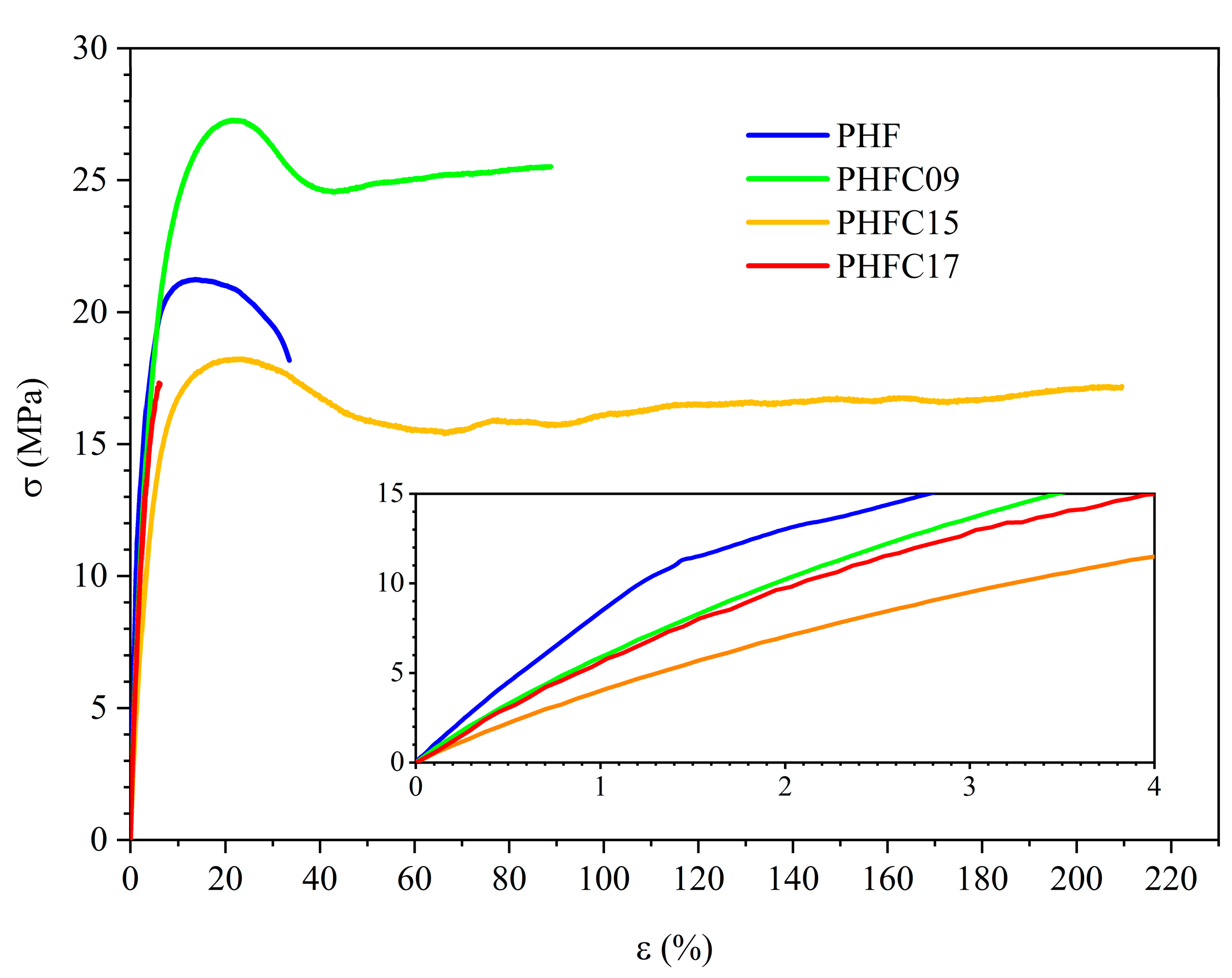
3.3. Mechanical Tests
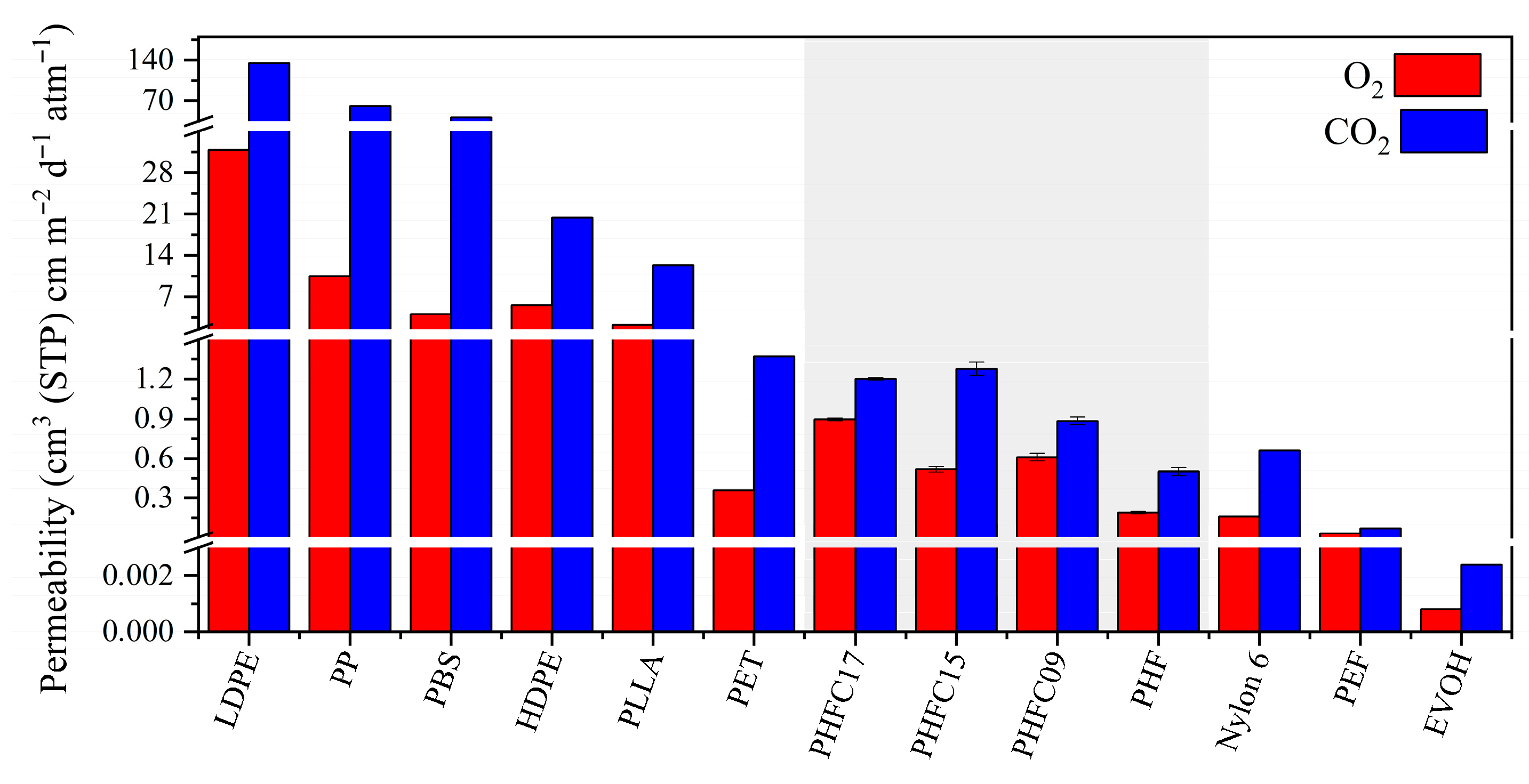
3.4. Gas Permeability Tests
4. Conclusions
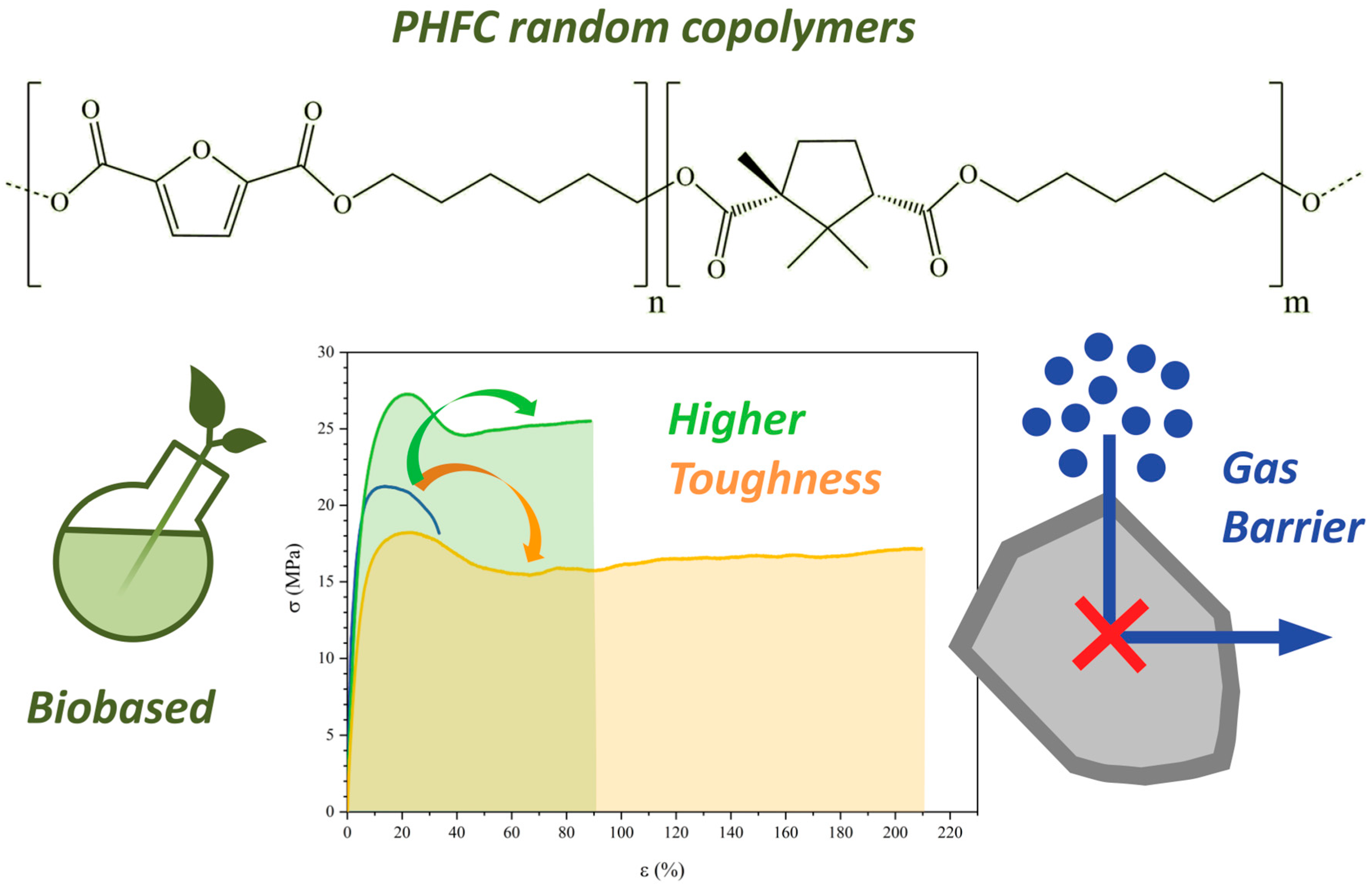
- The mechanical properties were significantly improved compared to the homopolymer of reference, PHF. In particular, in the case of PHFC15, flexibility improved of about 33%, elongation at break by 430%, and toughness by 223%.
- The thermal stability and the gas permeability properties did not change significantly compared to PHF. In particular, the gas permeability properties were excellent, comparable to the ones of commercial PET and superior than those of polyolefins and other biobased polymeric systems, such as PLLA and PBS.
- The presence of camphoric acid units favored the formation of a mesomorph phase in all PHFC copolymers, and it was hypothesized that its structure could be smectic.
Supplementary Materials
Author Contributions
Funding
Institutional Review Board Statement
Data Availability Statement
Acknowledgments
Conflicts of Interest
References
- Xanthos, D.; Walker, T.R. International Policies to Reduce Plastic Marine Pollution from Single-Use Plastics (Plastic Bags and Microbeads): A Review. Mar. Pollut. Bull. 2017, 118, 17–26. [Google Scholar] [CrossRef] [PubMed]
- Schnurr, R.E.J.; Alboiu, V.; Chaudhary, M.; Corbett, R.A.; Quanz, M.E.; Sankar, K.; Srain, H.S.; Thavarajah, V.; Xanthos, D.; Walker, T.R. Reducing Marine Pollution from Single-Use Plastics (SUPs): A Review. Mar. Pollut. Bull. 2018, 137, 157–171. [Google Scholar] [CrossRef]
- Vilela, C.; Sousa, A.F.; Fonseca, A.C.; Serra, A.C.; Coelho, J.F.J.; Freire, C.S.R.; Silvestre, A.J.D. The Quest for Sustainable Polyesters—Insights into the Future. Polym. Chem. 2014, 5, 3119–3141. [Google Scholar] [CrossRef]
- Rabnawaz, M.; Wyman, I.; Auras, R.; Cheng, S. A Roadmap Towards Green Packaging: The Current Status and Future Outlook for Polyesters in the Packaging Industry. Green Chem. 2017, 19, 4737–4753. [Google Scholar] [CrossRef]
- Zhang, Q.; Song, M.; Xu, Y.; Wang, W.; Wang, Z.; Zhang, L. Bio-Based Polyesters: Recent Progress and Future Prospects. Prog. Polym. Sci. 2021, 120, 101430. [Google Scholar] [CrossRef]
- Gandini, A. The Irruption of Polymers from Renewable Resources on the Scene of Macromolecular Science and Technology. Green Chem. 2011, 13, 1061. [Google Scholar] [CrossRef]
- Pellis, A.; Malinconico, M.; Guarneri, A.; Gardossi, L. Renewable Polymers and Plastics: Performance Beyond the Green. New Biotechnol. 2021, 60, 146–158. [Google Scholar] [CrossRef] [PubMed]
- European Bioplastics. Renewable Feedstock. Available online: https://www.european-bioplastics.org/bioplastics/feedstock/ (accessed on 19 December 2023).
- Ning, P.; Yang, G.; Hu, L.; Sun, J.; Shi, L.; Zhou, Y.; Wang, Z.; Yang, J. Recent Advances in the Valorization of Plant Biomass. Biotechnol. Biofuels 2021, 14, 102. [Google Scholar] [CrossRef]
- Flexible Packaging Europe. Key Sustainability Fact. Available online: https://www.flexpack-europe.org/key-sustainability-facts (accessed on 19 December 2023).
- Werpy, T.; Petersen, G.; Aden, A.; Bozell, J.; Holladay, J.; White, J.; Manheim, A.; Eliot, D.; Lasure, L.; Jones, S.; et al. Top Value Added Chemicals from Biomass—Results of Screening for Potential Candidates from Sugars and Synthesis Gas; Werpy, T., Petersen, G., Eds.; U.S. Department of Energy: Washington, DC, USA, 2004.
- Bozell, J.J.; Petersen, G.R. Technology Development for the Production of Biobased Products from Biorefinery Carbohydrates—The US Department of Energy’s “Top 10” Revisited. Green Chem. 2010, 12, 539. [Google Scholar] [CrossRef]
- Loos, K.; Zhang, R.; Pereira, I.; Agostinho, B.; Hu, H.; Maniar, D.; Sbirrazzuoli, N.; Silvestre, A.J.D.; Guigo, N.; Sousa, A.F. A Perspective on PEF Synthesis, Properties, and End-Life. Front. Chem. 2020, 8, 585. [Google Scholar] [CrossRef]
- Sousa, A.F.; Patrício, R.; Terzopoulou, Z.; Bikiaris, D.N.; Stern, T.; Wenger, J.; Loos, K.; Lotti, N.; Siracusa, V.; Szymczyk, A.; et al. Recommendations for Replacing PET on Packaging, Fiber, and Film Materials with Biobased Counterparts. Green Chem. 2021, 23, 8795–8820. [Google Scholar] [CrossRef]
- de Jong, E.; Visser, H.A.; Dias, A.S.; Harvey, C.; Gruter, G.-J.M. The Road to Bring FDCA and PEF to the Market. Polymers 2022, 14, 943. [Google Scholar] [CrossRef] [PubMed]
- Haas, V.; Wenger, J.; Ranacher, L.; Guigo, N.; Sousa, A.F.; Stern, T. Developing Future Visions for Bio-Plastics Substituting PET—A Backcasting Approach. Sustain. Prod. Consum. 2022, 31, 370–383. [Google Scholar] [CrossRef]
- Sousa, A.F.; Vilela, C.; Fonseca, A.C.; Matos, M.; Freire, C.S.R.; Gruter, G.-J.M.; Coelho, J.F.J.; Silvestre, A.J.D. Biobased Polyesters and Other Polymers from 2,5-Furandicarboxylic Acid: A Tribute to Furan Excellency. Polym. Chem. 2015, 6, 5961–5983. [Google Scholar] [CrossRef]
- Guidotti, G.; Soccio, M.; García-Gutiérrez, M.C.; Ezquerra, T.; Siracusa, V.; Gutiérrez-Fernández, E.; Munari, A.; Lotti, N. Fully Biobased Superpolymers of 2,5-Furandicarboxylic Acid with Different Functional Properties: From Rigid to Flexible, High Performant Packaging Materials. ACS Sustain. Chem. Eng. 2020, 8, 9558–9568. [Google Scholar] [CrossRef]
- Bianchi, E.; Guidotti, G.; Soccio, M.; Siracusa, V.; Gazzano, M.; Salatelli, E.; Lotti, N. Biobased and Compostable Multiblock Copolymer of Poly(L-Lactic Acid) Containing 2,5-Furandicarboxylic Acid for Sustainable Food Packaging: The Role of Parent Homopolymers in the Composting Kinetics and Mechanism. Biomacromolecules 2023, 24, 2356–2368. [Google Scholar] [CrossRef] [PubMed]
- Quattrosoldi, S.; Guidotti, G.; Soccio, M.; Siracusa, V.; Lotti, N. Bio-Based and One-Day Compostable Poly(Diethylene 2,5-Furanoate) for Sustainable Flexible Food Packaging: Effect of Ether-Oxygen Atom Insertion on the Final Properties. Chemosphere 2022, 291, 132996. [Google Scholar] [CrossRef]
- Saltzberg, M. Update on Dupont’s FDME/Furan Polymer Program. Available online: https://www.plasticstoday.com/plastics-processing/dupont-adm-to-bring-new-breakthrough-molecule-to-market (accessed on 23 August 2023).
- Scott, A. DuPont, ADM Eye Biobased Polyester. Available online: https://cen.acs.org/articles/94/i12/BASF-Avantium-combine-bio-polyester.html?ref=search_results (accessed on 25 July 2023).
- Albert Heijn to Use Avantium’s 100% Plant-Based PEF for Packaging of Own-Brand Products. Available online: https://avantium.com/wp-content/uploads/2023/11/20231121-Albert-Heijn-to-use-Avantiums-100-plant-based-PEF-for-packaging-of-own-brand-products-.pdf (accessed on 11 December 2023).
- Roux, M.; Varrone, C. Assessing the Economic Viability of the Plastic Biorefinery Concept and Its Contribution to a More Circular Plastic Sector. Polymers 2021, 13, 3883. [Google Scholar] [CrossRef]
- Dessbesell, L.; Souzanchi, S.; Venkateswara Rao, K.T.; Carrillo, A.A.; Bekker, D.; Hall, K.A.; Lawrence, K.M.; Tait, C.L.J.; Xu, C. Production of 2,5-furandicarboxylic Acid (FDCA) from Starch, Glucose, or High-fructose Corn Syrup: Techno-economic Analysis. Biofuels Bioprod. Biorefining 2019, 13, 1234–1245. [Google Scholar] [CrossRef]
- ChemAnalyst. Purified Terephthalic Acid (TPA) Price Trend and Forecast. Available online: https://www.chemanalyst.com/Pricing-data/purified-terephthalic-acid-pta-18 (accessed on 15 October 2023).
- ChemAnalyst. Polyethylene Terephthalate (PET) Price Trend and Forecast. Available online: https://www.chemanalyst.com/Pricing-data/polyethylene-terephthalate-72 (accessed on 15 October 2023).
- Fahlbusch, K.; Hammerschmidt, F.; Panten, J.; Pickenhagen, W.; Schatkowski, D.; Bauer, K.; Garbe, D.; Surburg, H. Flavors and Fragrances. In Ullmann’s Encyclopedia of Industrial Chemistry; Wiley: Hoboken, NJ, USA, 2003. [Google Scholar]
- Guo, S.; Geng, Z.; Zhang, W.; Liang, J.; Wang, C.; Deng, Z.; Du, S. The Chemical Composition of Essential Oils from Cinnamomum Camphora and Their Insecticidal Activity Against the Stored Product Pests. Int. J. Mol. Sci. 2016, 17, 1836. [Google Scholar] [CrossRef]
- Talapatra, S.K.; Talapatra, B. Chemistry of Plant Natural Products; Springer: Berlin/Heidelberg, Germany, 2015; ISBN 978-3-642-45409-7. [Google Scholar]
- Harman-Ware, A.E. Conversion of Terpenes to Chemicals and Related Products. In Chemical Catalysts for Biomass Upgrading; Wiley: Hoboken, NJ, USA, 2020; pp. 529–568. [Google Scholar]
- Gubelmann, I.; Elley, H.W. American Production of Synthetic Camphor from Turpentine. Ind. Eng. Chem. 1934, 26, 589–594. [Google Scholar] [CrossRef]
- Beri, M.L.; Sarin, J.L. Production of Synthetic Camphor from Indian Turpentine. J. Soc. Chem. Ind. 1936, 55, 605–607. [Google Scholar] [CrossRef]
- Renewable Carbon Monomers from Camphor Enable Biobased Plastics. Available online: https://renewable-carbon.eu/news/monomers-from-camphor-enable-biobased-plastics/ (accessed on 19 December 2023).
- Nsengiyumva, O.; Miller, S.A. Synthesis, Characterization, and Water-Degradation of Biorenewable Polyesters Derived from Natural Camphoric Acid. Green Chem. 2019, 21, 973–978. [Google Scholar] [CrossRef]
- Zhang, W.; Wu, J.; Gao, L.; Zhang, B.; Jiang, J.; Hu, J. Recyclable, Reprocessable, Self-Adhered and Repairable Carbon Fiber Reinforced Polymers Using Full Biobased Matrices from Camphoric Acid and Epoxidized Soybean Oil. Green Chem. 2021, 23, 2763–2772. [Google Scholar] [CrossRef]
- Kang, J.H.; Sim, S.J.; Lee, J.H.; Lee, S.; Suh, D.H. Bio-Degradable Polyesters with Rigid Cyclic Diester from Camphor and Tartaric Acid. J. Polym. Environ. 2022, 30, 3463–3473. [Google Scholar] [CrossRef]
- Ouhichi, R.; Bougarech, A.; Kluge, M.; Pérocheau Arnaud, S.; Abid, S.; Abid, M.; Robert, T. Camphoric Acid as Renewable Cyclic Building Block for Bio-Based UV-Curing Polyhexylene Itaconate. Eur. Polym. J. 2021, 151, 110423. [Google Scholar] [CrossRef]
- Jiang, X.; Yu, Y.; Guan, Y.; Liu, T.; Pang, C.; Ma, J.; Gao, H. Random and Multiblock PBS Copolyesters Based on a Rigid Diol Derived from Naturally Occurring Camphor: Influence of Chemical Microstructure on Thermal and Mechanical Properties. ACS Sustain. Chem. Eng. 2020, 8, 3626–3636. [Google Scholar] [CrossRef]
- Pang, C.; Jiang, X.; Yu, Y.; Chen, L.; Ma, J.; Gao, H. Copolymerization of Natural Camphor-Derived Rigid Diol with Various Dicarboxylic Acids: Access to Biobased Polyesters with Various Properties. ACS Macro Lett. 2019, 8, 1442–1448. [Google Scholar] [CrossRef]
- Guidotti, G.; Burzotta, G.; Soccio, M.; Gazzano, M.; Siracusa, V.; Munari, A.; Lotti, N. Chemical Modification of Poly(Butylene Trans-1,4-Cyclohexanedicarboxylate) by Camphor: A New Example of Bio-Based Polyesters for Sustainable Food Packaging. Polymers 2021, 13, 2707. [Google Scholar] [CrossRef]
- Guidotti, G.; Soccio, M.; Gazzano, M.; Siracusa, V.; Lotti, N. New Random Aromatic/Aliphatic Copolymers of 2,5-Furandicarboxylic and Camphoric Acids with Tunable Mechanical Properties and Exceptional Gas Barrier Capability for Sustainable Mono-Layered Food Packaging. Molecules 2023, 28, 4056. [Google Scholar] [CrossRef] [PubMed]
- ASTM D1434:2009; Standard Test Method for Determining Gas Permeability Characteristics of Plastic Film and Sheeting. ASTM International: West Conshohocken, PA, USA, 2009.
- DIN 53536; Testing of Elastomers; Determination of Gas Permeability. Deutsches Institut für Normung: Berlin, Germany, 1986.
- ISO/DIS 15105-1:2007; Plastics—Determination of Gas-Transmission Rate—Part 1: Differential-Pressure Methods. International Organization for Standardization: Geneva, Switzerland, 2007.
- Siracusa, V. Food Packaging Permeability Behaviour: A Report. Int. J. Polym. Sci. 2012, 2012, 1–11. [Google Scholar] [CrossRef]
- Siracusa, V.; Rocculi, P.; Romani, S.; Rosa, M.D. Biodegradable Polymers for Food Packaging: A Review. Trends Food Sci. Technol. 2008, 19, 634–643. [Google Scholar] [CrossRef]
- Siracusa, V.; Ingrao, C. Correlation amongst Gas Barrier Behaviour, Temperature and Thickness in BOPP Films for Food Packaging Usage: A Lab-Scale Testing Experience. Polym. Test. 2017, 59, 277–289. [Google Scholar] [CrossRef]
- Aminabhavi, T.M.; Aithal, U.S.; Shukla, S.S. An Overview of the Theoretical Models Used to Predict Transport of Small Molecules Through Polymer Membranes. J. Macromol. Sci. Part C Polym. Rev. 1988, 28, 421–474. [Google Scholar] [CrossRef]
- Piergiovanni, L.; Limbo, S. Plastic Packaging Materials. In Food Packaging Materials; Springer: Cham, Switzerland, 2016; pp. 33–49. [Google Scholar]
- Lee, D.S.; Yam, K.L.; Piergiovanni, L. Food Packaging Science and Technology; CRC Press: Boca Raton, FL, USA, 2008; ISBN 9781439894071. [Google Scholar]
- Robertson, G.L. Food Packaging—Principles and Practice; CRC Press: Boca Raton, FL, USA, 2013; ISBN 1-4398-6241-9. [Google Scholar]
- Atkins, P.; Jones, L.; Laverman, L.; Young, K.; Patterson, J. Chemical Principles: The Quest for Insight; W. H. Freeman & Company: New York, NY, USA, 2016; ISBN 1319437613. [Google Scholar]
- Rogers, C.E. Polymer Permeability; Comyn, J., Ed.; Springer: Dordrecht, The Netherlands, 1985; ISBN 978-94-010-8650-9. [Google Scholar]
- Shen, A.; Wang, J.; Ma, S.; Fei, X.; Zhang, X.; Zhu, J.; Liu, X. Completely Amorphous High Thermal Resistant Copolyesters from Bio-based 2,5-Furandicarboxylic Acid. J. Appl. Polym. Sci. 2021, 138, 50627. [Google Scholar] [CrossRef]
- Brady, J.E.; Dürig, T.; Shang, S.S. Polymer Properties and Characterization. In Developing Solid Oral Dosage Forms; Elsevier: Amsterdam, The Netherlands, 2009; pp. 187–217. [Google Scholar]
- Bianchi, E.; Soccio, M.; Siracusa, V.; Gazzano, M.; Thiyagarajan, S.; Lotti, N. Poly(Alkylene 2,4-Furanoate)s: The Potential of Structural Isomerism for Outstanding Sustainable Food Packaging and Unexpected Evidence of Self-Healing Microstructure. React. Funct. Polym. 2024, 203, 106010. [Google Scholar] [CrossRef]
- Gennes, P.G.d.; Prost, J. The Physics of Liquid Crystals; Clarendon Press: Oxford, UK, 2001; ISBN 9780198517856. [Google Scholar]
- Blumstein, A. Nematic Order in Polyesters with Flexible Moieties in the Main Chain. Polym. J. 1985, 17, 277–288. [Google Scholar] [CrossRef]
- Blumstein, A.; Gauthier, M.M.; Thomas, O.; Blumstein, R.B. Structure–Property Correlations in Some Nematic Main–Chain Polyesters. Faraday Discuss. Chem. Soc. 1985, 79, 33–39. [Google Scholar] [CrossRef]
- Raja, V.N.; Shashidhar, R.; Chandrasekhar, S.; Blumstein, A.; Blumstein, R.B.; Kumar, S. Phase Transitions of Nematic Main-Chain Polyesters Under High Pressure. Mol. Cryst. Liq. Cryst. Inc. Nonlinear Opt. 1988, 155, 521–529. [Google Scholar] [CrossRef]
- Hu, Y.S.; Prattipati, V.; Mehta, S.; Schiraldi, D.A.; Hiltner, A.; Baer, E. Improving Gas Barrier of PET by Blending with Aromatic Polyamides. Polymer 2005, 46, 2685–2698. [Google Scholar] [CrossRef]
- Siracusa, V.; Lotti, N.; Munari, A.; Dalla Rosa, M. Poly(Butylene Succinate) and Poly(Butylene Succinate-Co-Adipate) for Food Packaging Applications: Gas Barrier Properties After Stressed Treatments. Polym. Degrad. Stab. 2015, 119, 35–45. [Google Scholar] [CrossRef]
- Zhao, M.; Zhang, C.; Yang, F.; Weng, Y. Gas Barrier Properties of Furan-Based Polyester Films Analyzed Experimentally and by Molecular Simulations. Polymer 2021, 233, 124200. [Google Scholar] [CrossRef]



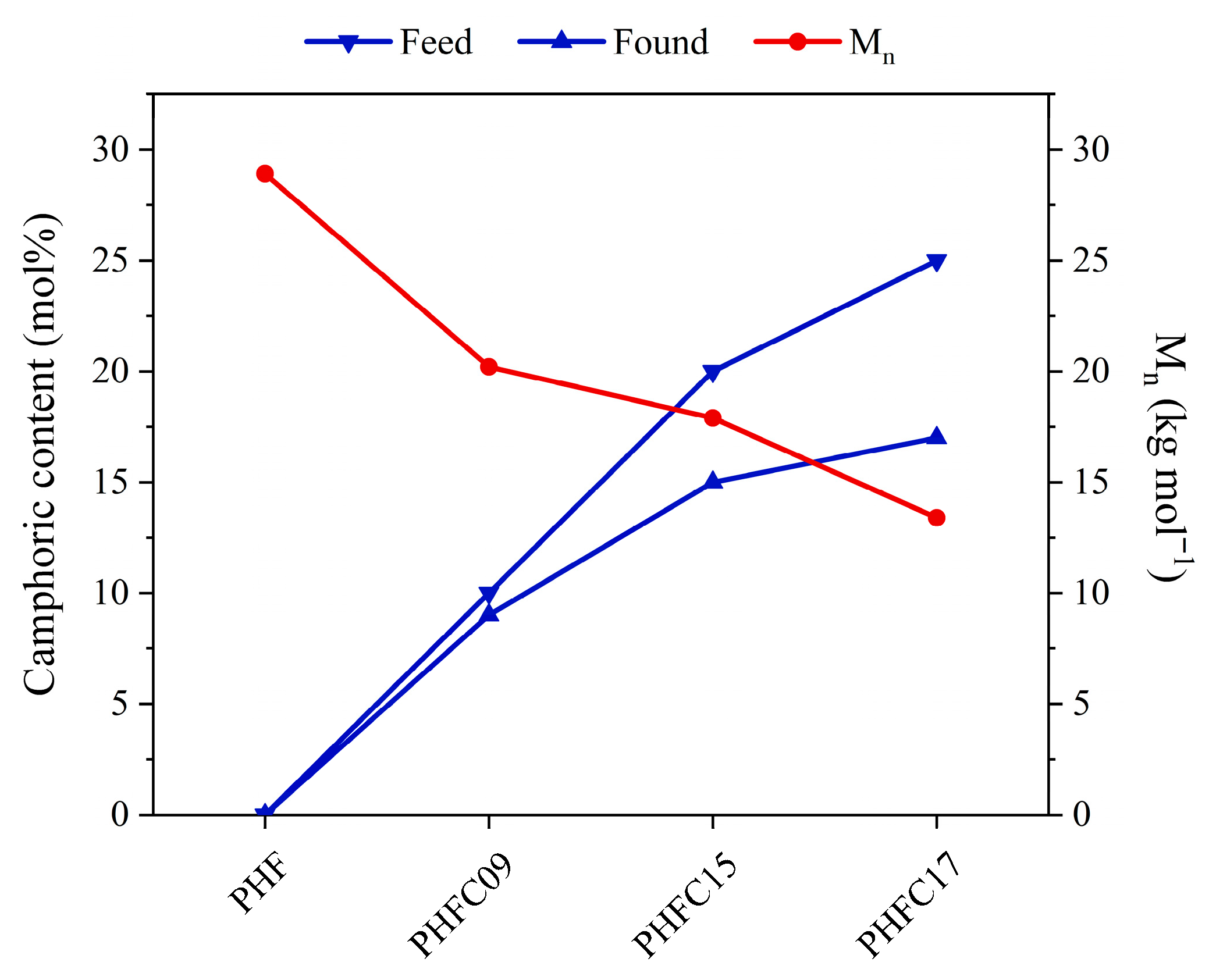
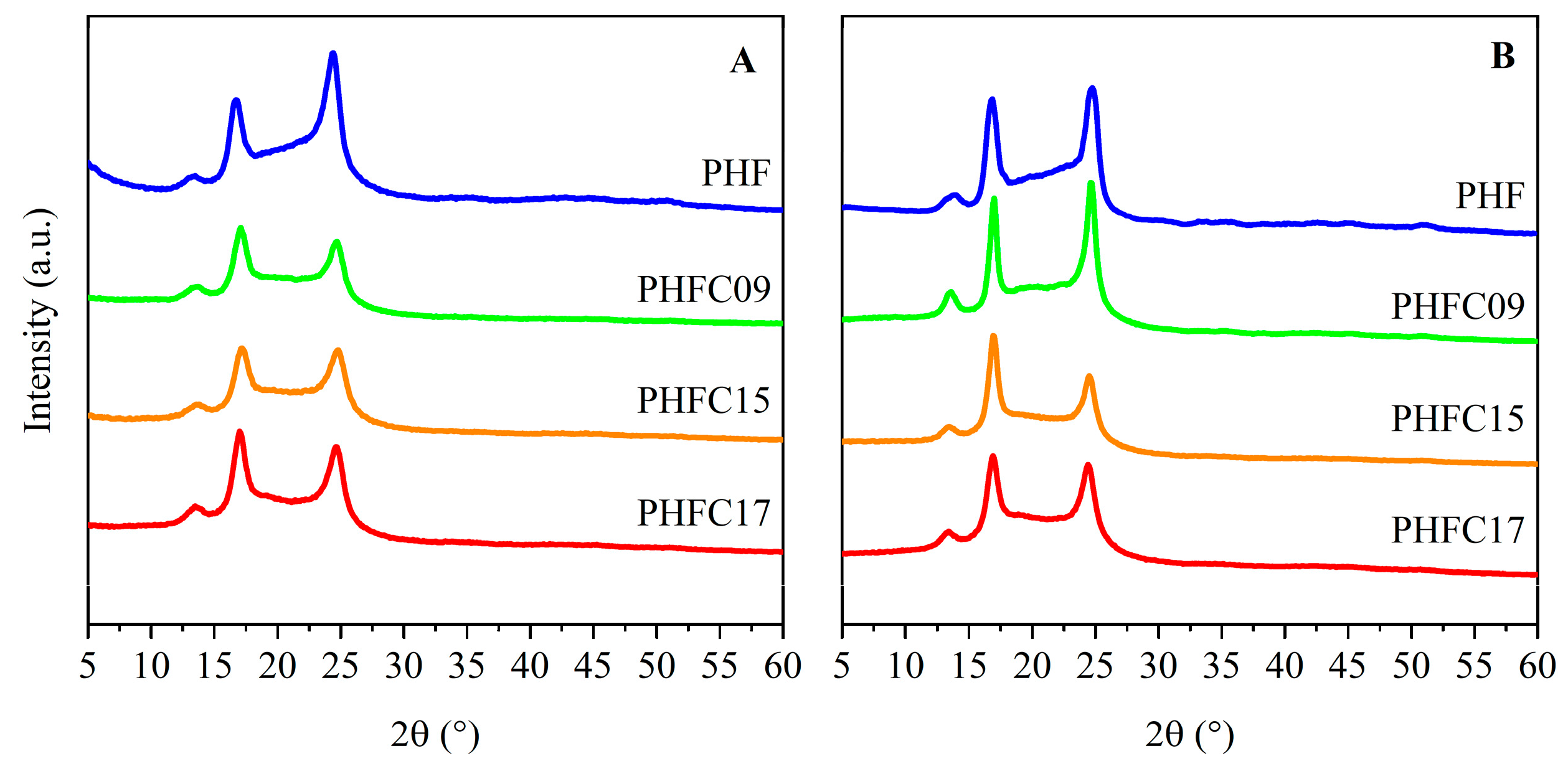
| Physical State | C Feed (mol%) | C Found 1 (mol%) | χ1,2 (%) | Mn 3 (g mol−1) | Đ 3 | Xc 4 (%) | FWHM 4 (°) | L 4 (nm) |
|---|---|---|---|---|---|---|---|---|
| PHF | ||||||||
| Powder | 0 | 0 | - | 28,900 | 2.3 | 37 | 1.1 | 8 |
| Film | 35 | 1.0 | 9 | |||||
| PHFC09 | ||||||||
| Powder | 10 | 9 | 90 | 20,200 | 1.9 | 33 | 1.1 | 8 |
| Film | 34 | 0.7 | 12 | |||||
| PHFC15 | ||||||||
| Powder | 20 | 15 | 75 | 17,900 | 2.0 | 31 | 1.2 | 7 |
| Film | 32 | 0.8 | 11 | |||||
| PHFC17 | ||||||||
| Powder | 25 | 17 | 68 | 13,400 | 2.0 | 34 | 1.1 | 8 |
| Film | 31 | 0.9 | 9 | |||||
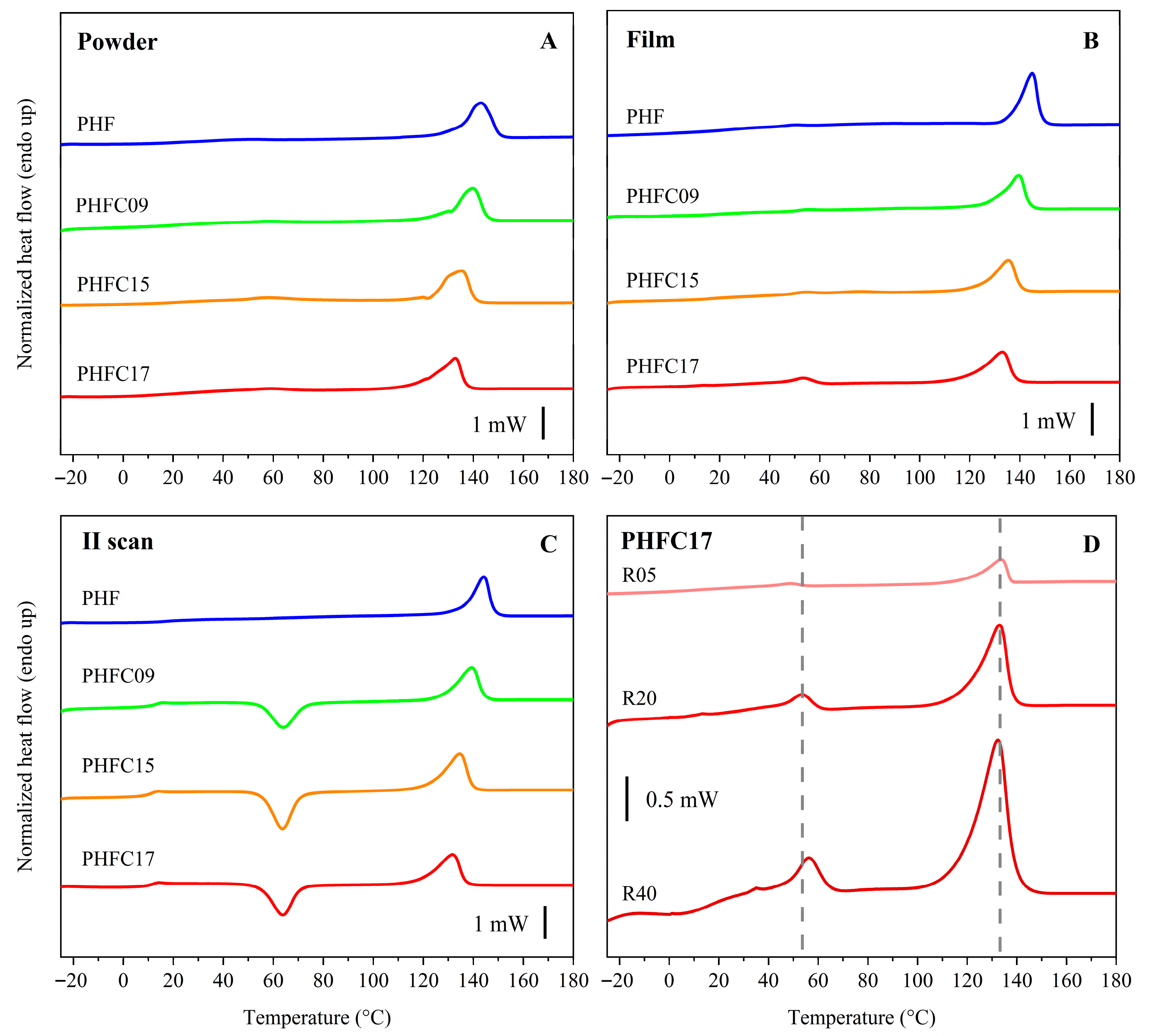
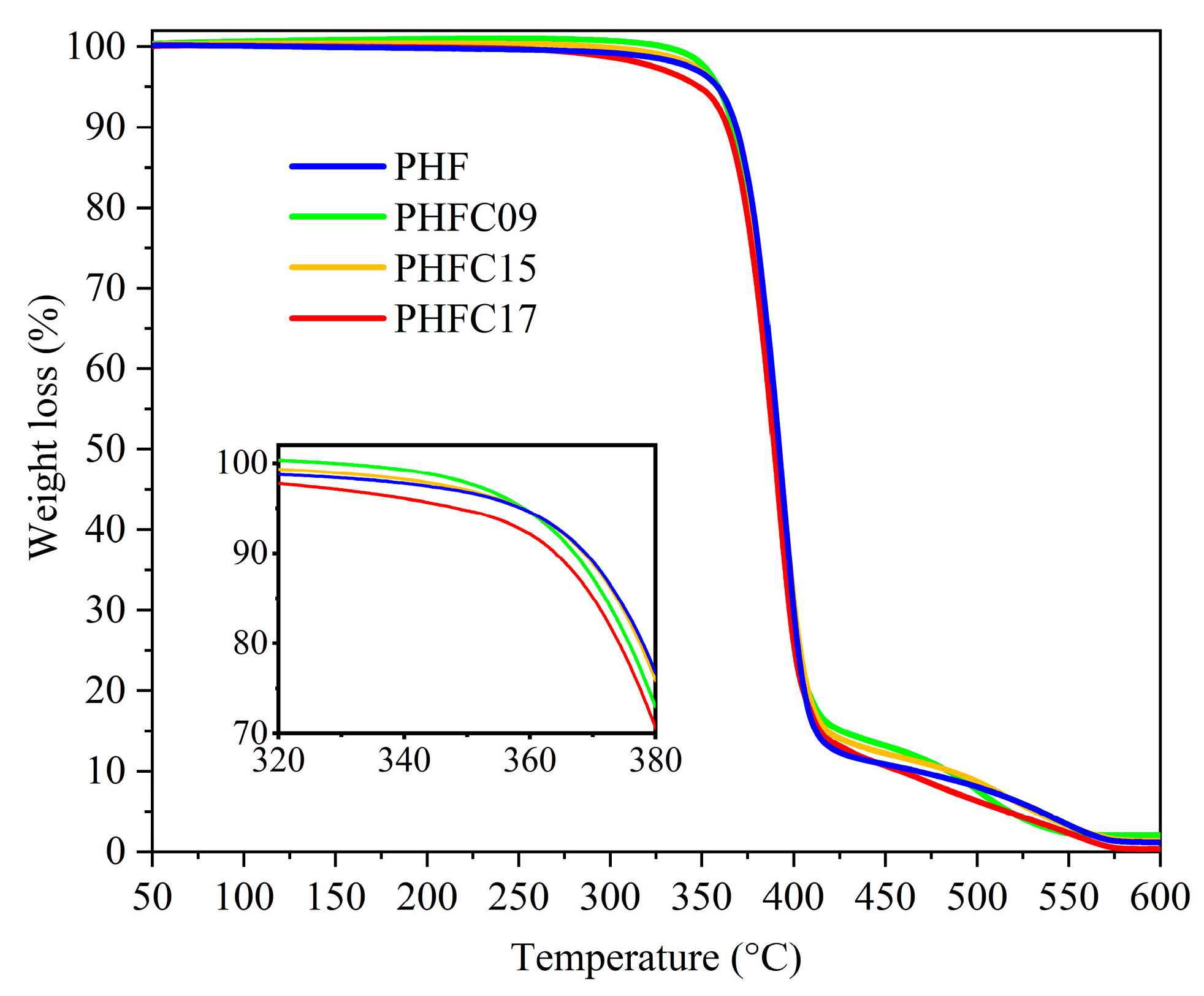
| Sample | Tg (°C) 1 ΔCp (J g−1 °C−1) 1 | Ti (°C) 1 ΔHi (J g−1) 1 | Tcc (°C) 1 ΔHcc (J g−1) 1 | Tm (°C) 1 ΔHm (J g−1) 1 | T5% 2 | Tonset 2 | Tmax 2 | |
|---|---|---|---|---|---|---|---|---|
| PHF | ||||||||
| Powder | 23 | - | - | 143 | 358 | 372 | 395 | |
| 0.210 | - | - | 42 | |||||
| Film | 22 | - | - | 145 | ||||
| 0.208 | - | - | 38 | |||||
| II scan | 18 | - | - | 144 | ||||
| 0.146 | - | - | 34 | |||||
| PHFC09 | ||||||||
| Powder | 21 | - | - | 140 | 359 | 369 | 392 | |
| 0.244 | - | - | 33 | |||||
| Film | 20 | 55 | - | 140 | ||||
| 0.202 | 1 | - | 34 | |||||
| II scan | 11 | - | 64 | 139 | ||||
| 0.451 | - | 26 | 31 | |||||
| PHFC15 | ||||||||
| Powder | 21 | - | - | 135 | 359 | 371 | 395 | |
| 0.304 | - | - | 35 | |||||
| Film | 19 | 54 | - | 135 | ||||
| 0.174 | 2 | - | 33 | |||||
| II scan | 10 | - | 64 | 134 | ||||
| 0.499 | - | 33 | 37 | |||||
| PHFC17 | ||||||||
| Powder | 18 | - | - | 133 | 348 | 370 | 391 | |
| 0.381 | - | 33 | ||||||
| Film | R05 | 8 | 48 | - | 133 | |||
| 0.114 | 3 | - | 37 | |||||
| R20 | 12 | 54 | - | 133 | ||||
| 0.148 | 4 | - | 36 | |||||
| R40 | 20 | 56 | - | 133 | ||||
| 0.377 | 6 | - | 39 | |||||
| II scan | 10 | - | 64 | 132 | ||||
| 0.364 | - | 29 | 32 | |||||
| Property | PHF | PHFC09 | PHFC15 | PHFC17 |
|---|---|---|---|---|
| Thickness (μm) | 360 ± 10 | 237 ± 8 | 178 ± 9 | 263 ± 6 |
| O2 Permeability | 0.19 ± 0.01 | 0.61 ± 0.03 | 0.52 ± 0.02 | 0.90 ± 0.01 |
| CO2 Permeability | 0.50 ± 0.03 | 0.88 ± 0.03 | 1.28 ± 0.05 | 1.20 ± 0.01 |
| E (MPa) | 910 ± 30 | 620 ± 90 | 520 ± 70 | 600 ± 40 |
| σy (MPa) | - | 26 ± 2 | 17 ± 1 | - |
| εy (%) | - | 21 ± 3 | 18 ± 4 | - |
| σb (MPa) | 22 ± 1 | 24 ± 1 | 17 ± 1 | 17 ± 2 |
| εb (%) | 42 ± 4 | 90 ± 20 | 220 ± 30 | 6 ± 1 |
| Toughness (J m−3) | 6 ± 1 | 27 ± 4 | 34 ± 5 | 0.9 ± 0.2 |
Disclaimer/Publisher’s Note: The statements, opinions and data contained in all publications are solely those of the individual author(s) and contributor(s) and not of MDPI and/or the editor(s). MDPI and/or the editor(s) disclaim responsibility for any injury to people or property resulting from any ideas, methods, instructions or products referred to in the content. |
© 2026 by the authors. Licensee MDPI, Basel, Switzerland. This article is an open access article distributed under the terms and conditions of the Creative Commons Attribution (CC BY) license.
Share and Cite
Bianchi, E.; Soccio, M.; Siracusa, V.; Gazzano, M.; Lotti, N. Biobased Random Copolymers of Poly(Hexamethylene Furanoate) for Sustainable Food Packaging: Camphoric Acid as a Valuable Co-Monomer for Improved Mechanical Properties. Polymers 2026, 18, 255. https://doi.org/10.3390/polym18020255
Bianchi E, Soccio M, Siracusa V, Gazzano M, Lotti N. Biobased Random Copolymers of Poly(Hexamethylene Furanoate) for Sustainable Food Packaging: Camphoric Acid as a Valuable Co-Monomer for Improved Mechanical Properties. Polymers. 2026; 18(2):255. https://doi.org/10.3390/polym18020255
Chicago/Turabian StyleBianchi, Enrico, Michelina Soccio, Valentina Siracusa, Massimo Gazzano, and Nadia Lotti. 2026. "Biobased Random Copolymers of Poly(Hexamethylene Furanoate) for Sustainable Food Packaging: Camphoric Acid as a Valuable Co-Monomer for Improved Mechanical Properties" Polymers 18, no. 2: 255. https://doi.org/10.3390/polym18020255
APA StyleBianchi, E., Soccio, M., Siracusa, V., Gazzano, M., & Lotti, N. (2026). Biobased Random Copolymers of Poly(Hexamethylene Furanoate) for Sustainable Food Packaging: Camphoric Acid as a Valuable Co-Monomer for Improved Mechanical Properties. Polymers, 18(2), 255. https://doi.org/10.3390/polym18020255