PEDOT:PSS as a Bio-Solid Electrolyte Interphase for Neural Interfaces: From Molecular Design to Interfacial Intelligence


Abstract
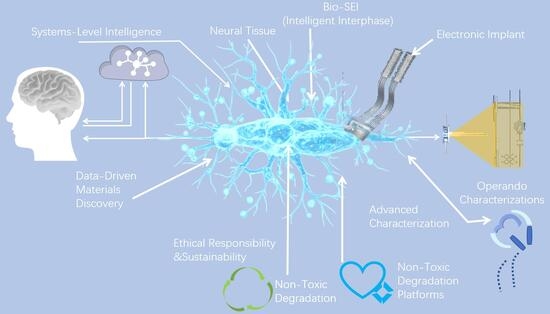
1. Introduction
2. PEDOT:PSS in Chemistry and Flexible Electronics: The Baseline of Success
3. The Unique Neural and Implantable Environment
4. Molecular and Structural Design of PEDOT:PSS for Neural Interfaces
4.1. Molecular Engineering and Control of Chemical Purity
4.2. Post-Treatment and Reactive Functionalization
4.3. Mesoscale Morphology and Transport Pathways
4.4. Formation of SEI-like Protective Interphases
4.5. Structure–Property–Function Correlation Across Hierarchies
5. Toward Interfacial Stability and Clinical Translation
5.1. Hybrid Architectures for Mechanical and Ionic Compatibility
5.2. Chronic Biocompatibility and Electrochemical Durability
5.3. Convergence Toward Clinical and Commercial Platforms
6. Outlook and Conclusions
Author Contributions
Funding
Data Availability Statement
Conflicts of Interest
References
- Duan, W.; Robles, U.A.; Poole-Warren, L.; Esrafilzadeh, D. Bioelectronic Neural Interfaces: Improving Neuromodulation Through Organic Conductive Coatings. Adv. Sci. 2024, 11, 2306275. [Google Scholar] [CrossRef]
- Cogan, S.F. Neural stimulation and recording electrodes. Annu. Rev. Biomed. Eng. 2008, 10, 275–309. [Google Scholar] [CrossRef] [PubMed]
- Boufidis, D.; Garg, R.; Angelopoulos, E.; Cullen, D.K.; Vitale, F. Bio-inspired electronics: Soft, biohybrid, and “living” neural interfaces. Nat. Commun. 2025, 16, 1861. [Google Scholar] [CrossRef] [PubMed]
- Lozano, A.M.; Lipsman, N.; Bergman, H.; Brown, P.; Chabardes, S.; Chang, J.W.; Matthews, K.; McIntyre, C.C.; Schlaepfer, T.E.; Schulder, M.; et al. Deep brain stimulation: Current challenges and future directions. Nat. Rev. Neurol. 2019, 15, 148–160. [Google Scholar] [CrossRef] [PubMed]
- Williams, C.; Anik, F.I.; Hasan, M.M.; Rodriguez-Cardenas, J.; Chowdhury, A.; Tian, S.; He, S.; Sakib, N. Advancing Brain-Computer Interface Closed-Loop Systems for Neurorehabilitation: Systematic Review of AI and Machine Learning Innovations in Biomedical Engineering. JMIR Biomed. Eng. 2025, 10, e72218. [Google Scholar] [CrossRef]
- Lecomte, A.; Descamps, E.; Bergaud, C. A review on mechanical considerations for chronically-implanted neural probes. J. Neural Eng. 2018, 15, 031001. [Google Scholar] [CrossRef]
- He, F.; Lycke, R.; Ganji, M.; Xie, C.; Luan, L. Review Ultraflexible Neural Electrodes for Long-Lasting Intracortical Recording. Iscience 2020, 23, 101387. [Google Scholar] [CrossRef]
- Patil, P.G.; Turner, D.A. The development of brain-machine interface neuroprosthetic devices. Neurotherapeutics 2008, 5, 137–146. [Google Scholar] [CrossRef]
- Li, J.; Mo, D.Z.; Hu, J.Y.; Wang, S.C.; Gong, J.; Huang, Y.J.; Li, Z.; Yuan, Z.; Xu, M.Z. PEDOT:PSS-based bioelectronics for brain monitoring and modulation. Microsyst. Nanoeng. 2025, 11, 87. [Google Scholar] [CrossRef]
- Boehler, C.; Aqrawe, Z.; Asplund, M. Applications of PEDOT in Bioelectronic Medicine. Bioelectron. Med. 2019, 2, 89–99. [Google Scholar] [CrossRef]
- Liang, Y.; Offenhäusser, A.; Ingebrandt, S.; Mayer, D. PEDOT:PSS-Based Bioelectronic Devices for Recording and Modulation of Electrophysiological and Biochemical Cell Signals. Adv. Healthc. Mater. 2021, 10, 2100061. [Google Scholar] [CrossRef] [PubMed]
- Kim, H.W.; Kim, J.; Kim, J.Y.; Kim, K.; Lee, J.Y.; Kim, T.; Cho, S.; An, J.B.; Kim, H.J.; Sun, L.; et al. Transparent, metal-free PEDOT:PSS neural interfaces for simultaneous recording of low-noise electrophysiology and artifact-free two-photon imaging. Nat. Commun. 2025, 16, 4032. [Google Scholar] [CrossRef] [PubMed]
- Musk, E. An Integrated Brain-Machine Interface Platform with Thousands of Channels. J. Med. Internet Res. 2019, 21, e16194. [Google Scholar] [CrossRef] [PubMed]
- Heiskanen, S.K.; Kim, J.; Lucht, B.L. Generation and Evolution of the Solid Electrolyte Interphase of Lithium-Ion Batteries. Joule 2019, 3, 2322–2333. [Google Scholar] [CrossRef]
- Busche, M.R.; Weiss, M.; Leichtweiss, T.; Fiedler, C.; Drossel, T.; Geiss, M.; Kronenberger, A.; Weber, D.A.; Janek, J. The Formation of the Solid/Liquid Electrolyte Interphase (SLEI) on NASICON-Type Glass Ceramics and LiPON. Adv. Mater. Interfaces 2020, 7, 2000380. [Google Scholar] [CrossRef]
- Adenusi, H.; Chass, G.A.; Passerini, S.; Tian, K.V.; Chen, G. Lithium Batteries and the Solid Electrolyte Interphase (SEI)—Progress and Outlook. Adv. Energy Mater. 2023, 13, 2203307. [Google Scholar] [CrossRef]
- Xia, K.; Yao, Z.; Liu, Z.; Luo, S.; Xie, H.; Li, X.; Yao, X.; Liang, G.; Zhang, P. Hierarchical ionic networks in polymer electrolyte boost high-voltage solid-state Li batteries with stable interfaces and long cycling. Nano Res. Energy 2025. [Google Scholar] [CrossRef]
- Swallow, J.E.N.; Fraser, M.W.; Kneusels, N.-J.H.; Charlton, J.F.; Sole, C.G.; Phelan, C.M.E.; Björklund, E.; Bencok, P.; Escudero, C.; Pérez-Dieste, V.; et al. Revealing solid electrolyte interphase formation through interface-sensitive Operando X-ray absorption spectroscopy. Nat. Commun. 2022, 13, 6070. [Google Scholar] [CrossRef]
- Verma, P.; Maire, P.; Novák, P. A review of the features and analyses of the solid electrolyte interphase in Li-ion batteries. Electrochim. Acta 2010, 55, 6332–6341. [Google Scholar] [CrossRef]
- Lee, H.; Dellatore, S.M.; Miller, W.M.; Messersmith, P.B. Mussel-Inspired Surface Chemistry for Multifunctional Coatings. Science 2007, 318, 426–430. [Google Scholar] [CrossRef]
- Qiu, J.; Lu, Y.; Qian, X.; Yao, J.; Han, C.; Wu, Z.; Ye, H.; Shan, G.; Zheng, Q.; Xu, K.; et al. Highly conductive polymer with vertical phase separation for enhanced bioelectronic interfaces. NPJ Flex. Electron. 2025, 9, 69. [Google Scholar] [CrossRef]
- Qiu, J.; Sheng, Q.; Qian, X.; Yao, J.; Zhao, Y.; Zhang, X.; Han, C.; Wu, Z.; Ye, H.; Peng, B.; et al. Vertically Phase-Separated PEDOT:PSS Film via Solid–Liquid Interface Doping for Flexible Organic Electrochemical Transistors. ACS Appl. Mater. Interfaces 2025, 17, 17202–17216. [Google Scholar] [CrossRef] [PubMed]
- Elschner, A.; Kirchmeyer, S.; Lovenich, W.; Merker, U.; Reuter, K. PEDOT: Principles and Applications of an Intrinsically Conductive Polymer, 1st ed.; CRC Press: Boca Raton, FL, USA, 2010. [Google Scholar]
- Liu, Z.; Li, X.; Zou, R.; Zhou, Z.; Ma, Q.; Zhang, P. Deciphering the quaternary structure of PEDOT:PSS aqueous dispersion with small-angle scattering. Polymer 2022, 261, 125415. [Google Scholar] [CrossRef]
- Zou, R.-K.; Liu, G.-F.; Chen, G.-X.; Li, X.; Zhou, Z.-K.; Liu, Z.; Zhang, P. Modelling the 3D Structure of PEDOT:PSS Supramolecular Assembly in Aqueous Dispersion Based on SAXS with Synchrotron Light. Chin. J. Polym. Sci. 2023, 41, 1298–1304. [Google Scholar] [CrossRef]
- Mantione, D.; Del Agua, I.; Sanchez-Sanchez, A.; Mecerreyes, D. Poly(3,4-ethylenedioxythiophene) (PEDOT) Derivatives: Innovative Conductive Polymers for Bioelectronics. Polymers 2017, 9, 354. [Google Scholar] [CrossRef]
- Seiti, M.; Giuri, A.; Corcione, C.E.; Ferraris, E. Advancements in tailoring PEDOT: PSS properties for bioelectronic applications: A comprehensive review. Biomater. Adv. 2023, 154, 213655. [Google Scholar] [CrossRef]
- Li, H.; Cao, J.; Wan, R.; Feig, V.R.; Tringides, C.M.; Xu, J.; Yuk, H.; Lu, B. PEDOTs-Based Conductive Hydrogels: Design, Fabrications, and Applications. Adv. Mater. 2025, 37, 2415151. [Google Scholar] [CrossRef]
- Kim, S.; Sanyoto, B.; Park, W.-T.; Kim, S.; Mandal, S.; Lim, J.-C.; Noh, Y.-Y.; Kim, J.-H. Purification of PEDOT:PSS by Ultrafiltration for Highly Conductive Transparent Electrode of All-Printed Organic Devices. Adv. Mater. 2016, 28, 10149–10154. [Google Scholar] [CrossRef]
- Li, X.; Liu, Z.; Zhou, Z.; Gao, H.; Liang, G.; Rauber, D.; Kay, C.W.M.; Zhang, P. Effects of Cationic Species in Salts on the Electrical Conductivity of Doped PEDOT:PSS Films. ACS Appl. Polym. Mater. 2021, 3, 98–103. [Google Scholar] [CrossRef]
- Li, X.; Zou, R.; Liu, Z.; Mata, J.; Storer, B.; Chen, Y.; Qi, W.; Zhou, Z.; Zhang, P. Deciphering the superior thermoelectric property of post-treatment-free PEDOT:PSS/IL hybrid by X-ray and neutron scattering characterization. NPJ Flex. Electron. 2022, 6, 6. [Google Scholar] [CrossRef]
- He, Z.-H.; Liu, G.-F.; Zhou, Z.-K.; Liu, Z.; Zeng, Y.-S.; Zhang, P. Understand the Temperature Sensing Behavior of Solid-state Polymerized PEDOT Hybrid Based on X-ray Scattering Studies. Chin. J. Polym. Sci. 2024, 42, 105–112. [Google Scholar] [CrossRef]
- Chen, G.; He, Z.; Liu, Z.; Li, X.; Yao, Z.; Zhang, P. Highly Flexible and Foldable Paper-Based Thermoelectric Generator Prepared with Post-Treatment-Free PEDOT:PSS Hybrid Ink. Polymers 2023, 15, 4215. [Google Scholar] [CrossRef]
- Tu, S.; Tian, T.; Lena Oechsle, A.; Yin, S.; Jiang, X.; Cao, W.; Li, N.; Scheel, M.A.; Reb, L.K.; Hou, S.; et al. Improvement of the thermoelectric properties of PEDOT:PSS films via DMSO addition and DMSO/salt post-treatment resolved from a fundamental view. Chem. Eng. J. 2022, 429, 132295. [Google Scholar] [CrossRef]
- Mantione, D.; Del Agua, I.; Schaafsma, W.; ElMahmoudy, M.; Uguz, I.; Sanchez-Sanchez, A.; Sardon, H.; Castro, B.; Malliaras, G.G.; Mecerreyes, D. Low-Temperature Cross-Linking of PEDOT:PSS Films Using Divinylsulfone. ACS Appl. Mater. Interfaces 2017, 9, 18254–18262. [Google Scholar] [CrossRef] [PubMed]
- Cheng, S.; Zhu, R.; Xu, X. Hydrogels for next generation neural interfaces. Commun. Mater. 2024, 5, 99. [Google Scholar] [CrossRef]
- Galliani, M.; Ferrari, L.M.; Bouet, G.; Eglin, D.; Ismailova, E. Tailoring inkjet-printed PEDOT:PSS composition toward green, wearable device fabrication. APL Bioeng. 2023, 7, 016101. [Google Scholar] [CrossRef]
- Zhang, P.; Reiser, B.; González-García, L.; Beck, S.; Drzic, J.; Kraus, T. Drying of electrically conductive hybrid polymer–gold nanorods studied with in situ microbeam GISAXS. Nanoscale 2019, 11, 6538–6543. [Google Scholar] [CrossRef]
- Paulsen, B.D.; Tybrandt, K.; Stavrinidou, E.; Rivnay, J. Organic mixed ionic–electronic conductors. Nat. Mater. 2020, 19, 13–26. [Google Scholar] [CrossRef]
- Fahlman, M.; Fabiano, S.; Gueskine, V.; Simon, D.; Berggren, M.; Crispin, X. Interfaces in organic electronics. Nat. Rev. Mater. 2019, 4, 627–650. [Google Scholar] [CrossRef]
- Guimard, N.K.; Gomez, N.; Schmidt, C.E. Conducting polymers in biomedical engineering. Prog. Polym. Sci. 2007, 32, 876–921. [Google Scholar] [CrossRef]
- Salatino, J.W.; Ludwig, K.A.; Kozai, T.D.Y.; Purcell, E.K. Glial responses to implanted electrodes in the brain. Nat. Biomed. Eng. 2017, 1, 862–877. [Google Scholar] [CrossRef]
- Giovannitti, A.; Rashid, R.B.; Thiburce, Q.; Paulsen, B.D.; Cendra, C.; Thorley, K.; Moia, D.; Mefford, J.T.; Hanifi, D.; Weiyuan, D.; et al. Energetic Control of Redox-Active Polymers Toward Safe Organic Bioelectronic Materials. Adv. Mater. 2020, 32, 1908047. [Google Scholar] [CrossRef] [PubMed]
- Siemons, N.; De La Fuente Durán, A.; Shad, A.C.; Iyer, M.; Chen, F.-Y.; Marks, A.; Chueh, W.; Salleo, A. The Importance of Organic Mixed Ionic-Electronic Conductor (OMIEC)–Water Interactions: A Perspective. J. Am. Chem. Soc. 2025, 147, 41193–41203. [Google Scholar] [CrossRef] [PubMed]
- Zhang, S.; Ding, P.; Ruoko, T.-P.; Wu, R.; Stoeckel, M.-A.; Massetti, M.; Liu, T.; Vagin, M.; Meli, D.; Kroon, R.; et al. Toward Stable p-Type Thiophene-Based Organic Electrochemical Transistors. Adv. Funct. Mater. 2023, 33, 2302249. [Google Scholar] [CrossRef]
- Le, V.N.; Baustert, K.N.; Brown, M.R.; Bombile, J.H.; Flagg, L.Q.; Thorley, K.; Kousseff, C.J.; Solomeshch, O.; McCulloch, I.; Tessler, N.; et al. Improved organic electrochemical transistor stability using solvent degassing and chemical doping. Nat. Electron. 2025, 8, 116–126. [Google Scholar] [CrossRef]
- Czarniak, N.; Kamińska, J.; Matowicka-Karna, J.; Koper-Lenkiewicz, O.M. Cerebrospinal Fluid–Basic Concepts Review. Biomedicines 2023, 11, 1461. [Google Scholar] [CrossRef]
- Lv, S.; Xu, Z.; Mo, F.; Wang, Y.; Duan, Y.; Liu, Y.; Jing, L.; Shan, J.; Jia, Q.; Wang, M.; et al. Long-term stability strategies of deep brain flexible neural interface. NPJ Flex. Electron. 2025, 9, 40. [Google Scholar] [CrossRef]
- Figueiredo, T.; Jing, J.; Jeacomine, I.; Olsson, J.; Gerfaud, T.; Boiteau, J.-G.; Rome, C.; Harris, C.; Auzély-Velty, R. Injectable Self-Healing Hydrogels Based on Boronate Ester Formation Between Hyaluronic Acid Partners Modified with Benzoxaborin Derivatives and Saccharides. Biomacromolecules 2020, 21, 230–239. [Google Scholar] [CrossRef]
- Rana, D.; Babushkina, N.; Gini, M.; Flores Cáceres, A.; Li, H.; Maybeck, V.; Criscuolo, V.; Mayer, D.; Ienca, M.; Musall, S.; et al. Neural vs Neuromorphic Interfaces: Where Are We Standing? Chem. Rev. 2025, 125, 9092–9139. [Google Scholar] [CrossRef]
- Wang, M.J.; Choudhury, R.; Sakamoto, J. Characterizing the Li-Solid-Electrolyte Interface Dynamics as a Function of Stack Pressure and Current Density. Joule 2019, 3, 2165–2178. [Google Scholar] [CrossRef]
- Yao, Z.; Liu, Z.; Xia, K.; Xie, H.; Xie, S.; Zhang, P. Advancing lithium metal batteries with in situ polymerized PMMA-based elastomericelectrolytes. Chem. Sci. 2025, 16, 6812–6821. [Google Scholar] [CrossRef]
- Zhang, P.; Liu, Z.; Xia, K.; Jia, H. Lithium Batteries—Lithium Secondary Batteries—Lithium All-Solid State Battery|Solid Polymer Electrolytes. In Encyclopedia of Electrochemical Power Sources, 2nd ed.; Garche, J., Ed.; Elsevier: Oxford, UK, 2025; pp. 513–525. [Google Scholar]
- Bi, L.; Garg, R.; Noriega, N.; Wang, R.J.; Kim, H.; Vorotilo, K.; Burrell, J.C.; Shuck, C.E.; Vitale, F.; Patel, B.A.; et al. Soft, Multifunctional MXene-Coated Fiber Microelectrodes for Biointerfacing. ACS Nano 2024, 18, 23217–23231. [Google Scholar] [CrossRef] [PubMed]
- Shoda, S.-i.; Uyama, H.; Kadokawa, J.-i.; Kimura, S.; Kobayashi, S. Enzymes as Green Catalysts for Precision Macromolecular Synthesis. Chem. Rev. 2016, 116, 2307–2413. [Google Scholar] [CrossRef] [PubMed]
- Mariano, A.; Lubrano, C.; Bruno, U.; Ausilio, C.; Dinger, N.B.; Santoro, F. Advances in Cell-Conductive Polymer Biointerfaces and Role of the Plasma Membrane. Chem. Rev. 2022, 122, 4552–4580. [Google Scholar] [CrossRef] [PubMed]
- Gkoupidenis, P.; Zhang, Y.; Kleemann, H.; Ling, H.; Santoro, F.; Fabiano, S.; Salleo, A.; van de Burgt, Y. Organic mixed conductors for bioinspired electronics. Nat. Rev. Mater. 2024, 9, 134–149. [Google Scholar] [CrossRef]
- Stalin, S.; Chen, P.; Li, G.; Deng, Y.; Rouse, Z.; Cheng, Y.; Zhang, Z.; Biswal, P.; Jin, S.; Baker, S.P.; et al. Ultrathin zwitterionic polymeric interphases for stable lithium metal anodes. Matter 2021, 4, 3753–3773. [Google Scholar] [CrossRef]
- Liu, C.; Zhao, Y.; Cai, X.; Xie, Y.; Wang, T.; Cheng, D.; Li, L.; Li, R.; Deng, Y.; Ding, H.; et al. A wireless, implantable optoelectrochemical probe for optogenetic stimulation and dopamine detection. Microsyst. Nanoeng. 2020, 6, 64. [Google Scholar] [CrossRef]
- Li, Y.; Yang, L.; Zeng, Y.; Wu, Y.; Wei, Y.; Tao, L. Self-Healing Hydrogel with a Double Dynamic Network Comprising Imine and Borate Ester Linkages. Chem. Mater. 2019, 31, 5576–5583. [Google Scholar] [CrossRef]
- Rivnay, J.; Inal, S.; Salleo, A.; Owens, R.M.; Berggren, M.; Malliaras, G.G. Organic electrochemical transistors. Nat. Rev. Mater. 2018, 3, 17086. [Google Scholar] [CrossRef]
- Khodagholy, D.; Gelinas, J.N.; Thesen, T.; Doyle, W.; Devinsky, O.; Malliaras, G.G.; Buzsáki, G. NeuroGrid: Recording action potentials from the surface of the brain. Nat. Neurosci. 2015, 18, 310–315. [Google Scholar] [CrossRef]
- Yuk, H.; Zhang, T.; Lin, S.; Parada, G.A.; Zhao, X. Tough bonding of hydrogels to diverse non-porous surfaces. Nat. Mater. 2016, 15, 190–196. [Google Scholar] [CrossRef] [PubMed]
- Yang, C.; Suo, Z. Hydrogel ionotronics. Nat. Rev. Mater. 2018, 3, 125–142. [Google Scholar] [CrossRef]
- Seymour, J.P.; Kipke, D.R. Neural probe design for reduced tissue encapsulation in CNS. Biomaterials 2007, 28, 3594–3607. [Google Scholar] [CrossRef] [PubMed]
- Jiang, S.; Cao, Z. Ultralow-Fouling, Functionalizable, and Hydrolyzable Zwitterionic Materials and Their Derivatives for Biological Applications. Adv. Mater. 2010, 22, 920–932. [Google Scholar] [CrossRef]
- Mohammadi, M.; Mardi, S.; Phopase, J.; Wentz, F.; Samuel, J.J.; Ail, U.; Berggren, M.; Crispin, R.; Tybrandt, K.; Rahmanudin, A. Make it flow from solid to liquid: Redox-active electrofluids for intrinsically stretchable batteries. Sci. Adv. 2025, 11, eadr9010. [Google Scholar] [CrossRef]
- Chong, J.; Sung, C.; Nam, K.S.; Kang, T.; Kim, H.; Lee, H.; Park, H.; Park, S.; Kang, J. Highly conductive tissue-like hydrogel interface through template-directed assembly. Nat. Commun. 2023, 14, 2206. [Google Scholar] [CrossRef]
- Seyedin, M.Z.; Razal, J.M.; Innis, P.C.; Wallace, G.G. Strain-Responsive Polyurethane/PEDOT:PSS Elastomeric Composite Fibers with High Electrical Conductivity. Adv. Func. Mater. 2014, 24, 2957–2966. [Google Scholar] [CrossRef]
- Zhang, P.; Zou, R.; Wu, S.; Meyer, L.-A.; Wang, J.; Kraus, T. Gold Nanoprobes Exploring the Ice Structure in the Aqueous Dispersion of Poly(Ethylene Glycol)–Gold Hybrid Nanoparticles. Langmuir 2022, 38, 2460–2466. [Google Scholar] [CrossRef]
- Park, S.; Yuk, H.; Zhao, R.; Yim, Y.S.; Woldeghebriel, E.W.; Kang, J.; Canales, A.; Fink, Y.; Choi, G.B.; Zhao, X.; et al. Adaptive and multifunctional hydrogel hybrid probes for long-term sensing and modulation of neural activity. Nat. Commun. 2021, 12, 3435. [Google Scholar] [CrossRef]
- Li, J.; Cao, J.; Lu, B.; Gu, G. 3D-printed PEDOT:PSS for soft robotics. Nat. Rev. Mater. 2023, 8, 604–622. [Google Scholar] [CrossRef]
- Lopez-Buenafe, G.d.R.; Alonso-Cabrera, J.A.; Marcuello, C.; Ortiz-Perez, M.; Benito-Lopez, F.; Colom, A.; Basabe-Desmonts, L.; Saez, J. Fabrication and Characterization of PEDOT:PSS-Based Microstructured Electrodes for In Vitro Cell Culture. Adv. Mater. Interfaces 2025, 12, 2500097. [Google Scholar] [CrossRef]
- ISO 10993-1:2018; Biological Evaluation of Medical Devices—Part 1: Evaluation and Testing Within a Risk Management Process. ISO: Geneva, Switzerland, 2018.
- Butler, K.T.; Davies, D.W.; Cartwright, H.; Isayev, O.; Walsh, A. Machine learning for molecular and materials science. Nature 2018, 559, 547–555. [Google Scholar] [CrossRef]



| Bio- Interphase Material | Mixed Ionic– Electronic Transport | Mechanical Compliance | Chronic Biocompatibility | Interfacial Stability | Key Advantages | Key Limitations | Representative References |
|---|---|---|---|---|---|---|---|
| PEDOT:PSS | Yes | Moderate-high (tunable via hydration/hybrids) | Good (with surface control) | Moderate (ROS-sensitive) | Low impedance, signal amplification, scalable processing | ROS generation, chemical residue sensitivity | Rivnay Nat. Rev. Mater. 2018 [61] Khodagholy Nat. Neurosci. 2015 [62] |
| Conductive hydrogels | Yes (ionic-dominant) | Very high (kPa range) | Excellent | Moderate | Tissue-like mechanics, low inflammation | Low electronic conductivity, dehydration | Yuk Nat. Mater. 2016 [63] Yang Nat. Rev. Mater. 2018 [64] |
| Parylene C | No (insulating) | Low | Excellent | High | Robust encapsulation, FDA approved | High impedance, signal attenuation | Seymour Biomaterials 2007 [65] |
| Metal oxides (IrOx, TiN) | Electronic only | Very low | Good | High | High charge injection capacity | Mechanical mismatch, delamination | Cogan Annu. Rev. Biomed. Eng. 2008 [2] |
| Zwitterionic polymer layers | No (passive) | Moderate | Excellent | High | Antifouling, protein resistance | No signal transduction | Jiang Adv. Mater. 2010 [66] |
Disclaimer/Publisher’s Note: The statements, opinions and data contained in all publications are solely those of the individual author(s) and contributor(s) and not of MDPI and/or the editor(s). MDPI and/or the editor(s) disclaim responsibility for any injury to people or property resulting from any ideas, methods, instructions or products referred to in the content. |
© 2025 by the authors. Licensee MDPI, Basel, Switzerland. This article is an open access article distributed under the terms and conditions of the Creative Commons Attribution (CC BY) license.
Share and Cite
Liu, Z.; Liu, J.; Zhang, P.; Xu, X. PEDOT:PSS as a Bio-Solid Electrolyte Interphase for Neural Interfaces: From Molecular Design to Interfacial Intelligence. Polymers 2026, 18, 20. https://doi.org/10.3390/polym18010020
Liu Z, Liu J, Zhang P, Xu X. PEDOT:PSS as a Bio-Solid Electrolyte Interphase for Neural Interfaces: From Molecular Design to Interfacial Intelligence. Polymers. 2026; 18(1):20. https://doi.org/10.3390/polym18010020
Chicago/Turabian StyleLiu, Zhen, Jia Liu, Peng Zhang, and Xinrong Xu. 2026. "PEDOT:PSS as a Bio-Solid Electrolyte Interphase for Neural Interfaces: From Molecular Design to Interfacial Intelligence" Polymers 18, no. 1: 20. https://doi.org/10.3390/polym18010020
APA StyleLiu, Z., Liu, J., Zhang, P., & Xu, X. (2026). PEDOT:PSS as a Bio-Solid Electrolyte Interphase for Neural Interfaces: From Molecular Design to Interfacial Intelligence. Polymers, 18(1), 20. https://doi.org/10.3390/polym18010020