Optimum Carbon Fiber Reinforced Polymer (CFRP) Design for Flexural Strengthening of Cantilever Concrete Walls Using Artificial Neural Networks





Abstract
1. Introduction
2. Materials and Methods
2.1. JAYA Algorithm
2.2. Artificial Neural Network
- Feedforward Neural Networks (FNNs): These are the simplest ANNs, where information flows unidirectionally from input to output. FNNs are widely used for tasks like regression and classification [36].
- Convolutional Neural Networks (CNNs): These are a specialized type of ANN primarily utilized in image-related tasks. By applying a series of convolutional filters across the input data, CNNs are capable of capturing local spatial hierarchies and patterns. This architectural feature makes them particularly well-suited for applications such as image classification, object detection, and visual recognition tasks [38].
- Recurrent Neural Networks (RNNs): These networks are designed to handle sequential and time-dependent data by incorporating internal memory. Unlike traditional feedforward networks, RNNs retain information from previous steps in the sequence, enabling them to model temporal behaviors in tasks like speech recognition, time series prediction, and natural language processing [39].
- Deep Neural Networks (DNNs): These are ANNs with multiple hidden layers, enabling the modeling of complex, hierarchical patterns. DNNs underpin advancements in deep learning [35].
- Supervised Learning: Involves training ANNs on labeled datasets, where the model learns to map inputs to known outputs. Backpropagation, combined with optimization algorithms like stochastic gradient descent (SGD), is commonly used [34].
- Unsupervised Learning: ANNs identify patterns in unlabeled data, often through techniques like autoencoders or clustering. This is useful for tasks like dimensionality reduction [40].
- Reinforcement Learning: ANNs learn by interacting with an environment, optimizing actions based on rewards. Deep reinforcement learning, as exemplified by AlphaGo, integrates ANNs with reinforcement learning principles [41].
- Computer Vision: CNNs excel in tasks like image classification, object detection, and facial recognition. For instance, AlexNet, a deep CNN, achieved groundbreaking results in the 2012 ImageNet competition [43].
- Natural Language Processing (NLP): RNNs and transformer-based models, which build on ANN principles, power applications like machine translation, sentiment analysis, and chatbots [44].
- Healthcare: ANNs analyze medical images, predict disease outcomes, and personalize treatment plans. For example, DNNs have been used to detect diabetic retinopathy with high accuracy [45].
- Autonomous Systems: ANNs enable self-driving cars and robotics by processing sensor data for navigation and decision-making [46].
- Finance: ANNs predict stock prices, detect fraud, and assess credit risk by analyzing complex datasets [47].
- Civil Engineering: In civil engineering, ANNs are transformative for optimizing structural designs and predicting material behaviors. For instance, Seyed Hakim et al. [48] developed a multilayer feedforward neural network (MFNN) trained on 368 mix design samples using eight input parameters including cement, water, aggregates, and mineral admixtures. Their optimal network architecture (8-10-6-1) achieved high accuracy with a relative percentage error of 7.02% in training and 12.64% in testing, demonstrating the practicality of ANNs for modeling nonlinear behavior in HSC mixtures.
- Computational Complexity: Training deep ANNs requires significant computational resources, limiting accessibility for smaller organizations [35].
- Overfitting: ANNs may memorize training data rather than generalize, necessitating techniques like dropout and regularization [42].
- Interpretability: ANNs are often described as “black boxes” due to their complex internal workings, posing challenges for trust and accountability in critical applications [49].
- Data Dependency: ANNs require large, high-quality datasets, which may not always be available, particularly in specialized domains [37].
- Ethical Concerns: Bias in training data can lead to unfair or discriminatory outcomes, as seen in some facial recognition systems [50].
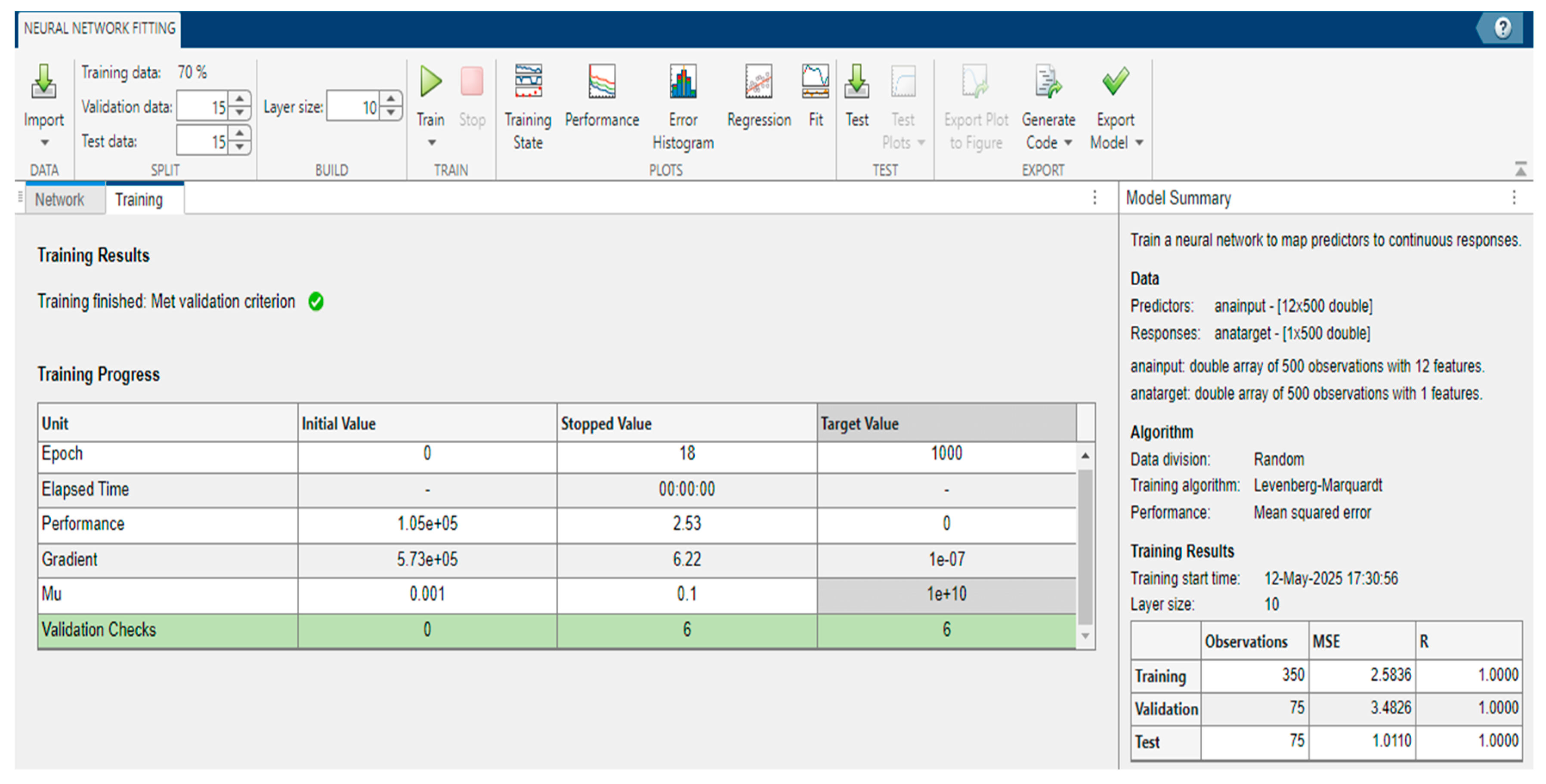
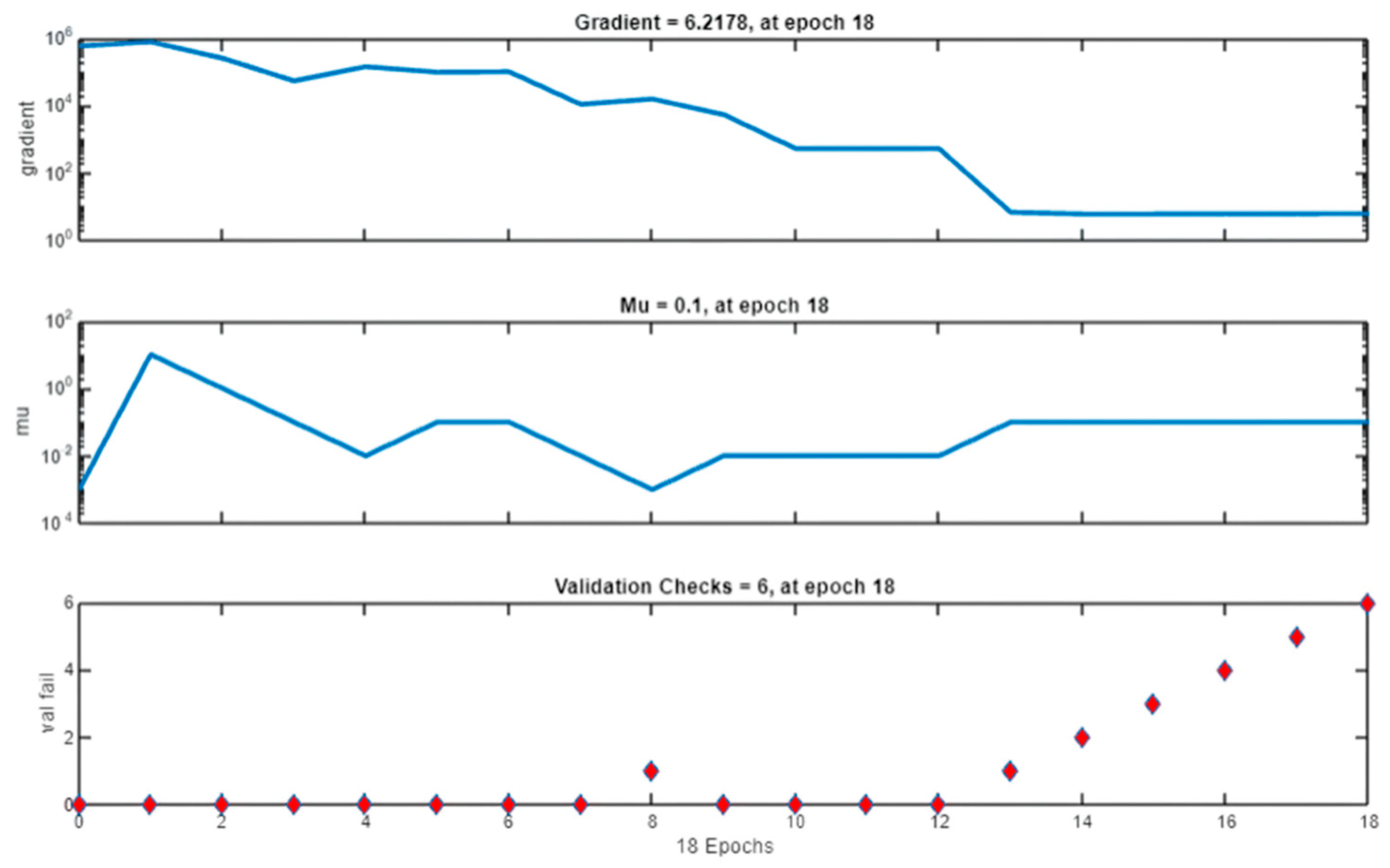
- Training set: 70% of the data, used to update the network’s weights and biases through iterative learning.
- Validation set: 15%, used to monitor the model’s performance during training and to prevent overfitting via early stopping.
- Testing set: 15%, used to assess the model’s predictive capability on unseen data and ensure its robustness.
3. Results and Discussion
3.1. Regression Analysis and Model Accuracy
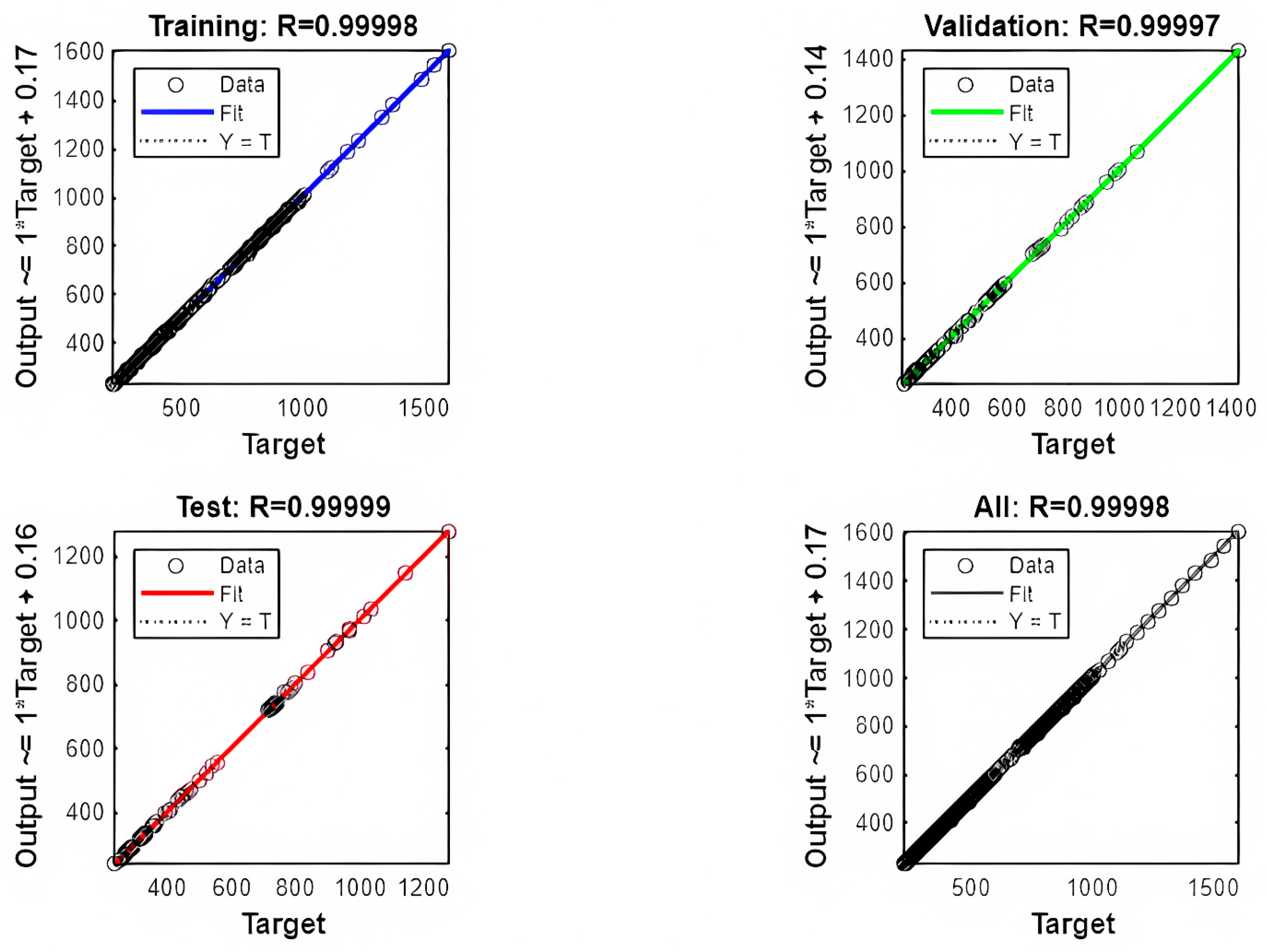
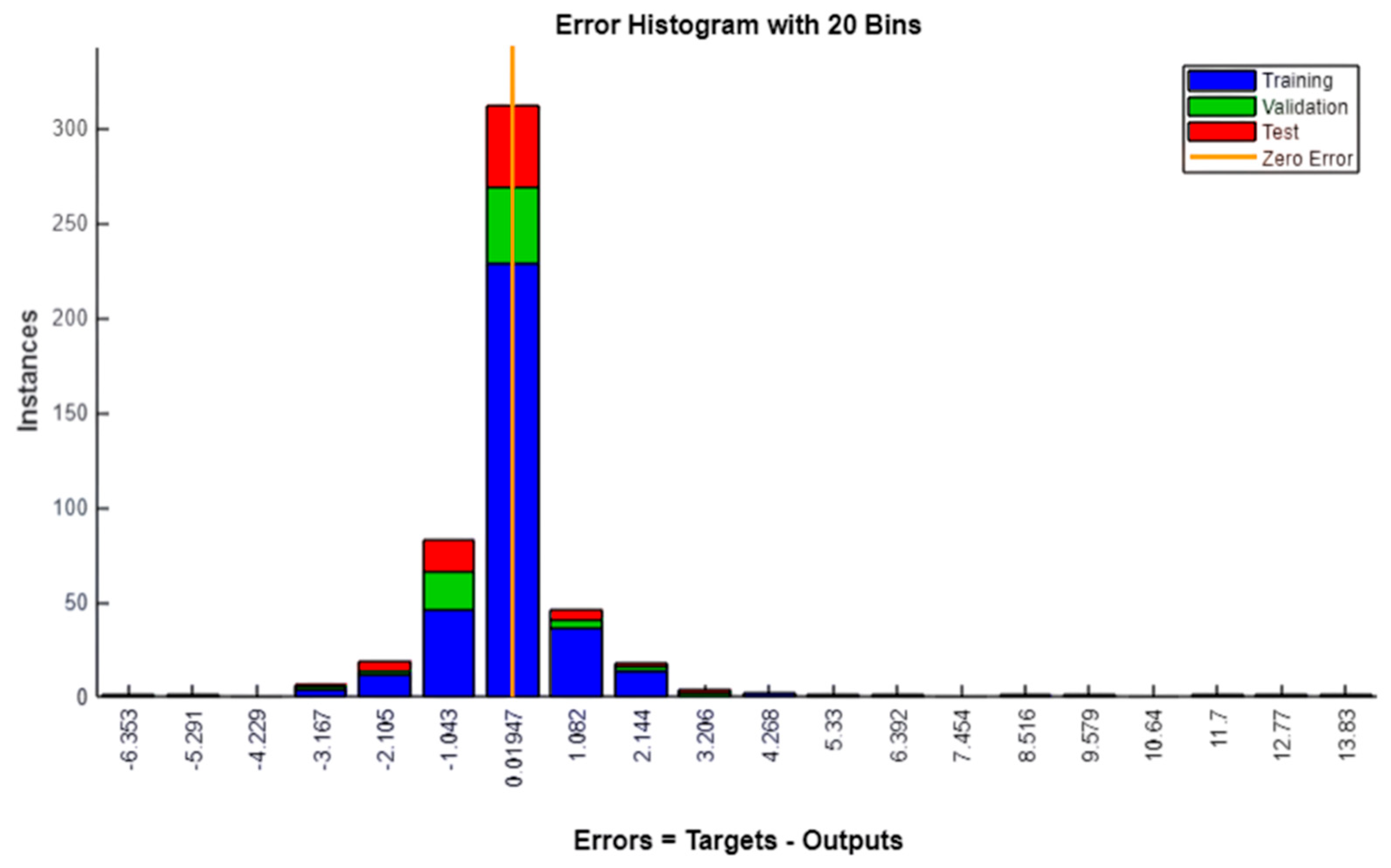
3.2. Error Distribution and Validation
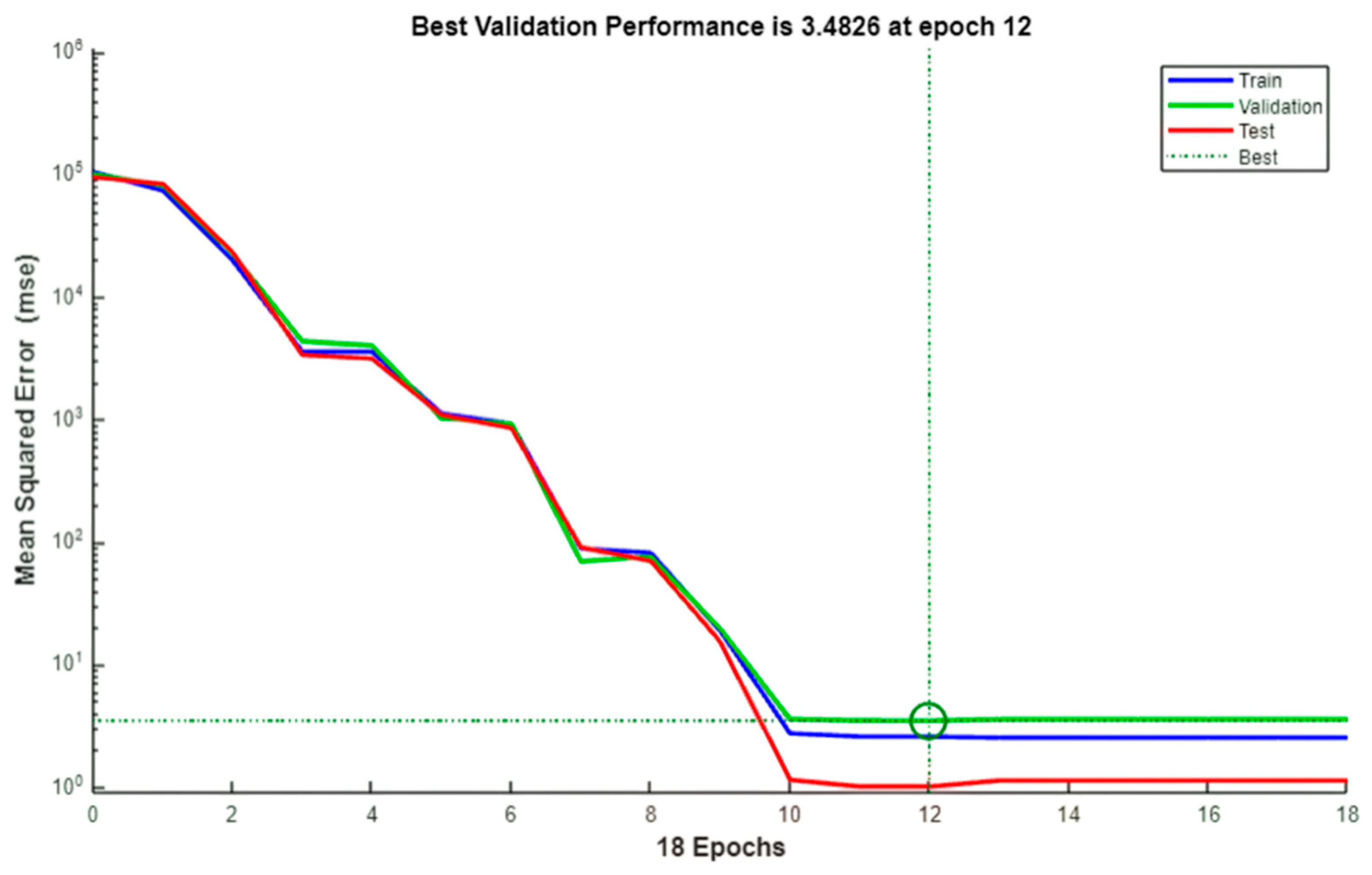
3.3. Training Dynamics
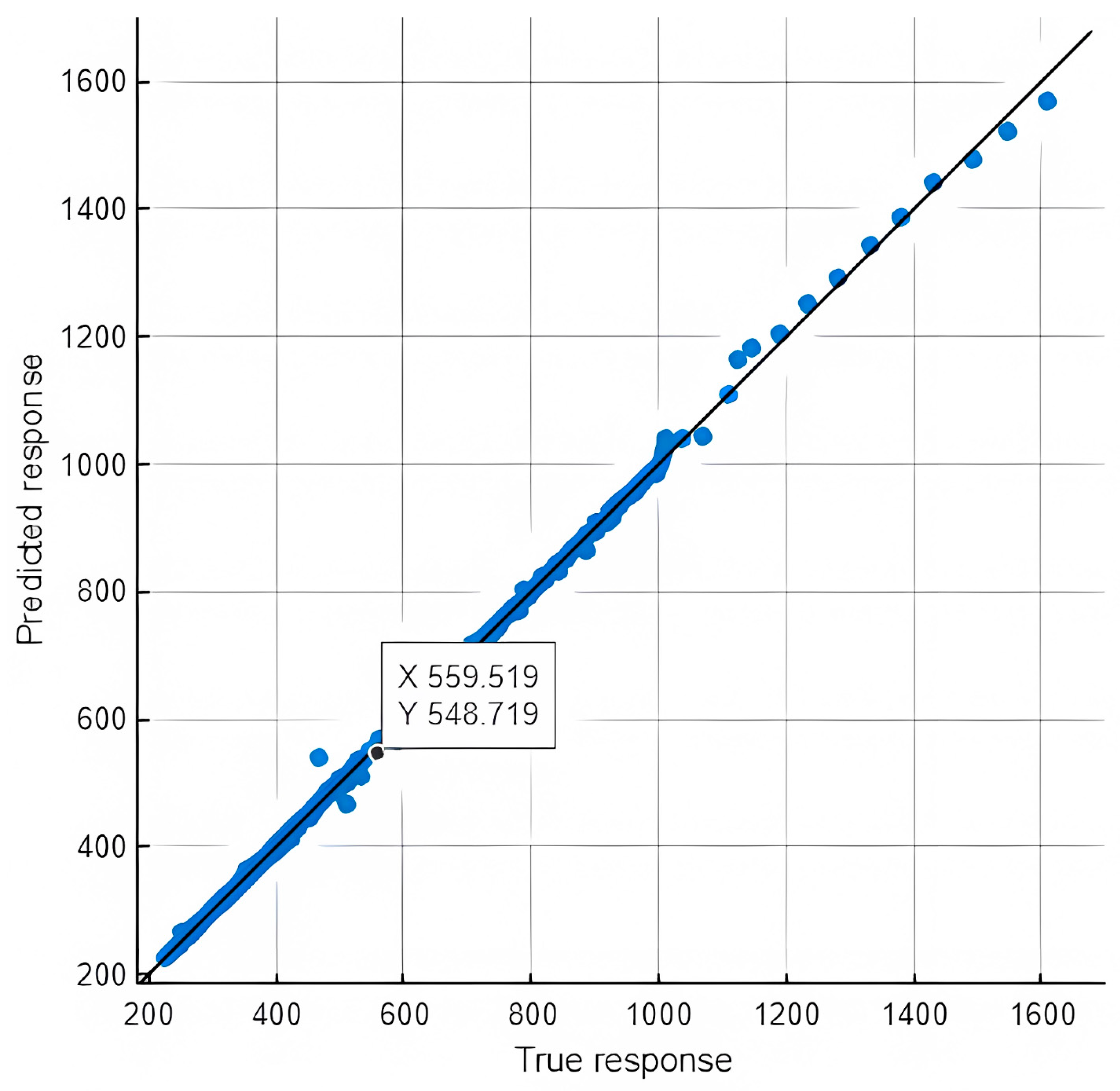
3.4. Predictive Performance on Unseen Data
3.5. Global Sensitivity Analysis via Perturbation Method
3.6. Discussion and Implications
4. Conclusions
- High Predictive Accuracy: The ANN consistently reproduced Jaya-optimized CFRP areas with errors below 11% in the worst case and below 6% in four of five scenarios, demonstrating that machine learning can supplant iterative optimization with minimal loss of precision.
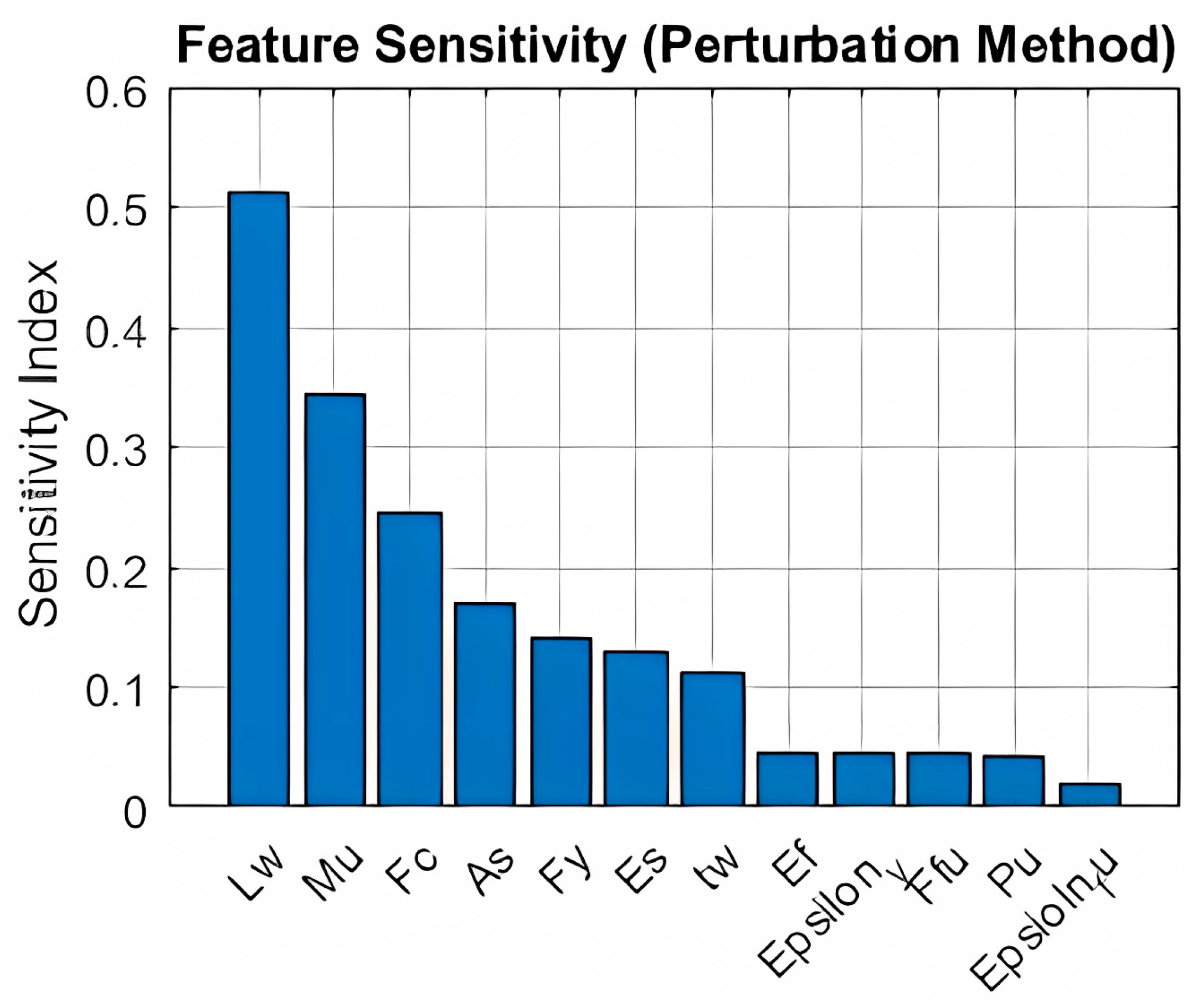
- Global Sensitivity Insights: Through a perturbation-based sensitivity analysis, wall length (Lw), moment demand (Mu), and concrete compressive strength (Fc) were identified as the most influential factors on CFRP demand. This analysis enhances the interpretability of the model and informs engineers on which parameters most critically affect retrofitting requirements.
- Parametric Sensitivity: A focused study on moment demand showed that a 15% increase in ultimate moment led to a 36% rise in required CFRP area, highlighting the model’s ability to capture nonlinear interactions and enabling rapid “what-if” analyses.
- Design Workflow Integration: Embedding the trained ANN into a streamlined design procedure transforms retrofit design from cumbersome trial-and-error into an instantaneous prediction step, where twelve readily available inputs yield a code-verified CFRP area that satisfies ACI 318 and ACI 440.2R-17 requirements.
Author Contributions
Funding
Institutional Review Board Statement
Data Availability Statement
Conflicts of Interest
References
- Kim, S.-Y.; Cho, U.; Chung, J.-H.; Bae, B.-I.; Choi, C.-S. Seismic Performance of Existing RC Structural Walls Retrofitted in Flexure by Wall End Plate. Sustainability 2021, 13, 509. [Google Scholar] [CrossRef]
- Yücel, M.; Nigdeli, S.M.; Kayabekir, A.E.; Bekdaş, G. Optimization and Artificial Neural Network Models for Reinforced Concrete Members. In Nature-Inspired Metaheuristic Algorithms for Engineering Optimization Applications; Rao, R.V., Ed.; Springer: Singapore, 2021; pp. 201–224. Available online: https://www.researchgate.net/publication/350534546_Optimization_and_Artificial_Neural_Network_Models_for_Reinforced_Concrete_Members (accessed on 10 December 2025).
- Antoniades, K.; Salonikios, T.N.; Kappos, A.J. Cyclic Tests on Seismically Damaged Reinforced Concrete Walls Strengthened Using FRP Reinforcement. ACI Struct. J. 2003, 100, 510–518. [Google Scholar]
- Vijayan, D.S.; Sivasuriyan, A.; Devarajan, P.; Stefańska, A.; Wodzyński, Ł.; Koda, E. Carbon Fibre-Reinforced Polymer (CFRP) Composites in Civil Engineering Application—A Comprehensive Review. Buildings 2023, 13, 1509. [Google Scholar] [CrossRef]
- Duan, S.-J.; Feng, R.-M.; Yuan, X.-Y.; Song, L.-T.; Tong, G.-S.; Tong, J.-Z. A Review on Research Advances and Applications of Basalt Fiber-Reinforced Polymer in the Construction Industry. Buildings 2025, 15, 181. [Google Scholar] [CrossRef]
- Yun, H.D.; Lee, S.Y.; Kang, D.H.; Choi, W. Retention strength of carbon fiber reinforced polymer rebar under elevated temperatures. Sci. Rep. 2025, 15, 17408. [Google Scholar] [CrossRef]
- Chowdhury, I.R.; Pemberton, R.; Summerscales, J. Developments and Industrial Applications of Basalt Fibre Reinforced Composite Materials. J. Compos. Sci. 2022, 6, 367. [Google Scholar] [CrossRef]
- Li, B.; Lim, C.L. Tests on Seismically Damaged Reinforced Concrete Structural Walls Repaired Using Fiber-Reinforced Polymers. J. Compos. Constr. 2010, 14, 597–608. [Google Scholar] [CrossRef]
- Wang, Z.; Wang, B.; Jiang, H.; Zhuge, P. Experimental Study on the Flexural and Shear Performance of Concrete Beams Strengthened with Prestressed CFRP Tendons. Appl. Sci. 2024, 14, 1237. [Google Scholar] [CrossRef]
- Siddika, A.; Saha, K.; Mahmud, M.S.; Roy, S.C.; Mamun, M.A.A.; Alyousef, R. Performance and Failure Analysis of Carbon Fiber-Reinforced Polymer (CFRP) Strengthened Reinforced Concrete (RC) Beams. Materials 2019, 12, 3363. [Google Scholar] [CrossRef]
- Haroon, M.; Moon, J.S.; Kim, C. Performance of Reinforced Concrete Beams Strengthened with Carbon Fiber Reinforced Polymer Strips. Materials 2021, 14, 5866. [Google Scholar] [CrossRef]
- Nguyen, Q.H.; Ly, H.B.; Nguyen, T.A.; Phan, V.H.; Nguyen, L.K.; Tran, V.Q. Investigation of ANN Architecture for Predicting Shear Strength of Fiber Reinforcement Bars Concrete Beams. PLoS ONE 2021, 16, e0247391. [Google Scholar] [CrossRef]
- ACI Committee 440. ACI 440.2R-17: Design and Construction of Externally Bonded FRP Systems for Strengthening Concrete Structures; American Concrete Institute: Farmington Hills, MI, USA, 2017; Available online: https://afzir.com/knowledge/wp-content/uploads/2018/03/ACI_440_2R_17_Guide_for_the_Design.pdf (accessed on 10 December 2025).
- ACI Committee. Building Code Requirements for Structural Concrete (ACI 318-05) and Commentary (ACI 318R-05); American Concrete Institute: Farmington Hills, MI, USA, 2005; Available online: https://old.cwd.gkp.pk/images/Aci_318-05_Building_Code_Requirements_For_Structural_Concret.pdf (accessed on 10 December 2025).
- Rahman, M.M.; Jumaat, M.Z.; Hosen, M.A. Genetic Algorithm for Material Cost Minimization of External Strengthening System with Fiber Reinforced Polymer. Adv. Mater. Res. 2012, 468–471, 1817–1822. [Google Scholar] [CrossRef]
- Rao, R.V. Jaya: A Simple and New Optimization Algorithm for Solving Constrained and Unconstrained Optimization Problems. Int. J. Ind. Eng. Comput. 2016, 7, 19–34. [Google Scholar] [CrossRef]
- Kayabekir, A.E.; Sayın, B.; Nigdeli, S.M.; Bekdaş, G. An Artificial Neural Network Model for Prediction of Optimum Amount of Carbon Fiber Reinforced Polymer for Shear Capacity Improvement of Beams. In Proceedings of the 12th International Congress on Mechanics (HSTAM2019), Thessaloniki, Greece, 22–25 September 2019; pp. 1–8. Available online: https://www.researchgate.net/publication/336047843_AN_ARTIFICIAL_NEURAL_NETWORK_MODEL_FOR_PREDICTION_OF_OPTIMUM_AMOUNT_OF_CARBON_FIBER_REINFORCED_POLYMER_FOR_SHEAR_CAPACITY_IMPROVEMENT_OF_BEAMS (accessed on 10 December 2025).
- Zhang, S.-Y.; Chen, S.-Z.; Jiang, X.; Han, W.-S. Data-Driven Prediction of FRP Strengthened Reinforced Concrete Beam Capacity Based on Interpretable Ensemble Learning Algorithms. Structures 2022, 43, 860–877. [Google Scholar] [CrossRef]
- Bekdaş, G.; Nigdeli, S.M.; Yüel, M.; Kayabekir, A.E. Artificial Intelligence Optimization Algorithms and Engineering Applications; Seçkin Publishing: Istanbul, Türkiye, 2021; pp. 67–70. Available online: https://www.seckin.com.tr/kitap/yapay-zeka-optimizasyon-algoritmalari-ve-muhendislik-uygulamalari-kavram-uygulama-kodla-ma-gebrail-bekdas-sinan-melih-nigdeli-melda-yucel-aylin-ece-kayabekir-s-p-822965274?srsltid=AfmBOooS7GzBr9KKHMmwUDTW5XrIesyfGTNERUW8ZBUR_I6DTND68Aho (accessed on 10 December 2025).
- Bekdaş, G.; Nigdeli, S.M.; Kayabekir, A.E. Metasezgisel Yöntemlerle Betonarme Yapı Elemanlarının Optimizasyonu; Istanbul University-Cerrahpaşa University Press: Istanbul, Türkiye, 2023; p. 60. Available online: https://static1.squarespace.com/static/648c55a5827aee7ae7b19c77/t/65e1d3a3181f6e1795bd0bd7/1709298598757/29.+kitap+Yeni.pdf (accessed on 10 December 2025).
- Duysak, Y.; Nigdeli, S.M.; Bekdaş, G. Optimum Design of Reinforced Concrete Beam Sections with JAYA Algorithm. Chall. J. Concr. Res. Lett. 2024, 2, 4. [Google Scholar] [CrossRef]
- Nigdeli, S.M.; Bekdaş, G. A New Modified Jaya Algorithm for Optimum Design of Tuned Mass Dampers. In Proceedings of the 14th International Conference on Evolutionary and Deterministic Methods for Design, Optimization and Control (EUROGEN-2021), Athens, Greece, 28–30 June 2021; pp. 1–10. Available online: https://www.researchgate.net/publication/354513877_A_NEW_MODIFIED_JAYA_ALGORITHM_FOR_OPTIMUM_DESIGN_OF_TUNED_MASS_DAMPERS (accessed on 10 December 2025).
- Grzywiński, M.; Dede, T.; Atmaca, B.; Aslay, S.E. Jaya Algorithm for Optimization of 2D Reinforced Concrete Frame Structure. In Proceedings of the 5th Polish Congress of Mechanics and the 25th International Conference on Computer Methods in Mechanics (PCM-CMM 2023), Gliwice, Poland, 4–7 September 2023; pp. 74–80. Available online: https://www.researchgate.net/publication/385579056_Jaya_Algorithm_for_Optimization_of_2D_Reinforced_Concrete_Frame_Structure (accessed on 10 December 2025).
- Aslay, S.E.; Dede, T. 3D Cost Optimization of 3 Story RC Constructional Building Using Jaya Algorithm. Structures 2022, 40, 803–811. [Google Scholar] [CrossRef]
- Phan, H.D.; Phan, S.V. Cost Optimization in Structural Design for Reinforced Concrete Frames Using Jaya Algorithm. J. Sci. Technol. Civ. Eng. 2024, 18, 76–91. [Google Scholar] [CrossRef]
- Çoşut, M. Optimization of Reinforced Concrete Structures and Elements as Well as Tuned Mass Dampers Using Hybrid Metaheuristic Algorithms. Master’s Thesis, Istanbul University-Cerrahpaşa Graduate School of Education, Istanbul, Türkiye, 2022. [Google Scholar]
- Eroğlu, N.; Aral, S.; Nigdeli, S.M.; Bekdaş, G. Jaya Algorithm Based Optimum Design of Reinforced Concrete Retaining Walls under Dynamic Loads. Chall. J. Struct. Mech. 2021, 7, 2. [Google Scholar] [CrossRef]
- da Silva, L.S.A.; Lúcio, Y.L.S.; Coelho, L.D.; Mariani, V.C.; Rao, R.V. A Comprehensive Review on Jaya Optimization Algorithm. Artif. Intell. Rev. 2023, 56, 4329–4361. [Google Scholar] [CrossRef]
- El-Kashif, K.F.O.; Adly, A.K.; Abdalla, H.A. Finite Element Modeling of RC Shear Walls Strengthened with CFRP Subjected to Cyclic Loading. Alex. Eng. J. 2019, 58, 189–205. [Google Scholar] [CrossRef]
- Altin, S.; Anil, Ö.; Kopraman, Y.; Kara, M.E. Hysteretic Behavior of RC Shear Walls Strengthened with CFRP Strips. Compos. Part B Eng. 2013, 44, 321–329. [Google Scholar] [CrossRef]
- Basheer, I.A.; Hajmeer, M. Artificial Neural Networks: Fundamentals, Computing, Design, and Application. J. Microbiol. Methods 2000, 43, 3–31. [Google Scholar] [CrossRef]
- McCulloch, W.S.; Pitts, W. A Logical Calculus of the Ideas Immanent in Nervous Activity. Bull. Math. Biophys. 1943, 5, 115–133. [Google Scholar] [CrossRef]
- Minsky, M.; Papert, S. Perceptrons: An Introduction to Computational Geometry; MIT Press: Cambridge, MA, USA, 1969; Available online: https://mitpress.mit.edu/9780262534772/perceptrons/ (accessed on 10 December 2025).
- Rumelhart, D.E.; Hinton, G.E.; Williams, R.J. Learning Representations by Back-Propagating Errors. Nature 1986, 323, 533–536. [Google Scholar] [CrossRef]
- LeCun, Y.; Bengio, Y.; Hinton, G. Deep Learning. Nature 2015, 521, 436–444. [Google Scholar] [CrossRef]
- Haykin, S. Neural Networks and Learning Machines, 3rd ed.; Pearson: Upper Saddle River, NJ, USA, 2009; Available online: https://dai.fmph.uniba.sk/courses/NN/haykin.neural-networks.3ed.2009.pdf (accessed on 10 December 2025).
- Goodfellow, I.; Bengio, Y.; Courville, A. Deep Learning; MIT Press: Cambridge, MA, USA, 2016; Available online: https://scholar.google.com.tr/scholar?q=Goodfellow,+I.%3B+Bengio,+Y.%3B+Courville,+A.+Deep+Learning%3B+MIT+Press:+Cambridge,+MA,+USA,+2016&hl=en&as_sdt=0&as_vis=1&oi=scholart (accessed on 10 December 2025).
- LeCun, Y.; Boser, B.; Denker, J.S.; Henderson, D.; Howard, R.E.; Hubbard, W.; Jackel, L.D. Backpropagation Applied to Handwritten Zip Code Recognition. Neural Comput. 1989, 1, 541–551. [Google Scholar] [CrossRef]
- Hochreiter, S.; Schmidhuber, J. Long Short-Term Memory. Neural Comput. 1997, 9, 1735–1780. [Google Scholar] [CrossRef]
- Hinton, G.E.; Salakhutdinov, R.R. Reducing the Dimensionality of Data with Neural Networks. Science 2006, 313, 504–507. [Google Scholar] [CrossRef]
- Silver, D.; Huang, A.; Maddison, C.J.; Guez, A.; Sifre, L.; van den Driessche, G.; Schrittwieser, J.; Antonoglou, I.; Panneershelvam, V.; Lanctot, M.; et al. Mastering the Game of Go with Deep Neural Networks and Tree Search. Nature 2016, 529, 484–489. [Google Scholar] [CrossRef]
- Srivastava, N.; Hinton, G.; Krizhevsky, A.; Sutskever, I.; Salakhutdinov, R. Dropout: A Simple Way to Prevent Neural Networks from Overfitting. J. Mach. Learn. Res. 2014, 15, 1929–1958. [Google Scholar]
- Krizhevsky, A.; Sutskever, I.; Hinton, G.E. ImageNet Classification with Deep Convolutional Neural Networks. Adv. Neural Inf. Process. Syst. 2012, 25, 1097–1105. [Google Scholar] [CrossRef]
- Vaswani, A.; Shazeer, N.; Parmar, N.; Uszoreit, J.; Jones, L.; Gomez, A.N.; Kaiser, Ł.; Polosukhin, I. Attention Is All You Need. Adv. Neural Inf. Process. Syst. 2017, 30, 5998–6008. [Google Scholar]
- Gulshan, V.; Peng, L.; Coram, M.; Stumpe, M.C.; Wu, D.; Narayanaswamy, A.; Venugopalan, S.; Widner, K.; Madams, T.; Cuadros, J.; et al. Development and Validation of a Deep Learning Algorithm for Detection of Diabetic Retinopathy in Retinal Fundus Photographs. JAMA 2016, 316, 2402–2410. [Google Scholar] [CrossRef]
- Bojarski, M.; Del Testa, D.; Dworakowski, D.; Firner, B.; Flepp, B.; Goyal, P.; Jackel, L.D.; Monfort, M.; Muller, U.; Zhang, J.; et al. End to End Learning for Self-Driving Cars. arXiv 2016, arXiv:1604.07316. [Google Scholar] [CrossRef]
- West, D. Neural Network Credit Scoring Models. Comput. Oper. Res. 2000, 27, 1131–1152. [Google Scholar] [CrossRef]
- Hakim, S.J.S.; Noorzaei, J.; Jaafar, M.S.; Jameel, M.; Mohammadhassani, M. Application of Artificial Neural Networks to Predict Compressive Strength of High Strength Concrete. Int. J. Phys. Sci. 2011, 6, 975–981. [Google Scholar]
- Rudin, C. Stop Explaining Black Box Machine Learning Models for High Stakes Decisions and Use Interpretable Models Instead. Nat. Mach. Intell. 2019, 1, 206–215. [Google Scholar] [CrossRef]
- Buolamwini, J.; Gebru, T. Gender Shades: Intersectional Accuracy Disparities in Commercial Gender Classification. In Proceedings of the Conference on Fairness, Accountability and Transparency, New York, NY, USA, 23–24 February 2018; pp. 77–91. Available online: https://proceedings.mlr.press/v81/buolamwini18a/buolamwini18a.pdf (accessed on 10 December 2025).
- Mead, C. Neuromorphic Electronic Systems. Proc. IEEE 1990, 78, 1629–1636. [Google Scholar] [CrossRef]
- Biamonte, J.; Wittek, P.; Pancotti, N.; Rebentrost, P.; Wiebe, N.; Lloyd, S. Quantum Machine Learning. Nature 2017, 549, 195–202. [Google Scholar] [CrossRef]
- Haykin, S. Neural Networks: A Comprehensive Foundation, 2nd ed.; Prentice-Hall: Englewood Cliffs, NJ, USA, 1999; Available online: https://www.scirp.org/reference/referencespapers?referenceid=1863429 (accessed on 10 December 2025).
- Wahidna, A.; Sookia, N.; Ramgolam, Y.K. Performance Evaluation of Artificial Neural Network and Hybrid Artificial Neural Network-Based Genetic Algorithm Models for Global Horizontal Irradiance Forecasting. Sol. Energy Adv. 2024, 4, 100054. [Google Scholar] [CrossRef]



| Ref. | Structural Element Type | FRP Configuration | Modeling/Approach | Optimization/AI Algorithm | Performance Metric | Key Contribution |
|---|---|---|---|---|---|---|
| Wang et al. (2024) [9] | RC beams (simply supported, continuous) | Prestressed CFRP tendons (straight and flexural layouts) | Experimental testing | – | % increase in flexural and shear capacity | Quantified flexural and shear gains with different prestressing levels and layouts |
| Siddika et al. (2019) [10] | RC beams | Full-length U-wrap, strip U-wrap, soffit strips | Experimental testing | – | % increase in ultimate load | Compared CFRP layouts for flexural vs. shear enhancement |
| Haroon et al. (2021) [11] | RC beams | CFRP strips in shear spans (unidirectional, bidirectional) | Experimental testing | – | Shear strength increase, stirrup strain uniformity | Demonstrated improved shear behavior and strain distribution |
| Nguyen et al. (2021) [12] | RC beams | Flexural and shear FRP | ANN prediction model | ANN (multiple architectures) | R2, sensitivity analysis | Predicted shear strength with high accuracy from experimental database |
| Rahman et al. (2012) [15] | RC beams | Externally bonded CFRP plates | Analytical design + GA optimization | Genetic Algorithm | Minimized CFRP cost | Optimized CFRP layout under TR55 constraints |
| Kayabekir et al. (2019) [17] | RC beams | CFRP for shear strengthening | ANN trained on metaheuristic-optimized data | ANN | Prediction accuracy | Predicted optimal CFRP ratios/orientations from training data |
| Zhang et al. (2022) [18] | RC beams | FRP strengthening (flexural) | Ensemble learning model | Gradient boosting, etc. | R2, feature importance | Interpretable AI model predicting flexural capacity |
| Present study | RC cantilever shear walls | CFRP for flexural strengthening | ANN surrogate trained on optimization results | Jaya + ANN | Minimized CFRP area, prediction error (%) | Hybrid optimization–AI framework for rapid, code-compliant retrofit design |
| Parameter | Symbol | Range |
|---|---|---|
| Wall length | Lw | 1100–1600 mm |
| Wall thickness | tw | 100–220 mm |
| Axial load | Pu | 36–75 kN |
| Concrete compressive strength | fc | 16–30 MPa |
| Steel yield strength | fy | 255–400 MPa |
| Reinforcement yield strain | εy | 0.001–0.0019 |
| Reinforcement area | As | 450–940 mm2 |
| Modulus of elasticity of steel | Es | 185,000–234,000 MPa |
| Modulus of elasticity of CFRP | Ef | 65,100–70,000 MPa |
| CFRP ultimate tensile strength | ffu | 805–1050 MPa |
| CFRP ultimate strain | εfu | 0.0106–0.0125 |
| Ultimate moment demand | Mu | 301,000–409,000 N·mm |
| def generate_data(): data = [] for thickness in range(1100, 1610, 10): data.append([thickness, 150, 53.4, 17.23, 275.8, 0.0014, 500, 200000, 66200, 917, 0.0114, 348000]) for length in range(100, 225, 5): data.append([1500, length, 53.4, 17.23, 275.8, 0.0014, 500, 200000, 66200, 917, 0.0114, 348000]) for load in range(36, 76): data.append([1250, 150, load, 17.23, 275.8, 0.0014, 500, 200000, 66200, 917, 0.0114, 348000]) for strength in range(16, 31): data.append([1250, 140, 50, strength, 275, 0.0014, 500, 200000, 66200, 917, 0.0114, 348000]) for yield_str in range(255, 405, 5): data.append([1500, 140, 50, 20, yield_str, 0.0014, 500, 200000, 66200, 917, 0.0114, 348000]) for i in range(10): strain = round(0.001 + i * 0.0001, 4) data.append([1500, 140, 50, 20, 300, strain, 500, 200000, 66200, 917, 0.0114, 348000]) for area in range(450, 950, 10): data.append([1300, 130, 55, 18, 300, 0.0014, area, 200000, 66200, 917, 0.0114, 348000]) for modulus in range(185000, 235000, 1000): data.append([1200, 120, 45, 22, 325, 0.0014, 550, modulus, 66200, 917, 0.0114, 348000]) for modulus in range(65100, 70100, 100): data.append([1400, 125, 60, 23, 340, 0.0014, 525, 200000, modulus, 917, 0.0114, 348000]) for strength in range(805, 1051, 5): data.append([1450, 155, 55, 19, 340, 0.0014, 490, 190000, 68000, strength, 0.0114, 348000]) for i in range(20): strain = round(0.0106 + i * 0.0001, 4) data.append([1500, 150, 55, 20, 350, 0.0014, 500, 190000, 69000, 900, strain, 348000]) for moment in range(301000, 410000, 1000): data.append([1600, 145, 50, 18, 270, 0.0014, 520, 195000, 70000, 950, 0.0114, moment]) return data generate_data() |
| Data | Optimal Value | |||||||||||
|---|---|---|---|---|---|---|---|---|---|---|---|---|
| Lw | tw | Pu | Fc | Fy | εy | As | Es | Ef | Ffu | εfu | Mu | Af |
| 1600 | 150 | 50 | 18 | 275 | 0.0014 | 500 | 200,000 | 66,900 | 850 | 0.0118 | 400,000 | 558.83 |
| 1500 | 145 | 45 | 17.4 | 275 | 0.0014 | 520 | 195,000 | 69,300 | 1005 | 0.0114 | 380,000 | 630.67 |
| 1550 | 160 | 51 | 16.5 | 280 | 0.0013 | 550 | 198,000 | 69,500 | 830 | 0.0123 | 350,000 | 393.62 |
| 1400 | 150 | 44 | 25 | 310 | 0.0014 | 512 | 200,000 | 69,923 | 887 | 0.0125 | 405,000 | 538.38 |
| 1350 | 140 | 56.6 | 17.7 | 300 | 0.0013 | 570 | 199,000 | 68,729 | 919 | 0.0114 | 330,000 | 461.86 |
| Observations | MSE | R | |
|---|---|---|---|
| Training Set | 350 | 2.5836 | 0.9999 |
| Validation Set | 75 | 3.4826 | 0.9999 |
| Test Set | 75 | 1.0110 | 0.9999 |
| Validation Set (10-fold CV) | 500 * | 41.104 ** | 0.9996 ** |
| Case | Optimum Results | ANN Predictions | Percent Error (%) | |
|---|---|---|---|---|
| Af (mm2) | Case 1 | 558.83 | 615.33 | 10.11 |
| Case 2 | 630.67 | 639.03 | 1.33 | |
| Case 3 | 393.62 | 391.42 | 0.56 | |
| Case 4 | 538.38 | 570.43 | 5.95 | |
| Case 5 | 461.86 | 464.13 | 0.49 | |
| Average Percent Error: 3.69% | ||||
Disclaimer/Publisher’s Note: The statements, opinions and data contained in all publications are solely those of the individual author(s) and contributor(s) and not of MDPI and/or the editor(s). MDPI and/or the editor(s) disclaim responsibility for any injury to people or property resulting from any ideas, methods, instructions or products referred to in the content. |
© 2025 by the authors. Licensee MDPI, Basel, Switzerland. This article is an open access article distributed under the terms and conditions of the Creative Commons Attribution (CC BY) license (https://creativecommons.org/licenses/by/4.0/).
Share and Cite
Bekdaş, G.; Khalbous, A.; Nigdeli, S.M.; Işıkdağ, Ü. Optimum Carbon Fiber Reinforced Polymer (CFRP) Design for Flexural Strengthening of Cantilever Concrete Walls Using Artificial Neural Networks. Polymers 2025, 17, 3300. https://doi.org/10.3390/polym17243300
Bekdaş G, Khalbous A, Nigdeli SM, Işıkdağ Ü. Optimum Carbon Fiber Reinforced Polymer (CFRP) Design for Flexural Strengthening of Cantilever Concrete Walls Using Artificial Neural Networks. Polymers. 2025; 17(24):3300. https://doi.org/10.3390/polym17243300
Chicago/Turabian StyleBekdaş, Gebrail, Ammar Khalbous, Sinan Melih Nigdeli, and Ümit Işıkdağ. 2025. "Optimum Carbon Fiber Reinforced Polymer (CFRP) Design for Flexural Strengthening of Cantilever Concrete Walls Using Artificial Neural Networks" Polymers 17, no. 24: 3300. https://doi.org/10.3390/polym17243300
APA StyleBekdaş, G., Khalbous, A., Nigdeli, S. M., & Işıkdağ, Ü. (2025). Optimum Carbon Fiber Reinforced Polymer (CFRP) Design for Flexural Strengthening of Cantilever Concrete Walls Using Artificial Neural Networks. Polymers, 17(24), 3300. https://doi.org/10.3390/polym17243300