


Abstract
Magnesium phosphate cement (MPC) has gained attention in specialized construction applications due to its rapid setting and high early strength, though its inherent brittleness limits structural performance. This study developed an innovative toughening strategy through synergistic reinforcement using hybrid fibers and carbon fiber-reinforced polymer (CFRP) fabric capable of multi-scale crack control. The experimental program systematically evaluated the hybrid fiber system, dosage, and CFRP positioning effects through mechanical testing of 7-day cured specimens. The results indicated that 3.5% fiber dosage optimized flexural–compressive balance (45% flexural gain with <20% compressive reduction), while CFRP integration at 19 mm displacement enhanced flexural capacity via multi-scale reinforcement. Fracture analysis revealed that the combined system increases post-cracking strength by 60% through coordinated crack bridging at micro (fiber) and macro (CFRP) scales. These findings elucidated the mechanisms by which fiber–CFRP interaction mitigates MPC’s brittleness through hierarchical crack control while maintaining its rapid hardening advantages. The study established quantitative design guidelines, showing the fiber composition of CF/WSF/CPS15 = 1/1/1 with 19 mm CFRP placement achieves optimal toughness–flexural balance (ff/fc > 0.38). The developed composite system reduced brittleness through effective crack suppression across scales, confirming its capability to transform fracture behavior from brittle to quasi-ductile. This work advances MPC’s engineering applicability by resolving its mechanical limitations through rationally designed composite systems, with particular relevance to rapid repair scenarios requiring both early strength and damage tolerance, expanding its potential in specialized construction where conventional cement proves inadequate.
1. Introduction
Magnesium phosphate cement (MPC) is a chemically bonded ceramic material characterized by rapid setting and high early strength [1]. The typical MPC system comprises magnesium oxide (MgO) as the base component, an acidic phosphate solution (e.g., NH4H2PO4 or KH2PO4) as the reactant, and borax as a retarder [2]. The chemical interaction between these constituents results in the formation of crystalline magnesium phosphate phases, primarily struvite or k-struvite, endowing the final product with significant sustainability advantages, including CO2 sequestration, utilization of industrial wastes in production, and applications in hazardous waste stabilization and rapid low-energy repairs [3,4,5,6,7]. Given the growing emphasis on sustainable construction, MPC has emerged as a versatile candidate with applications spanning structural rehabilitation, biomedical engineering implementations, and hazardous waste containment systems.
Despite the above merits, MPC exhibits inherent limitations in flexural performance, characterized by higher brittleness and lower toughness compared to conventional cement-based materials [8,9,10]. The pronounced mechanical vulnerability of MPC stems from its crystalline-dominated microstructure, where rapid formation of dense struvite crystals (MgNH4PO4·6H2O) creates preferential cleavage planes with minimal crack deflection capacity [11], unlike Portland cement’s amorphous phases and fiber-like hydration products, such as calcium silicate hydrate (C-S-H) gels, which contribute to energy dissipation and crack bridging in cementitious systems [12,13,14]. Given this inherent brittleness, research efforts have focused on fiber reinforcement strategies to reconcile MPC’s high compressive strength with enhanced flexural toughness required for structural applications [11,14,15,16,17]. Fiber reinforcements such as steel fiber, polyvinyl alcohol (PVA) fiber, polypropylene (PP) fiber, basalt fiber, etc., were incorporated into MPC matrices to enhance ductility [5]. The underlying toughening mechanism involves both physical and chemical interactions: at the microscale, fibers bridge microcracks through interfacial bonding with the crystalline struvite matrix, thereby delaying crack coalescence and growth [18,19,20]. It is confirmed by Dong et al. that aligned fibers exert closure stress across crack planes through frictional pull-out, inhibiting crack widening while dissipating fracture energy [21]. At the nanoscale, chemical bonding between fiber surfaces and MPC matrices has been demonstrated through phosphate-mediated interactions (e.g., P-O-Mg bonds) [22]. This dual-scale synergy transforms brittle fracture into a multi-stage failure process: Initial microcracking activates fiber bridging, followed by debonding and fiber pull-out, which collectively enhance energy absorption by up to 400% [23]. Consequently, the resulting fiber-reinforced MPC composites demonstrate improved energy absorption capacity and overall toughness while maintaining the original advantages of rapid setting and high early strength [24,25].
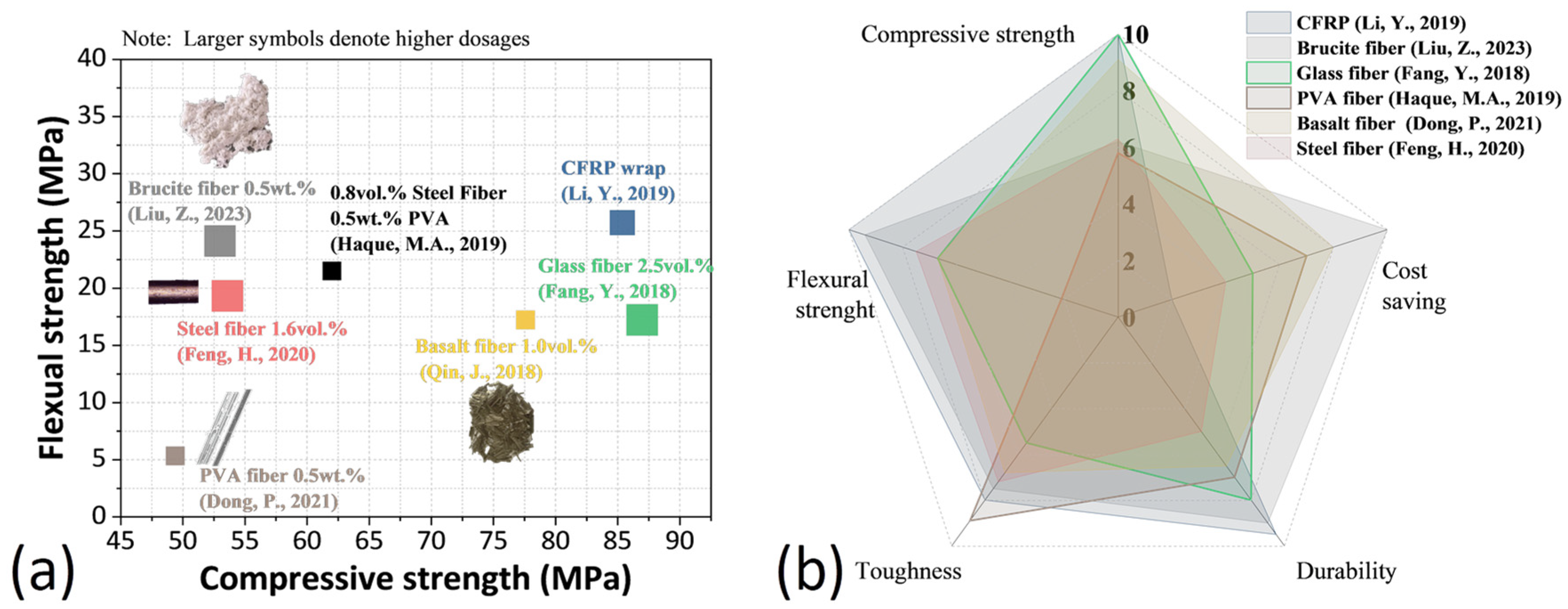
Figure 1 summarizes the comparison results of the effects of different fiber types and CFRP on MPC performance. Haque et al. reported that the inclusion of steel fiber, PVA fiber, and basalt fiber with dosages ranging from 0.6% to 1.2% increased the flexural strength of MPC by over 15%, though with slight compressive strength reduction [26]. E-glass and polyester fibers, which can be destroyed by cement reaction corrosion, were also found to be compatible with MPC [27]. With the investigation of the interface transition zone (ITZ) between MPC and steel fiber, Feng et al. found that the bonding performance between steel fiber and MPC was better than that between steel fiber and sulphoaluminate or ordinary Portland cement [28]. Due to the excellent bonding performance, Zhu et al. [29] and Feng et al. [30] found that steel fibers can increase the flexural strength and toughness of MPC concrete and mortar with unchanged or slightly improved compressive strength. Fang et al. [24] and Tassew and Lubell [31] found a pronounced effect of glass fiber on increasing the flexural strength of MPC mortar and concrete, but had little influence on their compressive strengths and moduli of elasticity. Qin et al. [14] noticed better MPC reinforcement by basalt fiber over glass fiber, and the flexural strength and fracture toughness of basalt fiber-reinforced MPC increased with the fiber dosage. However, these fibers may not be suitable for the long-term service of MPC owing to the proneness of steel fibers to corrosive degradation and the inferior alkaline durability of glass and basalt fibers [11]. By contrast, organic compound fibers, such as PVA fiber, were relatively stable in alkali or corrosive media [14], making them an excellent choice for environments where corrosion of steel reinforcement could be a concern, such as marine applications. Dong et al. [25] found that PVA fibers with a dosage of up to 0.75% significantly improved fracture toughness and ductility performance and increased the porosity of the reinforced MPC mortar. The poor interfacial bonding between organic fibers and cementitious materials is still an issue for fiber-reinforced MPC products [11]. Therefore, to achieve the MPC-based composite with high strength and ductility, adding different types of fibers into the MPC mixture was applied, as using hybrid fibers to reinforce cementitious materials is beneficial for compensating for the shortcomings of single fiber additions [32].
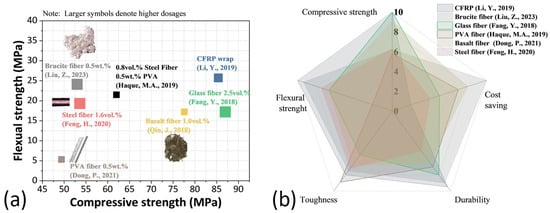
Figure 1.
Comparison of the effects of different fiber types and CFRP on MPC performance, summarized from [5,11,14,24,25,28,33]: (a) Correlation between compressive strength and flexural strength; (b) Normalized results evaluated against five key parameters (note: durability and cost savings were explicitly mentioned or derivable in the cited studies).
While fiber reinforcement effectively addresses MPC’s brittleness limitations, advanced composite materials offer additional enhancement pathways. Carbon fiber reinforced polymer (CFRP) is a lightweight, strong material that can reinforce concrete columns through MPC bonding. Previous research shows that using CFRP-MPC composites can strengthen reinforced concrete construction [33]. According to Li et al. [33], with the MPC-bonded CFRP composites, the compressive strength of the concrete column was increased by 85.39%. Ding et al. [34] and Li et al. [35] found excellent interface bonding performances of the MPC with various CFRPs. These advantages make CFRP a suitable material for enhancing MPC materials.
Building upon the established benefits of both fiber reinforcement and CFRP-MPC systems, an emerging opportunity lies in the synergistic combination of hybrid fibers with CFRP fabrics to optimize the mechanical performance of MPC. While existing studies have demonstrated the effectiveness of CFRP in enhancing compressive strength [27] and excellent interfacial bonding with MPC [34,35], the potential of integrating these two reinforcement approaches remains largely unexplored. This integration adheres to the fundamental principle of hybrid reinforcement in cementitious composites, wherein distinct reinforcement mechanisms operate synergistically to achieve performance characteristics beyond the capabilities of individual reinforcement systems [33]. Therefore, the complementary interaction of these systems establishes a hierarchical reinforcement architecture capable of mitigating the inherent limitations of each method when applied in isolation.
The primary objective of this study is to investigate the synergistic toughening effects of hybrid fiber and CFRP fabric reinforcement in MPC composites, with a comprehensive evaluation of their combined influence on mechanical performance and durability characteristics. This study systematically investigated the effects of fiber type and CFRP fabric placement configuration on the mechanical properties of MPC mortar, with a particular focus on compressive strength and flexural performance. The optimal design was obtained by achieving the maximum flexural to compressive strength value. Given the primary research objective of toughness enhancement, a comprehensive analysis of flexural force-deflection responses was conducted to quantify key performance indicators, including toughness indices, energy absorption capacity, etc., providing fundamental insights into the synergistic reinforcement mechanisms of the hybrid fiber–CFRP system in MPC mortar. This study holds significant potential to advance sustainable construction materials by synergistically combining the rapid-setting and eco-friendly attributes of MPC with the mechanical reinforcement and durability enhancements provided by hybrid fibers and CFRP fabric. The resulting composite system offers a promising solution for developing resilient, sustainable, and cost-effective infrastructure materials capable of meeting modern engineering demands while reducing environmental impact.
2. Materials and Methods
2.1. Materials
The raw materials used for MPC production consisted of dead-burned magnesia (DBM: MgO, 98% purity), mono-potassium phosphate (MPP: KH2PO4, 98% purity), borax (BR: Na2B4O7·10H2O, industrial grade), quartz sand (QS), and tap water (W). The DBM was purchased as fine powders with an average particle diameter of 45 μm. Before mixing the raw materials, MPP and BR were milled using a high-speed pulverize and sieved through a 1 mm sieve to enhance their reactivity during the subsequent mixing process.
Different fiber types, along with carbon fiber-reinforced polymer (CFRP) fabric, were used to create a hybrid reinforcement system for the prepared MPC.
Table 1 presents the dimensions and colors of the fibers used. The glass fiber powder (GFP) was produced by milling the glass fiber (GF), and the maximum particle size of the GFP was 150 μm.

Table 1.
Physical characteristics of fibers used for producing specimens.
2.2. Experimental Design and Sample Preparation
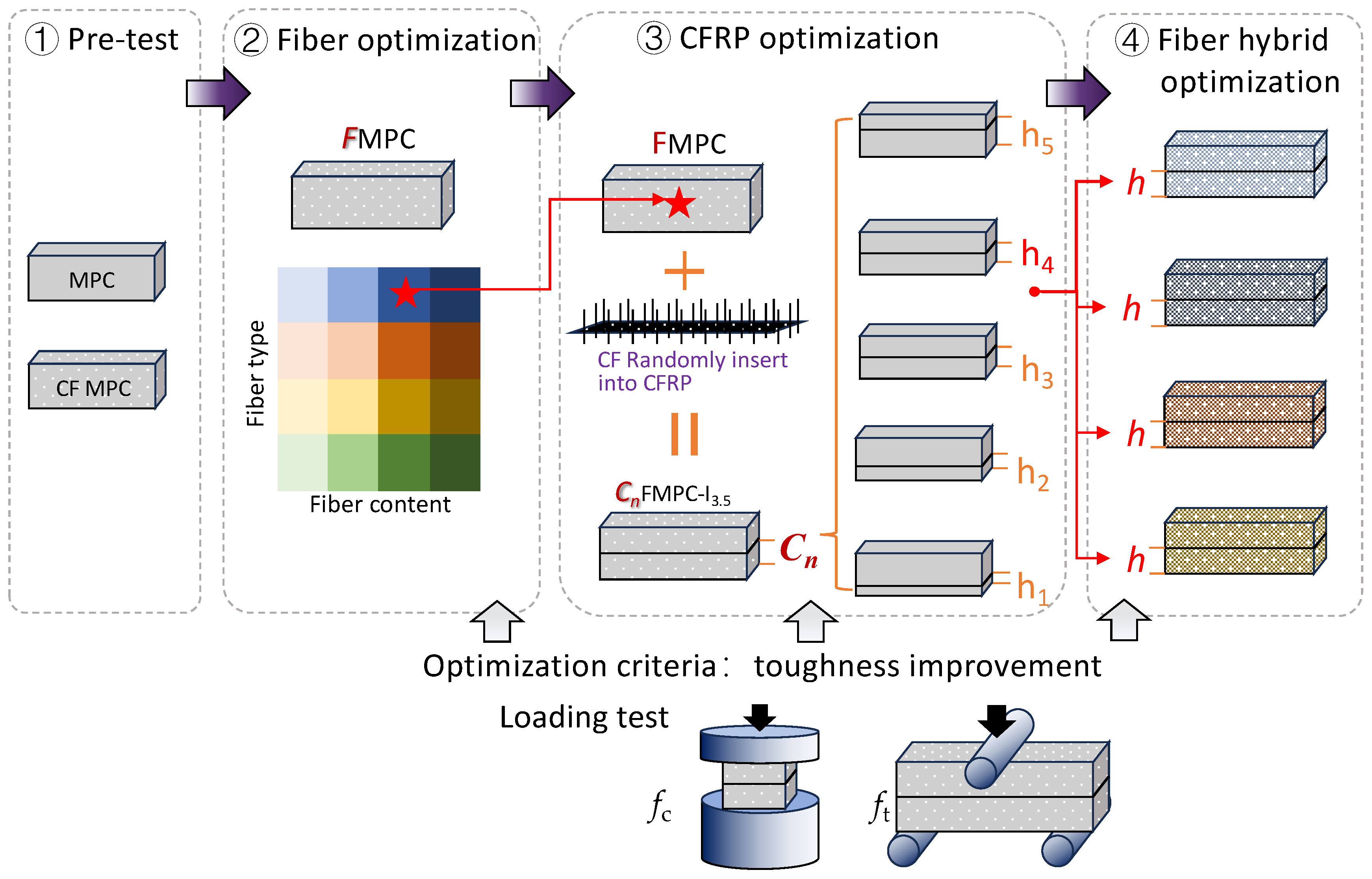
A schematic diagram shown in Figure 2 presents the overall experimental design of this study. The whole investigation is divided into five steps, including pre-tests, optimal fiber MPC selection, CFRP addition, optimal CFRP location determination for toughness improvement, and verification of the cooperative toughness-improving effect of other fibers and CFRP. Among the above steps, compressive and flexural loading test results were used to evaluate the toughness-improving ability of different mix designs. The details of these loading tests and the calculation of relevant parameters are described in Section 2.3 and Section 2.4.
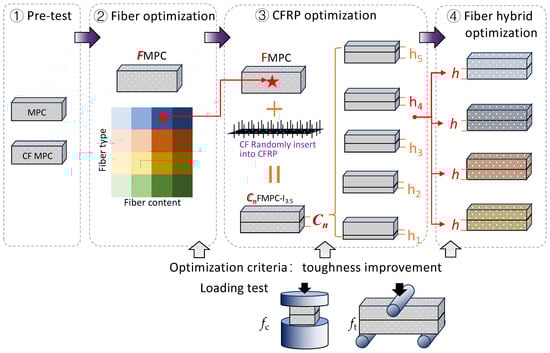
Figure 2.
Schematic diagram of experimental procedures: the optimal design was obtained by the ff/fc and toughness index via compressive and flexural loading tests.
The experimental procedures is schematically illustrated in Figure 2. In the pre-tests (Figure 2①), the mix design for MPC (Table 2) was optimized and the reinforcing effect of CF incorporation was verified. To enhance the toughening effect of MPC, hybrid fiber systems were developed by incorporating supplementary fibers with CF, resulting in a series of fiber-reinforced MPC composites. In the second experimental phase (Figure 2②), systematic compression and flexural testing were conducted on specimens incorporating varying fiber types and contents to identify the optimal fiber reinforcement configuration for MPC composites. After that, the CFRP fabric with CF fibers randomly inserted (Figure 2③) was added to the optimal fiber-reinforced specimen during the molding period. It is noted that about 1/3 length of the CF was inserted into the CFRP fabric to form a cactus-like surface before the mixing. The CFRP fabrics were strategically positioned at predetermined vertical locations within the specimen geometry, with their elevations precisely corresponding to the interface of the initially cast cementitious matrix layer. The CFRP fabric was placed on top of the first layer of the pouring paste after vibration, and the remaining pastes were poured onto the CFRP fabric until the mold was filled. To account for potential CFRP flotation during placement, a positional tolerance of ±1 mm was permitted. After determining the optimal CFRP place with the loading tests, this assembly and molding method was subsequently applied to other fiber MPC designs to verify the efficacy of this cooperative toughness-improving effect.
Table 2.
Mixed designs for fiber MPC specimens.
Table 2 lists the mixed designs of all the specimens used in this study. The specimens were prepared with the dimensions of 40 mm × 40 mm × 40 mm for compressive strength (fc) tests and 40 mm × 40 mm × 160 mm for flexural strength (ff) tests. Following casting, the specimens were subjected to 2 min of vibration for compaction, then cured under controlled conditions at 20 ± 2 °C and 60 ± 5% relative humidity. The specimen labeling system follows this convention: CnFMPC-Tm, where
| MPC: | Magnesium phosphate cement. |
| F: | Fibers. |
| Cn: | CFRP fabric placed at n mm (9, 13, 16, and 19; CFRP placed in Table 2). |
| Tm: | Fiber type designation (I, II, III, and V1-V5, Fiber type in Table 2). |
| m: | Fiber content in weight percentage (m = 1.5, 2.5, 3.5, and 5, Fiber column in Table 2). |
2.3. Mechanical Property Tests
Considering that MPC attains ca. 90% of its 28-day compressive strength within 7 days of curing, all mechanical characterization in this study was performed on specimens cured for 7 days. The compressive and flexural strength tests were performed according to the procedure recommended by the Chinese National Standard GB/T 17671-2021 [36] using a universal testing machine (Shenzhen Enpuda Industrial System Co., Ltd., Shenzhen, China). Cubic specimens with dimensions of 40 mm × 40 mm × 40 mm were subjected to uniaxial compression testing at a controlled loading rate of 2.4 kN/s. The compressive strength (fc) was determined following Equation (1). Flexural strength (ff) evaluation was performed using a three-point bending configuration (Figure 2) on beam specimens, with displacement control at 0.5 mm/min, and the resulting values were calculated using Equation (2).
where Fmax is the maximum load at failure, N; A the area under compression, mm2; P is the ultimate load at failure, N; L is the span between the two bottom supports Figure 2②), equal to 100 mm in this study; b is the width of the beam specimens, mm; d is the height of the beam specimens, mm.
The coefficient of variation (COV) of three parallel tests was computed to evaluate the dispersion of the strength results obtained. The COV values were obtained according to Equation (3) below.
The change rate (R) of the mechanical properties due to the fiber and fabric reinforcement was obtained by Equation (4).
2.4. Parameters of Flexural Properties
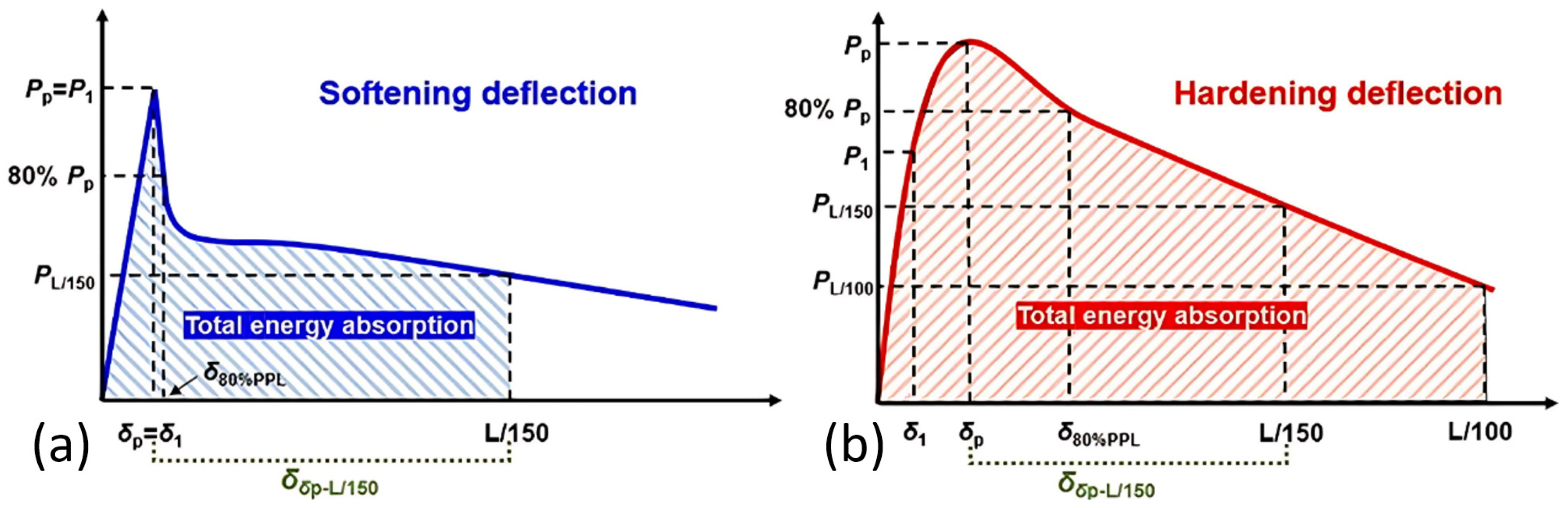
Figure 3 shows typical load-deflection (L-D) curves of fiber-reinforced cementitious materials, which can be classified as softening behavior and hardening behavior. Basic flexural parameters are illustrated in Figure 3, with the corresponding names and definitions listed in Table 3. The first peak load (P1) is considered the load causing the first cracking in a sample, with the load increasing linearly with deflection to reach this peak. In softening deflection curves, the first peak load (P1) equals the peak load (Pp) (Figure 3a), while in hardening deflection curves, the peak load (Pp) is greater than the first peak load (P1) (Figure 3b). In addition to the basic flexural parameters, samples’ properties, such as post-peak behavior, toughness, energy absorption (EA), and stiffness, can also be obtained by calculating with the information extracted from the L-D curves. More details regarding the calculation of these flexural properties are described in Table 3.
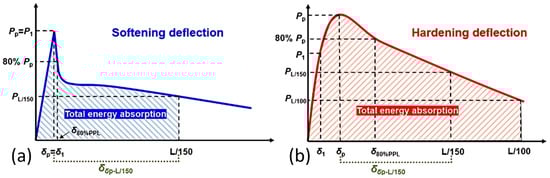
Figure 3.
Typical load-deflection (L-D) curves of fiber-reinforced cementitious materials: (a) softening deflection and (b) hardening deflection characteristics.
Table 3.
Flexural parameters and properties obtained from the L-D curves.
3. Results and Discussion
3.1. Effect of Fiber Types and Dosages
3.1.1. Mechanical Strengths
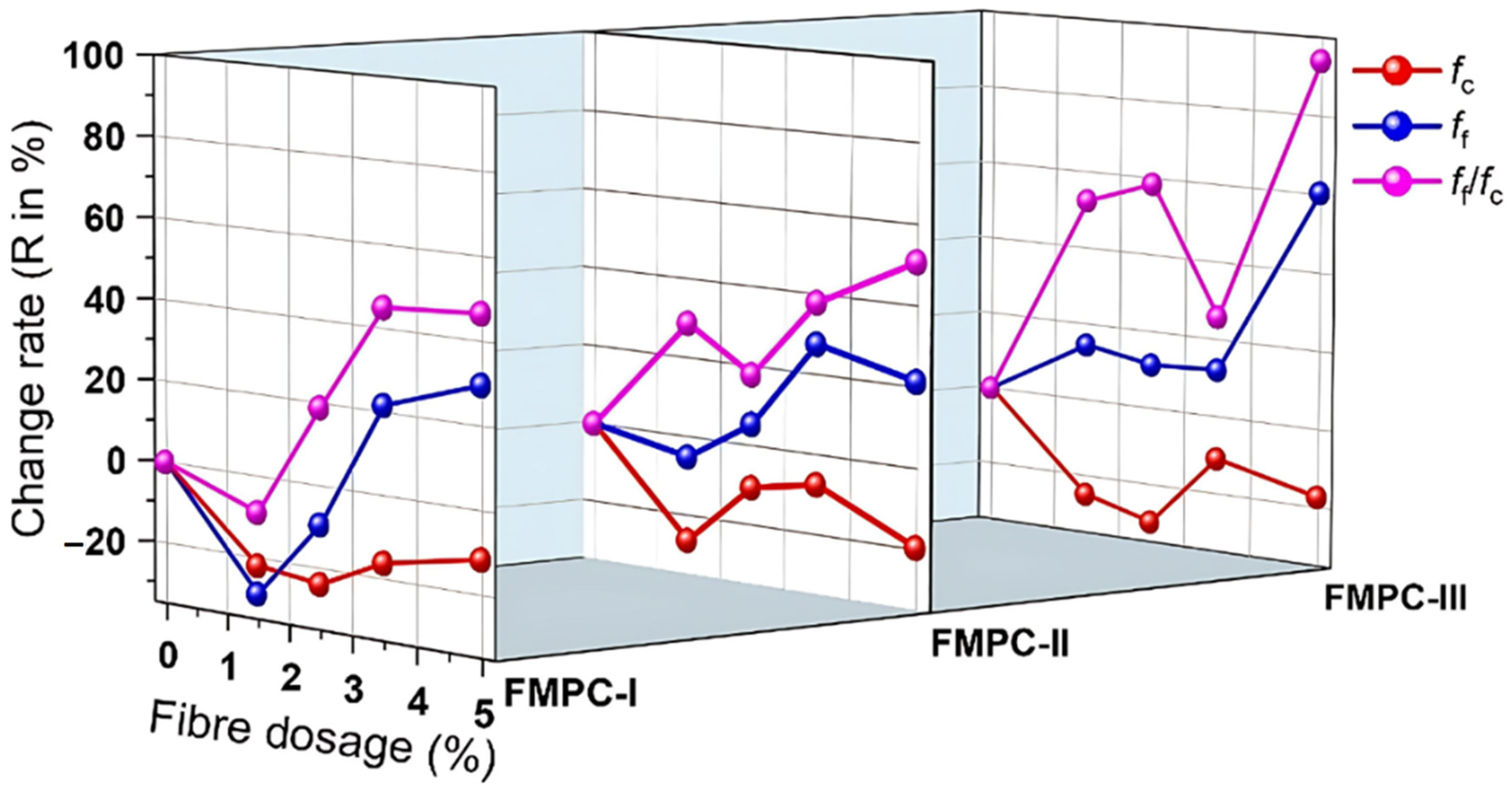
As detailed in Table 4, the compressive strength (fc), flexural strength (ff), and their corresponding ratio (ff/fc) of fiber-reinforced MPC composites are presented for different fiber types and dosages. The initial reduction in compressive strength (fc), particularly at lower fiber dosages like 1.5%, primarily stems from the introduction of air voids during fiber mixing and potential localized stress concentrations at the fiber–matrix interface, which acts as flaws under compressive loading [37]. Conversely, the increase in flexural strength (ff) is attributed to the fibers’ ability to bridge microcracks that develop under tensile bending stresses. This bridging effect transfers load across cracks, delaying their propagation and requiring more energy to cause failure [38], thereby enhancing ff and material ductility. The results are compared to the unreinforced control MPC via change rates (R). The addition of fibers induced a marked reduction in fc but a pronounced enhancement in ff, yielding elevated ff/fc ratios. This behavior indicates a preferential improvement in ductility and fracture toughness over compressive strength, which yielding elevated prior observations by Feng et al. [31]. The COV for fc is relatively low for all the tested specimens compared to the COV for ff. This suggests that flexural strength measurements are more sensitive to factors such as specimen preparation, fiber distribution, and loading conditions. The higher variability in ff relates directly to the critical dependence of flexural performance on fiber dispersion and alignment within the brittle MPC matrix [25]. Imperfect fiber distribution can lead to localized weak planes or variations in fiber density across the tension zone during bending, significantly influencing the measured strength [39]. To better evaluate the changes in mechanical strengths due to fiber dosages, the fiber-dosage-dependent change rates (R) of fc, ff, and ff/fc are further plotted in Figure 4.
Table 4.
Mechanical strengths of MPC reinforced with various types and dosages of fibers.
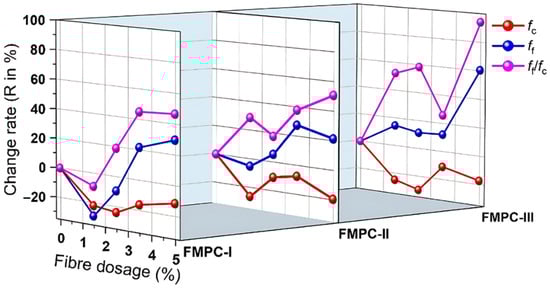
Figure 4.
Change rates of fc, ff, and ff/fc of FMPCs with fiber dosages ranging from 0 to 5%.
For all FMPC types, the change rates (R) of ff/fc are over those of fc and ff in all tested dosages, indicating that the tested fibers enhance the material’s ductility and toughness more than its compressive capacity. As the fiber dosages increased from 0 to 1.5%, all the FMPC samples exhibited a significant fc reduction, and further increasing the dosage led to fewer negative R values. At 3.5% and 5% dosages, all the FMPC samples showed the R values of fc higher than −20%. Flexural strength tended to improve with the fiber addition across all FMPC types, particularly at higher dosages, such as 3.5% and 5%. The R values of ff/fc consistently increase with the fiber dosage for the FMPC samples, indicating a strong positive impact of fibers on the ff/fc ratio. Specific to the type of fiber used and the overall mechanical performance with fiber dosages, FMPC-I and FMPC-II showed excellent performance at 3.5% and 5%, while FMPC-III displayed considerable performance at 5%.
3.1.2. L-D Curves
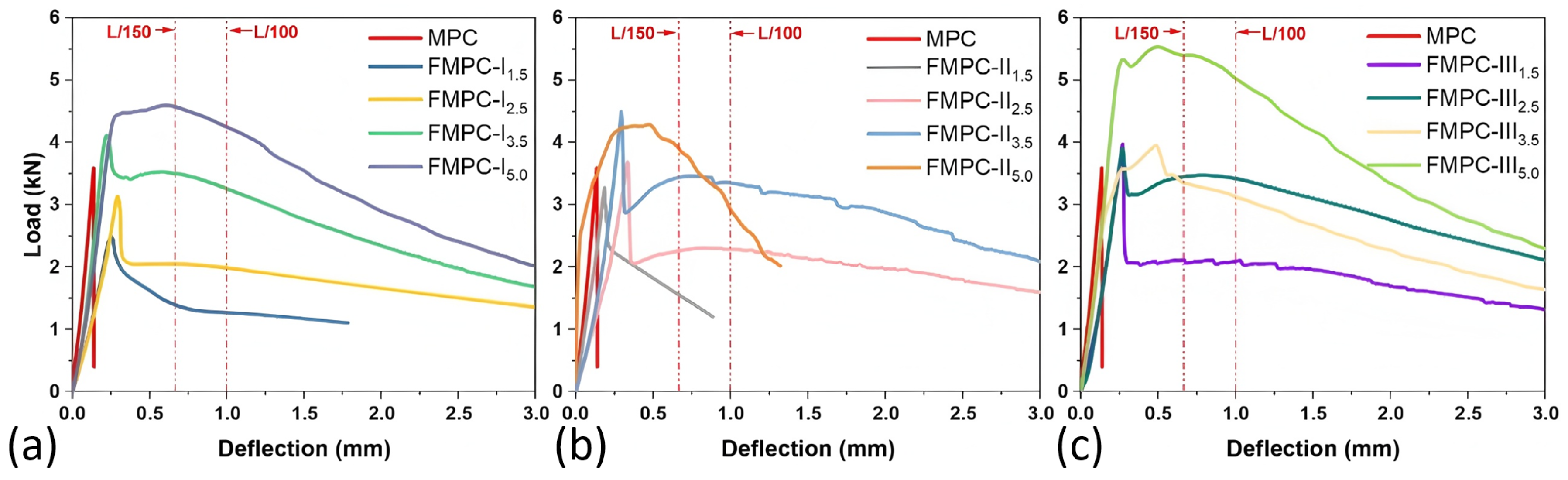
Figure 5 displays the load-deflection (L-D) curves, which present the flexural performance of MPC reinforced with different types and dosages of fibers. Initially, each curve ascends nearly linearly, reflecting a proportional increase in load with deflection, indicative of the material’s stiffness. This initial stiffness of the MPC was reduced by introducing fibers, as evidenced by a gentle softening of the slope. Upon reaching the peak load, the curves exhibit the composites’ maximum load capacity, corresponding to the ultimate flexural strength before the onset of significant deformation. For all the types of FMPC investigated here, the incorporation of fibers impacted the flexural characteristics substantially. As the fiber dosages increased from 1.5 to 5.0, increases in peak load capacity were noticed, suggesting the fibers’ effect in enhancing the flexural strength. The improved ductility was also noted with the fiber enhancement, as the reinforced MPCs can endure more extensive deflection before yielding to failure.
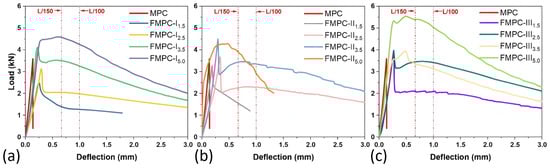
Figure 5.
Flexural load-deflection (L-D) curves of MPC reinforced with various types and dosages of fibers: (a) MPC-I; (b) MPC-II; (c) MPC-III.
3.1.3. Flexural Strengths, Moduli, and Deflections
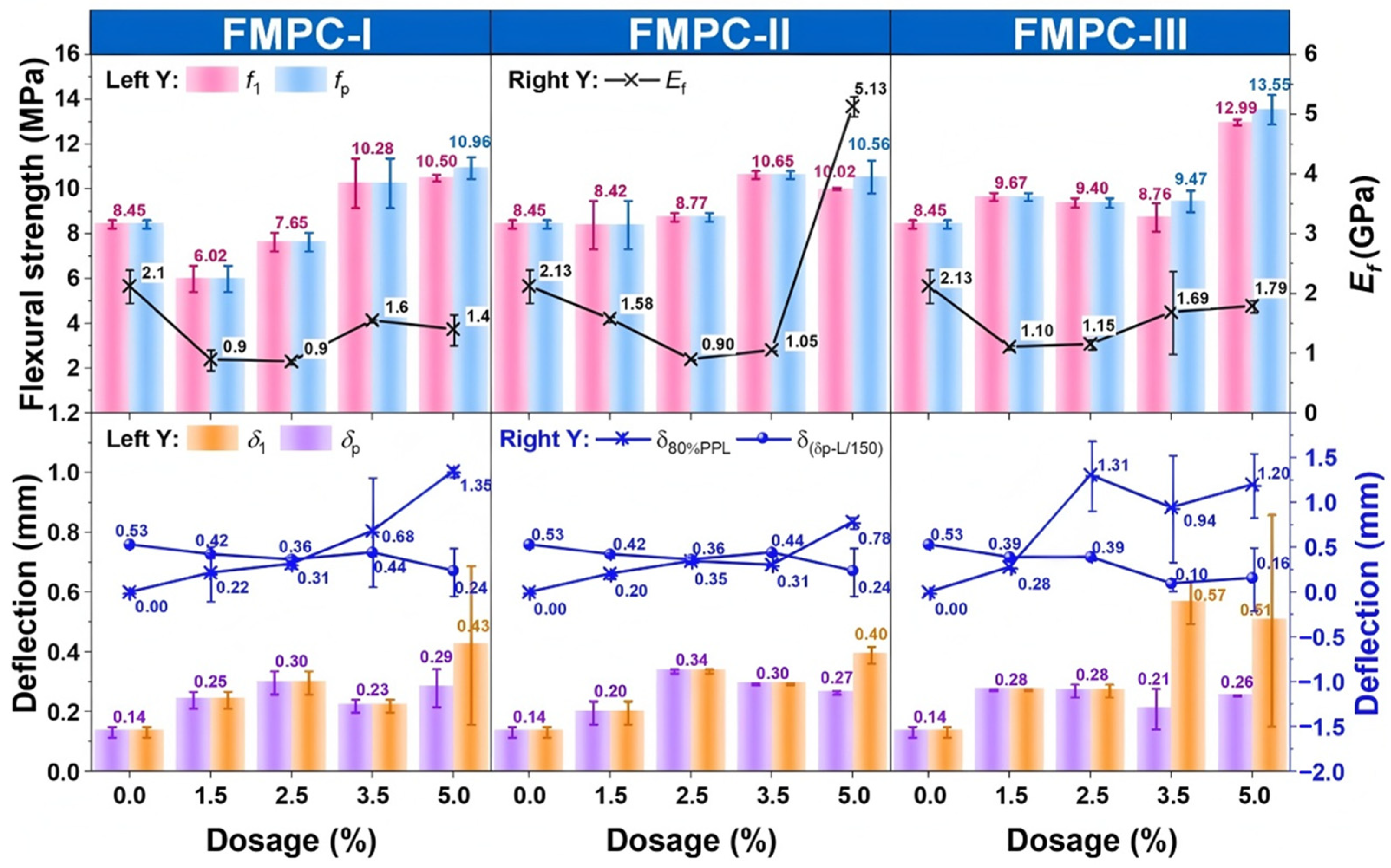
To further analyze the flexural property changes with various types and dosages of fibers added in MPC, the results of the strength (f1) and corresponding deflection (δ1) at the first peak point, the strength (fp) and deflection (δp) at the peak point, the modulus of elasticity (Ef), the deflection (δ80%PPL) at 80% post-peak load, and the difference between the peak deflection (δp) and the deflection of L/150 were obtained from the L-D curves in Figure 5, and depicted in Figure 6.
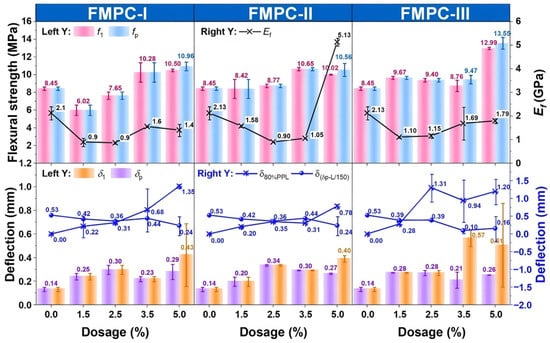
Figure 6.
Strengths (MPa), moduli (GPa), and deflections (mm) of MPC reinforced with various types and dosages of fibers (Note: Error bars represent standard deviation (SD)).
The data in Figure 6 reveals that, across all types of FMPC, up to a fiber dosage of 3.5%, the initial f1 is equal to the fp. This equivalence originates from insufficient fiber content to substantially modify matrix-dominated brittle fracture behavior, where initial microcracks rapidly propagate to failure without significant fiber-mediated load redistribution [40]. The f1 and fp of the samples exhibit a general increase as the fiber dosage rose, regardless of the fiber types, attributed to progressive enhancement in crack-bridging efficiency as more fibers intercept propagating cracks and redistribute stresses through interfacial bond development [41]. Optimal flexural strengths were achieved at a 5.0% fiber dosage for FMPC-I and FMPC-III, while FMPC-II plateaus at 3.5%. Adding more fibers did not significantly affect the f1 and fp of FMPC-II. In contrast to the strengths, fiber addition generally decreased the Ef, implying a reduction in stiffness, except for FMPC-II at a 5.0% fiber dosage. The prevalent Ef reduction stems from localized microcracking at fiber–matrix interfaces that disrupts elastic load transfer [42], while FMPC-II’s anomalous increase at 5.0% suggests densified fiber packing may momentarily enhance composite rigidity through confinement effects [43]. The largest Ef values across the FMPC samples were observed at a 3.5% fiber dosage for FMPC-I and 5.0% for FMPC-II and FMPC-III, corresponding to region-specific optimization points where fiber content improves particle packing density without excessive interfacial defect generation [44].
The measured deflection parameters, including initial cracking deflection (δ1), peak load deflection (δp), and post-peak deflection at 80% residual strength (δ80%PPL), exhibited a consistent positive correlation with increasing fiber content. This systematic enhancement in deformation capacity provides clear evidence of improved composite ductility. The observed behavior stems from intensified fiber–matrix interaction mechanisms, where higher fiber dosages promote more extensive fiber pull-out processes, thereby increasing energy absorption capacity and effectively postponing structural failure through delayed load-bearing framework disintegration [45]. Consequently, the differential between peak deflection and the deflection at the serviceability limit δ(δp-L/150) decreased as fiber dosage increased. Despite the similar overall trend, the specific patterns of deflection change for each FMPC type are different. FMPC-I exhibits a consistent rise in deflection, whereas FMPC-II levels off beyond a 2.5% dosage, and FMPC-III shows significant fluctuations. Meanwhile, the increase in deflection variability at higher dosages, especially for FMPC-III, could indicate potential performance issues or measurement inconsistencies, possibly due to fiber aggregation at high dosages [46,47]. Caution is therefore advised when considering high-fiber dosage designs for FMPC-III, as the observed deflection irregularities may compromise the reliability and integrity of structures.
3.1.4. Other Flexural Parameters
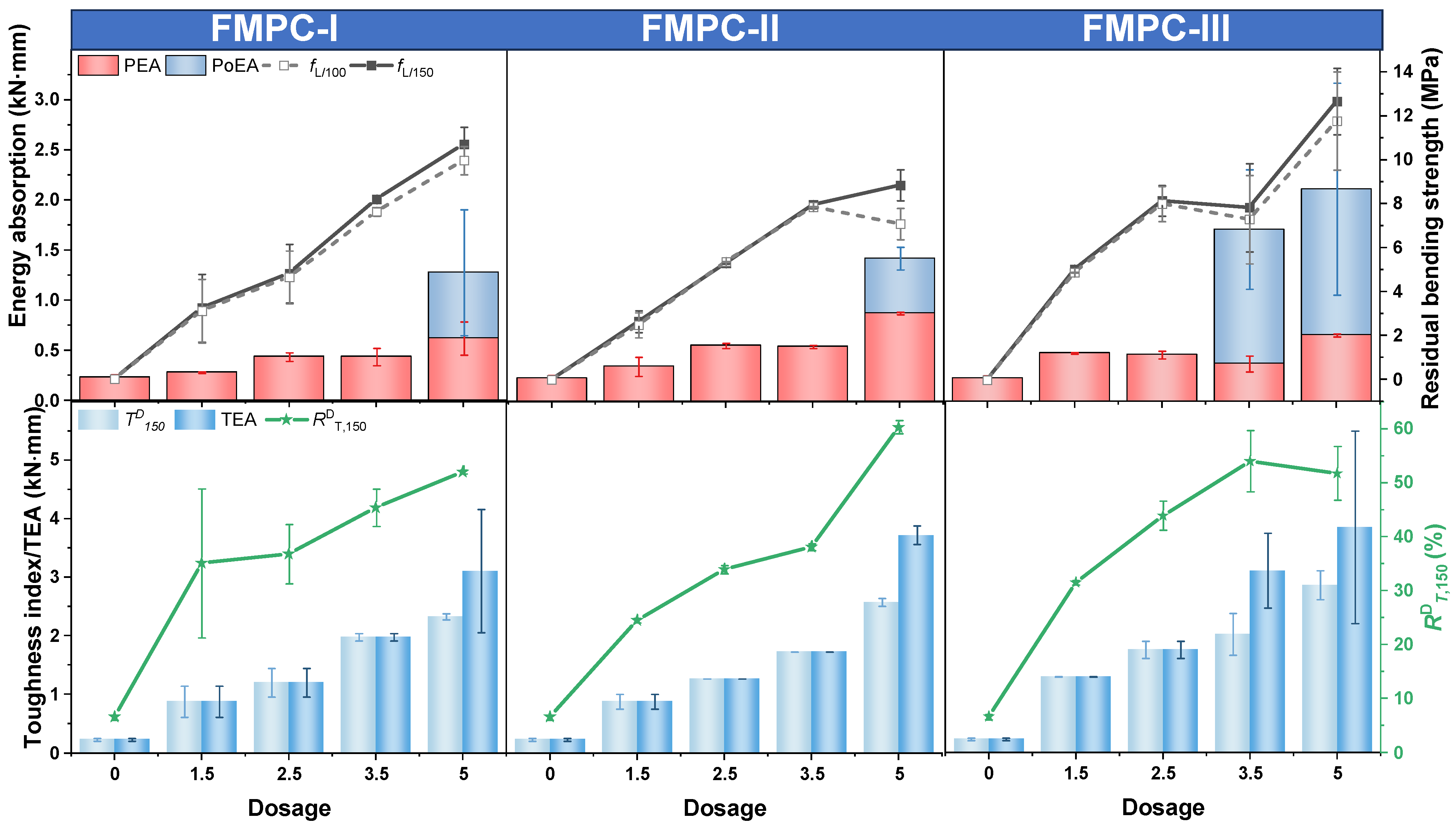
Figure 7 illustrates the influence of incremental fiber dosage augmentation on the energy absorption capacity, residual flexural strength, and fracture toughness characteristics across different fiber-modified MPC (FMPC) composites. For all the tested FMPCs, both the PEA and PoEA trended to ascend with increased fiber dosage, signifying that higher fiber content enhanced energy absorption capabilities and the overall toughness of the composites, consistent with study of [48]. Notably, a significant surge in PoEA was observed between the 3.5% to 5.0% dosage range, indicating a marked improvement in the material’s ability to absorb energy beyond the elastic stage. Concurrently, data variability also escalated with fiber dosage, pointing to increased experimental uncertainty at higher fiber contents.
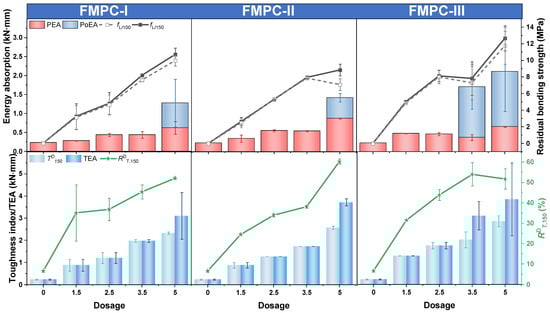
Figure 7.
Energy absorption (kN·mm), residual bending strengths (MPa), toughness index (kN·mm), and RDT,150 of MPC reinforced with various types and dosages of fibers. (Note: Error bars represent standard deviation (SD)).
As fibers play more significant roles after the occurrence of crack formation by acting as bridges to hinder the extension of flexural tensile cracks [49], using residual bending strengths (fL/150 and fL/100) can be a way to evaluate the impact of fibers on flexural strengths. Regarding the fL/150 and fL/100, FMPC-I showed a nearly linear improvement with rising fiber dosages. FMPC-II followed a similar upward trajectory up to a 3.5% dosage, beyond which the rate of increase for fL/150 tapered off and fL/100 slightly diminished. For FMPC-III, a leveling off in residual strengths occurred between 2.5% and 3.5% dosages, after which a significant data variability suggested potential reliability issues in the FMPC composites of high fiber content.
The toughness index (TD150), total energy absorption (TEA), and equivalent flexural strength ratio (RDT,150) exhibited consistent growth with increased fiber dosage across all the FMPC samples, improving the toughness of the composites. However, the pronounced error bars at higher dosages, particularly for FMPC-III, may reflect inconsistencies in fiber distribution or variability in matrix-fiber bonding. It underscored that while toughness tended to improve with fiber addition, the degree of enhancement may be variable and influenced by factors like fiber dispersion within the matrix.
3.1.5. Selection of FMPC for CFRP Fabric Addition
Mechanical testing results indicate that fiber dosage has a more pronounced impact on the properties of FMPC samples than fiber type. A 5.0% dosage notably enhanced flexural properties and toughness and reduced compressive strength by no more than 25%. Yet, at this dosage, data variability also significantly increased, primarily due to fiber agglomeration and inhomogeneous dispersion during mixing [50,51]. The issue of poor repeatability stems from uneven fiber distribution creating areas of both high fiber concentration and insufficient reinforcement, which compromises load transfer mechanisms [52]. Studies on hybrid fiber-reinforced materials highlight this sensitivity to fiber volume fraction, where even low concentrations require uniform dispersion for consistent performance, while fiber-reinforced polymer systems similarly depend on well-dispersed fibers for mechanical integrity [53]. This challenge parallels findings in broader cement-based materials research, where material homogeneity proves critical for predictable behavior [54,55], including advanced systems like 3D-printable ceramics requiring precise dispersion control [56]. At high dosages, these effects intensify without specialized mixing techniques or dispersing agents [57]. Therefore, despite the improvements at 5.0% fiber content, such fundamental variability in fiber distribution and unstable fiber–matrix bonding renders this dosage problematic for practical applications.
For further exploration with subsequent CFRP fabric reinforcement, the 5.0% dosage was dismissed owing to its high variability. A 3.5% dosage was preferred, considering the observed toughness improvements. FMPC-I3.5 and FMPC-II3.5 emerged as superior options over FMPC-III3.5, which showed high data variability in multiple parameters. With comparable strength and flexural toughness, FMPC-I3.5 was chosen for its higher modulus of elasticity (Ef), positioning it as the preferred substrate for CFRP fabric enhancement.
3.2. Effect of the Displacement of CFRP Fabric
Table 5 and Table 6 presents a comprehensive summary of mechanical properties including fc, ff and Ef, toughness index (TEA and TD150), TF and TWF across CFRP placements at 9, 13, 16, and 19 mm displacements, with subsequent subsections detailing the specific effects of CFRP positioning on MPC performance.
Table 5.
fc, ff and Ef of MPC reinforced with CFRP in different displacements.
Table 6.
Toughness index (TEA and TD150), TF and TWF of MPC reinforced with CFRP in different displacements.
3.2.1. Selection of FMPC for CFRP Fabric Addition
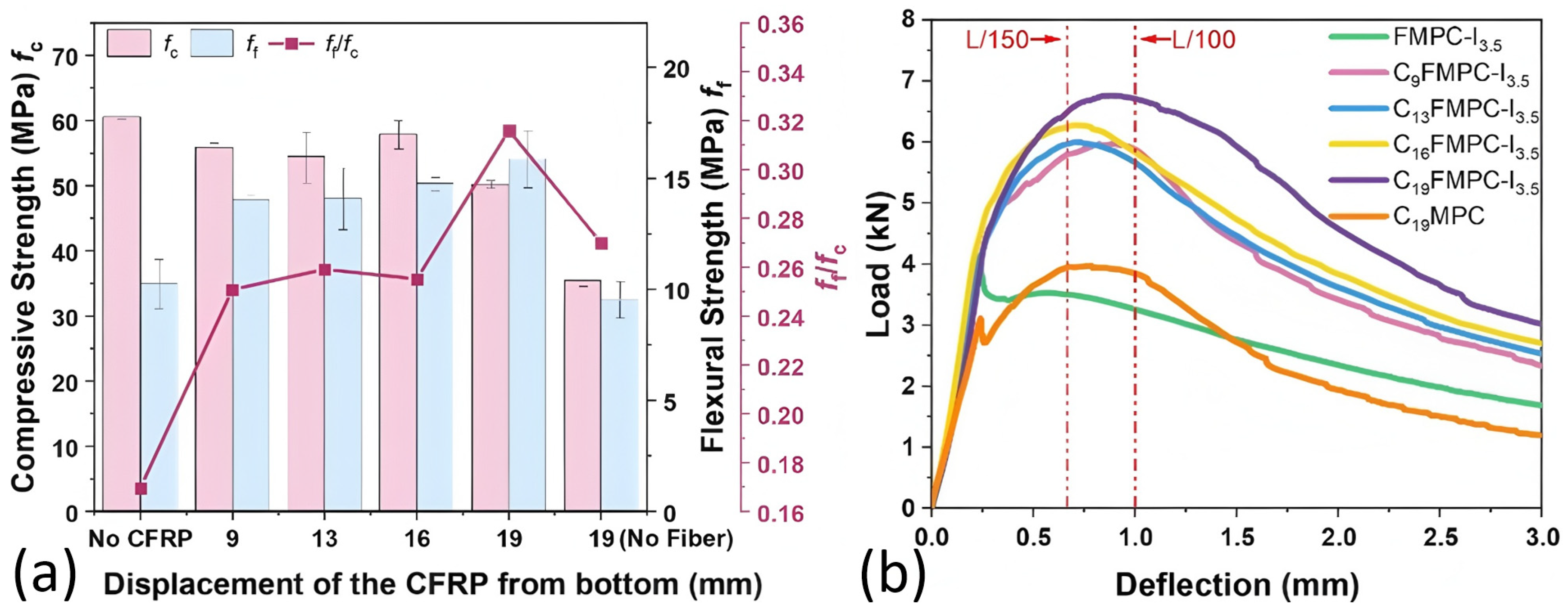
Figure 8 delineates the mechanical strengths and flexural L-D curves of FMPC with variations in CFRP fabric displacements. Figure 8a demonstrates that incorporating CFRP fabric typically lowers the fc but enhances the ff of the FMPCs. A notable trend is observed where the fc decreased and the ff increased as the CFRP is positioned further from the base, peaking at 19 mm displacement for the highest ff/fc ratio, indicating an optimal CFRP placement.
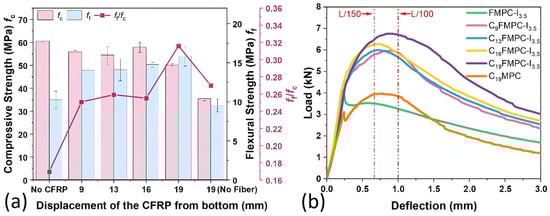
Figure 8.
Properties (a) mechanical strengths (MPa) and (b) L-D curves of optimal fiber MPC reinforced with CFRP fabric. (Note: Error bars represent standard deviation (SD)).
In the L-D curves of Figure 8b, all CFRP-reinforced FMPC specimens exhibit a consistent pattern: a vague yield point and an initial linear response followed by a gentle decline post-peak load, suggesting increased ductility. The FMPC curves without CFRP exhibit a steeper post-peak fall-off, while the CFRP-reinforced non-fiber MPC shows a distinct yield point. Overall, CFRP fabric reinforcement not only boosts load capacity but also augments the ductility of FMPC, allowing for greater deflection prior to failure.
3.2.2. Flexural Strengths, Moduli, and Deflection
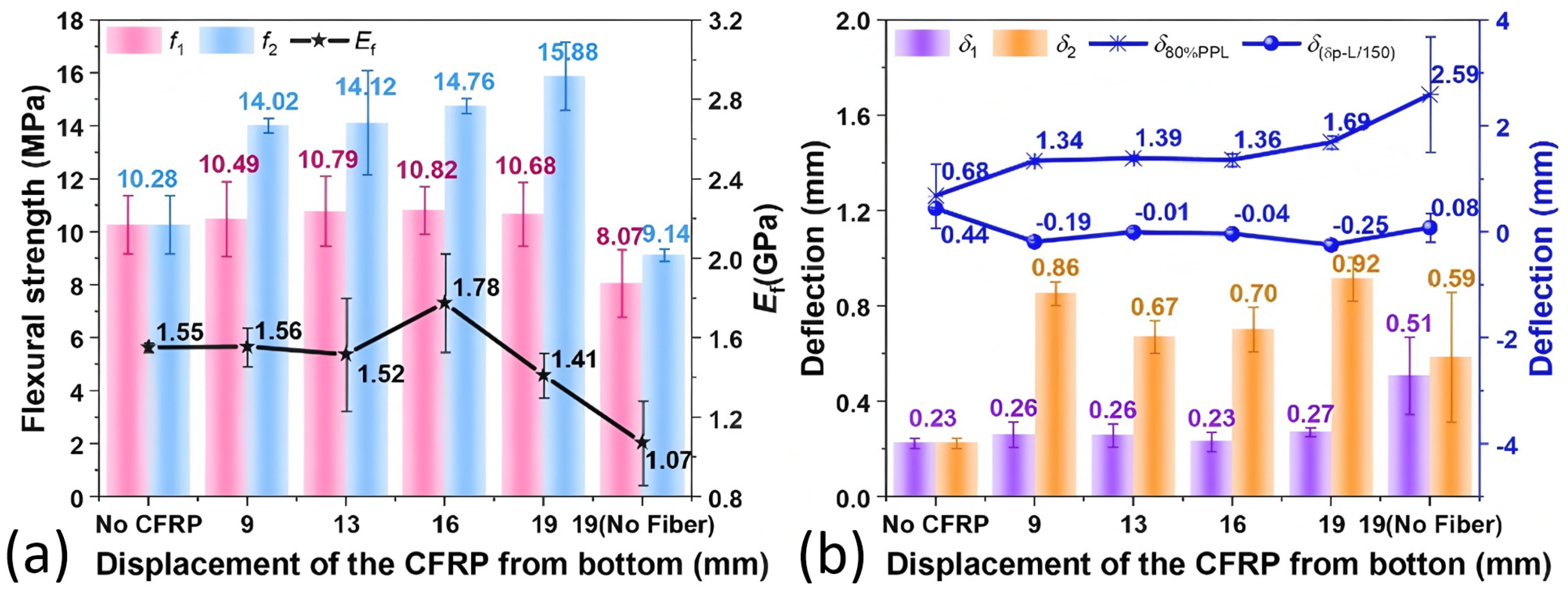
Figure 9 demonstrates the effect of CFRP positioning variations on the flexural performance characteristics of FMPCs, including flexural strength, elastic modulus, and deformation behavior. Figure 9a shows that CFRP enhanced the peak flexural strength fp more substantially than the initial strength f1, with fp rising as CFRP was positioned further from the base. The modulus of elasticity (Ef) exhibits limited variation with CFRP incorporation, attaining a peak value at 16 mm displacement. However, this observed maximum demonstrates significant statistical uncertainty, as evidenced by the substantial error margins. MPC without fibers registers the lowest flexural strength and modulus of elasticity, underscoring the reinforcement effect of fibers.
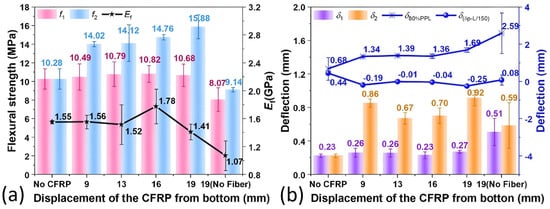
Figure 9.
Flexural properties (a) strengths (MPa) and moduli (GPa), and (b) deflections (mm) of optimal fiber MPC reinforced with CFRP fabric. (Note: Error bars represent standard deviation (SD)).
Figure 9b shows initial crack deflection (δ1) remaining fairly constant with CFRP addition, while peak deflection (δp) significantly increases, most notably at 19 mm displacement. The deflection at 80% post-peak load (δ80%PPL) also increased with CFRP displacement, indicating increased ductility. The extent of ductility enhancement is such that δp surpasses the L/150 serviceability limit for all CFRP-reinforced samples, resulting in negative δ(δp-L/150) values. A comparative analysis of deformation behavior reveals that unreinforced MPC specimens exhibit lower deflection capacity than CFRP-enhanced FMPCs, yet demonstrate greater deformation than fiber-modified MPC lacking CFRP reinforcement. This observation suggests CFRP incorporation may impart ductility enhancement effects even in the absence of discrete fiber reinforcement.
3.2.3. Other Flexural Parameters
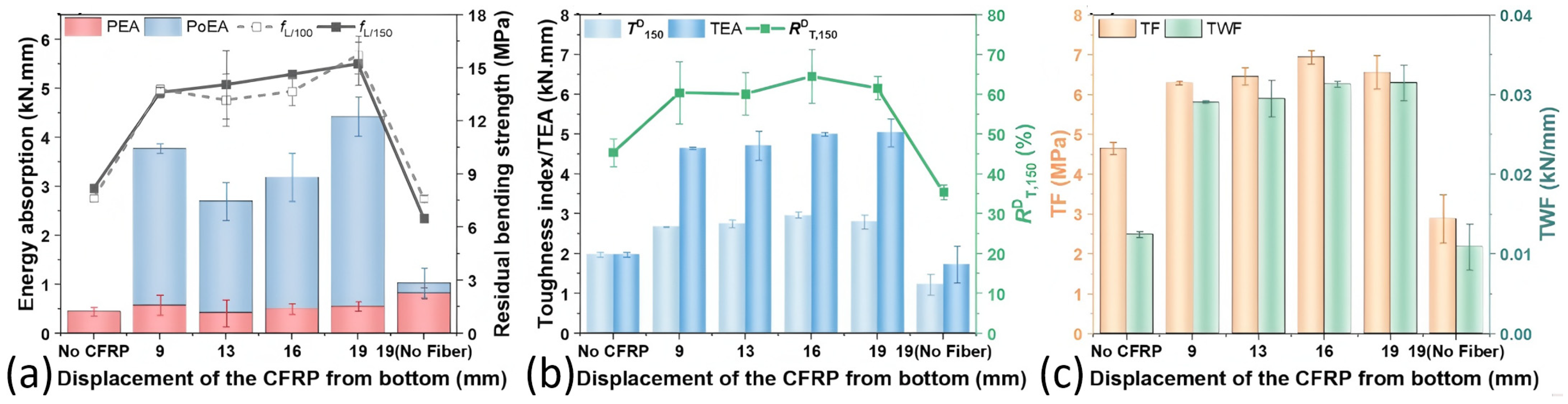
Figure 10 depicts different parameters related to the energy absorption and toughness of FMPC with varying CFRP fabric displacements. As shown in Figure 10a, the CFRP presence slightly enhanced the PEA while significantly boosting the PoEA of the FMPC samples, particularly at a 19 mm displacement, indicating improved energy absorption post-peak. Samples without CFRP or fibers display markedly lower PoEA, underscoring the synergistic effect of fibers and CFRP on energy absorption.
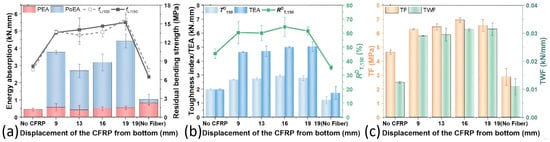
Figure 10.
Flexural parameters (a) energy absorption (kN·mm) and residual bending strengths (MPa), (b) toughness index (kN·mm) and RDT,150, and (c) TF (MPa) and TWF (kN/mm) of optimal fiber MPC reinforced with CFRP fabric. (Note: Error bars represent standard deviation (SD)).
In Figure 10b, the toughness index (TD150), total energy absorption (TEA), and equivalent flexural strength ratio (RDT,150) increased with added CFRP, though CFRP displacement had minimal impact on these measurements. The low values in the no-fiber MPC reinforced with CFRP highlighted the crucial role of fibers in conjunction with CFRP to enhance the toughness of MPC materials. The toughness factor (TF) and the total work of fracture (TWF) also improved with the combined addition of fibers and CFRP (Figure 10c). However, these properties show little sensitivity to CFRP displacement, indicating that varying the placement of CFRP does not significantly affect toughness adjustment.
3.2.4. Discussion
The synergy between fiber reinforcement and CFRP significantly enhances MPC’s mechanical properties, toughness, and energy absorption. Fibers provide internal support, improving crack resistance and stress distribution [58,59]. CFRP, with high tensile strength, augments load-bearing capabilities [60]. This cooperation increases material toughness, enabling greater energy absorption and crack resistance. Fibers bridge gaps, limiting crack widening and contributing to post-crack load-bearing [61]. Simultaneously, CFRP externally reinforces, restrains cracks, and adds bending strength [61].
Experimental results revealed that variations in CFRP placement had a marginal effect on fracture toughness, but substantially modified both ultimate flexural strength and cumulative energy absorption characteristics. Optimal CFRP placement leveraged flexibility and tensile properties over a larger deformation range. The experimental findings identify 19 mm as the optimal CFRP displacement, achieving peak mechanical performance and energy absorption while maintaining structural stability. This positioning balances reinforcement efficiency with material integrity, suggesting that precise CFRP placement and judicious fiber dosage selection are critical design parameters. Such optimization not only enhances load-bearing capacity under service conditions but also ensures cost-effective material utilization without sacrificing structural resilience.
3.3. Effect of the Displacement of CFRP Fabric
3.3.1. Mechanical Strengths and L-D Curves
To enhance graphical clarity in the following sections, the specimen labeling has been simplified while maintaining all experimental parameters: the fiber content is fixed at 1.5 wt.% and CFRP reinforcement is consistently positioned at 19 mm displacement. The original designation T19-FMPC-V1.5 has been streamlined by omitting the CFRP position indicator T19, with specimens simply marked as either with or without CFRP reinforcement. Furthermore, while the fiber blend composition remains distinguished by type identifiers (1-4), the fiber dosage subscript (1.5) has been excluded from the figure labels to minimize visual complexity.
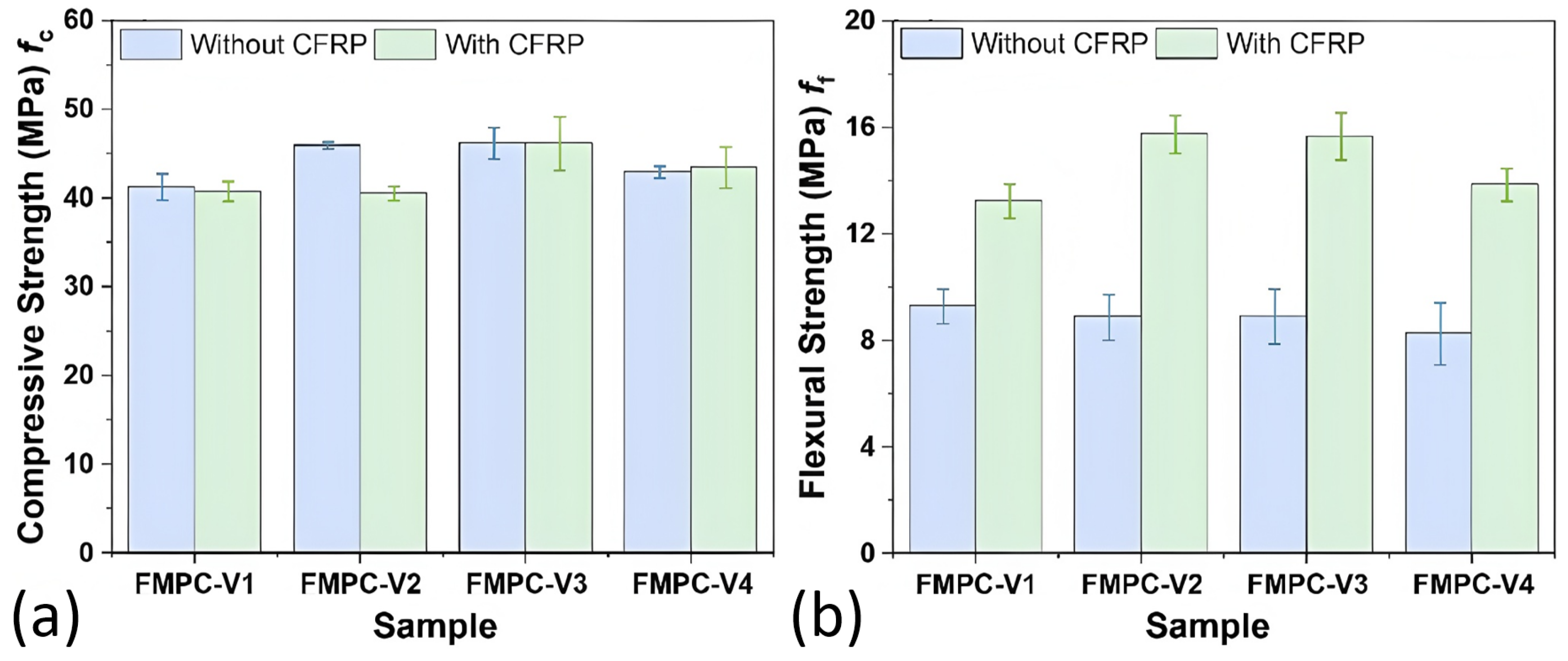
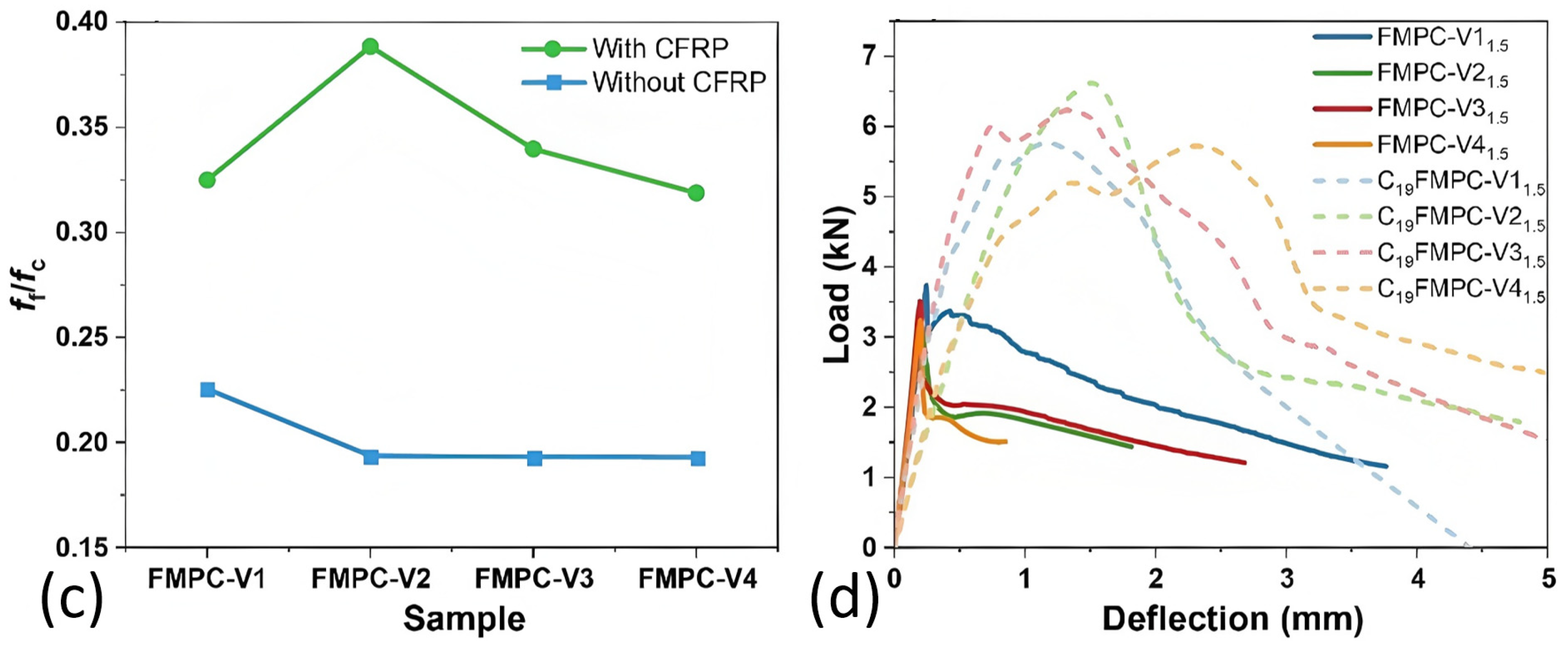
Table 7 and Figure 11 illustrates the influence of CFRP fabric integration (positioned at 19 mm displacement) across various FMPC-V formulations, evaluating the universality of its synergistic reinforcement mechanism with discrete fibers. The comparative analysis demonstrates the consistent enhancement of mechanical properties, confirming the robust cooperative effect between CFRP and fiber reinforcement in MPC composites. The fc and ff results demonstrate that CFRP significantly boosted ff but had minimal impact on fc, as shown in Figure 11a,b. The ratio ff/fc in CFRP-enhanced FMPC-V is at least 1.5 times greater than in samples without CFRP, with the greatest gains observed in the specific fiber composition of CF/WSF/CPS15 = 1/1/1 (Figure 11c). CFRP also altered the flexural L-D curves, presenting a lower initial slope, higher peak load and deflection values, and a more gradual decline after the peak. These results underscore the significant role of CFRP in improving the flexural performance of FMPC- samples.
Table 7.
Mechanical strengths of MPC reinforced with various fiber combinations and CFRP.
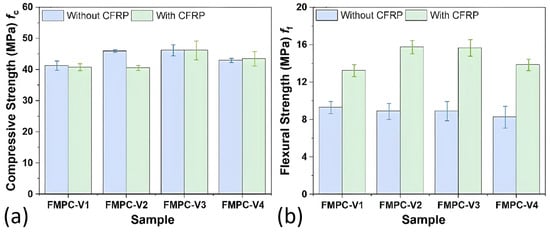
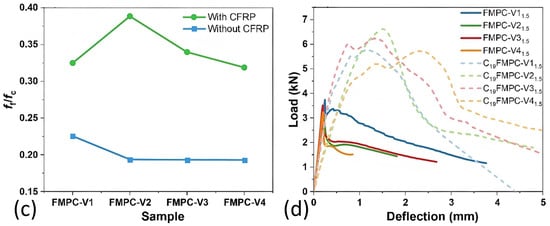
Figure 11.
Properties (a) compressive strengths (MPa), (b) flexural strength (MPa), (c) the ratio of compressive strength to flexural strength (ff/fc) and (d) L-D curves of MPC-V with fibers and CFRP fabric. (Note: Error bars represent standard deviation (SD)).
3.3.2. Flexural Strengths, Moduli, and Deflections
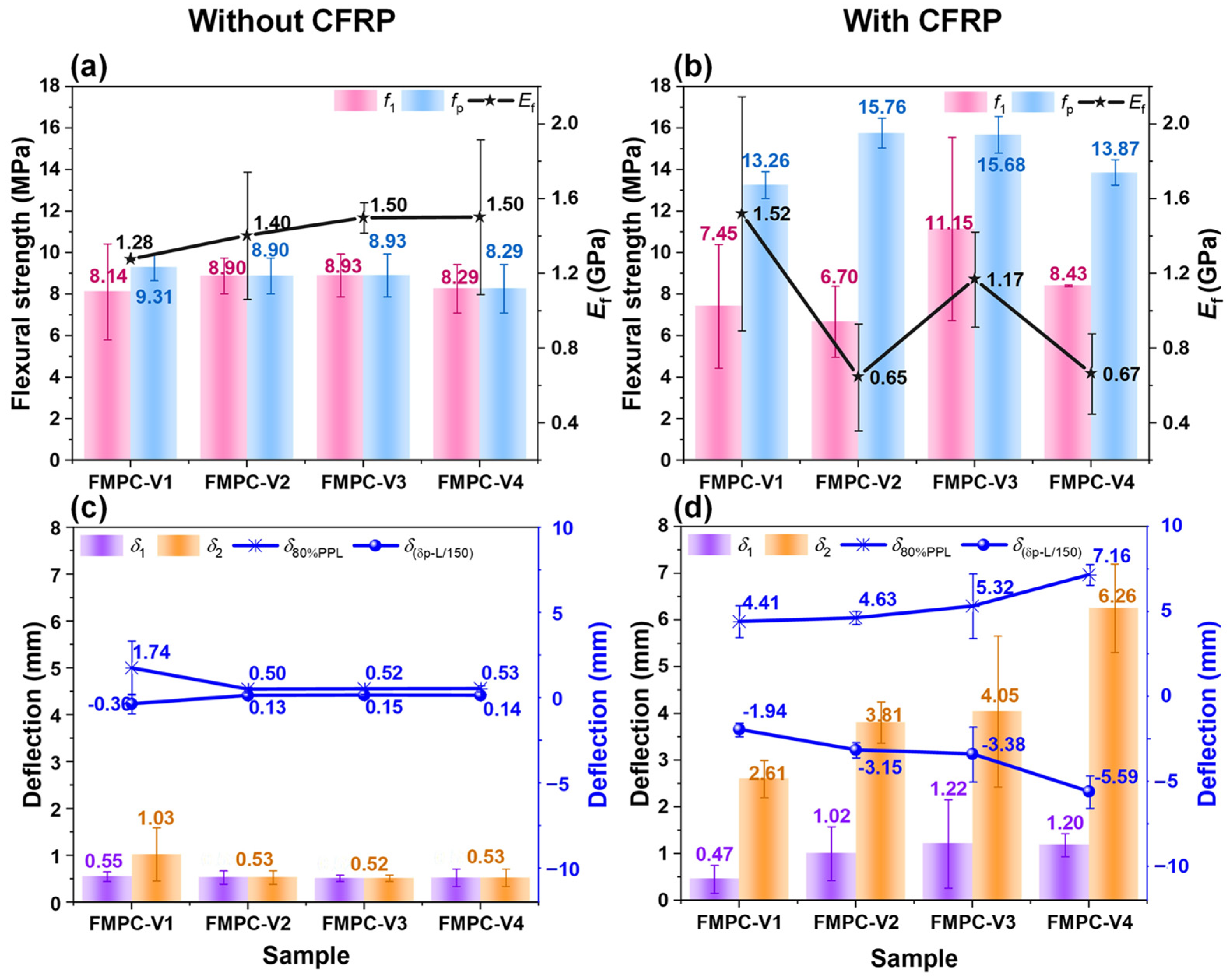
Figure 12 details the effects of CFRP on the flexural performance and deformation characteristics of various FMPC-V samples. Without the CFRP addition, it is noted that the f1, fp and Ef showed little variance among the samples (Figure 12a). Incorporating CFRP notably enhanced the fp across all FMPC-V types, with a marked f1 increase in FMPC-V3 which contains a specific fiber blend of CF/WSF/WW = 1/1/1 (Figure 12b). In contrast to the flexural strengths, the Ef decreased slightly, which could be interpreted as an increase in flexibility or a decrease in stiffness due to the CFRP incorporation [62]. Deflection analyses (Figure 12c,d) reveal that CFRP significantly improves both the δ1 and δp, showing enhanced ductility. The growth in δ80%PPL was also noticed by the CFRP addition, and the shift in the δ(δp-L/150) to negative values occurred due to the significant δp enhancement. These changes suggest that the CFRP addition extended the deformation capacity of the FMPC-V samples before serviceability failure, potentially enhancing toughness and energy absorption [63].
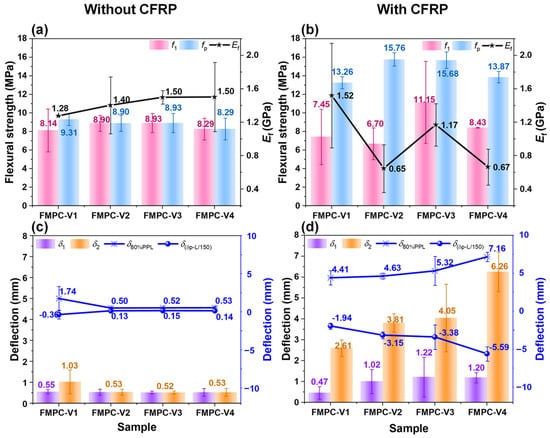
Figure 12.
Flexural strength (MPa) of fiber-reinforced samples (a) with and (b) without CFRP fabric; deflection (mm) of fiber-reinforced samples (c) with and (d) without CFRP fabric. (Note: Error bars represent standard deviation (SD)).
3.3.3. Other Flexural Parameters
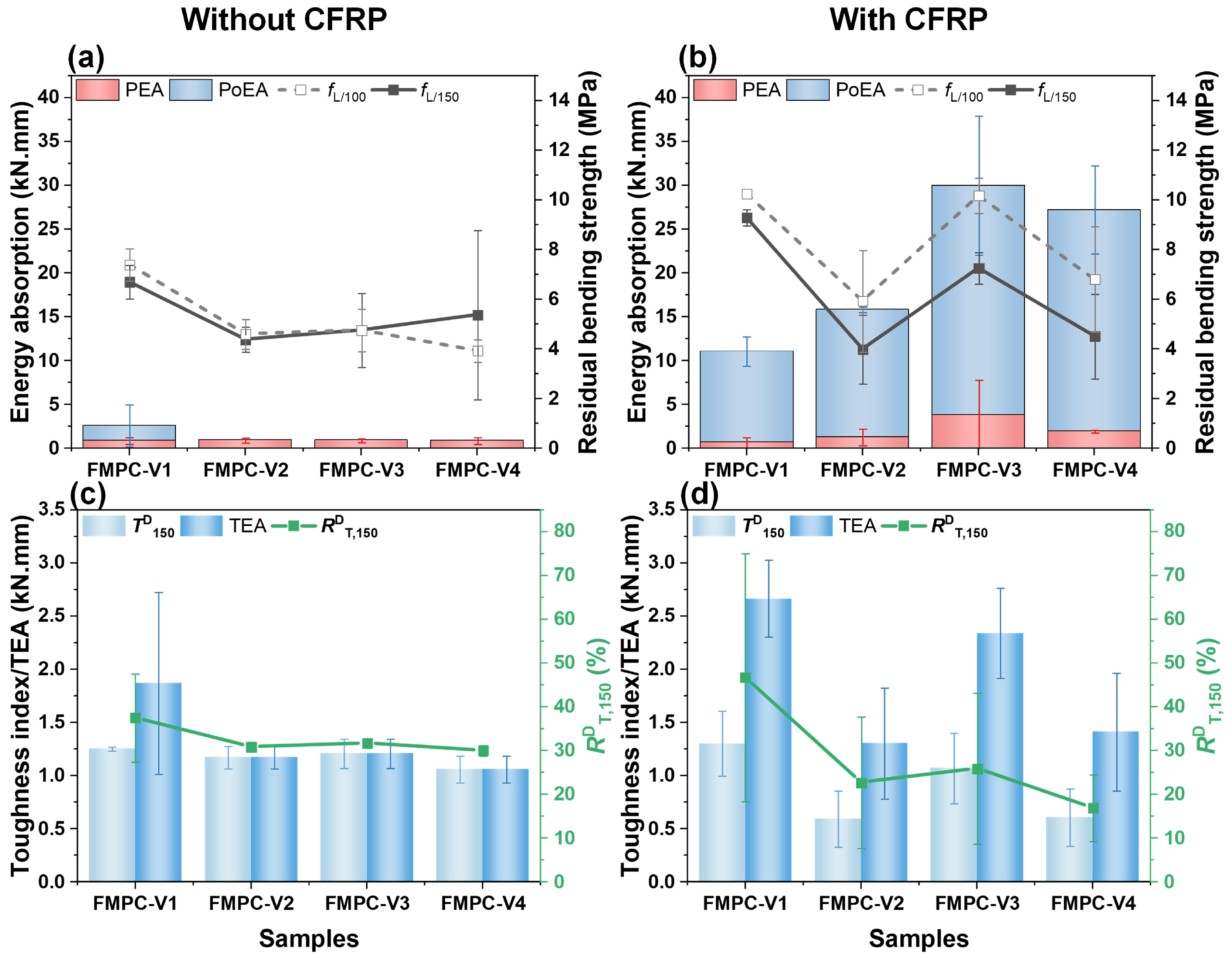
A comparative evaluation of energy absorption capacity, residual flexural strength, and toughness indices between CFRP-reinforced and non-reinforced FMPC composites is presented in Figure 13. Without CFRP, the FMPC-V samples demonstrate consistent energy absorption and residual bending strengths (Figure 13a), indicating uniform performance across the board. The incorporation of CFRP reinforcement induces a significant enhancement in both peak energy absorption (PEA) and post-cracking energy absorption (PoEA), particularly for FMPC-V3 and FMPC-V4 composites (Figure 13a,b). This pronounced improvement demonstrates the material’s superior energy dissipation capacity following initial crack formation. However, compared to the PEA and PoEA, the increases in residual bending strength (fL/100 and fL/150) with CFRP were modest, suggesting only slight improvements in the load at the ultimate deformation.
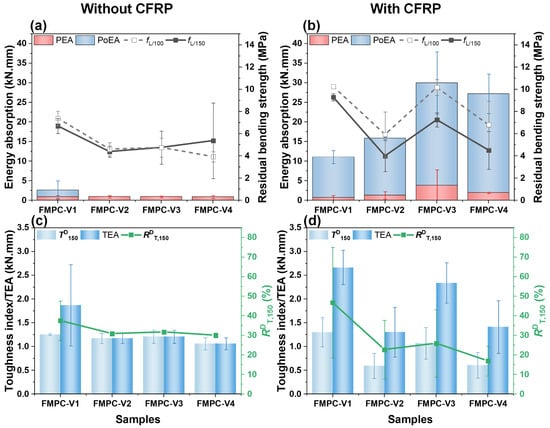
Figure 13.
Energy absorption (kN·mm) and residual bending strengths (MPa) of fiber-reinforced samples (a) with and (b) without CFRP fabric; toughness index (kN·mm), and RDT,150 of fiber-reinforced samples (c) with and (d) without CFRP fabric. (Note: Error bars represent standard deviation (SD)).
Comparing the results in Figure 12c,d, the CFRP presence substantially boosted the TEA, especially for FMPC-V3, which underscores its role in augmenting overall energy absorption. Alterations in the TD150 and RDT,150 were minimal, with some FMPC variants (FMPC-V2 and FMPC-V4) even experiencing reductions, hinting at potential inconsistencies in sample performance.
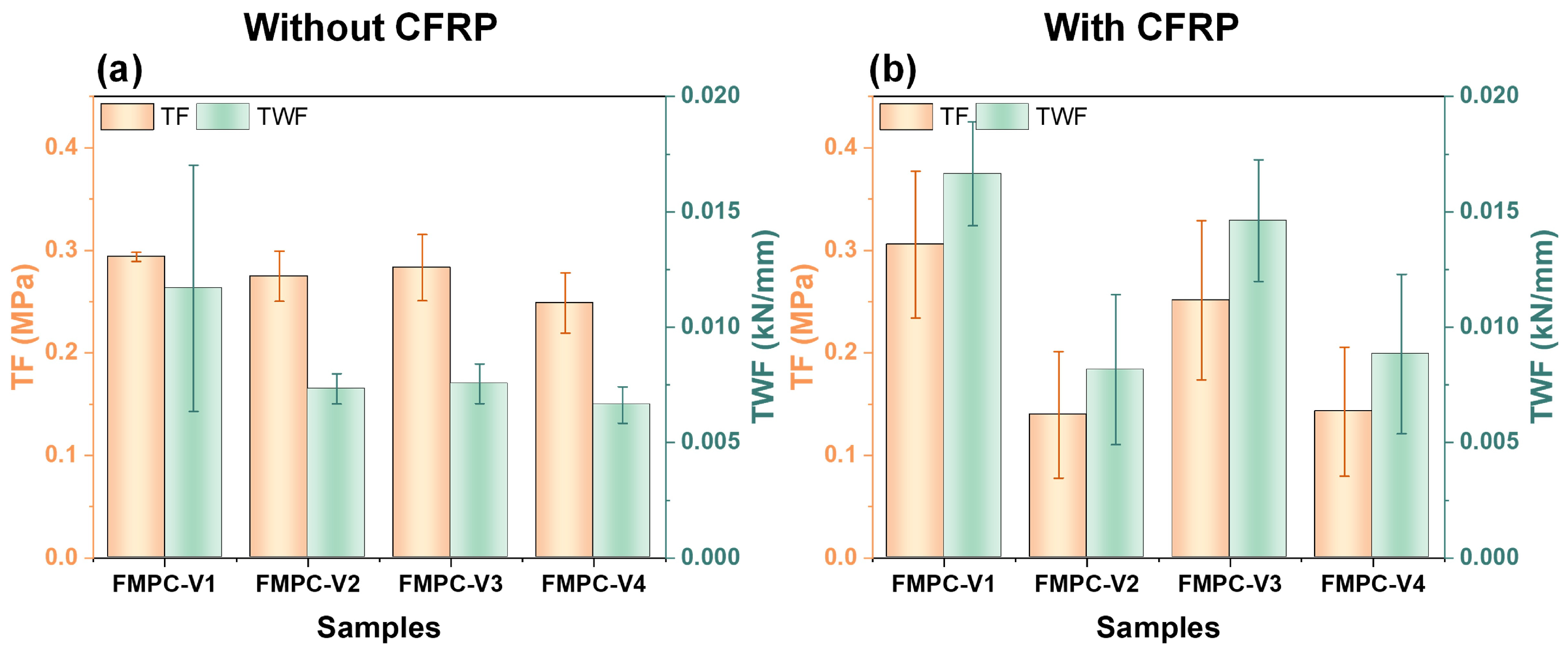
Figure 14 presents the TF and TWF of various FMPC-V samples with and without the CFRP addition. Without CFRP, TF and TWF are relatively uniform across the samples, with the error bars indicating minor variability (Figure 14a). The incorporation of CFRP reinforcement consistently enhances TWF, with FMPC-V3 exhibiting the most pronounced improvement among all tested formulations, demonstrating superior fracture resistance characteristics. However, TF did not consistently increase. FMPC-V2 and FMPC-V4 displayed a decrease, reflecting the variable impact of CFRP on the different FMPC-V compositions. The larger error bars for TF with CFRP, particularly for FMPC-V1, suggest that the influence of CFRP on toughness is not uniform and highly dependent on each FMPC-V samples’ specific properties.
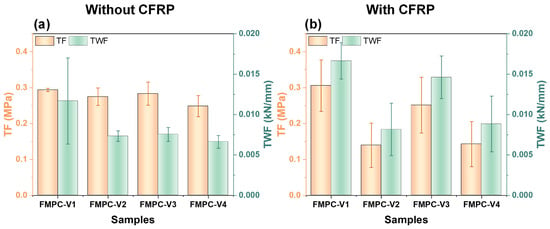
Figure 14.
(a) Toughness factor (TF, MPa) and (b) total work of fracture (TWF, kN/mm) of Fiber-reinforced samples (a) with and (b) without CFRP fabric. (Note: Error bars represent standard deviation (SD)).
3.3.4. Efficacy Evaluation
The investigation of the various FMPC-V samples reveals that CFRP significantly impacted the mechanical properties, toughness, and energy absorption. The CFRP addition enhanced ff and PoEA, with minimal effects on the fc, emphasizing its efficacy in scenarios dominated by bending forces. Meanwhile, the improved TF and TWF were noticed in some FMPC-V samples, indicating improved crack resistance and energy absorption during fracture. However, FMPC-V2 and FMPC-V4 showed a limited improvement or even reduction in TF values, highlighting the dependency of the CFRP on specific FMPC matrix designs. Considering the data reliability and overall performance enhancement, FMPC-V3 was found to be the most suitable design for the CFRP fabric reinforcement among all the investigated FMPC-V samples here.
Variability in CFRP-reinforced FMPC samples stems from factors like fiber distribution, interface quality, and manufacturing variability. Larger error bars, especially in specific variants, suggest achieving a consistent and beneficial response may be challenging. Although CFRP enhanced certain FMPC-V properties, its application must be carefully tailored to each formulation, considering potential drawbacks, to ensure optimal benefits in specific scenarios.
3.4. Further Discussion
Without the addition of CFRP fabric, it is found that fiber dosage has a more pronounced impact on the properties of FMPC samples than fiber type. This dosage dominance arises because insufficient fiber content fails to establish comprehensive crack-arresting networks [59,64], making matrix defects the primary performance driver. Higher fiber loadings, while more effective in modifying MPC properties, introduced greater performance variability due to fiber distribution heterogeneity and suboptimal fiber–matrix interfaces [50,51]. Although standard deviation values are provided to quantify this variability, it is important to acknowledge that achieving consistent dispersion and repeatability at elevated fiber contents (e.g., 5.0 wt.%) remains challenging due to increased risks of fiber agglomeration and non-uniform stress transfer. These factors generate stress concentrations and porosity, creating inconsistent load transfer mechanisms that complicate practical implementation. However, it should be noted that the interpretation of fiber agglomeration effects is primarily inferred from mechanical data variations and published studies [50,51,52,53,54,55,56,57], as direct microstructural evidence (e.g., from SEM analysis) was not included in the current study.
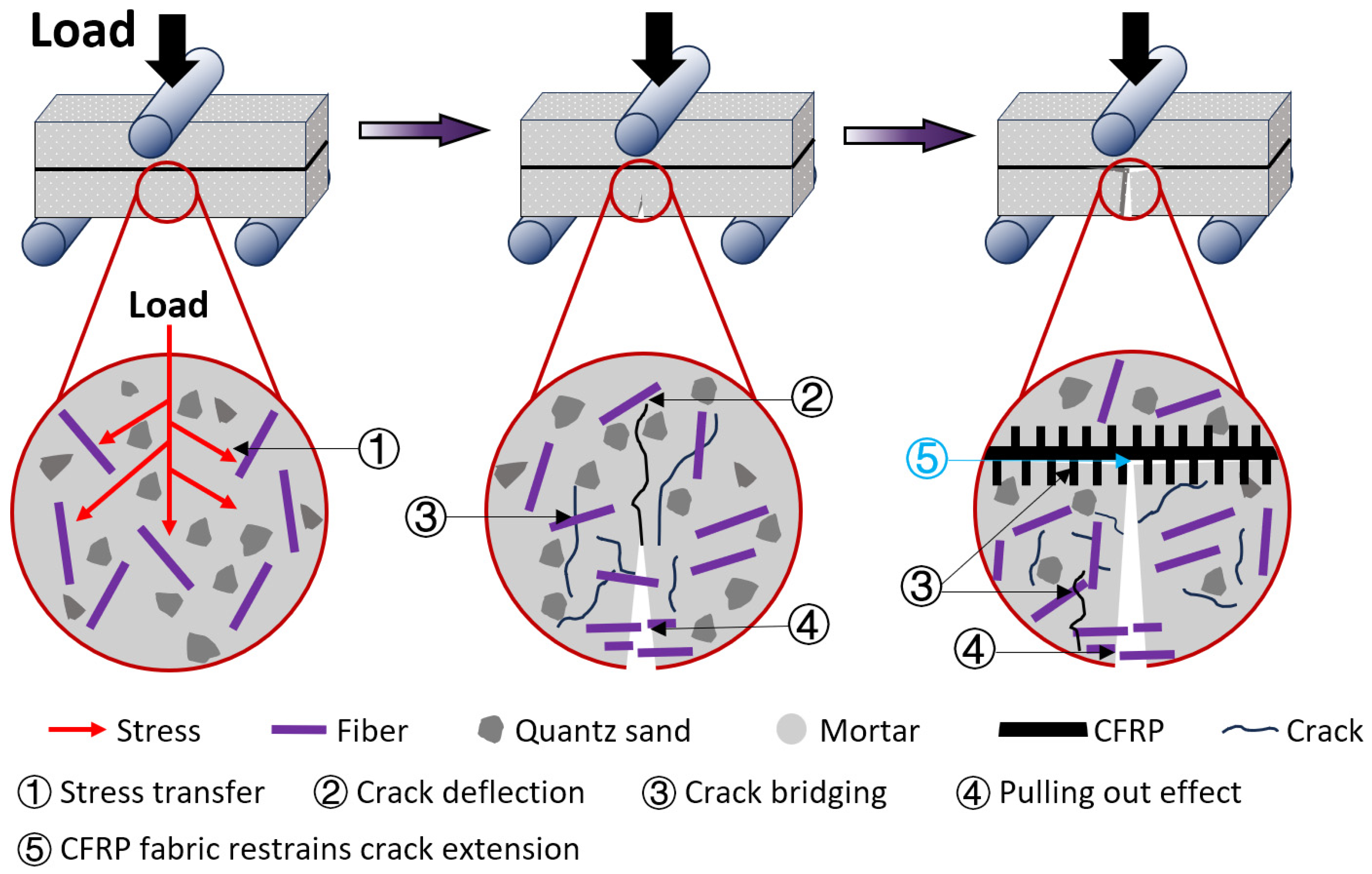
Introducing CFRP fabric to FMPC induces a synergistic interaction that leverages multi-scale toughening mechanisms, as illustrated in Figure 15. In the initial loading stage, fibers act as stress transfer mediators, redistributing localized stresses through interfacial bond development [65]. Upon initial cracking, fibers exhibit crack deflection, crack bridging, and pull-out effects, delaying the formation of critical macrocracks by dissipating energy through interfacial friction [66]. This microscale fiber reinforcement cooperates with macroscale CFRP confinement, where the high-tensile-strength CFRP fabric effectively restricts macrocrack propagation by interacting with fiber-mediated microcrack segmentation [67]. This synergistic mechanism activates fabric reinforcement prior to the formation of critical fracture planes, thereby simultaneously improving the flexural capacity and structural integrity of FMPC composites.
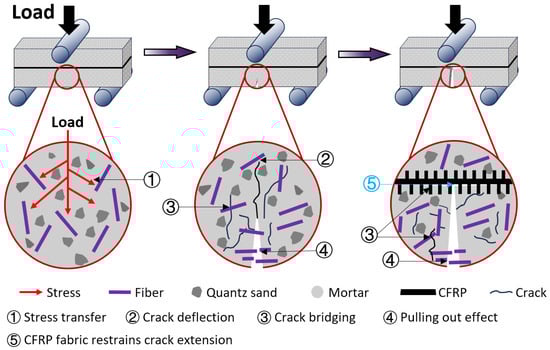
Figure 15.
A schematic illustration of the combined effect of fibers and CFRP fabric, depicting the sequential activation of reinforcement mechanisms: pre-cracking stress transfer, microcrack deflection/bridging/fiber pull-out energy dissipation, and CFRP-mediated macrocrack restraint.
Additional cooperative effects extend beyond simple combined contributions. The embedded fibers create micro-roughness at the fabric–matrix interface, enhancing mechanical interlocking and bond strength beyond chemical adhesion limits. Fibers penetrating the CFRP–matrix interface induce radial compressive stresses, homogenizing strain fields and preventing premature interfacial decohesion. This multi-scale stress regulation ensures CFRP maintains consistent engagement throughout loading, leading to more uniform load distribution and superior composite performance.
The hybrid CFRP-fiber reinforcement system developed in this work demonstrates distinct advantages over conventional MPC composites, as evidenced by the comprehensive comparison in Table 8. Our system achieves an exceptional ff/fc ratio of 0.389, substantially exceeding typical values of 0.107–0.228 reported for single-fiber MPC composites [14,25,43,68,69,70,71]. The exceptional ff/fc ratio of 0.389 indicates a superior balance between flexural and compressive performance, effectively overcoming the common trade-off in traditional reinforcements. This enhanced balance is structurally vital, as it provides high resistance to bending and tensile stresses without significantly compromising compressive capacity, leading to improved durability and crack resistance under service loads, which is highly desirable in repair materials and structural components subject to dynamic or flexural loading. Notably, the embedded CFRP configuration outperforms externally wrapped systems [72] by providing more integrated mechanical enhancement while maintaining competitive compressive strength (~46 MPa) relative to natural fiber composites (~42–45 MPa) [70]. The results clearly establish that the strategic combination of hybrid fibers with internally incorporated CFRP fabric creates a more effective reinforcement architecture for MPC, delivering simultaneous improvements in both strength and toughness that surpass existing approaches. Furthermore, this hierarchical reinforcement strategy offers broader applicability to other brittle matrix systems, such as ultra-high-performance concrete, geopolymers, and ceramic composites, where balancing early-age strength and post-crack ductility remains a critical challenge. The design principles elucidated here, including fiber hybridization and internal fabric placement, can guide future developments in sustainable and resilient construction materials, particularly in applications requiring rapid repair and enhanced damage tolerance.
Table 8.
Summary of research results on properties of fiber-reinforced and CFRP-reinforced MPC.
4. Conclusions
This study systematically investigated the cooperative reinforcement mechanisms of hybrid fibers and CFRP fabric in magnesium phosphate cement composites, yielding new scientific insights into multi-scale toughening strategies for brittle cementitious materials. The key scientific contributions are summarized as follows:
- (1)
- The research establishes that fiber dosage exerts a more dominant influence on MPC properties than fiber type, with 3.5% fiber content providing the optimal balance between enhanced flexural performance (45% improvement) and minimal compressive strength reduction (<20%). Beyond this threshold, fiber agglomeration at 5.0% content introduces significant variability, highlighting the existence of critical fiber content limits for practical applications.
- (2)
- A fundamental finding is the identification of 19 mm as the optimal CFRP fabric displacement, which maximizes the synergistic interaction between fiber reinforcement and fabric confinement. This specific configuration achieves an exceptional ff/fc ratio of 0.389, demonstrating that strategic placement of internal CFRP fabric can overcome the traditional trade-off between compressive strength and flexural toughness in ceramic-based composites.
- (3)
- The study further reveals that the cooperative reinforcement effect follows a hierarchical activation mechanism: microfibers initially bridge microcracks while CFRP fabric provides macro-scale crack restraint, with fiber–CFRP interfacial interactions enhancing stress redistribution. This multi-scale reinforcement strategy, validated across various fiber combinations, establishes a new paradigm for designing ductile MPC composites capable of transitioning from brittle to quasi-ductile fracture behavior.
These findings provide quantitative design guidelines for optimizing fiber–CFRP MPC systems and contribute fundamental knowledge to the broader field of composite material science, particularly for applications requiring rapid strength development and enhanced damage tolerance. However, it is also essential to recognize potential drawbacks such as the complexity of design, the potential for variability in manufacturing, and cost implications. Understanding these factors is vital for the optimization and practical application of fiber and fabric-reinforced MPC in construction and repair works. Future work should focus on long-term durability assessment, including 28-day mechanical performance and environmental resistance, along with microstructural characterization to further elucidate the interfacial mechanisms governing this hierarchical reinforcement system.
Author Contributions
Conceptualization, Y.F. and P.C.; methodology, P.C.; validation, W.F., Y.F. and C.W.; formal analysis, W.F.; investigation, W.F.; resources, Y.F.; data curation, W.F. and P.C.; writing—original draft preparation, W.F. and P.C.; writing—review and editing, W.F., Y.F., K.Z., W.Z. and Z.D.; visualization, W.F. and P.C.; supervision, Z.D.; project administration, Z.D.; funding acquisition, Y.F., W.F. and Z.D. All authors have read and agreed to the published version of the manuscript.
Funding
This work is grateful for the financial support from the National Natural Science Foundation of China (Grant No. 52408281, 52178231) and the Shenzhen Science and Technology Innovation Commission (Grant No. JCYJ20220531100816038).
Institutional Review Board Statement
Not applicable.
Data Availability Statement
The data presented in this study are available on request from the corresponding author.
Conflicts of Interest
The authors declare no conflicts of interest.
References
- Wagh, A.S. Chemically Bonded Phosphate Ceramics. In Chemically Bonded Phosphate Ceramics; Elsevier: Amsterdam, The Netherlands, 2016; pp. 17–34. [Google Scholar] [CrossRef]
- Fang, B.; Hu, Z.; Shi, T.; Liu, Y.; Wang, X.; Yang, D.; Zhu, K.; Zhao, X.; Zhao, Z. Research progress on the properties and applications of magnesium phosphate cement. Ceram. Int. 2023, 49, 4001–4016. [Google Scholar] [CrossRef]
- Zhang, T.; Chen, H.; Li, X.; Zhu, Z. Hydration behavior of magnesium potassium phosphate cement and stability analysis of its hydration products through thermodynamic modeling. Cem. Concr. Res. 2017, 98, 101–110. [Google Scholar] [CrossRef]
- Ahmad, M.R.; Chen, B.; Yu, J. A comprehensive study of basalt fiber reinforced magnesium phosphate cement incorporating ultrafine fly ash. Compos. Part B Eng. 2019, 168, 204–217. [Google Scholar] [CrossRef]
- Haque, M.A.; Chen, B. Research progresses on magnesium phosphate cement: A review. Constr. Build. Mater. 2019, 211, 885–898. [Google Scholar] [CrossRef]
- Qiao, F.; Chau, C.K.; Li, Z. Property evaluation of magnesium phosphate cement mortar as patch repair material. Constr. Build. Mater. 2010, 24, 695–700. [Google Scholar] [CrossRef]
- Fang, Y.; Cui, P.; Ding, Z.; Zhu, J.-X. Properties of a magnesium phosphate cement-based fire-retardant coating containing glass fiber or glass fiber powder. Constr. Build. Mater. 2018, 162, 553–560. [Google Scholar] [CrossRef]
- Li, Y.; Li, Y.; Shi, T.; Li, J. Experimental study on mechanical properties and fracture toughness of magnesium phosphate cement. Constr. Build. Mater. 2015, 96, 346–352. [Google Scholar] [CrossRef]
- Feng, H.; Liang, J.; Guo, A.; Lv, L.; Sun, Z.; Sheikh, M.N.; Liu, F. Development and design of ultra-high ductile magnesium phosphate cement-based composite using fly ash and silica fume. Cem. Concr. Compos. 2023, 137, 104923. [Google Scholar] [CrossRef]
- Feng, H.; Li, Z.; Wang, W.; Liu, G.; Zhang, Z.; Gao, D. Deflection hardening behaviour of ductile fibre reinforced magnesium phosphate cement-based composite. Cem. Concr. Compos. 2021, 121, 104079. [Google Scholar] [CrossRef]
- Liu, Z.; Lai, Z.; Luo, X.; Xiao, R.; Chen, J.; Lu, Z. Properties of magnesium phosphate cement reinforced with natural brucite fiber. Constr. Build. Mater. 2023, 393, 132057. [Google Scholar] [CrossRef]
- Wang, L.; Yu, I.K.M.; Tsang, D.C.W.; Yu, K.; Li, S.; Poon, C.S.; Dai, J.-G. Upcycling wood waste into fibre-reinforced magnesium phosphate cement particleboards. Constr. Build. Mater. 2018, 159, 54–63. [Google Scholar] [CrossRef]
- Yue, L.; Bing, C. Factors that affect the properties of magnesium phosphate cement. Constr. Build. Mater. 2013, 47, 977–983. [Google Scholar] [CrossRef]
- Qin, J.; Qian, J.; Li, Z.; You, C.; Dai, X.; Yue, Y.; Fan, Y. Mechanical properties of basalt fiber reinforced magnesium phosphate cement composites. Constr. Build. Mater. 2018, 188, 946–955. [Google Scholar] [CrossRef]
- Tassew, S.; Lubell, A. Textile Reinforced Ceramic Composites for Structural Infill Slab Applications. In Proceedings of the IABSE Symposium: Large Structures and Infrastructures for Environmentally Constrained and Urbanised Areas, Venice, Italy, 22–24 September 2010; pp. 268–269. [Google Scholar] [CrossRef]
- Zhang, S.; Sun, W.; Zhan, Z.; Wen, Q.; Zhang, H.; Xiong, X. Ablation and insulation properties of hybrid carbon-quartz fiber fabric reinforced magnesium phosphate cement composite. Constr. Build. Mater. 2025, 464, 140122. [Google Scholar] [CrossRef]
- Feng, H.; Sheikh, M.N.; Hadi, M.N.S.; Gao, D.; Zhao, J. Mechanical properties of micro-steel fibre reinforced magnesium potassium phosphate cement composite. Constr. Build. Mater. 2018, 185, 423–435. [Google Scholar] [CrossRef]
- Sim, J.; Park, C.; Moon, D.Y. Characteristics of basalt fiber as a strengthening material for concrete structures. Compos. Part B Eng. 2005, 36, 504–512. [Google Scholar] [CrossRef]
- Paulraj, S.; Balasundaram, N.; Kumar, K.; Devi, M. Experimental studies on strength and SCC characteristics of basalt fiber reinforced concrete. Int. J. Civ. Eng. Technol. 2017, 8, 704–711. [Google Scholar]
- High, C.; Seliem, H.M.; El-Safty, A.; Rizkalla, S.H. Use of basalt fibers for concrete structures. Constr. Build. Mater. 2015, 96, 37–46. [Google Scholar] [CrossRef]
- Dong, L.; Wang, X. Study on mechanical properties of E-glass fiber mat reinforced magnesium phosphate cement thin-slab. Structures 2025, 73, 108365. [Google Scholar] [CrossRef]
- Liu, F.; Wang, B.; Chen, Z.; Zhou, C. Interface bonding mechanism of BFPMPC and concrete: Insights from microscopic to molecular scale. J. Build. Eng. 2025, 107, 112678. [Google Scholar] [CrossRef]
- Zhan, Z.; Sun, W.; Zhang, S.; Wen, Q.; Zhang, H.; Xiong, X. Ablation and insulation behavior of magnesium phosphate cement composite in harsh environments. Corros. Sci. 2023, 221, 111326. [Google Scholar] [CrossRef]
- Fang, Y.; Chen, B.; Oderji, S.Y. Experimental research on magnesium phosphate cement mortar reinforced by glass fiber. Constr. Build. Mater. 2018, 188, 729–736. [Google Scholar] [CrossRef]
- Dong, P.; Ahmad, M.R.; Chen, B.; Munir, M.J.; Kazmi, S.M.S. A study on magnesium phosphate cement mortars reinforced by polyvinyl alcohol fibers. Constr. Build. Mater. 2021, 302, 124154. [Google Scholar] [CrossRef]
- Haque, M.A.; Chen, B.; Ahmad, M.R.; Shah, S.F.A. Mechanical strength and flexural parameters analysis of micro-steel, polyvinyl and basalt fibre reinforced magnesium phosphate cement mortars. Constr. Build. Mater. 2020, 235, 117447. [Google Scholar] [CrossRef]
- Péra, J.; Ambroise, J. Fiber-reinforced magnesia-phosphate cement composites for rapid repair. Cem. Concr. Compos. 1998, 20, 31–39. [Google Scholar] [CrossRef]
- Feng, H.; Li, L.; Zhang, P.; Gao, D.; Zhao, J.; Feng, L.; Sheikh, M.N. Microscopic characteristics of interface transition zone between magnesium phosphate cement and steel fiber. Constr. Build. Mater. 2020, 253, 119179. [Google Scholar] [CrossRef]
- Zhu, W.; Hu, X.; Zhang, J.; Li, T.; Chen, Z.; Shao, W. Experimental study on mechanical properties of a novel micro-steel fiber reinforced magnesium phosphate cement-based concrete. Front. Struct. Civ. Eng. 2021, 15, 1047–1057. [Google Scholar] [CrossRef]
- Feng, H.; Chen, G.; Gao, D.; Zhao, K.; Zhang, C. Mechanical Properties of Steel Fiber-Reinforced Magnesium Phosphate Cement Mortar. Adv. Civ. Eng. 2018, 2018, 3978318. [Google Scholar] [CrossRef]
- Tassew, S.T.; Lubell, A.S. Mechanical properties of glass fiber reinforced ceramic concrete. Constr. Build. Mater. 2014, 51, 215–224. [Google Scholar] [CrossRef]
- Hayashi, T. On the improvement of mechanical properties of composites by hybrid composition. In Proceedings of the 8th International Reinforced Plastics Conference, Brighton, UK, 10–12 October 1972; pp. 149–152. [Google Scholar]
- Li, Y.; Liu, X.; Wang, Z. Experimental Study on Reinforcement and Chloride Extraction of Concrete Column with MPC-CFRP Composite Anode. KSCE J. Civ. Eng. 2019, 23, 1766–1775. [Google Scholar] [CrossRef]
- Ding, Z.; Dai, J.-G.; Muner, S. Study on an Improved Phosphate Cement Binder for the Development of Fiber-Reinforced Inorganic Polymer Composites. Polymers 2014, 6, 2819–2831. [Google Scholar] [CrossRef]
- Li, Y.; Liu, X.; Wu, M.; Bai, W. Research of electrochemical chloride extraction and reinforcement of concrete column using MPC-bonded carbon fiber reinforced plastic sheet & mesh. Constr. Build. Mater. 2017, 153, 436–444. [Google Scholar] [CrossRef]
- GB/T 17671-2021; Test Method of Cement Mortar Strength (ISO Method). Chinese National Standard: Beijing, China, 2021.
- Bhutta, A.; Borges, P.H.R.; Zanotti, C.; Farooq, M.; Banthia, N. Flexural behavior of geopolymer composites reinforced with steel and polypropylene macro fibers. Cem. Concr. Compos. 2017, 80, 31–40. [Google Scholar] [CrossRef]
- Shi, J.; Liu, B.; Chu, S.H.; Zhang, Y.; Zhang, Z.; Han, K. Recycling air-cooled blast furnace slag in fiber reinforced alkali-activated mortar. Powder Technol. 2022, 407, 117686. [Google Scholar] [CrossRef]
- Moujoud, Z.; Sair, S.; Ousaleh, H.A.; Ayouch, I.; El Bouari, A.; Tanane, O. Geopolymer composites reinforced with natural Fibers: A review of recent advances in processing and properties. Constr. Build. Mater. 2023, 388, 131666. [Google Scholar] [CrossRef]
- Falliano, D.; De Domenico, D.; Ricciardi, G.; Gugliandolo, E. Compressive and flexural strength of fiber-reinforced foamed concrete: Effect of fiber content, curing conditions and dry density. Constr. Build. Mater. 2019, 198, 479–493. [Google Scholar] [CrossRef]
- Wang, S.; Xue, Q.; Ma, W.; Zhao, K.; Wu, Z. Experimental study on mechanical properties of fiber-reinforced and geopolymer-stabilized clay soil. Constr. Build. Mater. 2021, 272, 121914. [Google Scholar] [CrossRef]
- Qin, J.; Zhang, Z.; Ma, H.; Dai, X.; Cheng, X.; Jia, X.; Qian, J. Improving mechanical properties of magnesium phosphate cement-based ultra-high performance concrete by ultrafine fly ash incorporation. Constr. Build. Mater. 2024, 448, 138198. [Google Scholar] [CrossRef]
- Zhang, M.; Zhang, Q.; Long, X.; Pei, Y.; Skoczylas, F. Mechanical properties of magnesium phosphate cement composites reinforced with hybrid basalt and polyvinyl alcohol fibers. J. Build. Eng. 2025, 104, 112207. [Google Scholar] [CrossRef]
- Wang, X.; Hu, X.; Chong, L.; Yang, J.; Shi, C. Effects of the combination of NH4H2PO4 and KH2PO4 on the interfacial bond between magnesium phosphate cement and steel fiber. Constr. Build. Mater. 2023, 407, 133405. [Google Scholar] [CrossRef]
- Feng, H.; Lv, L.; Pang, Y.; Yuan, C.; Chu, L.; Zhao, X. Bond behavior between the nano-Al2O3-water-glass-modified magnesium-phosphate-cement mortar and steel fiber. Constr. Build. Mater. 2021, 306, 124814. [Google Scholar] [CrossRef]
- Liu, X.; Xiang, K.; Guo, Y.; Ye, Q.; Zhang, J.; Pei, X.; Wang, X. Experimental study on impact toughness of multi-combination hybrid fiber-reinforced magnesium phosphate cement-based materials. J. Build. Eng. 2023, 78, 107564. [Google Scholar] [CrossRef]
- Tang, Z.; Chen, D.; Wang, X.; Han, Z.; Tao, R.; Zhang, G.; Hou, D.; Wu, D.; Ding, Q. Impact of polyethylene fiber on the ductility and durability of magnesium phosphate cement. J. Build. Eng. 2023, 68, 106123. [Google Scholar] [CrossRef]
- Nie, S.; Guo, A.; Feng, H.; Yu, Z.; Hu, Q. Magnesium phosphate cement-based engineered cementitious composites with polyethylene fibers: Performance improvement and design method. J. Clean. Prod. 2024, 450, 141941. [Google Scholar] [CrossRef]
- Haque, M.A.; Chen, B.; Ahmad, M.R.; Shah, S.F.A. Evaluating the physical and strength properties of fibre reinforced magnesium phosphate cement mortar considering mass loss. Constr. Build. Mater. 2019, 217, 427–440. [Google Scholar] [CrossRef]
- Du, W.; Qian, C. Atomic-level insights into the mechanism by which synthetic organic fibers enhance the tensile strength of concrete. J. Build. Eng. 2023, 75, 106891. [Google Scholar] [CrossRef]
- Andersons, J.; Joffe, R.; Hojo, M.; Ochiai, S. Glass fibre strength distribution determined by common experimental methods. Compos. Sci. Technol. 2002, 62, 131–145. [Google Scholar] [CrossRef]
- Shi, F.; Pham, T.M.; Hao, H.; Hao, Y. Post-cracking behaviour of basalt and macro polypropylene hybrid fibre reinforced concrete with different compressive strengths. Constr. Build. Mater. 2020, 262, 120108. [Google Scholar] [CrossRef]
- Hamad, R.J.A.; Johari, M.A.M.; Haddad, R.H. Mechanical properties and bond characteristics of different fiber reinforced polymer rebars at elevated temperatures. Constr. Build. Mater. 2017, 142, 521–535. [Google Scholar] [CrossRef]
- Zeng, X.; Lan, X.; Zhu, H.; Long, G.; Xie, Y. Investigation on air-voids structure and compressive strength of concrete at low atmospheric pressure. Cem. Concr. Compos. 2021, 122, 104139. [Google Scholar] [CrossRef]
- Rovnaník, P.; Kusák, I.; Bayer, P.; Schmid, P.; Fiala, L. Comparison of electrical and self-sensing properties of Portland cement and alkali-activated slag mortars. Cem. Concr. Res. 2019, 118, 84–91. [Google Scholar] [CrossRef]
- Jin, H.; Yang, Z.; Cai, D.; Jia, D.; Zhou, Y. 3D printing of porous Si2N2O ceramics based on strengthened green bodies fabricated via strong colloidal gel. Mater. Des. 2020, 185, 108220. [Google Scholar] [CrossRef]
- Yu, J.; Qian, J.; Tang, J.; Ji, Z.; Fan, Y. Effect of ettringite seed crystals on the properties of calcium sulphoaluminate cement. Constr. Build. Mater. 2019, 207, 249–257. [Google Scholar] [CrossRef]
- Wang, L.; He, T.; Zhou, Y.; Tang, S.; Tan, J.; Liu, Z.; Su, J. The influence of fiber type and length on the cracking resistance, durability and pore structure of face slab concrete. Constr. Build. Mater. 2021, 282, 122706. [Google Scholar] [CrossRef]
- Zainal, S.M.I.S.; Hejazi, F.; Mafaileh, A.M.A. Strengthening of Reinforced Concrete slabs using macro and micro synthetic fibers. Structures 2023, 51, 1579–1590. [Google Scholar] [CrossRef]
- Yang, J.; Yu, J.; Zhang, Z.; Zou, Y.; Chen, R.; Zhou, J.; Li, B. Flexural behavior of 15-year-old full-scale hollow slab beams strengthened with fiber-reinforced composites. Case Stud. Constr. Mater. 2023, 19, e02545. [Google Scholar] [CrossRef]
- Ashraf, S.; Rucka, M. Microcrack monitoring and fracture evolution of polyolefin and steel fibre concrete beams using integrated acoustic emission and digital image correlation techniques. Constr. Build. Mater. 2023, 395, 132306. [Google Scholar] [CrossRef]
- Feng, H.; Zheng, Y.; Yu, Z.; Guo, A.; Yang, Z. Flexural performance of concrete reinforced with ultra-high ductility magnesium phosphate cement-based composites and CFRP. Constr. Build. Mater. 2024, 432, 136631. [Google Scholar] [CrossRef]
- Abdulrazzaq, A.M.; Hassan, M.S.; Abdulhameed, H.A. Ultimate capacity and failure mode analysis of heat-damaged concrete cylinders wrapped with CFRP fabric. Eng. Fail. Anal. 2025, 177, 109705. [Google Scholar] [CrossRef]
- Yang, Y.; Zhou, Q.; Deng, Y.; Lin, J. Reinforcement effects of multi-scale hybrid fiber on flexural and fracture behaviors of ultra-low-weight foamed cement-based composites. Cem. Concr. Compos. 2020, 108, 103509. [Google Scholar] [CrossRef]
- Ritchie, R.O. The conflicts between strength and toughness. Nat. Mater. 2011, 10, 817–822. [Google Scholar] [CrossRef] [PubMed]
- Tang, J.; Gao, C.; Li, Y.; Xu, J.; Huang, J.; Xu, D.; Hu, Z.; Han, F.; Liu, J. A Review on Multi-Scale Toughening and Regulating Methods for Modern Concrete: From Toughening Theory to Practical Engineering Application. Research 2024, 7, 0518. [Google Scholar] [CrossRef]
- Yang, K.; Tang, Z.; Li, W.; Long, Z.; He, J.; Ma, G.; Li, Y.; Xiang, Y.; Xie, Y.; Long, G. A comprehensive review on the toughening technologies of cement-based materials: From multiscale materials to advanced processes. Constr. Build. Mater. 2024, 456, 139274. [Google Scholar] [CrossRef]
- Ahmad, M.R.; Chen, B. Effect of silica fume and basalt fiber on the mechanical properties and microstructure of magnesium phosphate cement (MPC) mortar. Constr. Build. Mater. 2018, 190, 466–478. [Google Scholar] [CrossRef]
- Feng, H.; Li, L.; Wang, W.; Cheng, Z.; Gao, D. Mechanical properties of high ductility hybrid fibres reinforced magnesium phosphate cement-based composites. Compos. Struct. 2022, 284, 115219. [Google Scholar] [CrossRef]
- Lin, Z.; Zhang, L.; Zheng, W.; Huang, X.; Zhang, J.; Zhang, W. Properties and interfacial performances with magnesium phosphate cement of coir fiber treated by an efficient water bath method: Effect of immersion temperatures and times. Constr. Build. Mater. 2024, 429, 136443. [Google Scholar] [CrossRef]
- Zhang, Z.; Chang, Z.; Qian, J.; Hua, Y.; Wang, A.; Luo, Z. Preparation and properties of sisal fiber reinforced magnesium phosphate cement. Compos. Part B Eng. 2025, 307, 112859. [Google Scholar] [CrossRef]
- Zhang, X.; Gong, Y.; Liu, Q.; Sheng, Y.; Liang, L. Axial compressive performance of CFRP-confined concrete columns with magnesium phosphate cement-based adhesives, Case Studies in Construction. Materials 2025, 22, e04603. [Google Scholar] [CrossRef]
Disclaimer/Publisher’s Note: The statements, opinions and data contained in all publications are solely those of the individual author(s) and contributor(s) and not of MDPI and/or the editor(s). MDPI and/or the editor(s) disclaim responsibility for any injury to people or property resulting from any ideas, methods, instructions or products referred to in the content. |
© 2025 by the authors. Licensee MDPI, Basel, Switzerland. This article is an open access article distributed under the terms and conditions of the Creative Commons Attribution (CC BY) license (https://creativecommons.org/licenses/by/4.0/).