


Abstract
We study the bound state spectrum and the conditions for entering a supercritical regime in graphene with strong intrinsic and Rashba spin-orbit interactions within the topological insulator phase. Explicit results are provided for a disk-shaped potential well and for the Coulomb center problem.
1. Introduction
The electronic properties of graphene monolayers are presently under intense study. Previous works have already revealed many novel and fundamental insights; for reviews, see [1,2]. Following the seminal work of Kane and Mele [3], it may be possible to engineer a two-dimensional (2D) topological insulator (TI) phase [4] in graphene by enhancing the—usually very weak [5,6,7]—spin-orbit interaction (SOI) in graphene. This enhancement could, for instance, be achieved by the deposition of suitable adatoms [8]. Remarkably, random deposition should already be sufficient to reach the TI phase [9,10,11] where the effective “intrinsic” SOI  exceeds (half of) the “Rashba” SOI
  . So far, the only 2D TIs realized experimentally are based on the mercury telluride class. Using graphene as a TI material constitutes a very attractive option because of the ready availability of high-quality graphene samples [1] and the exciting prospects for stable and robust TI-based devices [4], see also [12,13].
exceeds (half of) the “Rashba” SOI . So far, the only 2D TIs realized experimentally are based on the mercury telluride class. Using graphene as a TI material constitutes a very attractive option because of the ready availability of high-quality graphene samples [1] and the exciting prospects for stable and robust TI-based devices [4], see also [12,13].In this work, we study bound-state solutions and the conditions for supercriticality in a graphene-based TI. Such questions can arise in the presence of an electrostatically generated potential well (“quantum dot”) or for a Coulomb center. The latter case can be realized by artificial alignment of Co trimers [14], or when defects or charged impurities reside in the graphene layer. Without SOI, the Coulomb impurity problem in graphene has been theoretically studied in depth [15,16,17,18,19,20]; for reviews, see [1,2]. Moreover, for  , an additional mass term in the Hamiltonian corresponds to the intrinsic SOI (see below), and the massive Coulomb impurity problem in graphene has been analyzed in [21,22,23,24,25,26]. However, a finite Rashba SOI is inevitable in practice and has profound consequences. In particular,
  breaks electron-hole symmetry and modifies the structure of the vacuum. We therefore address the general case with both and finite, but within the TI phase
  , in this paper. Experimental progress on the observation of Dirac quasiparticles near a Coulomb impurity in graphene was also reported very recently [14], and we are confident that the topological version with enhanced SOI can be studied experimentally in the near future. Our work may also be helpful in the understanding of spin-orbit mediated spin relaxation in graphene [27].
, an additional mass term in the Hamiltonian corresponds to the intrinsic SOI (see below), and the massive Coulomb impurity problem in graphene has been analyzed in [21,22,23,24,25,26]. However, a finite Rashba SOI is inevitable in practice and has profound consequences. In particular, breaks electron-hole symmetry and modifies the structure of the vacuum. We therefore address the general case with both and finite, but within the TI phase , in this paper. Experimental progress on the observation of Dirac quasiparticles near a Coulomb impurity in graphene was also reported very recently [14], and we are confident that the topological version with enhanced SOI can be studied experimentally in the near future. Our work may also be helpful in the understanding of spin-orbit mediated spin relaxation in graphene [27].The atomic collapse problem for Dirac fermions in an attractive Coulomb potential, 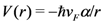 , could thereby be realized in topological graphene. Here we use the dimensionless impurity strength
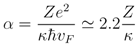 where
where  is the number of positive charges held by the impurity;
  a dielectric constant characterizing the environment; and
  m
m  s the Fermi velocity. Without SOI, the Hamiltonian is not self-adjoint for
  , and the potential needs short-distance regularization, e.g., by setting
  with short-distance cutoff
  of the order of the lattice constant of graphene [1,2]. Including a finite “mass” , i.e., the intrinsic SOI, but keeping , the critical coupling
  is shifted to [24]
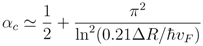 approaching the value
  for
for  . In the supercritical regime
  , the lowest bound state “dives” into the valence band continuum (Dirac sea). It then becomes a resonance with complex energy, where the imaginary part corresponds to the finite decay rate into the continuum. Below we show that the Rashba SOI provides an interesting twist to this supercriticality story. The structure of this article is as follows. In Section 2 we introduce the model and summarize its symmetries. The case of a circular potential well is addressed in Section 3 before turning to the Coulomb center in Section 4. Some conclusions are offered in Section 5. Note that we do not include a magnetic field (see, e.g., [28,29]) and thus our model enjoys time-reversal symmetry. Below, we often use units with
  .
.
, could thereby be realized in topological graphene. Here we use the dimensionless impurity strength
is the number of positive charges held by the impurity; a dielectric constant characterizing the environment; and m s the Fermi velocity. Without SOI, the Hamiltonian is not self-adjoint for , and the potential needs short-distance regularization, e.g., by setting with short-distance cutoff of the order of the lattice constant of graphene [1,2]. Including a finite “mass” , i.e., the intrinsic SOI, but keeping , the critical coupling is shifted to [24]
for . In the supercritical regime , the lowest bound state “dives” into the valence band continuum (Dirac sea). It then becomes a resonance with complex energy, where the imaginary part corresponds to the finite decay rate into the continuum. Below we show that the Rashba SOI provides an interesting twist to this supercriticality story. The structure of this article is as follows. In Section 2 we introduce the model and summarize its symmetries. The case of a circular potential well is addressed in Section 3 before turning to the Coulomb center in Section 4. Some conclusions are offered in Section 5. Note that we do not include a magnetic field (see, e.g., [28,29]) and thus our model enjoys time-reversal symmetry. Below, we often use units with .2. Model and Symmetries
2.1. Kane–Mele Model with Radially Symmetric Potential
We study the Kane–Mele model for a 2D graphene monolayer with both intrinsic ( ) and Rashba ( ) SOI [3] in the presence of a radially symmetric scalar potential  . Assuming that is sufficiently smooth to allow for the neglect of inter-valley scattering, the low-energy Hamiltonian near the
  point
point  is given by
 with Pauli matrices
  (
(  ) in sublattice (spin) space [1]. The Hamiltonian near the other valley (
  point) follows for
  in Equation (3). We note that a sign change of the Rashba SOI,
  , does not affect the spectrum due to the relation
  . Without loss of generality, we then put
  and
and  .
.
) and Rashba ( ) SOI [3] in the presence of a radially symmetric scalar potential . Assuming that is sufficiently smooth to allow for the neglect of inter-valley scattering, the low-energy Hamiltonian near the point is given by
( ) in sublattice (spin) space [1]. The Hamiltonian near the other valley ( point) follows for in Equation (3). We note that a sign change of the Rashba SOI, , does not affect the spectrum due to the relation . Without loss of generality, we then put and .Using polar coordinates, it is now straightforward to verify (see also [21]) that total angular momentum, defined as
 is conserved and has integer eigenvalues
  . For given , eigenfunctions of
  must then be of the form
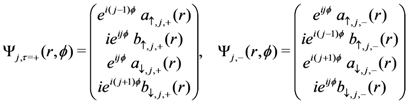 Next we combine the radial functions to (normalized) four-spinors
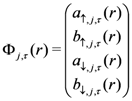
. For given , eigenfunctions of must then be of the form
In this representation, the radial Dirac equation for total angular momentum and valley index  reads
reads
 with Hermitian matrix operators (note that denotes the intrinsic SOI and not the Laplacian)
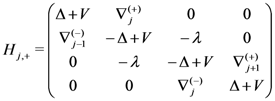
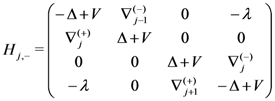 where we use the notation

and valley index reads
denotes the intrinsic SOI and not the Laplacian)
One easily checks that Equation (8) satisfies the parity symmetry relation
 Note that this “parity” operation for the radial Hamiltonian is non-standard in the sense that the valley is not changed by the transformation
  , spin and sublattice are flipped simultaneously, and only the
  -coordinate is reversed. (We will nonetheless refer to as parity transformation below.) A second symmetry relation connects both valleys,

, spin and sublattice are flipped simultaneously, and only the -coordinate is reversed. (We will nonetheless refer to as parity transformation below.) A second symmetry relation connects both valleys,
Using Equation (10), this relation can be traced back to a time-reversal operation. Equations (10) and (11) suggest that eigenenergies typically are four-fold degenerate.
When projected to the subspace of fixed (integer) total angular momentum , the current density operator has angular component  and radial component
  for arbitrary . When real-valued entries can be chosen in
  , the radial current density thus vanishes separately in each valley. We define the (angular) spin current density as
  . Remarkably, the transformation defined in Equation (11) conserves both (total and spin) angular currents, while the transformation in Equation (10) reverses the total current but conserves the spin current. Therefore, at any energy, eigenstates supporting spin-filtered counterpropagating currents are possible. However, in contrast to the edge states found in a ribbon geometry [3], these spin-filtered states do not necessarily have a topological origin.
, the current density operator has angular component and radial component for arbitrary . When real-valued entries can be chosen in , the radial current density thus vanishes separately in each valley. We define the (angular) spin current density as . Remarkably, the transformation defined in Equation (11) conserves both (total and spin) angular currents, while the transformation in Equation (10) reverses the total current but conserves the spin current. Therefore, at any energy, eigenstates supporting spin-filtered counterpropagating currents are possible. However, in contrast to the edge states found in a ribbon geometry [3], these spin-filtered states do not necessarily have a topological origin.We focus on one point (  ) and omit the
  -index henceforth; the degenerate
  Kramers partner easily follows using Equation (11). In addition, using the symmetry (10), it is sufficient to study the model for fixed total angular momentum
  .
.
point ( ) and omit the -index henceforth; the degenerate Kramers partner easily follows using Equation (11). In addition, using the symmetry (10), it is sufficient to study the model for fixed total angular momentum .2.2. Zero Total Angular Momentum
For arbitrary , we now show that a drastic simplification is possible for total angular momentum  , which can even allow for an exact solution. Although the lowest-lying bound states for the potentials in Section 3 and Section 4 are found in the
  sector, exact statements about what happens for are valuable and can be explored along the route sketched here.
, we now show that a drastic simplification is possible for total angular momentum , which can even allow for an exact solution. Although the lowest-lying bound states for the potentials in Section 3 and Section 4 are found in the sector, exact statements about what happens for are valuable and can be explored along the route sketched here.The reason why is special can be seen from the parity symmetry relation in Equation (10). The parity transformation connects the  sectors, but represents a discrete symmetry of the radial Hamiltonian
  [see Equation (8)] acting on the four-spinors in Equation (6). Therefore, the subspace can be decomposed into two orthogonal subspaces corresponding to the two distinct eigenvalues of the Hermitian operator . This operator is diagonalized by the matrix
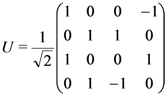

is special can be seen from the parity symmetry relation in Equation (10). The parity transformation connects the sectors, but represents a discrete symmetry of the radial Hamiltonian [see Equation (8)] acting on the four-spinors in Equation (6). Therefore, the subspace can be decomposed into two orthogonal subspaces corresponding to the two distinct eigenvalues of the Hermitian operator . This operator is diagonalized by the matrix
In fact, using this transformation matrix to carry out a similarity transformation, 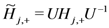 , we obtain
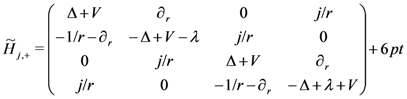 For , the upper and lower
  blocks decouple. Each block has the signature (“parity”)
  corresponding to the eigenvalues in Equation (13), and represents a mixed sublattice-spin state, see Equations (6) and (12).
, we obtain
, the upper and lower blocks decouple. Each block has the signature (“parity”) corresponding to the eigenvalues in Equation (13), and represents a mixed sublattice-spin state, see Equations (6) and (12).For parity , the block matrix in Equation (14) is formally identical to an effective problem with , fixed  , and the substitutions
 This implies that for and arbitrary , the complete spectral information for the full Kane–Mele problem (with ) directly follows from the solution.
, the block matrix in Equation (14) is formally identical to an effective problem with , fixed , and the substitutions
and arbitrary , the complete spectral information for the full Kane–Mele problem (with ) directly follows from the solution.2.3. Solution in Region with Constant Potential
We start our analysis of the Hamiltonian (3) with the general solution of Equation (7) for a region of constant potential. Here, it suffices to study  , since
  and
and  enter only through the combination
  in Equation (8). In Section 3, we will use this solution to solve the case of a step potential.
, since and enter only through the combination in Equation (8). In Section 3, we will use this solution to solve the case of a step potential.The general solution to Equation (7) follows from the Ansatz
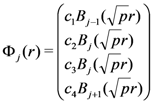 where the
  are real coefficients;
  is one of the cylinder (Bessel) functions;
  or
or  ; and
; and  denotes a real spectral parameter. In particular,
  is a generalized radial wavenumber. We here assume true bound-state solutions with real-valued energy. However, for quasi-stationary resonance states with complex energy, and the may be complex as well.
are real coefficients; is one of the cylinder (Bessel) functions; or ; and denotes a real spectral parameter. In particular, is a generalized radial wavenumber. We here assume true bound-state solutions with real-valued energy. However, for quasi-stationary resonance states with complex energy, and the may be complex as well.Using the Bessel function recurrence relation,  , the set of four coupled differential Equations (7) simplifies to a set of algebraic equations
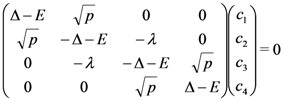 Notably, does not appear here, and therefore the spectral parameter depends only on the energy . The condition of vanishing determinant then yields a quadratic equation for , with the two solutions
 Which Bessel function is chosen in Equation (16) now depends on the sign of
  and on the imposed regularity conditions for
  and/or
  .
.
, the set of four coupled differential Equations (7) simplifies to a set of algebraic equations
does not appear here, and therefore the spectral parameter depends only on the energy . The condition of vanishing determinant then yields a quadratic equation for , with the two solutions
and on the imposed regularity conditions for and/or .For  , a solution regular at the origin is obtained by putting , which describes standing radial waves. Equation (17) then yields the unnormalized spinor
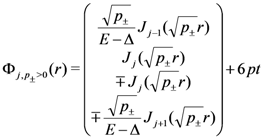
, a solution regular at the origin is obtained by putting , which describes standing radial waves. Equation (17) then yields the unnormalized spinor
For  , instead it is convenient to set in Equation (16). Using the identity
 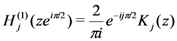 , the unnormalized spinor resulting from Equation (17) then takes the form
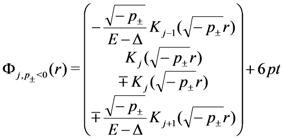 where the modified Bessel function
  describes evanescent modes, exponentially decaying at infinity.
, instead it is convenient to set in Equation (16). Using the identity , the unnormalized spinor resulting from Equation (17) then takes the form
describes evanescent modes, exponentially decaying at infinity.2.4. Solution without Potential
In a free system, i.e., when for all  , the only acceptable solution corresponding to a physical state is obtained when [30]. For
  , at least one in Equation (18) for all , and the system is gapless. However, the TI phase defined by has a gap as we show now.
for all , the only acceptable solution corresponding to a physical state is obtained when [30]. For , at least one in Equation (18) for all , and the system is gapless. However, the TI phase defined by has a gap as we show now.For , Equation (18) tells us that for  and for
  , both solutions are positive and hence (for given and ) there are two eigenstates
  for given energy . However, within the energy window [with
  in Equation (18)]
 we have
  and
and  , i.e., only the eigenstate
  represents a physical solution. Both are negative when
  , and no physical state exists at all. This precisely corresponds to the topological gap in the TI phase [3]. Note that due to the Rashba SOI, the valence band edge is characterized by the two energies , with halved density of states in the energy window (21). One may then ask at which energy (
  or
or  ) the supercritical diving of a bound state level in an impurity potential takes place.
, Equation (18) tells us that for and for , both solutions are positive and hence (for given and ) there are two eigenstates for given energy . However, within the energy window [with in Equation (18)]
and , i.e., only the eigenstate represents a physical solution. Both are negative when , and no physical state exists at all. This precisely corresponds to the topological gap in the TI phase [3]. Note that due to the Rashba SOI, the valence band edge is characterized by the two energies , with halved density of states in the energy window (21). One may then ask at which energy ( or ) the supercritical diving of a bound state level in an impurity potential takes place. 3. Circular Potential Well
3.1. Bound States
In this section, we study a circular potential well with radius and depth 
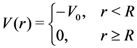
and depth
We always stay within the TI phase , where bound states are expected for energies  in the window
  . For
. For  , the corresponding radial eigenspinor [see Equation (6)] is written with arbitrary prefactors
  in the form
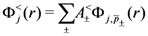 with Equation (19) for
  . Here, the
  follow from Equation (18) by including the potential shift,
 For
For  , the general solution is again written as
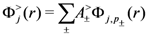 However, now is given by Equation (20), since for true bound states with only evanescent states outside the potential well.
, where bound states are expected for energies in the window . For , the corresponding radial eigenspinor [see Equation (6)] is written with arbitrary prefactors in the form
. Here, the follow from Equation (18) by including the potential shift,
, the general solution is again written as
is given by Equation (20), since for true bound states with only evanescent states outside the potential well.The continuity condition for the four-spinor at the potential step, 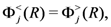 then yields a homogeneous linear system of equations for the four parameters (
  ). A nontrivial solution is only possible when the determinant of the corresponding
  matrix
  (which is too lengthy to be given here but follows directly from the above expressions) vanishes
 Solving the energy quantization condition (26) then yields the discrete bound-state spectrum (
  ). It is then straightforward to determine the corresponding spinor wavefunctions.
then yields a homogeneous linear system of equations for the four parameters ( ). A nontrivial solution is only possible when the determinant of the corresponding matrix (which is too lengthy to be given here but follows directly from the above expressions) vanishes
). It is then straightforward to determine the corresponding spinor wavefunctions.Numerical solution of Equation (26) yields the bound-state spectrum shown in Figure 1. When  exceeds a ( -dependent) “threshold” value,
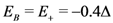
  , a bound state splits off the conduction band edge. When increasing further, this bound-state energy level moves down almost linearly, cf. inset of Figure 1, and finally reaches the valence band edge
  at some “critical” value
  . (For , we will see below that this definition needs some revision.) Increasing even further, the bound state is then expected to dive into the valence band and become a finite-width supercritical resonance, i.e., the energy would then acquire an imaginary part.
exceeds a ( -dependent) “threshold” value, , a bound state splits off the conduction band edge. When increasing further, this bound-state energy level moves down almost linearly, cf. inset of Figure 1, and finally reaches the valence band edge at some “critical” value . (For , we will see below that this definition needs some revision.) Increasing even further, the bound state is then expected to dive into the valence band and become a finite-width supercritical resonance, i.e., the energy would then acquire an imaginary part.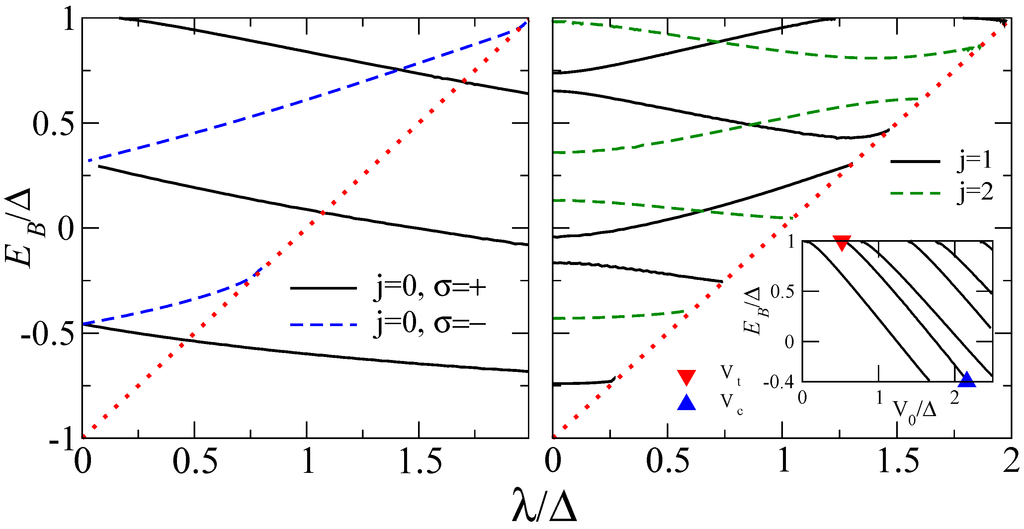
Figure 1.
Bound-state spectrum ( ) vs. Rashba SOI ( ) for a circular potential well with depth  and radius
  . Only the lowest-energy states with
  are shown. The red dotted line indicates . The left panel shows bound states with parity . The right panel shows
  bound states. The inset displays the bound-state energies vs. potential depth for
  . At some threshold value
  (where
  for the lowest state shown), a new bound state emerges from the conduction band. This state dives into the valence band for some critical value
  , where the valence band edge is at energy
  . For the second bound state in the inset, (
  ) is shown as red (blue) triangle.
) vs. Rashba SOI ( ) for a circular potential well with depth and radius . Only the lowest-energy states with are shown. The red dotted line indicates . The left panel shows bound states with parity . The right panel shows bound states. The inset displays the bound-state energies vs. potential depth for . At some threshold value (where for the lowest state shown), a new bound state emerges from the conduction band. This state dives into the valence band for some critical value , where the valence band edge is at energy . For the second bound state in the inset, ( ) is shown as red (blue) triangle.
3.2. Zero Angular Momentum States
Surprisingly, for , we find a different scenario where supercritical diving, with finite lifetime of the resonance, happens only for half of the bound states entering the energy window (21). Noting that states with different parity do not mix, see Section 2.2, we observe that all  bound states enter the valence band as true bound states (no imaginary part) throughout the energy window (21) while the valence band continuum is spanned by the
  states. We then define for
  bound states as the true supercritical threshold where
  . However, the
  bound states become supercritical already when reaching .
, we find a different scenario where supercritical diving, with finite lifetime of the resonance, happens only for half of the bound states entering the energy window (21). Noting that states with different parity do not mix, see Section 2.2, we observe that all bound states enter the valence band as true bound states (no imaginary part) throughout the energy window (21) while the valence band continuum is spanned by the states. We then define for bound states as the true supercritical threshold where . However, the bound states become supercritical already when reaching .Therefore an intriguing physical situation arises for in the energy window (21). While states are true bound states (no lifetime broadening), they coexist with states which span the valence band continuum or possibly form supercritical resonances. For , however, all bound states dive, become finite-width resonances, and eventually become dissolved in the continuum.
in the energy window (21). While states are true bound states (no lifetime broadening), they coexist with states which span the valence band continuum or possibly form supercritical resonances. For , however, all bound states dive, become finite-width resonances, and eventually become dissolved in the continuum.3.3. Threshold for Bound States
Returning to arbitrary total angular momentum , we observe that whenever hits a possible threshold value , a new bound state is generated, which then dives into the valence band at another potential depth (and so on). Analytical results for all possible threshold values follow by expanding Equation (26) for weak dimensionless binding energy  For
For  and , Equation (26) yields after some algebra

 where
where  is the Euler constant and
  . The binding energy approaches zero for
  , where Equation (27) simplifies to
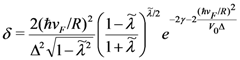 For vanishing Rashba SOI , this reproduces known results [25]. For any
  , we observe that the bound state in Equation (28) exists for arbitrarily shallow potential depth .
, we observe that whenever hits a possible threshold value , a new bound state is generated, which then dives into the valence band at another potential depth (and so on). Analytical results for all possible threshold values follow by expanding Equation (26) for weak dimensionless binding energy For and , Equation (26) yields after some algebra
is the Euler constant and . The binding energy approaches zero for , where Equation (27) simplifies to
, this reproduces known results [25]. For any , we observe that the bound state in Equation (28) exists for arbitrarily shallow potential depth .The threshold values for higher-lying bound states also follow from the binding energy (27), since  vanishes for
  and for
  . When one of these two conditions is fulfilled at some , a new bound state appears for potential depth above . This statement is in fact quite general: By similar reasoning, we find that the threshold values for follow by counting the zeroes of
  . Without SOI, this has also been discussed in [31]. Note that this argument immediately implies that no bound state with exists for .
for higher-lying bound states also follow from the binding energy (27), since vanishes for and for . When one of these two conditions is fulfilled at some , a new bound state appears for potential depth above . This statement is in fact quite general: By similar reasoning, we find that the threshold values for follow by counting the zeroes of . Without SOI, this has also been discussed in [31]. Note that this argument immediately implies that no bound state with exists for .From the above equations, we can then infer the threshold values for all bound states with or in analytical form. These are labeled by  and (for ,
  corresponds to parity)
 where
where  is the
  th zero of the
  Bessel function.
for all bound states with or in analytical form. These are labeled by and (for , corresponds to parity)
is the th zero of the Bessel function.Likewise, for  , the condition for the appearance of a new bound state is
 Close examination of this condition shows that no bound states with exist for . We conclude that bound states in a very weak potential well exist only for .
, the condition for the appearance of a new bound state is
exist for . We conclude that bound states in a very weak potential well exist only for .3.4. Supercritical Behavior
As can be seen in Figure 1, the lowest bound state is also the first to enter the valence band continuum for . For , the critical value is known to be [25]
 with
with  . The energy of the resonant state acquires an imaginary part for
  [25]. For
  , we have obtained implicit expressions for , plotted in Figure 2. Note that these results reproduce Equation (31) for
  . The almost linear decrease of with increasing , see Figure 2, can be rationalized by noting that the valence band edge is located at . Thereby supercritical resonances could be reached already for lower potential depth by increasing the Rashba SOI. Similarly, with increasing disk radius , the critical value decreases, see the inset of Figure 2. For the lowest
  bound state, the critical value in fact follows in analytical form,
 where
where  .
.
bound state is also the first to enter the valence band continuum for . For , the critical value is known to be [25]
. The energy of the resonant state acquires an imaginary part for [25]. For , we have obtained implicit expressions for , plotted in Figure 2. Note that these results reproduce Equation (31) for . The almost linear decrease of with increasing , see Figure 2, can be rationalized by noting that the valence band edge is located at . Thereby supercritical resonances could be reached already for lower potential depth by increasing the Rashba SOI. Similarly, with increasing disk radius , the critical value decreases, see the inset of Figure 2. For the lowest bound state, the critical value in fact follows in analytical form,
.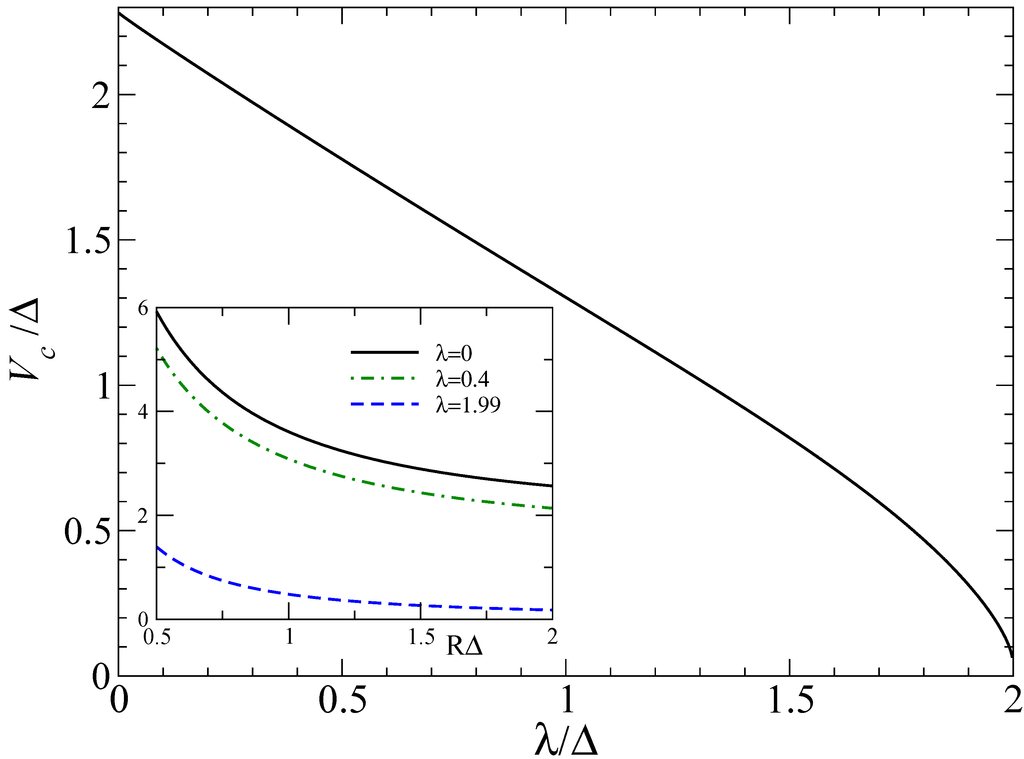
Figure 2.
Critical potential depth for the lowest bound state level in a disk with  . The obtained value matches the analytical prediction
  from Equation (31), while
  near the border of the TI phase (
  ). Inset: vs. radius with several values of (given in units of ) for the lowest bound state.
for the lowest bound state level in a disk with . The obtained value matches the analytical prediction from Equation (31), while near the border of the TI phase ( ). Inset: vs. radius with several values of (given in units of ) for the lowest bound state.
Since the parity decoupling in Section 2.2 only holds for , it is natural to expect that all  bound states turn into finite-width resonances when
  . This expectation is confirmed by an explicit calculation as follows. Within in the window
  , a true bound state should not receive a contribution from
  for , but instead has to be obtained by matching an Ansatz as in Equation (23) for the spinor state inside the disk ( ) to an evanescent spinor state
 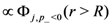 . However, the matching condition is then found to have no real solution , i.e., there are no true bound states with in the energy window (21). We therefore conclude that all bound states turn supercritical when . Note that this statement includes the lowest-lying bound state (which has ). This implies that a finite Rashba SOI can considerably lower the potential depth required for entering the supercritical regime.
, it is natural to expect that all bound states turn into finite-width resonances when . This expectation is confirmed by an explicit calculation as follows. Within in the window , a true bound state should not receive a contribution from for , but instead has to be obtained by matching an Ansatz as in Equation (23) for the spinor state inside the disk ( ) to an evanescent spinor state . However, the matching condition is then found to have no real solution , i.e., there are no true bound states with in the energy window (21). We therefore conclude that all bound states turn supercritical when . Note that this statement includes the lowest-lying bound state (which has ). This implies that a finite Rashba SOI can considerably lower the potential depth required for entering the supercritical regime.4. Coulomb Center
We now turn to the Coulomb potential,  , generated by a positively charged impurity located at the origin, with the dimensionless coupling strength
  in Equation (1). We consider only the TI phase and analyze the bound-state spectrum and conditions for supercriticality. Again, without loss of generality, we focus on the point only ( ), and first summarize the known solution for [2,21,24]. In that case,
  is conserved, and the spin-degenerate bound-state energies are labeled by the integer angular momentum and a radial quantum number
  (for
(for  ,
,  is also possible)
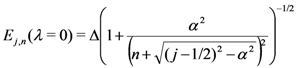 The corresponding eigenstates then follow in terms of hypergeometric functions. The lowest bound state is
 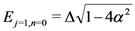 , which dives when
  ; note that precisely corresponds to in Section 3. In particular, for (
  states we define in the same manner. Next we discuss how this picture is modified when the Rashba coupling is included.
, generated by a positively charged impurity located at the origin, with the dimensionless coupling strength in Equation (1). We consider only the TI phase and analyze the bound-state spectrum and conditions for supercriticality. Again, without loss of generality, we focus on the point only ( ), and first summarize the known solution for [2,21,24]. In that case, is conserved, and the spin-degenerate bound-state energies are labeled by the integer angular momentum and a radial quantum number (for , is also possible)
, which dives when ; note that precisely corresponds to in Section 3. In particular, for ( states we define in the same manner. Next we discuss how this picture is modified when the Rashba coupling is included.Following the arguments in Section 2.2 for , the combination of Equation (33) with Equation (15) immediately yields the exact bound-state energy spectrum ( )
 The corresponding eigenstates then also follow from [21,24]. The very same reasoning also applies to a regularized
  potential [23,24], where
  is replaced by the constant value
  . Here, is a short-distance cutoff scale of the order of the lattice spacing. The solution of the bound-state problem then requires a wavefunction matching procedure, which has been carried out in [24]. Thereby we can already infer all bound states for .
, the combination of Equation (33) with Equation (15) immediately yields the exact bound-state energy spectrum ( )
potential [23,24], where is replaced by the constant value . Here, is a short-distance cutoff scale of the order of the lattice spacing. The solution of the bound-state problem then requires a wavefunction matching procedure, which has been carried out in [24]. Thereby we can already infer all bound states for .Figure 3 shows the resulting bound-state spectrum vs. for the regularized Coulomb potential. Within the energy window Equation (21), we again find that states with parity remain true bound states that dive only for  , while states show supercritical diving already for . Figure 4 shows the corresponding critical couplings for , where the lowest bound state with parity turns supercritical. Note that for finite and , a unique value for is found, while for two different critical values for are found. However, this conclusion holds only for finite regularization parameter , i.e., it is non-universal. As seen in the inset of Figure 4, in the limit , both critical values for approach again, which is the value found without SOI.
bound-state spectrum vs. for the regularized Coulomb potential. Within the energy window Equation (21), we again find that states with parity remain true bound states that dive only for , while states show supercritical diving already for . Figure 4 shows the corresponding critical couplings for , where the lowest bound state with parity turns supercritical. Note that for finite and , a unique value for is found, while for two different critical values for are found. However, this conclusion holds only for finite regularization parameter , i.e., it is non-universal. As seen in the inset of Figure 4, in the limit , both critical values for approach again, which is the value found without SOI.Finally, for , we can then draw the same qualitative conclusions as in Section 3.4 for the potential well. In particular, we expect that all bound states turn supercritical when their energy reaches the continuum threshold at  .
.
, we can then draw the same qualitative conclusions as in Section 3.4 for the potential well. In particular, we expect that all bound states turn supercritical when their energy reaches the continuum threshold at .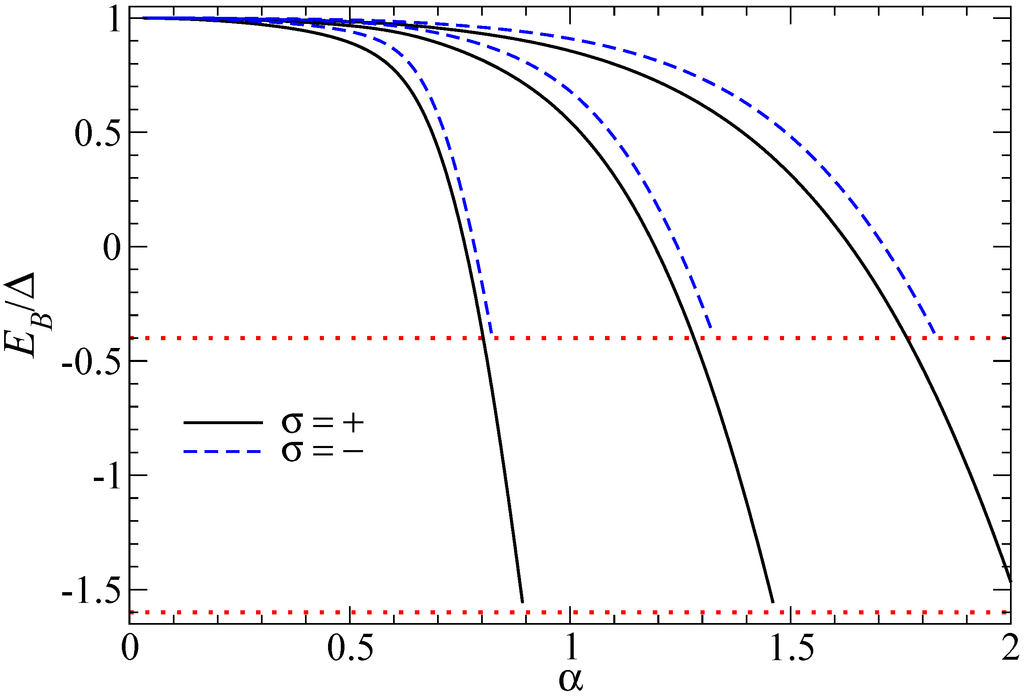
Figure 3.
Bound state energies with angular momentum ( in units of ) vs. dimensionless impurity strength for the Coulomb problem with regularization parameter  and Rashba SOI . Solid black (dashed blue) curves correspond to parity ( ). Results for radial number
  (with increasing energy) are shown. Red dotted lines denote
  .
.
( in units of ) vs. dimensionless impurity strength for the Coulomb problem with regularization parameter and Rashba SOI . Solid black (dashed blue) curves correspond to parity ( ). Results for radial number (with increasing energy) are shown. Red dotted lines denote .
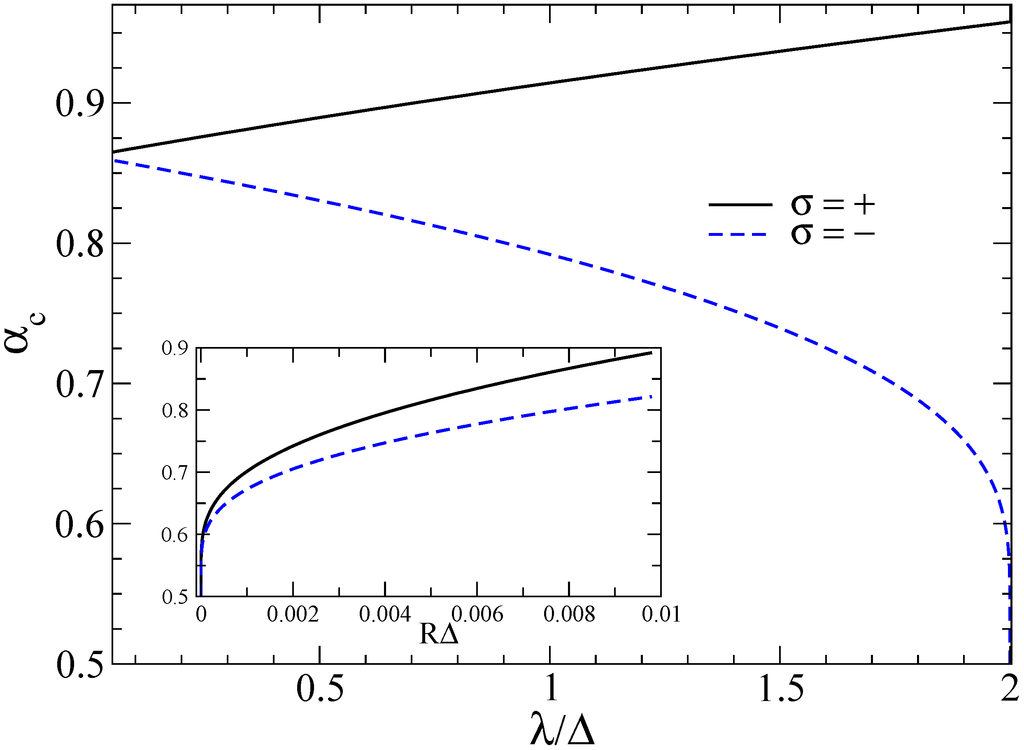
Figure 4.
Main panel: Critical Coulomb impurity strength vs. Rashba SOI for and the lowest bound states. Inset: vs. cutoff scale for .
vs. Rashba SOI for and the lowest bound states. Inset: vs. cutoff scale for .
5. Conclusions
In this work, we have analyzed the bound-state problem for the Kane–Mele model of graphene with intrinsic ( ) and Rashba ( ) spin-orbit couplings when a radially symmetric attractive potential is present. We have focused on the most interesting “topological insulator” phase with . The Rashba term leads to a restructuring of the valence band, with a halving of the density of states in the window  , where
  . This has spectacular consequences for total angular momentum , where the problem can be decomposed into two independent parity sectors ( ). The states remain true bound states even inside the above window and coexist with the continuum solutions as well as possible supercritical resonances in the sector. However, all bound states exhibit supercritical diving for
  , where the critical threshold ( or for the disk or the Coulomb problem, respectively) is lowered when the Rashba term is present. We hope that these results will soon be put to an experimental test.
) and Rashba ( ) spin-orbit couplings when a radially symmetric attractive potential is present. We have focused on the most interesting “topological insulator” phase with . The Rashba term leads to a restructuring of the valence band, with a halving of the density of states in the window , where . This has spectacular consequences for total angular momentum , where the problem can be decomposed into two independent parity sectors ( ). The states remain true bound states even inside the above window and coexist with the continuum solutions as well as possible supercritical resonances in the sector. However, all bound states exhibit supercritical diving for , where the critical threshold ( or for the disk or the Coulomb problem, respectively) is lowered when the Rashba term is present. We hope that these results will soon be put to an experimental test.Acknowledgements
This work has been supported by the DFG within the network programs SPP 1459 and SFB-TR 12.
References
- Castro Neto, A.H.; Guinea, F.; Peres, N.M.R.; Novoselov, K.S.; Geim, A. The electronic properties of graphene. Rev. Mod. Phys. 2009, 81, 109–162. [Google Scholar] [CrossRef]
- Kotov, V.N.; Uchoa, B.; Pereira, V.M.; Guinea, F.; Castro Neto, A.H. Electron-electron interactions in graphene: Current status and perspectives. Rev. Mod. Phys. 2012, 84, 1067–1125. [Google Scholar] [CrossRef]
- Kane, C.L.; Mele, E.J. Quantum spin hall effect in graphene. Phys. Rev. Lett. 2005, 95, 226801:1–226801:4. [Google Scholar]
- Hasan, M.Z.; Kane, C.L. Topological insulators. Rev. Mod. Phys. 2010, 82, 3045–3067. [Google Scholar] [CrossRef]
- Huertas-Hernando, D.; Guinea, F.; Brataas, A. Spin-orbit coupling in curved graphene, fullerenes, nanotubes, and nanotube caps. Phys. Rev. B 2006, 74, 155426:1–155426:15. [Google Scholar]
- Min, H.; Hill, J.E.; Sinitsyn, N.A.; Sahu, B.R.; Kleinman, L.; MacDonald, A.H. Intrinsic and Rashba spin-orbit interactions in graphene sheets. Phys. Rev. B 2006, 74, 165310:1–165310:5. [Google Scholar]
- Yao, Y.; Ye, F.; Qi, X.L.; Zhang, S.C.; Fang, Z. Spin-orbit gap of graphene: First-principles calculations. Phys. Rev. B 2007, 75, 041401(R):1–041401(R):4. [Google Scholar]
- Weeks, C.; Hu, J.; Alicea, J.; Franz, M.; Wu, R. Engineering a robust quantum spin hall state in graphene via adatom deposition. Phys. Rev. X 2011, 1, 021001:1–021001:15. [Google Scholar]
- Shevtsov, O.; Carmier, P.; Groth, C.; Waintal, X.; Carpentier, D. Graphene-based heterojunction between two topological insulators. Phys. Rev. X 2012, 2, 031004:1–031004:10. [Google Scholar]
- Shevtsov, O.; Carmier, P.; Groth, C.; Waintal, X.; Carpentier, D. Tunable thermopower in a graphene-based topological insulator. Phys. Rev. B 2012, 85, 245441:1–245441:7. [Google Scholar]
- Jiang, H.; Qiao, Z.; Liu, H.; Shi, J.; Niu, Q. Stabilizing topological phases in graphene via random adsorption. Phys. Rev. Lett. 2012, 109, 116803:1–116803:5. [Google Scholar]
- Bercioux, D.; de Martino, A. Spin-resolved scattering through spin-orbit nanostructures in graphene. Phys. Rev. B 2010, 81, 165410:1–165410:9. [Google Scholar] [CrossRef]
- Lenz, L.; Bercioux, D. Dirac-Weyl electrons in a periodic spin-orbit potential. Europhys. Lett. 2011, 96, 27006:1–27006:6. [Google Scholar]
- Wang, Y.; Brar, V.W.; Shytov, A.V.; Wu, Q.; Regan, W.; Tsai, H.Z.; Zettl, A.; Levitov, L.S.; Crommie, M.F. Mapping dirac quasiparticles near a single coulomb impurity on graphene. Nat. Phys. 2012, 8, 653–657. [Google Scholar] [CrossRef]
- Katsnelson, M.I. Nonlinear screening of charge impurities in graphene. Phys. Rev. B 2006, 74, 201401(R):1–201401(R):3. [Google Scholar]
- Pereira, V.M.; Nilsson, J.; Castro Neto, A.H. Coulomb impurity problem in graphene. Phys. Rev. Lett. 2007, 99, 166802:1–166802:4. [Google Scholar]
- Shytov, A.V.; Katsnelson, M.I.; Levitov, L.S. Vacuum polarization and screening of supercritical impurities in graphene. Phys. Rev. Lett. 2007, 99, 236801:1–236801:5. [Google Scholar]
- Shytov, A.V.; Katsnelson, M.I.; Levitov, L.S. Atomic collapse and quasi-rydberg states in graphene. Phys. Rev. Lett. 2007, 99, 246802:1–246802:5. [Google Scholar]
- Biswas, R.R.; Sachdev, S.; Son, D.T. Coulomb impurity in graphene. Phys. Rev. B 2007, 76, 205122:1–205122:5. [Google Scholar]
- Fogler, M.M.; Novikov, D.S.; Shklovskii, B.I. Screening of a hypercritical charge in graphene. Phys. Rev. B 2007, 76, 233402:1–233402:4. [Google Scholar]
- Novikov, D.S. Elastic scattering theory and transport in graphene. Phys. Rev. B 2007, 76, 245435:1–245435:17. [Google Scholar]
- Terekhov, I.S.; Milstein, A.I.; Kotov, V.I.; Sushkov, O.P. Screening of coulomb impurities in graphene. Phys. Rev. Lett. 2008, 100, 076803:1–076803:4. [Google Scholar]
- Pereira, V.M.; Kotov, V.N.; Castro Neto, A.H. Supercriticial coulomb impurities in gapped graphene. Phys. Rev. B 2008, 78, 085101:1–085101:8. [Google Scholar]
- Gamayun, O.B.; Gorbar, E.V.; Gusynin, V.P. Supercritical coulomb center and excitonic instability in graphene. Phys. Rev. B 2009, 80, 165429:1–165429:14. [Google Scholar]
- Gamayun, O.B.; Gorbar, E.V.; Gusynin, V.P. Magnetic field driven instability of a charged center in graphene. Phys. Rev. B 2011, 83, 235104:1–235104:9. [Google Scholar]
- Zhu, J.L.; Sun, S.; Yang, N. Dirac donor states controlled by magnetic field in gapless and gapped graphene. Phys. Rev. B 2012, 85, 035429:1–035429:9. [Google Scholar]
- Huertas-Hernando, D.; Guinea, F.; Brataas, A. Spin-orbit mediated spin relaxation in graphene. Phys. Rev. Lett. 2009, 103, 146801:1–146801:4. [Google Scholar]
- Rashba, E.I. Graphene with structure-induced spin-orbit coupling: Spin-polarized states, spin zero modes, and quantum Hall effect. Phys. Rev. B 2009, 79, 161409(R):1–161409(R):4. [Google Scholar]
- De Martino, A.; Hütten, A.; Egger, R. Landau levels, edge states, and strained magnetic waveguides in graphene monolayers with enhanced spin-orbit interaction. Phys. Rev. B 2011, 84, 155420:1–155420:12. [Google Scholar]
- Rakyta, P.; Kormanyos, A.; Cserti, J. Trigonal warping and anisotropic band splitting in monolayer graphene due to Rashba spin-orbit coupling. Phys. Rev. B 2010, 82, 113405:1–113405:4. [Google Scholar]
- Bardarson, J.H.; Titov, M.; Brouwer, P.W. Electrostatic confinement of electrons in an integrable graphene quantum dot. Phys. Rev. Lett. 2009, 102, 226803:1–226803:4. [Google Scholar]
© 2013 by the authors; licensee MDPI, Basel, Switzerland. This article is an open-access article distributed under the terms and conditions of the Creative Commons Attribution license (http://creativecommons.org/licenses/by/3.0/).