


Line Defects in Quasicrystals


Institute for Mechanics, Technical University of Darmstadt, D-64287 Darmstadt, Germany
Crystals 2025, 15(3), 275; https://doi.org/10.3390/cryst15030275
Submission received: 16 February 2025
/
Revised: 6 March 2025
/
Accepted: 7 March 2025
/
Published: 17 March 2025
(This article belongs to the Section Inorganic Crystalline Materials)
Abstract
The six-dimensional framework of the integral formalism for line defects (straight dislocations and line forces) in anisotropic elasticity has been extended to a -dimensional integral formalism for line defects in quasicrystals ( for one-, two-, and three-dimensional quasicrystals) including phonon and phason fields. The elastic fields of a line defect in a quasicrystal have a surprisingly simple and compact form in the integral formalism of quasicrystals.
1. Introduction
Quasicrystals represent an important class of novel materials discovered by Shechtman et al. [1]. In 2011, Shechtman received the Nobel Prize in Chemistry for this discovery. Quasicrystals belong to aperiodic crystals and possess a long-range orientational order but no translational symmetry in the quasiperiodic directions. Quasicrystals possess particular physical properties like high hardness, low conductivity, resistivity decreases with temperature, very low conductivity, small specific heat, low friction coefficients, and wear and oxidation resistance [2]. Quasicrystalline substances have many promising technological applications (see [3]). The basis of the continuum theory of solid quasicrystals consists of two elementary excitations: the phonons and the phasons [4,5,6]. Phonons are related to the translation of atoms, and phasons lead to the local rearrangements of atoms in a cell. The generalized elasticity theory of quasicrystals including phonon and phason fields was developed by Ding et al. [7].
Dislocations are important line defects in quasicrystals causing plasticity in quasicrystals (see [5,6,8,9,10,11,12,13]). The fields of dislocations in quasicrystals consist of phonon and phason parts. A dislocation in a quasicrystal can be considered as a “hyperdislocation” in the hyperlattice by means of a generalized Volterra process. Because the hyperlattice is periodic, the generalized Volterra process can be understood as the insertion or removal of a hyper-half plane (e.g., [14]). The Burgers vector of the “hyperdislocation” consists of phonon and phason components. A “hyperdislocation” is a line defect in a quasicrystal characterized by the Burgers vector and the direction of the dislocation line. For a perfect dislocation in a quasicrystal, both phonon and phason components are non-zero, and the Burgers vector is a lattice vector in the hyperspace. If the phason component is zero, then there exists a stacking fault along the cutting surface of the generalized Volterra process, and such a dislocation represents a partial dislocation since the phonon component alone is not a lattice vector in hyperspace (see [9,11,14]). Important defects in the approximants of quasicrystals are so-called metadislocations. Metadislocations are highly complex defects, including about 1000 atoms in the dislocation core [15,16]. In particular, metadislocations are specific partial dislocations characterized by Burgers vectors that correspond to certain short interatomic distances inside the crystallographic motif of the structure [17].
Using generalized elasticity theory of quasicrystals, the basic key equations of dislocations were given by Ding et al. [18,19] and Lazar and Agiasofitou [20]. The dislocation fields of dislocation loops in quasicrystals were given by Lazar and Agiasofitou [20]. The general expressions for the displacement fields induced by straight dislocations in quasicrystals in terms of the elastic Green tensor were given by Ding et al. [18,19]. Ding et al. [21] extended the Stroh formalism [22,23] and the integral formalism [24,25] for the displacement field of a dislocation in a quasicrystal (see also [11,26]). Ding et al. [21] derived the integral formalism from the Stroh formalism for quasicrystals using the eigenvectors and eigenvalues of the Stroh formalism. The Stroh formalism [22,23] is a complex variable formulation originally developed for solving the problems of two-dimensional linear anisotropic elasticity. The extended Stroh formalism was used by Li and Liu [27] to study a dislocation in an icosahedral quasicrystal. Radi and Mariano [28] investigated the steady-state propagation of dislocations in quasicrystals based on the extended Stroh formalism. Line defects in crystals and in quasicrystals are straight dislocations and line forces (see [29,30,31]). The detailed structure of the extended Stroh formalism including line defects for quasicrystals was given by Wang and Schiavone [31]. In the Stroh formalism, the fields of line defects are given as complex form solutions of an eigenvalue problem and in the integral formalism, and the fields of line defects are given as real form solutions of a matrix partial differential equation of the first order (see [30]). The integral formalism provides suitable expressions for the modeling of line defects. In approaches like the Stroh formalism and the integral formalism, which are based on anisotropic elasticity theory, a dislocation is considered as a Dirac -dislocation, leading to singularities in the elastic fields at the dislocation line. In particular, the elastic distortion and stress fields of line defects possess the typical -behavior. In the framework of the linear generalized elasticity of quasicrystals, we work in the limit of the vanishing phason self-action. However, a phason self-action can become important in the core region of dislocations in quasicrystals (see [16]).
The purpose of this work is to develop the extended integral formalism of line defects (straight dislocations and line forces) for quasicrystals in a straightforward manner without an unnecessary detour via the Stroh formalism. For the generalized plane strain of quasicrystals, we derive the appropriate two-dimensional matrix partial differential equation of the first order and their solution. The solution for the displacement fields and stress functions of line defects is logarithmic in the distance between field and source points plus an angular term. For quasicrystals, the solution gives the -dimensional vector of the n-dimensional displacement vector and the n-dimensional stress function vector of a straight dislocation with the Burgers vector and a line force of strength . In order to complete the integral formalism for quasicrystals, we compute the extended elastic distortion tensor, the extended stress tensor, and the self-energy for straight dislocations and line forces in quasicrystals. Using the integral formalism, the Peach–Koehler force for straight dislocations and the Cherepanov force for line forces present in quasicrystals are given. Moreover, the two-dimensional Green tensor of quasicrystals is derived in the framework of the integral formalism.
2. Basic Equations for Quasicrystals
An -dimensional quasicrystal can be generated by the projection of an n-dimensional periodic structure to the three-dimensional physical space (). The n-dimensional hyperspace can be decomposed into the direct sum of two orthogonal subspaces,
where is the three-dimensional physical or parallel space of the phonon fields, and is the -dimensional perpendicular space of the phason fields. The symbol ⊕ denotes the direct sum. For , we speak of one-dimensional, two-dimensional, and three-dimensional quasicrystals with the dimension of the corresponding hyperspace 4D, 5D, 6D, respectively. Here, indices in the parallel space are denoted by small Latin letters with , and indices in the perpendicular space are denoted by Greek letters with for one-dimensional quasicrystals (with quasiperiodicity in -direction), for two-dimensional quasicrystals (with quasiperiodicity in -plane), and for three-dimensional quasicrystals. Throughout the text, phonon fields are denoted by , and phason fields by . All field quantities (phonon and phason fields) depend on the so-called material space coordinates (or spatial coordinates) . Note that in the linear theory of quasicrystals, the material space coincides with the parallel space.
In the theory of the generalized elasticity of quasicrystals, the (elastic) phonon and phason distortion tensors and are defined as the gradient of the phonon displacement vector () and of the phason displacement vector (), respectively,
Here denotes the partial differentiation with respect to the spatial coordinates . The constitutive relations for quasicrystals are given by
where and are the phonon and phason stress tensors, respectively. Note that the phonon stress tensor is symmetric, , whereas the phason stress tensor is an asymmetric two-point tensor, (see [20,32]). is the tensor of the elastic moduli of phonons, is the tensor of the elastic moduli of phasons, and is the tensor of the elastic moduli of the phonon–phason coupling. The constitutive tensors possess the symmetries [7,20]
Using the hyperspace notation of quasicrystals introduced by Lazar and Agiasofitou [20], the phonon and phason fields can be unified in the corresponding extended fields in the hyperspace. The components of the extended fields will be denoted by capital letters, e.g., . In the hyperspace notation, we have the extended displacement vector :
the extended elastic distortion tensor :
the extended stress tensor :
and the tensor of the extended elastic moduli :
Here, ⊗ denotes the tensor (or dyadic) product. The tensor retains the major symmetry
and must be positive definite to ensure a positive elastic energy density:
Using the hyperspace notation, Equations (2) and (3) reduce to
and the constitutive relations (4) and (5) become
which is the extended Hooke law for quasicrystals.
In absence of external forces, the extended stress tensor (9) can be written in terms of an extended stress function tensor :
with
where and are the phonon and phason stress function tensors, respectively. Here, denotes the three-dimensional Levi–Civita tensor. Substituting Equation (15) into the left-hand side of the extended Hooke law (14), we obtain
which is nothing but the extended Hooke law (14) written in terms of and as a partial differential equation of the first order.
3. Two-Dimensional Generalized Anisotropic Elasticity for Quasicrystals
We consider the framework of the generalized plane strain of quasicrystals. In general, the plane strain and antiplane strain fields do not decouple due to the anisotropy. If we choose Cartesian coordinates, then, in the generalized plane strain, all fields are independent of the variable , and all derivatives with respect to vanish, . Therefore, the extended displacement fields depend only on and , but with the index in the hyperspace: , and thus .
Consider a Cartesian coordinate system in the parallel space. Using a unit vector in the -direction and a unit vector in the -direction (, ) and the notation
which is an matrix in the hyperspace with the property
or, alternatively,
which follows from the major symmetry of , Equation (11), the extended constitutive relation (14) reads for the generalized plane strain
with . Here, the superscript T indicates transposition. In matrix form, Equations (21) and (22) become
where the constitutive tensor for the generalized plane strain is a symmetric matrix with four blocks in the hyperspace
The following holds: or, alternatively, .
For the generalized plane strain, the extended stress tensor can be written in terms of an extended stress function vector , and Equation (15) reduces to
which is valid in the absence of external forces. Then, it yields
Substituting Equations (13), (26) and (27) into the extended Hooke law (21) and (22), we obtain
Equations (28) and (29), which have the meaning of the extended Hooke law (14) written in terms of and for the generalized plane strain, are the two components of Equation (17) for the generalized plane strain with .
Using the n-field vectors and in the hyperspace, the system of Equations (28) and (29) can be written in compact form
By multiplying Equation (31) by and inserting the resulting into Equation (30), it can be observed that the system of Equations (30) and (31) is equivalent to the following matrix partial differential equation of the first order
This is the matrix differential equation for the generalized plane strain of quasicrystals. Here, we introduce the -vector of the extended displacement vector and the extended stress function vector for generalized plane strain
and the real matrix is defined by its blocks in the hyperspace
Here, is the identity matrix. The matrix is the fundamental elasticity matrix for quasicrystals depending on the elastic constants of quasicrystals. It is the generalization of the fundamental elasticity matrix of anisotropic elasticity (see [29,30]). The matrix is written in four blocks. The northwest and southeast blocks of are transposes of each other, and the northeast and southwest blocks are symmetric. Note that the eigenvalue problem of the matrix given in Equation (34) leads to the generalized Stroh formalism for quasicrystals as given by Ding et al. [21] (see also [31]).
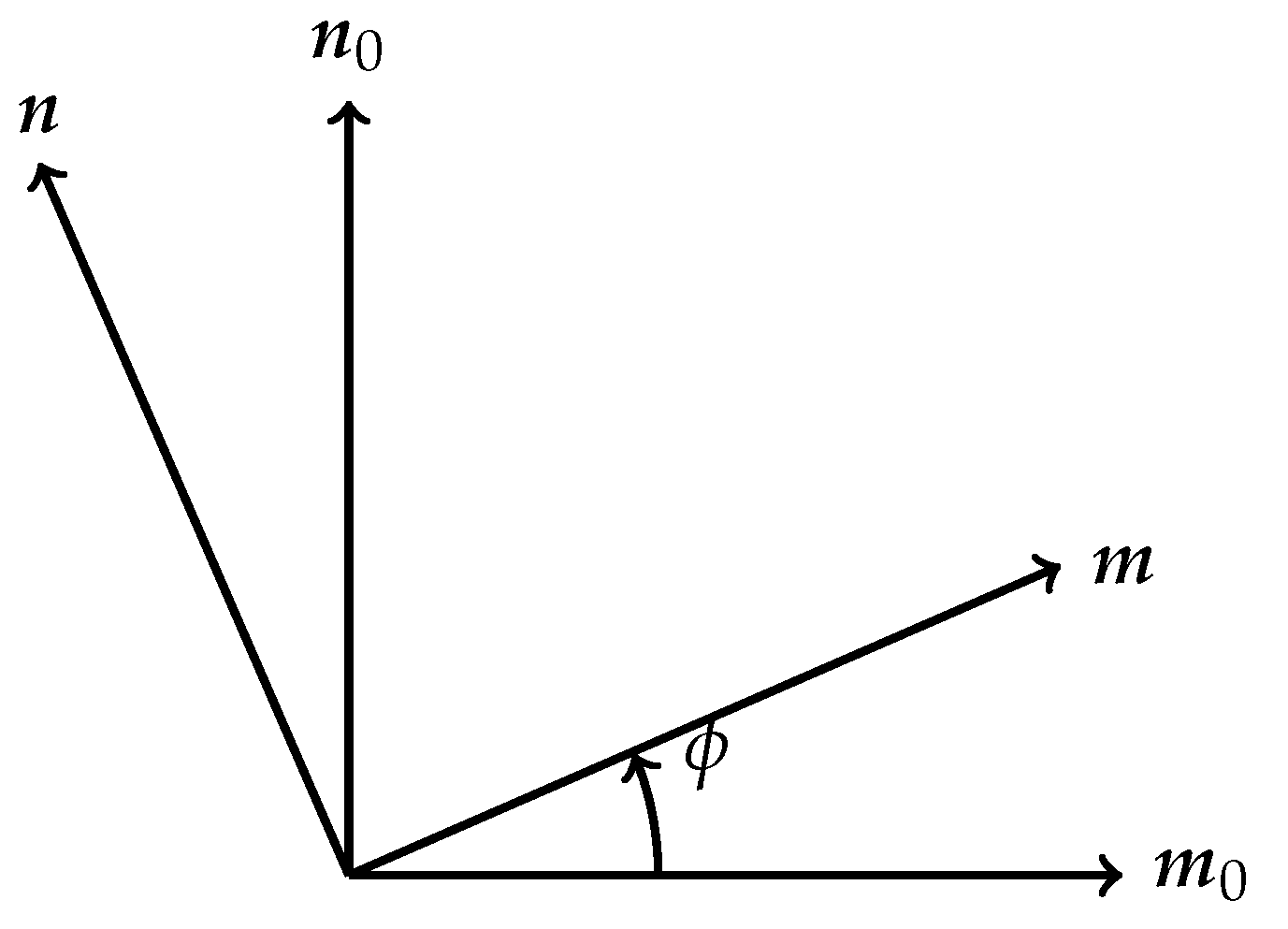
Now, we choose two orthogonal unit vectors and which are orthogonal to such that forms a right-handed Cartesian basis in . This basis is rotated around by an angle against another fixed basis in such that
as shown in Figure 1. It yields and . Only the independent variable is transformed but not the dependent variables and .
Using the relation
the extended elastic distortion tensor (13) becomes
the extended constitutive relation (14) reads
and Equations (21) and (22) become
Moreover, Equations (25)–(27) become
and
Substituting Equations (42) and (43) into Equations (39) and (40), it leads to
which can be rewritten in the following form of the matrix partial differential equation of the first order in rotated coordinates
The matrix is defined by the contraction of the elastic constants with orthogonal unit vectors and according to , , etc. As mentioned above, the vectors and are turned against the , coordinate system by an angle (see Figure 1), so that depends on the angle
Note that with and . In polar coordinates , it yields and (see Equation (35)) and and , and the matrix partial differential equation of the first order (46) reduces to
This is the elementary matrix differential equation for the generalized plane strain of quasicrystals in the integral formalism.
4. Straight Dislocations and Line Forces in Quasicrystals
We consider a straight dislocation with extended Burgers vector and a line force with extended strength in a quasicrystal located at the origin of the coordinate system. The defect line runs along the axis . The fields of the straight dislocation and line force are the extended displacement vector and the extended stress function vector , the “sources” or “topological charges” are the extended Burgers vector and the extended line force strength . In the integral formalism, the framework of multivalued fields can be used. In the framework of multivalued fields, the displacement vector of a straight dislocation and the stress function vector of a line force are multivalued fields. In field theory, the multivaluedness of fields is characteristic for topological defects (e.g., dislocations, monopoles, strings, and vortices), giving rise to a topological charge. Note that multivalued fields do not satisfy the Schwarz integrability conditions (see [33]).
In the hyperspace notation, the extended Burgers vector of a straight dislocation in quasicrystals is given by
where is the phonon component, and is the phason component of the extended Burgers vector, , and the extended body force vector of a line force in quasicrystals reads
where and are the strength of a phonon line force and the strength of a phason line force, , respectively.
The general solution of the matrix differential Equation (48) reads
with arbitrary vectors and . The first and second parts in the solution (51) are the radial and angular parts. The constant term in Equation (51) gives a constant shift, which is irrelevant. From the closure condition of a line defect in quasicrystals
and the relation
with
we find
Substituting Equation (55) into Equation (51), the solution of a straight dislocation with extended Burgers vector and a line force with extended strength for any quasicrystal is given by
Equation (56) is the -vector of the solution of the extended displacement vector and the extended stress function vector for a straight dislocation with extended Burgers vector and a line force with extended strength in a quasicrystal. Therefore, Equation (56) represents the -dimensional unification of the extended displacement vector of a straight dislocation and a line force, and the extended stress function vector of a straight dislocation and a line force in quasicrystals. Both complete integration from 0 to and incomplete integration from 0 to of are needed in Equation (56). In the limit to anisotropic elasticity, Equation (56) reduces to the solution of a line defect in anisotropic elasticity given in [34,35,36,37] (see also [30,38]). Therefore, Equation (56) represents the straightforward generalization of the solution of line defects in anisotropic elasticity towards the generalized elasticity of line defects in quasicrystals.
Using Equation (54), the solution (56) can be written in rather compact form as (see also [30,38,39])
It can be easily seen that the solution (57) has a straightforward decomposition into a radial and an angular part.
Introducing the matrices , and , which are tensors of rank two in the hyperspace, as the blocks of the matrix , Equation (54), with the block structure (47)
and
where , , and (transpose of ) are matrices resulting from integrating the four blocks in (see Equations (47) and (54)). Following Hirth and Lothe [40] (see also [41]), we use here the “symmetric” definition of the matrix instead of the original one used in anisotropic elasticity with an additional factor (see [24,29]).
Equation (57) can be decomposed into its four pieces, which are n-vectors in the n-dimensional hyperspace:
- The extended displacement vector of a straight dislocation with extended Burgers vector
- The extended displacement vector of a line force with extended strength
- The extended stress function vector of a straight dislocation with extended Burgers vector
- The extended stress function vector of a line force with extended strength
It is important to note that Equation (63) is in agreement with the integral expression of the extended displacement vector of a straight dislocation given by Ding et al. [21]. In the limit from quasicrystals to anisotropic elasticity, the extended displacement vector of a straight dislocation and a line force given in Equations (63) and (64) reduce to the displacement vector field of a straight dislocation and a line force given by Asaro et al. [25] (see also [35]) and the extended stress function vector of a straight dislocation and a line force given in Equations (65) and (66) reduce to the stress functions of a straight dislocation and a line force given by Asaro et al. [42].
Using and , Equation (36) becomes
the extended elastic distortion tensor (37) reads
and the extended stress tensor (41) reads
Using Equations (63) and (68), the extended elastic distortion tensor of a straight dislocation with extended Burgers vector is given by
Using Equations (64) and (68), the extended elastic distortion tensor of a line force with extended strength is given by
Using Equations (65) and (69), the extended stress tensor of a straight dislocation with extended Burgers vector is given by
Using Equations (66) and (69), the extended stress tensor of a line force with extended strength is given by
Note that all -dependence is contained in , , and the matrices , , and . Furthermore, Equations (70)–(73) show the typical -behavior of the elastic fields of line defects. It can be easily seen that the following consistency conditions are fulfilled for Equations (70) and (72) and for Equations (71) and (73) (see also [29])
Equation (70) is in agreement with the integral expression given by Ding et al. [21]. In the limit from quasicrystals to anisotropic elasticity, the extended displacement elastic distortion tensor of a straight dislocation and a line force given in Equations (70) and (71) reduce to the elastic distortion tensor of a straight dislocation and a line force given by Asaro et al. [25] (see also [29]).
Using the extended stress function vector of a straight dislocation (65) for and , the elastic self-energy of a straight dislocation per unit length reads
where and R are the inner and our cutoff radii. Equation (76) is in agreement with the expression given by Ding et al. [21].
Using the extended displacement vector of line force (66) for and , the elastic self-energy of a line force per unit length reads
In the limit from quasicrystals to anisotropic elasticity, the elastic self-energy of a straight dislocation (76) and the elastic self-energy of a line force (77) reduce to the expressions given by Bacon et al. [29].
5. Green Tensor in the Integral Formalism
In the framework of the integral formalism, the displacement field of a line force, Equation (64), gives the two-dimensional Green tensor for quasicrystals, namely
Therefore, within the integral formalism, the two-dimensional Green tensor for generalized plane strain in quasicrystals reads
Note that the Green tensor (81) possesses a straightforward decomposition into a radial part (-term) and an angular part depending on . Such a decomposition is not so easily visible in the general form of the two-dimensional Green tensor using Fourier transform (see [44]).
6. Conclusions
The six-dimensional integral formalism of anisotropic elasticity has been extended to an eight-dimensional integral formalism for one-dimensional quasicrystals, a ten-dimensional integral formalism for two-dimensional quasicrystals and a twelve-dimensional integral formalism for three-dimensional quasicrystals. The extended integral formalism can be used for the computation of the elastic fields of line defects in any quasicrystal. Using the extended integral formalism, the elastic fields of straight dislocations and line forces in quasicrystals have been determined, which are suitable for the analytical and numerical modeling of line defects in quasicrystals. The elastic fields of a line defect in quasicrystals have a surprisingly simple and compact form in the integral formalism. Moreover, the two-dimensional Green tensor of quasicrystals has been derived in the framework of the integral formalism.
Exact analytical solutions require analytical expressions for the integrals in the integral formalism. In the general case, only numerical solutions are possible using numerical integration. For quasicrystals of high symmetry and with a symmetrical orientation of the defect line, the complexity is reduced, and analytical solutions become possible because the integrals in the integral formalism can be computed analytically which will be performed in forthcoming publications. In the case of the lower symmetry of quasicrystals and of the orientation of the line defect, numerical treatment is needed in the integral formalism.
Funding
This research was funded by the Deutsche Forschungsgemeinschaft, Grant Number LA1974/5-1.
Data Availability Statement
The original contributions presented in this study are included in the article. Further inquiries can be directed to the corresponding author.
Acknowledgments
Markus Lazar gratefully acknowledges the grant from the Deutsche Forschungsgemeinschaft (Grant number LA1974/5-1). Markus Lazar thanks Eleni Agiasofitou for many useful and stimulating discussions on the fascinating subject of quasicrystals.
Conflicts of Interest
The author declares no conflicts of interest.
References
- Shechtman, D.; Blech, I.; Gratias, D.; Cahn, J.-W. Metallic phase with long-range orientational order and no translational symmetry. Phys. Rev. Lett. 1984, 53, 1951–1953. [Google Scholar] [CrossRef]
- Maciá-Barber, E. Chemical bonding and physical properties in quasicrystals and their related approximant phases: Known facts and current perspectives. Appl. Sci. 2019, 9, 2132. [Google Scholar] [CrossRef]
- Maciá, E. The role of aperiodic order in science and technology. Rep. Prog. Phys. 2006, 69, 397–441. [Google Scholar] [CrossRef]
- Bak, P. Symmetry, stability, and elastic properties of icosahedral incommensurate crystals. Phys. Rev. B 1985, 32, 5764–5772. [Google Scholar] [CrossRef]
- Levine, D.; Lubensky, T.C.; Ostlund, S.; Ramaswamy, S.; Steinhardt, P.J.; Toner, J. Elasticity and dislocations in pentagonal and icosahedral quasicrystals. Phys. Rev. Lett. 1985, 54, 1520–1523. [Google Scholar] [CrossRef]
- Socolar, J.E.S.; Lubensky, T.C.; Steinhardt, P.J. Phonons, phasons, and dislocations in quasicrystals. Phys. Rev. B 1986, 34, 3345–3360. [Google Scholar] [CrossRef]
- Ding, D.-H.; Wang, W.; Hu, C.; Yang, R. Generalized elasticity theory of quasicrystals. Phys. Rev. B 1993, 48, 7003–7010. [Google Scholar] [CrossRef]
- Lubensky, T.C.; Ramaswamy, S.; Toner, J. Dislocation motion in quasicrystals and implications for macroscopic properties. Phys. Rev. B 1986, 33, 7715–7719. [Google Scholar] [CrossRef]
- Edagawa, K. Dislocations in quasicrystals. Mater. Sci. Eng. A 2001, 309–310, 528–538. [Google Scholar] [CrossRef]
- Edagawa, K.; Takeuchi, S. Elasticity, dislocation and their motion in quasicrystals. In Dislocations in Solids; Nabarro, F.R.N., Hirth, J.P., Eds.; Elsevier B.V.: North-Holland, The Netherlands, 2007; Volume 13, pp. 365–417. [Google Scholar]
- Wang, R.; Hu, C. Dislocations in Quasicrystals. In Intermetallic Compounds—Principles and Practice: Progress; Westbrook, J.H., Fleischer, R.L., Eds.; John Wiley & Sons, Ltd.: Chichester, UK, 2002; Volume 3, pp. 379–402. [Google Scholar]
- Kleman, M. Phasons and the plastic deformation of quasicrystals. Eur. Phys. J. B 2003, 31, 315–325. [Google Scholar] [CrossRef]
- Fan, T.Y. Mathematical Theory of Elasticity of Quasicrystals and Its Applications; Science Press and Springer Science+Business Media Singapore: Beijing, China, 2011. [Google Scholar]
- Feuerbacher, M. Dislocations in icosahedral quasicrystals. Chem. Soc. Rev. 2012, 41, 6745–6759. [Google Scholar] [CrossRef] [PubMed]
- Feuerbacher, M.; Heggen, M. Metadislocations. In Dislocations in Solids; Hirth, J.P., Kubin, L., Eds.; Elsevier: Amsterdam, The Netherlands, 2010; Volume 16, pp. 109–170. [Google Scholar]
- Mariano, P.M. Mechanics of dislocations and metadislocations in quasicrystals and their approximants: Power invariance and balance. Contin. Mech. Thermodyn. 2019, 31, 373–399. [Google Scholar] [CrossRef]
- Gratias, D.; Quiquandon, M.; Caillard, D. Geometry of metadislocations in approximants of quasicrystals. Phil. Mag. 2013, 93, 304–313. [Google Scholar] [CrossRef]
- Ding, D.; Yang, W.; Hu, C.; Wang, R. Linear elasticity theory of quasicrystals and defects in quasicrystals. In Materials Science Forum; Trans Tech Publications, Ltd.: Baech, Switzerland, 1994; Volume 150–151, pp. 345–354. [Google Scholar]
- Ding, D.-H.; Wang, R.; Yang, W.; Hu, C. General expressions for the elastic displacement fields induced by dislocations in quasicrystals. J. Phys. Condens. Matter 1995, 7, 5423–5436. [Google Scholar] [CrossRef]
- Lazar, M.; Agiasofitou, E. Fundamentals in generalized elasticity and dislocation theory of quasicrystals: Green tensor, dislocation key-formulas and dislocation loops. Phil. Mag. 2014, 94, 4080–4101. [Google Scholar] [CrossRef]
- Ding, D.-H.; Wang, R.; Yang, W.; Hu, C.; Qin, Y. Elasticity theory of straight dislocations in quasicrystals. Phil. Mag. Lett. 1995, 72, 353–359. [Google Scholar] [CrossRef]
- Stroh, A.N. Dislocations and cracks in anisotropic elasticity. Phil. Mag. 1958, 3, 625–646. [Google Scholar] [CrossRef]
- Stroh, A.N. Steady state problems in anisotropic elasticity. J. Math. Phys. 1962, 41, 77–103. [Google Scholar] [CrossRef]
- Barnett, D.M.; Lothe, J. Synthesis of the sextic and the integral formalism for dislocations, Green’s function and structure waves in anisotropic elastic solids. Phys. Norv. 1973, 7, 13–19. [Google Scholar]
- Asaro, R.J.; Hirth, J.P.; Barnett, D.M.; Lothe, J. A further synthesis of sextic and integral theories for dislocations and line forces in anisotropic media. Phys. Status Solidi (b) 1973, 60, 261–271. [Google Scholar] [CrossRef]
- Hu, C.; Wang, R.; Ding, D.-H. Symmetry groups, physical property tensors, elasticity and dislocations in quasicrystals. Rep. Prog. Phys. 2000, 63, 1–39. [Google Scholar] [CrossRef]
- Li, L.H.; Liu, G.T. Stroh formalism for icosahedral quasicrystal and its application. Phys. Lett. A 2012, 376, 987–990. [Google Scholar] [CrossRef]
- Radi, E.; Mariano, P.M. Steady-state propagation of dislocations in quasi-crystals. Proc. R. Soc. A 2011, 467, 3490–3508. [Google Scholar] [CrossRef]
- Bacon, D.J.; Barnett, D.M.; Scattergood, R.O. Anisotropic continuum theory of defects. Prog. Mater. Sci. 1980, 23, 51–262. [Google Scholar] [CrossRef]
- Ting, T.C.T. Anisotropic Elasticity; Oxford Science Publishers: Oxford, UK, 1996. [Google Scholar]
- Wang, X.; Schiavone, P. Dislocations, imperfect interfaces and interface cracks in anisotropic elasticity for quasicrystals. Math. Mech. Complex Syst. 2013, 1, 1–17. [Google Scholar] [CrossRef]
- Lazar, M.; Agiasofitou, E. Eshelbian mechanics of novel materials: Quasicrystals. J. Micromech. Mol. Phys. 2016, 1, 1640008. [Google Scholar] [CrossRef]
- Kleinert, H. Multivalued Fields in Condensed Matter, Electromagnetism, and Gravitation; World Scientific: Singapore, 2008. [Google Scholar]
- Kirchner, H.O.K.; Bluemel, K.H. Elastic quasi-isotropy normal to the basal plane in the hexagonal system. Phys. Status Solidi (b) 1976, 75, 527–532. [Google Scholar] [CrossRef]
- Kirchner, H.O.K. Line defects along the axis of rotationally inhomogeneous media. Phil. Mag. A 1987, 55, 537–542. [Google Scholar] [CrossRef]
- Ting, T.C.T. Line forces and dislocations in anisotropic elastic composite wedges and spaces. Phys. Status Solidi (b) 1988, 146, 81–90. [Google Scholar] [CrossRef]
- Ting, T.C.T. The eigenvectors of the S matrix and their relations with line dislocations and forces in anisotropic elastic solids. In Micromechanics and Inhomogeneity; Weng, G.J., Taya, M., Abé, H., Eds.; Springer: New York, NY, USA, 1990; pp. 449–467. [Google Scholar]
- Lazar, M.; Kirchner, H.O.K. Generalized plane strain embedded in three-dimensional anisotropic elasticity. Phil. Mag. 2021, 101, 2584–2598. [Google Scholar] [CrossRef]
- Lazar, M. Displacements and stress functions of straight dislocations and line forces in anisotropic elasticity: A new derivation and its relation to the integral formalism. Symmetry 2021, 13, 1721. [Google Scholar] [CrossRef]
- Hirth, J.P.; Lothe, J. Theory of Dislocations, 2nd ed.; John Wiley: New York, NY, USA, 1982. [Google Scholar]
- Lothe, J. Dislocations in anisotropic media. In Elastic Strain Fields and Dislocation Mobility; Indenbom, V.L., Lothe, J., Eds.; Elsevier: Amsterdam, The Netherlands, 1992; pp. 269–328. [Google Scholar]
- Asaro, R.J.; Hirth, J.P.; Lothe, J. Stress functions for line defects in anisotropic elastic media. Scr. Metall. 1975, 9, 837–840. [Google Scholar] [CrossRef]
- Agiasofitou, E.; Lazar, M.; Kirchner, H. Generalized dynamics of moving dislocations in quasicrystals. J. Phys. Condens. Matter 2010, 22, 495401. [Google Scholar] [CrossRef] [PubMed]
- Lazar, M.; Agiasofitou, E. Three-dimensional and two-dimensional Green tensors of piezoelectric quasicrystals. Crystals 2024, 14, 835. [Google Scholar] [CrossRef]
Figure 1.
The unit vectors and are to be turned anticlockwise from and by an angle .
Disclaimer/Publisher’s Note: The statements, opinions and data contained in all publications are solely those of the individual author(s) and contributor(s) and not of MDPI and/or the editor(s). MDPI and/or the editor(s) disclaim responsibility for any injury to people or property resulting from any ideas, methods, instructions or products referred to in the content. |
© 2025 by the author. Licensee MDPI, Basel, Switzerland. This article is an open access article distributed under the terms and conditions of the Creative Commons Attribution (CC BY) license (https://creativecommons.org/licenses/by/4.0/).
Share and Cite
MDPI and ACS Style
Lazar, M. Line Defects in Quasicrystals. Crystals 2025, 15, 275. https://doi.org/10.3390/cryst15030275
AMA Style
Lazar M. Line Defects in Quasicrystals. Crystals. 2025; 15(3):275. https://doi.org/10.3390/cryst15030275
Chicago/Turabian StyleLazar, Markus. 2025. "Line Defects in Quasicrystals" Crystals 15, no. 3: 275. https://doi.org/10.3390/cryst15030275
APA StyleLazar, M. (2025). Line Defects in Quasicrystals. Crystals, 15(3), 275. https://doi.org/10.3390/cryst15030275
Note that from the first issue of 2016, this journal uses article numbers instead of page numbers. See further details here.

