


Abstract
We used the transfer matrix method to investigate the conditions supporting the existence of directional bulk waves in a two-dimensional (2D) phononic crystal. The 2D crystal was a square lattice of unit cells composed of rectangular subunits constituted of two different isotropic continuous media. We established the conditions on the geometry of the phononic crystal and its constitutive media for the emergence of waves, which, for the same handedness, exhibited a non-zero amplitude in one direction within the crystal’s 2D Brillouin zone and zero amplitude in the opposite direction. Due to time-reversal symmetry, the crystal supported propagation in the reverse direction for the opposite handedness. These features may enable robust directional propagation of bulk acoustic waves and topological acoustic technology.
1. Introduction
Unconventional topological features can endow waves in acoustic metamaterials and phononic crystals with exotic properties [1]. Breaking time-reversal symmetry of the equations governing the propagation of acoustic waves in a medium may lead to conditions for which a bulk wave or an edge/interface wave (localized at a surface or interface) propagates in only one direction. These one-way propagating waves are robust against backscattering due to obstacles, such as defects in the medium, as a reflected wave is not supported by the medium. In this scenario, physically realizing one-way propagation of acoustic waves requires the use of active media in which one injects energy to break time-reversal symmetry. Examples of such an approach include media subjected to spatiotemporal modulation of their physical properties [2,3,4,5,6,7] or media supporting time-reversal symmetry-breaking elements such as circulators [8] or gyroscopes [9].
A less demanding approach to achieving some form of immunity to backscattering of acoustic waves is to employ media structured in such a way that leads to breaking inversion or parity symmetry [10,11]. Conditions in these media arise for the existence of edge waves propagating in opposite directions at surfaces or interfaces that are orthogonal to each other, and hence support a form of resilience against back reflections. The conversion of an incident wave impinging on an obstacle to a reflected wave (propagating in the opposite direction) is more difficult in these media than in conventional materials, as it requires an obstacle shape that couples the two otherwise orthogonal waves. Immunity to backscattering is therefore possible for a range of defects; however, this approach does not lead to robust immunity to backscattering.
An interesting opportunity in this context arises when we combine broken inversion/parity symmetry with Fabry–Pérot resonances, leading to directional bulk waves that are more robust to backscattering [12,13]. These waves, called DRAK (Deymier, Runge, Alù, Khanikaev) modes, exhibit non-zero amplitudes when propagating in one direction but zero amplitude when propagating in the opposite direction for the same handedness. So far, DRAK modes have been studied in continuous or discrete one-dimensional superlattices. These superlattices are composed of periodic arrays of alternating layers of two different materials. The DRAK mode arises when a Fabry–Pérot resonance [14] of one type of layer becomes incompatible with the translational periodicity of the superlattice, that is, the resonance becomes incompatible with the Bloch wave character of waves in periodic media. While scattering of orthogonal edge modes does not offer robust immunity against backscattering [15,16], DRAK modes have been shown to exhibit robust immunity to backscattering by general scattering potentials [13].
The current paper extends previous work on DRAK modes in 1D superlattices to 2D phononic crystals. Here, we derive conditions for the existence of DRAK modes in the 2D Brillouin zone of a square lattice of unit cells composed of rectangular subunits constituted of two different continuous media. This work demonstrates that DRAK modes may not be limited to one-way propagation in low dimensionality phononic structures but also to propagation in composite structures with dimensionality higher than one.
We introduce the 2D model system in Section 2. In Section 3, we use the transfer matrix method [17] to establish relations between the amplitudes of the constitutive subunits of the phononic crystal. Section 4 illustrates some of the conditions which may lead to DRAK modes in the 2D Brillouin zone of the phononic crystal. Finally, some conclusions are drawn in Section 5 regarding the relevance of this work in the context of reducing reflection loss in acoustic devices.
2. Model System
We consider a two-dimensional (2D) phononic crystal composed of two different types of materials (Figure 1). The phononic crystal is periodic in the x and y directions. The square unit cell is constituted of four subunits labelled and for material 1 and and for material 2. The upper scripts “” and “u” stand for lower and upper quadrants of the unit cell. The length of the edges of the subunits are labeled and . The length of the edge of the unit cell is . The origin of a unit cell in the (x,y) system of coordinates is given by , where n and m are integers.
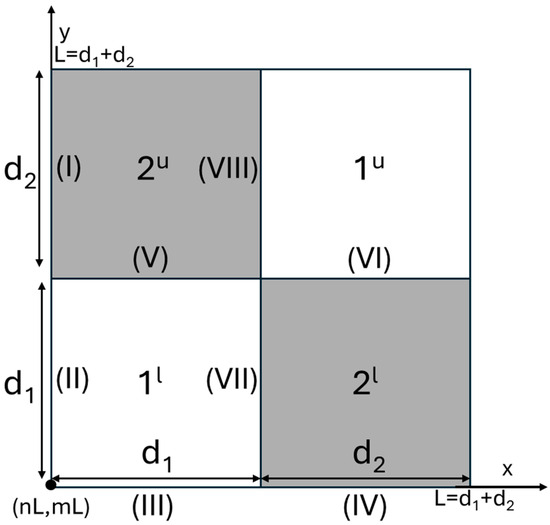
Figure 1.
Schematic illustration of the unit cell of the model 2D periodic phononic crystal.
The interfaces between subunits belonging to the different unit cells and are labelled (I) and (II). The interfaces between subunits belonging to the unit cells and are labelled (III) and (IV). Interfaces between subunits within the same unit cell are indicated by (V), (VI), (VII), and (VIII).
We consider elastic shear waves polarized in the direction perpendicular to the phononic crystal plane and seek solutions for the displacement field, u, taking the general form of Bloch waves.
Within a medium of type 1, the displacement field is written as
For medium 2, we have
In Equations (1) and (2), and are wave numbers in the x and y directions, and the displacements are time-dependent and multiplied by the factor , where ω is the wave angular frequency. The waves’ displacement in media 1 and 2, assumed homogeneous and isotropic, obey the equation of motions of the form with , where is the mass density and is the stiffness. Considering the ansatz , the wave numbers , satisfy the dispersion relations in media 1 and 2, where is the speed of shear waves in medium j.
, , , , , , , , , , , , , , , are 16 unknown amplitudes to be determined using displacement and stress continuity conditions at the eight interfaces.
The various components of stress in the subunits are obtained from Equations (1a,b) and (2a,b) as follows. For medium 1, we get
For medium 2, we have
where is the stiffness of medium j.
3. Conditions of Continuity
3.1. Interfaces (II) and (VII)
To begin solving for the modal amplitudes, we write the conditions of continuity of displacement and stress at interfaces (II) and (VII). At interface (II), continuity of displacement takes the form in unit cell {n,m} = in unit cell {n − 1,m}, or:
To obtain Equation (5), we have used the fact that .
The condition of continuity of stress at interface (II) takes the form
At interface (VII), for displacement we obtain in unit cell {n,m} = in unit cell {n,m}
Continuity of stress at interface (VII) leads to
In Equations (5b) and (6b), we have introduced the quantity by redefining
In Equation (7a–d), we assume that the quantities in parentheses are not zero. Note that the parentheses in Equation (7a,b) are the same, as are those in Equation (7c,d).
The conditions of continuity given by Equations (5a,b) and (6a,b) can be arranged in matrix form:
We introduced the notation and .
We can solve for the amplitudes , , , using the transfer matrix approach. For this we rewrite a part of Equation (8) as
Equation (9) can be reformulated as
The remaining part of Equation (8) gives:
This latter equation results in:
Combining Equations (12) and (10) yields:
or
where we have used the Bloch wave definition
Calculating the transform matrix relating the , amplitudes between two adjacent unit cells leads to
The components of the transfer matrix are defined as
The “*” in Equation (16a,b) stands for the complex conjugate.
Using the Bloch theorem, we are seeking eigenvalues of the transfer matrix taking the form , and satisfies the second order equation:
There exist two solutions given by
We now investigate the condition , which corresponds to a Fabry–Pérot resonance [12,14] of medium in the x direction. This condition is satisfied if , where p is an integer. There are two cases to consider, even and odd multiples of π.
To solve for the amplitudes, we rewrite Equation (15) in the form of an eigenvalue problem:
where is an eigenvalue, then we get
We can solve for the amplitudes:
We first consider the case when is odd. Under this condition, and . At the Fabry–Pérot resonance, . Provided that the dispersion relation of the superlattice satisfies we have and also . 0 when where the integer is odd. Note that this mode may be outside the first Brillouin zone. We recall that . Due to the periodicity in the wave vector space, is therefore located on the negative side of the first Brillouin zone, and we can rewrite . When , Equation (12) ensures that .
We now consider the case when is even. Under this condition, and . At the Fabry–Pérot resonance, we still have, . Provided that the dispersion relation of the superlattice satisfies we have and 0 when , where the integer is even. is therefore located on the positive side of the first Brillouin zone, . Due to the periodicity in the wave vector space, we can rewrite . Again, , implying that .
3.2. Interfaces (I) and (VIII)
The conditions of continuity of displacement at (I):
The condition of continuity of stress at interface (I) takes the form of
At interface (VIII), for displacement we obtain
The continuity of stress at interface (VIII) leads to
By redefining
we introduced the notation and .
The conditions of continuity given by Equations (21a,b) and (22a,b) can be arranged in matrix form:
Following Section 3.1, we introduce a transfer matrix such that
The components of the transfer matrix are defined as
The Bloch theorem implies that:
In Section 3.1. we considered the resonant condition . This condition is not sufficient to lead to zero amplitudes (e.g., . Here, one needs to consider the condition . This is the condition , where can be odd or even.
We first consider the case when is odd. Under this condition, and . At this resonance, . Provided that the dispersion relation of the superlattice satisfies we have and also . 0 when where the integer is odd, that is but not when . When , we also get .
We now consider the case when is even. Under this condition, and . At the resonance we still have, . Provided that the dispersion relation of the superlattice still satisfies we have and 0 when where is even, i.e., when but not when . Again, when , implying that .
3.3. Interfaces (III) and (V)
At interface (III), the condition of continuity of displacement reads:
At interface (V), displacement continuity yields
The continuity of stress at interfaces (III) and (V) gives
where we have defined the quantity .
In Equations (28) and (29), we have defined:
Equations (28) and (29) are reformulated in matrix form:
where we used the notation and . Equation (31) is isomorphic to Equation (8) but for the direction y.
We now investigate the condition which corresponds to a Fabry–Pérot resonance of medium in the y direction. This condition is satisfied if , where r is an integer. There are two cases to consider, even and odd multiples of π.
Solving for the amplitudes, we first consider the case when is odd. Under this condition, . At the Fabry–Pérot resonance, . Provided that the dispersion relation of the superlattice satisfies and also . 0 when where the integer is odd, that is, when but not when . The condition leads to .
We now consider the case when is even. Under this condition, . At the Fabry–Pérot resonance we still have, . Provided that the dispersion relation of the superlattice still satisfies 0 when where is even. This corresponds to a wave number in the negative region of the Brillouin zone . Again, when , .
3.4. Interfaces (IV) and (VI)
The conditions of displacement and stress continuity at interfaces (IV) and (VI) can be arranged in matrix form:
Here, we introduced the notation and .
We have also defined
We can perform the same analysis as was done for the pair of interfaces (I) and (VIII) but for propagation along the y direction.
We now investigate the resonant condition . This condition is satisfied if , where is an integer. There are two cases to consider, even and odd multiples of π.
Solving for the amplitudes, we first consider the case when is odd. Under this condition, . At resonance, . Provided that the dispersion relation of the superlattice satisfies and also . 0 when where the integer is odd. This corresponds to but not . The condition leads to .
We now consider the case when is even. Under this condition, . At the resonance we still have, . Provided that the dispersion relation of the superlattice still satisfies 0 when where is even, corresponding to the positive side of the Brillouin zone in the y direction, that is, but not . Again, implies that .
Table 1 summarizes these findings.

Table 1.
Resonant conditions resulting from continuity conditions at interfaces leading to zero amplitudes. See the text for details.
4. DRAK Modes
In this section, we identify sets of conditions which lead to directional modes, i.e., DRAK modes based on the findings of the previous section.
4.1. Case I
Within a medium of type 1, the displacement field can be written as
In medium 2, we can write
For the amplitudes, we recall Equation (7a–d):
To find DRAK modes, we seek conditions for the displacement field , that is, for the corresponding amplitudes, to vanish for wave vectors located on one side of the 2D Brillouin zone and not the other. For this, we use Table 1.
Let us consider the resonant conditions for medium corresponding to . For instance, we chose , with being an odd integer. The dispersion relation that must be satisfied is , with and an odd integer. Under these conditions we have and for . This resonance implies that .
We also consider the additional resonance of medium , , such that with being an odd integer. The corresponding dispersion relation that must be satisfied by the wave vector is with and odd. Under these conditions, we have , and , leading to .
These conditions for the existence of a DRAK mode are independent of . The motion associated with the joint resonances in the x direction of the subunits and is incompatible with the translational periodicity of Bloch waves in that same direction, leading to zero amplitudes.
A DRAK mode will exist when the 2D dispersion relation of the phononic crystal, , satisfies specific conditions. In the current case, these conditions are independent of . When both resonances are satisfied, the wave number in the x direction is defined as
Which, using the resonant conditions for the wave number in the x direction, leads to
Equation (37) determines the ratio of geometric parameters yielding the wave number, , which corresponds to specific resonances.
We recall that the angular frequency of the Bloch waves is given by
At the specific frequency , the relation of Equation (38) imposes and to take the values
and
These relationships can be used to determine the speeds of sound of the constitutive materials which are compatible with the dispersion relation and the resonance conditions of the 2D phononic crystal. For example, combining Equation (39a,b) and taking into account that and , we get .
4.2. Case II
The displacement of the four subunits forming the unit cell given by Equation (7a–d) can be rewritten as
and
The resonances associated with (subunit ) and (subunit ) may lead to , , , and for , yielding displacements that vanish.
For instance, we may choose with being an odd integer. The dispersion relation that must be satisfied is , with and an odd integer. Under these conditions we have and for . This resonance implies that .
We also consider the additional resonance associated with , such that with an odd integer. The corresponding dispersion relation that must be satisfied by the wave vector is with , and odd. Under these conditions, we have and , leading to for .
These conditions for the existence of a DRAK mode are independent of . The motion associated with these joint resonances in the y direction of the subunits and is incompatible with the translational periodicity of Bloch waves in that same direction leading to zero amplitudes.
A DRAK mode will exist when the 2D dispersion relation of the phononic crystal, , satisfies some specific conditions. In the current case, these conditions are independent of . When both resonances are satisfied, the wave number in the x direction is defined as
Which, using the resonant conditions for the wave number in the y direction, leads to:
Equation (42) determines the ratio of geometric parameters , yielding the wave number, , which corresponds to specific resonances.
We recall that the angular frequency of Bloch waves is given by
At the specific frequency , the relation of Equation (42) imposes and to take the values
and
Again, these relationships can be used to determine the speeds of sound of the constitutive materials which are compatible with the dispersion relation and the resonance conditions of the 2D phononic crystal.
5. Conclusions
We used the transfer matrix method to investigate the conditions leading to the existence of one-way propagating bulk waves, called DRAK modes, in a two-dimensional (2D) phononic crystal. The model system investigated here was a 2D phononic crystal taking the form of a square lattice of unit cells composed of rectangular subunits constituted of two different continuous media. We sought conditions where local resonances of the Fabry–Pérot type of the subunits became incompatible with the translational periodicity associated with the Bloch theorem. We established conditions on the geometry of the phononic crystal and the physical properties of the constitutive media for the existence of waves that exhibit a non-zero amplitude in one direction within the crystal’s 2D Brillouin zone and zero amplitude in the opposite direction for the same handedness. Because of time-reversal symmetry, we can expect a twin mode with a non-zero amplitude and opposite handedness propagating in the reverse direction. This work extends previous studies that have focused on DRAK modes in one-dimensional discrete and continuous superlattices. The existence of directional DRAK waves in 2D phononic structures opens new avenues in the design of acoustic devices which may exhibit robust immunity to scattering by obstacles such as defects, imperfections, or impedance mismatch between different parts of the devices, expectedly making them less prone to back reflections for a broader range of obstacles that do not couple modal handedness. Indeed, acoustic wave devices such as bulk acoustic wave (BAW) and surface acoustic wave (SAW) devices find many applications in radio frequency telecommunication [18,19] and sensors of various physical quantities [20]. However, the performance of these devices is strongly affected by loss such as return loss, which measures the amount of reflected signal caused by the impedance mismatch between the transduction parts of the device and that of the delay line part. DRAK modes may help overcome return loss in such acoustic devices beyond what can be achieved with current technologies.
Future work will involve numerical studies of DRAK modes in more complex phononic structures than the idealized “checkerboard” system studied here, as well as phononic structures with different symmetries or phononic structures more amenable to contemporary fabrication techniques.
Author Contributions
Conceptualization, P.A.D., K.R. and J.O.V.; methodology, J.O.V. and P.A.D.; validation, J.O.V.; formal analysis, P.A.D., J.O.V., K.R., K.M., A.A. and A.K.; writing—original draft preparation, P.A.D.; writing—review and editing, J.O.V., K.R., K.M., A.A. and A.K.; supervision, P.A.D.; project administration, P.A.D.; funding acquisition, P.A.D. and A.A. All authors have read and agreed to the published version of the manuscript.
Funding
This research was funded in part by the US National Science Foundation (NSF) grant #2242925 through the Science and Technology Center New Frontiers of Sound (NewFoS).
Data Availability Statement
The raw data supporting the conclusions of this article will be made available by the authors on request.
Conflicts of Interest
The authors declare no conflicts of interest.
References
- Xue, H.; Yang, Y.; Zhang, B. Topological acoustics. Nat. Rev. Mater. 2022, 7, 975. [Google Scholar] [CrossRef]
- Estep, N.; Sounas, D.; Soric, J.; Alù, A. Magnetic-Free Non-Reciprocity Based on Parametrically Modulated Coupled-Resonator Loops. Nat. Phys. 2014, 10, 923. [Google Scholar] [CrossRef]
- Fleury, R.; Khanikaev, A.; Alù, A. Floquet Topological Insulators for Sound. Nat. Commun. 2016, 7, 11744. [Google Scholar] [CrossRef] [PubMed]
- Swinteck, N.; Matsuo, S.; Runge, K.; Vasseur, J.O.; Lucas, P.; Deymier, P.A. Bulk elastic waves with unidirectional backscattering-immune topological states in a time-dependent superlattice. J. Appl. Phys. 2015, 118, 063103. [Google Scholar] [CrossRef]
- Trainiti, G.; Ruzzene, M. Non-reciprocal elastic wave propagation in spatiotemporal periodic structures. New J. Phys. 2016, 18, 083047. [Google Scholar] [CrossRef]
- Nassar, H.; Chen, H.; Norris, A.N.; Haberman, M.R.; Huang, G.L. Non-reciprocal wave propagation in modulated elastic metamaterials. Proc. R. Soc. 2017, 473, 20170188. [Google Scholar] [CrossRef] [PubMed]
- Tessier Brothelande, S.; Croënne, C.; Allein, F.; Vasseur, J.O.; Amberg, M.; Giraud, F.; Dubus, B. Experimental evidence of nonreciprocal propagation in space-time modulated piezoelectric phononic crystals. Appl. Phys. Lett. 2023, 123, 201701. [Google Scholar] [CrossRef]
- Khanikaev, A.B.; Fleury, R.; Mousavi, H.; Alù, A. Topologically Robust Sound Propagation in an Angular-Momentum-Biased Graphene-Like Resonator Lattice. Nat. Commun. 2015, 6, 8260. [Google Scholar] [CrossRef] [PubMed]
- Wang, P.; Lu, L.; Bertoldi, K. Topological phononic crystals with one-way elastic edge waves. Phys. Rev. Lett. 2015, 115, 104302. [Google Scholar] [CrossRef] [PubMed]
- Vila, J.; Pal, R.K.; Ruzzene, M. Observation of topological valley modes in an elastic hexagonal lattice. Phys. Rev. B. 2017, 96, 134307. [Google Scholar] [CrossRef]
- Pal, R.K.; Schaeffer, M.; Ruzzene, M. Helical edge states and topological phase transitions in phononic systems using bi-layered lattices. J. Appl. Phys. 2016, 119, 084305. [Google Scholar] [CrossRef]
- Deymier, P.A.; Runge, K.; Khanikaev, A.; Alù, A. Pseudo-Spin Polarized One-Way Elastic Wave Eigenstates in One-Dimensional Phononic Superlattices. Crystals 2024, 14, 92. [Google Scholar] [CrossRef]
- Deymier, P.A.; Vasseur, J.O.; Runge, K.; Khanikaev, A.; Alù, A. Immunity to Backscattering of Bulk Waves in Topological Acoustic Superlattices. Crystals 2024, 14, 344. [Google Scholar] [CrossRef]
- Pérot, A.; Fabry, C. On the application of interference phenomena to the solution of various problems of spectroscopy and metrology. Astrophys. J. 1899, 9, 87. [Google Scholar] [CrossRef]
- Rosiek, C.A.; Arregui, G.; Vladimirova, A.; Albrechtsen, M.; Lahijani, B.V.; Christiansen, R.E.; Stobbe, S. Observation of strong backscattering in valley-Hall photonic topological interface modes. Nat. Photonics 2023, 17, 386. [Google Scholar] [CrossRef]
- Rechtsman, M.C. Reciprocal topological photonic crystals allow backscattering. Nat. Photonics 2023, 17, 383. [Google Scholar] [CrossRef]
- Zhang, G.; He, Z.; Wang, S.; Hong, J.; Cong, Y.; Gu, S. Elastic foundation-introduced defective phononic crystals for tunable energy harvesting. Mech. Mater. 2024, 191, 104909. [Google Scholar] [CrossRef]
- Aigner, R. SAW and BAW technologies for RF filter applications: A review of the relative strengths and weaknesses. In Proceedings of the 2008 IEEE International Ultrasonic Symposium, Beijing, China, 2–5 November 2008; p. 582. [Google Scholar]
- Yang, Y.; Dejous, C.; Hallil, H. Trends and applications of surface and bulk acoustic wave devices: A review. Micromachines 2023, 14, 43. [Google Scholar] [CrossRef] [PubMed]
- Liu, B.; Chen, X.; Cai, H.; Mohammad Ali, M.; Tian, X.; Tao, L.; Yang, Y.; Ren, T. Surface acoustic wave devices for sensor applications. J. Semicond. 2016, 37, 021001. [Google Scholar] [CrossRef]
Disclaimer/Publisher’s Note: The statements, opinions and data contained in all publications are solely those of the individual author(s) and contributor(s) and not of MDPI and/or the editor(s). MDPI and/or the editor(s) disclaim responsibility for any injury to people or property resulting from any ideas, methods, instructions or products referred to in the content. |
© 2024 by the authors. Licensee MDPI, Basel, Switzerland. This article is an open access article distributed under the terms and conditions of the Creative Commons Attribution (CC BY) license (https://creativecommons.org/licenses/by/4.0/).