


Abstract
In this structural study, structural data are classified and analyzed for almost seventy complexes of the general formula Pt(η3–P1X1P2)(Y) (X1 = O, N, C, S, Si) and (Y = various monodentate ligands), in which the respective η3–P1X1P2 ligand forms a pair of five-membered metallocyclic rings with a common X1 atom of the P1C2X1C2P2 type. The present complexes crystallize in five crystal systems: trigonal (1×), tetragonal (1×), orthorhombic (11×), triclinic (18×), and monoclinic (39×). In 69 complexes, a η3 ligand with monodentate Y constructs a distorted square planar geometry around each Pt(II) atom. There is only one complex in which Pt(η3–P1Si1P2)(P3Ph3) constructs a trigonal–pyramidal geometry around a Pt(II) atom. The three P atoms construct a trigonal plane, and the Si atom occupies a pyramid. The structural data are discussed from various points of view, including the covalent radii of the atoms, the degree of distortion, and trans-influence. The trans-effect on the Pt-L bond distance also affects the L-PT-L bond angles, as well as the distortion of square planar geometry around Pt(II) atoms.
1. Introduction
The chemistry of platinum coordination complexes has been intensively studied and developed for more than five decades, focusing on the relationship between structure and reactivity. The chemistry of platinum is important in the fields of biochemistry [1], catalysis [2], spectroscopy [3,4], and coordination theory. Very recently, Horiuchi and Umakoshi published a review that focused on the importance of and advances in the synthetic, structural, thermodynamic, electronic, and photophysical properties of Pt-based heteropolynuclear complexes [5].
Significant attention has been paid to organomonophosphines, representing soft donor ligands in the chemistry of platinum. There are a large number of published structural studies on such complexes that have been classified and analyzed [6]. Another group of related structural studies is devoted to Pt(II) complexes with organodiphosphines [7,8]. Recently, we analyzed and classified structural data for the following compositions: Pt(η4–P4L), Pt(η4–P3 SiL), Pt(η4–P2N2L), Pt(η4–P2S2L), Pt(η4–P2C2L), Pt(η4–PN3L), and Pt(η4–PN2OL) [9]. As can be seen, P-donor ligands prevail by far. η4–ligands form 10-, 11-, 12-, 14-, and 16-membered metallocycles. A distorted square planar geometry around Pt(II) atoms with cis-configuration prevails by far.
From an application point of view, multifunctional ligands responsible for secondary catalyst–substrate interactions over the course of a catalytic transformation play increasingly important roles in contemporary catalysis, as has been demonstrated also within these groups of platinum complexes with P-donor ligands. Pincer-type complexes constitute a family of compounds that have recently attracted significant interest. They play important roles in organometallic reactions and mechanisms, catalysis, and the design of new materials (see, e.g., reviews [10,11,12,13,14,15,16]). The high thermal stability of such complexes, particularly those based on an aromatic backbone, permits their use as catalysts at elevated temperatures in various catalytic applications. Bulky bis-chelating pincer-type ligands are effective in the stabilization of highly unsaturated cationic complexes and the stabilization of reactive species [10,11,12,13,14,15,16,17].
As a continuation of the investigation of platinum complexes with P-donor ligands, this structural study aims to classify and analyze the structural parameters of heterotridentate organodiphosphines in monomeric four-coordinated platinum complexes of the Pt(η3–P1X1P2)(Y), (X1 = O1L, N1L, C1L, S1L, or Si1L) type, in which each tridentate ligand creates a pair of “equal” five-membered rings with a common X1 atom of the P1C2X1C2P2 type. The application potentialities of these ligands and their complexes are reviewed, as well, to demonstrate the prevailing areas of their practical use.
2. Pt(η3–P1C2X1C2P2)(Y), (X1 = O1,N1, C1, S1, or Si1)
There are 69 complexes in which heterotridentate organodiphosphines create a pair of “equal” five-membered metallocyclic rings with a common X1 atom. These tridentate ligands with monodentate Y ligands construct a square planar geometry with various degrees of distortion around Pt(II) atoms. These complexes are centrosymmetric. Groups of X1 = O1, N1, or C1 structures, which were mentioned for several representatives in our previous work devoted to any type of n-member metallocycle rings (n = 5,6,7) but different types of atoms between P1 and X1 [18], are analyzed in detail in this work, along with a new group of X1 = S1, Si1 structures, highlighting structural aspects related to distortion. The complexes are described in detail via the relevant structural data gathered in Table 1, Table 2 and Table 3 for Pt{η3–P1X1P2}(Y), (X1 = O1, N1), (Y = C2L, N2L, Cl, P3L); Pt{η3–P1C1P2}(Y), (Y = O2L, N2L, CL, Cl, Br); and Pt(η3–P1X1P2)(Y), (X1 = S1 or Si1), (Y = C2L, Cl, P3L, I, H, O2L) structural subgroups, respectively. The chemical structures of particular complexes in these subgroups are gathered in Supplementary Materials and Tables S1–S3 therein. The majority of the cited works describe the synthesis and structural characterization of various ligands and their Pt(II) complexes (just one example of a square planar Pt(0) complex). Pincer ligands and their Pt(II) complexes dominate in the presented application examples; they are all focused on various aspects of synthesis and catalysis performance, as can be seen from brief summaries in Tables S1–S3.

Table 1.
Crystallographic and structural data for Pt{η3–P1X1P2}(Y), (X1 = O1, N1), (Y = C2L, N2L, Cl, P3L) complexes a.
Table 2.
Crystallographic and structural data for Pt{η3-P1C1P2}(Y), (Y = O2L, N2L, CL, Cl, Br) complexes a.
Table 3.
Crystallographic and structural data for Pt(η3–P1X1P2)(Y), (X1 = S1 or Si1), (Y = C2L,Cl,P3L,I,H,O2L) complexes a.
2.1. Pt(η3–P1O1P2)(P3)
Monoclinic [Pt{η3-Ph2P(C15H12O)PPh2}{η1–P3(C5H4N)(Ph)2}](CF3SO3)2•0.5H2O [19] (at 150 K) is the only example of the P1C2O1C2P2 metallocycle type. The structural data are summarized in Table 1. The chemical structure and practical application of this particular complex are presented in Table S1. The heterotridentate η3-P1O1P2 ligand with monodentate P3L creates a distorted square planar geometry around a Pt(II) atom.
The total mean Pt–L bond distance elongates in the following sequences:
Pt (η3-P1O1P2)(Y), Y = P3L (1 example): Pt–L: 2.189 (3) Å (O1, trans to P3) < 2.239 (2) Å (P3) < 2.302 (2,11) Å (P1,2, mutually trans)
2.2. Pt(η3–P1N1P2)(Y), (Y = N2 L, (x1), CL(x9), Cl(x7), P3L(x2))
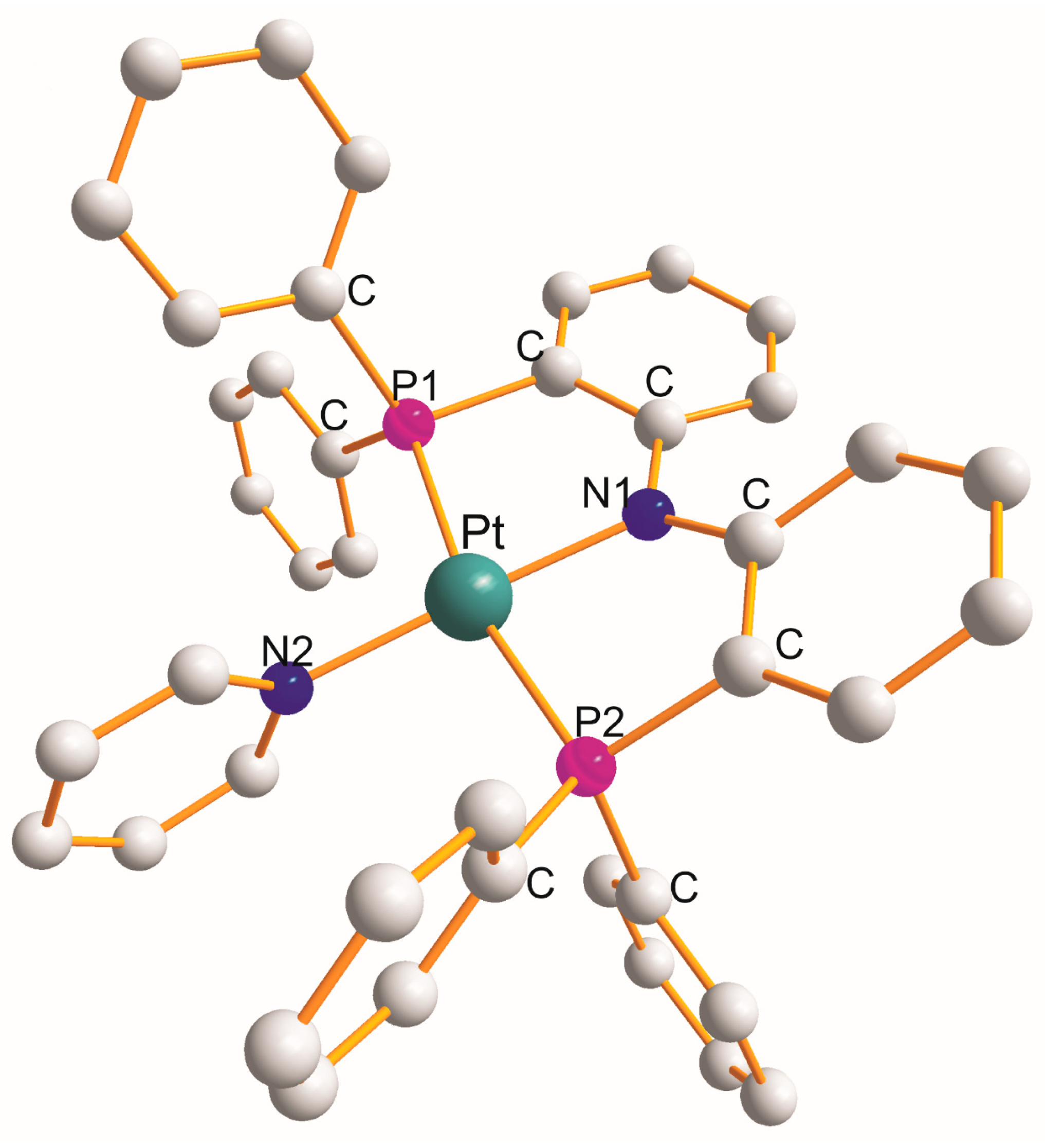
There are nineteen examples of the P1C2N1C2P2 metallocyclic type with a common N1 atom, and their structural data are summarized in Table 1. The chemical structures and practical applications of these particular complexes are presented in Table S1. Monoclinic [Pt{η3-Ph2P(C12H8N)PPh2}(N2C5H5)]CF3SO3.toluene [20] is the only example in which a N2 donor ligand completed a square planar geometry around a Pt(II) atom (PtP1N1P2N2). The structure of [Pt{η3-Ph2P(C12H8N)PPh2}(N2C5H5)]+ [20] is shown in Figure 1 as an example.
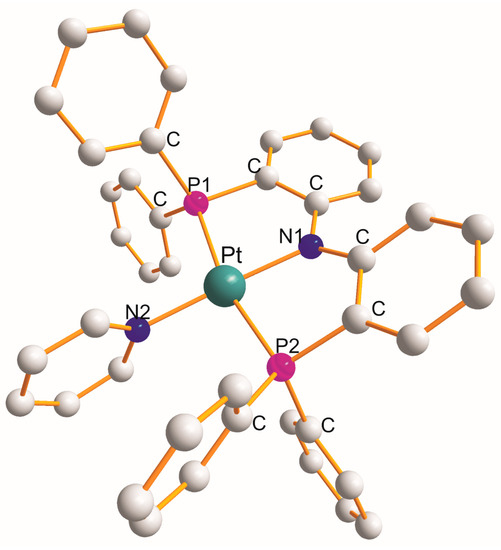
Figure 1.
Structure of [Pt{η3-Ph2P(C12H8N)PPh2}(py)] [20].
In the following eight complexes, triclinic [Pt{η3-But2P(C7H7N)PBut2}(CH3)]Cl (at 100 K), monoclinic [Pt{η3-But2P(C7H6N)PBut2}(CH3)] [21] (at 100 K), monoclinic [Pt{η3-Ph2P(C7H7N)PPh2}{C(=O)Et}]BF4.(CH2Cl2)5 [22] (at 100 K), triclinic [Pt{η3-Ph2P(C7H7N)PPh2}(CH2CHO)]BF4 [22], triclinic [Pt{η3-Ph2P(C7H7N)PPh2}(CH=CHPh)]BF4 [23], monoclinic [Pt{η3-Pri2P(C12H7F2N)PPri2}(C6H4F)]B(C6H5)4 (at 110 K) and monoclinic [Pt{η3-Pri2P(C12H7F2N)PPri2}. (p-toluene)]B(C6H5)4 [24] (at 110 K), and monoclinic [Pt{η3-Ph2P(C7H7N)PPri2}(η1-C11H15NO3)]BF4 [25] and a η3-P1N1P2 ligand with a monodentate CL create a distorted square planar geometry around a Pt(II) atom (PtP1N1P2C).
There are seven complexes, monoclinic [Pt{η3-Ph2P(C12H8N)PPh2}(Cl)](C6H6)5 [20], trigonal [Pt{η3-But2P(C7H7N)PBut2}(Cl)]Cl [21], orthorhombic [Pt{η3-But2P(C7H6N)PBut2}(Cl)] [21] (at 120 K), monoclinic [Pt{η3-Pri2P(C12H6F2N)PPri2}(Cl)]CHB11Cl11 [24] (at 110 K), monoclinic [Pt{η3-Ph2P(C14H12N)PPri2}(Cl)]C6H6 [26] (at 183 K) and triclinic [Pt{η3-Ph2P(C14H12N)Pcy2}(Cl)]C6H6 [26] (at 183 K), and monoclinic [Pt{η3-Ph2P(C7H8N)PPh2}(Cl)] [27] in which Cl− anions complete inner coordinate spheres (PtP1N1P2Cl).
In the remaining two complexes, triclinic [Pt{η3-(η2-(C24H44)P(C7H6N)P(C24H44)} (PPh3)].2CH2Cl2 [28] (at 103 K) and monoclinic [Pt{η3-(η2-C18H28)P(C7H6N)P(η2-C18H29)}(P3cy3)] [29] (at 103 K), a monodentate P3L is involved (PtP1N1P2P3).
The total mean Pt-L bond distance elongates in the following sequences:
Pt (η3-P1N1P2)(Y), Y = N2L, CL, Cl, P3L (19 examples): Pt–N1: (trans to Y): 2.024 (3) Å (N2) < 2.077 (2,5) Å (P3) < 2.128 (2,70) Å (C) < 2.201 (3,26) Å (Cl); Pt–Y: (trans to N1): 2.056 (3) Å (N2) < 2.072 (2,85) Å (C) < 2.277 (2,5) Å (P3) < 2.316 (2,17) Å (Cl); Pt–P1,2: (mutually trans) is 2.287 (2,17) Å
2.3. Pt(η3–P1C1P2)(Y), (Y = OL (x4), NL(x4), C2L (x9), Cl (x12), Br (x2))
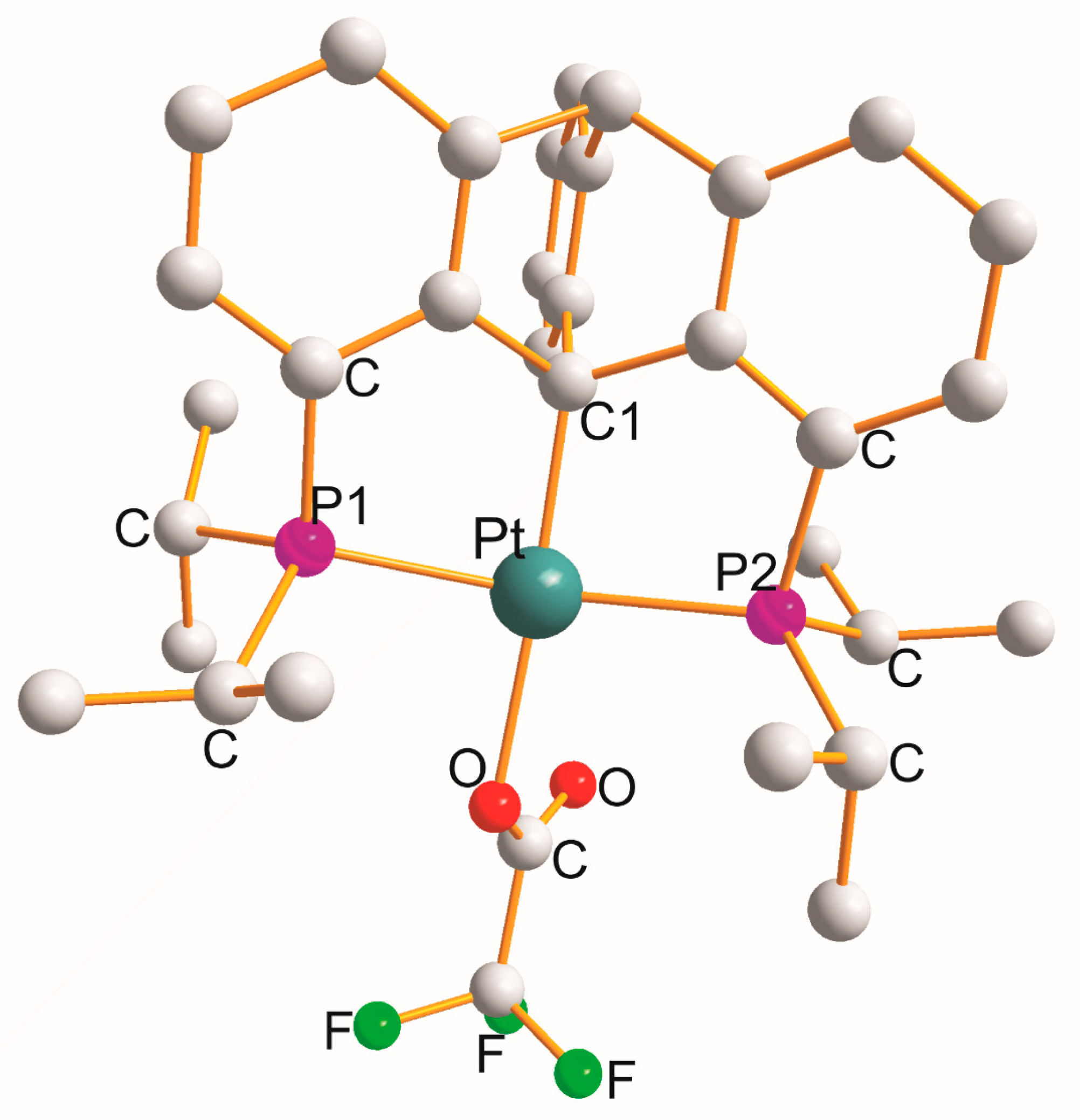
There are over thirty examples of the P1C2C1C2P2 metallocycle type, and their structural data are summarized in Table 2. The chemical structures and practical applications of these particular complexes are presented in Table S2. In four complexes, monoclinic [Pt{η3-(CF3)2P(C8H7)P(CF3)2}(H2O)].SbF6 [30], triclinic [Pt{η3-Ph2P(C8H7)Ph2P}(H2O)]CF3SO3 [31], triclinic [Pt{η3-Ph2P(C8H7)PPh2}(OMe)]0.5C6H6 [31], and orthorhombic [Pt{η3-Pri2P(C20H11)PPri2}(OOCCF3)] [32] (Figure 2), a monodentate OL ligand completed a square planar geometry (PtP1C1P2O).
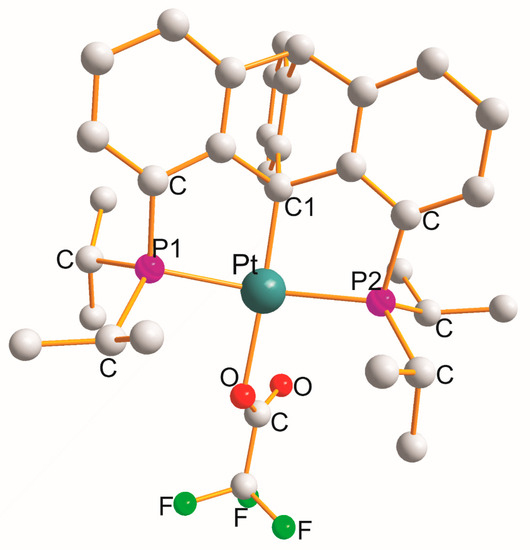
Figure 2.
Structure of [Pt{η3-Pri2P(C20H11)PPri2}(OOCCF3)] [32].
In four complexes, monoclinic [Pt{η3-(CF3)2P(C8H7)P(CF3)2} (NC5H5)]B(C6H5)4 [30], orthorhombic [Pt{η3-Ph2P(C20H13O4)PPh2}(N≡CCH3)]BF4 [32], monoclinic [Pt{η3-Ph2P(C20H11O2)PPh2}(NC5H5)]Cl}](NC5H5) [33], and monoclinic [Pt{η3-Ph2P(C20H11O4)PPh2} (N≡CCH3)]BF4. CH2Cl2 [33], monodentate NL ligands completed the inner coordination sphere PtP1N1P2N2.
There are nine complexes, tetragonal [Pt{η3-Ph2P(C24H19O2)PPh2}(CN)] [34], triclinic [Pt{η3-(CF3)2P(C8H7)P(CF3)2}(CO)]SbF6 [35], monoclinic [Pt{η3-(CF3)2P(C8H7)P(CF3)2}(CH3)] [35], monoclinic [Pt{η3-Pri2P(C8H7)PPri2}(CO)]CF3SO3 0.5C6H6 [36], monoclinic [Pt{η3-But2P(C8H7)PBut2}(η1-CHOMe)]CF3SO3.thf [36], orthorhombic [Pt{η3-But2P(C12H9)PBut2}(CO)]BF4 [37], monoclinic [Pt{η3-Ph2P(C8H7)PPh2}(η1-C12H19N2)] [38], monoclinic [Pt{η3-Ph2P(C6H7N2)PPh2}(η1-C3F2)] [39], and monoclinic [Pt{η3-Ph2P(C8H7)PPh2}(η1-C12H21N2)]2(BF4) [40], in which a monodentate C2L ligands are involved (PtP1C1P2C2).
In twelve complexes, triclinic [Pt{η3-Ph2P(C20H11O2)PPh2}(Cl)](CH3CN)4 [33], monoclinic [Pt{η3-Ph2P(C24H19O2)PPh2}(Cl)] [34], monoclinic [Pt{η3-(CF3)2P(C8H7)P(CF3)2}(Cl)]1.5C6H14 [35], orthorhombic [Pt{η3-But2P(C8H7)PBut2}(Cl)] [36], monoclinic [Pt{η3-But2P(C12H9)PBut2}(Cl)] [37], monoclinic [Pt{η3-But2P(C8H7)PBut2}(Cl)] [41], triclinic [Pt{η3-Pri2P(C8H7)PPri2}(Cl)] [42], monoclinic [Pt{η3-Ph2P(C14H7)PPh2}(Cl)] [43], monoclinic [Pt{η3-Ph2P(C8H7)PPh2}(Cl)]CH3CN [44], orthorhombic [Pt{η3-Ph2P(C18H11O8)PPh2}(Cl)]CH3CN [44], orthorhombic [Pt{η3-Ph2P(C18H11O8)PPh2}(Cl)]CH2Cl2 [45], and monoclinic [Pt{η3-Pri2P(C20H11)PPri2}(Cl)](CH3CN)2 [46], a Cl− anion completed inner coordination spheres around each Pt(II) atom (PtP1C1P2Cl).
A Br− anion is involved in two monoclinic complexes, [Pt{η3-Ph2P(C8H7)PPh2}(Br)] [57] and [Pt{η3-But2P(C8H7)PBut2}(Br)] [47].
The total mean PL-L bond distance elongates in the following sequences:
Pt (η3-P1C1P2)(Y), Y = OL, NL, C2L Cl, Br (31 examples): Pt–C1: (trans to Y): 2.001 (3,8) Å (N) < 2.027 (2,8) Å (O) ~ 2.027 (2,6) Å (Br) < 2.031 (2,12) Å (Cl) < 2.049 (2) Å (C2); Pt–Y: (trans to C1): 2.065 (7,12) Å (C2) < 2.085 (2,12) Å (N) < 2.132 (2,9) Å (O) < 2.400 (2,16) Å (Cl) < 2.467 (1,10) Å (Br); Pt–P1,2: (mutually trans) is 2.75 (2,12) Å.
2.4. Pt(η3–P1S1P2)(Y), (Y = CH3 (x1), Cl (x2), P3Ph3 (x2), I (x1))
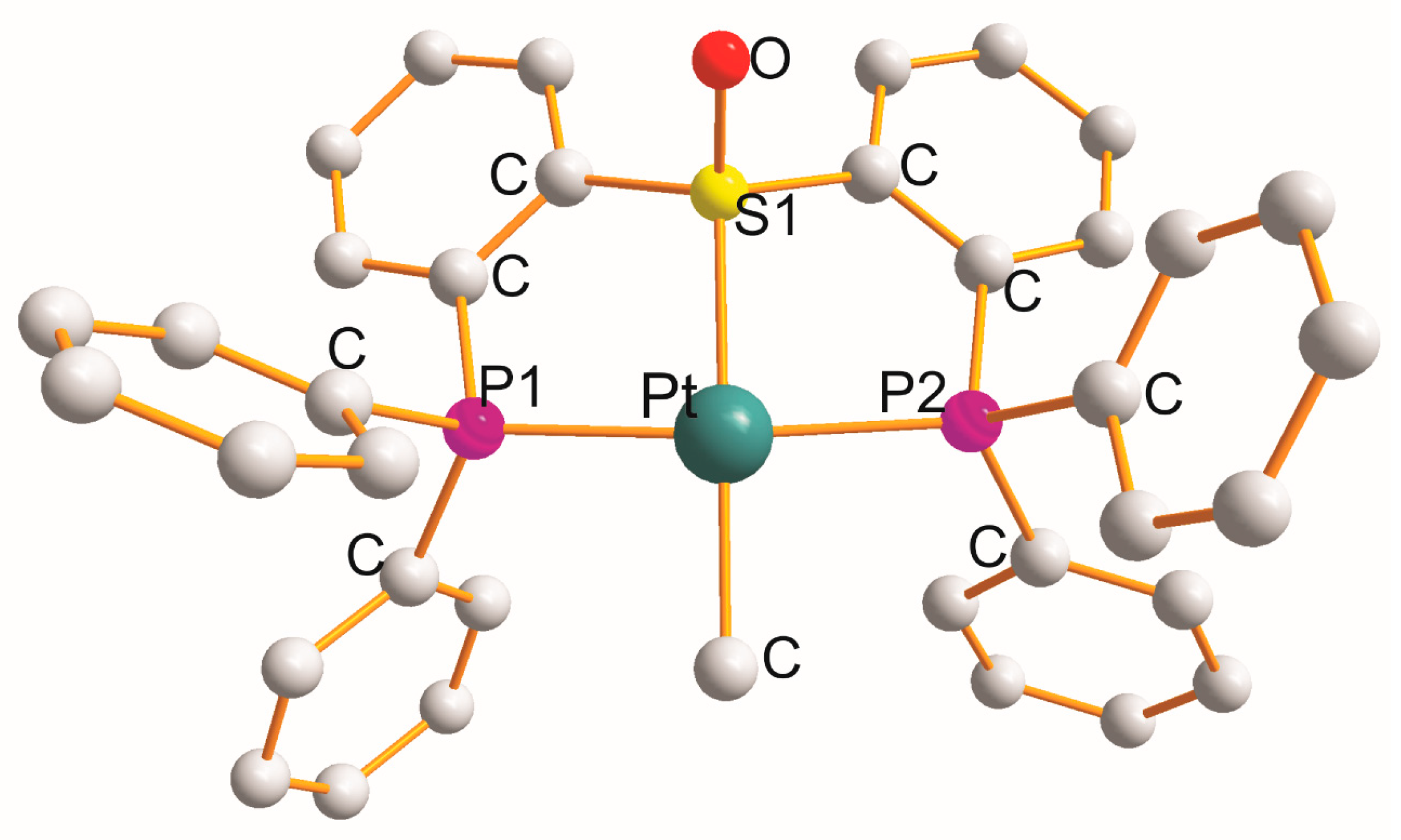
There are six complexes in which each heterotridentate ligand creates a P1C2S1C2P2 metallocycle. Monoclinic [Pt{η3-Ph2P(C6H4)S(=O)(C6H4)PPh2}(CH3)]PF6.CH3CN [48] (at 100 K; Figure 3) is the only example with a (PtP1S1P2C) chromophore. In monoclinic [Pt{η3-Ph2P(C6H4)S(=O)(C6H4)PPh2}(Cl)]PF6.CH3CN [48] and triclinic [Pt{η3-Ph2P(CH2)2S(=O)(CH2)2PPh2}(Cl)]ClO4 [49], the Cl− anion completed a square planar geometry (PtP1S1P2Cl). The structural data are summarized in Table 3. The chemical structures and practical applications of these particular complexes are presented in Table S3.
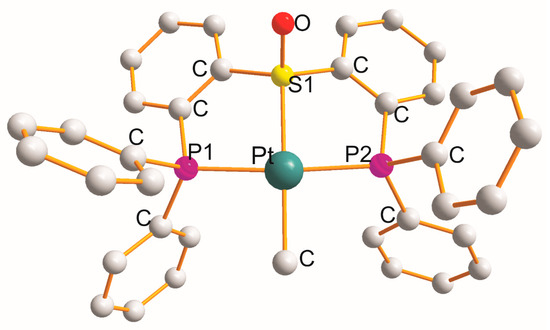
Figure 3.
Structure of [Pt{η3-Ph2P(C6H4)S(=O)(C6H4)PPh2}(CH3)] [49].
In triclinic [Pt{η3-Ph2P(C6H4)S(=O)(C6H4)PPh2}(P3Ph3)]0.5.CH2Cl [48] (at 100 K) and orthorhombic [Pt{η3-Ph2P(CH2)2S(CH2)2PPh2}(P3Ph3)]ClO4 [50] (at 100 K), the P3Ph3 are involved (PtP1S1P2P3).
In another triclinic [Pt{η3-Ph2P(C23H28S)PPh2}(I)].1.74 CH2Cl2 [51] (at 150 K), the I− anion is involved (PtP1S1P2I).
The total mean PL-L bond distance elongates in the sequences:
Pt (η3-P1S1P2)(Y), Y = CL, Cl, P3L, I (6 examples): Pt–S1: (trans to Y): 2.187 (2,5) Å (Cl) < 2.256 (2) Å (I) < 2.268 (2) Å (C) < 2.328 (2,15) Å (P3); Pt–Y: (trans to S1): 2.093 (2) Å (C) < 2.285 (2,3) Å (P3) < 2.317 (2,5) Å (Cl) < 2.510 (1) Å (I); Pt–P1,2: (mutually trans) is 2.300 (4,30) Å.
2.5. Pt(η3–P1Si1P2)(Y), (Y = H (x2), OL (x1), NL (x1), CL (x1), Cl (x5), P3L (x1))
There are fourteen complexes in which each heterotridentate ligand creates a pair of “equal” five-membered metallocyclic rings with a common Si1 atom of the P1C2Si1C2P2 type. The structural data are summarized in Table 3. The chemical structures and practical applications of these particular complexes are presented in Table S3. In two monoclinic [Pt{η3-cy2P(C6H4)Si(Me)(C6H4)Pcy2}(H)].0.5 pentane [52] (at 150 K) and [Pt{η3-cy2P(C6H4)Si(Me)(C6H4)Pcy2}(H)].1.25 pentane [52] (at 93 K), hydride completed a square planar geometry (PtP1Si1P2H).
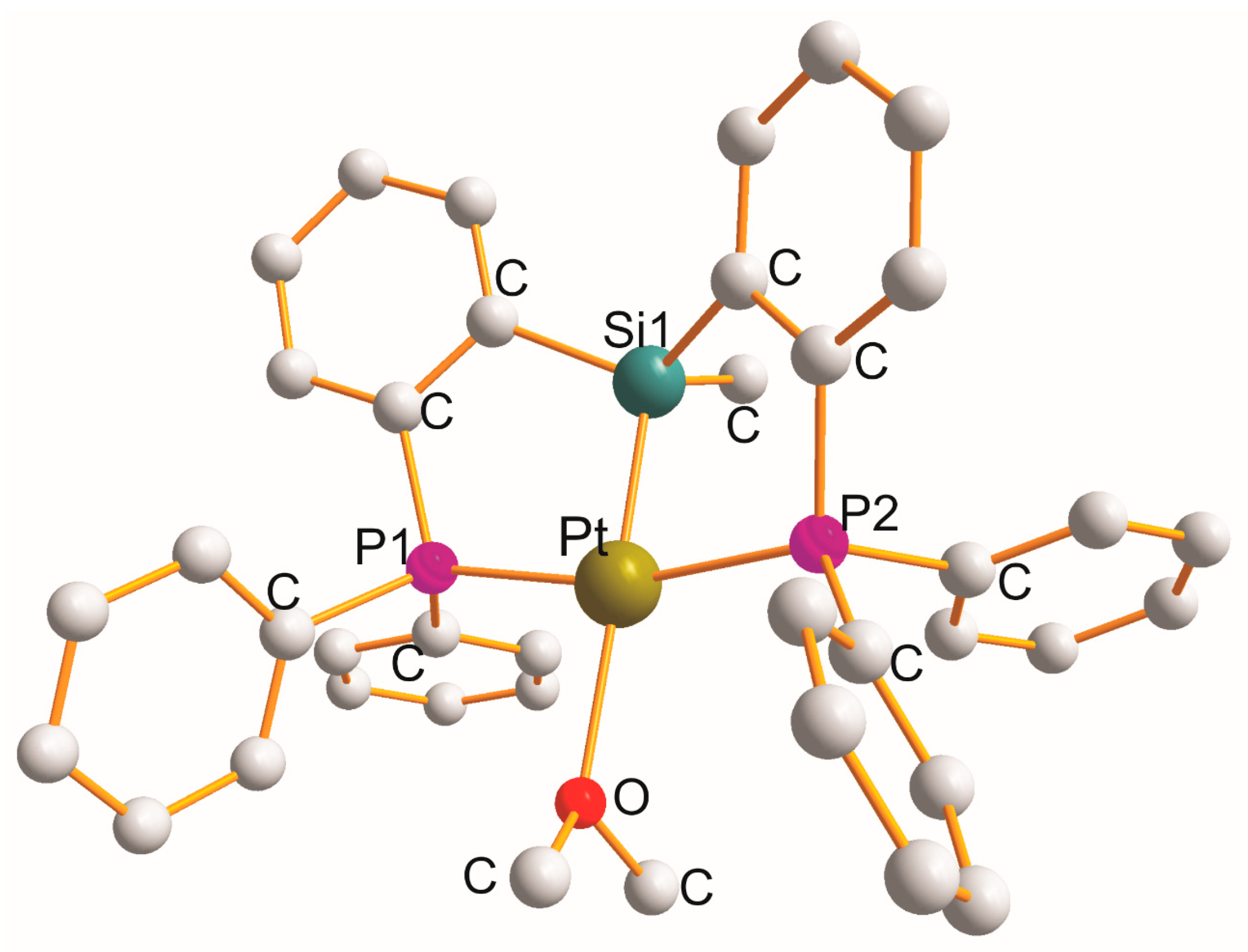
Triclinic [Pt{η3-Ph2P(C6H4)Si(Me)(C6H4)PPh2}(OEt2)]{B(C6F5)3 (CH2Ph)}.OEt2 [53] (Figure 4) is the only example with a monodentate OEt2 ligand (PtP1Si1P2O).
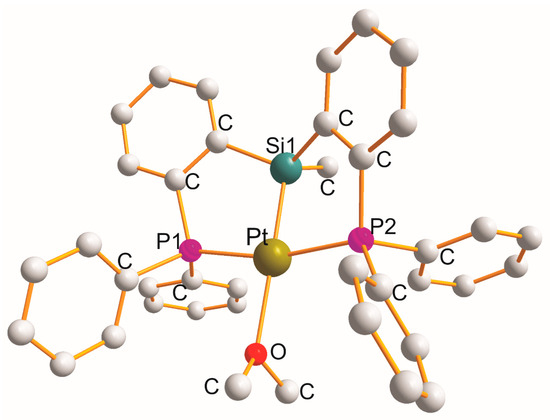
Figure 4.
Structure of [Pt{η3-Ph2P(C6H4)Si(Me)(C6H4)PPh2}(OEt2)] [53].
In another triclinic [Pt{η3-Pri2P1(C6H4)Si1(C6H4PPri2)(C6H4)P2Pri2}(NC5H5)]B(C8H3F6)4 [58] (at 100 K), a monodentate NC5H5 is involved (PtP1Si1P2N).
In the following four complexes: triclinic [Pt{η3-cy2P(C6H4)Si(Me)(C6H4)Pcy2}(Ph)]OEt2 [53] (at 173 K), triclinic [Pt{η3-Ph2P(C6H4)Si(Me)(C6H4)PPh2}(CH2Ph)]CH2Cl2 [53] (at 193 K), triclinic [Pt{η3-Pri2P)(C6H4)Si(OH)(C6H4)PPri2)}(CO)]B(C6F5)4 [54] (at 120 K), and orthorhombic [Pt{η3-Pri2P(C6H4)Si(H)(C6H4)PPri2}(mes)] [55] (at 110 K), monodentate CL ligands are involved (PtP1Si1P2C).
In the following five complexes: monoclinic [Pt{η3-Ph2P(C6H4)Si(Me)(C6H4)PPh2}(Cl)] [53] (at173 K), orthorhombic [Pt{η3-Ph2P(C6H4)Si(Me)(C6H4)PPh2}(ClAlCl3)](C6H5F)2 [53] (at 193 K), monoclinic [Pt{η3-Pri2P(C6H4)Si(OH)(C6H4)PPri2}(Cl)] [54] (at 120 K), monoclinic [Pt{η3-Pri2P(C6H4)Si(H)(C6H4)Pcy2}(Cl)] [55] (at 110 K), and monoclinic [Pt{η3-cy2P(C6H4)Si(Me)(C6H4)Pcy2}(Cl)] [56] (at 110 K), tridentate P1Si1P2 with Cl− anions construct inner coordination spheres around each Pt(II) atom (PtP1Si1P2Cl).
The total mean PL-L bond distance elongates in the following sequences:
Pt (η3-P1Si1P2)(Y), Y = H, OL, NL, CL, Cl, P3L (19 examples): Pt–Si1: (trans to Y): 2.276 (2) Å (O) < 2.279 (2,6) Å (Cl) < 2.315 (2) Å (N) < 2.331 (2,5) Å (H) < 2.339 (2,17) Å (C) < 2.369 (2) Å (P3); Pt–Y: 1.51 (1,2) Å (H) < 2.122 (2,6) Å (C) < 2.222 (2) Å (N) < 2.282 (2) Å (O) < 2.316 (2) Å (P3) < 2.451 (2,13) Å (Cl); Pt–P1,2: (mutually trans) is 2.289 (2,32) Å.
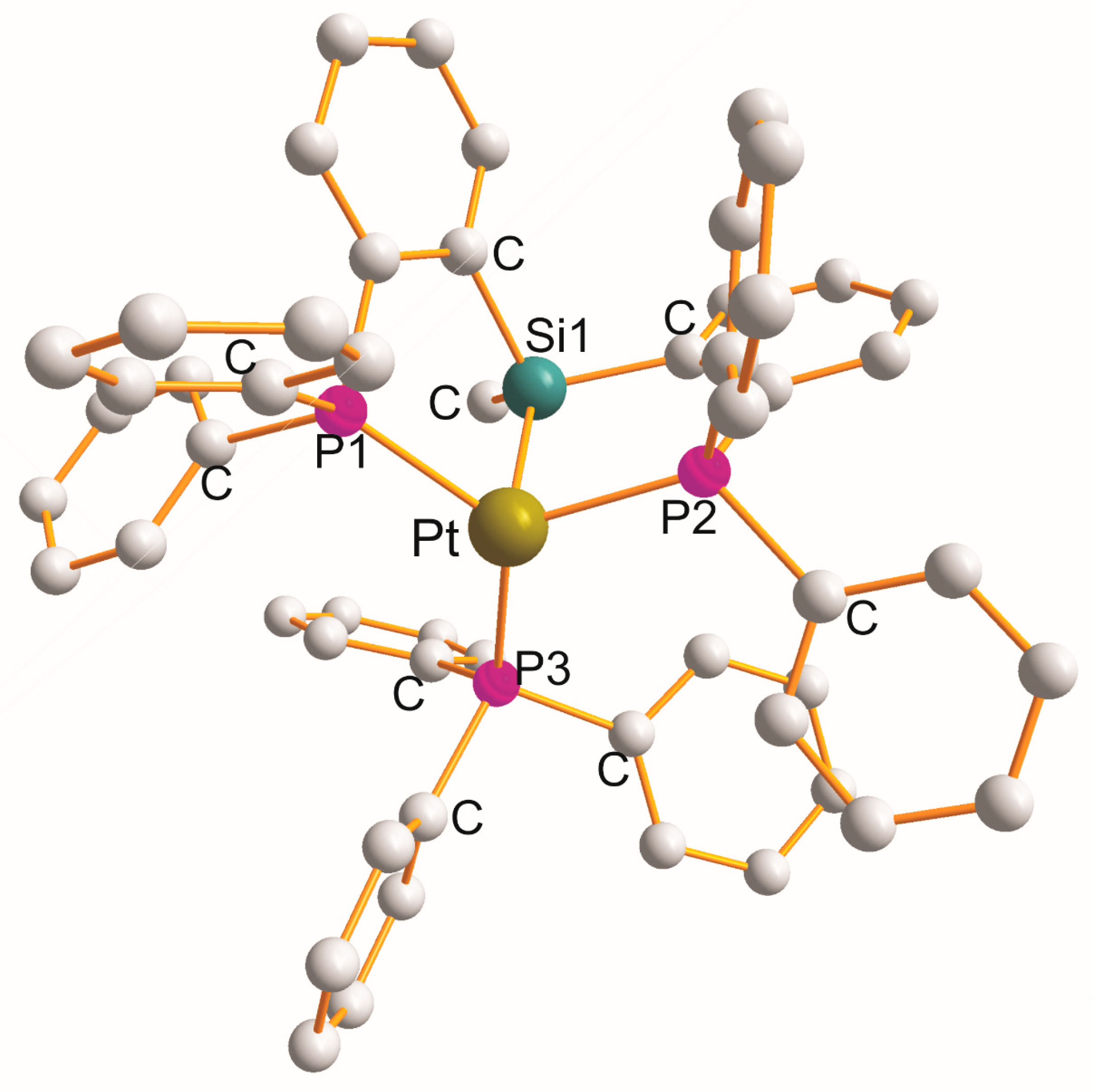
The structure of monoclinic [Pt{η3-Ph2P1(C6H4)Si1(Me)(C6H4)P2Ph2}(P3Ph3)] [59] (at 123 K) is shown in Figure 5. In a distorted trigonal–pyramidal geometry, three P atoms construct a trigonal plane, and the Si1 atom occupies a pyramid. The heterotridentate P1Si1P2 ligand forms a pair of “equal” five-membered metallocyclic rings with a common Si1 atom of the P1C2Si1C2P2 type, with the mean P1–Pt–Si1/Si1–Pt–P2 bite angles of 83.3 (1,8)°. The values for the remaining angles are 120.7 (2)° (P1–Pt–P2), 119.6 (2,2.4)° (P1–Pt–P3/P3–Pt–P2), and 108.9 (2)° (Si1–Pt–P3). The Pt-L bond distance elongates in the following order: 2.290 (2.11) Å (Pt–P1, Pt–P2) < 2.318 (2) Å (Pt–P3) < 2.369 (2) Å (Pt–Si1). This is the only example of such geometries.
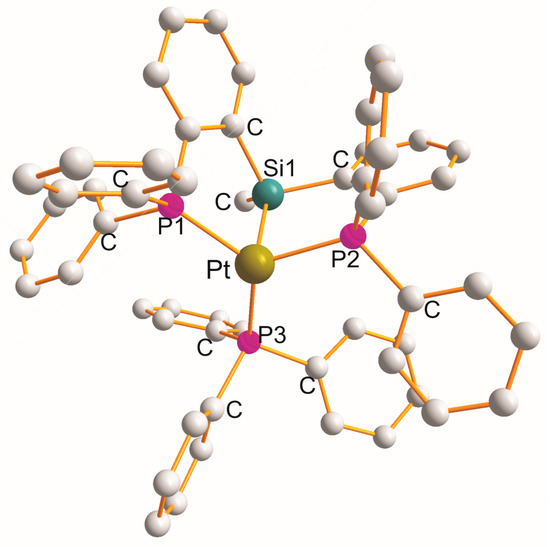
Figure 5.
Structure of [Pt{η3-Ph2P(C6H4)Si(Me)(C6H4)PPh2}(PPh3)] [59].
3. Conclusions
This review evaluates seventy Pt(II) complexes in which inner coordination spheres are constructed by heterotridentate organodiphosphines (η3−P1X1P2) (Y), (X1 = OL, NL, CL, SL or SiL) with variable monodentate donor ligands. These complexes crystallized in five crystal systems: trigonal (×1), tetragonal (×1), orthorhombic (×11), triclinic (×18), and monoclinic (×39).
The structures of the complexes are similar. Each heterotridentate organodiphosphine ligand creates a pair of “equal” five-membered metallocyclic rings with a common X1 atom of the P1C2X1C2P2 type.
The sum of four (Pt-P(x2) + Pt-X1 + Pt-Y) bond distances grows with the covalent radius of the Y atom in the following sequences:
PtP1N1P2Y: 8.65 Å (Y = N) < 8.76 Å (C) < 8.91 Å (Cl) < 9.00 Å (P3);
PtP1C1P2Y: 8.64 Å (Y = N) < 8.66 Å (C2) < 8.98 Å (Cl) < 9.05 Å (Br);
PtP1S1P2Y: 8.91 Å (Y = C) < 9.13 Å (Cl) < 9.20 Å (P3) < 9.39 Å (I);
PtP1Si1P2Y: 8.35 Å (Y = H) < 9.15 Å (O) < 9.17 Å (N) < 9.30 Å (Cl).
The total mean values of the L-Pt-L bond angles are 83.1 (2,2.7)° (P1-Pt-X1/X1-Pt-P2), 163.2 (2,3.5)° (P1-Pt-P2), 96.2 (2,2.5) ° (P1-Pt-Y/Y-Pt-P2), and 175.7° (2,3.9) (X1-Pt-Y).
There are two exceptions—PtP1C1P2O and PtP1Si1P2C—with the sums of 8.71 and 9.03 Å that do not follow the covalent radius of the Y atom. There are two reasons for this discrepancy: trans-influence of C1 vs. O and Si1 vs. C, and the types of ligand H2O and OMe in the former and CO and CN in the latter.
It is well known that in four-coordinated Pt(II) atoms, there is a preference for square planar geometry with different degrees of distortion. A simple metric to assess the molecular shape and degree of distortion is the parameter Τ4 for square planar geometry according to the following equation: Τ4 = 360 − (α + β)/141 [60]. The value of Τ4 for a perfect square planar geometry is zero. The degree of distortion for a square planar geometry around Pt(II) atoms grows in the following sequences (according to Y):
Pt(η3−P1S1P2)(Y):0.105 (Y = C2) < 0.120(I) < 0.138 (Cl) < 0.143 (P3);
The total mean value of τ4 is 0.125;
Pt(η3−P1C1P2)(Y):0.130(Cl) < 0.133(C2) < 0.138 (Br) < 0.146 (O2) < 0.166 (N2);
The total mean value of τ4 is 0.143;
Pt(η3−P1N1P2)(Y):0.115(Cl) < 0.125(N2) < 0.140 (C2) < 0.204 (P3);
The total mean value of τ4 is 0.146;
Pt(η3−P1C1P2)(Y):0.163 (P3);
Pt(η3−P1Si1P2)(Y):0.115(O2) < 0.169(H) < 0.171 (N2) < 0.176 (Cl) < 0.186 (C2);
The total mean value of τ4 is 0.163.
The trans-α-X1-Pt-Y and β-P1-Pt-P2 bond angles are responsible for distortion of square planar geometry around Pt(II) atoms. While the donor atoms of α-X1-Pt-Y angles exhibit a wide variety of soft (H, C, S, P, Si, I), borderline (Br), and hard (O, N, Cl), the donor atoms of β-P1-Pt-P2 angles are only soft. The soft atom ligand has a larger trans-effect than the borderline or hard ones. The trans-effect on a Pt bond distance also affects the L-Pt-L bond angles.
If we take trans-effect into account, the respective trans-α-X1-Pt-Y and β-P1-Pt-P2 angles open, and the distortion (τ4) diminishes in the order (means values) (Table 4).
Table 4.
Total mean values of angles and τ4 of the respective complexes according to the plasticity of atoms.
Structural information about platinum complexes is a prerequisite to properly understanding their roles in chemistry, biology, medicine, etc. Hence, this structural study provides relevant and rationally classified data on the evaluated group of Pt(II) complexes (Pt(η3–P1C2X1C2P2)(Y)), which is helpful for the proper interpretation of results from the areas where such complexes were applied (here, mainly toward their catalytic activity).
Supplementary Materials
The following are available at https://www.mdpi.com/article/10.3390/cryst13091340/s1, Table S1: Structures and applications of Pt{η3–P1X1P2}(Y), (X1 = O1,N1), (Y = C2L,N2L,Cl,P3L) complexes; Table S2: Structures and applications of Pt{η3-P1C1P2}(Y), (Y = O2L,N2L,CL,Cl,Br) complexes; Table S3: Structures and applications of Pt(η3–P1X1P2)(Y), (X1 = S1 or Si1) (Y = C2L,Cl,P3L,I,H,O2L) complexes.
Author Contributions
Conceptualization, M.M. and P.M.; methodology M.M. and P.M.; writing—original draft preparation, M.M. and P.M.; data curation, M.M.; writing—review and editing, V.M.; supervision, M.M. and P.M.; funding acquisition, P.M. All authors have read and agreed to the published version of the manuscript.
Funding
This work was supported by the following projects: VEGA 1/0514/22 and VEGA 1/0146/23.
Data Availability Statement
The data supporting the reported results can be requested from author M.M.
Acknowledgments
This work was supported by the Faculty of Pharmacy, Comenius University Bratislava.
Conflicts of Interest
The authors declare no conflict of interest.
Abbreviations
| But2P(C11H16N3)PBut2 | (N,N’-3,3,5 triethylpyridine-2,6-(1H,2H)-diylidene)bis(di-t-butyl(phosphinusamidato) |
| But2P(C12H9)PBut2 | (1,3-bis(di-t-butylphosphinomethyl)-2-naphtyl |
| But2P(C7H6N)PBut2 | (6-((di-t-butylphosphino)methyl-2-((di-t-butyl phosphino)methylene)-1,2-dihydropyridine-1-yl) |
| But2P(C7H7N)PBut2 | (2,6-bis(di-t-butylphosphino)methyl)pyridine |
| (CF3)2P(C8H7)P(CF3)2 | (2,6-bis(bis(trifluoromethyl)phosphinomethyl) phenyl) |
| (η2–C18H28)P(C7H6N)P(η1–C18H24) | (2-((5,7-di-t-butyl-3,3-dimethyl-2,3-dihydro-14-phosphindol-1-yl)methylene)-6-(((2,4,6-tri-t-butylphenylphosphino)methyl)-1,2-dihydro pyridinyl) undecachloro-carba-undecaborane |
| cy2P(C6H4)Si(Me)(C6H4)Pcy2 | ((methylsilanediyl)di-2,1-phenylene)bis(dicyclohexylphosphine)) |
| Pcy3 | tricyclohexylphosphino |
| Ph2P(C12H8N)PPh2 | (2,2’-bis (diphenylphosphino)diphenylamido) |
| Ph2P(C14H7)PPh2 | (1,8-bis(diphenylphosphino)-9-anthryl) |
| Ph2P(C14H7O2)PPh2 | (1,8-bis(diphenylphosphino)-9-hydroxy-10-oxo-9,10-dihydroanthracen-9-yl) |
| Ph2P(C15H12O)PPh2 | ((9,9-dimethyl-9H-xanthene-4,5-diyl)bis (diphenylphosphine)-diphenyl(2-pyridyl) phosphine |
| Ph2P(C18H19O8)PPh2 | (2,6-bis(1-(diphenylphosphino)-3-methoxy-2-(methoxycarbonyl)-3-oxopropylphenyl) |
| Ph2P(C20H11O2)PPh2 | (13,16-bis(diphenylphosphino)-3,6-dihydroxypentacyclo [6.6.6.O2,7.O9,14.O15,20]icosa-2,4,6,9,11,13,15,17,19-nonaen-1-yl) |
| Ph2P(C20H13O4)PPh2 | (3,13-bis(diphenylphosphino)-15,16-bis(methoxy-carbonyl)tetracyclo[6.6.6.2 O2,7.O9,14]hexadeca-2,4,6,9,11,13,15-heptaen-1-yl) |
| Ph2P(C23H28S)PPh2 | ((9,9-dimethyl-2,7-bis(t-butyl)-9H-thioxantene-4,5-diyl)bis(diphenylphosphine) |
| Ph2P(C6H4)S(=O)(C6H4)PPh2 | ((sulfinydi-2,1-phenylene)bis(diphenylphosphine) |
| Ph2P(C8H7)PPh2 | (2,6-bis((diphenylphosphino)methyl)phenyl) |
| Ph2P(CH2)2S(CH2)2PPh2 | (bis(2-(diphenylphosphino)ethyl)sulfide) |
| PPh3 | triphenylphosphine |
| Pri2P (C20H11)PPri2 | (3,13-bis(diisopropylphosphino)-pentacyclo [6.6.6.O2,7.O9,14.O15,20]icosa-2,4,6,9,11,13,15,17,19-heptaen-1-yl) |
| Pri2P(C12H6F2N)PPri2 | (2-(diisopropylphosphino)-N-(2-(diisopropyl-phosphino)-4-fluorophenyl)-4-fluoroanilinato) |
| Pri2P(C12H7F2N)PPri2 | (2-(diisopropylphosphino)-N-(2-(diisopropyl-phosphino)-4-fluorophenyl)-4-fluoroaniline) |
| Pri2P(C14H12N)PPh2 | (bis(2-(di-isopropylphosphino)-4-methyl-phenyl)(2-((diphenylphosphino)-4-methyl-phenyl)amide) |
| Pri2P(C6H4)Si(C12H46P)(C6H4)PPri2 | (tris(2-(diisopropylphosphino)phenyl)silyl) |
| Pri2P(C6H4)Si(H)(C6H4)PPri2 | ((silanediyldi-2,1-phenylene)bis(diiso-propyl phosphine)) |
References
- Rosenberg, B.; Van Camp, L.; Trasko, Y.E.; Mansour, V.H. Platinum Compounds: A New Class of Potent Antitumour Agents. Nature 1969, 222, 385–386. [Google Scholar] [CrossRef]
- Ashiq, M.; Danish, M.; Mohsin, M.; Bari, S.; Mukhtar, F. Chemistry of Platinum and Palladium Metal Complexes in Homogeneous and Heterogeneous Catalysis: A Mini Review. Int. J. Sci. Basic. Appl. Res. 2013, 7, 50–61. Available online: http://gssrr.org/index.php?journal=JournalOfBasicAndApplied&page=article&op=view&path%5B%5D=1134 (accessed on 25 May 2023).
- Chaaban, M.; Zhou, C.; Lin, H.; Chyic, B.; Ma, B. Platinum(ii) binuclear complexes: Molecular structures, photophysical properties, and applications. J. Mater. Chem. C 2019, 7, 5910–5924. [Google Scholar] [CrossRef]
- Santos, T.M.R.; Andolpho, G.A.; Tavares, C.A.; Gonçalves, M.A.; Ramalho, T.C. Improving the Path to Obtain Spectroscopic Parameters for the PI3K—(Platinum Complex) System: Theoretical Evidences for Using 195Pt NMR as a Probe. Magnetochemistry 2023, 9, 89. [Google Scholar] [CrossRef]
- Horiuchi, S.; Umakoshi, K. Recent advances in pyrazolato-bridged homo- and heterometallic polynuclear platinum and palladium complexes. Coord. Chem. Rev. 2023, 476, 214924. [Google Scholar] [CrossRef]
- Melník, M.; Mikuš, P. Organomonophosphines in PtP2Cl2 Derivatives: Structural Aspects. Rev. Inorg. Chem. 2015, 35, 179–189. [Google Scholar] [CrossRef]
- Melník, M.; Mikuš, P. Organodiphosphines in PtP2X2 (X = As, Ge or Te) Derivatives—Structural Aspects. Main. Group. Chem. 2020, 43, 132–137. [Google Scholar] [CrossRef]
- Melník, M.; Mikuš, P. Distortion Isomers of Cis-PtP2X2 and Cis-PtP2XY Derivatives—Structural Aspects. Rev. Inorg. Chem. 2020, 40, 153–165. [Google Scholar] [CrossRef]
- Albrecht, M.; van Koten, G. Platinum Group Organometallics Based on “Pincer” Complexes: Sensors, Switches, and Catalysts. Angew. Chem. Int. Ed. 2001, 40, 3750. [Google Scholar] [CrossRef]
- van der Boom, M.E.; Milstein, D. Cyclometalated Phosphine-Based Pincer Complexes: Mechanistic Insight in Catalysis, Coordination, and Bond Activation. Chem. Rev. 2003, 103, 1759. [Google Scholar] [CrossRef]
- Rybtchinski, B.; Milstein, D. Metal Insertion into C−C Bonds in Solution. Angew. Chem. Int. Ed. 1999, 38, 870. [Google Scholar] [CrossRef]
- Singleton, J.T. The Uses of Pincer Complexes in Organic Synthesis. Tetrahedron 2003, 59, 1837–1857. [Google Scholar] [CrossRef]
- Vigalok, A.; Milstein, D. Advances in metal chemistry of quinonoid compounds: New types of interactions between metals and aromatics. Acc. Chem. Res. 2001, 34, 798–807. [Google Scholar] [CrossRef] [PubMed]
- Milstein, D. Challenging metal-based transformations. From single-bond activation to catalysis and metallaquinonoids. Pure Appl. Chem. 2003, 75, 445–460. [Google Scholar] [CrossRef]
- Jensen, C.M. Iridium PCP pincer complexes: Highly active and robust catalysts for novel homogeneous aliphatic dehydrogenations. Chem. Commun. 1999, 2443–2449. [Google Scholar] [CrossRef]
- Gandelman, M.; Konstantinovski, L.; Rozenberg, H.; Milstein, D. Interplay between solvent and counteranion stabilization of highly unsaturated rhodium(III) complexes: Facile unsaturation-induced dearomatization. Chem. Eur. J. 2003, 9, 2595–2602. [Google Scholar] [CrossRef]
- Melník, M.; Mikuš, P. Tetradentate organophosphines in Pt(η4–A4L) (A = P4, P3Si), P2X2 (X2 = N2, S2, C2), (PX3) (X3 = N3, N2O): Structural aspects. Main Group Met. Chem. 2021, 44, 270–280. [Google Scholar] [CrossRef]
- Melník, M.; Mikuš, P. Heterotridentate organophosphines in Pt(κ3–P1C1P2)(X), (X=H, OL, NL, CL, Cl, Br or I) and Pt(κ3–P1P2C1)(Cl) derivatives structural aspects. J. Mol. Struct. 2023, 1276, 134768. [Google Scholar] [CrossRef]
- Lenero, K.Q.A.; Guari, Y.; Kamer, P.C.J.; van Leeuwen, P.W.N.M.; Donnadiere, B.; Sabo-Etienne, S.; Chaudret, B.; Lutz, M.; Spek, A.L. Heterolytic activation of dihydrogen by platinum and palladium complexes. Dalton Trans. 2013, 42, 6495–6512. [Google Scholar] [CrossRef]
- Liang, L.C.; Lin, J.M.; Lee, W.Y. Benzene C–H Activation by Platinum(Ii) Complexes of Bis(2-Diphenylphosphinophenyl)Amide. Chem. Commun. 2005, 19, 2462–2464. [Google Scholar] [CrossRef]
- Feller, M.; Ben-Ari, E.; Iron, M.A.; Diskin-Posner, Y.; Leitus, G.; Shimon, L.J.W.; Konstantinovski, L.; Milstein, D. Cationic, Neutral, and Anionic PNP Pd II and Pt II Complexes: Dearomatization by Deprotonation and Double-Deprotonation of Pincer Systems. Inorg. Chem. 2010, 49, 1615–1625. [Google Scholar] [CrossRef] [PubMed]
- Carlisle, S.; Matta, A.; Valles, H.; Bracken, J.B.; Miranda, M.; Yoo, J.; Hahn, C. Addition to Alkynes Promoted by a Dicationic Platinum(II) Complex. Organometallics 2011, 30, 6446–6457. [Google Scholar] [CrossRef]
- Hahn, C. Structural Investigations of Platinum(II) Styrene and Styryl Complexes and Mechanistic Study of Vinylic Deprotonation. Organometallics 2010, 29, 1331–1338. [Google Scholar] [CrossRef]
- DeMott, J.C.; Bhuvanesh, N.; Ozerov, O.V. Frustrated Lewis Pair-like Splitting of Aromatic C–H Bonds and Abstraction of Halogen Atoms by a Cationic [(FPNP)Pt]+. Species. Chem. Sci. 2013, 4, 642–649. [Google Scholar] [CrossRef]
- Cucciolito, M.E.; D’Amora, A.; Tuzi, A.; Vitagliano, A. Catalytic Hydroarylation of Olefins Promoted by Dicationic Platinum(II) and Palladium(II) Complexes. The Interplay of C−C Bond Formation and M−C Bond Cleavage. Organometallics 2007, 26, 5216–5223. [Google Scholar] [CrossRef]
- Lansing, R.B.; Goldberg, K.I.; Kemp, R.A. Unsymmetrical RPNPR′ Pincer Ligands and Their Group 10 Complexes. Dalton Trans. 2011, 40, 8950–8958. [Google Scholar] [CrossRef]
- Sacco, A.; Vasapollo, G.; Nobile, C.F.; Piergiovanni, A.; Pellinghelli, M.A.; Lanfranchi, M. Syntheses and Structures of 2-Diphenylphosphinomethylenide-6-Diphenylphosphinomethylenepyridine Complexes of Palladium(II) and Platinum(II); Crystal Structures of [PtCl2-(CHPPH2)-6-(CH2PPh2)Pyridine] and [Pd(COOMe)2-(CHPPh2)-6-(CH2PPh2)Pyridine]. J. Organomet. Chem. 1988, 356, 397–409. [Google Scholar] [CrossRef]
- Takeuchi, K.; Taguchi, H.; Tanigawa, I.; Tsujimoto, S.; Matsuo, T.; Tanaka, H.; Yoshizawa, I.K.; Ozawa, F. A Square-Planar Complex of Platinum(0). Angew. Chem. Int. Ed. Engl. 2016, 55, 15347–15350. [Google Scholar] [CrossRef]
- Taguchi, H.; Chang, Y.H.; Takeuchi, K.; Ozawa, F. Catalytic Synthesis of an Unsymmetrical PNP-Pincer-Type Phosphaalkene Ligand. Organometallics 2015, 34, 1589–1596. [Google Scholar] [CrossRef]
- Adams, J.J.; Arulsamy, N.; Roddick, D.M. Acceptor Pincer Coordination Chemistry of Platinum: Reactivity Properties of (CF3 PCP)Pt(L) + (L = NC5F5, C2H4). Organometallics 2009, 28, 1148–1157. [Google Scholar] [CrossRef]
- Arunachalampillai, A.; Loganathan, N.; Wendt, O.F. Carboxylation of Pincer PCP Platinum Methoxide Complexes under Formation of Metalla Carbonates. Polyhedron 2012, 32, 24–29. [Google Scholar] [CrossRef]
- Musa, S.; Shpruhman, A.; Gelman, D. New PC(sp3)P pincer complexes of platinum and palladium. J. Organomet. Chem. 2012, 699, 92–95. [Google Scholar] [CrossRef]
- De-Botton, S.; Romm, R.; Bensoussan, G.; Hitrik, M.; Musa, S.; Gelman, D. Coordination Versatility of P-Hydroquinone-Functionalized Dibenzobarrelene-Based PC(Sp3)P Pincer Ligands. Dalton Trans. 2016, 45, 16040–16046. [Google Scholar] [CrossRef] [PubMed]
- Jia, Y.X.; Yang, X.Y.; Tay, W.S.; Li, Y.; Pullarkat, S.A.; Xu, K.; Hirao, H.; Leung, P.H. Computational and Carbon-13 NMR Studies of Pt–C Bonds in P–C–P Pincer Complexes. Dalton Trans. 2016, 45, 2095–2101. [Google Scholar] [CrossRef] [PubMed]
- Adams, J.J.; Lau, A.; Arulsamy, N.; Roddick, D.M. Synthesis and Platinum Coordination Chemistry of the Perfluoroalkyl Acceptor Pincer Ligand, 1,3-(CH2P(CF3)2)2C6H4. Inorg. Chem. 2007, 46, 11328–11334. [Google Scholar] [CrossRef]
- Vuzman, D.; Poverenov, E.; Diskin-Posner, Y.; Leitus, G.; Shimon, L.J.W.; Milstein, D. Reactivity and Stability of Platinum(Ii) Formyl Complexes Based on PCP-Type Ligands. The Significance of Sterics. Dalton Trans. 2007, 48, 5692–5700. [Google Scholar] [CrossRef]
- Schwartsburd, L.; Poverenov, E.; Shimon, L.J.W.; Milstein, D. Naphthyl-Based PCP Platinum Complexes. Nucleophilic Activation of Coordinated CO and Synthesis of a Pt(II) Formyl Complex. Organometallics 2007, 26, 2931–2936. [Google Scholar] [CrossRef]
- Spek, A.L.; Dani, P.; van Koten, G. Crystal Structure of [Pt{η3-Ph2P(C8H7)PPh2}(η1-C12H19N2)]. Private Communication CCDB, IXICEX (2004). Available online: https://www.ccdc.cam.ac.uk/ (accessed on 28 April 2023).
- Hughes, R.P.; Williamson, A.; Incarvito, C.D.; Rheingold, A.L. Synthesis and Molecular Structure of a Perfluoroalkyl Complex of Platinum Containing a PCP Pincer Ligand. Organometallics 2001, 20, 4741–4744. [Google Scholar] [CrossRef]
- Albrecht, M.; Dani, P.; Lutz, M.; Spek, A.L.; van Koten, G. Transcyclometalation Processes with Late Transition Metals: C-aRyl−H Bond Activation via Noncovalent C−H···Interactions. J. Am. Chem. Soc. 2000, 122, 11822–11833. [Google Scholar] [CrossRef]
- Olsson, D.; Arunachalampillai, A.; Wendt, O.F. Synthesis and Characterisation of PCsp3P Phosphine and Phosphinite Platinum(Ii) Complexes. Cyclometallation and Simple Coordination. Dalton Trans. 2007, 46, 5427–5433. [Google Scholar] [CrossRef]
- Poverenov, E.; Leitus, G.; Shimon, L.J.W.; Milstein, D. C-Metalated Diazoalkane Complexes of Platinum Based on PCP- and PCN-Type Ligands. Organometallics 2005, 24, 5937–5944. [Google Scholar] [CrossRef]
- Fischer, S.; Wendt, O.F. {2,6-Bis[(Diphenylphosphino)Methyl]phenyl} chloroplatinum(II). Acta Cryst. Sect. E Struct. Rep. Online 2004, 60, m69–m70. [Google Scholar] [CrossRef]
- Hu, J.; Xu, H.; Nguyen, M.H.; Yip, J.H.K. Photooxidation of a Platinum-Anthracene Pincer Complex: Formation and Structures of Pt II -Anthrone and -Ketal Complexes. Inorg. Chem. 2009, 48, 9684–9692. [Google Scholar] [CrossRef] [PubMed]
- Yang, X.Y.; Tay, W.S.; Li, Y.; Pullarkat, S.A.; Leung, P.H. Versatile Syntheses of Optically Pure PCE Pincer Ligands: Facile Modifications of the Pendant Arms and Ligand Backbones. Organometallics 2015, 34, 1582–1588. [Google Scholar] [CrossRef]
- Azerraf, C.; Gelman, D. New Shapes of PC(Sp3)P Pincer Complexes. Organometallics 2009, 28, 6578–6584. [Google Scholar] [CrossRef]
- Williams, B.S.; Dani, P.; Lutz, M.; Spek, A.L.; van Koten, G. Development of the First P-Stereogenic PCP Pincer Ligands, Their Metallation by Palladium and Platinum, and Preliminary Catalysis. Helv. Chim. Acta 2001, 84, 3519–3530. [Google Scholar] [CrossRef]
- Suess, D.L.M.; Peters, J.C. Late-Metal Diphosphinosulfinyl S(O)P 2 Pincer-Type Complexes. Organometallics 2012, 31, 5213–5222. [Google Scholar] [CrossRef]
- Siah, S.Y.; Leung, P.H.; Mok, K.F. Palladium(II) and Platinum(II) Complexes with a Novel P—S(O)—P Tridentate Ligand. Polyhedron 1994, 13, 3253–3255. [Google Scholar] [CrossRef]
- Andreasen, L.V.; Hazell, A.; Wernberg, O. [Bis(2-Diphenylphosphinoethyl) Sulfide-κ3P,S,P′](Triphenylphosphine-κP)Platinum(II) Diperchlorate Acetone Solvate. Acta Crystallogr. Sect. C Cryst. Struct. Commun. 2002, 58, m385–m387. [Google Scholar] [CrossRef]
- Emslie, D.J.H.; Harrington, L.E.; Jenkins, H.A.; Robertson, C.M.; Britten, J.F. Group 10 Transition-Metal Complexes of an Ambiphilic PSB-Ligand: Investigations into η3(BCC)-Triarylborane Coordination. Organometallics 2008, 27, 5317–5325. [Google Scholar] [CrossRef]
- Suh, H.W.; Balcells, D.; Edwards, A.J.; Guard, L.M.; Hazari, N.; Mader, E.A.; Mercado, B.Q.; Repisky, M. Understanding the Solution and Solid-State Structures of Pd and Pt PSiP Pincer-Supported Hydrides. Inorg. Chem. 2015, 54, 11411–11422. [Google Scholar] [CrossRef] [PubMed]
- Mitton, S.J.; McDonald, R.; Turculet, L. Synthesis and Characterization of Neutral and Cationic Platinum(II) Complexes Featuring Pincer-like Bis(Phosphino)Silyl Ligands: Si−H and Si−Cl Bond Activation Chemistry. Organometallics 2009, 28, 5122–5136. [Google Scholar] [CrossRef]
- Korshin, E.E.; Leitus, G.; Shimon, L.J.W.; Konstantinovski, L.; Milstein, D. Silanol-Based Pincer Pt(II) Complexes: Synthesis, Structure, and Unusual Reactivity. Inorg. Chem. 2008, 47, 7177–7189. [Google Scholar] [CrossRef] [PubMed]
- DeMott, J.C.; Gu, W.; McCulloch, B.J.; Herbert, D.E.; Goshert, M.D.; Walensky, J.R.; Zhou, J.; Ozerov, O.V. Silyl–Silylene Interplay in Cationic PSiP Pincer Complexes of Platinum. Organometallics 2015, 34, 3930–3933. [Google Scholar] [CrossRef]
- Brost, R.D.; Bruce, G.C.; Joslin, F.L.; Stobart, S.R. Phosphinoalkylsilyl Complexes. 12. Stereochemistry of the Tridentate Bis(Diphenylphosphinopropyl)Silyl (BiPSi) Framework: Complexation That Introduces “Face Discrimination” at Coordinatively Unsaturated Metal Centers. X-Ray Crystal and Molecular Structure. Organometallics 1997, 16, 5669–5680. [Google Scholar] [CrossRef]
- Bachechi, F. X-Ray Structural Analysis of NiII, PdII, and PtII Complexes with the Potentially Tridentate Ligand 1,3-Bis(Diphenylphosphinomethyl)Benzene, 1,3-C6H4(CH2PPh2)2. Struct. Chem. 2003, 14, 263–269. [Google Scholar] [CrossRef]
- Tsay, C.; Mankad, N.P.; Peters, J.C. Four-Coordinate, Trigonal Pyramidal Pt(II) and Pd(II) Complexes. J. Am. Chem. Soc. 2010, 132, 13975–13977. [Google Scholar] [CrossRef]
- Takaya, J.; Iwasawa, N. Reaction of Bis(o-Phosphinophenyl)Silane with M(PPh3)4(M = Ni, Pd, Pt): Synthesis and Structural Analysis of H2-(Si–H) Metal(0) and Pentacoordinate Silyl Metal(Ii) Hydride Complexes of the Ni Triad Bearing a PSiP-Pincer Ligand. Dalton Trans. 2011, 40, 8814–8821. [Google Scholar] [CrossRef]
- Yang, L.; Powell, D.R.; Houser, R.P. Structural Variation in Copper(i) Complexes with Pyridylmethylamide Ligands: Structural Analysis with a New Four-Coordinate Geometry Index, Τ4. Dalton Trans. 2007, 9, 955–964. [Google Scholar] [CrossRef]
Disclaimer/Publisher’s Note: The statements, opinions and data contained in all publications are solely those of the individual author(s) and contributor(s) and not of MDPI and/or the editor(s). MDPI and/or the editor(s) disclaim responsibility for any injury to people or property resulting from any ideas, methods, instructions or products referred to in the content. |
© 2023 by the authors. Licensee MDPI, Basel, Switzerland. This article is an open access article distributed under the terms and conditions of the Creative Commons Attribution (CC BY) license (https://creativecommons.org/licenses/by/4.0/).