


Abstract
We demonstrate the peculiarities of the magnetization process in the ferrimagnetic intermetallic compound (Nd0.5Dy0.5)2Fe14B, which has been studied theoretically and experimentally using ultrahigh magnetic fields. We observe phase transition induced by external ultrahigh magnetic fields (up to 170 T) and also describe the magnetization process analytically in terms of critical transition fields. In this work, the first and second critical fields of the field-induced magnetic transitions, Hc1 and Hc2, were estimated, and the results were verified against experimental data for Hc1. Critical field Hc2 predicting the place of transition to the forced-ferromagnetic state was estimated for the first time for (Nd0.5Dy0.5)2Fe14B compound. A comparison of the magnetization behavior for (Nd0.5Dy0.5)2Fe14B with the basic systems Nd2Fe14B and Dy2Fe14B is also performed. We demonstrate that, in the Dy2Fe14B compound, the field-induced transition type is changed from the first to the second order due to the replacement of the Nd atom by Dy one.
1. Introduction
In the last few decades, searching for new materials for high-performance permanent magnets is an overriding task for modern physicists and technologists as these magnets are key driving components for electric motors, wind turbines, mobile phones, magnetic memory, and several other products [1,2,3].
Curie temperature Tc, magnetic anisotropy constant K, and saturation magnetization Ms of such materials are fundamental characteristics used to classify the existing permanent magnets. At Curie temperature, a material loses its ferromagnetic properties; hence, the higher the Tc, the better are the magnets to be used under extreme conditions. High values of saturation magnetization and magnetic anisotropy constants contribute to the creation of high-coercivity magnets that are very important for different practical applications [4,5,6,7,8].
Scientists pay the greatest attention to intermetallic compounds based on rare earth metals (R) and iron, in the fundamental magnetic properties, including exchange interaction parameters of R-Fe compounds, which can be studied most effectively by magnetization measurements in high magnetic fields. Ferrimagnetically ordered compounds are the most interesting because the ferrimagnetic structure is affected by applied external magnetic field, and a sequence of spin–reorientation phase transitions can be observed until the compound reaches magnetic saturation. In order to achieve the full magnetic saturation and to maintain the compound in the forced-ferromagnetic state, the ultrahigh magnetic fields are required [9,10,11,12]. In addition, interest of magnetic phase transitions study in (R,R’)2Fe14B compounds is increasing due to the recent discovery of skyrmions in Nd2Fe14B [13].
Obtaining high and ultrahigh fields, as well as obtaining reliable experimental data on the magnetization of samples, is a technically difficult task, which is the subject of great efforts of scientists from different countries as a rule. Generation of magnetic fields involves having an electric current flow through a coil, and the field intensity B is proportional to the current I. The heat dissipation I2R is proportional to the square of the magnetic field, where R is the coil’s resistance. The mechanical pressure is also proportional to B2, with a proportionality coefficient of approximately 4 atm/T2. Heating and mechanical forces are the two essential problems for the generation of high fields. The stored energy in magnetic field depends on the volume of the magnet, so the size of the field volume is also an important characteristic of the magnet. Another key parameter is whether a magnet is DC or pulsed and, in the latter case, additional important parameters are the duration, temporal profile of the pulse, and the pulse repetition rate. There are several different approaches to overcome the heat–dissipation and mechanical-stability challenges, which is demonstrated in Figure 1 [14]. In all cases, choice of materials is crucially important, so such development is a task at the intersection of physics, engineering, and materials sciences.
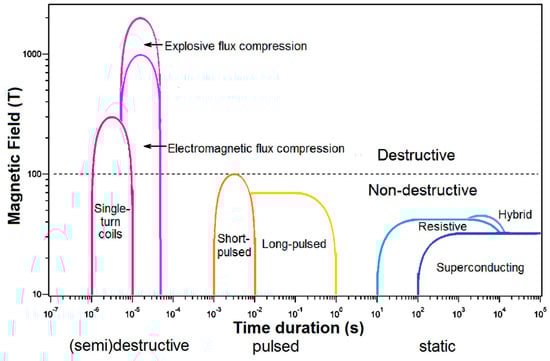
Figure 1.
Overview of methods for obtaining high and ultrahigh magnetic fields [14].
It should be noted that the highest-field magnet is not necessarily the best choice for a particular experiment. The figure-of-merit (FOM), depending on the experiment, could be the stored energy B2V (where V is the field volume), or the effective B2L (where L is the length of the field), or something else such as the tunability to a desired field value, or the broad operating range of the field values while keeping spatial homogeneity.
There are several laboratories around the world that conduct generation and research of high magnetic fields: the French Laboratoire National des Champs Magnetiques Intenses (LNCMI) with two locations; the German Dresden High Magnetic Field Laboratory (Hochfeld-Magnetlabor Dresden, HLD); and the High Field Magnet Laboratory (HMFL) in the Netherlands. These laboratories operate within the European Magnetic Field Laboratory (EMFL). The US National High Magnetic Field Laboratory (NHMFL) also has three locations. There are two laboratories in China: the High Magnetic Field Laboratory of the Chinese Academy of Sciences (CHMFL) and the Wuhan National High Magnetic Field Center (WHMFC), and four laboratories in Japan: the Tsukuba Magnet Laboratory (TML), the High Field Laboratory for Superconducting Materials, the International Megagauss Science Laboratory (IMGSL), and the Center for Advanced High Magnetic Field Science.
In our work, magnetization measurements were carried out at the Russian Federal Nuclear Center in Sarov in pulsed magnetic fields up to 170 T. This laboratory was one of the first in the world to obtain megagauss magnetic fields [15]. As the object of our study, we used the composition (Nd0.5Dy0.5)2Fe14B, which, due to the Dy atoms, is a ferrimagnet. Previously, this composition was studied by us in magnetic fields up to 58 T at the Dresden High Magnetic Field Laboratory. The experiment showed that the fields used were not enough to observe the forced-ferromagnetic state but allowed us to discuss the transition to the non-collinear phase and make a prediction about the place of the transition in a forced-ferromagnetic state. In addition, at the Megagauss Laboratory of Institute for Solid State Physics of University of Tokyo, the transition from a collinear ferrimagnet and a non-collinear spin-flop-like phase was observed in the Dy2Fe14B compound in magnetic fields up to 120 T [16]. It was also shown that such studies make it possible to compare the obtained experimental data with existing modern theoretical models and obtain the most important information about the main fundamental parameters for the (Nd,Dy)2Fe14B compound.
2. Materials and Methods
2.1. Sample Preparation
The samples for this study (NdxDy1-x)2Fe14B with x = 0, 0.5 and 1 were prepared using an arc furnace. The procedure for the samples obtaining is described in more details in the following works [17,18]. The phase composition of the samples was determined using the standard X-ray powder diffraction (XRD) at room temperature. XRD studies indicated that the Nd2Fe14B and Dy2Fe14B alloys were single-phase, while, in the (Nd,Dy)2Fe14B samples, traces of the second phase were seen (~5%). The investigated alloys have a tetragonal structure of the Nd2Fe14B type (space group P42/mnm) at room temperature. The lattice parameters for Nd2Fe14B, (NdxDy1-x)2Fe14B and Dy2Fe14B alloys are a = 0.880 nm, c = 1.219 nm, a = 0.877 nm, c = 1.212 nm, a = 0.873 nm, and c = 1.190 nm, respectively. The decreasing lattice parameter for the Dy-substituted compound is due to the smaller atomic radius of Dy3+ as compared to Nd3+. This agrees well with literature data [16].
2.2. Method of Magnetization Measurements
Magnetization measurements were performed at the Russian Federal Nuclear Center in Sarov in pulsed magnetic fields up to 170 T on powder samples. An ultrahigh magnetic field up to 600 T was created in a magnetocumulative generator MC-1 [19]. In a thin-walled wire solenoid, the discharge of a powerful capacitor bank with a stored energy of 2 MJ created a seed magnetic field of about 16 T. During the battery discharge, a converging shock wave was initiated in the annular charge of high explosives surrounding the solenoid. It came out on the surface of the solenoid at the seed field maximum (approximately 80 μs after the start of the discharge). When the shock wave passed through the solenoid, the solenoid wires were welded and formed a homogeneous conducting cylinder shell with the trapped magnetic flux. The ultrahigh magnetic field was generated by explosive magnetic flux compression for about 16 μs. The MC-1 generator has been widely used earlier and proved to be a reliable tool for scientific research [20]. The high uniformity of the magnetic field in large useful volumes (about 10 cm3) made it possible to install four researched samples in one experiment.
2.3. Registration of the Signal
The registration of the time derivative of the magnetic field was carried out by a set of pick-up coils with different sensitivities (7 coils in total, some of them were duplicated to increase reliability). It allowed measurements of the magnetic field induction with an accuracy of 5% over the entire operating range of the MC-1 generator. The magnetization of the studied samples was measured using compensated pick-up coils [21,22]. A pair of two identical coils were of diameter d = 2.8 mm and had number of turns N = 20. A special winding of the sensor was performed, which provided a significant reduction of the total electrical voltage between the coils of the sensor [21]. The signal induced in the compensation coils consists of a “useful” part and background signal, which stemmed from the coil decompensation and was proportional to the time derivative of the magnetic field. The degree of decompensation for all sensors was less than 2%. To take into account a slight attenuation of the signals of the compensation sensors in cable lines, the whole system was pre-calibrated immediately before the experiment. The compensated pick-up coils were proven to be a reliable technique for magnetization measurements at pulsed magnetic fields [20,21,22]. The compensation sensors were placed in a glass helium cryostat, into which liquid helium was raised from a transport Dewar vessel before the experiment.
The absolute values of the magnetization were calibrated by measuring the magnetization curves up to 14 T in static fields using a PPMS 14T magnetometer (Quantum Design, San Diego, CA, USA).
3. Results
Figure 2 displays the magnetization curves of the Dy2Fe14B and Nd2Fe14B single crystals measured at 1.8 and 10 K, respectively. Measurements have been performed along the main crystallographic axes and compared with the data given in the works [18,23]. Nd2Fe14B samples display an easy-cone anisotropy, in contrast to the uniaxial Dy2Fe14B with an anisotropy field of 27 T. In the inset in Figure 2, we show the magnetization curve of aligned polycrystal sample Dy2Fe14B in magnetic fields up to 120 T obtained at 10 K [16]. The anomaly near 100 T (at 105 and 101 T for increasing and decreasing fields, respectively, which correspond to intermittent changes in the M(H) curve) arises from the first-order transition between a collinear ferrimagnet and a non-collinear spin-flop-like phase. In the Nd2Fe14B single crystal, a jump in the M(H) magnetization curve is observed along the [100] direction in magnetic field 17 T.
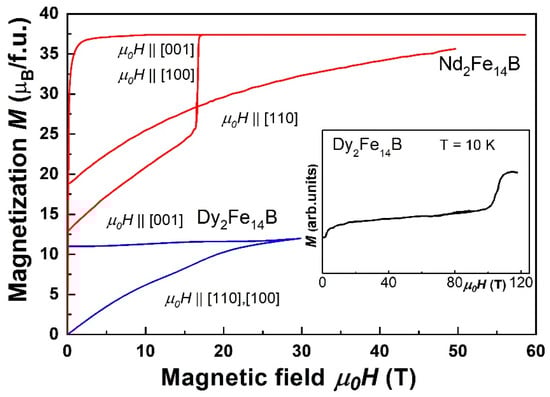
Figure 2.
Magnetization curves of Dy2Fe14B and Nd2Fe14B single crystals applied along the main crystallographic directions at 1.8 and 10 K, respectively [18,23]. Inset: The data for an aligned polycrystal Dy2Fe14B at 10 K (for increasing fields [16]) are shown for comparison.
Figure 3 demonstrates the magnetization curves of the (Nd0.5Dy0.5)2Fe14B compound along the perpendicular [001] easy axis. Magnetization measurements were performed by us at the Dresden High Magnetic Field Laboratory in pulsed magnetic fields up to 58 T previously [18]. The measurements up to 170 T obtained for the first time at the Russian Federal Nuclear Center in Sarov. It should be mentioned that a compensated pick-up sensor, in fact, measured a time derivative of magnetization. This is why the flat segments of the magnetization curve in Figure 3 were beyond the sensitivity and shown by the dashed line. A partial substitution of Dy by Nd atom in the latter compound results in an increase of the anisotropy field where the easy- and hard-axis magnetization curves intersect. Such new results, containing features on the magnetization curve, can also be used for modern numerical calculations, including for obtaining or refining the exchange and crystal-field parameters in the quantum model of the crystal electric field [16,17,18].
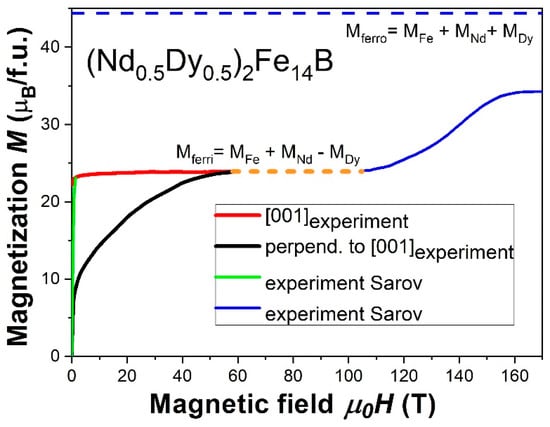
Figure 3.
Magnetization curves of (Nd0.5Dy0.5)2Fe14B at 1.8 K in magnetic fields up to 58 T applied along the perpendicular easy axis c (red and black lines) [18] and at 4.2 K in fields up to 170 T (for increasing fields) applied along the c-axis (green and blue lines).
Figure 3 shows that the experimental data obtained in different laboratories are in good agreement with each other. Moreover, it can be stated that ultrahigh magnetic fields in the (Nd0.5Dy0.5)2Fe14B compound induce a magnetic phase transition similar to that observed earlier in the Dy2Fe14B compound. These transitions can be interpreted as intermediate processes from ferrimagnetism to forced ferromagnetism. A significant difference here is the fact that the magnetic phase transition in the substituted composition (Nd0.5Dy0.5)2Fe14B occurs smoothly, covering a quite large range of magnetic fields from 105 T to 160 T, exhibiting features characteristic of second-order phase transitions.
4. Discussion
In order to analyze obtained experimental data, it is important to understand which sections of the magnetization curves correspond to which phase: ferrimagnetic, non-collinear, or ferromagnetic (field-induced forced ferromagnetic state). This can be understood using a quite simple analytical approach in terms of the first and second critical fields. The first critical field Hc1 corresponds to the transition from the ferrimagnetic to the non-collinear phase, and the second Hc2 to the ferromagnetic one. In order to estimate them, we applied the analytical approach (previously described in detail in Refs. [24,25,26,27]) well proven for the (R,R’)2Fe14B intermetallic compounds.
For the R2Fe14B compounds, both critical fields Hc1 and Hc2 are equal to [24,26,27]:
where λ is the R-Fe intersublattice exchange parameter, is the magnetic anisotropy field, and K1 is magnetic anisotropy constant [5]. Here, the second term describing the anisotropy has been added in order to make a more accurate critical fields estimation [27]. Thus, the accuracy of analytical evaluations of the critical fields reaches several Tesla.
For the (Nd0.5Dy0.5)2Fe14B compound with two different rare-earth ions, the critical fields Hc1 and Hc2 have the form [27]
and are the exchange parameter and susceptibility of the Nd sublattice, respectively. In accordance with our previous estimates, [24]. Formula (2) with anisotropic correction is universal and could be used for various rare-earth intermetallics. Hc1 and Hc2 values obtained for (Nd0.5Dy0.5)2Fe14B and Dy2Fe14B by analyzing high-field experimental data using Formulas (1) and (2) are given in Table 1.

Table 1.
Magnetic critical fields’ parameters Hc1 and Hc2 for (Nd0.5Dy0.5)2Fe14B and Dy2Fe14B.
Hc2 value provides important information, which the magnitudes of external magnetic fields require to reach the ferromagnetic state, and allow us to plan new ultrahigh magnetization experiments for studying similar types of compounds. It can be seen that, in order to experimentally observe the transition to the forced-ferromagnetic phase, both compounds ((Nd0.5Dy0.5)2Fe14B and Dy2Fe14B) require magnetic fields greater than 250 T. This is confirmed, among other things, by the value of the magnetization in the (Nd0.5Dy0.5)2Fe14B compound at 170 T. It reaches magnitude 34 μB/f.u., while the magnitude of the magnetization in a forced-ferromagnetic state is 44.1 μB/f.u. (see Table 2), that is, in the magnetic field 170 T, saturation has not yet been obtained.
Table 2.
Values of the rare-earth and iron magnetic moments for (Nd0.5Dy0.5)2Fe14B and Dy2Fe14B intermetallic compounds.
5. Conclusions
Magnetization measurements were performed for the intermetallic ferrimagnetic compound (Nd0.5Dy0.5)2Fe14B using ultrahigh magnetic fields up to 170 T. Such high magnetic fields make it possible to observe the experimentally field-induced phase transition from the initial ferrimagnetic state to the non-collinear one. The results obtained were compared with the literature high-field magnetization data for the basic Dy2Fe14B compound. We have determined two critical fields (Hc1 and Hc2) of field-induced transitions for the compounds under study. We demonstrate that, in order to observe the transition to the forced-ferromagnetic state, both compounds ((Nd0.5Dy0.5)2Fe14B and Dy2Fe14B) require magnetic fields greater than 250 T. It is shown that the replacement of one rare-earth atom by another is a powerful tool for controlling the properties of rare-earth R2Fe14B-type compounds, on the basis of which modern highly efficient permanent magnets are manufactured.
Author Contributions
Methodology, Y.B.K., D.A.M., V.V.P. and O.M.S.; investigation, N.V.K., A.K.Z., A.I.B., S.V.G., R.V.K., A.S.K., I.S.S., I.V.M. and A.V.F.; writing—original draft preparation, N.V.K.; writing—review and editing, I.S.T. and Y.B.K.; supervision, I.S.T. and Y.B.K.; project administration, A.K.Z., P.B.R. and V.D.S. All authors have read and agreed to the published version of the manuscript.
Funding
This work was supported by the Ministry of Science and Higher Education of the Russian Federation (No. FSMG-2021-0005). Research in ultrahigh magnetic fields was carried out within the framework of the scientific program of the National Center for Physics and Mathematics (Project “Research in high and ultrahigh magnetic fields”).
Institutional Review Board Statement
Not applicable.
Informed Consent Statement
Not applicable.
Data Availability Statement
Not applicable.
Conflicts of Interest
The authors declare no conflict of interest.
References
- Kostyuchenko, N.V.; Tereshina, I.S.; Andreev, A.V.; Doerr, M.; Tereshina-Chitrova, E.A.; Paukov, M.A.; Gorbunov, D.I.; Politova, G.A.; Pyatakov, A.P.; Miyata, A.; et al. Investigation of the field-induced phase transitions in the (R, R’)2Fe14B rare-earth intermetallics in ultra-high magnetic fields. IEEE Trans. Magn. 2021, 57, 2101105. [Google Scholar] [CrossRef]
- Coey, J.M.D. Hard Magnetic Materials: A Perspective. IEEE Trans. Magn. 2011, 47, 4671–4681. [Google Scholar] [CrossRef]
- Coey, J.M.D. Perspective and Prospects for Rare Earth Permanent Magnets. Engineering 2020, 6, 119–131. [Google Scholar] [CrossRef]
- Gutfleisch, O.; Willard, M.A.; Brück, E.; Chen, C.H.; Sankar, S.G.; Liu, J.P. Magnetic Materials and Devices for the 21st Century: Stronger, Lighter, and More Energy Efficient. Adv. Mater. 2011, 23, 821–842. [Google Scholar] [CrossRef] [PubMed]
- Sepehri-Amin, H.; Hirosawa, S.; Hono, K. Chapter 4—Advances in Nd-Fe-B Based Permanent Magnets. In Handbook of Magnetic Materials; Elsevier: Amsterdam, The Netherlands, 2018; Volume 27, pp. 269–372. [Google Scholar]
- Herbst, J.F. R2Fe14B materials: Intrinsic properties and technological aspects. Rev. Mod. Phys. 1991, 63, 819–898. [Google Scholar] [CrossRef]
- Li, H.-S.; Coey, J.M.D. Chapter 3—Magnetic properties of ternary rare-earth transition-metal compounds. In Handbook of Magnetic Materials; Elsevier: Amsterdam, The Netherlands, 2019; Volume 28, pp. 87–196. [Google Scholar]
- Gabay, A.M.; Marinescu, M.; Li, W.F.; Liu, J.F.; Hadjipanayis, G.C. Dysprosium-saving improvement of coercivity in Nd-Fe-B sintered magnets by Dy2S3 additions. J. Appl. Phys. 2011, 109, 083916. [Google Scholar] [CrossRef]
- Liu, W.-Q.; Chang, C.; Yue, M.; Yang, J.-S.; Zhang, D.-T.; Zhang, J.-X.; Liu, Y.-Q. Coercivity, microstructure, and thermal stability of sintered Nd–Fe–B magnets by grain boundary diffusion with TbH3 nanoparticles. Rare Met. 2017, 36, 718–722. [Google Scholar] [CrossRef]
- Poenaru, I.; Lixandru, A.; Güth, K.; Malfliet, A.; Yoon, S.; Škulj, I.; Gutfleisch, O. HDDR treatment of Ce-substituted Nd2Fe14B-based permanent magnet alloys—Phase structure evolution, intergranular processes and magnetic property development. J. Alloys Compd. 2020, 814, 152215. [Google Scholar] [CrossRef]
- Sözen, H.İ.; Ener, S.; Maccari, F.; Skokov, K.P.; Gutfleisch, O.; Körmann, F.; Neugebauer, J.; Hickel, T. Ab initio phase stabilities of Ce-based hard magnetic materials and comparison with experimental phase diagrams. Phys. Rev. Mater. 2019, 3, 084407. [Google Scholar] [CrossRef]
- Furlani, E.P. Permanent Magnet and Electromechanical Devices: Materials, Analysis, and Applications; Academic Press: Cambridge, MA, USA, 2001. [Google Scholar]
- Chaboy, J.; Piquer, C.; Plugaru, N.; Bartolomé, F.; Laguna-Marco, M.A.; Plazaola, F. 57Fe Mössbauer and x-ray magnetic circular dichroism study of magnetic compensation of the rare-earth sublattice in Nd2−xHoxFe14B compounds. Phys. Rev. B 2007, 76, 134408. [Google Scholar] [CrossRef]
- Xiao, Y.; Morvan, F.J.; He, A.N.; Wang, M.K.; Luo, H.B.; Jiao, R.B.; Xia, W.X.; Zhao, G.P.; Liu, J.P. Spin-reorientation transition induced magnetic skyrmion in Nd2Fe14B magnet. Appl. Phys. Lett. 2020, 117, 132402. [Google Scholar] [CrossRef]
- Battesti, R.; Beard, J.; Böser, S.; Bruyant, N.; Budker, D.; Crooker, S.A.; Daw, E.J.; Flambaum, V.V.; Inada, T.; Irastorza, I.G.; et al. High magnetic fields for fundamental physics. Phys. Rep. 2018, 765, 1–39. [Google Scholar] [CrossRef]
- Younger, S.; Lindemuth, I.; Reinovsky, R.; Fowler, C.M.; Goforth, J.; Ekdahl, C. Scientific Collaborations Between Los Alamos and Arzamas-16 Using Explosive-Driven Flux Compression Generators. Los Alamos Sci. 1996, 24, 48–67. [Google Scholar]
- Lim, D.W.; Kato, H.; Yamada, M.; Kido, G.; Nakagawa, Y. High-field magnetization process and spin reorientation in (Nd1−xDyx)2Fe14B single crystals. Phys. Rev. B 1991, 44, 10014. [Google Scholar] [CrossRef] [PubMed]
- Takeyama, S.; Amaya, K.; Nakagawa, T.; Ishizuka, M.; Nakao, K.; Sakakibara, T.; Goto, T.; Miura, N.; Ajiro, Y.; Kikuchi, H. Magnetisation measurements in ultra-high magnetic fields produced by a single-turn coil system. J. Phys. E Sci. Instrum. 1988, 21, 1025. [Google Scholar] [CrossRef]
- Kostyuchenko, N.V.; Tereshina, I.S.; Gorbunov, D.I.; Tereshina-Chitrova, E.A.; Andreev, A.V.; Doerr, M.; Politova, G.A.; Zvezdin, A.K. Features of magnetization behavior in the rare-earth intermetallic compound (Nd0.5Ho0.5)2Fe14B. Intermetallics 2018, 98, 139–142. [Google Scholar] [CrossRef]
- Shneerson, G.A.; Dolotenko, M.I.; Krivosheev, S.I. Strong and Superstrong Magnetic Fields Generation; Walter de Gruter GmbH: Berlin, Germany, 2014. [Google Scholar]
- Boriskov, G.V.; Bykov, A.I.; Dolotenko, M.I.; Egorov, N.I.; Kudasov, Y.B.; Platonov, V.V.; Selemir, V.D.; Tatsenko, O.M. Research in ultrahigh magnetic field physics. Phys. Uspekhi 2011, 54, 421–427. [Google Scholar] [CrossRef]
- Kudasov, Y.B. Megagauss magnetization measurements. Phys. B Condens. Matter 2001, 294, 684–690. [Google Scholar] [CrossRef]
- Kostyuchenko, N.V.; Tereshina, I.S.; Gorbunov, D.I.; Tereshina-Chitrova, E.A.; Rogacki, K.; Andreev, A.V.; Doerr, M.; Politova, G.A.; Zvezdin, A.K. High-field magnetization study of (Nd,Dy)2Fe14B: Intrinsic properties and promising compositions. Intermetallics 2020, 124, 106840. [Google Scholar] [CrossRef]
- Eslava, G.G.; Fayyazi, B.; Skokov, K.; Skourski, Y.; Gorbunov, D.; Gutfleisch, O.; Dempsey, N.M.; Givord, D. A two-sublattice model for extracting rare-earth anisotropy constants from measurements on (Nd,Ce)2(Fe,Co)14B single crystals. J. Magn. Magn. Mater. 2021, 520, 167470. [Google Scholar] [CrossRef]
- Tereshina, I.S.; Pyatakov, A.P.; Tereshina-Chitrova, E.A.; Gorbunov, D.I.; Skourski, Y.; Law, J.M.; Paukov, M.A.; Havela, L.; Doerr, M.; Zvezdin, A.K.; et al. Probing the exchange coupling in the complex modified Ho-Fe-B compounds by high-field magnetization measurements. AIP Adv. 2018, 8, 125223. [Google Scholar] [CrossRef]
- Zvezdin, A.K.; Lubashevskii, I.A.; Levitin, R.Z.; Platonov, V.V.; Tatsenko, O.M. Phase transitions in megagauss magnetic fields. Phys. Uspekhi 1998, 41, 1037–1042. [Google Scholar] [CrossRef]
- Zvezdin, A.K. Magnetic Phase Transitions: Field-induced (Order-to-order). In Encyclopedia of Materials: Science and Technology; Buschow, K.H.J., Cahn, R.W., Flemings, M.C., Ilschner, B., Kramer, E.J., Mahajan, S., Veyssière, P., Eds.; Elsevier: Amsterdam, The Netherlands, 2001; pp. 4841–4847. [Google Scholar]
Publisher’s Note: MDPI stays neutral with regard to jurisdictional claims in published maps and institutional affiliations. |
© 2022 by the authors. Licensee MDPI, Basel, Switzerland. This article is an open access article distributed under the terms and conditions of the Creative Commons Attribution (CC BY) license (https://creativecommons.org/licenses/by/4.0/).