
New Radical-Cation Salts Based on the TMTTF and TMTSF Donors with Iron and Chromium Bis(Dicarbollide) Complexes: Synthesis, Structure, Properties †

 ,
,  and
and
Abstract
:1. Introduction
2. Results and Discussion
Supplementary Materials
Author Contributions
Funding
Institutional Review Board Statement
Informed Consent Statement
Data Availability Statement
Acknowledgments
Conflicts of Interest
References
- Williams, J.M.; Ferraro, J.R.; Thorn, R.J.; Carlson, K.D.; Geiser, U.; Wang, H.H.; Kini, A.M.; Whangbo, M.-H. Organic SuperConductors (Including Fullerenes: Synthesis, Structure, Properties, and Theory); Prentice Hall: Englewood Cliffs, NJ, USA, 1992. [Google Scholar]
- Ishiguro, T.; Yamaji, K.; Saito, G. Organic Superconductors, 2nd ed.; Springer Series in Solid-State Sciences; Springer: Berlin, Germany, 1998. [Google Scholar]
- Saito, G.; Yoshida, Y. Organic superconductors. Chem. Rec. 2011, 11, 124–145. [Google Scholar] [CrossRef]
- Naito, T. Modern history of organic conductors: An overview. Crystals 2021, 11, 838. [Google Scholar] [CrossRef]
- Bregadze, V.I.; Dyachenko, O.A.; Kazheva, O.N.; Kravchenko, A.V.; Sivaev, I.B.; Starodub, V.A. Tetrathiafulvalene-based radical-cation salts with transition metal bis(dicarbollide) anions. CrystEngComm 2015, 17, 4754–4767. [Google Scholar] [CrossRef]
- Bregadze, V.I.; Dyachenko, O.A.; Kazheva, O.N.; Kosenko, I.D.; Kravchenko, A.V.; Sivaev, I.B.; Starodub, V.A. Electroconducting radical-cation salts based on tetrathiafulvalene derivatives and transition metals bis(dicarbollides). Russ. J. Gen. Chem. 2019, 89, 971–987. [Google Scholar] [CrossRef]
- Starodub, V.A.; Starodub, T.N.; Kazheva, O.N.; Bregadze, V.I. Materialy Sovremennoi Electroniki i Spintroniki (Materials of Modern Electronics and Spintronics); Fizmatlit: Moscow, Russia, 2018; 424p. [Google Scholar]
- Kazheva, O.N.; Chudak, D.M.; Shilov, G.V.; Komissarova, E.A.; Kosenko, I.D.; Kravchenko, A.V.; Shilova, I.A.; Shklyaeva, E.V.; Abashev, G.G.; Sivaev, I.B.; et al. First molecular conductors of BPDT-TTF with metallacarborane anions: (BPDT-TTF)[3,3′-Cr(1,2-C2B9H11)2] and (BPDT-TTF)[3,3′-Co(1,2-C2B9H11)2]—Synthesis, structure, properties. J. Organomet. Chem. 2018, 867, 375–380. [Google Scholar] [CrossRef]
- Kazheva, O.N.; Chudak, D.M.; Shilov, G.V.; Kosenko, I.D.; Abashev, G.G.; Shklyaeva, E.V.; Kravchenko, A.V.; Starodub, V.A.; Buravov, L.I.; Dyachenko, O.A.; et al. First EOTT and BPDT-TTF based molecular conductors with [8,8′-Cl2-3,3′-Fe(1,2-C2B9H10)2]− anion—Synthesis, structure, properties. J. Organomet. Chem. 2021, 949, 121956. [Google Scholar] [CrossRef]
- Kazheva, O.N.; Chudak, D.M.; Shilov, G.V.; Kravchenko, A.V.; Kosenko, I.D.; Sivaev, I.B.; Abashev, G.G.; Shklyaeva, E.V.; Starodub, V.A.; Buravov, L.I.; et al. First radical-cation salts based on dibenzotetrathiafulvalene (DBTTF) with metallacarborane anions: Synthesis, structure, properties. J. Organomet. Chem. 2020, 930, 121592. [Google Scholar] [CrossRef]
- Mroweh, N.; Mézière, C.; Allain, M.; Auban-Senzier, P.; Canadell, E.; Avarvari, N. Conservation of structural arrangements and 3:1 stoichiometry in a series of crystalline conductors of TMTTF, TMTSF, BEDT-TTF, and chiral DM-EDT-TTF with the oxo-bis[pentafluorotantalate(V)] dianion. Chem. Sci. 2020, 11, 10078–10091. [Google Scholar] [CrossRef] [PubMed]
- Yoshino, H.; Iwasaki, Y.; Tanaka, R.; Tsujimoto, Y.; Matsuoka, C. Crystal structures and electrical resistivity of three exotic TMTSF salts with I3−: Determination of valence by DFT and MP2 calculations. Crystals 2020, 10, 1119. [Google Scholar] [CrossRef]
- Sahadevan, S.A.; Abhervé, A.; Monni, N.; Auban-Senzier, P.; Cui, H.; Kato, R.; Mercuri, M.L.; Avarvari, N. Radical-cation salts of tetramethyltetrathiafulvalene (TM-TTF) and tetramethyltetraselenafulvalene (TM-TSF) with chlorocyananilate-based anions. Cryst. Growth Des. 2020, 20, 6777–6786. [Google Scholar] [CrossRef]
- Frąckowiak, A.; Barszcz, B.; Olejniczak, I.; Tomasik, M.; Jarzyniak, N.; Świetlik, R.; Auban-Senzier, P.; Fourmigué, M.; Jeannin, O.; Camerel, F. Mixed valence trimers in cation radical salts of TMTTF with the planar bis(6-sulfo-8-quinolato) platinum complex [Pt(qS)2]2−. New J. Chem. 2020, 44, 15538–15548. [Google Scholar] [CrossRef]
- Allain, M.; Mézière, C.; Auban-Senzier, P.; Avarvari, N. Old donors for new molecular conductors: Combining TMTSF and BEDT-TTF with anionic (TaF6)1−x/(PF6)x alloys. Crystals 2021, 11, 386. [Google Scholar] [CrossRef]
- Kazheva, O.N.; Alexandrov, G.G.; Kravchenko, A.V.; Kosenko, I.D.; Lobanova, I.A.; Sivaev, I.B.; Filippov, O.A.; Shubina, E.S.; Bregadze, V.I.; Starodub, V.A.; et al. Molecular conductors with a 8-hydroxy cobalt bis(dicarbollide) anion. Inorg. Chem. 2011, 50, 444–450. [Google Scholar] [CrossRef] [PubMed]
- Kazheva, O.N.; Alexandrov, G.G.; Kravchenko, A.V.; Sivaev, I.B.; Starodub, V.A.; Kosenko, I.D.; Lobanova, I.A.; Bregadze, V.I.; Buravov, L.I.; Dyachenko, O.A. New organic conductors with halogen and phenyl substituted cobalt bis(dicarbollide) anions. J. Chem. Eng. Chem. Res. 2015, 2, 497–503. [Google Scholar]
- Kazheva, O.N.; Chekhlov, A.N.; Alexandrov, G.G.; Buravov, L.I.; Kravchenko, A.V.; Starodub, V.A.; Sivaev, I.B.; Bregadze, V.I.; Dyachenko, O.A. Synthesis, structure and electrical conductivity of fulvalenium salts of cobalt bis(dicarbollide) anion. J. Organomet. Chem. 2006, 691, 4225–4233. [Google Scholar] [CrossRef]
- Kazheva, O.N.; Alexandrov, G.G.; Kravchenko, A.V.; Starodub, V.A.; Sivaev, I.B.; Lobanova, I.A.; Bregadze, V.I.; Buravov, L.I.; Dyachenko, O.A. New fulvalenium salts of bis(dicarbollide) cobalt and iron: Synthesis, crystal structure and electrical conductivity. J. Organomet. Chem. 2007, 692, 5033–5043. [Google Scholar] [CrossRef]
- Bednarska-Szczepaniak, K.; Przelazły, E.; Kania, K.D.; Szwed, M.; Litecká, M.; Grüner, B.; Leśnikowski, Z.J. Interaction of adenosine, modified using carborane clusters, with ovarian cancer cells: A new anticancer approach against chemoresistance. Cancers 2021, 13, 3855. [Google Scholar] [CrossRef] [PubMed]
- Forward, J.M.; Mingos, D.M.P.; Müller, T.E.; Williams, D.J.; Yan, Y.-K. Synthesis and structural characterization of metallacarborane sandwich salts with tetrathiafulvalene (ttf) [M(C2B9H11)2][ttf] (M = Cr, Fe, Ni). J. Organomet. Chem. 1994, 467, 207–216. [Google Scholar] [CrossRef]
- Yan, Y.-K.; Mingos, D.M.P.; Williams, D.J.; Kurmoo, M. Synthesis, structures and physical properties of bis(ethylenedithio) tetrathiafulvalenium salts of paramagnetic metallacarborane anions. J. Chem. Soc. Dalton Trans. 1995, 19, 3221–3230. [Google Scholar] [CrossRef]
- Čižmár, E.; Šoltésová, D.; Kazheva, O.N.; Alexandrov, G.G.; Kravchenko, A.V.; Chekulaeva, L.A.; Kosenko, I.D.; Sivaev, I.B.; Bregadze, V.I.; Fedorchenko, A.V.; et al. Large magnetic anisotropy of chromium(III) ions in a bis(ethylenedithio)tetrathiafulvalenium salt of chromium bis(dicarbollide), (ET)2[3,3′-Cr(1,2-C2B9H11)2]. Trans. Met. Chem. 2018, 43, 647–655. [Google Scholar] [CrossRef]
- Sivaev, I.B.; Bregadze, V.I. Chemistry of nickel and iron bis(dicarbollides). J. Organomet. Chem. 2000, 614–615, 27–36. [Google Scholar] [CrossRef]
- Kazheva, O.N.; Alexandrov, G.G.; Kravchenko, A.V.; Sivaev, I.B.; Kosenko, I.D.; Lobanova, I.A.; Kajňakov, M.; Buravov, L.I.; Bregadze, V.I.; Feher, A.; et al. Synthesis, structure, electrical and magnetic properties of (BEDT-TTF)2[3,3-Fe(1,2-C2B9H11)2]. Inorg. Chem. Commun. 2012, 15, 106–108. [Google Scholar] [CrossRef]
- Shannon, R.D. Revised effective ionic radii and systematic studies of interatomic distances in halides and chalcogenides. Acta Cryst. C 1976, 32, 751–767. [Google Scholar] [CrossRef]
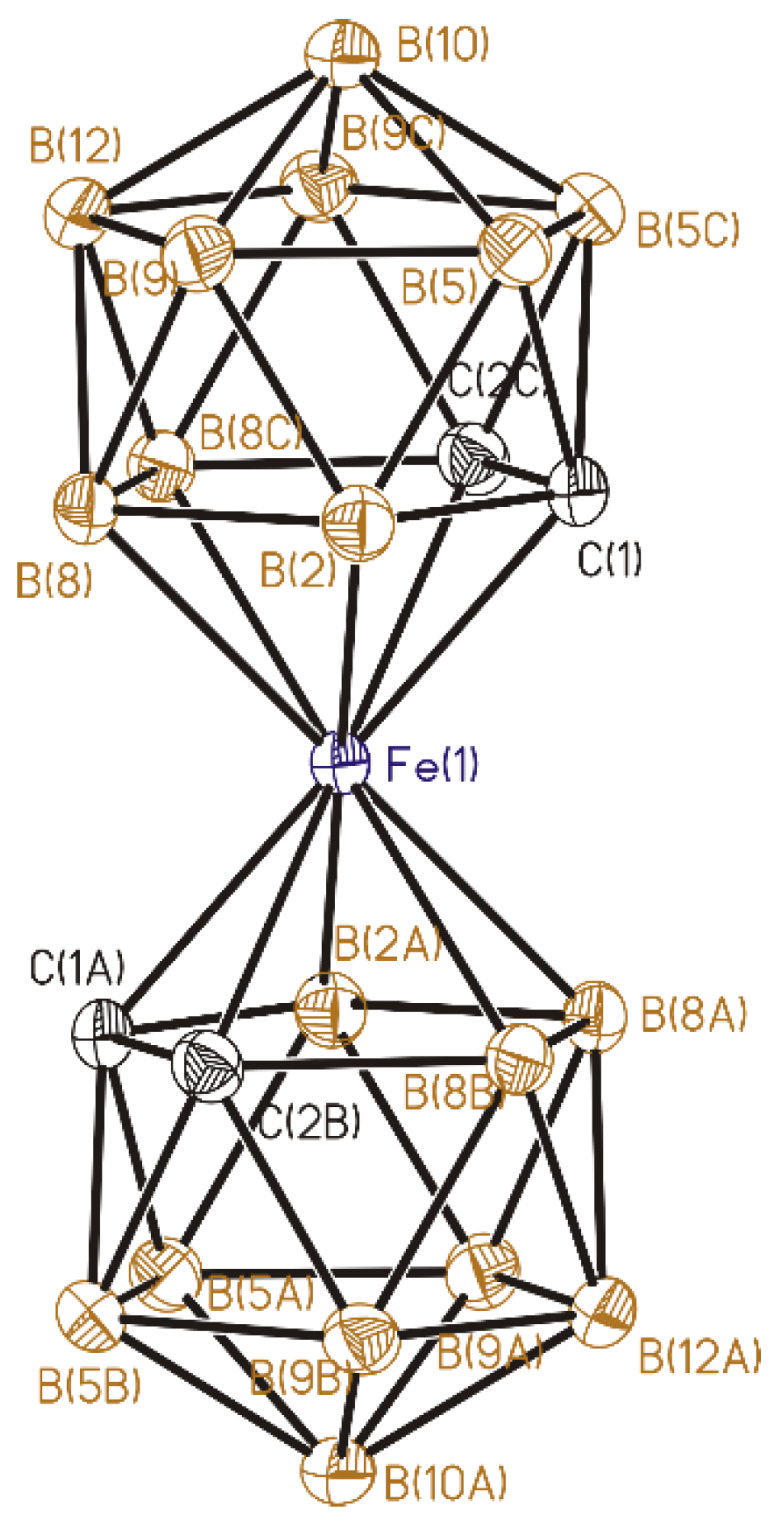
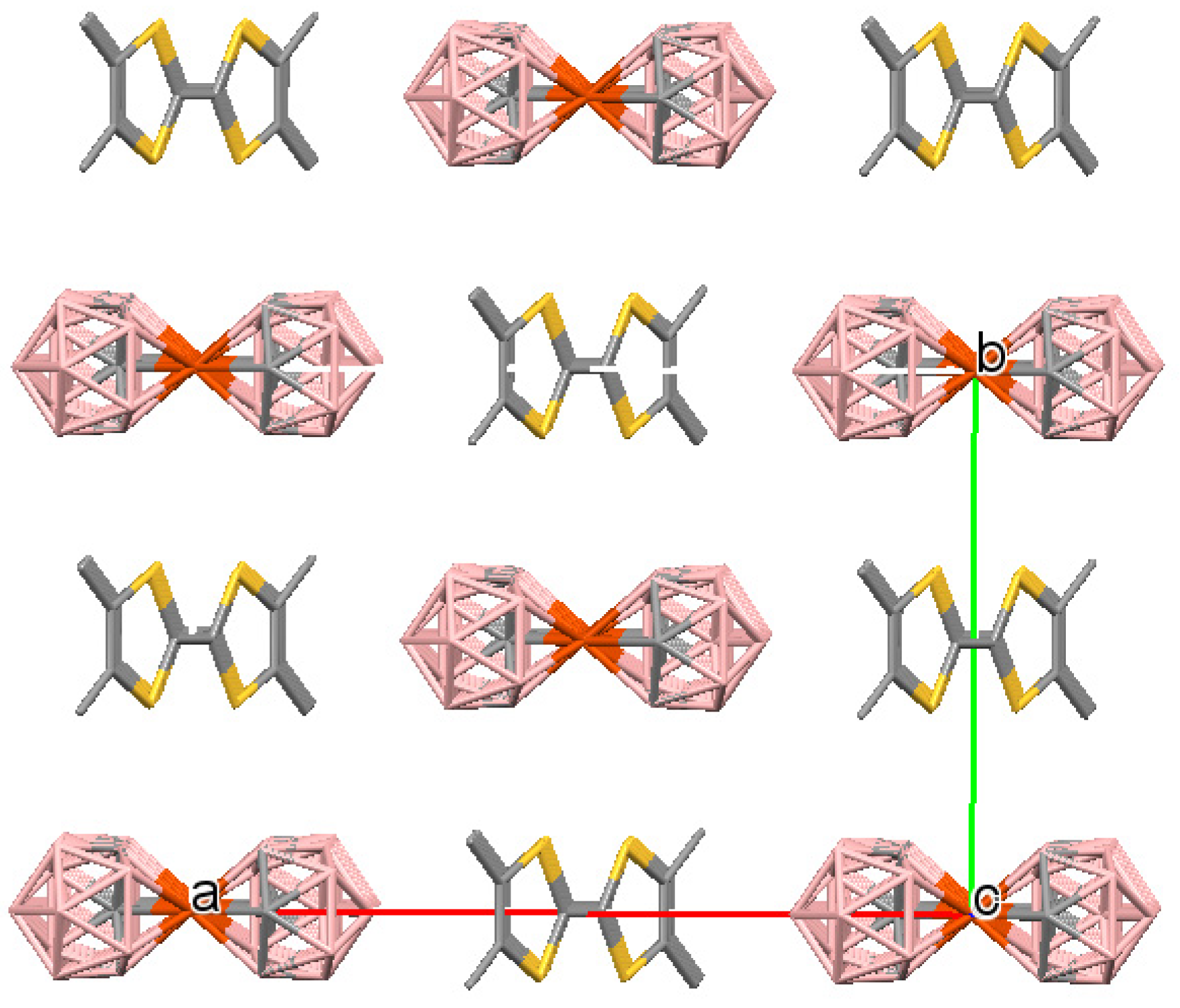

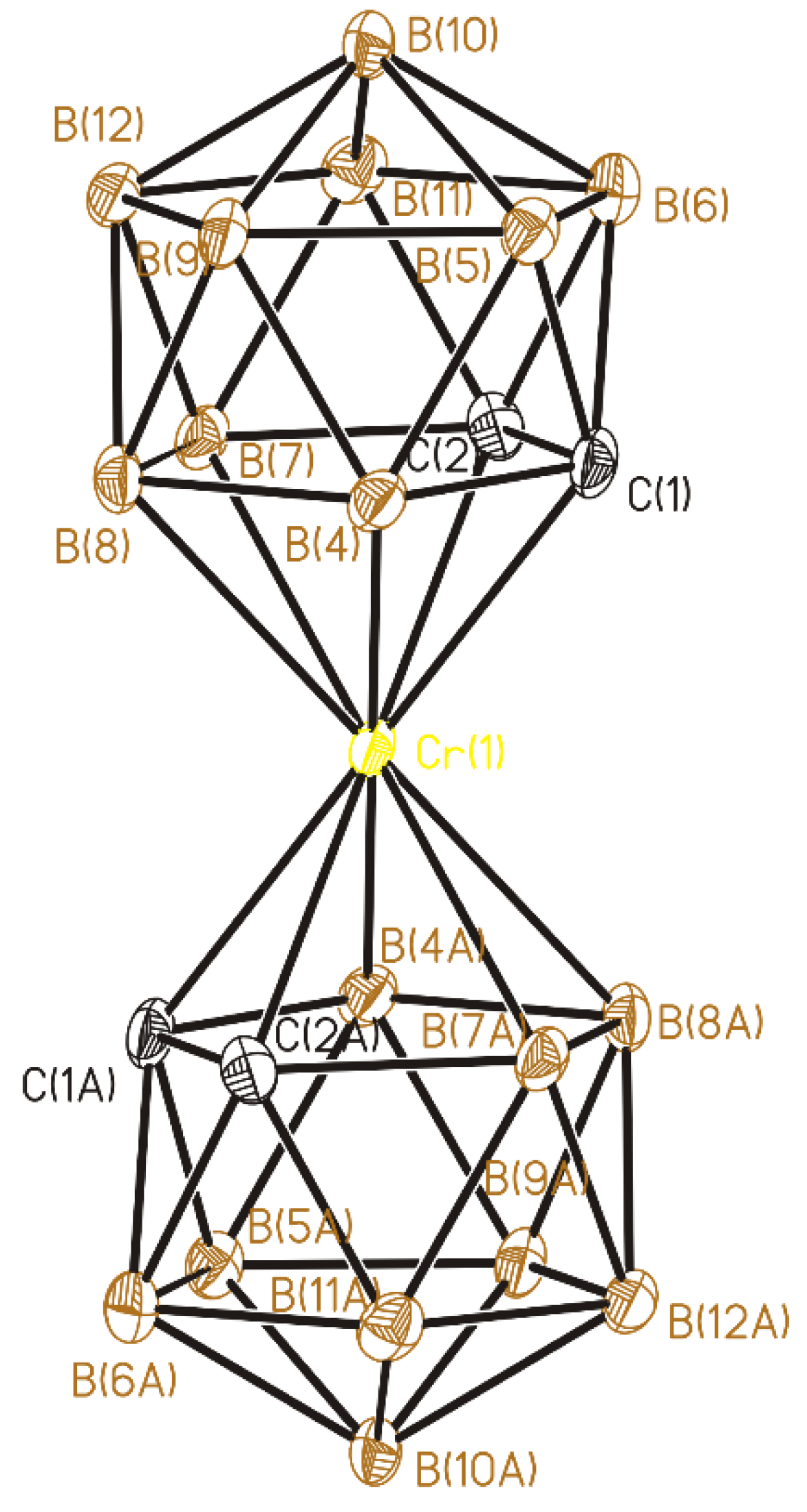

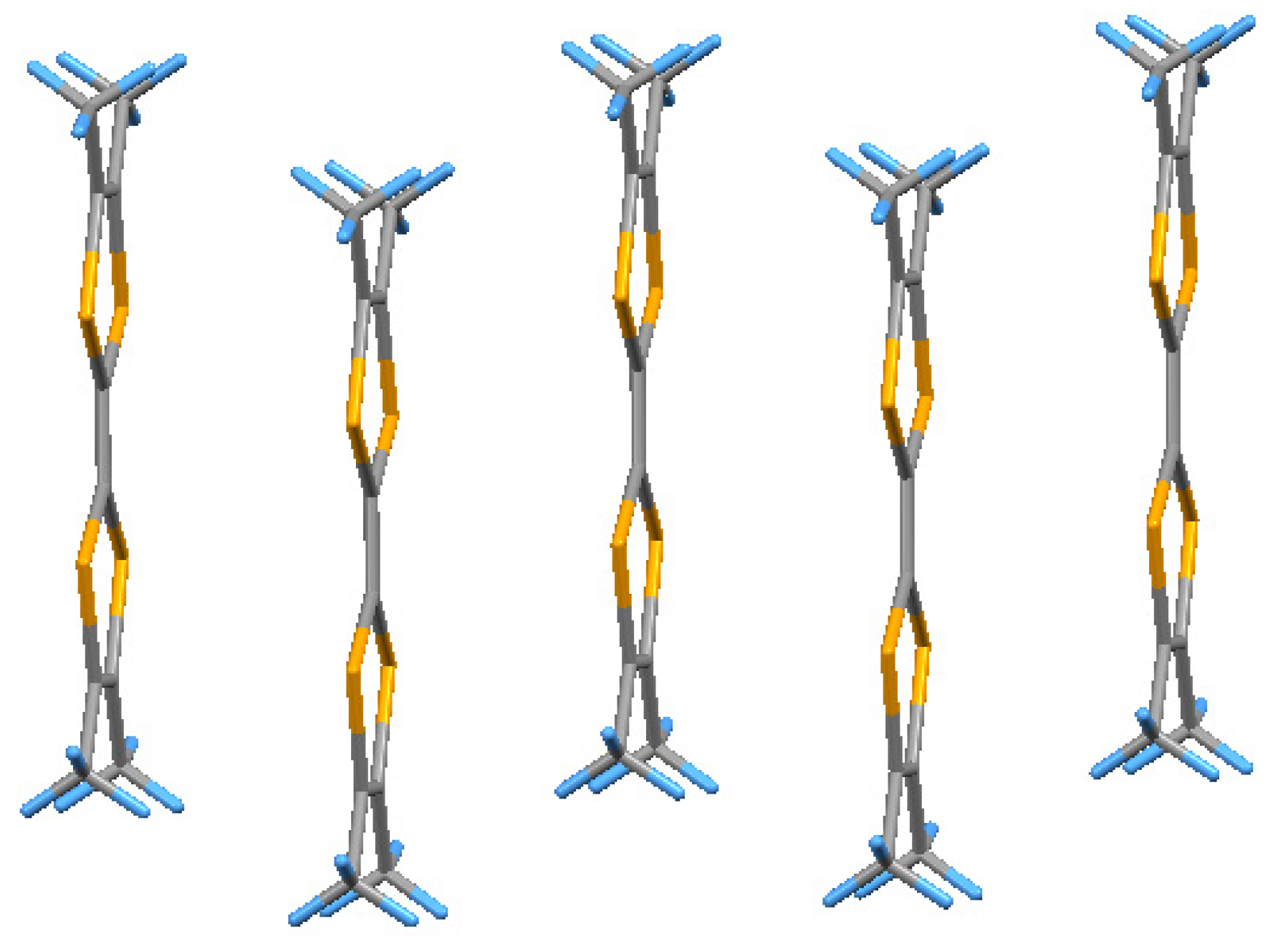

| Compound | (1) | (2) | (3) |
|---|---|---|---|
| Empiric formula | C14H34B18CrS4 | C14H34B18FeS4 | C24H46B18CrSe8 |
| Formula weight | 577.23 | 581.08 | 1212.87 |
| Crystal system | Monoclinic | Monoclinic | Triclinic |
| Space group | P21/c | C2/m | P 1 |
| a (Å) | 11.726(2) | 17.3487(8) | 7.451(4) |
| b (Å) | 12.753(2) | 12.0235(6) | 12.342(6) |
| c (Å) | 19.387(3) | 6.6791(3) | 12.961(7) |
| α (°) | 90 | 90 | 117.743(7) |
| β (°) | 102.701(2) | 90.7840(6) | 92.344(8) |
| γ (°) | 90 | 90 | 100.325(8) |
| V (Å3) | 2828.3(6) | 1393.08(11) | 1027.1(9) |
| Z | 4 | 2 | 1 |
| λ (Å) | 0.71073 | 0.71073 | 0.71073 |
| Dcalc (Mg m−3) | 1.36 | 1.38 | 1.96 |
| μ (mm−1) | 0.708 | 0.850 | 7.388 |
| Number of reflections collected | 28470 | 11191 | 4513 |
| Number of independent reflections | 8147 | 2319 | 4513 |
| Number of reflections with [F0 > 4σ(F0)] | 6787 | 2183 | 3754 |
| Number of parameters refined | 426 | 130 | 233 |
| (2θ)max (°) | 60.48 | 63.70 | 55.44 |
| R | 0.037 | 0.021 | 0.051 |
Publisher’s Note: MDPI stays neutral with regard to jurisdictional claims in published maps and institutional affiliations. |
© 2021 by the authors. Licensee MDPI, Basel, Switzerland. This article is an open access article distributed under the terms and conditions of the Creative Commons Attribution (CC BY) license (https://creativecommons.org/licenses/by/4.0/).
Share and Cite
Chudak, D.M.; Kazheva, O.N.; Kosenko, I.D.; Shilov, G.V.; Sivaev, I.B.; Abashev, G.G.; Shklyaeva, E.V.; Buravov, L.I.; Pevtsov, D.N.; Starodub, T.N.; et al. New Radical-Cation Salts Based on the TMTTF and TMTSF Donors with Iron and Chromium Bis(Dicarbollide) Complexes: Synthesis, Structure, Properties. Crystals 2021, 11, 1118. https://doi.org/10.3390/cryst11091118
Chudak DM, Kazheva ON, Kosenko ID, Shilov GV, Sivaev IB, Abashev GG, Shklyaeva EV, Buravov LI, Pevtsov DN, Starodub TN, et al. New Radical-Cation Salts Based on the TMTTF and TMTSF Donors with Iron and Chromium Bis(Dicarbollide) Complexes: Synthesis, Structure, Properties. Crystals. 2021; 11(9):1118. https://doi.org/10.3390/cryst11091118
Chicago/Turabian StyleChudak, Denis M., Olga N. Kazheva, Irina D. Kosenko, Gennady V. Shilov, Igor B. Sivaev, Georgy G. Abashev, Elena V. Shklyaeva, Lev I. Buravov, Dmitry N. Pevtsov, Tatiana N. Starodub, and et al. 2021. "New Radical-Cation Salts Based on the TMTTF and TMTSF Donors with Iron and Chromium Bis(Dicarbollide) Complexes: Synthesis, Structure, Properties" Crystals 11, no. 9: 1118. https://doi.org/10.3390/cryst11091118
APA StyleChudak, D. M., Kazheva, O. N., Kosenko, I. D., Shilov, G. V., Sivaev, I. B., Abashev, G. G., Shklyaeva, E. V., Buravov, L. I., Pevtsov, D. N., Starodub, T. N., Bregadze, V. I., & Dyachenko, O. A. (2021). New Radical-Cation Salts Based on the TMTTF and TMTSF Donors with Iron and Chromium Bis(Dicarbollide) Complexes: Synthesis, Structure, Properties. Crystals, 11(9), 1118. https://doi.org/10.3390/cryst11091118