1. Introduction
Non-renewable resource extraction inherently involves strategic conflicts among multiple stakeholders operating under profound uncertainties. As demonstrated in
Epaulard (
1998), uncertainties regarding resource stock and technological progress profoundly affect extraction paths and decision-makers’ intertemporal decisions, adding more complex dimensions to this field full of strategic conflicts and uncertainties. Differential games, as mathematical frameworks capturing strategic interactions over time, offer powerful tools to model these conflicts
Isaacs (
1999). Traditional formulations of such games usually assume a fixed game duration (finite time duration) or rely on an infinite time duration. However, real-world scenarios related to non-renewable resource extraction, including equipment failures, policy shifts and environmental disruptions, introduce duration uncertainty. In these cases, the duration of the game cannot be determined a priori and depends on a number of unknown factors. This type of uncertainty gives rise to the fascinating field of differential games with random duration. The random nature of the duration of the game affects the optimal strategies of the players. Understanding this process is critical to developing decision-making mechanisms under uncertainty.
This class of games was first introduced in
Petrosjan and Mursov (
1966), which studied differential zero-sum games with terminal payoff at a random time horizon. Subsequently,
Boukas et al. (
1990) conducted a general study on an optimal control problem with random duration. The study of cooperative and non-cooperative differential games with random duration was continued by Shevkoplyas and Petrosyan in
Petrosjan and Shevkoplyas (
2003) and
Shevkoplyas (
2014). The form of integral payoff in differential games with random duration was investigated in (
E. Gromova & Tur, 2017;
Shevkoplyas & Kostyunin, 2013). This class of games was further extended to the case where the distribution function of the random terminal time of the game has a composite form (
Gromov & Gromova, 2014,
2017). Specifically, it was assumed that the probability density function of the terminal time may change depending on certain conditions, which can be expressed as a function of time and state. This modification of games can be particularly useful in environmental models due to potential environmental disasters and climate change, as well as in technical models accounting for equipment failures or different modes of technical equipment operation. The study of such models was continued in
Zaremba et al. (
2020) for discontinuous distributions and in
Balas and Tur (
2023) for the case of feedback strategies. In parallel,
Wu et al. (
2023) focuses on sustainable optimal control for a switched pollution-control problem with random duration.
As mentioned above, incidents such as equipment failures may occur during resource extraction, causing switches in the game’s dynamic system. This can lead to changes in aspects of the game, including its payoff structure, state equations, or termination conditions.
Stuermer and Schwerhoff (
2015) studied how the geological distribution of the non-renewable resource interacts with technological change. The modelling of emission-reduction technology adoption as an endogenous threshold-triggered switch is presented in
Parilina et al. (
2024). The establishment of political regime switches as drivers of extraction voracity in non-renewable resources is addressed in
Van der Ploeg (
2024). The synthesis of stochastic equipment failures and periodic purification switching, along with the proof that pollution states converge to unique hybrid limit cycles, is conducted in
Wu et al. (
2025b). Additionally, the study of an multi-player hybrid pollution-control problem that considers switching behavior and uncertain game duration is reported in
Wu et al. (
2025a). The empirical validation of phase-specific efficiency switching in R&D competition, as well as the confirmation of the regime-dependent nature of duration effects, is carried out in
Huang (
2024). While existing studies have advanced the understanding of uncertainty and switching in resource-related games, they often lack a targeted analysis of how such integration operates in multi-player non-renewable resource extraction scenarios, leaving room to explore unaddressed problems like unknown distribution switching moment estimation.
In this paper, we consider a model of non-renewable resource extraction by multiple participants with random duration. The peculiarity of the model under consideration is that the distribution of the random terminal time of the game is composite. The first problem we address is the need to verify the preservation of the property proved in
Dockner (
2000) for a new formulation of the problem. In
Dockner (
2000), conditions were obtained under which the cooperative solution is also a Nash equilibrium in a similar problem with fixed duration. Our goal is to obtain similar conditions for a problem with a random duration and composite distribution. Furthermore, under the assumption that the players do not know the moment of switching of the distribution function, we study the problem of obtaining an optimal estimate of this unknown moment, as in
Ye et al. (
2024). Notably, a distinct model featuring random initial times of player entry is presented in
E. V. Gromova and López-Barrientos (
2016). While their work focuses on HJB equations and imputation distribution procedures for cooperative solutions under uncertain start times, our model addresses fundamentally different challenges: random terminal times with composite distributions and unknown switching mechanisms. This distinction positions our work as advancing the theoretical frontier in duration uncertainty rather than entry uncertainty, with direct implications for sustainability planning under environmental disruptions. Additionally, we derive optimal estimates in state-dependent cases. By delving into these aspects, we strive not only to enhance the theoretical framework of differential games in non-renewable resource extraction but also to offer practical strategies that can assist industry stakeholders in making more informed decisions. A comparative summary of our work alongside key related works is provided in
Table A1 of the
Appendix A.
This paper makes the following pivotal contributions:
The construction of optimal cooperative and Nash equilibrium strategies of players in the differential non-renewable resource extraction game with a composite distribution function of the game’s random duration.
The derivation of sufficient conditions under which the cooperative solution constitutes a Nash equilibrium within this model.
The definition of the optimal estimation of unknown parameters in a differential game of non-renewable resource extraction.
The development of a method of constructing the optimal estimation of unknown parameters.
Optimal parameter estimates for both time-dependent and state-dependent cases.
This paper is organized as follows. In
Section 2, we present the formulation of the problem.
Section 3 proves that, in this model, the cooperative solution is a Nash equilibrium under certain conditions. Assuming that the players do not know the switching moment of the distribution function, we obtain the optimal estimate in the time-dependent case in
Section 4 and
Section 5. In
Section 6 and
Section 7, the optimal estimate in state-dependent case is obtained. In
Section 8, we present a detailed example related to real-world oil extraction field development. Finally, in
Section 9, we present our conclusion.
2. Problem Statement
We first summarize all key parameters of the model, along with their definitions, in
Table 1 for reference.
Consider an n-player differential game of non-renewable resource extraction. The duration T of the game is a random variable following a ceratin distribution, whose cumulative distribution function is assumed to be an absolutely continuous nondecreasing function. Correspondingly, we adopt two distinct exponential cumulative distribution functions: describes the termination probability before the switching moment , and describes that after . This composite structure captures a system where hazard rates change from to .
At the switching moment
, the left limit must be equal to the function value:
Assume an exponential structure when
:
According to continuity, we have
i.e.,
we can obtain
Therefore, the duration
T of the game has a composite cumulative distribution function:
Let
denote the state variable representing the resource stock available for extraction at time
t. The dynamics of the stock are shown by the following differential equation with the initial condition
:
Here, denotes the extraction effort of player i at time t, and the coefficient is used to convert the effort of the i-th player into the extraction intensity. In accordance with the physical nature of the problem, we impose the constraints that and for all . Moreover, if , then the only feasible rate of extraction is for all . To simplify the notation, we denote . We consider the problem within the framework of open-loop strategies.
The expected integral payoff of player
i,
is evaluated by the following formula:
where
. According to
Shevkoplyas and Kostyunin (
2013), Equation (
3) can be written as follows:
In this study, the model aims to represent a typical dynamic decision-making problem faced by a coalition extracting a non-renewable resource (e.g., petroleum, natural gas, or mineral resources). Player i’s extraction effort can be interpreted as its invested capital, equipment, or number of drilling rigs. The coefficient characterizes player i’s technical efficiency in extraction; a higher value implies a greater extraction intensity for the same level of effort. The parameter captures the diminishing marginal returns of capital investment, a common assumption in resource economics. The random duration T could represent the time of resource exhaustion or the random time at which extraction activities are forcibly terminated due to external uncertainties such as risks of accidents and technical failures, economic constraints, new environmental policies, or technological revolutions. Thus, each player’s objective is to maximize their expected total payoff under the dual constraints of dynamic resource depletion and future uncertainty.
We hypothesize that players cooperate so as to achieve the maximum total payoff:
The optimal control problem can be divided into two sub-problems, corresponding to intervals
and
. Over every interval, we employ the Pontryagin maximum principle
Pontryagin (
2018).
On the interval
The Hamiltonian function is written as
where
is the adjoint variable.
The optimal controls
are obtained from the first-order optimality conditions
:
The second derivative of
ensures that the obtained optimal controls are maximum
The equation for the adjoint variable takes the following form
from which we obtain
. Using transversality condition
, we have the following form for the optimal trajectory on the interval
:
where
.
On the interval
In the same way, we define the Hamiltonian function
The optimal controls
are obtained from the first-order optimality conditions
The canonical system is
subject to the boundary condition
. We can obtain that
. By leveraging the initial condition
, we have the following form for the optimal trajectory on the interval
:
where
, which is obtained using the condition
.
The optimal cooperative strategies have the following form:
The cooperative trajectory, corresponding to (
7), takes the following form:
3. Nash Equilibrium
In the work by
Dockner (
2000), an intriguing question regarding the non-renewable resource extraction game was considered. Specifically, it was investigated whether the cooperative solution in this game can be achieved as a Nash equilibrium of a non-cooperative game. It turns out that the answer depends on the parameter values of the models. We also study this question for a game with random duration. As is standard in optimal control theory with a random horizon, the expectation involved in the game’s objective function can be transformed into an equivalent deterministic problem. Although the model’s duration
T is random, the verification of the Nash equilibrium, which specifically involves ensuring no player has an incentive to unilaterally deviate from their strategy, leads to a deterministic optimal control problem for any deviating player. Theorem 1 shows the results obtained.
Theorem 1. If , and for each player the inequalityis satisfied, then the cooperative solution in this game is a Nash equilibrium. Proof of Theorem 1. Suppose that player
i deviates from the optimal cooperative behaviour using strategy
. It is worth noting that if, under the situation
, the resource is not exhausted by some finite point in time, then we have
for
. This indicates that player
i cannot achieve a higher payoff in this situation compared to the situation
, as such an outcome would contradict the fact that the sum of players’ payoffs is maximized in the situation
. Accordingly, a deviation from
can be beneficial for player
i only if, in the situation
, the resource is exhausted by some time
.
First, consider the case where .
Player
i solves the following optimization problem:
Let
further denote the solution to (
9). To determine
, consider the Hamiltonian function for player
i:
By solving the respective canonical system, we obtain
where
.
Thus, the corresponding value of the payoff function of player
i is
Then, we solve the problem .
Find the first derivative of
with respect to the variable
:
Note that , . If , then . So, . And if also , then .
It can be concluded that if
and
, then
and
Now consider the case where .
Player
i solves the following optimization problem:
Let
further denote the solution to (
11). The corresponding trajectory is
We construct the Hamiltonians for the intervals
and
, respectively.
Using the boundary conditions
,
,
,
, the solution can be obtained
where
.
The corresponding value of the payoff function of player
i is
Its first derivative over
is
Note that if , then , since and . Furthermore, if , then .
It can be concluded that if
and
, then
Therefore, is an increasing function with respect to a variable .
Since
, we conclude that the payoff of player
i in the case
is no more than his payoff in the case
. Taking into account the increase in the function
with respect to variable
, and the fact that
we conclude that that if
and
, then for any finite value of
,
This means that no player i benefits from deviating from the cooperative trajectory, i.e., the cooperative solution in this game is a Nash equilibrium. □
This Theorem has significant practical implications. Its conditions and indicate that whether the cooperative solution can be a Nash equilibrium depends on three key factors: the hazard rates and , the marginal returns rate , and the technical efficiency of other players within the coalition. In practical resource extraction scenarios, this implies that, for a coalition to maintain stability, two prerequisites must be met. On the one hand, the risk of unexpected project termination in the early stage (before ) must be significantly higher than that in the later stage (after ). On the other hand, the technical efficiencies among coalition members must not differ excessively. Alternatively, if there are technologically advanced players, the effective benefit space must be large enough to suppress their incentive to unilaterally expand production and violate the cooperative agreement.
4. Time-Dependent Case
Let us now focus on the scenario where for all and . It is worth noting that for such parameter values, the condition stated in Theorem 1 holds only if . Nevertheless, for the sake of generality, we consider the problem in general for any number n. Although these parameter assignments are hypothetical, their values and relative relationships refer to stylized facts in resource economics to ensure the numerical results exhibit economic rationality.
Suppose that players do not have information about the exact value of the switching moment
. They use an estimated switching moment
of the switching moment in the control (
7) instead of the exact value
. This estimation arises due to the inherent uncertainty in the system and the lack of precise information. The exact value of
is not directly observable, as it is influenced by multiple factors, including the dynamic interactions among players, system parameters, and external disturbances. Players use
based on available information, historical data, or heuristic predictions, which serves as a reasonable approximation under these uncertain conditions.
Then, their controls have the following form:
For convenience, we denote the control of player i on the interval as and the control on the interval as .
The trajectory corresponding to these controls is
The form of players’ payoff in this scenario depends on the relationship between the values of
and
, which is expressed as follows:
If
, the total payoff has the following form:
If
, the total payoff has the following form:
The subsequent discussion focuses on the optimal determination of .
5. Optimal Estimate
To minimize potential risks, players may reach an agreement on a guess
, which minimizes the worst-case loss. Consequently, the following minimax problem needs to be solved:
where
is the estimated value of the switching moment, and
is the actual value.
Denote . The following theorem provides a solution.
Theorem 2. If , then the optimal estimate of the unknown switching moment that solves (16) iswhere p is the solution of the equation Proof of Theorem 2. First, we consider the maximization problem which can be rewritten as
Consider the behaviour of functions and to solve the maximization problem.
When
,
Note that if
and
, then
It can be concluded from this that
for
and
. This means that
is a decreasing function of
when
; then,
When
,
Note that if
and
, then (see
Appendix C)
Therefore,
for
and
. This means that
is an increasing function of
when
; then,
Let , .
Then, the problem (
16) is transformed into the following:
Note that
is an increasing function and
is a decreasing function (see the proof in
Appendix D). Given that
and
, it can be deduced that Equation
has only one root. Considering the behavior of these two functions, we can conclude that this root is the point of the minimum of the upper envelope of
and
graphs (the point of their intersection). This means that this root is the solution to the problem (
16).
To find the root, we need to solve the following:
Let
,
, then (
17) can be transformed into
This concludes the proof. □
To illustrate the result of Theorem 2, we present a numerical example with the following values of parameters:
,
,
,
.
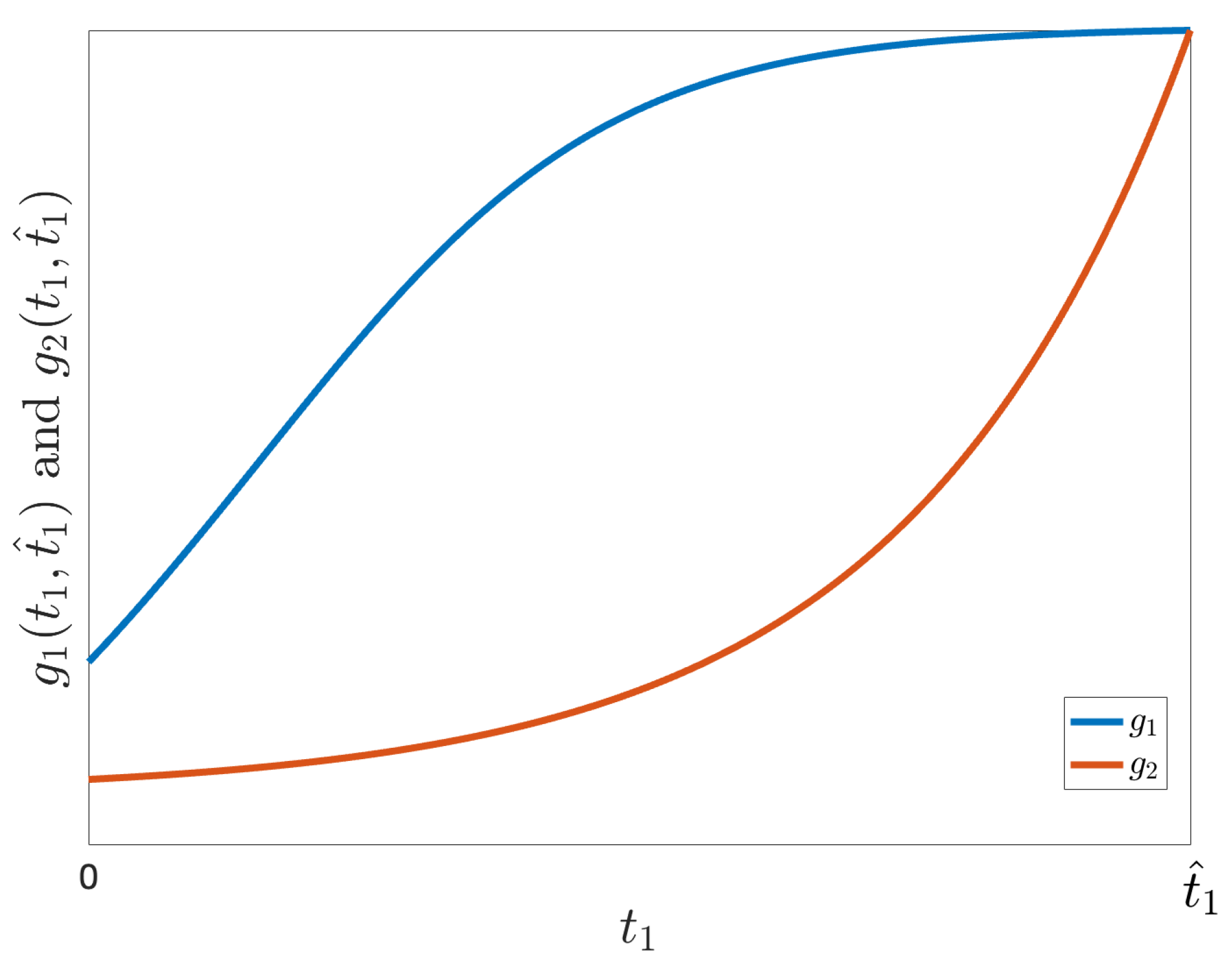
Figure 1 shows the graphs of
and
under these conditions. It can be observed that the intersection point of these graphs corresponds to the minimum of their upper envelope.
Finally,
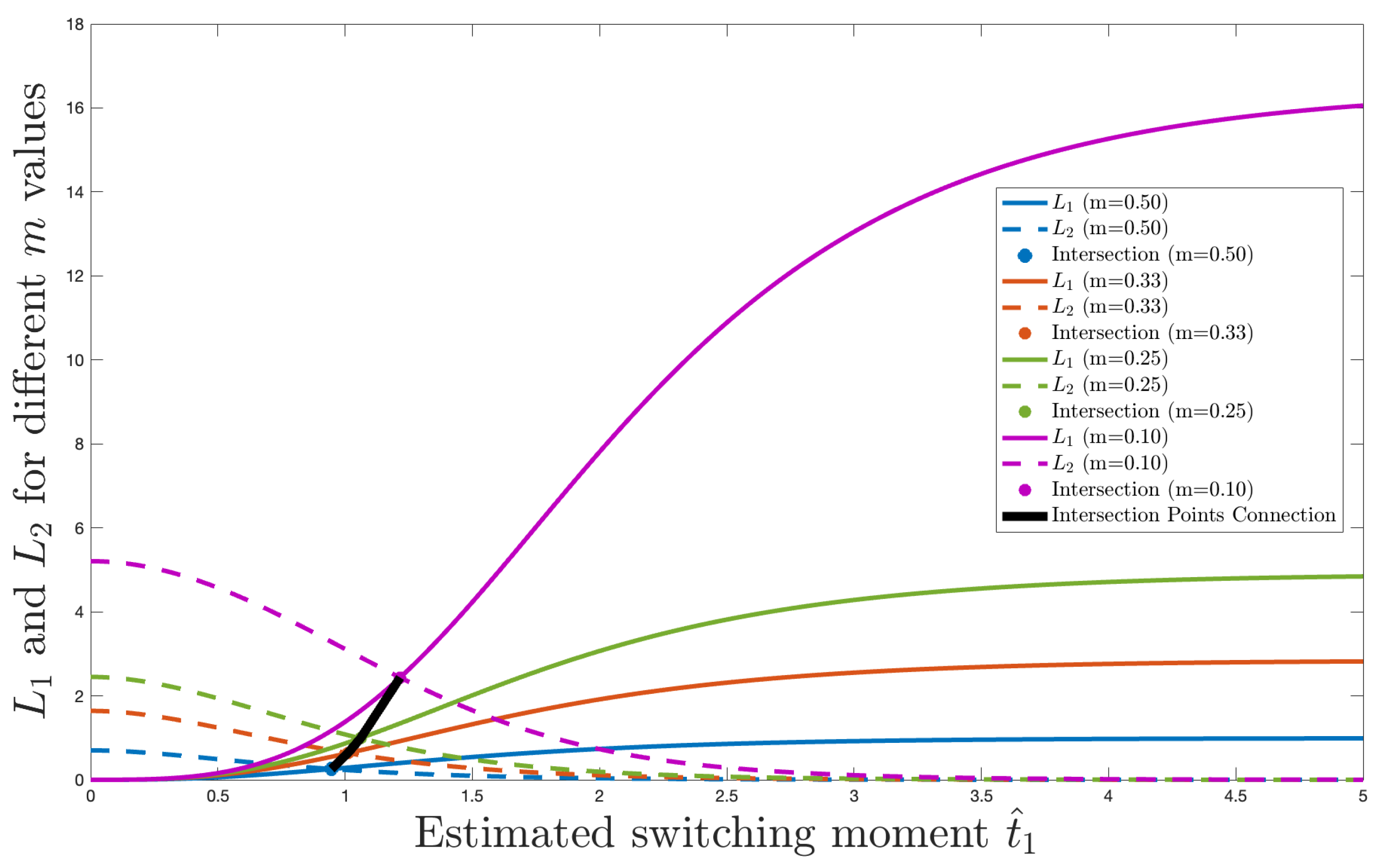
Table 2 shows the optimal estimates for different values of the parameter
m.
Figure 2 shows the maximum difference function
and
under these
m values. The visualization results clearly reveal the mapping relationship between system parameters and functional behavior. Analysis demonstrates that
m, as a key regulatory parameter, significantly influences the morphology of functions
and
and their intersection point: as
m decreases, the intersection point of the two functions continuously moves upper-right, the optimal switching time
increases substantially, and the corresponding function value also rises. This sensitivity analysis provides an intuitive basis for parameter optimization, indicating that system performance can be precisely modulated at different operating points by adjusting
m.
In the context of resource extraction, the switching moment can be interpreted as the anticipated time of a significant event, such as the enactment of new environmental regulations, the expected adoption time of a substitute technology, or a predicted market price inflection point. This time is unknown to the extractors due to incomplete information. The optimal estimate provided by Theorem 2 offers extractors a robust forecasting and decision-making tool. It also shows that is related to the parameter m, which is the hazard rate ratio between the time before and after the switch. Employing this estimate minimizes potential losses in the worst-case scenario, even if prediction errors exist, which is crucial for long-term investment and extraction planning under uncertainty.
6. State-Dependent Case
Following (
Gromov & Gromova, 2014,
2017) and
Balas and Tur (
2023), we now assume that the stock level of the resource can influence the probability of a regime shift. Consequently, the switching does not occur at a fixed point in time but is triggered when a certain condition on the trajectory is satisfied. Within the framework of the model under consideration, such a condition could be the attainment of a predetermined level of resource stock.
Assume that
is fixed, with
. The switching moment
for the composite distribution function (
1) is determined by the condition
.
Consider the Hamiltonian (
6) in the interval
with boundary conditions
,
, and the Hamiltonian (
5) in the interval
with boundary condition
, along with the transversality condition
, players’ controls are obtained in the following form:
To find the optimal solution, we also need to solve the following problem:
where
The optimal switching moment
is:
In summary, the cooperative trajectory
and the optimal cooperative controls
at intervals
and
have the following form:
7. Information Uncertainty
Suppose now that the value of
is unknown to the players. They use
instead of
. Then, their strategies are
where
The corresponding trajectory has the following form:
To find the optimal estimate of
, which minimizes the worst case possible loss in accordance with (
16), we consider the minimax problem:
First, consider the maximization problem, which can be reformulated as
When , we have , since the resource diminishes over time, where is the switching time of the composite distribution function.
The value of
could be obtained from Equation
, i.e.,
We can get
and then the total payoff is
Here, . We limit our analysis to the case of .
Denote
. Note that
since function
is increasing over
when
.
When
, we have
, where
could be obtained from Equation
, i.e.,
. We can obtain
Denote
. In order to find
, we need to solve
, where
changes the sign from positive to negative at this point. Let
. Then,
is the root of the following equation:
For
this equation takes the following form:
and
Now, problem (
23) could be rewritten as follows:
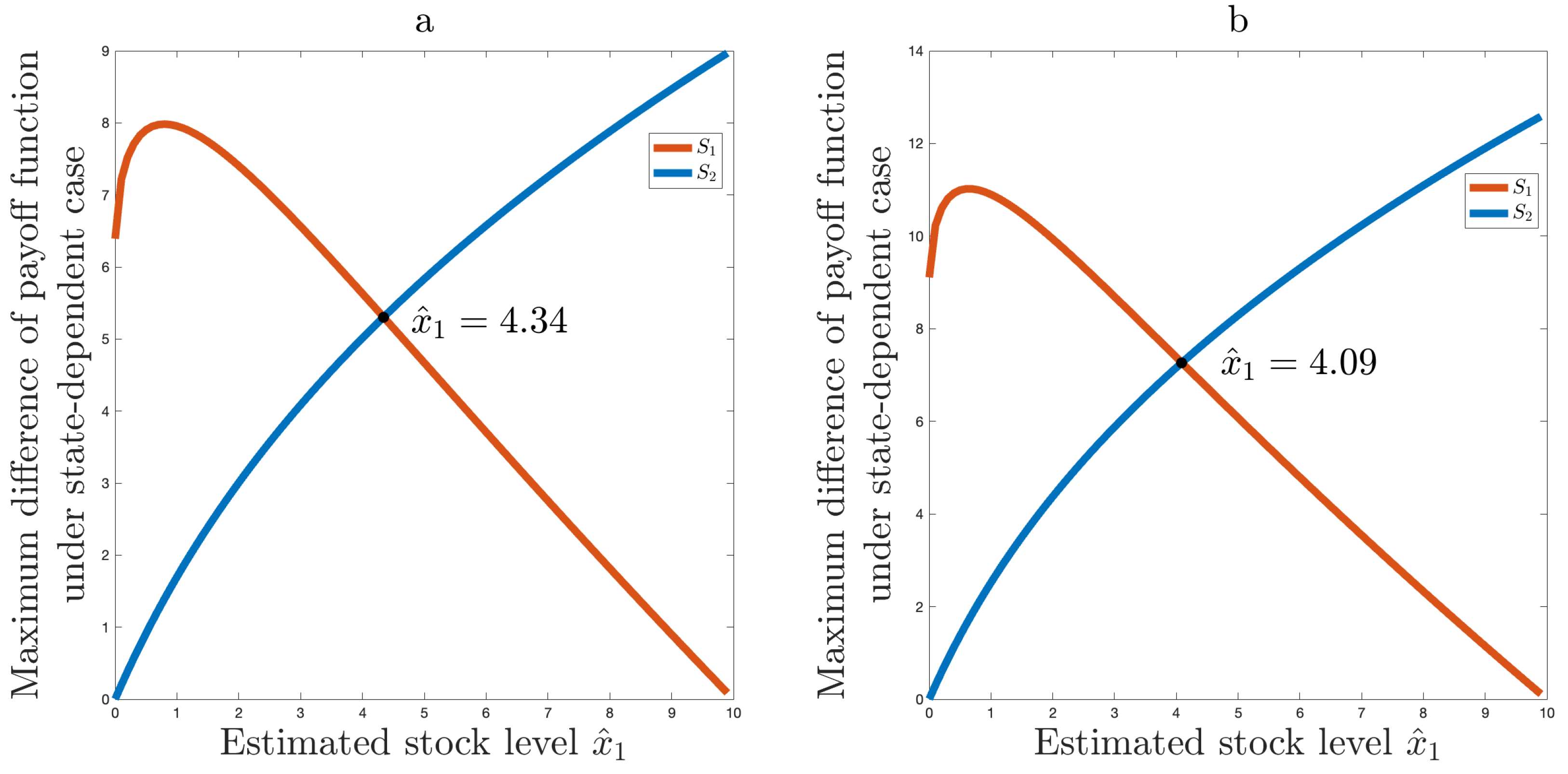
Let us demonstrate the numerical solution of this problem with different values of m.
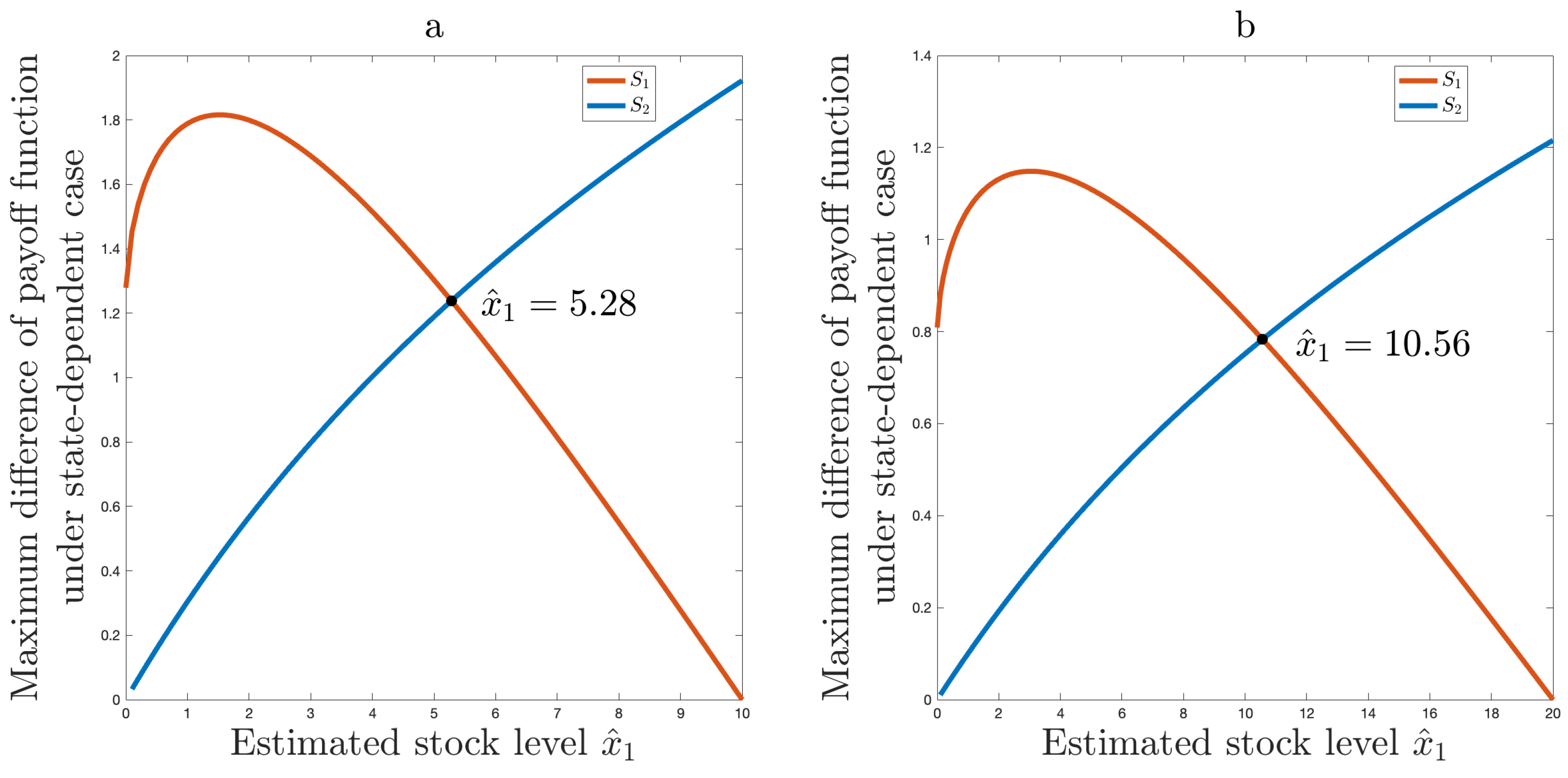
An illustration of the solution for
is provided in
Figure 3. We assume
,
,
for the case shown on the left side of
Figure 3. And,
,
,
for the right side of
Figure 3. Interestingly, a rather general result is obtained that does not depend on the values of the parameters
n and
. In all cases, for
, the optimal estimate will be
.
Let’s continue with the parameters
,
,
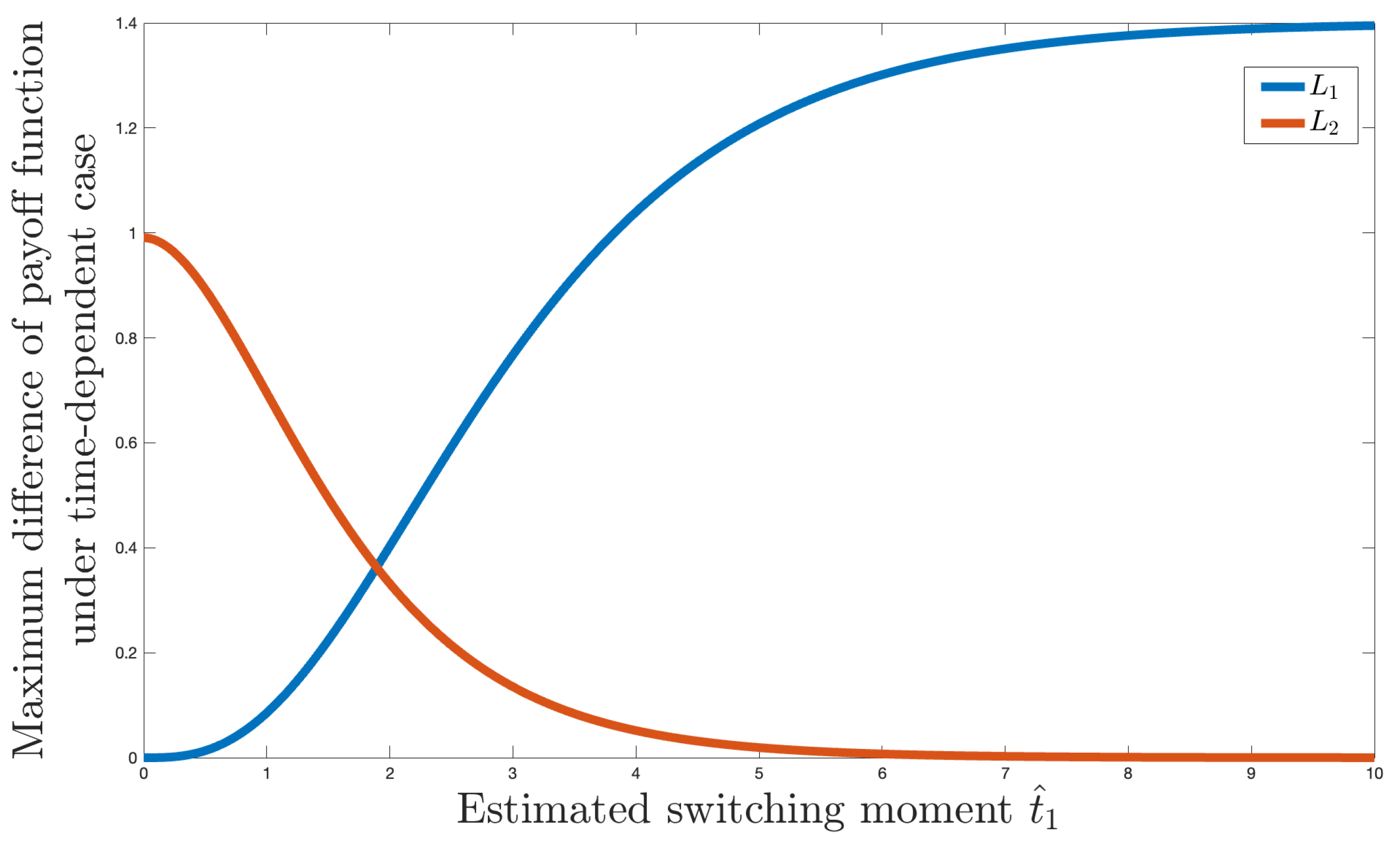
. The left side of
Figure 4 shows the solution for
. In this case,
. For
, we showed that
. This is shown in the right side of
Figure 4.
Comparing the optimal estimation in the time-dependent and state-dependent cases, we can see that in the first case, the optimal estimation depends only on the values of parameters m and , whereas in the second case, it also depends on .
8. Example: Oil Extraction Field with Equipment Modernization
Consider three companies (players) operating symmetrically in a shared oil field with an initial stock of 100 million tons (i.e., ). These companies are aware that new technologies are being developed which have the potential to improve extraction processes and reduce the risk of catastrophic accidents. However, the exact timing of the implementation of these innovations remains uncertain.
Before this modernization (), the equipment is older and more prone to failures, leading to a higher risk of a catastrophic accident that would terminate extraction operations. After modernization (), the new, more reliable equipment significantly reduces this risk. Consequently, the hazard rate before modernization is higher than the hazard rate afterwards .
The technical efficiency parameters are set to be equal for all players due to symmetry: . The output elasticity is set to . The hazard rates are configured as for the high-risk period before modernization and for the lower-risk period after modernization.
The central question for the companies is to determine optimal extraction strategies under this operational risk uncertainty.
1. Time-dependent switching estimation
The optimal estimate for the switching moment (modernization time),
, is derived from the model (substituting the parameter values
)
2. State-dependent switching estimation
The optimal estimated switching moment occurs when the resource level reaches
Despite the planned modernization being 10 years away, the optimal robust strategy derived from our model suggests that the companies should behave as if the transition to the lower-risk environment will occur in approximately 5.29 years (time-dependent) or when the oil reserve depletes to about 43.4 million tons (state-dependent). This result indicates that optimal strategy requires adopting more conservative extraction measures in the near term to mitigate the higher operational risks associated with the older equipment, rather than waiting for the scheduled modernization.
This example demonstrates how our model provides practical insights for resource extraction industries facing operational risk uncertainties, enabling more informed decision-making for equipment upgrade scheduling and risk management strategies.
9. Conclusions
A model of multi-player non-renewable resource extraction with a random duration is considered. It is assumed that the distribution of the random duration of the game is composite. The conditions under which the cooperative solution is also a Nash equilibrium are obtained. For the case where players do not know the exact moment of switching of the distribution function, the optimal estimate of this unknown moment is obtained for both the time-dependent and state-dependent cases.
Furthermore, this research offers practical insights for managing non-renewable resources, suggesting that the stability of extraction coalitions depends on the balance of technical efficiencies among players and hazard rates, and provides a robust tool for estimating uncertain future policy or market shifts.
However, this study has limitations, as our model relies on specific assumptions regarding the functional form of the composite distribution and player preferences, which may not fully capture the complexity of real-world scenarios. While providing a foundational framework, these limitations also open several promising research avenues. Future work should extend beyond our assumptions by investigating more general distribution forms for the random duration and by incorporating asymmetric information and heterogeneous among players, particularly use a Bayesian Nash equilibrium approach. Other promising directions include endogenizing the switching mechanism itself and exploring more complex preference structures.