


Abstract
In the past years, the education sector has suffered from repeated epidemics and their spread, and COVID-19 is a good example of this. Therefore, the search for other educational methods has become necessary. Therefore, e-learning is one of the best methods to replace traditional education. In this study, we found it necessary to conduct a comprehensive st udy on the perceptions of Iraqi university students toward e-learning and the factors affecting its use by students’ interest in being used consistently to increase learning effectiveness and the influence of educational presentations. In this research, the Expectation−Confirmation Model was used as a framework, and SPSS v21 and AMOS v21 were used to analyze the questionnaire obtained from 360 valid samples. According to the findings, students’ perceptions of the usefulness of e-learning systems are influenced by factors such as system quality, content quality, and confirmation. In addition, the findings show that technical support has no effect on perceived usefulness. In addition, content quality, system quality, and technical support are three critical antecedents of confirmation. In addition, we found that satisfaction was positively affected by both confirmation and perceived usefulness. We also found that the continuance intention to use e-learning was positively affected by both satisfaction and perceived usefulness.
1. Introduction
The great impact of the spread of epidemics, especially COVID-19, on education has prompted many countries to establish e-learning platforms as an alternative method for teaching students in Iraqi universities [1]. Therefore, the success of an e-learning system depends on students’ acceptance [2]. Many models have been used, such as the Technology Acceptance Model (TAM), to discuss the factors that impact students’ desire to use an e-learning system, such as usefulness [3]. In addition, the intention of university students to use e-learning is positively impacted by social influence and effort expectations [4]. While university students’ acceptance of e-learning is crucial, long-term usage is more crucial [5]. In this study, the Expectation–Confirmation Model (ECM) examines the extent of students’ desire to use the e-learning system through three factors: satisfaction, confirmation, and perceived usefulness. The model has also been used in several studies on the intention to continue using information systems [6]. However, it has been suggested that there is a positive relationship between the characteristics of the e-learning system and the intention to continue using it, which may include (Content Quality, Technical Support, and System Quality); these factors play an important role in students’ use of this system in universities [7,8]. The quality of educational content, which reflects the value of information and the effectiveness of teaching resources provided to learners, can enhance users’ perceptions of usefulness and align with their expectations [9,10]. These factors, in turn, play a role in shaping students’ motivation to continue engaging with the e-learning platform [11,12].
In the classroom, the teacher provides information and knowledge; therefore, we replaced the role of the teacher in this model with content quality to predict the factors affecting students’ continued use of e-learning [13]. Based on the information issued by the World Health Organization about the recurrence of what happened with the spread of COVID-19 and the possibility of the spread of epidemics in the future [14], it is likely that e-learning will be an important means of learning in the future [15]. Therefore, based on the results of the current study, (ECM) was used to explore the important factors affecting the continued use of e-learning by students of Iraqi University.
2. Expectation–Confirmation Model
Expectancy confirmation theory (ECT) was the underlying theory for the extraction and development of the Expectation−Confirmation Model (ECM). ECT was first proposed in 1980 in order to explain purchasers’ repurchase decisions based on the interaction between expectations, perceived performance, confirmation, and satisfaction on post-purchase behavior [16]. This framework provided links between these variables to predict repurchase intention. Bhattacherjee (2001) suggested this principle in the context of information systems (IS) and proposed that users continue to use technology as long as their satisfaction has not been diminished, similar to repurchase intentions in a consumer setting [17]. To handle this, he developed the Expectation−Confirmation Model (ECM) of IS continuance based on ECT tenets to elucidate the determinants that resulted in IS users’ continued adoption and usage of IS platforms.
However, in recent years, ECM has been adopted in various other domains to extend the purposes for which ISs are intended, with analyses of scholars employing ECM in studies of learning management systems (LMSs) and mobile apps, e-government, social media, digital textbooks, and smart personal devices [18,19]. Some studies have used ECM as a framework, e.g., Huda et al. (2024), who conducted a study at UIN Jakarta and assessed the continuance intention of using AIS mobile apps by merging ECM with quality of information, quality of the system, and trust [20]. Syaima et al. (2024) investigated the educational outcomes and user satisfaction impacted by Webex, centering on initial expectations and their confirmation [21]. The results show that Satisfaction positively impacts educational perceptions and Webex usage and that high initial expectations may lead to lower pleasure, while positive confirmation of expectations increases enjoyment. At the same time, Cheng et al. (2023) explored the effect of cognitive load reduction in online collaboration-based classes during COVID-19 on education satisfaction [22]. Based on the Expectation−Confirmation Model (ECM), this study extended ECM by investigating factors influencing students’ intention to continue using e-learning platforms. The results show that perceived usefulness and satisfaction significantly impact students’ intention to continue using it. While prior research has demonstrated the ECM utility in analyzing IS adoption, its application to Iraqi university contexts, specifically regarding e-learning persistence in the pandemic context, is still a relatively unexplored phenomenon.
To narrow this gap, the study extended the ECM framework with additional variables to fulfill a modified model suited to identify the factors that contribute to the sustained engagement of Iraqi students with digital learning systems. However, this modified process illustrates how educational organizations can improve e-learning and focus on not only the technical perspective but also the user perspective.
3. Methodology
3.1. Research Model
Based on the ECM, this study constructed a model of the continuance intention of Iraqi university students to continue using e-learning systems. Figure 1 shows the research model and hypotheses. Eleven hypotheses were formulated to investigate the relationships among these constructs.
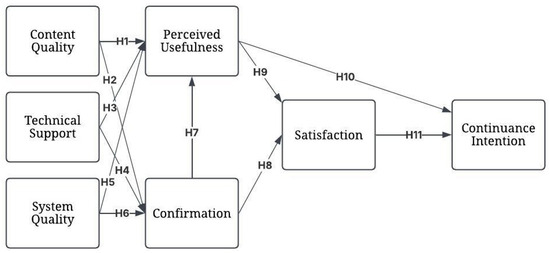
Figure 1.
Theoretical model.
3.2. Hypotheses
3.2.1. Content Quality, Perceived Usefulness, and Confirmation
This construct (Content Quality) in the context of an e-learning system pertains to the caliber of information or output generated by the e-learning system [23]. The content quality component of e-learning indicates the breadth and regularity of content updates [24]. Content quality is one of the major factors that influence the acceptance or perceived adoption of e-learning [25,26]. Previous literature has indicated that content quality has a significant effect on perceived usefulness [27,28]. In addition, previous studies have found a positive association between content quality, perceived usefulness, and confirmation of the e-learning system [29,30]. Consequently, the following hypotheses are proposed:
H1.
There is a statistically significant positive effect on the user perspective of the usefulness of quality content.
H2.
Similarly, quality content has a significant and positive influence on the degree of confirmation perceived by users.
3.2.2. Technical Support, Perceived Usefulness, and Confirmation
One critical external factor that can drive the steps to enter and adopt technology is the provision of technical support to assist end-users in resolving certain software or hardware-related issues on request [31]. According to [32,33], technical support increases the availability of institutional resources and related structures needed for system usage and is linked to users’ Perceived Usefulness.
In the realm of e-learning, strong technical support is crucial in facilitating users’ positive attitudes toward new technologies, confidence, and acceptance of new technologies [34,35,36]. Technical support has a direct influence on technology acceptance [37]. However, as users gain firsthand experience with e-learning, these opinions may change over time, and understanding how e-learning changes requires consideration of factors like satisfaction. As perceived usefulness is adjustable based on confirmation experience [17], the perception of technical support can be adjusted based on confirmation, leading to the following hypothesis:
H3.
Perceived Usefulness has a positive and significant effect on Technical Support.
H4.
Technical Support positively and significantly affects confirmation.
3.2.3. System Quality, Perceived Usefulness, and Confirmation
System quality refers to the functionality of an IS in terms of reliability, responsiveness, flexibility, usability, and accessibility [38]. An effective system can offer users a practical feature that satisfies their requirements [39]. Users view a system as helpful once it improves their learning and working efficiency. Users’ expectations may be raised by a higher perceived system quality, which would increase their level of confirmation of the technology IS, such as e-learning [6]. Consequently, we can say that improved system quality in an online learning environment can help students perceive usefulness and confirmation. Therefore, the following hypotheses are proposed:
H5.
System Quality has positive and significant effects on perceived usefulness.
H6.
System Quality has positive and significant effects on the degree of confirmation.
3.2.4. Confirmation, Perceived Usefulness and Satisfaction
Confirmation is the way users assess the match between their initial expectations of learning and the actual performance of an e-learning system [40]. Confirmatory feedback: Confirmatory feedback is one of the strongest influences on users’ perception of system usefulness; several studies have made this finding [41]. For example, according to [42], during the pandemic, the level of students’ confirmation of e-learning platforms was a crucial factor in determining their opinion about the efficiency of those platforms [42]. Moreover, empirical findings confirm that confirmation is a key component of students’ satisfaction with these systems [36,42,43]. When learners experience something that is familiar to or exceeds their expectations, and thus validates their initial assumptions, we describe this as satisfaction. When students feel that their e-learning experiences match their initial expectations, this study implies that the system is seen as valuable, thus leading to higher satisfaction. Based on this foundation, the following hypotheses were developed:
H7.
There is a positive significant relationship between confirmation and the perceived usefulness of e-learning.
H8.
There is a positive significant relationship between confirmation and satisfaction with e-learning.
3.2.5. Perceived Usefulness, Satisfaction, and Continuance Intention
The concept of perceived usefulness refers to users’ beliefs regarding the anticipated advantages of utilizing e-learning systems [44,45]. Several studies have examined how perceived usefulness increases satisfaction in the context of e-learning systems [11,22,42]. Users are more satisfied when they believe that e-learning systems can assist them. Furthermore, perceived usefulness is thought to be a crucial component that affects students’ intention to continue using technology, such as e-learning systems [19,46]. In the present study, we hypothesized that students’ satisfaction and continuance intention would increase with the perceived usefulness of e-learning systems during the pandemic. Accordingly, the following hypothesis regarding students’ perceptions of usefulness was proposed:
H9.
Perceived usefulness positively influences learner satisfaction in the context of e-learning systems.
H10.
The perceived usefulness of e-learning has a significant positive relationship with e-learning users’ continuance intention.
3.2.6. Satisfaction and Continuance Intention
Users’ intentions to re-use e-learning systems are significantly influenced by their satisfaction, which is an ex-post assessment of their initial experience [47]. Higher satisfaction levels are associated with stronger usage intentions [48]. Numerous studies have found that students’ intention to continue using learning technologies in educational contexts is influenced by their level of satisfaction with e-learning systems [35,49]. We can infer from the previously mentioned research that students’ intention to continue using the e-learning systems will rise in proportion to their level of satisfaction. Consequently, the following hypotheses were proposed:
H11.
There is a positive significant relationship between satisfaction and E-learning continuance intention.
3.3. Data Analysis
The analysis consisted of a hierarchical three-step procedure to evaluate the measurement and structural properties of the scale. Phase 1 prepared response data for an initial psychometric evaluation by conducting Exploratory Factor Analysis (EFA) with Maximum Likelihood (ML) estimation using Promax oblique rotation functions in SPSS v21. This method evaluates the fundamental factor structure and inter-item associations and suggests statistically significant factor loading.
3.4. Exploratory Factor Analysis
An EFA using the ML and Promax rotation method, effective for detecting correlated factors, was performed to evaluate the scale’s factor structure and the relationships between items. The output of this analysis, such as the rotated factor matrix, is presented in the following tables (Table 1 and Table 2).

Table 1.
Kaiser-Meyer-Olkin (KMO) and Bartlett’s test.
Table 2.
Rotated Factor matrix.
The Kaiser-Meyer-Olkin (KMO) measure was also higher than 0.50, indicating that the sample size was adequate for the analysis. Bartlett’s Test of Sphericity also returns a statistically significant result (p < 0.05), indicating that the correlation matrix is significantly different from an identity matrix, which is required for a valid implementation of factor analysis.
EFA confirmed that a seven-factor structure was a good fit for the data and that all measurement items were loaded onto the hypothesized factors as expected. This model explained 59.8% of the total variance in the data, which is a satisfactory level of explanatory capacity. The factor structure was further supported by the construct validity of the model. Confirmatory factor analysis (CFA) was used in the next section to validate these results.
3.5. Confirmatory Factor Analysis (CFA)
CFA was conducted using AMOS version 21 [50] to evaluate the measurement model. The assessment focused on examining the constructs’ reliability, convergent validity, and discriminant validity. A visual illustration of the initial CFA model and its modified version after adjustments are presented in the accompanying Figure 2 and Figure 3, while the detailed outcomes of the analysis are summarized in Table 3.
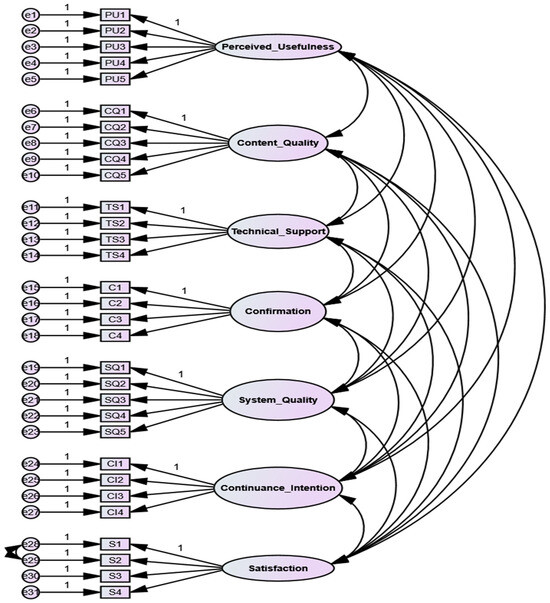
Figure 2.
Initial CFA model.
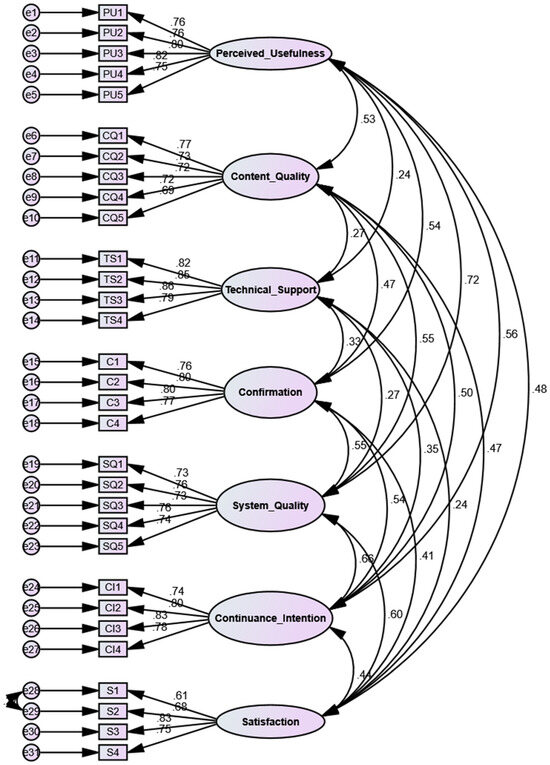
Figure 3.
Final CFA model.
Table 3.
Reliability and convergent validity.
Overall, the CFA yielded significant fit indices (χ2/df = 1.224, RMSEA = 0.025, RMR = 0.032, GFI = 0.919, and CFI = 0.981). These metrics agree with the standard cutoff [50,51], in which RMSEA less than 0.06 indicates an excellent fit. The factor loadings were all above 0.60, and the average variance extracted (AVE) was above 0.50, supporting convergent validity [52]. The Maximum Shared Variance (MSV) value for each construct was observed to be less than the AVE, which demonstrates further validation across the constructs. Cronbach’s alpha and composite reliability coefficients between all constructs were greater than 0.70, indicating strong reliability and internal consistency.
4. Hypotheses Testing (Structural Model)
To examine the relationship between Content Quality, Technical Support, System Quality, Confirmation, Perceived Usefulness, Satisfaction, and Continuance Intention, we used structural equation modeling using AMOS path analysis by imputing the Factor Score from CFA using AMOS. The following is a Figure 4 and Figure 5 representation of the structural model, followed by the results in Table 4.
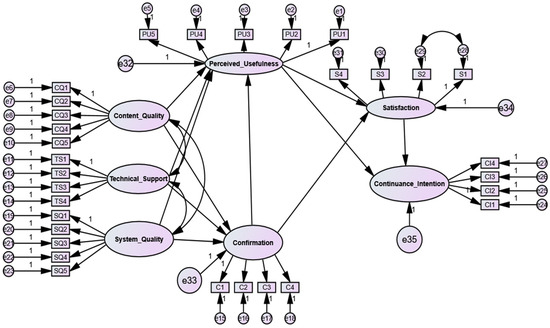
Figure 4.
Proposed structural model for hypotheses testing.
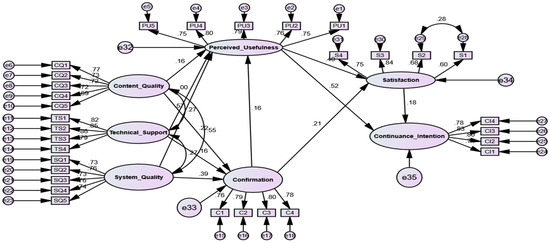
Figure 5.
Measurement model results.
Table 4.
Regression Weights.
5. Conclusions
This study provides insight into the factors influencing Iraqi university students’ willingness to continue using the e-learning platform following its success across the education sector after the COVID-19 pandemic subsided and the potential for future pandemics. A new research model based on the Expectation−Confirmation Model is proposed. The results show that content quality, system quality, and technical support have a significant impact on confirmation and that content quality, system quality, and confirmation have a positive impact on perceived usefulness. Confirmation and perceived usefulness explain university students’ satisfaction with using the e-learning system, which in turn leads to students’ intention to continue using it. This study combined both internal (i.e., content quality and system quality) and external (i.e., technical support) factors to reveal that what influenced Iraqi university students’ continued use of the e-learning system after subsiding the COVID-19 pandemic was not only derived from the characteristics of the system itself but also from the technical support provided in the e-learning system. This finding is crucial for educators and system developers to enhance and optimize the current state of affairs in order to establish a favorable e-learning environment for Iraqi university students, thereby increasing their intention to continue.
Funding
This research received no external funding.
Data Availability Statement
The data that support the findings of this study are available on request from the corresponding author. The data are not publicly available due to privacy or ethical restrictions.
Conflicts of Interest
The author declares no conflict of interest.
References
- Maatuk, A.M.; Elberkawi, E.K.; Aljawarneh, S.; Rashaideh, H.; Alharbi, H. The COVID-19 pandemic and E-learning: Challenges and opportunities from the perspective of students and instructors. J. Comput. High. Educ. 2022, 34, 21–38. [Google Scholar] [CrossRef] [PubMed]
- Alyoussef, I.Y. Acceptance of e-learning in higher education: The role of task-technology fit with the information systems success model. Heliyon 2023, 9, e13751. [Google Scholar] [CrossRef]
- Almulla, M. Technology Acceptance Model (TAM) and e-learning system use for education sustainability. Acad. Strateg. Manag. J. 2021, 20, 1–13. [Google Scholar]
- Bessadok, A. Analyzing student aspirations factors affecting e-learning system success using a structural equation model. Educ. Inf. Technol. 2022, 27, 9205–9230. [Google Scholar] [CrossRef]
- AAl-Adwan, A.S.; Nofal, M.; Akram, H.; Albelbisi, N.A.; Al-Okaily, M. Towards a Sustainable Adoption of E-Learning Systems: The Role of Self-Directed Learning. J. Inf. Technol. Educ. Res. 2022, 21, 245–267. [Google Scholar]
- Huang, X.; Zhi, H. Factors influencing students’ continuance usage intention with virtual classroom during the COVID-19 pandemic: An empirical study. Sustainability 2023, 15, 4420. [Google Scholar] [CrossRef]
- Malanga, A.C.M.; Bernardes, R.C.; Borini, F.M.; Pereira, R.M.; Rossetto, D.E. Towards integrating quality in theoretical models of acceptance: An extended proposed model applied to e-learning services. Br. J. Educ. Technol. 2022, 53, 8–22. [Google Scholar] [CrossRef]
- Li, X.; Zhu, W. System quality, information quality, satisfaction and acceptance of online learning platform among college students in the context of online learning and blended learning. Front. Psychol. 2022, 13, 1054691. [Google Scholar] [CrossRef]
- Ang, W.; Jedi, A.; Lohgheswary, N. Factors affecting the acceptance of open learning as e-learning platform by technical course students. J. Eng. Sci. Technol. 2021, 16, 903–918. [Google Scholar]
- Alkhawaja, M.I.; Halim, M.S.A.; Abumandil, M.S.S.; Al-Adwan, A.S. System Quality and Student’s Acceptance of the E-Learning System: The Serial Mediation of Perceived Usefulness and Intention to Use. Contemp. Educ. Technol. 2022, 14, ep350. [Google Scholar] [CrossRef]
- Merhi, M.I.; Meisami, A. The Role of Technological and Motivational Factors on Students’ Satisfaction with E-learning Assessments Platforms. Pac. Asia J. Assoc. Inf. Syst. 2024, 16, 4. [Google Scholar]
- Mir, M.S.; Moses, G.; Gulzar, Y.; Reegu, F.A. The Impact of Interplay between Intrinsic Capabilities, Extrinsic Support and System Quality on e-Learning Service Experiences. IEEE Access. 2024, 12, 182073–182085. [Google Scholar] [CrossRef]
- Abedi, E.A. Tensions between technology integration practices of teachers and ICT in education policy expectations: Implications for change in teacher knowledge, beliefs and teaching practices. J. Comput. Educ. 2024, 11, 1215–1234. [Google Scholar] [CrossRef]
- Burci, G.L.; Eccleston-Turner, M. Preparing for the next pandemic: The International Health Regulations and World Health Organization during COVID-19. YB Int. Disaster Law Online 2021, 2, 261. [Google Scholar] [CrossRef]
- Fauzi, M.A. E-learning in higher education institutions during COVID-19 pandemic: Current and future trends through bibliometric analysis. Heliyon 2022, 8, e09433. [Google Scholar] [CrossRef]
- Oliver, R.L. A cognitive model of the antecedents and consequences of satisfaction decisions. J. Mark. Res. 1980, 17, 460–469. [Google Scholar] [CrossRef]
- Bhattacherjee, A. Understanding information systems continuance: An expectation-confirmation model. MIS Q. 2001, 25, 351–370. [Google Scholar] [CrossRef]
- Alshammari, S.H.; Alshammari, R.A. An integration of expectation confirmation model and information systems success model to explore the factors affecting the continuous intention to utilise virtual classrooms. Sci. Rep. 2024, 14, 18491. [Google Scholar] [CrossRef]
- Cheng, Y.-M. Extending the expectation-confirmation model with quality and flow to explore nurses’ continued blended e-learning intention. Inf. Technol. People 2014, 27, 230–258. [Google Scholar] [CrossRef]
- Huda, M.Q.H.; Irahman, M.S.; Hidayah, N.A. Conceptual Model of Loyalty on Mobile AIS Users Using the Expectation Confirmation Model (ECM). In Proceedings of the 2024 12th International Conference on Cyber and IT Service Management (CITSM), Batam, Indonesia, 3–4 October 2024; IEEE: Piscataway, NJ, USA; pp. 1–6. [Google Scholar]
- Syaima’a binti Aripin, M.E.; Ajmain ima’ain, M.T.; Edwards, B.I. Original Research Article An analysis of educational outcomes and user satisfaction in webex following COVID-19: An expectation-confirmation model. J. Auton. Intell. 2024, 7. [Google Scholar] [CrossRef]
- Cheng, Y.-M. Which quality determinants cause MOOCs continuance intention? A hybrid extending the expectation-confirmation model with learning engagement and information systems success. Libr. Hi Tech. 2023, 41, 1748–1780. [Google Scholar] [CrossRef]
- Yildiz, E.P.; Isman, A. Quality content in distance education. Univers. J. Educ. Res. 2016, 4, 2857–2862. [Google Scholar] [CrossRef]
- Kumar, P.; Saxena, C.; Baber, H. Learner-content interaction in e-learning-the moderating role of perceived harm of COVID-19 in assessing the satisfaction of learners. Smart Learn. Environ. 2021, 8, 5. [Google Scholar] [CrossRef]
- Onofrei, G.; Filieri, R.; Kennedy, L. Social media interactions, purchase intention, and behavioural engagement: The mediating role of source and content factors. J. Bus. Res. 2022, 142, 100–112. [Google Scholar] [CrossRef]
- Elumalai, K.V.; Sankar, J.P.; R, K.; John, J.A.; Menon, N.; Alqahtani, M.S.M.; Abumelha, M.A. Factors affecting the quality of e-learning during the COVID-19 pandemic from the perspective of higher education students. J. Inf. Technol. Educ. Res. 2021, 189, 169. [Google Scholar]
- Mailizar, M.; Almanthari, A.; Maulina, S. Examining teachers’ behavioral intention to use E-learning in teaching of mathematics: An extended TAM model. Contemp. Educ. Technol. 2021, 13, ep298. [Google Scholar] [CrossRef]
- Salloum, S.A.; Alhamad, A.Q.M.; Al-Emran, M.; Monem, A.A.; Shaalan, K. Exploring students’ acceptance of e-learning through the development of a comprehensive technology acceptance model. IEEE Access 2019, 7, 128445–128462. [Google Scholar] [CrossRef]
- Saxena, C.; Baber, H.; Kumar, P. Examining the moderating effect of perceived benefits of maintaining social distance on e-learning quality during COVID-19 pandemic. J. Educ. Technol. Syst. 2021, 49, 532–554. [Google Scholar] [CrossRef]
- Kim, J.-H.; Kim, M.; Park, M.; Yoo, J. How interactivity and vividness influence consumer virtual reality shopping experience: The mediating role of telepresence. J. Res. Interact. Mark. 2021, 15, 502–525. [Google Scholar] [CrossRef]
- Thapa, P.; Bhandari, S.L.; Pathak, S. Nursing students’ attitude on the practice of e-learning: A cross-sectional survey amid COVID-19 in Nepal. PLoS ONE 2021, 16, e0253651. [Google Scholar] [CrossRef]
- Timotheou, S.; Miliou, O.; Dimitriadis, Y.; Sobrino, S.V.; Giannoutsou, N.; Cachia, R.; Monés, A.M.; Ioannou, A. Impacts of digital technologies on education and factors influencing schools’ digital capacity and transformation: A literature review. Educ. Inf. Technol. 2023, 28, 6695–6726. [Google Scholar] [CrossRef]
- Yu, H.; Yunyun, G. Generative artificial intelligence empowers educational reform: Current status, issues, and prospects. Front. Educ. 2023, 8, 1183162. [Google Scholar] [CrossRef]
- Shahzad, K.; Khan, S.A. Effects of e-learning technologies on university librarians and libraries: A systematic literature review. Electron. Libr. 2023, 41, 528–554. [Google Scholar] [CrossRef]
- Alzahrani, L.; Seth, K.P. Factors influencing students’ satisfaction with continuous use of learning management systems during the COVID-19 pandemic: An empirical study. Educ. Inf. Technol. 2021, 26, 6787–6805. [Google Scholar] [CrossRef] [PubMed]
- Ho, I.M.K.; Cheong, K.Y.; Weldon, A. Predicting student satisfaction of emergency remote learning in higher education during COVID-19 using machine learning techniques. PLoS ONE 2021, 16, e0249423. [Google Scholar] [CrossRef] [PubMed]
- Caratiquit, L.J.; Caratiquit, K. Influence of technical support on technology acceptance model to examine the project PAIR e-learning system in distance learning modality. Particip. Educ. Res. 2022, 9, 467–485. [Google Scholar] [CrossRef]
- Alshibly, H. An empirical investigation into factors influencing the intention to use e-learning system: An extended technology acceptance model. Br. J. Appl. Sci. Technol. 2014, 4, 2440. [Google Scholar] [CrossRef]
- Diansyah, R.; Nawi, N.C.; Zainuddin, S.A.B. The factors influencing e-learning adoption behavior: A conceptual paper. In Finance, Accounting and Law in the Digital Age: The Impact of Technology and Innovation in the Financial Services Sector; Springer: Berlin/Heidelberg, Germany, 2023; pp. 489–496. [Google Scholar]
- Ruangkanjanases, A.; Khan, A.; Sivarak, O.; Rahardja, U.; Chen, S.-C. Modeling the consumers’ flow experience in e-commerce: The integration of ecm and tam with the antecedents of flow experience. Sage Open 2024, 14, 21582440241258595. [Google Scholar] [CrossRef]
- Zaharuddin; Wahyuningsih, S.; Sutarman, A.; Hikam, I.N. Understanding purposeful leadership in entrepreneurial contexts: A bibliometric analysis. Aptisi Trans. Technopreneurship (ATT) 2024, 6, 213–230. [Google Scholar] [CrossRef]
- Li, L.; Wang, Q.; Li, J. Examining continuance intention of online learning during COVID-19 pandemic: Incorporating the theory of planned behavior into the expectation–confirmation model. Front. Psychol. 2022, 13, 1046407. [Google Scholar] [CrossRef]
- Nie, L.; Oldenburg, B.; Cao, Y.; Ren, W. Continuous usage intention of mobile health services: Model construction and validation. BMC Health Serv. Res. 2023, 23, 442. [Google Scholar] [CrossRef] [PubMed]
- Abu-Taieh, E.M.; AlHadid, I.; Alkhawaldeh, R.S.; Khwaldeh, S.; Masa’deh, R.; Alrowwad, A.; Al-Eidie, R. An empirical study of factors influencing the perceived usefulness and effectiveness of integrating e-learning systems during the COVID-19 pandemic using SEM and ML: A case study in Jordan. Sustainability 2022, 14, 13432. [Google Scholar] [CrossRef]
- Alkhuwaylidee, A.R. Extended unified theory acceptance and use technology (utaut) for e-learning. J. Comput. Theor. Nanosci. 2019, 16, 845–852. [Google Scholar] [CrossRef]
- Kuo, T.M.; Tsai, C.-C.; Wang, J.-C. Linking web-based learning self-efficacy and learning engagement in MOOCs: The role of online academic hardiness. Internet High. Educ. 2021, 51, 100819. [Google Scholar] [CrossRef]
- Bautista, R., Jr.; Jeong, L.S.; Saavedra, C.; Sy-Changco, J. Factors Affecting the Students’ Re-Use of the Electronic Learning System (ELS). Asia-Pac. Soc. Sci. Rev. 2021, 21, 5. [Google Scholar] [CrossRef]
- Pozón-López, I.; Higueras-Castillo, E.; Muñoz-Leiva, F.; Liébana-Cabanillas, F.J. Perceived user satisfaction and intention to use massive open online courses (MOOCs). J. Comput. High. Educ. 2021, 33, 85–120. [Google Scholar] [CrossRef]
- Al-Emran, M.; Arpaci, I.; Salloum, S.A. An empirical examination of continuous intention to use m-learning: An integrated model. Educ. Inf. Technol. 2020, 25, 2899–2918. [Google Scholar] [CrossRef]
- Hu, L.T.; Bentler, P.M. Cutoff criteria for fit indexes in covariance structure analysis: Conventional criteria versus new alternatives. Struct. Equ. Model. A Multidiscip. J. 1999, 6, 1–55. [Google Scholar] [CrossRef]
- Browne, M.W.; Cudeck, R. Alternative ways of assessing model fit. Sociol. Methods Res. 1992, 21, 230–258. [Google Scholar] [CrossRef]
- Hair, J.; Sarstedt, M.; Ringle, C.M.; Gudergan, S.P. Advanced Issues in Partial Least Squares Structural Equation Modeling; Sage Publications, Inc.: New York, NY, USA, 2017. [Google Scholar]
Disclaimer/Publisher’s Note: The statements, opinions and data contained in all publications are solely those of the individual author(s) and contributor(s) and not of MDPI and/or the editor(s). MDPI and/or the editor(s) disclaim responsibility for any injury to people or property resulting from any ideas, methods, instructions or products referred to in the content. |
© 2025 by the author. Licensee MDPI, Basel, Switzerland. This article is an open access article distributed under the terms and conditions of the Creative Commons Attribution (CC BY) license (https://creativecommons.org/licenses/by/4.0/).